

Luke 20:47
Greek (Tischendorf 8th ed.) Luke 20:47 appears in the Greek New Testament. The text above is from the Tischendorf 8th edition. Each word links to its Strong’s number and a concise gloss. Click any word for its full Thayer’s Greek Lexicon entry.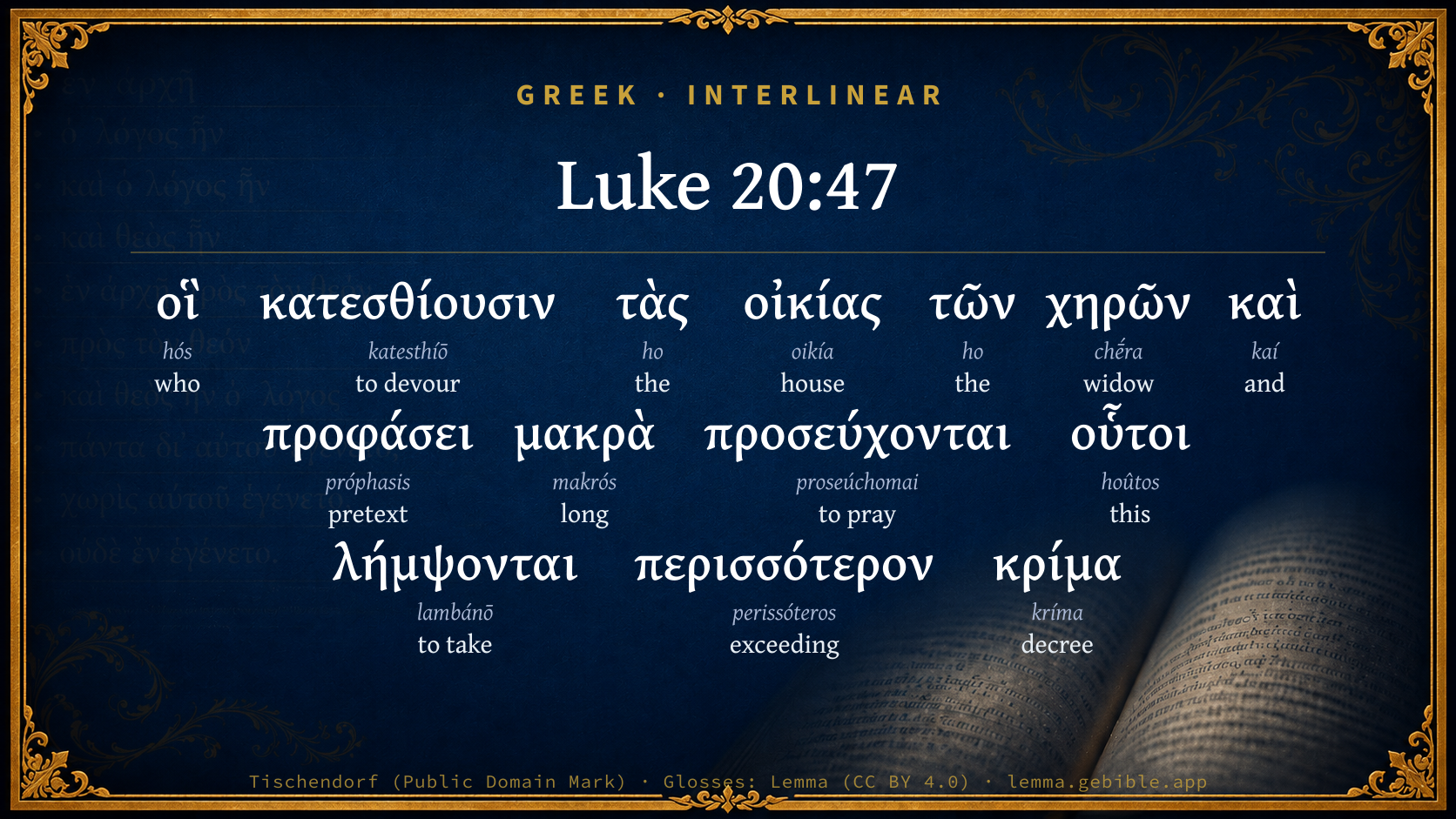
who devour widows' houses, and for a pretense make long prayers: these will receive greater condemnation."
Download a study sheet
One document with this verse’s original text, its word-by-word gloss line, the meaning frame, cross-references with their text, attributed commentary, and full source and license credits — printable, and it pastes into notes with its structure intact.
This verse Autodidact and up
A passage Seminary Student
Up to 50 verses in one chapter. A passage sheet keeps up to 6 commentary sources and 12 cross-references per verse, in the order this page ranks them, and says so on the sheet whenever that leaves anything out. Ask for a single verse and you get the Autodidact verse sheet above.
Everything on this page stays free to read, with no account — the sheet is a download of what is already on screen, not access to it.
Compare translations 3
The same verse in 3 English versions, stacked beneath the original-language interlinear above. Click any original word for its lexicon entry.
Each is an independent rendering of the whole verse — the interlinear is not word-aligned to these translations.
Highlighted words mark where these versions differ — a whole-verse word diff, not a word-by-word alignment.
-
World English Bible Public Domain
who devour widows' houses, and for a pretense make long prayers: these will receive greater condemnation."
-
King James Version Public Domain
Which devour widows' houses, and for a shew make long prayers: the same shall receive greater damnation.
-
unfoldingWord Literal Text CC BY-SA 4.0
They devour the houses of widows, and for a pretext they pray at length. These will receive greater condemnation.”
unfoldingWord Literal Text — © unfoldingWord, licensed CC BY-SA 4.0. Word-aligned USFM3 via Door43 (git.door43.org/unfoldingWord/en_ult).
Show all 19 translations
Every available English version of this verse, each an independent rendering of the whole verse.
-
World English Bible Public Domain
who devour widows' houses, and for a pretense make long prayers: these will receive greater condemnation."
-
Berean Standard Bible Public Domain
They defraud widows of their houses, and for a show make lengthy prayers. These men will receive greater condemnation.”
-
Majority Standard Bible Public Domain
They defraud widows of their houses, and for a show make lengthy prayers. These men will receive greater condemnation.”
-
King James Version Public Domain
Which devour widows' houses, and for a shew make long prayers: the same shall receive greater damnation.
-
American Standard Version (1901) Public Domain
who devour widows' houses, and for a pretence make long prayers: these shall receive greater condemnation.
-
Revised Version (1885) Public Domain
which devour widows’ houses, and for a pretence make long prayers: these shall receive greater condemnation.
-
Geneva Bible (1599) Public Domain
Which deuoure widowes houses, and in shewe make long prayers: These shall receiue greater damnation.
-
Douay-Rheims (1899) Public Domain
Who devour the houses of widows, feigning long prayer. These shall receive greater damnation.
-
Young's Literal Translation Public Domain
who devour the houses of the widows, and for a pretence make long prayers, these shall receive more abundant judgment.'
-
Literal Standard Version CC BY-SA 4.0
who devour the houses of the widows, and make long prayers for a pretense, these will receive more abundant judgment.”
-
Unlocked Literal Bible CC BY-SA 4.0
They also devour widows' houses, and for a show they make long prayers. Men like this will receive greater condemnation.”
-
unfoldingWord Literal Text CC BY-SA 4.0
They devour the houses of widows, and for a pretext they pray at length. These will receive greater condemnation.”
-
Darby Bible Public Domain
who devour the houses of widows, and as a pretext make long prayers. These shall receive a severer judgment.
-
World Messianic Bible Public Domain
who devour widows’ houses, and for a pretense make long prayers. These will receive greater condemnation.”
-
Webster's Bible Public Domain
Who devour widows' houses, and for a show make long prayers: the same shall receive greater damnation.
-
Free Bible Version CC BY-SA 4.0
They cheat widows out of what they own, and cover up the kind of people they really are with long-winded prayers. They will receive severe condemnation in the judgment.”
-
Bible in Basic English Public Domain
Who take the property of widows and before the eyes of men make long prayers; they will get a greater punishment.
-
Text-Critical English NT CC BY 4.0
They devour widows' houses and for a pretense make long prayers. They will receive a more severe judgment.”
-
Tyndale New Testament (1534) Public Domain
which devoure widdowes houses and that vnder a coloure of longe prayinge: the same shall receave greater damnacion.
Literal Standard Version (2020), Covenant Press — licensed CC BY-SA 4.0. Text via the HelloAO Bible API (eBible.org). Unlocked Literal Bible (unfoldingWord) — licensed CC BY-SA 4.0. Text via the HelloAO Bible API (eBible.org). unfoldingWord Literal Text — © unfoldingWord, licensed CC BY-SA 4.0. Word-aligned USFM3 via Door43 (git.door43.org/unfoldingWord/en_ult). Free Bible Version, Dr. Jonathan Gallagher — licensed CC BY-SA 4.0. Text via the HelloAO Bible API (eBible.org).
Word by word
More ways to search: Search by grammar → Find every occurrence → Compare this word →
Practice this passage: Drill this verse → Learn its vocabulary →
- Appears 5× in the Greek New Testament
- First appears at Mark 12:40
- Part of Speech
- Adjective
- Case
- Accusative
- Number
- Plural
- Gender
- Neuter
Full Thayer's Definition
- οἳ hós G3739 “who” Relative pronoun, Nominative, Plural, Masculine
- κατεσθίουσιν katesthíō G2719 “to devour” Verb, Present, Active, Indicative, 3rd person, Plural
- τὰς ho G3588 “the” Article, Accusative, Plural, Feminine
- οἰκίας oikía G3614 “house” Noun, Accusative, Plural, Feminine
- τῶν ho G3588 “the” Article, Genitive, Plural, Feminine
- χηρῶν chḗra G5503 “widow” Noun, Genitive, Plural, Feminine
- καὶ kaí G2532 “and” Conjunction
- προφάσει próphasis G4392 “pretext” Noun, Dative, Singular, Feminine
- μακρὰ makrós G3117 “long” Adjective, Accusative, Plural, Neuter
- προσεύχονται proseúchomai G4336 “to pray” Verb, Present, Middle or Passive deponent, Indicative, 3rd person, Plural
- οὗτοι hoûtos G3778 “this” Demonstrative pronoun, Nominative, Plural, Masculine
- λήμψονται lambánō G2983 “to take” Verb, Future, Middle deponent, Indicative, 3rd person, Plural
- περισσότερον perissóteros G4055 “exceeding” Adjective, Accusative, Singular, Neuter, Comparative
- κρίμα kríma G2917 “decree” Noun, Accusative, Singular, Neuter
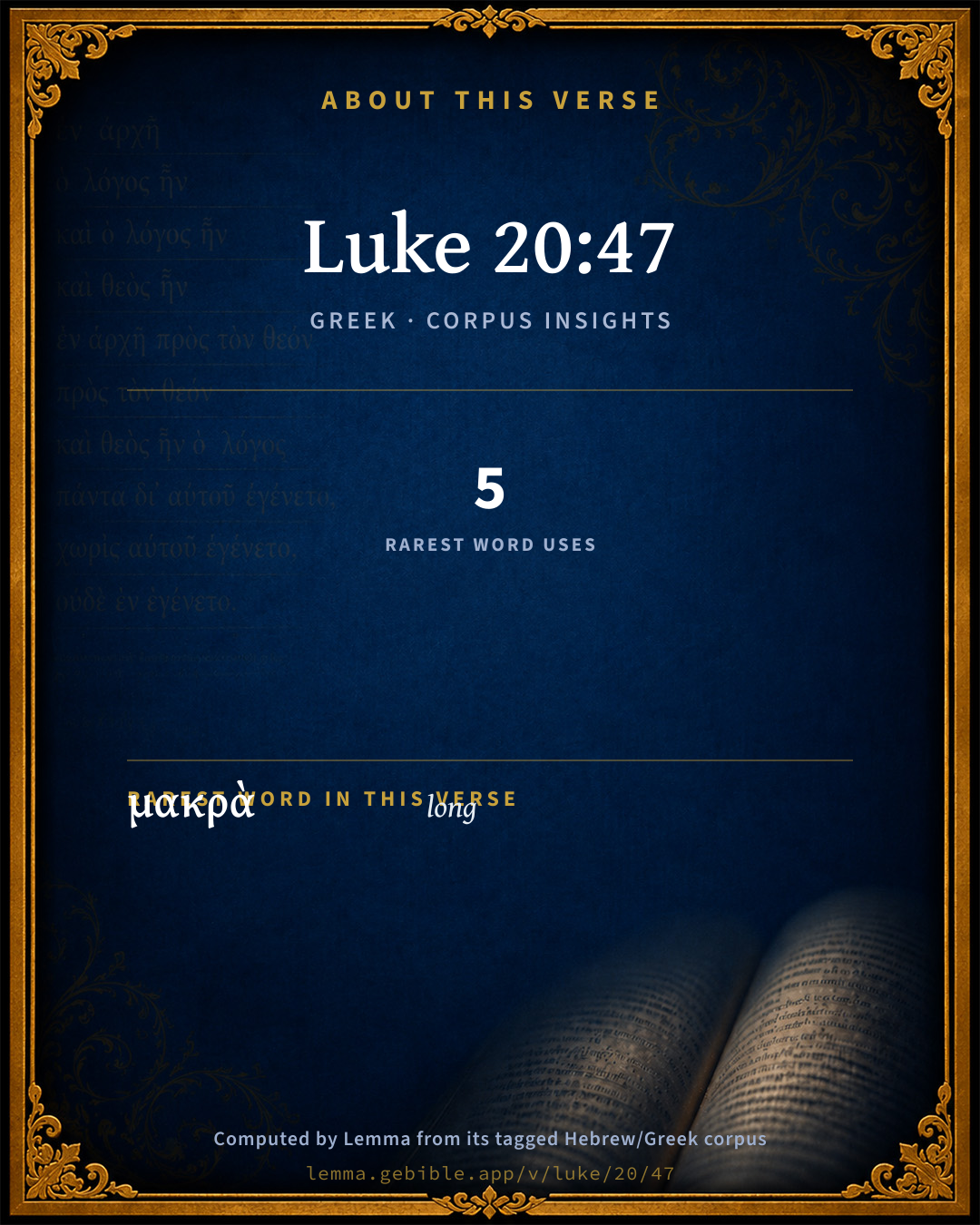
About this verse
These counts appear in no published source. They are computed here, from the morphology-tagged text and Lemma’s own curated glosses. What Lemma adds →
- 14
- words
- 13
- distinct lemmas
- Gospels
- section
Cross-references
20Topical passages linked to Luke 20:47 in the Treasury of Scripture Knowledge — connected by theme and wording, ordered by reader-vote popularity; previews shown in the World English Bible.
- Mark 12:40 those who devour widows' houses, and for a pretense make long prayers. These will receive greater condemnation."
- James 3:1 Let not many of you be teachers, my brothers, knowing that we will receive heavier judgment.
- Luke 12:1 Meanwhile, when a multitude of many thousands had gathered together, so much so that they trampled on each other, he began to tell his disciples first of all, "Beware of the yeast of the Pharisees, which is hypocrisy.
- Luke 12:47–48 That servant, who knew his lord's will, and didn't prepare, nor do what he wanted, will be beaten with many stripes,
- Titus 1:16 They profess that they know God, but by their works they deny him, being abominable, disobedient, and unfit for any good work.
- Isaiah 10:2 to turn aside the needy from justice, and to rob the poor of my people of their right, that widows may be their spoil, and that they may make the fatherless their prey!
- Jeremiah 7:6–10 if you don't oppress the foreigner, the fatherless, and the widow, and don't shed innocent blood in this place, neither walk after other gods to your own hurt:
- Ezekiel 33:31 They come to you as the people comes, and they sit before you as my people, and they hear your words, but don't do them; for with their mouth they show much love, but their heart goes after their gain.
- Amos 2:7 They trample on the dust of the earth on the head of the poor, And deny justice to the oppressed; And a man and his father use the same maiden, to profane my holy name;
- Amos 8:4–6 Hear this, you who desire to swallow up the needy, And cause the poor of the land to fail,
- Micah 3:2 You who hate the good, And love the evil; Who tear off their skin, And their flesh from off their bones;
- Matthew 11:22–24 But I tell you, it will be more tolerable for Tyre and Sidon on the day of judgment than for you.
- Matthew 23:13 "Woe to you, scribes and Pharisees, hypocrites! For you devour widows' houses, and as a pretense you make long prayers. Therefore you will receive greater condemnation.
- Luke 10:12–14 I tell you, it will be more tolerable in that day for Sodom than for that city.
- Micah 2:2 They covet fields, and seize them; And houses, and take them away: And they oppress a man and his house, Even a man and his heritage.
- Micah 2:8 But lately my people have risen up as an enemy. You strip the robe and clothing from those who pass by without a care, returning from battle.
- Matthew 23:26–28 You blind Pharisee, first clean the inside of the cup and of the platter, that the outside of it may become clean also.
- 2 Timothy 3:2–6 For men will be lovers of self, lovers of money, boastful, arrogant, blasphemers, disobedient to parents, unthankful, unholy,
- Ezekiel 22:7 In you have they set light by father and mother; in the midst of you have they dealt by oppression with the foreigner; in you have they wronged the fatherless and the widow.
- 1 Thessalonians 2:5 For neither were we at any time found using words of flattery, as you know, nor a cloak of covetousness (God is witness),
Cross-references courtesy of OpenBible.info (CC BY 4.0).
Lesson kit
Teaching starters — assembled from the data on this page, not authored interpretation. Every prompt links to the verse data it draws on. Edit before teaching.
Luke, in the Gospels, opens this verse with 14 words (13 distinct Greek lemmas). Its most distinctive word is makrós (“long”). A historical commentator’s framing appears above. Read the whole chapter for the surrounding context.
Discussion questions
- The word makrós carries the sense “long.” How does it shape the verse?
- Mark 12:40 shares the word «long» with this verse. How do the two illuminate each other?
- “the” occurs 2× in this one verse. What is the effect of the repetition?
- These translations render this verse differently. What is at stake in choosing one wording over another?
- Reading how Godbey's Commentary on the New Testament and Tyndale Open Study Notes read this verse, where do the two commentators agree and where do they part?
Things to notice
- These translations choose different wording for 15 words in this verse.
- “the” occurs 2× in this single verse.
- 13 distinct Greek lemmas span 14 words in this verse.
Commentary
Notes on Luke 20:47 from classic Christian and Jewish commentators (each source and its license shown beneath its notes). The classic Christian expositions comment on the surrounding passage and are grouped to its opening verse, so a note may address several verses; the Jewish commentaries on the Tanakh (Rashi and others) are per-verse, so they appear only where the commentator wrote on this verse.
Lemma curates 59 commentaries, every one of them public domain or Creative Commons licensed, each selected and text-cleaned for this edition rather than reprinted as found. About our sources →
Godbey's Commentary on the New Testament
William B. Godbey
William B. Godbey, Commentary on the New Testament (1896–1900) — public domain. Text from a community e-Sword module.
Tyndale Open Study Notes
Tyndale Open Resources
Tyndale Open Study Notes — © Tyndale Open Resources, licensed CC BY-SA 4.0. Text via the HelloAO Bible API.
Expositor's Greek Testament
ed. W. Robertson Nicoll
The Expositor's Greek Testament, edited by W. Robertson Nicoll (1897–1910) — public domain. Text from a community e-Sword module.
Geneva Bible (1599)
Geneva Bible translators
Geneva Bible (1599) marginal notes — public domain. Text via Bolls.life.
Jamieson, Fausset & Brown
Robert Jamieson, A. R. Fausset & David Brown
Jamieson, Fausset & Brown — Commentary Critical and Explanatory on the Whole Bible (1871) — public domain (CC PDM 1.0). Text via the HelloAO Bible API.
The Cambridge Bible for Schools and Colleges
gen. ed. J. J. S. Perowne
The Cambridge Bible for Schools and Colleges (gen. ed. J. J. S. Perowne; Cambridge University Press, 1878–1918) — public domain. Text from a community e-Sword module.
Trapp's Complete Commentary
John Trapp
John Trapp, A Commentary or Exposition upon All the Books of the Old and New Testament (1647–1656) — public domain. Text from a community e-Sword module.
Haydock's Catholic Bible Commentary
George Leo Haydock (1774–1849), Haydock's Catholic Family Bible and Commentary, 1859 edition — public domain. Excludes Psalms (Douay-Rheims chapter numbering differs from Protestant) and Deuterocanonical books (Catholic canon only).
The Pulpit Commentary
The Pulpit Commentary (1880–1919), ed. H.D.M. Spence-Jones & Joseph S. Exell — public domain. Text from a community e-Sword module.
John Wesley's Explanatory Notes
John Wesley, Explanatory Notes Upon the Whole Bible (1754–1765) — public domain. Text via the GEBible commentary corpus.
Cambridge Greek Testament for Schools and Colleges
Cambridge Greek Testament for Schools and Colleges (Cambridge University Press, 1896; 21 vols, various authors incl. Carr, Maclear, Plummer, Farrar, Lumby, Moule, M. R. James, Simcox) — public domain. Text from a community e-Sword module.
International Critical Commentary
International Critical Commentary — older volumes (1896–1929), various authors — public domain. Text from a community e-Sword module.
Vincent's Word Studies in the New Testament
Marvin R. Vincent
Marvin R. Vincent, Word Studies in the New Testament (1887–1900) — public domain. Text from a community e-Sword/MySword module.