
Luke 6:12

Greek (Tischendorf 8th ed.) Luke 6:12 appears in the Greek New Testament. The text above is from the Tischendorf 8th edition. Each word links to its Strong’s number and a concise gloss. Click any word for its full Thayer’s Greek Lexicon entry.
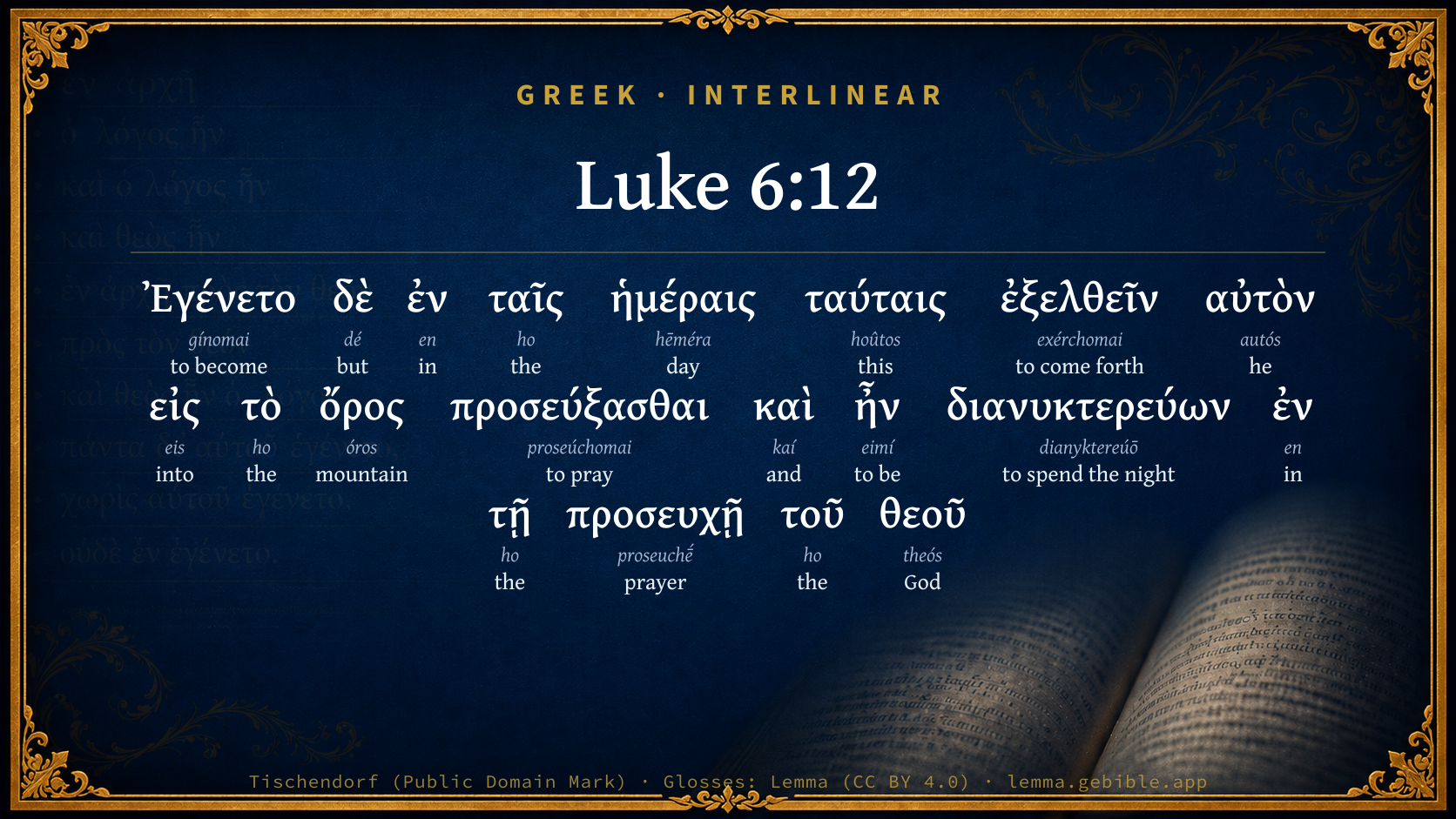
Download image
Cite this verse

Luke 6:12 (World English Bible). Public Domain. Lemma interlinear Bible study tool, https://lemma.gebible.app/v/luke/6/12.

Show BibTeX & RIS
BibTeX
RIS
English Translation
It happened in these days, that he went out to the mountain to pray, and he continued all night in prayer to God.
World English Bible · Public Domain
Highlights
  • 1 hapax legomenon — only here in the Greek New Testament
  • 1 first appearance in the Greek New Testament
Full analysis ↓
Download a study sheet

One document with this verse’s original text, its word-by-word gloss line, the meaning frame, cross-references with their text, attributed commentary, and full source and license credits — printable, and it pastes into notes with its structure intact.

This verse Autodidact and up

Study sheet (.html) Plain text (.txt)

A passage Seminary Student

Up to 50 verses in one chapter. A passage sheet keeps up to 6 commentary sources and 12 cross-references per verse, in the order this page ranks them, and says so on the sheet whenever that leaves anything out. Ask for a single verse and you get the Autodidact verse sheet above.

Everything on this page stays free to read, with no account — the sheet is a download of what is already on screen, not access to it.

Want to remove ads? Support Godless Engineer
Compare translations 3

The same verse in 3 English versions, stacked beneath the original-language interlinear above. Click any original word for its lexicon entry.

Each is an independent rendering of the whole verse — the interlinear is not word-aligned to these translations.

Highlighted words mark where these versions differ — a whole-verse word diff, not a word-by-word alignment.

  • World English Bible Public Domain
    It happened in these days, that he went out to the mountain to pray, and he continued all night in prayer to God.
  • King James Version Public Domain
    And it came to pass in those days, that he went out into a mountain to pray, and continued all night in prayer to God.
  • unfoldingWord Literal Text CC BY-SA 4.0
    And it happened that, in those days, he went out to the mountain to pray, and he was spending the whole night in prayer to God.

unfoldingWord Literal Text — © unfoldingWord, licensed CC BY-SA 4.0. Word-aligned USFM3 via Door43 (git.door43.org/unfoldingWord/en_ult).

Versions to compare (up to 4)

3 of 4 selected

Show all 19 translations

Every available English version of this verse, each an independent rendering of the whole verse.

  • World English Bible Public Domain
    It happened in these days, that he went out to the mountain to pray, and he continued all night in prayer to God.
  • Berean Standard Bible Public Domain
    In those days Jesus went out to the mountain to pray, and He spent the night in prayer to God.
  • Majority Standard Bible Public Domain
    In those days Jesus went out to the mountain to pray, and He spent the night in prayer to God.
  • King James Version Public Domain
    And it came to pass in those days, that he went out into a mountain to pray, and continued all night in prayer to God.
  • American Standard Version (1901) Public Domain
    And it came to pass in these days, that he went out into the mountain to pray; and he continued all night in prayer to God.
  • Revised Version (1885) Public Domain
    And it came to pass in these days, that he went out into the mountain to pray; and he continued all night in prayer to God.
  • Geneva Bible (1599) Public Domain
    And it came to passe in those dayes, that he went into a mountaine to praye, and spent the night in prayer to God.
  • Douay-Rheims (1899) Public Domain
    And it came to pass in those days, that he went out into a mountain to pray, and he passed the whole night in the prayer of God.
  • Young's Literal Translation Public Domain
    And it came to pass in those days, he went forth to the mountain to pray, and was passing the night in the prayer of God,
  • Literal Standard Version CC BY-SA 4.0
    And it came to pass in those days, He went forth to the mountain to pray, and was passing the night in the prayer of God,
  • Unlocked Literal Bible CC BY-SA 4.0
    It happened in those days that he went out to the mountain to pray. He continued all night in prayer to God.
  • unfoldingWord Literal Text CC BY-SA 4.0
    And it happened that, in those days, he went out to the mountain to pray, and he was spending the whole night in prayer to God.
  • Darby Bible Public Domain
    And it came to pass in those days that he went out into the mountain to pray, and he spent the night in prayer to God.
  • World Messianic Bible Public Domain
    In these days, he went out to the mountain to pray, and he continued all night in prayer to God.
  • Webster's Bible Public Domain
    And it came to pass in those days, that he went out to a mountain to pray, and continued all night in prayer to God.
  • Free Bible Version CC BY-SA 4.0
    One day shortly after, Jesus went up a mountain to pray. He remained there all night, praying to God.
  • Bible in Basic English Public Domain
    And it came about in those days that he went out to the mountain for prayer; and he was all night in prayer to God.
  • Text-Critical English NT CC BY 4.0
    One day soon afterward Jesus went out to the mountain to pray, and spent the whole night in prayer to God.
  • Tyndale New Testament (1534) Public Domain
    And it fortuned in thoose dayes that he went out into a mountayne for to praye and cotinued all nyght in prayer to god.

Literal Standard Version (2020), Covenant Press — licensed CC BY-SA 4.0. Text via the HelloAO Bible API (eBible.org). Unlocked Literal Bible (unfoldingWord) — licensed CC BY-SA 4.0. Text via the HelloAO Bible API (eBible.org). unfoldingWord Literal Text — © unfoldingWord, licensed CC BY-SA 4.0. Word-aligned USFM3 via Door43 (git.door43.org/unfoldingWord/en_ult). Free Bible Version, Dr. Jonathan Gallagher — licensed CC BY-SA 4.0. Text via the HelloAO Bible API (eBible.org).

Word by word

More ways to search: Search by grammar → Find every occurrence → Compare this word →

Practice this passage: Drill this verse → Learn its vocabulary →

διανυκτερεύων
dianyktereúō
G1273
“to spend the night”
Verb, Present, Active, Participle, Nominative, Singular, Masculine
Part of Speech
Verb
Tense
Present
Voice
Active
Mood
Participle
Case
Nominative
Number
Singular
Gender
Masculine
Full Thayer's Definition

Origin: from G1223 and a derivative of G3571

TDNT: None

1. to spend the night, to pass the whole night
  1. Ἐγένετο gínomai G1096 “to become” Verb, Aorist, Middle deponent, Indicative, 3rd person, Singular
  2. δὲ dé G1161 “but” Conjunction
  3. ἐν en G1722 “in” Preposition
  4. ταῖς ho G3588 “the” Article, Dative, Plural, Feminine
  5. ἡμέραις hēméra G2250 “day” Noun, Dative, Plural, Feminine
  6. ταύταις hoûtos G3778 “this” Demonstrative pronoun, Dative, Plural, Feminine
  7. ἐξελθεῖν exérchomai G1831 “to come forth” Verb, Aorist, Active, Infinitive
  8. αὐτὸν autós G846 “he” Personal pronoun, Accusative, Singular, Masculine
  9. εἰς eis G1519 “into” Preposition
  10. τὸ ho G3588 “the” Article, Accusative, Singular, Neuter
  11. ὄρος óros G3735 “mountain” Noun, Accusative, Singular, Neuter
  12. προσεύξασθαι proseúchomai G4336 “to pray” Verb, Aorist, Middle deponent, Infinitive
  13. καὶ kaí G2532 “and” Conjunction
  14. ἦν eimí G1510 “to be” Verb, Imperfect, Active, Indicative, 3rd person, Singular
  15. ἐν en G1722 “in” Preposition
  16. τῇ ho G3588 “the” Article, Dative, Singular, Feminine
  17. προσευχῇ proseuchḗ G4335 “prayer” Noun, Dative, Singular, Feminine
  18. τοῦ ho G3588 “the” Article, Genitive, Singular, Masculine
  19. θεοῦ theós G2316 “God” Noun, Genitive, Singular, Masculine

About this verse

These counts appear in no published source. They are computed here, from the morphology-tagged text and Lemma’s own curated glosses. What Lemma adds →

20
words
16
distinct lemmas
Gospels
section

Notable vocabulary

1 hapax legomenon — a word that appears only here in the entire Greek New Testament:

  • διανυκτερεύων to spend the night G1273

First appearance in Scripture

This word makes its first canonical appearance in the Greek New Testament here:

  • διανυκτερεύων to spend the night G1273

Shared distinctive vocabulary

προσευχῇ prayer G4335 occurs in 36 verses of the Greek New Testament. Also found in:
Repetition

Words recur within this verse:

Cross-references

12

Topical passages linked to Luke 6:12 in the Treasury of Scripture Knowledge — connected by theme and wording, ordered by reader-vote popularity; previews shown in the World English Bible.

  • Mark 6:46 After he had taken leave of them, he went up the mountain to pray.
  • Hebrews 5:7 He, in the days of his flesh, having offered up prayers and petitions with strong crying and tears to him who was able to save him from death, and having been heard for his godly fear,
  • Mark 1:35 Early in the night, he rose up and went out, and departed into a deserted place, and prayed there.
  • Matthew 6:6 But you, when you pray, enter into your inner chamber, and having shut your door, pray to your Father who is in secret, and your Father who sees in secret will reward you openly.
  • Matthew 14:23–25 After he had sent the multitudes away, he went up into the mountain by himself to pray. When evening had come, he was there alone.
  • Mark 14:34–36 He said to them, "My soul is exceedingly sorrowful, even to death. Stay here, and watch."
  • Daniel 6:10 When Daniel knew that the writing was signed, he went into his house (now his windows were open in his chamber toward Jerusalem) and he kneeled on his knees three times a day, and prayed, and gave thanks before his God, as he did before.
  • Colossians 4:2 Continue steadfastly in prayer, watching therein with thanksgiving;
  • Psalms 22:2 My God, I cry in the daytime, but you don't answer; In the night season, and am not silent.
  • Psalms 109:3–4 They have also surrounded me with words of hatred, And fought against me without a cause.
  • Psalms 55:15–17 Let death come suddenly on them. Let them go down alive into Sheol. For wickedness is in their dwelling, in the midst of them.
  • Genesis 32:24–26 Jacob was left alone, and wrestled with a man there until the breaking of the day.

Cross-references courtesy of OpenBible.info (CC BY 4.0).

Commentary

Notes on Luke 6:12 from classic Christian and Jewish commentators (each source and its license shown beneath its notes). The classic Christian expositions comment on the surrounding passage and are grouped to its opening verse, so a note may address several verses; the Jewish commentaries on the Tanakh (Rashi and others) are per-verse, so they appear only where the commentator wrote on this verse.

Lemma curates 59 commentaries, every one of them public domain or Creative Commons licensed, each selected and text-cleaned for this edition rather than reprinted as found. About our sources →

Matthew Henry's Commentary

In these verses, we have our Lord Jesus in secret, in his family, and in public; and in all three acting like himself.

I. In secret we have him praying to God, Luk 6:12. This evangelist takes frequent notice of Christ's retirements, to give us an example of secret prayer, by which we must keep up our communion with God daily, and without which it is impossible that the soul should prosper. In those days, when his enemies were filled with madness against him, and were contriving what to do to him, he went out to pray; that he might answer the type of David (Psa 109:4), For my love, they are my adversaries; but I give myself unto prayer. Observe, 1. He was alone with God; he went out into a mountain, to pray, where he might have no disturbance or interruption given him; we are never less alone than when we are thus alone. Whether there was any convenient place built upon this mountain, for devout people to retire to for their private devotions, as some think, and that that oratory, or place of prayer, is meant here by hē proseuchē tou theou, to me seems very uncertain. He went into a mountain for privacy, and therefore, probably, would not go to a place frequented by others. 2. He was long alone with God: He continued all night in prayer. We think one half hour a great deal to spend in the duties of the closet; but Christ continued a whole night in meditation and secret prayer. We have a great deal of business at the throne of grace, and we should take a great delight in communion with God, and by both these we may be kept sometimes long at prayer.

II. In his family we have him nominating his immediate attendants, that should be the constant auditors of his doctrine and eye-witnesses of his miracles, that hereafter they might be sent forth as apostles, his messengers to the world, to preach his gospel to it, and plant his church in it, Luk 6:13. After he had continued all night in prayer, one would have thought that, when it was day, he should have reposed himself, and got some sleep. No, as soon as any body was stirring, he called unto him his disciples. In serving God, our great care should be, not to lose time, but to make the end of one good duty the beginning of another. Ministers are to be ordained with prayer more than ordinarily solemn. The number of the apostles was twelve. Their names are here recorded; it is the third time that we have met with them, and in each of the three places the order of them differs, to teach both ministers and Christians not to be nice in precedency, not in giving it, much less in taking it, but to look upon it as a thing not worth taking notice of; let it be as it lights. He that in Mark was called Thaddeus, in Matthew Lebbeus, whose surname was Thaddeus, is here called Judas the brother of James, the same that wrote the epistle of Jude. Simon, who in Matthew and Mark was called the Canaanite, is here called Simon Zelotes, perhaps for his great zeal in religion. Concerning these twelve here named we have reason to say, as the queen of Sheba did of Solomon's servants, Happy are thy men, and happy are these thy servants, that stand continually before thee, and hear thy wisdom; never were men so privileged, and yet one of them had a devil, and proved a traitor (Luk 6:16); yet Christ, when he chose him, was not deceived in him.

III. In public we have him preaching and healing, the two great works between which he divided his time, Luk 6:17. He came down with the twelve from the mountain, and stood in the plain, ready to receive those that resorted to him; and there were presently gathered about him, not only the company of his disciples, who used to attend him, but also a great multitude of people, a mixed multitude out of all Judea and Jerusalem. Though it was some scores of miles from Jerusalem to that part of Galilee where Christ now was, - though at Jerusalem they had abundance of famous rabbin, that had great names, and bore a mighty sway, - yet they came to hear Christ. They came also from the sea-coast of Tyre and Sidon. Though they who lived there were generally men of business, and though they bordered upon Canaanites, yet there were some well affected to Christ; such there were dispersed in all parts, here and there one. 1. They came to hear him and he preached to them. Those that have not good preaching near them had better travel far for it than be without it. It is worth while to go a great way to hear the word of Christ, and to go out of the way of other business for it. 2. They came to be cured by him, and he healed them. Some were troubled in body, and some in mind; some had diseases, some had devils; but both the one and the other, upon their application to Christ, were healed, for he has power over diseases and devils (Luk 6:17, Luk 6:18), over the effects and over the causes. Nay, it should seem, those who had no particular diseases to complain of yet found it a great confirmation and renovation to their bodily health and vigour to partake of the virtue that went out of him; for (Luk 6:19) the whole multitude sought to touch him, those that were in health as well as those that were sick, and they were all, one way or other, the better for him: he healed them all; and who is there that doth not need, upon some account or other, to be healed? There is a fulness of grace in Christ, and healing virtue in him, and ready to go out from him, that is enough for all, enough for each.

Matthew Henry's Commentary on the Whole Bible (1708–1710) — public domain (CC PDM 1.0). Text via the HelloAO Bible API.

Jamieson, Fausset & Brown

Robert Jamieson, A. R. Fausset & David Brown

THE TWELVE APOSTLES CHOSEN--GATHERING MULTITUDES--GLORIOUS HEALING. (Luke 6:12-49)

went out--probably from Capernaum.

all night in prayer . . . and when . . . day, he called, &c.--The work with which the next day began shows what had been the burden of this night's devotions. As He directed His disciples to pray for "laborers" just before sending themselves forth (see on Mat 9:37; Mat 10:1), so here we find the Lord Himself in prolonged communion with His Father in preparation for the solemn appointment of those men who were to give birth to His Church, and from whom the world in all time was to take a new mould. How instructive is this!

Jamieson, Fausset & Brown — Commentary Critical and Explanatory on the Whole Bible (1871) — public domain (CC PDM 1.0). Text via the HelloAO Bible API.

The Cambridge Bible for Schools and Colleges

gen. ed. J. J. S. Perowne

12-19. The Selection of the Twelve Apostles.

12. in those days] wearied with their incessant espionage and opposition. Probably these two last incidents belong to a later period in the ministry, following the Sermon on the Mount (as in St Matthew) and the bright acceptable Galilaean year of our Lord’s work. In any case we have here, from Luk_6:12—viii. 56, a splendid cycle of Messianic work in Galilee in the gladdest epoch of Christ’s ministry.

into a mountain] Rather, “into the mountain,” with special reference to the Kurn Hattin, or Horns of Hattin, the traditional and almost certainly the actual scene of the Sermon on the Mount.

in prayer to God] The expression used is peculiar. It is literally “in the prayer of God.” Hence some have supposed that it should be rendered “in the Prayer-House of God.” The word proseuche meant in Greek not only ‘prayer,’ but also ‘prayer-house,’ as in the question to a poor person in Juvenal, “In what proseucha am I to look for you?” ■*- The proseuchae were merely walled spaces without roof, set apart for purposes of worship where there was no synagogue, as at Philippi (Act_16:13). There is however here an insuperable difficulty in thus understanding the words; for proseuchae were generally, if not in-variably, in close vicinity to running water (Jos. Antt. xiv. 10, § 23), for purposes of ritual ablution, nor do we ever hear of their being built ^ on hills. On the other hand, if τὸ ὄρος mean only ‘the mountainous district,’ this objection is not fatal. For another instance of a night spent on a mountain in prayer, see Mat_14:23.

12-19. The Selection of the Twelve Apostles.

And it came to pass in those days, that he went out into a mountain to pray, and continued all night in prayer to to do good, or to do evil] He was intending to work a miracle for good; they were secretly plotting to do harm,—their object being, if possible, to put Him to death. They received this question in stolid silence. Mar_3:4.

to save life] Rather, a life.

The Cambridge Bible for Schools and Colleges (gen. ed. J. J. S. Perowne; Cambridge University Press, 1878–1918) — public domain. Text from a community e-Sword module.

The Biblical Illustrator

Joseph S. Exell

Luk_6:12

And continued all night in prayer to God

Special protracted prayer

If any man of woman born might bare lived without prayer it was surely the Lord Jesus.

In some parts of prayer He could take no share, e.g., confession of sin. Then again, He had no need for self-examination each night, and no need to pray to be protected from sin each morning. Yet never was there a man more abundant in prayer.

1. Notice the place which Christ selected for prayer. The solitude of a mountain. Why?

(1) To prevent interruption.

(2) That He might be able to pray aloud.

(3) To avoid ostentation.

2. The time selected. The silent hours of night. To some of us, the night might be most inappropriate and unsuitable; if so, we must by no means select it, but must follow our Lord in the spirit rather than in the letter.

3. Again, our Lord sets us a good example in the matter of extraordinary seasons of devotion in the protracted character of His prayer. He continued all night in prayer. I do not think that we are bound to pray long as a general rule. Force is its standard rather than length. When the whole soul groans itself out in half a dozen sentences there may be more real devotion in them than in hours of mere wire drawing and word spinning. True prayer is the souls mounting up to God, and if it can ride upon a cherub or the wings of the wind so much the better, yet in extraordinary seasons, when the soul is thoroughly wrought up to an eminent intensity of devotion, it is well to continue it for a protracted season. We know not that our Lord was vocally praying all the time, He may have paused to contemplate; He may have surveyed the whole compass of the field over which His prayer should extend, meditating upon the character of His God recapitulating the precious promises, remembering the wants of His people, and thus arming Himself with arguments with which to return to wrestle and prevail. How very few of us have ever spent a whole night in prayer, and yet what boons we might have had for such asking!

4. Jesus has further instructed us in the art of special devotion by the manner of His prayer. Notice, he continued all night in prayer to God--to God. How much of our prayer is not prayer to God at all! That gunner will do no service to the army who takes no aim, but is content so long as he does but fire; that vessel makes an unremunerative voyage which is not steered for a port, but is satisfied to sail hither and thither. We must direct our prayers to God, and maintain soul-fellowship with Him, or our devotion will become a nullity, a name for a thing which is not.

5. Once more, we may learn from Jesus our Lord the occasion for special devotion. At the time when our Master continued all night in prayer He had been upbraided by the Pharisees. He fulfilled the resolve of the man after Gods own heart. Let the proud be ashamed; for they dealt perversely with me without a cause: but I will meditate in Thy precepts. So David did, and so did Davids Lord. The best answer to the slanders of the ungodly is to be more constant in communion with God: (C. H.Spurgeon.)

Christ an example to us in the choice of seasons for prayer

I. OUR LORD WAS WONT TO PRAY WHEN ENGAGED, OR ABOUT TO ENGAGE IN ANY RELIGIOUS ORDINANCE (Luk_3:21). The ordinances of grace must be sanctified to us by prayer, or we shall derive no benefit from them.

II. OUR LORD PRAYED WHEN ABOUT TO ENGAGE IN MORE THAN USUALLY IMPORTANT AND SERIOUS BUSINESS. AS here before the ordination of the apostles.

III. ANOTHER SEASON FOR PRAYER IS A SEASON OF EXCEEDING ENJOYMENT OR HONOUR (Luk_9:28-29). Strange as it may sound, yet, it is true, that they who receive most of the Lords grace and goodness stand the most m need of the Lords grace and goodness; they need grace to use abundant grace and goodness well. Pride of heart is often called into exercise by it; or, if not pride of heart, an undue love of that mercy--giving up the sou! to the enjoyment of it.

IV. ANOTHER SEASON FOR SPECIAL PRAYER IS WHEN WE SEE OUR FRIENDS IN PECULIAR DANGER OR SORROW (Luk_22:32; Joh_17:1-26.). How can there be Christian love if the sorrows and wants of those we love do not excite prayer in us?

V. ONE SEASON MORE I MENTION AS PECULIARLY A SEASON OF SUPPLICATION--WHEN TROUBLE IS ON US OR EXPECTED TO COME Luk_22:44). Severe affliction is the season, of all others, for prayer. (Charles Bradley, M. A.)

Private devotion

Some, from the nature of their employments, or from mental constitution, or habit, do not find that they can often continue, or profitably continue, long at devotion at once; such may supply this, in a good measure, by frequency. Most clearly, however, sufficient time ought to be taken to get the mind fully engaged. When Christ, after labouring the whole day that was past, and having also to labour as soon as day dawned again, spent the whole night in prayer, it is a shame for any of His professing followers, however busy a life they may load, not to make a point of reserving from the cares of the day, or it may be, from the slumbers of the night, as much time as is necessary for morning and evening devotions. Mark, Christians, how the airy trifler gives the night-watch to devour the foolish romance; and how the pale student toils over the midnight lamp; and how, for the sake of this worlds gain, some rise early and sit up late, and even work whole nights; and how the votaries of dissipating pleasure often spend the whole, or almost the whole, night in its pursuits; and then, though you will by no means think yourselves called on literally to spend whole nights in prayer, yet you will be ashamed and confounded when you think that a moderate tarrying before the throne of grace should ever have been unnecessarily neglected by you, or felt as a burden; and you will desire to give more of your time and of your heart to seasons of communion with your God. (James Foote, M. A.)

Jesus praying all night

On more than one occasion in the life of our Lord, it is recorded that He continued all night in prayer to God. What need was there that He should sacrifice rest and sleep in this way? He knew that His Father always heard His prayer. He gave us as the model for our prayer a form which can easily be repeated in half a minute. Was His Father unwilling to hear Him? Or was it because He could not bring His mind to the proper prayer-point, and so had to pray for hours, in order to learn how to pray for one moment with real faith? It could not be for either of these reasons. We may suppose then that our Saviour spent that long time in prayer as a delightful employment to Himself. He loved to commune with our God and His God. To Him it was better than meat to do the will of Him that sent Him. So, doubtless, it was more soothing and refreshing than sleep for Him to talk to His Father. Jesus praying and the Father listening; that was a harmony more entrancing than the songs of angels. But no; it was not for enjoyment alone that Jesus prayed all night. His prayers were poured into the deep heart of God as easily as the water pours over the rock into the chasm below. His heart unfolded to His Father as gently as a flower is kissed open by the breeze of a summer-dawn. But Christ had a definite purpose in the night-long prayer. (National Baptist)

A night of prayer

I. THE TEXT SHOULD CONVINCE US OF THE EFFICACY OF PRAYER.

II. THE TEXT SHOULD IMPRESS US WITH THE NECESSITY FOR PRAYER.

III. THE TEXT SHOULD INSTRUCT US AS TO THE MANNER OF PRAYER.

1. Christians should have their seasons of secret prayer and of retirement from the world.

2. Christians should have special seasons set apart for prayer in view of special work. (D. MacEwen, D. D.)

Prayer a preliminary to important steps in life

We should give ourselves to special prayer when we are about to make any important changes in life:

1. Leaving home.

2. Entering on a business or profession.

(1) That the temptations which cluster about our secular callings may not defile and degrade us.

(2) That our secular blessings may be made in the highest sense a blessing to us.

3. Marriage. (B. Wilkinson, F. G. S.)

A night of solitary prayer

I. THE NIGHT OF NEEDFUL REST SHORTENED FOR PRAYER.

II. THE SOLITUDE SOUGHT FOR SPIRITUAL PREPARATION. The crisis at which our Lord had arrived--

1. Originated the Christian ministry.

2. Began the Christian Church.

3. Involved the selection of His own betrayer.

4. Was a preparation for the full exposition of His doctrines.

Sermon on the plain.

III. THE CONDUCT OF OUR GRACIOUS LORD COUNSELS US TO.

1. Lonely prayer.

2. Preparatory prayer.

3. Self-denying prayer.

4. Leisurely prayer--All the night.

5. Lingering prayer--He continued.

6. Blissful prayer--All night with God. (W. H. Jellie.)

Here is the great secret of much that we see in the active life of Jesus.

1. Secret prayer.

2. Long prayer. Prayer calms and strengthens the soul. After prayer a man descends upon his work rather than rises strainingly towards it. (J. Parker, D. D.)

JESUS PRAYING.

He sought the mountain and the loneliest height,

For He would meet His Father all alone,

And there, with many a tsar and many a groan,

He strove in prayer throughout the long, long night.

Why need He pray, who held by filial right,

Oer all the world alike of thought and sense,

The fulness of His Sires omnipotence?

Why crave in prayer what was His own by might?

Vain is the question--Christ was man in need,

And being man, His duty was to pray.

The Son of God confessd the human need,

And doubtless askd a blessing every day,

Nor ceases yet for sinful man to plead,

Nor will, till heaven and earth shall pass away.

(Hartley Coleridge.)

All night in prayer

There are three classes of minds which are in danger of making too long prayers.

1. One is the loose, unconcentrative, who cumber thoughts with many words, and make vain, i.e., empty, repetitions of the same idea.

2. Another consists of those who, mistaking the nature of importunity, think that the more they say, the more they shall get--not seeing that in so doing they are virtually making their prayers a purchase-price, which they present in payment of what they ask--and forgetting, or not considering, the true character of prayer--that it is only the opening channel in a mans mind, through which God may pour out into that mind His preordained and ready gifts.

3. And the third are they who, with a superstitious feeling, think that God will be angry if their prayers do not go to a certain extent, and so, in their intercourse with God, they stretch their prayers to a degree either inconsistent with their other duties, or incompatible with their own health. They do not know that oftentimes the very best prayer we ever pray, is not to pray, but to cast ourselves simply on the love of God. The general rule is, pray according to the condition of your heart. Do not let the prayer strain the thoughts, but let the thoughts determine and regulate the prayer. Pray as you feel drawn in prayer--or, in other words, as the Spirit of God in you leads and dictates. Nevertheless, the holler a man is, and the nearer heaven--the more, and the more continuously that man will be able to commune with God. (J. Vaughan, M. A.)

All night in prayer

The Rev. John Welch, of Ayr, was accustomed to retire many nights to his church and spend the whole night in prayer--praying with an audible and sometimes with a loud voice. His wife, fearing he would catch cold, went one night to his closet where he had been long at prayer, and heard him say, Lord, wilt Thou not grant me Scotland? and, after a pause, Enough, Lord, enough. Once he got such nearness to the Lord in prayer that he exclaimed, Hold Thy hand, Lord; remember Thy servant is a clay vessel, and can hold no more.

The Biblical Illustrator, edited by Joseph S. Exell (c. 1880s–1900s) — public domain. Text from a community e-Sword module.

Joseph Benson's Commentary

Luk 6:12-13. And it came to pass in those days — Namely, of his teaching near the sea of Galilee; that he went out into a mountain to pray — Jesus, seeing the general notice which was taken of his appearance, and the desire which multitudes manifested of being further informed concerning the design of his coming, and the nature of his doctrine, determined to choose a number of persons who should assist and succeed him in his ministerial work. And as the office which he intended to assign them was of great importance, even to the remotest ages, previous to his choice of them, he retired to a mountain in the neighbourhood, and, notwithstanding all the labours of the preceding day, continued all night in prayer to God; so much was his heart enlarged on this momentous occasion. The original phrase, εν τη προσευχη του θεου, is singular and emphatical, being literally, in the prayer of God, implying an extraordinary and sublime devotion. Or, if the word προσευχη be taken for the proper name of a place, the clause may be rendered, he continued all night in the oratory, or prayer-place, of God; the Jews having many houses on mountains, and by the sides of rivers, &c., set apart for prayer. These houses, it is well known, were open at the top, and planted round with trees. This is the sense in which Drusius, Prideaux, Whitby, Hammond, and many other good critics, understand the expression. This interpretation does not alter the meaning of the passage, for as Jesus went up to the mountain to pray, we cannot avoid supposing that he spent the greatest part of the night in acts of devotion. And when it was day he called to him his disciples — Mark says, whom he would. And of them he chose twelve, whom also he named apostles — A name which well expressed the office for which they were designed. These he now fixed upon, that for some time they might be always with him, in order that from his own mouth they might learn the doctrine which they were, in due time, to preach through the world; “that they might see his glory, Joh 1:14, the transcendent glory of the virtues which adorned his human life; and that they might be witnesses of all the wonderful works which he should perform, and by which his mission from God was to be clearly demonstrated. The twelve were thus to be qualified for supplying the people with that spiritual food which their teachers neglected to give them; and that both before and after their Master’s death. Accordingly, when they had continued with Jesus as long as was necessary for this end, he sent them out by two and two into Judea, on the important work of preparing the people for his reception, who was the true shepherd. Hence he named them apostles, that is, persons sent out. But the name was more peculiarly applicable to them, and their office was raised to its perfection, after Christ’s ascension, when he sent them out into all the world with the doctrine of the gospel, which he enabled them to preach by inspiration, giving them power at the same time to confirm it by the most astonishing miracles. That this was the nature of the new dignity which Jesus now conferred on the twelve, is evident from Joh 20:21, where we find him confirming them in the apostolical office: as my Father hath sent me, so send I you; I send you upon the same errand, and with the same authority: I send you to reveal the will of God for the salvation of men. And I bestow on you both the gift of tongues and the power of working miracles, that you may be able to preach the doctrine of salvation in every country, and to confirm it as divine, in opposition to all gainsayers.” — Macknight. Of the probable reason why the number of twelve was fixed upon rather than any other, and for a further elucidation of the passage, see the notes on Mar 3:13-17; and Mat 10:1-4. After their election, the twelve accompanied Jesus constantly, lived with him on one common stock as his family, and never departed from him, unless by his express appointment.

Joseph Benson's Commentary on the Old and New Testaments (1811–1818) — public domain. Text from a community e-Sword module.

The Preacher's Complete Homiletical Commentary

Joseph S. Exell (gen. ed.)

CRITICAL NOTES

Luk_6:12. Went out.—I.e. from Capernaum. A mountain.—Rather, “the mountain” (R.V.)—that is, the mountainous country, the high table-land above the Lake of Gennesaret. Prayer to God.—The expression in the original is rather peculiar, but there is no doubt that this is its meaning. The idea that by the word translated “prayer” is meant a proseucha or place of prayer is far-fetched and incongruous. The narrative seems to imply that the prayer had reference to the coming selection of those who were to be set apart by Christ to do His work.

Luk_6:13. Twelve.—There can be no doubt that the number twelve was intended to correspond to the twelve tribes of Israel. Apostles.—Messengers, persons sent on a mission.

Luk_6:14-16.—In this as in all the other catalogues Peter is first, Philip fifth, James the son of Alphæus is ninth; so that the names of the apostles are given in groups of four: all give Judas Iscariot as the last of the list. Simon.—Also called Peter and Cephas—the one being the Greek, the other the Aramaic for “rock”: the name given by anticipation (Joh_1:42), formally conferred when he was chosen apostle (Mar_3:16). Andrew.—The name probably from a Greek word, meaning “manly.” James.—Same name as Jacob: usually called James the Elder, to distinguish him from the other James: the first of the twelve to suffer martyrdom (Act_12:2). John.—The last survivor of the twelve: the name Boanerges—“Sons of Thunder”—conferred on him and his brother (Mar_3:17): his father was Zebedee, mother Salome: in Joh_19:25 it is probable that the sister of the mother of Jesus refers to Salome; if so, he and his brother were cousins of our Lord. Philip.—Greek name: the first summoned by Christ to follow Him (Joh_1:43). These first five apostles were all of Bethsaida. Bartholomew.—I.e. son of Tolmai: probably to be identified with Nathanael, as from Joh_21:2 Nathanael appears to have been one of the twelve, and is named in conjunction with Philip (Joh_1:45), as Bartholomew is in all the lists of apostles.

Luk_6:15. Matthew.—The writer of the first Gospel: in his own list he enters his name as “Matthew the publican,” in reference to his former occupation. Thomas.—A Hebrew name meaning “the twin,” the Greek for which is Didymus (Joh_20:24): frequently mentioned in St. John’s Gospel. James the son of Alphæus.—Called James “the Less,” or the Younger (Mar_15:40). The name Alphæus appears in another form in St. John’s Gospel—as Clopas (Joh_19:25): of him we know nothing except that he was the husband of Mary the sister of the Virgin Mary, and that James and Jude were his sons. Simon called Zelotes.—I.e. the Zealot: the Zealots were a sect of fanatical Jews, noted for their intemperate zeal in maintaining the Jewish law. By St. Matthew he is called the Canaanite or Cananæan, another form of the name “zealot,” from Hebr. kineâh, “zeal.”

Luk_6:16. Judas the brother of James.—This apostle has three names: Judas (brother or son) of James; Lebbæus, from Hebr. lebh, “heart”; and Thaddæus, from Hebr. thad, “bosom”: either a son or a grandson of the above-mentioned Alphæus: author of Epistle of Jude. Judas Iscariot.—Probably a man of Kerioth, a city of the tribe of Judah (Jos_15:25): in St. John’s Gospel he is described as son of Simon or (R.V.) of Simon Iscariot (Joh_6:71; Joh_13:26). If this Simon were the apostle, he and Judas would be father and son.

Luk_6:17. Came down.—I.e. from the mountain mentioned in Luk_6:12. The plain.—The word can mean a level space on the mountain-side. Out of all Judæa.—“St. Matthew adds Galilee (which was to a great extent Greek), Decapolis, and Peræa: St. Mark also mentions Idumæa. Thus there were Jews, Greeks, Phœnicians, and Arabs among our Lord’s hearers” (Farrar).

Luk_6:19. To touch Him.—Cf. Luk_8:44; Mat_14:36; Mar_5:30.

MAIN HOMILETICS OF THE PARAGRAPH.—Luk_6:12-19

The Choice of the Twelve.—It is probable that the selection of a limited number to be His close and constant companions had become a necessity to Christ, in consequence of His very success in gaining disciples. It was impossible that all who believed could continue henceforth to follow Him, in the literal sense, whithersoever He might go: the greater number could now only be occasional followers. But it was His wish that certain selected men should be with Him at all times and in all places—His travelling companions in all His wanderings, witnessing all His work, and ministering to His daily needs. They were, however, to be more than travelling companions or menial servants. They were to be, in the meantime, students of Christian doctrine, and occasional fellow-labourers in the work of the kingdom, and eventually Christ’s chosen trained agents for propagating the faith after He Himself had left the earth. The number of the apostolic company is significant. A larger number of eligible men could easily have been found in a circle of disciples which afterwards supplied seventy auxiliaries for evangelistic work; and a smaller number might have served all the present or prospective purposes of the apostleship. The number twelve happily expressed in figures what Jesus claimed to be, and what He had come to do, and thus furnished a support to the faith and a stimulus to the devotion of His followers. It significantly hinted that Jesus was the Divine Messianic King of Israel, come to set up the kingdom whose advent was foretold by prophets in glowing language, suggested by the palmy days of Israel’s history, when the theocratic community existed in its integrity, and all the tribes of the chosen nation were united under the royal house of David. In a worldly point of view the twelve were a very insignificant company indeed—a band of poor, illiterate Galilæan provincials, utterly devoid of social consequence, not likely to be chosen by one having supreme regard to prudential considerations. Why did Jesus choose such men? Was He guided by feelings of antagonism to those possessing social advantages, or of partiality for men of His own class? No; His choice was made in true wisdom. If He chose Galilæans mainly, it was not from provincial prejudice against those of the south; if, as some think, He chose two or even four of His own kindred, it was not from nepotism; if He chose rude, unlearned, humble men, it was not because He was animated by any petty jealousy of knowledge, culture, or good birth. If any rabbi, rich man, or ruler had been willing to yield himself unreservedly to the service of the kingdom, no objection would have been taken to him on account of his acquirements, possessions, or titles. But such men would not condescend so far, and therefore the despised One did not get an opportunity of showing His willingness to accept as disciples and choose for apostles such as they were. It mattered little, except in the eyes of contemporary prejudice, what the social position or even the previous history of the twelve had been, provided they were spiritually qualified for the work to which they were called. What tells ultimately is, not what is without a man, but what is within. If it be thought that a number of apostles were undistinguished either by high endowment or by a great career, and were in fact all but useless, the wisdom of Christ’s choice of them is virtually impugned. The following considerations may serve to modify this opinion:—

I. That some of the apostles were comparatively obscure, inferior men cannot be denied; but even the obscurest of them may have been most useful as witnesses for Him with whom they had companied from the beginning.—It does not take a great man to make a good witness, and to be witnesses of Christian facts was the main business of the apostles. That even the humblest of them rendered important service in that capacity we need not doubt, though nothing is said of them in the apsotolic annals. It is not to be expected that a history so fragmentary and so brief as that given by St. Luke should mention any but the principal actors, especially when we reflect how few of the characters that appear on the stage at any particular crisis in human affairs are prominently noticed even in histories which go elaborately into detail. The purpose of history is served by recording the words and deeds of the representative men, and many are allowed to drop into oblivion who did nobly in their day. The less distinguished members of the apostolic band are entitled to the benefit of this reflection.

II. Three eminent men, or even two (Peter and John), out of twelve are a good proportion—there being few societies in which superior excellence bears such a high ratio to respectable mediocrity. Perhaps the number of “pillars” was as great as was desirable. Far from regretting that all were not Peters and Johns, it is rather a matter to be thankful for that there were diversities of gifts among the first preachers of the gospel. As a general rule it is not good when all are leaders. Little men are needed as well as great men; for human nature is one-sided, and little men have their peculiar virtues and gifts, and can do some things better than their more celebrated brethren.

III. We must remember how little we know concerning any of the apostles.—It is the fashion of biographers in our day, writing for a morbidly or idly curious public, to enter into the minutest particulars of outward event or personal peculiarity regarding their heroes. Of this fond, idolatrous minuteness there is no trace in the evangelic histories. The writers of the Gospels were not afflicted with the biographic mania. Moreover, the apostles were not their theme. Christ was their hero; and their sole desire was to tell what they knew of Him. They gazed steadfastly at the Sun of righteousness, and in His effulgence they lost sight of the attendant stars. Whether they were stars of the first magnitude, or of the second, or of the third made little difference.—Bruce.

SUGGESTIVE COMMENTS ON Luk_6:12-19

Luk_6:12-49. The Busy Christ.

I. A night of prayer.

II. A morning of work.—Calling, choosing, healing, teaching.—W. Taylor.

Luk_6:12-16. The Choice of the Apostles.—Note the difference between discipleship and apostleship. He called to Him the disciples, and of them He chose twelve to be apostles. A disciple is a learner; an apostle is an emissary. The one is still in the school; the other has left it to become a teacher and an envoy. The night between discipleship and apostleship was so critical that our Lord devoted the whole of it to prayer. These men were to be nearest to the person—to form the innermost circle—of the Saviour. From that choice sprang the little volume of the New Testament, words of eternal life; from it the real Christianity of Christendom; from it every word and work, during these eighteen centuries, of piety, of purity, of charity; from it the great multitude which no man can number. Well might that be a night of prayer upon which was to dawn the ordination, or the consecration, of the twelve apostles. Was there not matter for His night-long intercession at the throne of grace for the disciples about to become apostles, henceforth to be entrusted with this latest and largest interpretation of the mind, and the will, and the heart of God to men?—Vaughan.

The New Organisation.—This is all we are told of the planting of that germ of which the upgrowth is the Church of Christ. The organisation thus introduced was just enough to make of the disciples one body. Henceforth they could speak of themselves as “we”; but as yet they were only pupils, chosen to be about their Master’s person, entrusted with special powers for the good of those among whom they ministered, but with no authority over the rest of the disciples.—Latham.

Luk_6:12. “Into a mountain to pray.”—High mountain-peaks are in the Bible consecrated as places of communion with God. Almost all the secrets of God have been revealed on mountain-tops. Jesus prayed on this mountain for the disciples whom He was now to choose. He asked God to grant them to Him. Well has this been called the vigil before the laying of the foundation-stone of the Church—this night through which our Lord watched and prayed. We can guess the contents of this prayer from that which our Lord offered as our High Priest (John 17). He who prayed thus in the days of His flesh sits now on the right hand of the Majesty on high, and blesses His Church, both as High Priest and King, with gifts and offices (Eph_4:11).

A Crisis in the Ministry of Jesus.—St. Luke indicates in the most impressive manner that the choice of the twelve apostles marks a critical time in the ministry of Jesus. He had spoken of a new order of things, and had incurred the enmity of those who were devoted to the old order. He now regards it necessary to organise His followers, and to found a new society based upon faith in Himself and devotion to the interests of God’s kingdom upon earth. The calling of the twelve marks the beginning of the spiritual Israel, in a separate and distinctive form. The choice of the twelve and the institution of the sacraments were the only definite acts of organisation which Christ judged it necessary to perform.

The Apostles divinely chosen.—Great stress is laid by St. Luke upon the night of prayer and communion with God which preceded the choice of the twelve, and by this he would have us to understand both the importance of the occasion and also the fact that these individuals were selected under the special direction of God Himself.

The Laying of the Foundation-stone of the Church.—Thus then it would appear that our Redeemer prepared Himself by nocturnal prayer, and then in the morning installed the twelve apostles. If we consider that the election of this body of men, in whose hearts the first germs of truth were to be deposited, depended upon a careful selection of persons, we shall then be able to form an idea of that momentous act; it was the moment in which was laid the foundation-stone of the Church. Only as the discerner of all hearts was it possible for our Lord to lay the foundation of such a body of closely united minds, which might exist and represent the whole spiritual creation, that was to be called into existence. In His own person all was concentrated in one holy unity; but as the ray of light divides itself into its various colours, so in like manner went forth the one light which emanated from Christ into the hearts of the twelve in various modified degrees of brightness.—Olshausen.

Labourers sent forth by God.—As Jesus had told His disciples to pray to God to send forth labourers to gather in His harvest (Mat_9:38), so now does He Himself commit the matter of those to be chosen as labourers in prayer to God.

Great Importance of this Choice.—If the passage before us teaches anything, it teaches us that the sending forth of His apostles was in our Lord’s judgment a matter of great importance: He does not at all treat it as though it belonged to the subordinate details of His work.—Liddon.

Luk_6:13. “Of them He chose twelve.”

It is a striking fact that the whole of the twelve were chosen by our Lord near the beginning of His ministry. He did not begin with a small number, to be afterwards enlarged; He completed the college of apostles at once.

1. This shows us how mature His own mind was as to His work, and as to the men best fitted to aid in it.

2. This plan had the advantage, too, of securing a united testimony and an intelligent co-operation all through.—Blaikie.

Little More is Heard of These Men Afterwards.—So little is saint-worship countenanced by the practice of the early Church, that we hear little more of any of these men—of some, indeed, nothing whatever. Two things are noticeable of them as a body:—

I. Their variety in education and acquirements.

II. How few they seem for the task assigned to them.—Markby.

“Apostles.”—The special title conferred upon the twelve, that of those “sent out,” derives its dignity from the fact that those who bear it are in a sense representatives of Him who sends them. They are not so much messengers as ambassadors. The name is used elsewhere in the New Testament in a general sense, and applied to persons who were not of the twelve (Gal_1:19; Act_14:14; Heb_3:1), but it is only of the twelve that Christ, so far as we know, used it.

Not all Equally Intimate with Jesus.—It is a very striking fact that all the apostles were not on equal terms of intimacy with Jesus: Peter, James, and John were on several occasions honoured above the others in being taken into closer fellowship with the Lord (Luk_8:51, Luk_9:28; Mat_26:37). “The disciples thus surrounded our Lord in wider and still wider expanding circles; nearest to Him were the three, then came the other nine, after them the seventy, and finally the multitude of His other disciples. Undeniable, then, as is the difference which existed between the disciples of Christ, yet this does not imply that there existed any more intimate initiation for those standing nearest to Him. The secret, or the mystery of Christ, at once the highest and the simplest truth, was to be preached from the house-tops. It is not to be doubted, however, that some penetrated infinitely deeper into this mystery than the others, and hence became far more fitted to move in more intimate proximity to our Lord” (Olshausen).

Characteristics of the Apostles.—None of those chosen seem to have been of high social rank. James and John were still fishermen, though, as pointed out in a preceding note (Luk_6:1), they were evidently “better off” than their fellow-apostles. Nor do the twelve seem to have been distinguished by intellectual gifts, or learning of the kind acquired in the schools (Act_4:13). Their moral and spiritual faculties and attainments seem rather to have been called into being, and cultivated by association with Jesus, than to have belonged to them when they were first chosen to be apostles. But they were men of simple, unsophisticated characters, and devoid of those inveterate prejudices which blinded the eyes of scribes and Pharisees and hardened their hearts. They loved their Master and believed in Him, and had religious aspirations which He alone could satisfy. The sense of duty was strong in them; and they conscientiously desired to do what was right. “They had also the excellent quality of persistence, or holding-out. Other men had also enrolled themselves as Jesus’ disciples, and had given Him up; but the twelve had held on. No mere adventurers, or time-servers, or self-seekers would have stayed with Jesus.”

The Men chosen.—

1. Christ chooses simple-minded yet already measurably prepared men.

2. Few yet very diverse men.

3. Some prominent to go with several less noticeable men.—Lange

The Apostolic Office.

I. They were sent to do a given work.

II. They were to be witnesses—as to what their Master had been, and had done, and had suffered, while they were with Him. They carried out their mission

(1) by their words—they preached Christ;

(2) by their work—they built up the Church, the temple of redeemed souls;

(3) by their sufferings—they died for Christ.—Liddon.

Luk_6:17-18. “A great multitude of people.”—Three classes of persons were now about Jesus:

(1) occasional hearers (the “multitude of people” from all parts);

(2) permanent disciples (“the company of His disciples”); and

(3) the apostles. The first represented mankind as summoned to enter the kingdom of God; the second the Church, or the body of believers; and the third the Christian ministry.—Godet.

A Characteristic Scene.—The whole scene is a highly characteristic one: we have—

I. The company of sinners—of various nations, oppressed by various evils—ignorance, disease, and Satanic power—but desiring and seeking redemption from Christ.

II. The Saviour—moved with compassion, and able to heal and to deliver.

Luk_6:19. “Power came forth … healed them all.”—There is something unusually grand in this touch of description, giving to the reader the impression of a more than usual exuberance of His majesty and grace in this succession of healings, which made itself felt among all the vast multitude.—Brown.

Miracles a Seal to the Message from God.—Miracles preceded and followed the Sermon on the Mount. The sermon was like an epistle sent from God: the miracles were its seals, impressed with the Divine image and superscription.

The Preacher's Complete Homiletical Commentary (gen. ed. Joseph S. Exell; Funk & Wagnalls, c. 1892) — public domain (pre-1929). A full-Bible homiletical/sermon-outline anthology covering 65 of 66 books (2 John is absent from the source module). Text from a community e-Sword module.

Lange's Commentary on the Holy Scriptures

d. The Son Of Man, The Lawgiver In The Kingdom Of God.

Luk_6:12-49

α. The Choice of Apostles (Luk_6:12-16)

(Parallels: Mat_10:2-4; Mar_3:13-19.)

12And it came to pass in those days, that he went out into a [the] mountain to pray, and continued all night in prayer to God. 13And when it was day, he called unto him his disciples: and of them he chose twelve, whom also he named apostles [that is, missionaries];14Simon, (whom he also named Peter,) and Andrew his brother, James andJohn, [and12] Philip and Bartholomew, [and, V. O.] 15Matthew and Thomas, James the 16son of Alpheus, and Simon called Zelotes [i.e., the zealot], And Judas the brother [the son, V. O.13] of James, and Judas Iscariot, which also14 was the traitor [became traitor].

EXEGETICAL AND CRITICAL

Luk_6:12. In those days.—From the comparison with Matthew and Mark it appears that the choice of apostles took place at a time in which the fame of the Saviour had mightily increased in Galilee. The healing of the man with the withered hand was followed by a number of miracles (Mat_12:15-21; Mar_3:17 seq.). Even from Tyre and Sidon do the throngs stream together. The voice of the supplicating sick unites itself with the cry of the demons. With difficulty does He escape the throng, withdraws Himself to the solitary mountain, and finds in communion with the Father the rest which earth gives Him not.

In prayer to God.—It is of the greatest moment that the choice of the apostles is preceded by a night of prayer, and that it may thus be denominated the fruit of the most immediate communion of the Son with the Father. An echo of this prayer we hear in the heartfelt supplication of the Lord for all those given Him by the Father. (Joh_17:6-9.)

Luk_6:13. His disciples.—According to the definite account of Luke, we are to conceive the matter thus, that the Saviour caused a great number of the disciples to come to Him, and now out of this number called the twelve apostles. We have, therefore, to distinguish clearly this choice of apostles, on the one hand, from the later mission of the apostles indicated by Matthew 10 in giving their names (Luk_6:1; Luk_6:5), on the other hand, from the earlier relation in which at least some of these men had already stood to Jesus. First had they become friends, then disciples of the Lord in a wider sense, afterwards are they called as apostles to leave all (Luk_5:10-11; Luk_5:27-28), but now united in a distinctly formed circle of apostles. And even within this there are still grades in respect of their intimate communion with Christ. Even as apostles He calls them at first servants (Mat_10:24), afterwards friends and children (Joh_13:33; Joh_15:15), finally even brethren (Joh_20:17).

Whom also He named apostles.—The complete college of the twelve did not, therefore, first arise after Jesus’ ascension by gradual selection from a wider circle of His adherents (Schleiermacher, Weisse), but it was founded by Jesus Himself. Only on this supposition do we understand the character of the Sermon on the Mount as a dedicatory discourse, as well as the connection between this act of the Saviour and the previous solitary prayer. Although John does not mention the formal choice of apostles, yet it appears from Joh_6:70; Joh_15:16, that he by no means contradicts it. It is true that the name apostle in other places in the New Testament is not exclusively given to the twelve (see Gal_1:19; Act_14:14; Heb_3:1). But the Saviour Himself never, so far as we know, used this name otherwise than as the designation of the twelve to whom He entrusted the apostolic function.

The apostolic catalogue of Luke agrees almost entirely with that of Matthew; see Lange ad loc., who also communicates particularly what is most worth knowing respecting the names of each one. We wish chiefly to suggest the heavenly wisdom of the Saviour in the manner in which they have been paired. Although Luke does not give the names in pairs but individually (see Luk_6:14), yet from the comparison with other specifications of the names it is easy to see how the pairs must have been arranged.

a. Peter and Andrew. In all catalogues of the apostles Peter stands at the head. The man full of fire and energy, the son of Jonah (a dove), who is to become a rock of the doves, the mouth of the apostolic circle, as John constitutes its heart; of fiery spirit, as the latter of deep sensibility; ever ready for combat, as the latter is patient in enduring—and by his side Andrew, his brother, whose personality is less prominent, but who brought his brother to Jesus (Joh_1:42), and afterwards appears a single time as the fourth intimate companion of the Saviour along with the three specially chosen ones, Mar_13:3.

b. John and James, his brother, sons of Zebedee and own cousins of the Lord, the first prophet and the first martyr among the twelve. The question why they received the name Boanerges appears to have been best answered by Theophylact, who says this name designated them, ὡς μεγαλοκήρυκας καὶ θεολογικωτάτους. Against the view that this name was meant to be a censure of their fiery zeal (Luk_9:51 seq.), maintained by Gurlitt, see Lange in the Studien und Kritiken, 1839, 1. Comp. Leben Jesu, ii. p. 696.

c. Philip and Nathanael, the son of Tholmai (Bartholomæus), two friends (Joh_1:45 seq.), the one of Bethsaida, the other of Cana in Galilee. Nathanael is known for his uprightness (Joh_1:47), Philip for his frankness, through which he ventured to open every difficulty to the Lord (Joh_6:7; Joh_12:22; Joh_14:9). Two men involved in similar prejudices, but also animated by like love to the truth, belonged in the apostolic circle together.

d. Matthew and Thomas. In this fourth pair the name Matthew in Luke and Mark stands first, but he himself gives himself a second place, perhaps in the same feeling of humility in which he has added to his name the phrase ὁ τελώνης. Both are apparently of Galilee. If Thomas was of a heavy, melancholy temper, on the other hand Matthew, as we know from the narrative of his calling (Luk_5:27-28), was distinguished by the capability of easily surmounting great difficulties; and while the one, moreover, was disposed to solitary thought, the other appears from his former calling to have gained a certain facility in intercourse with men. Thus does one supplement the other

e. James, the son of Alphæus or Cleophas, and Lebbæus, surnamed Thaddæus. The former certainly is not one and the same with James, the brother of the Lord (Joh_7:5). The other, agreeably to his two names, לֵב, cor, תַּד, mamma, a courageous, spirited man. It is unnecessary to understand here two different persons, and far less can we believe (Von Ammon) that some apostles, because they did not come up to the Saviour’s expectations, were even in His life replaced by others. No, Lebbæus and Thaddæus are one person; however, the question remains: what was the proper name of the man who possessed this double surname? Here Luke (Luk_6:16) shows us the way with his: καὶ Ἰούδαν Ἰακώβου, only we must not understand by this the brother but the son15 of an otherwise unknown James. From Joh_14:22 we know that besides Judas Iscariot there was yet another Judas among the twelve. This similarity of name may have been the cause why he was not commonly called Judas, but by one of his surnames, as indeed Jerome with reason called him the Three-named.

f. Judas Iscariot and Simon Zelotes, or Cananites. These two names, the one Greek and the other Hebrew, signify “The Zealot.” The germ of zealotism, which first developed itself in the last Jewish war, already existed in the days of the Saviour; perhaps Simon had already appealed to the law of the Zealots and belonged to the followers of Judas Gaulonites, before he became an apostle. Apparently the Lord placed the high-spirited, vigorous man beside the dark form of Judas Iscariot, on account of the moral preponderance which Simon might exercise upon his character, but also because Judas could most easily unite himself with a brother who had already previously striven for a political and outwardly theocratical end. It is noticeable, moreover, that Judas Iscariot, in Luke, is not coupled with Simon Zelotes, but with Judas, the son of James. We need not, however, conclude from this alone that tradition, in respect to the pairing of the apostles, had already become uncertain. We incline the rather to suppose that the Saviour, who quite early penetrated the character of Judas, did not always associate the same companion with him. By change, the danger of being infected by Judas was averted, and from different sides an influence was exerted for the ennobling of his character. The vigorous, hearty Lebbæus might for his part have been as well fitted for that as the courageous zealot.

As to the choice of the apostles in general, comp. an admirable dissertation by Lange in his miscellaneous writings, part iv. p. 158, and the authors cited by Hase, Life of Jesus. Some names of apostles which are mentioned in the Gemara, namely, Nazar, Nabi, Bohi, are of later and fabulous origin, and can, therefore, by no means be turned as weapons against the evangelical tradition. Respecting the conjectural fate and deeds of these twelve, which were very early embellished by tradition, see Winer in voce.

DOCTRINAL AND ETHICAL

1. The calling and training of His apostles was one of the most momentous parts of the work which the Father had committed to the Son. With a little reflection, we can by no means be surprised that the Saviour (Joh_17:4-6) defines the declaration: τὸ ἔργον ἐτελείωσα, κ.τ.λ., more precisely by adding almost immediately afterwards: ἐφανέρωσά σου τὸ ὄνομα τοῖς ἀνθρώποις, οὓς δέδωκάς μοι, κ.τ.λ. The ἔργον of His public life was, as it were, concentrated in the training and guidance of His elect witnesses. He Himself could indeed only lay the first foundations of the extended temple of God, and therefore He was obliged to look around for skilful workmen who should carry the temple up. Therefore, even during His life, He gathered a little company whose spiritual head He was, first visibly, afterwards invisibly. Therefore does He begin immediately after His baptism, to prepare for the vocation of the twelve. To their training the greatest part of His time and energies is devoted, and even when He acts upon the people, He has regard at the same time to their peculiar needs. His death even has to contribute to their education, since by it their earthly expectations are at the same time slain; and even after His resurrection He continues for yet forty days to labor personally in their training, until finally they are fully capable and prepared to receive the promised Holy Spirit. We have accordingly here approached the proper centre of His public life.

2. The choice of apostles is one of the most brilliant proofs of the adorable wisdom of the Saviour. 1. He chooses simple-minded, yet already measurably prepared, men. To some has the Baptist’s instruction, to others the toilsome fisherman-life, or the active publican’s office, been a more suitable school of preparation than a scientific preparation by Hillel or Shammai. 2. Few, yet very diverse, men. He works intensively before He begins to labor extensively on the kingdom of God that is to be founded. He will rather perfect some than only partially train many. Accordingly He trains them with and also by means of one another, and shows how fully His gospel accommodates itself to every point of human development, and how it is perfectly calculated for every one’s individual necessities. 3. Some prominent to go with several less noticeable men whom He gathers together into a little company. So far as we can see, the beautiful figurative language used in 1Co_12:14-27 is also completely applicable to the organism of the apostolic circle. Had all been as distinguished as a Peter, a John, and as afterwards a Paul, the unity would have suffered by the diversity, and the one light would have been broken into altogether too many colors.

3. With this wisdom the preëminence which He gives to three of His apostles above the others is not in conflict. Unquestionably the preëminence is undeniable (Mar_5:37; Mar_9:2; Mat_26:37), but it was at the same time relative, natural, beneficent. Relative, for it by no means excluded sharp rebuke of personal failings and close observation of the necessities of each single one (Mat_16:23; Luk_9:54-55). Not Peter and the sons of Zebedee, but Andrew and Philip, make the Lord acquainted with the request of the Greeks (Joh_12:22). The former we find sitting with the three on the Mount of Olives (Mar_13:3), with the latter the Lord counsels as to how He shall feed the people (Joh_6:5). Natural, on account of their individuality and the need of the Son of Man for personal intimacy. A Christ who, among twelve intimate associates, had not one bosom-friend, we should scarcely understand or be able to love. Beneficent, for the training as well of the elect three for their special work as of the other nine, who must thus have learned to see that as well the Saviour’s vocation as the preëminence accorded by Him was only free grace.

4. Quite as little difficulty does the primacy of Peter offer, which we, understanding it in a sound sense, do not need to deny. Only one-sided ultra-Protestantism can assert that the Lord did not concede to Peter the slightest preëminence. Certainly it is not accidental that his name in all the apostolic catalogues is the first; and that the word of the Saviour (Mat_16:18) refers not alone to the confession but also to the person of Peter, is scarcely to be denied. Yet over against this, observe: 1. That the Lord also most sharply rebukes or humbles the high-placed apostle; 2. that his prerogatives are communicated to all the apostles, see Mat_18:18; Joh_20:22; John 3. that the other apostles and first churches conceded to him no primacy in the Roman Catholic sense (Act_11:12; Luke 15; Gal_2:11); 4. that he did not claim it for himself (1Pe_5:1-4); 5. that even the most ancient church fathers do not acknowledge it in respect to him. See J. Ellendorf, The Primacy of the Roman Popes.

5. As respects, finally, the choice of Judas, we are to avoid, on the one hand, the Docetic conception that Christ had at His very first meeting with him seen through the future traitor, and chosen him entirely ad hoc; on the other hand, the Ebionitic one, that He erred like a common man, and found a devil where He had expected an angel. According to the first, we must pity Judas as the victim of an unavoidable destiny, while the other view presents not indeed the love, yet so much the more the wisdom, of the Saviour in an unfavorable light. The only correct view is this, to see in the choice of Judas, the highest stake of adventurous love, which finds in him the germ for much that is excellent, and does all that is possible to win him wholly, but soon discovers that the evil is much stronger than the good, Joh_6:69, and now expressly warns him, Mat_6:19-21; Mar_7:21-23; Luk_12:16-20; repeatedly leaves him free to go, Joh_6:67; Joh_13:27; with long suffering endures him, Joh_13:11; finally, with majesty removes him, but now henceforth can look back even upon the son of perdition with tranquillity, because He has not on his account the least thing with which to reproach Himself, Joh_17:12. Living and dying, therefore, even Judas preserves the rank of a witness of the Lord, so that the scoff of unbelief upon this point, from Celsus on (see Origen Contr. Celsum, ii. p. 11) even to Strauss and later than he, rebounds on the head of its own authors. Comp. the weighty judgment of Lavater on Judas, communicated by Niemeyer, Charakteristik der-Bibel, 1. pp. 83, 86.

6. The result has justified the wisdom of the Saviour in the choice of apostles most admirably. The kingdom of heaven founded by so frail and weak instruments on earth, stands as a work of God in the strictest sense of the word before us. When we compare what the twelve originally were with what they afterwards became, we obtain the convincing proof of the power of the grace of the Lord, but see at the same time how the Holy Spirit works not for the destruction but for the purifying and ennobling of each particular individuality.

7. “First they become disciples, then apostles; not at once are they sent out to preach, and not at once into all the world. Christ was no enthusiast, to have called His apostles without instruction, and as it were with unwashed hands to the ministry. During a long time did He instruct them with great diligence, and carefully train them up for their future vocation, and yet upon the apostles a special miracle of the Holy Spirit was to be shown forth! How much more does it become us to insist that the servants of the Lord shall right earnestly study with persevering diligence and holy eagerness to learn in order to become fit to teach.” Chemnitz.

HOMILETICAL AND PRACTICAL

The Lord will have witnesses of His manifestation; He chooses them, He trains them.—The choice of apostles an image of the choice of grace.—The choice of apostles prepared for with care, brought into effect with wisdom, and by the result most admirably vindicated.—Important steps must be prepared for in prayer.—Difference and unity among the first witnesses of the Lord.—The grace of the Lord: 1. How low down it seeks its elect; 2. how high it lifts its elect.—“Diversities of gifts, but the same Spirit,” 1Co_12:4-6.—“Ye have not chosen Me, but I have chosen you,” Joh_15:16.—One must already be a disciple in order to be able to testify as an apostle.—The apostolate and the later ministry: 1. Precedence, 2. equality.—The preacher of the gospel not less called than the apostles to be His witness.—The word of the Saviour, “Ye also shall bear witness” (Joh_15:27), addressed to every preacher of the gospel. Thereby: 1. The extent of his office is defined; 2. the nobility of his office is confirmed; 3. the conflict of his office is declared; 4. the power of his office is assured; 5. the blessing of his office is prophesied; 6. the requirement of his office is renewed.

Starke:—The affairs of the kingdom of God we should prefer to all convenience and earthly repose.—Cramer:—Teachers and preachers must not crowd themselves into their office, but wait till they are sent by Christ, the Lord of the harvest.—Bibl. Wirt.:—We should not form such an idea to ourselves of the church of Christ on earth, as if it could be without hypocrites and ungodly.—Arndt:—The names of the twelve apostles: 1. Their choice; 2. their importance. We may: a. not overvalue, b. but quite as little fail to recognize their incomparable preëminence. “Their preëminence in the church has been, moreover, through all centuries in such wise recognized, that never has an important teacher of it, never has a martyr or a reformer, ventured to attribute to himself the appellation of an apostle, as little as any one since then has again borne the name of Jesus. Only high-minded fanatics have now and then chosen twelve apostles and two and seventy disciples from their adherents, but all “these sects have long since fallen under the judgment of history (and the Irvingites?).”

Borger:—The apostolic catalogue. I. Historically. 1. What was the work of the apostles? 2. What were the men whom the Lord chose to this work? 3. Why did He choose just such men? II. Apologetically. 1. These apostles the best witnesses of the Lord; 2. proofs for the divinity of the gospel; 3. even the traitor witness of the truth.—Van Oosterzee:—The catalogue of the apostles: I. A source of knowledge. This catalogue fills 1. a brilliant chapter in the history of mankind, 2. a sublime chapter in the history of Jesus, 3. a noteworthy chapter in the history of the Divine government. II. A support of faith. It witnesses of 1. the truth, 2. the sublimity, 3. the divinity, 4. the imperishableness, of the gospel. III. A school of life. It displays the image 1. of the condition, 2. of the intended work, 3. of the prerogatives, of the Christian church even in our days.

Footnotes:

[12]Luk_6:14.—For the insertion of καί—καί before the names James and Philip also, among others, we have B., D., L., [Sin.]. In the same way it appears that this particle must be read before all the following names, Luk_6:15-16. Luke, therefore, does not give the names of the apostles in pairs, but singulatim. [Before Ιακ., Luk_6:15, om. και A., B., D.2, 11 other uncials, ins. και D.1, Sin., L. Considering that και is so strongly supported before all the other names, it is evident that if it is to be omitted here, it is a mere taking of breath on the part of the evangelist, and does not introduce a pair.—C. C. S.]

[13]Luk_6:16.—“Usually, and I believe rightly, rendered Jude the brother of James, see Jude, Luk_6:1, and note.” Alford. Winer supports the same opinion as Alford, Meyer the same as Van Oosterzee. It appears to me that the former is preferable.—C. C. S.]

[14]Luk_6:16.—καὶ here has not sufficient manuscript testimony (see Tischendorf). At least it gives room for the conjecture that it is taken from the parallels in Matthew and Mark. [Om. B., L., Sin.—C. C. S.]

[15][See Notes on the text.—C. C. S.]

Lange's Commentary on the Holy Scriptures (Critical, Doctrinal, and Homiletical), ed. John Peter Lange, English translation edited by Philip Schaff (1864–1880) — public domain. Text from a community e-Sword module.

Tyndale Open Study Notes

Tyndale Open Resources

6:12 he prayed to God all night: See study note on 3:21. Jesus prayed before important events and decisions such as choosing the Twelve, who would carry on his ministry after him.

Tyndale Open Study Notes — © Tyndale Open Resources, licensed CC BY-SA 4.0. Text via the HelloAO Bible API.

Bengel's Gnomon

Johann Albrecht Bengel

Luk 6:12. Προσευχῇ, prayer) It is even because of these His prayers that the Twelve disciples are said to have been given to Jesus Christ: Joh 17:6 [comp. Luk 6:13 here in Luke 6]. A great business was transacted on this night between God and the Mediator! [Even elsewhere also Luke frequently mentions the prayers of Jesus: for instance, after His baptism, ch. Luk 3:21; before the questioning of His disciples to test them, recorded ch. Luk 9:18; before the transfiguration, ch. Luk 9:29; and when He taught His disciples to pray, ch. Luk 11:1. Comp. Mar 1:35; Luk 5:16; Mat 14:23. No evangelist however but John, excepting in the instance of the history of His passion, has detailed the very words of Jesus when praying.—Harm., p. 239.]—τοῦ Θεου, of God) Comp. Mar 11:22, note.

Bengel's Gnomon of the New Testament — English translation (T&T Clark, Edinburgh, 1860) — public domain. Text from a community e-Sword module.

Meyer's Critical & Exegetical Commentary

Heinrich August Wilhelm Meyer

Luk_6:12-13. Comp. Mar_3:13-15.

τὸ ὄρος] as Mat_5:1.

προσεύξασθαι κ.τ.λ.] comp. on Luk_5:16.

ἐν τῇ προσεὐχῇ τοῦ Θεοῦ] in prayer to God. Genitive of the object (see Winer, p. 167 [E. T. 231 f.]).

τοὺς μαθητὰς αὐτοῦ] in the wider sense. Comp. Luk_6:17.

καὶ ἐκλεξάμ, κ.τ.λ.] The connection is: And after He had chosen for Himself from them twelve … and (Luk_6:17) had come down with them, He took up His position on a plain, and (scil. ἔστη, there stood there) a crowd of His disciples, and a great multitude of people … who had come to hear Him and to be healed; and they that were tormented were healed of unclean spirits: and all the people sought, etc. The discovery of Schleiermacher, that ἐκλεξάμ. denotes not the actual choice, but only a bringing them together, was a mistaken idea which the word itself ought to have guarded against. Comp. Act_1:2.

οὓς καὶ ἀπ. ὠνόμ.] An action concurring towards the choice, and therefore, according to Luke, contemporaneous (in opposition to Schleiermacher). Comp. Mar_3:14, which is the source of this certainly anticipatory statement.

Luk_6:12-49. Luke inserts at this point the choice of the Twelve, and then a shorter and less original (see also Weiss in the Jahrb. f. d. Th. 1864, p. 52 ff.) edition of the Sermon on the Mount.[101] According to Matthew, the choice of the Twelve had not yet occurred before the Sermon on the Mount; nevertheless it is implied in Matthew, not, indeed, sooner than at Luk_10:1, but after the call of Matthew himself. Luke in substance follows Mark in what concerns the choice of the apostles. But he here assigns to the Sermon on the Mountwhich Mark has not got at alla position different from that in Matthew, following a tradition which attached itself to the locality of the choice of the apostles (τὸ ὄρος) as readily as to the description and the contents of the sermon. See, moreover, Commentary on Matthew. According to Baur, indeed, Luke purposely took from the discourse its place of distinction, and sought in the Pauline interest to weaken it as much as possible.

[101] That Matthew and Luke gave two distinct discourses, delivered in immediate succession (which Augustine supposed), that were related to one another as esoteric (given to the disciples exclusively) and exoteric (in the ears of the people), is neither to be established exegetically, nor is it reconcilable with the creative power of discourse manifested by Jesus at other times, in accordance with which He was certainly capable, at least, of extracting from the original discourse what would be suitable for the people (in opposition to Lange, L. J. II. 2, p. 566 ff.). And how much does the discourse in Matthew contain which there was no reason for Jesus keeping back from the people in Lukes supposed exoteric discourse! Comp. also Mat_7:28, from which passage it is clear that Matthew neither regarded the discourse as esoteric, nor knew anything of two discourses.

Meyer — Critical and Exegetical Commentary on the New Testament — English translation by Peter Christie, edited by Frederick Crombie (T&T Clark, 1880) — public domain. Text from a community e-Sword module.

Expositor's Greek Testament

ed. W. Robertson Nicoll

Luk 6:12-19 . On the hill (Mat 4:24-25 ; Mat 10:2-4 ; Mar 3:7-19 ).

Luk 6:12 . ἐν ταῖς ἡμέραις ταύταις : a vague expression, but suggestive of some connection with foregoing encounters. ἐξελθεῖν , went out; whence not indicated, probably from a town (Capernaum?) into the solitude of the mountains. εἰς τὸ ὄρος : as in Mat 5:1 . and Mar 3:13 , to the hill near the place where He had been. προσεύξασθαι , to pray, not in Mk.; might be taken for granted. But Lk. makes a point of exhibiting Jesus as a devotional Model, often praying, and especially at critical times in His life. The present is viewed as a very special crisis, hence what follows. ἦν διανυκτερεύων , etc., He was spending the whole night in prayer to God; διανυκτερεύων occurs here only in N. T. τοῦ θεοῦ is genitive objective: prayer of which God is the object; but if προσευχὴ were taken as = a place for prayer in the open air, as in Act 16:13 , we should get the poetic idea of the proseucha of God the mountains!

The Expositor's Greek Testament, edited by W. Robertson Nicoll (1897–1910) — public domain. Text from a community e-Sword module.

Cambridge Greek Testament for Schools and Colleges

12–19. THE SELECTION OF THE TWELVE APOSTLES

12. ἐν ταῖς ἡμέραις ταύταις, ‘in these days,’ wearied with their incessant espionage and opposition. Probably these two last incidents belong to a later period in the ministry, following the Sermon on the Mount (as in St Matthew) and the bright acceptable Galilaean year of our Lord’s work. In any case we have here, from Luk 6:12 to Luk 8:56, a splendid cycle of Messianic work in Galilee in the gladdest epoch of Christ’s ministry, and it will be seen that it consists of 12 incidents. These symmetrical combinations are generally intentional.

εἰς τὸ ὄρος, ‘into the mountain,’ with special reference to the Kurn Hattîn, or Horns of Hattîn, the traditional and almost certainly the actual scene of the Sermon on the Mount.

ἦν διανυκτερεύων. The analytic imperfect which we have already met several times heightens the sense of continuance. The verb διανυκτερεύω, ‘I pass the whole night,’ is unique in the N.T., though found in Xenophon and Plutarch. The verb is formed on the analogy of διημερεύω.

ἐν τῇ προσευχῇ τοῦ θεοῦ. The expression used is peculiar. It is literally “in the prayer of God.” Hence some have supposed that it should be rendered “in the prayer-house of God.” The word προσευχὴ meant in Greek not only ‘prayer,’ but also ‘prayer-house,’ as in the question to a poor person in Juvenal, “In what proseucha am I to look for you?” The προσευχαὶ were merely walled spaces without roof, set apart as places of worship where there was no synagogue, as at Philippi (Act 16:13). There is however here an insuperable difficulty in thus understanding the words; for προσευχαὶ were generally, if not invariably, in close vicinity to running water (Jos. Antt. XIV. 10, § 23), for purposes of ritual ablution, nor do we ever hear of their being built on hills. On the other hand, if τὸ ὄρος mean only ‘the mountainous district,’ this objection is not fatal. For another instance of a night spent on a mountain in prayer, see Mat 14:23.

Cambridge Greek Testament for Schools and Colleges (Cambridge University Press, 1896; 21 vols, various authors incl. Carr, Maclear, Plummer, Farrar, Lumby, Moule, M. R. James, Simcox) — public domain. Text from a community e-Sword module.

Godet's Commentaries

Frédéric Louis Godet

Third Cycle: From the Election of the Twelve to their First Mission, Luk 6:12 to Luk 8:56.

In the following section we shall see the Galilean ministry reach its zenith; it begins with the institution of the apostolate and the most important of Jesus’ discourses during His sojourn in Galilee, the Sermon on the Mount; and it ends with a cycle of miracles that display the extraordinary power of Jesus in all its grandeur (Luk 8:22-56). The hostility against Him seems to moderate; but it is sharpening its weapons in secret; in a very little while it will break out afresh.

This section comprises eleven portions: 1 st, the choosing of the Twelve, and the Sermon on the Mount (Luk 6:12-49); 2 d, the healing of the centurion’s servant (Luk 7:1-10); 3 d, the raising of the widow’s son at Nain (Luk 7:11-17); 4 th, the question of John the Baptist, and the discourse of Jesus upon it (Luk 7:18-35); 5 th, the woman that was a sinner at the feet of Jesus (Luk 7:36-50); 6 th, the women who ministered to Jesus’ support (Luk 8:1-3); 7 th, the parable of the sower (Luk 8:4-18); 8 th, the visit of the mother and brethren of Jesus (Luk 8:19-21); 9 th, the stilling of the storm (Luk 8:22-25); 10 th, the healing of the demoniac of Gadara (Luk 8:26-39); 11 th, the raising of Jaïrus’ daughter (Luk 8:40-56).

1. The Choosing of the Twelve, and the Sermon on the Mount: Luk 6:12-49.

Our affixing this title to this portion implies two things: 1 st, that there is a close connection between the two facts contained in this title; 2 d, that the discourse, Luk 6:20-49, is the same as that we read in Matthew 5-7. The truth of the first supposition, from Luke’s point of view, appears from Luk 6:20, where he puts the discourse which follows in close connection with the choosing of the Twelve which he has just narrated. The truth of the second is disputed by those who think that in consequence of this choice Jesus spoke two discourses,—one on the summit of the mountain, addressed specially to His disciples,—the second lower down on level ground, addressed to the multitude; the former, which was of a more private character, being that of Matthew; the latter, of a more popular aim, that of Luke. They rely on the differences in substance and form between the two discourses in our two Gospels. In regard to the substance, the essential matter in the discourse of Matthew, the opposition between the righteousness of the Pharisees and the true righteousness of the kingdom of heaven, is not found at all in Luke. As to the form, in Matthew Jesus ascends the mountain to preach it, while in Luke He comes down, after having spent the night on the summit. Further, there He is seated καθίσαντος αὐτοῦ, Mat 5:1); here He appears to be standing (ἔστη, Luk 6:17). Notwithstanding these reasons, we cannot admit that there were two distinct discourses. They both begin in the same way, with the beatitudes; they both treat of the same subject, the righteousness of the kingdom of God,—with this shade of difference, that the essence of this right-eousness, in Matthew, is spirituality; in Luke, charity. They both have the same conclusion, the parable of the two buildings. This resemblance in the plan of the discourse is so great, that it appears to us decidedly to take precedence of the secondary differences. As to the differences of form, it should be observed that Luke’s expression, ἐπὶ τόπου πεδινοῦ, literally, on a level place, denotes a flat place on the mountain. To denote the plain, Luke would have said, ἐπὶ πεδίου. Luke’s expression is not, therefore, contradictory to Matthew’s. The latter, as usual, giving a summary narrative, tells us that Jesus preached this time on the mountain, in opposition to the plain, the sea-side that is, where He usually preached; while Luke, who describes in detail all the circumstances of this memorable day, begins by mentioning the night which Jesus spent alone on the summit of the mountain; next he tells how He descended to a level place situated on the mountain side, where He stayed to speak to the people. This plateau was still the mountain in Matthew’s sense. On the relation of ἔστη (Luke) to He sat down (Matthew), see on Luk 6:17.

In order to understand the Sermon on the Mount, it is necessary to form a correct view of the historical circumstances which were the occasion of it; for this sermon is something more than an important piece of instruction delivered by Jesus; it is one of the decisive acts of His ministry. We have pointed out in the preceding section the symptoms of a growing rupture between Jesus and the hierarchical party (Luk 6:14; Luk 6:17; Luk 6:21-23, Luk 6:1 seq.). The bold attitude which Jesus assumes towards this party, challenging its hostility by calling a publican, by emphasizing in His teaching the antithesis between the old and new order of things, and by openly braving their Sabbatarian prejudices,—all this enables us to see that a crisis in the development of His work has arrived. It is an exactly corresponding state of things for Galilee to that which was brought about in Judaea after the healing of the impotent man on the Sabbath (John 5). The choice of the Twelve and the Sermon on the Mount are the result and the solution of this critical situation. Up to this time Jesus had been satisfied with gathering converts about Him, calling some of them to accompany Him habitually as disciples. Now He saw that the moment was come to give His work a more definite form, and to organize His adherents. The hostile army is preparing for the attack; it is time to concentrate His own forces; and consequently He begins, if I may venture to say so, by drawing up His list of officers. The choosing of the Twelve is the first constitutive act accomplished by Jesus Christ. It is the first measure, and substantially (with the sacraments) the only measure, of organization which He ever took. It sufficed Him, since the college of the Twelve, once constituted, was in its turn to take what further measures might be required when the time came for them.

The number 12 was significant. Jesus set up in their persons the twelve patriarchs of a new people of God, a spiritual Israel, that was to be substituted for the old. Twelve new tribes were to arise at their word and form the holy humanity which Jesus came to install in the earth. An act more expressly Messianic it is impossible to conceive; and the criticism which maintains that it was only at Caesarea-Philippi, and at the instigation of Peter, that Jesus decisively accepted the part of Messiah, must begin by effacing from history the choosing of the Twelve, with its manifest signification. Further, this act is the beginning of the divorce between Jesus and the ancient people of God. The Lord does not begin to frame a new Israel until He sees the necessity of breaking with the old. He has laboured in vain to transform; nothing now remains but to substitute. This attentive crowd which surrounds Him on the mountain is the nucleus of the new people; this discourse which He addresses to them is the promulgation of the new law by which they are to be governed; this moment is the solemn inauguration of the people of Jesus Christ upon the earth,—of that people which, by means of individual conversions, is eventually to absorb into itself all that belongs to God among all other peoples. Hence this discourse has a decidedly inaugural character,—a character which, whatever Weizsäcker may say about it, belongs no less to its form in Luke than to its form in Matthew. In the latter, Jesus addresses Himself, if you will, to the apostles, but as representing the entire new Israel. In Luke, He rather speaks, if you will, to the new Israel, but as personified in the person of the apostles. In reality this makes no difference. The distinction between apostles and believers is nowhere clearly asserted. Every believer is to be the salt of the earth, the light of the world (Matthew); every apostle is to be one of those poor, hungry, weeping, persecuted ones of which the new people is to be composed (Luke). Just as, at Sinai, Jehovah makes no distinction between priests and people, so it is His people, with all the constitutive elements of their life, whose appearance Jesus hails, whose new character He portrays, and whose future action on the world He proclaims. Further, He felt most deeply the importance of this moment, and prepared Himself for it by a whole night of meditation and prayer. The expressions of Luke upon this point (Luk 6:12) have, as we shall see, quite a special character.

The Sermon on the Mount occupies quite a different place in Matthew to that which it holds in Luke. That evangelist has made it the opening of the Galilean ministry, and he places it, therefore, immediately after the call of the four first disciples. Historically speaking, this position is a manifest anachronism. How, at the very commencement of His work, could Jesus speak of persecutions for His name, as He does, Mat 5:10-11, or feel it necessary to justify Himself against the charge of destroying the law (Luk 6:17), and to give a solemn warning to false disciples (Luk 7:21-23)? The position of the Sermon on the Mount in Matthew is only to be understood from the systematic point of view from which this evangelist wrote. There was no better way in which the author could show the Messianic dignity of Jesus than by opening the history of His ministry with this discourse, in which was laid down the basis of that spiritual kingdom which the Messiah came to found. If the collection of the discourses composed by Matthew, of which Papias speaks, really existed, and served as a foundation for our Gospel, the position which this discourse occupies in the latter is fully accounted for.

As to Mark, we can easily perceive the precise point in his sketch where the Sermon on the Mount should come in (Luk 3:13 et seq.). But the discourse itself is wanting, doubtless because it was no part of his design to give it to his readers. Mark’s narrative is nevertheless important, in that it substantiates that of Luke, and confirms the significance attributed by this evangelist to the act of the choosing of the Twelve. This comparison with the two other Syn. shows how well Luke understood the development of the work of Jesus, and the superior chronological skill with which he compiled his narrative (καθεξῆς γράψαι, Luk 1:3).

Gess has replied to our objections against the chronological accuracy of Matthew’s narrative (Litter. Anzeiger of Andreae, September 1871) in the following manner: The mention of the persecutions might refer to the fact mentioned Joh 4:1, and to the fate of John the Baptist; the charge of undermining the law had already been made in Judaea (comp. John 5); the false disciples might have been imitators of the man who wrought cures in the name of Jesus (Luk 9:49; Mar 9:38), although of a less pure character. And, in any case, the time of the discourse indicated by Luke does not differ sensibly from that at which Matthew places it.

But neither the hostility which Jesus had met with in Judaea, nor the accusations which had been laid against Him there, could have induced Him to speak as He did in the Sermon on the Mount, unless some similar events, such as those which St. Luke has already related, had taken place in this province, and within the knowledge of the people. It is quite possible that the facts related by Luke do not prove any very great interval between the time to which he assigns this discourse and the beginning of the Galilean ministry, at which Matthew places it. But they serve at least as a preparation for it, and give it just that historical foundation which it needs, whilst in Matthew it occurs ex abrupto, and without any historical framework.

The fact that the call of Matthew is placed in the first Gospel (Luk 9:9) after the Sermon on the Mount, which supposes this call already accomplished (Luk 6:12 et seq.), would be sufficient, if necessary, to show that this discourse is detached, in this Gospel, from its true historical context.

1 st. Luk 6:12-19. Choosing of the Twelve.

Ver. 12. Luke has already brought before us more than once the need of prayer, which so often drew Jesus away into solitude (Luk 4:42, Luk 5:16). But the expressions he makes use of here are intended to carry special weight. Διανυκτερεύειν, to pass the night in watching, is a word rarely used in Greek, and which in all the N. T. is only found here. The choice of this unusual term, as well as the analytical form (the imperf. with the participle), express the persevering energy of this vigil. The term προσευχὴ τοῦ Θεοῦ, literally, prayer of God, is also an unique expression in the N. T. It does not denote any special request, but a state of wrapt contemplation of God’s presence, a prayer arising out of the most profound communion with Him. The development of the work of Jesus having now reached a critical point, during this night He laid it before God, and took counsel with Him. The choosing of the twelve apostles was the fruit of this lengthened season of prayer; in that higher light in which Jesus stood, it appeared the only measure answering to the exigencies of the present situation.

The reading ἐξελθεῖν is a correction of the Alexandrian purists for ἐξῆλθεν, which, after ἐγένετο, offended the Greek ear.

Frédéric Louis Godet — Commentaries on Luke, John, Romans, and 1 Corinthians — English translation (T&T Clark, Edinburgh, 1870s–1890s) — public domain. Text from a community e-Sword module.

Geneva Bible (1599)

Geneva Bible translators

In that, that Christ useth earnest and long prayer, in choosing twelve of his own company, to the office of the Apostleship, he showeth how religiously we ought to behave ourselves in the choice of Ecclesiastical persons.

Geneva Bible (1599) marginal notes — public domain. Text via Bolls.life.

Adam Clarke's Commentary

Verse 12. In prayer to God.] Or, in the prayer of God: or, in the oratory of God, εν τῃ προσευχῃ του Θεου. So this passage is translated by many critics; for which Dr. Whitby gives the following reasons: As the mountain of God, Ex 3:1; Ex 4:27; the bread of God, Le 21:17; the lamp of God, 1Sa 3:3; the vessels of God, 1Ch 22:19; the altar of God, Ps 43:4; the sacrifices of God, Ps 51:17; the gifts of God, Lu 21:4; the ministers of God, 2Co 6:4; the tabernacle of God, 2Ch 1:3; the temple of God, Mt 21:12; the synagogues of God, Ps 74:8; are all things consecrated or appropriated to God's service; so προσευχη του Θεου must, in all reason, be a house of prayer to God; whence it is called τοπος προσευχης, a place of prayer, 1 Mac. iii. 46; and so the word is certainly used Ac 16:13; and by Philo, in his oration against Flaccus, where he complains that αιπροσευχαι, their houses for prayer were pulled down, and there was no place left in which they might worship God, or pray for Caesar; and by Josephus, who says the multitude was gathered εις της προσευχην, into the house of prayer: and so Juvenal, Sat. iii. v. 296, speaks to the mendicant Jew: -

Ede ubi consistas; in qua te quaero proseucha?

In what house of prayer may I find thee begging?

See on Ac 16:13. But on this it may be observed, that as the mountains of God, the wind of God, the hail of God, the trees of God, c., mean very high mountains, a very strong wind, great and terrible hail, very tall trees, c., so προσευχη του Θεου, here, may be very properly translated the prayer of God i.e. very fervent and earnest prayer and though διανυκτερευων may signify, to lodge in a place for a night, yet there are various places in the best Greek writers in which it is used, not to signify a place, but to pass the night in a particular state. So Appian, Bell. Pun. Εν τοις ὁπλοις διενυκτερευϚε μεθ' ἁπαντων - He passed the night under arms with them all. Idem, Bell. Civ. lib. v. διενυκτερευον - They passed the night without food, without any regard to the body, and in the want of all things. See more examples in Kypke, who concludes by translating the passage thus: He passed the night without sleep in prayers to God. Some of the Jews imagine that God himself prays; and this is one of his petitions: Let it be my good pleasure, that my mercy overcome my wrath. See more in Lightfoot.

Adam Clarke's Commentary on the Bible (1810–1826) — public domain. Text from a community e-Sword/MySword module.

Ellicott's Commentary for English Readers

(12) He went out into a mountain to pray.—Better, into the mountain, or, the hill-country. The stress laid on the prayers of Jesus is again characteristic of St. Luke.

Continued all night in prayer to God.—The original, at least, admits of another rendering. The word translated “prayer” (proseuchè) had come to be applied to the place dedicated to prayer—the chapel or oratory by the river-side, or on the mountain-side, where there was a running stream available for ablutions, to which devout Jews could retire for their devotions. Such a proseuchè there seems to have been at Philippi (Act_16:13). Another is named at Halicarnassus. Such, the language of Roman poets (in quâ te quœro proseuchâ, Juvenal, Sat. iii. 296) shows us, there were at Rome. The fact mentioned by Josephus that there was one near Tiberias (Life, c. 54) shows that they were not unknown in Galilee. The precise combination of words—literally, in the prayer of God—is not found elsewhere for prayer as offered to God.

A Bible Commentary for English Readers, edited by Charles John Ellicott (1878–1897) — public domain. Text from a community e-Sword module.

John Gill's Exposition

And when it was day,.... Or morning; having spent the whole night in prayer to God, no doubt for his disciples, whom he was about to send forth as his apostles, to preach his Gospel, and work miracles, and for their success therein:

he called unto him his disciples; the whole company of them, as in Luk 6:17 all that were his followers, and professed to believe in him, or as many as he pleased; see Mar 3:13.

And of them he chose twelve; and ordained them, and sent them out to preach, heal sicknesses, and cast out devils:

whom he also named apostles; or "messengers", from their being sent by him on such important business; and their names are as follow.

John Gill's Exposition of the Whole Bible (1746–1763) — public domain (CC PDM 1.0). Text via the HelloAO Bible API.

Trapp's Complete Commentary

John Trapp

12 And it came to pass in those days, that he went out into a mountain to pray, and continued all night in prayer to God.

Ver. 12. He went out into a mountain to pray] He premiseth prayer, being to make choice of the twelve. If Eliezer prayed when to seek a wife for Isaac, Gen 24:12-14; if Solomon prayed for wisdom, ere he set upon the temple work; if Ezra fasted and prayed ere he committed the golden and silver vessels to them that kept them, Ezr 8:21; Ezr 8:30; should there not prayer be made for ministers ere they be set over God’s house and people?

John Trapp, A Commentary or Exposition upon All the Books of the Old and New Testament (1647–1656) — public domain. Text from a community e-Sword module.

Albert Barnes' Notes on the Bible

And it came to pass in those days - The designation of the time here is very general. It means “about” the time when the events occurred which had been just narrated.

He went out into a mountain - Jesus was accustomed to resort to such places to hold communion with God, Mar 6:46. He did it because it was retired, free from interruption, and fitted by impressiveness and grandeur to raise the thoughts to the God that had formed the high hills and the deep-shaded groves.

And continued all night in prayer to God - There has been a difference of opinion about this passage, whether it means that he spent the night in the act of “praying” to God, or in a “place” of prayer. The Jews had places of prayer, called “oratories,” built out of their cities or towns, where they could retire from the bustle of a city and hold communion with God. They were built on the banks of rivers (compare Act 16:13), in groves, or on hills. They were rude inclosures, made by building a rough wall of stone around a level piece of ground, and capable of accommodating a small number who might resort thither to pray. But the more probable opinion is that he spent the whole night in supplication; for:

1. This is the obvious meaning of the passage.

2. The object for which he went out was “to pray.”

3. It was an occasion of great importance. He was about to send out his apostles - to lay the foundation of his religion - and he therefore set apart this time especially to seek the divine blessing.

4. It was no unusual thing for Jesus to spend much time in prayer, and we are not to wonder that he passed an entire night in supplication. If it be asked why Jesus should pray “at all” if he was divine, it may be replied that he was also a “man” - a man subject to the same sufferings as others, and, “as a man,” needing the divine blessing. There was no more inconsistency in his “praying” than there was in his “eating.” Both were “means” employed for an end, and both were equally consistent with his being divine. But Jesus was also “Mediator,” and as such it was proper to seek the divine direction and blessing. In “this” case he has set us an example that we should follow. In great emergencies, when we have important duties, or are about to encounter special difficulties, we should seek the divine blessing and direction by “prayer.” We should set apart an unusual portion of time for supplication. Nay, if we pass the “whole night” in prayer, it should not be charged as enthusiasm. Our Saviour did it. Men of the world often pass whole nights in plans of gain or in dissipation, and shall it be esteemed strange that Christians should spend an equal portion of time in the far more important business of religion?

Albert Barnes' Notes on the Bible (1834–1885) — public domain. Text from a community e-Sword/MySword module.

Matthew Poole's English Annotations

Those who straining this text would interpret the words, εν τη προσευχη, for, the place of prayer, will be concerned to find us out that house of prayer which stood in this mountain, or to tell us where we shall find in holy writ any place but the temple so called, and why it should be said that

he went out into a mountain to pray, if it were not to signify unto us, that he sought a privacy and retiredness, which he could not have had in the temple, nor in any other common place for prayer. Those interpreters certainly judge righter that say, that our Saviour, being about to send put his twelve apostles, thought so great a work should not be done without solemn prayers; he therefore seeketh a place of privacy, and goeth thither to spend some more time than ordinary in the duty of prayer, and the evangelist saith that he continued all night; so setting us an example what to do in great affairs, especially such as are the sending out of persons to so great an employment as that of the ministry, and by his own example commending to us what Paul afterwards commanded, Eph 6:18; Col 4:2, Continue in prayer, and watch in the same with thanksgiving.

Matthew Poole's English Annotations on the Holy Bible (1683–1685) — public domain. Text from a community e-Sword/MySword module.

Whedon's Commentary on the Bible

Daniel D. Whedon

12. In those days—A customary Hebrew phrase, indefinite in its character, intended to refer to the general period or era of which the author has written or is about to write.

Went out—Out of synagogue and city; from the crowded haunts of men. Solemn was the exchange from town to mountain; from man to

God. A mountain—Rather the mountain; and this phrase, the mountain, το ορος, occurs so ordinarily in the Greek of the Gospels that a German sceptic wittily remarks that “there is but one mountain in the gospels.” But this supposed argument against their truth Ebrard learnedly reverses in their favour. Palestine is, on the whole, not a plain interspersed with mountains, but an extensive mountain-level intersected by vales and lowlands. The mountain is therefore the ordinary table-land, the mountain-level, the second story of the region, including an occasional lofty peak or ridge, like Tabor, Hermon, and in the present case, the double brow of Hattin. Hattin was the mountain-summit into which our Lord ascended for a night of prayer; and the plain of Luk_6:17, is the table-land or lower mountain plain upon which the sermon was delivered.

All night—The ordination sermon was preceded by a whole night of prayer! So solemn a work is the holy ministry! With what depth of devotion ought the young minister, after this example of Jesus, to consecrate himself to God when about to take his ordination vows!

In prayer to God—God being in the genitive, it would read literally in prayer of God. Yet there is not a little plausibility in the rendering in a proseucha; that is, a prayer-house or chapel of God. The Jews, it is certain, were accustomed to erect oratories or chapels of private devotion. Both Philo and Josephus make mention of them. The Jews say that when R. Jochanan visited the camp of Vespasian the Roman General, he was asked by the Roman what personal favour he desired, and the Rabbi replied, “I desire nothing but this school of Jabneh, that I may teach disciples and fix therein an oratory.” It is very natural to suppose that an oratory in the mountain was the place of Jesus’s prayer. See Kitto’s Bib. Encyc. on the word Proseucha.

Daniel D. Whedon (gen. ed.), Commentary on the Old and New Testaments (1874–1909) — public domain. Text from a community e-Sword module.

The Pulpit Commentary

Vers. 12-19. The choice of the twelve.

And it came to pass in those days. That is to say, in the course of his ministry in Galilee, especially in the thickly populated district lying round the Lake of Genessaret, and after the events related in ch. 5. and the first eleven verses of ch. 6., Jesus proceeded to choose, out of the company of those who had especially attached themselves to him, twelve who should henceforth be always with him. These he purposed to train up as the authorized exponents of his doctrine, and as the future leaders of his Church. Things had assumed a new aspect during the last few months. Jerusalem and the hierarchy, supported by the great teachers of that form of Judaism which for so long a period had swayed the hearts of the people, had, although not yet openly, declared against the views and teaching of Jesus. His acts but far more his words had gathered round him, especially in Galilee, in the north and central districts of Palestine, a large and rapidly increasing following. It was necessary that some steps should be taken at once to introduce among the people who had received his words gladly, some kind of organization; hence the formal choice of the twelve, who from henceforth stood nearest to him. We possess the following four lists of these twelve men:

Mat_10:2-4

Simon

Andrew

James

John

Philip

Bartholomew

Thomas

Matthew

James of Alphaeus

Lebbaeus

Simon the Kananite

Judas Iscariot

Mar_3:16-19

Simon

James

John

Andrew

Philip

Bartholomew

Matthew

Thomas

James of Alphaeus

Thaddaeus

Simon the Kananite

Judas Iscariot

Luk_6:14-16

Simon

Andrew

James

John

Philip

Bartholomew

Matthew

Thomas

James of Alphaeus

Simon Zelotes

Judas of James

Judas Iscariot

Act_1:13

Peter

James

John

Andrew

Philip

Thomas

Bartholomew

Matthew

James of Alphaeus

Simon Zelotes

Judas of James

He went out into a mountain to pray, and continued all night in prayer to God.

Vers. 12-49. The foundation of the kingdom.

The work set before us in this portion is great and solemn. It is the beginning of a new epoch of the earthly ministry. Hitherto Christ had been the Rabbi, the Prophet, the Healer. Now he is to "gird his sword on his thigh," to take to himself the power of the King. And for this work observe the preparation mentioned by the evangelist (vers. 12, 13), "All night in prayer to God." The hush breathed over nature; the silence unbroken except by the cry of the wild beast seeking, in its own way, its meat from God; the glories of the firmament above, united with the sabbath-quiet of the earth around, these were the features which invited, not slumber to the eyelids, but prayer, meditation, conference with the Father in heaven. We cannot avoid the conclusion that the retreat and the "all-night prayer" were specially in view of the action of the morrow. Oh, what a rebuke on our listless, quickly dismissed intercessions! How impressive the reminder that, for the appointment of men to minister in the house of the Lord, to render any spiritual service, the right beginning is effectual fervent prayer! Would there not be more fruits of work, more blessing for workmen, if there were more diligent following of Christ"s example? Compare this passage with Act_13:3. Note the two points in the foundation-laying of the kingdom of heaven the personal agency, and the Law.

I "HE CALLED THE DISCIPLES the larger company, including those who had attached themselves to his Person, many, no doubt, of the healed, of those who had been delivered from demons and brought to their right mind; and "of them he chose twelve." Let us assume that the number is part of the ordering. (see Luk_22:29, Luk_22:30) And recollect also the significance attached to twelve as the complete number of the Church in the Book Of Revelation. Do not exaggerate, but do not underrate, the significance of the numbers found in Scripture. The naturalist who would learn the differences, truths, and natures of things must take into account the curious parallels, the typical forms, the numbers which he discovers running through genera and species. It is the perception of these minute evidences of method, of purpose in details, which is part of the scientific man"s paradise. And it is the same kind of perception, the "searching rapturous glance "into the hidden truth of Scripture, which carries the devout mind through the mere outer boundaries of the garden into the enjoyment of its delicacies and delights. Observe the statement as to the twelve.

1. The Lord chose them. "He called," it is said in St. Mark, "whom he would." This is the foundation of the apostolate for each and all. The choice is in his own hands, determined, not by any plan or rule of mere prudential wisdom, but because of that which, the night before, he had seen and heard of his Father. And to this same royalty all selection for spiritual office is evermore the witness. The action of the Church, through its officers, is only a supplementary or declarative action. The originating and efficient action is what we style the call of the Holy Ghost an inward aptitude or anointing of Divine love and grace in the character so manifest that we can read the sentence, "Called because the Lord has willed.

2. The Lord ordained. This is expressly stated by St. Mark. It is included in St. Luke"s "he named." Probably there was an outward act or symbol that laying on of hands, which carried out well-known Hebrew associations, and, for designation to office, has been appropriated by the Christian Church from the earliest period of its history. Be this as it may, the ordination was also a disjunction; it was the final severance from the former calling; they were henceforth to give themselves wholly to the Word of God, the Master"s meat their meat, the Master himself their all in all. Immediately before he suffered, Christ reminded the eleven of that transaction on the mountain-side, "I have chosen you, and ordained you, that ye should go and bring forth fruit." And, again, on the Resurrection morning, the fuller truth of the ordination symbol was realized when he said, "As the Father sent me, so have I sent you," and having so said, he breathed on them, and added, "Receive ye the Holy Ghost.

3. What were the functions of the twelve? Following the guidance of St. Mark, we reply: First, to be with Christ, his associates, sharing his temptations, eye-witnesses of his glory and majesty, depositaries of his words and of his inmost confidences. Second, to preach, to go forth declaring him and his gospel and his kingdom. Third, to exercise among men his own power of healing sickness and casting out devils. Keep hold of this sequence this first, second, third. The first requirement is always life with Christ, communion with the personal Saviour: there is no real preaching, no real power, without that. A man must be taught before he can teach. And where and by whom shall he be taught? The university is well. Never more to be desired than now is a body of Christian instructors learned as well as godly. Experience of men is well: thence comes tact, the skill by which souls are attracted and won for higher things. But there is a graduation better still one which is necessary to spiritual force graduation in the school of Christ; the learning of Christ. And this can be realized only through day-by-day fellowship with him, beholding his beauty, and inquiring in his temple. Then the second demand is, preach him, speak out what he speaks in. And so also there is the third function, to work for him, to be in this world presences of healing and blessing, in Jesus" name "casting out devils, speaking with new tongues, taking up serpents, laying hands on the sick that they may recover." Thus were the twelve named apostles the sent of the Lord. And, having been named, they were made ready by Christ himself for the day when they should do greater works than any which they had witnessed, because he had gone to the Father, and shed forth the promise of the Holy Ghost. A strange kingdom, indeed! The King, that lowly Man seated on one of the horns of Mount Hattin, and his princes and companions these poor, uncouth-looking, unlearned men! Never, it might be thought, was such a burlesque of royalty seen. But that was, that is, the monarchy whose sceptre shall stretch from pole to pole, that at the name of Jesus every knee may bow.

II HE CAME DOWN WITH THE TWELVE, it is added, and stood on the plain the King and the kingdom meeting the parliament of man. Yes, the King meek and lowly, but "the mighty God, the Lord, is about to speak, and call the earth from the rising of the sun to the going down thereof." He would not speak until he had constituted his Church. For the Man is before the Law, the Voice before the Scripture, the order before the ordering. This has been done, and he comes down to the great world with its fevers and diseases and spirits of uncleanness surging before him, and seeking to touch him from whom, as a great stream of healing, the power goes forth. The law, the manifesto of the kingdom, is published. What this law is admits of being more fully expounded in connection with the Gospel of St. Matthew. The differences between the reports in the two Gospels deserve to be studied. It is sufficient here to indicate the sum and substance of the legislation of Christ the King on the holy hill of Zion. Clearly the old Law, that delivered from Sinai, is fully in the mind of Jesus. It is quoted again and again. But how striking the contrast between that past and this present! That past, when "Around the trembling mountain-base The prostrate people lay; A day of wrath and not of grace; A dim and dreadful day; this present, the soft grassy slope, the bright sky overhead, the rejoicing world around, the many sitting before him who had received the healing virtue; himself, in tones full of the music of love, declaring the truth for which the soul of man is made as the eye is made for the light. Not that the past is ruthlessly swept away. All is preserved preserved because fulfilled. But his law-giving is a new law-making, because it penetrates to the innermost region of the life; it searches the spirit as with the candle of the Lord; its dealing is not so much with the mere outer conduct as with the inner motive power. The man is right when the heart is right this is the cardinal principle. And the sermon passes onward, from the beatitudes with which it begins, through the exposition of true soul-rectitude, to the sublime conclusion which may God help all to ponder. "Every one that cometh unto me, and heareth my words, and doeth them, I will show you to whom he is like... But he that heareth, and doeth not, is like," etc. From the great ruin foretold may the good Lord deliver us!

The Pulpit Commentary (1880–1919), ed. H.D.M. Spence-Jones & Joseph S. Exell — public domain. Text from a community e-Sword module.

John Wesley's Explanatory Notes

In the prayer of God - The phrase is singular and emphatical, to imply an extraordinary and sublime devotion. Mark iii, 13.

John Wesley, Explanatory Notes Upon the Whole Bible (1754–1765) — public domain. Text via the GEBible commentary corpus.

Burkitt's Expository Notes on the New Testament

William Burkitt

Observe here, 1. The duty which our holy Lord performed: the duty of prayer. We have much more business with God in prayer than Christ had; he had no sins to confess, no want of grace to make known, yet did our Lord spend much time, even a whole night, in this duty.

Lord, what delight did thou take in paying this homage to thy heavenly Father! O how does thy zeal and forwardness condemn our remissness and lukewarmness!

Observe, 2. It was solitary prayer that our Lord did so exceedingly delight in: He went into the mountain alone to pray, not suffering his very disciples to be with him. There are times and seasons when a Christian would not be willing that his dearest relations upon earth should hear that conversation which passes between him and his God.

Observe, 3. The place which our Lord withdraws to for privacy in prayer: He went into a mountain as a place of retiredness: God delights to meet his children alone. The modest Bridegroom of the church, says St. Bernard, will not impart himself to his spouse before company.

Observe, 4. The time when Christ retired into this mountain to pray, and to spend a whole night in prayer, to God. If we look back to the former part of the chapter, we shall find that it was at a time when the Pharisees were filled with rage and madness against him, and conspired to take away his life.

Thence learn, that it is our duty at such times, especially when enemies lie in wait to do us hurt, to give ourselves much unto prayer.

Again, if we look forward, the next verse tells us, that our Saviour was now about to send forth his twelve apostles to preach and propagate the gospel. Christ thought so great a work was not to be done without solemn and extraordinary prayer.

Accordingly he spends a whole night in prayer to God upon that occasion, leaving herein a most instructive example to his church, to continue in prayer at all times: but then especially to abound in it, when persons are to be set apart for the momentous work of the ministry, that they enterprise it with extraordinary dread and caution, not with aspiring but tremendous thoughts; for who is sufficient for these things?

William Burkitt's Expository Notes on the New Testament (1700–1703) — public domain. Text from a community e-Sword module.

McGarvey & Pendleton's Commentaries

J. W. McGarvey

J. W. McGarvey's The Fourfold Gospel [XLI. Jesus Selects Twelve Apostles].

XLI. AFTER PRAYER JESUS SELECTS TWELVE APOSTLES. (Near Capernaum.) aMATT. X. 2-4; bMARK III. 13-19; cLUKE VI. 12-16.

c12 And it came to pass in these days, that he went out into the mountain b13 And he goeth up into the mountain, cto pray; and he continued all night in prayer to God. [It was a momentous occasion. He was about to choose those to whom he was to entrust the planting, organizing, and training of that church which was to be the purchase of his own blood. Jesus used such important crises, not as occasions for anxiety and worry, but as fitting times to seek and obtain the Father's grace and blessing.] 13 And when it was day, he called his disciples: band calleth unto him whom he himself would; and they went unto him. cand he chose from them twelve [We can not think that the number twelve was adopted carelessly. It unquestionably had reference to the twelve tribes of Israel, over whom the apostles were to be tribal judges or viceroys ( Luk_22:30), and we find the tribes and apostles associated together in the structure of the New Jerusalem ( Rev_21:12-14). Moreover, Paul seems to regard the twelve as ministers to the twelve tribes, or to the circumcision, rather than as ministers to the Gentiles or the world in general ( Gal_2:7-9). See also Jam_1:1, 1Pe_1:1. The tribal reference was doubtless preserved to indicate that the church would be God's new Israel], b14 And he appointed twelve, that they might be with him, and that he might send them forth to preach, 15 and to have authority to cast out demons: cwhom also he named apostles [The word apostle means "one sent." Its meaning was kindred to the word ambassador [220] ( 2Co_5:20), the messenger whom a king sent to foreign powers, and also to our modern word missionary, which also means "one sent." Christ himself was an apostle ( Heb_3:1), and so sent them ( Joh_20:21). The word apostle is translated "messenger" at 2Co_8:23, Phi_2:25. The apostles were to be with Jesus, that they might be taught by his words, and that they might become teachers of that word and witnesses as to the life and actions of Jesus. A necessary condition, therefore, to their apostleship was this seeing of Jesus and the consequent ability to testify as to his actions, especially as to his resurrection ( Act_1:8, Act_1:21, 1Co_9:1, Act_22:14, Act_22:15). They could therefore have no successors. All the apostles were from Galilee save Judas Iscariot]: a2 Now the names of the twelve apostles are these Joh_1:41, Joh_1:42. Peter, by reason of his early prominence, is named first in the four lists. His natural gifts gave him a personal but not an ecclesiastical pre-eminence over his fellows. As a reward for his being first to confess Christ, he was honored by being permitted to first use the keys of the kingdom of heaven; i. e., to preach the first gospel sermon both to the Jews and Gentiles. But after these two sermons the right of preaching to the Jews and Gentiles became common to all alike. That Peter had supremacy or authority over his brethren is nowhere stated by Christ, or claimed by Peter, or owned by the rest of the twelve. On [221] the contrary, the statement of Jesus places the apostles upon a level ( Mat_23:8-11). See also Mat_18:18, Mat_19:27, Mat_19:28, Mat_20:25-27, Joh_20:21, Act_1:8. And Peter himself claims no more than an equal position with other officers in the church ( 1Pe_5:1, 1Pe_5:4), and the apostles in the subsequent history of the church acted with perfect independence. Paul withstood Peter to his face and (if we may judge by the order of naming which is made so much of in the apostolic lists), he ranks Peter as second in importance to James, the Lord's brother ( Gal_2:11-14, Gal_2:9). See also Act_12:17, Act_21:18. Again, James, in summing up the decree which was to be sent to the church at Antioch, gave no precedence to Peter, who was then present, but said, "Brethren, hearken unto me... my judgment is"--words which would be invaluable to those who advocate the supremacy of Peter, if only it had been Peter who spoke them. So much for the supremacy of Peter, which, even if it could be established, would still leave the papacy without a good title to its honors, for it would still have to prove that it was heir to the rights and honors of Peter, which is something it has never yet done. The papal claim rests not upon facts, but upon a threefold assumption: 1. That Peter had supreme authority. 2. That he was the first bishop of Rome. 3. That the peculiar powers and privileges of Peter (if he had any) passed at the time of his death from his own person, to which they belonged, to the chair or office which he vacated]; aand Andrew his brother; James the son of Zebedee, and John his brother; bthe brother of James; and them he surnamed Boanerges, which is, Sons of thunder [This selection of brothers suggests that the bonds of nature may strengthen those of grace. Why James and John were called sons of thunder is not stated, but it was probably because of their stormy and destructive temper ( Luk_9:51-56, Mar_9:38). The vigor of the two brothers is apparent, for it marked James as a fit object for Herod's spleen ( Act_12:2), and it sustained John to extreme old age, for Epiphanius says [223] that he died at Ephesus at the age of ninety-four, but Jerome places his age at a hundred. No change is noted in the nature of James during the brief time which he survived his Lord. But the gracious and loving character of the aged John showed the transforming power of the Holy Spirit. But even to the last this son of thunder muttered in portentous strains against Diotrephes ( 3Jo_1:9, 3Jo_1:10), and his denunciations of sins and sinners is very forceful, including such epithets as "liar," "antichrist," "deceiver," "children of the devil" ( 1Jo_1:6, 1Jo_2:4, 1Jo_2:22, 1Jo_3:15, 1Jo_1:3-11). It is also worthy of note that except in this verse in Mark, which applies the name "Son of thunder" to John, neither the word "thunder," nor any of its derivatives is found anywhere in the New Testament save in the writings of John, by whom it and its derivatives are used eleven times, a fact which causes Bengel to remark, "A son of thunder is a fit person for hearing voices of thunder."] a3 Philip, and Bartholomew [as noted on Mar_15:40); probably because he was younger than the son of Zebedee. He must not be confounded with James the Lord's brother, who, though called an apostle by Paul, was not one of the twelve apostles (nor was Barnabas-- Act_14:14). James the Lord's brother is mentioned at Mat_13:55, 1Co_15:5-7, Gal_1:19, Gal_2:9, Gal_2:12, Act_15:6-9, Act_21:18. He wrote the epistle which bears his name, and his brother Jude (who also must not be confounded with Judas Thaddæus, the apostle) wrote the epistle which bears his name. We do not know the James who was the father of Judas, and of Judas himself we know very little. He seems to have been known at first by his name Thaddæus, possibly to distinguish him from Iscariot, but later (for Luke and John wrote later than Matthew and Mark) by the name Judas-- Joh_14:22.] a4 Simon the Cananaean, cwho was called the Zealot [Cananæan means the same as zealot. It comes from the Hebrew word kana, which means zealous. The Zealots were a sect or order of men much like our modern "Regulators," or "Black Caps." They were zealous for the Jewish law, and citing Phinehas ( Num_25:7, Num_25:8) and Elijah ( 1Ki_18:40) as their examples, they took justice in their own hands and punished offenders much after the manner lynchers. It is thought that they derived their name from the dying charge of the Asmonæan Mattathias when he said, "Be ye zealous for the law, and give your lives for the covenant of your fathers" (I. Macc. ii. 50). Whatever they were at first, it is certain that their later course was marked by frightful excesses, and they are charged with having been the human instrument which brought about the destruction of Jerusalem. See Josephus, Wars, IV., iii. 9, v. 1-4; vi. 3; VII., viii. 1. Simon is the least known of all the apostles, being nowhere individually mentioned outside the catalogues], aand Judas Iscariot, cwho became a traitor; awho also betrayed him. [Judas is named last in all the three lists, and the same note of infamy attaches to him in each case. He is omitted from the list in Acts, for he was then dead. As he was treasurer of the apostolic group, he was probably chosen for office because of his executive ability. He was called Iscariot from his native city Kerioth, which pertained to Judah-- Jos_15:25.]

* NOTE.--To avoid making the text too complex and confusing, we have followed the order in which Matthew gives the names of the twelve. The names of the apostles are recorded four times in the following different arrangements and orders. Some think that Matthew divides them into groups of two, so that he may show us who went together when Jesus sent them out in pairs ( Mar_6:7). But it is idle to speculate as to the differences in arrangement. We note, however, that the twelve are divided into three quaternions, or groups of four, and that each has a fixed leader. TABLE OF THE TWELVE APOSTLES.

* NOTE.--To aid the reader, we submit the following table of the women who watched the crucifixion of Jesus, for it is from their names and descriptions that we get our Scriptural light by which we distinguish the kindred of our Lord.

Matthew and Mark each name three women, whence it is thought that Salome was the name of the mother of James and John. But the solution of the problem depends on our rendering of Joh_19:25, which is translated thus: "But there were standing by the cross of Jesus, his mother, and his mother's sister, Mary the wife of Clopas, and Mary Magdalene." Now, was Mary, the wife of Clopas, named and also additionally described as sister to our Lord's mother, or was it the unnamed Salome who was her sister? Does John mention three or four women? The best modern scholarship says that there were four women, and that therefore James and John, the sons of Zebedee, were cousins of our Lord. In support of this it is argued: 1. That it is unlikely that two sisters would bear the same name, a fact which, as Meyer says, is "established by no instance." 2. John gives two pairs of women, each pair coupled by an "and." The first pair is kindred to Jesus, and is unnamed and is paralleled by the other pair, which is not kindred and of which the names are given. Hebrew writers often used such parallelism. 3. It accords with John's custom to withhold the names of himself and all kindred, so that in his Gospel he nowhere gives his own, his mother's, or his brother's name, nor does he even give the name of our Lord's mother, who was his aunt. 4. The relationship explains in part why Jesus, when dying, left the care of his mother to John. It was not an unnatural thing to impose such a burden upon a kinsman.

[FFG 220-226]

J. W. McGarvey (with Philip Y. Pendleton), Commentaries on the New Testament (The Fourfold Gospel, 1914; Acts; and the epistles) — public domain. Text from a community e-Sword/MySword module.

The People's New Testament

B. W. Johnson

12. Went out into a mountain to pray. Preparatory to calling the apostles. Our Lord always prepared for any great crisis by prayer.

B. W. Johnson's The People's New Testament with Notes (1889–1891) — public domain. Electronic text from the Christian Classics Ethereal Library (CCEL) ThML edition.

unfoldingWord translationNotes

Door43 World Missions Community

General Information:

Jesus chooses twelve apostles after he prays all night.

It happened in those days

This phrase is used here to mark the beginning of a new part of the story. (See: Introduction of a New Event)

in those days

"around that time" or "not long after" or "one day around then"

he went out

"Jesus went out"

When it was day

"When it was morning" or "The next day"

he chose twelve of them

"he chose twelve of the disciples"

whom he also named apostles

"whom he also made apostles" or "and he appointed them to be apostles"

translationWords

pray

God

disciple

apostle

unfoldingWord translationNotes — © Distant Shores Media and the Door43 World Missions Community, licensed CC BY-SA 4.0. Source: git.door43.org/Door43/en_tn.

Alford’s Greek Testament

Henry Alford

12-19.] Calling and names of the twelve Apostles. Peculiar (in this form) to Luke: see Mat 12:15-21: Mar 3:13-19. We may observe that Matt. does not relate the choosing of the Apostles, but only takes occasion to give a list of them on their being sent out, ch. 10:1 ff.; and that Mark and Luke agree in the time of their being chosen, placing it immediately after the healing on the sabbath,—but with no very definite note of time.

12.] ἐν τ. ἡμ. τ. is vague in date, and may belong to any part of the period of our Lord’s ministry now before us. I believe it to be a form of acknowledgment on the part of the Evangelist, that he did not determine exactly into what part of this period to bring the incident so introduced. Indeed the whole of this paragraph is of a supplementary and indefinite character, serving more as a preface to the discourse which follows, than as an integral part of the narration in its present sequence. This of course in no way affects the accuracy of the circumstances therein related, which nearly coincide in this and the cognate, though independent, account of Mark.

ἐξελθεῖν—viz. from Capernaum.

τὸ ὄρος] See on Mat 5:1.

προσεύξ.] See note on ch. 5:16.

κ. ἦν διαν.…] and spent the night in prayer to God, see E. V. The whole context, and the frequency of the objective genitive (see Winer, § 30. 1, edn. 6), should have prevented the Commentators (Hammond, Olearius, &c.) from making the blunder of imagining προσευχή here to be a proseucha or house of prayer: see note on Act 16:13.

Henry Alford, The Greek Testament (1849–1861) — public domain. Text from a community e-Sword module.

International Critical Commentary

12-16. The Nomination of the Twelve. Common to all three: comp. Mar 3:13-19; Mat 10:2-4. L’élection des Douze est le premier acte organisateur accompli par Jésus-Christ. Sauf les sacraments, c’est le seul. Car c’éait ce collège, une fois constitué, qui devait un jour faire le reste (Godet).

12. ἐν ταῖς ἡμέραις τ.. See on 1:39. This expression, and ἐγένετο and ἦν with the participle, are characteristic of Lk., and are not found in the parallels in Mt. and Mk. For the constr. comp. vv. 1 and 6; for προσεύξασθαι see Introd. § 6. The momentous crisis of choosing the Twelve is at hand, and this vigil is the preration for it.

διανυκτερεύων. Here only in N.T., but not rare elsewhere; Job 2:9 (where LXX has much which is not in the extant Heb.); Jos. Ant. vi. 13. 9; B. J. i. 29, 2; Xen. Hellen. v. 4, 3. The analytical tense emphasizes the long continuance of the prayer.

τῇ προσευχῇ τοῦ Θεοῦ. The phrase occurs nowhere else. It means prayer which has God for its object: comp. ζῆλος Θεοῦ (Rom 10:2); ὁ ζῆλος τοῦ οἴκου σου (Joh 2:17); πίστις Ἰησοῦ (Gal 3:22). Win. xxx. 1. a, p. 231.1 That προσευχή here means an oratory or place of prayer is incredible: see on Act 16:13, Lightfoot says that some Rabbis taught that God prays: “Let it be My will that My mercy overcome My wrath.” But such trifling has no place here. Mar 11:22 and Jas 2:1 are perhaps parallel.

International Critical Commentary — older volumes (1896–1929), various authors — public domain. Text from a community e-Sword module.

Vincent's Word Studies in the New Testament

Marvin R. Vincent

A mountain [το ορος] . The article denotes a familiar place. Rev., rightly, the mountain.

Continued all night [ην διανυκτερευων] . Only here in New Testament. Used in medical language. The all night prayer is peculiar to Luke's narrative.

Marvin R. Vincent, Word Studies in the New Testament (1887–1900) — public domain. Text from a community e-Sword/MySword module.

Lesson kit

Teaching starters — assembled from the data on this page, not authored interpretation. Every prompt links to the verse data it draws on. Edit before teaching.

Luke, in the Gospels, opens this verse with 20 words (16 distinct Greek lemmas). Its most distinctive word is dianyktereúō (“to spend the night”). A historical commentator’s framing appears above. Read the whole chapter for the surrounding context.

Discussion questions

  1. How does “to spend the night” (dianyktereúō) shape what this verse is saying?
  2. This verse holds 1 word here found nowhere else in the Greek New Testament. What might the rare word draw attention to?
  3. The word “to spend the night” first appears here in Scripture. What is being introduced at this debut?
  4. Matthew 21:13 shares the word «prayer» with this verse. How do the two illuminate each other?
  5. “the” occurs 4× in this one verse. What is the effect of the repetition?
  6. These translations render this verse differently; the difference is in the English rendering, not the original. What questions does that raise?
  7. Reading how Matthew Henry's Commentary and Jamieson, Fausset & Brown read this verse, where do the two commentators agree and where do they part?

Things to notice

  • 1 word in this verse appears nowhere else in the Greek New Testament.
  • 1 word makes its first canonical appearance in Scripture here.
  • These translations choose different wording for 8 words in this verse.
  • “the” occurs 4× in this single verse.
  • 16 distinct Greek lemmas span 20 words in this verse.

Reading settings

Reading text

Shown beneath each verse's original-language words.

Old Testament
Old Testament edition

Read the OT as the Masoretic Hebrew (MT) or the Greek Septuagint (LXX).

English shown for the Greek Septuagint (in the Hebrew ↔ Greek comparison).

Comparing translations? Open the Compare panel on any verse page to stack up to four side by side.