
Luke 4:3

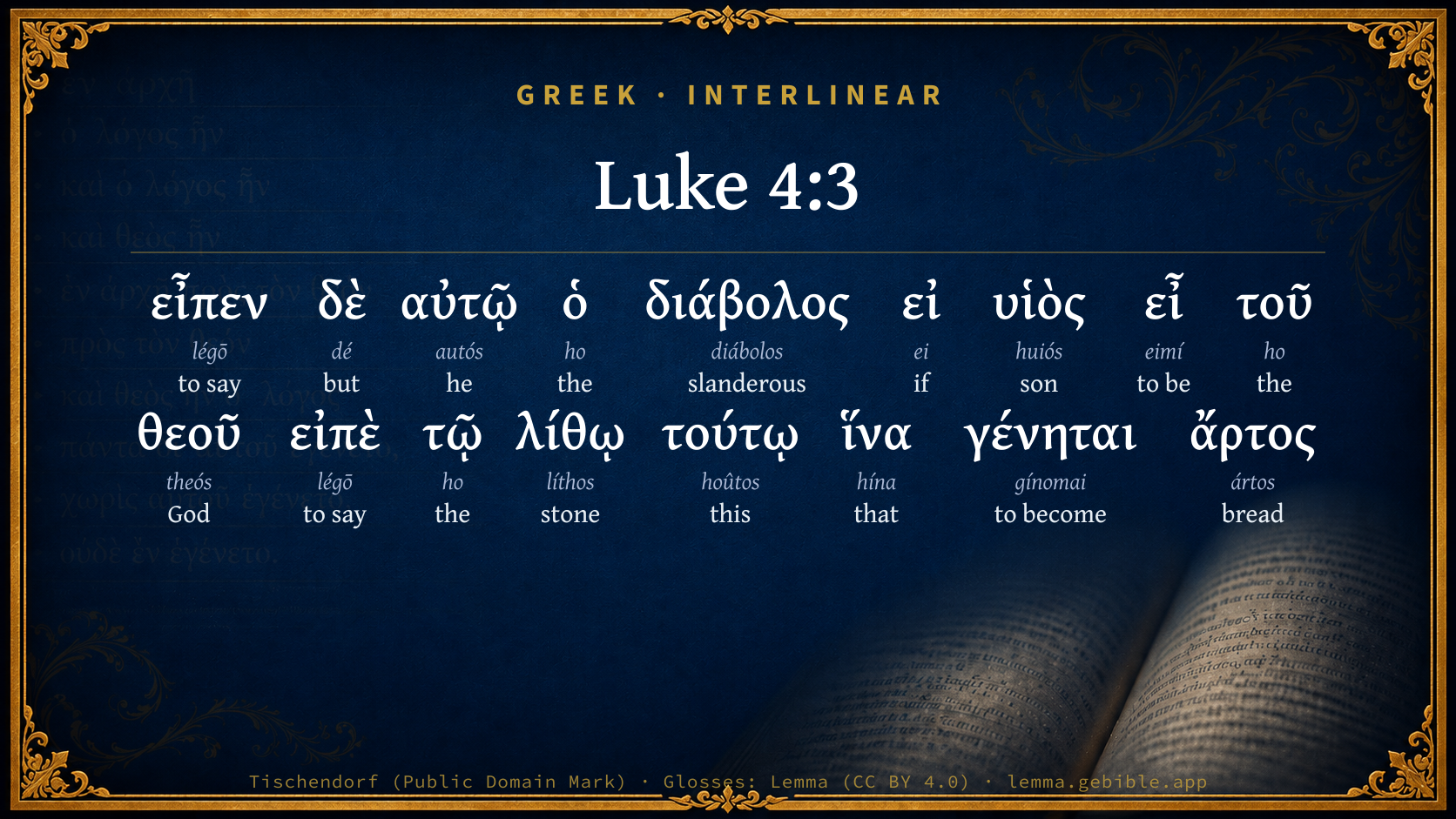
Greek (Tischendorf 8th ed.) Luke 4:3 appears in the Greek New Testament. The text above is from the Tischendorf 8th edition. Each word links to its Strong’s number and a concise gloss. Click any word for its full Thayer’s Greek Lexicon entry.
Download image
Cite this verse

Luke 4:3 (World English Bible). Public Domain. Lemma interlinear Bible study tool, https://lemma.gebible.app/v/luke/4/3.

Show BibTeX & RIS
BibTeX
RIS
English Translation
The devil said to him, "If you are the Son of God, command this stone to become bread."
World English Bible · Public Domain
Download a study sheet

One document with this verse’s original text, its word-by-word gloss line, the meaning frame, cross-references with their text, attributed commentary, and full source and license credits — printable, and it pastes into notes with its structure intact.

This verse Autodidact and up

Study sheet (.html) Plain text (.txt)

A passage Seminary Student

Up to 50 verses in one chapter. A passage sheet keeps up to 6 commentary sources and 12 cross-references per verse, in the order this page ranks them, and says so on the sheet whenever that leaves anything out. Ask for a single verse and you get the Autodidact verse sheet above.

Everything on this page stays free to read, with no account — the sheet is a download of what is already on screen, not access to it.

Want to remove ads? Support Godless Engineer
Compare translations 3

The same verse in 3 English versions, stacked beneath the original-language interlinear above. Click any original word for its lexicon entry.

Each is an independent rendering of the whole verse — the interlinear is not word-aligned to these translations.

Highlighted words mark where these versions differ — a whole-verse word diff, not a word-by-word alignment.

  • World English Bible Public Domain
    The devil said to him, "If you are the Son of God, command this stone to become bread."
  • King James Version Public Domain
    And the devil said unto him, If thou be the Son of God, command this stone that it be made bread.
  • unfoldingWord Literal Text CC BY-SA 4.0
    Then the devil said to him, “If you are the Son of God, speak to this stone so that it might become bread.”

unfoldingWord Literal Text — © unfoldingWord, licensed CC BY-SA 4.0. Word-aligned USFM3 via Door43 (git.door43.org/unfoldingWord/en_ult).

Versions to compare (up to 4)

3 of 4 selected

Show all 19 translations

Every available English version of this verse, each an independent rendering of the whole verse.

  • World English Bible Public Domain
    The devil said to him, "If you are the Son of God, command this stone to become bread."
  • Berean Standard Bible Public Domain
    The devil said to Him, “If You are the Son of God, tell this stone to become bread.”
  • Majority Standard Bible Public Domain
    The devil said to Him, “If You are the Son of God, tell this stone to become bread.”
  • King James Version Public Domain
    And the devil said unto him, If thou be the Son of God, command this stone that it be made bread.
  • American Standard Version (1901) Public Domain
    And the devil said unto him, if thou art the Son of God, command this stone that it become bread.
  • Revised Version (1885) Public Domain
    And the devil said unto him, If thou art the Son of God, command this stone that it become bread.
  • Geneva Bible (1599) Public Domain
    Then the deuil saide vnto him, If thou be the Sonne of God, commaund this stone that it be made bread.
  • Douay-Rheims (1899) Public Domain
    And the devil said to him: If thou be the Son of God, say to this stone that it be made bread.
  • Young's Literal Translation Public Domain
    and the Devil said to him, `If Son thou art of God, speak to this stone that it may become bread.'
  • Literal Standard Version CC BY-SA 4.0
    and the Devil said to Him, “If You are [the] Son of God, speak to this stone that it may become bread.”
  • Unlocked Literal Bible CC BY-SA 4.0
    The devil said to him, “If you are the Son of God, command this stone to become bread.”
  • unfoldingWord Literal Text CC BY-SA 4.0
    Then the devil said to him, “If you are the Son of God, speak to this stone so that it might become bread.”
  • Darby Bible Public Domain
    And the devil said to him, If thou be Son of God, speak to this stone, that it become bread.
  • World Messianic Bible Public Domain
    The devil said to him, “If you are the Son of God, command this stone to become bread.”
  • Webster's Bible Public Domain
    And the devil said to him, If thou art the Son of God, command this stone that it be made bread.
  • Free Bible Version CC BY-SA 4.0
    The devil said to him, “If you are the Son of God, command this stone to become bread.”
  • Bible in Basic English Public Domain
    And the Evil One said to him, If you are the Son of God, give orders to this stone to become bread.
  • Text-Critical English NT CC BY 4.0
    Then the devil said to him, “If yoʋ are the Son of God, command this stone to become bread.”
  • Tyndale New Testament (1534) Public Domain
    And the devyll sayde vnto him: yf thou be the sonne of God commaunde this stone that it be breed.

Literal Standard Version (2020), Covenant Press — licensed CC BY-SA 4.0. Text via the HelloAO Bible API (eBible.org). Unlocked Literal Bible (unfoldingWord) — licensed CC BY-SA 4.0. Text via the HelloAO Bible API (eBible.org). unfoldingWord Literal Text — © unfoldingWord, licensed CC BY-SA 4.0. Word-aligned USFM3 via Door43 (git.door43.org/unfoldingWord/en_ult). Free Bible Version, Dr. Jonathan Gallagher — licensed CC BY-SA 4.0. Text via the HelloAO Bible API (eBible.org).

Word by word

More ways to search: Search by grammar → Find every occurrence → Compare this word →

Practice this passage: Drill this verse → Learn its vocabulary →

διάβολος
diábolos
G1228
“slanderous”
Adjective, Nominative, Singular, Masculine
Part of Speech
Adjective
Case
Nominative
Number
Singular
Gender
Masculine
Full Thayer's Definition

Origin: from G1225

TDNT: 03:12,1

1. prone to slander, slanderous, accusing falsely a. a calumniator, false accuser, slanderer, 2. metaph. applied to a man who, by opposing the cause of God, may be said to act the part of the devil or to side with him
  1. εἶπεν légō G3004 “to say” Verb, Aorist, Active, Indicative, 3rd person, Singular
  2. δὲ dé G1161 “but” Conjunction
  3. αὐτῷ autós G846 “he” Personal pronoun, Dative, Singular, Masculine
  4. ὁ ho G3588 “the” Article, Nominative, Singular, Masculine
  5. εἰ ei G1487 “if” Conditional
  6. υἱὸς huiós G5207 “son” Noun, Nominative, Singular, Masculine
  7. εἶ eimí G1510 “to be” Verb, Present, Active, Indicative, 2nd person, Singular
  8. τοῦ ho G3588 “the” Article, Genitive, Singular, Masculine
  9. θεοῦ theós G2316 “God” Noun, Genitive, Singular, Masculine
  10. εἰπὲ légō G3004 “to say” Verb, Aorist, Active, Imperative, 2nd person, Singular
  11. τῷ ho G3588 “the” Article, Dative, Singular, Masculine
  12. λίθῳ líthos G3037 “stone” Noun, Dative, Singular, Masculine
  13. τούτῳ hoûtos G3778 “this” Demonstrative pronoun, Dative, Singular, Masculine
  14. ἵνα hína G2443 “that” Conjunction
  15. γένηται gínomai G1096 “to become” Verb, Aorist, Middle deponent, Subjunctive, 3rd person, Singular
  16. ἄρτος ártos G740 “bread” Noun, Nominative, Singular, Masculine

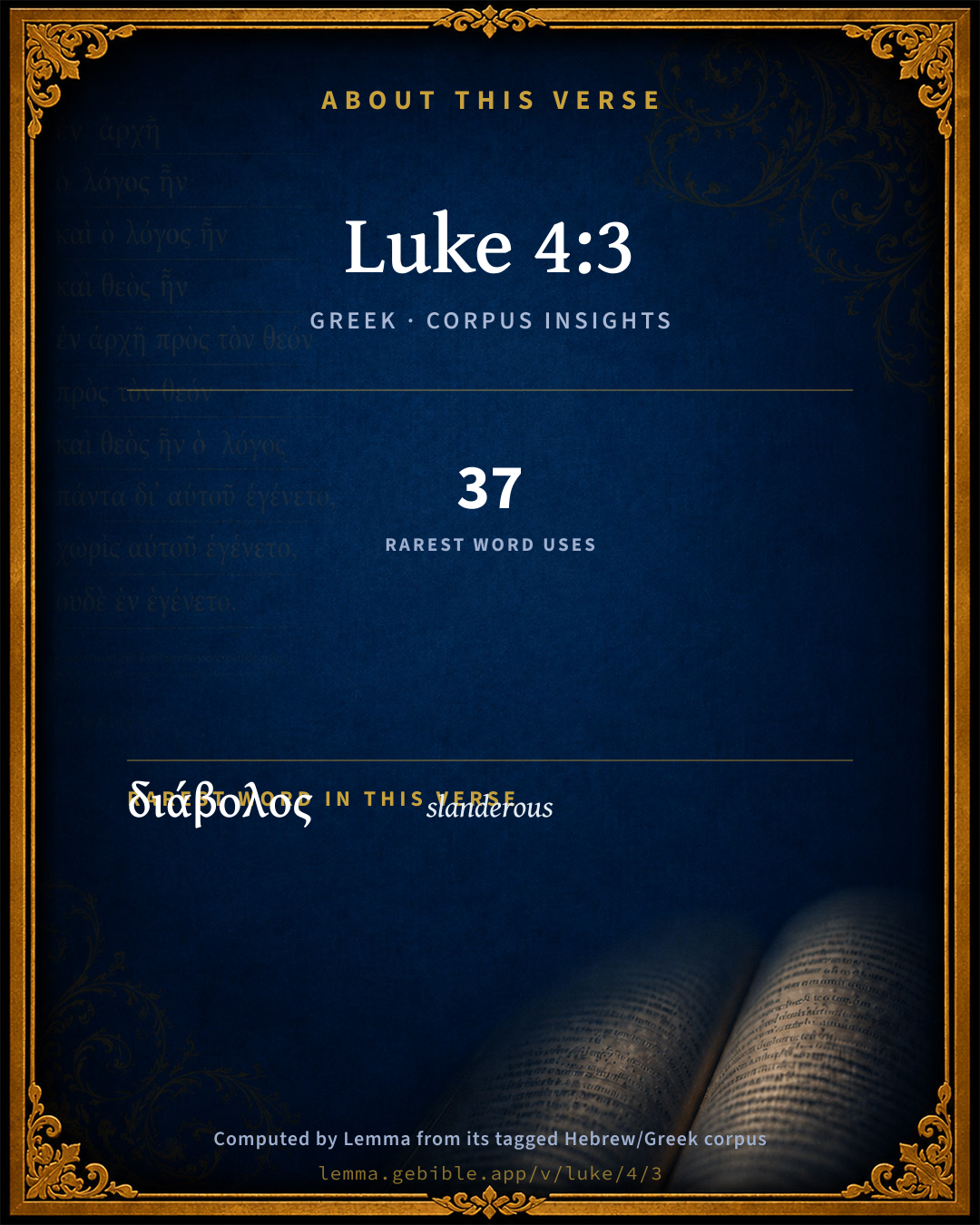
About this verse

These counts appear in no published source. They are computed here, from the morphology-tagged text and Lemma’s own curated glosses. What Lemma adds →

17
words
14
distinct lemmas
Gospels
section

Shared distinctive vocabulary

διάβολος slanderous G1228 occurs in 35 verses of the Greek New Testament. Also found in:
Repetition

Words recur within this verse:

Cross-references

2

Topical passages linked to Luke 4:3 in the Treasury of Scripture Knowledge — connected by theme and wording, ordered by reader-vote popularity; previews shown in the World English Bible.

  • Matthew 4:3 The tempter came and said to him, "If you are the Son of God, command that these stones become bread."
  • Luke 3:22 and the Holy Spirit descended in a bodily form as a dove on him; and a voice came out of the sky, saying "You are my beloved Son. In you I am well pleased."

Cross-references courtesy of OpenBible.info (CC BY 4.0).

Commentary

Notes on Luke 4:3 from classic Christian and Jewish commentators (each source and its license shown beneath its notes). The classic Christian expositions comment on the surrounding passage and are grouped to its opening verse, so a note may address several verses; the Jewish commentaries on the Tanakh (Rashi and others) are per-verse, so they appear only where the commentator wrote on this verse.

Lemma curates 59 commentaries, every one of them public domain or Creative Commons licensed, each selected and text-cleaned for this edition rather than reprinted as found. About our sources →

Matthew Poole's English Annotations

See Poole on "Mat 4:3-4". It is very observable, that Christ here asserts the authority of the Scriptures; and though he was full of the Holy Ghost, yet maketh the Holy Scripture his rule of action.

Matthew Poole's English Annotations on the Holy Bible (1683–1685) — public domain. Text from a community e-Sword/MySword module.

The Biblical Illustrator

Joseph S. Exell

Luk_4:3

If Thou be the Son of God

The devils preface

Satan knows how to write prefaces: here is one.

He began the whole series of his temptations by a doubt cast upon our Lords Sonship, and a crafty quotation from Scripture. He caught up the echo of the Fathers word at our Lords baptism, and began tempting where heavenly witness ended. He knew how to discharge a doubleshotted temptation, and at once to suggest doubt and rebellion-- If command.

I. THE TEMPTER ASSAILS WITH AN IF.

1. Not with point-blank denial. That would be too startling. Doubt serves the Satanic purpose better than heresy.

2. He grafts his if on a holy thing. He makes the doubt look like holy anxiety concerning Divine Sonship.

3. He ifs a plain Scripture. Thou art My Son (Psa_2:7).

4. He ifs a former manifestation. At His baptism God said, This is My beloved Son. Satan contradicts our spiritual experience.

5. He ifs a whole life. From the first Jesus had been about His Fathers business; yet after thirty years His Sonship is questioned.

6. He ifs inner consciousness. Our Lord knew that He was the Fathers Son; but the evil one is daring.

7. He ifs a perfect character. Well may he question us, whose faults are so many.

II. THE TEMPTER AIMS THE IF AT A VITAL PART.

1. At our sonship. In our Lords case he attacks His human and Divine Sonship. In our case he would make us doubt our regeneration.

2. At our childlike spirit. He tempts us to cater for ourselves.

3. At our Fathers honour. He tempts us to doubt our Fathers providence, and to blame Him for letting us hunger.

4. At our comfort and strength as members of the heavenly family.

III. THE TEMPTER SUPPORTS THAT IF WITH CIRCUMSTANCES.

1. YOU are alone. Would a father desert his child?

2. You are in a desert. Is this the place for Gods Heir?

3. You are with the wild beasts. Wretched company for a Son of God I

4. You are an hungered. How can a loving Father let His perfect Son hunger? Put all these together, and the tempters question comes home with awful force to one who is hungry and alone. When we see others thus tried, do we think them brethren? Do we not question their sonship, as Jobs friends questioned him? What wonder if we question ourselves!

IV. WHEN OVERCOME, THE TEMPTERS IF IS HELPFUL.

1. As coming from Satan, it is a certificate of our true descent.

(1) He only questions truth: therefore we are true sons.

(2) He only leads sons to doubt their sonship: therefore we are sons.

2. As overcome, it may be a quietus to the enemy for years. It takes the sting out of mans questionings and suspicions; for if we have answered the devil himself we do not fear men.

3. As past, it is usually the prelude to angels coming and ministering to us. (C. H.Spurgeon.)

The force of an if

What force there is often in a single monosyllable! What force, for instance, in the monosyllable if, with which this artful address begins! It was employed by Satan, for the purpose of insinuating into the Saviours mind a doubt of His being in reality the special object of His Fathers care, and it was pronounced by him, as we may well suppose, with a cunning and malignant emphasis. How different is the use which Jesus makes of this word if in those lessons of Divine instruction and heavenly consolation, which He so frequently delivered to His disciples when He was on earth l He always employed it to inspire confidence; never to excite distrust. Take a single instance of this: If God so clothe the grass of the field, which to-day is, and to-morrow is cast into the oven, shall He not much more clothe you, O ye of little faith? What a contrast between this Divine remonstrance and the malicious insinuation of the great enemy of God and man! (Dean Bagot.)

Oh, this word if! Oh, that I could tear it out of my heart! O thou poison of all my pleasures! Thou cold icy hand, that touchest me so often, and freezest me with the touch! If! I! (Robert Robinson.)

The beginning of temptation

I. The first step towards God is faith in Him and His love. The first step away from Him is doubt. Therefore the devil begins all temptation by seeking to inspire the human soul with doubt. He sought to make Eve doubt Gods loving purpose towards her by his Yea, hath God said?

II. 1. How often are we tempted to doubt Gods love! Especially is this the case when we are left for a time without any sensible tokens of His presence.

2. How shall we meet this temptation? By reliance on the Word and the promise of God. Is there not in His Word food for the hungry, solace for the lonely, comfort for the desponding? (Canon Vernon Hutton, M. A.)

That where Satan carries on a main design and end he bestows most of his pains and skill in rendering the means to that end plausible and taking

The end is least in mention, and the means in their fit contrivance takes up most of his art and care. The reasons whereof are these--

(1) The end is apparently bad, so that it would be a contradiction to his design to mention it. It is the snare and trap itself, which his wisdom and policy directs him to cover. His ultimate end is the destruction of the soul. This he dare not openly avouch to the vilest of men.

(2) The means to such wicked ends have not only an innate and natural tendency in themselves, which are apt to sway and bias men that way, but are also capable of artificial improvement, to a further enticement to the evils secretly intended; and these require the art and skill for the exact suiting and fitting of them.

(3) The means are capable of a varnish and paint. He can make a shift to set them off and colour them over, that the proper drift of them cannot easily be discovered; whereas the ends to which these lead cannot receive, at least so easily with some, such fair shows. It is far easier to set off company-keeping, with the pleasurable pretences of necessity or refreshing divertisement, than to propound direct drunkenness, the thing to which company-keeping tends, under such a dress. If it be demanded, How and by what arts he renders the means so plausible? I shall endeavour a satisfaction to that query, by showing the way that Satan took to render the means he made use of in this temptation plausible to Christ, which were these:

(1) He represents it as a harmless or lawful thing in itself. Who can say it had been sinful for the Son of God to have turned stones into bread, more than to turn water into wine?

(2) He gives the motion a further pretext of advantage or goodness. He insinuated that it might be a useful discovery of His Sonship, and a profitable supply against hunger.

(3) He seems also to put a necessity upon it, that other ways of help failing, He must be constrained so to do, or to suffer further want.

(4) He forgets not to tell Him that to do this was but suitable to His condition, and that it was a thing well becoming the Son of God to do a miracle.

(5) He doth urge it at the rate of a duty, and that being in hunger and want, it would be a sinful neglect not to do what He could and might for His preservation. (R. Gilpin.)

First, shipwreck of faith, then of obedience

The devil here seeing Him in great want and hunger, would thereby bring in doubt, that He was not the Son of God, which is not a good argument. For whether we respect the natural tokens of Gods favour, we see they happen not to the wisest and men of best and greatest knowledge, as appeareth in Ecc_9:11, or the supernatural favour of God. We shall see Abraham forced to fly his country into Egypt for famine (Gen_10:12). So did Isaac Gen_26:1). And Jacob likewise was in the same distress Gen_43:1). Notwithstanding that God was called the God of Abraham, Isaac, and Jacob, yet were they all three like to be hunger-starved. Yea, not only so, but for their faith many were burned and stoned, of whom the world was not worthy (Heb_11:37). So fared it with the apostles; they were hungry, naked, and athirst (1Co_4:11). (Bishop Andrewes.)

Joy and comfort ruined by doubt

Hope, joy, peace, thankfulness, repentance, obedience, prayer, patience, worship--all these will vanish away like a morning mist before the sun if the devil can make you distrust with such a temptation as this, If thou, &c. (Bishop Hacket.)

Certitude of salvation

1. That the Holy Ghost doth beget a true and an humble assurance in many of the faithful touching the remission of their sins in this life.

2. The Holy Ghost doth beget this assurance in them, by causing them to examine what good fruits they have produced already from a lively faith, and do resolve to produce thereafter.

3. This comfortable assurance is not the formal act of justifying faith, but an effect which follows it.

4. This assurance is not alike in all that are regenerate, nor at all times alike.

5. No mortified humble Christian must despair, or afflict his heart, because scruples arise in his mind, so that he cannot attain to a strong confidence or assurance in Christs mercies. He that can attain but to a conjectural hope, or some beginnings of gracious comfort, shall be blessed before God, who will not quench the smoking flax. (Bishop Hacket.)

All Christians have not the same degree of assurance

Every tree doth not shoot out its root so far as another, and yet may be firm in the ground, and live as well as that whose root is largest. So every faith streteheth not forth the arms of particular assurance to embrace Christ alike, and yet it may be a true faith, that lives by charity, repentance, and good works; some faith abounds with one sort of fruits, some with another. God is delighted with all that are good, and He will reward them. In all kind of Divine conclusions some are more doubtful spirited than others. (Bishop Hacket.)

Faith assaulted

We see it is the devils endeavour to call into question the truth of Gods Word. God had said, Thou art My Son, and now he comes with his If Thou be the Son of God. In the Word of God there be specially three things--

1. Commandments.

2. Threatenings.

3. Promises.

Secondly, faith is the very life of our lives, and the strength of our souls, without which we are but very drudges and droils in this life. The Holy Ghost fill you with all joy in believing (Rom_15:13). And believing, ye rejoiced with joy glorious and unspeakable (1Pe_1:8). Therefore the devil, envying our comfort and our happiness, would rob us of our faith, that he might rob us of our joy. Thirdly, faith is our choicest weapon, even our shield and buckler to fight against him, whom resist steadfast in the faith (1Pe_5:9). Therefore, as the Philistines got away the Israelites weapons, so doth Satan, in getting away faith from us, disarm us and make us naked. For this is our victory whereby we overcome, even our faith (1Jn_5:1-21.). And in this faith apprehending Gods strength lies our strength, as Samsons in his locks; and, therefore, the devil, knowing this, labours to do to us which Delilah did to Samson, even to cut off our locks. (D. Dyke.)

Affliction no argument against sonship

If any man should be used like a dog, or a bear, yet as long as he sees human shape and discerns the use of human reason in himself, he would still, for all this usage, think himself to be a man. So though the children of God be used here in this world as if they were wicked, yet as long as they feel the work of grace, and the power of Gods Spirit, they must still hold themselves to be Gods children. (D. Dyke.)

This stone bread--

The plea of necessity

That Satan usually endeavours to run his temptations upon the plea of necessity, and from thence to infer a duty. The reasons of this policy are these:

1. He knows that necessity hath a compulsive force, even to things of otherwise greatest abhorrencies.

2. Necessity can do much to the darkening of the understanding, and change of the judgment, by the strong influence it hath upon the affections. Men are apt to form their apprehensions according to the dictates of necessity.

3. Necessity offers an excuse, if not a justification, of the greatest miscarriages.

4. Necessity is a universal plea, and fitted to the conditions of all men in all callings, and under all extravagancies. The tradesman, in his unlawful gains or overreachings, pleads a necessity for it from the hardness of the buyer in other things.

We may observe three cheats in this plea of necessity.

1. Sometimes he puts men upon feigning a necessity where there is none.

2. Sometimes he puts men upon a necessity of their own sinful procurement.

3. Sometimes he stretcheth a necessity further than it ought. This must warn us not to suffer ourselves to be imposed upon by the highest pretences of necessity. (R. Gilpin.)

To open this a little further, I shall add the reasons why Satan strikes in with such an occasion as the want of means to tempt to distrust, which are these:--

1. Such a condition doth usually transport men beside themselves.

2. Sense is a great help to faith. Faith, then, must needs be much hazarded when sense is at a loss or contradicted, as usually it is in straits. That faith doth receive an advantage by sense, cannot be denied. But when out ward usual helps fail us, our sense, being not able to see afar off, is wholly puzzled and overthrown. The very disappearing of probabilities gives so great a shake to our faith that it commonly staggers at it. It is no wonder to see that faith, which usually called sense for a supporter, to fail when it is deprived of its crutch.

3. Though faith can act above sense, and is employed about things not seen, yet every saint at all times doth not act his faith so high.

4. When sense is nonplussed, and faith fails, the soul of man is at a great loss. The other branch of the observation, that from a distrust of providence he endeavours to draw them to an unwarrantable attempt for their relief, is as clear as the former.

That from a distrust men are next put upon unwarrantable attempts, is clear from the following reasons:

1. The affrightment which is bred by such distrusts of providences will not suffer men to be idle. Fear is active, and strongly prompts that something is to be done.

2. Yet such is the confusion of mens minds in such a ease, that though many things are propounded, in that hurry of thoughts they are deprived usually of a true judgment and deliberation.

3. The despairing grievance of spirit makes them take that which comes next to hand, as a drowning man that grasps a twig or straw, though to no purpose.

4. Being once turned off their rock, and the true stay of the promise of God for help, whatever other course they take must needs be unwarrantable.

5. Satan is so officious in an evil thing, that seeing any in this condition, he will not fail to proffer his help; and in place of Gods providence, to set some unlawful shift before them.

6. And so much the rather do men close in with such overtures, because a sudden fit of passionate fury doth drive them, and out of a bitter kind of despite and crossness--as if they meditated a revenge against God for their disappointment--they take up a hasty wilful resolve to go that way that seems most agreeable to their passion.

Application: Failures or ordinary means should not fill us with distrust, neither then should we run out of Gods way for help. He that would practise this must have these three things which are comprehended in it.

1. He must have full persuasions of the power and promise of God.

2. He that would thus wait upon God had need to have an equal balance of spirit in reference to second causes.

3. There is no waiting upon God, and keeping His way, without a particular trust in God. But let the strait be what it will, we must not forsake duty; for so we go out of Gods way, and do contradict that trust and hope which we are to keep up to God-ward. But there are other cases wherein it is our duty to fix our trust upon the particular mercy or help. I shall name four; and possibly a great many more may be added. As--

1. When mercies are expressly and particularly promised.

2. When God leads us into straits by engaging us in His service.

3. When the things we want are common universal blessings,, and such as we cannot subsist without.

4. When God is eminently engaged for our help, and His honour lies at stake in that very matter. (R. Gilpin.)

Stones turned into bread

How many are there that turn, not stones into bread, but lies, flatteries, base shifts, into silver and gold, yea, jewels and precious stones? Others turn stones, yea, precious stones, and their whole substance into bread, into meats, drinks, and apparel, and wastefully lavish Gods good creatures on idle backs and bellies, using this as a means to procure something their affections want. (D. Dyke.)

How many sins the devil couched and infolded in this one

It teaches us not to measure actions by the outward appearance. What a matter is it to eat bread when one is hungry? but we see what a matter it would have been here in Christ. A little pin, specially being poisoned, may prick mortally, as well as a great sword. Adams eating the fruit seems a small matter to flesh and blood, which wonders that so small a pin should wound all mankind to the death. But Adams sin was not simply the eating of the apple, but the eating of the apple forbidden by God. There was the deadly poison of that little pin. And there also the devil so handled the matter, that all the commandments were broken in that one action. As the first table in his infidelity, doubting both of Gods truth and goodness, contempt of, and rebellion against God, preferring of Satan before God, and in the profanation of that fruit he ate, which was a sacrament. And for the second table, he broke the fifth commandment, in his unthankfulness to God his Father, that gave him his being, and had bestowed so many blessings upon him. The sixth in the murder of himself and all his posterity, body and soul. The seventh in his intemperancy. The eighth in touching anothers goods against the will of the Lord. The ninth in receiving the devils false witness against God. The tenth in being discontent with his estate, and lusting after an higher. Take we heed now of the deceit of sin. It shows little sometimes, but oh the bundle of mischief that is lapped up in that little! (D. Dyke.)

The aim of Satanic temptation not always apparent

Like a waterman, he looks one way and rows another. The special thing he shot at, indeed, was to make Christ call in question the truth of that oracle that sounded at Jordan, to think through unbelief that He was not the Son of God. But yet the words of the temptation seem to import that he sought only the working of the miracle. And yet the devil would rather a great deal He would never work the miracle, so He would doubt Himself not to be the Son of God. For this would have been the greater foil. This discloses to us one of Satans mysteries. Sometimes he will tempt us to some sin, to which yet he cares not much whether we yield or no, hoping to get a greater conquest of us by not yielding. As thus, when by not yielding we grow proud, vain-glorious, secure, confident; wherein the devil seems to deal like a cunning gamester, that hides his skill, and loses two or three games at the first, that he may win so much the more afterwards. (D. Dyke.)

God not served for temporal profit

If every good Christian were satisfied at all times with temporal blessings, we should appear to serve God for our own profit, that we might lack nothing which concerned this transitory life. (Bishop Hacker.)

The eye to look to heaven

God doth not suppeditate bread always to him that is His son, that he may loathe this world, and look for a recompense for all this misery, not among these hard-hearted generations of men, but among the habitations of the blessed. (Bishop Hacker.)

Hereafter

It is my turn to want for awhile, I shall be replenished hereafter. (Bishop Hacker.)

Better than bread

Though a good man labour and watch, and cannot earn the bread of his carefulness, yet he shall fill his bosom with better fruits, for occasion is given hereby to the righteous to exercise these three spiritual graces, Prayer, and Patience, and Charity. (Bishop Hacker.)

The devils bread

There are others under these, indeed, yet of a most vile condition, that eat their bread by wrongful dealing, when it is grounded with the devils millstones; and according to Aristotle, my former director, these may be ranged into three sorts: Such as maintain themselves with no calling, such as use a bad calling, and such as cheat in a good calling. We must eat our bread by prayer to God, and good employment in the world, that is, by the duty of invocation, and by the fruits of our vocation; therefore he that fills up no place or part in a commonwealth to earn his gains must needs take the devils counsel to live by unjust means, command that these stones be made bread. (Bishop Hacker.)

Bad bread

By extortion and usury we may make stones into bread, that is the devils alchemistry: or haply we may make bread of nothing, when a man gets a thing by anothers oversight (Gen_43:12). Or else, what and if we can overreach our brother in subtilty, and go beyond him with a trick of wit or cunning t Let no man defraud or oppress his brother in any matter: for the Lord is avenged of all such (1Th_4:6). The one is called the bread of violence and oppression (Pro_4:17); the other, the bread of deceit. (Bishop Andrewes.)

The first temptation

Though in form sensuous, it is in essence moral or spiritual. What constituted it a temptation-where lay its evil? Christ had to live His personal life

(1) within the limits necessary to man, and

(2) in perfect dependence upon God. Had He transgressed either of these conditions, He had ceased to be mans ideal Brother or Gods ideal Son. His supernatural power existed not for Himself, but for us. The ideal Son could not act as if He had no Father. He conquered by faith, and His first victory was like His last. The taunts He had to bear on the cross-- He saved others, Himself He cannot save, &c.

were but a repetition of the earlier temptations; and then, as now, though the agony was deeper, and the darkness more dense, He triumphed by giving Himself into the hands of the Father. (A. M. Fairbairn, D. D.)

The first assault

I. THE SATANIC SUGGESTION. TO have complied with it would have been a violation of what, on reflection, appeared to Jesus to be the Fathers will.

II. THE REPLY OF OUR LORD--It is written, man shall not live, &c. This reply--

1. Disposes most effectually of all the arguments which are commonly urged in defence of modern excesses.

2. Points to mans higher nature as his distinguishing possession.

3. Teaches that man is not dependent on bread or material sustenance even for his lower life, but on the sustaining Word of God. (W. Landels, D. D.)

Life not a necessity

In excuse for some offence against the moral law, it was said to our great English moralist of the last century: A man must live. Sir, said Dr. Johnson, I do not see the necessity. That was the Stoic form of the principle enunciated in our Lords reply, but our Lord invests it with an infinitely higher character by expressing it in the gracious tones of the gospel. It was true in the highest sense that a man must live; but his life does not consist in the mere gratification of his bodily cravings, or even the natural desires of his mind and heart, or even in his life here. The essential life of his nature consists in his living and acting in harmony with the will of God. (H. Wace, D. D.)

Appositeness of the temptation

The temptation was shrewdly contrived to meet the peculiar circumstances. Remember that the desert and the Dead Sea, lying in the basin of the barren hills, were a figure of the desolation brought on the world by sin, and that probably our Lord, from the wilderness, looked over this picture of death, and saw in it a figure of the scene of His moral operation. Now Satan steals up to Him, holding out a dead stone, and asks Him to begin His work by transforming that stone. As He is about to make the desert fruitful, and the wilderness blossom as a rose, and the Sea of Death become a lake of living water, let Him begin His work symbolically, with a stone of this district. Very probably the temptation was not to turn the piece of black stone into white wheaten bread, but into the homely, hard rye, black bread, which nourishes, but is no dainty. On the way to Jericho, and, indeed, all around the Dead Sea, are to be found in chalk beds, masses of flint, of rounded shape, which the Arabs suppose to be the olives, apples, melons, and other fruit of the time of Sodom and Gomorrah, which, at the overthrow of the cities, were turned into stone. Some of these stones have the size and shape of loaves, and it is possible that Satan took one of these rounded masses of flint, and, with his undercurrent of bitterness and scorn, offered it to Christ, supposing Him to share the popular superstition about them. If we may expand his words, they ran thus: See this loaf-like flint stone! No doubt it was once bread in one of the houses of Sodom, but God overthrew the wicked city, and the bread was turned into stone. Now, O Son of God--that is, if you are the Son of God--as you have come to undo the work of destruction wrought by sin, and to bring life into a world subject to death, show your power on this stone, and turn it back into the loaf of bread which it once was. (S. Baring-Gould, M. A.)

These stones

They were, perhaps, those siliceous accretions, sometimes known under the name of lapides judaici, which assume the exact shape of little loaves of bread, and which were represented in legend as the petrified fruits of the cities of the plain. The pangs of hunger work all the more powerfully when they are stimulated by the added tortures of a quick imagination; and if the conjecture be correct, then the very shape and aspect and traditional origin of these stones would give to the temptation an added force. (Archdeacon Farrar.)

Crystallization

The stones called Elijahs melons, on Mount Carmel, and the Virgin Marys peas, near Bethlehem, are instances of crystallization well known in limestone formations. They are so called as being the supposed produce of these two plats turned into stone, from the refusal of the owners to supply the wants of the prophet and the saint. (Dean Stanley.)

The Biblical Illustrator, edited by Joseph S. Exell (c. 1880s–1900s) — public domain. Text from a community e-Sword module.

Joseph Benson's Commentary

Luk 4:3-12. The devil said, If thou be the Son of God, &c. — For an explanation of this whole paragraph, see notes on Mat 4:3-10. The devil taketh him up into a high mountain, &c. — This temptation, which stands here as the second, is by Matthew placed the last of the three. To reconcile the evangelists, it may be observed, that Matthew recites the temptations in the order in which they occurred; for he plainly affirms this order by the particle then, Luk 4:5, and again Luk 4:10, and at the conclusion of this temptation says, that then the devil left him. In this order they appear to rise progressively in strength one above another; Matthew, therefore, having preserved the true order of the temptations, Luke must be supposed to have neglected it as a thing not very material. And the supposition may be admitted without weakening his authority in the least, for he connects the temptations only by the particle και, and, which imports that he was tempted in these several ways, without marking the time or order of the temptations, as Matthew appears to do.

Joseph Benson's Commentary on the Old and New Testaments (1811–1818) — public domain. Text from a community e-Sword module.

Tyndale Open Study Notes

Tyndale Open Resources

4:3 If you are the Son of God: Both Israel and Adam are identified as God’s son (3:38; Exod 4:22-23; Hos 11:1). Jesus, the Son of God in the fullest sense, succeeded where Adam and Israel failed.

Tyndale Open Study Notes — © Tyndale Open Resources, licensed CC BY-SA 4.0. Text via the HelloAO Bible API.

Expositor's Greek Testament

ed. W. Robertson Nicoll

Luk 4:3-4 . First temptation . τῷ λίθῳ τ .: possibly the stone bore a certain resemblance to a loaf. Vide Farrar’s note (C. G. T.), in which reference is made to Stanley’s account ( Sinai and Palestine , p. 154) of “Elijah’s melons” found on Mount Carmel, as a sample of the crystallisations found in limestone formations.

The Expositor's Greek Testament, edited by W. Robertson Nicoll (1897–1910) — public domain. Text from a community e-Sword module.

Cambridge Greek Testament for Schools and Colleges

3. εἶπεν δὲ αὐτῷ ὁ διάβολος. St Luke says nothing about the devil ‘approaching Him’ (Mat 4:3), and thereby wholly leaves on one side the question of any corporal appearance.

εἰ υἱὸς εἶ τοῦ θεοῦ. Doubtless an allusion to the divine Voice at His baptism (Luk 3:22). The same words were tauntingly addressed to our Lord on the Cross (Mat 27:40). The Greek strictly means “Assuming that Thou art,” or “Since Thou art,” but in Hellenistic Greek words and phrases are not always used with their earlier delicate accuracy.

εἰπὲ τῷ λίθῳ τούτῳ. Say to this stone. The Greek implies that the Tempter called direct attention to a particular stone. In this desert there are loaf-shaped fossils known to early travellers as lapides judaici, and to geologists as septaria. Some of these siliceous accretions assume the shape of fruit, and are known as ‘Elijah’s melons’ (Stanley, Sin. and Pal. 154). They were popularly regarded as petrified fruits of the Cities of the Plain. Such deceptive semblances would intensify the pangs of hunger, and add to the temptation the additional torture of an excited imagination. (See a sketch of such a septarium in the Illustrated Edition of my Life of Christ, p. 99.)

ἵνα γένηται ἄρτος. ‘That it may become a loaf.’ Here again we have the extended use of ἵνα in Hellenistic Greek which has been already noticed. The subtle malignity of the temptation is indescribable. It was a temptation to ‘the lust’ (i.e. the desire ‘of the flesh;’ a temptation to gratify a natural and blameless appetite; an appeal to free-will and self-will, closely analogous to the devil’s first temptation of the race. ‘You may; you can; it will be pleasant: why not?’ (Gen 3:1-15). Yet it did not come in an undisguisedly sensuous form, but with the suggestive semblance of Scriptural sanctions (1Ki 19:8; Deu 8:16; Psa 78:19).

Cambridge Greek Testament for Schools and Colleges (Cambridge University Press, 1896; 21 vols, various authors incl. Carr, Maclear, Plummer, Farrar, Lumby, Moule, M. R. James, Simcox) — public domain. Text from a community e-Sword module.

International Critical Commentary

3. εἶπεν. Mt. adds προσελθών, which is a very favourite expression of his.It does not necessarily imply corporal presence, although Mt. himself may have understood it in that sense. Jesus says of the approaching struggle in Gethsemane, “The prince of the world cometh” (Joh 14:30). Nowhere in Scripture is Satan said to have appeared in a visible form: Zec 3:1 is a vision. And nothing in this narrative requires us to believe that Satan was visible on this occasion.

Εἰ υἱὸς εἶ τοῦ Θεοῦ. Both Mt. and Lk. have υἱός τ. Θ. without the article, the reference being to the relationship to God, rather than to the office of the Messiah. The emphatic word is υἱός. The allusion to the voice from heaven (3:22) is manifest, but is not likely to have occurred to a writer of fiction, who would more probably have written, “If Thou art the Christ.” The “if” does not necessarily imply any doubt in Satan, although Augustine takes it so;1 but it is perhaps meant to inspire doubt in Jesus: “Hath God said, Thou art My beloved Son, and yet forbidden Thee to give Thyself bread?” Comp. “Yea, hath God said, Ye shall not eat of any tree of the garden?” (Gen 3:1). The suggestion seems to be that He is to work a miracle in order to prove the truth of God’s express declaration, and that He may doubt His relation to God, if God does not allow the miracle.

This seems better than to regard the first temptation as a temptation of the flesh. If the food had been there, would it have been sinful for Jesus to partake of it? Again, it is sometimes said that it was a temptation to use His supernatural power to supply His own necessities. Among “the Laws of the Working of Signs” we are told was one to the effect that “Our Lord will not use His special powers to provide for His personal wants or those of His immediate followers.”2 This law perhaps does not hold, except so far as it coincides with the principle that no miracle is wrought where the given end can be obtained without miracle. Some of Christ’s escapes from His enemies seem to have been miraculous. Was not that “providing for a personal want”? His rejoining His disciples by walking on the sea might be classed under the same head. The boat coming suddenly to land might be called “providing for the wants of His immediate followers.” Had He habitually supplied His personal wants by miracle, then He would have ceased to share the lot of mankind. But it would be rash to say that it would have been sinful for Him to supply Himself with food miraculously, when food was necessary for His work and could not be obtained by ordinary means. It is safer to regard this as a temptation to satisfy Himself of the truth of God’s word by a test of His own. The singular τῷ λιθῳ τούτῳ is more graphic than the of οἰ λίθοι οὖτοι of Mt. A single loaf is all that He need produce. The similarity between lumps of stone and loaves of bread perhaps explains why this material, so common in the wilderness, was selected for change into food.

For the use of ἵνα after εἰπέ (10:40, 14:15, etc.) see Win. lxiv. 8, pp. 420-424; B. Weiss on Mat 4:3; Simcox, Lang. of N.T. p. 177; Green, Gr. of N. T. p. 170. It is a weakening of the talk force of ba rather than a mere substitute for the infinitive. See Blass, Gr. pp. 217 ff.

3. 6:12-8:56. To the first Mission of the Twelve.

3. Jesus did employ this method and went through me form of casting out demons, because in this matter He shared the erroneous belief of His contemporaries.

On the whole subject consult articles in D. B.2, Schaff-Herzog, Ency. Brit. on “Demoniacs,” “Demons,” “Demonology”; Trench, Miracles, No. 5; Caldwell, Contemp. Rev. Feb. 1876, vol. 28. PP. 369 ff. No explanation is satisfactory which does not account for the uniform and repeated testimony of the Evangelists.

International Critical Commentary — older volumes (1896–1929), various authors — public domain. Text from a community e-Sword module.

Vincent's Word Studies in the New Testament

Marvin R. Vincent

This stone. Matthew, these stones.

Bread [αρτος] . Lit., a loaf. See on Mt 4:3. Matthew has the plural loaves.

Marvin R. Vincent, Word Studies in the New Testament (1887–1900) — public domain. Text from a community e-Sword/MySword module.

Godet's Commentaries

Frédéric Louis Godet

2 d. Luk 4:3-4.

First Temptation.

The text of Luke is very sober: The devil said to Him. The encounter exhibited under this form may be explained as a contact of mind with mind; but in Matthew, the expression came to Him seems to imply a bodily appearance. This, however, is not necessarily its meaning. This term may be regarded as a symbolical expression of the moral sensation experienced by Jesus at the moment when He felt the attack of this spirit so alien from His own. In this sense, the coming took place only in the spiritual sphere. Since Scripture does not mention any visible appearance of Satan, and as the angelophanies are facts the perception of which always implies a co-operation of the inner sense, the latter interpretation is more natural.

The words, if thou art, express something very different from a doubt; this if has almost the force of since: “If thou art really, as it seems...” Satan alludes to God’s salutation at the baptism. M. de Pressensé is wrong in paraphrasing the words: “If thou art the Messiah.” Here, and invariably, the name Son of God refers to a personal relation, not to an office (see on Luk 4:22).

But what criminality would there have been in the act suggested to Jesus? It has been said that He was not allowed to use His miraculous power for His own benefit. Why not, if He was allowed to use it for the benefit of others? The moral law does not command that one should love his neighbour better than himself. It has been said that He would have acted from His own will, God not having commanded this miracle. But did God direct every act of Jesus by means of a positive command? Had not divine direction in Jesus a more spiritual character? Satan’s address and the answer of Jesus put us on the right track. In saying to Him, If thou art the Son of God, Satan seeks to arouse in His heart the feeling of His divine greatness; and with what object? He wishes by this means to make Him feel more painfully the contrast between His actual destitution, consequent on His human condition, and the abundance to which His divine nature seems to give Him a right. There was indeed, especially after His baptism, an anomaly in the position of Jesus. On the one hand, He had been exalted to a distinct consciousness of His dignity as the Son of God; while, on the other, His condition as Son of man remained the same. He continued this mode of existence wholly similar to ours, and wholly dependent, in which form it was His mission to realize here below the filial life. Thence there necessarily resulted a constant temptation to elevate, by acts of power, His miserable condition to the height of His conscious Sonship. And this is the first point of attack by which Satan seeks to master His will, taking advantage for this purpose of the utter exhaustion in which he sees Him sinking.

Had Jesus yielded to this suggestion, He would have violated the conditions of that earthly existence to which, out of love to us, He had submitted, denied His title as Son of man, in order to realize before the time His condition as Son of God, retracted in some sort the act of His incarnation, and entered upon that false path which was afterwards formulated by docetism in a total or partial denial of Christ come in the flesh. Such a course would have made His humanity a mere appearance.

This is precisely what is expressed in His answer. The word of holy writ, Deu 8:3, in which He clothes His thought, is admirably adapted, both in form and substance, to this purpose: Man shall not live by bread alone. This term, man, recalls to Satan the form of existence which Jesus has accepted, and from which He cannot depart on His own responsibility.

The omission of the article ὁ before ἄνθρωπος in nine Mjj. gives this word a generic sense which suits the context. But Jesus, while thus asserting His entire acceptance of human nature, reminds Satan that man, though he be but man, is not left without divine succour. The experience of Israel in the wilderness, to which Moses’ words refer, proves that the action of divine power is not limited to the ordinary nourishment of bread. God can support human existence by other material means, such as manna and quails; He can even, if He pleases, make a man live by the mere power of His will. This principle is only the application of a living monotheism to the sphere of physical life. By proclaiming it in this particular instance, Jesus declares that, in His career, no physical necessity shall ever compel Him to deny, in the name of His exalted Sonship, the humble mode of existence He adopted in making Himself man, until it shall please God Himself to transform His condition by rendering it suitable to His essence as Son of God. Although Son, He will nevertheless remain subject, subject unto the weakness even of death (Heb 5:8).

The words, but by every word of God, are omitted by the Alex.; they are probably taken from Matthew. What reason could there have been for omitting them from the text of Luke? By their suppression, the answer of Jesus assumes that brief and categorical character which agrees with the situation.

The sending of the angels to minister to Jesus, which Matthew and Mark mention at the close of their narrative, proves that the expectation of Jesus was not disappointed; God sustained Him, as He had sustained Elijah in the desert in similar circumstances (1 Kings 19).

The first temptation refers to the person of Jesus; the second, to His work.

Frédéric Louis Godet — Commentaries on Luke, John, Romans, and 1 Corinthians — English translation (T&T Clark, Edinburgh, 1870s–1890s) — public domain. Text from a community e-Sword module.

Geneva Bible (1599)

Geneva Bible translators

Christ being stirred up of Satan, first to distrust in God, secondly to the desire of riches and honor, and lastly to a vain confidence of himself, overcometh him thrice by the word of God.

Geneva Bible (1599) marginal notes — public domain. Text via Bolls.life.

Ellicott's Commentary for English Readers

(3) Command this stone.—The singular form is somewhat more vivid than the plural, “these stones,” in St. Matthew.

A Bible Commentary for English Readers, edited by Charles John Ellicott (1878–1897) — public domain. Text from a community e-Sword module.

The Cambridge Bible for Schools and Colleges

gen. ed. J. J. S. Perowne

3. If thou be the Son of God] Doubtless an allusion to the divine Voice at His baptism (Luk_3:22). The same words were tauntingly addressed to our Lord on the Cross (Mat_27:40). The Greek strictly means “Assuming that Thou art,” but in Hellenistic Greek words and phrases are not always used with their earlier delicate accuracy.

command this stone] The Greek implies that the suggestion called direct attention to a particular stone. In this desert there are loaf-shaped fossils known to early travellers as lapides judaici, and to geologists as septaria. Some of these siliceous accretions assume the shape of fruit, and are known as ‘Elijah’s melons’ (Stanley, Sin. and Pal. 154). They were popularly regarded as petrified fruits of the Cities of the Plain. Such deceptive semblances would intensify the pangs of hunger, and add to the temptation the additional torture of an excited imagination. (See a sketch of such a septarium in the Illustrated Edition of my Life of Christ, p. 99.)

that it be made bread] Rather, that it may become a loaf. The subtle malignity of the temptation is indescribable. It was a temptation to “the lust” (i. e. the desire) “of the flesh;” a temptation to gratify a natural and blameless appetite; an appeal to free-will and self-will, closely analogous to the devil’s first temptation of the race. ‘You may; you can; it will be pleasant: why not?’ (Gen_3:1-15). But it did not come in an undisguisedly sensuous form, but with the suggestive semblance of Scriptural sanctions (1Ki_19:8; Deu_8:16; Psa_78:19).

The Cambridge Bible for Schools and Colleges (gen. ed. J. J. S. Perowne; Cambridge University Press, 1878–1918) — public domain. Text from a community e-Sword module.

John Gill's Exposition

And the devil said unto him,.... Who now visibly appeared, and spoke unto him with an articulate voice:

if thou be the Son of God; as has been just now declared by a voice from heaven; or seeing thou art in such a relation to God, and so equal to him, and possessed of all divine perfections, and among the rest, of almighty power; wherefore, since thou art hungry, and in a wilderness, where no food is to be had,

command this stone that it be made bread; say but the word, and this stone, which he held out to him, or pointed at, as lying before them, or any one of the stones, which were in sight, for Matthew speaks of them in the plural number, will immediately be converted into bread, if he was what he was said to be: this he suggests might easily be effected by him, and he had no need to continue hungry.

John Gill's Exposition of the Whole Bible (1746–1763) — public domain (CC PDM 1.0). Text via the HelloAO Bible API.

Trapp's Complete Commentary

John Trapp

3 And the devil said unto him, If thou be the Son of God, command this stone that it be made bread.

Ver. 3. Command this stone] "Bread of deceit is sweet to a man; but afterwards his mouth shall be filled with gravel," Pro 20:17. Compare this verse with Pro 20:9, and see how the devil usually tempteth by extremes, to make men offend either in defect or excess. Thus he tempted master Knox upon his death bed, if not to despair, then to presume that heaven should be his, for his zeal in the Scottish Reformation. (Perkins.)

John Trapp, A Commentary or Exposition upon All the Books of the Old and New Testament (1647–1656) — public domain. Text from a community e-Sword module.

Haydock's Catholic Bible Commentary

The tempter here appears to endeavour to discover by stratagem whether Christ was the Son of God. He does not say, if thou be the Son of God, "pray" that these stones be made bread, which he might have said to any man; but "command," effect by thine own authority, that this come to pass. If Christ had done this, the tempter would have instantly concluded, that Jesus Christ was the Son of God, since only God could effect such a miracle. (Dionysius)

George Leo Haydock (1774–1849), Haydock's Catholic Family Bible and Commentary, 1859 edition — public domain. Excludes Psalms (Douay-Rheims chapter numbering differs from Protestant) and Deuterocanonical books (Catholic canon only).

Whedon's Commentary on the Bible

Daniel D. Whedon

3. The devil—For the nature of the devil, see our note on Mat_4:1.

Some see not, still, how so great an intellect as Satan’s should not see and reject the folly of evil. But all experience shows that great intellects encounter temptations proportionately great, and are liable to a proportionate fall. A Bacon, a Burr, a Buonaparte, could as readily yield to temptation as a simpleton or a boy. The intellect of a Satan may cover a stupendous circle of knowledge, and yet the circumference of that circle be so cut, as not to include a large amount of knowledge perfectly clear to men. Just so the eye of man may not see a microscopic world perfectly visible to the eye of an insect.

Lange suggests a theory that Satan was the master-spirit of the world of monstrous lizards revealed to us by geology. Satan’s judgment and fate took place in the catastrophe of that world. Hence he is “the dragon, that old serpent.” Hence, he found the serpent form most congenial for his brief incarnation in Eden. Hence his hatred for the human race that has superseded him. Hence, finally, his spirit breathes poison to man through nature, until his great Conqueror shall renovate the earth in holiness. This theory may solve a number of facts and expressions in Scripture; but Lange wisely allows no Scripture doctrine to depend upon its truth.

Devil said unto him—Of course he spoke under no serpentine or bestial shape. And as Ebrard says, “It was no cloven-footed caricature taken from German mythology.” It was in a form, to the utmost of his power, able to fascinate, by his blandishments or subdue by menace and terror.

Daniel D. Whedon (gen. ed.), Commentary on the Old and New Testaments (1874–1909) — public domain. Text from a community e-Sword module.

The Pulpit Commentary

And the devil said unto him, If thou be the Son of God, command this stone that it be made bread. It has been quaintly said of the tempter "that he had sped so successfully to his own mind by a temptation about a matter of eating with the first Adam, that he practiced the old manner of his trading with the second." These diabolical promptings have been spoken of already in this Commentary as "typical." They represent, indeed, some of the principal temptations to which different classes of men and women in all ages are subject; the hard task of bread-winning, after all, suggests very many of the evil thoughts and imaginings to which men are subject, though, perhaps, they suspect it not. Weakened and exhausted by long abstinence from food, the temptation to supply his wants by this easy means at once was great. Still, had he consented to the tempter"s suggestion, Jesus was aware that he would have broken the conditions of that human existence to which, in his deep love for us fallen beings, he had voluntarily consented and submitted himself. Should he, then, use his miraculous power for his own advantage? Then, remembering his own late experience, the long fast from all human food, and yet life enduring through it all; calling to mind the miraculous supply of manna in the old desert days, the preservation of Elijah"s life through a similar fast, Jesus, all faint and weary, exclaims in reply, "Man shall not live by bread alone."

The Pulpit Commentary (1880–1919), ed. H.D.M. Spence-Jones & Joseph S. Exell — public domain. Text from a community e-Sword module.

Burkitt's Expository Notes on the New Testament

William Burkitt

Observe here, 1. The occasion of the temptation.

And, 2. The temptation itself.

The occasion of the temptation was our Saviour’s hunger and want of bread.

Learn thence, that when God suffers any of his children to fall into want, and to be straitened for outward things, Satan takes a mighty advantage thereupon to tempt and assault them.

Observe, 3. What it is he tempts our Saviour to; it is the sin of distrust, to call in question his sonship; If thou be the Son of God: and then to distrust God’s providence and care; Command that these stones be made bread.

It is the grand policy of Satan, first to tempt the children of God to doubt of their adoption; next to distrust God’s fatherly care and provision, and last of all to use unwarrantable means to help themselves. Thus Satan dealt with Christ, and thus he deals with Christians; for to work a miracle at Satan’s direction, was not a lawful means of providing food for himself.

William Burkitt's Expository Notes on the New Testament (1700–1703) — public domain. Text from a community e-Sword module.

unfoldingWord translationNotes

Door43 World Missions Community

If you are the Son of God

The devil challenges Jesus to do this miracle in order to prove that he is "the Son of God" (See: Translating Son and Father)

this stone

The devil either holds a stone in his hand or points to a nearby stone.

Jesus answered him, "It is written ... alone.'"

Jesus' rejection of the devil's challenge is clearly implied in his answer. It may be helpful to state this clearly for your audience, as the UDB does. AT: "Jesus replied, 'No, I will not do that because it is written ... alone.'" (See: Assumed Knowledge and Implicit Information)

It is written

The quotation is from Moses' writings in the Old Testament. This can be stated in active form. AT: "Moses has written in the scriptures" (See: Active or Passive)

Man does not live on bread alone

The word "bread" refers to food in general. Food as compared to God, by itself, is not enough to sustain a person. Jesus quotes the scripture to say why he would not turn the stone into bread. AT: "People cannot live on just bread" or "It is not just food that makes a person live" or "God says there are more important things than food" (See: Synecdoche)

translationWords

Satan

Son of God

command

bread

written

unfoldingWord translationNotes — © Distant Shores Media and the Door43 World Missions Community, licensed CC BY-SA 4.0. Source: git.door43.org/Door43/en_tn.

Alford’s Greek Testament

Henry Alford

3.] τῷ λ. τ., pointing to some particular stone—command that it become a loaf.

Henry Alford, The Greek Testament (1849–1861) — public domain. Text from a community e-Sword module.

Lesson kit

Teaching starters — assembled from the data on this page, not authored interpretation. Every prompt links to the verse data it draws on. Edit before teaching.

Luke, in the Gospels, opens this verse with 17 words (14 distinct Greek lemmas). Its most distinctive word is diábolos (“slanderous”). A historical commentator’s framing appears above. Read the whole chapter for the surrounding context.

Discussion questions

  1. The word diábolos carries the sense “slanderous.” How does it shape the verse?
  2. Matthew 4:1 shares the word «slanderous» with this verse. How do the two illuminate each other?
  3. “to say” occurs 2× in this one verse. What is the effect of the repetition?
  4. These translations render this verse differently; the difference is in the English rendering, not the original. What questions does that raise?
  5. Reading how Matthew Poole's English Annotations and The Biblical Illustrator read this verse, where do the two commentators agree and where do they part?

Things to notice

  • These translations choose different wording for 6 words in this verse.
  • “to say” occurs 2× in this single verse.
  • 14 distinct Greek lemmas span 17 words in this verse.

Reading settings

Reading text

Shown beneath each verse's original-language words.

Old Testament
Old Testament edition

Read the OT as the Masoretic Hebrew (MT) or the Greek Septuagint (LXX).

English shown for the Greek Septuagint (in the Hebrew ↔ Greek comparison).

Comparing translations? Open the Compare panel on any verse page to stack up to four side by side.