Luke 9:13

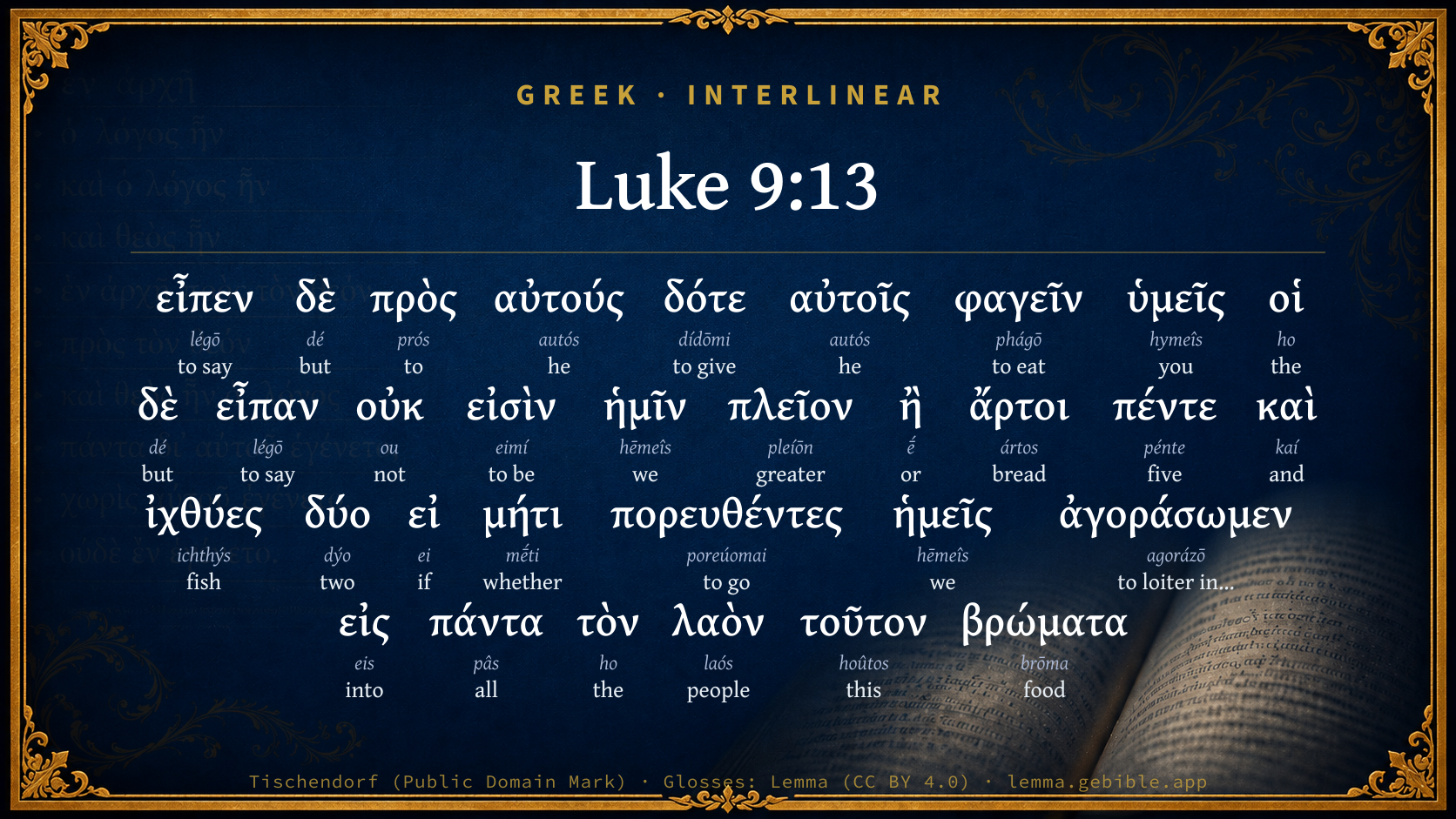
Greek (Tischendorf 8th ed.) Luke 9:13 appears in the Greek New Testament. The text above is from the Tischendorf 8th edition. Each word links to its Strong’s number and a concise gloss. Click any word for its full Thayer’s Greek Lexicon entry.
Download image
Cite this verse

Luke 9:13 (World English Bible). Public Domain. Lemma interlinear Bible study tool, https://lemma.gebible.app/v/luke/9/13.

Show BibTeX & RIS
BibTeX
RIS
English Translation
But he said to them, "You give them something to eat." They said, "We have no more than five loaves and two fish, unless we should go and buy food for all these people."
World English Bible · Public Domain
Download a study sheet

One document with this verse’s original text, its word-by-word gloss line, the meaning frame, cross-references with their text, attributed commentary, and full source and license credits — printable, and it pastes into notes with its structure intact.

This verse Autodidact and up

Study sheet (.html) Plain text (.txt)

A passage Seminary Student

Up to 50 verses in one chapter. A passage sheet keeps up to 6 commentary sources and 12 cross-references per verse, in the order this page ranks them, and says so on the sheet whenever that leaves anything out. Ask for a single verse and you get the Autodidact verse sheet above.

Everything on this page stays free to read, with no account — the sheet is a download of what is already on screen, not access to it.

Want to remove ads? Support Godless Engineer
Compare translations 3

The same verse in 3 English versions, stacked beneath the original-language interlinear above. Click any original word for its lexicon entry.

Each is an independent rendering of the whole verse — the interlinear is not word-aligned to these translations.

Highlighted words mark where these versions differ — a whole-verse word diff, not a word-by-word alignment.

  • World English Bible Public Domain
    But he said to them, "You give them something to eat." They said, "We have no more than five loaves and two fish, unless we should go and buy food for all these people."
  • King James Version Public Domain
    But he said unto them, Give ye them to eat. And they said, We have no more but five loaves and two fishes; except we should go and buy meat for all this people.
  • unfoldingWord Literal Text CC BY-SA 4.0
    But he said to them, “You give them to eat.” But they said, “There are not more than five loaves and two fish with us—unless we go buy food for all these people.”

unfoldingWord Literal Text — © unfoldingWord, licensed CC BY-SA 4.0. Word-aligned USFM3 via Door43 (git.door43.org/unfoldingWord/en_ult).

Versions to compare (up to 4)

3 of 4 selected

Show all 19 translations

Every available English version of this verse, each an independent rendering of the whole verse.

  • World English Bible Public Domain
    But he said to them, "You give them something to eat." They said, "We have no more than five loaves and two fish, unless we should go and buy food for all these people."
  • Berean Standard Bible Public Domain
    But Jesus told them, “You give them something to eat.” “We have only five loaves of bread and two fish,” they answered, “unless we go and buy food for all these people.”
  • Majority Standard Bible Public Domain
    But Jesus told them, “You give them something to eat.” “We have only five loaves of bread and two fish,” they answered, “unless we go and buy food for all these people.”
  • King James Version Public Domain
    But he said unto them, Give ye them to eat. And they said, We have no more but five loaves and two fishes; except we should go and buy meat for all this people.
  • American Standard Version (1901) Public Domain
    But he said unto them, Give ye them to eat. And they said, We have no more than five loaves and two fishes; except we should go and buy food for all this people.
  • Revised Version (1885) Public Domain
    But he said unto them, Give ye them to eat. And they said, We have no more than five loaves and two fishes; except we should go and buy food for all this people.
  • Geneva Bible (1599) Public Domain
    But he sayd vnto them, Giue ye them to eate. And they sayd, We haue no more but fiue loaues and two fishes, except we should go and buy meate for all this people.
  • Douay-Rheims (1899) Public Domain
    But he said to them: Give you them to eat. And they said: We have no more than five loaves and two fishes; unless perhaps we should go and buy food for all this multitude.
  • Young's Literal Translation Public Domain
    And he said unto them, `Give ye them to eat;' and they said, `We have no more than five loaves, and two fishes: except, having gone, we may buy for all this people victuals;'
  • Literal Standard Version CC BY-SA 4.0
    And He said to them, “You give them to eat”; and they said, “We have no more than five loaves and two fishes: except, having gone, we may buy food for all this people”;
  • Unlocked Literal Bible CC BY-SA 4.0
    But he said to them, “You give them something to eat.” They said, “We have no more than five loaves of bread and two fish—unless we go and buy food for all these people.”
  • unfoldingWord Literal Text CC BY-SA 4.0
    But he said to them, “You give them to eat.” But they said, “There are not more than five loaves and two fish with us—unless we go buy food for all these people.”
  • Darby Bible Public Domain
    And he said to them, Give *ye them to eat. And they said, We have not more than five loaves and two fishes, unless *we* should go and buy food for all this people;
  • World Messianic Bible Public Domain
    But he said to them, “You give them something to eat.” They said, “We have no more than five loaves and two fish, unless we should go and buy food for all these people.”
  • Webster's Bible Public Domain
    But he said to them, Give ye them to eat. And they said, We have no more than five loaves and two fishes; except we should go and buy provisions for all this people.
  • Free Bible Version CC BY-SA 4.0
    “You give them something to eat!” said Jesus. “All we have here are five loaves and two fish—unless you want us to go and buy food for everyone,” they said.
  • Bible in Basic English Public Domain
    But he said, Give them food yourselves. And they said, We have only five cakes of bread and two fishes, if we do not go and get food for all these people.
  • Text-Critical English NT CC BY 4.0
    But he said to them, “You give them something to eat.” They said, “We have only five loaves and two fish—unless we are to go and buy food for this entire group of people.”
  • Tyndale New Testament (1534) Public Domain
    But he sayde vnto them: Geve ye them to eate. And they sayde. We have no moo but fyve loves and two fisshes except we shuld goo and bye meate for all this people.

Literal Standard Version (2020), Covenant Press — licensed CC BY-SA 4.0. Text via the HelloAO Bible API (eBible.org). Unlocked Literal Bible (unfoldingWord) — licensed CC BY-SA 4.0. Text via the HelloAO Bible API (eBible.org). unfoldingWord Literal Text — © unfoldingWord, licensed CC BY-SA 4.0. Word-aligned USFM3 via Door43 (git.door43.org/unfoldingWord/en_ult). Free Bible Version, Dr. Jonathan Gallagher — licensed CC BY-SA 4.0. Text via the HelloAO Bible API (eBible.org).

Word by word

More ways to search: Search by grammar → Find every occurrence → Compare this word →

Practice this passage: Drill this verse → Learn its vocabulary →

μήτι
mḗti
G3385
“whether”
Particle, Interrogative
Part of Speech
Particle
Degree
Interrogative
Full Thayer's Definition

Origin: from G3361 and the neuter of G5100

TDNT: None

1. whether, at all, perchance
  1. εἶπεν légō G3004 “to say” Verb, Aorist, Active, Indicative, 3rd person, Singular
  2. δὲ dé G1161 “but” Conjunction
  3. πρὸς prós G4314 “to” Preposition
  4. αὐτούς autós G846 “he” Personal pronoun, Accusative, Plural, Masculine
  5. δότε dídōmi G1325 “to give” Verb, Aorist, Active, Imperative, 2nd person, Plural
  6. αὐτοῖς autós G846 “he” Personal pronoun, Dative, Plural, Masculine
  7. φαγεῖν phágō G5315 “to eat” Verb, Aorist, Active, Infinitive
  8. ὑμεῖς hymeîs G5210 “you” Personal pronoun, 2nd person, Nominative, Plural
  9. οἱ ho G3588 “the” Article, Nominative, Plural, Masculine
  10. δὲ dé G1161 “but” Conjunction
  11. εἶπαν légō G3004 “to say” Verb, Aorist, Active, Indicative, 3rd person, Plural
  12. οὐκ ou G3756 “not” Particle, Negative
  13. εἰσὶν eimí G1510 “to be” Verb, Present, Active, Indicative, 3rd person, Plural
  14. ἡμῖν hēmeîs G2249 “we” Personal pronoun, 1st person, Dative, Plural
  15. πλεῖον pleíōn G4119 “greater” Adjective, Nominative, Singular, Neuter, Comparative
  16. ἢ ḗ G2228 “or” Particle
  17. ἄρτοι ártos G740 “bread” Noun, Nominative, Plural, Masculine
  18. πέντε pénte G4002 “five” Adjective, Numeral (indeclinable)
  19. καὶ kaí G2532 “and” Conjunction
  20. ἰχθύες ichthýs G2486 “fish” Noun, Nominative, Plural, Masculine
  21. δύο dýo G1417 “two” Adjective, Numeral (indeclinable)
  22. εἰ ei G1487 “if” Conditional
  23. πορευθέντες poreúomai G4198 “to go” Verb, Aorist, Passive deponent, Participle, Nominative, Plural, Masculine
  24. ἡμεῖς hēmeîs G2249 “we” Personal pronoun, 1st person, Nominative, Plural
  25. ἀγοράσωμεν agorázō G59 “to loiter in marketplace” Verb, Aorist, Active, Subjunctive, 1st person, Plural
  26. εἰς eis G1519 “into” Preposition
  27. πάντα pâs G3956 “all” Adjective, Accusative, Singular, Masculine
  28. τὸν ho G3588 “the” Article, Accusative, Singular, Masculine
  29. λαὸν laós G2992 “people” Noun, Accusative, Singular, Masculine
  30. τοῦτον hoûtos G3778 “this” Demonstrative pronoun, Accusative, Singular, Masculine
  31. βρώματα brōma G1033 “food” Noun, Accusative, Plural, Neuter

About this verse

These counts appear in no published source. They are computed here, from the morphology-tagged text and Lemma’s own curated glosses. What Lemma adds →

32
words
27
distinct lemmas
Gospels
section

Notable vocabulary

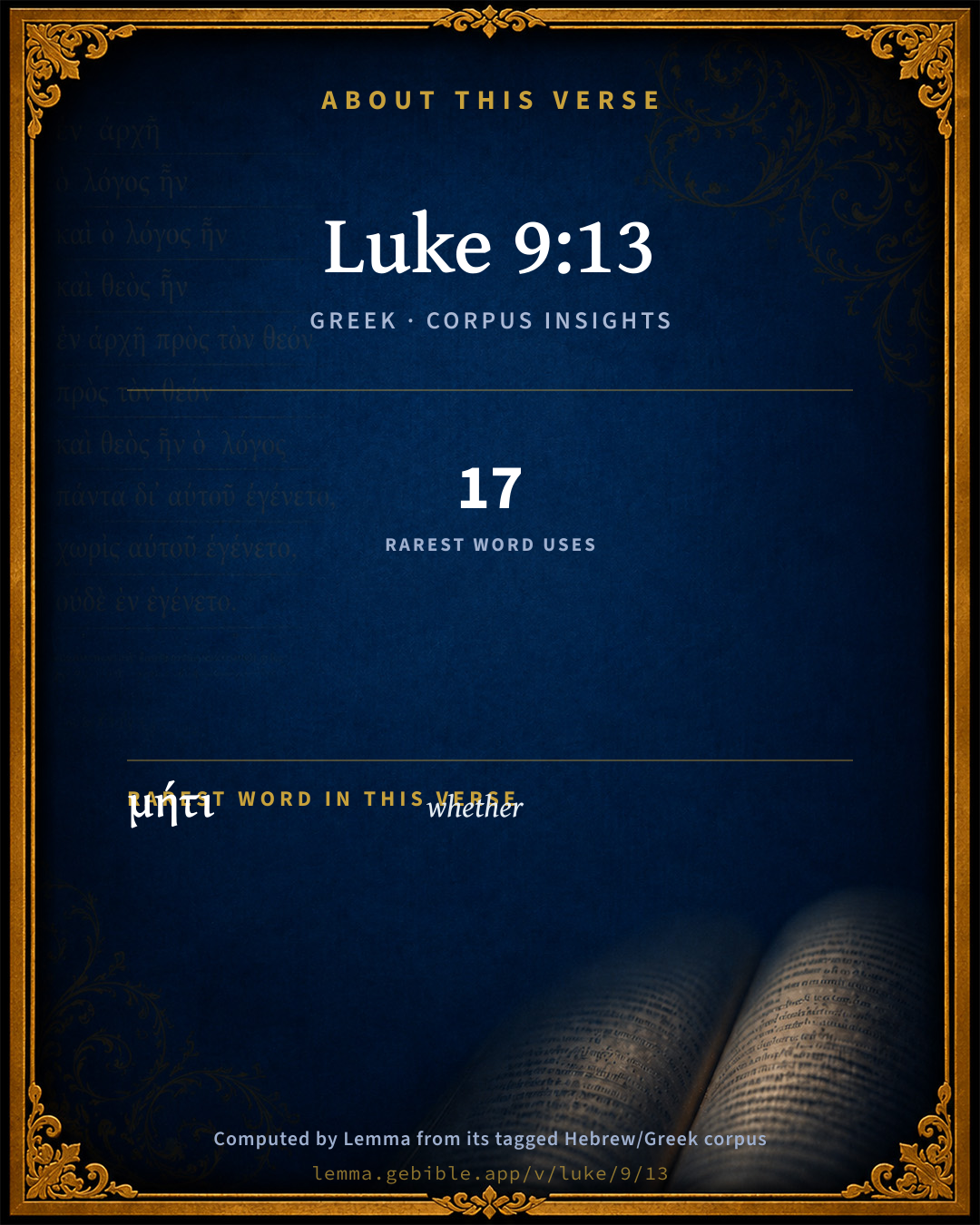
The rarest word here is μήτι whether G3385 — appearing just 17 times in the whole Greek New Testament.

Shared distinctive vocabulary

μήτι whether G3385 occurs in 17 verses of the Greek New Testament. Also found in:

Repetition

Words recur within this verse:

  • εἶπεν to say G3004 ×2
  • δὲ but G1161 ×2
  • αὐτούς he G846 ×2
  • οἱ the G3588 ×2
  • ἡμῖν we G2249 ×2

Cross-references

6

Topical passages linked to Luke 9:13 in the Treasury of Scripture Knowledge — connected by theme and wording, ordered by reader-vote popularity; previews shown in the World English Bible.

  • Proverbs 11:24–25 There is one who scatters, and increases yet more. There is one who withholds more than is appropriate, but gains poverty.
  • 2 Kings 4:42–43 There came a man from Baal Shalishah, and brought the man of God bread of the first fruits, twenty loaves of barley, and fresh ears of grain in his sack. He said, Give to the people, that they may eat.
  • John 6:5–9 Jesus therefore lifting up his eyes, and seeing that a great multitude was coming to him, said to Philip, "Where are we to buy bread, that these may eat?"
  • Mark 6:37–38 But he answered them, "You give them something to eat." They asked him, "Shall we go and buy two hundred denarii worth of bread, and give them something to eat?"
  • Matthew 14:16–17 But Jesus said to them, "They don't need to go away. You give them something to eat."
  • Numbers 11:21–23 Moses said, The people, among whom I am, are six hundred thousand footmen; and you have said, I will give them flesh, that they may eat a whole month.

Cross-references courtesy of OpenBible.info (CC BY 4.0).

Commentary

Notes on Luke 9:13 from classic Christian and Jewish commentators (each source and its license shown beneath its notes). The classic Christian expositions comment on the surrounding passage and are grouped to its opening verse, so a note may address several verses; the Jewish commentaries on the Tanakh (Rashi and others) are per-verse, so they appear only where the commentator wrote on this verse.

Lemma curates 59 commentaries, every one of them public domain or Creative Commons licensed, each selected and text-cleaned for this edition rather than reprinted as found. About our sources →

The Biblical Illustrator

Joseph S. Exell

Luk_9:13-17

Five loaves and two fishes

Feeding the five thousand

I.

All the people of God are stewards of the household of faith, and to God must they render an account.

II. We are to adopt all lawful means by which to escape impending danger. When our Lord was exposed to danger from Herod, though possessed of all power, he adopted human means to escape that danger. We must not allow any fear of encountering perils to deter us from duty.

III. We ought to esteem no sacrifice too great to be made for Christ and His gospel. The people referred to in the text did not think it too much to leave their comfortable homes; but, forsaking all, went into the desert to listen to Him who spake as never man spake. If called to hazard all, and even our life, for the gospel, let us commit ourselves to God.

IV. Our Lord welcomes all who come to Him by faith. When the people came to Him from the villages round about, He refused none, but healed all who had need.

V. Wherever true Christianity exists in the heart, it will manifest its presence by a spirit of benevolence. The disciples saw the night coming on, and wished the multitude to be dismissed, that they might retire to the comforts they needed. Christianity rejoices not only in our own salvation, but also in that of others.

VI. When human aid fails, Divine power is made manifest. VII. We should so receive and enjoy the blessings of heaven as to glorify God. When our Lord received the food, He returned thanks for it, and pronounced a blessing upon it.

VIII. When the mind reposes by faith on the Saviour, there will be ample supplies of grace and favour. Christ never said to the seed of Jacob, Seek ye My face in vain. Conclusion: In all situations of danger let the people put their trust in Jehovah, remembering that He who is for them is much greater than all who can be against them. (J. Henderson.)

Lessons from the miracle of multiplying the loaves

1. We learn from this miracle that it is our duty to do what we can to supply the bodily wants of others.

2. We here learn that those who follow Christ may trust to Him for the necessaries of life.

3. We are here reminded of the duty of what is commonly called saying grace at meals This was our Lords practice, and it is a duty often enjoined in Scripture.

4. From the particular direction our Lord here gave as to the fragments, we draw the general rule that nothing should be lost, or wasted. To waste our substance is a sinful abuse of Gods gifts. It is one thing to be generous and hospitable; it is quite another to be thoughtless, extravagant, and wasteful. Such wasting is not only offensive to God, but unjust and unkind to our fellow creatures. (J. Foote, M. A.)

Ability developed by responsibility

The vast hunger of the world is a vast responsibility upon the Church and a vast blessing. Christians must supply bread, or the people will perish. The necessity drives them to Christ, compels the bringing forth of their talents and resources, and works enlargement in volume and value.

I. Christ deals with us on principles of a wise economy, builds his supernatural work on our natural resources, and makes a little do the work of abundance.

II. Christ always makes that which we have and bring to Him for His blessing adequate for the needs of the hour. He takes us into partnership with Himself both in His work and its rewards.

III. Weakness made strong in effort for Him. (Anon.)

Food for hungry souls

The Lord helps our souls as He helps our bodies, through the aid of ordained means and sometimes He may cause these means to fall short, and then may supply them as suddenly and abundantly as He multiplied these loaves and fishes. A person may have but little learning--he may be quite unable to read, and may seem to himself as if he did not well understand what he hears--and yet, if he have the fear of God in his heart, and try to live accordingly, he shall eat and be filled with spiritual meat and drink. One good lesson, one verse, one prayer may be a treasure to him which he shall never lose. He may be a good way from Church, he may have few helps at home; but if he really try to make the most of what little he has, God can and will make a good deal of it--to him. Half a prayer remembered as having been learnt in childhood; an old loose Bible or Testament on a shelf; the remembrance of some good Christian formerly known, his sayings, his tone of voice, his manner of coming in and going out--all these and other such things are as the scanty fare of that multitude, which became abundant under His creative hand. (John Keble, M. A.)

Enough for all when Christ distributes

I. THE PEOPLES BODY NEED, AND SOUL NEED.

II. GODS PROVISION FOR BODY AND FOR SOUL.

III. GODS METHOD OF SUPPLY TO BODY AND TO SOUL. Ordinary. Miraculous. Moral. (The Weekly Pulpit.)

Christ in a fourfold aspect

I. Christ in MIRACULOUS BENEFICENCE. Omnipotence is ever instinct with love.

II. Christ in SOCIAL ORDER. Not a God of confusion.

III. Christ in FRUGAL ARRANGEMENT. Nothing in nature runs to waste.

IV. Christ in the PATRONAGE OF HOSPITALITY. Give ye them to eat. Help each other. Conclusion: Follow Christ in all this. (D. Thomas, D. D.)

The miraculous feeding of five thousand

The disciples had just returned from the mission in which they had been engaged, and told Him all that they had done. The considerate Master saw that they were exhausted by the fatigue and excitement of their labours. He accordingly seeks to secure them quiet. This they could not have in Capernaum (see Mar_6:31). They take passage privately in a vessel to a desert place near to Bethsaida. In vain did they look here for solitude. They had been observed by the eager multitude, who followed on foot, and were at the landing-place before them. The Lord has compassion on them, and is solicitous for their physical as well as their spiritual well-being. On finding that there are five loaves and two small fishes, He gives the disciples directions for the orderly arrangement of the multitude into companies; and when all were in perfect order He took the loaves and the fishes, and blessed and brake and gave the disciples to set before the multitude. As they passed from hand to hand, the loaves and fishes multiplied so as to become more than sufficient for the great multitude. Every year in the harvest we see this miracle repeated.

1. Learn that order is Christlike, is Divine.

2. That economy is Divine. All the evangelists are careful to record that they gathered up the fragments left. Liberal profusion and true economy always go hand in hand.

3. Learn to relieve the wants of others even when we have but little. It is ours also to feed the hungry. Especially with the bread of life. (D. Longwill.)

Jesus and His bounty

I. THE PROBLEM OF THE DISCIPLES. The desert place, the night, the multitude without food, presented a problem that might well constitute a reason for anxiety to any who were of a sympathetic nature. The circumstances were new and surprising, and were such as to test the weakness, or bring out the strength, of their confidence in the Masters wisdom and power. We all need to be surprised in life. It is the unexpected that shows us what we are. The disciples were perplexed, and very human they were in their perplexity. For the time they seem to have forgotten several things.

1. That the people had followed their Master and not them, and that they were connected with the people through Him. Had the people followed them there would be nothing to do but to send them away. If the case today were between the disciples and the multitude, it would be hopeless.

2. That the Master knew as much, and more, of the multitude than they did.

3. That the Master was moved with compassion towards the people. They had forgotten the most important elements of the problem. They had been looking at the multitude and the night; had been realizing the difficulties very vividly. We, too, look at our multitude, and see the darkness in which they are involved, and tremble as we think of the possible, if not the inevitable issue of what we see. But we do not see the whole when we tremble. God is above the night, and pities all who are in it. God knows, and God pities, and that ought to be enough for our faith, if not for our reason. At length the disciples made their petition, saying, Send the multitude away. The very fact that He was there to receive their requests ought to have reminded them of some of the many things which they had forgotten. For if they had thought, had not He much more than they?

II. THE SOLUTION OF THE MASTER Give ye them to eat.

1. The command seemed extravagant, but they knew that it had not been His habit to gather in where He had not scattered abroad. It made them feel how inadequate they were, with the little they had, to obey it. They had only five loaves and two fishes, do as they would, with a multitude to feed. The loaves were, however, just what the people needed. We have all some little which, if wisely used, may be of benefit to our fellows. We have mind, heart, and opportunity.

2. The Master took the five loaves and the two fishes from the disciples, and manifested His great power through that which they gave Him. He brought them into the fellowship of His mystery. He blessed the loaves which they brought. Our first condition of usefulness is to take the little we have to Christ, if we have only the little. That which is blessed by Him is equal to all that lifes occasion demands.

3. After the blessing came the breaking, but it does not seem that the loaves appeared to be more than five after they were blessed.

4. Although there is enough and to spare, there is nothing to be wasted. (J. O. Darien.)

Give ye them to eats--

Duty not measured by our own ability

The narrative suggests and illustrates the following important principle:--THAT MEN ARE OFTEN, AND PROPERLY, PUT UNDER OBLIGATION TO DO THAT FOR WHICH THEY HAVE, IN THEMSELVES, NO PRESENT ABILITY. God requires no man to do, without ability to do; but He does not limit His requirements by the measures of previous or inherently contained ability. He has made provision in many ways for the enlargement of our means and powers so as to meet our emergencies. And He does this on a large scale, and by system--does it in the natural life, and also in the works and experiences of the life of faith.

1. To begin at the very lowest point, it is the nature of human strength and fortitude bodily to have an elastic measure, and to be so let forth or extended as to meet the exigencies that arise. Muscular strength and endurance are often suddenly created or supplied by some great emergency for which they are wanted.

2. So, also, it is in the nature of courage to increase in the midst of perils and because of them, and courage is the strength of the heart.

3. Intellectual force, too, has the same elastic quality, and measures itself, in the same way, by the exigencies we are called to meet. Task it, and for that very reason it grows efficient. It discovers its own force by the exertion of force. All great commanders, statesmen, lawgivers, scholars, preachers, have found the powers unfolded in their calling, and by their calling, which were necessary for it.

4. The same thing is true, and quite as remarkably, of what we call moral power. Not seldom is it a fact that the very difficulty and grandeur of a design, which some heroic soul has undertaken to execute, exalts him at once to such a pre-eminence of moral power that mankind are exalted with him, and inspired with energy and confidence by the contemplation of his magnificent spirit. The great and successful men of history are commonly made by the great occasions they fill. As with David, so with Nehemiah, Paul, Luther. A Socrates, a Tully, a Cromwell, a Washington, all the great master-spirits, the founders and law-givers of empires and defenders of the rights of man, are made by the same law.

5. How childish, then, is it in religion, to imagine that we are called to do nothing save what we have ability to do beforehand; ability in ourselves to do. We have, in fact, no such ability at all, no ability that is inherent, as respects anything laid upon us to do. Our ability is what we can have, and then our duty is graduated by what we can have. This is the Christian doctrine everywhere.

6. This doctrine opposed to two opposite errors:

(1) That of those who think the demand of the religious life so limited and trivial as to require but little care and small sacrifice; and

(2) that of those who look upon them as being so many and so great, that they are discouraged under them. (H. Bushnell, D. D.)

Between the Lord of life and the famishing multitudes

1. The multitude in a desert place was representative to the Saviours mind of vaster multitudes all over the earth.

2. The bread He supplied for mens bodies was suggestive of the bread He was to supply for their souls.

3. The position of the disciples, then, is the position of the disciples still--we stand between the Lord of life and the famishing multitudes. We may still hear the words ringing in our ears, Give ye them to eat.

I. IT IS A COMMAND ON BEHALF OF THE FAMISHING MULTITUDES.

1. They have not the knowledge of God.

2. They have not the knowledge of the meaning of life.

3. They have not the knowledge of the gospel.

II. IT IS A COMMAND FROM THE LORD OF LIFE.

1. He has compassion on the multitudes.

2. He has provided bread for the multitudes.

3. It is His prerogative to command to give to the multitudes,

III. IT IS A COMMAND TO DISCIPLES AS STANDING BETWEEN THE LORD OF LIFE AND THE FAMISHING MULTITUDES.

1. We are to sympathize with the multitudes.

2. We are to be the medium of communication between Christ and the multitudes in the distribution of bread.

3. We are to distribute to the multitudes in hope.

The day is coming when the Church, turning to its Lord, shall say, All the famishing multitudes are now fed. And after its task has been accomplished it will feel so strong in the means of extension, that there will be, as it were, twelve baskets over, out of which many more might have been fed. (R. Finlayson, B. A.)

Confidence in Christs power to supply necessity

During the retreat of Alfred the Great, at Athelney, in Somersetshire, after the defeat of his forces by the Danes, the following circumstance happened, which, while it convinces us of the extremities to which that great man was reduced, will give us a striking proof of his pious, benevolent disposition. A beggar came to his little castle there and requested alms, when his queen informed him that they had only one small loaf remaining, which was insufficient for themselves and their friends, who were gone in quest of food, though with little hopes of success. The king replied, Give the poor Christian one halt of the loaf. He that could feed five thousand men with five loaves and two fishes can certainly make that half loaf suffice for more than our necessity. Accordingly, the poor man was relieved, and this noble act of charity was soon recompensed by a providential store of fresh provisions, with which his people returned. (W. Buck.)

Valuable fragments

A carpet from the San Francisco Mint was burned the other day, and yielded £505 worth of gold dust, which had fallen in imperceptible particles during five years use. In life take care of the minute things. These particles of gold seemed little indeed as they floated away, but they made a grand total. So it will be in life if we improve every moment of time, every scrap of knowledge, every, degree of influence, every opportunity of being good, getting good, doing good. A wise economy of the grains of gold brings out massive talents some day. Take care and value apparently mean things. The carpet on which men walked in the Mint was sown with gold, although they knew it not. All our common things, tasks, duties, are full of the dust of gold. That on which men trample would yield crowns for their head if they only knew it and walked wisely. Make the best of a life of trifles, and we shall one day be astonished at the splendid result. God will not let our good doings perish, Small as they may be. He will gather up the fragments to our eternal enrichment. The body will dissolve in the crucible of the grave, the earth be burned up as the carpet was, but the fine gold of true human life shall be gathered up in an eternal weight of glory. (Christian Journal.)

Saying grace at meals

Without meaning to say that any precise form, or length, or numeration of particulars, is necessary, the following hints may be given as of general application. A grace is a prayer before, or after meat, which circumstances require to be short, but which ought always to be solemn and earnest, never formal and careless. It most expressly requires an acknowledgment of God as the Author of our mercies, and a petition for His blessing along with them: and, as presented by Christians, it ought, in some way, to refer to the gospel, and spiritual things, and be concluded in the name of Christ. At a solitary meal, the duty must by no means be neglected; and then ones own private feelings may be more particularly consulted as to the matter. At a social meal, time and circumstances, in what is indifferent, may be, and ought to be, considered; but all present ought to hear what is said, and join heartily in it, else it is no grace, no act of blessing and thanksgiving of theirs. Children ought to be early instructed in the nature of this duty, and taught and accustomed reverentially to discharge it. Nor ought it ever afterwards to be discontinued. The due observance of this pious custom adorns the best furnished table, and ennobles and sweetens the plainest fare. Let no man, who should be expected to discharge this honourable service before others, whether he be minister, or landlord, or other person residing, or taking a lead for the time, be afraid or ashamed so to do. (J. Foote, M. A.)

Ancient graces before meals

From the earliest time our Lords act has been taken as a model, and the Jewish custom, being reconfirmed by our Lords example, has passed into the practice of Christian people. Examples remain of the early graces, as used both in the Eastern and Western Churches. The postolical Constitutions furnish the following as a prayer at a mid-day meal: Blessed art Thou, O Lord, who feedest me from my youth up, who givest food to all flesh. Fill our hearts with joy and gladness; that, always having a sufficiency, we may abound unto every good work, in Christ Jesus our Lord, through whom be glory and honour and power unto Thee, world without end, Amen. This prayer, slightly varied, is also given to be said after meals in a treatise improbably ascribed to St. Athanasius. (Biblical things not generally known.)

Divine provision, human distribution

1. Rationalizing tendency to explain away miracles on natural grounds wrong, but like many wrong things, a perversion of that which is right. It is a right and a reverent thing not to suppose a miracle where natural explanation sufficient. Peculiarity of New Testament miracles, which distinguishes them from absurd stories of apocryphal Gospels, that they all have a worthy purpose, and a purpose which could only be attained by the putting forth a supernatural power. But not everything, even in a miracle, is miraculous, for--

2. Christ multiplied the loaves miraculously, but He distributed the provision thus made by natural means, human instrumentality. Necessity for miracle ceased with rendering supply sufficient.

3. We have in this an illustration of the method of Gods working. God does not need human co-operation to enable Him to carry out His purposes. But He chooses that, while the power which makes the provision is of necessity Divine, the instruments of its distribution shall be human. Reason to be found in constitution of human nature and in blessedness of results. Good for recipient that he shall receive from brother-man. More blessed still for distributor.

4. Each disciple would feel it an unspeakable privilege to be made a dispenser of Christs beneficence. Can you imagine one holding back? How is it now, with us?

5. The personal responsibility involved in this law of human instrumentality. Suppose one of the disciples had begun to argue with himself that it was folly to give away what they might need for themselves, and had hidden away a loaf in the folds of his robe, may we not imagine that in that case the reverse of the miracle would have been enacted? What I gave I kept, etc. (J. R. Bailey.)

Gave

kept giving; the tense shows the manner in which the increase of bread took place. (A. Cart, M. A.)

The Biblical Illustrator, edited by Joseph S. Exell (c. 1880s–1900s) — public domain. Text from a community e-Sword module.

Tyndale Open Study Notes

Tyndale Open Resources

9:13 You feed them: After their ministry of healing the sick and casting out demons, Jesus wanted the disciples to demonstrate faith in God’s ability to feed the crowds.

Tyndale Open Study Notes — © Tyndale Open Resources, licensed CC BY-SA 4.0. Text via the HelloAO Bible API.

Expositor's Greek Testament

ed. W. Robertson Nicoll

Luk 9:13 . πλεῖον ἢ : on the construction, vide Winer, § 58, 4 obs. 1. εἰ μήτι … ἀγοράσωμεν , unless perhaps we are to buy, etc.; εἰ with subjunctive is one of the forms of protasis in N. T. to express a future supposition with some probability, εἰ takes also present and future indicative. Vide Burton, M. and T., § 252. That Lk. did not regard this proposal as, if possible, very feasible, appears from his mentioning the number present at this stage

The Expositor's Greek Testament, edited by W. Robertson Nicoll (1897–1910) — public domain. Text from a community e-Sword module.

Geneva Bible (1599)

Geneva Bible translators

This is unperfectly spoken, and therefore we must understand something, as this, we cannot give them to eat, unless we go and buy, etc.

Geneva Bible (1599) marginal notes — public domain. Text via Bolls.life.

Ellicott's Commentary for English Readers

(13) Buy meat.—Better, food.

A Bible Commentary for English Readers, edited by Charles John Ellicott (1878–1897) — public domain. Text from a community e-Sword module.

The Cambridge Bible for Schools and Colleges

gen. ed. J. J. S. Perowne

13. We have no more but five loaves and two fishes] Compare Num_11:22. It was Andrew who first mentioned this fact in a tentative sort of way. The little boy (paidarion) who carried them seems to have been in attendance on the Apostles; evidently this was the food which they had brought for their own supply, and it proves their simplicity of life, for barley loaves (Joh_6:9) are the food of the poor (2Ki_4:42; Jdg_7:13; Eze_13:19; Eze_4:9).

The Cambridge Bible for Schools and Colleges (gen. ed. J. J. S. Perowne; Cambridge University Press, 1878–1918) — public domain. Text from a community e-Sword module.

John Gill's Exposition

And he said to them, give ye them to eat,.... Signifying, that it was not his will to dismiss people, and send them scattering abroad into the adjacent cities, towns, or houses; and that there was no need of it, but that his will was, that they should be supplied with provisions out of their stock:

and they said, we have no more than five loaves and two fishes; and these loaves were barley loaves, and the fishes small, Joh 6:9

except we should go and buy meat for all this people; which would at least cost them two hundred pence; and which they represent as impossible to be done, either through want of so much money, or the scarcity of provision in those parts; where, had they money, it would be difficult, at least to get such a quantity of provisions at once, which so great a number of persons required.

John Gill's Exposition of the Whole Bible (1746–1763) — public domain (CC PDM 1.0). Text via the HelloAO Bible API.

Trapp's Complete Commentary

John Trapp

13 But he said unto them, Give ye them to eat. And they said, We have no more but five loaves and two fishes; except we should go and buy meat for all this people.

Ver. 13. Except we should go, &c.] Which is a thing not only improbable, but impossible. They held it an absurd notion.

John Trapp, A Commentary or Exposition upon All the Books of the Old and New Testament (1647–1656) — public domain. Text from a community e-Sword module.

The Pulpit Commentary

But he said unto them, Give ye them to eat. Godet here beautifully observes that this reply, and the great miracle that followed, was the result of a loving thought of the Redeemer. "John has disclosed it to us. (Luk_6:4) It was the time of the Passover. He could not visit Jerusalem with his disciples, owing to the virulent hatred of which he had become the object. In this unexpected gathering, resembling that of the nation at Jerusalem, he discerns a signal from on high, and determines to celebrate a feast in the desert as a compensation for the Passover Feast." We have no more but five loaves and two fishes; except we should go and buy meat for all this people. The main lines of this story are the same in each of the four accounts which we possess of this miracle; but each of the four evangelists supplies some little detail wanting in the others. It is clear that there was no original written tradition from which they all copied. St. John tells us it was a little boy who had this small, rough provision. The boy probably was in attendance on the apostles, and this was no doubt the little stock of food they had provided for their own frugal meal. The barley loaves were the ordinary food of the poorest in Palestine, and the two fish were dried, as was the common custom of the country; and such dried fish was usually eaten with the bread.

The Pulpit Commentary (1880–1919), ed. H.D.M. Spence-Jones & Joseph S. Exell — public domain. Text from a community e-Sword module.

Cambridge Greek Testament for Schools and Colleges

13. πλεῖον ἢ πέντε ἄρτοι καὶ ἰχθύες δύο. The contraction is an anakoluthon, for εἰσίν refers to ἄρτοι, not to πλεῖον ἢ, which must be regarded as a sort of parenthetic addition. Compare Num 11:22. It was Andrew who first mentioned this fact in a tentative sort of way. The little boy (παιδάριον) who carried them seems to have been in attendance on the Apostles; evidently this was the food which they had brought for their own supply, and it proves their simplicity of life, for barley loaves (Joh 6:9) are the food of the poor (2Ki 4:42; Jdg 7:13; Eze 4:9; Eze 13:19).

εἰ μήτι πορευθέντες ἡμεῖς ἀγοράσωμεν. ‘Unless perchance we should ourselves go and procure.’ Εἰ with the subjunctive is very rare and archaic in Attic prose. It simply means ‘if, apart from all conditions.’ See my Brief Greek Syntax, § 201 n. In the N.T. it only occurs in 1Co 9:11, εἰ … θερίσωμεν, Luk 14:5, εἰ μὴ διερμηνεύῃ. Here Winer regards it as a sort of deliberative subjunctive not really dependent on εἰ (‘unless—are we to go and buy?’).

Cambridge Greek Testament for Schools and Colleges (Cambridge University Press, 1896; 21 vols, various authors incl. Carr, Maclear, Plummer, Farrar, Lumby, Moule, M. R. James, Simcox) — public domain. Text from a community e-Sword module.

Alford’s Greek Testament

Henry Alford

13.] εἰ μή τι—unless indeed we were to go and buy, &c. On the construction see 1Co 9:11 (v. r.); 14:5: Rev 11:5 (rec.); and Winer, § 41. b. 2 prope fin., edn. 6.

Henry Alford, The Greek Testament (1849–1861) — public domain. Text from a community e-Sword module.

International Critical Commentary

13. Both εἶπεν δέ and πρός are in Lk.’s style, and neither occurs in the parallels. The same is true of πάντα, and in ver. 14 of πρός and the second ὡσεί. Note the emphatic ὑμεῖς. “Ye are to find food for them, not they.” There is no need to supply anything after εἰ μήτι ἡμεῖς ἀγοράσωμεν. “We have no more five loaves,” leads quite naturally to “unless we are to go and buy,” etc.; and then the sentence is complete. The statement expresses perplexity (Weiss), not sarcasm (Schanz).

Οὐκ εἰσὶν ἡμῖν πλεῖον ἢ πέντε. The πλεῖον ἢπέντε is virtually plur. and has plur. verb. For the subjunct, after εἰ μή comp. 1Co 14:5, and see Win. xli. 2. b, p. 368, and Burton., § 252, 253. The subjunct. after εἰ is not rare in late Grk. But this is rather a delib. subjunct.

Jn. tells us that it was Andrew who pointed out the lad with the loaves, and that they were of barley-bread. On the whole, narrative is the most precise. The ἡμεῖς, like the preceding ὑμεῖς, is emphatic.

International Critical Commentary — older volumes (1896–1929), various authors — public domain. Text from a community e-Sword module.

Vincent's Word Studies in the New Testament

Marvin R. Vincent

Give ye. The ye emphatic, closing the sentence in the Greek order. See on Mt 14:15.

Buy food. Compare Mr 6:37.

Marvin R. Vincent, Word Studies in the New Testament (1887–1900) — public domain. Text from a community e-Sword/MySword module.

Lesson kit

Teaching starters — assembled from the data on this page, not authored interpretation. Every prompt links to the verse data it draws on. Edit before teaching.

Luke, in the Gospels, opens this verse with 32 words (27 distinct Greek lemmas). Its most distinctive word is mḗti (“whether”). A historical commentator’s framing appears above. Read the whole chapter for the surrounding context.

Discussion questions

  1. How does “whether” (mḗti) shape what this verse is saying?
  2. Matthew 7:16 shares the word «whether» with this verse. How do the two illuminate each other?
  3. “to say” occurs 2× in this one verse. What is the effect of the repetition?
  4. These translations render this verse differently. What is at stake in choosing one wording over another?
  5. Reading how The Biblical Illustrator and Tyndale Open Study Notes read this verse, where do the two commentators agree and where do they part?

Things to notice

Reading settings

Reading text

Shown beneath each verse's original-language words.

Old Testament
Old Testament edition

Read the OT as the Masoretic Hebrew (MT) or the Greek Septuagint (LXX).

English shown for the Greek Septuagint (in the Hebrew ↔ Greek comparison).

Comparing translations? Open the Compare panel on any verse page to stack up to four side by side.