
Luke 12:41

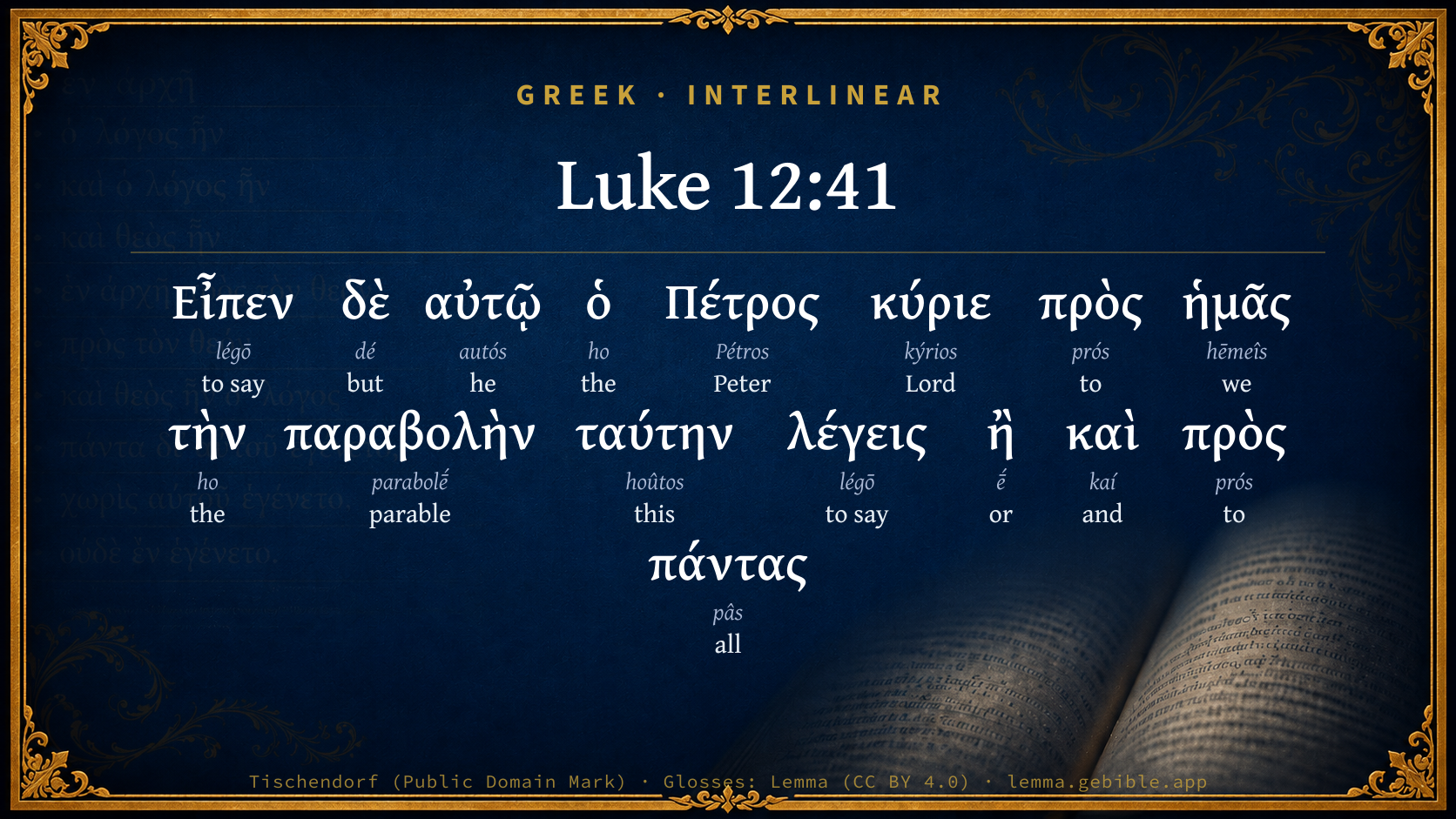
Greek (Tischendorf 8th ed.) Luke 12:41 appears in the Greek New Testament. The text above is from the Tischendorf 8th edition. Each word links to its Strong’s number and a concise gloss. Click any word for its full Thayer’s Greek Lexicon entry.
Download image
Cite this verse

Luke 12:41 (World English Bible). Public Domain. Lemma interlinear Bible study tool, https://lemma.gebible.app/v/luke/12/41.

Show BibTeX & RIS
BibTeX
RIS
English Translation
Peter said to him, "Lord, are you telling this parable to us, or to everybody?"
World English Bible · Public Domain
Download a study sheet

One document with this verse’s original text, its word-by-word gloss line, the meaning frame, cross-references with their text, attributed commentary, and full source and license credits — printable, and it pastes into notes with its structure intact.

This verse Autodidact and up

Study sheet (.html) Plain text (.txt)

A passage Seminary Student

Up to 50 verses in one chapter. A passage sheet keeps up to 6 commentary sources and 12 cross-references per verse, in the order this page ranks them, and says so on the sheet whenever that leaves anything out. Ask for a single verse and you get the Autodidact verse sheet above.

Everything on this page stays free to read, with no account — the sheet is a download of what is already on screen, not access to it.

Want to remove ads? Support Godless Engineer
Compare translations 3

The same verse in 3 English versions, stacked beneath the original-language interlinear above. Click any original word for its lexicon entry.

Each is an independent rendering of the whole verse — the interlinear is not word-aligned to these translations.

Highlighted words mark where these versions differ — a whole-verse word diff, not a word-by-word alignment.

  • World English Bible Public Domain
    Peter said to him, "Lord, are you telling this parable to us, or to everybody?"
  • King James Version Public Domain
    Then Peter said unto him, Lord, speakest thou this parable unto us, or even to all?
  • unfoldingWord Literal Text CC BY-SA 4.0
    Then Peter said, “Lord, are you speaking this parable to us, or also to everyone?”

unfoldingWord Literal Text — © unfoldingWord, licensed CC BY-SA 4.0. Word-aligned USFM3 via Door43 (git.door43.org/unfoldingWord/en_ult).

Versions to compare (up to 4)

3 of 4 selected

Show all 19 translations

Every available English version of this verse, each an independent rendering of the whole verse.

  • World English Bible Public Domain
    Peter said to him, "Lord, are you telling this parable to us, or to everybody?"
  • Berean Standard Bible Public Domain
    “Lord,” said Peter, “are You addressing this parable to us, or to everyone else as well?”
  • Majority Standard Bible Public Domain
    “Lord,” said Peter, “are You addressing this parable to us, or to everyone else as well?”
  • King James Version Public Domain
    Then Peter said unto him, Lord, speakest thou this parable unto us, or even to all?
  • American Standard Version (1901) Public Domain
    And Peter said, Lord, speakest thou this parable unto us, or even unto all?
  • Revised Version (1885) Public Domain
    And Peter said, Lord, speakest thou this parable unto us, or even unto all?
  • Geneva Bible (1599) Public Domain
    Then Peter saide vnto him, Master, tellest thou this parable vnto vs, or euen to all?
  • Douay-Rheims (1899) Public Domain
    And Peter said to him: Lord, dost thou speak this parable to us, or likewise to all?
  • Young's Literal Translation Public Domain
    And Peter said to him, `Sir, unto us this simile dost thou speak, or also unto all?'
  • Literal Standard Version CC BY-SA 4.0
    And Peter said to Him, “Lord, do You speak this allegory to us, or also to all?”
  • Unlocked Literal Bible CC BY-SA 4.0
    Peter said, “Lord, are you telling this parable only to us, or also to everyone?”
  • unfoldingWord Literal Text CC BY-SA 4.0
    Then Peter said, “Lord, are you speaking this parable to us, or also to everyone?”
  • Darby Bible Public Domain
    And Peter said to him, Lord, sayest thou this parable to us, or also to all?
  • World Messianic Bible Public Domain
    Peter said to him, “Lord, are you telling this parable to us, or to everybody?”
  • Webster's Bible Public Domain
    Then Peter said to him, Lord, speakest thou this parable to us, or even to all?
  • Free Bible Version CC BY-SA 4.0
    “Is this story you're telling just for us, or for everyone?” Peter asked.
  • Bible in Basic English Public Domain
    And Peter said to him, Lord, are these words said to us only, or to all men?
  • Text-Critical English NT CC BY 4.0
    Then Peter said to him, “Lord, are yoʋ telling this parable only for us, or for everyone else as well?”
  • Tyndale New Testament (1534) Public Domain
    Then Peter sayde vnto him: Master tellest thou this similitude vnto vs or to all men?

Literal Standard Version (2020), Covenant Press — licensed CC BY-SA 4.0. Text via the HelloAO Bible API (eBible.org). Unlocked Literal Bible (unfoldingWord) — licensed CC BY-SA 4.0. Text via the HelloAO Bible API (eBible.org). unfoldingWord Literal Text — © unfoldingWord, licensed CC BY-SA 4.0. Word-aligned USFM3 via Door43 (git.door43.org/unfoldingWord/en_ult). Free Bible Version, Dr. Jonathan Gallagher — licensed CC BY-SA 4.0. Text via the HelloAO Bible API (eBible.org).

Word by word

More ways to search: Search by grammar → Find every occurrence → Compare this word →

Practice this passage: Drill this verse → Learn its vocabulary →

παραβολὴν
parabolḗ
G3850
“parable”
Noun, Accusative, Singular, Feminine
Part of Speech
Noun
Case
Accusative
Number
Singular
Gender
Feminine
Full Thayer's Definition

Origin: from G3846

TDNT: 17:24,8

1. a placing of one thing by the side of another, juxtaposition, as of ships in battle 2. metaph. a. a comparing, comparison of one thing with another, likeness, similitude b. an example by which a doctrine or precept is illustrated c. a narrative, fictitious but agreeable to the laws and usages of human life, by which either the duties of men or the things of God, particularly the nature and history of God's kingdom are figuratively portrayed d. a parable: an earthly story with a heavenly meaning 3. a pithy and instructive saying, involving some likeness or comparison and having preceptive or admonitory force a. an aphorism, a maxim 4. a proverb 5. an act by which one exposes himself or his possessions to danger, a venture, a risk
  1. Εἶπεν légō G3004 “to say” Verb, Aorist, Active, Indicative, 3rd person, Singular
  2. δὲ dé G1161 “but” Conjunction
  3. αὐτῷ autós G846 “he” Personal pronoun, Dative, Singular, Masculine
  4. ὁ ho G3588 “the” Article, Nominative, Singular, Masculine
  5. Πέτρος Pétros G4074 “Peter” Noun, Nominative, Singular, Masculine
  6. κύριε kýrios G2962 “Lord” Noun, Vocative, Singular, Masculine
  7. πρὸς prós G4314 “to” Preposition
  8. ἡμᾶς hēmeîs G2249 “we” Personal pronoun, 1st person, Accusative, Plural
  9. τὴν ho G3588 “the” Article, Accusative, Singular, Feminine
  10. ταύτην hoûtos G3778 “this” Demonstrative pronoun, Accusative, Singular, Feminine
  11. λέγεις légō G3004 “to say” Verb, Present, Active, Indicative, 2nd person, Singular
  12. ἢ ḗ G2228 “or” Particle
  13. καὶ kaí G2532 “and” Conjunction
  14. πρὸς prós G4314 “to” Preposition
  15. πάντας pâs G3956 “all” Adjective, Accusative, Plural, Masculine

About this verse

These counts appear in no published source. They are computed here, from the morphology-tagged text and Lemma’s own curated glosses. What Lemma adds →

16
words
13
distinct lemmas
Gospels
section

Shared distinctive vocabulary

παραβολὴν parable G3850 occurs in 48 verses of the Greek New Testament. Also found in:
Repetition

Words recur within this verse:

Cross-references

3

Topical passages linked to Luke 12:41 in the Treasury of Scripture Knowledge — connected by theme and wording, ordered by reader-vote popularity; previews shown in the World English Bible.

  • Mark 13:37 What I tell you, I tell all: Watch."
  • 1 Peter 4:7 But the end of all things is near. Therefore be of sound mind, self-controlled, and sober in prayer.
  • Mark 14:37 He came and found them sleeping, and said to Peter, "Simon, are you sleeping? Couldn't you watch one hour?

Cross-references courtesy of OpenBible.info (CC BY 4.0).

Commentary

Notes on Luke 12:41 from classic Christian and Jewish commentators (each source and its license shown beneath its notes). The classic Christian expositions comment on the surrounding passage and are grouped to its opening verse, so a note may address several verses; the Jewish commentaries on the Tanakh (Rashi and others) are per-verse, so they appear only where the commentator wrote on this verse.

Lemma curates 59 commentaries, every one of them public domain or Creative Commons licensed, each selected and text-cleaned for this edition rather than reprinted as found. About our sources →

Matthew Henry's Commentary

Here is, I. Peter's question, which he put to Christ upon occasion of the foregoing parable (Luk 12:41): "Lord, speakest thou this parable to us that are thy constant followers, to us that are ministers, or also to all that come to be taught by thee, to all the hearers, and in them to all Christians?" Peter was now, as often, spokesman for the disciples. We have reason to bless God that there are some such forward men, that have a gift of utterance; let those that are such take heed of being proud. Now Peter desires Christ to explain himself, and to direct the arrow of the foregoing parable to the mark he intended. He calls it a parable, because it was not only figurative, but weighty, solid, and instructive. Lord, said Peter, was it intended for us, or for all? To this Christ gives a direct answer (Mar 13:37): What I say unto you, I say unto all. Yet here he seems to show that the apostles were primarily concerned in it. Note, We are all concerned to take to ourselves what Christ in his word designs for us, and to enquire accordingly concerning it: Speakest thou this to us? To me? Speak, Lord, for thy servant hears. Doth this word belong to me? Speak it to my heart.

II. Christ's reply to this question, directed to Peter and the rest of the disciples. If what Christ had said before did not so peculiarly concern them, but in common with other Christians, who must all watch and pray for Christ's coming, as his servants, yet this that follows is peculiarly adapted to ministers, who are the stewards in Christ's house. Now our Lord Jesus here tells them,

1. What was their duty as stewards, and what the trust committed to them. (1.) They are made rulers of God's household, under Christ, whose own the house is; ministers derive an authority from Christ to preach the gospel, and to administer the ordinances of Christ, and apply the seals of the covenant of grace. (2.) Their business is to give God's children and servants their portion of meat, that which is proper for them and allotted to them; convictions and comfort to those to whom they respectively belong. Suum cuique - to every one his own. This is rightly to divide the word of truth, Ti2 2:15. (3.) To give it to them in due season, at that time and in that way which are most suitable to the temper and condition of those that are to be fed; a word in season to him that is weary. (4.) Herein they must approve themselves faithful and wise; faithful to their Master, by whom this great trust is reposed in them, and faithful to their fellow-servants, for whose benefit they are put in trust; and wise to improve an opportunity of doing honour to their Master, and service in the family. Ministers must be both skilful and faithful.

2. What would be their happiness if they approved themselves faithful and wise (Luk 12:43): Blessed is that servant, (1.) That is doing, and is not idle, nor indulgent of his ease; even the rulers of the household must be doing, and make themselves servants of all. (2.) That is so doing, doing as he should be, giving them their portion of meat, by public preaching and personal application. (3.) That is found so doing when his Lord comes; that perseveres to the end, notwithstanding the difficulties he may meet with in the way. Now his happiness is illustrated by the preferment of a steward that has approved himself within a lower and narrower degree of service; he shall be preferred to a larger and higher (Luk 12:44): He will make him ruler over all that he has, which was Joseph's preferment in Pharaoh's court. Note, Ministers that obtain mercy of the Lord to be faithful shall obtain further mercy to be abundantly rewarded for their faithfulness in the day of the Lord.

3. What a dreadful reckoning there would be if they were treacherous and unfaithful, Luk 12:45, Luk 12:46. If that servant begin to be quarrelsome and profane, he shall be called to an account, and severely punished. We had all this before in Matthew, and therefore shall here only observe, (1.) Our looking upon Christ's second coming as a thing at a distance is the cause of all those irregularities which render the thought of it terrible to us: He saith in his heart, My Lord delays his coming. Christ's patience is very often misinterpreted his delay, to the discouragement of his people, and the encouragement of his enemies. (2.) The persecutors of God's people are commonly abandoned to security and sensuality; they beat their fellow-servants, and then eat and drink with the drunken, altogether unconcerned either at their own sin or their brethren's sufferings, as the king and Haman, who sat down to drink when the city Shushan was perplexed. Thus they drink, to drown the clamours of their own consciences, and baffle them, which would otherwise fly in their faces. (3.) Death and judgment will be very terrible to all wicked people, but especially to wicked ministers. It will be a surprise to them: At an hour when they are not aware. It will be the determining of them to endless misery; they shall be cut in sunder, and have their portion assigned them with the unbelievers.

4. What an aggravation it would be of their sin and punishment that they knew their duty, and did not do it (Luk 12:47, Luk 12:48): That servant that knew his lord's will, and did it not, shall be beaten with many stripes, shall fall under a sorer punishment; and he that knew not shall be beaten with few stripes, his punishment shall, in consideration of this, be mitigated. Here seems to be an allusion to the law, which made a distinction between sins committed through ignorance, and presumptuous sins (Lev 5:15, etc.; Num 15:29, Num 15:30), as also to another law concerning the number of stripes given to a malefactor, to be according to the nature of the crime, Deu 25:2, Deu 25:3. Now, (1.) Ignorance of our duty is an extenuation of sin. He that knew not his lord's will, through carelessness and neglect, and his not having such opportunities as some others had of coming to the knowledge of it, and did things worthy of stripes, he shall be beaten, because he might have known his duty better, but with few stripes; his ignorance excuses in part, but not wholly. Thus through ignorance the Jews put Christ to death (Act 3:17; Co1 2:8), and Christ pleaded that ignorance in their excuse: They know not what they do. (2.) The knowledge of our duty is an aggravation of our sin: That servant that knew his lord's will, and yet did his own will, shall be beaten with many stripes. God will justly inflict more upon him for abusing the means of knowledge he afforded him, which others would have made a better use of, because it argues a great degree of wilfulness and contempt to sin against knowledge; of how much sorer punishment then shall they be thought worthy, besides the many stripes that their own consciences will give them! Son, remember. Here is a good reason for this added: To whomsoever much is given, of him shall be much required, especially when it is committed as a trust he is to account for. Those have greater capacities of mind than others, more knowledge and learning, more acquaintance and converse with the scriptures, to them much is given, and their account will be accordingly.

III. A further discourse concerning his own sufferings, which he expected, and concerning the sufferings of his followers, which he would have them also to live in expectation of. In general (Luk 12:49): I am come to send fire on the earth. By this some understand the preaching of the gospel, and the pouring out of the Spirit, holy fire; this Christ came to send with a commission to refine the world, to purge away its dross, to burn up its chaff, and it was already kindled. The gospel was begun to be preached; some prefaces there were to the pouring out of the Spirit. Christ baptized with the Holy Ghost and with fire; this Spirit descended in fiery tongues. But, by what follows, it seems rather to be understood of the fire of persecution. Christ is not the Author of it, as it is the sin of the incendiaries, the persecutors; but he permits it, nay, he commissions it, as a refining fire for the trial of the persecuted. This fire was already kindled in the enmity of the carnal Jews to Christ and his followers. "What will I that it may presently be kindled? What thou doest, do quickly. If it be already kindled, what will I? Shall I wait the quenching of it? No, for it must fasten upon myself, and upon all, and glory will redound to God from it."

1. He must himself suffer many things; he must pass through this fire that was already kindled (Luk 12:50): I have a baptism to be baptized with. Afflictions are compared both to fire and water, Psa 66:12; Psa 69:1, Psa 69:2. Christ's sufferings were both. He calls them a baptism (Mat 20:22); for he was watered or sprinkled with them, as Israel was baptized in the cloud, and dipped into them, as Israel was baptized in the sea, Co1 10:2. He must be sprinkled with his own blood, and with the blood of his enemies, Isa 63:3. See here, (1.) Christ's foresight of his sufferings; he knew what he was to undergo, and the necessity of undergoing it: I am to be baptized with a baptism. He calls his sufferings by a name that mitigates them; it is a baptism, not a deluge; I must be dipped in them, not drowned in them; and by a name that sanctifies them, for baptism is a name that sanctifies them, for baptism is a sacred rite. Christ in his sufferings devoted himself to his Father's honour, and consecrated himself a priest for evermore, Heb 7:27, Heb 7:28. (2.) Christ's forwardness to his sufferings: How am I straitened till it be accomplished! He longed for the time when he should suffer and die, having an eye to the glorious issue of his sufferings. It is an allusion to a woman in travail, that is pained to be delivered, and welcomes her pains, because they hasten the birth of the child, and wishes them sharp and strong, that the work may be cut short. Christ's sufferings were the travail of his soul, which he cheerfully underwent, in hope that he should by them see his seed, Isa 53:10, Isa 53:11. So much was his heart set upon the redemption and salvation of man.

2. He tells those about him that they also must bear with hardships and difficulties (Luk 12:51): "Suppose ye that I came to give peace on earth, to give you a peaceable possession of the earth, and outward prosperity on the earth?" It is intimated that they were ready to entertain such a thought as this, nay, that they went upon this supposition, that the gospel would meet with a universal welcome, that people unanimously embrace it, and would therefore study to make the preachers of it easy and great, that Christ, if he did not give them pomp and power, would at least give them peace; and herein they were encouraged by divers passages of the Old Testament, which speak of the peace of the Messiah's kingdom, which they were willing to understand of external peace. "But," saith Christ, "you will be mistaken, the event will declare the contrary, and therefore do not flatter yourselves into a fool's paradise. You will find,"

(1.) "That the effect of the preaching of the gospel will be division." Not but that the design of the gospel and its proper tendency are to unite the children of men to one another, to knit them together in holy love, and, if all would receive it, this would be the effect of it; but there being multitudes that not only will not receive it, but oppose it, and have their corruptions exasperated by it, and are enraged at those that do receive it, it proves, though not the cause yet the occasion of division. While the strong man armed kept his palace, in the Gentile world, his goods were at peace; all was quiet, for all went one way, the sects of philosophers agreed well enough, so did the worshippers of different deities; but when the gospel was preached, and many were enlightened by it, and turned from the power of Satan to God, then there was a disturbance, a noise and a shaking, Eze 37:7. Some distinguished themselves by embracing the gospel, and others were angry that they did so. Yea, and among them that received the gospel there would be different sentiments in minor things, which would occasion division; and Christ permits it for holy ends (Co1 11:18), that Christians may learn and practise mutual forbearance, Rom 14:1, Rom 14:2.

(2.) "That this division will reach into private families, and the preaching of the gospel will give occasion for discord among the nearest relations" (Luk 12:53): The father shall be divided against the son, and the son against the father, when the one turns Christian and the other does not; for the one that does turn Christian will be zealous by arguments and endearments to turn the other too, Co1 7:16. As soon as ever Paul was converted, he disputed, Act 9:29. The one that continues in unbelief will be provoked, and will hate and persecute the one that by his faith and obedience witnesses against, and condemns, his unbelief and disobedience. A spirit of bigotry and persecution will break through the strongest bonds of relation and natural affection; see Mat 10:35; Mat 24:7. Even mothers and daughters fall out about religion; and those that believe not are so violent and outrageous that they are ready to deliver up into the hands of the bloody persecutors those that believe, though otherwise very near and dear to them. We find in the Acts that, wherever the gospel came, persecution was stirred up; it was every where spoken against, and there was no small stir about that way. Therefore let not the disciples of Christ promise themselves peace upon earth, for they are sent forth as sheep in the midst of wolves.

Matthew Henry's Commentary on the Whole Bible (1708–1710) — public domain (CC PDM 1.0). Text via the HelloAO Bible API.

Matthew Poole's English Annotations

See Poole on "Mat 24:45" and following verses to Mat 24:51, where we met with the same parable, but here expressed more largely, and with more circumstances. Matthew hath not the introduction to it which we have here, Luk 12:41.

It was occasioned from Peter’s saying to Christ, Lord, speakest thou this parable unto us, or unto all? Doth this duty of watchfulness concern all thy disciples, or only us, that are thine apostles, the ministers of thy gospel? The substance of what our Lord saith in answer to Peter, from Luk 12:42-48, is, Peter, I spake it to all, I have not the meanest hearer but is concerned to watch against my coming; but you that are ministers of my gospel are most eminently concerned. Others are concerned, upon the pain of eternal damnation, to have the loins of their understandings girt about with truth, the loins of their minds girt with sobriety and hope, to have their lights burning, to be every way and always ready, watching against sin, abstaining from it, and industriously keeping themselves from any obedience to their lusts, in a prospect of my coming to judgment. But you that are to be ministers are more highly concerned than others. You are the rulers of my household, the stewards of my mysteries, 1Co 4:1; your work is to give the rest of my people their portion of meat in due season; if you faithfully do this, you shall be blessed, holding on in doing of it to your lives end, so as your Lord find you so doing. But if any of you shall be found, who out of any atheistical principles, not in heart believing what you preach to others, but saying, either that I will not come, or not so soon but you may sleep awhile, and wake time enough to prepare for my coming; if they who should be examples to my flock, and are the rulers over them, shall give reins to their lusts, and eat with the gluttons, and drink with the drunkards; if they who should feed my flock, shall fail to the worrying of it, instead of feeding, beating my men servants and maidens; the Lord will not spare them long, but be upon them before they are aware, και διχοτομησει, and cut them to pieces, (the word signifies to divide into two parts), as those nations were wont to serve the vilest transgressors, traitors, and rebels, and violaters of their covenants; they shall be most severely dealt withal, Luk 12:47, they shall be beaten with many stripes, because they knew their Master’s will, and did it not. Ignorance of the Divine will not wholly excuse the sinner, he shall be beaten, but his stripes shall be few, his damnation shall be gentle compared with a minister’s, that knows his Master’s will, but doth it not; teacheth it to others, but doth it not himself. Our Saviour further tells them, that this just judgment of God upon lewd and scandalous ministers, is justified by the ordinary practice of men, who require much where they give much, and ask milch of those to whom they have committed great trusts. God looks upon wicked, loose, and scandalous and mischievous ministers as the greatest transgressors, and he will deal with them as such. There will be degrees in the punishment as well as in the rewards of another life. Such persons as have taken upon them to be the rulers of Christ’s household, the stewards of his mysteries, if they be vile and wicked, if they be not faithful in giving the servants of Christ’s household their portion in its season, must expect the deepest place in the bottomless pit: they know more than others, they have more committed to their trust than others, their examples do more harm than others, their sins are greater than others, and the fiery furnace will for them be heated over seven times.

Matthew Poole's English Annotations on the Holy Bible (1683–1685) — public domain. Text from a community e-Sword/MySword module.

Joseph Benson's Commentary

Luk 12:41-44. Then Peter said, Lord, speakest thou this parable to us — Who are thy constant followers, to us who are ministers; or even to all — That come to be taught by thee, to all the hearers, and, in them, to all Christians? Peter, it appears, had been giving close attention to the whole of Christ’s discourse, and saw it to be very important; out was at a loss to know whether the latter part of it, namely, the parable of the watching servants, was spoken to the multitude in general, and therefore to all that should hereafter become Christ’s followers, or to the apostles in particular. He therefore begged his master to satisfy him as to that point. He knew indeed that the parable was addressed to all the disciples, but it contained instructions which Peter thought might be peculiarly designed for the twelve. And the Lord said, Who, &c. — Our Lord, in his answer to Peter’s inquiry, shows that, though his exhortations were directed to all, they more especially concerned those who were, or hereafter should be, intrusted with the care of the souls of others, Who then is that faithful and wise steward, &c. — The sense of the word is, “What do you think ought to be the character and conduct of a steward to whom his lord commits the care of his family in his absence, as I do the care of my church to you? Why, certainly, he should be both wise, to know in what manner to govern the family, and faithful in executing whatever his wisdom and prudence direct as fit to be done; for thus only all the members of the family under his care will have due provision made for them.” Blessed, μακαριος, happy, is that servant, whom his Lord when he cometh shall find so doing — To complete the character of such a steward, he must never remit his care and diligence, that so, at whatever time his Lord returns, he may find him employed in the prudent and faithful discharge of the duties of his office. If this be the case, such a servant shall be happy, not only in the consciousness of doing his duty well, but in the rewards and honours which his lord will bestow upon him. Here we see the unspeakable importance of a patient continuance in well-doing. The servant spoken of is supposed to be now wise, faithful, and happy; yet our Lord’s words imply that he might become the reverse of all this, and perish for ever. I say unto you, That he will make him ruler, &c. — He will commit the management of his whole estate to him; a trust which such a servant merits by the prudence, faithfulness, and diligence which he showed as steward of the household.

Joseph Benson's Commentary on the Old and New Testaments (1811–1818) — public domain. Text from a community e-Sword module.

The Preacher's Complete Homiletical Commentary

Joseph S. Exell (gen. ed.)

CRITICAL NOTES

Luk_12:41. Then Peter said.—The high reward promised, rather than the duty enjoined, was in Peter’s thoughts, and involved a certain measure of danger against which Christ warns him. It is noticeable that his question is not answered directly, but by implication. “Jesus continues His teaching as if He took no account of Peter’s question; but in reality He gives such a turn to the warning which follows about watchfulness, that it includes the precise answer to the question” (Godet). Cf. chap. Luk_19:25-26; Joh_14:22-23, for a similar mode of answering questions. The reply of Christ is virtually that the larger the powers and opportunities entrusted to any servant, the greater is the degree of watchfulness which he needs to exercise, lest he should either neglect or abuse them.

Luk_12:42. Portion of meat.—Cf. the description of the duties of presbyters, or elders, in Act_20:28.

Luk_12:44. Ruler over all.—Probably referring to the history of Joseph (Gen_39:4).

Luk_12:46. Cut him in sunder.—I.e., put him to death in this manner. Cf. 1Ch_20:3; Dan_2:5. Unbelievers.—Mat_24:51 has “hypocrites.”

Luk_12:47. Prepared not himself.—Rather, “made not ready”—i.e., the things required (R.V.).

Luk_12:48. But he that knew not.—The justice of the procedure is not quite so obvious in this case as in the preceding. “Such a servant cannot remain unpunished—not because he has not obeyed his Lord’s will (for that was unknown to him), but because he has done that for which he deserved to be punished” (Meyer). Ask the more.—I.e., than from others to whom less has been entrusted. Cf. with the teaching of this passage Rom_2:12-15, in which the principle it states is applied to the Gentile world.

MAIN HOMILETICS OF THE PARAGRAPH.—Luk_12:41-49

Watching for the King.—There are many comings of the Son of Man before His coming in final judgment, and the nearer and smaller ones are themselves prophecies. So we do not need to settle the chronology of unfulfilled prophecy in order to get the full benefit of Christ’s teachings here. In its moral and spiritual effect on us, the uncertainty of the time of our going to Christ is nearly identical with the uncertainty of the time of His coming to us.

I. Watchfulness because of our ignorance of the time of His coming.—What is this watchfulness? It is, literally, wakefulness. We are beset by perpetual temptations to sleep, to spiritual drowsiness and torpor. Without continued effort our perception of the unseen realities, and our alertness for service, will be lulled to sleep. Christ bases His command on our ignorance of the time of His coming. It was His purpose that from generation to generation His servants should be kept in the attitude of expectation, as of an event that might come at any time, and must come at some time. The parallel uncertainty of the time of death, though not what is meant here, serves the same moral end, if rightly used, and is exposed to the same danger of being neglected, because of the very uncertainty, which ought to be one chief reason for keeping it ever in view. Any future event which combines these two things—absolute certainty that it will happen, and utter uncertainty when it will happen—ought to have power to insist on being remembered, at least till it is prepared for, and would have, if men were not so foolish. Christ’s coming would be often contemplated if it were more welcome. But what sort of servant is he who has no glow of gladness at the thought of meeting his lord? True Christians are “all them that have loved His appearing.”

II. The picture and reward of watchfulness.—It is to be observed that watchfulness is not mentioned in this portraiture of the watchful servant. It is pre-supposed as the basis and motive of his service. So we learn the double lesson, that the attitude of continual outlook for the Lord is needed if we are to discharge the tasks which He has set us, and that the true effect of watchfulness is to harness us to the car of duty. A Church or a soul which has ceased to be looking for Him will have let all its tasks drop from its drowsy hands, and will feel the power of other constraining motives of Christian service but faintly, as in a half-dream. On the other hand, true waiting for Him is best expressed in the quiet discharge of accustomed and appointed tasks. The right place for the servant to be found, when the Lord comes, is “so doing” as He commands, however secular the task may be. Observe, further, the interrogative form of the parable. The question is the sharp point which gives penetrating power, and suggests Christ’s high estimate of the worth and difficulty of such conduct, and sets us to ask for ourselves, “Lord, is it I?” The servant is “faithful,” inasmuch as he does his Lord’s will, and rightly uses the goods entrusted to him; and “wise,” inasmuch as he is “faithful.” For a single-hearted devotion to Christ is the parent of insight into duty, and the best guide to conduct; and whoever seeks only to be true to his lord in the use of his gifts and possessions, will not lack prudence to guide him in giving to each his food, and that in due season. Such faithfulness and wisdom (which are, at bottom, but two names for one course of conduct) find their motive in that watchfulness which works as ever in the great Taskmaster’s eye, and as ever keeping in view His coming, and its rendering account to Him. The reward is, that faithfulness in a narrower sphere leads to a wider. The reward for true work is more work, of nobler sort and on a grander scale. That is true for earth and for heaven. If we do His will here, we shall one day exchange the subordinate place of the steward for the authority of the ruler, and the toil of the servant for the joy of the Lord.

III. The picture and doom of the unwatchful servant.—This portrait presupposes that a long period will elapse before Christ comes. The dimming over of the expectation, and doubt of the firmness, of the promise is the natural product of the long time of apparent delay which the Church has had to encounter. It will cloud and depress the religion of later ages, unless there be constant effort to resist the tendency and to keep awake. It was an “evil” servant who said so in his heart. He was evil because he said it, and he said it because he was evil; for the yielding to sin and the withdrawal of love from Jesus dim the desire for His coming, and make the whisper that He delays a hope; while, on the other hand, the hope that He delays helps to open the sluices, and let sin flood the life. So an outburst of cruel masterfulness and of riotous sensuality is the consequence of the dimmed expectation. The corruptions of the Church, especially of its official members, are traced with sad and prescient hand in these foreboding words, which are none the less a prophecy because cast by His forbearing gentleness in the milder form of a supposition. The dreadful doom of the unwatchful servant is cast into a form of awful severity. The cruel punishment of sawing asunder is his. What concealed terror of retribution it signifies, we do not know. At all events, it shadows a dreadful retribution, which is not extinction, inasmuch as, in the next clause, we read that his portion—his lot, or that condition which belongs to him by virtue of his character—is with the unbelievers. That is not the punishment of unwatchfulness, but of what unwatchfulness leads to, if unawakened. Let these words of the King ring an alarm for us all, and rouse our sleepy souls to watch, as becomes the children of the day.—Maclaren.

SUGGESTIVE COMMENTS ON Luk_12:41-49

Luk_12:41. “Then Peter.”—This apostle was the one who afterwards most needed the admonition (Mat_26:41), and in so sad a manner forgot it. Those who stand in most danger are often slowest to profit by words of warning.

Luk_12:42. “Faithful and wise.”—Faithful comes before wise, because the true wisdom of the heart comes from faithfulness. Motives to faithfulness:—

I. Love.—Which is sufficient of itself.

II. But where love is defective, considerations of prudence—a salutary fear, which Christ here commends to us.

The portion of steward in the kingdom of God is—

I. One of honour.

II. One of usefulness.

III. One of responsibility.

Luk_12:43. “Blessed.”—I. He is already blessed in his deed.

II. It is a new and increased blessedness so to be found of his lord.

III. He is promised a high promotion, from a few things to many things.

Luk_12:45-48. Punishment of evildoers is here represented—

I. As no mere affectionate chastisement for the moral reformation of the erring, but as just retribution.

II. As varying in degree according to the guilt incurred—according to the measure of knowledge the servants had of their Lord’s will, and the measure of their disobedience.

Luk_12:45-46. Carelessness:—

I. Trusting to a longer delay of the Master.

II. The ease with which carelessness leads to unbridled insolence and dissoluteness.

III. The severe punishment of such carelessness.

Luk_12:45. Negligence.—Negligence leads to two great sins:—

I. Hardness and caprice towards others.

II. Slothfulness and wantonness as respects the servant himself.

Luk_12:46. A Divided Heart.—The heart of the negligent sinner is divided between the duty he owes and the vicious indulgences he is determined to have; his punishment corresponds to his fault—“will cut him in sunder.”

Answer to Peter’s Question.—It is not difficult for Peter to draw from these two pictures of the faithful and the unfaithful steward the answer to his question. Yes, watchfulness, with the fidelity which results from it, is a sacred duty for all believers, but it is still more incumbent upon those of them who are honoured with the special confidence of their Master, and charged with the superintendence of their fellow-servants, as Peter and the other apostles were shortly to be. Their fidelity would receive a glorious recompense; but their neglect would be esteemed still more culpable than that of others, and would draw upon them a severer chastisement.—Godet.

Luk_12:47. A Warning to Rulers in the Church.—It ought to be remembered that those who are appointed to govern the Church do not err through ignorance, but basely and wickedly defraud their Master of His right.—Calvin.

Ignorance no Excuse.—Ignorance does not free from condemnation; for—

1. If we seek to know God’s will, we may discover it.

2. Ignorance is always accompanied by gross and shameful negligence.

The Preacher's Complete Homiletical Commentary (gen. ed. Joseph S. Exell; Funk & Wagnalls, c. 1892) — public domain (pre-1929). A full-Bible homiletical/sermon-outline anthology covering 65 of 66 books (2 John is absent from the source module). Text from a community e-Sword module.

Bengel's Gnomon

Johann Albrecht Bengel

Luk 12:41. Ἡμᾶς, us) the apostles, and disciples.—καὶ, even, also) we not being excluded. See Luk 12:22 [where His discourse is restricted to the disciples].—πάντας, all) viz. all then present. Comp. Luk 12:1; Luk 12:4; Luk 12:15; Luk 12:22; Luk 12:54.

Bengel's Gnomon of the New Testament — English translation (T&T Clark, Edinburgh, 1860) — public domain. Text from a community e-Sword module.

Meyer's Critical & Exegetical Commentary

Heinrich August Wilhelm Meyer

Luk_12:41. Certainly original (in opposition to de Wette, Holtzmann, Weizsäcker, Weiss), the more certainly, the finer are the threads with which what follows down to Luk_12:48 is linked on to such a question. The succeeding passage at least offered no occasion for either the tradition or Luke inventing the question. If it had been suggested to Luke by Mar_13:37, the answer of Jesus would also have been in closer agreement with the meaning of the passage in Mark.

πρός] in reference to, for us, comp. Luk_20:19; Rom_10:21.

τὴν παραβ. ταύτ.] to wit, of the slaves who wait for their lord, Luk_12:36 ff. See Luk_12:42 ff. The reference to the master of the house and the thief, Luk_12:39, belonged also thereto as a concrete warning example.

ἢ καί] Peter asks whether the parable is intended for the disciples, or also (or at the same time also) has a general reference.

Meyer — Critical and Exegetical Commentary on the New Testament — English translation by Peter Christie, edited by Frederick Crombie (T&T Clark, 1880) — public domain. Text from a community e-Sword module.

Expositor's Greek Testament

ed. W. Robertson Nicoll

Luk 12:41-46 . A question by Peter and a reply (Mat 24:45-51 ). Some look on Peter’s question as a literary device of the evangelist either to connect his material (Weiss in Meyer; x. 29, xi. 45 cited as similar instances), or to give what follows a special relation to the Apostles and to Peter as their head (Holtzmann, H. C., the passage thus becoming in his view a substitute for Mat 16:18-19 ).

Luk 12:41 . Peter’s question reminds us of Mar 13:37 : “What I say unto you, I say unto all, watch”.

The Expositor's Greek Testament, edited by W. Robertson Nicoll (1897–1910) — public domain. Text from a community e-Sword module.

Godet's Commentaries

Frédéric Louis Godet

4 th. To the Apostles: Luk 12:41-53.

Up till now, Jesus had been speaking to all believers; from this point, on occasion of a question put by Peter, He addresses the apostles in particular, and reminds them of the special responsibility which attaches to them in the prospect of their Master’s return (Luk 12:41-48); then He gives vent to the emotions which fill His heart in view of the moral revolution which He is about to work on the earth (Luk 12:49-53).

Vers. 41-48. The Parable of the Two Stewards.

The magnificence of the promise, Luk 12:37, has struck Peter; he asks himself if such a recompense is intended for all the subjects of the Messiah, or ought not rather to be restricted to those who shall play the chief part in His kingdom. If that is the meaning of his question, Luk 12:41, it relates not to the parable of the thief (Luk 12:39-40), but to that of the Master’s return (Luk 12:35-38), which would confirm the impression that Luk 12:39-40 are an interpolation in this discourse, to be ascribed either to Luke or to the document from which he borrows. The question of Peter recalls one put by the same apostle, Mat 19:27, which, so far as the sense goes, is exactly similar.

Jesus continues His teaching as if He took no account (ἄρα, then) of Peter’s question; but in reality He gives such a turn to the warning which follows about watchfulness, that it includes the precise answer to the question. For a similar form, comp. Luk 19:25-26, Joh 14:21-23, et al.

All shall be recompensed for their fidelity, but those more magnificently than the rest who have been set to watch over their brethren in the Master’s absence (Luk 12:42-44); as, on the contrary, he who has been in this higher position and neglected his duty, shall be punished much more severely than the servants of a less exalted class (Luk 12:45-46). Finally, Luk 12:47-48, the general principle on which this judgment of the Church proceeds.

Jesus gives an interrogative form to the indirect answer which He makes to Peter’s question: “Who then is the steward...?” Why this style of expression? De Wette thinks that Jesus speaks as if He were seeking with emotion among His own for this devoted servant. Bleek finds again here the form observed, Luk 11:5-8: “Who is the steward who, if his master comes to find him, shall not be established by him...?” Neither of the explanations is very natural. Jesus puts a real question; He invites Peter to seek that steward (it ought to be himself and every apostle). Matthew, by preserving (Luk 24:45-51) the interrogative form, while omitting Peter’s question, which gave rise to it, supplies a remarkable testimony to the fidelity of Luke’s narrative.

The stewards, although slaves (Luk 12:45), were servants of a higher rank. The θεραπεία is the general body of domestics, the famulitium of the Latins. This term corresponds to the all in Peter’s question, as the person of the ruler to the us in the same question. The fut. καταστήσει, shall make, seems to indicate that the Church shall not be so constituted till after the departure of the Master. Καιρός, the due season, denotes the time fixed for the weekly or daily distribution; σιτομέτριον, their rations.

There is a difference between the recompense promised, Luk 12:44, to the faithful steward and that which was pledged, Luk 12:37, to the watchful servant. The latter was of a more inward character; it was the expression of the master’s personal attachment to the faithful servant who had personally bestowed his care upon him. The former is more glorious; it is a sort of official recompense for services rendered to the house: the matter in question is a high government in the kingdom of glory, in recompense for labours to which the faithful servant has devoted himself in an influential position during the economy of grace. This relation is indicated by the correspondence of the two καταστήσει, Luk 12:42; Luk 12:44.

This saying seems to assume that the apostolate will be perpetuated till the return of Christ; and the figure employed does indisputably prove that there will subsist in the Church to the very end a ministry of the word established by Christ. Of this the apostles were so well aware, that when they were themselves leaving the earth, they took care to establish ministers of the word to fill their places in the Church. This ministry was a continuation, if not of their whole office, at least of one of its most indispensable functions, that of which Jesus speaks in our parable—the regular distribution of spiritual nourishment to the flock; comp. the Pastoral Epistles and 1 Peter 5. The theory which makes the pastorate emanate from the Church as its representative, is therefore not biblical; the office is rather an emanation from the apostolate, and thus mediately an institution of Jesus Himself. Comp. Eph 4:11: “He gave some as...pastors and teachers.” It is Jesus who will have this ministry, who has established it by His mandatories, who procures for His Church in every age those who have a mission to fill it, and who endows them for that end. Hence their weightier responsibility.

Frédéric Louis Godet — Commentaries on Luke, John, Romans, and 1 Corinthians — English translation (T&T Clark, Edinburgh, 1870s–1890s) — public domain. Text from a community e-Sword module.

Jamieson, Fausset & Brown

Robert Jamieson, A. R. Fausset & David Brown

unto us or even to all?--us the Twelve, or all this vast audience?

Jamieson, Fausset & Brown — Commentary Critical and Explanatory on the Whole Bible (1871) — public domain (CC PDM 1.0). Text via the HelloAO Bible API.

Ellicott's Commentary for English Readers

(41) Then Peter said unto him.—The motive of Peter’s question is not given. Interpreted by the like question in Mat_19:27 (where see Note), it is natural to suppose that he dwelt, not so much on the last words of warning, as on the greatness of the promise which is held out in Luk_12:37. Was that to be the common blessing of all believers, or the special reward of those who had forsaken all?

A Bible Commentary for English Readers, edited by Charles John Ellicott (1878–1897) — public domain. Text from a community e-Sword module.

The Cambridge Bible for Schools and Colleges

gen. ed. J. J. S. Perowne

41. Then Peter said unto him] Peter’s intercourse with his Lord seems to have been peculiarly frank and fearless, in accordance with his character. In the immaturity of the disciples we may suppose that the blessing on the faithful servants mainly prompted his question. But if so the lesson of our Lord was by no means lost on him, 1Pe_5:3, and passim.

The Cambridge Bible for Schools and Colleges (gen. ed. J. J. S. Perowne; Cambridge University Press, 1878–1918) — public domain. Text from a community e-Sword module.

John Gill's Exposition

And the Lord said, who then is that faithful and wise steward,.... Christ does not directly, and in express words, answer to Peter's question, but suggests, that though he intended it as a caution to all his people, and in it spoke to them all to be upon their watch and guard, Mar 13:37 yet that he had a special regard to them, his apostles, and succeeding ministers of the Gospel, whose characters, office, work, dignity, and honour, are here described. Such are stewards in Christ's family, they are entrusted with the stores and provisions of his house, and "faithfulness" and "wisdom" are requisite in them; the one, that they do not corrupt and adulterate the word of God, and mix it with human doctrines, but that they deliver it out pure and sincere as it is; and the other, that they may rightly divide it, and wisely distribute it:

whom his Lord shall make ruler over his household: Christ's "household", or family, is his church, over which the ministers of the Gospel are appointed "rulers", to govern the house according to the laws of Christ, and keep every thing in good decorum and order; and particularly their work, and which agrees to their character as stewards is,

to give them their portion of meat in due season: in doing which they answer the characters of faithful and wise stewards: they are faithful who give out the whole portion allotted, without adulterating it, or keeping back any part of it; and they are wise, who deliver it to them in proper time and season. The word translated "portion of meat", is only used in this place, and is rendered in the Vulgate Latin version, "a measure of wheat"; but it may be applied to any food in general, and an allotment of it; and signifies such a portion as was given to servants for one month, or rather every day; and may signify that portion of the word of God, and the interpretation of it, which is to be given forth every Lord's day to his people, suitable to their condition, cases, and circumstances. The Septuagint translators use the verb in Gen 47:12 who render the text thus, "and Joseph, measured out to his father", and to "his brethren, and to all the house of father, wheat", or bread, "according to their persons", i.e. the number of them: to which passage there may be some reference here; at least it serves to illustrate this; See Gill on Mat 24:45.

John Gill's Exposition of the Whole Bible (1746–1763) — public domain (CC PDM 1.0). Text via the HelloAO Bible API.

Trapp's Complete Commentary

John Trapp

41 Then Peter said unto him, Lord, speakest thou this parable unto us, or even to all?

Ver. 41. Lord, speakest thou, &c.] The disciples ever dreamed of some singular happiness, some immunity and privilege, that they should have above others. Hence this question, that gave occasion to the ensuing parables.

John Trapp, A Commentary or Exposition upon All the Books of the Old and New Testament (1647–1656) — public domain. Text from a community e-Sword module.

Whedon's Commentary on the Bible

Daniel D. Whedon

VI. Jesus, in answer to Peter, extends the warnings so as to include all.

41. Unto us, or even to all—Our Lord had addressed Luk_12:22-34 to the apostles. But so solemn is his charge, 35-40, to watch for his second coming, that Peter wishes to know whether these solemn responsibilities belonged to the apostles alone, or to all Christians.

Daniel D. Whedon (gen. ed.), Commentary on the Old and New Testaments (1874–1909) — public domain. Text from a community e-Sword module.

The Pulpit Commentary

Then Peter said unto him, Lord, speakest thou this parable unto us, or even to all? Peter"s question here referred evidently to the longer and more important parable-story, where the reward which the faithful watchers were to receive is mentioned (ver. 37). The grandeur of that reward seems deeply to have impressed the impulsive apostle. Some true conception of the heaven-life had entered into Peter"s mind; we know, too, that now and again dimly Peter seemed to grasp the secret of his Master"s awful Divinity. What meant, then, thought the faithful, loving man, the figure in the parable of the lord? Who was that lordhimself serving his faithful followers? The same curious perplexity evidently passed through Peter"s mind when, on the evening before the death, in a symbol-act the Master repeated the words of the great promise made here, and washed his disciples" feet. Then we read how Peter said to him, "Lord, dost thou wash my feet?" Were all who followed Jesus to share in that strange, mighty promise; or only a few, such as Peter and his companions, called for a special purpose?

Vers. 41-59. The glories and responsibilities of the Christian ministry.

The previous parable attracts Peter by reason of its glorious promise, and he accordingly wonders if it can apply to all believers or to the apostles only. Having asked our Lord, he receives light upon the responsibilities and glories of the ministerial office. From our Lord"s words we learn

I IT IS CHRIST"S WILL THERE SHOULD BE STEWARDS IN HIS CHURCH, WHOSE DUTY IT IS TO GIVE HIS PEOPLE MEAT IN DUE SEASON. (Ver. 42-44) This is the great design of the ministry to feed the flock of God. All other duties are subsidiary to this.. For souls need to be as regularly fed with truth as the body with food. To this end the Christian ministry should, therefore, direct all its effects, that the people may be fed. And need it be said that the truth which nourishes men"s souls is the truth as it is in Jesus? When Jesus is presented in the glory of his Person and offices, then the famished souls are saved and satisfied. Now, our Lord declares that the ministry will continue for such a purpose until his advent. The household of God will always need the food furnished by the ministry. No time will come when the ministry shall be superseded. And the ministers who are diligently employed at their teaching and feeding of souls when our Lord comes will find themselves blessed

(1) in their own experience, and

(2) in the magnificent promotion awaiting them,

Christ promises the faithful minister no less than universal influence. He is to be ruler over all he has. Others may have some influence, but a faithful minister will, in the world made new, have universal sovereignty. Ministerial influence is often incomparably the grandest and widest exercised among men in this life: how much more in the life and order which will be ushered in by the advent!

II OUR LORD AT HIS ADVENT WILL MAKE SHORT WORK OF SPIRITUAL DESPOTS. (Ver. 45, 46) Some in the ministry, it would seem, instead of living in expectation of the advent, will live as if the long-delayed advent would never come. In such a case selfish tyranny over the people committed to them will soon manifest itself; and upon the self-indulgent despot our Lord shall come suddenly, to appoint him his portion with the unbelievers. A ministry that is not earnest, but self indulgent and tyrannical, has before it a terrible doom. ()

III HE ALSO SHOWS THAT JUDGMENT IN THE WORLD TO COME SHALT, BE GRADUATED ACCORDING TO DESERT. (Vers. 47, 48) The difficulties about the Divine judgment have been partly owing to the forgetfulness of the fact that sinners are not to be cast indiscriminately into some common receptacle, but subjected to a series of graduated punishments of the most carefully adjusted character. The rhapsodies which are so plentiful against any thoroughness in punishing the impenitent are based mainly upon the false assumption of indiscriminating punishment. According to a person"s opportunities will be his doom.

IV OUR LORD DECLARES THAT HIS PRESENT ADVENT MUST GENERATE OPPOSITION. (Vers. 49-53) The fire which our Lord came to kindle is that of spiritual enthusiasm; such a fire as burned in the disciples" hearts as he spoke to them on the way to Emmaus; such a fire as was promised in the baptism with the Holy Ghost. Such incendiarism is just the blessed commotion the world needs. But in the kindling of the holy flame our Lord will have to pass through a bloody baptism. He sees how inevitable this dread experience is, and yet he pants for the cross which is to crown his work and revolutionize the world. The cross of Christ is really the great divider of mankind; by its instrumentality families are divided into different camps, and the battle of the truth begun. But the division Christ creates is infinitely better than the unity without him. Better far that we should have to fight for truth than that we should live, like lotus-eaters, through indifference towards or ignorance of it. The battle for Christ is wholesome exercise, and the victory at last is assured.

V HE CHARGES THEM WITH MISUNDERSTANDING THE SIGNS OF THE TIMES, WHILE THEY CAN APPRECIATE THE SIGNS OF THE WEATHER. (Vers. 54-56) He is now speaking to the people, and not to the apostles. He points out how they can anticipate shower and heat by certain signs on the face of nature. People become "weather-wise," and can often show wonderful predictive power. And yet the times were providentially more significant than the weather. And before their eyes were hung the signs of a great contest between good and evil, between Christ and the world; and yet their hypocritical hearts would not allow them to appreciate the signs or take the proper side. It is a curious fact that many will study the laws of physical nature with intense interest and success, and yet neglect utterly those laws of the Divine government which involve the mightiest of revolutions. The hypocrisy of the heart is, our Savior here says, the secret of such inconsistent apathy.

VI HE DECLARES THE URGENCY OF RECONCILIATION WITH GOD. (Vers. 57-59) The adversary, magistrate, and officer, are three individuals needful for the initiation and execution of human judgment. But the context shows that Jesus here refers to the Divine judgment which these hypocrites are courting. In this case as Godet, in loco, observes the adversary, judge, and officer are united in the Person of God. He is the Adversary to charge us with our defaults; he is the Judge to decide our guilt; he is the Officer to execute due vengeance on us in case we incur it. Christ consequently urges reconciliation with God without delay upon these hypocrites. To secure this he appeals to their conscience. They can surely come to this conclusion themselves, that, in opposing and persecuting him, they are not doing right. Their own inward monitor must witness to the guilt of their present course. Let them see to it, then, that they are delivered from their doom. Only one way is open, and that is by throwing themselves upon his mercy manifested in Christ. In this appointed way our Lord leaves them without excuse. There is surely a hopeless air about the terms of this judgment. The payment of the last mite is surely impossible in the prison-house of eternity, and current remedial programmes about the future life are but "will-o"-the-wisps" to lure thoughtless minds onwards towards doom! May we calculate upon no post-mortem reformation, but enter upon the pardon and spiritual progress God offers to us now! R.M.E.

The Pulpit Commentary (1880–1919), ed. H.D.M. Spence-Jones & Joseph S. Exell — public domain. Text from a community e-Sword module.

John Wesley's Explanatory Notes

Speakest thou this parable to us - Apostles and disciples: Or to all - The people? Does it concern us alone? Or all men?

John Wesley, Explanatory Notes Upon the Whole Bible (1754–1765) — public domain. Text via the GEBible commentary corpus.

Kretzmann's Popular Commentary

Paul E. Kretzmann

Peter’s question and the Lord’s reply:

v. 41. Then Peter said unto Him, Lord, speakest Thou this parable unto us, or even to all?

v. 42. And the Lord said, Who, then, is that faithful and wise steward whom his lord shall make ruler over his household to give them their portion of meat in due season?

v. 43. Blessed is that servant, whom his lord, when he cometh, shall find so doing-.

v. 44. Of a truth I say unto you that he will make him ruler over all that he hath.

v. 45. But and if that servant say in his heart, My lord delayeth his coming, and shall begin to beat the men-servants and maidens, and to eat and drink, and to be drunken,

v. 46. the lord of that servant will come in a day when he looketh not for him, and at an hour when he is not aware, and will cut him in under, and will appoint him his portion with the unbelievers.

See Mat 24:45-51. Peter interrupted the Lord with the question whether the parable, and therefore also its lesson, was meant for the disciples only or for all the people present. While Jesus did not answer directly, the continuation of the discourse made it plain that He had reference mainly to His disciples. The believers should be ready at all times, they should be examples of watchfulness for all men. The Lord’s parable is a fine bit of vivid description: A servant selected for a position of special trust by his master, given the administration of the entire household, which includes, above all, the dealing out of due portions of food; the faithful servant found engaged in this service upon the return of the master and rewarded far beyond his deserts, receiving the charge of all the goods of the master; the unfaithful servant trusting in the further delay of the master, by which he will gain time for his wicked deeds, beating the slaves of both sexes, taking their portion of the food for himself, to gorge himself to gluttony and drunkenness; the unexpected return of the master at an unusual hour; the awful punishment meted out to the scoundrel. The faithful servant is a type of the true disciple of Christ, especially of the faithful pastor. Those that serve Christ in their fellow-men will rule with Christ in the world to come. And the pastors that have given to every one of their fellow-servants their due portion of the Word of God, and have sought only to minister after His great example, they will be rewarded with mercy far beyond all hopes and understanding. But the faithless disciples, that lived in careless security, that believed in enjoying life, that refused to take part in the duties of charity toward their neighbor, and even were guilty of cruelty to their fellow-men, they will receive their portion with the wicked in eternal damnation. Above all is this true of hirelings that do not care for the flock of Christ, but try to gain from them what they want for a life of ease, that neglect the preaching of the Gospel, that feed the souls with the husks of human wisdom. They will receive the greater damnation.

Paul E. Kretzmann, Popular Commentary of the Bible (1921–1924) — public domain. Text from a community e-Sword module.

Burkitt's Expository Notes on the New Testament

William Burkitt

These words may be applied these two ways: First, to all the faithful servants of God in general; and then the note is this, that for a Christian to spend and end his days in the service of Christ, and doing his will, gives good assurance of a happy and blessed condition: Blessed is that servant.

Secondly, these words may be applied to the ministers of the gospel in special; and then observe,

1. The character and duty of a gospel minister; he is the steward of Christ’s household, to give them their meat in due season.

2. A double qualification requisite in such stewards: namely, prudence and faithfulness. Who then is that faithful and wise steward?

Observe, 3. The reward insured to such stewards, with whom are found these qualifications: Blessed is that servant.

Learn hence,

1. That the ministers of the gospel are in a spiritual sense stewards of Christ’s household.

2. That faithfulness and prudence are the indispensable qualifications of Christ’s stewards.

3. That where these qualifications are found, Christ will graciously and abundantly reward them. Our faithfulness must respect God, ourselves, and our flock; and includes integrity of heart, purity of intention, industry of endeavor, and impartiality in all our administrations. Our prudence must appear in the choice of suitable subjects, in the choice of fit language, in exciting our own affections in order to the moving of our people’s. Ministerial prudence also must teach us, by the strictness and gravity of our deportment, to maintain our authority, and to keep up our esteem in the consciences of our people: it will also assist us to bear reproach, and direct us to give reproof: he that is silent cannot be innocent: reprove we must, or we cannot be faithful; but prudently, or we cannot be successful.

William Burkitt's Expository Notes on the New Testament (1700–1703) — public domain. Text from a community e-Sword module.

unfoldingWord translationNotes

Door43 World Missions Community

Connecting Statement:

In verse 42, Jesus begins to tell another parable.

General Information:

In verse 41, there is a break in the story line as Peter asks Jesus a question about the previous parable.

Who then is ... right time?

Jesus uses a question to answer Peter's question indirectly. He expected those who wanted to be faithful managers to understand that the parable was about them. AT: "I said it for everyone who is ... right time." (See: Rhetorical Question)

the faithful and wise manager

Jesus tells another parable about how servants should be faithful while they wait for their master to return. (See: Parables)

whom his lord will set over his other servants

"whom his lord puts in charge of his other servants"

Blessed is that servant

"How good it is for that servant"

whom his lord finds doing that when he comes

"if his lord finds him doing that work when he comes back"

Truly I say to you

This expression means they should pay special attention to what he is about to say.

will set him over all his property

"will put him in charge of all his property"

translationWords

Peter

lord

parable

faithful

wise

manager

servant

bless

unfoldingWord translationNotes — © Distant Shores Media and the Door43 World Missions Community, licensed CC BY-SA 4.0. Source: git.door43.org/Door43/en_tn.

Cambridge Greek Testament for Schools and Colleges

41. εἶπεν δὲ αὐτῷ ὁ Πέτρος. Peter’s intercourse with his Lord seems to have been peculiarly frank and fearless, in accordance with his character. In the immaturity of the disciples we may suppose that the blessing on the faithful servants mainly prompted his question. But if so the lesson of our Lord was by no means lost on him, 1Pe 5:3, and passim.

Cambridge Greek Testament for Schools and Colleges (Cambridge University Press, 1896; 21 vols, various authors incl. Carr, Maclear, Plummer, Farrar, Lumby, Moule, M. R. James, Simcox) — public domain. Text from a community e-Sword module.

Alford’s Greek Testament

Henry Alford

41.] τὴν παρ. τ., not the two last verses (Stier), but the whole:—Who are they that are thus to wait and watch, and to be thus honoured at the Lord’s coming? This question, coming in so suddenly and unconnectedly and remaining apparently unanswered, is among the many proofs of the originality and historic reality of this discourse (against De Wette, &c.).

42 ff.] Our Lord does not answer the question directly, but proceeds with His discourse, so as to furnish it with an answer;—viz. that in its highest sense it applies to his Apostles and ministers, inasmuch as to them most has been given as the οἰκονόμοι—but that its application is gradationally downwards through all those who know their Master’s will, even to the lowest, whose measure both of responsibility and of reward is more limited. For the comment on vv. 42-46 see on Mat 24:45-51. Notice that ἀπίστων here = ὑποκριτῶν in Matt.

47,

Henry Alford, The Greek Testament (1849–1861) — public domain. Text from a community e-Sword module.

International Critical Commentary

41. Εἶπεν δὲ ὁ Πέτρος. This interruption should be compared with that in 9:33. Each of them connects the discourse in which it appears with a definite incident. It illustrates Peter’s impulsiveness and his taking the lead among the Twelve. Perhaps it was the magnificence of the promise in ver. 37 which specially moved him. He wants to know whether this high privilege is reserved for the Apostles. For παραβολὴν λέγεις see on 36, and for πρός = “in reference to” comp. 18:1; Rom 10:21; Heb 1:7, Heb 1:8, Heb 1:11:18, and possibly Luk 19:9 and 20:19. Here πρός ἡμᾶς comes first with emphasis.

ἢ καὶ πρὸς πάντας. Peter is sure that it has reference to the Twelve: the question is whether others are included. The employment of parables would make him suppose that the multitude was being addressed, as in ver. 16; for Jesus did not commonly employ this kind of teaching with His permanent disciples. The spirit of the question resembles Joh 21:21, and the answer resembles Joh 21:22. In Mar 13:37 we have what looks like a direct answer to the question here askcd by S. Peter, “What I say to you I say to all, Watch.”

International Critical Commentary — older volumes (1896–1929), various authors — public domain. Text from a community e-Sword module.

Lesson kit

Teaching starters — assembled from the data on this page, not authored interpretation. Every prompt links to the verse data it draws on. Edit before teaching.

Luke, in the Gospels, opens this verse with 16 words (13 distinct Greek lemmas). Its most distinctive word is parabolḗ (“parable”). A historical commentator’s framing appears above. Read the whole chapter for the surrounding context.

Discussion questions

  1. What does “parable” (parabolḗ) contribute to the verse as a whole?
  2. How does Matthew 13:3, which shares the word «parable», read alongside this verse?
  3. What does the repetition of “to say” (2× in this one verse) do in this verse?
  4. The translations on this page render this verse differently — a whole-verse word diff, not a word-by-word alignment. What might account for the different wordings?
  5. Compare how Matthew Henry's Commentary and Matthew Poole's English Annotations read this verse. Where do they agree or differ?

Things to notice

Reading settings

Reading text

Shown beneath each verse's original-language words.

Old Testament
Old Testament edition

Read the OT as the Masoretic Hebrew (MT) or the Greek Septuagint (LXX).

English shown for the Greek Septuagint (in the Hebrew ↔ Greek comparison).

Comparing translations? Open the Compare panel on any verse page to stack up to four side by side.