Luke 7:44

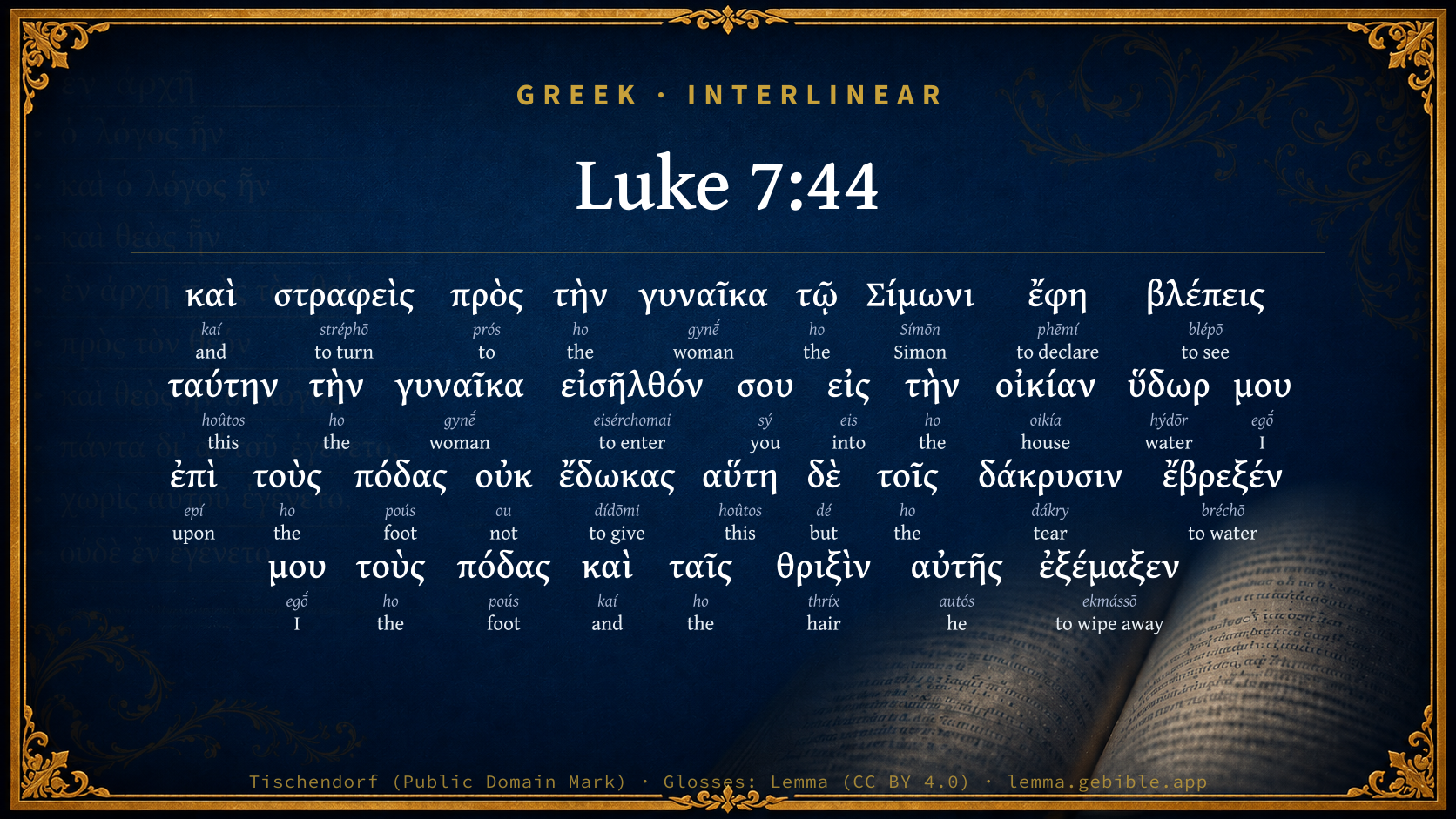
Greek (Tischendorf 8th ed.) Luke 7:44 appears in the Greek New Testament. The text above is from the Tischendorf 8th edition. Each word links to its Strong’s number and a concise gloss. Click any word for its full Thayer’s Greek Lexicon entry.
Download image
Cite this verse

Luke 7:44 (World English Bible). Public Domain. Lemma interlinear Bible study tool, https://lemma.gebible.app/v/luke/7/44.

Show BibTeX & RIS
BibTeX
RIS
English Translation
Turning to the woman, he said to Simon, "Do you see this woman? I entered into your house, and you gave me no water for my feet, but she has wet my feet with her tears, and wiped them with the hair of her head.
World English Bible · Public Domain
Download a study sheet

One document with this verse’s original text, its word-by-word gloss line, the meaning frame, cross-references with their text, attributed commentary, and full source and license credits — printable, and it pastes into notes with its structure intact.

This verse Autodidact and up

Study sheet (.html) Plain text (.txt)

A passage Seminary Student

Up to 50 verses in one chapter. A passage sheet keeps up to 6 commentary sources and 12 cross-references per verse, in the order this page ranks them, and says so on the sheet whenever that leaves anything out. Ask for a single verse and you get the Autodidact verse sheet above.

Everything on this page stays free to read, with no account — the sheet is a download of what is already on screen, not access to it.

Want to remove ads? Support Godless Engineer
Compare translations 3

The same verse in 3 English versions, stacked beneath the original-language interlinear above. Click any original word for its lexicon entry.

Each is an independent rendering of the whole verse — the interlinear is not word-aligned to these translations.

Highlighted words mark where these versions differ — a whole-verse word diff, not a word-by-word alignment.

  • World English Bible Public Domain
    Turning to the woman, he said to Simon, "Do you see this woman? I entered into your house, and you gave me no water for my feet, but she has wet my feet with her tears, and wiped them with the hair of her head.
  • King James Version Public Domain
    And he turned to the woman, and said unto Simon, Seest thou this woman? I entered into thine house, thou gavest me no water for my feet: but she hath washed my feet with tears, and wiped them with the hairs of her head.
  • unfoldingWord Literal Text CC BY-SA 4.0
    And turning to the woman, he said to Simon, “Do you see this woman? I entered into your house. You did not give me water for my feet, but she has wet my feet with her tears and wiped them with her hair.

unfoldingWord Literal Text — © unfoldingWord, licensed CC BY-SA 4.0. Word-aligned USFM3 via Door43 (git.door43.org/unfoldingWord/en_ult).

Versions to compare (up to 4)

3 of 4 selected

Show all 19 translations

Every available English version of this verse, each an independent rendering of the whole verse.

  • World English Bible Public Domain
    Turning to the woman, he said to Simon, "Do you see this woman? I entered into your house, and you gave me no water for my feet, but she has wet my feet with her tears, and wiped them with the hair of her head.
  • Berean Standard Bible Public Domain
    And turning toward the woman, He said to Simon, “Do you see this woman? When I entered your house, you did not give Me water for My feet, but she wet My feet with her tears and wiped them with her hair.
  • Majority Standard Bible Public Domain
    And turning toward the woman, He said to Simon, “Do you see this woman? When I entered your house, you did not give Me water for My feet, but she wet My feet with her tears and wiped them with the hair of her head.
  • King James Version Public Domain
    And he turned to the woman, and said unto Simon, Seest thou this woman? I entered into thine house, thou gavest me no water for my feet: but she hath washed my feet with tears, and wiped them with the hairs of her head.
  • American Standard Version (1901) Public Domain
    And turning to the woman, he said unto Simon, Seest thou this woman? I entered into thy house, thou gavest me no water for my feet: but she hath wetted my feet with her tears, and wiped them with her hair.
  • Revised Version (1885) Public Domain
    And turning to the woman, he said unto Simon, Seest thou this woman? I entered into thine house, thou gavest me no water for my feet: but she hath wetted my feet with her tears, and wiped them with her hair.
  • Geneva Bible (1599) Public Domain
    Then he turned to the woman, and said vnto Simon, Seest thou this woman? I entred into thine house, and thou gauest mee no water to my feete: but she hath washed my feete with teares, and wiped them with the heares of her head.
  • Douay-Rheims (1899) Public Domain
    And turning to the woman, he said unto Simon: Dost thou see this woman I entered into thy house, thou gavest me no water for my feet; but she with tears hath washed my feet, and with her hairs hath wiped them.
  • Young's Literal Translation Public Domain
    And having turned unto the woman, he said to Simon, `Seest thou this woman? I entered into thy house; water for my feet thou didst not give, but this woman with tears did wet my feet, and with the hairs of her head did wipe;
  • Literal Standard Version CC BY-SA 4.0
    And having turned to the woman, He said to Simon, “See this woman? I entered into your house; you did not give water for My feet, but this woman wet My feet with tears, and wiped with the hairs of her head;
  • Unlocked Literal Bible CC BY-SA 4.0
    Jesus turned to the woman and said to Simon, “You see this woman. I have entered into your house. You gave me no water for my feet, but she has wet my feet with her tears and wiped them with her hair.
  • unfoldingWord Literal Text CC BY-SA 4.0
    And turning to the woman, he said to Simon, “Do you see this woman? I entered into your house. You did not give me water for my feet, but she has wet my feet with her tears and wiped them with her hair.
  • Darby Bible Public Domain
    And turning to the woman he said to Simon, Seest thou this woman? I entered into thy house; thou gavest me not water on my feet, but *she* has washed my feet with tears, and wiped them with her hair.
  • World Messianic Bible Public Domain
    Turning to the woman, he said to Simon, “Do you see this woman? I entered into your house, and you gave me no water for my feet, but she has wet my feet with her tears, and wiped them with the hair of her head.
  • Webster's Bible Public Domain
    And he turned to the woman, and said to Simon, Seest thou this woman? I entered into thy house, thou gavest me no water for my feet: but she hath washed my feet with tears, and wiped them with the hairs of her head.
  • Free Bible Version CC BY-SA 4.0
    Turning to the woman, he said to Simon, “You see this woman? When I came into your house, you didn't give me water to wash my feet. But she has washed my feet with her tears, and wiped them with her hair.
  • Bible in Basic English Public Domain
    And turning to the woman he said to Simon, You see this woman? I came into your house; you did not give me water for my feet: but she has been washing my feet with the drops from her eyes, and drying them with her hair.
  • Text-Critical English NT CC BY 4.0
    Then he turned toward the woman and said to Simon, “Do yoʋ see this woman? When I came into yoʋr house, yoʋ did not give me water for my feet, but this woman has wet my feet with her tears and wiped them with the hair of her head.
  • Tyndale New Testament (1534) Public Domain
    And he turned to the woman and sayde vnto Simon: Seist thou this woman? I entred into thy housse and thou gavest me noo water to my fete but she hath wesshed my fete with teares and wiped the with the heeres of her heed.

Literal Standard Version (2020), Covenant Press — licensed CC BY-SA 4.0. Text via the HelloAO Bible API (eBible.org). Unlocked Literal Bible (unfoldingWord) — licensed CC BY-SA 4.0. Text via the HelloAO Bible API (eBible.org). unfoldingWord Literal Text — © unfoldingWord, licensed CC BY-SA 4.0. Word-aligned USFM3 via Door43 (git.door43.org/unfoldingWord/en_ult). Free Bible Version, Dr. Jonathan Gallagher — licensed CC BY-SA 4.0. Text via the HelloAO Bible API (eBible.org).

Word by word

More ways to search: Search by grammar → Find every occurrence → Compare this word →

Practice this passage: Drill this verse → Learn its vocabulary →

ἐξέμαξεν
ekmássō
G1591
“to wipe away”
Verb, Aorist, Active, Indicative, 3rd person, Singular
Part of Speech
Verb
Tense
Aorist
Voice
Active
Mood
Indicative
Person
3rd person
Number
Singular
Full Thayer's Definition

Origin: from G1537 and the base of G3145

TDNT: None

1. to wipe off, to wipe away
  1. καὶ kaí G2532 “and” Conjunction
  2. στραφεὶς stréphō G4762 “to turn” Verb, Aorist, Passive, Participle, Nominative, Singular, Masculine
  3. πρὸς prós G4314 “to” Preposition
  4. τὴν ho G3588 “the” Article, Accusative, Singular, Feminine
  5. γυναῖκα gynḗ G1135 “woman” Noun, Accusative, Singular, Feminine
  6. τῷ ho G3588 “the” Article, Dative, Singular, Masculine
  7. Σίμωνι Símōn G4613 “Simon” Noun, Dative, Singular, Masculine
  8. ἔφη phēmí G5346 “to declare” Verb, Imperfect, Active, Indicative, 3rd person, Singular
  9. βλέπεις blépō G991 “to see” Verb, Present, Active, Indicative, 2nd person, Singular
  10. ταύτην hoûtos G3778 “this” Demonstrative pronoun, Accusative, Singular, Feminine
  11. τὴν ho G3588 “the” Article, Accusative, Singular, Feminine
  12. γυναῖκα gynḗ G1135 “woman” Noun, Accusative, Singular, Feminine
  13. εἰσῆλθόν eisérchomai G1525 “to enter” Verb, Aorist, Active, Indicative, 1st person, Singular
  14. σου sý G4771 “you” Personal pronoun, 2nd person, Genitive, Singular
  15. εἰς eis G1519 “into” Preposition
  16. τὴν ho G3588 “the” Article, Accusative, Singular, Feminine
  17. οἰκίαν oikía G3614 “house” Noun, Accusative, Singular, Feminine
  18. ὕδωρ hýdōr G5204 “water” Noun, Accusative, Singular, Neuter
  19. μου egṓ G1473 “I” Personal pronoun, 1st person, Genitive, Singular
  20. ἐπὶ epí G1909 “upon” Preposition
  21. τοὺς ho G3588 “the” Article, Accusative, Plural, Masculine
  22. πόδας poús G4228 “foot” Noun, Accusative, Plural, Masculine
  23. οὐκ ou G3756 “not” Particle, Negative
  24. ἔδωκας dídōmi G1325 “to give” Verb, Aorist, Active, Indicative, 2nd person, Singular
  25. αὕτη hoûtos G3778 “this” Demonstrative pronoun, Nominative, Singular, Feminine
  26. δὲ dé G1161 “but” Conjunction
  27. τοῖς ho G3588 “the” Article, Dative, Plural, Neuter
  28. δάκρυσιν dákry G1144 “tear” Noun, Dative, Plural, Neuter
  29. ἔβρεξέν bréchō G1026 “to water” Verb, Aorist, Active, Indicative, 3rd person, Singular
  30. μου egṓ G1473 “I” Personal pronoun, 1st person, Genitive, Singular
  31. τοὺς ho G3588 “the” Article, Accusative, Plural, Masculine
  32. πόδας poús G4228 “foot” Noun, Accusative, Plural, Masculine
  33. καὶ kaí G2532 “and” Conjunction
  34. ταῖς ho G3588 “the” Article, Dative, Plural, Feminine
  35. θριξὶν thríx G2359 “hair” Noun, Dative, Plural, Feminine
  36. αὐτῆς autós G846 “he” Personal pronoun, Genitive, Singular, Feminine

About this verse

These counts appear in no published source. They are computed here, from the morphology-tagged text and Lemma’s own curated glosses. What Lemma adds →

37
words
25
distinct lemmas
Gospels
section

Notable vocabulary

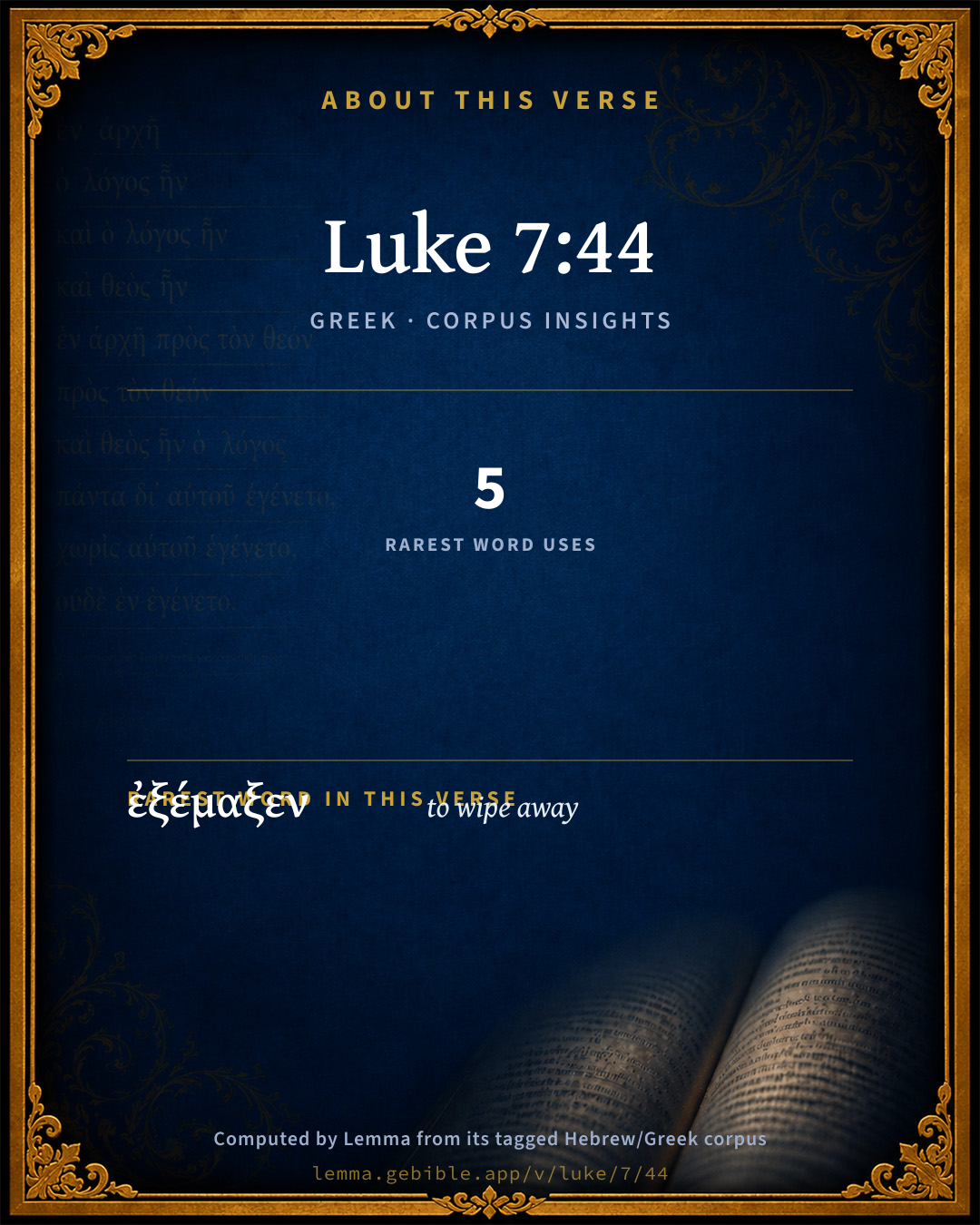
The rarest word here is ἐξέμαξεν to wipe away G1591 — appearing just 5 times in the whole Greek New Testament.

Shared distinctive vocabulary

ἐξέμαξεν to wipe away G1591 occurs in 5 verses of the Greek New Testament. Also found in:

Repetition

Words recur within this verse:

  • γυναῖκα woman G1135 ×2
  • πόδας foot G4228 ×2
  • τὴν the G3588 ×8
  • καὶ and G2532 ×2
  • ταύτην this G3778 ×2
  • μου I G1473 ×2

Cross-references

7

Topical passages linked to Luke 7:44 in the Treasury of Scripture Knowledge — connected by theme and wording, ordered by reader-vote popularity; previews shown in the World English Bible.

  • 1 Timothy 5:10 being approved by good works, if she has brought up children, if she has been hospitable to strangers, if she has washed the saints' feet, if she has relieved the afflicted, and if she has diligently followed every good work.
  • Genesis 18:4 Now let a little water be fetched, wash your feet, and rest yourselves under the tree.
  • Genesis 19:2 and he said, "See now, my lords, please turn aside into your servant's house, stay all night, wash your feet, and you will rise up early, and go on your way." They said, "No, but we will stay in the street all night."
  • Judges 19:21 So he brought him into his house, and gave the donkeys fodder; and they washed their feet, and ate and drink.
  • Genesis 43:24 The man brought the men into Joseph's house, and gave them water, and they washed their feet. He gave their donkeys fodder.
  • 1 Samuel 25:41 She arose, and bowed herself with her face to the earth, and said, Behold, your handmaid is a servant to wash the feet of the servants of my lord.
  • James 2:6 But you have dishonored the poor man. Don't the rich oppress you, and personally drag you before the courts?

Cross-references courtesy of OpenBible.info (CC BY 4.0).

Where the printed editions differ

1 variant

Places in this verse where the major printed Greek editions disagree on the wording in a way that affects the translation — a comparison of editions, not a manuscript-by-manuscript collation. The editions are the modern critical texts (Nestlé-Aland 28/27, SBL, Westcott-Hort, Tregelles, Tyndale House) and the traditional texts behind the KJV (the Textus Receptus and the Byzantine/Majority text). It is not a claim about which reading is original.

  1. Extra text
    τὴς κεφαλῆς

    “the head”

    In TRByz Not in NA28NA27TynSBLWHTreg

    τὴς κεφαλῆς (tēs kephalēs) 'the head' is only in traditional manuscripts (TR+Byz)

Textual data: Translators Amalgamated Greek New Testament (STEPBible TAGNT) · CC BY 4.0.

Commentary

Notes on Luke 7:44 from classic Christian and Jewish commentators (each source and its license shown beneath its notes). The classic Christian expositions comment on the surrounding passage and are grouped to its opening verse, so a note may address several verses; the Jewish commentaries on the Tanakh (Rashi and others) are per-verse, so they appear only where the commentator wrote on this verse.

Lemma curates 59 commentaries, every one of them public domain or Creative Commons licensed, each selected and text-cleaned for this edition rather than reprinted as found. About our sources →

The Biblical Illustrator

Joseph S. Exell

Luk_7:44

Simon, seest thou this woman?

--

Penitence worth seeing

Not only with the bodily eye, for with that he saw and mistook, but with consideration and observation. The deportment of a true penitent is worth our seeing; their carriage and conversation is worthy observation. (N. Rogers.)

Thou gavest Me no water for My feet: Ceremonies of courtesy

And, to reason from the less to the greater, if ritual observances are requisite for the full welcome of friends, think it not enough in entertaining your Saviour that you give Him the substance of good usage, neglecting the compliments. Simon, you see, here gave Him both meat and welcome, yet the neglect of washing, kissing, and anointing is not well taken. When we come to His house, and to His ordinances, as to the word, sacraments, prayer, we make Him good cheer, He esteems Himself then feasted; but if we perform not these things with the decency of outward carriage, we give Him neither water, kiss, nor oil. Believe it, our-best actions receive either life or bane from their circumstances; the substance or matter of a work may be good, and yet the work cannot be so called, unless it be done mode et forma. Velvet is good matter to make a garment, timber goad matter to build a house; and yet the one may be so marred in the cutting and the other in the framing, as that neither the one nor the other shall attain the name of good. What is good in the substance may be sin in the circumstance, and for want of care about the manner, the best work may be done thanklessly. (N. Rogers.)

She hath washed My feet with tears

There are two sorts of tears, as shows St. Austin. Some are commendable, others are discommendable.

1. Commendable tears are natural or spiritual. Natural tears, as Jer_31:15. These discover natural affection, and being well bounded are not to be blamed (Luk_23:28).

2. Spiritual tears are either tears of passion and contrition, as Mat_26:75, or of compassion and devotion, as Jer_9:1-2; Luk_19:1-48. Tears culpable or discommendable are likewise of two sorts, temporal or infernal.

1. Temporal, are those shed in this life by wicked ones. And they are of two sorts, worldly or hypocritical.

(1) Worldly tears are those which are occasioned merely for worldly losses. Of these we read in Eze_8:14; Hos_7:14; Heb_12:1-29.

(2) Hypocritical tears are those which are produced from dissimulation and deceit. Of these we read in Jer_41:5-6.

2. Infernal tears are those shed by the damned in hell (Luk_13:28; Mat_24:51; Mat_25:30). (N. Rogers.)

The smart of sin a good sign

And as it is in a diseased body or with some old sore, if in the dressing of the wound no pain be felt, we conclude the flesh is dead, but when the patient begins to complain of the pain and is sensible of the smart, then it is taken for a good sign that the cure is in a good forwardness. (N. Rogers.)

Is shedding of tears absolutely necessary in godly sorrow?

May not the heart be drowned, and yet the eyes dry? Tears are additions and necessary appendences of true repentance, but not always necessary and true tokens of it. Some have repented truly who have not wept, and some have wept bitterly who have not repented truly. All who shed tears are not straightway penitents; the hardest marble against some weather may weep. And how often do we see the dew to stand on the blasted corn or grass. There are eyeing waters spoken of by Jeremiah, as well as clouds without water, spoken of by St. Jude. It is an easy matter to give you instances Gen_17:3-4; 1Sa_24:17; Mal_2:13). Tears are deceitful things; nothing sooner dried up than a tear, and, therefore, not to be trusted too far. For a man may as well go to his graves end by water as by land. (N. Rogers.)

Tears few at first

In a deep or fresh wound in the body, there is not first that pain felt, nor so much blood seen, as is in a little cut of the finger, because the part is astonied for the time. So is it sometimes with the soul. The wine vessel, you know, without vent runs not though it be ready to burst. (N. Rogers.)

Tears vocal

Tears have a voice with them, nay, they are not only vocal, but importunate. What do you weeping, and breaking my heart? saith St. Act_21:13). You may remember how the tears of Moses, whilst he was floating in an ark of bulrushes on the water, prevailed with Pharaohs daughter. The babe wept, saith the text, and she had compassion on him (Exo_2:6). (N. Rogers.)

To answer the greatness of our sin with the greatness of our sorrow

According to the proportion of the one, should the other be proportioned. Look how grievously we have sinned, so greatly should our sins be bewailed and lamented. A deep wound must have a large plaster, and our repentance, as showeth St. Cyprian, must not be less than our fault. (N. Rogers.)

Sorrow for sin must not be slight

Where sins are great, think it not enough that your sorrow be slight. If thy sins be small and little, thy sorrow may be the less, but if great, thy grief must be suitable. A garment that is deeply soiled cannot, without much rubbing and many layers, become clean. Where there is a deep pollution, and of a scarlet tincture, there must be not only ablutio, but balneatio, a soaking and bathing in the tears of contrition, as is required in Isa_1:16. But may not a man exceed in sorrow, may he not grieve over much? A man cannot exceed in the displeasure of his will against sin, yet he may in the testification of his displeasure by weeping and macerating of his body. Too much moistening chokes a plant, when moderate moistening quickens it. Too much rain gulls the earth, and standing waters on low grounds breed nothing but flags and rushes. So it is with our hearts when they prove standing pools. (N. Rogers.)

Sorrow for sin measured by duration

A torrent may run faster for the present than a continual current, but the current is to be preferred, and hath more water in it than the torrent. One keeps open house at Christmas, but all the year after the gates are shut; he hath taken up a citys refuge. Another keeps a constant and full table all the year, though at that time he may not be compared with the other for abundance. Which of these two now would you count the best housekeeper? I suppose you will grant the latter. So is it here. (N. Rogers.)

Grace quickened by tears

By tears, likewise, grace is quickened. They are not like well water, springing out of the bowels of the earth, nor like rain, distilling from the clouds which clear the air, but they are as the dew of Hermon, which makes all herbs to flourish. Such as mourn for sin grow

up as the lily, and fasten themselves in grace like the trees of Lebanon. They are like the former and the latter rain, they make the heart fruitful in all good works, as you see here in Mary. It is a sovereign water, and will fetch the sinner again to the life of grace though never so far gone. As for glory hereafter (Psa_126:5). Thus as the sun draws up vapours from the earth, not for itself, but to restore them back again; so cloth God our tears. But the bottle spoken of (Psa_56:8), and the vial Rev_5:8), are for the saints both. In them He preserves both their tears and prayers. Not a drop of their eye-water will He suffer to run in waste, He catcheth every tear before it comes to the ground; and till death close up those two fountains, Jor and Dan, flowing from Mount Lebanon, they shall never fail running, but then shall our souls be wafted in them from grace to glory, as they were first transported by them here from sin to grace. (N. Rogers.)

The city of waters taken by Satan

If, in case what hath been said of the good which our tears procure for us prevail not, then give me leave to add a word of the great danger which follows upon the neglect of them, and it shall be only by way of allusion to that we read (2Sa_12:27). Joab having taken the city of waters, he sent to David and willed him to come quickly to take the city itself, well knowing that it could not hold out, the city of waters being cut off before. Thus when Satan hath taken the eyes and cut off the pipes, can you think your soul can long hold out against his temptations? (N. Rogers.)

Wiped them with the hairs of her head

1. In true repentance there is a converting of those things which have been abused to the service of sin to the service of God.

2. That the best ornament of the body, in the judgment of a penitent, is not too good to be employed about the meanest piece of service which concerns Christ. (N. Rogers.)

Truth impressed by living examples

After all, there is no so forcible way of impressing truth as by a living example. The parable of the two debtors could but faintly show the power of forgiveness to win gratitude, in comparison with that vivid picture of the penitent, trusting, grateful woman, washing the feet of her Saviour with her tears, and wiping them with her dishevelled hair. And so it has been from the beginning. Would you realize the power of one person in tempting others to ruin? Seest thou this woman Eve, or this woman Jezebel? Would you realize the beauty of fidelity in friendship? Seest thou this woman Ruth? Would you realize the grandeur of moral heroism? Seest thou this woman Esther? Would you realize the holy influence of a mothers love and faithfulness? Seest thou this woman Jochebed, or this woman Hannah, or this woman Eunice? Would you realize the power of unwavering faith? Seest thou this woman of Syro-Phoenicia? Would you realize the force and beauty of any trait of human character, or the preciousness of any truth which God would have his children to bear in mind? Seest thou this woman before you, who illustrates it as it could not be taught in any other way? That woman is your mother, your wife, your sister, your friend, your neighbour. Look at her glorious example, and thank God for the blessedness of His grace in a willing and trustful human heart. (H. Clay Trumbull.)

Seest thou this woman?

Simon had not seen the woman yet He had only seen the sinner. Look, then, on the woman at last, O Pharisee. Look upon her in the light of the parable you have just heard. Look on thyself, too, for as yet thou hast not seen thyself--the Pharisee hiding the man from thy incurious eyes. Thou poor blind Pharisee I if love be the proof of forgiveness, how much hast thou, loving so little, been forgiven? (S. Cox, D. D.)

The Biblical Illustrator, edited by Joseph S. Exell (c. 1880s–1900s) — public domain. Text from a community e-Sword module.

Joseph Benson's Commentary

Luk 7:44-48. And he turned to the woman — That had been a scandalous, notorious sinner, and was the greater, the five hundred pence debtor. The Pharisee, however, though the less, the fifty pence debtor, yet was a debtor too; which was more than he thought himself to be, judging rather that God was his debtor, Luk 18:10-11. Seest thou this woman — Afflicted and distressed as she is? and canst thou avoid taking notice of the extraordinary tenderness and affectionate regard to me that she has now manifested? I entered into thy house — As a guest, on thine own express invitation; thou gavest me no water for my feet — Though that be so customary and necessary a refreshment on these occasions. But she hath washed my feet with her tears — Tears of affection for me, tears of affliction for sin; and wiped them with the hairs of her head — In token of her great love to me. Thou gavest me no kiss — When I first came under thy roof. So little was thy love to me. It was customary with the Jews to show respect and kindness to their welcome guests, by saluting them with a kiss, by washing their feet, and anointing their heads with oil, or some fine ointment. It is possible Simon might omit some of these civilities, lest his brethren, who sat at the table with him, should think he paid Jesus too much respect; and, if there was any such slight intended, it might be an additional reason for our Lord’s taking such particular notice of the neglect. But this woman, since the time I came in — Or rather, as many copies read it, εισηλθεν, she came in, hath not ceased to kiss even my feet — With the greatest humility and affection. My head with oil thou didst not anoint — Though few entertainments fail of being attended with that circumstance, (see Deu 28:40; Mic 6:15; Psa 2:5; and Psa 104:15; and Psa 141:5;) but she, as thou seest, hath anointed my feet with precious and fragrant ointment; wherefore I say unto thee — I declare it openly, both for her vindication and for thy admonition; her sins, which are many — And exceedingly heinous, as I well know; are forgiven — Freely and graciously; for — Rather, therefore, as οτι undoubtedly ought here to be translated, she loved much — As I have been the means of bringing her to repentance, and to enjoy pardon and peace, she has thus testified the great love and high regard she has for me, as being persuaded that she never can sufficiently express her sense of the obligation. But to whom little is forgiven — Or who thinks his debt was but small; the same loveth little — Is not much affected with the kindness of the creditor that forgives him: and feels but little gratitude and love to him on that account. The substance, therefore, of our Lord’s answer to the Pharisee is, “It is true, this woman has been a great sinner; but she is a pardoned sinner, which supposes her to be a penitent sinner: what she has done to me, is an expression of her great love to me, her Saviour, by whom her sins are forgiven: and as she is pardoned, who was so great a sinner, it may reasonably be expected that she will love her Saviour more than others, and give greater proofs of it; and if this be the fruit of her love, flowing from a sense of the pardon of her sins, it becomes me to accept of it, and ill becomes any to be offended at it.” It must be carefully observed here, that her love is mentioned as the effect and evidence, not the cause of her pardon. She knew that much had been forgiven her, and therefore she loved much. It is true, Jesus had not yet given her any express intimation in word of the pardon of her sins; yet, having, by his sermons and his grace attending her hearing them, brought her to true repentance, without doubt she was assured of her pardon by the general doctrine of the gospel, which she had heard; by the promise of rest, which Jesus had lately made to all weary and heavy-laden sinners; and especially by the Spirit of adoption, which he had sent into her heart, sealing forgiveness upon her conscience, begetting her again to immortal hopes, and filling her with joy and peace, through believing that God was pacified toward her after all she had done.

As a further proof of the justness of this interpretation, it may not be improper to produce here the following testimony of Dr. Whitby: “Christ saith not her sins are forgiven because she loved much, but this ought to be a token, that her sins, which rendered her unworthy to touch me, have been forgiven; this great love to me being an indication of her deep sense of God’s mercy to her in pardoning her many sins; and this do I, the prophet and the Son of God, declare unto her. To this sense lead both the parable of the great debtor, to whom his lord frankly had forgiven all, for he loved much because much had been forgiven, and the conclusion of it, in these words, he that hath little forgiven, loveth little. Whence it appears, that οτι here cannot be causal, or intimate that she was forgiven much because she loved much; the cause assigned of her forgiveness being, not her love, but faith, Luk 7:50; but only consequential, denoting the effect, or indication of the forgiveness of her many sins. So, Hos 9:15, all their iniquity was in Gilgal, οτι, therefore there I hated them; for they did not sin in Gilgal because he hated them there; but he hated them there because there they offended.” Thus also Dr. Campbell, who translates the words, Therefore her love is great, observing, “The whole context shows that the particle οτι is illative, and not causal, in this place. The parable of the debtors clearly represents the gratuitous forgiveness as the cause of the love, not the love as the cause of the forgiveness. And this, on the other hand, is, Luk 7:50 th, ascribed to her faith.” Observe, reader, 1st, The Pharisee doubted whether Jesus was a prophet or not, nay, he, in effect, denied it; but Christ here shows that he was more than a prophet, that he was one who had power on earth to forgive sins, and to whom the affections and thankful acknowledgments of penitent sinners were due; in other words, that he was the Messiah, the Son of God, whose sole prerogative and right it was, in conjunction with the Father, to forgive men’s sins. 2d, In testifying that this pardoned sinner loved much, because she had had much forgiven, and in signifying that to whom little is forgiven, the same loveth little; he intimated to the Pharisee, that his love to Christ was so little, that he had reason to question whether he loved him at all in sincerity; and consequently, whether indeed his sins, though comparatively little, were forgiven him. From this we learn that, instead of grudging great sinners the mercy they find with Christ upon their repentance, we ought to be excited by their example to examine ourselves, whether we be indeed forgiven, and do at all love Christ. “Our Lord did not make the application of this parable more directly, but left Simon to do it, because he could not but see that if love invites love, and merits a return, Jesus would have been ungenerous had he treated this woman with rudeness and contempt. Having expressed greater love to him, she deserved higher returns of gratitude from him than even Simon himself; for which reason he was not to blame when he allowed her to wash his feet with her tears, wipe them with the hairs of her head, kiss them, and anoint them with fragrant ointment.” And he said unto her, Thy sins are forgiven — Having vindicated her, he spake kindly to her, and assured her, in express terms, that her sins, of which he knew she had truly repented, were actually forgiven.

Joseph Benson's Commentary on the Old and New Testaments (1811–1818) — public domain. Text from a community e-Sword module.

Tyndale Open Study Notes

Tyndale Open Resources

7:44-46 Simon had neglected to show Jesus the common courtesies of hospitality. Since roads were dusty, a servant would wash the dust from a guest’s feet. Greeting a guest with a kiss on both cheeks is normal in the Middle East even today. Anointing the head with olive oil was a way to honor a respected guest.

Tyndale Open Study Notes — © Tyndale Open Resources, licensed CC BY-SA 4.0. Text via the HelloAO Bible API.

Bengel's Gnomon

Johann Albrecht Bengel

Luk 7:44. Ταύτην, this) The woman, by her very attitude and appearance at the time, was refuting Simon, and moving the emotions of all present [save Simon].—σοῦ, thy) Therefore in this instance Simon’s obligation [as being in his own house, and the host] was greater than that of the woman.—οὐκ ἔδωκας, thou hast not given) Simon treated Jesus in the way that a guest who is not honoured is treated.—τοῖς δάκρυσιν, with tears) The Lord observed and notices all the circumstantial details of her pious action: Psa 56:9 (8). Tears are the most precious of waters.

Bengel's Gnomon of the New Testament — English translation (T&T Clark, Edinburgh, 1860) — public domain. Text from a community e-Sword module.

Meyer's Critical & Exegetical Commentary

Heinrich August Wilhelm Meyer

Luk_7:44-46. Jesus places the affectionate services rendered by the woman in contrast with the cold respectable demeanour of the Pharisee, who had not observed towards Him at all the customs of courtesy (foot-washing, kissing) and of deference (anointing of the head).

σου εἰς τ. οἰκ] I came into thy house. The σου being placed first sharpens the rebuke.

That, moreover, even the foot-washing before meals was not absolutely a rule (it was observed especially in the case of guests coming off a journey, Gen_18:4; Jdg_19:21; 1Sa_25:41; 1Ti_5:10) is plain from John 13, and hence the neglect on the part of the heartless Pharisee is the more easily explained.

ἔβρεξέ μου τ. πόδ.] moistened my feet. Comp. on Joh_11:32; Mat_8:3.

Observe the contrasts of the less and the greater:(1) ὕδωρ and τοῖς δάκρυσιν; (2) φίλημα, which is plainly understood as a kiss upon the mouth, and οὐ διέλ. καταφ. μ. τοὺς πόδας; (3) ἐλαίῳ τὴν κεφαλ. and μύρῳ ἤλ. μ. τοὺς πόδας (μύρον is an aromatic anointing oil, and more precious than ἔλαιον, see Xen. Conv. ii. 3).

ἀφʼ ἧς εἰσῆλθον] loosely hyperbolical in affectionate consideration,suggested by the mention of the kiss which was appropriate at the entering.

Meyer — Critical and Exegetical Commentary on the New Testament — English translation by Peter Christie, edited by Frederick Crombie (T&T Clark, 1880) — public domain. Text from a community e-Sword module.

Expositor's Greek Testament

ed. W. Robertson Nicoll

Luk 7:44-46 . στραφεὶς : Jesus looks at the woman now for the first time, and asks His host to look at her, the despised one, that he may learn a lesson from her, by a contrast to be drawn between her behaviour and his own in application of the parable. A sharply marked antithesis runs through the description. ὕδωρ δάκρυσιν ; φίλημα καταφιλοῦσα ; ἐλαίῳ (common oil), μύρῳ (precious ointment); κεφαλήν πόδας . There is a kind of poetic rhythm in the words, as is apt to be the case when men speak under deep emotion.

The Expositor's Greek Testament, edited by W. Robertson Nicoll (1897–1910) — public domain. Text from a community e-Sword module.

Godet's Commentaries

Frédéric Louis Godet

Vers. 44-47. The Application.

Jesus follows an order the inverse of that which He had taken in the parable. In the latter He descends from the cause to the effect, from the debt remitted to the gratitude experienced. In the application, on the contrary, He ascends from the effect to the cause. For the effect is evident, and comes under the observation of the senses (βλέπεις).

Jesus describes it, Luk 7:44-46, whilst the cause is concealed (Luk 7:47), and can only be got at by means of the principle which forms the substance of the parable.

During the first part of the conversation, Jesus was turned towards Simon. He now turns towards the woman whom He is about to make the subject of His demonstration. Jesus had not complained of the want of respect and the impoliteness of His host. But He had noticed them, and felt them deeply. And now what a contrast He draws between the cold and measured welcome of the Pharisee, who appeared to think that it was honour enough to admit Him to his table, and the love shown by this woman that was a sinner! The customary bath for the feet had been omitted by the one, while copious tears were showered upon His feet by the other; the usual kiss with which the host received his guests Simon had neglected, while the woman had covered His feet with kisses; the precious perfume with which it was usual to anoint an honoured guest on a festive day (Psa 23:5) he had withheld, but she had more than made up for the omission. In fact, it is not Simon, it is she who has done Jesus the honours of the house! The omission of τῆς κεφαλῆς (Luk 7:44) in the Alex., “[the hairs] of her head,” is probably the result of negligence. The word perfectly suits the context; the head, as the most noble part of the body, is opposed to the feet of Jesus.

The reading εἰσῆλθεν, “[ever since] she entered,” found in one Mn., has at first glance something taking about it. But it has too little support; and the T. R., “ever since I entered,” is in reality preferable. Jesus thereby reminds Simon of the moment when He came under his roof, and when He had a right to expect those marks of respect and affection which had been neglected. The woman had followed Jesus so closely that she had all but entered with Him; there she was, the moment He was set at the table, to pay Him homage.

From this visible effect—the total difference between the love of the one and the love of the other, Jesus ascends, Luk 7:47, to its hidden cause—the difference in the measure of forgiveness accorded to them respectively. Οὗ χάριν, wherefore; properly, an account of which, that is to say, of this contrast between the respective exhibitions of your gratitude (Luk 7:44-46). This conjunction is the inverse of the therefore in Luk 7:42, which led from the cause to the foreseen effect.

We might make this wherefore bear upon the principal idea, “Her sins are forgiven her.” In that case we should have to regard the words λέγω σοί, I say unto thee, as an inserted phrase, and the last proposition as an epexegetical explanation of this wherefore: “Wherefore I say unto thee, her many sins are forgiven, and that because she loved much.” But we may also make the wherefore bear directly on “I say unto thee,” and make all the rest of the verse the complement of this verb: “Wherefore I say unto thee, that her many sins are forgiven her, because that...” The latter is evidently the more simple construction. The reading, I said unto thee, of א, would indicate that this truth was already contained in this parable. It has neither authority nor probability. — How should we understand the words, for she loved much? Is love, according to Jesus, the cause of forgiveness? Catholic interpreters, and even many Protestants, understand the words in this sense: God forgives us much when we love much; little, if we love little. But, 1. In this case there is no coherence whatever between the parable and its application. On this principle, Jesus should not have asked, Luk 7:42, “Which of them will love Him most?” but, “Which then loved Him most?” The remission of the two debts of such different amounts would result from the different degrees of love in the two debtors; while, on the contrary, it is the difference between the debts remitted which produces the different amount of gratitude. 2. There would be, if possible, a more striking incoherence still between the first part of the application, Luk 7:47 a, and the second, Luk 7:47 b: “To whom little is forgiven, the same loveth little.” To be logical, Jesus should have said precisely the contrary: “Who loves little, to him little is forgiven.” 3. The words, Thy faith hath saved thee (Luk 7:50), clearly show what, in Jesus’ view, was the principle on which forgiveness was granted to this woman; it was faith, not love. We must not forget that ὅτι, because, frequently expresses, just as our for does, not the relation of the effect to its cause, but the relation (purely logical) of the proof to the thing proved. We may say, It is light, for the sun is risen; but we may also say, The sun is risen, for [I say this because] it is light. So in this passage the ὅτι, because, for, may, and, according to what precedes and follows, must mean: “I say unto thee that her many sins are forgiven, as thou must infer from this, that she loved much.” Thus all is consistent, the application with the parable, this saying with the words that follow, and Jesus with Himself and with St. Paul.

Ver. 47b contains the other side of the application of this same principle: the less forgiveness, the less love. This is addressed to Simon. But with delicacy of feeling Jesus gives this severe truth the form of a general proposition, “He to whom...;” just as He also did with Nicodemus, “Except a man be born...” (Joh 3:3).

The thought expressed in this Luk 7:47 raises two difficulties: 1. May forgiveness be only partial? Then there would be men half-saved and half-lost! 2. Is it necessary to have sinned deeply in order to love much?

The real forgiveness of the least sin certainly contains in germ a complete salvation, but only in germ. If faith is maintained and grows, this forgiveness will gradually extend to all the sins of a man’s life, just as they will then become more thoroughly known and acknowledged. The first forgiveness is the pledge of all the rest. In the contrary case, the forgiveness already granted will be withdrawn, just as represented in the parable of the wicked debtor, Matthew 18; and the work of grace, instead of becoming complete, will prove abortive. All is transition here below, free transition, either to perfect salvation or to complete condemnation. As to the great amount of sin necessary in order to loving much, we need add nothing to what each of us already has; it is sufficient to estimate accurately what we have. What is wanting to the best of us, in order to love much, is not sin, but the knowledge of it.

Frédéric Louis Godet — Commentaries on Luke, John, Romans, and 1 Corinthians — English translation (T&T Clark, Edinburgh, 1870s–1890s) — public domain. Text from a community e-Sword module.

Jamieson, Fausset & Brown

Robert Jamieson, A. R. Fausset & David Brown

I entered . . . no water--a compliment to guests. Was this "much love?" Was it any?

Jamieson, Fausset & Brown — Commentary Critical and Explanatory on the Whole Bible (1871) — public domain (CC PDM 1.0). Text via the HelloAO Bible API.

Adam Clarke's Commentary

Verse 44. Thou gavest me no water] In this respect Simon was sadly deficient in civil respect, whether this proceeded from forgetfulness or contempt. The custom of giving water to wash the guest's feet was very ancient. See instances in Ge 18:4; Ge 24:32; Jdg 19:21; 1Sa 25:41. In Hindoostan it is the custom, that when a superior enters the house of an inferior, the latter washes his feet, and gives him water to rinse his mouth before he eats. See AYEEN AKBERY, vol. iii. p. 226.

Adam Clarke's Commentary on the Bible (1810–1826) — public domain. Text from a community e-Sword/MySword module.

Ellicott's Commentary for English Readers

(44) Thou gavest me no water for my feet.—There had, then, been no real respect or reverence in the Pharisee’s invitation. It was hardly more than an act of ostentatious patronage. It was honour enough for the carpenter’s son to be admitted into the house. The acts of courtesy which were due to well-nigh every guest (comp. Notes on Mat_3:11; Joh_13:5; 1Ti_5:10), and which a Rabbi might expect as a thing of course, were, in his judgment, superfluous. Possibly the fact which afterwards drew down the censure of the Pharisees (Mar_7:8) had already become known, and may have influenced Simon. If the new Teacher cared so little about ablutions, why take the trouble to provide them for Him?

A Bible Commentary for English Readers, edited by Charles John Ellicott (1878–1897) — public domain. Text from a community e-Sword module.

The Cambridge Bible for Schools and Colleges

gen. ed. J. J. S. Perowne

44. Seest thou this woman] Rather, Dost thou mark? Hitherto the Pharisee, in accordance with his customs and traditions, had hardly deigned to throw upon her one disdainful glance. Now Jesus bids him look full upon her to shew him that she had really done the honours of his house. Her love had more than atoned for his coldness.

We notice in the language here that rhythmic parallelism, which is often traceable in the words of our Lord, at periods of special emotion.

Into thine house I entered:

Water upon my feet thou gavest not,

But she with her tears bedewed my feet,

And with her tresses wiped them.

A kiss thou gavedst me not:

But she, since I entered, ceased not earnestly kissing my feet.

My head with oil thou anointedst not,

But she anointed my feet with perfume.

Wherefore I say to thee, Her sins, her many sins, have been forgiven, because she loved much.

But he to whom little is being forgiven loveth little.

“As oft as I think over this event,” says Gregory the Great, “I am more disposed to weep over it than to preach upon it.”

thou gavest me no water for my feet] Thus Simon had treated his guest with such careless indifference as to have neglected the commonest courtesies and comforts. To sandalled travellers on those burning, rocky, dusty paths, water for the feet was a necessity; Joh_13:4-5. “Wash your feet, and rest yourselves under the tree” Gen_18:4. “Tarry all night, and wash your feet,” Gen_19:2. “He brought them into his house, and they washed their feet,” Jdg_19:21. “If she have washed the saints’ feet,” 1Ti_5:10.

hath washed] Rather, bedewed or wetted.

with tears] “The most priceless of waters.” Bengel. “She poured forth tears, the blood of the heart.” S. Aug.

The Cambridge Bible for Schools and Colleges (gen. ed. J. J. S. Perowne; Cambridge University Press, 1878–1918) — public domain. Text from a community e-Sword module.

John Gill's Exposition

And he saith unto her,.... Directing his discourse to the woman that now stood before him:

thy sins are forgiven; which was said, partly on account of the Pharisee, to let him see, that he knew this woman, what she was, and had been; that she had been a sinner, a great sinner, one that owed five hundred pence, but was now forgiven, washed, cleansed, sanctified, and justified, and therefore not to be shunned and avoided; and partly on the woman's account, that she might have a fresh discovery of the forgiveness of her sins, for her comfort under the severe censure of the Pharisee, and that her faith in it might be strengthened; as also on his own account, to show that he was not only a prophet that had extraordinary knowledge of persons, and their characters, but that he was the most high God, to whom belonged the prerogative of pardoning sin.

John Gill's Exposition of the Whole Bible (1746–1763) — public domain (CC PDM 1.0). Text via the HelloAO Bible API.

Trapp's Complete Commentary

John Trapp

44 And he turned to the woman, and said unto Simon, Seest thou this woman? I entered into thine house, thou gavest me no water for my feet: but she hath washed my feet with tears, and wiped them with the hairs of her head.

Ver. 44. She hath washed my feet with tears] Her heart was a sacred alembic, {a} out of which those tears were distilled. Never did any man read his pardon with dry eyes.

Washed my feet with tears, &c.] We read not that the Virgin Mary ever did as this greater sinner did. Repentance is the fair child of that foul mother, sin, as the Romans said of Pompey, Εχθρου πατρος φιλτατον τεκνον. And it is question whether more glorifies God, innocence or penitence?

{a} An apparatus formerly used in distilling, consisting of a cucurbit or gourd-shaped vessel containing the substance to be distilled, surmounted by the head or cap, or alembic proper, the beak of which conveyed the vaporous products to a receiver, in which they were condensed. It is now superseded by the retort and worm still. ŒD

John Trapp, A Commentary or Exposition upon All the Books of the Old and New Testament (1647–1656) — public domain. Text from a community e-Sword module.

Albert Barnes' Notes on the Bible

Seest thou this woman? - You see what this woman has done to me, compared with what you have done. She has shown me expressions of regard which you, in your own house, have not shown.

I entered into thine house - I came at your invitation, where I might expect all the usual rites of hospitality.

Thou gavest me no water for my feet - Among Eastern people it was customary, before eating, to wash the feet; and to do this, or to bring water for it, was one of the rites of hospitality. See Gen 18:4; Jdg 19:21. The reasons for this were, that they wore “sandals,” which covered only the bottom of the feet, and that when they ate they reclined on couches or sofas. It became therefore necessary that the feet should be often washed.

Albert Barnes' Notes on the Bible (1834–1885) — public domain. Text from a community e-Sword/MySword module.

Whedon's Commentary on the Bible

Daniel D. Whedon

44. Turned to the woman—Half inclining his face, as he reclines upon the couch, towards her, while he speaks from the couch to Simon.

I entered into thy house—Our Lord knew the honour that entrance conferred upon the house, but the host did not. Very touching is the reminder to the Pharisee of his want, not of courtesy to him as a guest, but of the tokens of love to him as a Saviour. Had Jesus come from a journey, the offices he named would have been matters of obligatory hospitality; and Jesus was evidently invited from the town. Beautiful indeed is the threefold contrast. Simon withheld water; she gave tears. Simon kissed not his face; she kissed his feet. Simon furnished no customary oil; she poured forth the costly ointment.

Daniel D. Whedon (gen. ed.), Commentary on the Old and New Testaments (1874–1909) — public domain. Text from a community e-Sword module.

John Wesley's Explanatory Notes

Thou gavest me no water - It was customary with the Jews to show respect and kindness to their welcome guests, by saluting them with a kiss, by washing their feet, and anointing their heads with oil, or some fine ointment.

John Wesley, Explanatory Notes Upon the Whole Bible (1754–1765) — public domain. Text via the GEBible commentary corpus.

Scofield Reference Notes

C. I. Scofield

Simon

See Jas 2:14-26. When Jesus would justify the woman in the eyes of Simon, He points to her works, for only through her works could Simon see the proof of her faith; but when He would send the woman away in peace, He points to her faith, not her works. See; Tit 2:14; Tit 3:4-8. His own works can never be to the believer his own ground of assurance, which must rest upon the work of Christ (cf. Mat 7:22; Mat 7:23). See "Assurance"; Isa 32:17; Jud 1:1.

The Scofield Reference Bible (1917 edition), notes by C. I. Scofield — public domain. Text from a community e-Sword module.

Burkitt's Expository Notes on the New Testament

William Burkitt

Observe here, 1. How our Saviour recounts and sums up the several particular instances of this woman’s love and respect towards himself: she washed, wiped, kissed, and anointed his feet, according to the custom of those eastern countries. Love will creep where it cannot go, it will stoop to the meanest offices, and is ambitous of the highest services for, and towards the persons we sincerely love.

Observe, 2. The words of comfort given by our Saviour to this poor woman: Thy sins, which are many, are forgiven thee.

Thence learn, that the pardoning mercy of God is boundless and unlimited; it is not limited to any degree of sins or sinners; Thy sins, that are many, are forgiven thee: and thy sins, which are heinous, are forgiven also.

Observe, 3. What is the effect and fruit, of great pardoning mercy; it is great love; her sins, which are many, are forgiven, for she loved much. Her love to Christ was the effect of his pardoning love to her, and not the cause of it; she did not first love much, and then Christ forgave her, and then she loved much. Her love was a love of gratitude, because she was pardoned, and not a love of merit to purchase and procure her pardon.

The Papists interpret this word (for) as if it were the antecedent cause of her forgiveness; whereas it is a consequential sign and evidence, that the free grace and mercy of Christ had forgiven her; her many and great sins were forgiven her, and therefore she loved much. The debt is not forgiven, because the debtor loves his creditor; but the debtor therefore loves, because the debt is forgiven. Forgiveness goes before, and love follows after.

Hence learn, that much love will follow great forgiveness. Love will work in the heart towards God, in some proportion to that love which we have experienced from God.

Observe lastly, the very gracious dismission which this woman meets with from our blessed Saviour: what could she desire that is not here granted to her? Here is remission, safety, faith, and peace; all these here meet to make a contrite soul happy: remission is the ground of her safety, faith the ground of her peace, peace the fruit of her faith, and salvation the issue of her remission.

O woman! Great was thy sin, great was Christ’s pardoning grace, and great was thy joy and comfort: Thy sins are forgiven thee, thy faith hath saved thee, go in peace.

William Burkitt's Expository Notes on the New Testament (1700–1703) — public domain. Text from a community e-Sword module.

The People's New Testament

B. W. Johnson

44–46. I entered into thine house. How strong the contrast between the indifference of the Pharisees and the earnestness of the penitent! He withheld water; she gave precious tears, “the blood of her heart,” says Augustine. He gave no kiss to his cheek; she covered his feet with kisses. He grudged even a drop of oil; she broke the box of rare ointment for her Lord. He treated him with despite as an underling; she adored him as a prince. The water for the feet, the kiss and the oil for the head were ordinary Oriental courtesies.

B. W. Johnson's The People's New Testament with Notes (1889–1891) — public domain. Electronic text from the Christian Classics Ethereal Library (CCEL) ThML edition.

unfoldingWord translationNotes

Door43 World Missions Community

Jesus turned to the woman

Jesus directed Simon's attention to the woman by turning to her.

You gave me no water for my feet

It was a basic responsibility of a host to provide water and a towel for guests to wash and dry their feet after walking on dusty roads. (See: Assumed Knowledge and Implicit Information)

You ... but she

Jesus twice uses these phrases to contrast Simon's lack of courtesy with the woman's extreme actions of gratitude.

she has wet my feet with her tears

The woman used her tears in place of the missing water.

wiped them with her hair

The woman used her hair in place of the missing towel.

You did not give me a kiss

A good host in that culture would greet his guest with a kiss on the cheek. Simon did not do this. (See: Assumed Knowledge and Implicit Information)

did not stop kissing my feet

"has continued to kiss my feet"

kissing my feet

The woman kissed the feet of Jesus rather than his cheek as a sign of extreme repentance and humility.

unfoldingWord translationNotes — © Distant Shores Media and the Door43 World Missions Community, licensed CC BY-SA 4.0. Source: git.door43.org/Door43/en_tn.

Cambridge Greek Testament for Schools and Colleges

44. βλέπεις; ‘Dost thou mark?’ Hitherto the Pharisee, in accordance with his customs and traditions, had hardly deigned to throw upon her one disdainful glance. Now Jesus bids him look full upon her to shew him that she had really done the honours of his house. Her love had more than atoned for his coldness.

We notice in the language here that rhythmic parallelism, which is often traceable in the words of our Lord, at periods of special emotion.

Into thine house I entered:

Water upon my feet thou gavest not,

But she with her tears bedewed my feet,

And with her tresses wiped them.

A kiss thou gavest me not:

But she, since I entered, ceased not earnestly kissing my feet.

My head with oil thou anointedst not,

But she anointed my feet with perfume.

Wherefore I say to thee, Her sins, her many sins, have been forgiven, because she loved much.

But he to whom little is being forgiven loveth little.

“As oft as I think over this event,” says Gregory the Great, “I am more disposed to weep over it than to preach upon it.”

ὕδωρ μου ἐπὶ τοὺς πόδας. Thus Simon had treated his guest with such careless indifference as to have neglected the commonest courtesies and comforts. To sandalled travellers on those burning, rocky, dusty paths, water for the feet was a necessity; Joh 13:4-5. “Wash your feet, and rest yourselves under the tree,” Gen 18:4. “Tarry all night, and wash your feet,” Gen 19:2. “He brought them into his house, and they washed their feet,” Jdg 19:21. “If she have washed the saints’ feet,” 1Ti 5:10.

ἔβρεξεν. ‘Bedewed’ or ‘wetted.’

δάκρυσιν. “The most priceless of waters.” Bengel. “She poured forth tears, the blood of the heart.” St Aug.

Cambridge Greek Testament for Schools and Colleges (Cambridge University Press, 1896; 21 vols, various authors incl. Carr, Maclear, Plummer, Farrar, Lumby, Moule, M. R. James, Simcox) — public domain. Text from a community e-Sword module.

Alford’s Greek Testament

Henry Alford

44-46.] It would not appear that Simon had been deficient in the ordinary courtesies paid by a host to his guests—for these, though marks of honour sometimes paid, were not (even the washing of the feet, except when coming from a journey) invariably paid to guests:—but that he had taken no particular pains to shew affection or reverence for his Guest. Respecting water for the feet, see Gen 18:4: Jdg 19:21. Observe the contrasts here:—ὕδωρ,—δάκρυσιν (‘fudit lacrymas, sanguinem cordis,’ Serm. xcix. (xxiii.) 1, vol. v.),—φίλημα οὐκ ἔδωκ. (on the face),—καταφιλοῦσα τοὺς πόδας:—ἐλαίῳ τὴν κεφ.,—μύρῳ (which was more precious) τοὺς πόδας.

ἀφʼ ἧς εἰσῆλθ.] These words will explain one difficulty in the circumstances of the anointing: how such a woman came into the guest-chamber of such a Pharisee.

She appears by them to have entered simultaneously with our Lord and His disciples. Nor do vv. 36, 37 at all preclude this idea:—ἐπιγνοῦσα ὅτι κατάκειται may mean, ‘having knowledge that He was going to dine,’ &c. If she came in His train, the Pharisee would not exclude her, as He was accustomed to gather such to hear Him: it was the touching at which he wondered.

Henry Alford, The Greek Testament (1849–1861) — public domain. Text from a community e-Sword module.

International Critical Commentary

44. στραφεὶς πρὸς τὴν γυναῖκὰ. She was behind Him. His turning to her while He spoke to Simon was in itself half a rebuke.Up to this He seems to have treated her as He treated the Syrophenician woman, as if paying no attention. The series of contrasts produces a parallelism akin to Hebrew poetry, and in translating a rhythm comes almost spontaneously.

Βλέπεις ταύτην τὴν γυναῖκα; This is probably a question: Simon had ignored her presence. The σου being placed before εἰς τὴνοἰκίαν gives point to the rebuke, but it hardly makes the σου emphatic. An enclitic cannot be emphatic, and σου here is enclitic. The meaning is not “I entered into thine house,” in preference to others; but rather, “I came to thee in thy house,” and not merely in the public street; “I was thy invited guest.”

ὕδωρ μοι ἐπὶ πόδας. Comp. Gen 18:4; Jdg 19:21; 1Sa 25:41; Joh 13:5 ; 1Ti 5:10. The reading is somewhat uncertain, and there are many variations between ftot and μοι, and μου, πόδας and τοὺς πόδας and also of order: μου ἐπὶ τοὺς πόδας (א L Ξ) may be right.

International Critical Commentary — older volumes (1896–1929), various authors — public domain. Text from a community e-Sword module.

Lesson kit

Teaching starters — assembled from the data on this page, not authored interpretation. Every prompt links to the verse data it draws on. Edit before teaching.

Luke, in the Gospels, opens this verse with 37 words (25 distinct Greek lemmas). Its most distinctive word is ekmássō (“to wipe away”). A historical commentator’s framing appears above. Read the whole chapter for the surrounding context.

Discussion questions

  1. How does “to wipe away” (ekmássō) shape what this verse is saying?
  2. Luke 7:38 shares the word «to wipe away» with this verse. How do the two illuminate each other?
  3. “woman” occurs 2× in this one verse. What is the effect of the repetition?
  4. These translations render this verse differently; the difference is in the English rendering, not the original. What questions does that raise?
  5. Reading how The Biblical Illustrator and Joseph Benson's Commentary read this verse, where do the two commentators agree and where do they part?

Things to notice

Reading settings

Reading text

Shown beneath each verse's original-language words.

Old Testament
Old Testament edition

Read the OT as the Masoretic Hebrew (MT) or the Greek Septuagint (LXX).

English shown for the Greek Septuagint (in the Hebrew ↔ Greek comparison).

Comparing translations? Open the Compare panel on any verse page to stack up to four side by side.