Luke 23:35

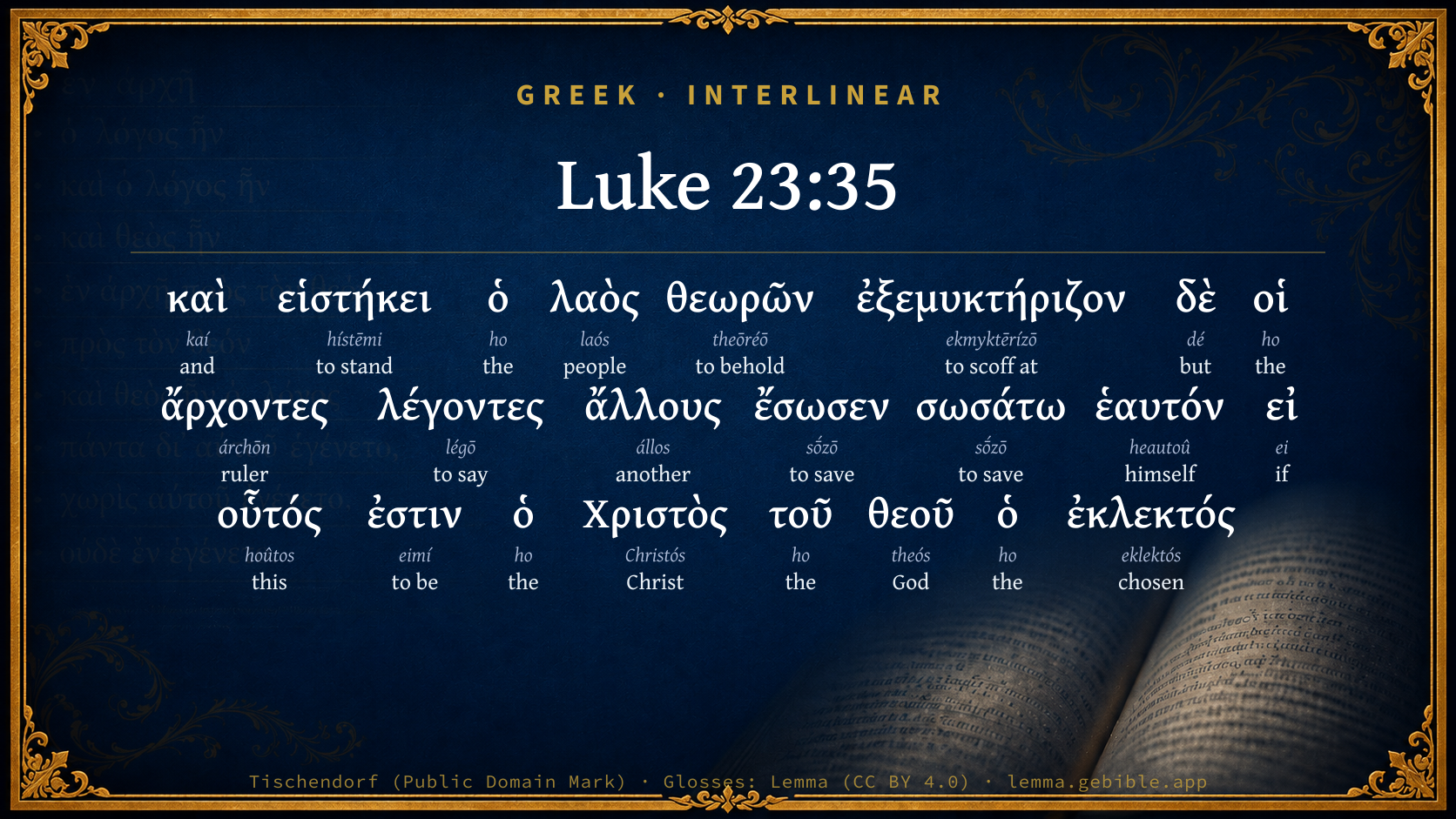
Greek (Tischendorf 8th ed.) Luke 23:35 appears in the Greek New Testament. The text above is from the Tischendorf 8th edition. Each word links to its Strong’s number and a concise gloss. Click any word for its full Thayer’s Greek Lexicon entry.
Download image
Cite this verse

Luke 23:35 (World English Bible). Public Domain. Lemma interlinear Bible study tool, https://lemma.gebible.app/v/luke/23/35.

Show BibTeX & RIS
BibTeX
RIS
English Translation
The people stood watching. The rulers with them also scoffed at him, saying, "He saved others. Let him save himself, if this is the Christ of God, his chosen one!"
World English Bible · Public Domain
Download a study sheet

One document with this verse’s original text, its word-by-word gloss line, the meaning frame, cross-references with their text, attributed commentary, and full source and license credits — printable, and it pastes into notes with its structure intact.

This verse Autodidact and up

Study sheet (.html) Plain text (.txt)

A passage Seminary Student

Up to 50 verses in one chapter. A passage sheet keeps up to 6 commentary sources and 12 cross-references per verse, in the order this page ranks them, and says so on the sheet whenever that leaves anything out. Ask for a single verse and you get the Autodidact verse sheet above.

Everything on this page stays free to read, with no account — the sheet is a download of what is already on screen, not access to it.

Want to remove ads? Support Godless Engineer
Compare translations 3

The same verse in 3 English versions, stacked beneath the original-language interlinear above. Click any original word for its lexicon entry.

Each is an independent rendering of the whole verse — the interlinear is not word-aligned to these translations.

Highlighted words mark where these versions differ — a whole-verse word diff, not a word-by-word alignment.

  • World English Bible Public Domain
    The people stood watching. The rulers with them also scoffed at him, saying, "He saved others. Let him save himself, if this is the Christ of God, his chosen one!"
  • King James Version Public Domain
    And the people stood beholding. And the rulers also with them derided him, saying, He saved others; let him save himself, if he be Christ, the chosen of God.
  • unfoldingWord Literal Text CC BY-SA 4.0
    And the people stood by watching, and the rulers were also ridiculing him, saying, “He saved others; let him save himself, if he is the Christ of God, the Chosen One.”

unfoldingWord Literal Text — © unfoldingWord, licensed CC BY-SA 4.0. Word-aligned USFM3 via Door43 (git.door43.org/unfoldingWord/en_ult).

Versions to compare (up to 4)

3 of 4 selected

Show all 19 translations

Every available English version of this verse, each an independent rendering of the whole verse.

  • World English Bible Public Domain
    The people stood watching. The rulers with them also scoffed at him, saying, "He saved others. Let him save himself, if this is the Christ of God, his chosen one!"
  • Berean Standard Bible Public Domain
    The people stood watching, and the rulers sneered at Him, saying, “He saved others; let Him save Himself if He is the Christ of God, the Chosen One.”
  • Majority Standard Bible Public Domain
    The people stood watching, and the rulers with them sneered at Him, saying, “He saved others; let Him save Himself if He is the Christ, the Chosen One of God.”
  • King James Version Public Domain
    And the people stood beholding. And the rulers also with them derided him, saying, He saved others; let him save himself, if he be Christ, the chosen of God.
  • American Standard Version (1901) Public Domain
    And the people stood beholding. And the rulers also scoffed at him, saying, He saved others; let him save himself, if this is the Christ of God, his chosen.
  • Revised Version (1885) Public Domain
    And the people stood beholding. And the rulers also scoffed at him, saying, He saved others; let him save himself, if this is the Christ of God, his chosen.
  • Geneva Bible (1599) Public Domain
    And the people stoode, and behelde: and the rulers mocked him with them, saying, He saued others: let him saue himselfe, if hee be that Christ, the Chosen of God.
  • Douay-Rheims (1899) Public Domain
    And the people stood beholding, and the rulers with them derided him, saying: He saved others; let him save himself, if he be Christ, the elect of God.
  • Young's Literal Translation Public Domain
    And the people were standing, looking on, and the rulers also were sneering with them, saying, `Others he saved, let him save himself, if this be the Christ, the choice one of God.'
  • Literal Standard Version CC BY-SA 4.0
    And the people were standing, looking on, and the rulers were also sneering with them, saying, “He saved others, let Him save Himself, if this be the Christ, the Chosen One of God.”
  • Unlocked Literal Bible CC BY-SA 4.0
    The people stood watching while the rulers also were mocking him, saying, “He saved others. Let him save himself, if he is the Christ of God, the chosen one.”
  • unfoldingWord Literal Text CC BY-SA 4.0
    And the people stood by watching, and the rulers were also ridiculing him, saying, “He saved others; let him save himself, if he is the Christ of God, the Chosen One.”
  • Darby Bible Public Domain
    And the people stood beholding, and the rulers also [with them] sneered, saying, He has saved others; let him save himself if this is the Christ, the chosen one of God.
  • World Messianic Bible Public Domain
    The people stood watching. The rulers with them also scoffed at him, saying, “He saved others. Let him save himself, if this is the Messiah of God, his chosen one!”
  • Webster's Bible Public Domain
    And the people stood beholding. And the rulers also with them derided him, saying, He saved others; let him save himself, if he is Christ the chosen of God.
  • Free Bible Version CC BY-SA 4.0
    The people stood and watched and the leaders sneered at Jesus. “He saved others, let him save himself, if he is really God's Messiah, the Chosen One,” they said.
  • Bible in Basic English Public Domain
    And the people were looking on. And the rulers made sport of him, saying, He was a saviour of others; let him do something for himself, if he is the Christ, the man of God's selection.
  • Text-Critical English NT CC BY 4.0
    The people stood there looking on, and the rulers who were with them ridiculed him, saying, “He saved others; let him save himself if he is the Christ, the Chosen One of God.”
  • Tyndale New Testament (1534) Public Domain
    And the people stode and behelde. And the rulers mocked him with thee saying: he holpe other men let him helpe him selfe yf he be Christ the chosen of god.

Literal Standard Version (2020), Covenant Press — licensed CC BY-SA 4.0. Text via the HelloAO Bible API (eBible.org). Unlocked Literal Bible (unfoldingWord) — licensed CC BY-SA 4.0. Text via the HelloAO Bible API (eBible.org). unfoldingWord Literal Text — © unfoldingWord, licensed CC BY-SA 4.0. Word-aligned USFM3 via Door43 (git.door43.org/unfoldingWord/en_ult). Free Bible Version, Dr. Jonathan Gallagher — licensed CC BY-SA 4.0. Text via the HelloAO Bible API (eBible.org).

Word by word

More ways to search: Search by grammar → Find every occurrence → Compare this word →

Practice this passage: Drill this verse → Learn its vocabulary →

ἐξεμυκτήριζον
ekmyktērízō
G1592
“to scoff at”
Verb, Imperfect, Active, Indicative, 3rd person, Plural
Part of Speech
Verb
Tense
Imperfect
Voice
Active
Mood
Indicative
Person
3rd person
Number
Plural
Full Thayer's Definition

Origin: from G1537 and G3456

TDNT: 17:16,6

1. to deride by turning up the nose, to sneer at, to scoff at
  1. καὶ kaí G2532 “and” Conjunction
  2. εἱστήκει hístēmi G2476 “to stand” Verb, Pluperfect, Active, Indicative, 3rd person, Singular
  3. ὁ ho G3588 “the” Article, Nominative, Singular, Masculine
  4. λαὸς laós G2992 “people” Noun, Nominative, Singular, Masculine
  5. θεωρῶν theōréō G2334 “to behold” Verb, Present, Active, Participle, Nominative, Singular, Masculine
  6. δὲ dé G1161 “but” Conjunction
  7. οἱ ho G3588 “the” Article, Nominative, Plural, Masculine
  8. ἄρχοντες árchōn G758 “ruler” Noun, Nominative, Plural, Masculine
  9. λέγοντες légō G3004 “to say” Verb, Present, Active, Participle, Nominative, Plural, Masculine
  10. ἄλλους állos G243 “another” Adjective, Accusative, Plural, Masculine
  11. ἔσωσεν sṓzō G4982 “to save” Verb, Aorist, Active, Indicative, 3rd person, Singular
  12. σωσάτω sṓzō G4982 “to save” Verb, Aorist, Active, Imperative, 3rd person, Singular
  13. ἑαυτόν heautoû G1438 “himself” Reflexive pronoun, 3rd person, Accusative, Singular, Masculine
  14. εἰ ei G1487 “if” Conditional
  15. οὗτός hoûtos G3778 “this” Demonstrative pronoun, Nominative, Singular, Masculine
  16. ἐστιν eimí G1510 “to be” Verb, Present, Active, Indicative, 3rd person, Singular
  17. ὁ ho G3588 “the” Article, Nominative, Singular, Masculine
  18. Χριστὸς Christós G5547 “Christ” Noun, Nominative, Singular, Masculine
  19. τοῦ ho G3588 “the” Article, Genitive, Singular, Masculine
  20. θεοῦ theós G2316 “God” Noun, Genitive, Singular, Masculine
  21. ὁ ho G3588 “the” Article, Nominative, Singular, Masculine
  22. ἐκλεκτός eklektós G1588 “chosen” Adjective, Nominative, Singular, Masculine

About this verse

These counts appear in no published source. They are computed here, from the morphology-tagged text and Lemma’s own curated glosses. What Lemma adds →

23
words
18
distinct lemmas
Gospels
section

Notable vocabulary

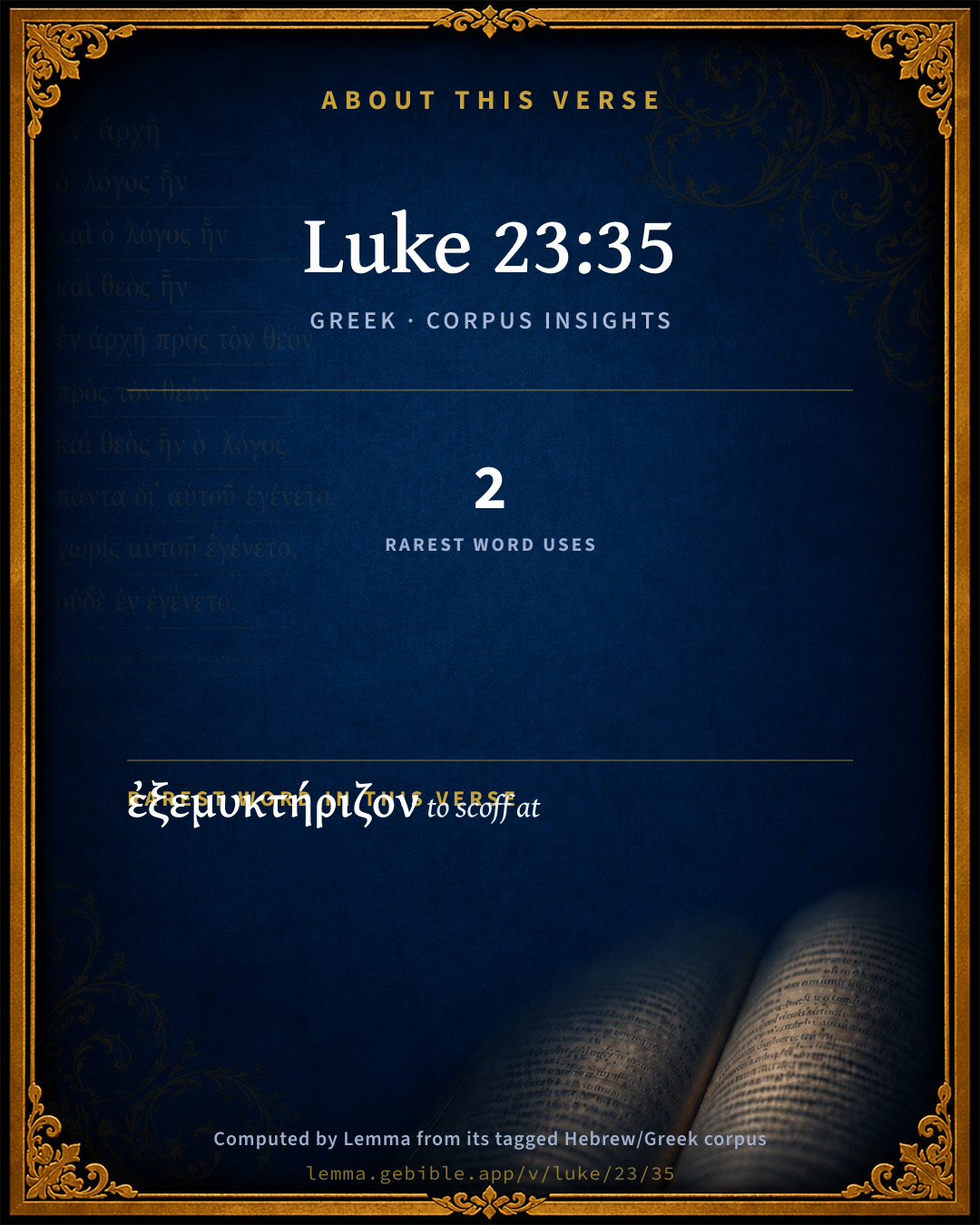
The rarest word here is ἐξεμυκτήριζον to scoff at G1592 — appearing just 2 times in the whole Greek New Testament.

Shared distinctive vocabulary

ἐξεμυκτήριζον to scoff at G1592 occurs in 2 verses of the Greek New Testament. Also found in:

Repetition

Words recur within this verse:

  • ἔσωσεν to save G4982 ×2
  • ὁ the G3588 ×5

Cross-references

22

Topical passages linked to Luke 23:35 in the Treasury of Scripture Knowledge — connected by theme and wording, ordered by reader-vote popularity; previews shown in the World English Bible.

  • Psalms 22:17 I can count all of my bones. They look and stare at me.
  • Isaiah 42:1 Behold, my servant, whom I uphold; my chosen, in whom my soul delights: I have put my Spirit on him; he will bring forth justice to the Gentiles.
  • 1 Peter 2:4 coming to him, a living stone, rejected indeed by men, but chosen by God, precious.
  • Matthew 12:18 "Behold, my servant whom I have chosen; My beloved in whom my soul is well pleased: I will put my Spirit on him. He will proclaim justice to the Gentiles.
  • Mark 15:29–32 Those who passed by blasphemed him, wagging their heads, and saying, "Ha! You who destroy the temple, and build it in three days,
  • Psalms 22:6–8 But I am a worm, and no man; A reproach of men, and despised by the people.
  • Isaiah 53:3 He was despised, and rejected by men; a man of suffering, and acquainted with disease: and as one from whom men hide their face he was despised; and we didn't respect him.
  • Luke 16:14 The Pharisees, who were lovers of money, also heard all these things, and they scoffed at him.
  • Matthew 27:38–43 Then there were two robbers crucified with him, one on his right hand and one on the left.
  • Genesis 37:19–20 They said one to another, "Behold, this dreamer comes.
  • Psalms 22:12–13 Many bulls have surrounded me. Strong bulls of Bashan have encircled me.
  • Psalms 35:15 But in my adversity, they rejoiced, and gathered themselves together. The attackers gathered themselves together against me, and I didn't know it. They tore at me, and didn't cease.
  • Psalms 35:19–25 Don't let those who are my enemies wrongfully rejoice over me; Neither let them wink with the eye who hate me without a cause.
  • Psalms 69:7–12 Because for your sake, I have borne reproach. Shame has covered my face.
  • Psalms 69:26 For they persecute him whom you have wounded. They tell of the sorrow of those whom you have hurt.
  • Psalms 71:11 Saying, "God has forsaken him. Pursue and take him, for no one will rescue him."
  • Isaiah 49:7 Thus says Yahweh, the Redeemer of Israel, [and] his Holy One, to him whom man despises, to him whom the nation abhors, to a servant of rulers: Kings shall see and arise; princes, and they shall worship; because of Yahweh who is faithful, [even] the Holy One of Israel, who has chosen you.
  • Lamentations 3:14 I am become a derision to all my people, and their song all the day.
  • Zechariah 12:10 I will pour on the house of David, and on the inhabitants of Jerusalem, the spirit of grace and of supplication; and they will look to me whom they have pierced; and they shall mourn for him, as one mourns for his only son, and will grieve bitterly for him, as one grieves for his firstborn.
  • Matthew 3:17 Behold, a voice out of the heavens said, "This is my beloved Son, with whom I am well pleased."
  • Luke 22:67–70 "If you are the Christ, tell us." But he said to them, "If I tell you, you won't believe,
  • Psalms 4:2 You sons of men, how long shall my glory be turned into dishonor? Will you love vanity, and seek after falsehood? Selah.

Cross-references courtesy of OpenBible.info (CC BY 4.0).

Commentary

Notes on Luke 23:35 from classic Christian and Jewish commentators (each source and its license shown beneath its notes). The classic Christian expositions comment on the surrounding passage and are grouped to its opening verse, so a note may address several verses; the Jewish commentaries on the Tanakh (Rashi and others) are per-verse, so they appear only where the commentator wrote on this verse.

Lemma curates 59 commentaries, every one of them public domain or Creative Commons licensed, each selected and text-cleaned for this edition rather than reprinted as found. About our sources →

Albert Barnes' Notes on the Bible

See the notes at Mat 27:41-44.

Luk 23:38

In letters of Greek ... - See the notes at Mat 27:37.

Luk 23:39

One of the malefactors - Matthew Mat 27:44 says “the thieves - cast the same in his teeth.” See the apparent contradiction in these statements reconciled in the notes at that place.

If thou be Christ - If thou art the Messiah; if thou art what thou dost pretend to be. This is a taunt or reproach of the same kind as that of the priests in Luk 23:35.

Save thyself and us - Save our lives. Deliver us from the cross. This man did not seek for salvation truly; he asked not to be delivered from his sins; if he had, Jesus would also have heard him. Men often, in sickness and affliction, call upon God. They are earnest in prayer. They ask of God to save them, but it is only to save them from “temporal” death. It is not to be saved from their sins, and the consequence is, that when God “does” raise them up, they forget their promises, and live as they did before, as this robber “would” have done if Jesus had heard his prayer and delivered him from the cross.

Albert Barnes' Notes on the Bible (1834–1885) — public domain. Text from a community e-Sword/MySword module.

The Biblical Illustrator

Joseph S. Exell

Luk_23:35-37

He saved others, let Him save Himself

God in sovereignty often selects as His instruments those who have no desire to be subordinate to His will

Some passengers on the ships deck may be walking forward, and some walking aft, and some standing still; but all, and all alike, are borne onward to their destiny by the breath of heaven in the sails, and according to the will of the pilot who holds the helm in his hand.

This world in space is like a ship on the sea. Of the teeming multitudes that crowd its surface, some intelligently and willingly walk in the way of Gods commandments, others violently resist, and others cleave sluggishly to the dust like clods of the earth; but our Father is at the helm--he will make all subservient to His purpose. Every atom will be compelled to take its place and contribute its own share to the establishment of His kingdom and the redemption of His people. The sovereignty of God is a precious doctrine. Providence is sweet to them that believe: Casting all your care upon Him; for He careth for you. Apart from the meaning of their words, the scuffing of these scribes was overruled by God for the accomplishment of His own purpose. By their conduct they unconsciously fulfilled the prophecy of Scripture regarding the Messiah. This reviling constituted one of the marks by which those who waited for redemption in Israel should know the Redeemer when He came. A root out of a dry ground: no form nor comeliness--no beauty that He should be desired: rejected and despised: they shall look on Him whom they have pierced. (W. Arnot.)

Himself He cannot save

The Kings Son has offered Himself as hostage for certain subjects that were held in captivity by a foreign power. He has gone into their place, and they have on the faith of this transaction been set free. Precisely because they have been set free, He cannot now escape. He has saved others by the substitution of Himself in their stead, and therefore Himself He cannot save. In order to explain fully how Jesus, having saved others, could not also save Himself, we must refer to the history of redemption. Bear in mind that we live under a Divine administration that has been well ordered from the beginning. When an architect begins to lay the foundation of a building, he has the perfect plan already before his eye. Although it be only a mans covenant, it is not carried forward by fits and starts according to the changing circumstances of the times. The design is completed from the first, and its execution is carried forward, it may be from generation to generation, all in accordance with the first design. Much more certain and evident it is that God, who sees the end from the beginning, framed His plan at first, and conducts His administration from age to age according to that plan. The way of salvation for sinful men is not left uncertain, to be modified by the accidents of the day. The gospel does not take its character from passing events. It is, indeed, a transaction between the unchangeable God and erring man; but it takes its character from the Source whence it springs, and not from the objects to which it is directed. It partakes of the immutability of its Author: it has nothing in common with the caprice of men. It has come from heaven to earth, not to receive, but to give an impression. The suns rays when they reach the earth meet with a various reception. At one time they are intercepted before they touch its surface by an intervening subordinate orb; at another time the earth itself keeps out the light from that side of it whereon we stand: at one place, even when the rays are permitted to reach us, they stir corruption into greater energy; at another time they paint the flowers and ripen the fruit, stimulating life and gilding the landscape with varied beauty. But whether they are kept at a distance or received, whether when received they make corruption more corrupt, or make beauty more beautiful, the suns rays are ever the same; they remain true to their celestial character, and are never changed by the changing accidents of earth. They retain all the purity of the heaven they come from, and contract none of the defilement of the earth they come to. (W. Arnot.)

If Christ had saved Himself, man would have been left unsaved

A traveller in an Asiatic desert has spent his last bit of bread and his last drop of water. He has pursued his journey in hunger and thirst until his limbs have given way, and he has at length lain down on the ground to die. Already, as he looks on the hard dry sky, he sees the vultures swooping down, as if unwilling to wait till his breath go out. But a caravan of travellers with provisions and camels comes up. Hope revives in his fainting heart. They halt and look; but as the poor man cannot walk, they are unwilling to burden themselves, and coldly pass on. Now he is left to all the horrors of despair. They have saved themselves, but left him to die. A ship has caught fire at sea. The passengers and crew, shut up in one extremity of the burning ship, strain their eyes and sweep the horizon round for sight of help. At length, and just in time, a sail appears and bears down upon them. But the stranger, fearing fire, does not venture near, but puts about her helm, and soon is out of sight. The men in the burning ship are left to their fate. How dreadful their situation, when the selfish ship saved itself from danger, and left them to sink! Ah! what heart can conceive the misery of human kind, if the Son of God had saved Himself from suffering, and left a fallen world to the wrath of God! (W. Arnot.)

Refusing to save himself

A soldier on duty at the palace of the Emperor at St. Petersburg, which was burnt a few years ago, was stationed, and had been forgotten, in one suite of apartments that was in flames. A Greek priest was the last person to rush through the burning rooms, at the imminent risk of his life, to save a crucifix in a chapel, and, returning, he was hailed by the set, try, who must in a few instants more have been suffocated. What do you want? cried the priest. Save yourself, or you will be lost. I cant leave, replied the sentry, because I am unrelieved; but I called to you to give me your blessing before I die. The priest blessed him, and the soldier died at his post.

Happiness in saving others

One of the Russian emperors, Alexander, when hunting, and riding in front of his suite, heard a groan which arrested him; he reined in his horse, alighted, looked round, and found a man at the point of death. He bent over him, chafed his temples, and tried to excite him. A surgeon was called, but he said He is dead. Try what you can do, said the Emperor. He is dead, replied the surgeon. Try what you can do. At this second command, the surgeon tried some processes; and after a time a drop of blood appeared from a vein which had been opened; respiration was being restored. On seeing this the Emperor, with deep feeling, exclaimed, This is the happiest day of my life; I have saved the life of a fellow-creature. If being thus useful in saving a man from death imparted such happiness to the Emperor, how much greater will our joy and satisfaction be if any of our efforts result in saving a soul from death. Let us try what we can do. There is the greatest encouragement for the largest faith, for Christ is able to save to the uttermost all who come unto God through Him.

Saving others by sacrifice of self

The plague was making a desert of the city of Marseilles; death was everywhere. The physicians could do nothing. In one of their counsels it was decided that a corpse must be dissected; but it would be death to the operator. A celebrated physician of the number arose, and said, I devote myself for the safety of my country. Before this numerous assembly, I swear in the name of humanity and religion, that to-morrow, at the break of day, I will dissect a corpse, and write down as I proceed what I observe. He immediately left the room, made his will, and spent the night in religious exercises. During the day a man had died in his house of the plague; and at daybreak on the following morning, the physician, whose name was Guyon, entered the room and critically made the necessary examinations, writing down all his surgical observations. He then left the room, threw the papers into a vase of vinegar, that they might not convey the disease to another, and retired to a convenient place, where he died in twelve hours. Before the battle of Hatchets Run, a Christian soldier said to his comrade, You are detailed to go to the front, while I am to remain with the baggage. Let us change places. Ill go front, you remain in camp. What for? said the comrade. Because I am prepared to die, I think; but you are not. The exchange was made. The thought of the self-sacrifice of his friend, and his readiness for the exposure of life or the realities of death, led the unsaved soldier to repentance and a like preparation for life. A vessel had driven on the rocks in a storm, and was hopelessly lost. Another vessel had gone out in the blind desire to do something, but a long way off she stopped and watched. That was all, but it was not very much. The men, however, dared venture no further; it would be life for life, and they were not great enough for that. Nelson, the ships lad, said, Capn, Im going to try and save those men. And the captain said, Nelson, if you do, youll be drowned. And Nelson replied--no nobler reply was ever given--Capn, Im not thinking of being drowned, Im thinkin of savin those men. So he and a shipmate took the boat, and went to the wreck, and saved every man who was there. Saving others:--A few years ago a vessel was wrecked on the southwest coast of this country; and with these words I close. It became known to the hamlets and villages, the towns and districts, that this vessel was wrecked, that men were seen clinging to the rigging. The life-boat was launched, and away the men went, and were a long while at sea. Darkness set in, but the people on the coast lighted fires; they kindled great flames so that the sailors might be aided, that the life-boat might be guided on its return to shore. After awhile they saw it returning, and a great strong man, of the name of John Holden, who was on the coast, cried aloud, as with a trumpet, to the Captain of the life-boat, Hi! hi! have you saved the men? The Captain answered, Ay, ay, I have saved the men, and all hearts were filled with gladness. But when the boat reached the coast it was found that one man was left clinging to the mast. Why did not you save him? said Holden; why did not you save him? Because we were exhausted, said the Captain, and we thought it better to attempt to get safely to shore for those we had rescued and for ourselves. We should all have perished if we had remained another five minutes attempting to save one man. But you will go back--you will go back to the rescue? They said no, they had not the strength, the storm was so fierce. Holden threw himself on the shingle, and lifted up a prayer to God louder than the storm that God would put it into the hearts of some of those people to go to the rescue of this one man, just as Jesus Christ came to rescue one lost world. When he had ceased praying six men volunteered to accompany him, and John Holden, with six men, were prepared to go and rescue that one man. If seven men will go to the rescue of one man, how many men shall we send to save Africa? These men were preparing to start when the good old mother of John Holden came rushing down, and threw her arms around his neck, and said, John, you must not go. What can I do if You perish? You know your father was drowned at sea, and it is just two years since your brother William left; we have never heard a word of him since. No doubt he, too, has perished. John, what shall I do if you perish? John said, Mother, God has put it in my heart to go, and if I perish He will take care of you. And away he went; and after awhile the life-boat returned, and when he neared the coast a loud voice was raised, Hi! hi! John, have you saved the man? John answered in a trumpet voice, Yes, we have saved the man; and tell my mother it is my brother William we have saved. Now, there is your brother man the wide world over; haste to the rescue even if you perish in the attempt. (J. S. Balmer.)

Self-sacrificing love

The helmsman who stood at the wheel in the burning steamer till he brought her to the shore, and then dropped backed into the flames, conscious that he had saved the passengers; the soldier who, to save his fugitive comrades, blew up the bridge over which they had crossed, though he knew that he himself would be blown up with the bridge; the Arab, dying of thirst in the desert, yet giving his last drop of water to his faithful camel, may be cited as types of Christ in his self-sacrificing love. Not many years ago there was a colliery accident in the north of England. The mine was flooded, and there were still some of the miners imprisoned below. Rescue parties were made up and sent down. It was a hard piece of work, and they had to work in relays. One man, however, it was noticed, kept working all the time. Others told him that he would kill himself, and asked him to stop and rest. But he answered: How can I stop? There are some of my own down there. Is it not in some such way that Christ came down to seek His own on earth, and to give His life for them? (Sunday School Times.)

The Biblical Illustrator, edited by Joseph S. Exell (c. 1880s–1900s) — public domain. Text from a community e-Sword module.

Joseph Benson's Commentary

Luk 23:35-37. And the people stood beholding — Him hanging on the cross, being, it seems, not at all concerned, but rather pleasing themselves with the spectacle. And the rulers — Whom, from their office, one would have supposed to be men of sense and men of honour, stood among the rabble; and derided him, saying, He saved others, let him save himself — Thus do they upbraid him for the good works he had done, as if it were indeed for these that they crucified him. They triumph over him as if they had conquered him, at the time that he was conquering sin and death for them! They challenge him to save himself from the cross, when he was saving others by the cross! See on Mat 27:39-44. Let him save himself if he be Christ, the chosen of God — If he really be the true Messiah, the elect of God, and, in consequence of that divine choice, be the king of Israel, as he has often pretended, let him save himself from death, that we may see a demonstration of his saving power; and we will then believe him. Or, if he, as the Messiah, would deliver our nation from the Romans, (to do which they supposed would be the principal office of the Messiah,) let him deliver himself from the Romans that have him now in their hands. Thus these Jewish rulers ridiculed him, as captivated by the Romans instead of subduing them. The expression, ο του θεου εκλεκτος, the elect, or chosen of God, is taken from Isa 42:1, and appears to be one of those titles by which the Messiah was at that time distinguished. The soldiers also — Who kept guard at that time, joined with the rest of the spectators; and mocked him, coming and offering him vinegar — To drink in the midst of his agonies. Compare Joh 19:29. And saying — As the rulers and people had done; if thou be the king of the Jews — As thou hast frequently pretended to be, before thou undertakest to deliver them, save thyself — From our power, and thus begin to assert thy claim to a supreme authority. Their insult, it seems, did not lie in their offering our Lord vinegar, for that was the soldiers’ common drink, when mixed with water; (see note on Mat 27:48;) but it lay in what they said to him when they offered it, reproaching him for pretending to be a king, when he was so poor and mean a person, and now about to expire as a malefactor. As this claim of being a king, seemed to the soldiers most derogatory to the Roman authority, it is no wonder that they grounded their insult on this, rather than his professing himself the Son of God. Thus the priests derided his claiming the title of the Messiah, and the Romans his claiming that of a king.

Joseph Benson's Commentary on the Old and New Testaments (1811–1818) — public domain. Text from a community e-Sword module.

Godbey's Commentary on the New Testament

William B. Godbey

THEY REVILE HIM ON THE CROSS

Mar 15:29-32; Luk 23:35-43; Mat 27:39-44. “And passing by, they continued to blaspheme Him, wagging their heads, and saying, Thou that destroyest the temple, and buildest it in three days, save Thyself. If Thou art the Son of God, come down from the cross. Likewise the high priests mocking Him, with the scribes and elders, continued to say, He saved others; Himself He is not able to save. If He is the King of Israel, let Him now come down from the cross, and we will believe on Him. He trusted in God; let Him now deliver Him, if He wishes Him: for He said, I am the Son of God.” This scene, led off by the high priests, elders, and scribes, whose honorable example, of course, many thoughtless people followed, both citizens and soldiers, was not only barbaric in the extreme and infinitely worse than brutal, but diabolical in the superlative degree. And yet it was perpetrated by the ministers and elders standing at the head of the Church, illustrating the significant fact that collegiate education, religious professions, official dignity, and clerical sanctity are no guarantee against the vilest and most demoniacal persecutions when the devil is in them. Shall we not all learn a profitable lesson by this scene, and that is, to have no faith in man, but all in God?

“The thieves also, being crucified along with Him, continued to cast this same reproach on Him.” Luk 22:39-43 : “But one of the malefactors, having been hanged up, continued to blaspheme Him, If Thou art the Christ, save Thyself and us.” There is no contradiction of the preceding with the following. Simply recognize the fact that both of the robbers at first joined with the high priest and the rabble in reproaching Him. But after so long a time, something in the look or the manner of Jesus sent conviction deep into the heart of one of the malefactors, superinducing a tremendous reaction, such as to evoke from the repentant thief the following: “And the other one, responding, continued to rebuke him, saying, Dost thou not fear God, because thou art in the same condemnation? And we indeed justly; for we are receiving the punishment worthy of the crimes which we have committed; but this One has done nothing wrong. He said to Jesus, Lord, when Thou mayest come in Thy kingdom, remember me. And Jesus said to him, Truly I say unto thee, This day thou shalt be with Me in paradise.” On the resurrection morn, three days subsequently, Jesus said to Mary, “I have not yet ascended unto My Father,” setting forth the indisputable fact that He had not met the thief in heaven. He was a Jew, and was saved under the Abrahamic covenant, which all concentrates in Christ. So he went to Abraham’s bosom (Luke 16), whither Lazarus and all of the Old Testament saints had been gathering since the days of Abel. Jesus, expiring on the cross, His disembodied human soul (1Pe 3:19) went and proclaimed to the spirits in prison — i. e. the inmates of hell — the victory won on Calvary (Act 2:27-31); then, crossing the impassable chasm, entered the intermediate paradise — i. e., Abraham’s bosom — and met the thief before the expiration of that day at midnight; spent a wonderful hallelujah Sabbath with the patriarchs and prophets and all of the Old Testament saints; early, the first day of the week, abolished the intermediate paradise, and led up all the inmates with Him (Eph 4:8-10), and, coming to the tomb, received His body, the mighty host of Old Testament saints — being invisible, because not having their bodies — accompanied Him the forty days, and finally ascended with Him up to heaven. The prophetic eye of David (Psalms 24) catching the vision of the triumphant host, hears the shout, “Lift up your heads, O ye gates, and be ye lifted up, ye everlasting doors, and let the King of glory come in.” Then the shout roars back from the celestial portals, “Who is this King of glory?” The answer is prompt, “The Lord, mighty to save and strong to deliver; He is the King of glory.” Now the gates swing high, and millions of glorified spirits shout Him welcome, with the triumphant host captured from the cruel clutches of Satan. The grandest ovation heaven has seen in all the ages now monopolizes the interest of the celestial universe, while the Conqueror of Mount Calvary leads His blood-washed pilgrims up into the august presence of the Almighty Father, presenting them before Him, “Behold, I and the children whom Thou hast given unto Me.” O what a thrilling testimony-meeting follows, Father Abraham, the patriarchs and prophets, all participating, to the most delectable edification of angels, archangels, cherubim, and seraphim! A false exegesis has been put on this passage, in order to sustain that miserable materialistic heresy which deprives man of his soul, ignoring the idea that the soul is ever separate from the body, as this false dogma does not concede that you have a soul. As this positive statement of Jesus to the thief, “This day thou shalt be with Me in paradise,” so clearly and unequivocally recognizes the soul of the thief as going out of the body hanging on the cross and entering paradise that very day, to their ineffaceable shame be it said, they have condescended to the diabolical audacity to change the punctuation of the very identical words which Jesus spoke, so moving the comma as to make it read, “Truly I say unto thee this day, Thou shalt be with Me in paradise,” making the adverb semeron, “this day,” qualify “say unto thee,” instead of “thou shalt be with Me in paradise,” thus making our Savior commit a solecism and talk nonsense. As this occult form of infidelity — i. e., soul-sleeping materialism has been sown by Satan throughout this continent, we feel it our duty to expose it, as it is utterly destitute of truth. The salvation of the thief on the cross is infinitely consolatory to penitent sinners in the hour and article of death. However, it is awfully risky to make our Lord’s mercy in this notable instance an apology for continuing in sin. All should bear in mind the obvious fact that this poor thief had never seen Jesus before, nor hardened his heart by slighting opportunities.

William B. Godbey, Commentary on the New Testament (1896–1900) — public domain. Text from a community e-Sword module.

Tyndale Open Study Notes

Tyndale Open Resources

23:35 The crowd watched and the leaders scoffed (see Ps 22:7-8): Psalm 22 speaks of David, a righteous sufferer, crying out to God for protection. Jesus, David’s descendant, was the ultimate righteous sufferer who fulfilled Ps 22.

Tyndale Open Study Notes — © Tyndale Open Resources, licensed CC BY-SA 4.0. Text via the HelloAO Bible API.

Bengel's Gnomon

Johann Albrecht Bengel

Luk 23:35. [Ὁ λαὸς, the people) not the rabble (ὄχλοι) indiscriminately (whether Jews or Gentiles), as in Luk 23:48, but the Jewish people is here meant.—V. g.—θεωρῶν, beholding) The people no doubt feasted their eyes with that spectacle; for Luke states, that the rulers with them.[258] namely, with the people, derided the Saviour. But, a short while after, a check was put upon their fondness (lit. itching) for derision, Luk 23:48.—Harm., p. 564.]—σὺν αὐτοῖς) viz. with those who had crucified Him.[259] [Luke collects into one passage the mocking insults with which Jesus was harassed when being crucified, Luk 23:35-39. The inscription on the cross was itself an insult in the eyes of the heathens. For which reason, Luke makes mention of the vinegar also, which was offered to Him by the soldiers, sooner than the other evangelists.[260]—Harm., p. 566. Men of respectability do not usually, under ordinary circumstances, blend themselves with such scenes; but wantonness and desire of revenge in the present instance took away all regard for their own dignity. No one ever was derided with such sneers as was Jesus. See that you feel grateful to Him, and learn to endure meekly insults, especially when for His sake.—V. g.]—[ὁ τοῦ Θεοῦ ἐκλεκτὸς, the chosen of GOD) It is not befitting, say they, that the chosen of GOD (if Jesus were really so) should die upon a cross.—V. g.]—οὗτος, this man) Used as a demonstrative, with contempt.

[258] σὺν αὐτοῖς is read in A Vulg. and Rec. Text. But BCDLQbc omit the words.—E. and T.

[259] But the Harm., quoted above, makes it with the people.—E. and T.

[260] Mat 27:48; Mar 15:36; Joh 19:29. But all these describe the second offering of the vinegar, in compassion, to refresh His thirst, just before death. Whereas Mat 27:34, Mar 15:23, and Luke here, Luk 23:35. describes the vinegar, “mingled with gall,” offered in mockery, and at an earlier point of time—E. and T.

Bengel's Gnomon of the New Testament — English translation (T&T Clark, Edinburgh, 1860) — public domain. Text from a community e-Sword module.

Meyer's Critical & Exegetical Commentary

Heinrich August Wilhelm Meyer

Luk_23:35-38. According to the corrected text (see the critical remarks), it is not in Luke the people that mock (comp., on the other hand, Mat_27:39 f.; Mar_15:29 f.), for they rather stand there as spectators, but the members of the Sanhedrim. δὲ καί refers merely to the ἐκμυκτηρίζειν of the ἄρχοντες. To the standing by and looking on of the people (not further sympathizing) is added, however, also mockery on the part of the members of the Sanhedrim. On ἐξεμυκτ. comp. Psa_22:8, and see on Luk_16:14.

οὗτος] this fellow! with scornful contempt.

ὁ τοῦ Θεοῦ ἐκλεκτός] Luk_9:35.

Luk_23:36 is not a misunderstanding of Mat_27:48 (de Wette), but something special which the other evangelists have not got. A mocking offer, not an actual giving to drink; for here the offer was not made by means of a sponge, so that naturally Jesus could not accept the drink. The proceeding was a grim joke!

Luk_23:38. ἐπʼ αὐτῷ] over Him on the cross. The supplementary statement of the title on the cross (see on Mat_27:37) explains the fact that the soldiers scoffed at Him as the King of the Jews.

Meyer — Critical and Exegetical Commentary on the New Testament — English translation by Peter Christie, edited by Frederick Crombie (T&T Clark, 1880) — public domain. Text from a community e-Sword module.

Expositor's Greek Testament

ed. W. Robertson Nicoll

Luk 23:35 . θεωρῶν : the people are now mere spectators. Have they begun to rue already when they see what their demand has come to? Observe the words θεωρίαν and θεωρήσαντες in Luk 23:48 . When they had gazed long enough it came to decided poignant regret. Fickle mob! οἱ ἄρχοντες : they alone, the rulers of the people, mock and sneer. The σὺν αὐτοῖς (T.R.) is a badly attested reading and clearly contrary to the spirit of the narrative. ὁ ἐκλεκτός , the Elect One, and come to this? Incredible? No! thus all the truest sons and elect of God have fared in this evil world.

The Expositor's Greek Testament, edited by W. Robertson Nicoll (1897–1910) — public domain. Text from a community e-Sword module.

Geneva Bible (1599)

Geneva Bible translators

Whom God loveth more than all others.

Geneva Bible (1599) marginal notes — public domain. Text via Bolls.life.

Adam Clarke's Commentary

Verse 35. Derided him] Treated him with the utmost contempt, εξεμυκτηριζον, in the most infamous manner. See the meaning of this word explained, Lu 16:14.

Adam Clarke's Commentary on the Bible (1810–1826) — public domain. Text from a community e-Sword/MySword module.

Ellicott's Commentary for English Readers

(35) And the rulers also with them derided him.—St. Luke uses the generic term for the members of the Sanhedrin, whom St. Matthew particularises as “chief priests, scribes, and elders.” The verb is the same as in 16:14, and implies the curled lip and distended nostril of scorn.

He saved others.—The words were, like those of Caiaphas (Joh_11:50), an unconscious prophecy, in part also an admission of the work that He had done, as in the case of Lazarus, in rescuing others from the power of death.

If he be Christ, the chosen of God.—It may be noted that this is the only passage in the New Testament in which the adjective “chosen,” or “elect,” is directly applied to Christ. The participle of the verb, is, however, found in the better MSS. of Luk_9:35, and the adjective is used of Him as the “stone, elect and precious,” in 1Pe_2:6.

A Bible Commentary for English Readers, edited by Charles John Ellicott (1878–1897) — public domain. Text from a community e-Sword module.

The Cambridge Bible for Schools and Colleges

gen. ed. J. J. S. Perowne

35. beholding] The word implies that they gazed as at a solemn spectacle, Psa_22:17; Zec_12:10. They seem as a body to have been far less active in insult than the others.

with them] These words are omitted in א, B, C, D, L, &c.

derided] The same strong word which is used in Luk_16:14; 1Es_1:51.

He saved others] They said this in the same spirit as the Nazarenes, Luk_4:23.

if he be Christ, the chosen of God] Literally, “if this man (contemptuously) be the Christ of God, the chosen.” For other insults see Mat_27:40-43; Mar_15:29-32. Observe how the universal derision of what appeared to be such abject failure and humiliation enhances our estimate of the faith of the dying robber.

The Cambridge Bible for Schools and Colleges (gen. ed. J. J. S. Perowne; Cambridge University Press, 1878–1918) — public domain. Text from a community e-Sword module.

John Gill's Exposition

And a superscription also was written,.... Containing the crime he was charged with, and accused of; See Gill on Mat 27:37; See Gill on Joh 19:19; See Gill on Joh 19:20.

.

Luke 23:39

luk 23:39

luk 23:39

luk 23:39And one of the malefactors, which were hanged,.... On the cross, one of the thieves crucified with Christ; the Oriental versions add, "with him"; according to the Evangelists Matthew and Mark, both of them reviled him, and threw the same things in his teeth as the priests, people, and soldiers did; which how it may be reconciled; see Gill on Mat 27:44.

railed on him, saying, if thou be Christ, save thyself, and us; taking up the words of the rulers, and adding to them, perhaps, with a design to curry favour with them, hoping thereby to get a release; or, however, showing the wickedness and malice of his heart, which his sufferings and punishment, he now endured, could make no alteration in; see Rev 16:9.

John Gill's Exposition of the Whole Bible (1746–1763) — public domain (CC PDM 1.0). Text via the HelloAO Bible API.

Trapp's Complete Commentary

John Trapp

35 And the people stood beholding. And the rulers also with them derided him, saying, He saved others; let him save himself, if he be Christ, the chosen of God.

Ver. 35. Derided him] Gr. εξεμυκτηριζον, blew their noses at him.

John Trapp, A Commentary or Exposition upon All the Books of the Old and New Testament (1647–1656) — public domain. Text from a community e-Sword module.

Whedon's Commentary on the Bible

Daniel D. Whedon

35. He saved others—Saved them by his miracles from disease and death.

Let him save himself—This is the true test miracle. All his other deeds of power and mercy are of no validity, unless he now asserts his power and demonstrates his Messiahship by making his own crucifixion impossible. If he can be crucified he is not the Christ. This argument, derived from the rulers, satisfies the people.

If he be Christ—If he be the MESSIAH.

Daniel D. Whedon (gen. ed.), Commentary on the Old and New Testaments (1874–1909) — public domain. Text from a community e-Sword module.

The Pulpit Commentary

And the people stood beholding. A hush seems to have fallen over the scene. The crowd of by-standers were awed as they at first silently gazed on the dying form of the great Teacher. What memories must have surged up in the hearts of many of the gazers memories of his parables, his mighty miracles, his words of love; memories of the raising of Lazarus, and of the day of palms! Such a silent awe-struck contemplation was dangerous, the rulers felt, so they hastened to commence their mockery clear," as Stier remarks, "the stifling air, and deafen the voice which was stirring even in themselves." "Look now," they would cry, "at the end of the Man who said he could do, and pretended to do, such strange, unheard-of things!" They seem soon to have induced many to join in their mocking cries and gestures, and so to break the awful silence.

A sad spectacle and the supreme vision.

"And the people stood beholding." "Sitting down they watched him there". (Mat_27:36) Shall we envy those spectators the scene they then witnessed? Shall we wish that we had lived when, with our mortal eyes, we could have seen the Savior crucified on our behalf? I think not. With this distance of time and space between us, we have a better, truer standpoint where we are. No doubt we lose much by that distance; but we gain at least as much as we lose. To those who "stood beholding," or who "sat and watched," there was

I AN EXCEEDINGLY SAD SPECTACLE. They saw:

1. A human being suffering the last extremity of pain and shame. Some among that company could look upon that scene with positive enjoyment, some with stolid indifference; but those of whom we think, the disciples, would witness it with intense, heart-piercing sympathy, with utmost agitation of spirit. His suffering must, in a large degree, have been theirs also theirs in proportion to the love they bore him.

2. A Prophet who had failed to be appreciated, and was now a martyr nobly dying in attestation of the truth.

3. A sacred cause losing its Chief and Champion; a cause being wounded and almost certainly slain in the person of its Founder and Exponent. For who could hope that there would be found amongst his disciples any that would take the standard from his hands, and bear it on to victory? For Christ to die was for Christianity to perish. Such was the spectacle on which his disciples looked as they gathered about his cross. The scene was more vivid, more impressive, more powerfully affecting, as thus enacted before their eyes; but we see in reality more than they did. We have before us

II THE SUPREME VISION on which we can gaze on earth. We see:

1. One who once suffered and died, but whose agony is over; whose pain and sorrow are not now to him sources of evil, but, on the other hand, the ground and the occasion of purest joy and highest honor (see homily on vers. 27-31). Had we been present then, we must have shrunk teem the spectacle before us as too painful for sensitiveness to endure. Now we can bear to dwell on his dying and his death, because the element of overwhelming and blinding sympathy is happily withdrawn.

2. A grand spiritual victory. We do not see in the crucified prophet One that was defeated; we see One that told us all that he came to tell, communicating to us all the knowledge we need in order to live our higher life on earth, and to prepare for the heavenly life beyond; that was not prevented from delivering any part of his Divine message; that completed all he came to do; that was amply entitled to say, as he did before he died, "It is finished.

3. A Divine Redeemer ensuring, by his death, the triumph of his cause. Had he not died as he did, had he saved himself as he was taunted and challenged to do, had he not gone on to that bitter end and drunk that bitter cup even to the dregs, then he would have failed. But because he suffered unto death, he triumphed gloriously, and became "the Author of eternal salvation to all them that believe." This is the supreme vision of human souls. We do well to gaze on nobility as we see it illustrated in human lives around us. We do well to look long and lovingly on human virtue as manifested in the lives and deaths of the glorious army of martyrs. But there is no vision so well worthy of our view; of our frequent, our constant, our protracted and intense beholding, as that of the merciful and mighty Savior dying for our sins, dying in wondrous love that he might draw us to himself and restore us to our Father and our home. Before our eyes Christ crucified is conspicuously set forth; (Gal_3:1) and if we would have forgiveness of sin, rest of soul, worthiness of spirit, nobility of life, hope in death, a blessed immortality, we must direct our eyes unto him who was once "lifted up" that he might be the Refuge, the Friend, the Lord, the Savior of the world to the end of time. Better than the saddest spectacle man ever saw is that supreme vision which is the hope and the life of each looking and trusting human heart. C.

Vers. 35-37. Self-saving and self-sacrifice.

We have two things here of which the latter is much the more worth looking at.

I INHUMANITY AT ITS LOWEST. There are many degrees of inhumanity.

1. It is bad for men or women deliberately to shut themselves out of the society of the wrong and miserable, in order that, without distraction, they may minister to their own comfort or consult their own well-being..

2. It is worse to look on the wounded traveler as he lies within sight and reach of us, and to pass him coldly by "on the other side.

3. It is worse still to regard the overthrow of human greatness or prosperity with positive satisfaction of spirit, to find a guilty enjoyment in the humiliation of another.

4. It is worst of all to do as did these men at the cross to mock at human misery, to taunt it in the hour of its agony, to add another pang to the keen sufferings that already lacerate the soul. Alas! what may not men become! what positively awful possibilities of evil are wrapt up in every human soul! that tiny hand, so soft and delicate, so beautiful, so harmless, what blow may it not possibly strike, some day, against all that is most sacred and most precious! It makes all the difference whether, under Christian principles, we are steadily climbing up toward that which is holy and Divine; or whether, under the dominion of evil forces, we are slowly sliding down toward all that is wrong and base. What an argument for ranging ourselves, while yet young, under the guidance of Jesus Christ, the Righteous and the Gracious One!

II MAGNANIMITY AT ITS HIGHEST.

1. The extremity of evil to which our Lord was then submitting; the most excruciating bodily pain; the most terrible and almost intolerable mental distress; the apprehension of approaching death.

2. The powerful temptation presented to him to deliver himself from it all. By one volition of his will he could have descended from the cross, thus releasing himself and confounding his enemies. He had

(1) the strongest possible inducement to do this from the instincts of the nature he had assumed;

(2) the strongest possible provocation to do this in the bitter and cruel taunts of his enemies.

3. His most magnanimous refusal to exert his power in his own favor. He heard those derisive cries, but he heeded them not. He let those revilers think that he was unable to save himself; he knew that if he did save himself he could not save others. (Mat_27:42) So he voluntarily continued to endure all that torture of body, to bear all that burden of shame and agony of spirit, to go on and down into the deepening shadow of death. Surely spiritual nobility could never strike a higher note than that, could never reach a loftier summit than that. How far can we follow our Lord along this upward path? There have been men who, at a certain point in their career, have clearly foreseen a dark and deathful ending, who have been entreated by their friends to go no further, to stand aside, to "save themselves" and think no more about the salvation of others. (see Act_21:12) And it is quite possible that, though we shall never be placed in a position just like that of our Master, we may have the choice offered us which was then offered him we may have to choose between saving ourselves and leaving others to their fate on the one hand, or sacrificing ourselves and saving our fellows on the other hand. It" that choice should be presented to us, what should we do? The answer depends very much on the measure of the spirit of unselfishness we are cherishing and practising continually.

(1) Before us is a noble opportunity that of teaching, enlightening, (instrumentally) redeeming men; but

(2) we cannot use this opportunity to any extent without self-sacrifice. If we are determined to "save ourselves," we shall do but very little in the work of saving others.

(3) We must choose between the two: either we must resolve to spare ourselves expenditure and endurance, and let the work of human elevation go on without our help; or we must resolve not to spare ourselves, not to save time or money, or trouble, or health, not to spare ourselves uncongenial acts or unpleasant endurances, that men may learn what they know not, may see that to which they are yet blind, that they may be led out of exile into the kingdom of God. If we are keeping our Master well in view, especially if we are beholding him on the cross refusing to save himself though challenged with utmost bitterness to do so, we also shall make the nobler choice. C.

The Pulpit Commentary (1880–1919), ed. H.D.M. Spence-Jones & Joseph S. Exell — public domain. Text from a community e-Sword module.

John Wesley's Explanatory Notes

If thou be the Christ; ver. 37. If thou be the king - The priests deride the name of Messiah: the soldiers the name of king.

John Wesley, Explanatory Notes Upon the Whole Bible (1754–1765) — public domain. Text via the GEBible commentary corpus.

Scofield Reference Notes

C. I. Scofield

people

Jesus crucified is the true touchstone revealing what the world is: "The people stood beholding" in stolid indifference; the rulers, who wanted religion, but without a divine Christ crucified for their sins, "reviled"; the brutal amongst them mocked or railed; the conscious sinner prayed; the covetous sat down before the cross and played their sordid game. The cross is the judgment of this world. Joh 12:31

The Scofield Reference Bible (1917 edition), notes by C. I. Scofield — public domain. Text from a community e-Sword module.

Kretzmann's Popular Commentary

Paul E. Kretzmann

The mocking of the people:

v. 35. And the people stood beholding. And the rulers also with them derided Him, saying, He saved others; let Him save Himself, if He be Christ, the Chosen of God.

v. 36. And the soldiers also mocked Him, coming to Him, and offering Him vinegar,

v. 37. and saying, If Thou be the king of the Jews, save Thyself.

v. 38. And a superscription also was written over Him in letters of Greek and Latin and Hebrew, this is the King of the Jews.

The anticlimax of the people’s frenzy had now been reached. Their bloodthirstiness had been satisfied, and it was only their curiosity that kept them at Calvary. They watched the soldiers in their gruesome work until the crucifixion had been completed. Then, however, they did not remain idle. No other distraction offering itself, they joined the rulers. For these worthies, who would at any other time have felt it a disgrace to mingle with the vulgar crowd, could not deny themselves the joy of coming out from the city and expressing their satisfaction over the success of their plan. They turned up their noses in token of utter contempt of the Lord, and sneeringly remarked: Others He saved; let Him save Himself, if this be indeed the Christ of God, the Chosen One. What they had formerly denied with all the bitterness of their envious hearts they now confessed, showing that they were hypocrites and rotten to the core. They had seen and heard a large enough number of evidences of His Godhead to satisfy any ordinary person, but here they again cast doubt upon the entire matter by challenging Him to come down from the cross to save Himself. See Psa 22:6-8; Psa 22:17. But the Lord did not return the insults in kind. When He was Revelation led, He Revelation led not again; when He suffered, He threatened not, 1Pe 2:23. The soldiers also, tiring of their game of dice, joined in the mockery, making fun especially of the appellation "King of the Jews. " That seemed to them the height of ridiculousness, that this man should have aspired to be the ruler of the despised Israelites. The occasion for using just this name was given by the fact that Pilate had had a superscription placed over the head of Jesus, at the top of the cross, naming the cause or reason for His condemnation: The king of the Jews is this man, or, as it read literally: Jesus of Nazareth, the king of the Jews. In Greek, the language commonly spoken on the street and in business, in Latin, the official language of the Romans, and in Hebrew, or Aramaic, the home language of the majority of the Jews, the superscription had been written out. Note: Jesus here became, as Luther says, the rock of offense before the whole world, every class of people and the most representative languages of the world being here represented. Also: Pilate undoubtedly wanted to express his contempt both for the Jews and for Jesus by choosing the superscription in that form. But his words were actually true and should be a comfort to this day to all that are children of Abraham in the real, the spiritual sense. The King of Grace, the King of Glory, that is the Savior in whom we place our trust.

Paul E. Kretzmann, Popular Commentary of the Bible (1921–1924) — public domain. Text from a community e-Sword module.

Burkitt's Expository Notes on the New Testament

William Burkitt

Observe here, 1. A mighty aggravation of our Lord’s sufferings upon the cross; namely, the mocking derision which he met with in his dying moments. As he endured the pain so he despised the shame; cruel mockings was our Lord tried with, both from the common people and from the chief priests; yet the common people’s reviling him, and wagging their heads at him, was not so much to be taken notice of, as the chief priests, who were men of age and gravity, and the ministers of religion: for them barbarously to mock him in his misery; and, what was worse, atheistically to jeer and scoff at his faith and affiance in God, saying, He trusted in God that he would deliver him: let him deliver him, if he will have him; this was such an indignity as confounds our thoughts.

But from hence we learn,

1. That persecutors are generally atheistical scoffers: the chief priests and elders, who persecuted Christ, do blaspheme God; they mock at his power, and deride his providence, which was as wicked as to deny his being.

2. We learn from this example, that such as minister to God in holy things by way of office, if they be not the best, they are generally the worst of men; no such bitter enemies to the power of godliness, as such preachers who were never experimentally acquainted with the efficacy and power of it upon their own hearts and lives.

Observe, 2. The inscription wrote by Pilate over our suffering Saviour, this is Jesus, the king of the Jews. It was the custom of the Romans, when they crucified a malefactor, to publish the cause of his death in capital letters, placed over the head of the person.

Now it is observable how wonderfully the wisdom of God overruled the heart and pen of Pilate, to draw this title, which was truly honorable, and fix it to his cross. Pilate is Christ’s herald, and proclaims him King of the Jews.

Learn hence, that the kingship and regal dignity of Christ was proclaimed by an enemy, and that in time of his greatest sufferings and reproaches. Pilate without his knowledge did our Saviour an eminent piece of service: verily, he did that for Christ which none of his own disciples durst do; not that he did it designedly, and with any intent to put honor upon Christ, but from the special overruling providence of God. No thanks to Pilate for all this; because the highest services performed for Christ undesignedly, shall never be accepted nor rewarded by him.

William Burkitt's Expository Notes on the New Testament (1700–1703) — public domain. Text from a community e-Sword module.

unfoldingWord translationNotes

Door43 World Missions Community

The people stood

"The people were standing there"

him

This refers to Jesus.

He saved others. Let him save himself

Luke records the ironic words of the rulers. The only way Jesus could save others was by dying instead of saving himself. (See: Irony)

Let him save himself

"Jesus should be able to save himself." They said this to mock Jesus. They did not believe he could save himself. AT: "We would like to see him prove who he is by saving himself from the cross"

the chosen one

"the one that God has chosen"

translationWords

rule

mock

save

Christ

chosen one

unfoldingWord translationNotes — © Distant Shores Media and the Door43 World Missions Community, licensed CC BY-SA 4.0. Source: git.door43.org/Door43/en_tn.

Cambridge Greek Testament for Schools and Colleges

35. The σὺν αὐτοῖς of Rec[392] is omitted by אBCDL.

[392] Rec. The Textus Receptus.

35. θεωρῶν. The word implies that they gazed as at a solemn spectacle, Psa 22:17; Zec 12:10. They seem as a body to have been far less active in insult than the others.

[σὺν αὐτοῖς.] These words are omitted in אBCDL, &c.

ἐξεμυκτήριζον. The same strong word which is used in Luk 16:14; 1Es 1:51.

ἄλλους ἔσωσεν. They said this in the same spirit as the Nazarenes, Luk 4:23.

εἰ οὗτός ἐστιν ὁ Χριστὸς τοῦ θεοῦ ὁ ἐκλεκτός. Literally, “if this man (contemptuously) is the Christ of God, the chosen.” For other insults see Mat 27:40-43; Mar 15:29-32. Observe how the universal derision of what appeared to be such abject failure and humiliation enhances our estimate of the faith of the dying robber.

Cambridge Greek Testament for Schools and Colleges (Cambridge University Press, 1896; 21 vols, various authors incl. Carr, Maclear, Plummer, Farrar, Lumby, Moule, M. R. James, Simcox) — public domain. Text from a community e-Sword module.

Alford’s Greek Testament

Henry Alford

35.] The insults of the people are by no means excluded, even with σὺν αὐτοῖς omitted: nay they are implied, by the δὲ καί which follows. To find a discrepancy with Matt. and Mark here, is surely unfair (Meyer, De Wette):—the people’s standing looking on, does not describe their mind towards Jesus: Luke reports no more than he had before him: and the inference may be drawn that those whom he has related to have cried out an hour ago, ‘Crucify him,’—would not have stood by in silence.

On ver. 48, see note there.

οἱ ἄρχοντες are the chief priests and members of the Sanhedrim: Matt. ver. 41.

τ. θ. ὁ ἐκλ., either the Christ of God, His elect one,—or, the elect Christ of God; I prefer the former: but either way, χρ. τ. θεοῦ must be taken together, not as in .

Henry Alford, The Greek Testament (1849–1861) — public domain. Text from a community e-Sword module.

International Critical Commentary

35. θεωρῶν. ἐξεμυκτήριζον. Both words are from Psa 22:8: πάντες οἱ θεωροῦντές με ἐξεμυκτήρισάν με. Mt. and Mk. use other words; but they add, what Lk. omits, the fulfilment of ἐκίησαν κεεφαλήν. Lk. marks clearly four kinds of ill-treatment which Jesus received. The people ἱστήκει θεωρῶν, the rulers ἐξεμυκτήριζον, the soldiers ἐνέπαιξαν, and the robber ἐβλασφήμει. They form a sort of climax. The θεωρῶν implies vulgar curiosity, staring as at a spectacle (comp. ver. 48): for ἐκμυκτηρίζω comp. 16:14, where, as here, Cod. Bezae has subsannabant. For the form ἱστήκει see on ver. 10.

Ἄλλους ἔσωσεν. This sarcasm is preserved in all three narratives, but Lk. alone gives the contemptuous οὗτος and ὁ ἐκλεκτός. Comp. 9:35. Jesus was elected from all eternity to fulfil all there things. Comp. Enoch, xl. 5.

WH. and RV. put a comma after τοῦ Θεοῦ, which belongs to ὁ Χριστός, not to ὁ ἐκλεκτός. TR., following A C3 Q X Γ etc., places ὁ before τοῦ Θεοῦ, while C*, ff2 have ὁ ἐκλεκτός before Θεοῦ. Syr-Sin. supports this combination. D has εἰ υἱὸς εἶ τοῦ Θεοῦ εἰ Χριστὸς εἷ ὁ ἐκλεκτός, si filius es dei si christus es electus; and the insertion of υἱός is found in other texts.

The σὺν αὐτοῖς after ἄρχοντες (A Γ Δ Π, f Vulg. Syr-Sin.) is an insertion to harmonize with Mt. and Mk.

International Critical Commentary — older volumes (1896–1929), various authors — public domain. Text from a community e-Sword module.

Vincent's Word Studies in the New Testament

Marvin R. Vincent

Beholding. See on ch. Luk 10:18.

Scoffed. See on ch. Luk 16:14.

If he. The A. V. does not give the contemptuous emphasis on ou=tov, this fellow.

Marvin R. Vincent, Word Studies in the New Testament (1887–1900) — public domain. Text from a community e-Sword/MySword module.

Lesson kit

Teaching starters — assembled from the data on this page, not authored interpretation. Every prompt links to the verse data it draws on. Edit before teaching.

Luke, in the Gospels, opens this verse with 23 words (18 distinct Greek lemmas). Its most distinctive word is ekmyktērízō (“to scoff at”). A historical commentator’s framing appears above. Read the whole chapter for the surrounding context.

Discussion questions

  1. What does “to scoff at” (ekmyktērízō) contribute to the verse as a whole?
  2. Luke 16:14 shares the word «to scoff at» with this verse. How do the two illuminate each other?
  3. “to save” occurs 2× in this one verse. What is the effect of the repetition?
  4. The translations on this page render this verse differently — a whole-verse word diff, not a word-by-word alignment. What might account for the different wordings?
  5. Reading how Albert Barnes' Notes on the Bible and The Biblical Illustrator read this verse, where do the two commentators agree and where do they part?

Things to notice

  • These translations choose different wording for 6 words in this verse.
  • “to save” occurs 2× in this single verse.
  • 18 distinct Greek lemmas span 23 words in this verse.

Reading settings

Reading text

Shown beneath each verse's original-language words.

Old Testament
Old Testament edition

Read the OT as the Masoretic Hebrew (MT) or the Greek Septuagint (LXX).

English shown for the Greek Septuagint (in the Hebrew ↔ Greek comparison).

Comparing translations? Open the Compare panel on any verse page to stack up to four side by side.