Luke 7:4

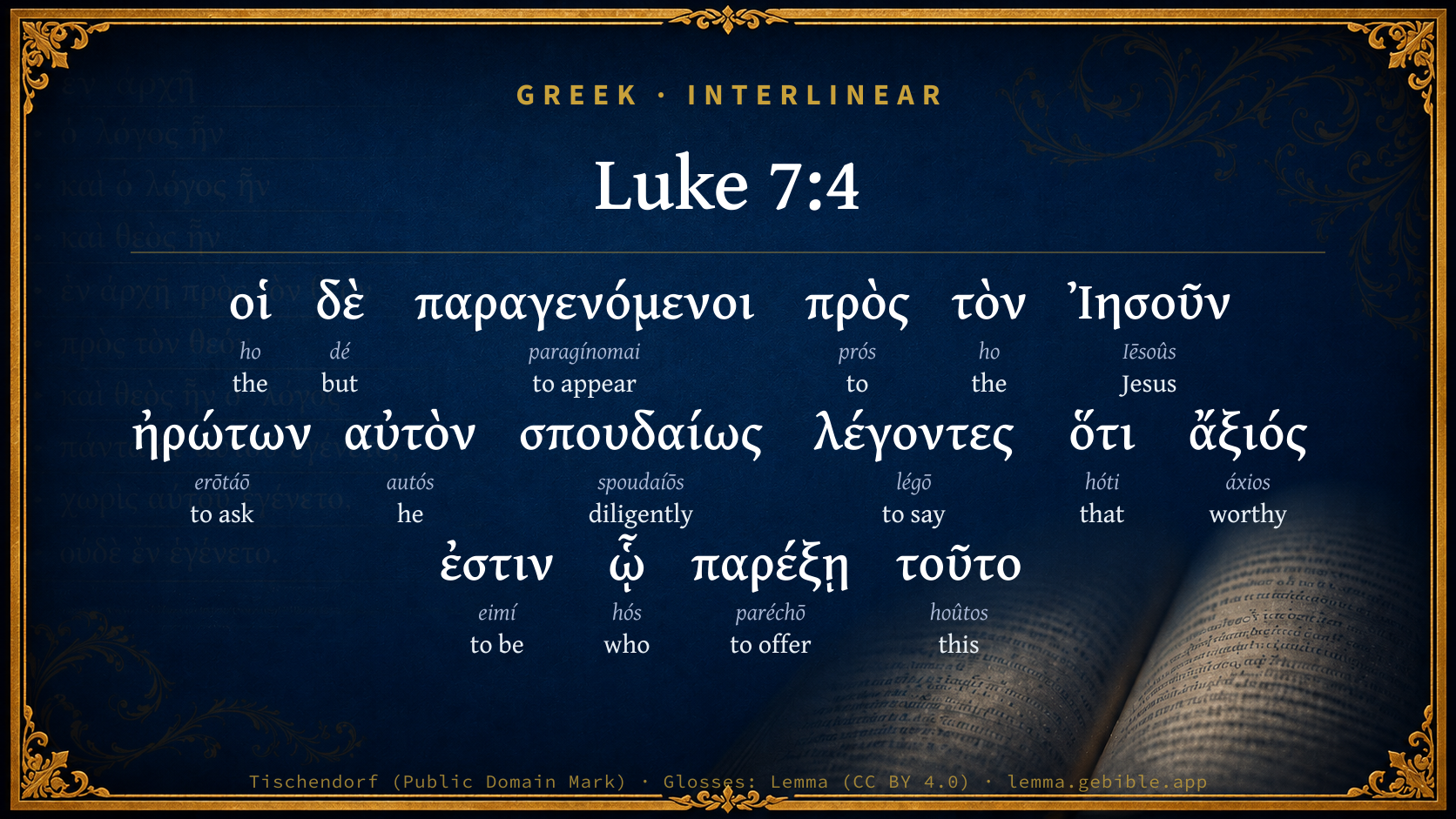
Greek (Tischendorf 8th ed.) Luke 7:4 appears in the Greek New Testament. The text above is from the Tischendorf 8th edition. Each word links to its Strong’s number and a concise gloss. Click any word for its full Thayer’s Greek Lexicon entry.
Download image
Cite this verse

Luke 7:4 (World English Bible). Public Domain. Lemma interlinear Bible study tool, https://lemma.gebible.app/v/luke/7/4.

Show BibTeX & RIS
BibTeX
RIS
English Translation
When they came to Jesus, they begged him earnestly, saying, "He is worthy for you to do this for him,
World English Bible · Public Domain
Highlights
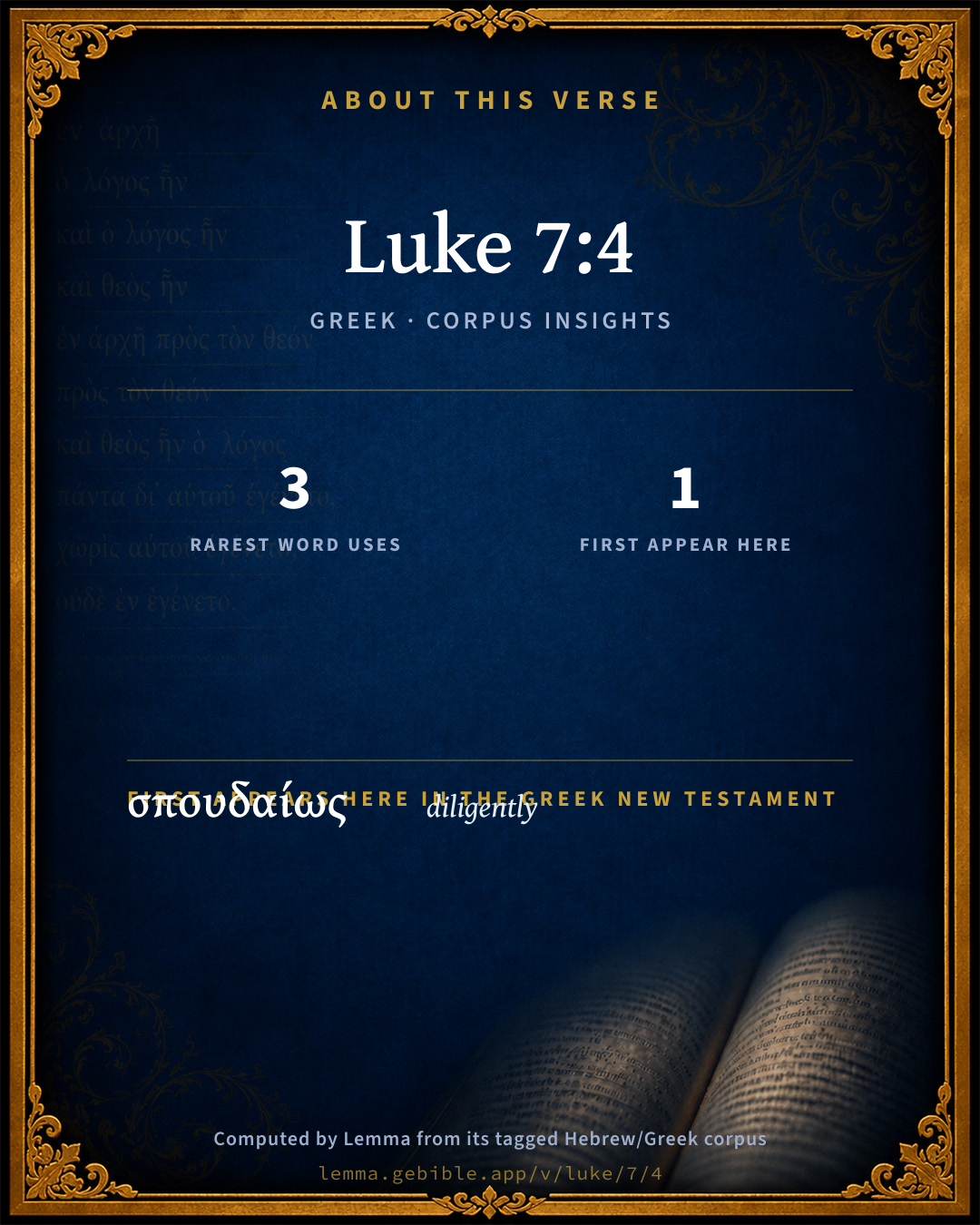
  • 1 first appearance in the Greek New Testament
Full analysis ↓
Download a study sheet

One document with this verse’s original text, its word-by-word gloss line, the meaning frame, cross-references with their text, attributed commentary, and full source and license credits — printable, and it pastes into notes with its structure intact.

This verse Autodidact and up

Study sheet (.html) Plain text (.txt)

A passage Seminary Student

Up to 50 verses in one chapter. A passage sheet keeps up to 6 commentary sources and 12 cross-references per verse, in the order this page ranks them, and says so on the sheet whenever that leaves anything out. Ask for a single verse and you get the Autodidact verse sheet above.

Everything on this page stays free to read, with no account — the sheet is a download of what is already on screen, not access to it.

Want to remove ads? Support Godless Engineer
Compare translations 3

The same verse in 3 English versions, stacked beneath the original-language interlinear above. Click any original word for its lexicon entry.

Each is an independent rendering of the whole verse — the interlinear is not word-aligned to these translations.

Highlighted words mark where these versions differ — a whole-verse word diff, not a word-by-word alignment.

  • World English Bible Public Domain
    When they came to Jesus, they begged him earnestly, saying, "He is worthy for you to do this for him,
  • King James Version Public Domain
    And when they came to Jesus, they besought him instantly, saying, That he was worthy for whom he should do this:
  • unfoldingWord Literal Text CC BY-SA 4.0
    And the ones having come to Jesus asked him earnestly, saying, “He is worthy that you will grant this to him,

unfoldingWord Literal Text — © unfoldingWord, licensed CC BY-SA 4.0. Word-aligned USFM3 via Door43 (git.door43.org/unfoldingWord/en_ult).

Versions to compare (up to 4)

3 of 4 selected

Show all 19 translations

Every available English version of this verse, each an independent rendering of the whole verse.

  • World English Bible Public Domain
    When they came to Jesus, they begged him earnestly, saying, "He is worthy for you to do this for him,
  • Berean Standard Bible Public Domain
    They came to Jesus and pleaded with Him earnestly, “This man is worthy to have You grant this,
  • Majority Standard Bible Public Domain
    They came to Jesus and pleaded with Him earnestly, “This man is worthy to have You grant this,
  • King James Version Public Domain
    And when they came to Jesus, they besought him instantly, saying, That he was worthy for whom he should do this:
  • American Standard Version (1901) Public Domain
    And they, when they came to Jesus, besought him earnestly, saying, He is worthy that thou shouldest do this for him;
  • Revised Version (1885) Public Domain
    And they, when they came to Jesus, besought him earnestly, saying, He is worthy that thou shouldest do this for him:
  • Geneva Bible (1599) Public Domain
    So they came to Iesus, and besought him instantly, saying that hee was worthy that hee should doe this for him:
  • Douay-Rheims (1899) Public Domain
    And when they came to Jesus, they besought him earnestly, saying to him: He is worthy that thou shouldest do this for him.
  • Young's Literal Translation Public Domain
    And they, having come near unto Jesus, were calling upon him earnestly, saying -- `He is worthy to whom thou shalt do this,
  • Literal Standard Version CC BY-SA 4.0
    And they, having come near to Jesus, were calling on Him earnestly, saying, “He is worthy to whom You will do this,
  • Unlocked Literal Bible CC BY-SA 4.0
    When they had come to Jesus, they asked him earnestly, saying, “He is worthy to have you do this for him,
  • unfoldingWord Literal Text CC BY-SA 4.0
    And the ones having come to Jesus asked him earnestly, saying, “He is worthy that you will grant this to him,
  • Darby Bible Public Domain
    But they, being come to Jesus, besought him diligently, saying, He is worthy to whom thou shouldest grant this,
  • World Messianic Bible Public Domain
    When they came to Yeshua, they begged him earnestly, saying, “He is worthy for you to do this for him,
  • Webster's Bible Public Domain
    And when they came to Jesus, they besought him earnestly, saying, That he was worthy for whom he should do this:
  • Free Bible Version CC BY-SA 4.0
    When the elders came to Jesus, they pleaded with him strongly, saying, “Please come and do what he asks. He deserves your help,
  • Bible in Basic English Public Domain
    And they, when they came to Jesus, made their request warmly, saying,
  • Text-Critical English NT CC BY 4.0
    When they came to Jesus, they earnestly pleaded with him, saying, “This man is worthy to have yoʋ do this for him,
  • Tyndale New Testament (1534) Public Domain
    And they came to Iesus and besought him instantly sayinge: He is worthi that thou shuldest do this for him.

Literal Standard Version (2020), Covenant Press — licensed CC BY-SA 4.0. Text via the HelloAO Bible API (eBible.org). Unlocked Literal Bible (unfoldingWord) — licensed CC BY-SA 4.0. Text via the HelloAO Bible API (eBible.org). unfoldingWord Literal Text — © unfoldingWord, licensed CC BY-SA 4.0. Word-aligned USFM3 via Door43 (git.door43.org/unfoldingWord/en_ult). Free Bible Version, Dr. Jonathan Gallagher — licensed CC BY-SA 4.0. Text via the HelloAO Bible API (eBible.org).

Word by word

More ways to search: Search by grammar → Find every occurrence → Compare this word →

Practice this passage: Drill this verse → Learn its vocabulary →

σπουδαίως
spoudaíōs
G4709
“diligently”
Adverb
Part of Speech
Adverb
Full Thayer's Definition

Origin: from G4705

TDNT: None

1. hastily, with haste 2. diligently 3. earnestly
  1. οἱ ho G3588 “the” Article, Nominative, Plural, Masculine
  2. δὲ dé G1161 “but” Conjunction
  3. παραγενόμενοι paragínomai G3854 “to appear” Verb, Aorist, Middle deponent, Participle, Nominative, Plural, Masculine
  4. πρὸς prós G4314 “to” Preposition
  5. τὸν ho G3588 “the” Article, Accusative, Singular, Masculine
  6. Ἰησοῦν Iēsoûs G2424 “Jesus” Noun, Accusative, Singular, Masculine
  7. ἠρώτων erōtáō G2065 “to ask” Verb, Imperfect, Active, Indicative, 3rd person, Plural
  8. αὐτὸν autós G846 “he” Personal pronoun, Accusative, Singular, Masculine
  9. λέγοντες légō G3004 “to say” Verb, Present, Active, Participle, Nominative, Plural, Masculine
  10. ὅτι hóti G3754 “that” Conjunction
  11. ἄξιός áxios G514 “worthy” Adjective, Nominative, Singular, Masculine
  12. ἐστιν eimí G1510 “to be” Verb, Present, Active, Indicative, 3rd person, Singular
  13. ᾧ hós G3739 “who” Relative pronoun, Dative, Singular, Masculine
  14. παρέξῃ paréchō G3930 “to offer” Verb, Future, Middle deponent, Indicative, 3rd person, Singular
  15. τοῦτο hoûtos G3778 “this” Demonstrative pronoun, Accusative, Singular, Neuter

About this verse

These counts appear in no published source. They are computed here, from the morphology-tagged text and Lemma’s own curated glosses. What Lemma adds →

16
words
15
distinct lemmas
Gospels
section

Notable vocabulary

The rarest word here is σπουδαίως diligently G4709 — appearing just 3 times in the whole Greek New Testament.

First appearance in Scripture

This word makes its first canonical appearance in the Greek New Testament here:

  • σπουδαίως diligently G4709

Shared distinctive vocabulary

σπουδαίως diligently G4709 occurs in 3 verses of the Greek New Testament. Also found in:

Repetition

A word recurs within this verse:

Cross-references

6

Topical passages linked to Luke 7:4 in the Treasury of Scripture Knowledge — connected by theme and wording, ordered by reader-vote popularity; previews shown in the World English Bible.

  • Matthew 10:11 Into whatever city or village you enter, find out who in it is worthy; and stay there until you go on.
  • Matthew 10:37–38 He who loves father or mother more than me is not worthy of me; and he who loves son or daughter more than me isn't worthy of me.
  • Luke 7:6–7 Jesus went with them. When he was now not far from the house, the centurion sent friends to him, saying to him, "Lord, don't trouble yourself, for I am not worthy for you to come under my roof.
  • Revelation 3:4 Nevertheless you have a few names in Sardis that did not defile their garments. They will walk with me in white, for they are worthy.
  • Matthew 10:13 If the household is worthy, let your peace come on it, but if it isn't worthy, let your peace return to you.
  • Luke 20:35 But those who are considered worthy to attain to that age and the resurrection from the dead, neither marry, nor are given in marriage.

Cross-references courtesy of OpenBible.info (CC BY 4.0).

Where the printed editions differ

1 variant

Places in this verse where the major printed Greek editions disagree on the wording in a way that affects the translation — a comparison of editions, not a manuscript-by-manuscript collation. The editions are the modern critical texts (Nestlé-Aland 28/27, SBL, Westcott-Hort, Tregelles, Tyndale House) and the traditional texts behind the KJV (the Textus Receptus and the Byzantine/Majority text). It is not a claim about which reading is original.

  1. Different wording
    παρέξῃ

    “You will grant”

    In NA28NA27TynSBLWHTreg Not in TRByz

    παρέξει (parexei) 'He will grant' occurs in traditional manuscripts (TR+Byz) instead of παρέξῃ (parexē) 'You will grant' in older manuscripts (NA28+NA27+Tyn+SBL+WH+Treg)

Textual data: Translators Amalgamated Greek New Testament (STEPBible TAGNT) · CC BY 4.0.

Commentary

Notes on Luke 7:4 from classic Christian and Jewish commentators (each source and its license shown beneath its notes). The classic Christian expositions comment on the surrounding passage and are grouped to its opening verse, so a note may address several verses; the Jewish commentaries on the Tanakh (Rashi and others) are per-verse, so they appear only where the commentator wrote on this verse.

Lemma curates 59 commentaries, every one of them public domain or Creative Commons licensed, each selected and text-cleaned for this edition rather than reprinted as found. About our sources →

MacLaren's Expositions of Holy Scripture

Alexander MacLaren

Luke

WORTHY-NOT WORTHY

Luk 7:4, Luk 7:6 - Luk 7:7.

A Roman centurion, who could induce the elders of a Jewish village to approach Jesus on his behalf, must have been a remarkable person. The garrison which held down a turbulent people was not usually likely to be much loved by them. But this man, about whom the incident with which our texts are connected is related, was obviously one of the people of whom that restless age had many, who had found out that his creed was outworn, and who had been drawn to Judaism by its lofty monotheism and its austere morality. He had gone so far as to build a synagogue, and thereby, no doubt, incurred the ridicule of his companions, and perhaps the suspicions of his superiors. What would the English authorities think of an Indian district officer that conformed to Buddhism or Brahminism, and built a temple? That is what the Roman officials would think of our centurion. And there were other beautiful traits in his character. He had a servant ‘that was dear to him.’ It was not only the nexus of master and servant and cash payments that bound these two together. And very beautiful is this story, when he himself speaks about this servant. He does not use the rough word which implies a bondservant, and which is employed throughout the whole of the rest of the narrative, but a much gentler one, and speaks of him as his ‘boy.’ So he had won the hearts of these elders so far as to make them swallow their dislike to Jesus, and deign to go to Him with a request which implied His powers at which at all other times they scoffed.

Now, we owe to Luke the details which show us that there was a double deputation to our Lord-the first which approached Him to ask His intervention, and the second which the centurion sent when he saw the little group coming towards his house, and a fresh gush of awe rose in his heart. The elders said, ‘He is worthy’; he said, ‘I am not worthy.’ The verbal resemblance is, indeed, not so close in the original as in our versions, for the literal rendering of the words put into the centurion’s mouth is ‘not fit.’ But still the evident antithesis is preserved: the one saying expresses the favourable view that partial outsiders took of the man, the other gives the truer view that the man took of himself. And so, putting away the story altogether, we may set these two verdicts side by side, as suggesting wider lessons than those which arise from the narrative itself.

I. And, first, we have here the shallow plea of worthiness.

These elders did not think loftily of Jesus Christ. The conception that we have of Him goes a long way to settle whether it is possible or not for us to approach Him with the word ‘worthy’ on our lips. The higher we lift our thought of Christ, the lower becomes our thought of ourselves. These elders saw the centurion from the outside, and estimated him accordingly. There is no more frequent, there is no more unprofitable and impossible occupation, than that of trying to estimate other people’s characters. Yet there are few things that we are so fond of doing. Half our conversation consists of it, and a very large part of what we call literature consists of it; and it is bound to be always wrong, whether it is eulogistic or condemnatory, because it only deals with the surface.

Here we have the shallow plea advanced by these elders in reference to the centurion which corresponds to the equally shallow plea that some of us are tempted to advance in reference to ourselves. The disposition to do so is in us all. Luther said that every man was born with a Pope in his belly. Every man is born with a Pharisee in himself, who thinks that religion is a matter of barter, that it is so much work, buying so much favour here, or heaven hereafter. Wherever you look, you see the working of that tendency. It is the very mainspring of heathenism, with all its penances and performances. It is enshrined in the heart of Roman Catholicism, with its dreams of a treasury of merits, and works of supererogation and the like. Ay! and it has passed over into a great deal of what calls itself Evangelical Protestantism, which thinks that, somehow or other, it is all for our good to come here, for instance on a Sunday, though we have no desire to come and no true worship in us when we have come, and to do a great many things that we would much rather not do, and to abstain from a great many things that we are strongly inclined to, and all with the notion that we have to bring some ‘worthiness’ in order to move Jesus Christ to deal graciously with us.

And then notice that the religion of barter, which thinks to earn God’s favour by deeds, and is, alas! the only religion of multitudes, and subtly mingles with the thoughts of all, tends to lay the main stress on the mere external arts of cult and ritual. ‘He loveth our nation, and hath built us a synagogue’; not, ‘He is gentle, good, Godlike.’ ‘He has built a synagogue.’ That is the type of work which most people who fall into the notion that heaven is to be bought, offer as the price. I have no doubt that there are many people who have never caught a glimpse of any loftier conception than that, and who, when they think-which they do not often do-about religious subjects at all, are saying to themselves, ‘I do as well as I can,’ and who thus bring in some vague thought of the mercy of God as a kind of make-weight to help out what of their own they put in the scale. Ah, dear brethren! that is a wearying, an endless, a self-torturing, an imprisoning, an enervating thought, and the plea of ‘worthiness’ is utterly out of place and unsustainable before God.

II. Now let me turn to the deeper conviction which silences that plea.

‘I am not worthy that Thou shouldest enter under my roof, wherefore neither thought I myself worthy to come unto Thee.’ This man had a loftier conception of who and what Christ was than the elders had. To them He was only one of themselves, perhaps endowed with some kind of prophetic power, but still one of themselves. The centurion had pondered over the mystic power of the word of command, as he knew it by experience in the legion, or in the little troop of which he, though a man under the authority of his higher officers, was the commander; and he knew that even his limited power carried with it absolute authority and compelled obedience. And he had looked at Christ, and wondered, and thought, and had come at last to a dim apprehension of that great truth that, somehow or other, in this Man there did lie a power which, by the mere utterance of His will, could affect matter, could raise the dead, could still a storm, could banish disease, could quell devils. He did not formulate his belief, he could not have said exactly what it led to, or what it contained, but he felt that there was something divine about Him. And so, seeing, though it was but through mists, the sight of that great perfection, that divine humanity and human divinity, he bowed himself and said, ‘Lord! I am not worthy.’

When you see Christ as He is, and give Him the honour due to His name, all notions of desert will vanish utterly.

Further, the centurion saw himself from the inside, and that makes all the difference. Ah, brethren! most of us know our own characters just as little as we know our own faces, and find it as difficult to form a just estimate of what the hidden man of the heart looks like as we find it impossible to form a just estimate of what we look to other people as we walk down the street. But if we once turned the searchlight upon ourselves, I do not think that any of us would long be able to stand by that plea, ‘I am worthy.’ Have you ever been on a tour of discovery, like what they go through at the Houses of Parliament on the first day of each session, down into the cellars to see what stores of explosive material, and what villains to fire it, may be lurking there? If you have once seen yourself as you are, and take into account, not only actions but base tendencies, foul, evil thoughts, imagined sins of the flesh, meannesses and basenesses that never have come to the surface, but which you know are bits of you, I do not think that you will have much more to say about ‘I am worthy.’ The flashing waters of the sea may be all blazing in the sunshine, but if they were drained off, what a frightful sight the mud and the ooze at the bottom would be! Others look at the dancing, glittering surface, but you, if you are a wise man, will go down in the diving-bell sometimes, and for a while stop there at the bottom, and turn a bull’s-eye straight upon all the slimy, crawling things that are there, and that would die if they came into the light.

‘I am not worthy that Thou shouldest enter under my roof.’ But then, as I have said, most of us are strangers to ourselves. The very fact of a course of action which, in other people, we should describe with severe condemnation, being ours, bribes us to indulgence and lenient judgment. Familiarity, too, weakens our sense of the foulness of our own evils. If you have been in the Black Hole all night, you do not know how vitiated the atmosphere is. You have to come out into the fresh air to find out that. We look at the errors of others through a microscope; we look at our own through the wrong end of the telescope; and the one set, when we are in a cynical humour, seem bigger than they are; and the other set always seem smaller.

Now, that clear consciousness of my own sinfulness ought to underlie all my religious feelings and thoughts. I believe, for my part, that no man is in a position to apprehend Christianity rightly who has not made the acquaintance of his own bad self. And I trace a very large proportion of the shallow Christianity of this day as well as of the disproportion in which its various truths are set forth, and the rising of crops of erroneous conceptions just to this, that this generation has to a large extent lost-no, do not let me say this generation, you and I-have to a large extent lost, that wholesome consciousness of our own unworthiness and sin.

But on the other hand, let me remind you that the centurion’s deeper conviction is not yet the deepest of all, and that whilst the Christianity which ignores sin is sure to be impotent, on the other hand the Christianity which sees very little but sin is bondage and misery, and is impotent too. And there are many of us whose type of religion is far gloomier than it should be, and whose motive of service is far more servile than it ought to be, just because we have not got beyond the centurion, and can only say, ‘I am not worthy; I am a poor, miserable sinner.’

III. And so I come to the third point, which is not in my text, but which both my texts converge upon, and that is the deepest truth of all, that worthiness or unworthiness has nothing to do with Christ’s love.

When these elders interceded with Jesus, He at once rose and went with them, and that not because of their intercession or of the certificate of character which they had given, but because His own loving heart impelled Him to go to any soul that sought His help. So we are led away from all anxious questionings as to whether we are worthy or no, and learn that, far above all thoughts either of undue self-complacency or of undue self-depreciation, lies the motive for Christ’s gracious and healing approach in.

‘His ceaseless, unexhausted love,

Unmerited and free.’

This is the truth to which the consciousness of sinfulness and unworthiness points us all, for which that consciousness prepares us, in which that consciousness does not melt away, but rather is increased and ceases to be any longer a burden or a pain. Here, then, we come to the very bed-rock of everything, for

‘Merit lives from man to man,

But not from man, O Lord, to Thee.’

Jesus Christ comes to us, not drawn by our deserts, but impelled by His own love, and that love pours itself out upon each of us. So we do not need painfully to amass a store of worthiness, nor to pile up our own works, by which we may climb to heaven. ‘Say not, who shall ascend up into heaven,’ to bring Christ down again, ‘but the word is nigh thee, that if thou wilt believe with thine heart, thou shalt be saved.’ Worthiness or unworthiness is to be swept clean out of the field, and I am to be content to be a pauper, to owe everything to what I have done nothing to procure, and to cast myself on the sole, all-sufficient mercy of God in Jesus Christ our Lord.

And then comes liberty, and then comes joy. If the gift is given from no consideration of men’s deserts, then the only thing that men have to do is to exercise the faith that takes it. As the Apostle says in words that sound very hard and technical, but which, if you would only ponder them, are throbbing with vitality, ‘It is of faith that it might be by grace.’ Since He gives simply because He loves, the only requisites are the knowledge of our need, the will to receive, the trust that, in clasping the Giver, possesses the gift.

The consciousness of unworthiness will be deepened. The more we know ourselves to be sinful, the more we shall cleave to Christ, and the more we cleave to Christ, the more we shall know ourselves to be sinful. Peter caught a glimpse of what Jesus was when he sat in the boat, and he said, ‘Depart from me, for I am a sinful man, O Lord!’ But Peter saw both himself and his Lord more clearly, that is more truly, when, subsequent to his black treachery, his brother Apostle said to him concerning the figure standing on the beach in the grey morning, ‘It is the Lord,’ and he flung himself over the side and floundered through the water to get to his Master’s feet. For that is the place for the man who knows himself unworthy. The more we are conscious of our sin, the closer let us cling to our Lord’s forgiving heart, and the more sure we are that we have that love which we have not earned, the more shall we feel how unworthy of it we are. As one of the prophets says, with profound meaning, ‘Thou shalt be ashamed and confounded, and never open thy mouth any more because of thy transgression, when I am pacified towards thee for all that thou hast done.’ The child buries its face on its mother’s breast, and feels its fault the more because the loving arms clasp it close.

And so, dear brethren, deepen your convictions, if you are deluded by that notion of merit; deepen your convictions, if you see your own evil so clearly that you see little else. Come into the light, come into the liberty, rise to that great thought, ‘Not by works of righteousness which we have done, but by His mercy He saved us.’ Have done with the religion of barter, and come to the religion of undeserved grace. If you are going to stop on the commercial level, ‘the wages of sin is death’; rise to the higher ground: ‘the gift of God is eternal life through Jesus Christ our Lord.’

Alexander MacLaren, Expositions of Holy Scripture (1904–1910) — public domain. Text from a community e-Sword module.

Bengel's Gnomon

Johann Albrecht Bengel

Luk 7:4. Ἄξιος, worthy) The centurion himself thought differently of himself, “Neither thought I myself worthy,” Luk 7:7.—παρέξῃ) The Others read παρέξει; but the construction supports the Subjunctive: ἄξιός ἐστιν, ᾦ παρέξῃ τοῦτο.[69]

[69] ABCDLΔ read παρέξῃ. “Dignus est ut hoc illi præstes,” Vulg. Rec. Text has παρέξει without any very old authority.—ED. and TRANSL.

Bengel's Gnomon of the New Testament — English translation (T&T Clark, Edinburgh, 1860) — public domain. Text from a community e-Sword module.

Expositor's Greek Testament

ed. W. Robertson Nicoll

Luk 7:4 . σπουδαίως , earnestly; though he was a Pagan, they Jews, for reason given. ἄξιος ᾧ παρέξῃ , for ἄξιος ἵνα αὐτῷ π . παρέξῃ is the 2nd person singular, future, middle, in a relative clause expressing purpose instead of the more usual subjunctive ( vide Burton, § 318).

The Expositor's Greek Testament, edited by W. Robertson Nicoll (1897–1910) — public domain. Text from a community e-Sword module.

Ellicott's Commentary for English Readers

(4) They besought him instantly.—Better, earnestly, or urgently, the adverb “instantly” having practically lost the meaning which our translators attached to it.

A Bible Commentary for English Readers, edited by Charles John Ellicott (1878–1897) — public domain. Text from a community e-Sword module.

The Cambridge Bible for Schools and Colleges

gen. ed. J. J. S. Perowne

4. instantly] i.e. urgently, as in the phrase “continuing instant in prayer.”

The Cambridge Bible for Schools and Colleges (gen. ed. J. J. S. Perowne; Cambridge University Press, 1878–1918) — public domain. Text from a community e-Sword module.

John Gill's Exposition

And when they came to Jesus,.... To that part of the city where he was; either at Peter's house, where he used to be when in this place; or rather it might be as he was passing along the streets, that they came up to him

they besought him instantly; or with great vehemence and importunity; very studiously and carefully they urged the case, and pressed him much to it:

saying, he was worthy for whom he should do this; or, "for whom thou shouldst do this", as the Vulgate Latin, Syriac, Persic, and Ethiopic versions read, and some copies; and which reading connects the words best. This speech of theirs savours of their "pharisaic" tenet and notion of merit, and is very different from the sense the poor centurion had of himself.

John Gill's Exposition of the Whole Bible (1746–1763) — public domain (CC PDM 1.0). Text via the HelloAO Bible API.

Trapp's Complete Commentary

John Trapp

4 And when they came to Jesus, they besought him instantly, saying, That he was worthy for whom he should do this:

Ver. 4. That he was worthy] So they held him: but he held himself unworthy, Luk 7:6. God in like manner saith that Jerusalem had received double for her sins, Isa 40:2. But Jerusalem herself saith, Our God hath punished us less than our sins, Ezr 9:13. Too much, saith God; Too little, saith she; and yet how sweetly and beautifully doth this kind of contradiction become both!

John Trapp, A Commentary or Exposition upon All the Books of the Old and New Testament (1647–1656) — public domain. Text from a community e-Sword module.

Albert Barnes' Notes on the Bible

They besought him instantly - Urgently or earnestly.

He was worthy - The centurion. He had showed favor to the Jews, and it was not improper to show him a kindness.

Albert Barnes' Notes on the Bible (1834–1885) — public domain. Text from a community e-Sword/MySword module.

Whedon's Commentary on the Bible

Daniel D. Whedon

4. Instantly—Earnestly, pressingly.

Worthy—They thought him worthy, though he in his humility did not.

Should do—That is, the centurion was worthy to have this favour done him.

Daniel D. Whedon (gen. ed.), Commentary on the Old and New Testaments (1874–1909) — public domain. Text from a community e-Sword module.

The Pulpit Commentary

Vers. 4, 5. He was worthy for whom he should do this: for he loveth our nation, and he hath built us a synagogue. There are several mentions of these Roman military officers in the Gospels and Acts, and in every instance the mention is a favourable one. Still more notable instances occur in the case of Cornelius to whom Peter was specially sent (Ac 10 Ac 11) of the centurion who was on guard at the execution on Calvary, and of the centurion who conveyed Paul to Rome. (Act_27:1-3) On these Gentile soldiers "the faith and life of Judaism (seen, we may well believe, to more advantage in the village life of Galilee than amid the factions of Jerusalem) had made a deep impression: he found a purity, reverence, simplicity, and nobleness of life which he had not found elsewhere, and so he loved the nation, and built a new one of the synagogues of the town" (Dean Plumptre). The centurion was apparently one of those foreigners who without submitting to circumcision and other burdensome ceremonial rites which were incompatible with the exercise of his profession had accepted the faith of Israel, and worshipped with the people in the position of one who, in another age, would have been termed a "proselyte of the gate." He was evidently one of those true-hearted men who translated a beautiful creed into acts, for it was specially urged by the elders, in their petition to Jesus, that he loved the people, no doubt emphasizing his generous almsgivings, and, as a crowning act of his kindness, had built a synagogue Capernaum. Modern travellers tell us that among the ruins of this city of Jesus are the remains of a white marble synagogue of the time of the Herods. This may have been the Roman soldier"s noble gift to Israel. The whole character of this nameless officer seems to have been singularly noble. In those selfish days of undreamed-of luxury, cruelty, and heartlessness, for a master to care for, much less to love, a slave was, comparatively speaking, rare. From his message to Jesus (ver. 7) it would seem as though he had a clearer conception who the poor Galilaean Teacher was than any one else at that period of the public ministry, not excluding the inner circle of disciples.

The Pulpit Commentary (1880–1919), ed. H.D.M. Spence-Jones & Joseph S. Exell — public domain. Text from a community e-Sword module.

Cambridge Greek Testament for Schools and Colleges

4. παρέξῃ, אABCDE &c. ‘thou should’st do.’ Rec[144] παρέξει (3rd pers. sing.).

[144] Rec. The Textus Receptus.

4. σπουδαίως. ‘Instantly,’ i.e. urgently, as in the phrase “continuing instant in prayer.”

παρέξῃ. See critical note. As the παρέξει of the Rec[157] can only be a 3rd pers. singular, it would thus represent the remarks of the elders among themselves. Meyer.

[157] Rec. The Textus Receptus.

Cambridge Greek Testament for Schools and Colleges (Cambridge University Press, 1896; 21 vols, various authors incl. Carr, Maclear, Plummer, Farrar, Lumby, Moule, M. R. James, Simcox) — public domain. Text from a community e-Sword module.

Alford’s Greek Testament

Henry Alford

4.] If the . reading παρέξει be retained, it must be remembered that it is not the second person of παρέξομαι (for which ὄψει, βούλει, οἴει are no precedents, being peculiar conventional forms), but third pers. fut. act. The second person in -ει does not occur in later Greek, with the above exceptions.

Henry Alford, The Greek Testament (1849–1861) — public domain. Text from a community e-Sword module.

International Critical Commentary

4. οἱ δὲ παραγενόμενοι A favourite verb (ver. 20, 8:19, 11:6, 12:51, 14:21; 19:16, 22:52; and about twenty times in Acts): elsewhere in N.T. eight or nine times, but very freq. in LXX.

ἄξιός ἐστιν ᾧ παρέξῃ τοῦτο “He is worthy that Thou shouldest de this for him”; 2 sing. fut. mid. The reading παρέξει (G Γ Λ) Isa_3 sing. fut. act. and must not be taken as analogous to the exceptional forms ὄει, ὄψει, and βούλει. But beyond doubt παρέξῃ (א A B C D R Ξ etc.) is the correct reading.

International Critical Commentary — older volumes (1896–1929), various authors — public domain. Text from a community e-Sword module.

Vincent's Word Studies in the New Testament

Marvin R. Vincent

They besought him instantly [παρεκαλουν σπουδαιως] . On besought, see on ch. Luk 6:24. Instantly, which commonly means at once, is used in its older meaning, pressingly, from the Latin instare, to urge or press upon. So Rom 12:12, "instant in prayer." Wyc., prayed busily. That he was worthy [οτι αξιος εστιν] . The A. V. renders oti as a conjunction, that. The Rev., more correctly, takes it as a mark of quotation, besides properly rendering ejstin is, instead of was. Render as Rev., He is worthy that thou shouldst do this; for the best texts read parexh, the second person, thou shouldst do, instead of the third person, parexei, he shall do.

Marvin R. Vincent, Word Studies in the New Testament (1887–1900) — public domain. Text from a community e-Sword/MySword module.

Lesson kit

Teaching starters — assembled from the data on this page, not authored interpretation. Every prompt links to the verse data it draws on. Edit before teaching.

Luke, in the Gospels, opens this verse with 16 words (15 distinct Greek lemmas). Its most distinctive word is spoudaíōs (“diligently”). A historical commentator’s framing appears above. Read the whole chapter for the surrounding context.

Discussion questions

  1. What does “diligently” (spoudaíōs) contribute to the verse as a whole?
  2. The word “diligently” first appears here in Scripture. What is being introduced at this debut?
  3. 2 Timothy 1:17 shares the word «diligently» with this verse. How do the two illuminate each other?
  4. “the” occurs 2× in this one verse. What is the effect of the repetition?
  5. The translations on this page render this verse differently — a whole-verse word diff, not a word-by-word alignment. What might account for the different wordings?
  6. Reading how MacLaren's Expositions of Holy Scripture and Bengel's Gnomon read this verse, where do the two commentators agree and where do they part?

Things to notice

  • 1 word makes its first canonical appearance in Scripture here.
  • These translations choose different wording for 16 words in this verse.
  • “the” occurs 2× in this single verse.
  • 15 distinct Greek lemmas span 16 words in this verse.

Reading settings

Reading text

Shown beneath each verse's original-language words.

Old Testament
Old Testament edition

Read the OT as the Masoretic Hebrew (MT) or the Greek Septuagint (LXX).

English shown for the Greek Septuagint (in the Hebrew ↔ Greek comparison).

Comparing translations? Open the Compare panel on any verse page to stack up to four side by side.