
Luke 13:7

Greek (Tischendorf 8th ed.) Luke 13:7 appears in the Greek New Testament. The text above is from the Tischendorf 8th edition. Each word links to its Strong’s number and a concise gloss. Click any word for its full Thayer’s Greek Lexicon entry.
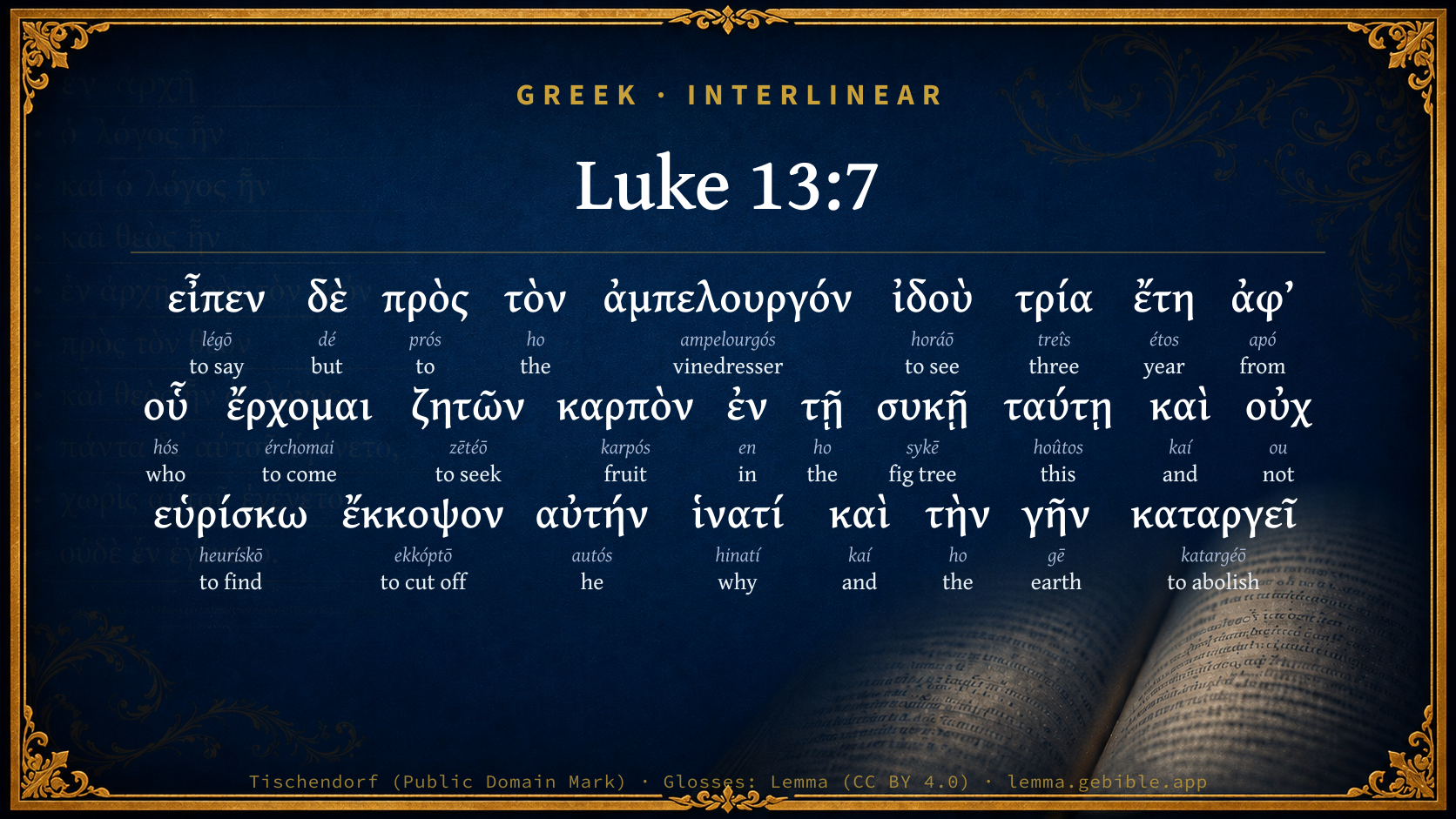
Download image
Cite this verse

Luke 13:7 (World English Bible). Public Domain. Lemma interlinear Bible study tool, https://lemma.gebible.app/v/luke/13/7.

Show BibTeX & RIS
BibTeX
RIS
English Translation
He said to the vine dresser, 'Behold, these three years I have come looking for fruit on this fig tree, and found none. Cut it down. Why does it waste the soil?'
World English Bible · Public Domain
Highlights
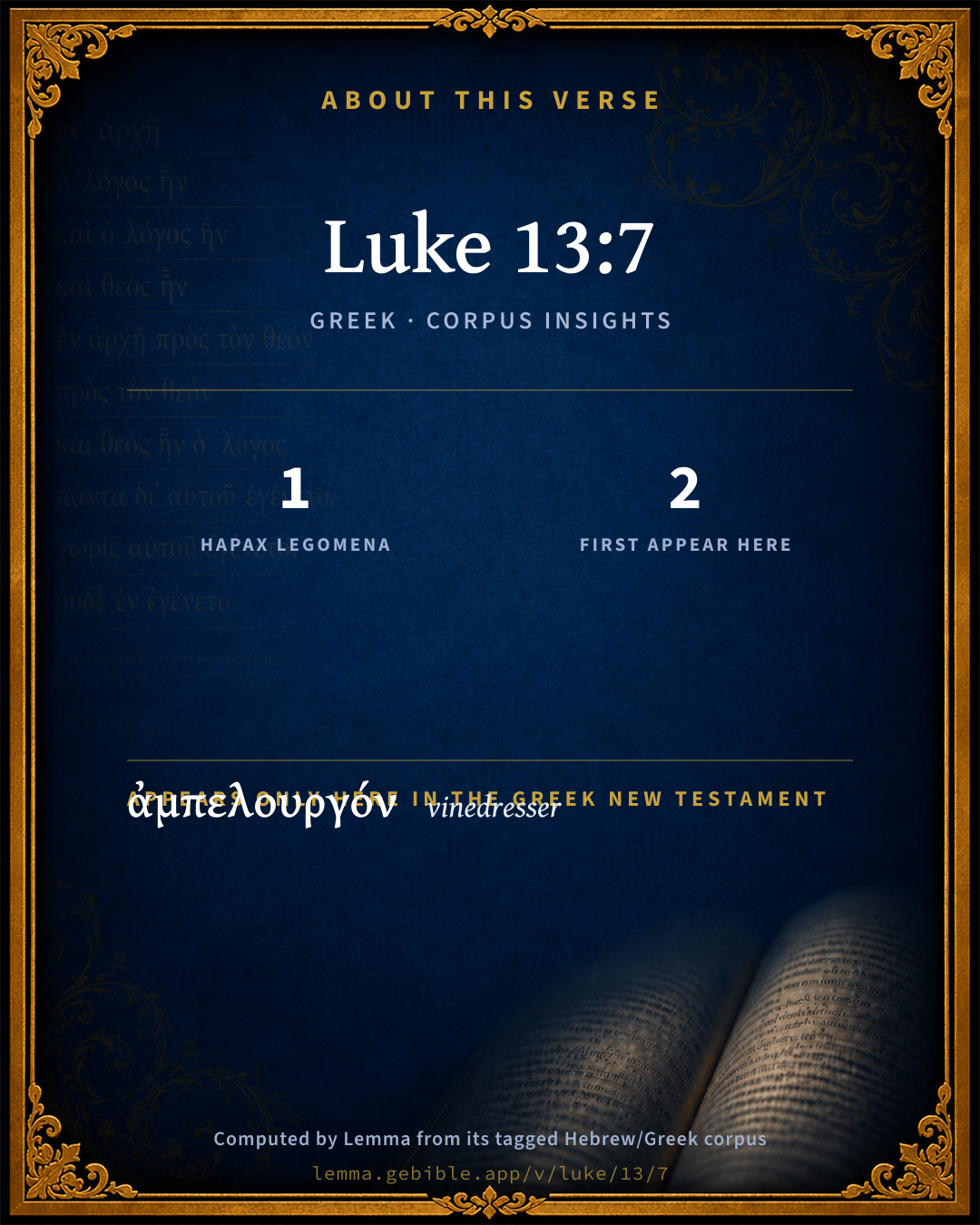
  • 1 hapax legomenon — only here in the Greek New Testament
  • 2 first appearances in the Greek New Testament
Full analysis ↓
Download a study sheet

One document with this verse’s original text, its word-by-word gloss line, the meaning frame, cross-references with their text, attributed commentary, and full source and license credits — printable, and it pastes into notes with its structure intact.

This verse Autodidact and up

Study sheet (.html) Plain text (.txt)

A passage Seminary Student

Up to 50 verses in one chapter. A passage sheet keeps up to 6 commentary sources and 12 cross-references per verse, in the order this page ranks them, and says so on the sheet whenever that leaves anything out. Ask for a single verse and you get the Autodidact verse sheet above.

Everything on this page stays free to read, with no account — the sheet is a download of what is already on screen, not access to it.

Want to remove ads? Support Godless Engineer
Compare translations 3

The same verse in 3 English versions, stacked beneath the original-language interlinear above. Click any original word for its lexicon entry.

Each is an independent rendering of the whole verse — the interlinear is not word-aligned to these translations.

Highlighted words mark where these versions differ — a whole-verse word diff, not a word-by-word alignment.

  • World English Bible Public Domain
    He said to the vine dresser, 'Behold, these three years I have come looking for fruit on this fig tree, and found none. Cut it down. Why does it waste the soil?'
  • King James Version Public Domain
    Then said he unto the dresser of his vineyard, Behold, these three years I come seeking fruit on this fig tree, and find none: cut it down; why cumbereth it the ground?
  • unfoldingWord Literal Text CC BY-SA 4.0
    And he said to the gardener, ‘Behold, for three years I have come seeking fruit on this fig tree and have not found any. Cut it down. For what is it even idling the ground?’

unfoldingWord Literal Text — © unfoldingWord, licensed CC BY-SA 4.0. Word-aligned USFM3 via Door43 (git.door43.org/unfoldingWord/en_ult).

Versions to compare (up to 4)

3 of 4 selected

Show all 19 translations

Every available English version of this verse, each an independent rendering of the whole verse.

  • World English Bible Public Domain
    He said to the vine dresser, 'Behold, these three years I have come looking for fruit on this fig tree, and found none. Cut it down. Why does it waste the soil?'
  • Berean Standard Bible Public Domain
    So he said to the keeper of the vineyard, ‘Look, for the past three years I have come to search for fruit on this fig tree and haven’t found any. Therefore cut it down! Why should it use up the soil?’
  • Majority Standard Bible Public Domain
    So he said to the keeper of the vineyard, ‘Look, for the past three years I have come to search for fruit on this fig tree and haven’t found any. Cut it down! Why should it use up the soil?’
  • King James Version Public Domain
    Then said he unto the dresser of his vineyard, Behold, these three years I come seeking fruit on this fig tree, and find none: cut it down; why cumbereth it the ground?
  • American Standard Version (1901) Public Domain
    And he said unto the vinedresser, Behold, these three years I come seeking fruit on this fig tree, and find none: cut it down; why doth it also cumber the ground?
  • Revised Version (1885) Public Domain
    And he said unto the vinedresser, Behold, these three years I come seeking fruit on this fig tree, and find none: cut it down; why doth it also cumber the ground?
  • Geneva Bible (1599) Public Domain
    Then said he to the dresser of his vineyard, Behold, this three yeeres haue I come and sought fruite of this figge tree, and finde none: cut it downe: why keepeth it also the ground barren?
  • Douay-Rheims (1899) Public Domain
    And he said to the dresser of the vineyard: Behold, for these three years I come seeking fruit on this fig tree, and I find none. Cut it done therefore: why cumbereth it the ground?
  • Young's Literal Translation Public Domain
    and he said unto the vine-dresser, Lo, three years I come seeking fruit in this fig-tree, and do not find, cut it off, why also the ground doth it render useless?
  • Literal Standard Version CC BY-SA 4.0
    and he said to the vinedresser, Behold, three years I come seeking fruit in this fig tree, and do not find [it], cut it off, why does it also render the ground useless?
  • Unlocked Literal Bible CC BY-SA 4.0
    The man said to the gardener, 'Look, for three years I came and tried to find fruit on this fig tree and found none. Cut it down. Why let it waste the ground?'
  • unfoldingWord Literal Text CC BY-SA 4.0
    And he said to the gardener, ‘Behold, for three years I have come seeking fruit on this fig tree and have not found any. Cut it down. For what is it even idling the ground?’
  • Darby Bible Public Domain
    And he said to the vinedresser, Behold, [these] three years I come seeking fruit on this fig-tree and find none: cut it down; why does it also render the ground useless?
  • World Messianic Bible Public Domain
    He said to the vine dresser, ‘Behold, these three years I have come looking for fruit on this fig tree, and found none. Cut it down! Why does it waste the soil?’
  • Webster's Bible Public Domain
    Then said he to the dresser of his vineyard, Behold, these three years I come seeking fruit on this fig-tree, and find none: cut it down; why cumbereth it the ground?
  • Free Bible Version CC BY-SA 4.0
    So he told the gardener, ‘Look, for three years I've been coming to look for fruit on this fig tree and I haven't found any. Chop it down! Why should it be taking up space?’
  • Bible in Basic English Public Domain
    And he said to the gardener, See, for three years I have been looking for fruit from this tree, and I have not had any: let it be cut down; why is it taking up space?
  • Text-Critical English NT CC BY 4.0
    So he said to the vinedresser, ‘Behold, for three years I have come looking for fruit on this fig tree and have not found any. Cut it down! Why should it use up the soil?’
  • Tyndale New Testament (1534) Public Domain
    Then sayde he to the dresser of his vyneyarde: Beholde this thre yeare have I come and sought frute in this fygge tree and fynde none: cut it doune: why combreth it the grounde?

Literal Standard Version (2020), Covenant Press — licensed CC BY-SA 4.0. Text via the HelloAO Bible API (eBible.org). Unlocked Literal Bible (unfoldingWord) — licensed CC BY-SA 4.0. Text via the HelloAO Bible API (eBible.org). unfoldingWord Literal Text — © unfoldingWord, licensed CC BY-SA 4.0. Word-aligned USFM3 via Door43 (git.door43.org/unfoldingWord/en_ult). Free Bible Version, Dr. Jonathan Gallagher — licensed CC BY-SA 4.0. Text via the HelloAO Bible API (eBible.org).

Word by word

More ways to search: Search by grammar → Find every occurrence → Compare this word →

Practice this passage: Drill this verse → Learn its vocabulary →

ἀμπελουργόν
ampelourgós
G289
“vinedresser”
Noun, Accusative, Singular, Masculine
Part of Speech
Noun
Case
Accusative
Number
Singular
Gender
Masculine
Full Thayer's Definition

Origin: from G288 and G2041

TDNT: None

1. a vinedresser
  1. εἶπεν légō G3004 “to say” Verb, Aorist, Active, Indicative, 3rd person, Singular
  2. δὲ dé G1161 “but” Conjunction
  3. πρὸς prós G4314 “to” Preposition
  4. τὸν ho G3588 “the” Article, Accusative, Singular, Masculine
  5. ἰδοὺ horáō G3708 “to see” Verb, Aorist, Middle, Imperative, 2nd person, Singular
  6. τρία treîs G5140 “three” Adjective, Accusative, Plural, Neuter
  7. ἔτη étos G2094 “year” Noun, Accusative, Plural, Neuter
  8. ἀφ’ apó G575 “from” Preposition
  9. οὗ hós G3739 “who” Relative pronoun, Genitive, Singular, Neuter
  10. ἔρχομαι érchomai G2064 “to come” Verb, Present, Middle or Passive deponent, Indicative, 1st person, Singular
  11. ζητῶν zētéō G2212 “to seek” Verb, Present, Active, Participle, Nominative, Singular, Masculine
  12. καρπὸν karpós G2590 “fruit” Noun, Accusative, Singular, Masculine
  13. ἐν en G1722 “in” Preposition
  14. τῇ ho G3588 “the” Article, Dative, Singular, Feminine
  15. συκῇ sykē G4808 “fig tree” Noun, Dative, Singular, Feminine
  16. ταύτῃ hoûtos G3778 “this” Demonstrative pronoun, Dative, Singular, Feminine
  17. καὶ kaí G2532 “and” Conjunction
  18. οὐχ ou G3756 “not” Particle, Negative
  19. εὑρίσκω heurískō G2147 “to find” Verb, Present, Active, Indicative, 1st person, Singular
  20. ἔκκοψον ekkóptō G1581 “to cut off” Verb, Aorist, Active, Imperative, 2nd person, Singular
  21. αὐτήν autós G846 “he” Personal pronoun, Accusative, Singular, Feminine
  22. ἱνατί hinatí G2444 “why” Adverb, Interrogative
  23. καὶ kaí G2532 “and” Conjunction
  24. τὴν ho G3588 “the” Article, Accusative, Singular, Feminine
  25. γῆν gē G1093 “earth” Noun, Accusative, Singular, Feminine
  26. καταργεῖ katargéō G2673 “to abolish” Verb, Present, Active, Indicative, 3rd person, Singular

About this verse

These counts appear in no published source. They are computed here, from the morphology-tagged text and Lemma’s own curated glosses. What Lemma adds →

27
words
24
distinct lemmas
Gospels
section

Notable vocabulary

1 hapax legomenon — a word that appears only here in the entire Greek New Testament:

  • ἀμπελουργόν vinedresser G289

First appearance in Scripture

These words make their first canonical appearance in the Greek New Testament here:

  • ἀμπελουργόν vinedresser G289
  • καταργεῖ to abolish G2673

Shared distinctive vocabulary

ἱνατί why G2444 occurs in 6 verses of the Greek New Testament. Also found in:
Repetition

Words recur within this verse:

Cross-references

10

Topical passages linked to Luke 13:7 in the Treasury of Scripture Knowledge — connected by theme and wording, ordered by reader-vote popularity; previews shown in the World English Bible.

  • Matthew 7:19 Every tree that doesn't grow good fruit is cut down, and thrown into the fire.
  • Luke 3:9 Even now the axe also lies at the root of the trees. Every tree therefore that doesn't bring forth good fruit is cut down, and thrown into the fire."
  • John 15:6 If a man doesn't remain in me, he is thrown out as a branch, and is withered; and they gather them, throw them into the fire, and they are burned.
  • John 15:2 Every branch in me that doesn't bear fruit, he takes away. Every branch that bears fruit, he prunes, that it may bear more fruit.
  • Romans 2:4–5 Or do you despise the riches of his goodness, forbearance, and patience, not knowing that the goodness of God leads you to repentance?
  • Exodus 32:10 Now therefore leave me alone, that my wrath may burn hot against them, and that I may consume them; and I will make of you a great nation."
  • Leviticus 19:23 "'When you come into the land, and have planted all kinds of trees for food, then you shall count their fruit as forbidden. Three years shall they be forbidden to you. It shall not be eaten.
  • Matthew 3:9–10 Don't think to yourselves, 'We have Abraham for our father,' for I tell you that God is able to raise up children to Abraham from these stones.
  • Daniel 4:14 He cried aloud, and said thus, Hew down the tree, and cut off its branches, shake off its leaves, and scatter its fruit: let the animals get away from under it, and the fowls from its branches.
  • Leviticus 25:21 then I will command my blessing on you in the sixth year, and it shall bring forth fruit for the three years.

Cross-references courtesy of OpenBible.info (CC BY 4.0).

Where the printed editions differ

1 variant

Places in this verse where the major printed Greek editions disagree on the wording in a way that affects the translation — a comparison of editions, not a manuscript-by-manuscript collation. The editions are the modern critical texts (Nestlé-Aland 28/27, SBL, Westcott-Hort, Tregelles, Tyndale House) and the traditional texts behind the KJV (the Textus Receptus and the Byzantine/Majority text). It is not a claim about which reading is original.

  1. Extra text
    οὖν

    “therefore”

    In NA28NA27Tyn Not in SBLWHTregTRByz

    οὖν (oun) 'therefore' is only in older manuscripts (NA28+NA27+Tyn)

Textual data: Translators Amalgamated Greek New Testament (STEPBible TAGNT) · CC BY 4.0.

Commentary

Notes on Luke 13:7 from classic Christian and Jewish commentators (each source and its license shown beneath its notes). The classic Christian expositions comment on the surrounding passage and are grouped to its opening verse, so a note may address several verses; the Jewish commentaries on the Tanakh (Rashi and others) are per-verse, so they appear only where the commentator wrote on this verse.

Lemma curates 59 commentaries, every one of them public domain or Creative Commons licensed, each selected and text-cleaned for this edition rather than reprinted as found. About our sources →

Bengel's Gnomon

Johann Albrecht Bengel

Luk 13:7. Τρία, three) A number in some measure decisive and determinate. The Lord was beginning His third year of teaching, as the true harmony of the Evangelists shows.—ἔρχομαι, I come) An abbreviated expression, as in ch. Luk 15:29, τοσαῦτα ἔτη δουλεύω, these so many years I (have served and still) serve thee.—ἔκκοψον, cut it off [down]) (Great, severity (stern strictness in punishing) is expressed in this word: as also there is implied the great power of the ἀμπελουργὸς, Vine-dresser.—ἵνα τί καὶ, why even [not expressed in the Engl. Vers.]) Not only is it of no use, but it even draws off the juices, which the vines would otherwise extract (suck) out of the earth, and intercepts the sun’s rays; and it takes up valuable room.

Bengel's Gnomon of the New Testament — English translation (T&T Clark, Edinburgh, 1860) — public domain. Text from a community e-Sword module.

Expositor's Greek Testament

ed. W. Robertson Nicoll

Luk 13:7 . ἀμπελουργόν , the vine-dresser ( ἄμπελος , ἔργον ) here only in N.T. ἰδοὺ , lo! as of one who has a right to complain. τρία ἔτη , three years, reckoned not from the planting of the tree (it is three years after planting that it begins to bear fruit), but from the time that it might have been expected in ordinary course to yield a crop of figs. Three years is not a long period, but enough to determine whether it is going to be fruit-bearing, the one thing it is there for. In the spiritual sphere in national life that cannot be determined to soon. It may take as many thousand years. ἔρχομαι , I keep coming, the progressive present. The master comes not merely once a year, but again and again within the year, at the seasons when fruit may be found on a fig tree (Hahn). Cf. δουλεύω in Luk 15:29 . οὐχ εὑρίσκω , I do not find it. I come and come and am always disappointed. Hence the impatient ἔκκοψον , cut it out (from the root). ἵνα τί καὶ : καὶ points to a second ground of complaint. Besides bearing no fruit it occupies space which might be more profitably filled. καταργεῖ (here and in Paul’s epistles), renders useless; Vulgate, occupat , practically if not verbally the right rendering. A barren fig tree renders the land useless by occupying valuable space.

The Expositor's Greek Testament, edited by W. Robertson Nicoll (1897–1910) — public domain. Text from a community e-Sword module.

Geneva Bible (1599)

Geneva Bible translators

Maketh the ground barren in that part, which otherwise were good for vines.

Geneva Bible (1599) marginal notes — public domain. Text via Bolls.life.

Jamieson, Fausset & Brown

Robert Jamieson, A. R. Fausset & David Brown

three years--a long enough trial for a fig tree, and so denoting probably just a sufficient period of culture for spiritual fruit. The supposed allusion to the duration of our Lord's ministry is precarious.

cut it down--indignant language.

cumbereth--not only doing no good, but wasting ground.

Jamieson, Fausset & Brown — Commentary Critical and Explanatory on the Whole Bible (1871) — public domain (CC PDM 1.0). Text via the HelloAO Bible API.

Adam Clarke's Commentary

Verse 7. Behold these three years] From this circumstance in the parable, it may be reasonably concluded that Jesus had been, at the time of saying this, exercising his ministry for three years past; and, from what is said in Lu 13:8, of letting it alone this year also, it may be concluded likewise that this parable was spoken about a year before Christ's crucifixion; and, if both these conclusions are reasonable, we may thence infer that this parable was not spoken at the time which appears to be assigned to it, and that the whole time of Christ's public ministry was about four years. See Bishop Pearce. But it has already been remarked that St. Luke never studies chronological arrangement. See the Preface to this Gospel.

Why cumbereth it the ground?] Or, in other words, Why should the ground be also useless? The tree itself brings forth no fruit; let it be cut down that a more profitable one may be planted in its place. Cut it down. The Codex Bezae has added here, φερετην αξινην, Bring the axe and cut it down. If this reading be genuine, it is doubtless an allusion to Mt 3:10: Now the axe lieth at the root of the trees. If the writer has added it on his own authority, he probably referred to the place above mentioned. See the note on the above text.

There is something very like this in the γεωπονικα, or De Re Rustica of the ancient Greek writers on agriculture. I refer to cap. 83 of lib. x., p. 773; edit. Niclas, entitled, Δενδρον ακαρπον καρποφορειν, How to make a barren tree fruitful. Having girded yourself, and tied up your garments, take a bipen or axe, and with an angry mind approach the tree as if about to cut it down. Then let some person come forward and deprecate the cutting down of the tree, making himself responsible for its future fertility. Then, seem to be appeased, and so spare the tree, and afterwards it will yield fruit in abundance. "Bean straw (manure of that material,) scattered about the roots of the tree, will make it fruitful." That a similar superstition prevailed among the Asiatics, Michaelis proves from the Cosmographer Ibn Alvardi, who prescribes the following as the mode to render a sterile palm tree fruitful: "The owner, armed with an axe, having an attendant with him, approaches the tree, and says, I must cut this tree down, because it is unfruitful. Let it alone, I beseech thee, says the other, and this year it will bring forth fruit. The owner immediately strikes it thrice with the back of his axe; but the other preventing him says, I beseech thee to spare it, and I will be answerable for its fertility. Then the tree becomes abundantly fruitful." Does not our Lord refer to such a custom?

Adam Clarke's Commentary on the Bible (1810–1826) — public domain. Text from a community e-Sword/MySword module.

Ellicott's Commentary for English Readers

(7) Why cumbereth it the ground?—The Greek verb means more than that the fig-tree was what we call a useless burden or incumbrance, and implies positive injury. It is commonly rendered by “bring to nought,” or some like phrase. (In 1Co_13:8 it is rendered “fail.”) This would seem, indeed, to have been the old meaning of the English verb. Comp. Shakespeare’s Julius Cœsar, iii. 1:—

“Domestic fury, and fierce civil strife.

Shall cumber all the parts of Italy.”

A Bible Commentary for English Readers, edited by Charles John Ellicott (1878–1897) — public domain. Text from a community e-Sword module.

The Cambridge Bible for Schools and Colleges

gen. ed. J. J. S. Perowne

7. unto the dresser of his vineyard] It seems clear that in the truth which the parable shadows forth, Christ corresponds to the vine-dresser, and Jehovah to the owner (Isa_5:7). Some however prefer to see in the vine-dresser the Holy Spirit as Intercessor.

Behold, these three years] Many suppose an allusion to the length up to this time of our Lord’s ministry. Others explain it of the periods of the Judges, Kings, and High Priests. It is very doubtful how far these lesser details—which are essential to the colouring of the parable—are intended to be pressed.

cut it down] at once—as the tense implies (Mat_3:10; Joh_15:2). It was fulfilled in the rejection of Israel (Rom_11:22).

why cumbereth it the ground?] Rather, why doth it also sterilise the ground? i.e. it is not only useless, but positively mischievous by preventing other growth.

The Cambridge Bible for Schools and Colleges (gen. ed. J. J. S. Perowne; Cambridge University Press, 1878–1918) — public domain. Text from a community e-Sword module.

John Gill's Exposition

Then said he unto the dresser of the vineyard,.... If by the owner of the vineyard is meant God the Father, then by the dresser of the vineyard Jesus Christ is intended; but as he seems rather designed by the owner, the vinedresser, or "the gardeners", as the Persic version reads, in the plural number, may signify the ministers of the word, to whom Christ, who is Solomon's antitype, lets out his vineyard to dress and cultivate it, and to keep the fruit of it; see Sol 8:11,

behold, these three years I come seeking fruit on this fig tree, and find none; or "behold, there are three years since I came"; so read the Vulgate Latin and Persic versions, and Beza's most ancient copy. Some think Christ here refers to the three years of his public ministry, which he had now gone through among the Jews with little success; but he seems rather to allude to the nature of fig trees, which, if fruitful, bear in three years time; for even , "a sort of white figs", which are the longest before they bring forth fruit to perfection, yet their fruit is ripe in three years time. These trees bear fruit once in three years; they bear fruit indeed every year, but their fruit does not come to maturity till after three years (i); and this may be the reason why this number is fixed upon; for if such fig trees do not bring forth ripe fruit in three years time, there is little reason to expect any from them: and thus it was time after time with the Jewish nation; and so it is with carnal professors: hence it follows,

cut it down, why cumbereth it the ground? or "that it may not cumber"; or "render the ground useless", as read the Arabic version, and one of Beza's copies; for unfruitful trees suck up the juices of the earth, and draw away nourishment from other trees that are near them, and so make the earth barren, and not only hurt other trees, but stand in the way and place of fruitful ones; and therefore it is best to cut them down. So barren professors, as were the Jews, are not only useless and unprofitable themselves, being fruitless, but make churches barren, and stand in the way of others, who are stumbled by them; they are grieving to God, to Christ, and to the blessed Spirit, and are troublesome and burdensome to churches, ministers, and true believers: and the cutting them down may regard the judgment of God upon the nation of the Jews, which Christ would not have his apostles and ministers interpose for the averting of; or the excommunication of such worthless and hurtful professors out of the churches by them.

(i) T. Hieros. Sheviith, fol. 35. 4. Jarchi, Maimon. & Bartenora in Misn. Demai, c. 1. sect. 1. & Sheviith, c. 5. sect. 1.

John Gill's Exposition of the Whole Bible (1746–1763) — public domain (CC PDM 1.0). Text via the HelloAO Bible API.

Trapp's Complete Commentary

John Trapp

7 Then said he unto the dresser of his vineyard, Behold, these three years I come seeking fruit on this fig tree, and find none: cut it down; why cumbereth it the ground?

Ver. 7. Cut it down] Trees that are not for fruit are for the fire. God will lay down his basket and take up his axe. He will not always serve men for a sinning stock.

John Trapp, A Commentary or Exposition upon All the Books of the Old and New Testament (1647–1656) — public domain. Text from a community e-Sword module.

Albert Barnes' Notes on the Bible

The dresser of his vineyard - The man whose duty it was to trim the vines and take care of his vineyard.

These three years - These words are not to be referred to the time which Christ had been preaching the gospel, as if he meant to specify the exact period. They mean, as applicable to the vineyard, that the owner had been “a long time” expecting fruit on the tree. For three successive years he had been disappointed. In his view it was long enough to show that the tree was barren and would yield no fruit, and that therefore it should be cut down.

Why cumbereth it the ground? - The word “cumber” here means to render “barren” or “sterile.” By taking up the juices of the earth, this useless tree rendered the ground sterile, and prevented the growth of the neighboring vines. It was not merely “useless,” but was doing mischief, which may be said of all sinners and all hypocritical professors of religion. Dr. Thomson (“The Land and the Book,” vol. i. p. 539) says of the barren fig-tree: “There are many such trees now; and if the ground is not properly cultivated, especially when the trees are young - as the one of the parable was, for only “three” years are mentioned they do not bear at all; and even when full grown they quickly fail, and wither away if neglected. Those who expect to gather good crops of well-flavored figs are particularly attentive to their culture - not only plow and dig about them frequently, and manure them plentifully, but they carefully gather out the stones from the orchards, contrary to their general slovenly habits.”

This parable is to be taken in connection with what goes before, and with our Saviour’s calling the Jewish nation to repentance. It was spoken to illustrate the dealings of God with them, and their own wickedness under all his kindness, and we may understand the different parts of the parable as designed to represent:

God, by the man who owned the vineyard. The vineyard as the Jewish people. The coming of the owner for fruit, the desire of God that they should produce good works. The barrenness of the tree, the wickedness of the people. The dresser was perhaps intended to denote the Saviour and the other messengers of God, pleading that God would spare the Jews, and save them from their enemies that stood ready to destroy them, as soon as God should permit. His waiting denotes the delay of vengeance, to give them an opportunity of repentance. And, The remark of the dresser that he might “then” cut it down, denotes the acquiescence of all in the belief that such a judgment would be just.

We may also remark that God treats sinners in this manner now; that he spares them long; that he gives them opportunities of repentance; that many live but to cumber the ground; that they are not only useless to the church, but pernicious to the world; that in due time, when they are fairly tried, they shall be cut down; and that the universe will bow to the awful decree of God, and say that their damnation is just.

Albert Barnes' Notes on the Bible (1834–1885) — public domain. Text from a community e-Sword/MySword module.

Whedon's Commentary on the Bible

Daniel D. Whedon

7. Behold these three years—The fig produces within this period after planting. This is applied by some to represent the period of the Lord’s ministry. If so the nation was allowed to survive near forty years after the voice of the intercessor had surrendered and ceased on earth.

I come—This is a verb of continuity. During the whole three years again and again have I been coming. The visits of God are secret and unrecognized, though they be ever recurring. Our fruitfulness, our barrenness, our production of the wild poison fruit, all take place beneath his watchful but patient eye.

Seeking fruit—The master seeks, and seeks from season to season. There may be no fruit; there may be leaves; there may be the leafless branch; in either case he departs in sorrowful disappointment.

Cumbereth the ground—Renders the ground barren, absorbing the virtue of the soil only to abuse it. For the sinner can never sin by omission alone. He will commit positive sin, and produce positive evil and destruction.

Daniel D. Whedon (gen. ed.), Commentary on the Old and New Testaments (1874–1909) — public domain. Text from a community e-Sword module.

The Pulpit Commentary

Behold, these three years I come seeking fruit on this fig tree, and find none. Some expositors see in this period of three years an allusion to the storied past of Hebrew life, and in the number 3 discern the three marked epochs, each lasting several centuries, of the high priests, judges, and kings. This, however, is a very doubtful reference, owing to the impossibility of separating the first two periods of the rule of high priests and judges, as these interchange and overlap each other. Another school of interpreters sees a reference to the three years of the public ministry of Jesus. A better reference would be God"s successive calls to Israel by the Law, the prophets, and by Christ. It is, however, safer, in this and m many of the Lord"s parables, not to press every little detail which was necessary for the completion of the picture. Here the period of three years in which the Lord of the vineyard came seeking fruit, represents by the number 3 the symbol of complete-ness a period of full opportunity given to the tree to have become fruitful and productive. Cut it down; why cumbereth it the ground? better rendered, why doth it make the ground useless? It is an unproductive tree, and occupies the place which another and a fertile tree might fill.

The Pulpit Commentary (1880–1919), ed. H.D.M. Spence-Jones & Joseph S. Exell — public domain. Text from a community e-Sword module.

John Wesley's Explanatory Notes

Three years - Christ was then in the third year of his ministry. But it may mean only several years; a certain number being put for an uncertain. Why doth it also cumber the ground? - That is, not only bear no fruit itself, but take up the ground of another tree that would.

John Wesley, Explanatory Notes Upon the Whole Bible (1754–1765) — public domain. Text via the GEBible commentary corpus.

Cambridge Greek Testament for Schools and Colleges

7. πρὸς τὸν ἀμπελουργόν. It seems clear that in the truth which the parable shadows forth, Christ corresponds to the vine-dresser, and Jehovah to the owner (Isa 5:7). Some however prefer to see in the vine-dresser the Holy Spirit as Intercessor.

τρία ἔτη. Many suppose an allusion to the length up to this time of our Lord’s ministry (Bengel, &c.). Others (Euthym., &c.) explain it of the periods of the Judges, Kings, and High Priests. It is very doubtful how far these lesser details—which are essential to the colouring of the parable—are intended to be pressed.

ἔκκοψον αὐτήν. At once—as the tense implies (Mat 3:10; Joh 15:2). It was fulfilled in the rejection of Israel (Rom 11:22).

ἱνατί; Why? originally two words with γένηται understood; ἵνα τί γένηται; in order that what may happen?

ἱνατί καὶ τὴν γῆν καταργεῖ; ‘Why doth it also sterilise the ground?’ i.e. it is not only useless, but positively mischievous by preventing other growth. For the verb comp. Rom 3:3.

Cambridge Greek Testament for Schools and Colleges (Cambridge University Press, 1896; 21 vols, various authors incl. Carr, Maclear, Plummer, Farrar, Lumby, Moule, M. R. James, Simcox) — public domain. Text from a community e-Sword module.

Alford’s Greek Testament

Henry Alford

7. τρία ἔτη] I have little doubt (against Bleek, .) that an allusion is intended to the three years of our Lord’s ministry. The objection to this, that the cutting down ought then to have taken place at the end of τοῦτο τὸ ἔτος, does not apply; for all is left indefinite in the request and the implied answer. In the individual application, many thousands did bear fruit this very year; and of those who did not, who shall say when the Spirit ceased pleading with them, and the final sentence went forth?

καὶ τ. γ. κατ.] Why, besides bearing no fruit, is it impoverishing the soil [rendering the neighbouring ground useless]?

Henry Alford, The Greek Testament (1849–1861) — public domain. Text from a community e-Sword module.

International Critical Commentary

7. τρία ἔτη ἀφʼ οὖ ἔρχομαι. Lit. “It is three years from the time when I continue coming”: comp. Thuc. i. 18. 1. A fig tree is said to attain maturity in three years, and a tree that remained fruitless for so long would not be likely to bear afterwards. See quotations in Wetst. The three years of Christ’s ministry cannot well be meant. The tree had been fruitless long before He began to preach, and it was not cut down until forty years after He ceased to do so. Cyril suggests Moses and Aaron, Joshua and the Judges, and the Prophets (Migne, vol. 72:753). Ambrose proposes the armunciations to Abraham, Moses, and Mary (Migne, vol. 15:1743). Other triplets equally good might be easily devised; but none are required. See Schanz, ad loc. p. 369.

ἵνα τί καὶ τὴν γῆν καταργεῖ; “Why, in addition to doing no good, does it sterilize the ground?” Ut quid etiam terram occupat (Vulg.). Excepting here and Heb 2:14, the verb is used in N.T. only by S. Paul. He has it often, and in all four groups of his Epistles. In LXX only in Ezra (4:21, 23, 5:5, 6:8). Latin Versions vary between occupat, evacuat, detinet, and intricat; English Versions between “occupy,” “keep barren,” “cumber,” and “hinder.” All the latter, excepting Rhem, and RV., miss the καὶ: it not only gives no fruit, it also renders good soil useless (ἀργόν).1

International Critical Commentary — older volumes (1896–1929), various authors — public domain. Text from a community e-Sword module.

Vincent's Word Studies in the New Testament

Marvin R. Vincent

These three years I come. The best texts insert ajf ou=, from which, or since. "It is three years from the time at which I came."

Cut it down [εκκοψον] . Rather, "cut it out" [εκ] from among the other trees and the vines.

Why cumbereth it. The A. V. omits the very important kai, also (Rev.), which, as Trench observes, is the key - word of the sentence. Besides being barren in itself, it also injures the soil. "Not only is it unfruitful, but it draws away the juices which the vines would extract from the earth, intercepts the sun, and occupies room" (Bengel). The verb cumbereth [καταργει] means to make of no effect. So Rom 3:3, 31; Gal 3:17. Cumbereth expresses the meaning in a very general and comprehensive way. The specific elements included in it are expressed by Bengel above. De Wette, makes the land unfruitful. See on barren and unfruitful, 2Pe 1:8.

Marvin R. Vincent, Word Studies in the New Testament (1887–1900) — public domain. Text from a community e-Sword/MySword module.

Lesson kit

Teaching starters — assembled from the data on this page, not authored interpretation. Every prompt links to the verse data it draws on. Edit before teaching.

Luke, in the Gospels, opens this verse with 27 words (24 distinct Greek lemmas). Its most distinctive word is ampelourgós (“vinedresser”). A historical commentator’s framing appears above. Read the whole chapter for the surrounding context.

Discussion questions

  1. The word ampelourgós carries the sense “vinedresser.” How does it shape the verse?
  2. This verse holds 1 word here found nowhere else in the Greek New Testament. What might the rare word draw attention to?
  3. 2 words here appear for the first time in Scripture. What is being introduced at this debut?
  4. Matthew 9:4 shares the word «why» with this verse. How do the two illuminate each other?
  5. “the” occurs 3× in this one verse. What is the effect of the repetition?
  6. These translations render this verse differently; the difference is in the English rendering, not the original. What questions does that raise?
  7. Reading how Bengel's Gnomon and Expositor's Greek Testament read this verse, where do the two commentators agree and where do they part?

Things to notice

  • 1 word in this verse appears nowhere else in the Greek New Testament.
  • 2 words make their first canonical appearance in Scripture here.
  • These translations choose different wording for 20 words in this verse.
  • “the” occurs 3× in this single verse.
  • 24 distinct Greek lemmas span 27 words in this verse.

Reading settings

Reading text

Shown beneath each verse's original-language words.

Old Testament
Old Testament edition

Read the OT as the Masoretic Hebrew (MT) or the Greek Septuagint (LXX).

English shown for the Greek Septuagint (in the Hebrew ↔ Greek comparison).

Comparing translations? Open the Compare panel on any verse page to stack up to four side by side.