Luke 12:31

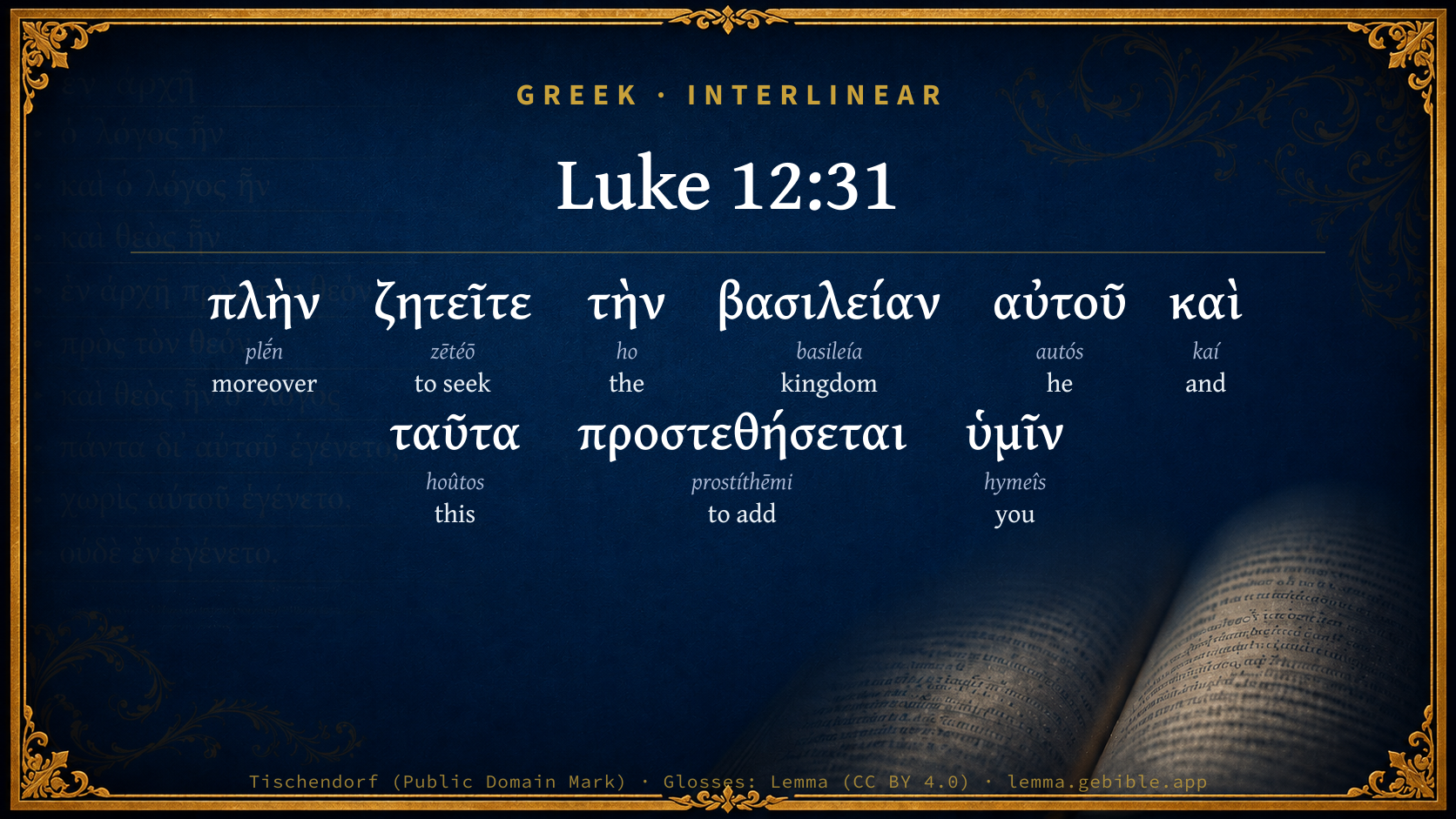
Greek (Tischendorf 8th ed.) Luke 12:31 appears in the Greek New Testament. The text above is from the Tischendorf 8th edition. Each word links to its Strong’s number and a concise gloss. Click any word for its full Thayer’s Greek Lexicon entry.
Download image
Cite this verse

Luke 12:31 (World English Bible). Public Domain. Lemma interlinear Bible study tool, https://lemma.gebible.app/v/luke/12/31.

Show BibTeX & RIS
BibTeX
RIS
English Translation
But seek God's Kingdom, and all these things will be added to you.
World English Bible · Public Domain
Download a study sheet

One document with this verse’s original text, its word-by-word gloss line, the meaning frame, cross-references with their text, attributed commentary, and full source and license credits — printable, and it pastes into notes with its structure intact.

This verse Autodidact and up

Study sheet (.html) Plain text (.txt)

A passage Seminary Student

Up to 50 verses in one chapter. A passage sheet keeps up to 6 commentary sources and 12 cross-references per verse, in the order this page ranks them, and says so on the sheet whenever that leaves anything out. Ask for a single verse and you get the Autodidact verse sheet above.

Everything on this page stays free to read, with no account — the sheet is a download of what is already on screen, not access to it.

Want to remove ads? Support Godless Engineer
Compare translations 3

The same verse in 3 English versions, stacked beneath the original-language interlinear above. Click any original word for its lexicon entry.

Each is an independent rendering of the whole verse — the interlinear is not word-aligned to these translations.

Highlighted words mark where these versions differ — a whole-verse word diff, not a word-by-word alignment.

  • World English Bible Public Domain
    But seek God's Kingdom, and all these things will be added to you.
  • King James Version Public Domain
    But rather seek ye the kingdom of God; and all these things shall be added unto you.
  • unfoldingWord Literal Text CC BY-SA 4.0
    But seek his kingdom, and these things will be added to you.

unfoldingWord Literal Text — © unfoldingWord, licensed CC BY-SA 4.0. Word-aligned USFM3 via Door43 (git.door43.org/unfoldingWord/en_ult).

Versions to compare (up to 4)

3 of 4 selected

Show all 19 translations

Every available English version of this verse, each an independent rendering of the whole verse.

  • World English Bible Public Domain
    But seek God's Kingdom, and all these things will be added to you.
  • Berean Standard Bible Public Domain
    But seek His kingdom, and these things will be added unto you.
  • Majority Standard Bible Public Domain
    But seek the kingdom of God, and all these things will be added unto you.
  • King James Version Public Domain
    But rather seek ye the kingdom of God; and all these things shall be added unto you.
  • American Standard Version (1901) Public Domain
    Yet seek ye his kingdom, and these things shall be added unto you.
  • Revised Version (1885) Public Domain
    Howbeit seek ye his kingdom, and these things shall be added unto you.
  • Geneva Bible (1599) Public Domain
    But rather seeke ye after the kingdome of God, and all these things shalbe cast vpon you.
  • Douay-Rheims (1899) Public Domain
    But seek ye first the kingdom of God and his justice, and all these things shall be added unto you.
  • Young's Literal Translation Public Domain
    but, seek ye the reign of God, and all these things shall be added to you.
  • Literal Standard Version CC BY-SA 4.0
    but seek the Kingdom of God, and all these things will be added to you.
  • Unlocked Literal Bible CC BY-SA 4.0
    But seek his kingdom, and these things will be added to you.
  • unfoldingWord Literal Text CC BY-SA 4.0
    But seek his kingdom, and these things will be added to you.
  • Darby Bible Public Domain
    but seek his kingdom, and [all] these things shall be added to you.
  • World Messianic Bible Public Domain
    But seek God’s Kingdom, and all these things will be added to you.
  • Webster's Bible Public Domain
    But rather seek ye the kingdom of God, and all these things shall be added to you.
  • Free Bible Version CC BY-SA 4.0
    Search for God's kingdom, and you'll be given these things as well.
  • Bible in Basic English Public Domain
    But let your chief care be for his kingdom, and these other things will be given to you in addition.
  • Text-Critical English NT CC BY 4.0
    Rather, seek the kingdom of God, and all these things will be added to you.
  • Tyndale New Testament (1534) Public Domain
    Wherfore seke ye after the kyngedome of God and all these thinges shalbe ministred vnto you.

Literal Standard Version (2020), Covenant Press — licensed CC BY-SA 4.0. Text via the HelloAO Bible API (eBible.org). Unlocked Literal Bible (unfoldingWord) — licensed CC BY-SA 4.0. Text via the HelloAO Bible API (eBible.org). unfoldingWord Literal Text — © unfoldingWord, licensed CC BY-SA 4.0. Word-aligned USFM3 via Door43 (git.door43.org/unfoldingWord/en_ult). Free Bible Version, Dr. Jonathan Gallagher — licensed CC BY-SA 4.0. Text via the HelloAO Bible API (eBible.org).

Word by word

More ways to search: Search by grammar → Find every occurrence → Compare this word →

Practice this passage: Drill this verse → Learn its vocabulary →

About this verse

These counts appear in no published source. They are computed here, from the morphology-tagged text and Lemma’s own curated glosses. What Lemma adds →

9
words
9
distinct lemmas
Gospels
section

Notable vocabulary

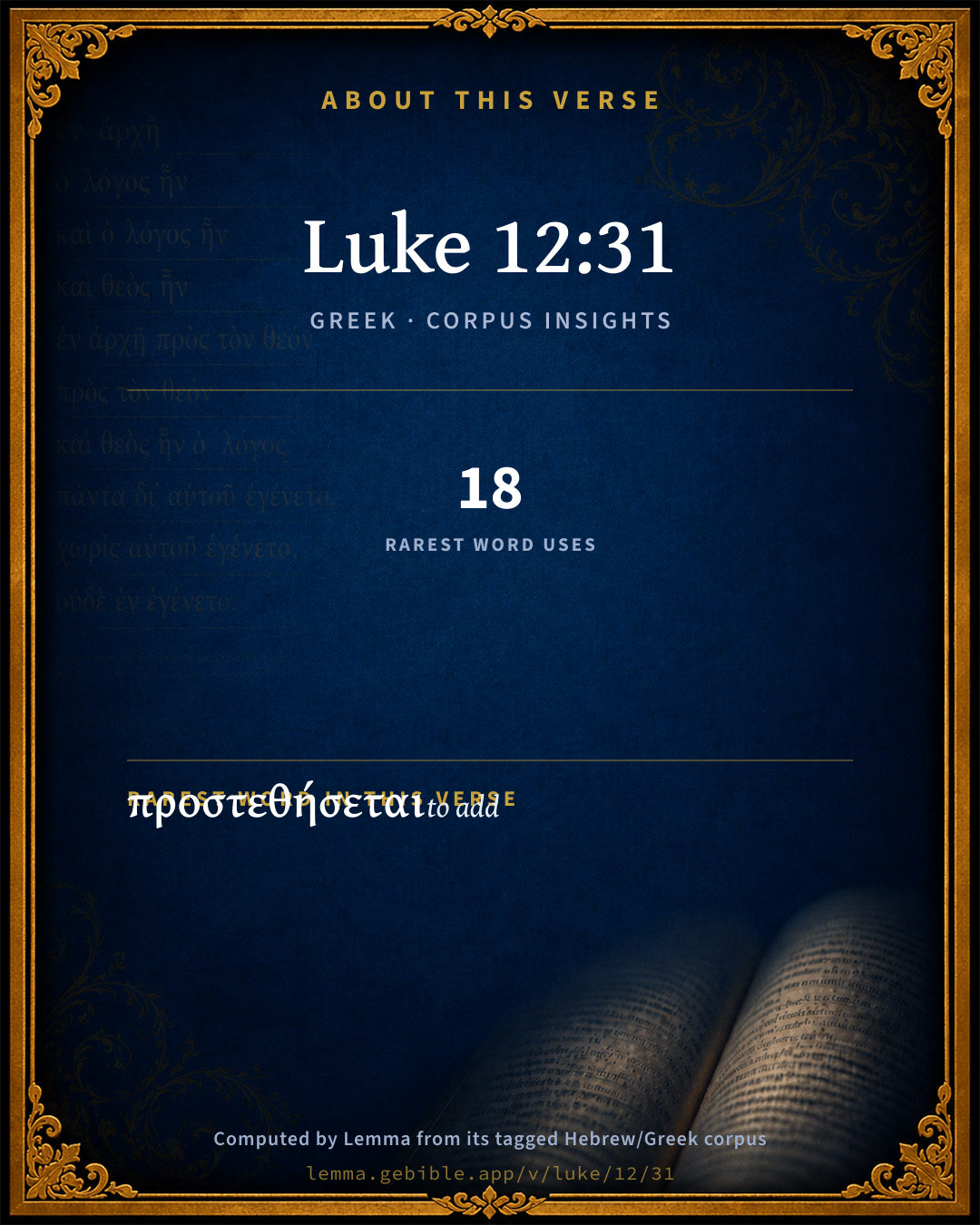
The rarest word here is προστεθήσεται to add G4369 — appearing just 18 times in the whole Greek New Testament.

Shared distinctive vocabulary

προστεθήσεται to add G4369 occurs in 18 verses of the Greek New Testament. Also found in:

Cross-references

13

Topical passages linked to Luke 12:31 in the Treasury of Scripture Knowledge — connected by theme and wording, ordered by reader-vote popularity; previews shown in the World English Bible.

  • Matthew 6:33 But seek first God's Kingdom, and his righteousness; and all these things will be given to you as well.
  • Hebrews 13:5 Be free from the love of money, content with such things as you have, for he has said, "I will in no way leave you, neither will I in any way forsake you."
  • Psalms 34:9 Oh fear Yahweh, you his saints, For there is no lack with those who fear him.
  • 1 Kings 3:11–13 God said to him, Because you have asked this thing, and have not asked for yourself long life, neither have asked riches for yourself, nor have asked the life of your enemies, but have asked for yourself understanding to discern justice;
  • John 6:27 Don't work for the food which perishes, but for the food which remains to eternal life, which the Son of Man will give to you. For God the Father has sealed him."
  • 1 Timothy 4:8 For bodily exercise has some value, but godliness has value for all things, having the promise of the life which is now, and of that which is to come.
  • Psalms 84:11 For Yahweh God is a sun and a shield. Yahweh will give grace and glory. He withholds no good thing from those who walk blamelessly.
  • Psalms 37:25 I have been young, and now am old, Yet I have not seen the righteous forsaken, Nor his children begging for bread.
  • Psalms 37:3 Trust in Yahweh, and do good. Dwell in the land, and enjoy safe pasture.
  • Romans 8:31 What then shall we say about these things? If God is for us, who can be against us?
  • Isaiah 33:16 He shall dwell on high; his place of defense shall be the munitions of rocks; his bread shall be given [him]; his waters shall be sure.
  • Psalms 37:19 They shall not be disappointed in the time of evil. In the days of famine they shall be satisfied.
  • Luke 10:42 but one thing is needed. Mary has chosen the good part, which will not be taken away from her."

Cross-references courtesy of OpenBible.info (CC BY 4.0).

Where the printed editions differ

2 variants

Places in this verse where the major printed Greek editions disagree on the wording in a way that affects the translation — a comparison of editions, not a manuscript-by-manuscript collation. The editions are the modern critical texts (Nestlé-Aland 28/27, SBL, Westcott-Hort, Tregelles, Tyndale House) and the traditional texts behind the KJV (the Textus Receptus and the Byzantine/Majority text). It is not a claim about which reading is original.

  1. Different wording
    αὐτοῦ

    “of Him”

    In NA28NA27TynSBLWHTreg Not in TRByz

    θεοῦ (theou) 'of God' occurs in traditional manuscripts (TR+Byz) instead of αὐτοῦ (autou) 'of Him' in older manuscripts (NA28+NA27+Tyn+SBL+WH+Treg)

  2. Extra text
    πάντα

    “all things”

    In TRByz Not in NA28NA27TynSBLWHTreg

    πάντα (panta) 'all things' is only in traditional manuscripts (TR+Byz)

Textual data: Translators Amalgamated Greek New Testament (STEPBible TAGNT) · CC BY 4.0.

Commentary

Notes on Luke 12:31 from classic Christian and Jewish commentators (each source and its license shown beneath its notes). The classic Christian expositions comment on the surrounding passage and are grouped to its opening verse, so a note may address several verses; the Jewish commentaries on the Tanakh (Rashi and others) are per-verse, so they appear only where the commentator wrote on this verse.

Lemma curates 59 commentaries, every one of them public domain or Creative Commons licensed, each selected and text-cleaned for this edition rather than reprinted as found. About our sources →

The Biblical Illustrator

Joseph S. Exell

Luk_12:31

Seek ye the Kingdom of God

Manner of sanctifying our exertions for daily bread

The Lord gives us continually our daily bread, multiplying for this the grain in the field; yet are we contented with it?

The reason of our discontentedness is, because we are inclined to make our daily pursuits for a livelihood the main point, and the Kingdom of God a secondary one. Perhaps we go so far even as to separate one from the other, although religion, like the leaven, should penetrate all our works and bring Gods blessing upon all we do. This blessing will be given to us if we endeavour to sanctify our solicitude for our daily bread, by performing our employments--

I. IN OBEDIENCE. TO GOD.

1. It is Gods will that I work. By this truth we should be induced--

(1) To consider and esteem labour as a sacred duty.

(2) To avoid idleness, which is not only sinful in itself, but also the source of sin and poverty.

2. I work for Gods honour. This truth renders labour--

(1) Consoling, though hard.

(2) Meritorious.

II. IN THE SPIRIT OF PENITENCE. I must work, because I am a sinner.

1. This reflection will reconcile you to your work. As the heart is wounded by undeserved punishment, so a generous mind finds satisfaction in a consciousness of justice being done.

2. It ennobles man: imparting to him--

(1) Deep humility.

(2) True wisdom.

III. IN ORDER TO FULFIL, A DUTY TOWARDS OTHERS. Only he that has lost all sense of duty can refuse to work. For--

1. Labour is a duty of justice. Gods wrath is challenged by--

(1) Idlers.

(2) Squanderers.

2. Labour is a duty of charity.

(1) You are bound to provide for your family.

(2) And for the poor. (Bishop Galura.)

The wisdom of attending to Gods business

Your business--you cannot neglect that. Call to mind the story of the rich English merchant to whom Elizabeth gave some commission of importance, and he demurred to undertake it, saying, Please your Majesty, if I obey your behest, what will become of these affairs of mine? And his monarch answered, Leave those things to me, when you are employed in my service, I will take charge of your business. So will it be with you. Do but surrender yourself to Christ, and He, of His own free will, takes in hand all your affairs. (C. H.Spurgeon.)

Gods promise to be relied on

I was once crossing the Atlantic, and had come within three days sail of the Irish coast. Fog and darkness shut out the sun by day and the stars at night. We had to trust to dead reckoning--that is, to the log, the compass, the chart, and other nice nauticalcomputations. Standing by the captain, I heard him say on the last of these days, We ought to see Fastnet Light in twelve minutes! I took out my watch and waited. We saw the welcome light in just eleven! There, thought I, is a triumph of nautical skill and calculation, to push on so steadily and surely through the darkness day after day to the point aimed at. We justly confide in one who has proved himself trustworthy in human affairs, but the witness of God is greater. Why ever distrust Him? He has not only fixed the movements of the stars and the tides, but His promises of grace are unchangeable. (R. S. Storrs, D. D.)

Seeking Gods Kingdom for children also

Few things are looked back on by me with less satisfaction than my own conduct in respect to my children, except in one particular, which appears to have been the grand secret; and that is, that I have always sought for them, as well as for myself, in the first place, the Kingdom of God and His righteousness. (T. Scott.)

Admonition addressed to the young

Let us press the seeking Gods kingdom first on those who are yet in the springtime of their days. And we will just tell you what we believe would constitute a thorough submission to the precept of our text, and what, therefore, entitles a man to depend on the fulfilment of the promise. We will suppose that, from his youth upwards, an individual has proposed to himself the salvation of his soul as the prime object to engage his solicitudes and occupy his strivings. We may suppose that, so soon as he could discern the evil and the good, so soon as the will had the power of making an election, he decided in favour of the paths of righteousness, and set out on the heavenward course; and, ever afterward, we may regard him as holding on in one uniform course of faith and obedience; so that, whatever the other objects which may demand and obtain some share of his attention, he keeps ever uppermost, as the great end of his being, that attainment of Gods favour to which he had devoted himself at the outset of life. Of such an individual it may be asserted, in all the extent of which the expression admits--he has sought first the Kingdom of God and His righteousness. He has sought it first, as having begun with this seeking; he has sought it first, as having never permitted another object to take precedence: and to the doing this is what we would earnestly exhort the younger of our hearers. Seek ye first the kingdom of God and His righteousness: seek ye first this kingdom--first, before ye seek the wealth of the world, which cannot satisfy you, or the honours of the world, which will only mock you, or the pleasures of the world, which like the Dead Sea fruits, wear a bloom to the eye, but are ashes to the taste--first, before the strength has been impaired, and the spirit has beenbroken, and the eye has lost its fire, and the hope is sick with disappointment. First! Will ye give the bounding pulse, and the soaring thought, and the eager glance, and the rushing purpose, to the slavery of time and created things, and think of bringing the jaded energies, the thin grey hairs, the emaciated limbs, and consecrating them to the service of God? We know that even in old age the kingdom may be sought, the kingdom may be founds; we dare not, therefore, and we thank God that we dare not, regard any individual, be he ever so old, be he ever so hardened, as having outlived the opportunity of being saved. We preach to the man of four-score years; and though, in the expressive language of Solomon--the daughters of music are brought low, and the grasshopper is a burden, and the silver cord is almost loosed, and the golden bowl broken, we still say to him, Now is the accepted time; now is the day of salvation. And yet it is impossible not to feel, that where there has been, for forty, or sixty, or seventy years, a determined resistance to all the proffers of the gospel, the case is growing comparatively hopeless. We may go on with our work; but it is impossible to go on with a very light heart. And never does the minister of Christ seem charged with a commission in which success is so doubtful, as when sent to the infirm and worn-out sinner, who, having given the strength of life to Satan and the world, has at last only the dregs with which to make an offering to his God. We say, indeed, it is our duty, ay, and it is our privilege, to say, even to the old person who has been hardening for half a century under faithful sermons--It is not too late to seek; seek, therefore; the Pearl of great price may even yet be found--even yet, though the last streak of light is fading from the sky, thoughthe film is gathering on the eye, and the cold and rough wind threatens to put out the lamp; we say to him, Seek! But now tell me, my brethren, can we do otherwise than feel, that even if he seeks he seeks last. And where is the promise to those who seek last?--last, inasmuch as heaven is not sought until earth is sliding from the grasp? Where is the premise to those that seek last the kingdom of God and his righteousness? We remember the words which, in the Book of Proverbs, are placed in the mouth of Eternal Wisdom--I love them that love Me; and those that seek Me early shall find Me. Those that seek Me early! Here is an express promise. It is a promise that does not exclude those who seek late, but certainly it does not include them. We have, however, better hopes of the young. We know, indeed, that you feel tempted to delay and put off the giving heed to the solemn things of eternity. And why so? Because you regard religion as a melancholy thing--as circumscribing your pleasures and curtailing your enjoyments; and you feel that it will interfere with many things in which you delight--the gewgawry of fashion, and the revelry of life. There are certain things which you wish to keep a little longer, and which you perceive that true religion will require you to surrender. So you make the calculation--you shall run but little risk in giving a year or two more to the world; you shall have time enough left for the care of the soul. Ah! thus, to speak the unvarnished truth, you are balancing the chances of destruction against another draught of the intoxicating cup; you loiter round the edge of the pit, to pluck flowers which fade in the gathering. And yet all the while the true pleasure is in religion. Yes, that it is--the elevation of soul--the companionship with beings of the invisible world--the filling up with God the immeasured voids of a human spirit--the beatings of a large philanthropy--the sense that, all things are ours, for we are Christs, and Christ is Gods--life curtained by lovingkindness--death abolished by the Mediator--eternity studded with the rich and the radiant,--these are ours; we know them, we feel them to be ours. What! then, has religion no pleasures? Nay! seek ye first the kingdom of God, and His righteousness. It is seeking peace; it is seeking comfort; it is seeking happiness. Seek ye this first, assured that--oh! for the testimony that might be given from above I oh I for the testimony that might be given from beneath!--assured that, though thousands have wept bitter, scalding tears because they sought late, none have ever found that they began too soon. (H. Melvill, B. D.)

Gods people not forgotten by Him

Many years ago, when in my country charge, I returned one afternoon from a funeral, fatigued with the days work. After a long ride, I had accompanied the mourners to the churchyard. As I neared my stable door, I felt a strange prompting to visit a poor widow who, with her invalid daughter, lived in a lonely cottage in an outlying part of the parish. My natural reluctance to make another visit was overcome by a feeling which I could not resist, and I turned my horses head towards the cottage. I was thinking only of the poor widows spiritual needs; but when I reached her little house, I was struck with its look of unwonted bare: hess and poverty. After putting a little money into her hand, I began to inquire into their circumstances, and found that their supplies had been utterly exhausted since the night before. I asked them what they had done. I just spread it out before the Lord! Did you not tell your case to any friend? Oh no, sir; naebody kens but Himsel and me! I kent He wadna forget, but I didna ken hoe he wad help me till I saw you come riding ower the brae, and then I said, Theres the Lords answer! Many a time has the recollection of this incident encouraged me to trust in the loving care of my heavenly Father. (J. H. Norton.)

The Biblical Illustrator, edited by Joseph S. Exell (c. 1880s–1900s) — public domain. Text from a community e-Sword module.

Tyndale Open Study Notes

Tyndale Open Resources

12:31 Seek the Kingdom of God: Adopt God’s value system, pursue his purpose in the world, and submit to his authority.

Tyndale Open Study Notes — © Tyndale Open Resources, licensed CC BY-SA 4.0. Text via the HelloAO Bible API.

Expositor's Greek Testament

ed. W. Robertson Nicoll

Luk 12:31 . πλὴν , much rather (Schanz, Hahn). ζητεῖτε , etc.: In his version of this great word of Jesus Lk. omits πρῶτον and τὴν δικαιοσύνην , so that it takes this simple and absolute form: seek His (the Father’s) kingdom : very probably the original form. As temporal things are added ( προστεθήσεται ) they do not need to be sought. Mt.’s final word about not caring for to-morrow Lk. omits, either deeming it superfluous, or giving what follows as a substitute.

The Expositor's Greek Testament, edited by W. Robertson Nicoll (1897–1910) — public domain. Text from a community e-Sword module.

Geneva Bible (1599)

Geneva Bible translators

They shall lack nothing, which are careful for the kingdom of heaven.

Geneva Bible (1599) marginal notes — public domain. Text via Bolls.life.

John Gill's Exposition

But rather seek ye the kingdom of God,.... The Vulgate Latin version adds, "first", as also, "and his righteousness", as in Mat 6:33 and the Ethiopic version reads, "seek his kingdom and righteousness" meaning either the grace of God, which is not meat and drink, but righteousness, peace and joy in the Holy Ghost, Rom 14:17 or the heavenly glory; unless the Gospel, and the dispensation of it, which is the Messiah's kingdom, and which was then just ushering in, should rather be intended.

And all these things shall be added unto you; food and raiment, which are as much as can be enjoyed; and godliness with these, and contentment with them, is great gain; See Gill on Mat 6:33.

John Gill's Exposition of the Whole Bible (1746–1763) — public domain (CC PDM 1.0). Text via the HelloAO Bible API.

Matthew Poole's English Annotations

Matthew saith, seek first the kingdom of God, and his righteousness; and all these things shall be added, &c. The particle πλην prefixed here to ζητειτε, (which we translate rather seek), doth expound Matthew’s πρωτον, seek first, and likewise expounds our Saviour’s meaning, when he said. Take no thought, what ye should eat, &c.; that is, let not those be your only or principal thoughts, quin etiam, tantum maxime, but also, and mostly, or chiefly,

seek ye the kingdom of God, that kingdom mentioned in the next verse,

and all these things shall be added to you; either an affluence of them; or a sufficiency of them, with a contented, satisfied mind. See Poole on "Mat 6:33".

Matthew Poole's English Annotations on the Holy Bible (1683–1685) — public domain. Text from a community e-Sword/MySword module.

The Pulpit Commentary

Service and sufficiency.

It has been much debated whether God should be represented as the Sovereign or the Father of mankind. It has been but a foolish strife; it has been another case in which both disputants have been right and both wrong. God is the Sovereign of the world, and a great deal more than that; God is the Father of men, and a great deal beside. He is a royal Father, or a fatherly King. The Lord"s Prayer might have taught us this: "Our Father... thy kingdom come." God is to us all and much more than all both these human relationships represent, only that one presents him in one aspect and the other in another. Here Christ invites us to think of him as a Sovereign; and we look at

I THE KINGDOM OF GOD, of which we may become citizens. "Seek ye the citizenship of the kingdom of God." Jesus Christ launched a perfectly new idea when he spoke of this kingdom. In his mind that was nothing less than a universal spiritual empire; a kingdom of peace, righteousness, and joy, wide as the world and lasting as time; a.kingdom to be established without forming a regiment, or shaping a sword, or fashioning crown; a kingdom of God, in which all men of every land and tongue should own him as their rightful Sovereign, should cheerfully obey his righteous laws, should dwell together in holiness and in love.

II THE ALLEGIANCE WHICH IS OUR SACRED DUTY. Christ summons us to citizenship. He says imperatively, "Seek ye the kingdom;" and he bids us seek entrance into it "rather" than pursue any earthly objects, rather than be anxiously concerning ourselves about temporal supplies. He indicates that this is something which has the first claim on our thought and on our endeavor. And so, indeed, it has. For God is that King

(1) without the exercise of whose sovereign power there would be no other kingdom, no subjects, no liberties, no riches, no honors, in fact, no being;

(2) to be disloyal to whom is the lowest depth of ingratitude, is the deliberate abandonment of the most bounden duty, the guilty severance of the most sacred tie. Being what he is to all men, and having done what he has wrought for all men, he rightly demands of us, through Jesus Christ, our fealty, our loyal service. To respond to this summons of the Savior and to become citizens of the kingdom of God, we must offer him something more than the honor of the bended knee, or the tribute of the acclaiming voice, or the service of the dutiful hand; we must bring the homage of the reverent spirit, the affection of the loving heart, the submission of the acquiescent will. And out of this inward and spiritual loyalty will.proceed the praises of the tongue and the obedience of the life. Seeking the kingdom means a real returning of soul unto God and a consequent devoting of the rest of our life to his service.

III CHRIST"S PROMISE OF SUFFICIENCY to all loyal subjects. "All these things shall be added unto you." It is well for the world that there is not attached to the service of Christ any very valuable and attractive treasures which are of this earth. If there were, we should have the Church choked with insincere and worldly minded members, paying as little devotion as they thought necessary for as much enjoyment and prosperity as they could reap. Christ has mercifully saved us from this calamity; but he has not found it needful to leave us without a provision for our need.

1. He has made present happiness an attendant upon virtue, and virtue is an appendage of piety.

2. But he has given us a promise and a pledge in our text. He assures to those who enter his holy kingdom not, indeed, luxury, not a large measure of prosperity and enjoyment on an earthly ground, but sufficiency. They who yield themselves to him and who live in his service may be well assured that they will want "no good thing;" nothing that would really make for their well-being will he withhold. All resources are at his disposal, and he will see that his children are supplied.

(1) Let none be kept out of the kingdom because they dread social or pecuniary evils; God will shield and save them.

(2) Let none who are in the kingdom despond, though circumstances are against them; at the right moment God will appear on their behalf; "goodness and mercy will follow them all the days of their life," and attend them right up to the gates of the heavenly city. C.

The Pulpit Commentary (1880–1919), ed. H.D.M. Spence-Jones & Joseph S. Exell — public domain. Text from a community e-Sword module.

Burkitt's Expository Notes on the New Testament

William Burkitt

As if Christ had said, let your first and chief care be to promote the kingdom of grace in this world, and to secure the kingdom of glory in the next, and then fear not the want of these outward comforts; they shall be added in measure, though not in excess; to satisfy, though not to satiate; for health, though not for surfeit.

Learn,

1. That Christians ought not to be so solicitoous about the necessaries and conveniences of this life, as about the happiness of the next: Rather seek ye the kingdom of God.

2. That heaven or the kingdom of God, must be sought in the first place; that is, with our principal care and chief endeavors.

3. That heaven being once secured by us, all earthly things shall be super added to us as God sees needful and convenient for us. But few men like our Saviour’s method; they would seek the things of this world in the first place, and get to heaven at last; they would be content to seek the world and to have heaven thrown in without their seeking: but his will not be granted: if we make religion, and the salvation of our souls, our first and chief care, all other things shall be added unto us, so far as the wisdom of God sees them fit and convenient for us.

William Burkitt's Expository Notes on the New Testament (1700–1703) — public domain. Text from a community e-Sword module.

unfoldingWord translationNotes

Door43 World Missions Community

seek his kingdom

"focus on God's kingdom" or "greatly desire God's kingdom"

these things will be added to you

"these things also will be given to you." "These things" refers to food and clothing. This could be stated in active form. AT: "God will also give you these things" (See: Active or Passive)

little flock

Jesus is calling his disciples a flock. A flock is a group of sheep or goats that a shepherd cares for. As a shepherd cares for his sheep, God cares for Jesus' disciples. AT: "small group" or "dear group" (See: Metaphor)

your Father

This is an important title for God. (See: Translating Son and Father)

translationWords

seek

kingdom

flocks

God the Father

unfoldingWord translationNotes — © Distant Shores Media and the Door43 World Missions Community, licensed CC BY-SA 4.0. Source: git.door43.org/Door43/en_tn.

International Critical Commentary

31. Lk. alone has his favourite πλήν. See on 6:24. “But (dismissing all this useless anxiety) continue to seek,” etc. Mt. adds πρῶτον to ζητεῖτε.

Origen quotes εἶπε γὰρ ὁ Ἰησοῦς τοῖς μαθηταῖς αὐτοῦ Αἰτεῖτε τὰ μεγάλα καὶ τὰ μικρὰ ὑμῖν προστεθήσεται, καὶ αἰτεῖτε, καὶ αἰτεῖτε τὰ ἐπουράνια καὶ τὰ ἐπίγεια προστεθήσεται ὑμῖν (De Orat. § 2). Comp. Clem. Alex. Strom. i. 24, P. 416, ed. Potter, and iv. 6, p. 579.

International Critical Commentary — older volumes (1896–1929), various authors — public domain. Text from a community e-Sword module.

Lesson kit

Teaching starters — assembled from the data on this page, not authored interpretation. Every prompt links to the verse data it draws on. Edit before teaching.

Luke, in the Gospels, opens this verse with 9 words (9 distinct Greek lemmas). Its most distinctive word is prostíthēmi (“to add”). A historical commentator’s framing appears above. Read the whole chapter for the surrounding context.

Discussion questions

  1. How does “to add” (prostíthēmi) shape what this verse is saying?
  2. Matthew 6:27 shares the word «to add» with this verse. How do the two illuminate each other?
  3. These translations render this verse differently. What is at stake in choosing one wording over another?
  4. Reading how The Biblical Illustrator and Tyndale Open Study Notes read this verse, where do the two commentators agree and where do they part?

Things to notice

Reading settings

Reading text

Shown beneath each verse's original-language words.

Old Testament
Old Testament edition

Read the OT as the Masoretic Hebrew (MT) or the Greek Septuagint (LXX).

English shown for the Greek Septuagint (in the Hebrew ↔ Greek comparison).

Comparing translations? Open the Compare panel on any verse page to stack up to four side by side.