Mark 16:17

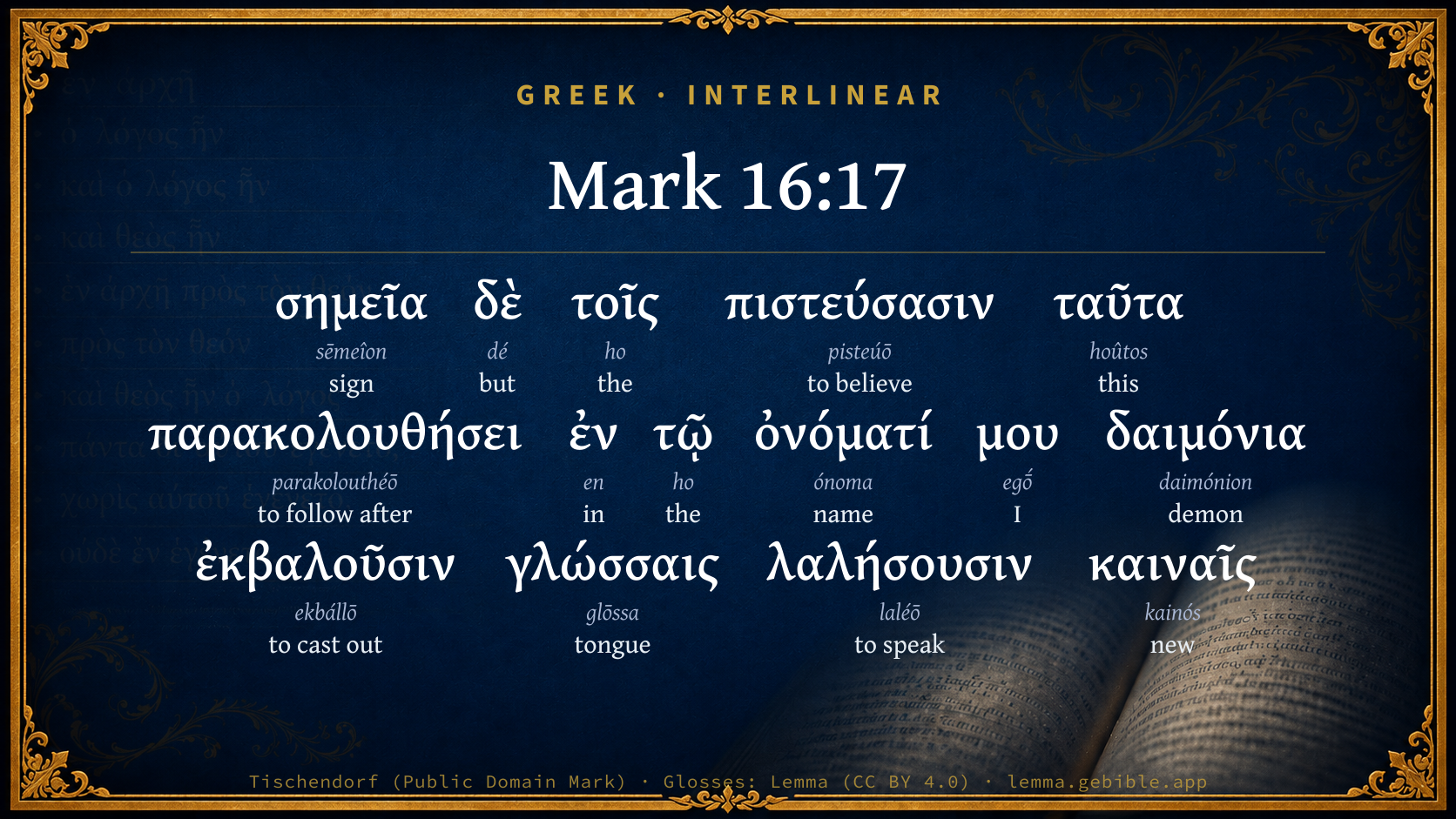
Greek (Tischendorf 8th ed.) Mark 16:17 appears in the Greek New Testament. The text above is from the Tischendorf 8th edition. Each word links to its Strong’s number and a concise gloss. Click any word for its full Thayer’s Greek Lexicon entry.
Download image
Cite this verse

Mark 16:17 (World English Bible). Public Domain. Lemma interlinear Bible study tool, https://lemma.gebible.app/v/mark/16/17.

Show BibTeX & RIS
BibTeX
RIS
English Translation
These signs will accompany those who believe: in my name they will cast out demons; they will speak with new languages;
World English Bible · Public Domain
Highlights
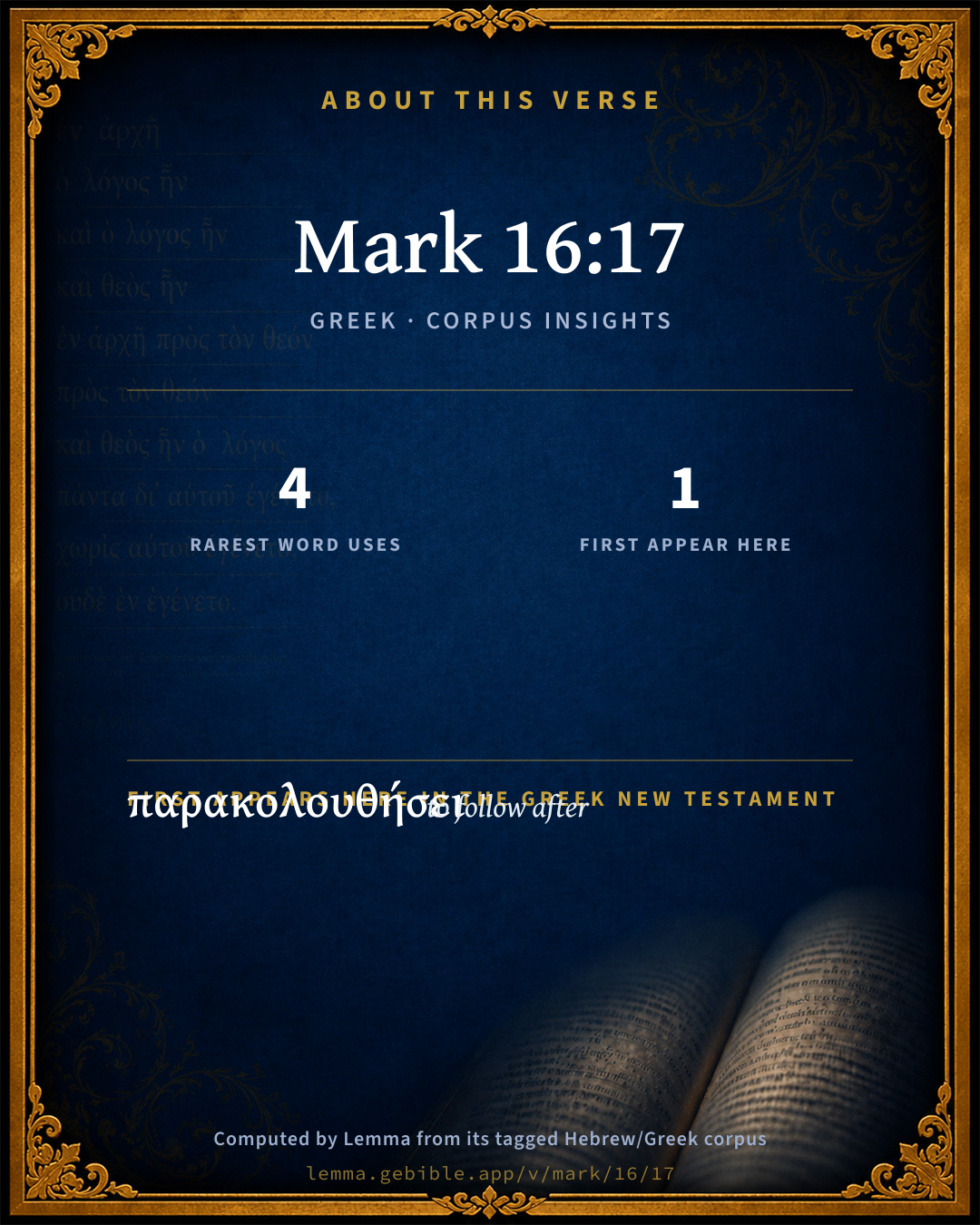
  • 1 first appearance in the Greek New Testament
Full analysis ↓
Download a study sheet

One document with this verse’s original text, its word-by-word gloss line, the meaning frame, cross-references with their text, attributed commentary, and full source and license credits — printable, and it pastes into notes with its structure intact.

This verse Autodidact and up

Study sheet (.html) Plain text (.txt)

A passage Seminary Student

Up to 50 verses in one chapter. A passage sheet keeps up to 6 commentary sources and 12 cross-references per verse, in the order this page ranks them, and says so on the sheet whenever that leaves anything out. Ask for a single verse and you get the Autodidact verse sheet above.

Everything on this page stays free to read, with no account — the sheet is a download of what is already on screen, not access to it.

Want to remove ads? Support Godless Engineer
Compare translations 3

The same verse in 3 English versions, stacked beneath the original-language interlinear above. Click any original word for its lexicon entry.

Each is an independent rendering of the whole verse — the interlinear is not word-aligned to these translations.

Highlighted words mark where these versions differ — a whole-verse word diff, not a word-by-word alignment.

  • World English Bible Public Domain
    These signs will accompany those who believe: in my name they will cast out demons; they will speak with new languages;
  • King James Version Public Domain
    And these signs shall follow them that believe; In my name shall they cast out devils; they shall speak with new tongues;
  • unfoldingWord Literal Text CC BY-SA 4.0
    Now these signs will accompany the ones having believed: In my name they will cast out demons; they will speak in new tongues;

unfoldingWord Literal Text — © unfoldingWord, licensed CC BY-SA 4.0. Word-aligned USFM3 via Door43 (git.door43.org/unfoldingWord/en_ult).

Versions to compare (up to 4)

3 of 4 selected

Show all 19 translations

Every available English version of this verse, each an independent rendering of the whole verse.

  • World English Bible Public Domain
    These signs will accompany those who believe: in my name they will cast out demons; they will speak with new languages;
  • Berean Standard Bible Public Domain
    And these signs will accompany those who believe: In My name they will drive out demons; they will speak in new tongues;
  • Majority Standard Bible Public Domain
    And these signs will accompany those who believe: In My name they will drive out demons; they will speak in new tongues;
  • King James Version Public Domain
    And these signs shall follow them that believe; In my name shall they cast out devils; they shall speak with new tongues;
  • American Standard Version (1901) Public Domain
    And these signs shall accompany them that believe: in my name shall they cast out demons; they shall speak with new tongues;
  • Revised Version (1885) Public Domain
    And these signs shall follow them that believe: in my name shall they cast out devils; they shall speak with new tongues;
  • Geneva Bible (1599) Public Domain
    And these tokens shall folowe them that beleeue, In my Name they shall cast out deuils, and shall speake with newe tongues,
  • Douay-Rheims (1899) Public Domain
    And these signs shall follow them that believe: In my name they shall cast out devils: they shall speak with new tongues.
  • Young's Literal Translation Public Domain
    `And signs shall accompany those believing these things; in my name demons they shall cast out; with new tongues they shall speak;
  • Literal Standard Version CC BY-SA 4.0
    And signs will accompany those believing these things: they will cast out demons in My Name; they will speak with new tongues;
  • Unlocked Literal Bible CC BY-SA 4.0
    These signs will go with those who believe: In my name they will cast out demons. They will speak in new languages.
  • unfoldingWord Literal Text CC BY-SA 4.0
    Now these signs will accompany the ones having believed: In my name they will cast out demons; they will speak in new tongues;
  • Darby Bible Public Domain
    And these signs shall follow those that have believed: in my name they shall cast out demons; they shall speak with new tongues;
  • World Messianic Bible Public Domain
    These signs will accompany those who believe: in my name they will cast out demons; they will speak with new languages;
  • Webster's Bible Public Domain
    And these signs shall follow them that believe: In my name shall they cast out demons; they shall speak in new languages;
  • Free Bible Version CC BY-SA 4.0
    The following signs will accompany those who trust in me: in my name they will drive out demons; they will speak new languages;
  • Bible in Basic English Public Domain
    And these signs will be with those who have faith: in my name they will send out evil spirits; and they will make use of new languages;
  • Text-Critical English NT CC BY 4.0
    And these signs will accompany those who believe: They will cast out demons in my name, they will speak in new tongues,
  • Tyndale New Testament (1534) Public Domain
    And these signes shall folowe them that beleve: In my name they shall cast oute devyls and shall speake with newe tonges

Literal Standard Version (2020), Covenant Press — licensed CC BY-SA 4.0. Text via the HelloAO Bible API (eBible.org). Unlocked Literal Bible (unfoldingWord) — licensed CC BY-SA 4.0. Text via the HelloAO Bible API (eBible.org). unfoldingWord Literal Text — © unfoldingWord, licensed CC BY-SA 4.0. Word-aligned USFM3 via Door43 (git.door43.org/unfoldingWord/en_ult). Free Bible Version, Dr. Jonathan Gallagher — licensed CC BY-SA 4.0. Text via the HelloAO Bible API (eBible.org).

Word by word

More ways to search: Search by grammar → Find every occurrence → Compare this word →

Practice this passage: Drill this verse → Learn its vocabulary →

παρακολουθήσει
parakolouthéō
G3877
“to follow after”
Verb, Future, Active, Indicative, 3rd person, Singular
Part of Speech
Verb
Tense
Future
Voice
Active
Mood
Indicative
Person
3rd person
Number
Singular
Full Thayer's Definition

Origin: from G3844 and G190

TDNT: 04:35,3

1. to follow after a. so to follow one as to be always at his side b. to follow close, accompany 2. metaph. a. to be always present, to attend one wherever he goes b. to follow up a thing in mind so as to attain to the knowledge of it 1. to understand, (cf our follow a matter up, trace its course) 2. to examine thoroughly, investigate c. to follow faithfully i.e a standard or rule, to conform one's self to
  1. σημεῖα sēmeîon G4592 “sign” Noun, Nominative, Plural, Neuter
  2. δὲ dé G1161 “but” Conjunction
  3. τοῖς ho G3588 “the” Article, Dative, Plural, Masculine
  4. πιστεύσασιν pisteúō G4100 “to believe” Verb, Aorist, Active, Participle, Dative, Plural, Masculine
  5. ταῦτα hoûtos G3778 “this” Demonstrative pronoun, Nominative, Plural, Neuter
  6. ἐν en G1722 “in” Preposition
  7. τῷ ho G3588 “the” Article, Dative, Singular, Neuter
  8. ὀνόματί ónoma G3686 “name” Noun, Dative, Singular, Neuter
  9. μου egṓ G1473 “I” Personal pronoun, 1st person, Genitive, Singular
  10. δαιμόνια daimónion G1140 “demon” Noun, Accusative, Plural, Neuter
  11. ἐκβαλοῦσιν ekbállō G1544 “to cast out” Verb, Future, Active, Indicative, 3rd person, Plural
  12. γλώσσαις glōssa G1100 “tongue” Noun, Dative, Plural, Feminine
  13. λαλήσουσιν laléō G2980 “to speak” Verb, Future, Active, Indicative, 3rd person, Plural
  14. καιναῖς kainós G2537 “new” Adjective, Dative, Plural, Feminine

About this verse

These counts appear in no published source. They are computed here, from the morphology-tagged text and Lemma’s own curated glosses. What Lemma adds →

15
words
14
distinct lemmas
Gospels
section

Notable vocabulary

The rarest word here is παρακολουθήσει to follow after G3877 — appearing just 4 times in the whole Greek New Testament.

First appearance in Scripture

This word makes its first canonical appearance in the Greek New Testament here:

  • παρακολουθήσει to follow after G3877

Shared distinctive vocabulary

παρακολουθήσει to follow after G3877 occurs in 4 verses of the Greek New Testament. Also found in:

Repetition

A word recurs within this verse:

  • τοῖς the G3588 ×2

Cross-references

17

Topical passages linked to Mark 16:17 in the Treasury of Scripture Knowledge — connected by theme and wording, ordered by reader-vote popularity; previews shown in the World English Bible.

  • Acts 5:16 Multitudes also came together from the cities around Jerusalem, bringing sick people, and those who were tormented by unclean spirits: and they were all healed.
  • 1 Corinthians 12:28 God has set some in the assembly: first apostles, second prophets, third teachers, then miracle workers, then gifts of healings, helps, governments, and various kinds of languages.
  • Luke 10:17 The seventy returned with joy, saying, "Lord, even the demons are subject to us in your name!"
  • Acts 8:7 For unclean spirits came out of many of those who had them. They came out, crying with a loud voice. Many who had been paralyzed and lame were healed.
  • John 14:12 Most assuredly I tell you, he who believes in me, the works that I do, he will do also; and greater works than these will he do; because I am going to my Father.
  • 1 Corinthians 12:10 and to another workings of miracles; and to another prophecy; and to another discerning of spirits; to another different kinds of languages; and to another the interpretation of languages.
  • Acts 10:46 For they heard them speaking in other languages and magnifying God. Then Peter answered,
  • Acts 19:6 When Paul had laid his hands on them, the Holy Spirit came on them, and they spoke with other languages and prophesied.
  • 1 Corinthians 14:2 For he who speaks in another language speaks not to men, but to God; for no one understands; but in the Spirit he speaks mysteries.
  • 1 Corinthians 12:30 Do all have gifts of healings? Do all speak with various languages? Do all interpret?
  • 1 Corinthians 14:4–26 He who speaks in another language edifies himself, but he who prophesies edifies the assembly.
  • 1 Corinthians 13:1 If I speak with the languages of men and of angels, but don't have love, I have become sounding brass, or a clanging cymbal.
  • Acts 16:18 She was doing this for many days. But Paul, becoming greatly annoyed, turned and said to the spirit, "I charge you in the name of Jesus Christ to come out of her!" It came out that very hour.
  • Acts 19:12–16 so that even handkerchiefs or aprons were carried away from his body to the sick, and the evil spirits went out.
  • Mark 9:38 John said to him, "Teacher, we saw someone who doesn't follow us casting out demons in your name; and we forbade him, because he doesn't follow us."
  • Acts 2:4–11 They were all filled with the Holy Spirit, and began to speak with other languages, as the Spirit gave them the ability to speak.
  • Acts 2:33 Being therefore exalted by the right hand of God, and having received from the Father the promise of the Holy Spirit, he has poured out this, which you now see and hear.

Cross-references courtesy of OpenBible.info (CC BY 4.0).

Where the printed editions differ

4 variants

Places in this verse where the major printed Greek editions disagree on the wording in a way that affects the translation — a comparison of editions, not a manuscript-by-manuscript collation. The editions are the modern critical texts (Nestlé-Aland 28/27, SBL, Westcott-Hort, Tregelles, Tyndale House) and the traditional texts behind the KJV (the Textus Receptus and the Byzantine/Majority text). It is not a claim about which reading is original.

  1. Extra text
    Σημεῖα δὲ τοῖς πιστεύσασιν

    “Signs now with those having believed”

    In NA28NA27TynWHTregTRByz Not in SBL
  2. Extra text
    ταῦτα

    “these”

    In NA28NA27Tyn»1SBLWH»1Treg»1TRByz Not in TynWHTreg
  3. Extra text
    ἐν τῷ ὀνόματί μου δαιμόνια ἐκβαλοῦσιν, γλώσσαις λαλήσουσιν

    “In the name of Me demons they will cast out, with tongues they will speak”

    In NA28NA27TynWHTregTRByz Not in SBL
  4. Extra text
    καιναῖς,

    “new,”

    In NA28NA27TRByz Not in TynSBLWHTreg

    Σημεῖα δὲ τοῖς πιστεύσασιν ταῦτα παρακολουθήσει· ἐν τῷ ὀνόματί μου δαιμόνια ἐκβαλοῦσιν, γλώσσαις λαλήσουσιν καιναῖς, (Sēmeia de tois pisteusasin tauta parakolouthēsei en tō onomati mou daimonia ekbalousin glōssais lalēsousin kainais) 'Signs now with those having believed these will accompany: In the name of Me demons they will cast out, with tongues they will speak new,' is only in traditional manuscripts

Textual data: Translators Amalgamated Greek New Testament (STEPBible TAGNT) · CC BY 4.0.

Commentary

Notes on Mark 16:17 from classic Christian and Jewish commentators (each source and its license shown beneath its notes). The classic Christian expositions comment on the surrounding passage and are grouped to its opening verse, so a note may address several verses; the Jewish commentaries on the Tanakh (Rashi and others) are per-verse, so they appear only where the commentator wrote on this verse.

Lemma curates 59 commentaries, every one of them public domain or Creative Commons licensed, each selected and text-cleaned for this edition rather than reprinted as found. About our sources →

The Biblical Illustrator

Joseph S. Exell

Mar_16:17

And these signs shall follow.

New tongues

New, because strange to the natural man, because acquired not by nature, but by grace. As the world of old was divided by the confusion of tongues, so by the renewing of our nature, and by the oneness of our speech, shall all be united into one people, having one heart and one seal. This new tongue must be given as the special gift of God to His children, for the tongue can no man tame of himself. This new tongue we have if-

(1) in the midst of adversity we refrain from murmuring, and are able to submit truly to the will of God, rendering Him thanks even in the midst of our sufferings;

(2) we can make full and unreserved confession of our sins to God, without seeking to excuse ourselves in His sight;

(3) we restrain ourselves from the censure of others, and use our tongue for the edification of our brethren. (W. Denton, M. A.)

Disappearance of miraculous powers accounted for

Probably Gods sliding scale-by which supernatural aid increases and decreases inversely according to our strength-may explain how, in the course of time, the supernatural aids of the Church have merged into the more ordinary aids of grace. (R. Glover.)

Christs presence in the Church continual

The cooperation of Christ was promised, not for the apostolic age alone, but for all time. The miraculous gifts of the Holy Ghost were withdrawn, and the third generation, at the latest, buried the last of The Twelve; but other men entered into their labours, and the office has been perpetuated by an unbroken lineage, so that those who minister in Christs Church today can feel that the voice which sent them forth was but the echo of that which spake on the Galilean hill to the first in the ministerial line. That Presence, which arrested the attention of an unbelieving age by startling manifestations, has been vouchsafed to the Church through all its chequered history in the power of an unseen but undiminished cooperation. In the Church at large it is borne witness to by the influence of Christianity upon the evil spirits of oppression and cruelty, of greed and profligate living. It has shown itself in a thousand ways in the alleviation of sickness and disease, and the tenderer care for the bereft of reason; while in a later age at least, the Pentecostal gift of tongues has been virtually repeated, by the translation of the gospel of glad tidings into well-nigh every spoken language. (H. M. Luckock, D. D.)

The Biblical Illustrator, edited by Joseph S. Exell (c. 1880s–1900s) — public domain. Text from a community e-Sword module.

Joseph Benson's Commentary

Mar 16:17-20. And these signs shall follow them that believe — Bengelius subjoins, “That believe with that very faith mentioned in the preceding verse.” (Though it is certain a man may work miracles and not have saving faith, Mat 7:22-23.) “It was not one faith by which Paul was saved; another, by which he wrought miracles. Even at this day, in every believer, faith has a latent miraculous power: (every effect of prayer being really miraculous:) although in many, because of their littleness of faith, and because the world is unworthy, that power is not exerted. Miracles in the beginning were helps to faith; now also they are the objects of it. At Leonberg, a town in Wirtemberg, in the memory of our fathers, a cripple, that could hardly move with crutches, while the dean was preaching on this very text, was in a moment made whole.” See note on Mar 11:22; where many similar instances are referred to; the number of which might easily be increased on the most certain evidence. Shall follow them that believe — The gospel word, and faith therein, must precede, and then the signs shall follow. In my name they shall cast out devils, &c. — That is, by my authority committed to them, and by my power attending them. Raising the dead is not mentioned here; so our Lord performed even more than he promised. If they drink any deadly thing — But not by their own choice: God never calls us to try any such experiment; it shall not hurt them. They shall lay their hands on the sick, and they shall recover — Immediately, without the use of any further means. Such was the purport of our Lord’s discourses with his disciples till his ascension, as is more largely related by Luke and John. And after he had spoken unto them — In this and a similar manner, time after time, for forty days; he was received up into heaven — While they were steadfastly beholding him; and sat on the right hand of God — That is, was invested with the highest dignity and authority, there to reign in all the glory of his mediatorial kingdom: And they went forth and preached everywhere — Through all parts of the Roman empire, and even to divers barbarous nations, and that with amazing success; the Lord working with them, according to his promise, and confirming the word with signs following — Which were at once the most solid, as well as the most obvious and popular demonstration of those divine truths which they delivered. Amen — So may the presence of the Lord be always with his faithful ministers! and may his gospel be attended everywhere with success, as well as with convincing evidences of its divine authority!

Joseph Benson's Commentary on the Old and New Testaments (1811–1818) — public domain. Text from a community e-Sword module.

Bengel's Gnomon

Johann Albrecht Bengel

Mar 16:17. Τοῖς πιστεύσασι, in the case of them that believe) by the instrumentality of that very faith, of which Mar 16:16 treats: comp. Heb 11:33, etc. The state of mind [faith] whereby Paul was saved, was not different from that whereby he performed miracles. Even in our day, faith has in every believer a hidden power of a miraculous character: every effect resulting from our prayers is really miraculous, even though that miraculous character be not apparent; although in many, both on account of their own feebleness, and on account of the unworthiness of the world,—not merely because [as some say] the Church, being once planted, needs not the continuance of miracles, though no doubt the early miracles of the New Testament have ‘made’ for the Lord Jesus “an everlasting name” (comp. Isa 63:12),—that power does not exert itself in our day. Signs were in the beginning the props and stays of faith: now they are also the object of faith. At Leonberg, a town of Wirtemberg [A.C. 1644, thirteenth Sunday after Trinity], a girl of twenty years of age was so disabled in her limbs, as hardly to be able to creep along by the help of crutches; but whilst the Dean [Raumeier was his name] was, from the pulpit, dwelling on the miraculous power of Jesus’ name, she suddenly was raised up and restored to the use of her limbs.[12]—ταῦτα, these) Miracles are here alluded to of a most palpable kind, and such as are altogether removed from every suspicion of trickery.—παρακολουθήσει, shall follow in the train of) The word and faith precede the signs, Mar 16:20.—ἐν τῷ ὀνόματί Μου, in My name) which believers call upon.—καιναῖς, new) Such as they themselves had not previously known: or even such as no nation had previously spoken: 1Co 12:10. For in Act 2:4, the tongues of the Parthians, Medes, etc., are called other tongues, not new tongues. Ἕτεραι, other tongues, were such as were used before, viz., by the various nations: but καιναὶ, new tongues: for instance, as at Corinth, where one spake in the tongue, and another had to interpret it, although there was no one present who used the foreign tongue; a proceeding which was as it were a kind of prophetical exercise.

[12] This happened in the presence of Duke Eberhard III. and his courtiers, and was committed to the public records, which are above all suspicion. However D. Ernesti, Bibl. Theol. T. ii. 416, regards the whole affair as not worthy to be dignified with the name of miracle. The very words of the Dean are given by E. B. in his Ed. of Beng. Gnom., which the curious reader can consult. The girl had been for nine years continuously disabled. E. B. tells a marvellous tale in addition. At Lavingen, in the year 1606, Nov. 26, Joseph Jenisch was born of the noble stock of the Kellers; he was destitute of a tongue from his birth, but in consequence of the earnest prayers of his parents and family, when he had not yet finished his first year, he was able to name distinctly the several members of the family, and was, therefore, dedicated to the service of the ministry, which for forty years he discharged at Böblingen and Münchingen: he died on the 10th of April 1675.—ED. and TRANSL.

Bengel's Gnomon of the New Testament — English translation (T&T Clark, Edinburgh, 1860) — public domain. Text from a community e-Sword module.

Meyer's Critical & Exegetical Commentary

Heinrich August Wilhelm Meyer

Mar_16:17. Σημεῖα] marvellous significant appearances for the divine confirmation of their faith. Comp. 1Co_14:22.

τοῖς πιστεύσουσι] those who have become believing, generically. The limitation to the teachers, especially the apostles and seventy disciples (Kuinoel), is erroneous. See Mar_16:16. The σημεῖα adduced indeed actually occurred with the believers as such, not merely with the teachers. See 1 Corinthians 12. Yet in reference to the serpents and deadly drinks, see on Mar_16:18. Moreover, Jesus does not mean that every one of these signs shall come to pass in the case of every one, but in one case this, in another that one. Comp. 1Co_12:4.

παρακολ.] shall follow them that believe, shall accompany them, after they have become believers. The word, except in Luk_1:3, is foreign to all the four evangelists, but comp. 1Ti_4:6; 2Ti_3:10.

ταῦτα] which follow. See Krüger, Xen. Anab. ii. 2. 2; Kühner, ad Anab. ii. 5. 10.

ἐν τῷ ὀνόματί μου] in my name, which they confess, shall the ground be, that they, etc. It refers to all the particulars which follow.

δαιμ. ἐκβαλ.] Comp. Mar_9:38.

γλώσσ. λαλ. καιναῖς] to speak with new languages. The ecstatic glossolalia (see on 1Co_12:10), which first appeared at the event of Pentecost, and then, moreover, in Act_10:46; Act_19:6, and is especially known from the Corinthian church, had been converted by the tradition with reference to the Pentecostal occurrence into a speaking in languages different from the mother-tongue (see on Act_2:4). And such is the speaking in new languages mentioned in the passage before us, in such languages, that is, as they could not previously speak, which were new and strange to the speakers. Hereby the writer betrays that he is writing in the sub-apostolic period, since he, like Luke in reference to the Pentecostal miracle, imports into the first age of the church a conception of the glossolalia intensified by legend; nay, he makes the phenomenon thereby conceived as a speaking in strange languages to be even a common possession of believers, while Luke limits it solely to the unique event of Pentecost. We must accordingly understand the γλώσσ. λαλεῖν καιναῖς of our text, not in the sense of the speaking with tongues, 1 Corinthians 12-14, but in the sense of the much more wonderful speaking of languages, Acts 2, as it certainly is in keeping with the two strange particulars that immediately follow. Hence every rationalizing attempt to explain away the concrete designation derived, without any doubt as to the meaning of the author, from the Acts of the Apostles, is here as erroneous as it is in the case of Acts 2, whether recourse be had to generalities, such as the newness of the utterance of the Christian spirit (Hilgenfeld), or the new formation of the spirit-world by the new word of the Spirit (Lange), the ecstatic speaking on religious subjects (Bleek), or others. Against such expedients, comp. Keim in Herzog, Encykl. XVIII. p. 687 ff. The ecstatic phenomena of Montanism and of the Irvingites present no analogy with the passage before us, because our passage has to do with languages, not with tongues. Euthymius Zigabenus: γλώσσαις ξέναις, διαλέκτοις ἀλλοεθνέσιν.

Meyer — Critical and Exegetical Commentary on the New Testament — English translation by Peter Christie, edited by Frederick Crombie (T&T Clark, 1880) — public domain. Text from a community e-Sword module.

Expositor's Greek Testament

ed. W. Robertson Nicoll

Mar 16:17 . Here also we find a great lapse from the high level of Mt.’s version of the farewell words of Jesus: signs, physical charisms, and thaumaturgic powers, taking the place of the spiritual presence of the exalted Lord. Casting out devils represents the evangelic miracles; speaking with tongues those of the apostolic age; taking up venomous serpents and drinking deadly poison seem to introduce us into the twilight of apocryphal story. Healing of the sick by laying on of hands brings us back to apostolic times. θανάσιμον is a ἅπ . λεγ .

The Expositor's Greek Testament, edited by W. Robertson Nicoll (1897–1910) — public domain. Text from a community e-Sword module.

Geneva Bible (1599)

Geneva Bible translators

Strange tongues, such as they knew not before.

Geneva Bible (1599) marginal notes — public domain. Text via Bolls.life.

Adam Clarke's Commentary

Verse 17. These signs shall follow] Or rather, accompany; this is the proper import of the original word παρακολουθησει, from παρα with, and ακολουθεω, I follow.

Them that believe] The believers, as we express it; i.e. the apostles, and all those who in those primitive times were endued with miraculous powers, for the confirmation of the doctrines they preached.

In my name] That is, by the authority and influence of the almighty Jesus.

Cast out devils] Whose kingdom Jesus Christ was manifested to destroy.

Speak with new tongues] This was most literally fulfilled on the day of pentecost, Ac 2:4-19.

Adam Clarke's Commentary on the Bible (1810–1826) — public domain. Text from a community e-Sword/MySword module.

Ellicott's Commentary for English Readers

(17) They shall speak with new tongues.—This is noticeable as being the only distinct reference in the Gospels to the form of the Pentecostal gift. The promise of the Spirit itself had been prominent, however, throughout our Lord’s teaching (Luk_11:13; Joh_14:17; Joh_14:26), and appears from Act_1:8 to have been specially renewed between the Resurrection and Ascension. On the nature of the gift itself, see Notes on Act_2:4; Act_10:46; Act_19:6; 1Co_12:10; 1Co_14:4-26.

A Bible Commentary for English Readers, edited by Charles John Ellicott (1878–1897) — public domain. Text from a community e-Sword module.

The Cambridge Bible for Schools and Colleges

gen. ed. J. J. S. Perowne

17. And these signs] For this word applied to Miracles see note, ch. Mar_6:2.

shall follow] Literally, shall proceed along with. The same word in the original is used by St Luke, Luk_1:3, “It seemed good to me also, having had perfect understanding of all things” (literally, having carefully followed up).

them that believe] i. e. those that shall have believed, shall have adopted the Faith and been baptized.

In my name shall they cast out devils] As is afterwards recorded to have been done by Philip the deacon in Samaria (Act_8:7), by St Paul at Philippi (Act_16:18) and Ephesus (Act_19:15-16).

they shall speak with new tongues] as all the Apostles did on the day of Pentecost, and the Gentile friends of Cornelius (Act_10:46), and the twelve disciples at Ephesus (Act_19:6), and many afterwards in the Church of Corinth (1Co_12:10).

The Cambridge Bible for Schools and Colleges (gen. ed. J. J. S. Perowne; Cambridge University Press, 1878–1918) — public domain. Text from a community e-Sword module.

John Gill's Exposition

They shall take up serpents,.... The Arabic version adds, "in their own hands"; and in an ancient manuscript of Beza's it is read, "in the hands"; so the Apostle Paul had a viper, which fastened and hung on his hand, which he shook off, without receiving any harm from it, Act 28:3.

And if they drink any deadly thing, it shall not hurt them; not that they were hereby warranted to drink poison, to show what power they had; but should they accidentally drink it, or rather should they be forced to it by their enemies in order to destroy them, they should find no hurt by it: and Papias (x) reports of Barsabas, surnamed Justus, who was put up with Matthias for the apostleship, Act 1:23, that he drank a poisonous draught, and by the grace of the Lord, received no hurt: and the Jews themselves report (y), that

"a son of R. Joshua ben Levi, swallowed something hurtful; and one came and whispered to him in the name of Jesus, the son of Pandira (so they call our Lord), and he did well.''

It follows,

and they shall lay hands on the sick, and they shall recover; as the Apostle Paul did on the father of Publius, who was thereby healed of a fever, and a bloody flux, and also others, Act 28:8; nay, some were healed by the shadow of Peter, Act 5:15, and others, by handkerchiefs and aprons taken from the body of Paul, Act 19:12. The Persic version adds, without any authority, "whatsoever ye ask in my name, shall be given unto you".

(x) Apud Euseb. Hist. Eccl. l. 3. c. 39. (y) T. Hieros. Sabbat, fol. 14. 4. & Avoda Zara, fol. 40. 4. & Midrash Kobelet, fol. 81. 1.

John Gill's Exposition of the Whole Bible (1746–1763) — public domain (CC PDM 1.0). Text via the HelloAO Bible API.

Trapp's Complete Commentary

John Trapp

17 And these signs shall follow them that believe; In my name shall they cast out devils; they shall speak with new tongues;

Ver. 17. In my name they shall, &c.] This promise was peculiar to the primitive Christians and to such as lived immediately after Christ’s ascension. That was an extraordinary providence, that when Squier, that traitor, A. D. 1597, had poisoned the pummel of Queen Elizabeth’s saddle when she was to take horse; albeit the season were hot, and the veins open to receive any malignant tainture, yet her body thereupon felt no distemperature, her hand felt no more hurt than Paul’s did when he shook off the viper into the fire. (Speed’s Hist.)

John Trapp, A Commentary or Exposition upon All the Books of the Old and New Testament (1647–1656) — public domain. Text from a community e-Sword module.

Albert Barnes' Notes on the Bible

And these signs - These miracles. These evidences that they are sent from God.

Them that believe - The apostles, and those in the primitive age who were endowed with like power. This promise was fulfilled if it can be shown that these signs followed in the case of any who believed, and it is not necessary to suppose that they would follow in the case of all. The meaning is, that they would be the result of faith, or of the belief of the gospel. It is true that they were. These signs were shown in the case of the apostles and early Christians. The infidel cannot say that the promise has not been fulfilled unless he can show that this never occurred; the Christian should be satisfied that the promise was fulfilled if these miracles were ever actually wrought, though they do not occur now; and the believer now should not expect a miracle in his case. Miracles were necessary for the establishment of religion in the world; they are not necessary for its continuance now.

In my name - By my authority, and using the power that I would in such cases, if bodily present. This was done; and in this they differed essentially from the manner in which Jesus himself wrought miracles. He did it in “his own name,” and as possessing original, underived authority. See the account of his stilling the sea (Mat 8:26, etc.); of his healing the sick Mat 9:5-6; of his raising Lazarus, John 11. The prophets spoke “in the name of the Lord.” The apostles did likewise, Act 3:6, etc. There was, therefore, an important difference between Jesus and all the other messengers that God has sent into the world. He acted in his own name; they in the name of another. He wielded his own power; they were the instruments by which God put forth the omnipotence of his arm to save. He was therefore God; they were men of like passions as other men, Act 14:15.

Shall they cast out devils - See the notes at Mat 4:24. Compare Act 16:16-18.

Shall speak with new tongues - Shall speak other languages than their native language. This was remarkably fulfilled on the day of Pentecost, Act 2:4-11. It existed, also, in other places. See 1Co 12:10.

Albert Barnes' Notes on the Bible (1834–1885) — public domain. Text from a community e-Sword/MySword module.

Whedon's Commentary on the Bible

Daniel D. Whedon

17. Follow them that believe — This promise is general, but not universal. It does not affirm that all in all ages who believe shall be followed by these signs. In fact, if each sign is once, twice, or thrice fulfilled in the case of any who believe, it is completely fulfilled. All over that is surplus fulfilment. So that those are very foolish who cavil that, according to this text, all believers must perform signs, and that none that work not miracles can be true believers.

The signs here mentioned do not include the raising of the dead. That great miracle, by which the soul is recalled from its departed state, has perhaps never been unequivocally and completely performed since the resurrection of our Lord.

In my name… cast out devils — As Jesus cast out devils in his own original power, so the apostles must perform the same miracles in his, and not in their own name. Their first miracle should be that signal work which typified the great work of Christ in expelling evil and its author from the soul of man, and from the world, namely, the casting out of devils. This phenomenon of possession existed through the apostolic age; and the fathers of the early Church bear ample testimony that the true believer expelled demons through faith in Jesus’s name.

Speak with new tongues — Tongues by them not hitherto possessed. Here is an intimation of the Pentecostal miracle. This miracle remained with the early Church (1Co_12:10) as a symbol of the power of Christianity to pervade all the tribes and languages of the babbling earth, and as a means of arresting the attention of the unchristian and unheeding world.

Daniel D. Whedon (gen. ed.), Commentary on the Old and New Testaments (1874–1909) — public domain. Text from a community e-Sword module.

The Pulpit Commentary

Vers. 17, 18. And these signs shall follow them that believe. Such evidences were necessary in the first dawn of Christianity, to attract attention to the doctrine; but our Lord"s words do not mean that they were to be in perpetuity, as a continually recurring evidence of the truth of Christianity. St. Gregory (on 1Co_14:22) says, "These signs were necessary in the beginning of Christianity. In order that faith might take root and increase, it must be nourished by miracle; for so even we, when we plant shrubs, only water them until we see that they are taking root, and when we see that they have rooted themselves, we cease to water them. And this is what St. Paul means where he says "Tongues are for a sign, not to those who believe, but to the unbelieving"." (1Co_14:22) In my name shall they cast out devils. St. Mark, of all the evangelists, dwells most perhaps on this, as characteristic of our Lord"s work, and as the evidence of his supreme dominion over the spiritual world. They shall speak with new tongues. This was the first.intimation of the great miracle to be inaugurated on the day of Pentecost. The gift was continued but for a very limited time. They shall take up serpents.

The instance of St. Paul at Melita (Act_28:3-5) would be familiar to St. Mark"s readers. And if they drink any deadly thing, it shall in no wise hurt them. There are some few traditionary notices of the fulfillment of this promise; as in the case of "Justus Barsabas," mentioned by Eusebius ("H.E.," 3, 19), and of St. John, mentioned by St. Augustine. It may be observed of this passage, that no one could have interpolated it after the cessation of the signs to which it refers, which took place very early.

The Pulpit Commentary (1880–1919), ed. H.D.M. Spence-Jones & Joseph S. Exell — public domain. Text from a community e-Sword module.

John Wesley's Explanatory Notes

And these signs shall follow them that believe - An eminent author sub-joins, "That believe with that very faith mentioned in the preceding verse." (Though it is certain that a man may work miracles, and not have saving faith, Matt. vii, 22, 23.) "It was not one faith by which St. Paul was saved, another by which he wrought miracles. Even at this day in every believer faith has a latent miraculous power; (every effect of prayer being really miraculous;) although in many, both because of their own littleness of faith, and because the world is unworthy, that power is not exerted. Miracles, in the beginning, were helps to faith; now also they are the object of it. At Leonberg, in the memory of our fathers, a cripple that could hardly move with crutches, while the dean was preaching on this very text, was in a moment made whole." Shall follow - The word and faith must go before. In my name - By my authority committed to them. Raising the dead is not mentioned. So our Lord performed even more than he promised.

John Wesley, Explanatory Notes Upon the Whole Bible (1754–1765) — public domain. Text via the GEBible commentary corpus.

Burkitt's Expository Notes on the New Testament

William Burkitt

Here we have a gracious promise of Christ, that in order to the spreading and propagating the gospel, as far as may be, the Spirit should be poured forth abundantly from on high upon the apostles, and thereby they should be enabled to work miracles, to cast out devils, to speak strange languages, which we read they did, Acts 2.

And this power of working miracles, continued in the church an hundred years after Christ’s ascension, until Christianity had taken root in the hearts of men. Iraeneus, lib. 2. chap. 58. says, that many believers, besides the apostles, had this power of working miracles; as new-set plants are watered at first, till they have taken fast rooting, so, that the Christian faith might grow the faster, God watered it with miracles at its first plantation.

Yet observe, That all the miracles which they had power to work, were healing and beneficient; not terrifying judgments, but acts of kindness and mercy. It was our Saviour’s design to bring over persons to Christianity by lenity, mildness, and gentleness, not to affright them into a compliance with astonishing judgment, which might affect their fear, but little influence their faith: for the will and consent of persons to the principles of any religion, especially the Christian, is like a royal fort which must not be stormed by violence, but taken by surrender.

William Burkitt's Expository Notes on the New Testament (1700–1703) — public domain. Text from a community e-Sword module.

The People's New Testament

B. W. Johnson

17. These signs shall follow them that believe. It is generally held that this is a promise limited to the apostolic age and to a few of the disciples of that age. Perhaps the plural them does not have for its antecedent the singular he in verse 16, but the plural them in verse 14. If it does not, why is the number changed in verses 15 and 16? The grammatical construction requires us to look to verse 14 for the antecedent of them in verse 17. In verse 14 the apostles are “upbraided for their unbelief because they believed not them who had seen him after he had arisen.” They are commanded to go and tell the glad story, and assured that miraculous credentials shall be given to those of “them who believe” and tell the wonderful tidings. In my name shall they cast out devils, etc. See Acts 2:4; 5:16; 8:7; 16:18; 28:3.

B. W. Johnson's The People's New Testament with Notes (1889–1891) — public domain. Electronic text from the Christian Classics Ethereal Library (CCEL) ThML edition.

unfoldingWord translationNotes

Door43 World Missions Community

These signs will go with those who believe

Mark speaks of miracles as though they were people going along with the believers. AT: "People watching those who believe will see these things happen and know that I am with the believers" (See: Personification)

In my name they

Possible meanings are 1) Jesus is giving a general list: "In my name they will do things like these: They" or 2) Jesus is giving an exact list: "These are the things they will do in my name: They."

In my name

Here "name" is associated with Jesus' authority and power. See how "in your name" is translated in Mark 9:38. AT: "By the authority of my name" or "By the power of my name" (See: Metonymy)

translationWords

demon

serpent

unfoldingWord translationNotes — © Distant Shores Media and the Door43 World Missions Community, licensed CC BY-SA 4.0. Source: git.door43.org/Door43/en_tn.

Cambridge Greek Testament for Schools and Colleges

17. [3581][3582][3583][3584][3585] omit καιναῖς.

[3581] Codex Ephraemi. 5th cent. A palimpsest: the original writing has been partially rubbed out, and the works of Ephraem the Syrian have been written over it; but a great deal of the original writing has been recovered; of Mark we have Mar 1:17 to Mar 6:31, Mar 8:5 to Mar 12:29, Mar 13:19 to Mar 16:20. In the National Library at Paris.

[3582] An asterisk denotes that the word is not found elsewhere in N.T., and such words are included in the index, even if there is no note on them in the commentary.

[3583] Codex Regius. 8th cent. An important witness. At Paris. Contains Mar 1:1 to Mar 10:15; Mar 10:30 to Mar 15:1; Mar 15:20 to Mar 16:20, but the shorter ending is inserted between Mar 16:8 and Mar 16:9, showing that the scribe preferred it to the longer one.

[3584] Codex Sangallensis. 9th or 10th cent. Contains the Gospels nearly complete, with an interlinear Latin translation. The text of Mark is specially good, agreeing often with CL. At St Gall.

[3585] Codex Athous Laurae. 8th cent. Like N and Σ, it is written in silver letters on purple vellum. Contains Mar 9:5 to Mar 16:20, and, as in L, the shorter ending is inserted between Mar 16:8 and Mar 16:9. As in Δ, the text of Mark is specially good.

17. τοῖς πιστεύσασιν. The writer does not say τῷ πιστεύσαντι, nor does he add πᾶσιν. His own experience must have taught him that not each individual believer, but only some of those who believed, had these χαρίσματα ἰαμάτων (1Co 12:30); πολλὰ τοιαῦτα πολλοῖς παρηκολούθησαν ἁγίοις (Euthym.), and even that may be too strong. In any case, the promise was to the Church collectively. The writer would not have put into the mouth of Christ a prediction which everyone knew had not been fulfilled. On the other hand, both in 1Co 12:10 and Gal 3:5, St Paul treats the possession of extraordinary powers by some of his converts as a well-known fact. Cf. Joh 14:12.

ἐν τῷ ὀνόματί μου. These words are placed first with great emphasis. The power is not their own to be used for their own aggrandisement. Cf. Mar 9:38; Act 3:6; Act 16:18; Act 19:13. The disciples had already exercised this power (Mar 3:15; Mat 10:1; Luk 9:1; Luk 10:17). Justin repeatedly testifies that in his day the power of thus exorcizing demons was possessed by Christians, who were more successful with the Name of Jesus Christ than Jews were with the Name of the God of Abraham (Try. 30, 85, Apol. ii. 8). Tertullian bears similar testimony (Apol. 23, Ad Scap. 2, 4). Origen says, “We ourselves, by the use or prayers and other means which we learn from Scripture, drive demons out of the souls of men” (Cels. vii. 67). Soon there arose the idea that the mere uttering of the Name of Jesus had a magical effect, which cannot have been Christ’s meaning. The exact meaning of “in My Name” depends upon the context; e.g. “by My authority and power,” “in My character,” “as My representative.” Cf. Joh 14:13; Joh 15:16; Joh 16:24; Joh 16:26.

γλώσσαις λαλήσουσιν. Cf. Act 2:4; Act 10:46; Act 19:6; 1Co 12:10; 1Co 12:28; 1Co 14:5 f. Irenaeus states that this continued in his day (5. 6. 1), as well as the driving out of demons (II. xxxii. 4). Thus far all that is mentioned in this summary of what Christ promised to the disciples is confirmed by statements in N.T. as well as by other evidence. In the next verse elements which seem to be akin to legend are mingled with well-attested facts.

Cambridge Greek Testament for Schools and Colleges (Cambridge University Press, 1896; 21 vols, various authors incl. Carr, Maclear, Plummer, Farrar, Lumby, Moule, M. R. James, Simcox) — public domain. Text from a community e-Sword module.

Alford’s Greek Testament

Henry Alford

17.] This promise is generally made, without limitation to the first ages of the Church. Should occasion arise for its fulfilment, there can be no doubt that it will be made good in our own or any other time. But we must remember that σημεῖα are not needed where Christianity is professed: nor by missionaries who are backed by the influence of powerful Christian nations.

There are credible testimonies of miraculous powers having been exercised in the Church considerably after the Apostles’ time.

δαιμ. ἐκβ.] The Lord Himself has declared how weighty a sign this was, Mat 12:28. For fulfilments of the promise, see Act 5:16; Act 8:7; Act 16:18.

γλώσ. λ. καιν.] See 1Co 14:22: Act 2:4 . On the gift of tongues, see notes at those places.

Henry Alford, The Greek Testament (1849–1861) — public domain. Text from a community e-Sword module.

International Critical Commentary

17, 18. Of the signs promised here, the healing, and the casting out of demons, are characteristic of our Lord’s activity; the speaking with tongues is new, and belongs to the apostolic period; and the taking up of serpents and drinking poisons with impunity is absolutely foreign to our Lord’s principle.5 The verbal peculiarities are in the use of παρακολούθησει(?), and θανάσιμον, the former occurring only here in Mk., and the latter only here in N.T.

ἀκολουθήσει, instead of παρακολουθήσει, Treg. WH. CL. παρακολουθήσει, Act 2:33 (Δ ῥακολουθήσει). There is a meaning of closeness of attendance which makes παρακολουθήσει much more individual and probable. Omit καιναῖς, new, after γλώσσαις, Treg. WH. RV.marg. CL Δ Memph. Insert. καὶ ἐν ταῖς χερσὶν, and in their hands, before ὄφεις ἀροῦσι, Treg. (Treg. marg. WH.) C* and 2 LM marg. Χ Δ. Grk. 1, 22, 33, Memph. Cur. Harcl.

THE ASCENSION

International Critical Commentary — older volumes (1896–1929), various authors — public domain. Text from a community e-Sword module.

Vincent's Word Studies in the New Testament

Marvin R. Vincent

Shall follow [παρακολουθησει] . The preposition para, alongside of, gives the sense of accompany.

Marvin R. Vincent, Word Studies in the New Testament (1887–1900) — public domain. Text from a community e-Sword/MySword module.

Lesson kit

Teaching starters — assembled from the data on this page, not authored interpretation. Every prompt links to the verse data it draws on. Edit before teaching.

Mark, in the Gospels, opens this verse with 15 words (14 distinct Greek lemmas). Its most distinctive word is parakolouthéō (“to follow after”). A historical commentator’s framing appears above. Read the whole chapter for the surrounding context.

Discussion questions

  1. The word parakolouthéō carries the sense “to follow after.” How does it shape the verse?
  2. The word “to follow after” first appears here in Scripture. What is being introduced at this debut?
  3. Luke 1:3 shares the word «to follow after» with this verse. How do the two illuminate each other?
  4. “the” occurs 2× in this one verse. What is the effect of the repetition?
  5. These translations render this verse differently. What is at stake in choosing one wording over another?
  6. Reading how The Biblical Illustrator and Joseph Benson's Commentary read this verse, where do the two commentators agree and where do they part?

Things to notice

  • 1 word makes its first canonical appearance in Scripture here.
  • These translations choose different wording for 14 words in this verse.
  • “the” occurs 2× in this single verse.
  • 14 distinct Greek lemmas span 15 words in this verse.

Reading settings

Reading text

Shown beneath each verse's original-language words.

Old Testament
Old Testament edition

Read the OT as the Masoretic Hebrew (MT) or the Greek Septuagint (LXX).

English shown for the Greek Septuagint (in the Hebrew ↔ Greek comparison).

Comparing translations? Open the Compare panel on any verse page to stack up to four side by side.