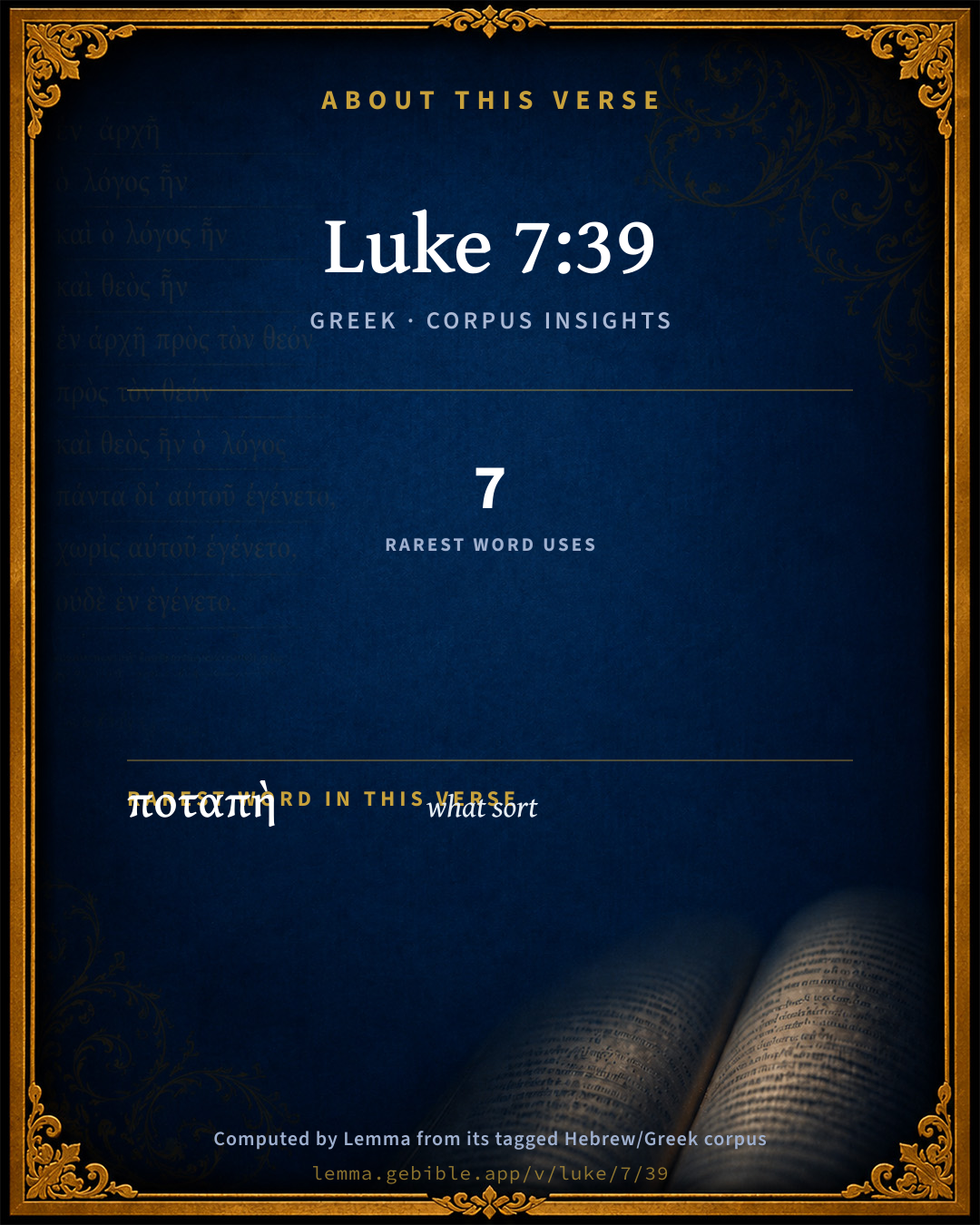
Luke 7:39

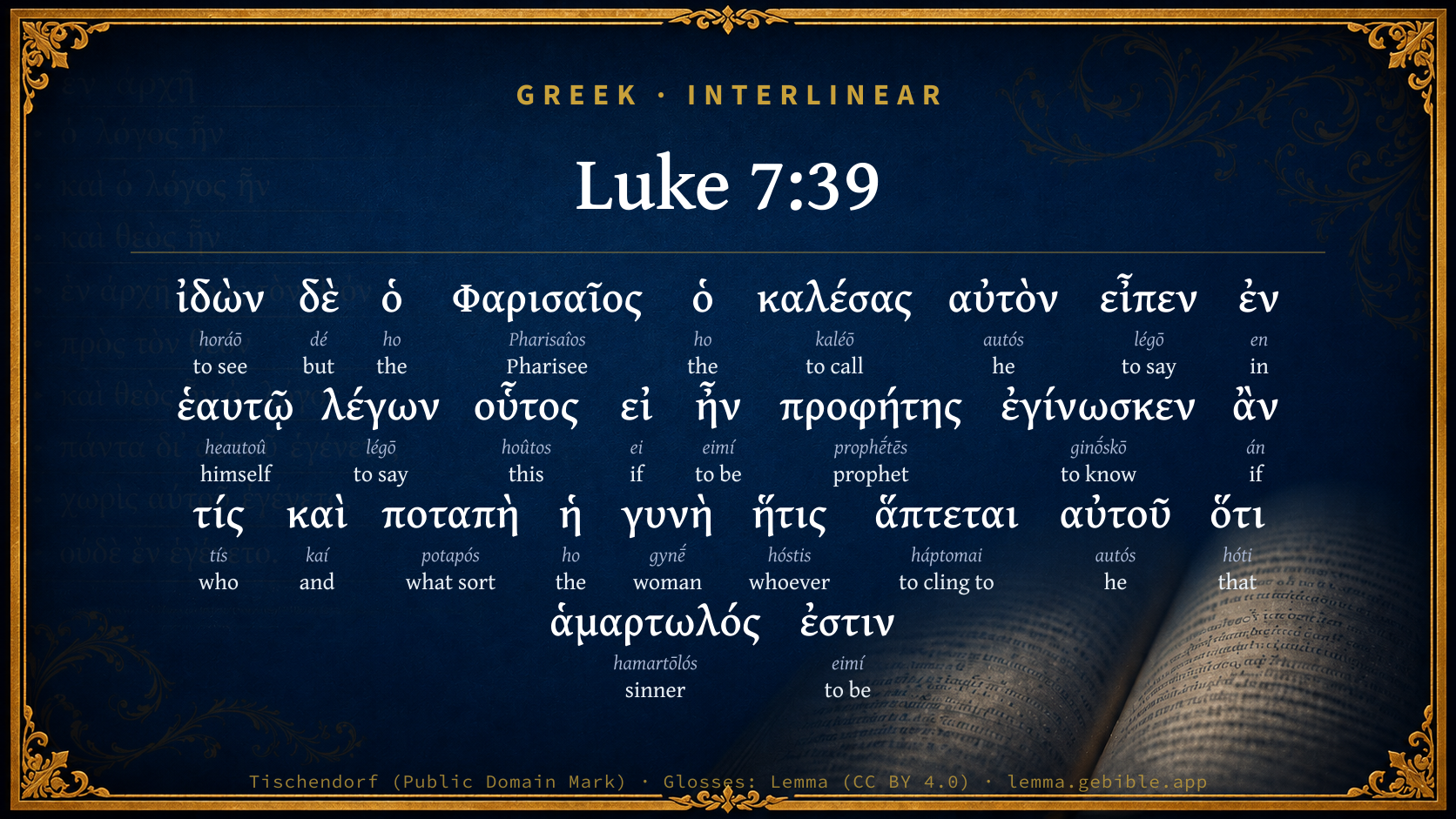
Greek (Tischendorf 8th ed.) Luke 7:39 appears in the Greek New Testament. The text above is from the Tischendorf 8th edition. Each word links to its Strong’s number and a concise gloss. Click any word for its full Thayer’s Greek Lexicon entry.
Download image
Cite this verse

Luke 7:39 (World English Bible). Public Domain. Lemma interlinear Bible study tool, https://lemma.gebible.app/v/luke/7/39.

Show BibTeX & RIS
BibTeX
RIS
English Translation
Now when the Pharisee who had invited him saw it, he said to himself, "This man, if he were a prophet, would have perceived who and what kind of woman this is who touches him, that she is a sinner."
World English Bible · Public Domain
Download a study sheet

One document with this verse’s original text, its word-by-word gloss line, the meaning frame, cross-references with their text, attributed commentary, and full source and license credits — printable, and it pastes into notes with its structure intact.

This verse Autodidact and up

Study sheet (.html) Plain text (.txt)

A passage Seminary Student

Up to 50 verses in one chapter. A passage sheet keeps up to 6 commentary sources and 12 cross-references per verse, in the order this page ranks them, and says so on the sheet whenever that leaves anything out. Ask for a single verse and you get the Autodidact verse sheet above.

Everything on this page stays free to read, with no account — the sheet is a download of what is already on screen, not access to it.

Want to remove ads? Support Godless Engineer
Compare translations 3

The same verse in 3 English versions, stacked beneath the original-language interlinear above. Click any original word for its lexicon entry.

Each is an independent rendering of the whole verse — the interlinear is not word-aligned to these translations.

Highlighted words mark where these versions differ — a whole-verse word diff, not a word-by-word alignment.

  • World English Bible Public Domain
    Now when the Pharisee who had invited him saw it, he said to himself, "This man, if he were a prophet, would have perceived who and what kind of woman this is who touches him, that she is a sinner."
  • King James Version Public Domain
    Now when the Pharisee which had bidden him saw it, he spake within himself, saying, This man, if he were a prophet, would have known who and what manner of woman this is that toucheth him: for she is a sinner.
  • unfoldingWord Literal Text CC BY-SA 4.0
    And the Pharisee who had invited him, having seen this, he said to himself, saying, “If this were a prophet, he would know who and of what type the woman who is touching him, that she is a sinner.”

unfoldingWord Literal Text — © unfoldingWord, licensed CC BY-SA 4.0. Word-aligned USFM3 via Door43 (git.door43.org/unfoldingWord/en_ult).

Versions to compare (up to 4)

3 of 4 selected

Show all 19 translations

Every available English version of this verse, each an independent rendering of the whole verse.

  • World English Bible Public Domain
    Now when the Pharisee who had invited him saw it, he said to himself, "This man, if he were a prophet, would have perceived who and what kind of woman this is who touches him, that she is a sinner."
  • Berean Standard Bible Public Domain
    When the Pharisee who had invited Jesus saw this, he said to himself, “If this man were a prophet, He would know who this is and what kind of woman is touching Him—for she is a sinner!”
  • Majority Standard Bible Public Domain
    When the Pharisee who had invited Jesus saw this, he said to himself, “If this man were a prophet, He would know who this is and what kind of woman is touching Him—for she is a sinner!”
  • King James Version Public Domain
    Now when the Pharisee which had bidden him saw it, he spake within himself, saying, This man, if he were a prophet, would have known who and what manner of woman this is that toucheth him: for she is a sinner.
  • American Standard Version (1901) Public Domain
    Now when the Pharisee that had bidden him saw it, he spake within himself, saying, This man, if he were a prophet, would have perceived who and what manner of woman this is that toucheth him, that she is a sinner.
  • Revised Version (1885) Public Domain
    Now when the Pharisee which had bidden him saw it, he spake within himself, saying, This man, if he were a prophet, would have perceived who and what manner of woman this is which touched him, that she is a sinner.
  • Geneva Bible (1599) Public Domain
    Nowe when the Pharise which bade him, saw it, he spake within himselfe, saying, If this man were a Prophet, hee woulde surely haue knowen who, and what maner of woman this is which toucheth him: for she is a sinner.
  • Douay-Rheims (1899) Public Domain
    And the Pharisee, who had invited him, seeing it, spoke within himself, saying: This man, if he were a prophet, would know surely who and what manner of woman this is that toucheth him, that she is a sinner.
  • Young's Literal Translation Public Domain
    And the Pharisee who did call him, having seen, spake within himself, saying, `This one, if he were a prophet, would have known who and of what kind `is' the woman who doth touch him, that she is a sinner.'
  • Literal Standard Version CC BY-SA 4.0
    And the Pharisee who called Him, having seen, spoke within himself, saying, “This One, if He were a prophet, would have known who and of what kind [is] the woman who touches Him, that she is a sinner.”
  • Unlocked Literal Bible CC BY-SA 4.0
    When the Pharisee who had invited Jesus saw this, he thought to himself, saying, “If this man were a prophet, then he would know who and what type of woman is touching him, that she is a sinner.”
  • unfoldingWord Literal Text CC BY-SA 4.0
    And the Pharisee who had invited him, having seen this, he said to himself, saying, “If this were a prophet, he would know who and of what type the woman who is touching him, that she is a sinner.”
  • Darby Bible Public Domain
    And the Pharisee who had invited him, seeing it, spoke with himself saying, This [person] if he were a prophet would have known who and what the woman is who touches him, for she is a sinner.
  • World Messianic Bible Public Domain
    Now when the Pharisee who had invited him saw it, he said to himself, “This man, if he were a prophet, would have perceived who and what kind of woman this is who touches him, that she is a sinner.”
  • Webster's Bible Public Domain
    Now when the Pharisee who had invited him, saw it, he spoke within himself, saying, This man, if he were a prophet, would have known who, and what manner of woman this is that toucheth him, for she is a sinner.
  • Free Bible Version CC BY-SA 4.0
    When the Pharisee who had invited Jesus saw this he said to himself, “If this man was really a prophet he would know who this woman was who's touching him, and what kind of person she was—that she's a sinner!”
  • Bible in Basic English Public Domain
    Now when the Pharisee in whose house he was saw it, he said to himself, This man, if he was a prophet, would be conscious what sort of woman this is who has put her hands on him, that she is a sinner.
  • Text-Critical English NT CC BY 4.0
    When the Pharisee who had invited him saw it, he said to himself, “If this man were a prophet, he would know who is touching him and what kind of woman she is—that she is a sinner.”
  • Tyndale New Testament (1534) Public Domain
    When the pharise which bade him sawe that he spake with in him sylfe sayinge: If this man were a prophete he wolde surely have knowen who and what maner woman this is which toucheth him for she is a synner.

Literal Standard Version (2020), Covenant Press — licensed CC BY-SA 4.0. Text via the HelloAO Bible API (eBible.org). Unlocked Literal Bible (unfoldingWord) — licensed CC BY-SA 4.0. Text via the HelloAO Bible API (eBible.org). unfoldingWord Literal Text — © unfoldingWord, licensed CC BY-SA 4.0. Word-aligned USFM3 via Door43 (git.door43.org/unfoldingWord/en_ult). Free Bible Version, Dr. Jonathan Gallagher — licensed CC BY-SA 4.0. Text via the HelloAO Bible API (eBible.org).

Word by word

More ways to search: Search by grammar → Find every occurrence → Compare this word →

Practice this passage: Drill this verse → Learn its vocabulary →

ποταπὴ
potapós
G4217
“what sort”
Adjective, Nominative, Singular, Feminine
Part of Speech
Adjective
Case
Nominative
Number
Singular
Gender
Feminine
Full Thayer's Definition

Origin: apparently from G4219 and the base of G4226

TDNT: None

1. from what country, nation or tribe 2. of what sort or quality (what manner of) a. of persons b. of things
  1. ἰδὼν horáō G3708 “to see” Verb, Aorist, Active, Participle, Nominative, Singular, Masculine
  2. δὲ dé G1161 “but” Conjunction
  3. ὁ ho G3588 “the” Article, Nominative, Singular, Masculine
  4. Φαρισαῖος Pharisaîos G5330 “Pharisee” Noun, Nominative, Singular, Masculine
  5. ὁ ho G3588 “the” Article, Nominative, Singular, Masculine
  6. καλέσας kaléō G2564 “to call” Verb, Aorist, Active, Participle, Nominative, Singular, Masculine
  7. αὐτὸν autós G846 “he” Personal pronoun, Accusative, Singular, Masculine
  8. εἶπεν légō G3004 “to say” Verb, Aorist, Active, Indicative, 3rd person, Singular
  9. ἐν en G1722 “in” Preposition
  10. ἑαυτῷ heautoû G1438 “himself” Reflexive pronoun, 3rd person, Dative, Singular, Masculine
  11. λέγων légō G3004 “to say” Verb, Present, Active, Participle, Nominative, Singular, Masculine
  12. οὗτος hoûtos G3778 “this” Demonstrative pronoun, Nominative, Singular, Masculine
  13. εἰ ei G1487 “if” Conditional
  14. ἦν eimí G1510 “to be” Verb, Imperfect, Active, Indicative, 3rd person, Singular
  15. προφήτης prophḗtēs G4396 “prophet” Noun, Nominative, Singular, Masculine
  16. ἐγίνωσκεν ginṓskō G1097 “to know” Verb, Imperfect, Active, Indicative, 3rd person, Singular
  17. ἂν án G302 “if” Particle
  18. τίς tís G5101 “who” Interrogative pronoun, Nominative, Singular, Feminine
  19. καὶ kaí G2532 “and” Conjunction
  20. ἡ ho G3588 “the” Article, Nominative, Singular, Feminine
  21. γυνὴ gynḗ G1135 “woman” Noun, Nominative, Singular, Feminine
  22. ἥτις hóstis G3748 “whoever” Relative pronoun, Nominative, Singular, Feminine
  23. ἅπτεται háptomai G680 “to cling to” Verb, Present, Middle, Indicative, 3rd person, Singular
  24. αὐτοῦ autós G846 “he” Personal pronoun, Genitive, Singular, Masculine
  25. ὅτι hóti G3754 “that” Conjunction
  26. ἁμαρτωλός hamartōlós G268 “sinner” Adjective, Nominative, Singular, Feminine
  27. ἐστιν eimí G1510 “to be” Verb, Present, Active, Indicative, 3rd person, Singular

About this verse

These counts appear in no published source. They are computed here, from the morphology-tagged text and Lemma’s own curated glosses. What Lemma adds →

28
words
23
distinct lemmas
Gospels
section

Notable vocabulary

The rarest word here is ποταπὴ what sort G4217 — appearing just 7 times in the whole Greek New Testament.

Shared distinctive vocabulary

ποταπὴ what sort G4217 occurs in 6 verses of the Greek New Testament. Also found in:

Repetition

Words recur within this verse:

  • εἶπεν to say G3004 ×2
  • ἦν to be G1510 ×2
  • ὁ the G3588 ×3
  • αὐτὸν he G846 ×2

Cross-references

21

Topical passages linked to Luke 7:39 in the Treasury of Scripture Knowledge — connected by theme and wording, ordered by reader-vote popularity; previews shown in the World English Bible.

  • Luke 7:16 Fear took hold of all, and they glorified God, saying, "A great prophet has arisen among us!" and, "God has visited his people!"
  • Luke 15:2 The Pharisees and the scribes murmured, saying, "This man welcomes sinners, and eats with them."
  • Proverbs 23:7 For as he thinks about the cost, so he is. "Eat and drink!" he says to you, But his heart is not with you.
  • Isaiah 65:5 who say, Stand by yourself, don't come near to me, for I am holier than you. These are a smoke in my nose, a fire that burns all the day.
  • Mark 7:21 For from within, out of the hearts of men, proceed evil thoughts, adulteries, sexual sins, murders, thefts,
  • 2 Kings 5:20 But Gehazi the servant of Elisha the man of God, said, Behold, my master has spared this Naaman the Syrian, in not receiving at his hands that which he brought: as Yahweh lives, I will run after him, and take somewhat of him.
  • Matthew 9:12–13 When Jesus heard it, he said to them, "Those who are healthy have no need for a physician, but those who are sick do.
  • Luke 3:8 Bring forth therefore fruits worthy of repentance, and don't begin to say among yourselves, 'We have Abraham for our father;' for I tell you that God is able to raise up children to Abraham from these stones!
  • Luke 7:37 Behold, a woman in the city who was a sinner, when she knew that he was reclining in the Pharisee's house, she brought an alabaster jar of ointment.
  • Luke 16:3 "The manager said within himself, 'What will I do, seeing that my lord is taking away the management position from me? I don't have strength to dig. I am ashamed to beg.
  • Luke 18:4 He wouldn't for a while, but afterward he said to himself, 'Though I neither fear God, nor respect man,
  • Luke 18:9–11 He spoke also this parable to certain people who were convinced of their own righteousness, and who despised all others.
  • John 4:19 The woman said to him, "Sir, I perceive that you are a prophet.
  • John 7:12 There was much murmuring among the multitudes concerning him. Some said, "He is a good man." Others said, "Not so, but he leads the multitude astray."
  • John 7:47–52 The Pharisees therefore answered them, "You aren't also led astray, are you?
  • John 9:24 So they called the man who was blind a second time, and said to him, "Give glory to God. We know that this man is a sinner."
  • Matthew 20:16 So the last will be first, and the first last. For many are called, but few are chosen."
  • Matthew 21:28–31 But what do you think? A man had two sons, and he came to the first, and said, 'Son, go work today in my vineyard.'
  • Mark 2:6–7 But there were some of the scribes sitting there, and reasoning in their hearts,
  • Luke 12:17 He reasoned within himself, saying, 'What will I do, because I don't have room to store my crops?'
  • John 7:40–41 Many of the multitude therefore, when they heard these words, said, "This is truly the prophet."

Cross-references courtesy of OpenBible.info (CC BY 4.0).

Commentary

Notes on Luke 7:39 from classic Christian and Jewish commentators (each source and its license shown beneath its notes). The classic Christian expositions comment on the surrounding passage and are grouped to its opening verse, so a note may address several verses; the Jewish commentaries on the Tanakh (Rashi and others) are per-verse, so they appear only where the commentator wrote on this verse.

Lemma curates 59 commentaries, every one of them public domain or Creative Commons licensed, each selected and text-cleaned for this edition rather than reprinted as found. About our sources →

Joseph Benson's Commentary

Luk 7:39. Now when the Pharisee saw it — When Simon observed what was done, that Jesus permitted such a notorious sinner to approach, nay, and to touch him; he spake within himself — He thought in his heart; This man, if he were a prophet — As he pretends to be; would have known what manner of woman — What a vile, abominable creature; this is that toucheth him — Thus familiarly; and instead of allowing her to do so, would immediately have driven her away with just disdain, as the tradition of the elders directs; for it was a maxim with the Pharisees, that the very touch of the wicked caused pollution. “But though Simon did not declare his sentiments, they were not hidden from Christ, who, to show him that he was a prophet, and that he knew not only the characters of men, but the inward and invisible state of their minds, conversed with him immediately upon the subject of his thoughts. The scope indeed of what he said was, to convince Simon how absurdly he reasoned. Nevertheless, Jesus did not expose him before the company, by making what he said within himself public, but, with great delicacy, pointed out the unreasonableness of his thoughts to Simon alone, without letting the guests at table know any thing of the matter.”

Joseph Benson's Commentary on the Old and New Testaments (1811–1818) — public domain. Text from a community e-Sword module.

Bengel's Gnomon

Johann Albrecht Bengel

Luk 7:39. Εἰ, if) Nay, but if thou, Simon, didst know what kind of a character this woman was now become, thou wouldest judge otherwise.—προφήτης, a prophet) [The people had called Him so, Luk 7:16.—V. g.] Previously Simon had doubted: now he quickly [and without hesitation] affirms the contrary [viz. that He without doubt is not a prophet].—Ἐγίνωσκεν ἂν, He would have known) Not even does this follow, that he, whoever does not know any man that comes in his way, is decidedly no prophet.—ἅπτεται, touches) His idea was, that not even a touch of such a sinner was to be borne, much less the whole of her proceeding.

Bengel's Gnomon of the New Testament — English translation (T&T Clark, Edinburgh, 1860) — public domain. Text from a community e-Sword module.

Meyer's Critical & Exegetical Commentary

Heinrich August Wilhelm Meyer

Luk_7:39-40. To the Pharisee in his legal coldness and conceit, the essence, the moral character of the proceeding, remains entirely unknown; he sees in the fact that Jesus acquiesces in this homage of the sinful woman the proof that He does not know her, and therefore is no prophet, because He allows Himself unawares to be defiled by her who is unclean.

οὗτος] placed first with an emphasis of depreciation.

ποταπή] of what character, Luk_1:29.

ἥτις ἅπτ. αὐτοῦ] she who touches, comes in contact with Him.

ὅτι] that she, namely.

Luk_7:40. Jesus saw into the thoughts of the Pharisee. The ἔχω κ.τ.λ. is a comis praefatio, Bengel. Observe that the Pharisee himself, in respect of such a scene, does not venture to throw any suspicion of immorality on Jesus.

Meyer — Critical and Exegetical Commentary on the New Testament — English translation by Peter Christie, edited by Frederick Crombie (T&T Clark, 1880) — public domain. Text from a community e-Sword module.

Expositor's Greek Testament

ed. W. Robertson Nicoll

Luk 7:39 . ὁ φαρισαῖος , for the fourth time; this time he is most appropriately so designated because he is to act in character. εἰ ἦν προφήτης : not the worst thing he could have thought. This woman’s presence implies previous relations, of what sort need not be asked: not a prophet, but no thought of impurity; simply ignorant like a common man. ἐγίνωσκεν ἂν , indicative with ἂν , as usual in a supposition contrary to fact. τίς καὶ ποταπὴ , who and what sort of a woman; known to everybody and known for evil. ἄπτεται : touch of a man however slight by such a woman impossible without evil desire arising in her. So judged the Pharisee; any other theory of her action inconceivable to him.

The Expositor's Greek Testament, edited by W. Robertson Nicoll (1897–1910) — public domain. Text from a community e-Sword module.

Geneva Bible (1599)

Geneva Bible translators

The Pharisee respecteth the Law, which holdeth them defiled, that touch the defiled.

Rashness is the fellow of pride.

Geneva Bible (1599) marginal notes — public domain. Text via Bolls.life.

Jamieson, Fausset & Brown

Robert Jamieson, A. R. Fausset & David Brown

the Pharisee--who had formed no definite opinion of our Lord, and invited Him apparently to obtain materials for a judgment.

spake within himself, &c.--"Ha! I have Him now; He plainly knows nothing of the person He allows to touch Him; and so, He can be no prophet." Not so fast, Simon; thou hast not seen through thy Guest yet, but He hath seen through thee.

Jamieson, Fausset & Brown — Commentary Critical and Explanatory on the Whole Bible (1871) — public domain (CC PDM 1.0). Text via the HelloAO Bible API.

Ellicott's Commentary for English Readers

(39) This man, if he were a prophet.—The words show that the Pharisee had had a half-feeling of respect for our Lord as a teacher, that he at least knew that He was looked upon by the people as a prophet. There is traceable in what he says a tone of satisfaction at having detected what seemed to him inconsistent with the conception of a prophet’s character. It is noticeable that he, like the woman of Samaria (Joh_4:19), sees that character manifested, not merely in prediction, but in the power to read the secrets of men’s lives and hearts. (Comp. 1Co_14:24-25.) He knew what the woman was, and the so-called prophet did not.

A Bible Commentary for English Readers, edited by Charles John Ellicott (1878–1897) — public domain. Text from a community e-Sword module.

The Cambridge Bible for Schools and Colleges

gen. ed. J. J. S. Perowne

39. This man] The word in the original expresses the supercilious scorn which is discernible throughout in the bearing of the speaker.

who and what manner of woman] ‘Who,’ because the particular offender was notorious for her beauty and her shame. This rather strengthens the inference that the woman was Mary of Magdala, for the legends of the Jewish Talmud respecting her shew that she was well known.

that toucheth him] Rather, “who is clinging to him.” Simon makes a double assumption—first that a prophet would have known the character of the woman, and next that he would certainly have repelled her. The bearing and tone of the Rabbis towards women closely resembled that of some mediaeval monks. They said that no one should stand nearer them than four cubits. But Jesus knew more of the woman than Simon did, and was glad that she should shed on His feet the tears of penitence. A great prophet had declared long before that those which say, “Stand by thyself, come not near to me, for I am holier than thou,” were “a smoke in my nose.” Isa_65:5.

The Cambridge Bible for Schools and Colleges (gen. ed. J. J. S. Perowne; Cambridge University Press, 1878–1918) — public domain. Text from a community e-Sword module.

John Gill's Exposition

Simon answered and said,.... Very readily, without any hesitation, not being aware of the application of it, to the instance he had been pondering in his mind:

I suppose, that he to whom he forgave most; it was his opinion, and to him a plain case, that he that owed the largest debt, and that being forgiven him fully, and freely, as he was under the greatest obligation, so as he ought, he would show the greatest love and affection to his kind and gracious creditor:

and he said unto him; that is, Jesus said, as the Syriac and Persic versions express it:

thou hast rightly judged; this is a right and true judgment of the case; it is according to the nature and truth of things, and what is obvious and clear at first sight, and which every one must agree to.

John Gill's Exposition of the Whole Bible (1746–1763) — public domain (CC PDM 1.0). Text via the HelloAO Bible API.

Trapp's Complete Commentary

John Trapp

39 Now when the Pharisee which had bidden him saw it, he spake within himself, saying, This man, if he were a prophet, would have known who and what manner of woman this is that toucheth him: for she is a sinner.

Ver. 39. This man, if he were a prophet] See the picture of a hypocrite, slighting and censuring his betters.

What manner of woman this is] Syr. What an ill name she hath, for a light hussy.

John Trapp, A Commentary or Exposition upon All the Books of the Old and New Testament (1647–1656) — public domain. Text from a community e-Sword module.

Albert Barnes' Notes on the Bible

He spake within himself - Thought.

If he were a prophet - The word “prophet” here means, not one who predicts future events, but one who knows the hearts of people. If Jesus had been sent from God as a prophet, he supposed that he would have known the character of the woman and would have rebuked her.

Would have known ... - Because Jesus did not rebuke her and drive her from his presence, he inferred that he could not be acquainted with her character. The Pharisees considered it improper to hold communion with those who were notorious sinners. They judged our Saviour by their own rules, and supposed that “he” would act in the same way; and Simon therefore concluded that he did not know her character and could not be a prophet. Jesus did not refuse the society of the guilty. He came to save the lost; and no person ever came to him so sure of finding a “friend,” as those who came conscious that they were deeply depraved, and mourning on account of their crimes.

That toucheth him - The “touch” of a Gentile, or a person singularly wicked, they supposed to be polluting, and the Pharisees avoided it. See Mat 9:11.

Albert Barnes' Notes on the Bible (1834–1885) — public domain. Text from a community e-Sword/MySword module.

Haydock's Catholic Bible Commentary

The Pharisee was egregiously deceived. 1. In thinking that Christ was ignorant of the character of the woman, when he not only clearly saw the past bad conduct of the woman, but the present unjust thoughts of the Pharisee; 2. in his erroneous inference that Christ could not be a prophet; for all things are not necessarily revealed by God to his prophets; 3. by judging of Christ, after his own and the other Pharisees’ treatment of sinners; who, elated with pride, and thinking themselves just, kept all public sinners at a respectful distance; whereas not those who are well, but such as are sick, need the physician. (Menochius)

George Leo Haydock (1774–1849), Haydock's Catholic Family Bible and Commentary, 1859 edition — public domain. Excludes Psalms (Douay-Rheims chapter numbering differs from Protestant) and Deuterocanonical books (Catholic canon only).

Matthew Poole's English Annotations

How easily are persons (though seemingly well inclined and fair) offended, who have not the love of God rooted and grounded in their hearts! Did then all men who were prophets know persons at first sight?

1. It is certain they knew no more of people’s hearts and lives than God was pleased to reveal to them, or they knew by converse with them, and observation of them.

2. Suppose she had been a sinner, might she not be a convert now? And did not her behaviour toward Christ (before mentioned) witness a change in her?

3. Admit she had been yet such a sinner, yet might not she touch Christ?

This was indeed a Pharisaical error, that all not of their own religion, and all persons notorious for some sins, were in the same order as lepers, and other persons that were Levitically or legally unclean, so as none might touch them, but that contact made them also unclean. It is said also of the Samaritans, that when they met a Jew, or a Christian, they would first call out to him, Do not touch me. That there was of old such a party amongst the Jews that cried, Stand by thyself, come not near to me, for I am holier than thou, is plain from Isa 65:5.

Matthew Poole's English Annotations on the Holy Bible (1683–1685) — public domain. Text from a community e-Sword/MySword module.

Whedon's Commentary on the Bible

Daniel D. Whedon

39. If he were a prophet—The discerning of spirits was, according to the opinion of the Jews, one of the characteristics of the Messiah. (Isa_9:3-4.) But it was hasty reasoning for Simon to conclude that every prophet must know the secret character of every person who approaches him.

Perhaps the character of this Simon is treated more severely by commentators than he is by the Saviour or by the evangelist. He evidently invited Jesus for the purpose of forming a correct judgment as to his true prophetic mission. He was respectful, but not affectionate; he is candid in his replies, and, at the close, he does not join with the cavillers at the claim of Jesus to forgive sins. In his parable our Lord seems to hold that he was a forgiven man. We see, then, no reason forbidding us to classify him with Nicodemus or Joseph of Arimathea, whom we hold to have been true disciples of Christ; or his justification was, perhaps, like that of Zacharias and Elisabeth, complete under the old dispensation.

Daniel D. Whedon (gen. ed.), Commentary on the Old and New Testaments (1874–1909) — public domain. Text from a community e-Sword module.

The Pulpit Commentary

Now when the Pharisee which had bidden him saw it, he spake within himself, saying, This Man, if he were a Prophet, would have known who and what manner of woman this is that toucheth him. It is clear that it was no mere curiosity which prompted his asking the Master to be his Guest. Respect and love for the Galilaean Teacher alternated with dread of what the Pharisee order to which he belonged would think of his conduct. As we have said, he compromised the matter with his heart, by inviting Jesus publicly, but then only receiving him with the coldest formality. He seems half-glad of this incident, for it seemed in some measure to excuse his haughty unfriendly reception of One from whom he had undoubtedly received rich spiritual benefit, as we shall see further on. "Hardly a great Prophet, then, after all, else he would have known all about her." This was what at once occurred to Simon. For she is a sinner. Yes, in Simon"s mind, and in the world"s estimation, but before the throne of God she was differently viewed. She had heard the Master"s loving call to repentance, and a new life and a change had taken place in her whole being since she had listened to his voice.

The Pulpit Commentary (1880–1919), ed. H.D.M. Spence-Jones & Joseph S. Exell — public domain. Text from a community e-Sword module.

Kretzmann's Popular Commentary

Paul E. Kretzmann

The Pharisee’s condemnation:

v. 39. Now when the Pharisee which had bidden Him saw it, he spake within himself, saying, This Man, if He were a prophet, would have known who and what manner of woman this is that toucheth Him; for she is a sinner.

v. 40. And Jesus, answering, said unto him, Simon, I have somewhat to say unto thee. And he saith, Master, say on.

The host had watched the entire proceeding with ill-concealed disgust. The very thought of Jesus’ being touched by such a notorious character made him shudder. And therefore he passed the ’verdict in his heart that Jesus could not be a prophet. The tears of the woman were disagreeable to him, and the smell of the ointment filled him with loathing. Note: The same spirit of self-righteous repulsiveness is found in the modern Pharisees. They draw aside their silken skirts or their fur-lined overcoats, even when they are given the assurance that a former sinner has left the path of transgression, not knowing that their hearts are filled with a far worse, a much more dangerous disease, that of pride and conceit. But Jesus knew the thoughts of the Pharisee, and He soon gave him evidence that He was a prophet who knew the hearts of men. He determined to give this haughty Pharisee a much-needed lesson, but in a kind and gentle way, with the object of convincing and gaining him. The host politely acquiesced when the Lord asked him whether He might tell him a certain matter, lay a certain case before him.

Paul E. Kretzmann, Popular Commentary of the Bible (1921–1924) — public domain. Text from a community e-Sword module.

Burkitt's Expository Notes on the New Testament

William Burkitt

Observe here, 1. How unreasonably the Pharisee was offended with Christ, for permitting this poor woman to come near him, and touch him. Admit she had been the greatest of sinners, might not such come to Christ, when he was come from heaven to them?

Oh, blessed Saviour! There is merit enough in thy blood, and mercy enough in thy bowels, to justify and save the vilest sinners, which by repentance and faith do make a timely application to thee.

Observe, 2. The parable which Christ makes use of, for the Pharisee’s conviction, and the woman’s comfort: namely, the parable of the two debtors, one of whom owed a greater sum, and the other a less, who both having nothing to pay, were both freely forgiven; and both upon their forgiveness loved their creditor much, but he most to whom most was forgiven.

Now from this parable we gather these lessons of instruction;

1. That great is the debt which all mankind have contracted, and lie under to the justice of God: ’tis here expressed by five hundred pence. Our debt is infinite; and, had not miraculous mercy interposed, divine justice could never have been satisfied, but by undergoing an infinite punishment.

2. That yet all sinners stand not alike indebted to the justice of God; some owe more, and others less; all are guilty, but not all alike; some owe five hundred talents, others fifty pence.

3. That be men’s debt greater or less, their sins more or fewer, ’tis utterly impossible for any person of himself to clear his debt, and make satisfaction, but they that owe least stand in need of mercy and forgiveness; He forgave them both.

4. That the forgiveness that is in God is a free, gratuitous, and gracious forgiveness: he frankly forgave them both: Gracious art thou, O Lord, in thy doings towards thy children, and thy tender mercy is over all thy works.

William Burkitt's Expository Notes on the New Testament (1700–1703) — public domain. Text from a community e-Sword module.

The People's New Testament

B. W. Johnson

39. When the Pharisee … saw it. He wondered that Jesus did not spurn her. He spake within himself. The Pharisee mentally put the Lord into this dilemma—either he does not know the true character of this woman, in which case he lacks discernment of spirits which pertains to every true prophet, or, if he knows it, and yet endures her touch, he is lacking in that holiness which is also the mark of a prophet of God.

B. W. Johnson's The People's New Testament with Notes (1889–1891) — public domain. Electronic text from the Christian Classics Ethereal Library (CCEL) ThML edition.

unfoldingWord translationNotes

Door43 World Missions Community

he thought to himself, saying

"he said to himself"

If this man were a prophet, then he would know ... a sinner

The Pharisee thought that Jesus was not a prophet because he allowed the sinful woman to touch him. AT: "Apparently Jesus is not a prophet, because a prophet would know that this woman who is touching him is a sinner"

that she is a sinner

Simon assumed that a prophet would never allow a sinner to touch him. This part of his assumption can be stated clearly. AT: "that she is a sinner, and he would not allow her to touch him" (See: Assumed Knowledge and Implicit Information)

Simon

This was the name of the Pharisee who invited Jesus into his home. This was not Simon Peter.

translationWords

prophet

teacher

unfoldingWord translationNotes — © Distant Shores Media and the Door43 World Missions Community, licensed CC BY-SA 4.0. Source: git.door43.org/Door43/en_tn.

Cambridge Greek Testament for Schools and Colleges

39. οὗτος. ‘This person.’ The word expresses the supercilious scorn which is discernible throughout in the bearing of the speaker.

τίς καὶ ποταπή. ‘Who, and what kind of character’—viz. one personally known, and of a shameful class. “Who,” because the particular offender was notorious for her beauty and her shame. This rather strengthens the inference that the woman was Mary of Magdala, for the legends of the Jewish Talmud respecting her shew that she was well known.

ἥτις ἅπτεται αὐτοῦ. ‘Who is clinging to him.’ Simon makes a double assumption—first that a prophet would have known the character of the woman, and next that he would certainly have repelled her. The bearing and tone of the Rabbis towards women closely resembled that of some mediaeval monks. They said that no one should stand nearer them than four cubits. But Jesus knew more of the woman than Simon did, and was glad that she should shed on His feet the tears of penitence. A great prophet had declared long before that those which say, “Stand by thyself, come not near to me, for I am holier than thou,” were “a smoke in my nose.” Isa 65:5.

ὅτι ἁμαρτωλός ἐστιν. (He would have recognised) ‘that she is a sinner.’

Cambridge Greek Testament for Schools and Colleges (Cambridge University Press, 1896; 21 vols, various authors incl. Carr, Maclear, Plummer, Farrar, Lumby, Moule, M. R. James, Simcox) — public domain. Text from a community e-Sword module.

Alford’s Greek Testament

Henry Alford

39. εἶπ. ἐν ἑαυ λέγων] This phraseology is perhaps a mark of translation from the Hebrew.

The Pharisee assumes that our Lord did not know who, or of what sort, this woman was, and thence doubts His being a prophet (see ver. 16);—the possibility of His knowing this and permitting it, never so much as occurs to him. It was the touching by an unclean person which constituted the defilement. This is all that the Pharisee fixes on: his offence is merely technical and ceremonial.

Henry Alford, The Greek Testament (1849–1861) — public domain. Text from a community e-Sword module.

International Critical Commentary

39. προφήτης. Referring to the popular estimate of Jesus (vv. 16, 17). The οὖτος is contemptuous. No true Prophet would knowingly allow himself to be rendered unclean by contact with such a person. The reading ὁ προφήτης (B Ξ) would mean “the great Prophet” of Deu 18:15 (comp. Joh 1:25, Joh 7:40), or possibly “the Prophet that He professes to be.” The art. is accepted by Weiss, bracketed by WH., put in the margin by Treg., and rejected by Tisch.

τίς καὶ ποταπὴ ἡ γυνὴ ἥτις ἅπτεται αὐτοῦ. “Who and of what character is the woman who is clinging to Him.” She was notorious both in person and in life. See on 1:29. The ἅπτεται implies more than mere touching, and is the pres. of continued action. Trench, Syn. xvii.; Lft. on Col 2:21. Imo si tu, Simon, scires, qualis hæc jam esset femina, aliter judicares (Beng.). The ὅτι comes after ἐγίωσκεν: “that she is,” not “because she is.” See on ver. 16, and comp. Isa 65:5.

International Critical Commentary — older volumes (1896–1929), various authors — public domain. Text from a community e-Sword module.

Lesson kit

Teaching starters — assembled from the data on this page, not authored interpretation. Every prompt links to the verse data it draws on. Edit before teaching.

Luke, in the Gospels, opens this verse with 28 words (23 distinct Greek lemmas). Its most distinctive word is potapós (“what sort”). A historical commentator’s framing appears above. Read the whole chapter for the surrounding context.

Discussion questions

  1. The word potapós carries the sense “what sort.” How does it shape the verse?
  2. Matthew 8:27 shares the word «what sort» with this verse. How do the two illuminate each other?
  3. “to say” occurs 2× in this one verse. What is the effect of the repetition?
  4. The translations on this page render this verse differently — a whole-verse word diff, not a word-by-word alignment. What might account for the different wordings?
  5. Reading how Joseph Benson's Commentary and Bengel's Gnomon read this verse, where do the two commentators agree and where do they part?

Things to notice

Reading settings

Reading text

Shown beneath each verse's original-language words.

Old Testament
Old Testament edition

Read the OT as the Masoretic Hebrew (MT) or the Greek Septuagint (LXX).

English shown for the Greek Septuagint (in the Hebrew ↔ Greek comparison).

Comparing translations? Open the Compare panel on any verse page to stack up to four side by side.