Luke 1:24

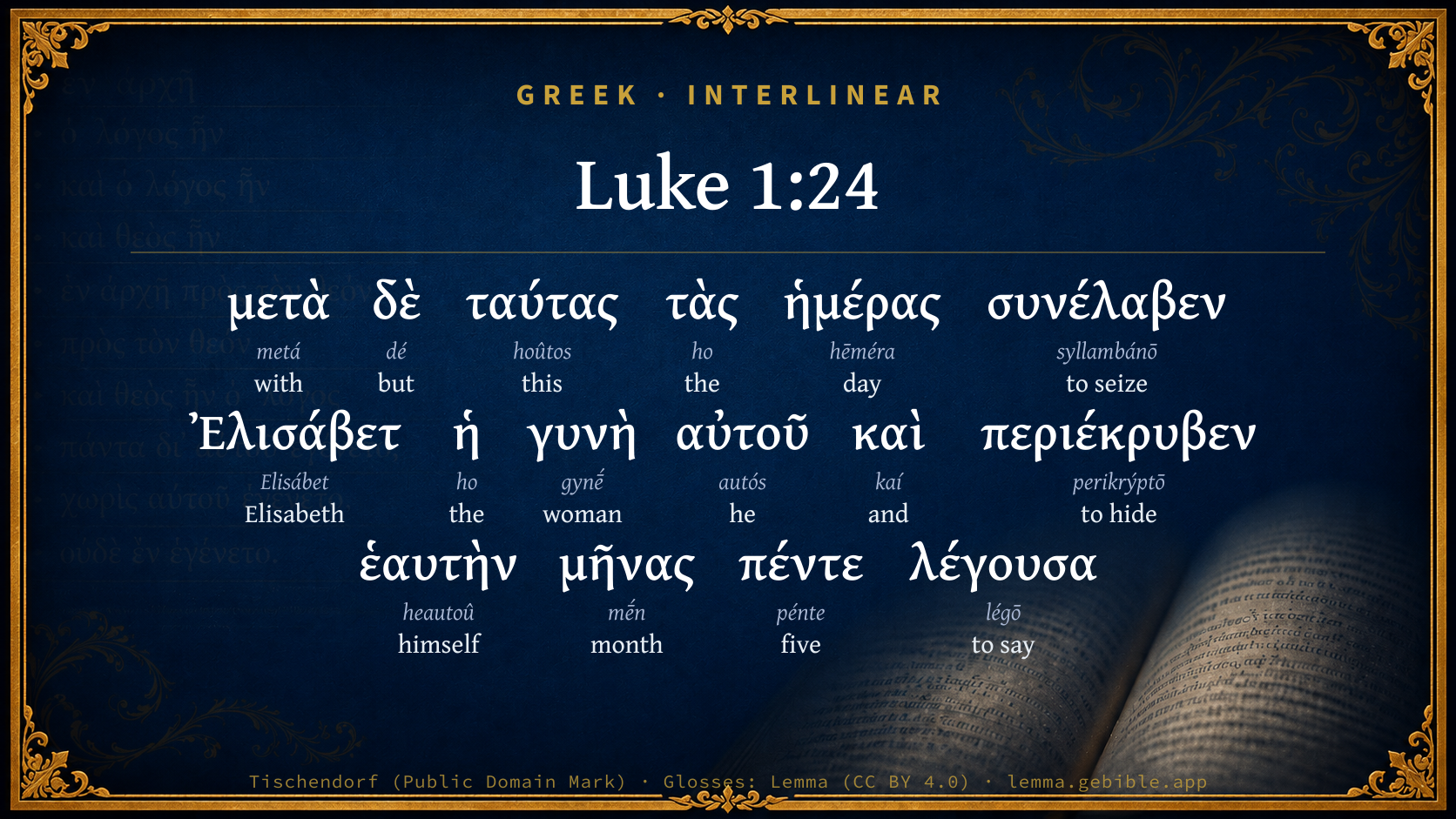
Greek (Tischendorf 8th ed.) Luke 1:24 appears in the Greek New Testament. The text above is from the Tischendorf 8th edition. Each word links to its Strong’s number and a concise gloss. Click any word for its full Thayer’s Greek Lexicon entry.
Download image
Cite this verse

Luke 1:24 (World English Bible). Public Domain. Lemma interlinear Bible study tool, https://lemma.gebible.app/v/luke/1/24.

Show BibTeX & RIS
BibTeX
RIS
English Translation
After these days Elizabeth, his wife, conceived, and she hid herself five months, saying,
World English Bible · Public Domain
Highlights
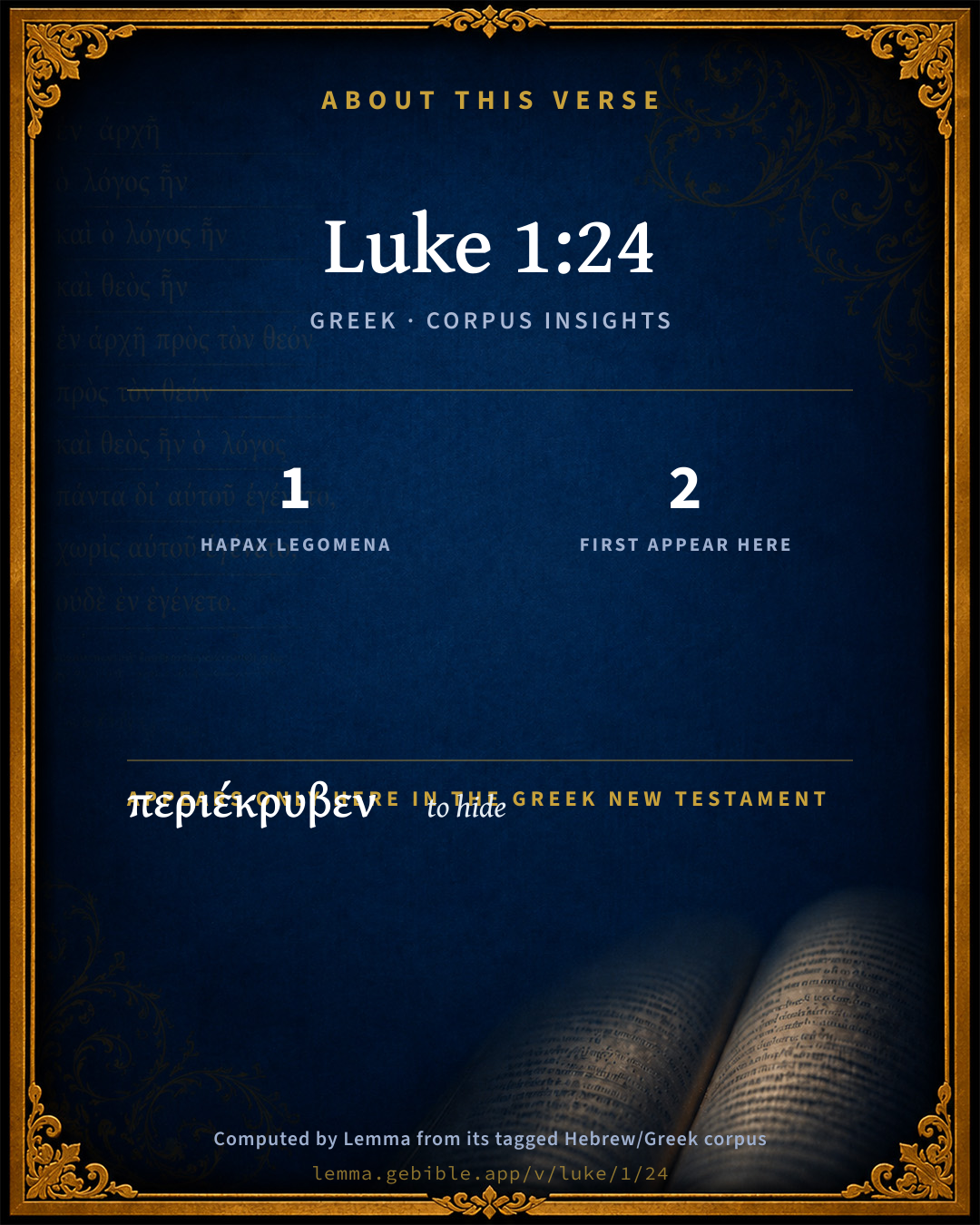
  • 1 hapax legomenon — only here in the Greek New Testament
  • 2 first appearances in the Greek New Testament
Full analysis ↓
Download a study sheet

One document with this verse’s original text, its word-by-word gloss line, the meaning frame, cross-references with their text, attributed commentary, and full source and license credits — printable, and it pastes into notes with its structure intact.

This verse Autodidact and up

Study sheet (.html) Plain text (.txt)

A passage Seminary Student

Up to 50 verses in one chapter. A passage sheet keeps up to 6 commentary sources and 12 cross-references per verse, in the order this page ranks them, and says so on the sheet whenever that leaves anything out. Ask for a single verse and you get the Autodidact verse sheet above.

Everything on this page stays free to read, with no account — the sheet is a download of what is already on screen, not access to it.

Want to remove ads? Support Godless Engineer
Compare translations 3

The same verse in 3 English versions, stacked beneath the original-language interlinear above. Click any original word for its lexicon entry.

Each is an independent rendering of the whole verse — the interlinear is not word-aligned to these translations.

Highlighted words mark where these versions differ — a whole-verse word diff, not a word-by-word alignment.

  • World English Bible Public Domain
    After these days Elizabeth, his wife, conceived, and she hid herself five months, saying,
  • King James Version Public Domain
    And after those days his wife Elisabeth conceived, and hid herself five months, saying,
  • unfoldingWord Literal Text CC BY-SA 4.0
    And after these days, his wife Elizabeth conceived, and for five months she hid herself, saying,

unfoldingWord Literal Text — © unfoldingWord, licensed CC BY-SA 4.0. Word-aligned USFM3 via Door43 (git.door43.org/unfoldingWord/en_ult).

Versions to compare (up to 4)

3 of 4 selected

Show all 19 translations

Every available English version of this verse, each an independent rendering of the whole verse.

  • World English Bible Public Domain
    After these days Elizabeth, his wife, conceived, and she hid herself five months, saying,
  • Berean Standard Bible Public Domain
    After these days, his wife Elizabeth became pregnant and for five months remained in seclusion. She declared,
  • Majority Standard Bible Public Domain
    After these days, his wife Elizabeth became pregnant and for five months remained in seclusion. She declared,
  • King James Version Public Domain
    And after those days his wife Elisabeth conceived, and hid herself five months, saying,
  • American Standard Version (1901) Public Domain
    And after these days Elisabeth his wife conceived; and she hid herself five months, saying,
  • Revised Version (1885) Public Domain
    And after these days Elisabeth his wife conceived; and she hid herself five months, saying,
  • Geneva Bible (1599) Public Domain
    And after those daies, his wife Elisabet conceiued, and hid her selfe fiue moneths, saying,
  • Douay-Rheims (1899) Public Domain
    And after those days, Elizabeth his wife conceived, and hid herself five months, saying:
  • Young's Literal Translation Public Domain
    and after those days, his wife Elisabeth conceived, and hid herself five months, saying --
  • Literal Standard Version CC BY-SA 4.0
    and after those days, his wife Elizabeth conceived, and hid herself five months, saying,
  • Unlocked Literal Bible CC BY-SA 4.0
    After these days, his wife Elizabeth conceived and for five months she kept herself hidden. She said,
  • unfoldingWord Literal Text CC BY-SA 4.0
    And after these days, his wife Elizabeth conceived, and for five months she hid herself, saying,
  • Darby Bible Public Domain
    Now after these days, Elizabeth his wife conceived, and hid herself five months, saying,
  • World Messianic Bible Public Domain
    After these days Elisheva his wife conceived, and she hid herself five months, saying,
  • Webster's Bible Public Domain
    And after those days his wife Elisabeth conceived, and secluded herself five months, saying,
  • Free Bible Version CC BY-SA 4.0
    Some time later his wife Elizabeth became pregnant. She stayed at home for five months.
  • Bible in Basic English Public Domain
    After that time, Elisabeth, being certain that she was to become a mother, kept herself from men's eyes for five months, saying,
  • Text-Critical English NT CC BY 4.0
    After those days his wife Elizabeth conceived and kept herself in seclusion for five months, saying,
  • Tyndale New Testament (1534) Public Domain
    And after thoose dayes his wyfe Elizabeth conceaved and hyd her sylfe.v. monethes sayinge:

Literal Standard Version (2020), Covenant Press — licensed CC BY-SA 4.0. Text via the HelloAO Bible API (eBible.org). Unlocked Literal Bible (unfoldingWord) — licensed CC BY-SA 4.0. Text via the HelloAO Bible API (eBible.org). unfoldingWord Literal Text — © unfoldingWord, licensed CC BY-SA 4.0. Word-aligned USFM3 via Door43 (git.door43.org/unfoldingWord/en_ult). Free Bible Version, Dr. Jonathan Gallagher — licensed CC BY-SA 4.0. Text via the HelloAO Bible API (eBible.org).

Word by word

More ways to search: Search by grammar → Find every occurrence → Compare this word →

Practice this passage: Drill this verse → Learn its vocabulary →

περιέκρυβεν
perikrýptō
G4032
“to hide”
Verb, Imperfect, Active, Indicative, 3rd person, Singular
Part of Speech
Verb
Tense
Imperfect
Voice
Active
Mood
Indicative
Person
3rd person
Number
Singular
Full Thayer's Definition

Origin: from G4012 and G2928

TDNT: None

1. to conceal on all sides or entirely, to hide, seclude
  1. μετὰ metá G3326 “with” Preposition
  2. δὲ dé G1161 “but” Conjunction
  3. ταύτας hoûtos G3778 “this” Demonstrative pronoun, Accusative, Plural, Feminine
  4. τὰς ho G3588 “the” Article, Accusative, Plural, Feminine
  5. ἡμέρας hēméra G2250 “day” Noun, Accusative, Plural, Feminine
  6. συνέλαβεν syllambánō G4815 “to seize” Verb, Aorist, Active, Indicative, 3rd person, Singular
  7. Ἐλισάβετ Elisábet G1665 “Elisabeth” Noun, Proper, indeclinable
  8. ἡ ho G3588 “the” Article, Nominative, Singular, Feminine
  9. γυνὴ gynḗ G1135 “woman” Noun, Nominative, Singular, Feminine
  10. αὐτοῦ autós G846 “he” Personal pronoun, Genitive, Singular, Masculine
  11. καὶ kaí G2532 “and” Conjunction
  12. ἑαυτὴν heautoû G1438 “himself” Reflexive pronoun, 3rd person, Accusative, Singular, Feminine
  13. μῆνας mḗn G3376 “month” Noun, Accusative, Plural, Masculine
  14. πέντε pénte G4002 “five” Adjective, Numeral (indeclinable)
  15. λέγουσα légō G3004 “to say” Verb, Present, Active, Participle, Nominative, Singular, Feminine

About this verse

These counts appear in no published source. They are computed here, from the morphology-tagged text and Lemma’s own curated glosses. What Lemma adds →

16
words
15
distinct lemmas
Gospels
section

Notable vocabulary

1 hapax legomenon — a word that appears only here in the entire Greek New Testament:

  • περιέκρυβεν to hide G4032

First appearance in Scripture

These words make their first canonical appearance in the Greek New Testament here:

  • περιέκρυβεν to hide G4032
  • μῆνας month G3376

Shared distinctive vocabulary

Ἐλισάβετ Elisabeth G1665 occurs in 8 verses of the Greek New Testament. Also found in:

Repetition

A word recurs within this verse:

Commentary

Notes on Luke 1:24 from classic Christian and Jewish commentators (each source and its license shown beneath its notes). The classic Christian expositions comment on the surrounding passage and are grouped to its opening verse, so a note may address several verses; the Jewish commentaries on the Tanakh (Rashi and others) are per-verse, so they appear only where the commentator wrote on this verse.

Lemma curates 59 commentaries, every one of them public domain or Creative Commons licensed, each selected and text-cleaned for this edition rather than reprinted as found. About our sources →

The Biblical Illustrator

Joseph S. Exell

Luk_1:24

And hid herself five months

Modesty a retiring grace

Desirous of plucking one of the elegant sea-anemones, you extend your hand; but, at the slightest touch, its beautiful coronet begins to curl, and incurve in the form of a cup.

If further annoyed, the rim of this cup contracts more and more, until the animated blossom, now transformed into a shrivelled, shapeless mass, and receding all the time from the rude assault, retires under the cover of its rocky fortress, or clings with such tenacity to the stone to which it is attached, that you will sooner tear it to pieces than make it forego its grasp. (Hartwig.)

Modesty

Virgil, who was called the Prince of the Latin Poets, was naturally modest and of a timorous nature when people crowded to gaze upon him, or pointed at him with the finger with raptures: the poet blushed, and stole away from them, and often hid himself in shops to be removed from the curiosity and admiration of the public. The Christian is called indeed to let his light shine before men; but then it must be with all meekness, simplicity, and modesty. (Buck.)

The Biblical Illustrator, edited by Joseph S. Exell (c. 1880s–1900s) — public domain. Text from a community e-Sword module.

Tyndale Open Study Notes

Tyndale Open Resources

1:24 went into seclusion for five months: The reason for this seclusion is unknown and does not seem related to any Old Testament custom or command. Perhaps it was a spiritual retreat to honor God for answered prayer.

Tyndale Open Study Notes — © Tyndale Open Resources, licensed CC BY-SA 4.0. Text via the HelloAO Bible API.

Bengel's Gnomon

Johann Albrecht Bengel

Luk 1:24. Ταύτας, these) the days of which Luk 1:23 makes mention [the days of his ministration].—περίεκρυβεν, She hid herself) that her pregnancy might be unobserved: owing to which, subsequently her pregnancy was suddenly made the more apparent.—λέγουσα, saying) to the partakers of [those who sympathized in] her joy.

Bengel's Gnomon of the New Testament — English translation (T&T Clark, Edinburgh, 1860) — public domain. Text from a community e-Sword module.

Meyer's Critical & Exegetical Commentary

Heinrich August Wilhelm Meyer

Luk_1:24 f. Μετὰ δὲ ταύτ. τ. ἡμέρ.] in which this vision had occurred, and he had returned at the end of the service-week to his house. Between the return and the conception we are not to place an indefinite interval.

περιέκρυβεν ἑαυτήν] she hid herself, withdrew her own person completely (περί, see Valckenaer) from the view of others.

μῆνας πέντε] is of necessity to be understood of the first, not of the last five months of pregnancy (in opposition to Heumann). See Luk_1:26; Luk_1:36; Luk_1:56-57.

λέγουσα· ὅτι κ.τ.λ.] the reason which was uttered by her for this withdrawal; hence ὅτι is not recitative, but to be rendered because, as at Luk_7:16 : because thus hath the Lord done to me in the days, in which He was careful to take away my reproach among men. Her reflection, therefore, was to this effect: seeing that her pregnancy was the work of God, whose care, at the setting in of this state of hers, had been directed towards removing from her the reproach of unfruitfulness, she must leave to God also the announcement of her pregnancy, and not herself bring it about. God would know how to attain His purpose of taking away her reproach. And God knew how to attain this His purpose. After she had kept herself concealed for five months, there occurred in the sixth month, Luk_1:26 ff., the annunciation to Mary, in which the condition of Elizabeth was disclosed to Mary, so that she rose up (Luk_1:39 ff.), etc. Hence the opinions are not in accordance with the text, which represent Elizabeth as having kept herself concealed from shame at being with child in her old age (Origen, Ambrose, Beda, Theophylact, Euthymius Zigabenus), or in order that she might first assure herself of her condition (Paulus), and might in the meantime apply herself to devotion (Kuinoel), or to afford no handle to curiosity (Schegg), or quo magis appareret postea repente graviditas (Bengel), or even because it was necessary to keep herself quiet during the first months of pregnancy (de Wette). No; it was because with resignation and confidence she awaited the emerging of the divine guidance.

αἷς] without repetition of the preposition. See Bernhardy, p. 203; Bornemann, Schol. p. 5; Kühner, ad Xen. Mem. ii. 1. 32.

ἐπεῖδεν] looked to it, i.e. took care for it. So more frequently ἐφοράω is used of the providence of the gods in the classical writers; Herod. i. 124; Soph. El. 170. Comp. Act_4:29

τὸ ὄνειδός μου] Comp. Gen_30:23. Unfruitfulness was a disgrace, as being a token of the divine disfavour (Psa_113:9; Isa_4:1; Isa_44:3; Isa_47:9; Hos_9:11); the possession of many children was an honour and blessing (Psalms 127, 128). Comp. the view of the Greeks, Herod. vi. 86; Müller, Dor. II. p. 192.

ἐν ἀνθρώποις] belongs to ἀφελεῖν; among men she had dishonour.

Meyer — Critical and Exegetical Commentary on the New Testament — English translation by Peter Christie, edited by Frederick Crombie (T&T Clark, 1880) — public domain. Text from a community e-Sword module.

Expositor's Greek Testament

ed. W. Robertson Nicoll

Luk 1:24 . περιέκρυβεν : hid herself entirely ( περὶ ), here only; ἔκρυβον : a late form of 2nd aorist. Why, not said, nor whether her husband told her what had happened to him. μῆνας πέντε : after which another remarkable event happened. Whether she appeared openly thereafter is not indicated. Possibly not (J. Weiss). ἐπεῖδεν : here and in Act 4:29 = took care, the object being ἀφελεῖν τὸ ὄν . μ . = to remove my reproach: keenly felt by a Jewish woman. ἐν is understood before αἷς (Bornemann, Scholia ).

The Expositor's Greek Testament, edited by W. Robertson Nicoll (1897–1910) — public domain. Text from a community e-Sword module.

Vincent's Word Studies in the New Testament

Marvin R. Vincent

Conceived [συνελαβεν] . Mr. Hobart (" Medical Language of Luke ") says that the number of words referring to pregnancy, barrenness, etc., used by Luke, is almost as large as that used by Hippocrates. Compare Luk 1:31; Luk 1:24; Luk 2:5; Luk 1:7; Luk 20:28. All of these, except Luk 1:24, are peculiar to himself, and all, of course, in common use among medical writers. Hid [περιεκρυβεν] . Only here in New Testament. Peri signifies completely; entire seclusion.

Marvin R. Vincent, Word Studies in the New Testament (1887–1900) — public domain. Text from a community e-Sword/MySword module.

Jamieson, Fausset & Brown

Robert Jamieson, A. R. Fausset & David Brown

hid five months--till the event was put beyond doubt and became apparent.

Jamieson, Fausset & Brown — Commentary Critical and Explanatory on the Whole Bible (1871) — public domain (CC PDM 1.0). Text via the HelloAO Bible API.

Adam Clarke's Commentary

Verse 24. Hid herself five months] That she might have the fullest proof of the accomplishment of God's promise before she appeared in public, or spoke of her mercies. When a Hindoo female is pregnant of her first child, she avoids the presence of those with whom she was before familiar, as a point of delicacy.

Adam Clarke's Commentary on the Bible (1810–1826) — public domain. Text from a community e-Sword/MySword module.

The Cambridge Bible for Schools and Colleges

gen. ed. J. J. S. Perowne

24. hid herself] We can only conjecture her motive. It may have been devotional; or precautionary; or she may merely have wished out of deep modesty to avoid as long as possible the idle comments and surmises of her neighbours.

The Cambridge Bible for Schools and Colleges (gen. ed. J. J. S. Perowne; Cambridge University Press, 1878–1918) — public domain. Text from a community e-Sword module.

John Gill's Exposition

And after those days,.... The days of his ministration in the temple, quickly after his return home; the Ethiopic version reads, "after two days":

his wife Elisabeth conceived; according to the angels prediction, and notwithstanding her barrenness, and the unbelief of her husband,

and hid herself five months. The Arabic and Persic versions render it, "hid her size"; but there could be no occasion to take any methods to hide this, since, if she said nothing of it herself, and there could be no suspicion of it in one of her years, it could not be much discerned in her by such a time; but she hid herself, or lived retired, that she might be fully satisfied that she was with child, before she said any thing about it; and that she might not discover any pride or vanity on account of it; and to avoid all discourse with others about it, which might be rumoured abroad; and chiefly to shun all ceremonial uncleanness, which one, that bred a Nazarite, was obliged to; see Jdg 13:14 and most of all, that she might be retired, and spend her time in meditation upon the goodness of God, and in returning thanks to him for the favour she had received; saying; as in the following verse.

John Gill's Exposition of the Whole Bible (1746–1763) — public domain (CC PDM 1.0). Text via the HelloAO Bible API.

Trapp's Complete Commentary

John Trapp

24 And after those days his wife Elisabeth conceived, and hid herself five months, saying,

Ver. 24. And hid herself] Obscurum qua id fecerit ex causa. It is hard to say why she did this, saith a learned interpreter, but likely out of modesty; and that she may make no show till she was sure, as also that the miracle might appear the greater.

John Trapp, A Commentary or Exposition upon All the Books of the Old and New Testament (1647–1656) — public domain. Text from a community e-Sword module.

Albert Barnes' Notes on the Bible

Hid herself - Did not go forth into public, and concealed her condition. This might have been done that she might spend her time more entirely in giving praise to God for his mercies, and that she might have the fullest proof of the accomplishment of the promise before she appeared in public or spoke of the mercies of God.

Albert Barnes' Notes on the Bible (1834–1885) — public domain. Text from a community e-Sword/MySword module.

Matthew Poole's English Annotations

How long after those days the Scripture saith not, but it is probable it was soon after, as in the case of Abraham, and in the case of Manoah’s wife, Jdg 13:3, who conceived presently after the revelation.

And hid herself: not that she hid herself from seeing any person, but she concealed from those whom she saw the hopes that she had of her being with child, and perhaps what her husband had let her know by writing of the revelation he had from the angel: not that she herself doubted the thing, that were unreasonable to presume, after the seeing of her husband made dumb for a sign of it, and the next words will let us know the contrary; but to avoid the discourse of people upon so unusual a thing, who might possibly think her too vain in speaking of a thing so improbable and unlikely as this was. In the mean time she did not conceal herself from God, but said,

Thus hath the Lord dealt with me, ascribing it all to the power of God, who keepeth the key of the womb in his hand, and maketh the fruit of it his reward.

In the days wherein he looked upon me: it is the same with Luk 1:48,

He hath regarded the low estate of his handmaiden. The favour of God to his creatures is oft expressed under this notion, Psa 25:18; Psa 84:9; 119:132.

To take away my reproach among men. Barrenness is no more than a reproach amongst men; it was more especially a reproach to Jewish women, not only in regard of the expectation of being the mother of the Messias, (for none could expect that but a virgin, Isa 7:14, and she of the tribe of Judah, to which the Messiah was promised, and one of the house of David, to whose family he was promised as a branch), but in regard of the special promise to Abraham, to whom a seed was promised, numerous as the dust, and as the stars, to which the barren woman could contribute nothing. It is a great mercy when God favoureth his people with any in evidences which take away their reproach amongst men, and a just cause for his people’s thankful acknowledgment.

Matthew Poole's English Annotations on the Holy Bible (1683–1685) — public domain. Text from a community e-Sword/MySword module.

The Pulpit Commentary

And after those days his wife Elisabeth conceived, and hid herself five months. Various reasons have been suggested for this retirement. It seems most probable that, amazed at the angelic announcement, the saintly woman went into perfect retirement and isolation for a considerable period, to prove well the words of the angel, and to consider how she best could do her part in the training of the expected child, who was to play so mighty a part in the history of her people.

The Pulpit Commentary (1880–1919), ed. H.D.M. Spence-Jones & Joseph S. Exell — public domain. Text from a community e-Sword module.

John Wesley's Explanatory Notes

Hid herself - She retired from company, that she might have the more leisure to rejoice and bless God for his wonderful mercy.

John Wesley, Explanatory Notes Upon the Whole Bible (1754–1765) — public domain. Text via the GEBible commentary corpus.

Kretzmann's Popular Commentary

Paul E. Kretzmann

The beginning of the fulfillment:

v. 24 And after those days his wife Elisabeth conceived, and hid herself five months, saying,

v. 25. Thus hath the Lord dealt with me in the days wherein He looked on me, to take away my reproach among men.

In His season God remembered Elisabeth and her husband. The aged wife had evidence that her prayers at last seemed about to be heard. The result of this knowledge was that she hid herself entirely, she took no part in any social intercourse. God had taken care to remove her reproach from her. Since fruitfulness was one of the promises of God to His people, Gen 17:6, and since children, on this account, were considered as a. particular blessing from heaven, Exo 23:26; Lev 26:9; Psa 127:3, barrenness was among the Jews considered a reproach, a token of the disapprobation of the Lord, 1Sa 1:6. This stigma was now about to be removed. Though the fact was not yet known, even to her intimate friends and relatives, she was aware of it, and she wanted to escape the pitying glances to which she had never become accustomed, until such a time as her hope would be beyond doubt, when no more reproach could strike her.

Paul E. Kretzmann, Popular Commentary of the Bible (1921–1924) — public domain. Text from a community e-Sword module.

The People's New Testament

B. W. Johnson

24. Hid herself. Did not go into society, both from delicacy and that she might have more time for devotion.

B. W. Johnson's The People's New Testament with Notes (1889–1891) — public domain. Electronic text from the Christian Classics Ethereal Library (CCEL) ThML edition.

unfoldingWord translationNotes

Door43 World Missions Community

After these days

The phrase "these days" refers to the time Zechariah was serving in the temple. It is possible to state more clearly what this refers to. AT: "After Zechariah's time of serving at the temple" (See: Introduction of a New Event and Assumed Knowledge and Implicit Information)

his wife

"Zechariah's wife"

kept herself hidden

"did not leave her house" or "stayed inside by herself"

This is what the Lord has done for me

This phrase refers to the fact that the Lord allowed her to become pregnant.

This is what

This is a positive exclamation. She is very happy with what the Lord has done for her.

looked at me with favor

"to look at" here is an idiom that means "to treat" or "to deal with." AT: "regarded me kindly" or "had pity on me" (See: Idiom)

my shame

This refers to the shame she felt when she was not able to have children.

translationWords

day

Elizabeth

conceive

lord

shame

unfoldingWord translationNotes — © Distant Shores Media and the Door43 World Missions Community, licensed CC BY-SA 4.0. Source: git.door43.org/Door43/en_tn.

Cambridge Greek Testament for Schools and Colleges

24. περιέκρυβεν ἑαυτήν. ἔκρυβον is a late form of the 2nd aor. of κρύπτω (as though from κρύβω) found also in Plutarch, &c. The compound verb implies the complete seclusion. The periphrastic form used for the middle marks the decaying stage of a synthetic language. We can only conjecture Elizabeth’s motive. It may have been devotional; or precautionary; or she may merely have wished out of deep modesty to avoid as long as possible the idle comments and surmises of her neighbours. In any case there is in the incident an exquisite verisimilitude.

Cambridge Greek Testament for Schools and Colleges (Cambridge University Press, 1896; 21 vols, various authors incl. Carr, Maclear, Plummer, Farrar, Lumby, Moule, M. R. James, Simcox) — public domain. Text from a community e-Sword module.

International Critical Commentary

24. συνέλαβεν. The word occurs eleven times in Lk. against five times elsewhere. He alone uses it in the sense of conceiving offspring, and only in these first two chapters (vv. 31, 36, 2:21). This sense is common in medical writers and in Aristotle. Hobart remarks that the number of words referring to pregnancy and barrenness used by Lk. is almost as great as that used by Hippocrates: ἐν γαστρὶ ἔχειν (21:23), ἔγκυος (2:5) στεῖρα (1:7) ἄτεκνος (20:28). And, excepting ἐν γαστρὶ ἔχειν, all of these are peculiar to himself in N.T. (Med. Lang. of Lk. p. 91).

περιέκρυβεν ἑαυτὴν μῆνας πέντε. The reflexive pronoun brings out more forcibly than the middle voice would have done that the act was entirely her own (Act 23:14; 1Co 11:31; 1Jn 1:8); and the compound verb implies all round, complete concealment. Her motive can only be conjectured; but the enigmatical conduct and remark are evidence of historic truth, for they would not be likely to be invented. The five months are the first five months; and at the end of them it would be evident that she had ceased to be ἡ στεῖρα (ver. 36). During these five months she did not wish to risk hearing a reproach, which had ceased to be true, but which she would not care to dispute. She withdrew, therefore, until all must know that the reproach had been removed.

The form ἔκρυβον is late: in class. Grk. ἔκρυψα is used. But a present κρύβω is found, of which this might be the imperfect.

It can hardly be accidental that μήν is scarcely ever used in N.T. in a literal sense by any writer except Lk., who has it five times in his Gospel and five times in the Acts. The chronological details involved in this frequent use are the results of the careful investigation of which he writes in the preface. The other passages are Gal 4:10; Jas 5:17, and six times in Revelation. So also ἔτος occurs fifteen times in Lk. and six in Mt. Mk. and Jn.

International Critical Commentary — older volumes (1896–1929), various authors — public domain. Text from a community e-Sword module.

Lesson kit

Teaching starters — assembled from the data on this page, not authored interpretation. Every prompt links to the verse data it draws on. Edit before teaching.

Luke, in the Gospels, opens this verse with 16 words (15 distinct Greek lemmas). Its most distinctive word is perikrýptō (“to hide”). A historical commentator’s framing appears above. Read the whole chapter for the surrounding context.

Discussion questions

  1. What does “to hide” (perikrýptō) contribute to the verse as a whole?
  2. This verse holds 1 word here found nowhere else in the Greek New Testament. What might the rare word draw attention to?
  3. 2 words here appear for the first time in Scripture. What is being introduced at this debut?
  4. Luke 1:5 shares the word «Elisabeth» with this verse. How do the two illuminate each other?
  5. “the” occurs 2× in this one verse. What is the effect of the repetition?
  6. These translations render this verse differently; the difference is in the English rendering, not the original. What questions does that raise?
  7. Reading how The Biblical Illustrator and Tyndale Open Study Notes read this verse, where do the two commentators agree and where do they part?

Things to notice

  • 1 word in this verse appears nowhere else in the Greek New Testament.
  • 2 words make their first canonical appearance in Scripture here.
  • These translations choose different wording for 2 words in this verse.
  • “the” occurs 2× in this single verse.
  • 15 distinct Greek lemmas span 16 words in this verse.

Reading settings

Reading text

Shown beneath each verse's original-language words.

Old Testament
Old Testament edition

Read the OT as the Masoretic Hebrew (MT) or the Greek Septuagint (LXX).

English shown for the Greek Septuagint (in the Hebrew ↔ Greek comparison).

Comparing translations? Open the Compare panel on any verse page to stack up to four side by side.