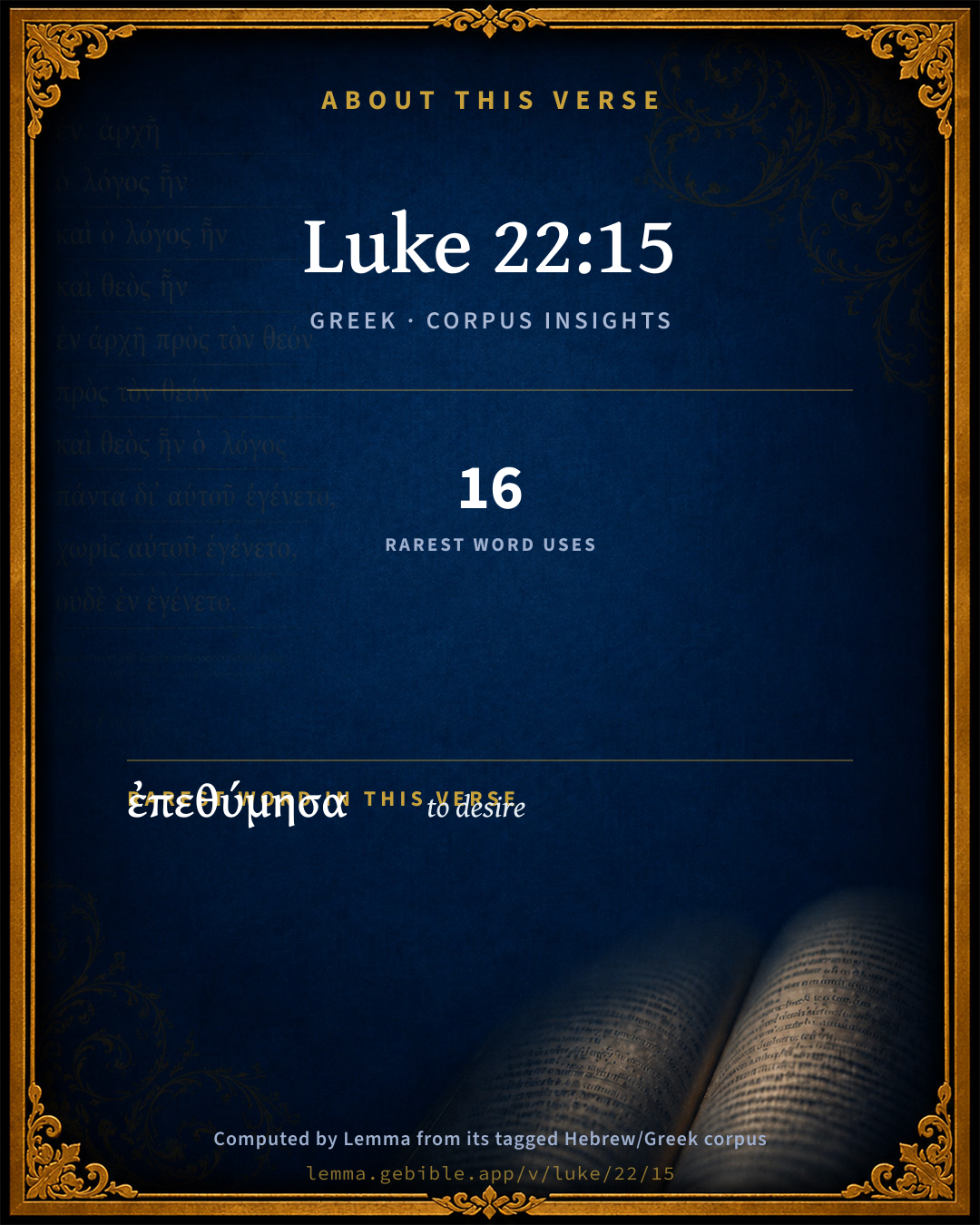
Luke 22:15

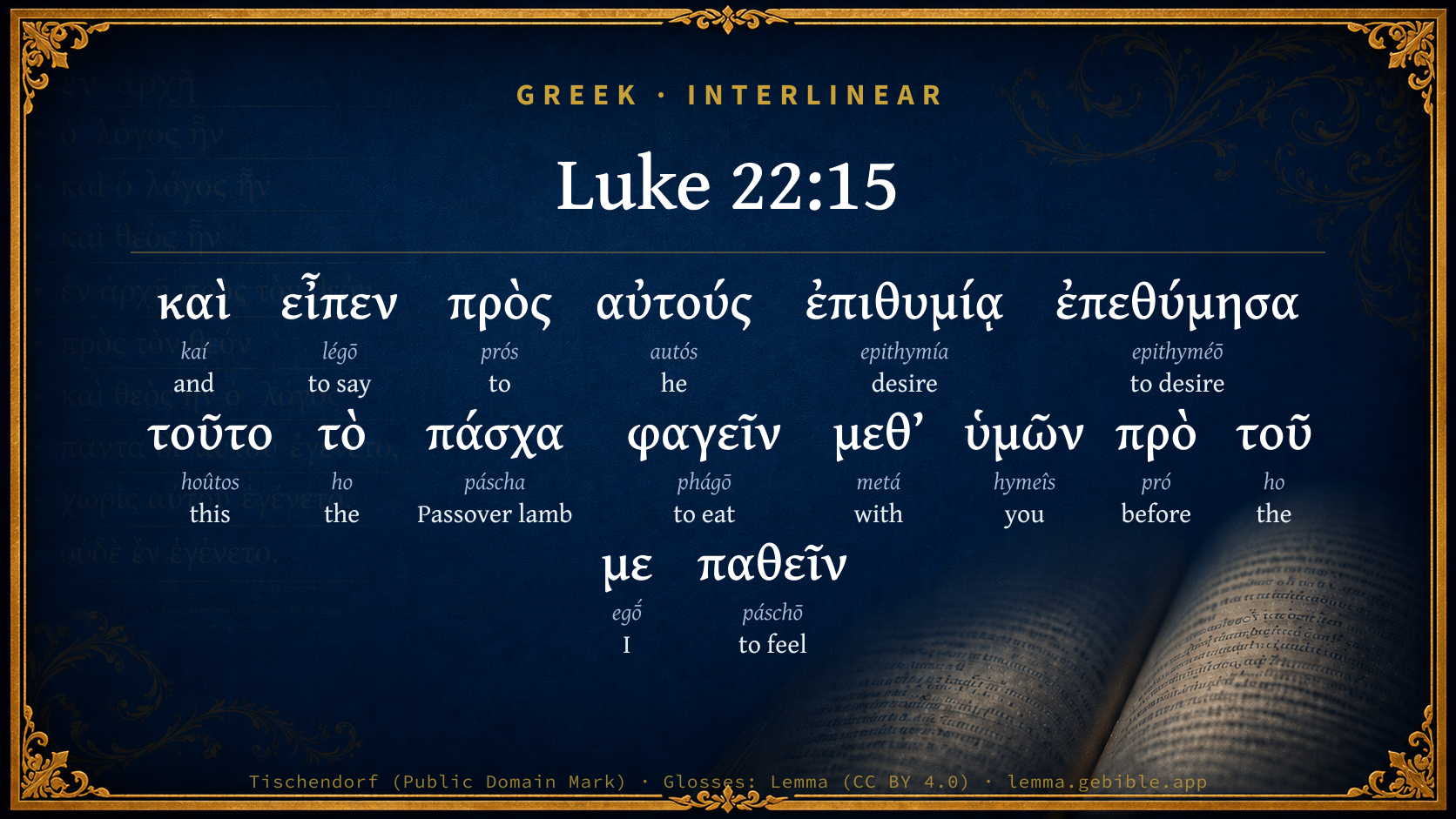
Greek (Tischendorf 8th ed.) Luke 22:15 appears in the Greek New Testament. The text above is from the Tischendorf 8th edition. Each word links to its Strong’s number and a concise gloss. Click any word for its full Thayer’s Greek Lexicon entry.
Download image
Cite this verse

Luke 22:15 (World English Bible). Public Domain. Lemma interlinear Bible study tool, https://lemma.gebible.app/v/luke/22/15.

Show BibTeX & RIS
BibTeX
RIS
English Translation
He said to them, "I have earnestly desired to eat this Passover with you before I suffer,
World English Bible · Public Domain
Download a study sheet

One document with this verse’s original text, its word-by-word gloss line, the meaning frame, cross-references with their text, attributed commentary, and full source and license credits — printable, and it pastes into notes with its structure intact.

This verse Autodidact and up

Study sheet (.html) Plain text (.txt)

A passage Seminary Student

Up to 50 verses in one chapter. A passage sheet keeps up to 6 commentary sources and 12 cross-references per verse, in the order this page ranks them, and says so on the sheet whenever that leaves anything out. Ask for a single verse and you get the Autodidact verse sheet above.

Everything on this page stays free to read, with no account — the sheet is a download of what is already on screen, not access to it.

Want to remove ads? Support Godless Engineer
Compare translations 3

The same verse in 3 English versions, stacked beneath the original-language interlinear above. Click any original word for its lexicon entry.

Each is an independent rendering of the whole verse — the interlinear is not word-aligned to these translations.

Highlighted words mark where these versions differ — a whole-verse word diff, not a word-by-word alignment.

  • World English Bible Public Domain
    He said to them, "I have earnestly desired to eat this Passover with you before I suffer,
  • King James Version Public Domain
    And he said unto them, With desire I have desired to eat this passover with you before I suffer:
  • unfoldingWord Literal Text CC BY-SA 4.0
    And he said to them, “With desire I have desired to eat this Passover with you before I suffer.

unfoldingWord Literal Text — © unfoldingWord, licensed CC BY-SA 4.0. Word-aligned USFM3 via Door43 (git.door43.org/unfoldingWord/en_ult).

Versions to compare (up to 4)

3 of 4 selected

Show all 19 translations

Every available English version of this verse, each an independent rendering of the whole verse.

  • World English Bible Public Domain
    He said to them, "I have earnestly desired to eat this Passover with you before I suffer,
  • Berean Standard Bible Public Domain
    And He said to them, “I have eagerly desired to eat this Passover with you before My suffering.
  • Majority Standard Bible Public Domain
    And He said to them, “I have eagerly desired to eat this Passover with you before My suffering.
  • King James Version Public Domain
    And he said unto them, With desire I have desired to eat this passover with you before I suffer:
  • American Standard Version (1901) Public Domain
    And he said unto them, With desire I have desired to eat this passover with you before I suffer:
  • Revised Version (1885) Public Domain
    And he said unto them, With desire I have desired to eat this passover with you before I suffer:
  • Geneva Bible (1599) Public Domain
    Then he saide vnto them, I haue earnestly desired to eate this Passeouer with you, before I suffer.
  • Douay-Rheims (1899) Public Domain
    And he said to them: With desire I have desired to eat this pasch with you, before I suffer.
  • Young's Literal Translation Public Domain
    and he said unto them, `With desire I did desire to eat this passover with you before my suffering,
  • Literal Standard Version CC BY-SA 4.0
    and He said to them, “With desire I desired to eat this Passover with you before My suffering,
  • Unlocked Literal Bible CC BY-SA 4.0
    Then he said to them, “I have greatly desired to eat this Passover with you before I suffer.
  • unfoldingWord Literal Text CC BY-SA 4.0
    And he said to them, “With desire I have desired to eat this Passover with you before I suffer.
  • Darby Bible Public Domain
    And he said to them, With desire I have desired to eat this passover with you before I suffer.
  • World Messianic Bible Public Domain
    He said to them, “I have earnestly desired to eat this Passover with you before I suffer,
  • Webster's Bible Public Domain
    And he said to them, I have earnestly desired to eat this passover with you before I suffer.
  • Free Bible Version CC BY-SA 4.0
    “I've been really looking forward to eating this Passover meal with you before my sufferings begin.
  • Bible in Basic English Public Domain
    And he said, I have had a great desire to keep this Passover with you before I come to my death;
  • Text-Critical English NT CC BY 4.0
    He said to them, “I have earnestly desired to eat this Passover with you before I suffer.
  • Tyndale New Testament (1534) Public Domain
    And he sayde vnto them: I have inwardly desyred to eate this ester lambe with you before that I suffre.

Literal Standard Version (2020), Covenant Press — licensed CC BY-SA 4.0. Text via the HelloAO Bible API (eBible.org). Unlocked Literal Bible (unfoldingWord) — licensed CC BY-SA 4.0. Text via the HelloAO Bible API (eBible.org). unfoldingWord Literal Text — © unfoldingWord, licensed CC BY-SA 4.0. Word-aligned USFM3 via Door43 (git.door43.org/unfoldingWord/en_ult). Free Bible Version, Dr. Jonathan Gallagher — licensed CC BY-SA 4.0. Text via the HelloAO Bible API (eBible.org).

Word by word

More ways to search: Search by grammar → Find every occurrence → Compare this word →

Practice this passage: Drill this verse → Learn its vocabulary →

ἐπεθύμησα
epithyméō
G1937
“to desire”
Verb, Aorist, Active, Indicative, 1st person, Singular
Part of Speech
Verb
Tense
Aorist
Voice
Active
Mood
Indicative
Person
1st person
Number
Singular
Full Thayer's Definition

Origin: from G1909 and G2372

TDNT: 05:48,3

1. to turn upon a thing 2. to have a desire for, long for, to desire 3. to lust after, covet a. of those who seek things forbidden
  1. καὶ kaí G2532 “and” Conjunction
  2. εἶπεν légō G3004 “to say” Verb, Aorist, Active, Indicative, 3rd person, Singular
  3. πρὸς prós G4314 “to” Preposition
  4. αὐτούς autós G846 “he” Personal pronoun, Accusative, Plural, Masculine
  5. ἐπιθυμίᾳ epithymía G1939 “desire” Noun, Dative, Singular, Feminine
  6. τοῦτο hoûtos G3778 “this” Demonstrative pronoun, Accusative, Singular, Neuter
  7. τὸ ho G3588 “the” Article, Accusative, Singular, Neuter
  8. πάσχα páscha G3957 “Passover lamb” Aramaic transliteration
  9. φαγεῖν phágō G5315 “to eat” Verb, Aorist, Active, Infinitive
  10. μεθ’ metá G3326 “with” Preposition
  11. ὑμῶν hymeîs G5210 “you” Personal pronoun, 2nd person, Genitive, Plural
  12. πρὸ pró G4253 “before” Preposition
  13. τοῦ ho G3588 “the” Article, Genitive, Singular, Neuter
  14. με egṓ G1473 “I” Personal pronoun, 1st person, Accusative, Singular
  15. παθεῖν páschō G3958 “to feel” Verb, Aorist, Active, Infinitive

About this verse

These counts appear in no published source. They are computed here, from the morphology-tagged text and Lemma’s own curated glosses. What Lemma adds →

16
words
15
distinct lemmas
Gospels
section

Notable vocabulary

The rarest word here is ἐπεθύμησα to desire G1937 — appearing just 16 times in the whole Greek New Testament.

Shared distinctive vocabulary

ἐπεθύμησα to desire G1937 occurs in 16 verses of the Greek New Testament. Also found in:

Repetition

A word recurs within this verse:

Cross-references

4

Topical passages linked to Luke 22:15 in the Treasury of Scripture Knowledge — connected by theme and wording, ordered by reader-vote popularity; previews shown in the World English Bible.

  • Luke 12:50 But I have a baptism to be baptized with, and how distressed I am until it is accomplished!
  • John 4:34 Jesus said to them, "My food is to do the will of him who sent me, and to accomplish his work.
  • John 13:1 Now before the feast of the Passover, Jesus knowing that his time had come that he would depart from this world to the Father, having loved his own who were in the world, he loved them to the end.
  • John 17:1 Jesus said these things, and lifting up his eyes to heaven, he said, "Father, the time has come. Glorify your Son, that your Son may also glorify you;

Cross-references courtesy of OpenBible.info (CC BY 4.0).

Commentary

Notes on Luke 22:15 from classic Christian and Jewish commentators (each source and its license shown beneath its notes). The classic Christian expositions comment on the surrounding passage and are grouped to its opening verse, so a note may address several verses; the Jewish commentaries on the Tanakh (Rashi and others) are per-verse, so they appear only where the commentator wrote on this verse.

Lemma curates 59 commentaries, every one of them public domain or Creative Commons licensed, each selected and text-cleaned for this edition rather than reprinted as found. About our sources →

Tyndale Open Study Notes

Tyndale Open Resources

22:15 Jesus ate the Passover meal with his disciples and followed the ritual order of the Passover celebration (see study note on Matt 26:26-29).

Tyndale Open Study Notes — © Tyndale Open Resources, licensed CC BY-SA 4.0. Text via the HelloAO Bible API.

Bengel's Gnomon

Johann Albrecht Bengel

Luk 22:15. Καὶ, and) There is described in the verses 15–18, a kind of prelude, as it were, to the Holy Supper. Comp. Mat 26:29.—ἐπεθύμησα, I have desired) He had desired for the sake of the disciples, to whom He wished now at last to manifest Himself more openly in His very act of bidding them farewell; He had desired it for His own sake also, because He was about forthwith after it to enter into His glory.—τοῦτο) this, which is a Passover peculiarly memorable.—πρὸ, before) By this word, explanation is given of the τοῦτο, this. [His enemies were hardly leaving Him this much time (viz. sufficient to celebrate the Passover): but yet they were forced to delay the accomplishment of their purpose, even until both the Passover banquet and several remaining incidents had passed by.—V. g.]

Bengel's Gnomon of the New Testament — English translation (T&T Clark, Edinburgh, 1860) — public domain. Text from a community e-Sword module.

Expositor's Greek Testament

ed. W. Robertson Nicoll

Luk 22:15 . πρὸ τοῦ με παθεῖν : the last passover He will eat with them is looked forward to with solemn, tender feeling.

The Expositor's Greek Testament, edited by W. Robertson Nicoll (1897–1910) — public domain. Text from a community e-Sword module.

Geneva Bible (1599)

Geneva Bible translators

I am put to death.

Geneva Bible (1599) marginal notes — public domain. Text via Bolls.life.

Jamieson, Fausset & Brown

Robert Jamieson, A. R. Fausset & David Brown

With desire . . . desired--"earnestly have I longed" (as Gen 31:30, "sore longedst"). Why? It was to be His last "before He suffered"--and so became "Christ our Passover sacrificed for us" (Co1 5:7), when it was "fulfilled in the Kingdom of God," the typical ordinance thenceforth disappearing.

Jamieson, Fausset & Brown — Commentary Critical and Explanatory on the Whole Bible (1871) — public domain (CC PDM 1.0). Text via the HelloAO Bible API.

Adam Clarke's Commentary

Verse 15. With desire I have desired] A Hebraism for, I have desired most earnestly. Our Lord's meaning seems to be, that, having purposed to redeem a lost world by his blood, he ardently longed for the time in which he was to offer himself up. Such love did the holy Jesus bear to the human race. This eucharistic passover was celebrated once, by way of anticipation, before the bloody sacrifice of the victim of salvation, and before the deliverance it was appointed to commemorate; as the figurative passover had been likewise once celebrated before the going out of Egypt, and the deliverance of God's chosen people. Quesnel.

Adam Clarke's Commentary on the Bible (1810–1826) — public domain. Text from a community e-Sword/MySword module.

Ellicott's Commentary for English Readers

(15) With desire I have desired.—The peculiar mode of expressing intensity by the use of a cognate noun with the verb of action, though found sometimes in other languages, is an idiom characteristically Hebrew (comp. “thou shalt surely die” for “dying thou shalt die,” in Gen_2:17), and its use here suggests the thought that St. Luke heard what he reports from some one who repeated the very words which our Lord had spoken in Aramaic. The whole passage is peculiar to him, and implies that he had sought to fill up the gaps in the current oral teaching which is reproduced in St. Matthew and St. Mark. It was natural that in so doing he might feel some uncertainty as to the precise position of these supplementary incidents, and hence the difficulties, of no great importance, which present themselves on a comparison of the three narratives. The words now before us bear obviously the impression of having been spoken at the beginning of the Feast. The Master yearned, if we may so speak, for a last Passover with His “friends,” as we yearn for a last Communion with ours; all the more so, we may believe, because it was in His purpose to perfect the former by transfiguring it into the latter. The words have been thought to confirm the view that our Lord was anticipating by twenty-four hours the strictly legal time of the Passover. It must be admitted, however, that they-do not in themselves suggest that thought. All that can be said is that they fall in with it, if proved on independent evidence.

A Bible Commentary for English Readers, edited by Charles John Ellicott (1878–1897) — public domain. Text from a community e-Sword module.

The Cambridge Bible for Schools and Colleges

gen. ed. J. J. S. Perowne

15. With desire I have desired] i.e. I earnestly desired. A Hebraism. Mat_13:14, &c.

to eat this passover] The expression may perhaps point to the fact that this was not the actual Jewish Paschal meal, but one which was intended to supersede it by a Passover of far more divine significance.

The Cambridge Bible for Schools and Colleges (gen. ed. J. J. S. Perowne; Cambridge University Press, 1878–1918) — public domain. Text from a community e-Sword module.

John Gill's Exposition

For I say unto you, I will not any more eat thereof,.... Of the passover, and which now, with the rest of the ceremonial law, was to be abolished:

until it be fulfilled in the kingdom of God; signifying, not that he should eat of it in the kingdom of God, where it would be fulfilled; seeing the passover was never more to take place, neither in the Gospel dispensation, nor in the heavenly glory; both which may be meant by the kingdom of God; but that he should never eat more of it in this ceremonial way, since it would have its accomplishment in each of those states: and it has been already fulfilled under the Gospel dispensation, which is often meant by the kingdom of God; in himself, who is the passover sacrificed for us, Co1 5:7 for the passover lamb was a type of Christ, and he is the sum and substance of that shadow, and the fulfilling end of that type; it had its accomplishment in him; of which See Gill on Co1 5:7 and it will also be fulfilled in the kingdom of heaven, or eternal glory, when there will be a perfect deliverance of the saints from sin, Satan, and the world; which the deliverance of the Israelites out of Egypt was typical of, commemorated in the passover; and therefore then will be sung the song of Moses, and the Lamb; and then will Christ, and his true followers, eat and drink together in his Father's kingdom, and spend an endless eternity in never fading joys and pleasures.

John Gill's Exposition of the Whole Bible (1746–1763) — public domain (CC PDM 1.0). Text via the HelloAO Bible API.

Trapp's Complete Commentary

John Trapp

11 And ye shall say unto the goodman of the house, The Master saith unto thee, Where is the guestchamber, where I shall eat the passover with my disciples?

12 And he shall shew you a large upper room furnished: there make ready.

13 And they went, and found as he had said unto them: and they made ready the passover.

14 And when the hour was come, he sat down, and the twelve apostles with him.

15 And he said unto them, With desire I have desired to eat this passover with you before I suffer:

Ver. 15. With desire have I desired] How much more should we come with strong affections and lusty appetites to this holy supper! It is a virtue here to be a holy glutton, and to drink hearty draughts; that we may go from the table, as Christ from Jordan, full of the Holy Ghost. For this end consider what is before thee, as Pro 23:1, not to restrain appetite, but to provoke it. And the rather because Christ thus earnestly thirsted after our salvation, though he knew it should cost him so dear. See Luk 12:50.

John Trapp, A Commentary or Exposition upon All the Books of the Old and New Testament (1647–1656) — public domain. Text from a community e-Sword module.

Albert Barnes' Notes on the Bible

With desire I have desired - This is a Hebrew form of expression, and means “I have greatly desired.” The reasons why he desired this we may suppose to have been:

That, as he was about to leave them, he was desirous once of seeing them together, and of partaking with them of one of the religious privileges of the Jewish dispensation. Jesus was “man” as well as God, and he never undervalued the religious rites of his country, or the blessings of social and religious contact; and there is no impropriety in supposing that even he might feel that his human nature might be prepared by the service of religion for his great and terrible sufferings. He doubtless wished to take an opportunity to prepare “them” for his sufferings, and to impress upon them more fully the certainty that he was about to leave them, that they might be prepared for it. We may also suppose that he particularly desired it that he might institute for “their” use, and for the edification of all Christians, the supper which is called by his name - “the Lord’s Supper.” All his sufferings were the expression of love to his people, and he was desirous of testifying “always” his regard for their comfort and welfare.

Before I suffer - Before I die.

Albert Barnes' Notes on the Bible (1834–1885) — public domain. Text from a community e-Sword/MySword module.

Haydock's Catholic Bible Commentary

With desire I have desired: literally, with a desire have I desired.[1] The repetition expresseth a great and earnest desire. (Witham)

===============================

[BIBLIOGRAPHY]

With a desire have I desired. This is commonly reputed a Hebraism, or form of speech peculiar to the Hebrews: hearing, I have heard; seeing, I have seen, &c. But the judicious critic, Mr. Blackwall, has produced parallel expressions out the most exact Greek classics, in his learned book, entitled, The Sacred Classics defended and illustrated; and has clearly proved, by examples, that many forms of speech, called, reputed, and carped at, as Hebraisms, are frequently found in the best Greek classics. (Witham)

George Leo Haydock (1774–1849), Haydock's Catholic Family Bible and Commentary, 1859 edition — public domain. Excludes Psalms (Douay-Rheims chapter numbering differs from Protestant) and Deuterocanonical books (Catholic canon only).

Matthew Poole's English Annotations

See Poole on "Mat 26:20", and following verses to Mat 26:30, where is opened whatsoever Luke hath that is not in the other evangelists.

Matthew Poole's English Annotations on the Holy Bible (1683–1685) — public domain. Text from a community e-Sword/MySword module.

Whedon's Commentary on the Bible

Daniel D. Whedon

15. With desire I have desired—The Hebrew mode of saying I have had a most intense desire. The deep emotion of the Saviour at coming to the hour of his last converse with his chosen ones, fills his language with an exquisite pathos. And these last hours were to be devoted to instituting the symbols of his own death. He was to die, be emblematically slain before them, and to appoint the ever-continued repetition of that symbolical death in his Church through future ages. No wonder that he had looked forward to that supper with earnest emotion, and had well provided that it should be an hour upon whose sacred privacy no enemy but one should intrude.

The present passage (15-18) narrates that part of the supper which belonged to the Passover. That which belonged to the institution of the Lord’s Supper is Luk_22:19-20. See notes on Mat_26:26, with introductory note preceding.

Daniel D. Whedon (gen. ed.), Commentary on the Old and New Testaments (1874–1909) — public domain. Text from a community e-Sword module.

The Pulpit Commentary

And he said unto them, With desire I have desired to eat this Passover with you before I suffer. This peculiar expression, "with desire," etc., is evidently a reproduction by St. Luke of the Lord"s very words repeated to him originally in Aramaic (Hebrew), They seem to be a touching apology or explanation from him to his own, for thus anticipating the regular Passover Supper by twenty-four hours. He had been longing with an intense longing to keep this last Passover with them: First as the dear human Friend who would make this his solemn last farewell. (Do not we, when we feel the end is coming, long for a last communion with our dearest ones?) And, secondly, as the Divine Master who would gather up into a final discourse his most important, deepest teaching. We find this teaching especially reported by St. John in his Gospel (13-17). And thirdly, as the Founder of a great religion, he purposed, on this momentous occasion, transforming the most solemn festal gathering of the ancient Jewish people, which commemorated their greatest deliverance, into a feast which should as age succeeded age commemorate a far greater deliverance, not of the old chosen race only, but of every race under heaven. These were three of the reasons why he had desired so earnestly to eat this Passover with them. "To-morrow, at the usual hour, when the people cat their Passover, it will be too late for us." This he expresses in his own sad words, before I suffer.

Vers. 15, 16. The Passion, from two standpoints.

I As IT LOOKED TO OUR LORD WHEN HE WAS APPROACHING IT. It was to him a terrible trial, which he was eager to reach and pass through. "With desire he desired" the time to arrive when he should suffer and should complete his work. He did not wish to escape it; he was not looking about for an alternative; he knew that he could not save himself if he would save the world; and he longed for the trial-time to come and to be passed. Here was the heroic, and here was also the human. Here was the determination to endure, and, at the same time, the natural, human anxiety to know the worst and to exchange an almost intolerable suspense for the suffering that awaited him.

1. Having chosen the path of self-sacrifice, and having entered upon and pursued it, it behoved him to continue and to complete his appointed work. He could not turn back without suffering defeat; he accepted the dark future that was before him as a sacred duty. From it there must be no turning aside to other ends; and there was none. He never wavered in his purpose from beginning to end. "This shall not be unto thee," from Peter, appears to have been. a strong shock of temptation to him. (Mat_16:21-23) But nothing induced him to turn aside by a single step from the path of sacrificial service.

2. Yet we have here a glimpse of the extreme severity of the trial he underwent. He knew that his "suffering" would immediately follow this Passover, and he "earnestly desired" that Passover to come, that the sufferings might follow. With perfect reverence we may say that he could not realize what they would include, for they had never before been experienced; they stood absolutely by themselves, and could not be known until they were actually felt. And this element of suspense and uncertainty must have added a great weight of trouble to the sorrows of our Lord. "How bitter that cup no heart can conceive;" not even his heart did conceive until it was in his hands.

(1) Like our Lord, we should go on without faltering to the darkest future which we feel it becomes us to face.

(2) As with him, the uncertainty of the actual elements of our grief may oppress our spirit and fill us with eager desire for its coming. (see also Luk_12:50)

(3) We shall find, as he found, all needful Divine help when the hour does actually arrive.

II AS HE WOULD HAVE US REGARD IT NOW. That is, as a completed work of redeeming love. That last Passover has been "fulfilled in the kingdom of God." All that the Passover prophesied has been fulfilled. The "Lamb of God" has been slain that Lamb "which taketh away the sin of the world." Everything in the way of sacred endurance, of Divine preparation, is now completed, and the way into the kingdom is open. Those sufferings to which Jesus was so eagerly looking forward, to which he had now come, with nothing between them and him but that Passover Feast, had to he endured; (see Luk_24:26) and now they have been endured. Everything predicted in sacred rite or solemn utterance has been fulfilled," and we wait for nothing more. We sit down to no predictive Passover Feast, because Christ, our Passover, is slain for us." What we have to do is gratefully and eagerly to avail ourselves of the "finished" work of our redeeming Lord; to let that suffering, that death, that sacrifice,

(1) evoke our humility;

(2) call forth our faith;

(3) kindle our love and command our obedience;

(4) inspire us with sacred and abiding joy, inasmuch as his "sorrow unto death" is the source of our eternal life. C.

The Pulpit Commentary (1880–1919), ed. H.D.M. Spence-Jones & Joseph S. Exell — public domain. Text from a community e-Sword module.

John Wesley's Explanatory Notes

With desire have I desired - That is, I have earnestly desired it. He desired it, both for the sake of his disciples, to whom he desired to manifest himself farther, at this solemn parting: and for the sake of his whole Church, that he might institute the grand memorial of his death.

John Wesley, Explanatory Notes Upon the Whole Bible (1754–1765) — public domain. Text via the GEBible commentary corpus.

Cambridge Greek Testament for Schools and Colleges

15. ἐπιθυμίᾳ ἐπεθύμησα. I earnestly desired. A Hebraism. Mat 13:14; Joh 3:29; Act 4:17; Act 5:28, &c. Winer, p. 584.

τοῦτο τὸ πάσχα φαγεῖν. The expression may perhaps point to the fact that this was not the actual Jewish Paschal meal, but one which was intended to supersede it by a Passover of far more divine significance.

Cambridge Greek Testament for Schools and Colleges (Cambridge University Press, 1896; 21 vols, various authors incl. Carr, Maclear, Plummer, Farrar, Lumby, Moule, M. R. James, Simcox) — public domain. Text from a community e-Sword module.

Alford’s Greek Testament

Henry Alford

15-18.] Peculiar to Luke. The desire of our Lord to eat this His last Passover may be explained from ch. 12:50: not merely from his depth of love for His disciples, though this formed an element in it,—see Joh 13:1 sq. The γάρ in ver. 16 gives us the leading reason.

15. παθεῖν] This is the only instance in the Gospels, of the absolute use of πάσχω, as in the Creed, ‘He suffered.’ We have several times πολλὰ παθεῖν, ch. 9:22; 17:25: Mat 16:21 . ταῦτα παθεῖν, ch. 24:26, and οὕτως παθεῖν, ditto ver. 46.

Henry Alford, The Greek Testament (1849–1861) — public domain. Text from a community e-Sword module.

International Critical Commentary

15. The whole of this verse and most of the next are peculiar to Lk. The combination of ἐπιθυμίᾳ ἐπεθύμησα with τοῦ με παθεῖν is remarkable. The knowledge of the intensity of the suffering does not cancel the intensity of the desire.

Ἐπιθυμίᾳ ἐπεθύμησα. A Hebraism common in LXX. Comp. Act 5:28, Act 5:23:14; Joh 3:29; Mat 13:14, Mat 13:15:4; Jas 5:17; Gen 31:30; Exo 21:20; Deu 7:26, etc.

International Critical Commentary — older volumes (1896–1929), various authors — public domain. Text from a community e-Sword module.

Vincent's Word Studies in the New Testament

Marvin R. Vincent

With desire I have desired. Expressing intense desire. Compare Joh 3:29, rejoiceth with joy; Act 4:17, threaten with threatening.

19 - 20. Compare Mt 26:26 - 29. Mr 14:22 - 25. 1Co 11:23 - 25.

Marvin R. Vincent, Word Studies in the New Testament (1887–1900) — public domain. Text from a community e-Sword/MySword module.

Lesson kit

Teaching starters — assembled from the data on this page, not authored interpretation. Every prompt links to the verse data it draws on. Edit before teaching.

Luke, in the Gospels, opens this verse with 16 words (15 distinct Greek lemmas). Its most distinctive word is epithyméō (“to desire”). A historical commentator’s framing appears above. Read the whole chapter for the surrounding context.

Discussion questions

  1. What does “to desire” (epithyméō) contribute to the verse as a whole?
  2. How does Matthew 5:28, which shares the word «to desire», read alongside this verse?
  3. What does the repetition of “the” (2× in this one verse) do in this verse?
  4. The translations on this page render this verse differently — a whole-verse word diff, not a word-by-word alignment. What might account for the different wordings?
  5. Compare how Tyndale Open Study Notes and Bengel's Gnomon read this verse. Where do they agree or differ?

Things to notice

Reading settings

Reading text

Shown beneath each verse's original-language words.

Old Testament
Old Testament edition

Read the OT as the Masoretic Hebrew (MT) or the Greek Septuagint (LXX).

English shown for the Greek Septuagint (in the Hebrew ↔ Greek comparison).

Comparing translations? Open the Compare panel on any verse page to stack up to four side by side.