Luke 18:14

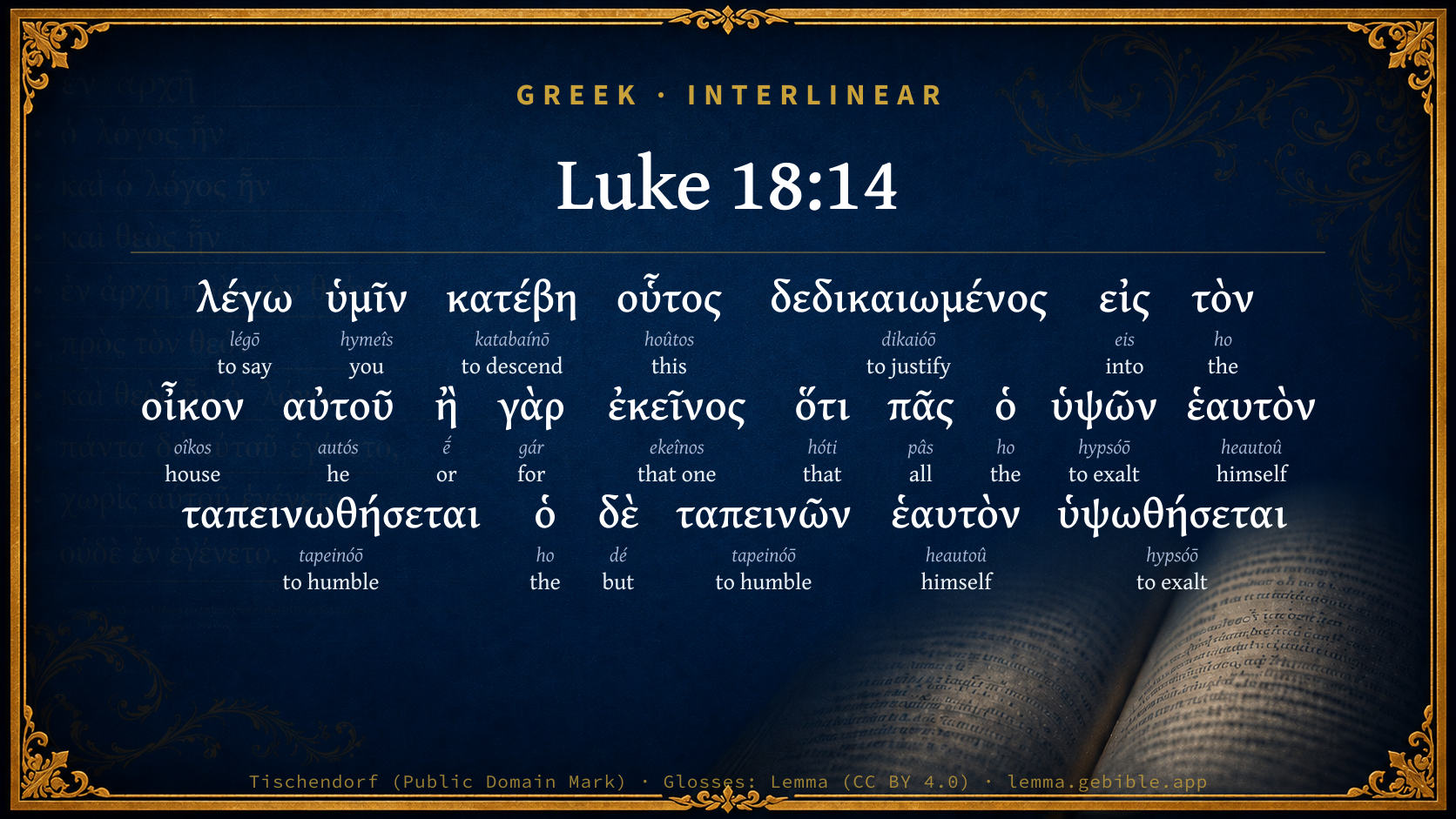
Greek (Tischendorf 8th ed.) Luke 18:14 appears in the Greek New Testament. The text above is from the Tischendorf 8th edition. Each word links to its Strong’s number and a concise gloss. Click any word for its full Thayer’s Greek Lexicon entry.
Download image
Cite this verse

Luke 18:14 (World English Bible). Public Domain. Lemma interlinear Bible study tool, https://lemma.gebible.app/v/luke/18/14.

Show BibTeX & RIS
BibTeX
RIS
English Translation
I tell you, this man went down to his house justified rather than the other; for everyone who exalts himself will be humbled, but he who humbles himself will be exalted."
World English Bible · Public Domain
Download a study sheet

One document with this verse’s original text, its word-by-word gloss line, the meaning frame, cross-references with their text, attributed commentary, and full source and license credits — printable, and it pastes into notes with its structure intact.

This verse Autodidact and up

Study sheet (.html) Plain text (.txt)

A passage Seminary Student

Up to 50 verses in one chapter. A passage sheet keeps up to 6 commentary sources and 12 cross-references per verse, in the order this page ranks them, and says so on the sheet whenever that leaves anything out. Ask for a single verse and you get the Autodidact verse sheet above.

Everything on this page stays free to read, with no account — the sheet is a download of what is already on screen, not access to it.

Want to remove ads? Support Godless Engineer
Compare translations 3

The same verse in 3 English versions, stacked beneath the original-language interlinear above. Click any original word for its lexicon entry.

Each is an independent rendering of the whole verse — the interlinear is not word-aligned to these translations.

Highlighted words mark where these versions differ — a whole-verse word diff, not a word-by-word alignment.

  • World English Bible Public Domain
    I tell you, this man went down to his house justified rather than the other; for everyone who exalts himself will be humbled, but he who humbles himself will be exalted."
  • King James Version Public Domain
    I tell you, this man went down to his house justified rather than the other: for every one that exalteth himself shall be abased; and he that humbleth himself shall be exalted.
  • unfoldingWord Literal Text CC BY-SA 4.0
    I say to you, this one went down to his house justified rather than that one. For everyone exalting himself will be humbled, but the one humbling himself will be exalted.”

unfoldingWord Literal Text — © unfoldingWord, licensed CC BY-SA 4.0. Word-aligned USFM3 via Door43 (git.door43.org/unfoldingWord/en_ult).

Versions to compare (up to 4)

3 of 4 selected

Show all 19 translations

Every available English version of this verse, each an independent rendering of the whole verse.

  • World English Bible Public Domain
    I tell you, this man went down to his house justified rather than the other; for everyone who exalts himself will be humbled, but he who humbles himself will be exalted."
  • Berean Standard Bible Public Domain
    I tell you, this man, rather than the Pharisee, went home justified. For everyone who exalts himself will be humbled, but the one who humbles himself will be exalted.”
  • Majority Standard Bible Public Domain
    I tell you, this man, rather than the Pharisee, went home justified. For everyone who exalts himself will be humbled, but the one who humbles himself will be exalted.”
  • King James Version Public Domain
    I tell you, this man went down to his house justified rather than the other: for every one that exalteth himself shall be abased; and he that humbleth himself shall be exalted.
  • American Standard Version (1901) Public Domain
    I say unto you, This man went down to his house justified rather than the other: for every one that exalteth himself shall be humbled; but he that humbleth himself shall be exalted.
  • Revised Version (1885) Public Domain
    I say unto you, This man went down to his house justified rather than the other: for every one that exalteth himself shall be humbled; but he that humbleth himself shall be exalted.
  • Geneva Bible (1599) Public Domain
    I tell you, this man departed to his house iustified, rather then the other: for euery man that exalteth himselfe, shall be brought lowe, and he that humbleth himselfe, shalbe exalted.
  • Douay-Rheims (1899) Public Domain
    I say to you, this man went down into his house justified rather that the other: because every one that exalteth himself, shall be humbled: and he that humbleth himself, shall be exalted.
  • Young's Literal Translation Public Domain
    I say to you, this one went down declared righteous, to his house, rather than that one: for every one who is exalting himself shall be humbled, and he who is humbling himself shall be exalted.'
  • Literal Standard Version CC BY-SA 4.0
    I say to you, this one went down declared righteous, to his house, rather than that one: for everyone who is exalting himself will be humbled, and he who is humbling himself will be exalted.”
  • Unlocked Literal Bible CC BY-SA 4.0
    I say to you, this man went back down to his house justified rather than the other, because everyone who exalts himself will be humbled, but everyone who humbles himself will be exalted.”
  • unfoldingWord Literal Text CC BY-SA 4.0
    I say to you, this one went down to his house justified rather than that one. For everyone exalting himself will be humbled, but the one humbling himself will be exalted.”
  • Darby Bible Public Domain
    I say unto you, This [man] went down to his house justified rather than that [other]. For every one who exalts himself shall be humbled, and he that humbles himself shall be exalted.
  • World Messianic Bible Public Domain
    I tell you, this man went down to his house justified rather than the other; for everyone who exalts himself will be humbled, but he who humbles himself will be exalted.”
  • Webster's Bible Public Domain
    I tell you, this man went down to his house justified rather than the other: for every one that exalteth himself shall be abased; and he that humbleth himself shall be exalted.
  • Free Bible Version CC BY-SA 4.0
    I tell you, it was this man who went home right in God's sight and not the other. For those who exalt themselves will be humbled, while those who humble themselves will be exalted.”
  • Bible in Basic English Public Domain
    I say to you, This man went back to his house with God's approval, and not the other: for everyone who makes himself high will be made low and whoever makes himself low will be made high.
  • Text-Critical English NT CC BY 4.0
    I tell you, this man went down to his home justified rather than the other one. For everyone who exalts himself will be humbled, but he who humbles himself will be exalted.”
  • Tyndale New Testament (1534) Public Domain
    I tell you: this man departed home to his housse iustified moore then the other. For every man that exalteth him selfe shalbe brought low: And he that hubleth him selfe shalbe exalted

Literal Standard Version (2020), Covenant Press — licensed CC BY-SA 4.0. Text via the HelloAO Bible API (eBible.org). Unlocked Literal Bible (unfoldingWord) — licensed CC BY-SA 4.0. Text via the HelloAO Bible API (eBible.org). unfoldingWord Literal Text — © unfoldingWord, licensed CC BY-SA 4.0. Word-aligned USFM3 via Door43 (git.door43.org/unfoldingWord/en_ult). Free Bible Version, Dr. Jonathan Gallagher — licensed CC BY-SA 4.0. Text via the HelloAO Bible API (eBible.org).

Word by word

More ways to search: Search by grammar → Find every occurrence → Compare this word →

Practice this passage: Drill this verse → Learn its vocabulary →

ταπεινωθήσεται
tapeinóō
G5013
“to humble”
Verb, Future, Passive, Indicative, 3rd person, Singular
Part of Speech
Verb
Tense
Future
Voice
Passive
Mood
Indicative
Person
3rd person
Number
Singular
Full Thayer's Definition

Origin: from G5011

TDNT: 08:01,1

1. to make low, bring low a. to level, reduce to a plain b. metaph. to bring into a humble condition, reduce to meaner circumstances 1. to assign a lower rank or place to 2. to abase 3. to be ranked below others who are honoured or rewarded 4. to humble or abase myself by humble living c. to lower, depress 1. of one's soul bring down one's pride 2. to have a modest opinion of one's self 3. to behave in an unassuming manner 4. devoid of all haughtiness
  1. λέγω légō G3004 “to say” Verb, Present, Active, Indicative, 1st person, Singular
  2. ὑμῖν hymeîs G5210 “you” Personal pronoun, 2nd person, Dative, Plural
  3. κατέβη katabaínō G2597 “to descend” Verb, Aorist, Active, Indicative, 3rd person, Singular
  4. οὗτος hoûtos G3778 “this” Demonstrative pronoun, Nominative, Singular, Masculine
  5. δεδικαιωμένος dikaióō G1344 “to justify” Verb, Perfect, Passive, Participle, Nominative, Singular, Masculine
  6. εἰς eis G1519 “into” Preposition
  7. τὸν ho G3588 “the” Article, Accusative, Singular, Masculine
  8. οἶκον oîkos G3624 “house” Noun, Accusative, Singular, Masculine
  9. αὐτοῦ autós G846 “he” Personal pronoun, Genitive, Singular, Masculine
  10. ἢ ḗ G2228 “or” Particle
  11. γὰρ gár G1063 “for” Conjunction
  12. ἐκεῖνος ekeînos G1565 “that one” Demonstrative pronoun, Nominative, Singular, Masculine
  13. ὅτι hóti G3754 “that” Conjunction
  14. πᾶς pâs G3956 “all” Adjective, Nominative, Singular, Masculine
  15. ὁ ho G3588 “the” Article, Nominative, Singular, Masculine
  16. ὑψῶν hypsóō G5312 “to exalt” Verb, Present, Active, Participle, Nominative, Singular, Masculine
  17. ἑαυτὸν heautoû G1438 “himself” Reflexive pronoun, 3rd person, Accusative, Singular, Masculine
  18. ὁ ho G3588 “the” Article, Nominative, Singular, Masculine
  19. δὲ dé G1161 “but” Conjunction
  20. ταπεινῶν tapeinóō G5013 “to humble” Verb, Present, Active, Participle, Nominative, Singular, Masculine
  21. ἑαυτὸν heautoû G1438 “himself” Reflexive pronoun, 3rd person, Accusative, Singular, Masculine
  22. ὑψωθήσεται hypsóō G5312 “to exalt” Verb, Future, Passive, Indicative, 3rd person, Singular

About this verse

These counts appear in no published source. They are computed here, from the morphology-tagged text and Lemma’s own curated glosses. What Lemma adds →

23
words
18
distinct lemmas
Gospels
section

Notable vocabulary

The rarest word here is ταπεινωθήσεται to humble G5013 — appearing just 14 times in the whole Greek New Testament.

Shared distinctive vocabulary

ταπεινωθήσεται to humble G5013 occurs in 11 verses of the Greek New Testament. Also found in:

Repetition

Words recur within this verse:

  • ὑψῶν to exalt G5312 ×2
  • ἑαυτὸν himself G1438 ×2
  • ταπεινωθήσεται to humble G5013 ×2
  • τὸν the G3588 ×3

Cross-references

37

Topical passages linked to Luke 18:14 in the Treasury of Scripture Knowledge — connected by theme and wording, ordered by reader-vote popularity; previews shown in the World English Bible.

  • Luke 14:11 For everyone who exalts himself will be humbled, and whoever humbles himself will be exalted."
  • Luke 16:15 He said to them, "You are those who justify yourselves in the sight of men, but God knows your hearts. For that which is exalted among men is an abomination in the sight of God.
  • James 4:10 Humble yourselves in the sight of the Lord, and he will exalt you.
  • Matthew 23:12 Whoever exalts himself will be humbled, and whoever humbles himself will be exalted.
  • Proverbs 29:23 A man's pride brings him low, But one of lowly spirit gains honor.
  • James 4:6 But he gives more grace. Therefore it says, "God resists the proud, but gives grace to the humble."
  • Luke 1:52 He has put down princes from their thrones. And has exalted the lowly.
  • Psalms 138:6 For though Yahweh is high, yet he looks after the lowly; But the proud, he knows from afar.
  • Isaiah 57:15 For thus says the high and lofty One who inhabits eternity, whose name is Holy: I dwell in the high and holy place, with him also who is of a contrite and humble spirit, to revive the spirit of the humble, and to revive the heart of the contrite.
  • Matthew 5:3 "Blessed are the poor in spirit, For theirs is the Kingdom of Heaven.
  • Job 25:4 How then can man be just with God? Or how can he who is born of a woman be clean?
  • Proverbs 3:34 Surely he mocks the mockers, But he gives grace to the humble.
  • 1 Peter 5:5–6 Likewise, you younger ones, be subject to the elder. Yes, all of you gird yourselves with humility, to subject yourselves to one another; for "God resists the proud, but gives grace to the humble."
  • Exodus 18:11 Now I know that Yahweh is greater than all gods because of the thing in which they dealt arrogantly against them."
  • 1 Samuel 1:18 She said, Let your handmaid find favor in your sight. So the woman went her way, and ate; and her facial expression wasn't sad any more.
  • Job 22:29 When they cast down, you shall say, 'be lifted up.' He will save the humble person.
  • Proverbs 15:33 The fear of Yahweh teaches wisdom. Before honor is humility.
  • Proverbs 16:18–19 Pride goes before destruction, And a haughty spirit before a fall.
  • Proverbs 18:12 Before destruction the heart of man is proud, But before honor is humility.
  • Isaiah 2:11–17 The lofty looks of man will be brought low, The haughtiness of men will be bowed down, And Yahweh alone will be exalted in that day.
  • Romans 4:5 But to him who doesn't work, but believes in him who justifies the ungodly, his faith is accounted for righteousness.
  • Job 9:20 Though I am righteous, my own mouth shall condemn me. Though I am blameless, it shall prove me perverse.
  • Isaiah 45:25 In Yahweh shall all the seed of Israel be justified, and shall glory.
  • Isaiah 53:11 He shall see of the travail of his soul, [and] shall be satisfied: by the knowledge of himself shall my righteous servant justify many; and he shall bear their iniquities.
  • Daniel 4:37 Now I, Nebuchadnezzar, praise and extol and honor the King of heaven; for all his works are truth, and his ways justice; and those who walk in pride he is able to abase.
  • Luke 5:24–25 But that you may know that the Son of Man has authority on earth to forgive sins" (he said to the paralyzed man), "I tell you, arise, and take up your cot, and go to your house."
  • Romans 3:20 Because by the works of the law, no flesh will be justified in his sight. For through the law comes the knowledge of sin.
  • Romans 5:1 Being therefore justified by faith, we have peace with God through our Lord Jesus Christ;
  • Romans 8:33 Who could bring a charge against God's chosen ones? It is God who justifies.
  • Galatians 2:16 yet knowing that a man is not justified by the works of the law but through the faith of Jesus Christ, even we believed in Christ Jesus, that we might be justified by faith in Christ, and not by the works of the law, because no flesh will be justified by the works of the law.
  • James 2:21–25 Wasn't Abraham our father justified by works, in that he offered up Isaac his son on the altar?
  • Job 40:9–13 Or have you an arm like God? Can you thunder with a voice like him?
  • Psalms 143:2 Don't enter into judgment with your servant, For in your sight no man living is righteous.
  • Ecclesiastes 9:7 Go your way--eat your bread with joy, and drink your wine with a merry heart; for God has already accepted your works.
  • Habakkuk 2:4 Behold, his soul is puffed up. It is not upright in him, but the righteous will live by his faith.
  • Luke 7:47–50 Therefore I tell you, her sins, which are many, are forgiven, for she loved much. But to whom little is forgiven, the same loves little."
  • Luke 10:29 But he, desiring to justify himself, asked Jesus, "Who is my neighbor?"

Cross-references courtesy of OpenBible.info (CC BY 4.0).

Commentary

Notes on Luke 18:14 from classic Christian and Jewish commentators (each source and its license shown beneath its notes). The classic Christian expositions comment on the surrounding passage and are grouped to its opening verse, so a note may address several verses; the Jewish commentaries on the Tanakh (Rashi and others) are per-verse, so they appear only where the commentator wrote on this verse.

Lemma curates 59 commentaries, every one of them public domain or Creative Commons licensed, each selected and text-cleaned for this edition rather than reprinted as found. About our sources →

Tyndale Open Study Notes

Tyndale Open Resources

18:14 Jesus’ conclusion that only the tax collector went home justified before God would have shocked Jesus’ audience, who regarded Pharisees as righteous and tax collectors as wicked. • those who exalt themselves will be humbled: See 1:52-53; 6:21, 25; 10:15; 14:11; 16:19-31.

Tyndale Open Study Notes — © Tyndale Open Resources, licensed CC BY-SA 4.0. Text via the HelloAO Bible API.

Bengel's Gnomon

Johann Albrecht Bengel

Luk 18:14. Εἰς τὸν οἶκον, to his house [home]) whether in the parable his house be supposed to have been at Jerusalem, or in that locality where the parable was uttered. Comp. as to returning to one’s own house [Mary], ch. Luk 1:56.—ἤπερ ἐκεῖνος) Otherwise it is read ἢ ἐκεῖνος.[202] In either case μᾶλλον is to be understood, as in ch. Luk 15:7; 1Co 14:19. The Pharisee was not justified at all; for he ἐταπεινώθη, was abased.

[202] Tisch. reads ἢ γὰρ ἐκεῖνος, with APQXΔ and later Syr. Cyprian and bc have “magis (omitted by b) quam ille Pharisæus.” Lachm. has παρʼ ἐκεὶνον, with BL Memph. Origen. D has μᾶλλον παρʼ αἰκεῖνον τὀν Φαριοαῖον: and so the Syr. Version; a, “præ illum Pharisæum:” Vulg. “ab illo.”—E. and T.

Bengel's Gnomon of the New Testament — English translation (T&T Clark, Edinburgh, 1860) — public domain. Text from a community e-Sword module.

Expositor's Greek Testament

ed. W. Robertson Nicoll

Luk 18:14 . δεδικαιωμένος , justified (here only in Gospels), a Pauline word, but not necessarily used in a Pauline sense = pardoned. παρʼ ἐκεῖνον ( ἢ ἐκεῖνος , T.R.), in comparison with that one (the Pharisee). The reading ἢ γὰρ ἐκεῖνος ( [143] [144] ) would have to be taken as a question or was that one justified? The publican was the justified man; you would not say the other one was? ὅτι , etc.: ὅτι introduces a moral maxim which we have met with already at Luk 14:11 . It stands here as the ethical basis of “justification”. It is a universal law of the moral world, true both of God and of men, that self-exaltation provokes in others condemnation, and self-humiliation gentle judgment.

[143] cod. Guelpherbytanus II. 5th century (fragments from Luke and John).

[144] cod. Monacensis. 9th or 10th century (fragments of all the Gospels).

The Expositor's Greek Testament, edited by W. Robertson Nicoll (1897–1910) — public domain. Text from a community e-Sword module.

Jamieson, Fausset & Brown

Robert Jamieson, A. R. Fausset & David Brown

rather than the other--The meaning is, "and not the other"; for the Pharisee was not seeking justification, and felt no need of it. This great law of the Kingdom of God is, in the teaching of Christ, inscribed, as in letters of gold, over its entrance gate. And in how many different forms is it repeated (Psa 138:6; Psa 147:6; Luk 1:53). To be self-emptied, or, "poor in spirit," is the fundamental and indispensable preparation for the reception of the "grace which bringeth salvation": wherever this exists, the "mourning" for it which precedes "comfort" and the earnest "hungerings and thirstings after righteousness" which are rewarded by the "fulness" of it, will, as we see here, be surely found. Such, therefore, and such only, are the justified ones (Job 33:27-28; Psa 34:18; Isa 57:15).

Jamieson, Fausset & Brown — Commentary Critical and Explanatory on the Whole Bible (1871) — public domain (CC PDM 1.0). Text via the HelloAO Bible API.

Adam Clarke's Commentary

Verse 14. Went doom to his house justified] His sin blotted out; and himself accepted.

Rather than the other] Η εκεινος: that is, the other was not accepted, because he exalted himself - he made use of the mercies which he acknowledged he owed to God, to make claims on the Divine approbation, and to monopolize the salvation of the Most High! He was abased, because he vainly trusted that he was righteous, and depended on what he had been enabled to do, and looked not for a change of heart, nor for reconciliation to God. It is a strange perversion of the human mind, to attempt to make God our debtor by the very blessings which his mere mercy has conferred upon us! It was a maxim among the Jews, that whoever brought a sacrifice to the temple returned justified. But our Lord shows that this depended on the state of mind-if they were not humbled under a sense of sin, they were not justified, though they had even offered a sacrifice.

Adam Clarke's Commentary on the Bible (1810–1826) — public domain. Text from a community e-Sword/MySword module.

Ellicott's Commentary for English Readers

(14) This man went down to his house, justified rather than the other.—The Greek participle is in the perfect, implying a completed and abiding justification. There is something suggestive in the fact that the “house” is made the test in each case. Home-life is the test of the reality and acceptableness of our worship. The Pharisee, in spite of his self-fratulation, betrayed a conscience ill at ease by irritability, harshness, sitting in judgment upon others. The publican, not in spite of his self-condemnation, but by reason of it, went home with a new sense of peace, showing itself in a new gentleness and cheerfulness.

For every one that exalteth himself.—Comp. Note on Luk_14:11. What had there been said, in its bearing on man’s outward life, and as shown by the judgment of men, is here transferred, the law remaining the same, to the higher regions of the spiritual life and to God’s judgment. In both cases there is a needless variation in the English version, the Greek giving the same verb for both “abased” and “humbleth.”

The lessons of the parable force themselves upon every reader. The spirit of religious egotism, however, is not easily exorcised, and we need, perhaps, to be reminded that the temper of the Pharisee may learn to veil itself in the language of the publican, men confessing that they are “miserable sinners,” and resting, with a secret self-satisfaction in the confession; or that, conversely, the publican—i.e., the openly non-religious man—may cease to smite upon his breast, and may come to give God thanks that he is not as the Pharisee.

A Bible Commentary for English Readers, edited by Charles John Ellicott (1878–1897) — public domain. Text from a community e-Sword module.

The Cambridge Bible for Schools and Colleges

gen. ed. J. J. S. Perowne

14. went down to his house justified rather than the other] Of the Pharisee it might be said, “His soul which is lifted up is not upright in him but of the Tax-gatherer, “the just shall live by his faith,” Hab_2:4. But the day had not yet come in which the words ‘be merciful’ (hilaskou), and ‘justified’ (dedikaiomenos), possessed the deep full meaning which they were soon to acquire (Heb_2:17; Rom_3:20). The phrase was not unknown to the Talmud, which says that while the Temple stood, when every Israelite had offered sacrifice, ‘his sin was pardoned and he departed justified.’ The reading of our Greek text ἢ ἐκεῖνος is untenable, though it correctly gives the meaning. The best supported reading is ἢ γὰρ ἐκεῖνος, but it seems to have originated by mistake from παρ ἐκεῖνον. Abp Trench quotes Crashaw’s striking epigram:

“Two went to pray: or rather say

One went to brag, the other to pray;

One stands up close, and treads on high,

Where th’ other dares not send his eye.

One nearer to the altar trod,

The other to the altar’s God.”

every one that exalteth himself] See Luk_14:11. In this Parable, as in that of the Prodigal son, we have the contrast between unrighteousness and self-righteousness.

The Cambridge Bible for Schools and Colleges (gen. ed. J. J. S. Perowne; Cambridge University Press, 1878–1918) — public domain. Text from a community e-Sword module.

John Gill's Exposition

I tell you that this man,.... The publican that so freely owned himself to be a sinner, and by his carriage acknowledged he was unworthy of any favour; and who was treated with so much contempt by the Pharisee:

went down to his house; from the temple which was built on a mountain,

justified, rather than the other: accounted as a righteous person in the sight of God; justified from all his sins, and accepted by him, when the other was abhorred and neglected. The Syriac and Persic versions, and so Beza's most ancient copy, read, "than the Pharisee", who had such an high opinion of himself, and despised others: not that the Pharisee was justified at all, when the publican really was; but the sense is, that if judgment had been to have been made, and sentence passed according to the then conduct and behaviour of both parties, the publican had greatly the advantage, in the sight of God; an humble demeanour being well pleasing and acceptable to him, when pride, and arrogance, boasting of, and trusting in a man's own righteousness, are abhorred by him;

for every one that exalteth himself, shall be abased, and he that humbleth himself, shall be exalted. This was a proverbial expression, often mentioned by Christ on different occasions, and frequently used by the Jews; See Gill on Mat 23:12 to which may be added the following passages;

"whoever is of a haughty spirit, at last shall be made low (y).''

And again,

"whosoever humbleth himself, the holy blessed God will lift him up (z).''

(y) T. Bab. Sota, fol. 5. 1. (z) Zohar in Lev. fol. 39. 1.

John Gill's Exposition of the Whole Bible (1746–1763) — public domain (CC PDM 1.0). Text via the HelloAO Bible API.

Trapp's Complete Commentary

John Trapp

14 I tell you, this man went down to his house justified rather than the other: for every one that exalteth himself shall be abased; and he that humbleth himself shall be exalted.

Ver. 14. Justified rather than the other] The Pharisee was not at all justified; neither is there more or less in justification. But our Saviour here useth a popular kind of expression.

John Trapp, A Commentary or Exposition upon All the Books of the Old and New Testament (1647–1656) — public domain. Text from a community e-Sword module.

Albert Barnes' Notes on the Bible

I tell you - The Pharisees would have said that the first man here was approved. Jesus assures them that they judged erroneously. God judges of this differently from people.

Justified - Accepted or approved of God. The word “justify” means to declare or treat as righteous. In this case it means that in their prayers the one was approved and the other not; the one went down with the favor of God in answer to his petitions, the other not.

For every one ... - See the notes at Luk 14:11.

Albert Barnes' Notes on the Bible (1834–1885) — public domain. Text from a community e-Sword/MySword module.

Haydock's Catholic Bible Commentary

If any one should ask why the Pharisee is here condemned for speaking some few words in his own commendation, and why the like sentence was not passed on Job, who praised himself much more; the difference is evident: the former praised himself without any necessity, merely with an intention of indulging his vanity, and extolling himself over the poor publican; the latter, being overwhelmed with misery, and upbraided by his friends, as if, forsaken of God, he suffered his present distress in punishment of his crimes, justifies himself by recounting his virtues for the greater glory of God, and to preserve himself and others in the steady practice of virtue, under similar temptations. (Theophylactus)

George Leo Haydock (1774–1849), Haydock's Catholic Family Bible and Commentary, 1859 edition — public domain. Excludes Psalms (Douay-Rheims chapter numbering differs from Protestant) and Deuterocanonical books (Catholic canon only).

Matthew Poole's English Annotations

Justified η εχεινος, we translate, rather than the other; not that the other was at all justified by God; the other was justified by himself only, and those of his party. The publican was justified by God. It followeth, for every one that exalteth himself shall be abased, & c. It is another of our Saviour’s sentences, often made use of by him, Mat 23:12, and in this Gospel, Luk 14:11. It is applied to the ordinary practice of men, but here to God in the ways of his providence; he resisteth the proud, and giveth grace to the humble. The blessed Virgin magnifies God on this account, Luk 1:51,52.

Matthew Poole's English Annotations on the Holy Bible (1683–1685) — public domain. Text from a community e-Sword/MySword module.

Whedon's Commentary on the Bible

Daniel D. Whedon

14. I tell you—With what emphasis and power did this tell you come from this divine I.

Down to his house—Where went the strutting Pharisee? Who knows? But this publican sought a home now illuminate by the beams of God’s smiling face.

Justified—Not merely pardoned; but held as enjoying the position of one just before God. The Epistle to the Romans is the expansion of this great thought.

Rather than the other—The other was amply justified by and before himself; this man is justified by and before God.

Exalteth himself—Our Lord here repeats one of those great formulas which expresses a fundamental law of the kingdom of God.

Here terminates the great series of the (Peculiaria Lucae) Peculiar Contributions of Luke, or the LUKEAN SECTION. (See p. 101.) Thus far his path has been independent and alone; he is now joined by his brother Evangelists. Henceforth, though often furnishing peculiar paragraphs, he moves abreast with them.

Daniel D. Whedon (gen. ed.), Commentary on the Old and New Testaments (1874–1909) — public domain. Text from a community e-Sword module.

The Pulpit Commentary

I tell you, this man went down to his house justified rather than the other: for every one that exalteth himself shall be abased; and he that humbleth himself shall be exalted. And the publican was right; there was mercy even for him, all sin-stained though he was. The words with which the Lord closes his teaching are full of comfort. That prayer he tells us was heard and granted. The "I tell you" of Jesus here means, as Stier well puts it, "I tell you, for I know, I have seen, I have heard all this in many such a case, and in many such prayers." With this example of prayer favourably heard, there is surely no sin-burthened soul on earth who may not take courage in seeking God"s face. One great object of this parable, we may believe, was to suggest some such thoughts, to embolden sorrowful, heart-broken sinners simply to go to God, trusting in his great pitying love. It should not be forgotten that the publican"s prayer was heard in the temple; a silent approval seems given to his having thus sought out the appointed consecrated place of prayer.

The Pulpit Commentary (1880–1919), ed. H.D.M. Spence-Jones & Joseph S. Exell — public domain. Text from a community e-Sword module.

John Wesley's Explanatory Notes

This man went down - From the hill on which the temple stood, justified rather than the other - That is, and not the other.

John Wesley, Explanatory Notes Upon the Whole Bible (1754–1765) — public domain. Text via the GEBible commentary corpus.

The People's New Testament

B. W. Johnson

14. This man went … justified. With his sins forgiven. His prayer was answered; not the proud boasts of the Pharisee. “This parable teaches us the spirit that should pervade our prayers. The first parable encourages us to pray, and faint not. The second reminds us how we ought to pray. Both should be often pondered by every true Christian.”—Ryle.

B. W. Johnson's The People's New Testament with Notes (1889–1891) — public domain. Electronic text from the Christian Classics Ethereal Library (CCEL) ThML edition.

Cambridge Greek Testament for Schools and Colleges

14. παρ’ ἐκεῖνον אBL, Copt. Sah[314] μᾶλλον παρ’ ἐκ. D. ἢ γὰρ ἐκεῖνος AE, &c. ἢ ἐκ. Elz. If this last reading were right the ἢ must be explained as in Luk 15:7.

[314] Sah. Sahidic Version.

14. δεδικαιωμένος. Of the Pharisee it might be said, “His soul which is lifted up is not upright in him;” but of the Tax-gatherer, “the just shall live by his faith,” Hab 2:4. But the day had not yet come in which the words “be merciful” (ἱλάσκου), and “justified” (δεδικαιωμένος), possessed the deep full meaning which they were soon to acquire (Heb 2:17; Rom 3:20). The phrase was not unknown to the Talmud, which says that while the Temple stood, when every Israelite had offered sacrifice, ‘his sin was pardoned and he departed justified.’ The reading of the Received text ἢ ἐκεῖνος is untenable, though it correctly gives the meaning. (See Winer, p. 302.) The best supported reading is ἢ γὰρ ἐκεῖνος, but it seems to have originated by mistake from παρ’ ἐκεῖνον. Abp Trench quotes Crashaw’s striking epigram:

“Two went to pray: or rather say

One went to brag, the other to pray;

One stands up close, and treads on high,

Where th’ other dares not send his eye.

One nearer to the altar trod,

The other to the altar’s God.”

παρ’ ἐκεῖνον. Prae illo. The παρὰ follows the implied comparative. Comp. Luk 13:2. See the critical note.

πᾶς ὁ ὑψῶν ἑαυτόν. See Luk 14:11. In this Parable, as in that of the Prodigal son, we have the contrast between unrighteousness and self-righteousness.

Cambridge Greek Testament for Schools and Colleges (Cambridge University Press, 1896; 21 vols, various authors incl. Carr, Maclear, Plummer, Farrar, Lumby, Moule, M. R. James, Simcox) — public domain. Text from a community e-Sword module.

Alford’s Greek Testament

Henry Alford

14.] The sense is, One returned home in the sight of God with his prayer answered, and that prayer had grasped the true object of prayer,—the forgiveness of sins (so that δεδ. is in the usual sense of the Epistles of Paul, justified before God—see reff.), the other prayed not for it, and obtained it not. Therefore he who would seek justification before God must seek it by humility and not by self-righteousness.

ὅτι πᾶς ὁ ὑψῶν ἑαυτ. has been illustrated in the demeanour of the Pharisee;—ταπεινωθ. in his failure to obtain justification from God:—ταπεινῶν ἑαυτόν in that of the Publican;—ὑψωθήσ. in his obtaining the answer to his prayer, which was this justification. Thus the particular instance is bound up with the general truth.

Henry Alford, The Greek Testament (1849–1861) — public domain. Text from a community e-Sword module.

International Critical Commentary

14. λέγω ὑμῖν. As often, this formula introduces an important declaration uttered with authority (7:26, 28, 9:27, 10:12, 24, 11:9, 51, 12:4, 5, 8, 27, 37, 44, 51, 13:3, etc.). Here Christ once more claims to know the secrets both of man’s heart and of God’s judgments.

κατέβη οὖτος δεδικαιωμένος. The pronoun perhaps looks back to the contemptuous οὖτος in vet. 11. “This despised man went down justified in the sight of God,” i.e. “accounted as righteous, accepted.” Comp. 7:35, 10:29, 16:15; Isa 50:8, 53:11; Job 33:32. The Talmud says, “So long as the temple stood, no Israelite was in distress; for as often as he came to it full of sin and offered sacrifice, then his sin was forgiven and he departed a just man” (Schœttgen, 1. p. 308).

παρʼ ἐκεῖνον. The expression is one of comparison, and of itself does not exclude the possibility of the Pharisee being justified in some smaller degree. Comp. 13:2, 4. But the context perhaps excludes it. Thus Tertullian (Adv. Marcion. iv. 36), ideoque alterum reprobatum, alterum justificatum. Also Euthym. (ad loc.), ὁ δικαιώσας μόνον ἑαυτὸ κατεδικάσθη παρὰ Θεοῦ, ὁ δὲ καταδικάσας μόνον ἑαυτὸν ἐδικαιώθη παρὰ Θεοῦ. Aug., however, points out that the Scripture does not say that the Pharisee was condemned (Ep. xxxvi. 4, 7).

The readings are various, but παρʼ ἐκεῖνον (א B L, Boh. Sah., Orig. Naz.) may be safely adopted: ab illo (Vulg.) is a misrepresentation of this, and μαλλον παρʼ αικεινον τον φαρισειον (D) an amplification of it. The ἢ ἐκεῖνος (min.pauc.) of Elz. is a gloss; which, however, may have helped to produce the common reading ἢ ὰρ ἐκεῖνος (A A G H K M P Q etc.), ΠΑΠ being changed to ΓΑΠ. If ἤ γὰρ ἐκεῖνος (Tisch., Treg. marg.) be adopted, it must be interrogative: “I say to you, this man went down to his house justified—or did the other do so?” Other Latin variations are præ illum pharisæum (a), magis guam ille pharisæus (b c e), to which some add qui so exaltabat (f ff2 i l q r). ἦ παρʼ ἐκεῖνον (Hofm. Kell) and ἤπερ ἐκεῖνος (Hahn) are conjectures. See Blass, Gr. pp. 106, 139.

ὅτι πᾶς ὁ ἑψῶν, κ.τ.λ. Verbatim as 14:2 (where see note), which Weiss pronounces to be its original position, while its appearance here is due to Lk. Why is it assumed that Jesus did not repeat His sayings?

The suggestion (Aug. Bede) that the Pharisee represents the Jews and the publican the Gentiles cannot be accepted. Nor need we suppose (Godet) that Lk. is here showing that the Pauline doctrine of justification was based on the teaching of Christ. There is nothing specially Pauline here. We are not told that the publican was justified by faith in Christ, but by confession of sin and prayer. The meaning is simple. Christ takes a crucial case. One generally recognized as a saint fails in prayer, while one generally recognized as a sinner succeeds. Why? Because the letter’s prayer is real, and the former’s not. The one comes in the spirit of prayer,—self-humiliation; the other in the spirit of pride,—self-satisfaction.

International Critical Commentary — older volumes (1896–1929), various authors — public domain. Text from a community e-Sword module.

Lesson kit

Teaching starters — assembled from the data on this page, not authored interpretation. Every prompt links to the verse data it draws on. Edit before teaching.

Luke, in the Gospels, opens this verse with 23 words (18 distinct Greek lemmas). Its most distinctive word is tapeinóō (“to humble”). A historical commentator’s framing appears above. Read the whole chapter for the surrounding context.

Discussion questions

  1. What does “to humble” (tapeinóō) contribute to the verse as a whole?
  2. How does Matthew 18:4, which shares the word «to humble», read alongside this verse?
  3. What does the repetition of “to exalt” (2× in this one verse) do in this verse?
  4. These translations render this verse differently. What is at stake in choosing one wording over another?
  5. Compare how Tyndale Open Study Notes and Bengel's Gnomon read this verse. Where do they agree or differ?

Things to notice

  • These translations choose different wording for 18 words in this verse.
  • “to exalt” occurs 2× in this single verse.
  • 18 distinct Greek lemmas span 23 words in this verse.

Reading settings

Reading text

Shown beneath each verse's original-language words.

Old Testament
Old Testament edition

Read the OT as the Masoretic Hebrew (MT) or the Greek Septuagint (LXX).

English shown for the Greek Septuagint (in the Hebrew ↔ Greek comparison).

Comparing translations? Open the Compare panel on any verse page to stack up to four side by side.