
Luke 21:28

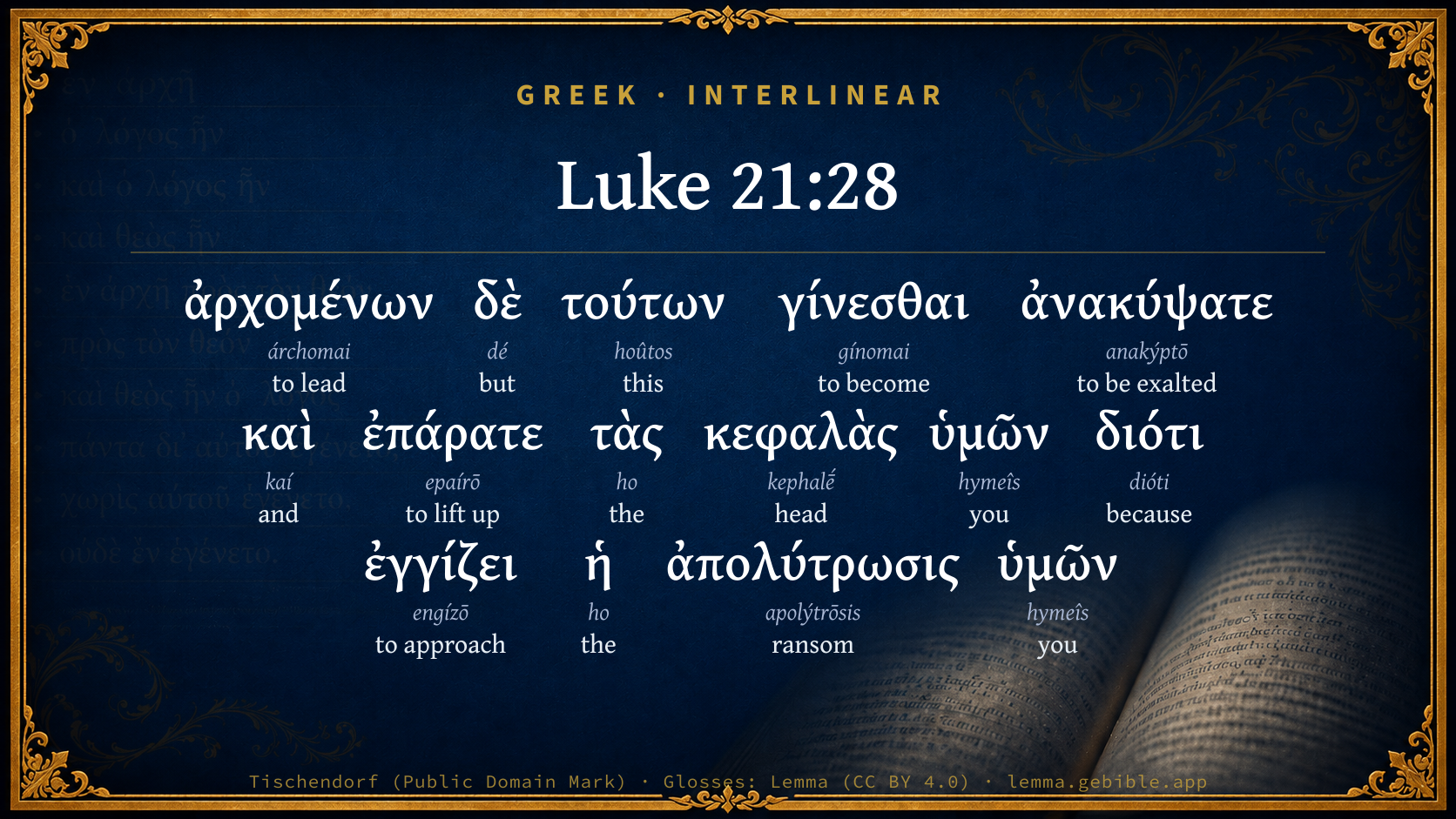
Greek (Tischendorf 8th ed.) Luke 21:28 appears in the Greek New Testament. The text above is from the Tischendorf 8th edition. Each word links to its Strong’s number and a concise gloss. Click any word for its full Thayer’s Greek Lexicon entry.
Download image
Cite this verse

Luke 21:28 (World English Bible). Public Domain. Lemma interlinear Bible study tool, https://lemma.gebible.app/v/luke/21/28.

Show BibTeX & RIS
BibTeX
RIS
English Translation
But when these things begin to happen, look up, and lift up your heads, because your redemption is near."
World English Bible · Public Domain
Highlights
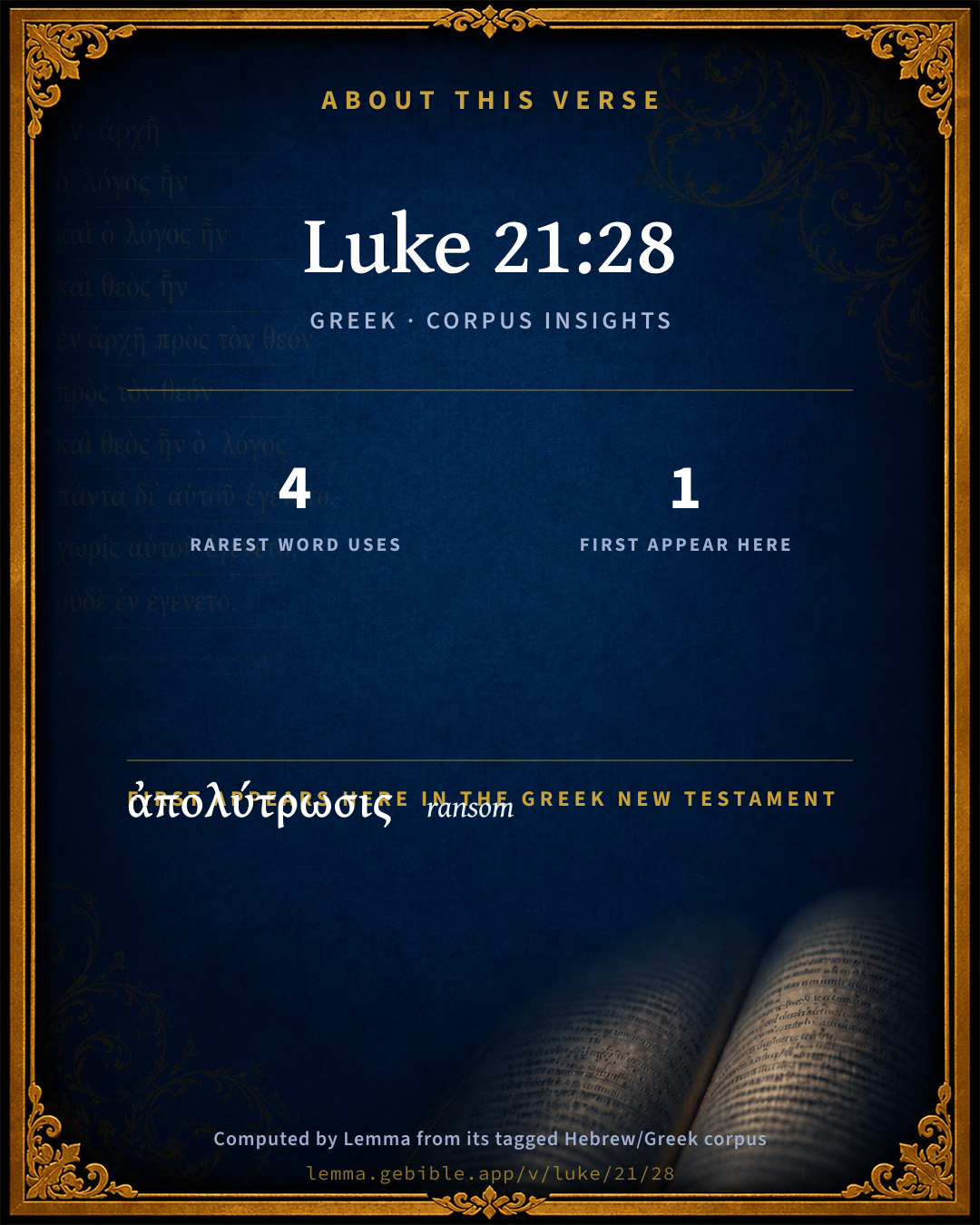
  • 1 first appearance in the Greek New Testament
Full analysis ↓
Download a study sheet

One document with this verse’s original text, its word-by-word gloss line, the meaning frame, cross-references with their text, attributed commentary, and full source and license credits — printable, and it pastes into notes with its structure intact.

This verse Autodidact and up

Study sheet (.html) Plain text (.txt)

A passage Seminary Student

Up to 50 verses in one chapter. A passage sheet keeps up to 6 commentary sources and 12 cross-references per verse, in the order this page ranks them, and says so on the sheet whenever that leaves anything out. Ask for a single verse and you get the Autodidact verse sheet above.

Everything on this page stays free to read, with no account — the sheet is a download of what is already on screen, not access to it.

Want to remove ads? Support Godless Engineer
Compare translations 3

The same verse in 3 English versions, stacked beneath the original-language interlinear above. Click any original word for its lexicon entry.

Each is an independent rendering of the whole verse — the interlinear is not word-aligned to these translations.

Highlighted words mark where these versions differ — a whole-verse word diff, not a word-by-word alignment.

  • World English Bible Public Domain
    But when these things begin to happen, look up, and lift up your heads, because your redemption is near."
  • King James Version Public Domain
    And when these things begin to come to pass, then look up, and lift up your heads; for your redemption draweth nigh.
  • unfoldingWord Literal Text CC BY-SA 4.0
    But these things begin to happen, stand up and lift up your heads, because your redemption is coming near.”

unfoldingWord Literal Text — © unfoldingWord, licensed CC BY-SA 4.0. Word-aligned USFM3 via Door43 (git.door43.org/unfoldingWord/en_ult).

Versions to compare (up to 4)

3 of 4 selected

Show all 19 translations

Every available English version of this verse, each an independent rendering of the whole verse.

  • World English Bible Public Domain
    But when these things begin to happen, look up, and lift up your heads, because your redemption is near."
  • Berean Standard Bible Public Domain
    When these things begin to happen, stand up and lift up your heads, because your redemption is drawing near.”
  • Majority Standard Bible Public Domain
    When these things begin to happen, stand up and lift up your heads, because your redemption is drawing near.”
  • King James Version Public Domain
    And when these things begin to come to pass, then look up, and lift up your heads; for your redemption draweth nigh.
  • American Standard Version (1901) Public Domain
    But when these things begin to come to pass, look up, and lift up your heads; because your redemption draweth nigh.
  • Revised Version (1885) Public Domain
    But when these things begin to come to pass, look up, and lift up your heads; because your redemption draweth nigh.
  • Geneva Bible (1599) Public Domain
    And when these things beginne to come to passe, then looke vp, and lift vp your heades: for your redemption draweth neere.
  • Douay-Rheims (1899) Public Domain
    But when these things begin to come to pass, look up, and lift up your heads, because your redemption is at hand.
  • Young's Literal Translation Public Domain
    and these things beginning to happen bend yourselves back, and lift up your heads, because your redemption doth draw nigh.'
  • Literal Standard Version CC BY-SA 4.0
    and these things beginning to happen, bend yourselves back, and lift up your heads, because your redemption draws near.”
  • Unlocked Literal Bible CC BY-SA 4.0
    But when these things begin to happen, stand up and lift up your heads, because your deliverance is coming near.”
  • unfoldingWord Literal Text CC BY-SA 4.0
    But these things begin to happen, stand up and lift up your heads, because your redemption is coming near.”
  • Darby Bible Public Domain
    But when these things begin to come to pass, look up and lift up your heads, because your redemption draws nigh.
  • World Messianic Bible Public Domain
    But when these things begin to happen, look up and lift up your heads, because your redemption is near.”
  • Webster's Bible Public Domain
    And when these things begin to come to pass, then look up, and lift up your heads: for your redemption draweth nigh.
  • Free Bible Version CC BY-SA 4.0
    But when these things happen, stand up and look up, because you will soon be saved.”
  • Bible in Basic English Public Domain
    But when these things come about, let your heads be lifted up, because your salvation is near.
  • Text-Critical English NT CC BY 4.0
    So when these things begin to take place, stand tall and lift up your heads, for your redemption is near.”
  • Tyndale New Testament (1534) Public Domain
    When these thinges begyn to come to passe: then loke vp and lifte vp youre heddes for youre redempcion draweth neye.

Literal Standard Version (2020), Covenant Press — licensed CC BY-SA 4.0. Text via the HelloAO Bible API (eBible.org). Unlocked Literal Bible (unfoldingWord) — licensed CC BY-SA 4.0. Text via the HelloAO Bible API (eBible.org). unfoldingWord Literal Text — © unfoldingWord, licensed CC BY-SA 4.0. Word-aligned USFM3 via Door43 (git.door43.org/unfoldingWord/en_ult). Free Bible Version, Dr. Jonathan Gallagher — licensed CC BY-SA 4.0. Text via the HelloAO Bible API (eBible.org).

Word by word

More ways to search: Search by grammar → Find every occurrence → Compare this word →

Practice this passage: Drill this verse → Learn its vocabulary →

ἀνακύψατε
anakýptō
G352
“to be exalted”
Verb, Aorist, Active, Imperative, 2nd person, Plural
Part of Speech
Verb
Tense
Aorist
Voice
Active
Mood
Imperative
Person
2nd person
Number
Plural
Full Thayer's Definition

Origin: from G303 (in the sense of reversal) and G2955

TDNT: None

1. to raise or lift one's self up a. one's body b. one's soul 1. to be elated or exalted
  1. ἀρχομένων árchomai G756 “to lead” Verb, Present, Middle, Participle, Genitive, Plural, Masculine
  2. δὲ dé G1161 “but” Conjunction
  3. τούτων hoûtos G3778 “this” Demonstrative pronoun, Genitive, Plural, Masculine
  4. γίνεσθαι gínomai G1096 “to become” Verb, Present, Middle or Passive deponent, Infinitive
  5. καὶ kaí G2532 “and” Conjunction
  6. ἐπάρατε epaírō G1869 “to lift up” Verb, Aorist, Active, Imperative, 2nd person, Plural
  7. τὰς ho G3588 “the” Article, Accusative, Plural, Feminine
  8. κεφαλὰς kephalḗ G2776 “head” Noun, Accusative, Plural, Feminine
  9. ὑμῶν hymeîs G5210 “you” Personal pronoun, 2nd person, Genitive, Plural
  10. διότι dióti G1360 “because” Conjunction
  11. ἐγγίζει engízō G1448 “to approach” Verb, Present, Active, Indicative, 3rd person, Singular
  12. ἡ ho G3588 “the” Article, Nominative, Singular, Feminine
  13. ἀπολύτρωσις apolýtrōsis G629 “ransom” Noun, Nominative, Singular, Feminine
  14. ὑμῶν hymeîs G5210 “you” Personal pronoun, 2nd person, Genitive, Plural

About this verse

These counts appear in no published source. They are computed here, from the morphology-tagged text and Lemma’s own curated glosses. What Lemma adds →

15
words
13
distinct lemmas
Gospels
section

Notable vocabulary

The rarest word here is ἀνακύψατε to be exalted G352 — appearing just 4 times in the whole Greek New Testament.

First appearance in Scripture

This word makes its first canonical appearance in the Greek New Testament here:

  • ἀπολύτρωσις ransom G629

Shared distinctive vocabulary

ἀνακύψατε to be exalted G352 occurs in 4 verses of the Greek New Testament. Also found in:
Repetition

Words recur within this verse:

Cross-references

9

Topical passages linked to Luke 21:28 in the Treasury of Scripture Knowledge — connected by theme and wording, ordered by reader-vote popularity; previews shown in the World English Bible.

  • Romans 8:23 Not only so, but ourselves also, who have the first fruits of the Spirit, even we ourselves groan within ourselves, waiting for adoption, the redemption of our body.
  • Isaiah 60:1–2 Arise, shine; for your light is come, and the glory of Yahweh is risen on you.
  • Ephesians 4:30 Don't grieve the Holy Spirit of God, in whom you were sealed for the day of redemption.
  • Isaiah 12:1–3 In that day you will say, "I will give thanks to you, Yahweh; for though you were angry with me, your anger has turned away and you comfort me.
  • Romans 8:19 For the creation waits with eager expectation for the children of God to be revealed.
  • Psalms 98:5–9 Sing praises to Yahweh with the harp, With the harp and the voice of melody.
  • Luke 18:7 Won't God avenge his chosen ones, who are crying out to him day and night, and yet he exercises patience with them?
  • Isaiah 25:8–9 He has swallowed up death forever; and the Lord Yahweh will wipe away tears from off all faces; and the reproach of his people will he take away from off all the earth: for Yahweh has spoken it.
  • Ephesians 1:14 who is a pledge of our inheritance, to the redemption of God's own possession, to the praise of his glory.

Cross-references courtesy of OpenBible.info (CC BY 4.0).

Commentary

Notes on Luke 21:28 from classic Christian and Jewish commentators (each source and its license shown beneath its notes). The classic Christian expositions comment on the surrounding passage and are grouped to its opening verse, so a note may address several verses; the Jewish commentaries on the Tanakh (Rashi and others) are per-verse, so they appear only where the commentator wrote on this verse.

Lemma curates 59 commentaries, every one of them public domain or Creative Commons licensed, each selected and text-cleaned for this edition rather than reprinted as found. About our sources →

Whedon's Commentary on the Bible

Daniel D. Whedon

The Parable of the Fig-tree, Luk_21:28-33.

28. These things.—The these things of the apostles’ question, Mat_24:3, namely, the destruction of the temple and city.

Daniel D. Whedon (gen. ed.), Commentary on the Old and New Testaments (1874–1909) — public domain. Text from a community e-Sword module.

Bengel's Gnomon

Johann Albrecht Bengel

Luk 21:28. Ἀρχομένων, when these things are beginning) Comp. the expression, “the beginning,” in Mat 24:8. For this reason refer these things to Luk 21:8-10, et seqq.: and in this passage He is treating of the preparation for nearer events; but (δὲ) in Luk 21:34-35, He is treating of the preparation for the last events of all.—ἀνακύψατε καὶ ἐπάρατε, look up, and lift up your heads) in order that as soon as possible ye may perceive the event answering to your expectation, and may with joy embrace it (welcome it). Comp. ch. Luk 24:5 [Not as the disciples after the resurrection, who, with “faces bowed down to the earth,” “sought the living among the dead”]; Job 10:15 [If I be righteous, yet will I not lift up my head]. In the LXX. Version ἀνακύψαι is used to express, “to lift up the head;” also ἆραι κεφαλὴν, Jdg 8:28.—ἀπολύτρωσις, deliverance [redemption) from many miseries, Luk 21:12; Luk 21:16-17. Deliverance from the miseries which befell the Jews. [So long, to wit, as the shadows of the Levitical law, along with the City and Temple, were standing, the kingdom of GOD, or the free exercise of the Christian religion, did not as yet enjoy unrestricted scope. This is compared to the loveliness of the summer, Luk 21:30-31: but old things must first be taken away,—V. g.]

Bengel's Gnomon of the New Testament — English translation (T&T Clark, Edinburgh, 1860) — public domain. Text from a community e-Sword module.

Godet's Commentaries

Frédéric Louis Godet

Vers. 28-36. The Application.—“When these things begin to come to pass, then look up, and lift up your heads; for your redemption draweth nigh. 29. And He spake to them a parable: Behold the fig-tree, and all the trees; 30. When they now shoot forth, ye see and know of your own selves that summer is now nigh at hand. 31. So likewise ye, when ye see these things come to pass, know ye that the kingdom of God is nigh at hand. 32. Verily I say unto you, This generation shall not pass away till all be fulfilled. 33. Heaven and earth shall pass away; but my words shall not pass away. 34, But take heed to yourselves, lest at any time your hearts be overcharged with surfeiting and drunkenness, and cares of this life, and so that day come upon you unawares. 35. For as a snare it shall come on all them that dwell on the face of the whole earth. 36. Watch ye, therefore, and pray always, that ye may be accounted worthy to escape all these things that shall come to pass, and to stand before the Son of man.”

Jesus draws practical conclusions from the whole of the preceding discourse: 1. In respect of hope, Luk 21:28-33; Luke 2. In respect of watchfulness, Luk 21:34-36.

Vers. 28-33. It might be thought that after this saying relative to the Parousia (Luk 21:26-27), which is strictly speaking a digression, Jesus returns to the principal topic of this discourse, the destruction of Jerusalem. The expression: your deliverance, would then denote the emancipation of the Judeo-Christian Church by the destruction of the persecuting Jewish power. The coming of the kingdom of God, Luk 21:31, would refer to the propagation of the gospel among the Gentiles; and Luk 21:32: this generation shall not pass away, would thus indicate quite naturally the date of the destruction of Jerusalem. Yet the fact of the Parousia, once mentioned, is too solemn to be treated as a purely accessory idea. The kingdom of God seems, therefore, necessarily to denote here rather the final establishment of the Messianic kingdom; and the deliverance (Luk 21:28) should be applied to the definitive emancipation of the Church by the return of the Lord (the deliverance of the widow, Luk 18:1-8). Of yourselves, Luk 21:30: “It is not necessary that an official proclamation announce to the inhabitants of the world that summer is near!” It is about the middle of March that fruits begin to show themselves on the old branches of the spring fig-tree; they reach maturity before the shooting of the leaves. The first harvest is gathered in June (Keim, iii. p. 206).

Can Luk 21:32 refer still to the Parousia? But in that case, how are we to explain the expression: this generation? Jerome understood by it the human species, Origen and Chrysostom the Christian Church. These explanations are now regarded as forced. That of Dorner and Riggenbach, who take it to mean the Jewish people (applying to their conversion the image of the fig-tree flourishing again, Luk 21:29-30), is not much more natural. In this context, where we have to do with a chronological determination (“is nigh,” Luk 21:31), the meaning of γενεά must be temporal. Besides, we have the authentic commentary on this saying in Luk 11:50-51, where Jesus declares that it is the very generation which is to shed His blood and that of His messengers, which must suffer, besides, the punishment of all the innocent blood shed since that of Abel down to this last. It is not less false to give to this expression, with the Tübingen School, such an extension that it embraces a period of 70 years (Hilgenfeld), or even of a century (Volkmar): the duration of a man’s life. It has not this meaning among the ancients. In Herod. (2. 142, 7. 171), Heraclitus, and Thuc. (1. 14), it denotes a space of from 30 to 40 years. A century counts three generations. The saying of Irenaeus respecting the composition of the Apocalypse, wherein he declares “that this vision was seen not long before his epoch, almost within the time of our generation, towards the end of Domitian’s reign,” does not at all prove the contrary, as Volkmar alleges; for Irenaeus says expressly: σχεδόν, almost, well aware that he is extending the reach of the term generation beyond its ordinary application. An impartial exegesis, therefore, leaves no doubt that this saying fixes the date of the near destruction of Jerusalem at least the third of a century after the ministry of Jesus. The meaning is: “The generation which shall shed this blood shall not pass away till God require it” (in opposition to all the blood of the ancients which has remained so long unavenged). Πάντα, all things, refers to all those events precursive of that catastrophe which are enumerated Luk 21:8-19, and to the catastrophe itself (20-24).

The position of this saying immediately after the preceding verses relative to the Parousia, seems to be in Luke a faint evidence of the influence exercised by that confusion which reigns throughout the whole discourse as related by the other two Syn. There is nothing in that to surprise us. Would not the omission of some word of transition, or the simple displacing of some sentence, suffice to produce this effect? And how many cases of similar transpositions or omissions are to be met with in our Syn.? But if this observation is well founded, it proves that the Gospel of Luke was not composed, any more than the other two, after the destruction of Jerusalem.

Heaven and earth (Luk 21:33) are contrasted with those magnificent structures which His disciples would have Him to admire (Luk 21:5): Here is a very different overthrow from that which they had so much difficulty in believing. This universe, this temple made by the hand of God, passeth away; one thing remains: the threats and promises of the Master who is speaking to them.

Frédéric Louis Godet — Commentaries on Luke, John, Romans, and 1 Corinthians — English translation (T&T Clark, Edinburgh, 1870s–1890s) — public domain. Text from a community e-Sword module.

Jamieson, Fausset & Brown

Robert Jamieson, A. R. Fausset & David Brown

redemption--from the oppression of ecclesiastical despotism and legal bondage by the total subversion of the Jewish state and the firm establishment of the evangelical kingdom (Luk 21:31). But the words are of far wider and more precious import. Matthew (Mat 24:30) says, "And then shall appear the sign of the Son of man in heaven," evidently something distinct from Himself, mentioned immediately after. What this was intended to mean, interpreters are not agreed. But as before Christ came to destroy Jerusalem, some appalling portents were seen in the air, so before His personal appearing it is likely that something analogous will be witnessed, though of what nature it is vain to conjecture.

Jamieson, Fausset & Brown — Commentary Critical and Explanatory on the Whole Bible (1871) — public domain (CC PDM 1.0). Text via the HelloAO Bible API.

Ellicott's Commentary for English Readers

(28) Look up.—The Greek word, literally, bend up, or turn up, meets us here and in Luk_13:11, and nowhere else in the New Testament, except in the doubtful passage of Joh_8:7; Joh_8:10.

Redemption.—The word, familiar as it is to us, is, in the special form here used, another of those characteristic of St. Paul’s phraseology (Rom_3:24; Rom_8:23; 1Co_1:30; Eph_1:7, et al.). It occurs also in Heb_9:15; Heb_11:35. In its primary meaning here it points to the complete deliverance of the disciples from Jewish persecutions in Palestine that followed on the destruction of Jerusalem. The Church of Christ was then delivered from what had been its most formidable danger.

A Bible Commentary for English Readers, edited by Charles John Ellicott (1878–1897) — public domain. Text from a community e-Sword module.

The Cambridge Bible for Schools and Colleges

gen. ed. J. J. S. Perowne

28. Hope for the Faithful.

28. look up] The ‘earnest expectation’ (apokaradokia—‘watching with outstretched neck’) of the creature, Rom_8:19; Rom_8:23. This verb anakuptein only occurs in Luk_13:11. Comp. Mat_24:31.

The Cambridge Bible for Schools and Colleges (gen. ed. J. J. S. Perowne; Cambridge University Press, 1878–1918) — public domain. Text from a community e-Sword module.

John Gill's Exposition

For as a snare shall it come,.... In which a bird is suddenly taken, and cannot get out again; the Persic version renders it, "as lightning and the splendour of the sun"; which break out at once, and enlighten the whole earth; so the destruction of the Jewish nation should be sudden and unavoidable, and universal; for it should come

on all them that dwell upon the face of the whole earth: or land of Judea; and so it was, for not only Jerusalem, but all Judea, and Galilee, suffered in this desolation.

John Gill's Exposition of the Whole Bible (1746–1763) — public domain (CC PDM 1.0). Text via the HelloAO Bible API.

Trapp's Complete Commentary

John Trapp

28 And when these things begin to come to pass, then look up, and lift up your heads; for your redemption draweth nigh.

Ver. 28. Look up] You that shall then be found alive shall soon be caught up, 1Th 4:14-18, and fully freed from all evils and enemies.

John Trapp, A Commentary or Exposition upon All the Books of the Old and New Testament (1647–1656) — public domain. Text from a community e-Sword module.

The Pulpit Commentary

Vers. 28-36. Practical teaching arising the foregoing prophecy respecting the Jerusalem and the last things.

And when these things begin to come to pan, then look up, and lift up your heads; for your redemption draweth nigh. There is no doubt that the first reference in this verse is to the earlier part of the prophecy the fate of the city and the ruin of the Jewish power. "Your redemption" would then signify "your deliverance from the constant and bitter hostility of the Jewish authority." After A.D. 70 and the fall of Jerusalem, the growth of Christianity was far more rapid than it had been the first thirty or forty years of its It had no longer to cope with the skillfully ordered, relentless opposition of its deadly Jewish foe. Yet between the lines a yet deeper meaning is discernible. In all times the earnest Christian is on the watch for the signs of the advent of his Lord, and the restless watch serves to keep hope alive, for the watcher knows that that advent will be the sure herald of his redemption from all the weariness and painfulness of this life.

The second redemption.

"Lift up your heads; for your redemption draweth nigh." Jesus Christ led his disciples to think that beyond the redemption which he was working out for them, and subsequent to it in time, was another great deliverance which should prove of unspeakable value to them. This is true now of our discipleship; we look for and we sorely need a second redemption.

I ITS CHARACTER. It is not, like the first, distinctively and purely spiritual. That was; men were yearning for a political revolution and redemption. But the kingdom of heaven was not to be "of this world;" it was to be wholly inward and spiritual; it was to be our redemption from sin and restoration to the favor and the likeness of our Divine Father. But the second redemption is not distinctively and primarily that of the soul; it is to be "the redemption of our body". (Rom_8:23) It will have a gracious and beneficent effect, a redeeming and elevating influence, upon the soul; but in the first instance it is a redemption from a troublous and trying condition; it is being taken away, by the appearance of Christ, in the providence of God, from a state in which happy service is almost impossible; it is a removal from storm to calm, from hostile to friendly forces, from turbulence to serenity; from hard conflict, or tense anxiety, or painful suffering, to "the rest which remaineth for the people of God." It is a blessed and merciful change from unfavourable to favorable conditions.

II OUR HUMAN NEED OF IT. We are not of this world, we who have been redeemed by Jesus Christ and renewed by the Spirit of God. And we may be nobly, even grandly, victorious over it, being "always caused to triumph" by that Divine Spirit that dwells within us, and strengthens us with all might." Yet are we actually, and by universal experience, seriously affected by it, and we suffer many things as we pass through it. We may suffer, as the early Christians did (to whom these words were addressed), from persecution, and thereby be made "most miserable". (1Co_15:19) Our life may be made worthless, or worse than worthless, to us by the cruelties of our fellow-men. Or we may suffer so much from privation of privilege, or from the struggles of daily life, or from grief and disappointment, or from a steadily advancing decrepitude, that we may earnestly long for this second redemption, the redemption of our body. We may be in sore need of its approach, of its presence.

III ITS KINDLY SHADOW. It will then be much to us, perhaps everything; that our redemption draweth nigh.

1. It is something that at any moment we may be within a step of the heavenly sphere; for anything we know, Christ may be about to say concerning us, "This day ye shall be with me in Paradise.

2. It is more that we may be confident that a life of holy activity will rapidly pass away and bring us to the day of rest and of reward.

3. It is very much indeed that the duration of the blessed future will prove to be such that any number of years of earthly trouble will be nothing in comparison.

4. It is also a truth full of hope and healing that every day spent in faithful service or patient waiting brings us that distance nearer to the blessedness that lies beyond. "We nightly pitch our moving tent A day"s march nearer home.

Beneath the varied and heavy burdens of time we are fain to bow our heads; but we shall lift them up with strength and eager-hearted expectation as we realize that every step forward is a step onward to the heavenly horizon. C.

The Pulpit Commentary (1880–1919), ed. H.D.M. Spence-Jones & Joseph S. Exell — public domain. Text from a community e-Sword module.

John Wesley's Explanatory Notes

Now when these things - Mentioned ver. 8, 10, &c., begin to come to pass, look up with firm faith, and lift up your heads with joy: for your redemption out of many troubles draweth nigh, by God's destroying your implacable enemies.

John Wesley, Explanatory Notes Upon the Whole Bible (1754–1765) — public domain. Text via the GEBible commentary corpus.

Scofield Reference Notes

C. I. Scofield

redemption

(See Scofield "Rom 3:24"), See Scofield "Rom 8:19", See Scofield "Rom 8:23"

The Scofield Reference Bible (1917 edition), notes by C. I. Scofield — public domain. Text from a community e-Sword module.

Kretzmann's Popular Commentary

Paul E. Kretzmann

The comfort of the believers:

v. 28. And when these things begin to come to pass, then look up and lift up your heads; for your redemption draweth nigh.

v. 29. And He spake to them a parable: Behold the fig-tree and all the trees;

v. 30. when they now shoot forth, ye see and know of your own selves that summer is now nigh at hand.

v. 31. So likewise ye, when ye see these things come to pass, know ye that the kingdom of God is nigh at hand.

v. 32. Verily I say unto you, This generation shall not pass away till all be fulfilled.

v. 33. Heaven and earth shall pass away; but My words shall not pass away.

When there is a beginning of all these things, when these tokens begin to be fulfilled. The events upon which the children of the world will gaze with helpless terror should be for the believers a voice awakening in their hearts the most joyful hope and expectation. The heads which have so often been bowed under all manner of misery and persecution should now be lifted up in happy anticipation of the final, glorious deliverance. This admonition Jesus tries to impress by means of a parable. No matter what tree may be chosen for an example, for instance, the fig-tree, the same truth holds good of all of them. When they put forth their leaves, all ordinary people that are acquainted with trees at all immediately known, without further demonstration, that summer must be near. In the same way the believers, seeing these signs which are to precede the coming of Christ to judgment fulfilled, conclude and know at once that the kingdom of God is near, that the final revelation of the Church of Christ in the glories of heaven will take place, that the believers in Him will enter, from the trials and tribulations of the Church Militant into the everlasting bliss of the Church Triumphant. "Therefore let us also learn this art and new language and become accustomed to it, that we may be able to picture these signs before us in such a comforting way, and look upon them and judge them according to the Word. For if we follow our reason and wisdom, we can do nothing but become terrified and flee before them. For our reason does not like to see things appear dark and unpleasant, that it lightens and thunders, that it roars and is noisy, as though everything would be turned topsy-turvy. But a Christian should pay no attention to that, but take hold of the Word, with which He wants to open our eyes and explain how He means it, as though we were approaching the beautiful summer-time, and as though there were nothing but beautiful roses and lilies that bloom to delight the eye, and that nothing but joy and delight will come after this abominably evil way and misfortune in which we now are " And He gives them a further sign, namely, that this generation, the race of the Jews, will not pass away, will not lose its identity as a separate race, but retain its characteristics among the nations and in their very midst, in spite of all persecutions, until the end of time, until the great Day of Judgment. And so far as the whole discourse is concerned, with its threats and warnings, as well as with its comforting promises, it is true what, the Lord claims for His Word as a whole: Heaven and earth will pass away rather than that a single word of the Lord remain unfulfilled or fall to the ground. In the midst of the return of primeval chaos, in the midst of the destruction of worlds and the very universe itself, the Word of the Lord will stand in eternity as a rock of trust and confidence for all believers.

Paul E. Kretzmann, Popular Commentary of the Bible (1921–1924) — public domain. Text from a community e-Sword module.

Cambridge Greek Testament for Schools and Colleges

28. HOPE FOR THE FAITHFUL

28. ἀνακύψατε. The ‘earnest expectation’ (ἀποκαραδοκία—‘watching with outstretched neck’) of the creature, Rom 8:19; Rom 8:23. This verb ἀνακύπτειν only occurs in Luk 13:11; Joh 8:7; Joh 8:10. Comp. Mat 24:31.

ἡ ἀπολύτρωσις ὑμῶν. This will follow Christ’s Parousia. Comp. Luk 18:7.

Cambridge Greek Testament for Schools and Colleges (Cambridge University Press, 1896; 21 vols, various authors incl. Carr, Maclear, Plummer, Farrar, Lumby, Moule, M. R. James, Simcox) — public domain. Text from a community e-Sword module.

Alford’s Greek Testament

Henry Alford

28.] ἀπολ., i.e. the completion of it by My appearing.

Henry Alford, The Greek Testament (1849–1861) — public domain. Text from a community e-Sword module.

International Critical Commentary

28. This word of comfort is given by Lk. alone. Only here in N.T. is ἀνακύπτειν used of being elated after sorrow. Comp. Job 10:15, and contrast Luk 13:2; [Jn.] 8:7, 10. The disciples present are regarded as representatives of believers generally, Only those who witness the signs can actually fulfil this injunction.

ἀπολύρωσις. At the Second Advent. Here the word means little more than “release” or “deliverance,” without any idea of “ransom” (λύτρον). See Sanday on Rom 3:24, Abbott on Eph 1:7, and Wsctt. Heb. pp. 295-297. Comp. Enoch, 51:2.

International Critical Commentary — older volumes (1896–1929), various authors — public domain. Text from a community e-Sword module.

Vincent's Word Studies in the New Testament

Marvin R. Vincent

Look up. See on ch. Luk 13:11. Graphic, as implying being previously bowed down with sorrow.

Redemption [απολυτρωσις] . See on lettest depart, ch. 2 29.

Marvin R. Vincent, Word Studies in the New Testament (1887–1900) — public domain. Text from a community e-Sword/MySword module.

Lesson kit

Teaching starters — assembled from the data on this page, not authored interpretation. Every prompt links to the verse data it draws on. Edit before teaching.

Luke, in the Gospels, opens this verse with 15 words (13 distinct Greek lemmas). Its most distinctive word is anakýptō (“to be exalted”). A historical commentator’s framing appears above. Read the whole chapter for the surrounding context.

Discussion questions

  1. How does “to be exalted” (anakýptō) shape what this verse is saying?
  2. The word “ransom” first appears here in Scripture. What is being introduced at this debut?
  3. Luke 13:11 shares the word «to be exalted» with this verse. How do the two illuminate each other?
  4. “the” occurs 2× in this one verse. What is the effect of the repetition?
  5. The translations on this page render this verse differently — a whole-verse word diff, not a word-by-word alignment. What might account for the different wordings?
  6. Reading how Whedon's Commentary on the Bible and Bengel's Gnomon read this verse, where do the two commentators agree and where do they part?

Things to notice

  • 1 word makes its first canonical appearance in Scripture here.
  • These translations choose different wording for 11 words in this verse.
  • “the” occurs 2× in this single verse.
  • 13 distinct Greek lemmas span 15 words in this verse.

Reading settings

Reading text

Shown beneath each verse's original-language words.

Old Testament
Old Testament edition

Read the OT as the Masoretic Hebrew (MT) or the Greek Septuagint (LXX).

English shown for the Greek Septuagint (in the Hebrew ↔ Greek comparison).

Comparing translations? Open the Compare panel on any verse page to stack up to four side by side.