

Luke 12:20
Greek (Tischendorf 8th ed.) Luke 12:20 appears in the Greek New Testament. The text above is from the Tischendorf 8th edition. Each word links to its Strong’s number and a concise gloss. Click any word for its full Thayer’s Greek Lexicon entry.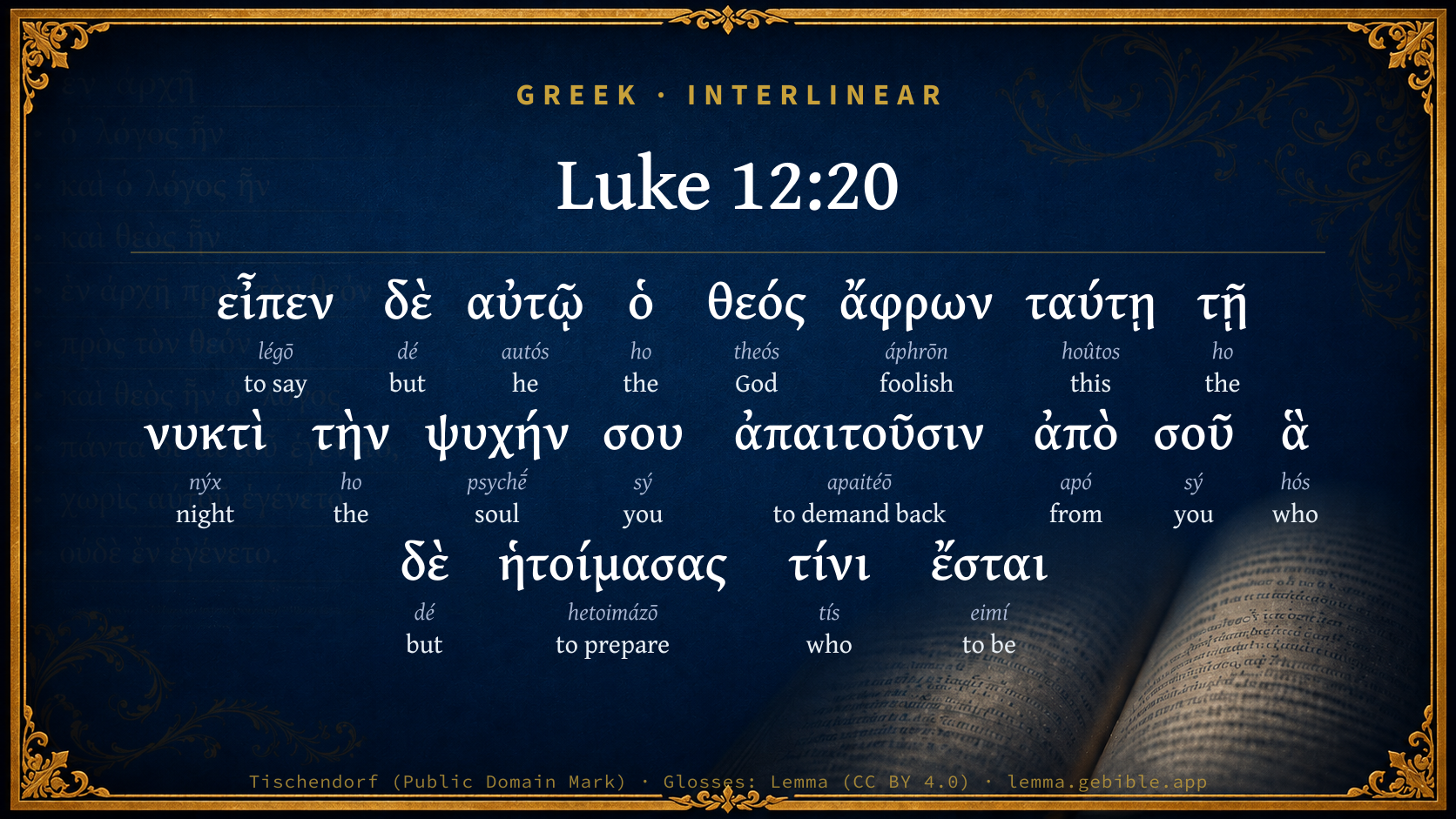
"But God said to him, 'You foolish one, tonight your soul is required of you. The things which you have prepared--whose will they be?'
Download a study sheet
One document with this verse’s original text, its word-by-word gloss line, the meaning frame, cross-references with their text, attributed commentary, and full source and license credits — printable, and it pastes into notes with its structure intact.
This verse Autodidact and up
A passage Seminary Student
Up to 50 verses in one chapter. A passage sheet keeps up to 6 commentary sources and 12 cross-references per verse, in the order this page ranks them, and says so on the sheet whenever that leaves anything out. Ask for a single verse and you get the Autodidact verse sheet above.
Everything on this page stays free to read, with no account — the sheet is a download of what is already on screen, not access to it.
Compare translations 3
The same verse in 3 English versions, stacked beneath the original-language interlinear above. Click any original word for its lexicon entry.
Each is an independent rendering of the whole verse — the interlinear is not word-aligned to these translations.
Highlighted words mark where these versions differ — a whole-verse word diff, not a word-by-word alignment.
-
World English Bible Public Domain
"But God said to him, 'You foolish one, tonight your soul is required of you. The things which you have prepared--whose will they be?'
-
King James Version Public Domain
But God said unto him, Thou fool, this night thy soul shall be required of thee: then whose shall those things be, which thou hast provided?
-
unfoldingWord Literal Text CC BY-SA 4.0
But God said to him, ‘Foolish one, this night they are demanding your soul from you, and what you have prepared, whose will it be?’
unfoldingWord Literal Text — © unfoldingWord, licensed CC BY-SA 4.0. Word-aligned USFM3 via Door43 (git.door43.org/unfoldingWord/en_ult).
Show all 19 translations
Every available English version of this verse, each an independent rendering of the whole verse.
-
World English Bible Public Domain
"But God said to him, 'You foolish one, tonight your soul is required of you. The things which you have prepared--whose will they be?'
-
Berean Standard Bible Public Domain
But God said to him, ‘You fool! This very night your life will be required of you. Then who will own what you have accumulated?’
-
Majority Standard Bible Public Domain
But God said to him, ‘You fool! This very night your life will be required of you. Then who will own what you have accumulated?’
-
King James Version Public Domain
But God said unto him, Thou fool, this night thy soul shall be required of thee: then whose shall those things be, which thou hast provided?
-
American Standard Version (1901) Public Domain
But God said unto him, Thou foolish one, this night is thy soul required of thee; and the things which thou hast prepared, whose shall they be?
-
Revised Version (1885) Public Domain
But God said unto him, Thou foolish one, this night is thy soul required of thee; and the things which thou hast prepared, whose shall they be?
-
Geneva Bible (1599) Public Domain
But God said vnto him, O foole, this night wil they fetch away thy soule from thee: then whose shall those things be which thou hast prouided?
-
Douay-Rheims (1899) Public Domain
But God said to him: Thou fool, this night do they require thy soul of thee: and whose shall those things be which thou hast provided?
-
Young's Literal Translation Public Domain
`And God said to him, Unthinking one! this night thy soul they shall require from thee, and what things thou didst prepare -- to whom shall they be?
-
Literal Standard Version CC BY-SA 4.0
And God said to him, Unthinking [one]! This night your life is required of you, and what things you prepared—to whom will they be [given]?
-
Unlocked Literal Bible CC BY-SA 4.0
But God said to him, 'Foolish man, tonight your soul is required of you, and the things you have prepared, whose will they be?'
-
unfoldingWord Literal Text CC BY-SA 4.0
But God said to him, ‘Foolish one, this night they are demanding your soul from you, and what you have prepared, whose will it be?’
-
Darby Bible Public Domain
But God said to him, Fool, this night thy soul shall be required of thee; and whose shall be what thou hast prepared?
-
World Messianic Bible Public Domain
“But God said to him, ‘You foolish one, tonight your soul is required of you. The things which you have prepared—whose will they be?’
-
Webster's Bible Public Domain
But God said to him, Thou fool, this night thy soul shall be required of thee: then whose shall those things be which thou hast provided?
-
Free Bible Version CC BY-SA 4.0
But God said to him, ‘You foolish man! Your life will be demanded back this very night, and then who will get everything you've stored up?’
-
Bible in Basic English Public Domain
But God said to him, You foolish one, tonight I will take your soul from you, and who then will be the owner of all the things which you have got together?
-
Text-Critical English NT CC BY 4.0
But God said to him, ‘Yoʋ fool! This very night yoʋr life will be demanded back from yoʋ, and the things yoʋ have prepared, whose will they be?’
-
Tyndale New Testament (1534) Public Domain
But God sayde vnto him: Thou fole this night will they fetche awaye thy soule agayne from the. Then whose shall thoose thinges be which thou hast provyded?
Literal Standard Version (2020), Covenant Press — licensed CC BY-SA 4.0. Text via the HelloAO Bible API (eBible.org). Unlocked Literal Bible (unfoldingWord) — licensed CC BY-SA 4.0. Text via the HelloAO Bible API (eBible.org). unfoldingWord Literal Text — © unfoldingWord, licensed CC BY-SA 4.0. Word-aligned USFM3 via Door43 (git.door43.org/unfoldingWord/en_ult). Free Bible Version, Dr. Jonathan Gallagher — licensed CC BY-SA 4.0. Text via the HelloAO Bible API (eBible.org).
Word by word
More ways to search: Search by grammar → Find every occurrence → Compare this word →
Practice this passage: Drill this verse → Learn its vocabulary →
- Appears 2× in the Greek New Testament
- First appears at Luke 6:30
- Part of Speech
- Verb
- Tense
- Present
- Voice
- Active
- Mood
- Indicative
- Person
- 3rd person
- Number
- Plural
Full Thayer's Definition
- εἶπεν légō G3004 “to say” Verb, Aorist, Active, Indicative, 3rd person, Singular
- δὲ dé G1161 “but” Conjunction
- αὐτῷ autós G846 “he” Personal pronoun, Dative, Singular, Masculine
- ὁ ho G3588 “the” Article, Nominative, Singular, Masculine
- θεός theós G2316 “God” Noun, Nominative, Singular, Masculine
- ἄφρων áphrōn G878 “foolish” Adjective, Vocative, Singular, Masculine
- ταύτῃ hoûtos G3778 “this” Demonstrative pronoun, Dative, Singular, Feminine
- τῇ ho G3588 “the” Article, Dative, Singular, Feminine
- νυκτὶ nýx G3571 “night” Noun, Dative, Singular, Feminine
- τὴν ho G3588 “the” Article, Accusative, Singular, Feminine
- ψυχήν psychḗ G5590 “soul” Noun, Accusative, Singular, Feminine
- σου sý G4771 “you” Personal pronoun, 2nd person, Genitive, Singular
- ἀπαιτοῦσιν apaitéō G523 “to demand back” Verb, Present, Active, Indicative, 3rd person, Plural
- ἀπὸ apó G575 “from” Preposition
- σοῦ sý G4771 “you” Personal pronoun, 2nd person, Genitive, Singular
- ἃ hós G3739 “who” Relative pronoun, Accusative, Plural, Neuter
- δὲ dé G1161 “but” Conjunction
- ἡτοίμασας hetoimázō G2090 “to prepare” Verb, Aorist, Active, Indicative, 2nd person, Singular
- τίνι tís G5101 “who” Interrogative pronoun, Dative, Singular, Masculine
- ἔσται eimí G1510 “to be” Verb, Future, Middle deponent, Indicative, 3rd person, Singular
About this verse
These counts appear in no published source. They are computed here, from the morphology-tagged text and Lemma’s own curated glosses. What Lemma adds →
- 20
- words
- 16
- distinct lemmas
- Gospels
- section
Cross-references
27Topical passages linked to Luke 12:20 in the Treasury of Scripture Knowledge — connected by theme and wording, ordered by reader-vote popularity; previews shown in the World English Bible.
- Job 27:8 For what is the hope of the godless, when he is cut off, When God takes away his life?
- Jeremiah 17:11 As the partridge that sits on [eggs] which she has not laid, so is he who gets riches, and not by right; in the midst of his days they shall leave him, and at his end he shall be a fool.
- 1 Timothy 6:7 For we brought nothing into the world, and we certainly can't carry anything out.
- Psalms 39:6 "Surely every man walks like a shadow. Surely they busy themselves in vain. He heaps up, and doesn't know who shall gather.
- James 4:14 Whereas you don't know what your life will be like tomorrow. For what is your life? For you are a vapor, that appears for a little time, and then vanishes away.
- Job 27:16–17 Though he heap up silver as the dust, And prepare clothing as the clay;
- Psalms 49:17–19 For when he dies he shall carry nothing away. His glory shall not descend after him.
- Luke 16:22–23 It happened that the beggar died, and that he was carried away by the angels to Abraham's bosom. The rich man also died, and was buried.
- Psalms 52:5–7 God will likewise destroy you forever. He will take you up, and pluck you out of your tent, And root you out of the land of the living. Selah.
- Psalms 73:19 How they are suddenly destroyed! They are completely swept away with terrors.
- Proverbs 28:8 He who increases his wealth by excessive interest Gathers it for one who has pity on the poor.
- Matthew 24:48–51 But if that evil servant should say in his heart, 'My lord is delaying his coming,'
- Luke 11:40 You foolish ones, didn't he who made the outside make the inside also?
- 1 Thessalonians 5:3 For when they are saying, "Peace and safety," then sudden destruction will come on them, like birth pains on a pregnant woman; and they will in no way escape.
- Proverbs 11:4 Riches don't profit in the day of wrath, But righteousness delivers from death.
- Nahum 1:10 For entangled like thorns, and drunken as with their drink, they are consumed utterly like dry stubble.
- 2 Samuel 13:28–29 Absalom commanded his servants, saying, Mark you now, when Amnon's heart is merry with wine; and when I tell you, Smite Amnon, then kill him; don't be afraid; haven't I commanded you? be courageous, and be valiant.
- Psalms 78:30 They didn't turn from their cravings. Their food was yet in their mouths,
- Ecclesiastes 2:18–22 I hated all my labor in which I labored under the sun, seeing that I must leave it to the man who comes after me.
- Daniel 5:1–6 Belshazzar the king made a great feast to a thousand of his lords, and drank wine before the thousand.
- Daniel 5:25–30 This is the writing that was inscribed: MENE, MENE, TEKEL, UPHARSIN.
- 1 Kings 16:9–10 His servant Zimri, captain of half his chariots, conspired against him. Now he was in Tirzah, drinking himself drunk in the house of Arza, who was over the household in Tirzah:
- Esther 5:11 Haman recounted to them the glory of his riches, and the multitude of his children, and all the things in which the king had promoted him, and how he had advanced him above the princes and servants of the king.
- Esther 8:1–2 On that day did the king Ahasuerus give the house of Haman the Jews' enemy to Esther the queen. Mordecai came before the king; for Esther had told what he was to her.
- Job 20:20–23 "Because he knew no quietness within him, He shall not save anything of that in which he delights.
- Ecclesiastes 5:14–16 Those riches perish by misfortune, and if he has fathered a son, there is nothing in his hand.
- 1 Samuel 25:36–38 Abigail came to Nabal; and, behold, he held a feast in his house, like the feast of a king; and Nabal's heart was merry within him, for he was very drunken: therefore she told him nothing, less or more, until the morning light.
Cross-references courtesy of OpenBible.info (CC BY 4.0).
Lesson kit
Teaching starters — assembled from the data on this page, not authored interpretation. Every prompt links to the verse data it draws on. Edit before teaching.
Luke, in the Gospels, opens this verse with 20 words (16 distinct Greek lemmas). Its most distinctive word is apaitéō (“to demand back”). A historical commentator’s framing appears above. Read the whole chapter for the surrounding context.
Discussion questions
- What does “to demand back” (apaitéō) contribute to the verse as a whole?
- Luke 6:30 shares the word «to demand back» with this verse. How do the two illuminate each other?
- “the” occurs 3× in this one verse. What is the effect of the repetition?
- These translations render this verse differently; the difference is in the English rendering, not the original. What questions does that raise?
- Reading how Bengel's Gnomon and Meyer's Critical & Exegetical Commentary read this verse, where do the two commentators agree and where do they part?
Things to notice
- These translations choose different wording for 18 words in this verse.
- “the” occurs 3× in this single verse.
- 16 distinct Greek lemmas span 20 words in this verse.
Commentary
Notes on Luke 12:20 from classic Christian and Jewish commentators (each source and its license shown beneath its notes). The classic Christian expositions comment on the surrounding passage and are grouped to its opening verse, so a note may address several verses; the Jewish commentaries on the Tanakh (Rashi and others) are per-verse, so they appear only where the commentator wrote on this verse.
Lemma curates 59 commentaries, every one of them public domain or Creative Commons licensed, each selected and text-cleaned for this edition rather than reprinted as found. About our sources →
Bengel's Gnomon
Johann Albrecht Bengel
Bengel's Gnomon of the New Testament — English translation (T&T Clark, Edinburgh, 1860) — public domain. Text from a community e-Sword module.
Meyer's Critical & Exegetical Commentary
Heinrich August Wilhelm Meyer
Meyer — Critical and Exegetical Commentary on the New Testament — English translation by Peter Christie, edited by Frederick Crombie (T&T Clark, 1880) — public domain. Text from a community e-Sword module.
Expositor's Greek Testament
ed. W. Robertson Nicoll
The Expositor's Greek Testament, edited by W. Robertson Nicoll (1897–1910) — public domain. Text from a community e-Sword module.
Jamieson, Fausset & Brown
Robert Jamieson, A. R. Fausset & David Brown
Jamieson, Fausset & Brown — Commentary Critical and Explanatory on the Whole Bible (1871) — public domain (CC PDM 1.0). Text via the HelloAO Bible API.
Adam Clarke's Commentary
Adam Clarke's Commentary on the Bible (1810–1826) — public domain. Text from a community e-Sword/MySword module.
Ellicott's Commentary for English Readers
A Bible Commentary for English Readers, edited by Charles John Ellicott (1878–1897) — public domain. Text from a community e-Sword module.
The Cambridge Bible for Schools and Colleges
gen. ed. J. J. S. Perowne
The Cambridge Bible for Schools and Colleges (gen. ed. J. J. S. Perowne; Cambridge University Press, 1878–1918) — public domain. Text from a community e-Sword module.
John Gill's Exposition
John Gill's Exposition of the Whole Bible (1746–1763) — public domain (CC PDM 1.0). Text via the HelloAO Bible API.
Trapp's Complete Commentary
John Trapp
John Trapp, A Commentary or Exposition upon All the Books of the Old and New Testament (1647–1656) — public domain. Text from a community e-Sword module.
Albert Barnes' Notes on the Bible
Albert Barnes' Notes on the Bible (1834–1885) — public domain. Text from a community e-Sword/MySword module.
Whedon's Commentary on the Bible
Daniel D. Whedon
Daniel D. Whedon (gen. ed.), Commentary on the Old and New Testaments (1874–1909) — public domain. Text from a community e-Sword module.
The Pulpit Commentary
The Pulpit Commentary (1880–1919), ed. H.D.M. Spence-Jones & Joseph S. Exell — public domain. Text from a community e-Sword module.
John Wesley's Explanatory Notes
John Wesley, Explanatory Notes Upon the Whole Bible (1754–1765) — public domain. Text via the GEBible commentary corpus.
The People's New Testament
B. W. Johnson
B. W. Johnson's The People's New Testament with Notes (1889–1891) — public domain. Electronic text from the Christian Classics Ethereal Library (CCEL) ThML edition.
unfoldingWord translationNotes
Door43 World Missions Community
unfoldingWord translationNotes — © Distant Shores Media and the Door43 World Missions Community, licensed CC BY-SA 4.0. Source: git.door43.org/Door43/en_tn.
Cambridge Greek Testament for Schools and Colleges
Cambridge Greek Testament for Schools and Colleges (Cambridge University Press, 1896; 21 vols, various authors incl. Carr, Maclear, Plummer, Farrar, Lumby, Moule, M. R. James, Simcox) — public domain. Text from a community e-Sword module.
Alford’s Greek Testament
Henry Alford
Henry Alford, The Greek Testament (1849–1861) — public domain. Text from a community e-Sword module.
International Critical Commentary
International Critical Commentary — older volumes (1896–1929), various authors — public domain. Text from a community e-Sword module.
Vincent's Word Studies in the New Testament
Marvin R. Vincent
Marvin R. Vincent, Word Studies in the New Testament (1887–1900) — public domain. Text from a community e-Sword/MySword module.