Luke 11:31

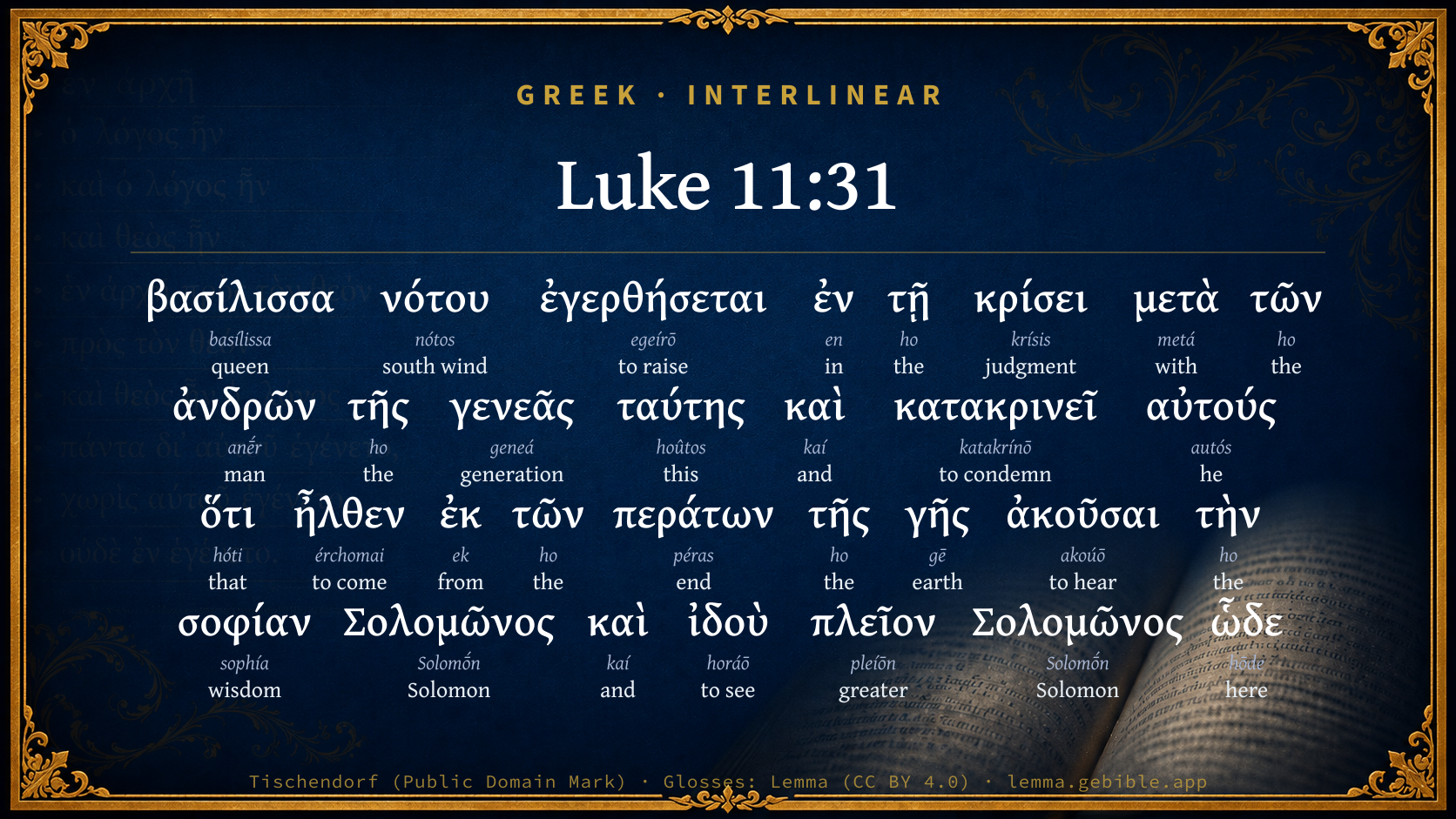
Greek (Tischendorf 8th ed.) Luke 11:31 appears in the Greek New Testament. The text above is from the Tischendorf 8th edition. Each word links to its Strong’s number and a concise gloss. Click any word for its full Thayer’s Greek Lexicon entry.
Download image
Cite this verse

Luke 11:31 (World English Bible). Public Domain. Lemma interlinear Bible study tool, https://lemma.gebible.app/v/luke/11/31.

Show BibTeX & RIS
BibTeX
RIS
English Translation
The Queen of the South will rise up in the judgment with the men of this generation, and will condemn them: for she came from the ends of the earth to hear the wisdom of Solomon; and behold, one greater than Solomon is here.
World English Bible · Public Domain
Download a study sheet

One document with this verse’s original text, its word-by-word gloss line, the meaning frame, cross-references with their text, attributed commentary, and full source and license credits — printable, and it pastes into notes with its structure intact.

This verse Autodidact and up

Study sheet (.html) Plain text (.txt)

A passage Seminary Student

Up to 50 verses in one chapter. A passage sheet keeps up to 6 commentary sources and 12 cross-references per verse, in the order this page ranks them, and says so on the sheet whenever that leaves anything out. Ask for a single verse and you get the Autodidact verse sheet above.

Everything on this page stays free to read, with no account — the sheet is a download of what is already on screen, not access to it.

Want to remove ads? Support Godless Engineer
Compare translations 3

The same verse in 3 English versions, stacked beneath the original-language interlinear above. Click any original word for its lexicon entry.

Each is an independent rendering of the whole verse — the interlinear is not word-aligned to these translations.

Highlighted words mark where these versions differ — a whole-verse word diff, not a word-by-word alignment.

  • World English Bible Public Domain
    The Queen of the South will rise up in the judgment with the men of this generation, and will condemn them: for she came from the ends of the earth to hear the wisdom of Solomon; and behold, one greater than Solomon is here.
  • King James Version Public Domain
    The queen of the south shall rise up in the judgment with the men of this generation, and condemn them: for she came from the utmost parts of the earth to hear the wisdom of Solomon; and, behold, a greater than Solomon is here.
  • unfoldingWord Literal Text CC BY-SA 4.0
    The Queen of the South will stand up in the judgment with the men of this generation and condemn them, for she came from the ends of the earth to hear the wisdom of Solomon, and behold, something greater than Solomon here.

unfoldingWord Literal Text — © unfoldingWord, licensed CC BY-SA 4.0. Word-aligned USFM3 via Door43 (git.door43.org/unfoldingWord/en_ult).

Versions to compare (up to 4)

3 of 4 selected

Show all 19 translations

Every available English version of this verse, each an independent rendering of the whole verse.

  • World English Bible Public Domain
    The Queen of the South will rise up in the judgment with the men of this generation, and will condemn them: for she came from the ends of the earth to hear the wisdom of Solomon; and behold, one greater than Solomon is here.
  • Berean Standard Bible Public Domain
    The Queen of the South will rise at the judgment with the men of this generation and condemn them; for she came from the ends of the earth to hear the wisdom of Solomon, and now One greater than Solomon is here.
  • Majority Standard Bible Public Domain
    The Queen of the South will rise at the judgment with the men of this generation and condemn them; for she came from the ends of the earth to hear the wisdom of Solomon, and now One greater than Solomon is here.
  • King James Version Public Domain
    The queen of the south shall rise up in the judgment with the men of this generation, and condemn them: for she came from the utmost parts of the earth to hear the wisdom of Solomon; and, behold, a greater than Solomon is here.
  • American Standard Version (1901) Public Domain
    The queen of the south shall rise up in the judgment with the men of this generation, and shall condemn them: for she came from the ends of the earth to hear the wisdom of Solomon; and behold, a greater than Solomon is here.
  • Revised Version (1885) Public Domain
    The queen of the south shall rise up in the judgment with the men of this generation, and shall condemn them: for she came from the ends of the earth to hear the wisdom of Solomon; and behold, a greater than Solomon is here.
  • Geneva Bible (1599) Public Domain
    The Queene of the South shall rise in iudgement, with the men of this generation, and shall condemne them: for shee came from the vtmost partes of the earth to heare the wisedome of Salomon, and beholde, a greater then Salomon is here.
  • Douay-Rheims (1899) Public Domain
    The queen of the south shall rise in the judgment with the men of this generation, and shall condemn them: because she came from the ends of the earth to hear the wisdom of Solomon; and behold more than Solomon here.
  • Young's Literal Translation Public Domain
    `A queen of the south shall rise up in the judgment with the men of this generation, and shall condemn them, because she came from the ends of the earth to hear the wisdom of Solomon; and lo, greater than Solomon here!
  • Literal Standard Version CC BY-SA 4.0
    A queen of the south will rise up in the judgment with the men of this generation, and will condemn them, because she came from the ends of the earth to hear the wisdom of Solomon; and behold, [One] greater than Solomon [is] here!
  • Unlocked Literal Bible CC BY-SA 4.0
    The Queen of the South will rise up at the judgment with the men of this generation and condemn them, for she came from the ends of the earth to hear the wisdom of Solomon, and see, someone greater than Solomon is here.
  • unfoldingWord Literal Text CC BY-SA 4.0
    The Queen of the South will stand up in the judgment with the men of this generation and condemn them, for she came from the ends of the earth to hear the wisdom of Solomon, and behold, something greater than Solomon here.
  • Darby Bible Public Domain
    A queen of the south shall rise up in the judgment with the men of this generation, and shall condemn them: for she came from the ends of the earth to hear the wisdom of Solomon; and behold, more than Solomon is here.
  • World Messianic Bible Public Domain
    The Queen of the South will rise up in the judgment with the men of this generation and will condemn them, for she came from the ends of the earth to hear the wisdom of Solomon; and behold, one greater than Solomon is here.
  • Webster's Bible Public Domain
    The queen of the south shall rise up in the judgment with the men of this generation, and condemn them: for she came from the utmost parts of the earth, to hear the wisdom of Solomon; and behold, a greater than Solomon is here.
  • Free Bible Version CC BY-SA 4.0
    The queen of the south will rise in the judgment together with the people of this generation and will condemn them, for she came from the ends of the earth to hear Solomon's wisdom, and now there is someone greater than Solomon here!
  • Bible in Basic English Public Domain
    The queen of the South will come up on the day of judging and give her decision against the men of this generation: for she came from the ends of the earth to give ear to the wisdom of Solomon; and now something greater than Solomon is here.
  • Text-Critical English NT CC BY 4.0
    The queen of the South will rise up at the judgment with the men of this generation and condemn them, for she came from the ends of the earth to hear the wisdom of Solomon, and behold, something greater than Solomon is here.
  • Tyndale New Testament (1534) Public Domain
    The quene of the southe shall ryse at iudgement with the men of this generacion and condempne them: for she came from the ende of the worlde to heare the wysdome of Salomon. And beholde a greater then Salomon is here.

Literal Standard Version (2020), Covenant Press — licensed CC BY-SA 4.0. Text via the HelloAO Bible API (eBible.org). Unlocked Literal Bible (unfoldingWord) — licensed CC BY-SA 4.0. Text via the HelloAO Bible API (eBible.org). unfoldingWord Literal Text — © unfoldingWord, licensed CC BY-SA 4.0. Word-aligned USFM3 via Door43 (git.door43.org/unfoldingWord/en_ult). Free Bible Version, Dr. Jonathan Gallagher — licensed CC BY-SA 4.0. Text via the HelloAO Bible API (eBible.org).

Word by word

More ways to search: Search by grammar → Find every occurrence → Compare this word →

Practice this passage: Drill this verse → Learn its vocabulary →

βασίλισσα
basílissa
G938
“queen”
Noun, Nominative, Singular, Feminine
Part of Speech
Noun
Case
Nominative
Number
Singular
Gender
Feminine
Full Thayer's Definition

Origin: from G936

TDNT: 10:51,0

1. queen
  1. νότου nótos G3558 “south wind” Noun, Genitive, Singular, Masculine
  2. ἐγερθήσεται egeírō G1453 “to raise” Verb, Future, Passive, Indicative, 3rd person, Singular
  3. ἐν en G1722 “in” Preposition
  4. τῇ ho G3588 “the” Article, Dative, Singular, Feminine
  5. κρίσει krísis G2920 “judgment” Noun, Dative, Singular, Feminine
  6. μετὰ metá G3326 “with” Preposition
  7. τῶν ho G3588 “the” Article, Genitive, Plural, Masculine
  8. ἀνδρῶν anḗr G435 “man” Noun, Genitive, Plural, Masculine
  9. τῆς ho G3588 “the” Article, Genitive, Singular, Feminine
  10. γενεᾶς geneá G1074 “generation” Noun, Genitive, Singular, Feminine
  11. ταύτης hoûtos G3778 “this” Demonstrative pronoun, Genitive, Singular, Feminine
  12. καὶ kaí G2532 “and” Conjunction
  13. κατακρινεῖ katakrínō G2632 “to condemn” Verb, Future, Active, Indicative, 3rd person, Singular
  14. αὐτούς autós G846 “he” Personal pronoun, Accusative, Plural, Masculine
  15. ὅτι hóti G3754 “that” Conjunction
  16. ἦλθεν érchomai G2064 “to come” Verb, Aorist, Active, Indicative, 3rd person, Singular
  17. ἐκ ek G1537 “from” Preposition
  18. τῶν ho G3588 “the” Article, Genitive, Plural, Neuter
  19. περάτων péras G4009 “end” Noun, Genitive, Plural, Neuter
  20. τῆς ho G3588 “the” Article, Genitive, Singular, Feminine
  21. γῆς gē G1093 “earth” Noun, Genitive, Singular, Feminine
  22. ἀκοῦσαι akoúō G191 “to hear” Verb, Aorist, Active, Infinitive
  23. τὴν ho G3588 “the” Article, Accusative, Singular, Feminine
  24. σοφίαν sophía G4678 “wisdom” Noun, Accusative, Singular, Feminine
  25. Σολομῶνος Solomṓn G4672 “Solomon” Noun, Genitive, Singular, Masculine
  26. καὶ kaí G2532 “and” Conjunction
  27. ἰδοὺ horáō G3708 “to see” Verb, Aorist, Middle, Imperative, 2nd person, Singular
  28. πλεῖον pleíōn G4119 “greater” Adjective, Nominative, Singular, Neuter, Comparative
  29. Σολομῶνος Solomṓn G4672 “Solomon” Noun, Genitive, Singular, Masculine
  30. ὧδε hōde G5602 “here” Adverb

About this verse

These counts appear in no published source. They are computed here, from the morphology-tagged text and Lemma’s own curated glosses. What Lemma adds →

31
words
24
distinct lemmas
Gospels
section

Notable vocabulary

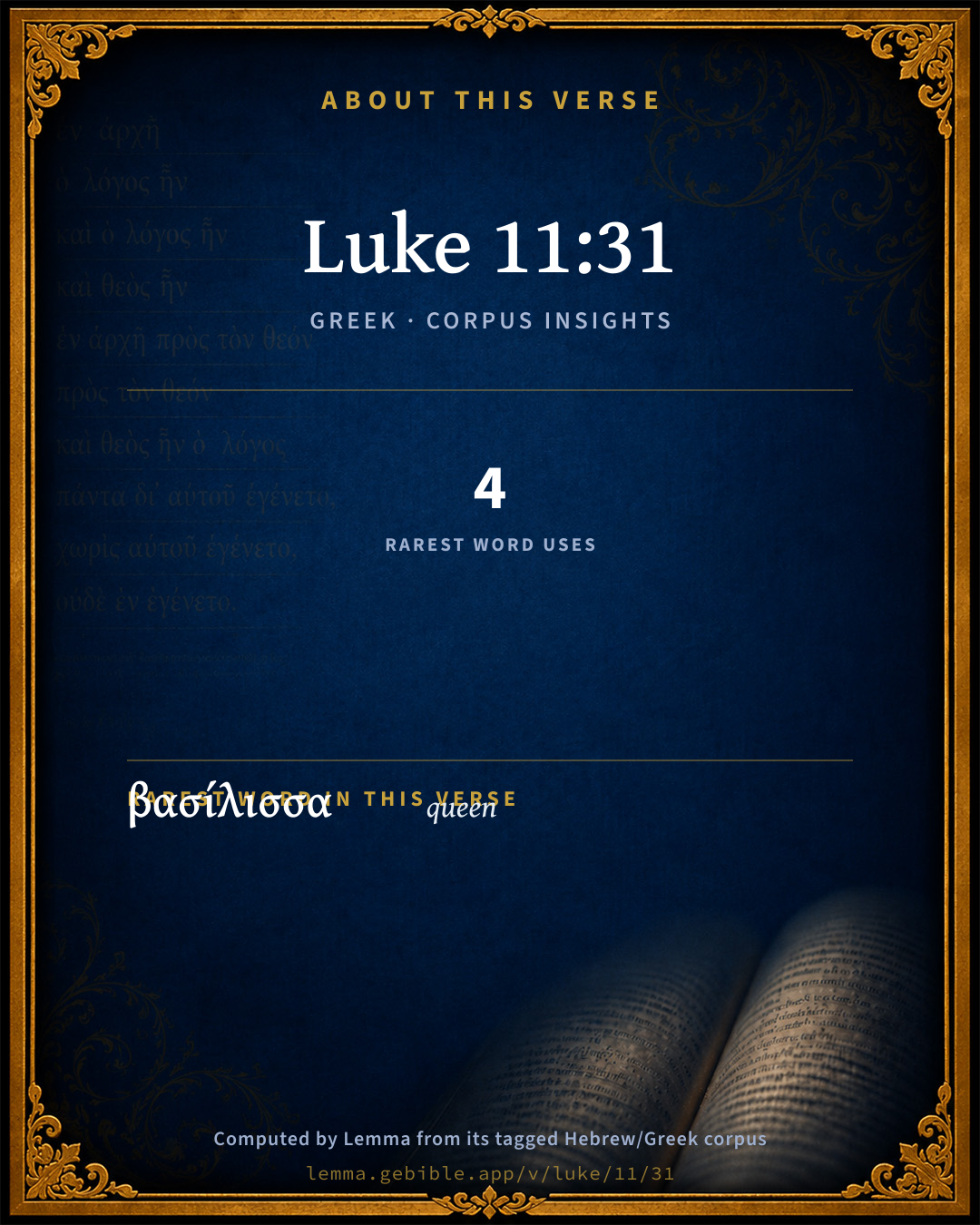
The rarest word here is βασίλισσα queen G938 — appearing just 4 times in the whole Greek New Testament.

Shared distinctive vocabulary

βασίλισσα queen G938 occurs in 4 verses of the Greek New Testament. Also found in:

Repetition

Words recur within this verse:

  • Σολομῶνος Solomon G4672 ×2
  • τῇ the G3588 ×6
  • καὶ and G2532 ×2

Cross-references

9

Topical passages linked to Luke 11:31 in the Treasury of Scripture Knowledge — connected by theme and wording, ordered by reader-vote popularity; previews shown in the World English Bible.

  • 2 Chronicles 9:1 When the queen of Sheba heard of the fame of Solomon, she came to prove Solomon with hard questions at Jerusalem, with a very great train, and camels that bore spices, and gold in abundance, and precious stones: and when she was come to Solomon, she talked with him of all that was in her heart.
  • 1 Kings 10:1–13 When the queen of Sheba heard of the fame of Solomon concerning the name of Yahweh, she came to prove him with hard questions.
  • Jeremiah 3:11 Yahweh said to me, Backsliding Israel has shown herself more righteous than treacherous Judah.
  • Luke 3:22 and the Holy Spirit descended in a bodily form as a dove on him; and a voice came out of the sky, saying "You are my beloved Son. In you I am well pleased."
  • Romans 2:27 Won't the uncircumcision which is by nature, if it fulfills the law, judge you, who with the letter and circumcision are a transgressor of the law?
  • Matthew 12:42 The queen of the south will rise up in the judgment with this generation, and will condemn it, for she came from the ends of the earth to hear the wisdom of Solomon; and behold, someone greater than Solomon is here.
  • Luke 9:35 A voice came out of the cloud, saying, "This is my beloved Son. Listen to him!"
  • Isaiah 9:6–7 For to us a child is born, to us a son is given; and the government shall be on his shoulder: and his name shall be called Wonderful, Counselor, Mighty God, Everlasting Father, Prince of Peace.
  • Hebrews 11:7 By faith, Noah, being warned about things not yet seen, moved with godly fear, prepared an ark for the saving of his house, through which he condemned the world, and became heir of the righteousness which is according to faith.

Cross-references courtesy of OpenBible.info (CC BY 4.0).

Commentary

Notes on Luke 11:31 from classic Christian and Jewish commentators (each source and its license shown beneath its notes). The classic Christian expositions comment on the surrounding passage and are grouped to its opening verse, so a note may address several verses; the Jewish commentaries on the Tanakh (Rashi and others) are per-verse, so they appear only where the commentator wrote on this verse.

Lemma curates 59 commentaries, every one of them public domain or Creative Commons licensed, each selected and text-cleaned for this edition rather than reprinted as found. About our sources →

The Biblical Illustrator

Joseph S. Exell

Luk_11:31-32

A greater than Solomon is here

Christs superiority to Solomon

The superiority of Christ to Solomon may be traced in the following particulars.

1. In His origin. Solomon was indeed of honourable descent, being of the princely tribe of Judah, and of the family of David, who was one of the most illustrious monarchs that ever filled the throne of Israel. No one could claim a higher pedigree than Solomon, or receive a crown from the hands of a more honourable ancestor. Yet Jesus was Davids greater Son, and to Him the pre-eminence belonged. With respect to His human nature, He was a rod from the stem of Jesse, and a branch growing out of his roots. With respect to His Divine nature, He is the eternal, co-existent, and coequal Son of God, in a way mysterious and unknown.

2. In personal qualifications Christ obtains the pre-eminence, especially in that for which Solomon was so highly celebrated. Solomon with all his wisdom was weak and fallible, and liable to the greatest folly; but the Lord Jesus is wisdom itself, wisdom in the very abstract. He was liable to no mistake, to no error, either in judgment or in practice. He was the pattern of all excellence, and of all perfection. Even His enemies were astonished at His doctrine, and testified that never man spake like this Man. In two things especially He excelled all other teachers; He had the most perfect comprehension of His subject, and the power of making it effectually understood, not merely by outward instruction, but by internal illumination.

3. Christ exceeded Solomon in the purity of His life and the general excellence of His character.

4. Solomon sustained the two-fold office of prophet and king, and in both these Christ has the pre-eminence.

5. Christ exceeded Solomon in the mighty works which He performed as well as in His general character and dignity.

6. In the present glory which these illustrious personages possess, there can be no doubt which of them obtains the pre-eminence. Though Solomon was a partaker of Divine grace, and is now an inheritor of the invisible glory, it can bespeak no want of charity to suppose that his inconstancy and backslidings in religion have in some degree tarnished the lustre of his celestial diadem; but be it ever so bright and splendid, it falls infinitely short of that which is placed on the Redeemers head, as the reward of His obedience unto death.

(1) Let us contemplate the character of our Lord and Saviour with astonishment and delight, for a greater than Solomon is here. Let us consider the apostle and high priest of our profession, withdrawing our thoughts from every other object, and fixing them intensely upon Him.

(2) As no object is so amiable and attractive, let us view the Saviour till our hearts are inflamed with love.

(3) Let us view the Saviour by faith, saying with the prophet, I will look unto the Lord, I will wait for the God of my salvation.

(4) View His condescension with astonishment and love, that one so much greater than Solomon should have humbled Himself unto death, even the death of the cross, that He might raise us to dignity and honour. (B. Beddome, M. A.)

A greater than Solomon

Our first thought is that no mere man would have said this concerning himself unless he had been altogether eaten up with vanity; for Solomon was among the Jews the very ideal of greatness and wisdom. The second thought that comes to ones mind is this: Notice the self-consciousness of the Lord Jesus Christ. He knows who He is, and what He is, and He is not lowly in spirit because He is ignorant of His own greatness. He was meek and lowly in heart--Servus servorum, as the Latins were wont to call Him, Servant of servants, but all the while He knew that He was Rex regum, or King of kings.

I. BETWEEN CHRIST AND SOLOMON THERE ARE SOME POINTS OF LIKENESS.

1. And, first, in wisdom. He intermeddled with all knowledge, and was a master in all sciences. He was a naturalist; an engineer and architect; a politician, &c. He was everything, in fact. God gave Him wisdom and largeness of heart, says the Scripture, like the sand of the sea: and Solomons wisdom excelled the wisdom of all the children of the east country, and all the wisdom of Egypt. For he was wiser than all men; and his fame was in all nations round about. Yes; but our Saviour knows infinitely more than Solomon. I want you to-night to come to Him just as the Queen of Sheba came to Solomon, only for weightier reasons. You do not want to learn anything concerning architecture or navigation, agriculture or anatomy. You want to know only how you shall be built up a spiritual house, and how you shall cross those dangerous seas which lie between this land and the celestial city. Well, you may come to Jesus, and He will teach you all that you need to know, for all wisdom is in Christ.

2. Observe, next, that our Lord Jesus Christ is greater than Solomon in wealth. This was one of the things for which Solomon was noted. He had great treasures: he made gold to be as stones, and as for silver it was little accounted of, so rich did he become. But, oh, when you consider all the wealth of Solomon, what poor stuff it is compared with the riches that are treasured up in Christ Jesus.

3. There was one point about Solomon in which every Israelite rejoiced, namely, that he was the prince of peace. His name signifies peace. His father, David, was a great warrior, but Solomon had not to carry on war. Those were halcyon days for Israel when Solomon reigned. Ah, but in that matter a greater than Solomon is here; for Solomon could not give his subjects peace of mind, he could not bestow upon them rest of heart, he could not ease them of their burden of guilt, or draw the arrow of conviction from their breast and heal its smart.

4. A fourth thing for which Solomon was noted was his great works. Solomon built the temple, which was one of the seven wonders of the world in its time. A very marvellous building it must have been. In addition to this he erected for himself palaces, constructed fortfications, and made aqueducts and great pools to bring streams from the mountains to the various towns. He also founded Palmyra and Baalbec--those cities of the desert--to facilitate his commerce with India, Arabia, and other remote regions. He was a marvellous man. And yet a greater than Solomon is here, for Christ has brought the living water from the throne of God right down to thirsty men, being Himself the eternal aqueduct through which the heavenly current streams. Christ has built fortresses and munitions of defence, behind which His children stand secure against the wrath of hell; and He has founded and is daily finishing a wondrous temple, His Church, of which His people are the living stones, and which God Himself shall inhabit.

5. Solomon was great as to dominion. He managed to bring various kings into subjection to him, and he was the greatest monarch that ever swayed the sceptre of Judah. It has all gone now. Poor, feeble Rehoboam dropped from his foolish hands the reins his father held. The kingdom was rent in pieces, the tributary princes found their liberty, and the palmy days of Israel were over. On the contrary, our Lord Jesus Christ at this moment has dominion over all things. God has set Him over all the works of His hands.

II. BETWEEN CHRIST AND SOLOMON THERE IS MUCH MORE CONTRAST THAN COMPARISON--much more difference than likeness.

1. In His nature the Lord Jesus is greater than Solomon.

2. In His character.

3. In His influence.

4. In His power to bless. (C. H. Spurgeon.)

A privileged nation judged by the heathen

Mr. Johnstone observes that When Japan was recently revolutionised, the inhabitants adopted Occidental customs, and many of them--chiefly their style of dress, social manners, and form of government--were taken from England. It was thought by those in authority in Japan that it would be well to look into the English religion, and see if it were better, and tended to the moral advancement of those professing it. A deputation was sent for that purpose, and beginning at London, set itself to study the Christian religion.

I know not where they went to, nor from what standpoint they viewed it; but their report was unfavourable. They said that never in Japan had they seen such sin, such open licentiousness, drunkenness, selfishness, unkindness, and lack of sympathy as they had witnessed among the professed Christians of England, and they would advise that they adhere to their own religion, which was as good, if not better, than the Christian. Such was their report, after witnessing the life of the people of nominally Christian England.

The Biblical Illustrator, edited by Joseph S. Exell (c. 1880s–1900s) — public domain. Text from a community e-Sword module.

Tyndale Open Study Notes

Tyndale Open Resources

11:31 Sheba was a kingdom in southern Arabia. The queen traveled a great distance to hear the wisdom of Solomon (1 Kgs 10:1-13; 2 Chr 9:1-12).

Tyndale Open Study Notes — © Tyndale Open Resources, licensed CC BY-SA 4.0. Text via the HelloAO Bible API.

Bengel's Gnomon

Johann Albrecht Bengel

Luk 11:31. Ἀνδρῶν, the men) Because, though but a woman, this queen followed after wisdom.

Bengel's Gnomon of the New Testament — English translation (T&T Clark, Edinburgh, 1860) — public domain. Text from a community e-Sword module.

Expositor's Greek Testament

ed. W. Robertson Nicoll

Luk 11:31-32 = Mat 12:41 ; Mat 12:22 , only that the men of Nineveh and the Queen of Sheba change places. Mt.’s order seems the more natural, the discourse so passing from the sign of Jonah to the Ninevites, who had the benefit of it.

The Expositor's Greek Testament, edited by W. Robertson Nicoll (1897–1910) — public domain. Text from a community e-Sword module.

Adam Clarke's Commentary

Verse 31. The queen of the south, &c.] Perhaps it would be better to translate, A queen of the south, and the men of this race, shall rise up in judgment, &c. See Clarke on Lu 11:7. The 32d verse Lu 11:32 may be read in the same way.

Adam Clarke's Commentary on the Bible (1810–1826) — public domain. Text from a community e-Sword/MySword module.

The Cambridge Bible for Schools and Colleges

gen. ed. J. J. S. Perowne

31. The queen of the south] The queen of Sheba (1Ki_10:1-13; 2Ch_9:1-12). The visit of this queen of Yemen made a deep impression on Oriental imagination, and is found in the Koran (xxvii., &c.) “dilated with nonsense and encumbered with fables.”

to hear the wisdom of Solomon] and also “to prove him with hard questions,” 1Ki_10:1.

a greater] Rather, something more.

The Cambridge Bible for Schools and Colleges (gen. ed. J. J. S. Perowne; Cambridge University Press, 1878–1918) — public domain. Text from a community e-Sword module.

John Gill's Exposition

No man when he hath lighted a candle,.... These words are often repeated by Christ on different occasions; see Gill on Mat 5:15 and See Gill on Luk 8:16 and here seem to design the free, open, and clear ministry of Christ, who excelled Solomon in wisdom, and Jonas in powerful preaching. It being as a candle, which, when lighted, no man

putteth in a secret place; as under a bed, Mar 4:21 where it cannot be seen, and its light be of any use:

neither under a bushel, but on a candlestick, that they which come may see the light; intimating, that Christ and his disciples did not preach in corners, or in private houses, and secret places, but in the streets of the city, and in the temples and synagogues, the public places of worship: and therefore the Jews were the more inexcusable, that they did not attend to the ministry of the word; and this would be their condemnation, that light was come among them, and they preferred darkness to it, Joh 3:19.

John Gill's Exposition of the Whole Bible (1746–1763) — public domain (CC PDM 1.0). Text via the HelloAO Bible API.

Trapp's Complete Commentary

John Trapp

31 The queen of the south shall rise up in the judgment with the men of this generation, and condemn them: for she came from the utmost parts of the earth to hear the wisdom of Solomon; and, behold, a greater than Solomon is here.

Ver. 31. See Mat 12:41-42.

John Trapp, A Commentary or Exposition upon All the Books of the Old and New Testament (1647–1656) — public domain. Text from a community e-Sword module.

Haydock's Catholic Bible Commentary

Queen of the South shall condemn this generation, not by exercising the power of judgment against them, but by having performed an action which, when put in competition with theirs, will be found superior to them. (Ven. Bede)

George Leo Haydock (1774–1849), Haydock's Catholic Family Bible and Commentary, 1859 edition — public domain. Excludes Psalms (Douay-Rheims chapter numbering differs from Protestant) and Deuterocanonical books (Catholic canon only).

The Pulpit Commentary

The queen of the south shall rise up in the judgment with the men of this generation, and condemn them: for she came from the utmost parts of the earth to hear the wisdom of Solomon; and, behold, a greater than Solomon is here. The Queen of Sheba, her visit to King Solomon, and its subsequent results made a lasting impression throughout the East; probably the immediate consequence was that a great commerce was opened up between Yemen, of which she was queen, and other parts of Arabia and the far East. The Talmud and Koran, for instance, have various legends respecting this Eastern queen who was so dazzled and impressed by the magnificent Israelitic sovereign. Such a simile would be singularly attractive to the common folk who were then, we know (from ver. 29), crowding round Jesus. King Solomon"s wisdom charmed and attracted from far countries the famous queen. Lo! One wiser than Solomon was in their midst: can we not hear from the honest, plain folk around him a murmur of assent here? Hadn"t they been just listening to his wise words when the Pharisees tried to prejudice them against him? Hadn"t they burst out, in the person of the woman of vers. 27, 28, with an irrepressible sign of admiration? Lo! the great Arabian queen, when at the day of judgment she arose, would condemn Israel for their blind folly.

Vers. 31, 32. Christ and Solomon.

It is one of the strong arguments in favor of our Lord"s Divinity that, while there was that about him which made him free to claim for himself the attribute of meekness, (Mat_11:29) and which saved him from the charge of immodesty, yet was there in him a wonderful and wholly exceptional consciousness of greatness. On appealing to his own consciousness, he found himself anterior in existence to Abraham; (Joh_8:58) greater (of more consequence to the nation) than the very temple itself, that object of boundless veneration; (Mat_12:6) living in heaven even while dwelling on the earth; (Joh_3:13) associated in the most intimate way possible and (to us) inconceivable with the Divine Father; (Joh_5:19 Joh_6:46 Joh_10:30) wiser and worthier than the "wise man" himself (text). It may not be surprising that One claiming to be a Prophet should believe himself to be superior in worth and work to Jonah; for there was nothing remarkably great either in the moral character or in the professional course of that erratic prophet. But in respect to Solomon? It may be said that only One who could claim to be highest among the highest was entitled to say, "I am greater than he." But the actual superiority of Christ to Solomon is apparent enough if we consider

I THE DIGNITY OF HIS PERSON. The Son of David was great, as such; but nothing in comparison with the Son of God. The King of Israel was great, as such; but nothing when compared with the Prince of peace, with him "who sitteth on the throne" of heaven.

II THE CHARACTER OF THE WISDOM. Solomon was very learned in the knowledge of his age; (1Ki_4:29-34) he was also very skilled in the intellectual conflicts of his time; (1Ki 10) he had, moreover, a very keen discernment of the ways and wants and weaknesses of human nature (Proverbs). And he had (what Jesus Christ had not) an acquaintance, gained by his own experience, of the hollowness of earthly greatness, of the pitiful consequences of human folly. But the wisdom of Christ was the wisdom of God. For such he had, and such indeed he was. He was "the Truth"; (Joh_14:6) he was "the Wisdom of God". (1Co_1:24, 1Co_1:30) He knew and taught mankind, as Solomon could not do, the nature and the will of God; (Luk_10:22) the capacities and the possibilities of man; (Joh_2:25) the way home to God; (Joh_14:6) the secret of spiritual triumph; (Mat_10:39) the glory and the shame awaiting the faithful and the unfaithful in the future. (Mt 25)

III THE BEAUTY AND EXCELLENCY OF HIS LIFE. Beginning admirably, (1Ki_3:5) and continuing well for a season, Solomon gave way to dangerous luxury, to selfish and exacting legislation, and at last to moral corruption. (1Ki_11:1-10) The surpassing beauty of the character of Jesus Christ became more manifest as his life continued, and it culminated in a supreme act of self-sacrifice which is the crowning glory of his life.

IV THE GLORY OF HIS CAREER. Solomon"s career began in brilliance, it remained bright for many years; but its light waned as his character declined, and it was concluded in sombre shadows. The career of Jesus Christ began in lowliest obscurity, it continued in struggle and in sorrow for a while; but it has risen into the light, it becomes ever more blessed as his influence grows ever wider and deeper; it will not be complete until all the kingdoms of the earth are in subjection to his holy will.

1. Are we wise in the wisdom of Christ?

2. Are we the subjects of his benignant rule? C.

Comparative guilt.

The main truth of the text, that the weight of our guilt depends on the measure of our privilege, rests on the solid foundation of

I MAN"S MORAL FREEDOM. However much character may be affected by circumstance, it remains true that man is a free agent. When we condemn ourselves or others, as we continually do; when we distinguish between misfortune and sin, between calamity and crime; whenever we apply the word "ought" to our own or to another"s behavior; we practically assent to the doctrine that man is spiritually free; otherwise such action on our part is unjust or illogical, such language improper. But, in truth, a sense of our moral freedom is inwrought in our deepest convictions; we cannot extricate it from our nature, however much we try.

II OUR ACCOUNTABLENESS TO GOD FOR OUR CHARACTER AND LIFE.

1. God is requiring great things of us thought, reverence, affection, submission, obedience.

2. He is marking at every moment the life we are living, the character we are forming; he is looking upon us and into us.

3. He is recording all our actions, including among these the thoughts of our mind, the feelings of our heart, the purposes of our will.

4. He will one day call us to give an account of all the things done in the flesh.

III A REVEALED PRINCIPLE OF DIVINE JUDGMENT. The men of Nineveh, the great Teacher tells us, will be a source of condemnation to those of Judaea, for with slighter privilege they repented, while the contemporaries of our Lord remained impenitent at the preaching of Christ himself.

1. There is to be punishment in the future.

2. This will be comparative some guilty servants will be "beaten with few stripes," others with" many.

3. This, again, will depend on the degree of condemnation, whether it will be less or more severe.

4. And on what, then, will God"s condemnation hang? Surely on two things.

(1) On the guiltiness of the character and life; for of the condemned there will be those in whom there was the "some good thing," or even many good things; and there will be those in whom there was no good thing toward God, but in whom were shameful things of many kinds.

(2) On the character of Gods requirement; for God will require much less of some men than he will of others. What he will require of us depends on the measure of spiritual capacity he has conferred upon us, and also (and very largely) on the measure of the privilege he has granted to us. From those to whom Christ had preached he would require far more than from those to whom Jonah had delivered his brief warning message. And if we reject the gospel of the grace of God, how guilty shall we be in comparison with the men of our Master"s own time! Surely we shall be at least as guilty as they. For though, indeed, we do not actually behold the countenance of the Son of man, nor hear the tones of his voice, yet we do "sit at his feet;" we are his disciples; we know the thoughts of his mind; we understand his will; we are familiar with his overtures of love. Indeed, we have certain great advantages which those to whom our Lord was speaking did not possess.

(a) We have the light that shines not only from the whole of his completed life, but also from his death and resurrection.

(b) We have Christ"s own commentary, through the writings of his inspired apostles, upon his life and death.

(c) We have freedom from the national prepossessions which misguided those, his hearers.

(d) We have the accumulated experience of the Christian Church through eighteen centuries. If we heed not his Word, and range not ourselves on his side, if, "gathering not" with him the sheaves of righteousness, we scatter abroad the seeds of sin and death, who will there not be "to rise up in the judgment" and condemn us! C.

The Pulpit Commentary (1880–1919), ed. H.D.M. Spence-Jones & Joseph S. Exell — public domain. Text from a community e-Sword module.

unfoldingWord translationNotes

Door43 World Missions Community

Queen of the South

This refers to the Queen of Sheba. Sheba was a kingdom south of Israel.

will rise up at the judgment with the men of this generation

"will stand up and judge the people of this time"

she came from the ends of the earth

This idiom means that she came from very far away. AT: "she came a very great distance" or "she came from a place very far away" (See: Idiom)

someone greater than Solomon is here

Jesus is speaking about himself. AT: "I, who am greater than Solomon, am here" (See: Assumed Knowledge and Implicit Information)

someone greater than Solomon

Jesus is speaking about himself. AT: "I am greater than Solomon" (See: Assumed Knowledge and Implicit Information)

translationWords

queen

judgment day

condemn

wise

Solomon

unfoldingWord translationNotes — © Distant Shores Media and the Door43 World Missions Community, licensed CC BY-SA 4.0. Source: git.door43.org/Door43/en_tn.

Cambridge Greek Testament for Schools and Colleges

31. βασίλισσα νότου. The queen of Sheba (1Ki 10:1-13; 2Ch 9:1-12). The visit of this queen of Yemen made a deep impression on Oriental imagination, and is found in the Koran (xxvii., &c.) “diluted with nonsense and encumbered with fables.”

μετὰ τῶν ἀνδρῶν. Woman though she was she will rise with the men (ἀνδρῶν not ἀνθρώπων).

ἀκοῦσαι τὴν σοφίαν Σολομῶνος. And also “to prove him with hard questions,” 1Ki 10:1.

πλεῖον. ‘Something more.’

Cambridge Greek Testament for Schools and Colleges (Cambridge University Press, 1896; 21 vols, various authors incl. Carr, Maclear, Plummer, Farrar, Lumby, Moule, M. R. James, Simcox) — public domain. Text from a community e-Sword module.

International Critical Commentary

31. βασίλισσα νότου. Lk. inserts this illustration between the two sayings about Jonah. Mt. keeps the two sayings about Jonah together. Lk. places the Ninevites after the Queen of Sheba either for chronology, or for effect, or both: their case was the stronger of the two. There is a threefold contrast in this illustration: (1) between a heathen queen and the Jews; (2) between the ends of the earth and here; (3) between Solomon and the Son of Man. There may possibly be a fourth contrast between that enterprising woman and the men of this generation implied in ἀνδρῶν, which is not in Mt.

νότου … ἐκ τῶν περάτων τῆς γῆς. Sheba was in the southern part of Arabia, the modern Yemen, near the southern limits of the world as then known. Comp. Psa 2:8.

πλεῖον Σολομῶνος. There is no need to understand σημεῖον: “a greater thing, something greater, than Solomon.”

International Critical Commentary — older volumes (1896–1929), various authors — public domain. Text from a community e-Sword module.

Vincent's Word Studies in the New Testament

Marvin R. Vincent

Shall rise up [εγερθησεται] . From the dead.

A greater [πλειον] . Lit., something more. See on Mt 12:6. Wyc., here is more than Solomon.

Marvin R. Vincent, Word Studies in the New Testament (1887–1900) — public domain. Text from a community e-Sword/MySword module.

Lesson kit

Teaching starters — assembled from the data on this page, not authored interpretation. Every prompt links to the verse data it draws on. Edit before teaching.

Luke, in the Gospels, opens this verse with 31 words (24 distinct Greek lemmas). Its most distinctive word is basílissa (“queen”). A historical commentator’s framing appears above. Read the whole chapter for the surrounding context.

Discussion questions

  1. What does “queen” (basílissa) contribute to the verse as a whole?
  2. How does Matthew 12:42, which shares the word «queen», read alongside this verse?
  3. What does the repetition of “Solomon” (2× in this one verse) do in this verse?
  4. The translations on this page render this verse differently — a whole-verse word diff, not a word-by-word alignment. What might account for the different wordings?
  5. Compare how The Biblical Illustrator and Tyndale Open Study Notes read this verse. Where do they agree or differ?

Things to notice

  • These translations choose different wording for 9 words in this verse.
  • “Solomon” occurs 2× in this single verse.
  • 24 distinct Greek lemmas span 31 words in this verse.

Reading settings

Reading text

Shown beneath each verse's original-language words.

Old Testament
Old Testament edition

Read the OT as the Masoretic Hebrew (MT) or the Greek Septuagint (LXX).

English shown for the Greek Septuagint (in the Hebrew ↔ Greek comparison).

Comparing translations? Open the Compare panel on any verse page to stack up to four side by side.