Luke 2:19

Greek (Tischendorf 8th ed.) Luke 2:19 appears in the Greek New Testament. The text above is from the Tischendorf 8th edition. Each word links to its Strong’s number and a concise gloss. Click any word for its full Thayer’s Greek Lexicon entry.
Download image
Cite this verse

Luke 2:19 (World English Bible). Public Domain. Lemma interlinear Bible study tool, https://lemma.gebible.app/v/luke/2/19.

Show BibTeX & RIS
BibTeX
RIS
English Translation
But Mary kept all these sayings, pondering them in her heart.
World English Bible · Public Domain
Highlights
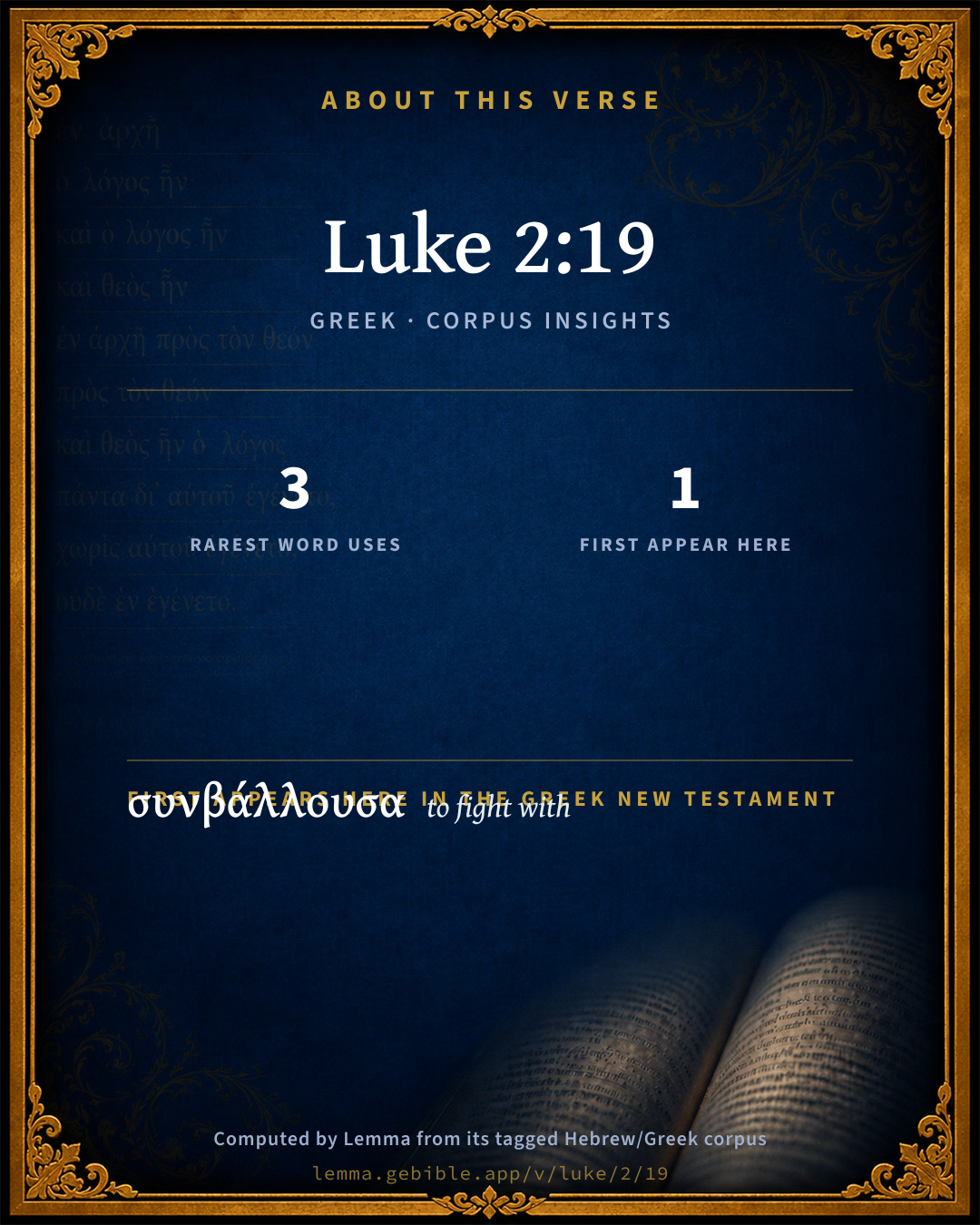
  • 1 first appearance in the Greek New Testament
Full analysis ↓
Download a study sheet

One document with this verse’s original text, its word-by-word gloss line, the meaning frame, cross-references with their text, attributed commentary, and full source and license credits — printable, and it pastes into notes with its structure intact.

This verse Autodidact and up

Study sheet (.html) Plain text (.txt)

A passage Seminary Student

Up to 50 verses in one chapter. A passage sheet keeps up to 6 commentary sources and 12 cross-references per verse, in the order this page ranks them, and says so on the sheet whenever that leaves anything out. Ask for a single verse and you get the Autodidact verse sheet above.

Everything on this page stays free to read, with no account — the sheet is a download of what is already on screen, not access to it.

Want to remove ads? Support Godless Engineer
Compare translations 3

The same verse in 3 English versions, stacked beneath the original-language interlinear above. Click any original word for its lexicon entry.

Each is an independent rendering of the whole verse — the interlinear is not word-aligned to these translations.

Highlighted words mark where these versions differ — a whole-verse word diff, not a word-by-word alignment.

  • World English Bible Public Domain
    But Mary kept all these sayings, pondering them in her heart.
  • King James Version Public Domain
    But Mary kept all these things, and pondered them in her heart.
  • unfoldingWord Literal Text CC BY-SA 4.0
    But Mary kept all these things, pondering them in her heart.

unfoldingWord Literal Text — © unfoldingWord, licensed CC BY-SA 4.0. Word-aligned USFM3 via Door43 (git.door43.org/unfoldingWord/en_ult).

Versions to compare (up to 4)

3 of 4 selected

Show all 19 translations

Every available English version of this verse, each an independent rendering of the whole verse.

  • World English Bible Public Domain
    But Mary kept all these sayings, pondering them in her heart.
  • Berean Standard Bible Public Domain
    But Mary treasured up all these things and pondered them in her heart.
  • Majority Standard Bible Public Domain
    But Mary treasured up all these things and pondered them in her heart.
  • King James Version Public Domain
    But Mary kept all these things, and pondered them in her heart.
  • American Standard Version (1901) Public Domain
    But Mary kept all these sayings, pondering them in her heart.
  • Revised Version (1885) Public Domain
    But Mary kept all these sayings, pondering them in her heart.
  • Geneva Bible (1599) Public Domain
    But Mary kept all those sayings, and pondred them in her heart.
  • Douay-Rheims (1899) Public Domain
    But Mary kept all these words, pondering them in her heart.
  • Young's Literal Translation Public Domain
    and Mary was preserving all these things, pondering in her heart;
  • Literal Standard Version CC BY-SA 4.0
    and Mary was preserving all these things, pondering [them] in her heart;
  • Unlocked Literal Bible CC BY-SA 4.0
    But Mary kept thinking about all the things she had heard, treasuring them in her heart.
  • unfoldingWord Literal Text CC BY-SA 4.0
    But Mary kept all these things, pondering them in her heart.
  • Darby Bible Public Domain
    But Mary kept all these things [in her mind], pondering [them] in her heart.
  • World Messianic Bible Public Domain
    But Miriam kept all these sayings, pondering them in her heart.
  • Webster's Bible Public Domain
    But Mary kept all these things, and pondered them in her heart.
  • Free Bible Version CC BY-SA 4.0
    But Mary was careful to remember all the things that had happened and often thought about them.
  • Bible in Basic English Public Domain
    But Mary kept all these words in her heart, and gave much thought to them.
  • Text-Critical English NT CC BY 4.0
    But Mary treasured up all these things, pondering them in her heart.
  • Tyndale New Testament (1534) Public Domain
    But Mary kept all thoose sayinges and pondered them in hyr hert.

Literal Standard Version (2020), Covenant Press — licensed CC BY-SA 4.0. Text via the HelloAO Bible API (eBible.org). Unlocked Literal Bible (unfoldingWord) — licensed CC BY-SA 4.0. Text via the HelloAO Bible API (eBible.org). unfoldingWord Literal Text — © unfoldingWord, licensed CC BY-SA 4.0. Word-aligned USFM3 via Door43 (git.door43.org/unfoldingWord/en_ult). Free Bible Version, Dr. Jonathan Gallagher — licensed CC BY-SA 4.0. Text via the HelloAO Bible API (eBible.org).

Word by word

More ways to search: Search by grammar → Find every occurrence → Compare this word →

Practice this passage: Drill this verse → Learn its vocabulary →

συνετήρει
syntēréō
G4933
“to preserve”
Verb, Imperfect, Active, Indicative, 3rd person, Singular
Part of Speech
Verb
Tense
Imperfect
Voice
Active
Mood
Indicative
Person
3rd person
Number
Singular
Full Thayer's Definition

Origin: from G4862 and G5083

TDNT: 10:31,1

1. to preserve (a thing from perishing or being lost) 2. to keep within one's self, keep in mind (a thing, lest it be forgotten)
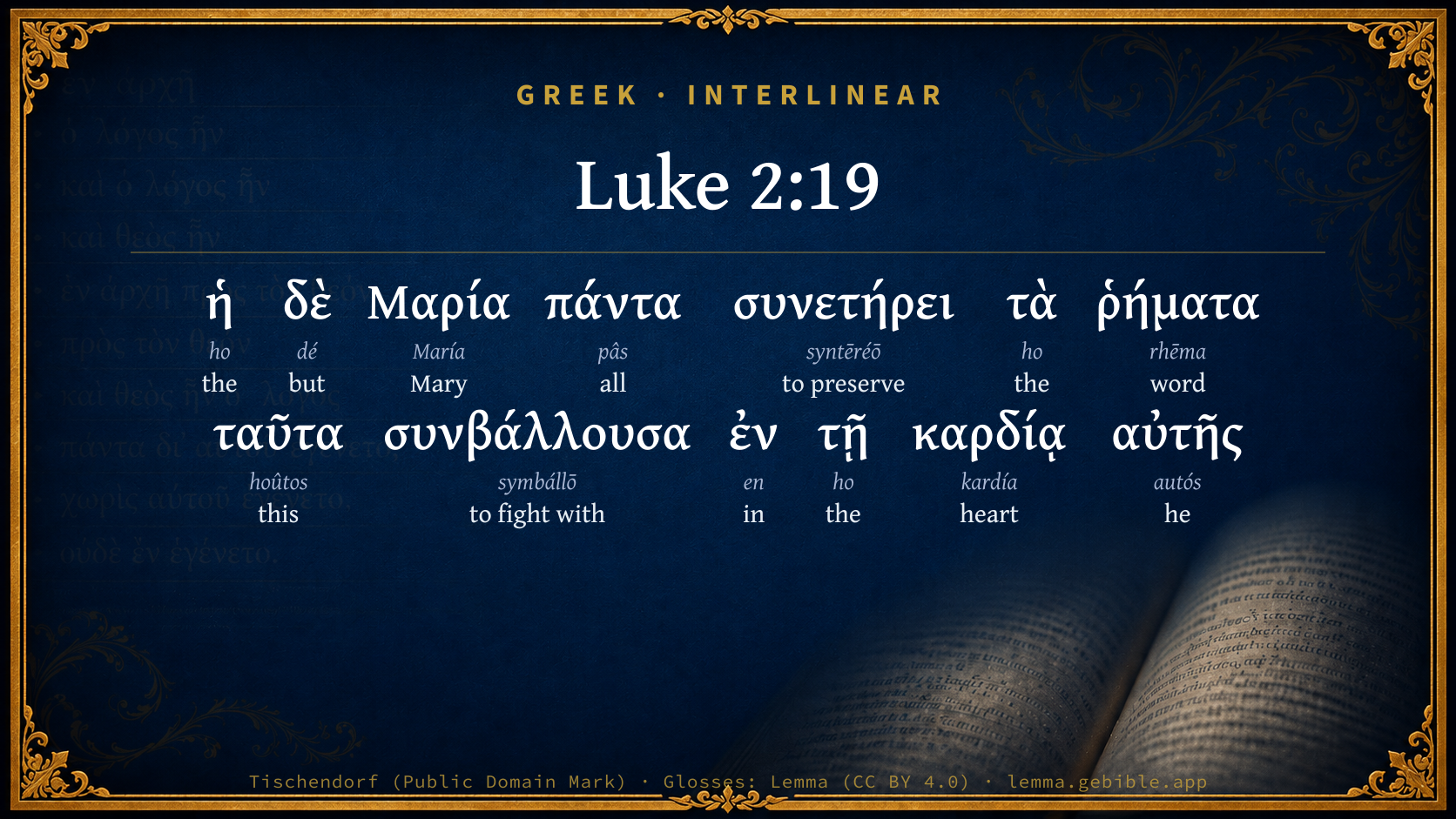
  1. ἡ ho G3588 “the” Article, Nominative, Singular, Feminine
  2. δὲ dé G1161 “but” Conjunction
  3. Μαρία María G3137 “Mary” Noun, Nominative, Singular, Feminine
  4. πάντα pâs G3956 “all” Adjective, Accusative, Plural, Neuter
  5. τὰ ho G3588 “the” Article, Accusative, Plural, Neuter
  6. ῥήματα rhēma G4487 “word” Noun, Accusative, Plural, Neuter
  7. ταῦτα hoûtos G3778 “this” Demonstrative pronoun, Accusative, Plural, Neuter
  8. συνβάλλουσα symbállō G4820 “to fight with” Verb, Present, Active, Participle, Nominative, Singular, Feminine
  9. ἐν en G1722 “in” Preposition
  10. τῇ ho G3588 “the” Article, Dative, Singular, Feminine
  11. καρδίᾳ kardía G2588 “heart” Noun, Dative, Singular, Feminine
  12. αὐτῆς autós G846 “he” Personal pronoun, Genitive, Singular, Feminine

About this verse

These counts appear in no published source. They are computed here, from the morphology-tagged text and Lemma’s own curated glosses. What Lemma adds →

13
words
11
distinct lemmas
Gospels
section

Notable vocabulary

The rarest word here is συνετήρει to preserve G4933 — appearing just 3 times in the whole Greek New Testament.

First appearance in Scripture

This word makes its first canonical appearance in the Greek New Testament here:

  • συνβάλλουσα to fight with G4820

Shared distinctive vocabulary

συνετήρει to preserve G4933 occurs in 3 verses of the Greek New Testament. Also found in:

Repetition

A word recurs within this verse:

Cross-references

7

Topical passages linked to Luke 2:19 in the Treasury of Scripture Knowledge — connected by theme and wording, ordered by reader-vote popularity; previews shown in the World English Bible.

  • Luke 2:51 And he went down with them, and came to Nazareth. He was subject to them, and his mother kept all these sayings in her heart.
  • Luke 1:66 All who heard them laid them up in their heart, saying, "What then will this child be?" The hand of the Lord was with him.
  • Genesis 37:11 His brothers envied him; but his father kept this saying in mind.
  • 1 Samuel 21:12 David laid up these words in his heart, and was very afraid of Achish the king of Gath.
  • Proverbs 4:4 He taught me, and said to me: "Let your heart retain my words. Keep my commandments, and live.
  • Hosea 14:9 Who is wise, that he may understand these things? Who is prudent, that he may know them? For the ways of Yahweh are right, And the righteous walk in them; But the rebellious stumble in them.
  • Luke 9:43–44 They were all astonished at the majesty of God. But while all were marveling at all the things which Jesus did, he said to his disciples,

Cross-references courtesy of OpenBible.info (CC BY 4.0).

Commentary

Notes on Luke 2:19 from classic Christian and Jewish commentators (each source and its license shown beneath its notes). The classic Christian expositions comment on the surrounding passage and are grouped to its opening verse, so a note may address several verses; the Jewish commentaries on the Tanakh (Rashi and others) are per-verse, so they appear only where the commentator wrote on this verse.

Lemma curates 59 commentaries, every one of them public domain or Creative Commons licensed, each selected and text-cleaned for this edition rather than reprinted as found. About our sources →

The Biblical Illustrator

Joseph S. Exell

Luk_2:19

And pondered them in her heart

Marys musings

Great things were these which she kept, and most fit for earnest pondering.

Great were they to all, greatest to her, the highly favoured amongst women. Life was opening strangely upon her; and the last few months had crowded into their narrow compass all that was most fit to stir the very depths of her spirit. Brought up in the, comparative seclusion which shut in Jewish damsels, the angel of the Most High had stood suddenly beside her, and troubled her mind by the strangeness of his salutation. Then had followed the fears and hopes which the promise of that angel-visitor had interwoven with her very being. The Desire of all nations was at last to come, and she should be indeed His mother. From her should spring that mighty Redeemer, to give birth to whom had been the earnest longing of every Jewish mother. What hopes and wonder must have filled her soul! At length the months of waiting passed away, and the gracious birth was come, the promised Child was born, the Son of hope was given; and still how much was there upon which to muse and ponder! There was the full tide of a mothers love for the Babe which slept beside her; there was the awful reverence of her pious soul for the unknown majesty of Him who of her had taken human flesh. Depths were all around her, into which her spirit searched, in which it could find no resting-place. How was He, this infant of days, the Everlasting Son? How was He to make atonement for her sins and the sins of her people? When would the mystery begin to unfold itself? As yet it lay upon her thick and impenetrable; all was dark around her; mighty promises and small fulfilments seemed to strive together in the womb of time. The angel had called Him Great, the Son of the Highest; but He lay there on her bosom weak and wailing as any other babe. He was to sit upon the throne of David; yet He was cradled in a manger. Angels broke on mortal sight, to make His birthplace known: yet none but the shepherds of Bethlehem had heard their message. A star from heaven guided eastern magi to His feet; but they made their offerings in a stable. She was highly favoured who had borne Him; yet a sword should pierce through her own soul. All was full of contradictions; yet amidst all she was unmoved. To the eye of a passing observer she might have seemed perhaps insensible--such a quietness there was about her. Did she know her own greatness? Did she feel the strangeness of all around her? Did her soul yearn over this Babe, and reach, forth to comprehend His unknown destiny? or was she indeed destitute of kindling feelings? No; she kept all these things and pondered them in her heart; not one escaped her; but the current of her soul flowed far too deeply to babble forth its emotions. The ornament of a quiet spirit shrouded the mighty swellings of her heart. She was in Gods hands: this one thought was her anchor. Behold the handmaid of the Lord: this was her talisman … So that this is the lesson taught us in the character of the Virgin Mary. The blessedness of cultivating a quiet, trusting spirit, a deep inward piety, a calm, waiting soul, by musing on Gods dealings. This was what distinguished her; this was the groundwork of that strength and nobleness of character which we trace in her. This, therefore, we should likewise cultivate, who would share her blessedness. For this will be to us too, of Gods blessing, a means of acquiring that pious cheerfulness of temper which is the natural mother of high and noble conduct. It is not in a loud profession or an obtrusive exterior, but in its silent inner power of bowing our will to that of God, of filling our common life with His presence, that true religion shows itself. (Bishop Samuel Wilberforce.)

Significant silence respecting Mary

How small a space does Mary hold in the New Testament! how vast a space in the history of the Church! Observe the silence of the record respecting her. Shakespeare, the highest among all who haw conceived the human heart or portrayed human life, is marked above all others, as the New Testament is, by the use of significant silence in representing character--led by his deep instinct to know that whatever is peculiarly fine or high can only in this way be hinted to the apprehension. The highest traits of his highest women especially, and in their highest moments, are indicated--how? Just by a few words, a few touches, coming in between silences of far deeper tone, and so the exquisite outline of those wonderful characters is made out. I find the same in the New Testament. Nothing in it is, to me, so deep and bottomless in meaning and effect as the silences of Christ--a stroke or two, a few lines, giving figure and expression to the formless deep lying below. And the same as to Mary. How few the touches!--only just enough to mark out and give character to the deeps of silence, as, when you hear a strain of music at night, the stillness which follows it is made richer still and more musical than any possibility of sound. The evangelists, having given us certain facts as to Mary, do afterwards almost nothing but remain quiet, and not interfere with the inferences of the Christian heart as to the beautiful nature and wonderful consciousness of the virgin mother. Nothing is said as to her feelings--(silence)--but we understand from a general sense of her character, how meek and submissive that silence is. In things which are above her thought, and which seem to men impossible, in things which bring glory to her, or in things which bring shame, the characteristic of this woman is deep, meek, silent submission; and this, as it is the natural top of true womanhood, so also is it of true Christianity. What she was, her son was also in His wider and grander relations to God. (A. G. Mercer, D. D.)

The inwardness of Marys character

Observe what I may call the inwardness of Marys character. On several occasions, when a common nature would have exulted, when vanity would have babbled, or when common wonder and doubt would have gone asking for explanations, it is said of her, Mary kept all these things, and pondered them in her heart. Now this would not have been repeated as it is, if it had not been a peculiarity and observable. This I call inwardness. There was a hush of awe about it, a disposition to keep a sacred thing sacred; to hide the depths of the heart away from common talk, and to keep their inexpressible-mess hidden to God; to keep all doubts and demurs submissively for His solution; to judge nothing before the time; to draw inward, and compose and hush the entire nature at the footstool of God; in short, her whole heart seems to have been expressed in the one sentence, Behold the handmaid of the Lord; be it unto me according to Thy word. (A. G. Mercer, D. D.)

Hearing should be followed by meditation

Musing makes the fire to burn, and deep and constant thoughts are operative, not a glance or a slight view. The hen which straggles from her nest when she sits a brooding, produces nothing; it is a constant incubation which hatches the young. So when we have only a few straggling thoughts, and do not set a-brooding upon a truth, when we have flashes only, like a little glance of a sunbeam upon a wall, it does nothing; but serious and inculcative thoughts (through the Lords blessing) will do the work. (T. Manton, D. D.)

Value of meditation

Any benefit to be derived from hearing the Word exceedingly depends on meditation. Before we hear the Word, meditation is like a plough, which opens the ground to receive the seed; and after we have heard the Word, it is like the harrow which covers the new-sown seed in the earth, that the fowls of the air may not pick it up: meditation is that which makes the Word full of life and energy to our soul. What is the reason that most men come to hear the Word, as the beasts did in Noahs ark: they came in unclean, and they went out unclean? The reason is, because they do not meditate on the truths they hear; it is but just like putting money into a bag with holes--presently it falls out. The truths they hear preached are put into shallow, neglected memories, and they do not draw them forth by meditation. It is for this reason, that hearing is so ineffectual. Hearing the Word merely is like indigestion, and when we meditate upon the Word, thats digestion: and this digestion of the Word by meditation produces warm affections, zealous resolutions, and holy actions; and therefore, if you desire to profit by hearing the word, meditate. (H. G.Salter.)

Comfort by meditation

Meditation, as it advances the graces of the soul, so the comfort of the soul. God conveys comfort to us in a rational way; and although He is able to rain manna in the wilderness, and to cast in comfort to our souls without any labour of ours, yet usually He dispenses comfort according to the standing rule. He that does not work shall not eat--he that does not labour in the duties of religion shall not taste thesweetness of religion. Now, meditation is the serious and active performance of the soul to which God has promised comfort. The promises of the gospel do not convey comfort to us as they are recorded in the Word merely, but as they are applied by meditation. The grapes, while they hang upon the vine, do not produce that wine which cheers the heart of man: but when they arc squeezed in the wine-press, then they yield forth their liquor, which is of such a cheering nature. So the promises which are in the Word barely, do not send forth that sovereign juice which cheers our hearts; but when we ponder them in our souls, and press them by meditation, then the promises convey the water of life to us. Meditation turns the promises into marrow (Psa_63:5-6); it conveys the strength of them to our souls. (H. G. Salter.)

Meditation nourishes the soul

Out of the abundance of the heart the mouth speaketh; and our best abundance of the heart must be slowly and in quietness prepared. The cattle, when they rest, are yet working to prepare from the grass that sweetest and moat wholesome of beverages--milk. So must we prepare the abundance of the heart. If the milk of our word is to flow from us nourishingly, we must turn the common things of life--the grass--by slow and quiet processes, into sweet wisdom. In retired, meditative hours, the digesting and secreting powers of the spirit act; and thus ourselves are nourished, and we store nourishment for others. (T. T. Lynch.)

Meditation must be experienced to be appreciated

The advantage of meditation is rather to be felt than read. He that can paint spikenard, or musk, or roses, in their proper colour, cannot with all his art draw their pleasant savour; that is beyond the skill of his pencil. (T. Swinnock.)

The Incarnation a subject for devout study

No one can absolve himself from the duty of spiritual thought. The words which I have chosen for a text presents the duty to us with almost startling force. The mother of the Lord had received that direct, personal, living revelation of the purpose and the working of God which none other could have; she had acknowledged in the familiar strain of the Magnificat the salvation which He had prepared through her for His people; she might well seem to have been lifted above the necessity of any later teaching; but when the simple shepherds told their story, a faint echo as we might think of what she knew, she kept all these things, &c., if haply they might show a little more of the great mystery of which she was the minister: she kept them waiting and learning during that long thirty years of silence, waiting and learning during that brief time of open labour, from the first words at the marriage feast to the last words from the cross. And shall we, with our restless, distracted lives, with our feeble and imperfect grasp on Truth, be contented to repeat with indolent assent a traditional confession? Can we suppose that the highest knowledge and the highest know ledge alone is to be gained without effort, without preparation, without discipline, and by a simple act of memory? Is it credible that the law of our nature, which adds capacity to experience and joy to quest, is suddenly suspended when we reach the loftiest field of mans activity?

1. The SPIRIT of our study of the Incarnation must be love illuminated by faith, attested by the heart.

2. It follows that the AIM of our study will be vital and not merely intellectual.

3. If we have felt one touch of the spirit which should animate our contemplation of Christ Born, Crucified, Ascended, for us: if we have realized one fragment of the end to which our work is directed, we shall know what the BLESSING IS. know what it is to see with faint and trembling eyes depth below depth opening in the poor and dull surface of the earth; to see flashes of great hope shoot across the weary trivialities of business and pleasure; to see active about us, in the face of every scheme of selfish ambition, powers of the age to come; to see over all the inequalities of the world, its terrible contrasts, its desolating crimes, its pride, its lust, its cruelty, one over-arching sign of Gods purpose of redemption, broad as the sky and bright as the sunshine; to see in the gospel a revelation of love powerful enough to give a foretaste of the unity of creation, powerful hereafter to realize it. To us also the Christ has been given. To us also the message of the angels has been made known. To us also the sign of the Saviour has been fulfilled. Happy are we--then only happy--if we keep all these things and ponder them in our hearts. (Canon Westcott.)

The profoundest mystery yet is the origin of child-life

It is an unexplored history. The sublimest results often are in the child, and yet not a step can we trace with definiteness backward to know the cause of which this is the little effect. The future beams with revelations in its behalf; but of the particles which go to make it up who can guess? Who knows anything about it? The great Sphinx--standing alone in Egypt half-buried in the sand--what mind conceived that? what hand carved it? what has it to say for itself? or who shall speak for it? Yet every cradle has a sphinx more unreadable and mysterious than the old Sphinx of the desert. It is chiefly this future over which parents brood. A mothers heart is a miracle. She sees what is not there. She creates what she sees and recreates it when a breath blows it all away. She loves what has no lovable quality. The child is a mere prophecy. These feet shall yet walk, but not now. These eyes shall beam, but now they sleep. These hands shall work, or caress, or carve, or carry the sword, but they are helpless now. She kept all these things and pondered them in her heart is true of every Mary, and of every other name by which the mother is known. She ponders the miracle of the babe, and is herself another miracle creating the life which is to come, and which is purely the myth of her imagination. The things spoken by the angels and the shepherds of the Messiah, the mother of Jesus pondered, and every mother is a Mary, and ponders the little traveller knocking at the door of life or sleeping in the hospitable cradle. The unwritten poetry of a mothers heart would give to the world a literature beyond all printed words. (H. F.Beecher.)

THE VIRGIN MARY TO THE CHILD JESUS,

Sleep, sleep, mine Holy One!

My flesh, my Lord I what name?

I do not know A name that seemeth not too high or low,

Too far from me or heaven.

My Jesus, that is best I that word being given

By the majestic angel whose command

Was softly as a mans beseeching said,

When I and all the earth appeared to stand

In the great overflow.

A light celestial from his wings and head

Sleep, sleep, my saving One.

The slumber of His lips meseems to run

Through my lips to mine heart.

And then the drear sharp tongue of prophecy

With the dread sense of things which shall be done,

Doth smite me inly, like a sword.

(Mrs. E. B. Browning.)

THE MOTHER MARY.

Mary, to thee the heart was given,

For infant hands to hold,

Thus clasping, an eternal heaven,

The great earth in its fold.

He came, all helpless, to thy power,

For warmth, and love, and birth;

In thy embraces, every hour

He grew into the earth.

And thine the grief, O mother high,

Which all thy sisters share,

Who keep the gate betwixt the sky

And this our lower air.

And unshared sorrows, gathering slow;

New thoughts within thy heart,

Which through thee like a sword will go,

And make thee mourn apart.

For, if a woman bore a son

That was of angel-brood,

Who lifted wings ere day was done,

And soared from where he stood;

Strange grief would fill each mother-moan,

Wild longing, dim and sore;

My child! my child I He is my own,

And yet is mine no more.

So thou, O Mary, years on years,

From child-birth to the cross,

Wast filled with yearnings, filled with fears,

Keen sense of love and loss.

(G. MacDonald.)

Missings of mother

I think that the most wonderful book that could be written would be a book in which an angel should write all the thoughts that pass through a faithful mothers mind from the time that she first hears the cry of her child, and knows that it is born into the world, and rejoices in the midst of her griefs; from the moment of her absorption, or annihilation, pouring herself into the child. Her wonderful gladness of fatigue; her unwillingness to divide her care with any; her heroic sacrifice of all that is brightest and best in life, with no prospect of remuneration except the satisfaction which she feels in serving that little mute and helpless child--these are past description. (H. W. Beecher.)

The Biblical Illustrator, edited by Joseph S. Exell (c. 1880s–1900s) — public domain. Text from a community e-Sword module.

Tyndale Open Study Notes

Tyndale Open Resources

2:19 Mary kept all these things in her heart: Perhaps Mary reflected on the significance of these events and wondered about Jesus’ destiny. It is also possible that Luke says this because Mary was his source of information on these events.

Tyndale Open Study Notes — © Tyndale Open Resources, licensed CC BY-SA 4.0. Text via the HelloAO Bible API.

Bengel's Gnomon

Johann Albrecht Bengel

Luk 2:19. Συνετήρει, was keeping up) So Luk 2:51. She may have borne her testimony to the facts a long while after: Act 1:14.—[ταῦτα, these) Without doubt the shepherds reported the angels’ words to Mary also.—V. g.]—συμβάλλουσα, comparing [pondering] them) considering the several parts in their mutual relation.

Bengel's Gnomon of the New Testament — English translation (T&T Clark, Edinburgh, 1860) — public domain. Text from a community e-Sword module.

Meyer's Critical & Exegetical Commentary

Heinrich August Wilhelm Meyer

Luk_2:19 f. Δέ] leading over to the special thing, which Mary amidst this general amazement didshe, who, in accordance with the revelations made to her, was more deeply struck with the tidings of the shepherds, and saw matters in a deeper light. She kept all these utterances (τὰ ῥήματα) of the shepherds. Observe in the narrative the emphasis of πάντα, as well as the purposely chosen adumbrative tense συνετήρει (previously the aorist). On συντηρεῖν, alta mente repositum servare, comp. Dan_7:28; Sir_13:12; Sir_39:2; Sir_28:3.

συμβάλλουσα κ.τ.λ.] The Vulgate well renders: conferens, inasmuch as she put them together, i.e. in silent heart-pondering she compared and interpreted them to herself. Comp. Plat. Crat. p. 348 A: συμβαλεῖν τὴν Κρατύλου μαντείαν, p. 412 C; Soph. Oed. C. 1472; Pind. Nem. xi. 43; Eur. Or. 1394.

ὑπέστρεψ.] to their flocks, Luk_2:8.

δοξάζοντες καὶ αἰνοῦντες] Glorifying and giving approval. The latter is more special than the former.

ἐπὶ πᾶσιν κ.τ.λ.] over all things, which they had just heard and seen in Bethlehem after such manner as was spoken to them by the angel at Luk_2:10-12.

REMARK.

To make of these angelic appearances a natural (phosphoric) phenomenon, which had first been single and then had divided itself and moved to and fro, and which the shepherds, to whom was known Marys hope of bringing forth the Messiah, interpreted to themselves of this birth (Paulus; comp. Ammon, L. J. I. p. 203, who likewise assumes a meteor), is a pecided and unworthy offence against the contents and purpose of the narrative, which is to be left in its charming, thoughtful, and lofty simplicity as the most distinguished portion of the cycle of legend, which surrounded the birth and the early life of Jesus. The truth of the history of the shepherds and the angels lies in the sphere of the idea, not in that of historical reality, although Luke narrates it as a real event. Regarded as reality, the history loses its truth, as a premiss, with which the notorious subsequent want of knowledge and non-recognition of Jesus as the Messiah, as well as the absolute silence of evangelic preaching as to this heavenly evangelium, do not accord as a sequel,apart from the fact, that it is not at all consistent with Matthews narrative of the Magi and of the slaying of the children, which is to be explained from the circumstance that various wreaths of legend, altogether independent one of another, wove themselves around the divine child in His lowliness.[52] The contrast of the lowliness of Jesus and of His divine glory, which pervade His entire history on earth until His exaltation (Php_2:6 ff.), is the great truth, to which here, immediately upon the birth, is given the most eminent and most exhaustive expression by the living and creative poetry of faith, in which with thoughtful aptness members of the lowly and yet patriarchally consecrated class of shepherds receive the first heavenly revelation of the Gospel outside the family circle, and so the πτωχοὶ εὐαγγελίζονται (Luk_7:22) is already even now realized.

[52] In opposition to Schleiermacher, who in the case of our passage lays stress, in opposition to the mythical view, on the absence of lyrical poetry, failing to see that precisely the most exalted and purest poetry is found in the contents of our passage with all its simplicity of presentation; see the appropriate remarks of Strauss, I. p. 245. Lange, L. J. II. p. 103, in his own manner transfers the appearances to the souls of the shepherds, which were of such elevated and supramundane mood that they could discern the joy of an angelic host; and holds that the appearance of the angel and the glory of the Lord, ver. 9, point to a vision of the Angel of the Covenant.

Meyer — Critical and Exegetical Commentary on the New Testament — English translation by Peter Christie, edited by Frederick Crombie (T&T Clark, 1880) — public domain. Text from a community e-Sword module.

Adam Clarke's Commentary

Verse 19. And pondered them in her heart.] συμβαλλουσα, Weighing them in her heart. Weighing is an English translation of our word pondering, from the Latin ponderare. Every circumstance relative to her son's birth, Mary treasured up in her memory; and every new circumstance she weighed, or compared with those which had already taken place, in order to acquire the fullest information concerning the nature and mission of her son.

Adam Clarke's Commentary on the Bible (1810–1826) — public domain. Text from a community e-Sword/MySword module.

Ellicott's Commentary for English Readers

(19) Mary kept all these things.—On the assumption that the whole narrative is traceable to the Virgin herself as its first author, these brief and simple touches as to her own feelings are of singular interest. She could not as yet understand all that had been said and done, but she received it in faith, and waited till it should be made clear. It was enough for her to know that her Child was, in some sense, the Son of God and the hope of Israel. The contrast between the simplicity and purity of St. Luke’s narrative, and the fantastic and often prurient details of the Apocryphal Gospel of the Infancy is every way suggestive.

A Bible Commentary for English Readers, edited by Charles John Ellicott (1878–1897) — public domain. Text from a community e-Sword module.

The Cambridge Bible for Schools and Colleges

gen. ed. J. J. S. Perowne

19. all these things] or ‘words.’

pondered] Literally, “casting together,” i. e. comparing and considering; like our ‘casting in mind.’ Comp. Gen_37:11, “his father observed the saying.” She did not at once understand the full significance of all these events.

The Cambridge Bible for Schools and Colleges (gen. ed. J. J. S. Perowne; Cambridge University Press, 1878–1918) — public domain. Text from a community e-Sword module.

John Gill's Exposition

But Mary kept all these things,.... Which the shepherds had related to her:

and pondered them in her heart; or compared them in her mind, with what had been said to herself by the angel, and also by her husband, as well as what was said by Elisabeth at the time she made her a visit; but she said nothing of them to others, lest she should be thought an enthusiast, or a vain boaster; and therefore left things, till time should make a discovery of them in a proper way, and in the best season.

John Gill's Exposition of the Whole Bible (1746–1763) — public domain (CC PDM 1.0). Text via the HelloAO Bible API.

Trapp's Complete Commentary

John Trapp

19 But Mary kept all these things, and pondered them in her heart.

Ver. 19. Mary kept all these things] Her soul was a holy ark; her memory like the pot of manna, preserving holy truths and remarkable occurrences.

John Trapp, A Commentary or Exposition upon All the Books of the Old and New Testament (1647–1656) — public domain. Text from a community e-Sword module.

Albert Barnes' Notes on the Bible

Mary kept all these things - All that happened, and all that was said respecting her child. She “remembered” what the angel had said to “her;” what had happened to Elizabeth and to the shepherds - all the extraordinary circumstances which had attended. the birth of her son. Here is a delicate and beautiful expression of the feelings of a mother. A “mother” forgets none of those things which occur respecting her children. Everything they do or suffer - everything that is said of them, is treasured up in her mind; and often she thinks of those things, and anxiously seeks what they may indicate respecting the future character and welfare of her child.

Pondered - Weighed. This is the original meaning of the word “weighed.” She kept them; she revolved them; she “weighed” them in her mind, giving to each circumstance its just importance, and anxiously seeking what it might indicate respecting her child.

In her heart - In her mind. She “thought” of these things often and anxiously.

Albert Barnes' Notes on the Bible (1834–1885) — public domain. Text from a community e-Sword/MySword module.

Haydock's Catholic Bible Commentary

Mary kept all these things, and compared what was accomplished in her, concerning the Lord, with what had been written of him by the prophets. (Ven. Bede) --- She considered in her heart the arguments of faith. (St. Ambrose)

George Leo Haydock (1774–1849), Haydock's Catholic Family Bible and Commentary, 1859 edition — public domain. Excludes Psalms (Douay-Rheims chapter numbering differs from Protestant) and Deuterocanonical books (Catholic canon only).

Matthew Poole's English Annotations

The different effect of these things upon the generality of the people, upon Mary, and upon the shepherds, is worthy of our notice. The people only wondered, thinking the story of the shepherds a strange story. Mary suffereth them not to pass out of her thoughts, nor entertains them with a mere passion, which suddenly is extinguished; but she pondereth them in her heart, both those things she had learned from her husband, and what herself had heard from the angel, and this also, which was related to her of or by the shepherds. The shepherds return, that is, to the care of their flocks. Religion gives none a discharge from their secular duties: the disciples had a special call and command, that left their nets, and their parents, and followed Christ. The shepherds were only made occasional preachers, pro hac vice; they return, but

glorifying and praising God for all the things that they had heard and seen, as it was told unto them; which argued that they gave a firm and full assent to them, and that they were the first fruits of believers under the gospel dispensation. True faith produces great joy and thanksgiving to God, and needs must produce joy, because of the union it maketh betwixt a soul and its desired object.

Matthew Poole's English Annotations on the Holy Bible (1683–1685) — public domain. Text from a community e-Sword/MySword module.

Whedon's Commentary on the Bible

Daniel D. Whedon

19. Kept all these things—The whole train of events; miraculous birth of John, the annunciation of the angel to herself, the visits of the shepherds and of the Magi.

Daniel D. Whedon (gen. ed.), Commentary on the Old and New Testaments (1874–1909) — public domain. Text from a community e-Sword module.

The Pulpit Commentary

But Mary kept all these things, and pondered them in her heart. Such a note as this could only have been made by Mary herself. She knew her Child was in some mysterious sense the Son of God. A glorious being not of earth had told her that her Boy would be the Savior of Israel. The visit of the rough shepherds to her in the crowded caravanserai, and their strange but quiet and circumstantial story of the angel"s visit to them, was only another link in the wondrous chain of events which was day by day influencing her young pure life. She could not as yet grasp it all, perhaps she never did in its mighty gracious fullness; but, as at the first, when Gabriel the angel spoke to her, so at each new phase of her life, she bowed herself in quiet trustful faith, and waited and thought, writing down, we dare to believe, the record of all that was passing, and this record, we think, she showed to Luke or Paul.

The wisdom of devout meditation.

Mary "kept" all those things which she had heard, treasured them in the secret chamber of her mind, dwelt upon them in her heart. Much she must have wondered what it could all mean and what would be the issue of it. Doubtless the hope that was in her purified her heart as so sacred a hope would do, (1Jn_3:3) and made her life a life of reverence and prayer. It was good for her to think much of the purpose God was about to accomplish through her instrumentality; she would be the better fitted for that holy motherhood by which she was to be so highly honored, and by which she was to render so inestimable a service to her nation and her race. The fact that she did keep and dwell upon these solemn and sacred mysteries may remind us of

I THE THINGS THAT ARE MOST WORTH KEEPING. These are not moneys that may be kept in the bank, nor jewels that may be treasured in the cabinet, nor parchments that may be guarded in the strong box; they are none other than Divine thoughts which we can hold in our hearts. And of these there are Divine revelations. They may be of his holy purpose, such as Mary"s heart held; or they may be of his own character or disposition toward us his children, such as we may learn and hold; or they may be revelations of our own true selves, of our character and our necessities and our possibilities; or they may be of the way by which we can approach and resemble God. There are also Divine invitations to return from our estrangement, to draw near to his throne, to accept his mercy, to walk by his side, to sit down at his table. There are Divine exhortations to duty, to service, to self-sacrifice. And there are Divine promises , of provision and protection and inspiration here, of blessedness and enlargement hereafter.

II THAT WHICH CONSTITUTES THEIR SUPREME VALUE.

1. They pertain to God himself, and therefore connect us with the Highest.

2. They affect us, ourselves our character, our inner life, our essential being.

3. They bring us into harmony with all things; for he that is right with Godand true to himself is adjusted to all other beings, and is ready for all other things.

4. They render us fitted for life anywhere and in the distant future; so thatdeath will be a mere incident in our history, not concluding our career, but only opening the gate into other and brighter spheres.

III THE DANGER WE ARE IN OF LOSING THEM. There is a plausible philosophical theory that a thought once received into the mind cannot ever be wholly lost; once there it remains there, though it may be in the far background, unperceived, unemployed. But, as a matter of practical life, we know too well, both from testimony and experience, that the best and highest thoughts may escape our view; they may be only too easily lost sight of and disregarded. Neglect, or an engrossing interest in lower or in more exciting subjects, will make them invisible, ineffective, useless. It is a most pitiable thing that in every generation there are multitudes of souls that once welcomed and cherished the loftiest conceptions and the noblest aspirations, to whom these thoughts and hopes are now nothing whatsoever; they are gone from their mind; they have not been wisely "kept," but foolishly and culpably lost. Therefore

IV THE WISDOM OF A REVERENT MEDITATION. We do ourselves the truest service when, by pondering on them, we keep sound and whole within our hearts the great thoughts of God. The power of continuous meditation is one of the faculties of our human nature; but the rush and strain of modern life constitute a powerful temptation to let this faculty rust in disuse. But as we love ourselves truly and wisely we shall resist and overcome the temptation. All souls that would do their sacred duty to themselves must think well and much on the things they know. If they would truly and thoroughly understand that of which they speak, if they wish Divine truth to have its own purifying and transforming power over them, if they aspire to build up a strong and influential character, if they wish to be "no longer children," but men in Christ Jesus, they must ponder in their hearts the doctrines they count in their creed, the language they take into their lips. It is the truth we dwell upon that we live upon. C.

The Pulpit Commentary (1880–1919), ed. H.D.M. Spence-Jones & Joseph S. Exell — public domain. Text from a community e-Sword module.

The People's New Testament

B. W. Johnson

19. Mary kept all these things. A mother forgets none of those things which occur respecting her children.

B. W. Johnson's The People's New Testament with Notes (1889–1891) — public domain. Electronic text from the Christian Classics Ethereal Library (CCEL) ThML edition.

Cambridge Greek Testament for Schools and Colleges

19. πάντα τὰ ῥήματα ταῦτα ‘all these things’ or ‘words.’

συνετήρει. The imperfect follows the aorist as in Luk 1:64 (where see note). The verb is used in Dan 7:28; Mar 6:20.

συνβάλλουσα. Literally, “casting together,” i.e. comparing and considering; like our ‘casting in mind.’ Comp. Gen 37:11, “his father observed the saying.” She did not at once understand the full significance of all these events.

Cambridge Greek Testament for Schools and Colleges (Cambridge University Press, 1896; 21 vols, various authors incl. Carr, Maclear, Plummer, Farrar, Lumby, Moule, M. R. James, Simcox) — public domain. Text from a community e-Sword module.

Alford’s Greek Testament

Henry Alford

19.] συνετ., in her memory.

ῥήμ. may have its literal sense, words: viz. those spoken by the shepherds:—or its Hebraistic, as above, ver. 15, which is more probable—all these things now spoken of.

συμβ., revolving them—comparing one with another.

Henry Alford, The Greek Testament (1849–1861) — public domain. Text from a community e-Sword module.

International Critical Commentary

19. ἡ δὲ Μαρία πάντα συνετήρει τὰ ῥήματα ταῦτα. “But Mary” could have no such astonishment; neither did she publish her impressions. The revelations to Joseph and herself precluded both. Note the change from momentary wonder (aor.) to sustained reticence (imperf.): also that πάντα is put before the verb with emphasis. Comp. Dan 7:28; Ecclus. 39:2.—συνβάλλουσα ἐν τῇ καρδίᾳ αὐτῆς. Conferens in corde suo. From whom could Lk. learn this? The verb is peculiar to him (14:31; Act 4:15; Act 17:18, Act 17:18:27, Act 17:20:14). See small print note on 1:66.

International Critical Commentary — older volumes (1896–1929), various authors — public domain. Text from a community e-Sword module.

Vincent's Word Studies in the New Testament

Marvin R. Vincent

Kept [συνετηρει] . See on the simple verb threw, on 1Pe 1:4. The word signifies not merely to guard, but to keep, as the result of guarding. Hence the compound verb is very expressive : kept, sun, with or within herself : closely. Note the imperfect tense : was keeping all the while. Pondered [συμβαλλουσα] . The present participle, pondering. Lit., bringing together : comparing and weighing facts. Wyc., bearing together in her heart. Vulg., conferens. Compare Sophocles, "Oedipus Coloneus," 1472 - 4.

" OEDIPUS My children, the heaven ordained end of life has come upon him who stands here, and there is no avoiding it.

"ANTIGONE. How dost thou know, and with what (fact) having compared [συμβαλων] thine opinion hast thou this?"

Marvin R. Vincent, Word Studies in the New Testament (1887–1900) — public domain. Text from a community e-Sword/MySword module.

Lesson kit

Teaching starters — assembled from the data on this page, not authored interpretation. Every prompt links to the verse data it draws on. Edit before teaching.

Luke, in the Gospels, opens this verse with 13 words (11 distinct Greek lemmas). Its most distinctive word is syntēréō (“to preserve”). A historical commentator’s framing appears above. Read the whole chapter for the surrounding context.

Discussion questions

  1. What does “to preserve” (syntēréō) contribute to the verse as a whole?
  2. This is the first place “to fight with” appears in Scripture (first appears here). What does its debut here establish?
  3. How does Matthew 9:17, which shares the word «to preserve», read alongside this verse?
  4. What does the repetition of “the” (3× in this one verse) do in this verse?
  5. These translations render this verse differently. What is at stake in choosing one wording over another?
  6. Compare how The Biblical Illustrator and Tyndale Open Study Notes read this verse. Where do they agree or differ?

Things to notice

  • 1 word makes its first canonical appearance in Scripture here.
  • These translations choose different wording for 4 words in this verse.
  • “the” occurs 3× in this single verse.
  • 11 distinct Greek lemmas span 13 words in this verse.

Reading settings

Reading text

Shown beneath each verse's original-language words.

Old Testament
Old Testament edition

Read the OT as the Masoretic Hebrew (MT) or the Greek Septuagint (LXX).

English shown for the Greek Septuagint (in the Hebrew ↔ Greek comparison).

Comparing translations? Open the Compare panel on any verse page to stack up to four side by side.