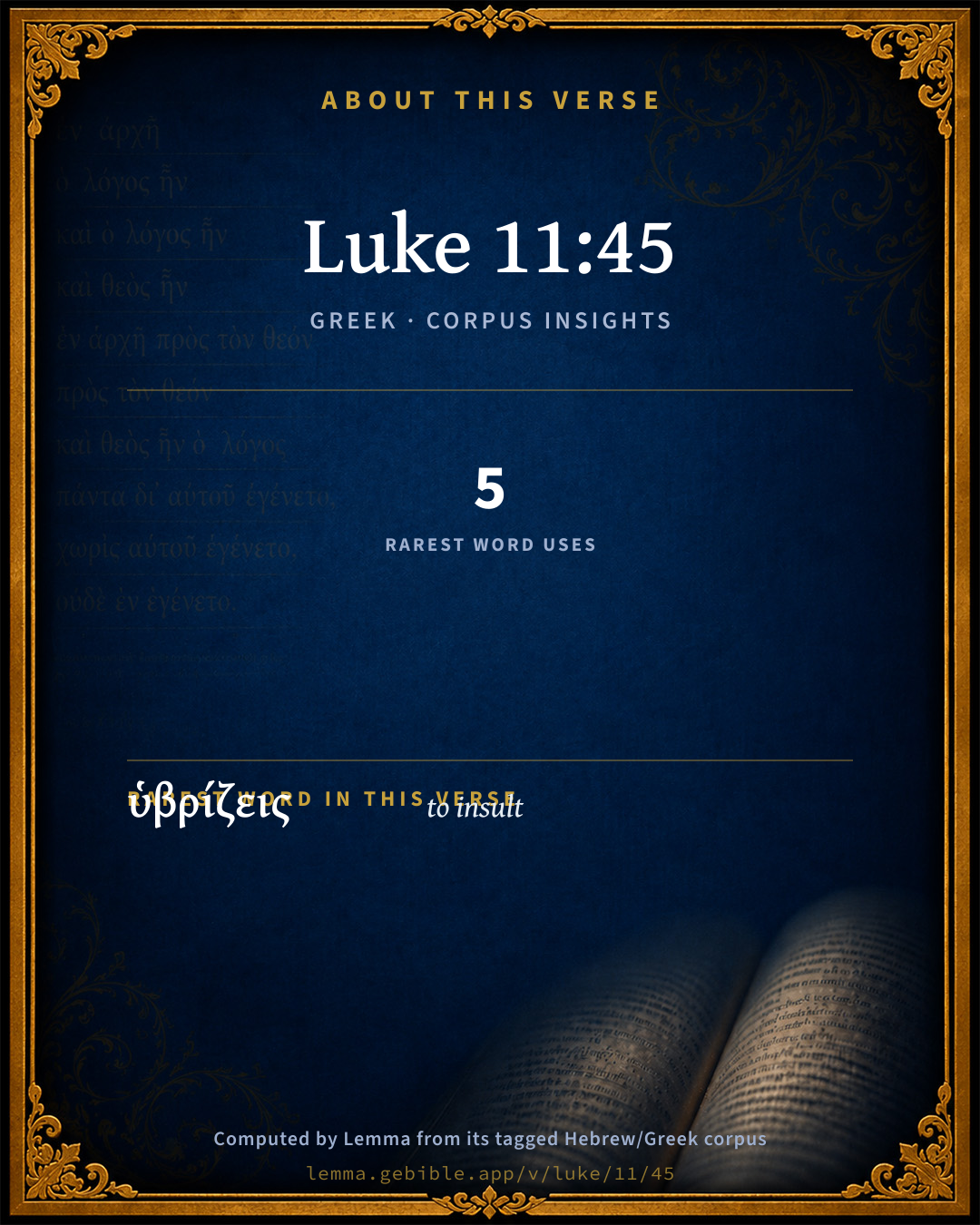
Luke 11:45

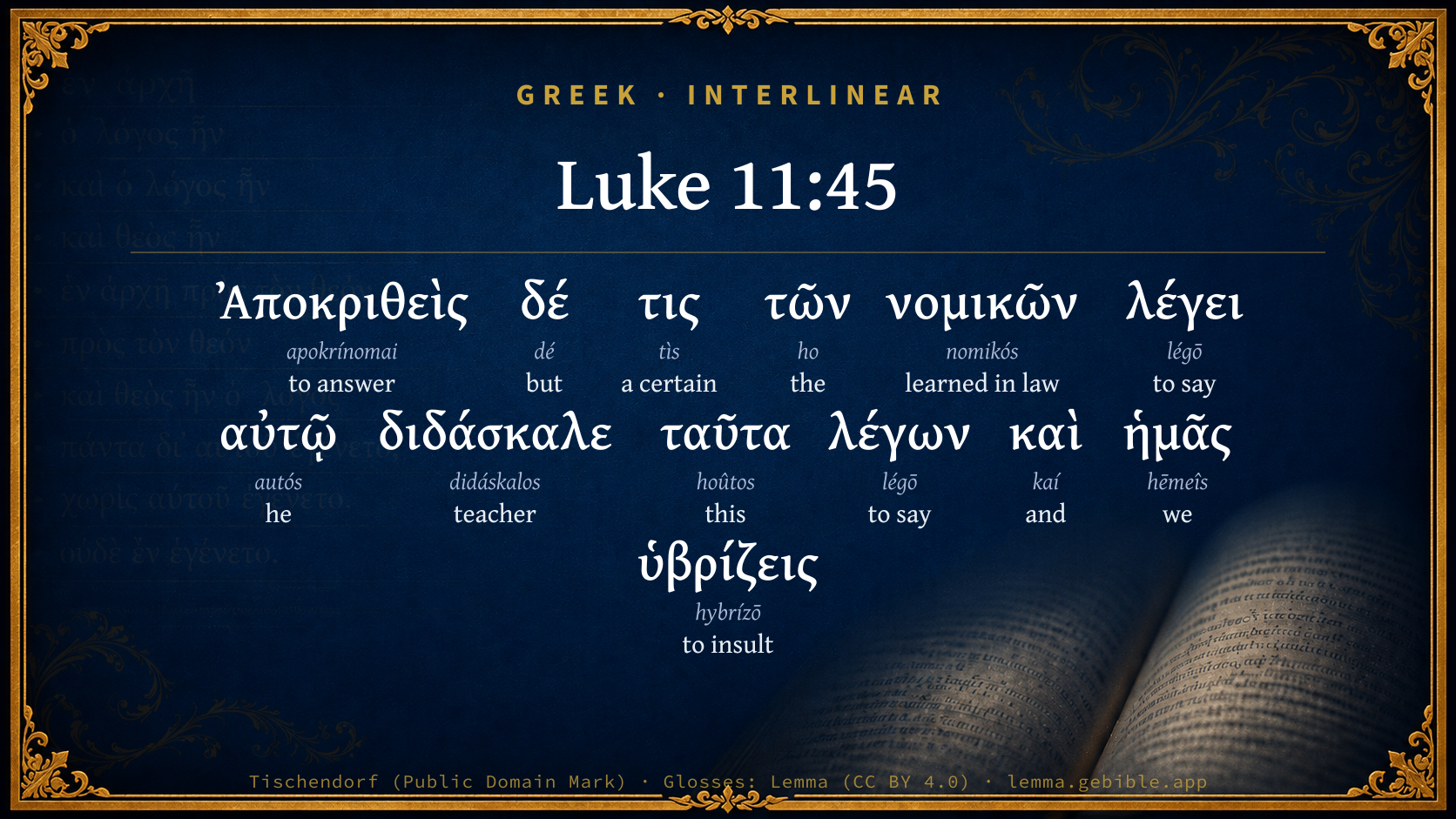
Greek (Tischendorf 8th ed.) Luke 11:45 appears in the Greek New Testament. The text above is from the Tischendorf 8th edition. Each word links to its Strong’s number and a concise gloss. Click any word for its full Thayer’s Greek Lexicon entry.
Download image
Cite this verse

Luke 11:45 (World English Bible). Public Domain. Lemma interlinear Bible study tool, https://lemma.gebible.app/v/luke/11/45.

Show BibTeX & RIS
BibTeX
RIS
English Translation
One of the lawyers answered him, "Teacher, in saying this you insult us also."
World English Bible · Public Domain
Download a study sheet

One document with this verse’s original text, its word-by-word gloss line, the meaning frame, cross-references with their text, attributed commentary, and full source and license credits — printable, and it pastes into notes with its structure intact.

This verse Autodidact and up

Study sheet (.html) Plain text (.txt)

A passage Seminary Student

Up to 50 verses in one chapter. A passage sheet keeps up to 6 commentary sources and 12 cross-references per verse, in the order this page ranks them, and says so on the sheet whenever that leaves anything out. Ask for a single verse and you get the Autodidact verse sheet above.

Everything on this page stays free to read, with no account — the sheet is a download of what is already on screen, not access to it.

Want to remove ads? Support Godless Engineer
Compare translations 3

The same verse in 3 English versions, stacked beneath the original-language interlinear above. Click any original word for its lexicon entry.

Each is an independent rendering of the whole verse — the interlinear is not word-aligned to these translations.

Highlighted words mark where these versions differ — a whole-verse word diff, not a word-by-word alignment.

  • World English Bible Public Domain
    One of the lawyers answered him, "Teacher, in saying this you insult us also."
  • King James Version Public Domain
    Then answered one of the lawyers, and said unto him, Master, thus saying thou reproachest us also.
  • unfoldingWord Literal Text CC BY-SA 4.0
    Then answering, one of the lawyers says to him, “Teacher, saying these things, you insult us too.”

unfoldingWord Literal Text — © unfoldingWord, licensed CC BY-SA 4.0. Word-aligned USFM3 via Door43 (git.door43.org/unfoldingWord/en_ult).

Versions to compare (up to 4)

3 of 4 selected

Show all 19 translations

Every available English version of this verse, each an independent rendering of the whole verse.

  • World English Bible Public Domain
    One of the lawyers answered him, "Teacher, in saying this you insult us also."
  • Berean Standard Bible Public Domain
    One of the experts in the law told Him, “Teacher, when You say these things, You insult us as well.”
  • Majority Standard Bible Public Domain
    One of the experts in the law told Him, “Teacher, when You say these things, You insult us as well.”
  • King James Version Public Domain
    Then answered one of the lawyers, and said unto him, Master, thus saying thou reproachest us also.
  • American Standard Version (1901) Public Domain
    And one of the lawyers answering saith unto him, Teacher, in saying this thou reproachest us also.
  • Revised Version (1885) Public Domain
    And one of the lawyers answering saith unto him, Master, in saying this thou reproachest us also.
  • Geneva Bible (1599) Public Domain
    Then answered one of the Lawyers, and saide vnto him, Master, thus saying thou puttest vs to rebuke also.
  • Douay-Rheims (1899) Public Domain
    And one of the lawyers answering, saith to him: Master, in saying these things, thou reproachest us also.
  • Young's Literal Translation Public Domain
    And one of the lawyers answering, saith to him, `Teacher, these things saying, us also thou dost insult;'
  • Literal Standard Version CC BY-SA 4.0
    And one of the lawyers answering, says to Him, “Teacher, saying these things, You also insult us”;
  • Unlocked Literal Bible CC BY-SA 4.0
    One of the teachers of the law said to him, “Teacher, what you say insults us too.”
  • unfoldingWord Literal Text CC BY-SA 4.0
    Then answering, one of the lawyers says to him, “Teacher, saying these things, you insult us too.”
  • Darby Bible Public Domain
    And one of the doctors of the law answering says to him, Teacher, in saying these things thou insultest us also.
  • World Messianic Bible Public Domain
    One of the Torah scholars answered him, “Rabbi, in saying this you insult us also.”
  • Webster's Bible Public Domain
    Then answered one of the lawyers, and said to him, Master, thus saying, thou reproachest us also.
  • Free Bible Version CC BY-SA 4.0
    One of the experts in religious law reacted, saying, “Teacher, when you talk like this, you're insulting us too!”
  • Bible in Basic English Public Domain
    And one of the teachers of the law, answering, said to him, Master, in saying this, you give a bad name to us as to them.
  • Text-Critical English NT CC BY 4.0
    In response one of the lawyers said to him, “Teacher, by saying these things, yoʋ insult us as well.”
  • Tyndale New Testament (1534) Public Domain
    Then answered one of the lawears and sayd vnto him: Master thus sayinge thou puttest vs to rebuke also.

Literal Standard Version (2020), Covenant Press — licensed CC BY-SA 4.0. Text via the HelloAO Bible API (eBible.org). Unlocked Literal Bible (unfoldingWord) — licensed CC BY-SA 4.0. Text via the HelloAO Bible API (eBible.org). unfoldingWord Literal Text — © unfoldingWord, licensed CC BY-SA 4.0. Word-aligned USFM3 via Door43 (git.door43.org/unfoldingWord/en_ult). Free Bible Version, Dr. Jonathan Gallagher — licensed CC BY-SA 4.0. Text via the HelloAO Bible API (eBible.org).

Word by word

More ways to search: Search by grammar → Find every occurrence → Compare this word →

Practice this passage: Drill this verse → Learn its vocabulary →

ὑβρίζεις
hybrízō
G5195
“to insult”
Verb, Present, Active, Indicative, 2nd person, Singular
Part of Speech
Verb
Tense
Present
Voice
Active
Mood
Indicative
Person
2nd person
Number
Singular
Full Thayer's Definition

Origin: from G5196

TDNT: 12:55,1

1. to be insolent, to behave insolently, wantonly, outrageously 2. to act insolently and shamefully towards one, to treat shamefully 3. of one who injures another by speaking evil of him
  1. Ἀποκριθεὶς apokrínomai G611 “to answer” Verb, Aorist, Passive deponent, Participle, Nominative, Singular, Masculine
  2. δέ dé G1161 “but” Conjunction
  3. τις tìs G5100 “a certain” Indefinite pronoun, Nominative, Singular, Masculine
  4. τῶν ho G3588 “the” Article, Genitive, Plural, Masculine
  5. νομικῶν nomikós G3544 “learned in law” Adjective, Genitive, Plural, Masculine
  6. λέγει légō G3004 “to say” Verb, Present, Active, Indicative, 3rd person, Singular
  7. αὐτῷ autós G846 “he” Personal pronoun, Dative, Singular, Masculine
  8. διδάσκαλε didáskalos G1320 “teacher” Noun, Vocative, Singular, Masculine
  9. ταῦτα hoûtos G3778 “this” Demonstrative pronoun, Accusative, Plural, Neuter
  10. λέγων légō G3004 “to say” Verb, Present, Active, Participle, Nominative, Singular, Masculine
  11. καὶ kaí G2532 “and” Conjunction
  12. ἡμᾶς hēmeîs G2249 “we” Personal pronoun, 1st person, Accusative, Plural

About this verse

These counts appear in no published source. They are computed here, from the morphology-tagged text and Lemma’s own curated glosses. What Lemma adds →

13
words
12
distinct lemmas
Gospels
section

Notable vocabulary

The rarest word here is ὑβρίζεις to insult G5195 — appearing just 5 times in the whole Greek New Testament.

Shared distinctive vocabulary

ὑβρίζεις to insult G5195 occurs in 5 verses of the Greek New Testament. Also found in:

Repetition

A word recurs within this verse:

  • λέγει to say G3004 ×2

Cross-references

10

Topical passages linked to Luke 11:45 in the Treasury of Scripture Knowledge — connected by theme and wording, ordered by reader-vote popularity; previews shown in the World English Bible.

  • Matthew 22:35 One of them, a lawyer, asked him a question, testing him.
  • John 9:40 Those of the Pharisees who were with him heard these things, and said to him, "Are we also blind?"
  • 1 Kings 22:8 The king of Israel said to Jehoshaphat, there is yet one man by whom we may inquire of Yahweh, Micaiah the son of Imlah: but I hate him; for he does not prophesy good concerning me, but evil. Jehoshaphat said, "Don't let the king say so."
  • Jeremiah 6:10 To whom shall I speak and testify, that they may hear? behold, their ear is uncircumcised, and they can't listen: behold, the word of Yahweh is become to them a reproach; they have no delight in it.
  • Jeremiah 20:8 For as often as I speak, I cry out; I cry, Violence and destruction! because the word of Yahweh is made a reproach to me, and a derision, all the day.
  • Amos 7:10–13 Then Amaziah the priest of Beth El sent to Jeroboam king of Israel, saying, "Amos has conspired against you in the midst of the house of Israel. The land is not able to bear all his words.
  • Luke 11:46 He said, "Woe to you lawyers also! For you load men with burdens that are difficult to carry, and you yourselves won't even lift one finger to help carry those burdens.
  • Luke 11:52 Woe to you lawyers! For you took away the key of knowledge. You didn't enter in yourselves, and those who were entering in, you hindered."
  • John 7:7 The world can't hate you, but it hates me, because I testify about it, that its works are evil.
  • John 7:48 Have any of the rulers believed in him, or of the Pharisees?

Cross-references courtesy of OpenBible.info (CC BY 4.0).

Commentary

Notes on Luke 11:45 from classic Christian and Jewish commentators (each source and its license shown beneath its notes). The classic Christian expositions comment on the surrounding passage and are grouped to its opening verse, so a note may address several verses; the Jewish commentaries on the Tanakh (Rashi and others) are per-verse, so they appear only where the commentator wrote on this verse.

Lemma curates 59 commentaries, every one of them public domain or Creative Commons licensed, each selected and text-cleaned for this edition rather than reprinted as found. About our sources →

The Biblical Illustrator

Joseph S. Exell

Luk_11:45

Thou reproachest us also

Disputes reviewed

I.

WE MUST ALL EXPECT TO BE CALLED TO AN ACCOUNT BY THE LORD JESUS.

1. We are all now in the way--travellers--following Christ in consort.

2. There will be a review of what passes in the way.

3. The accounts in the great day must be given up to our Lord Jesus. God made the world, by His Son; and by Him, as the fittest person, He will judge the world. Now this is a good reason--

(1) Why we should judge ourselves, and prove our own work, and see that our matters be right and good against that day. Let us examine ourselves concerning our spiritual state, that we may make sure work for our own souls.

(2) Why we should not judge one another, or be severe in our censures one of another. We thereby invade Christs throne.

II. WE MUST IN A PARTICULAR MANNER BE CALLED TO AN ACCOUNT ABOUT OUR DISCOURSES AMONG OURSELVES.

1. If we talk anything which is good among ourselves, and which is to the use of edifying; which manifests grace in the speaker, and ministers grace to the hearers; Christ takes notice of that, and we shall hear of it again to our comfort, in that day when those who thus confess Christ before men shall be owned by Him before His father and the holy angels.

2. If we talk anything that is ill among ourselves; if any corrupt communication proceeds out of our mouths, dictated by the corruption of our minds, and which has a tendency to corrupt the minds and manners of others; Christ observes that too, is displeased with it--and we shall hear of it again, either by the checks of our own consciences, in order to our repentance, or in the day of the revelation of the righteous judgment of God, when, according to Enoch s prophecy, the Lord shall come to reckon with sinners, not only for all their ungodly deeds, but for all their hard speeches, spoken against Him.

III. As our other discourses among ourselves by the way, so ESPECIALLY OUR DISPUTES, WILL ALL BE CALLED OVER AGAIN, and we shall be called to an account about them.

1. Disputes commonly arise from difference of opinion, either in religion and Divine things (about which oftentimes the disputes and contests are most violent); or in philosophy, politics, or other parts of learning; or in the conduct of human life. These disputes (though not necessarily sinful in themselves, for men cannot be expected to agree on all points) are often such as we may justly be ashamed of, when we come to look back upon them.

(1) Upon account of the matter of them. This may have been--

(a) Something above us, with which we had no concern; or

(b) something below us, not worth disputing about.

(2) Upon account of our management of them. Our Master will be displeased with us if it be found that we have been hot and fierce in our disputes, and have mingled our passions and peevish resentments with them; if a point of honour has governed us more than a point of conscience, and we have contended more for victory and reputation, than for truth and duty; if we have contended about things of small moment for, or against, them, and have neglected the weightier matters of the law and gospel; if we have spent more of our zeal on matters in difference than they deserve; and have lost the vitals of religion in our heat about circumstantials, and have disputed away our seriousness and devotion--What then shall we do when God riseth up? and when He visiteth, what shall we answer Him?

2. Many disputes arise from separate and interfering interests in this world. Neighbours and relations quarrel about their rights and properties, their estates and trades, their honours and powers and pleasures; Meum and Tuum--my rent and thy bond, are the great subjects of dispute, and engage people in endless strifes. These disputes, as they are most common, so they are most scandalous, among relations, and those who are under particular obligations to love one another. And whatever keeps brethren from dwelling together in unity, is very provoking to Christ, who has made brotherly love the livery of His family: and it is very hardly removed.

3. Some disputes, and hot ones too, arise merely from passion and clashing humours, where really there is nothing of judgment or interest in the case.

(1) As far as we are able to make a judgment, let us see to it that we have truth and right on our side, in all our disputes, and not be confident any further than we see just cause to be so. We must not only never contend for that which we know to be false and wrong, but also never for that which is doubtful, or which we do not know to be true and right.

(2) In matters of doubtful disputation. While we are contending for that which we take to be right, let us at the same time think it possible that we may be in the wrong.

(3) Let us keep the full possession and government of our own spirits, in all our disputes. Let us carefully suppress all inward tumults, whatever provocation may be given us; and let our minds be calm and sedate, whatever argument we are engaged in.

(4) Let us never lose the charity we ought to have for our brethren in our disputes of any kind, nor violate the sacred laws of it.

(5) Let us often think of the account we must shortly give to our great Master of all our disputes with our fellow-servants by the way. Let us consider how our disputes will look in that day, and what our own reflections will be then upon them.

IV. Of all disputes, Christ will be sure to reckon with His disciples for their DISPUTES ABOUT PRECEDENCY AND SUPERIORITY. The prevalency of such a temper as this, as far as it appears, is very threatening. But when the Spirit shall be poured out upon us from on high, there shall be no more such disputes as these; and then the wilderness shall become a fruitful field. Upon the whole matter, therefore, let our strife be, Who shall be best, not Who shall be greatest.

1. Let us never strive who shall be greatest in this world; who shall have the best preferment; who shall be master of the best estate, or make the best figure; but acquiesce in the lot Providence carves out to us, not aiming at great things, or striving for them. Consider what worldly greatness is.

(1) What a despicable thing it is to those who have their eyes upon another world.

(2) What a dangerous thing this worldly greatness is to those who have not their eyes upon another world; how apt it is to keep their hearts at a distance from God, and from the consideration and pursuit of a future blessedness; and to fix them to this world, and make them willing to take up with a portion in it; and, especially, what a strong temptation it is to break through all the sacred fences of the Divine law to compass it.

2. Let all our strife be who shall be best, not disputing who has been best, that is a vain-glorious strife, but humbly contending who shall be so; who shall be most humble, and stoop lowest, for the good of others; and who shall labour most for the common welfare. This is a gracious strife; a strife that will pass well in our account, when all our disputes will be reviewed, (Matthew Henry.)

The Biblical Illustrator, edited by Joseph S. Exell (c. 1880s–1900s) — public domain. Text from a community e-Sword module.

Joseph Benson's Commentary

Luk 11:45. Then answered one of the lawyers, &c. — A doctor, or interpreter of the law. The Jewish lawyers (as our translation not very properly terms them) were the most considerable species of scribes, who applied themselves peculiarly to study and explain the law. Probably many of them were Pharisees, but it was no ways essential to their office that they should be so. What touched the person here speaking was, that our Lord, in his last wo, Luk 11:44, had joined the scribes with the Pharisees. Master, thus saying, thou reproachest us — The rebuke which thou hast given the scribes and Pharisees in so general a way, affects us lawyers also. And he said, Wo unto you also, ye lawyers — The lawyers, even of the Pharisean denomination, had done unspeakable mischief by their erroneous interpretation of Scripture, which they perverted to favour the tradition of the elders as much as possible, and so bound heavy burdens on men’s shoulders, which they themselves would not touch with one of their fingers. Jesus, therefore, spake his mind freely concerning them also, laid open their character, and denounced further woes against them. Wo unto you, for ye build the sepulchres of the prophets — He blames them for building the sepulchres of the prophets, because they did it from no regard to the murdered prophets, though in words they pretended to venerate their memory, but in order to make an ostentation of their piety. Truly ye bear witness that ye allow the deeds of your fathers — By all your conduct you show that inwardly, in your minds, you approve of the deeds of your fathers, who persecuted the prophets; for they killed them, and ye build their sepulchres — You are men of precisely the same character and disposition with them; hypocrites, who covered the grossest acts of wickedness with the specious appearance of piety. For like them you pretend great reverence for the ancient prophets, while ye destroy those whom God sends to yourselves. Ye therefore bear witness, by this deep hypocrisy, that you are of the very same spirit with them. Or, more at large, thus: “From your known disposition, as well as from your open practice, which is to trample upon the laws of God, as often as they stand in the way of your wicked purposes, and particularly from your persecuting the messengers of God, one is obliged to think that you build the sepulchres of the prophets whom your fathers killed, not from any pious regard for God, whose messengers they were, nor to do honour to the prophets themselves, but to do honour to their murderers, as approving of their deeds, and intending to perpetuate the memory of them to posterity with applause. The great men among the Jews always possessed the true spirit of politicians. In the time of the prophets they made no scruple to kill persons, whom they knew to be the messengers of God, because, forsooth, the good of the state required it. In our Saviour’s time, Caiaphas, the high- priest, openly avowed this principle in a full meeting of the grandees. For when some were opposing the resolution of the major part of the council, who had determined to kill Jesus, and urged the unlawfulness of the action, he told them plainly that they were a parcel of ignorant bigots, who knew nothing at all either of the principles or ends of government, which render it necessary oft-times to sacrifice the most innocent for the safety of the community. Therefore also said the wisdom of God — Agreeably to this the wisdom of God hath said, in many places of Scripture, though not in these very words, I will send them prophets, &c. — Because you imitate the ways of your fathers, by persecuting the messengers of God; because you carry your wickedness to as great a pitch as your fathers did; for these reasons God hath declared his last resolutions concerning you: he hath said, I will send them prophets and apostles, yea, and my beloved Son, notwithstanding I know they will persecute and slay them: That the blood of all the prophets, &c. — That by this last and greatest act of rebellion, the iniquity of the nation being completed, God may at length testify how much he was displeased with this people from the beginning, for persecuting and murdering his prophets, and that by sending upon the generation which completed the iniquity of the nation, such signal judgments as should evidently appear to be the punishment of that great and accumulated wickedness, committed by them in their several successive generations. Verily I say, It shall be required of this generation — And so it was within forty years, in a most astonishing manner, by the dreadful destruction of the temple, the city, and the nation. The justice of such a procedure every thinking person will acknowledge, who considers that sins committed by men, as constituting a body politic, can only be punished in the present life; the proper punishment of national sins being national judgments, even such judgments as dissolve the transgressing state. And these the providence of God thinks necessary for its own vindication, always inflicting them upon nations, when the measure fixed upon by God for punishment is filled up, that the wrath of God being revealed from heaven against all ungodliness and unrighteousness of men, the nations of the world may be awed and kept in subjection to the government of God. See on Mat 23:29-33.

Joseph Benson's Commentary on the Old and New Testaments (1811–1818) — public domain. Text from a community e-Sword module.

Tyndale Open Study Notes

Tyndale Open Resources

11:45 an expert in religious law: The experts in religious law were closely aligned with the Pharisees and shared the same zeal for keeping the law of Moses.

Tyndale Open Study Notes — © Tyndale Open Resources, licensed CC BY-SA 4.0. Text via the HelloAO Bible API.

Bengel's Gnomon

Johann Albrecht Bengel

Luk 11:45. [Ταῦτα, these things) which precede, especially in Luk 11:43.—V. g.]—ὑβρίζεις, thou dost insult) ὑβρίζειν, to insult, to treat with insolence, is a different idea from that of justly reproving, as expressed by ὀνειδίζειν, to reproach.

Bengel's Gnomon of the New Testament — English translation (T&T Clark, Edinburgh, 1860) — public domain. Text from a community e-Sword module.

Meyer's Critical & Exegetical Commentary

Heinrich August Wilhelm Meyer

Luk_11:45. This νομικός was no Sadducee (Paulus, yet see his Exeget. Handb.), because he otherwise would not have applied these reproaches to himself as well as to the Pharisees, and Jesus would not have continued to discourse so entirely in an anti-Pharisaic tone, but he likewise was a Pharisee, as in general were most of the νομικοί. That he only partially professed the principles of the Pharisees is assumed by de Wette on account of καὶ ἡμᾶς, in which, however, is implied not merely the common Pharisees (the laity), but even us, the learned, thou art aspersing. The scribe calls what was a righteous ὀνειδίζειν (Mat_11:20; Mar_16:14) by the name of ὑβρίζειν (Luk_18:32; Act_14:5; Mat_22:6). Although this episode is not mentioned in Matthew, there is no sufficient ground to doubt its historical character. Comp. on Luk_12:41. Consequently, all that follows down to Luk_11:52 is addressed to the νομικοί, as they are once again addressed at the close by name, Luk_11:52. But it is not to be proved that Luke in his representation had in view the legalists of the apostolic time (Weizsäcker), although the words recorded must needs touch them, just as they were also concerned in the denunciations of Matthew 23.

Meyer — Critical and Exegetical Commentary on the New Testament — English translation by Peter Christie, edited by Frederick Crombie (T&T Clark, 1880) — public domain. Text from a community e-Sword module.

Expositor's Greek Testament

ed. W. Robertson Nicoll

Luk 11:45-52 . Castigation of the scribes present ; severe, but justified by having been invited.

Luk 11:45 . τις τῶν νομικῶν : a professional man, the Pharisees being laymen; the two classes kindred in spirit, hence the lawyer who speaks felt hit.

The Expositor's Greek Testament, edited by W. Robertson Nicoll (1897–1910) — public domain. Text from a community e-Sword module.

Godet's Commentaries

Frédéric Louis Godet

2 d. To the Scribes: Luk 11:45-54. A remark made by a scribe gives a new turn to the conversation. The Pharisees were only a religious party; but the scribes, the experts in the law, formed a profession strictly so called. They were the learned, the wise, who discovered nice prescriptions in the law, such as that alluded to in Luk 11:42, and gave them over for the observance of their pious disciples. The scribes played the part of clerical guides. The majority of them seem to have belonged to the pharisaic party; for we meet with no others in the N. T. But their official dignity gave them a higher place in the theocracy than that of a mere party. Hence the exclamation of him who here interrupts Jesus: “Thus saying, Thou reproachest us, us scribes also,” which evidently constitutes in his eyes a much graver offence than that of reproaching the Pharisees. In His answer Jesus upbraids them on three grounds, as He had done the Pharisees: 1 st. Religious intellectualism (Luk 11:46); 2 d. Persecuting fanaticism (Luk 11:47-51); 3 d. The pernicious influence which they exercised on the religious state of the people (Luk 11:52).

Vers. 53 and 54 describe the end of the feast.

Luk 11:45-46. Literalism.—“Then answered one of the lawyers, and said unto him, Master, thus saying thou reproachest us also. 46. And He said, Woe unto you also, ye lawyers! for ye lade men with burdens grievous to be borne, and ye yourselves touch not the burdens with one of your fingers.”

There seems to be no essential difference between the terms νομικός, νομοδιδάσκαλος, and γραμματεύς. See Luk 11:53; and comp. Luk 11:52 with Mat 23:13. Yet there must be a shade of difference at least between the words; according to the etymology, νομικός denotes the expert, the casuist, who discusses doubtful cases, the Mosaic jurist, as Meyer says; νομοδιδάσκαλος, the doctor, the professor who gives public or private courses of Mosaic law; γραμματεύς would include in general all those who are occupied with the Scriptures, either in the way of theoretical teaching or practical application.

Our Lord answers the scribe, as He had answered the Pharisee, in three sentences of condemnation. The first rebuke is the counterpart of that which He had addressed in the first place to the latter, to wit, literalism; this is the twin brother of formalism. The paid scribes were infinitely less respectable than the generality of the Pharisees. As to those minute prescriptions which they discovered daily in the law, and which they recommended to the zeal of devotees, they had small regard for them in their own practice. They seemed to imagine that, so far as they were concerned, the knowing dispensed with the doing. Such is the procedure characterized by Jesus in Luk 11:46. Constantly drawing the heaviest burdens from the law, they bind them on the shoulders of the simple. But as to themselves, they make not the slightest effort to lift them.

Frédéric Louis Godet — Commentaries on Luke, John, Romans, and 1 Corinthians — English translation (T&T Clark, Edinburgh, 1870s–1890s) — public domain. Text from a community e-Sword module.

Geneva Bible (1599)

Geneva Bible translators

Hypocrites are very severe against other men, but think all things lawful to themselves.

Geneva Bible (1599) marginal notes — public domain. Text via Bolls.life.

Adam Clarke's Commentary

Verse 45. Thou reproachest as] He alone who searches the heart could unmask these hypocrites; and he did it so effectually that their own consciences acknowledged the guilt, and re-echoed their own reproach.

Adam Clarke's Commentary on the Bible (1810–1826) — public domain. Text from a community e-Sword/MySword module.

Ellicott's Commentary for English Readers

(45) Then answered one of the lawyers.—See Note on Mat_22:35 for the term “lawyer.” We note here the sense at once of distinctness and of class fellowship. Though something more than a scribe, he feels that he stands or falls with them.

A Bible Commentary for English Readers, edited by Charles John Ellicott (1878–1897) — public domain. Text from a community e-Sword module.

The Cambridge Bible for Schools and Colleges

gen. ed. J. J. S. Perowne

45. one of the lawyers] See on Luk_7:30, Luk_10:25. This Scribe thought that Jesus could not possibly mean to reflect on the honoured class who copied and expounded the Law.

reproachest] Literally, “insultest.” There was a difference between

Pharisees and lawyers; the position of the latter involved more culture and distinction. They were the ‘divines,’ the ‘theologians’ of that day. Hence the man’s reproach. ‘Lawyer’ and ‘Scribe’ seem to be more or less convertible terms (Luk_11:52-53; Mat_23:13). Jesus here charges them with tyrannical insincerity (Luk_11:46), persecuting rancour (Luk_11:47-51), and theological arrogance and exclusiveness (Luk_11:52).

The Cambridge Bible for Schools and Colleges (gen. ed. J. J. S. Perowne; Cambridge University Press, 1878–1918) — public domain. Text from a community e-Sword module.

John Gill's Exposition

Woe unto you,.... Meaning particularly the lawyers or Scribes, together with the Pharisees, and even the whole body of the people, who in general were of the cast and complexion here described:

for ye build the sepulchres of the prophets; See Gill on Mat 23:29.

and your fathers killed them; the prophets; "or whom your fathers killed", as read the Syriac, Arabic, and Persic versions; the one put them to death, and the other erected stately monuments over them, or adorned them; and yet both had the same malignant spirit against the faithful servants and messengers of God; and which showed their great hypocrisy.

John Gill's Exposition of the Whole Bible (1746–1763) — public domain (CC PDM 1.0). Text via the HelloAO Bible API.

Trapp's Complete Commentary

John Trapp

45 Then answered one of the lawyers, and said unto him, Master, thus saying thou reproachest us also.

Ver. 45. Thou reproachest us also] Who meddled with them, but that their own consciences accused them? It is a rule of Jerome, Ubi generalis de vitiis disputatio est, ibi nullius personae est iniuria; neque carbone notatur quisquam, quasi malus sit, sed omnes admonentur ne sint mali. Where the discourse is of all, there is no personal intimation of any.

John Trapp, A Commentary or Exposition upon All the Books of the Old and New Testament (1647–1656) — public domain. Text from a community e-Sword module.

Albert Barnes' Notes on the Bible

Lawyers - Men learned in the law; but it is not known in what way the lawyers differed from the “scribes,” or whether they were Pharisees or Sadducees.

Thus saying, thou ... - He felt that the remarks of Jesus about loving the chief seats, etc., applied to them as well as to the Pharisees. His conscience told him that if “they” were to blame, “he” was also, and he therefore applied the discourse to himself.

Reproachest - Accusest. Dost calumniate or blame us, for we do the same things. Sinners often consider “faithfulness” as “reproach” - they know not how to separate them. Jesus did “not” reproach or abuse them. He dealt faithfully with them; reproved them; told them the unvarnished truth. Such faithfulness is rare; but when it “is” used, we must expect that people will flinch, perhaps be enraged. Though their consciences tell them they are “guilty,” still they will consider it as abuse.

Albert Barnes' Notes on the Bible (1834–1885) — public domain. Text from a community e-Sword/MySword module.

Haydock's Catholic Bible Commentary

Then one of the lawyers, &c. Correction, which turns to the advantage of the meek, appears always more intolerable to the wicked. Christ denounces woes against the Pharisees for deviating from the right path, and the doctors of the law found them equally applicable to themselves. (St. Cyril in St. Thomas Aquinas) --- How miserable is the conscience which, upon hearing the word of God, thinks itself insulted, and always hears the punishment of the reprobate rehearsed as the words of its own condemnation. (Ven. Bede)

George Leo Haydock (1774–1849), Haydock's Catholic Family Bible and Commentary, 1859 edition — public domain. Excludes Psalms (Douay-Rheims chapter numbering differs from Protestant) and Deuterocanonical books (Catholic canon only).

Matthew Poole's English Annotations

This lawyer was a scribe of the law, Luk 11:44. The work of these men was to interpret the law; the Pharisees strictly observed their decrees and interpretations. The lawyer therefore spake rightly in thinking our Saviour’s words had some reflection upon men of his order, but he woefully erred both in thinking his own order was unblamable, and also in calling our Lord’s just reproof a reproaching them. But by this he gives an occasion to him, who used rightly to divide the word of God, and to give every one their portion out of it, to let them know wherein they were faulty, as well as the Pharisees.

Matthew Poole's English Annotations on the Holy Bible (1683–1685) — public domain. Text from a community e-Sword/MySword module.

Whedon's Commentary on the Bible

Daniel D. Whedon

45. One of the lawyers—There were several present, doubtless to take share in the contest. This lawyer was a professional man, as the inviting Pharisee was a layman.

Reproachest us also—For the layman furnishes the practice, while we furnish the theory.

Daniel D. Whedon (gen. ed.), Commentary on the Old and New Testaments (1874–1909) — public domain. Text from a community e-Sword module.

The Pulpit Commentary

Then answered one of the lawyers Master, thus saying thou reproachest us also. It did not follow that all these professed jurists were of the Pharisee sect; some, doubtless, were Sadducees. It seems, however, probable that the greater proportion of these professional teachers and expounders of the Law did belong to the Pharisees. The oral and written Law, based upon the comparatively simple Mosaic code, had now become the absolute guide and director of the whole life of the people in all its smaller details. The various copyists, lecturers, teachers, and casuists, who debated the many doubtful points constantly arising in the perplexing and elaborate system, were all known under the general term "scribes." The lawyer was the scribe who had especially devoted his attention to the unravelment of the difficult and disputed questions which arose in the daily life of the people. This lawyer was certainly, considering the company he was associated with, of the strictest sect of Pharisees. This person could not believe that this able Rabbi from Galilee for that they must all, after the morning"s discussion, have allowed Jesus to be could include him and his holy order in his terrible denunciations, the truth of which the learned scribe not improbably dimly discerned.

The Pulpit Commentary (1880–1919), ed. H.D.M. Spence-Jones & Joseph S. Exell — public domain. Text from a community e-Sword module.

John Wesley's Explanatory Notes

One of the lawyers - That is scribes; expounders of the law.

John Wesley, Explanatory Notes Upon the Whole Bible (1754–1765) — public domain. Text via the GEBible commentary corpus.

Scofield Reference Notes

C. I. Scofield

lawyers

(See Scofield "Mat 22:35").

The Scofield Reference Bible (1917 edition), notes by C. I. Scofield — public domain. Text from a community e-Sword module.

Kretzmann's Popular Commentary

Paul E. Kretzmann

The insulted lawyer:

v. 45. Then answered one of the lawyers and said unto Him, Master, thus saying Thou reproachest us also.

v. 46. And He said, Woe unto you also, ye lawyers! For ye lade men with burdens grievous to be borne, and ye yourselves touch not the burdens with one of your fingers.

v. 47. Woe unto you! For ye build the sepulchers of the prophets, and your fathers killed them.

v. 48. Truly ye bear witness that ye allow the deeds of your fathers; for they indeed killed them, and ye build their sepulchers.

A certain scribe, one of the teachers of the Law, who was sitting by, felt that the description which Jesus had just given of the Pharisees fitted his own case remarkably well. And so he actually invited the criticism of Jesus upon himself and his fellows by challenging Him at this point. For Christ fearlessly proceeds to say exactly what He thinks of the whole class. These teachers of the Law, in their rules of conduct for the people, weighed them down with heavy, unbearable burdens, with precepts which regulated even the most minute happenings of their daily life, but they themselves did not so much as touch the burdens with one of their fingers, for they knew better and did not care to torture themselves. How well this fits many rules of the Roman Catholic Church! The lawyers also built tombs unto the prophets with the idea of honoring them. But in reality they were continuing the evil work of their fathers. Their forefathers had put more than one of the prophets of old to death, and the present people, in erecting the tombs, agreed with the work of their ancestors. "They killed, you build; worthy sons of such fathers!" The lawyers truly had their fathers’ disposition. Outwardly they honored the prophets, insisted upon observing any precept that might be found in any book of the Old Testament, but the prophecy concerning the Messiah they garbled and denied. This feature characterizes the preaching of the false prophets of all times. They refer to the Bible and praise many sections of it highly, but the great central doctrines of Scripture, especially that concerning the justification of a poor sinner through the merits of Jesus, by faith only, that they omit, and they are full of enmity toward the true messengers of the Gospel, persecuting them whenever they have an opportunity.

Paul E. Kretzmann, Popular Commentary of the Bible (1921–1924) — public domain. Text from a community e-Sword module.

Burkitt's Expository Notes on the New Testament

William Burkitt

The former woes were denounced by our Saviour against the Pharisees, who had their names from an Hebrew word, which signifies to separate, because they were persons separated and set apart for studying the law of God, and teaching it to others.

The next woe is here denounced against the lawyers, that is, the scribes of the law, of which there were two sorts: the civil scribe and the ecclesiastical scribe.

The civil scribe was a public notary, or a register of the synagogue, employed in writing bills of divorce, and sentences on the phylacteries. The ecclesiastical scribe was an expounder of the scripture, an interpreter of the law; men of great learning and knowledge, whose decrees and interpretations the Pharisees strictly observed. This lawyer here insolently calls our Saviour’s reproof a reproach: however, our Saviour, who never feared the face or regarded the person of any man, gives them their portion, and lets them know wherein they were faulty as well as the Pharisees, and accordingly pronounces a woe unto them also, for a threefold crime.

1. For their laying heavy burdens upon others’ shoulders, which they would not touch with one of their fingers. These burdens in general were a rigid exaction of obedience in the whole ceremonial law, and in particular the burden of traditions, certain austerities and severities, which they imposed upon the people, but would not undergo any part of them themselves. In vain do we hope to oblige our hearers to follow those rules of life, which we refuse or neglect to put in practice ourselves.

William Burkitt's Expository Notes on the New Testament (1700–1703) — public domain. Text from a community e-Sword module.

unfoldingWord translationNotes

Door43 World Missions Community

General Information:

Jesus begins to respond to a Jewish teacher.

One of the teachers of the law

This introduces a new character into the story. (See: Introduction of New and Old Participants)

what you say insults us too

Jesus' comments about the Pharisees also seemed to apply to the teachers of the Jewish laws.

Woe to you, teachers of the law!

Jesus makes it clear that he intended to condemn the actions of the teachers of the law along with the Pharisees.

you put people under burdens that are hard to carry

"you put burdens on people that are too heavy and they cannot carry them." Jesus speaks about someone giving people many rules as if the person were giving them heavy things to carry. AT: "you burden people by giving them too many rules to follow" (See: Metaphor)

touch the burdens with one of your own fingers

Possible meanings are 1) "do anything at all to help people carry those burdens" or 2) "make any effort to carry those burdens yourselves."

translationWords

teacher

scribe

woe

burden

unfoldingWord translationNotes — © Distant Shores Media and the Door43 World Missions Community, licensed CC BY-SA 4.0. Source: git.door43.org/Door43/en_tn.

Cambridge Greek Testament for Schools and Colleges

45. τις τῶν νομικῶν. See on Luk 7:30, Luk 10:25. This Scribe thought that Jesus could not possibly mean to reflect on the honoured class who copied and expounded the Law.

καὶ ἡμᾶς ὑβρίζεις. ‘Thou insultest even us,’ who are superior to ordinary Pharisees. The word is a strong and an unjust one. Anything like ὕβρις was utterly alien to the words and the spirit of Christ. Had the lawyer said ὀνειδίζεις he would have spoken accurately; but just reproach is not insult. There was a difference between Pharisees and lawyers; the position of the latter involved more culture and distinction. They were the ‘divines,’ the ‘theologians’ of that day. Hence the man’s reproach. ‘Lawyer’ and ‘scribe’ seem to be more or less convertible terms (Luk 11:52-53; Mat 23:13). Jesus here charges them with tyrannical insincerity (46), persecuting rancour (47–51), and theological arrogance and exclusiveness (52).

Cambridge Greek Testament for Schools and Colleges (Cambridge University Press, 1896; 21 vols, various authors incl. Carr, Maclear, Plummer, Farrar, Lumby, Moule, M. R. James, Simcox) — public domain. Text from a community e-Sword module.

Alford’s Greek Testament

Henry Alford

45.] This man appears to have been not a common Pharisee merely, but besides, a νομικός, whose duty it especially was to interpret the law. Perhaps he found himself involved in the censure of ver. 42; or generally among the other Pharisees.

Henry Alford, The Greek Testament (1849–1861) — public domain. Text from a community e-Sword module.

International Critical Commentary

45. τῶν νομικῶν. See on 7:30. Not all the Pharisees were professional students (νομικοί), or teachers of the Law (νομοδιδάσκαλοι).

καὶ ἡμᾶς ὑβρίζεις. “Thou insultest even us,” the better instructed among the Pharisees. The verb implies outrageous treatment (18:32; Act 14:5; Mat 22:6; 1Th 2:2), and “reproachest” is hardly strong enough. Comp. ἐνυβρίζειν (Heb 10:29). In class. Gk. ὑβρίζειν is commonly followed by εἰς, esp. in prose. “Reproach” would be ὀνειδίζειν (Mat 11:20).

International Critical Commentary — older volumes (1896–1929), various authors — public domain. Text from a community e-Sword module.

Vincent's Word Studies in the New Testament

Marvin R. Vincent

Reproachest [υβριζεις] . The lawyer converts Jesus ' reproach (see Mr 16:14, upbraided) into an insult; the word meaning to outrage or affront.

Us also [και ημας] . Or perhaps better, even us, the learned.

Marvin R. Vincent, Word Studies in the New Testament (1887–1900) — public domain. Text from a community e-Sword/MySword module.

Lesson kit

Teaching starters — assembled from the data on this page, not authored interpretation. Every prompt links to the verse data it draws on. Edit before teaching.

Luke, in the Gospels, opens this verse with 13 words (12 distinct Greek lemmas). Its most distinctive word is hybrízō (“to insult”). A historical commentator’s framing appears above. Read the whole chapter for the surrounding context.

Discussion questions

  1. What does “to insult” (hybrízō) contribute to the verse as a whole?
  2. Matthew 22:6 shares the word «to insult» with this verse. How do the two illuminate each other?
  3. “to say” occurs 2× in this one verse. What is the effect of the repetition?
  4. These translations render this verse differently. What is at stake in choosing one wording over another?
  5. Reading how The Biblical Illustrator and Joseph Benson's Commentary read this verse, where do the two commentators agree and where do they part?

Things to notice

Reading settings

Reading text

Shown beneath each verse's original-language words.

Old Testament
Old Testament edition

Read the OT as the Masoretic Hebrew (MT) or the Greek Septuagint (LXX).

English shown for the Greek Septuagint (in the Hebrew ↔ Greek comparison).

Comparing translations? Open the Compare panel on any verse page to stack up to four side by side.