
Luke 4:28

Greek (Tischendorf 8th ed.) Luke 4:28 appears in the Greek New Testament. The text above is from the Tischendorf 8th edition. Each word links to its Strong’s number and a concise gloss. Click any word for its full Thayer’s Greek Lexicon entry.
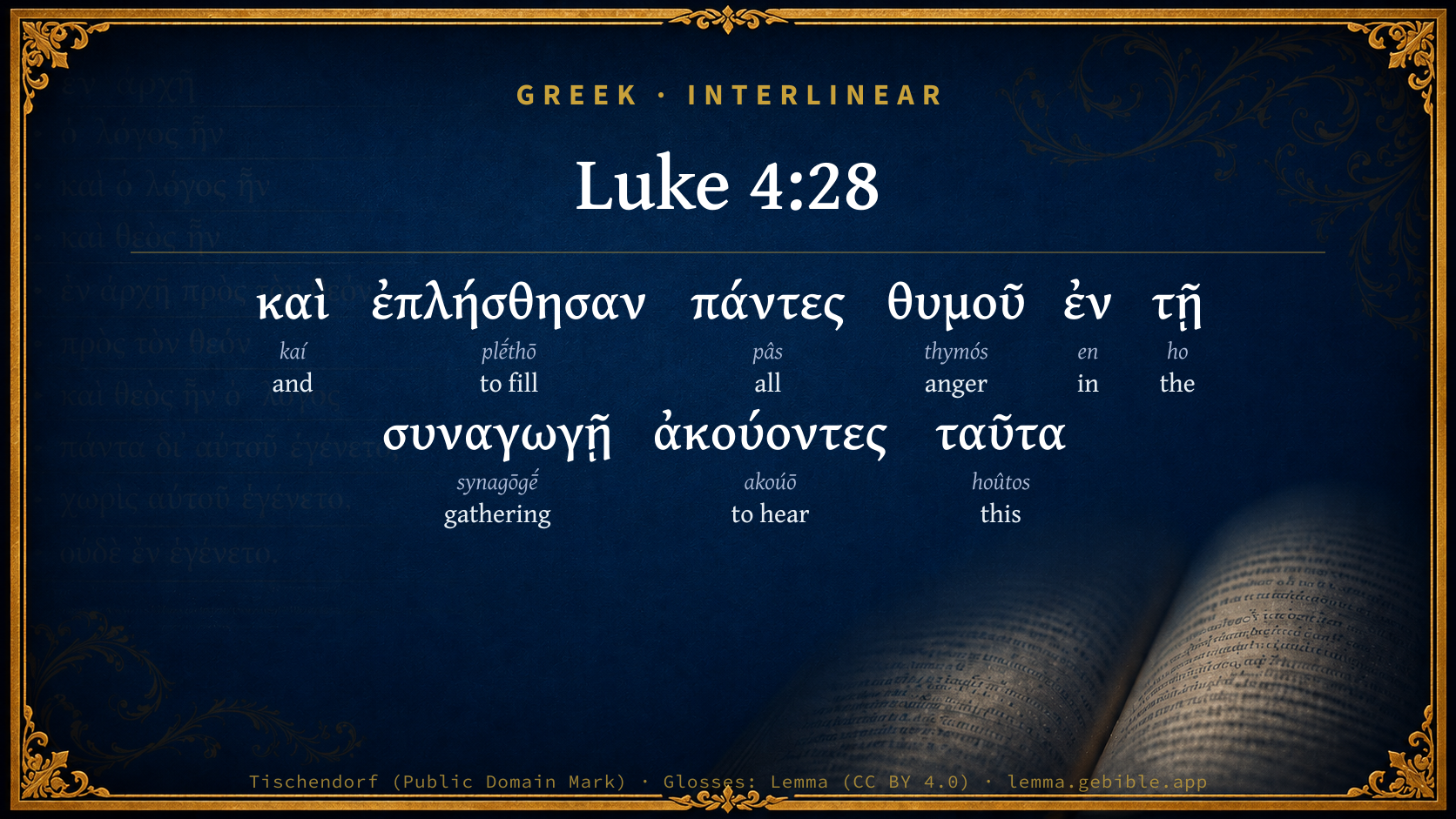
Download image
Cite this verse

Luke 4:28 (World English Bible). Public Domain. Lemma interlinear Bible study tool, https://lemma.gebible.app/v/luke/4/28.

Show BibTeX & RIS
BibTeX
RIS
English Translation
They were all filled with wrath in the synagogue, as they heard these things.
World English Bible · Public Domain
Highlights
  • 1 first appearance in the Greek New Testament
Full analysis ↓
Download a study sheet

One document with this verse’s original text, its word-by-word gloss line, the meaning frame, cross-references with their text, attributed commentary, and full source and license credits — printable, and it pastes into notes with its structure intact.

This verse Autodidact and up

Study sheet (.html) Plain text (.txt)

A passage Seminary Student

Up to 50 verses in one chapter. A passage sheet keeps up to 6 commentary sources and 12 cross-references per verse, in the order this page ranks them, and says so on the sheet whenever that leaves anything out. Ask for a single verse and you get the Autodidact verse sheet above.

Everything on this page stays free to read, with no account — the sheet is a download of what is already on screen, not access to it.

Want to remove ads? Support Godless Engineer
Compare translations 3

The same verse in 3 English versions, stacked beneath the original-language interlinear above. Click any original word for its lexicon entry.

Each is an independent rendering of the whole verse — the interlinear is not word-aligned to these translations.

Highlighted words mark where these versions differ — a whole-verse word diff, not a word-by-word alignment.

  • World English Bible Public Domain
    They were all filled with wrath in the synagogue, as they heard these things.
  • King James Version Public Domain
    And all they in the synagogue, when they heard these things, were filled with wrath,
  • unfoldingWord Literal Text CC BY-SA 4.0
    And all in the synagogue were filled with rage, having heard these things.

unfoldingWord Literal Text — © unfoldingWord, licensed CC BY-SA 4.0. Word-aligned USFM3 via Door43 (git.door43.org/unfoldingWord/en_ult).

Versions to compare (up to 4)

3 of 4 selected

Show all 19 translations

Every available English version of this verse, each an independent rendering of the whole verse.

  • World English Bible Public Domain
    They were all filled with wrath in the synagogue, as they heard these things.
  • Berean Standard Bible Public Domain
    On hearing this, all the people in the synagogue were enraged.
  • Majority Standard Bible Public Domain
    On hearing this, all the people in the synagogue were enraged.
  • King James Version Public Domain
    And all they in the synagogue, when they heard these things, were filled with wrath,
  • American Standard Version (1901) Public Domain
    And they were all filled with wrath in the synagogue, as they heard these things;
  • Revised Version (1885) Public Domain
    And they were all filled with wrath in the synagogue, as they heard these things;
  • Geneva Bible (1599) Public Domain
    Then all that were in the Synagogue, when they heard it, were filled with wrath,
  • Douay-Rheims (1899) Public Domain
    And all they in the synagogue, hearing these things, were filled with anger.
  • Young's Literal Translation Public Domain
    And all in the synagogue were filled with wrath, hearing these things,
  • Literal Standard Version CC BY-SA 4.0
    And all in the synagogue were filled with wrath, hearing these things,
  • Unlocked Literal Bible CC BY-SA 4.0
    All the people in the synagogue were filled with rage when they heard these things.
  • unfoldingWord Literal Text CC BY-SA 4.0
    And all in the synagogue were filled with rage, having heard these things.
  • Darby Bible Public Domain
    And they were all filled with rage in the synagogue, hearing these things;
  • World Messianic Bible Public Domain
    They were all filled with wrath in the synagogue as they heard these things.
  • Webster's Bible Public Domain
    And all they in the synagogue, when they heard these things, were filled with wrath,
  • Free Bible Version CC BY-SA 4.0
    When they heard this everyone in the synagogue became furious.
  • Bible in Basic English Public Domain
    And all who were in the Synagogue were very angry when these things were said to them.
  • Text-Critical English NT CC BY 4.0
    When they heard this, all the people in the synagogue were filled with rage.
  • Tyndale New Testament (1534) Public Domain
    And as many as were in the sinagoge when they herde that were filled with wrath:

Literal Standard Version (2020), Covenant Press — licensed CC BY-SA 4.0. Text via the HelloAO Bible API (eBible.org). Unlocked Literal Bible (unfoldingWord) — licensed CC BY-SA 4.0. Text via the HelloAO Bible API (eBible.org). unfoldingWord Literal Text — © unfoldingWord, licensed CC BY-SA 4.0. Word-aligned USFM3 via Door43 (git.door43.org/unfoldingWord/en_ult). Free Bible Version, Dr. Jonathan Gallagher — licensed CC BY-SA 4.0. Text via the HelloAO Bible API (eBible.org).

Word by word

More ways to search: Search by grammar → Find every occurrence → Compare this word →

Practice this passage: Drill this verse → Learn its vocabulary →

About this verse

These counts appear in no published source. They are computed here, from the morphology-tagged text and Lemma’s own curated glosses. What Lemma adds →

9
words
9
distinct lemmas
Gospels
section

Notable vocabulary

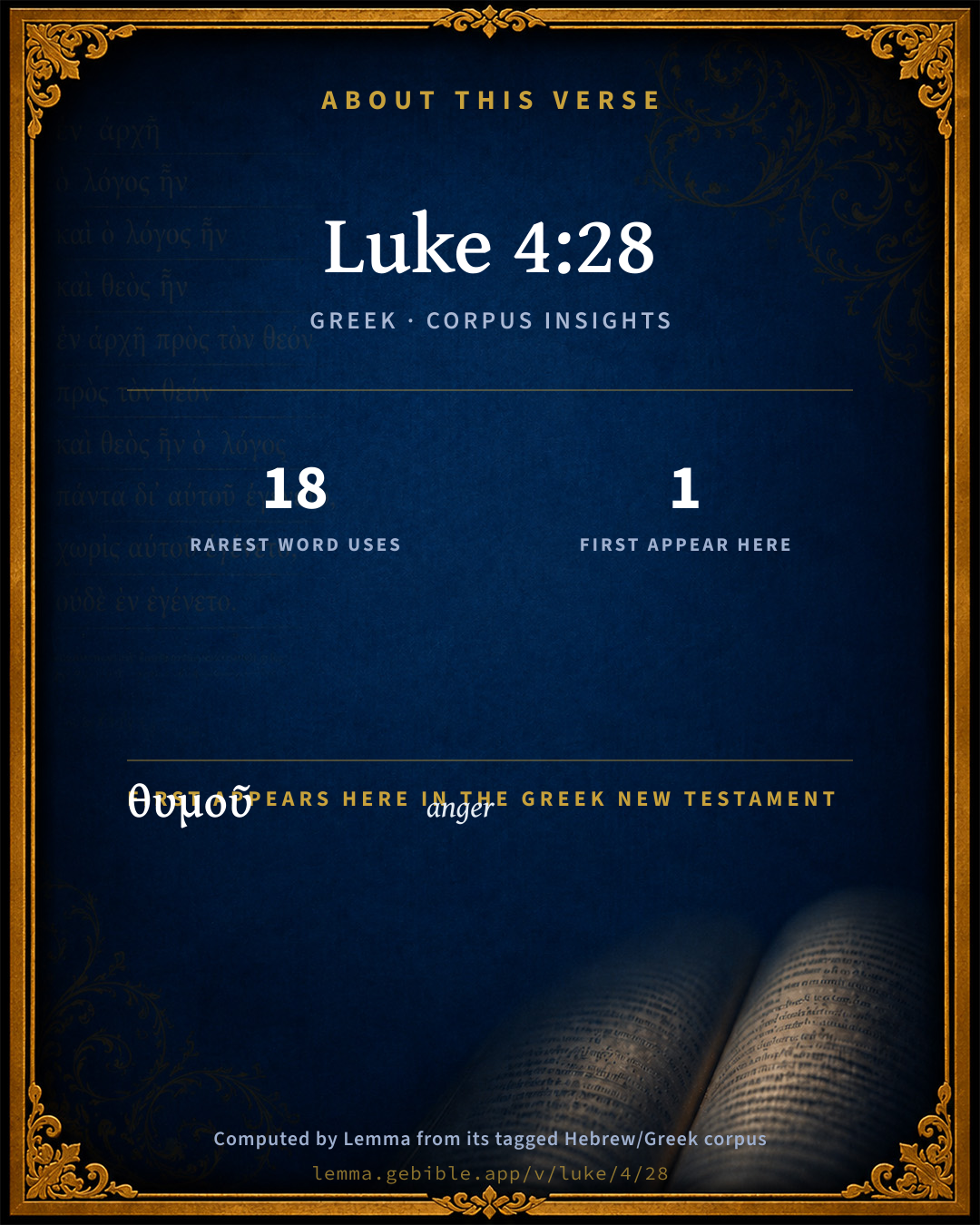
The rarest word here is θυμοῦ anger G2372 — appearing just 18 times in the whole Greek New Testament.

First appearance in Scripture

This word makes its first canonical appearance in the Greek New Testament here:

  • θυμοῦ anger G2372

Shared distinctive vocabulary

θυμοῦ anger G2372 occurs in 18 verses of the Greek New Testament. Also found in:
Cross-references

10

Topical passages linked to Luke 4:28 in the Treasury of Scripture Knowledge — connected by theme and wording, ordered by reader-vote popularity; previews shown in the World English Bible.

  • 2 Chronicles 24:20–21 The Spirit of God came on Zechariah the son of Jehoiada the priest; and he stood above the people, and said to them, Thus says God, Why disobey you the commandments of Yahweh, so that you can't prosper? because you have forsaken Yahweh, he has also forsaken you.
  • Jeremiah 37:15–16 The princes were angry with Jeremiah, and struck him, and put him in prison in the house of Jonathan the scribe; for they had made that the prison.
  • Jeremiah 38:6 Then took they Jeremiah, and cast him into the dungeon of Malchijah the king's son, that was in the court of the guard: and they let down Jeremiah with cords. In the dungeon there was no water, but mire; and Jeremiah sank in the mire.
  • Luke 6:11 But they were filled with rage, and talked with one another about what they might do to Jesus.
  • Luke 11:53–54 As he said these things to them, the scribes and the Pharisees began to be terribly angry, and to draw many things out of him;
  • Acts 5:33 But they, when they heard this, were cut to the heart, and determined to kill them.
  • Acts 7:54 Now when they heard these things, they were cut to the heart, and they gnashed at him with their teeth.
  • Acts 22:21–23 "He said to me, 'Depart, for I will send you out far from here to the Gentiles.'"
  • 2 Chronicles 16:10 Then Asa was angry with the seer, and put him in the prison-house; for he was in a rage with him because of this thing. Asa oppressed some of the people at the same time.
  • 1 Thessalonians 2:15–16 who killed both the Lord Jesus and their own prophets, and drove us out, and didn't please God, and are contrary to all men;

Cross-references courtesy of OpenBible.info (CC BY 4.0).

Commentary

Notes on Luke 4:28 from classic Christian and Jewish commentators (each source and its license shown beneath its notes). The classic Christian expositions comment on the surrounding passage and are grouped to its opening verse, so a note may address several verses; the Jewish commentaries on the Tanakh (Rashi and others) are per-verse, so they appear only where the commentator wrote on this verse.

Lemma curates 59 commentaries, every one of them public domain or Creative Commons licensed, each selected and text-cleaned for this edition rather than reprinted as found. About our sources →

The Biblical Illustrator

Joseph S. Exell

Luk_4:28; Luk_4:31

And all they in the synagogue, when they heard these things, were filled with wrath

Nazareth; or, Jesus rejected by His friends

I.

WHO WERE THESE REJECTORS OF CHRIST? They have their types and representatives now.

1. They were those who were nearest related to the Saviour. They were the people of His own town.

2. They were those who knew most about Christ. The whole story of the wondrous Child was known to them.

3. They were people who supposed that they had a claim upon Christ. They no doubt argued, He is a Nazareth man, and of course He is in duty bound to help Nazareth.

II. WHY THEY THUS REJECT THE MESSIAH.

1. I should not wonder but what the groundwork of their dissatisfaction was laid in the fact that they did not feel themselves to be the persons to whom the Saviour claimed to have a commission. Observe, He said, in the eighteenth verse, that He was anointed to preach the gospel to the poor. Now, the poorest ones in the synagogue may have felt pleased at that word; but as it was almost a maxim with the Jewish doctors that it did not signify what became of the poor--for few but the rich could enter heaven--the very announcement of a gospel for the poor must have sounded tothem awfully democratical and extreme, and must have laid in their minds the foundation of a prejudice. Did not some of them say, We have worn our phylacteries, and made broad the borders of our garments; we have not eaten except with washen hands; we have strained out all gnats from our wine; we have kept the fasts, and the feasts, and we have made long prayers, why should we feel any poverty of spirit? Hence they felt there was nothing in Christs mission for them. When He next mentioned the broken-hearted, they were not at all conscious of any need of a broken heart. They felt heart-whole, self-satisfied, perfectly content. What is the acceptable year of the Lord to us, if it is only for bruised captive ones? We are not such. At a glance you perceive, my brethren, the reason why in these days Jesus Christ is rejected by so many church-going and chapel-going people.

2. I entertain little doubt but what the men of Nazareth were angry with Christ because of His exceeding high claims. He said, The spirit of Jehovah is upon Me. They started at that. And so men now reject Christ because He sets Himself too high, and asks more of them than they are willing to give.

3. Another reason might be found in the fact that they were not for receiving Christ until He had exhibited some great wonder. They craved for miracles. Their minds were in a sickly state. A young man yonder has said to himself, If I had a dream, as I hear So-and-so had, or if there should happen to me some very remarkable event in providence, which should just meet my taste; or if I could feel to-day some sudden shock of I know not what, then I would believe. Thus you dream that my Lord and Master is to be dictated to by you! You are beggars at His gate, asking for mercy, and you must needs draw up rules and regulations as to how He shall give that mercy.

4. Again, and perhaps this time I may hit the head of the nail in some cases, though I suppose not in many in this place, part of the irritation which existed in the minds of the men of Nazareth was caused by the peculiar doctrine which the Saviour preached upon the subject of election. He laid it down that God had a right to dispense His favours just as He pleased, and that in doing so He often selected the most unlikely objects. They did not like this. The doctrine of free grace to the needy is ever a stumbling-block to men.

5. They loved not such plain personal speaking as the Saviour gave them.

6. They could not bear to hear Him hint that He meant to bless the Gentiles.

III. And now, WHAT CAME OF IT?

1. They thrust the Saviour out of the synagogue, and then they tried to hurl Him down the brow of the hill. These were His friends, good, respectable people: who would have believed it of them? You saw that goodly company in the synagogue who sang so sweetly, and listened so attentively, would you have guessed that there was a murderer inside every one of their coats? It only needed the opportunity to bring the murderer out; for there they are all trying to throw Jesus down the hill. We do not know how much devil there is inside any one of us; if we are not renewed and changed by grace, we are heirs of wrath even as others.

2. But what came of it? Why, though they thus thrust Him out, they could not hurt the Saviour. The hurt was all their own. (C. H. Spurgeon.)

Men seldom see the great in what is about them

We ride without eyes under Greylock, and go to the White Mountains for sublimity. The moon in Venice, and the sky in Naples, have more charm than here at home. The weeds of other climates become our flowers, and our flowers seem to us but weeds. There is little heroism, little devotion and nobility on our square mile; there are no epics or lyrics of human deed and feeling sung in our streets; the great, the beautiful, the excellent, is at a distance. Why we think thus it may be hard to tell, unless it is from instinctive reverence on the one hand, and on the other because the realization of greatness makes us aware of our own littleness, and so provokes us to every danger. So that what we read of here is no strange history, but only an illustration of a daily fact: a great spirit rejected by friends and neighbours; it is only the carpenters Son, the boy who grew up in the midst of us, and now, forsooth, claiming to be a prophet! And so they drive Him out of their city. (T. T. Munger.)

Cause of the Nazarenes wrath

What was actually the cause of the sudden upboil of these mens wrath? It was that their selfesteem was wounded. Christ declared that only the humble and meek would be able to receive Him. Elijah was persecuted, and received only by one poor widow. Naaman was unworthy to be healed till he humbled himself to dip in despised Jordan. The men of Nazareth understood the inference. It was not flattering to their pride; they could not be fed and healed unless they became humble, and submitted to the Lords Christ. This they would not do--and they cast Him out of their city. As with Christ, so with His Church, and with His messengers. As long as they preach a gospel which does not touch mans pride and lower his selfesteem, they wonder at the graciousness of the gospel; but the moment it bids them not to be wise in their own conceits, insists on submission of body, soul, and reason to Christ, and calls to a lowly walk and self-abasement, then men rise up against the Church, and its ministers, and against the true gospel of Christ, and would, if they could, cast it out of their city, and hurl it from their thoughts. (J. Baring. Gould, M. A.)

Capernaum

It lay on the western shore of the Sea of Galilee, and was, in Christs day, a thriving, busy town. The highway to the sea, from Damascus to Ptolemais--now Acre--ran through it, bringing no little local traffic, and also opening the markets of the coast to the rich yield of the neighbouring farms, orchards, and vineyards, and the abundant returns of the fisheries of the lake. The townsfolk thus, as a rule, enjoyed the comfort and plenty we see in the homes of Peter and Matthew, and were even open to the charge of being winebibbers and gluttonous, which implied generous entertainments They were proud of their town, and counted on its steady growth and unbounded prosperity, little dreaming of the ruin which would one day make even its site a question. (Dr. Geikie.)

Dr. Robinson, Captain Conder, and others place the site of Capernaum at Khan Mingeh, a spot of unique interest and beauty. Captain Conder certainly adduces strong reasons in favour of this hypothesis. (L. Oliphant.)

Not far from the banks of the Jordan stands Capernaum (now Tell. Hum), and here we find ourselves in the very centre of the Lords Galilean ministry. It was at Capernaum that He dwelt. This was the startingpoint of His journeys, and to this He returned after going about from place to place doing good. (E. Stapfer, D. D.)

Blindness of prejudice

A lady who excelled in making wax flowers and fruit was often criticised severely by her friends, and her work decried, as she thought, unjustly. She convicted them by showing an apple, which they as usual found fault with, one as to the shape, another as to colour, and so on. When they had finished, the lady cut the apple and ate it. (Baxendales Anecdotes.)

Overawed by the Spirit

The Rev. Charles G. Finney gives, in the words following, an account of the effects of a Christian look on a certain occasion:--I once preached, for the first time, in a manufacturing village. The next morning I went into a manufacturing establishment to view its operations. As I passed into the weaving department, I beheld a great company of young women, some of whom, I observed, were looking at me and then at each other, in a manner that indicated a trifling spirit, and that they knew me. I, however, knew none of them. As I approached nearer to those who had recognized me, they seemed to increase in their manifestation of lightness of mind. Their levity made a peculiar impression upon me; I felt it to my very heart. I stopped short and looked at them, I know not how, as my whole mind was absorbed with their guilt and danger. As I settled my countenance upon them, I observed that one of them became very much agitated. A thread broke. She attempted to mend it; but her hands trembled in such a manner that she could not do it. I immediately observed that the sensation was spreading, and had become universal among that class of triflers. I looked steadily at them, until one after another gave up, and paid no more attention to their looms. They fell on their knees, and the influence spread throughout the whole room. I had not spoken a word, as the noise of the looms would have prevented my being heard if I had. In a few minutes all work was abandoned, and tears and lamentations filled the room. At this moment the owner of the factory, who was himself an unconverted man, came in, accompanied, I believe, by the superintendent, who was a professed Christian. When the owner saw the state of things, he said to the superintendent, Stop the mill. What he saw seemed to pierce him to the heart. It is more important, he hurriedly remarked, that these souls should be saved than that this mill should run. As soon as the noise of the machinery had ceased, the owner inquired, What shall we do? We must have a place to meet where we can receive instruction. The superintendent replied, The mule-room will do. The mules were run up out of the way, and all the hands were notified, and assembled in that room. We had a marvellous meeting. I prayed with them, and gave them such instructions as at the time they could bear. The Word was with power; and within a few days, as I was informed, nearly every hand in that great establishment, together with the owner, had hope in Christ. (Bates Influence of Mind on Mind.)

Remarkable change in the conduct of a mob

A missionary who had been sent to a strange land to proclaim the gospel of the kingdom of God and who had passed through many hardships and was often in danger of losing his life, through the persecutions excited against him, came to a place where he had often before, at no small risk, preached Christ crucified. About fifty people who had received good impressions from the Word of God, assembled: he began his discourse; and after he had preached about thirty minutes, an outrageous mob surrounded the house, armed with different instruments of death, and breathing the most sanguinary purposes. The preacher then addressed his little flock to this effect, These outrageous people seek not you but me, if I continue in the house, they will soon pull it down and we shall be all buried in its ruins, I will therefore in the name of God go out to them and you will be safe. As soon as the preacher made his appearance the savages became instantly as silent and as still as night: he walked forward and they divided to the right and to the left, leaving a passage about four feet wide for himself and a young man who followed him to walk in. The narrator who was present on the occasion goes on to say, This was one of the most affecting spectacles I ever witnessed, an infuriated mob without any visible cause (for the preacher spoke not one word) became in a moment as calm as lambs. They seemed struck with amazement bordering on stupefaction; they stared and stood speechless, and after they had fallen back to right and left to leave him a free passage, they were as motionless as statues. They assembled with the full purpose to destroy the man who came to show them the way of salvation, but he, passing through the midst of them, went his way. (Dr. Adam Clarke.)

The Biblical Illustrator, edited by Joseph S. Exell (c. 1880s–1900s) — public domain. Text from a community e-Sword module.

Joseph Benson's Commentary

Luk 4:28-30. And all they in the synagogue were filled with wrath — The Nazarenes, perceiving the purport of his discourse, namely, that the blessings which they despised would be offered to, and accepted by, the Gentiles, were enraged to such a pitch, that, forgetting the sanctity of the sabbath, they gathered around him tumultuously, forced him out of the synagogue, and rushed with him through the streets to the brow of the hill whereon their city was built; that they might cast him down headlong. So changeable are the hearts of wicked men! So little are their starts of love to be depended on! So unable are they to bear the close application, even of a discourse which they most admire! But he, passing through the midst of them — Probably by making himself invisible; or by overawing them: so that, though they saw, they had not power to touch him.

Joseph Benson's Commentary on the Old and New Testaments (1811–1818) — public domain. Text from a community e-Sword module.

Tyndale Open Study Notes

Tyndale Open Resources

4:28 The people in the synagogue were furious that Jesus pointed out the favor God had shown to Gentiles. The Jews viewed themselves as sole recipients of God’s favor, and they were oppressed by Gentile overlords.

Tyndale Open Study Notes — © Tyndale Open Resources, licensed CC BY-SA 4.0. Text via the HelloAO Bible API.

Bengel's Gnomon

Johann Albrecht Bengel

Luk 4:28. Θυμοῦ, with wrath) They had thought that the giving of a very different character to themselves, and a different return, namely thanks, were due to them for their applause. But by their own very act they prove the truth of Jesus’ words.

Bengel's Gnomon of the New Testament — English translation (T&T Clark, Edinburgh, 1860) — public domain. Text from a community e-Sword module.

Expositor's Greek Testament

ed. W. Robertson Nicoll

Luk 4:28-29 . Unsympathetic from the first, the Nazareans, stung by these O. T. references, become indignant. Pagans , not to speak of Capernaum people, better than we: away with Him! out of the synagogue, nay, out of the town ( ἔξω τῆς πόλεως ). ἕως ὀφρύος τ . ὄ ., etc., to the eyebrow ( supercilium , here only in N. T.) of the hill on which the city was built, implying an elevated point but not necessarily the highest ridge. Kypke remarks: “non summum montis cacumen, sed minor aliquis tumulus sive clivus intelligitur, qui cum monte cohaeret, metaphora a superciliis oculorum desumta, quae in fronte quidem eminent, ipso tamen vertice inferiora sunt”. Nazareth now lies in a cup, built close up to the hill surrounding. Perhaps then it went further up. ὥστε ( εἰς τὸ , T.R.) with infinitive indicating intention and tendency, happily not result.

The Expositor's Greek Testament, edited by W. Robertson Nicoll (1897–1910) — public domain. Text from a community e-Sword module.

Geneva Bible (1599)

Geneva Bible translators

The more sharply the world is rebuked, the more it rageth openly: but the life of the godly is not simply subject to the pleasure of the wicked.

Geneva Bible (1599) marginal notes — public domain. Text via Bolls.life.

Jamieson, Fausset & Brown

Robert Jamieson, A. R. Fausset & David Brown

when they heard these things--these allusions to the heathen, just as afterwards with Paul (Act 22:21-22).

Jamieson, Fausset & Brown — Commentary Critical and Explanatory on the Whole Bible (1871) — public domain (CC PDM 1.0). Text via the HelloAO Bible API.

Adam Clarke's Commentary

Verse 28. Were filled with wrath] They seem to have drawn the following conclusion from what our Lord spoke: "The Gentiles are more precious in the sight of God than the Jews; and to them his miracles of mercy and kindness shall be principally confined." This was pretty near the truth, as the event proved. Those who profit not by the light of God, while it is among them, shall have their candle extinguished. The kingdom of God was taken from the Jews, and given to the Gentiles; not because the Gentiles were better than they were, but because,

1st. The Jews had forfeited their privileges; and

2dly. Because Christ saw that the Gentiles would bring forth the fruits of the kingdom.

Adam Clarke's Commentary on the Bible (1810–1826) — public domain. Text from a community e-Sword/MySword module.

Ellicott's Commentary for English Readers

(28) Were filled with wrath.—The admiration they had felt at first was soon turned into bitterness. They heard themselves spoken of as though there might be a faith in Zidon and in Syria which was not found in Israel, of which they themselves were altogether destitute.

A Bible Commentary for English Readers, edited by Charles John Ellicott (1878–1897) — public domain. Text from a community e-Sword module.

The Cambridge Bible for Schools and Colleges

gen. ed. J. J. S. Perowne

28. were filled with wrath] The aorist implies a sudden outburst. Perhaps they were already offended by knowing that Jesus had spent two days at Sychar among the hated Samaritans; and now He whom they wished to treat as “the carpenter” and their equal, was as it were asserting the superior claims of Gentiles and lepers. “Truth embitters those whom it does not enlighten.” “The word of God,” said Luther, “is a sword, is a war, is a poison, is a scandal, is a stumbling-block, is a ruin”—viz. to those who resist it (Mat_10:34; 1Pe_2:8).

The Cambridge Bible for Schools and Colleges (gen. ed. J. J. S. Perowne; Cambridge University Press, 1878–1918) — public domain. Text from a community e-Sword module.

John Gill's Exposition

And all they in the synagogue,.... The ruler and minister, and the whole multitude of the common people that were met together there for worship; and who before were amazed at his eloquence, and the gracefulness of his delivery; and could not but approve of his ministry, though they could not account for it, how he should come by his qualifications for it:

when they heard these things; these two instances of Elijah and Elisha, the one supplying the wants of a Sidonian woman, and the other healing a Syrian leper, when no notice were taken by them of poor widows and lepers in Israel:

were filled with wrath; for by these instances they perceived, that they were compared to the Israelites in the times of wicked Ahab and Jezebel; and that no miracles were to be wrought among them, or benefits conferred on them, though they were his townsmen; yea, that the Gentiles were preferred unto them: and indeed the calling of the Gentiles was here plainly intimated, which was always ungrateful and provoking to the Jews; and it was suggested, that the favours of God, and grace of the Messiah, are dispensed in a sovereign and discriminating way, than which nothing is more offensive to carnal minds.

John Gill's Exposition of the Whole Bible (1746–1763) — public domain (CC PDM 1.0). Text via the HelloAO Bible API.

Trapp's Complete Commentary

John Trapp

28 And all they in the synagogue, when they heard these things, were filled with wrath,

Ver. 28. And all they in the synagogue] Though but plain rustics, yet they soon understood this saying of preaching to the Gentiles: which put them into an anger, and our Saviour into a danger.

John Trapp, A Commentary or Exposition upon All the Books of the Old and New Testament (1647–1656) — public domain. Text from a community e-Sword module.

Albert Barnes' Notes on the Bible

Filled with wrath - They were enraged, probably, for the following reasons:

They saw that the cases applied to themselves, because they would not receive the miraculous evidences of his mission. That he would direct his attention to others, and not to them. That the “Gentiles” were objects of compassion with God, and that God often showed more favor to a “single” Gentile than to multitudes of Jews in the same circumstances. That they might be “worse” than the Gentiles. And, That it was a part of his design to preach the gospel to the Gentiles, and not confine his labors to them only.

On these accounts their favor was soon turned to wrath, and the whole transaction shows us:

That popular applause is of little value. That the slightest circumstances may soon turn the warmest professed friendship to hatred. And, That people are exceedingly unreasonable in being unwilling to hear the truth and profit by it.

Albert Barnes' Notes on the Bible (1834–1885) — public domain. Text from a community e-Sword/MySword module.

Matthew Poole's English Annotations

Unhappy Nazareth, where Christ had now lived more than thirty years! They had seen him growing up, increasing in wisdom and stature, and in favour both with God and man, Luk 2:52; they had had the first fruits of his ministry, and, Luk 4:22, they bare him witness, and wondered at the gracious words which proceeded out of his mouth; they knew his education, so as they could not think he had this wisdom and knowledge from any advantages of that, but must have it from Heaven; yet when they hear him preaching, and but touching them for their contempt and rejection of him, and tacitly comparing them with their forefathers in the time of Ahab, and preaching the doctrine of God’s sovereign and free grace, and hinting to them that the grace of God should pass to the Gentiles, while they should be rejected, they are not able to bear him. Thus, Act 22:21, the Jews heard Paul patiently, till he repeated God’s commission to him to go unto the Gentiles; then they cried, Away with such a fellow from the earth, for it is not fit he should live. This was according to the old prophecy, Deu 32:21, (applied to the Jews by the apostle, Rom 10:19), that because they had moved God to jealousy with that which is not God, he would move them to jealousy with them that are not a people, and provoke them to anger with a foolish nation. This is further matter of observation, that wretched sinners, who cannot obtain of their lusts to be as good and holy as others, yet are ordinarily so proud, as they have no patience to hear that others are better than they, or have or shall have any more special share in God’s favour. Those of Nazareth which were in the synagogue hearing these things, are filled with wrath, thrust Christ out of the city, as not fit to live among them, and go about to kill him, by throwing him down headlong from the brow of the hill upon which their city was built.

But he passing through the midst of them went his way. How he got out of their hands, when they had laid hold of him, the Scripture doth not tell us, nor is it our concern to be curious to inquire. We read much the like passage, Joh 8:59, when the Jews had taken up stones to stone him. We know it was an easy thing for him, who was God as well as man, to quit himself of any mortal enemies; but how he did it, whether by blinding their eyes, or altering the nature of his body, and making it imperceptible by them, or by a greater strength than they, (which the Divine nature could easily supply his human nature with), who is able to determine?

Matthew Poole's English Annotations on the Holy Bible (1683–1685) — public domain. Text from a community e-Sword/MySword module.

Whedon's Commentary on the Bible

Daniel D. Whedon

28. Were filled with wrath—All at once the Church became a mob. It was clearly seen that the faithless widows and lepers were but types of themselves, the faithless Nazarenes. They now proceeded to show the justness of the type.

Daniel D. Whedon (gen. ed.), Commentary on the Old and New Testaments (1874–1909) — public domain. Text from a community e-Sword module.

The Pulpit Commentary

And all they in the synagogue, when they heard these things, were filled with wrath. The Jews in the synagogue quickly caught the Master"s meaning. Thoughts such as "Thou our Messiah, who talkest of Gentile, Syrian, and Zidonian in the same breath with us the chosen and elect of God, who hintest at the possibility of the accursed Gentile sharing in our promised blessings!" flashed through their minds, and as one man the congregation rose, and, seizing the Preacher, dragged him out of the synagogue, and hurried him through the little town to one of the rocky precipices close by.

The Pulpit Commentary (1880–1919), ed. H.D.M. Spence-Jones & Joseph S. Exell — public domain. Text from a community e-Sword module.

John Wesley's Explanatory Notes

And all in the synagogue were filled with fury - Perceiving the purport of his discourse, namely, that the blessing which they despised, would be offered to, and accepted by, the Gentiles. So changeable are the hearts of wicked men! So little are their starts of love to be depended on! So unable are they to bear the close application, even of a discourse which they most admire!

John Wesley, Explanatory Notes Upon the Whole Bible (1754–1765) — public domain. Text via the GEBible commentary corpus.

Kretzmann's Popular Commentary

Paul E. Kretzmann

The attempt to kill the Lord:

v. 28. And all they in the synagogue, when they heard these things, were filled with wrath,

v. 29. and rose up, and thrust Him out of the city, and led Him unto the brow of the hill whereon their city was built, that they might cast Him down headlong.

v. 30. But He, passing through, the midst of them, went His way,

v. 31. and came down to Capernaum, a city of Galilee, and taught them on the Sabbath-days.

v. 32. And they were astonished at His doctrine; for His word was with power.

Up to this point the congregation had listened to Jesus, though with growing indignation, since He dared to expose and flay their national vice, their self-righteous pride. But now their indignation, which filled them to overflowing, carried all reason and common sense before it. The entire population shared in the movement. Rising up, they cast Him out of the synagogue, out of the city. And then they deliberately laid hold upon Him and led Him to a precipice of the hill on which their city was built, a place where there was a steep, sheer drop into the valley below, their intention being to throw Him down bodily. Theirs was the action of people that have lost all semblance of calm reasoning, whom insane wrath has deprived of the ability to think right and to consider the consequences, a typical mob, such as are the rule to this day under similar circumstances. As long as faithful pastors speak in a general way in their preaching and admonishing, they have peace and are even praised. But if the same men dare to point to individual sins, they are accused of unjust criticism and condemnation. For it is a peculiarity of the truth that it embitters and makes enemies where it does not work conversion. There is no worse censure for a pastor than that winch was spoken of one concerning his position in his congregation: We do not hurt him, and he does not hurt us. But the mob, in Christ’s case, did not realize its murderous intention, though they received evidence of the supernatural power of the Lord. For He quietly passed through their midst and went His way. Whether He rendered Himself invisible for the time being, or whether they were struck with blindness, or whether their arms were paralyzed by a power above them, is not stated. It was not merely the power of a tranquil spirit and a firm will over human passions, but the almighty power of the Son of God that stayed their hands.

Jesus went down from the hill country to the city of Capernaum, which He made His headquarters during His Galilean ministry. Here He made it a habit to teach in the synagogues on the Sabbath-days, for the preaching of the Gospel of salvation was the first and principal part of His work. And wherever He taught, the effect of His words was the same: people were astonished almost to stupefaction over His doctrine, which differed so radically from the vapid discourses of the average rabbi, and in authority and power His word went out. There was not only the force of conviction behind it, but the merciful power of God which is in the means of grace and gives them their efficacy. Note: Luke always adds the geographical references for the sake of his readers, who were unacquainted with the location of the various towns which are mentioned in the Gospel story.

Paul E. Kretzmann, Popular Commentary of the Bible (1921–1924) — public domain. Text from a community e-Sword module.

Burkitt's Expository Notes on the New Testament

William Burkitt

Observe here, 1. The horrid impiety of the people of Nazareth, in thrusting their Saviour out of their city, and their barbarous and bloody cruelty in bringing him to the brow of the hill, with full intent to cast him down headlong. But Christ was to die a clean contrary way, not by throwing down, but by lifting up.

O ungrateful and unhappy Nazareth! Is this the return you make the divine Guest, which for thirty years had sojourned in your coasts? No wonder that the ablest preaching, and most exemplary living, of the holiest and best of Christ’s ministers obtain no greater success at this day amongst a people, when the presence of Christ at Nazareth, for thirty years together, had no better influence upon the minds and manners of that people; but instead of receiving his message, they rage at the messenger: neither let any of the ministers of Christ think it strange, that they are ignominiously despised, when our Master before us was in danger of being barbarously murdered, and that for his plain preaching to his own people, the men of Nazareth.

But observe, 2. The miraculous escape of our blessed Lord from the murdering hands of the wicked Nazarites: He, passing through the midst of them, went his way. How and after what manner he escaped is not declared, and therefore cannot without presumption be determined.

Although the Romanists, to make way for their doctrine of transub- stantiation, positively affirm, that, contrary to the nature of a body, he penetrated through the breasts of the people. But whether he struck them with blindness that they did not see, or smote them with fear that they durst not hold him, or whether by a greater strength than theirs, (which his Godhead could easily supply his human nature with), he escaped from them.

It is neither prudent to enquire nor possible to determine: we know it was an easy thing for him who was God as well as man, to quit himself of any mortal enemies; and at the same time, when he rescued himself, could have ruined them, by frowning them into hell, or looking them into nothing.

William Burkitt's Expository Notes on the New Testament (1700–1703) — public domain. Text from a community e-Sword module.

The People's New Testament

B. W. Johnson

28–30. Were filled with wrath. They were so filled with bigotry that the suggestion of the salvation of the Gentiles was intolerable, and in their rage they sought to slay him. See Acts 2:22, where a similar suggestion leads the Jews to seek Paul's death.

Passing through the midst of them. With a majesty that overawed them.

B. W. Johnson's The People's New Testament with Notes (1889–1891) — public domain. Electronic text from the Christian Classics Ethereal Library (CCEL) ThML edition.

unfoldingWord translationNotes

Door43 World Missions Community

All the people in the synagogue were filled with rage when they heard these things

The people of Nazareth were deeply offended that Jesus had cited scriptures where God had helped Gentiles instead of Jews.

forced him out of the town

"forced him to leave the town" or "shoved him out of the city"

cliff of the hill

"edge of the cliff"

he passed through the middle of them

"through the middle of the crowd" or "between the people who were trying to kill him."

he went to another place

"he went away" or "he went on his way" Jesus went where he had planned to go instead of where the people were trying to force him to go.

translationWords

synagogue

rage

unfoldingWord translationNotes — © Distant Shores Media and the Door43 World Missions Community, licensed CC BY-SA 4.0. Source: git.door43.org/Door43/en_tn.

Cambridge Greek Testament for Schools and Colleges

28. ἐπλήσθησαν … θυμοῦ. The aorist implies a sudden outburst. Perhaps they were already offended by knowing that Jesus had spent two days at Sychar among the hated Samaritans; and now He whom they wished to treat as “the carpenter” and their equal, was as it were asserting the superior claims of Gentiles and lepers. “Truth embitters those whom it does not enlighten.” “The word of God,” said Luther, “is a sword, is a war, is a poison, is a scandal, is a stumbling-block, is a ruin”—viz. to those who resist it (Mat 10:34; 1Pe 2:8).

Cambridge Greek Testament for Schools and Colleges (Cambridge University Press, 1896; 21 vols, various authors incl. Carr, Maclear, Plummer, Farrar, Lumby, Moule, M. R. James, Simcox) — public domain. Text from a community e-Sword module.

Alford’s Greek Testament

Henry Alford

28-30.] The same sort of rage possessed the Jews, Act 22:22, on a similar truth being announced to them. This whole occurrence, whenever it happened in our Lord’s ministry, was but a foreshadowing of His treatment afterwards from the whole nation of the Jews—a foretaste of εἰς τὰ ἴδια ἦλθεν, καὶ οἱ ἴδιοι αὐτὸν οὐ παρέλαβον (Joh 1:11). The expression of St. Paul, Rom 11:25, πώρωσις ἀπὸ μέρους τῷ Ἰσραὴλ γέγονεν, has been regarded as corresponding with the judicial infliction on these Nazarenes, by means of which our Lord passed out from among them. But see my note, and Ellicott’s, on Eph 4:18, from which it appears that πώρωσις cannot mean blindness at all.

The modern Nazareth is at a distance of about two English miles from what is called the Mount of Precipitation; nor is it built literally on the brow of that mount or hill. But (1) neither does the narrative preclude a considerable distance having been traversed, during which they had our Lord in their custody, and were hurrying with Him to the edge of the ravine; nor (2) is it at all necessary to suppose the city built on the ὀφρύς, but only on the mountain, or range of hills, of which the ὀφρύς forms a part—which it is: see Robinson, iii. 187.

Our Lord’s passing through the midst of them is evidently miraculous: the circumstances were different from those in Joh 8:59, where the expression is ἐκρύβη καὶ ἐξῆλθεν ἐκ τ. ἱεροῦ: see note there. Here, the Nazarenes had Him actually in their custody.

Henry Alford, The Greek Testament (1849–1861) — public domain. Text from a community e-Sword module.

International Critical Commentary

28. ἐπλήσθησαν πάντες θυμοῦ. See on 1:66. They see the point of His illustrations; He has been comparing them to those aws who were judged less worthy of Divine Benefits than the heathen. It is this that infuriates them, just as it infuriated the Jews at Jerusalem to be told by S. Paul that the heathen would receive the blessings which they despised (Act 13:46, Act 13:50, Act 13:22:21, Act 13:22). Yet to this day the position remains the same; and Gentiles enjoy the Divine privileges of which the Jews have deprived themselves. His comparing Himself to such Prophets as Elijah and Elisha would add to the wrath of the Nazarenes. On the other hand, these early instances of God’s special blessings being conferred upon heathen would have peculiar interest for Lk.

International Critical Commentary — older volumes (1896–1929), various authors — public domain. Text from a community e-Sword module.

Godet's Commentaries

Frédéric Louis Godet

Vers. 28-30. Conclusion.

The threat contained in these examples exasperates them: “Thou rejectest us: we reject thee,” was their virtual reply. The term ἐκβάλλειν, to cast out, denotes that they set upon Him with violence.

About forty minutes distant from Nazareth, to the south-east, they show a wall of rock 80 feet high, and (if we add to it a second declivity which is found a little below) about 300 feet above the plain of Esdraelon. It is there that tradition places this scene. But Robinson regards this tradition as of no great antiquity. Besides, it does not agree with the expression: on which the city was built. Nazareth spreads itself out upon the eastern face of a mountain, where there is a perpendicular wall of rock from 40 to 50 feet high. This nearer locality agrees better with the text.

The ὥστε of the Alex. reading signifies: so as to be able to cast Him down. It was for that purpose that they took the trouble of going up so high. This reading is preferable to the T. R.: εἰς τό, for the purpose of.

The deliverance of Jesus was neither a miracle nor an escape; He passed through the group of these infuriated people with a majesty which overawed them. The history offers some similar incidents. We cannot say, as one critic does: “In the absence of any other miracle, He left them this.”

The greater part of modern critics regard this scene as identical with that of Matthew 13. and Mark 6., placed by these evangelists at a much later period. They rely, 1 st, On the expression of surprise: Is not this the son of Joseph? and on the proverbial saying, Luk 4:24, which could not have been repeated twice within a few months; 2 d, On the absence of miracles common to the two narratives; 3 d, On the words of Luk 4:23, which suppose that Jesus had been labouring at Capernaum prior to this visit to Nazareth. But how in this case are the following differences to be explained?—1. In Matthew and Mark there is not a word about the attempt to put Jesus to death. All goes off peaceably to the very end. 2. Where are certain cases of healing recorded by Matthew (Mat 13:58) and Mark (Mar 6:5) to be placed? Before the preaching? This is scarcely compatible with the words put into the mouth of the inhabitants of Nazareth (Luk 4:23, Luke). After the preaching? Luke’s narrative absolutely excludes this supposition. 3. Matthew and Mark place the visit which they relate at the culminating point of the Galilaean ministry, and towards its close, whilst Luke commences his account of this ministry with the narrative which we have just been studying. An attempt has been made to explain this difference in two ways: Luke may have wished, in placing this narrative here, to make us see the reason which induced Jesus to settle at Capernaum instead of Nazareth (Bleek, Weizsäcker); or he may have made this scene the opening of Jesus’ ministry, because it prefigures the rejection of the Jews and the salvation of the Gentiles, which is the leading idea of his book (Holtzmann). But how is such an arbitrary transposition to be harmonized with his intention of writing in order, so distinctly professed by Luke (Luk 1:4)? These difficulties have not yet been solved. Is it then impossible, that after a first attempt among His fellow-citizens at the beginning of His ministry, Jesus should have made a second later on? On the contrary, is it not quite natural that, before leaving Galilee for ever (and thus at the very time to which Matthew and Mark refer their account), He should have addressed Himself once more to the heart of His fellow-countrymen, and that, if He had again found it closed against Him, the shock would nevertheless have been less violent than at the first encounter? However this may be, if the two narratives refer to the same event, as present criticism decides, Luke’s appears to me to deserve the preference, and for two reasons: 1. The very dramatic and detailed picture he has drawn leaves no room for doubting the accuracy and absolute originality of the source whence he derived his information; whilst the narratives of Matthew and Mark betray, by the absence of all distinctive features, their traditional origin. 2. John (Joh 4:4) cites, at the beginning of his account of the Galilaean ministry, the saying recorded by the three evangelists as to the rejection which every prophet must undergo from his own people. He quotes it as a maxim already previously announced by Jesus, and which had influenced from the first the course of His ministry. Now, as the three Syn. are agreed in referring this saying to a visit at Nazareth, this quotation in John clearly proves that the visit in question took place at the commencement (Luke), and not in the middle or at the end of the Galilaean ministry (Matthew and Mark). We are thus brought to the conclusions: 1. That the visit related by Luke is historical; 2. That the recollection of it was lost to tradition, in common with many other facts relating to the beginning of the ministry (marriage at Cana, etc.); 3. That it was followed by another towards the end of the Galilaean ministry, in the traditional account of which several incidents were introduced belonging to the former. As to the sojourn at Capernaum, implied in Luk 4:23, we have already seen that it is included in the general description, Luk 4:15. Joh 2:12 proves that from the first the attention of Jesus was drawn to this city as a suitable place in which to reside. His first disciples lived near it. The synagogue of Capernaum must then have been one of the first in which He preached, and consequently one of those mentioned in Luk 4:15.

Frédéric Louis Godet — Commentaries on Luke, John, Romans, and 1 Corinthians — English translation (T&T Clark, Edinburgh, 1870s–1890s) — public domain. Text from a community e-Sword module.

Lesson kit

Teaching starters — assembled from the data on this page, not authored interpretation. Every prompt links to the verse data it draws on. Edit before teaching.

Luke, in the Gospels, opens this verse with 9 words (9 distinct Greek lemmas). Its most distinctive word is thymós (“anger”). A historical commentator’s framing appears above. Read the whole chapter for the surrounding context.

Discussion questions

  1. What does “anger” (thymós) contribute to the verse as a whole?
  2. This is the first place “anger” appears in Scripture (first appears here). What does its debut here establish?
  3. How does Acts 19:28, which shares the word «anger», read alongside this verse?
  4. These translations render this verse differently. What is at stake in choosing one wording over another?
  5. Compare how The Biblical Illustrator and Joseph Benson's Commentary read this verse. Where do they agree or differ?

Things to notice

  • 1 word makes its first canonical appearance in Scripture here.
  • These translations choose different wording for 4 words in this verse.
  • 9 distinct Greek lemmas span 9 words in this verse.

Reading settings

Reading text

Shown beneath each verse's original-language words.

Old Testament
Old Testament edition

Read the OT as the Masoretic Hebrew (MT) or the Greek Septuagint (LXX).

English shown for the Greek Septuagint (in the Hebrew ↔ Greek comparison).

Comparing translations? Open the Compare panel on any verse page to stack up to four side by side.