
Luke 13:8

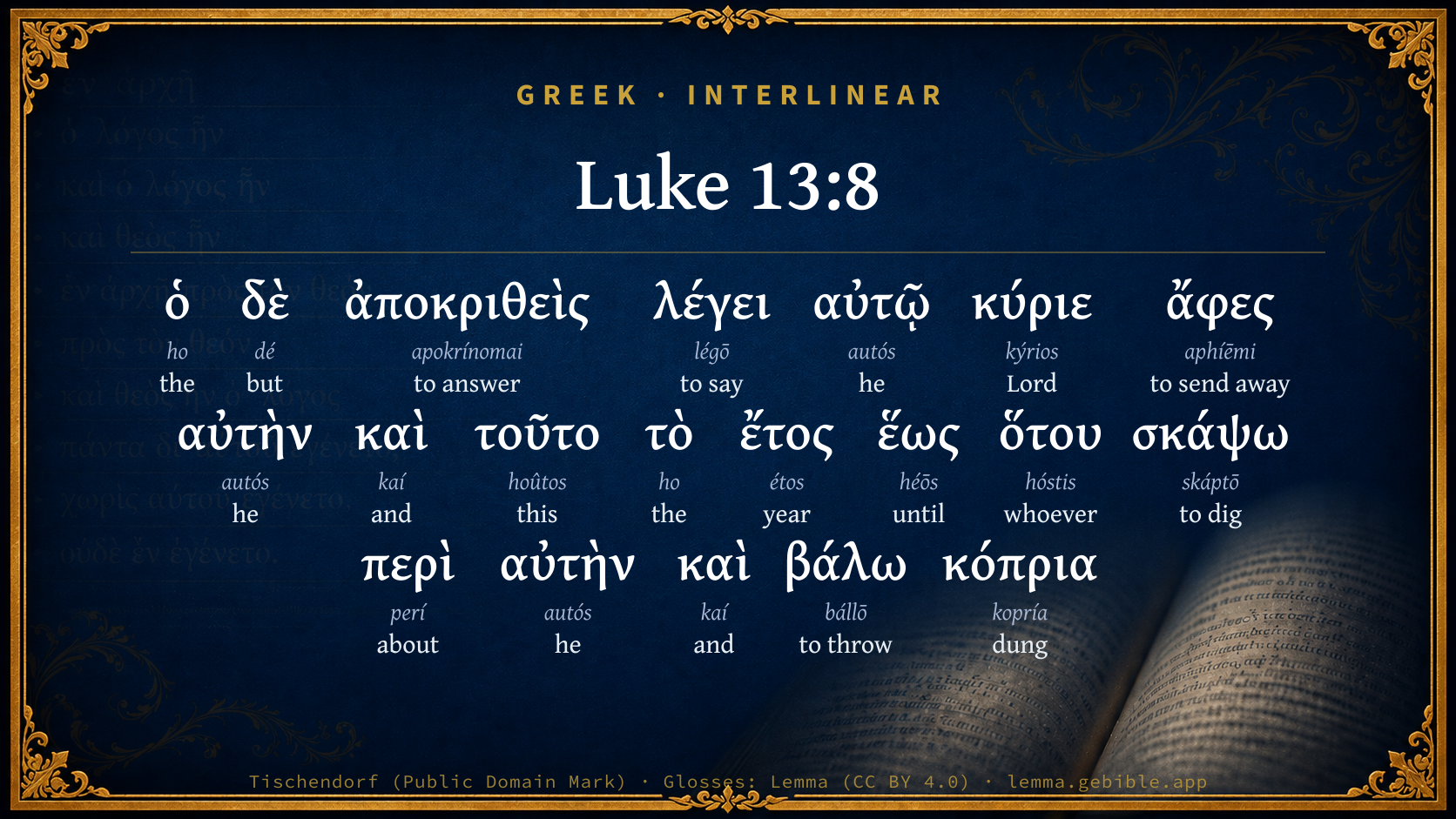
Greek (Tischendorf 8th ed.) Luke 13:8 appears in the Greek New Testament. The text above is from the Tischendorf 8th edition. Each word links to its Strong’s number and a concise gloss. Click any word for its full Thayer’s Greek Lexicon entry.
Download image
Cite this verse

Luke 13:8 (World English Bible). Public Domain. Lemma interlinear Bible study tool, https://lemma.gebible.app/v/luke/13/8.

Show BibTeX & RIS
BibTeX
RIS
English Translation
He answered, 'Lord, leave it alone this year also, until I dig around it, and fertilize it.
World English Bible · Public Domain
Highlights
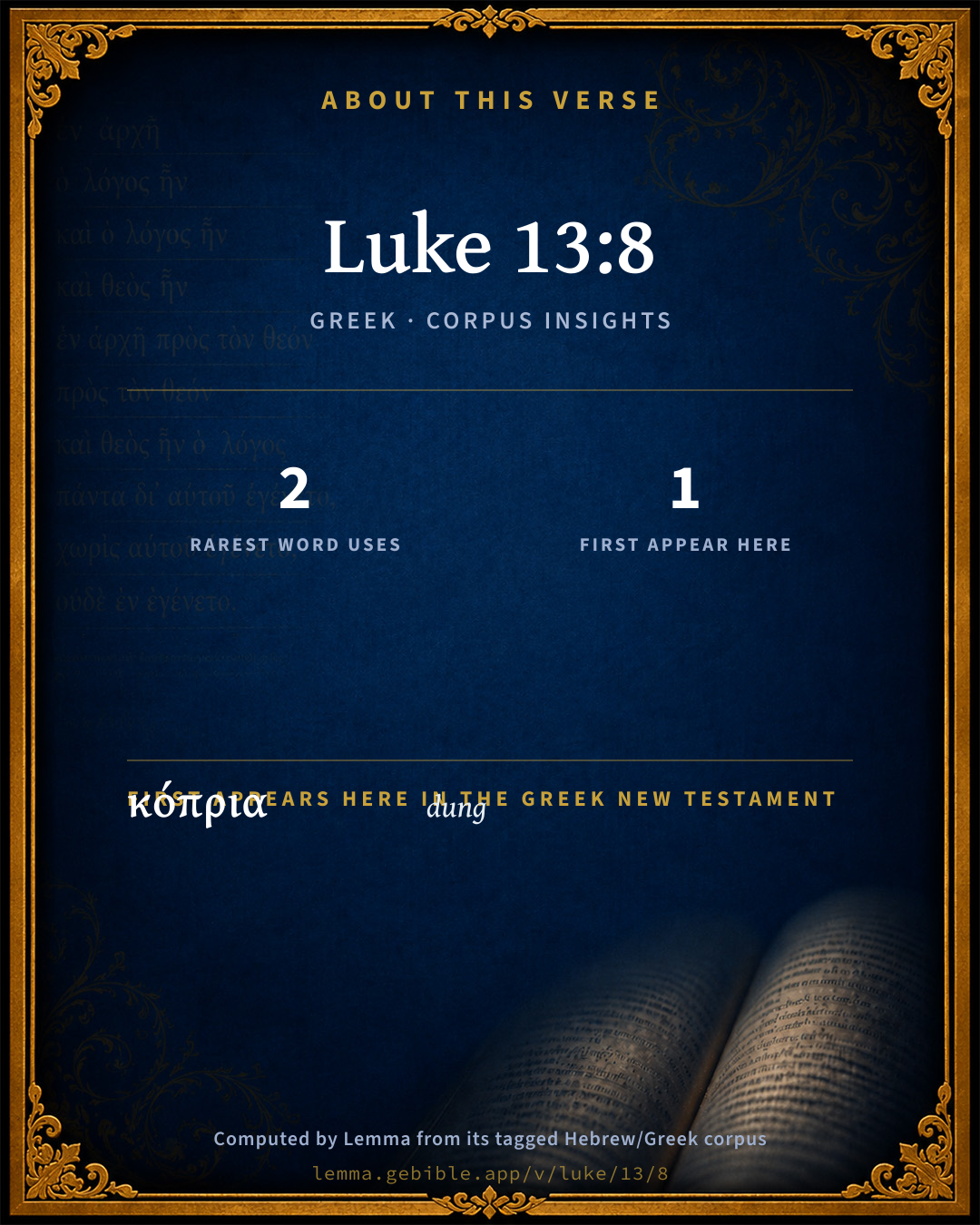
  • 1 first appearance in the Greek New Testament
Full analysis ↓
Download a study sheet

One document with this verse’s original text, its word-by-word gloss line, the meaning frame, cross-references with their text, attributed commentary, and full source and license credits — printable, and it pastes into notes with its structure intact.

This verse Autodidact and up

Study sheet (.html) Plain text (.txt)

A passage Seminary Student

Up to 50 verses in one chapter. A passage sheet keeps up to 6 commentary sources and 12 cross-references per verse, in the order this page ranks them, and says so on the sheet whenever that leaves anything out. Ask for a single verse and you get the Autodidact verse sheet above.

Everything on this page stays free to read, with no account — the sheet is a download of what is already on screen, not access to it.

Want to remove ads? Support Godless Engineer
Compare translations 3

The same verse in 3 English versions, stacked beneath the original-language interlinear above. Click any original word for its lexicon entry.

Each is an independent rendering of the whole verse — the interlinear is not word-aligned to these translations.

Highlighted words mark where these versions differ — a whole-verse word diff, not a word-by-word alignment.

  • World English Bible Public Domain
    He answered, 'Lord, leave it alone this year also, until I dig around it, and fertilize it.
  • King James Version Public Domain
    And he answering said unto him, Lord, let it alone this year also, till I shall dig about it, and dung it:
  • unfoldingWord Literal Text CC BY-SA 4.0
    But answering, he says to him, ‘Master, leave it this year also, until I dig around it and put on manure.

unfoldingWord Literal Text — © unfoldingWord, licensed CC BY-SA 4.0. Word-aligned USFM3 via Door43 (git.door43.org/unfoldingWord/en_ult).

Versions to compare (up to 4)

3 of 4 selected

Show all 19 translations

Every available English version of this verse, each an independent rendering of the whole verse.

  • World English Bible Public Domain
    He answered, 'Lord, leave it alone this year also, until I dig around it, and fertilize it.
  • Berean Standard Bible Public Domain
    ‘Sir,’ the man replied, ‘leave it alone again this year, until I dig around it and fertilize it.
  • Majority Standard Bible Public Domain
    ‘Sir,’ the man replied, ‘leave it alone again this year, until I dig around it and fertilize it.
  • King James Version Public Domain
    And he answering said unto him, Lord, let it alone this year also, till I shall dig about it, and dung it:
  • American Standard Version (1901) Public Domain
    And he answering saith unto him, Lord, let it alone this year also, till I shall dig about it, and dung it:
  • Revised Version (1885) Public Domain
    And he answering saith unto him, Lord, let it alone this year also, till I shall dig about it, and dung it:
  • Geneva Bible (1599) Public Domain
    And he answered, and said vnto him, Lord, let it alone this yeere also, till I digge round about it, and doung it.
  • Douay-Rheims (1899) Public Domain
    But he answering, said to him: Lord, let it alone this year also, until I dig about it, and dung it.
  • Young's Literal Translation Public Domain
    `And he answering saith to him, Sir, suffer it also this year, till that I may dig about it, and cast in dung;
  • Literal Standard Version CC BY-SA 4.0
    And he answering says to him, Lord, permit it also this year, until I may dig around it, and cast in dung;
  • Unlocked Literal Bible CC BY-SA 4.0
    The gardener answered and said, 'Leave it alone this year while I dig around it and put manure on it.
  • unfoldingWord Literal Text CC BY-SA 4.0
    But answering, he says to him, ‘Master, leave it this year also, until I dig around it and put on manure.
  • Darby Bible Public Domain
    But he answering says to him, Sir, let it alone for this year also, until I shall dig about it and put dung,
  • World Messianic Bible Public Domain
    He answered, ‘Lord, leave it alone this year also, until I dig around it and fertilize it.
  • Webster's Bible Public Domain
    And he answering, said to him, Lord, let it alone this year also, till I shall dig about it, and dung it:
  • Free Bible Version CC BY-SA 4.0
    ‘Master,’ the man replied, ‘please leave it alone for just one more year. I'll dig the soil around it and put down some fertilizer.
  • Bible in Basic English Public Domain
    And he said, Lord, let it be for this year, and I will have the earth turned up round it, and put animal waste on it, to make it fertile:
  • Text-Critical English NT CC BY 4.0
    But the vinedresser said to him in response, ‘Sir, allow it to remain for this year also, and I will dig around it and put manure on it.
  • Tyndale New Testament (1534) Public Domain
    And he answered and sayde vnto him: lorde let it alone this yeare also till I digge rounde aboute it and doge it to se whether it will beare frute:

Literal Standard Version (2020), Covenant Press — licensed CC BY-SA 4.0. Text via the HelloAO Bible API (eBible.org). Unlocked Literal Bible (unfoldingWord) — licensed CC BY-SA 4.0. Text via the HelloAO Bible API (eBible.org). unfoldingWord Literal Text — © unfoldingWord, licensed CC BY-SA 4.0. Word-aligned USFM3 via Door43 (git.door43.org/unfoldingWord/en_ult). Free Bible Version, Dr. Jonathan Gallagher — licensed CC BY-SA 4.0. Text via the HelloAO Bible API (eBible.org).

Word by word

More ways to search: Search by grammar → Find every occurrence → Compare this word →

Practice this passage: Drill this verse → Learn its vocabulary →

κόπρια
kopría
G2874
“dung”
Noun, Accusative, Plural, Neuter
Part of Speech
Noun
Case
Accusative
Number
Plural
Gender
Neuter
Full Thayer's Definition

Origin: from kopros (ordure, perhaps akin to G2875 )

TDNT: None

1. dung, manure
  1. ὁ ho G3588 “the” Article, Nominative, Singular, Masculine
  2. δὲ dé G1161 “but” Conjunction
  3. ἀποκριθεὶς apokrínomai G611 “to answer” Verb, Aorist, Passive deponent, Participle, Nominative, Singular, Masculine
  4. λέγει légō G3004 “to say” Verb, Present, Active, Indicative, 3rd person, Singular
  5. αὐτῷ autós G846 “he” Personal pronoun, Dative, Singular, Masculine
  6. κύριε kýrios G2962 “Lord” Noun, Vocative, Singular, Masculine
  7. ἄφες aphíēmi G863 “to send away” Verb, Aorist, Active, Imperative, 2nd person, Singular
  8. αὐτὴν autós G846 “he” Personal pronoun, Accusative, Singular, Feminine
  9. καὶ kaí G2532 “and” Conjunction
  10. τοῦτο hoûtos G3778 “this” Demonstrative pronoun, Accusative, Singular, Neuter
  11. τὸ ho G3588 “the” Article, Accusative, Singular, Neuter
  12. ἔτος étos G2094 “year” Noun, Accusative, Singular, Neuter
  13. ἕως héōs G2193 “until” Adverb
  14. ὅτου hóstis G3748 “whoever” Relative pronoun, Genitive, Singular, Neuter, Attic form
  15. σκάψω skáptō G4626 “to dig” Verb, Aorist, Active, Subjunctive, 1st person, Singular
  16. περὶ perí G4012 “about” Preposition
  17. αὐτὴν autós G846 “he” Personal pronoun, Accusative, Singular, Feminine
  18. καὶ kaí G2532 “and” Conjunction
  19. βάλω bállō G906 “to throw” Verb, Aorist, Active, Subjunctive, 1st person, Singular

About this verse

These counts appear in no published source. They are computed here, from the morphology-tagged text and Lemma’s own curated glosses. What Lemma adds →

20
words
16
distinct lemmas
Gospels
section

Notable vocabulary

The rarest word here is κόπρια dung G2874 — appearing just 2 times in the whole Greek New Testament.

First appearance in Scripture

This word makes its first canonical appearance in the Greek New Testament here:

  • κόπρια dung G2874

Shared distinctive vocabulary

κόπρια dung G2874 occurs in 2 verses of the Greek New Testament. Also found in:
Repetition

Words recur within this verse:

Cross-references

14

Topical passages linked to Luke 13:8 in the Treasury of Scripture Knowledge — connected by theme and wording, ordered by reader-vote popularity; previews shown in the World English Bible.

  • Romans 10:1 Brothers, my heart's desire and my prayer to God is for Israel, that they may be saved.
  • 2 Peter 3:9 The Lord is not slow concerning his promise, as some count slowness; but is patient with us, not wishing that any should perish, but that all should come to repentance.
  • Joel 2:17 Let the priests, the ministers of Yahweh, weep between the porch and the altar, And let them say, "Spare your people, Yahweh, And don't give your heritage to reproach, That the nations should rule over them. Why should they say among the peoples, 'Where is their God?'"
  • Exodus 34:9 He said, "If now I have found favor in your sight, Lord, please let the Lord go in the midst of us; although this is a stiff-necked people; pardon our iniquity and our sin, and take us for your inheritance."
  • Joshua 7:7–9 Joshua said, Alas, Lord Yahweh, why have you at all brought this people over the Jordan, to deliver us into the hand of the Amorites, to cause us to perish? would that we had been content and lived beyond the Jordan!
  • Psalms 106:23 Therefore he said that he would destroy them, Had Moses, his chosen, not stood before him in the breach, To turn away his wrath, so that he wouldn't destroy them.
  • Jeremiah 15:1 Then said Yahweh to me, Though Moses and Samuel stood before me, yet my mind would not be toward this people: cast them out of my sight, and let them go forth.
  • Romans 11:14 if by any means I may provoke to jealousy those who are my flesh, and may save some of them.
  • Numbers 14:11–20 Yahweh said to Moses, How long will this people despise me? and how long will they not believe in me, for all the signs which I have worked among them?
  • Jeremiah 14:7–9 Though our iniquities testify against us, work you for your name's sake, Yahweh; for our backslidings are many; we have sinned against you.
  • Jeremiah 18:20 Shall evil be recompensed for good? for they have dug a pit for my soul. Remember how I stood before you to speak good for them, to turn away your wrath from them.
  • Exodus 32:11–13 Moses begged Yahweh his God, and said, "Yahweh, why does your wrath burn hot against your people, that you have brought forth out of the land of Egypt with great power and with a mighty hand?
  • Exodus 32:30–32 It happened on the next day, that Moses said to the people, "You have sinned a great sin. Now I will go up to Yahweh. Perhaps I shall make atonement for your sin."
  • Jeremiah 14:13–18 Then said I, Ah, Lord Yahweh! behold, the prophets tell them, You shall not see the sword, neither shall you have famine; but I will give you assured peace in this place.

Cross-references courtesy of OpenBible.info (CC BY 4.0).

Commentary

Notes on Luke 13:8 from classic Christian and Jewish commentators (each source and its license shown beneath its notes). The classic Christian expositions comment on the surrounding passage and are grouped to its opening verse, so a note may address several verses; the Jewish commentaries on the Tanakh (Rashi and others) are per-verse, so they appear only where the commentator wrote on this verse.

Lemma curates 59 commentaries, every one of them public domain or Creative Commons licensed, each selected and text-cleaned for this edition rather than reprinted as found. About our sources →

Joseph Benson's Commentary

Luk 13:8-9. And he said, Let it alone this year also — Here we have the vine-dresser’s intercession for the barren fig-tree. Thus Christ the great Intercessor interceded for the Jewish Church and people, and thus, as he ever liveth, he continues to intercede for all unfruitful professors, and other sinners. And all faithful ministers of the gospel are intercessors for their flocks. They that dress the vineyard intercede for it, and pray for those to whom they preach. Observe, reader, the vine-dresser does not pray that the barren tree might never be cut down, but that it might not be cut down immediately; that a little further space might be granted to try whether it would bear fruit. Till I shall dig about it, &c. — Here the vine-dresser promises to improve this reprieve, if it be granted, for our prayers must always be seconded by our endeavours. When we request God’s grace, it must be with an humble resolution to do our duty, otherwise we mock God, and show that we do not rightly value the mercy we pray for. He engages to dig about the tree and dung it: for unfruitful Christians must be awakened by the terrors of the law, which, as it were, break up the ground, and then encouraged by the promises of the gospel, which may be compared to the application of warming and fattening manure to a tree: both methods must be tried, the one preparing for the other, and both are found by experience to be scarce sufficient. If it bear fruit, well — There being evidently an ellipsis in the original here, (for there is nothing answering to the word well,) Mr. Wesley and Dr. Campbell render the verse, Perhaps it will bear fruit; but if not, thou mayest afterward cut it down — Though God bear long, he will not bear always with unfruitful professors: his patience, if abused, will have an end, and will give way to that wrath which will have no end. And the longer he hath waited, and the more cost, so to speak, he has been at with sinners, the greater will be their destruction when it comes. And those who now intercede for them, and take pains with them, if they persist in their unfruitfulness, will be even content to see them cut down, and will have no more to plead in their behalf. Their best friends will acquiesce in, nay, will approve of, and applaud the righteous judgment of God, in the day of the manifestation of it; Rev 15:3-4. Thus, in this parable, primarily intended, as we have observed, to be applied to the Jews, our Lord represented to that people God’s displeasure against them for having neglected to improve, or, to speak more properly, for having abused the many advantages and opportunities vouchsafed to them, as planted in the vineyard of his church; and in an awful manner intimated, that though they had hitherto, at his intercession, been spared, and a further time of trial afforded them; yet, if they continued unfruitful under the additional cultivation they were shortly to receive, on the descent of the Holy Spirit, and the proposal of the gospel, in its full extent and evidence; that is, under the last and best means with which they should yet be favoured, no more pains would be taken with them, nor had they any thing to expect but speedy, irresistible, and irrecoverable ruin.

Joseph Benson's Commentary on the Old and New Testaments (1811–1818) — public domain. Text from a community e-Sword module.

Bengel's Gnomon

Johann Albrecht Bengel

Luk 13:8. Ἀποκριθεὶς, having answered) By reason of His tender affection for the tree, inasmuch as being the object of His care as its dresser.—ἄφες, let it alone) This is akin to an argument drawn from its costing no great trouble or expense, [To such a degree are even they benefited by the intercession of Christ, who if left to themselves would have long since perished.—V. g.]—τοῦτο τὸ ἔτος, this year) the third, year, on which Jesus most especially visited them (in mercy), ch. Luk 19:42; Luk 19:44; and perfected the work of redemption, and sent His apostles: Acts 2. [It follows from this parable, that three Passovers in all elapsed between the baptism and resurrection of Christ.—Harm., p. 403.]—κόπρια) Greg. Naz., κόπρια περιβαλεῖν. Sing. κόπριον.

Bengel's Gnomon of the New Testament — English translation (T&T Clark, Edinburgh, 1860) — public domain. Text from a community e-Sword module.

Expositor's Greek Testament

ed. W. Robertson Nicoll

Luk 13:8 . τοῦτο τὸ ἔτος , one year more; he has not courage to propose a longer time to an impatient owner. κόπρια (neuter plural from adjective κόπριος ), dung stuffs. A natural proposal, but sometimes fertility is better promoted by starving, cutting roots, so preventing a tree from running to wood.

The Expositor's Greek Testament, edited by W. Robertson Nicoll (1897–1910) — public domain. Text from a community e-Sword module.

Jamieson, Fausset & Brown

Robert Jamieson, A. R. Fausset & David Brown

he answering, &c.--Christ, as Intercessor, loath to see it cut down so long as there was any hope (see Luk 13:34).

dig, &c.--loosen the earth about it and enrich it with manure; pointing to changes of method in the divine treatment of the impenitent, in order to freshen spiritual culture.

Jamieson, Fausset & Brown — Commentary Critical and Explanatory on the Whole Bible (1871) — public domain (CC PDM 1.0). Text via the HelloAO Bible API.

Ellicott's Commentary for English Readers

(8) And dung it.—Literally, and put dung. Homely as the imagery is, it suggests fertilising and gracious influences not less vividly than the dew or rain from heaven, and points, perhaps, specifically to such as are working on us in our earthly surroundings, as contrasted with the directly supernatural action of God’s grace.

A Bible Commentary for English Readers, edited by Charles John Ellicott (1878–1897) — public domain. Text from a community e-Sword module.

The Cambridge Bible for Schools and Colleges

gen. ed. J. J. S. Perowne

8. Lord] Rather, Sir, as far as the parable is concerned.

this year also] “The Lord... is longsuffering to us ward, not willing that any should perish, but that all should come to repentance,” 2Pe_3:9. In “this year also” it is better to see generally the respite of forty years between the crucifixion and the destruction of Jerusalem, than merely the yet remaining period of our Lord’s ministry. God never strikes without warning, because He desires to save.

The Cambridge Bible for Schools and Colleges (gen. ed. J. J. S. Perowne; Cambridge University Press, 1878–1918) — public domain. Text from a community e-Sword module.

John Gill's Exposition

And he answering, said unto him, Lord,.... Which, if understood of God the Father, may intend the intercession of Christ with him, who not only intercedes for his elect, for those that are unconverted, that they may be converted; and for converted ones, for the carrying on of the work of sanctification; for fresh discoveries of pardoning grace; for consolation and support under trouble; for their final perseverance, and eternal glorification: but also for his enemies, for profane sinners, and for formal professors; for the sake of his own people among them, and for their preservation, and for the averting of divine judgments from them, at least as yet: and so the Jewish nation was spared for some time after this, though now deserving of immediate destruction. But rather, the intercession of the ministers of Christ, and other good men, may be here meant; who, as Abraham interceded for Sodom, and Moses and Aaron for Israel, so do they for a sinful nation, a barren and unfruitful church and people, and particular persons, that they may be spared, at least a little longer, as here:

let it alone this year also; have patience one year more, or a little while longer. The Ethiopic version renders it, "until the winter", that being a time for digging about, and dunging of trees, as follows,

till I shall dig about it, and dung it; these same phrases are used in the "Misna" (k),

, "they dung and dig" in gardens of cucumbers, and gourds, until the beginning of the year:''

upon which their commentators say (l), that they carry dung into their gardens to moisten the earth, and dig about the roots of the trees, and lay them bare, and cover them again, and prune them, and smoke them to kill the worms. And by these phrases may be signified the various means Christ made use of by his own ministry, and by the ministry of his apostles, to make the Jews a fruitful people; and rather the means Christ's ministers make use of, as did the apostles with the Jews, to reach the cases of barren professors; as by "digging", striking at, and exposing some secret sin or sins, which are the root and source of their barrenness; showing them, that they have no root in Christ, nor the root of the matter in them; and declaring to them the insufficiency of a mere profession of religion to save them: and "dunging", which as it supposes want of heat, or coldness, which is the cause of barrenness, and signifies, that such professors are without spiritual life, and without spiritual heat, or real warmth of love to Christ, his truths, ordinances, and people, and discharge their duty in a cold and lifeless manner; so it may design the means they make use of to warm and fire them with zeal for God, and true religion; by preaching the soul quickening doctrines of the Gospel, and by laying before them the agreeableness of a becoming zeal, and the disagreeableness of a lukewarm spirit and disposition, an indolence and unconcern for the glory of God, and interest of Christ.

(k) Sheviith, c. 2. sect. 2. (l) Jarchi, Maimon. & Bartenora in ib.

John Gill's Exposition of the Whole Bible (1746–1763) — public domain (CC PDM 1.0). Text via the HelloAO Bible API.

Trapp's Complete Commentary

John Trapp

8 And he answering said unto him, Lord, let it alone this year also, till I shall dig about it, and dung it:

Ver. 8. Lord, let it alone this year] Happy that people that have praying vinedressers to intercede for them! God will yield somewhat to prayer, when he is bitterly bent against a people or person.

Till I shall dig, &c.] Donec eam ablaqueavero et stercoravero. (Beza.) Ministers must try their utmost to fulfil their ministry that they have received of the Lord, Col 4:17.

John Trapp, A Commentary or Exposition upon All the Books of the Old and New Testament (1647–1656) — public domain. Text from a community e-Sword module.

Whedon's Commentary on the Bible

Daniel D. Whedon

8. Let it alone—It is the voice of the intercessor. No worth or worthiness in the sinner preserves him. He lives upon sufferance, and dies when the pleading voice becomes silent.

Dig about it—Hollow the earth around the root of the tree, and then pour in the manure, keeping the soil loose and mellow to catch the nourishing dews and rains that a cherishing heaven may send. Thus from beneath and from around and from above is the sinner beset with mercies to save his soul from death.

Daniel D. Whedon (gen. ed.), Commentary on the Old and New Testaments (1874–1909) — public domain. Text from a community e-Sword module.

The Pulpit Commentary

And he answering said unto him, Lord, let it alone this year also, till I shall dig about it, and dung it. The last year the year of grace they who listened to him then were living in. It was the last summons to repentance, the final reminder to the old covenant people that to their high privileges as the chosen race there were duties attached. They prided themselves on the privileges, they utterly forgot the duties. The period represented by this last year included the preaching of John the Baptist, the public ministry of Jesus Christ, and the forty years of apostolic teaching which followed the Crucifixion and Resurrection. The last chance was given, but in the Vinedresser"s prayer to the Lord of the vineyard there is scarcely a ray of hope. The history of the world supplies the sequel to this parable-story.

The Pulpit Commentary (1880–1919), ed. H.D.M. Spence-Jones & Joseph S. Exell — public domain. Text from a community e-Sword module.

Burkitt's Expository Notes on the New Testament

William Burkitt

Observe here, 1. The vine-dresser’s petition and request, Lord, let it alone this year also. This points out unto us the office and duty of the ministers of God, who are laborers in his vineyard, to be intercessors with God, for sparing a barren and unfruitful people. Lord, spare them a little longer, Let alone this year also. If they cannot absolutely prevent judgment coming upon an unfruitful people, yet they endeavor to respite it, and delay its coming all they can.

Observe, 2. The condition upon which the vine-dresser’s petition is grounded, Till I shall dig about it, and dung it; phrases which intimate unto us the nature and quality of the ministerial work and service, signifying it to be a very difficult and laborious service. Digging is a painful work, and a spending work: and such is our ministerial work, if followed as it ought to be. We deal in mysteries, in the deep things of God, which are not received without much digging.

Observe, 3. A double supposition here made by the vine-dresser:

First, of future fruitfulness; If it bear fruit, well.

Secondly, of future incorrigibleness; If not, after that thou shalt cut it down.

Here is a supposition of future fruitfulness; If it bear fruit, well; that is, it will be well for the Master of the vineyard; herein is he glorified, when his fig trees bear much fruit: well for the dresser of the vineyard; it rejoices the ministers of God to see their people bring forth fruit unto God: well for the vineyard, and the rest of the trees that are in it: but more especially well for the tree itself, thereby avoiding the punishment of barrenness, and procuring the reward of fruitfulness; thus, If it bear fruit, well.

Here is a supposition of future incorrigibleness, After that thou shalt cut it down: that is, after thou hast spared it, and I have pruned it; after thy patience and my pains; after thou hast forborne it, and I have manured it, digged and dunged it; if after all this, it bear no fruit, then I have not a word more to say, Thou shalt cut it down. Thou may cut it down, nobody will go about to hinder thee.

From hence learn, that a people’s continued unfruitfulness under the means of grace, does in time take off the prayers and intercessions of the ministers of God for them, and provokes God to bring his judgments unavoidably and irrevocably upon them: After that thou shalt cut it down.

William Burkitt's Expository Notes on the New Testament (1700–1703) — public domain. Text from a community e-Sword module.

unfoldingWord translationNotes

Door43 World Missions Community

Connecting Statement:

Jesus finishes telling his parable. This is the end of the story that began in Luke 12:1.

Leave it alone

"Do not do anything to the tree" or "Do not cut it down"

put manure on it

"put manure in the soil." Manure is animal dung. People put it in the ground to make the soil good for plants and trees. AT: "put fertilizer on it" (See: Assumed Knowledge and Implicit Information)

If it bears fruit next year, good

It may be helpful to state what will happen. AT: "If it has figs on it next year, we can allow it to keep growing" (See: Ellipsis)

cut it down

The servant was making a suggestion; he was not giving a command to the owner. AT: "Tell me to cut it down" or "I will cut it down"

translationWords

year

unfoldingWord translationNotes — © Distant Shores Media and the Door43 World Missions Community, licensed CC BY-SA 4.0. Source: git.door43.org/Door43/en_tn.

Cambridge Greek Testament for Schools and Colleges

8. κύριε. ‘Sir,’ as far as the parable is concerned.

καὶ τοῦτο τὸ ἔτος. “The Lord … is longsuffering to usward, not willing that any should perish, but that all should come to repentance,” 2Pe 3:9. In “this year also” it is better to see generally the respite of forty years between the crucifixion and the destruction of Jerusalem, rather than the yet remaining period of our Lord’s ministry. God never strikes without warning, because He desires to save.

Cambridge Greek Testament for Schools and Colleges (Cambridge University Press, 1896; 21 vols, various authors incl. Carr, Maclear, Plummer, Farrar, Lumby, Moule, M. R. James, Simcox) — public domain. Text from a community e-Sword module.

Alford’s Greek Testament

Henry Alford

8.] σκ. καὶ βάλ. κ., dig holes about the root, and cast in manure, as is done (Trench in loc.) to orange-trees in the south of Italy: and to hops in England.

Henry Alford, The Greek Testament (1849–1861) — public domain. Text from a community e-Sword module.

International Critical Commentary

8. κόθρια. Here only in N.T. In Jer 25:33 (32:19) and Ecclus. 22:2 this plur. occurs as here without the art. The curious reading κόφινον κοπρίων is found in D, and is supported by cofinum stercoris or cophinam stercoris of various Latin texts, d having qualum stercoris.

International Critical Commentary — older volumes (1896–1929), various authors — public domain. Text from a community e-Sword module.

Lesson kit

Teaching starters — assembled from the data on this page, not authored interpretation. Every prompt links to the verse data it draws on. Edit before teaching.

Luke, in the Gospels, opens this verse with 20 words (16 distinct Greek lemmas). Its most distinctive word is kopría (“dung”). A historical commentator’s framing appears above. Read the whole chapter for the surrounding context.

Discussion questions

  1. How does “dung” (kopría) shape what this verse is saying?
  2. This is the first place “dung” appears in Scripture (first appears here). What does its debut here establish?
  3. How does Luke 14:35, which shares the word «dung», read alongside this verse?
  4. What does the repetition of “he” (3× in this one verse) do in this verse?
  5. The translations on this page render this verse differently — a whole-verse word diff, not a word-by-word alignment. What might account for the different wordings?
  6. Compare how Joseph Benson's Commentary and Bengel's Gnomon read this verse. Where do they agree or differ?

Things to notice

  • 1 word makes its first canonical appearance in Scripture here.
  • These translations choose different wording for 19 words in this verse.
  • “he” occurs 3× in this single verse.
  • 16 distinct Greek lemmas span 20 words in this verse.

Reading settings

Reading text

Shown beneath each verse's original-language words.

Old Testament
Old Testament edition

Read the OT as the Masoretic Hebrew (MT) or the Greek Septuagint (LXX).

English shown for the Greek Septuagint (in the Hebrew ↔ Greek comparison).

Comparing translations? Open the Compare panel on any verse page to stack up to four side by side.