Luke 17:34

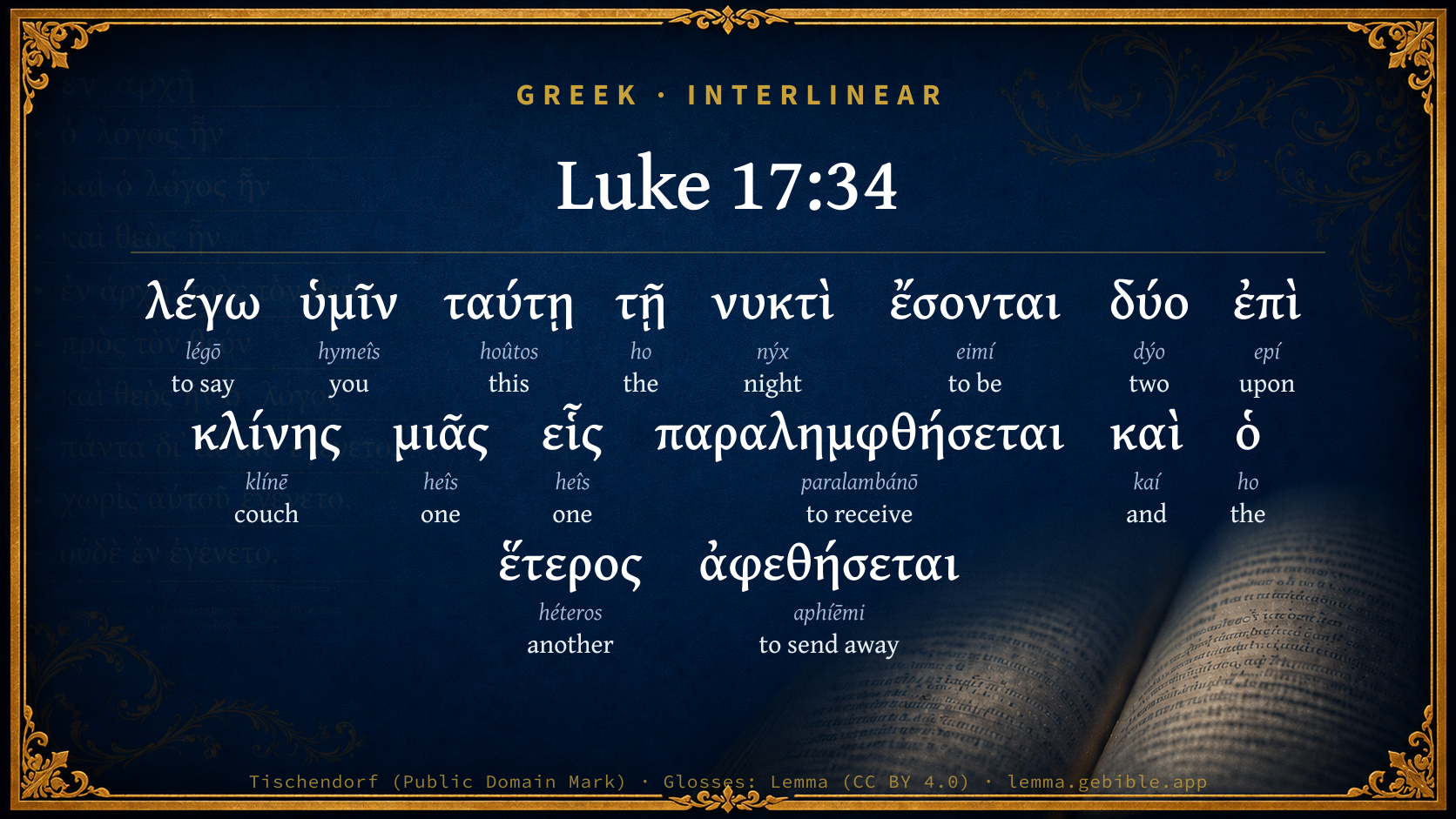
Greek (Tischendorf 8th ed.) Luke 17:34 appears in the Greek New Testament. The text above is from the Tischendorf 8th edition. Each word links to its Strong’s number and a concise gloss. Click any word for its full Thayer’s Greek Lexicon entry.
Download image
Cite this verse

Luke 17:34 (World English Bible). Public Domain. Lemma interlinear Bible study tool, https://lemma.gebible.app/v/luke/17/34.

Show BibTeX & RIS
BibTeX
RIS
English Translation
I tell you, in that night there will be two people in one bed. The one will be taken, and the other will be left.
World English Bible · Public Domain
Download a study sheet

One document with this verse’s original text, its word-by-word gloss line, the meaning frame, cross-references with their text, attributed commentary, and full source and license credits — printable, and it pastes into notes with its structure intact.

This verse Autodidact and up

Study sheet (.html) Plain text (.txt)

A passage Seminary Student

Up to 50 verses in one chapter. A passage sheet keeps up to 6 commentary sources and 12 cross-references per verse, in the order this page ranks them, and says so on the sheet whenever that leaves anything out. Ask for a single verse and you get the Autodidact verse sheet above.

Everything on this page stays free to read, with no account — the sheet is a download of what is already on screen, not access to it.

Want to remove ads? Support Godless Engineer
Compare translations 3

The same verse in 3 English versions, stacked beneath the original-language interlinear above. Click any original word for its lexicon entry.

Each is an independent rendering of the whole verse — the interlinear is not word-aligned to these translations.

Highlighted words mark where these versions differ — a whole-verse word diff, not a word-by-word alignment.

  • World English Bible Public Domain
    I tell you, in that night there will be two people in one bed. The one will be taken, and the other will be left.
  • King James Version Public Domain
    I tell you, in that night there shall be two men in one bed; the one shall be taken, and the other shall be left.
  • unfoldingWord Literal Text CC BY-SA 4.0
    I say to you, in that night there will be two in one bed. The one will be taken, and the other will be left.

unfoldingWord Literal Text — © unfoldingWord, licensed CC BY-SA 4.0. Word-aligned USFM3 via Door43 (git.door43.org/unfoldingWord/en_ult).

Versions to compare (up to 4)

3 of 4 selected

Show all 19 translations

Every available English version of this verse, each an independent rendering of the whole verse.

  • World English Bible Public Domain
    I tell you, in that night there will be two people in one bed. The one will be taken, and the other will be left.
  • Berean Standard Bible Public Domain
    I tell you, on that night two people will be in one bed: One will be taken and the other left.
  • Majority Standard Bible Public Domain
    I tell you, on that night two people will be in one bed: one will be taken and the other left.
  • King James Version Public Domain
    I tell you, in that night there shall be two men in one bed; the one shall be taken, and the other shall be left.
  • American Standard Version (1901) Public Domain
    I say unto you, In that night there shall be two men on one bed; the one shall be taken, and the other shall be left.
  • Revised Version (1885) Public Domain
    I say unto you, In that night there shall be two men on one bed; the one shall be taken, and the other shall be left.
  • Geneva Bible (1599) Public Domain
    I tell you, in that night there shall be two in one bed: the one shalbe receiued, and the other shalbe left.
  • Douay-Rheims (1899) Public Domain
    I say to you: in that night there shall be two men in one bed; the one shall be taken, and the other shall be left.
  • Young's Literal Translation Public Domain
    `I say to you, In that night, there shall be two men on one couch, the one shall be taken, and the other shall be left;
  • Literal Standard Version CC BY-SA 4.0
    I say to you, in that night there will be two [men] on one bed: one will be taken, and the other will be left;
  • Unlocked Literal Bible CC BY-SA 4.0
    I tell you, in that night there will be two people in one bed. One will be taken, and the other will be left.
  • unfoldingWord Literal Text CC BY-SA 4.0
    I say to you, in that night there will be two in one bed. The one will be taken, and the other will be left.
  • Darby Bible Public Domain
    I say to you, In that night there shall be two [men] upon one bed; one shall be seized and the other shall be let go.
  • World Messianic Bible Public Domain
    I tell you, in that night there will be two people in one bed. One will be taken and the other will be left.
  • Webster's Bible Public Domain
    I tell you, in that night there will be two men in one bed; the one will be taken, and the other will be left.
  • Free Bible Version CC BY-SA 4.0
    I tell you, at that time two will be in bed at night; one will be taken and the other left.
  • Bible in Basic English Public Domain
    I say to you, In that night there will be two men sleeping in one bed, and one will be taken away and the other let go.
  • Text-Critical English NT CC BY 4.0
    I tell you, on that night two people will be in one bed; one will be taken and the other will be left.
  • Tyndale New Testament (1534) Public Domain
    I tell you: In that nyght ther shalbe two in one beed the one shalbe receaved and the other shalbe forsaken.

Literal Standard Version (2020), Covenant Press — licensed CC BY-SA 4.0. Text via the HelloAO Bible API (eBible.org). Unlocked Literal Bible (unfoldingWord) — licensed CC BY-SA 4.0. Text via the HelloAO Bible API (eBible.org). unfoldingWord Literal Text — © unfoldingWord, licensed CC BY-SA 4.0. Word-aligned USFM3 via Door43 (git.door43.org/unfoldingWord/en_ult). Free Bible Version, Dr. Jonathan Gallagher — licensed CC BY-SA 4.0. Text via the HelloAO Bible API (eBible.org).

Word by word

More ways to search: Search by grammar → Find every occurrence → Compare this word →

Practice this passage: Drill this verse → Learn its vocabulary →

κλίνης
klínē
G2825
“couch”
Noun, Genitive, Singular, Feminine
Part of Speech
Noun
Case
Genitive
Number
Singular
Gender
Feminine
Full Thayer's Definition

Origin: from G2827

TDNT: None

1. a small bed, a couch 2. a couch to recline on at meals 3. a couch on which a sick man is carried
  1. λέγω légō G3004 “to say” Verb, Present, Active, Indicative, 1st person, Singular
  2. ὑμῖν hymeîs G5210 “you” Personal pronoun, 2nd person, Dative, Plural
  3. ταύτῃ hoûtos G3778 “this” Demonstrative pronoun, Dative, Singular, Feminine
  4. τῇ ho G3588 “the” Article, Dative, Singular, Feminine
  5. νυκτὶ nýx G3571 “night” Noun, Dative, Singular, Feminine
  6. ἔσονται eimí G1510 “to be” Verb, Future, Middle deponent, Indicative, 3rd person, Plural
  7. δύο dýo G1417 “two” Adjective, Numeral (indeclinable)
  8. ἐπὶ epí G1909 “upon” Preposition
  9. μιᾶς heîs G1520 “one” Adjective, Genitive, Singular, Feminine
  10. εἷς heîs G1520 “one” Adjective, Nominative, Singular, Masculine
  11. παραλημφθήσεται paralambánō G3880 “to receive” Verb, Future, Passive, Indicative, 3rd person, Singular
  12. καὶ kaí G2532 “and” Conjunction
  13. ὁ ho G3588 “the” Article, Nominative, Singular, Masculine
  14. ἕτερος héteros G2087 “another” Adjective, Nominative, Singular, Masculine
  15. ἀφεθήσεται aphíēmi G863 “to send away” Verb, Future, Passive, Indicative, 3rd person, Singular

About this verse

These counts appear in no published source. They are computed here, from the morphology-tagged text and Lemma’s own curated glosses. What Lemma adds →

16
words
14
distinct lemmas
Gospels
section

Notable vocabulary

The rarest word here is κλίνης couch G2825 — appearing just 8 times in the whole Greek New Testament.

Shared distinctive vocabulary

κλίνης couch G2825 occurs in 8 verses of the Greek New Testament. Also found in:

Repetition

Words recur within this verse:

Cross-references

16

Topical passages linked to Luke 17:34 in the Treasury of Scripture Knowledge — connected by theme and wording, ordered by reader-vote popularity; previews shown in the World English Bible.

  • Matthew 24:40–41 Then two men will be in the field: one will be taken and one will be left;
  • 2 Peter 2:9 the Lord knows how to deliver the godly out of temptation and to keep the unrighteous under punishment for the day of judgment;
  • Malachi 3:16–18 Then those who feared Yahweh spoke one with another; and Yahweh listened, and heard, and a book of memory was written before him, for those who feared Yahweh, and who honored his name.
  • 1 Thessalonians 4:16–17 For the Lord himself will descend from heaven with a shout, with the voice of the archangel, and with God's trumpet. The dead in Christ will rise first,
  • Psalms 26:9 Don't gather my soul with sinners, Nor my life with bloodthirsty men;
  • Mark 13:23 But you watch. "Behold, I have told you all things beforehand.
  • Luke 13:24 "Strive to enter in by the narrow door, for many, I tell you, will seek to enter in, and will not be able.
  • Psalms 28:3 Don't draw me away with the wicked, With the workers of iniquity who speak peace with their neighbors, But mischief is in their hearts.
  • Isaiah 42:9 Behold, the former things have happened, and new things do I declare. Before they spring forth I tell you of them.
  • Jeremiah 45:5 Seek you great things for yourself? Don't seek them; for, behold, I will bring evil on all flesh, says Yahweh; but your life will I give to you for a prey in all places where you go.
  • Ezekiel 9:4–6 Yahweh said to him, Go through the midst of the city, through the midst of Jerusalem, and set a mark on the foreheads of the men that sigh and that cry over all the abominations that are done in the midst of it.
  • Matthew 24:25 "Behold, I have told you beforehand.
  • Luke 13:3 I tell you, no, but, unless you repent, you will all perish in the same way.
  • Luke 13:5 I tell you, no, but, unless you repent, you will all perish in the same way."
  • Romans 11:4–7 But how does God answer him? "I have reserved for myself seven thousand men, who have not bowed the knee to Baal."
  • Mark 14:29 But Peter said to him, "Although all will be offended, yet I will not."

Cross-references courtesy of OpenBible.info (CC BY 4.0).

Commentary

Notes on Luke 17:34 from classic Christian and Jewish commentators (each source and its license shown beneath its notes). The classic Christian expositions comment on the surrounding passage and are grouped to its opening verse, so a note may address several verses; the Jewish commentaries on the Tanakh (Rashi and others) are per-verse, so they appear only where the commentator wrote on this verse.

Lemma curates 59 commentaries, every one of them public domain or Creative Commons licensed, each selected and text-cleaned for this edition rather than reprinted as found. About our sources →

The Biblical Illustrator

Joseph S. Exell

Luk_17:34

The one shall be taken, and the other shall be left

One taken, and the other left

Every great act of God has the effect of dividing, separating, and judging men.

So great are the diversities among men, so various their characters, so various by nature, and so endlessly varied by education and habit, that, when God acteth before them in any great or signal way, forthwith those who seemed to be much alike, are found to be really very different. The mercy that is balm to one, is poison to his next neighbour; the trial, which to one is easy and simple, is to his neighbour destruction and inevitable woe. To be born in a Christian country, to be the son of careful and godly parents, to be baptized in infancy, to be trained in the knowledge of God, to have natural abilities, to have education, to have station, or wealth, all these things have this effect of dividing men, and trying their hearts. To those who are obedient, and endeavour to please God, all these things are high blessings, choice gifts of God. Each of them enables a man to render God better service, to please Him better, to do more good, and to make higher attainments of holiness and happiness. But to the disobedient they are all so many downfalls. Every such thing brings out more, and makes more conspicuous and hopeless the inner disobedience; each one of them exhibits more strikingly the spirit of inward rebellion, which, but for these things, might have been comparatively unseen. Illness tries us; health tries us; every day, as it passes, tries us in innumerable ways; tries, and trains us; tries what we are now, and tries whether we will be better; furnishes matter for our judgment, and gives us the means of improvement, so that judgment may not be our ruin. And so we go on being tried, being balanced, and sifted, and searched, thousands of times, many times more than we suppose or conceive, every day of our life. We think of the great trials, but the little ones, which we do not think of, try us still more. It is very observable that, in the account given of the judgment-day by our Lord in the Gospel of St. Matthew, the doom of the righteous and wicked is made to depend on grounds wholly unexpected by each. They are alike represented as exclaiming, in astonishment and surprise, Lord, when saw we Thee an hungered, or athirst, or a stranger, or naked, or sick, or in prison? Full of fears, no doubt, and hopes about things which they do remember, nothing doubting that this or that great act (as they think it), is to be the one on which everything is to turn, for weal or woe, they seem alike struck with astonishment to find that things which they have wholly forgotten, which they neither observed when they happened, nor can recall since, have been laid up in the mind of the Judge, to be the ground of their last and inevitable doom. Lord, when saw we Thee an hungered, or athirst, or sick, or in prison, and ministered, or ministered not unto Thee? this, I say, is one of the striking things revealed of that awful time. And another is, the alteration which that day shall make; when last shall be first, and first last; when not only the ranks of the earth shall be in many instances reversed, but when the estimations of the earth shall be found to be entirely mistaken; apparent saints taking their place among the hypocrites departing to everlasting fire; publicans and sinners, purified by repentance, their robes washed in the blood of the Lamb, entering, among the blessed, into the joy of their Lord. And the text teaches us a third and different lesson still; how those who have been side by side upon earth, alike in condition, opportunity, and encouragement, to all human sight much alike in mind or temper; not much unlike, perhaps, in apparent earnestness and spiritual attainment, shall then be found, one on the right hand, and one on the left hand; one be taken, taken to joy, caught up to meet the Lord in the air, so as to be ever with Him; and the other left, to woe and despair for ever. Children of one family, bred alike, and taught alike, who have learned to say the same infantine prayers, have known the same friends, read the same books, loved the same pleasures; if one is earnest in his prayers, and, in his secret obedience, serves God faithfully, and the other persists in unfaithfulness and disobedience,--shall it not surely be so with them, that one shall be taken in that day, and the other left? What, then, shall we do? With this reality of trial on us, and this reality of judgment before us, the one more searching than we can trace, the other likely to be more unexpected than we can foresee, how are we to walk to be safe? how to pass through the present trial, how to meet the future judgment? Simply by turning with all our hearts and souls to our duties, and our prayers. We do not need any particular excitements of mind, or any particular glow of sentiments; we want to be in earnest, and the good Spirit of our God, by which we were sealed in baptism unto the day of our redemption, will help us to our safety. (Bishop Moberly.)

The great division

1. The meaning of the text being established, we have next to inquire what the lessons are which it is designed to teach us. When it is considered in relation to its context, it becomes plain that the primary intention of the passage is to denote the suddenness with which the day of the Lord will come upon the inhabitants of the earth. Of that day and hour knoweth no man, no, not the angels of heaven, but My Father only. There will be no perceptible check or change in the current of human affairs to warn us of its coming. Men will be engaged to the very last in the ordinary occupations of life, as in the days of Noe and as in the days of Lot, eating and drinking, marrying and giving in marriage. Nor shall the great and final partition of good and evil be preceded or prefigured by any partial and gradual severance. Men and women shall be united in their daily tasks, and even in the most familiar intercourse of domestic life, between whom there shall be a great gulf fixed in that day.

2. There is a further lesson which may be derived from the text, and which it is also without doubt intended to convey. It is one which is set forth more or less plainly in other places of Holy Scripture. The children of this world and the children of light cannot be absolutely distinguished, so long as we see through a glass, darkly. Our estimate of anothers character is after all nothing better than an inference from phenomena, and our powers of inference are at least as fallible in this as in all other matters. The warmest friendships, the most endearing ties, can afford us no unmistakable guarantee that those with whom we are thus outwardly united, are both almost and altogether such as we are.

3. There is, however, a third inference to which we are naturally led by the words before us, and to which I desire particularly to direct your attention at present. However closely and undistinguishably men are mingled together in this world, however various, minute, and delicate are the shades of character by which they are severally differenced, however hopeless it may appear, I will not say for man, but for Absolute Wisdom and Absolute Justice, to draw a broad line between the children of this world and the children of light, the text seems to imply, what we are elsewhere taught, that they will ultimately be divided into two and only two classes. But I think the text goes beyond this, at all events in the way of implication. For it not only tells us that such a sharp line as I have described will ultimately be drawn between the evil and the good, but it seems also to tell us that the line exists already, although we may be unable to discern it. For inasmuch as it represents the day of judgment as coming upon men unprepared, discovering them in the midst of their daily avocations, finding persons of the most opposite characters united in the closest intercourse without a suspicion of their incompatibility, and then at once awarding to every man his everlasting doom; is it not reasonable to infer that the grounds of that award exist already, although they are not in every instance cognizable by us? At this point, however, we are met by a difficulty. Our experience of the world and of human life appears to teach us a different lesson. No doubt there are good men and there are bad men on the face of the earth--good men who are acknowledged to be so even by those who are farotherwise, and bad men who are confessed to be so even by themselves. But the great mass of mankind seems to belong to an intermediate and indifferent body, consisting of those who are neither saints nor reprobates, neither fit for eternal life nor deserving of eternal death. The longer the world lasts, the more complicated the developments of society become, the more does this appear to be the case. The visible confusion of the moral world may only serve to cover a clear and well-defined line of demarcation. And, as much, on the one hand, that is outwardly and materially honest, and just, and pure, and lovely, and of good report, when traced to its true source would be found to be of the earth, earthy; so we must remember that the Lord knoweth them that are His; that, the kingdom of God, which is within us, cometh not with observation; and that as the wind bloweth where it listeth, and thou hearest the sound thereof, but canst not tell whence it cometh, or whither it goeth; so is event one that is born of the Spirit. But we shall do well to recollect, in addition, that we see men ordinarily in a transitional and undeveloped state. The good or the evil that is in them may not have had time to come to a head, or may be over shadowed by old habits which hang about a man like parasites, but which can hardly be said to form a part of his proper self. But as each mans probation draws near its close, it may be that his character is altogether simplified and stereotyped. Then it is that the awful decree goes forth: He that is unjust, let him be unjust still. Mere experience, then, can decide nothing against the teaching of holy Scripture on this point, although it may not actually confirm it. On the other hand, it is worthy of observation, that a great thinker, whose name marks an era in the history of modern philosophy, in endeavouring to frame a religious system a priori, was led to a result altogether coincident with the doctrine under consideration. After raising the two following questions: first, Whether man can be neither good nor evil? and then, Whether man can be partly good and partly evil? he decides against the former, in opposition (as he confesses) to the prima facie dictates of experience, upon the ground that moral neutrality in any voluntary act is an impossible conception; and he disposes of the latter, by observing that no act has any intrinsic moral worth, unless it spring from a deliberate adoption of the moral law as our universal principle of action. I have cited this writers testimony mainly because he cannot be accused of any undue partiality towards the distinctive peculiarities of the Christian system. But it is not difficult to translate his arguments into Scriptural language. For, on the one hand, it is our Lord Himself who proposes the dilemma, Either make the tree good, and his fruit good; or else make the tree corrupt, and his fruit corrupt: and, on the other, His apostle tells us that Whosoever shall keep the whole law, and yet offend in one point, he is guilty of all. (W. B. Jones, M. A.)

Divine sovereignty in the death of men

I. WHAT IS IMPLIED IN GODS ACTING AS A SOVEREIGN.

1. His acting as a sovereign implies that He always acts after the counsel of His own will, without consulting the will, or pleasure, or counsel of any other being.

2. His acting as a sovereign implies that He always acts not only without the counsel, but without the control, of any created beings.

II. IN WHAT RESPECTS HE ACTS AS A SOVEREIGN IN TAKING AWAY THE LIVES OF MEN. Here it may be observed--

1. That He acts as a sovereign in respect to appointing the time of every ones death.

2. God acts as a sovereign in determining not only the time, but the place of every ones death.

3. God acts as a sovereign in respect to the means of death.

4. God acts as a sovereign in regard to the circumstances of death. He takes one, and leaves another, under the very same circumstances. He takes one, and leaves another, according to the order in which He has been pleased to place their names in deaths commission, regardless of all exterior circumstances or distinctions.

5. God acts as a sovereign in calling men out of the world, whether they are willing or unwilling to leave it.

6. God displays His awful sovereignty by calling men out of time into eternity, whether they are prepared or not prepared to go to their long home.

III. WHY GOD ACTS AS A SOVEREIGN IN THIS VERY IMPORTANT CASE. Several plain and pertinent reasons may be mentioned.

1. Because He has an independent right to act as a sovereign in taking away the lives of men. He is the former of their bodies, and Father of their spirits. In Him they live, and move, and have their being.

2. God acts as a sovereign in the article of death, because He only knows when and where to put a period to human life.

3. Another reason why God disposes of the lives of men as a sovereign, in all those respects which have been mentioned, is because He is under indispensable moral obligations to dispose of His own creatures in the wisest and best manner.

Application:

1. If God acts as a sovereign in taking away the lives of men, then the aged have great reason of gratitude for the continuance of life.

2. If God acts as a sovereign in taking away the lives of men, then they ought to maintain a constant and realizing sense that their lives are uncertain.

3. If God acts as a sovereign in taking away the lives of men, then they ought to avoid every mode of conduct which tends to stupify their minds, and create an insensibility to the uncertainty of life.

4. If God acts as a sovereign in taking away the lives of men, then it is not strange that He causes so many sudden and unexpected deaths.

5. It appears from what has been said that there is a solid foundation for the most cordial and unreserved submission under the heaviest bereavements. They come from the hand and heart of a holy, wise, and benevolent Sovereign, who has a right to take one, and leave another, and who never afflicts willingly, or grieves the children of men. (N. Emmons, D. D.)

Eternal separation

The Rev. Dr. Witherspoon, formerly president of Princeton College, America, was once on board a packet-ship, where, among other passengers, was a professed atheist. This unhappy man was very fond of troubling every one with his peculiar belief, and of broaching the subject as often as he could get any one to listen to him. He did not believe in a God and a future state, not he! By and by there came on a terrible storm, and the prospect was that all would be drowned. There was much consternation on board, but not one was so greatly frightened as the professed atheist. In this extremity he sought out the clergyman, and found him in the cabin, calm and collected in the midst of danger, and thus addressed him: Oh, Doctor Witherspoon! Doctor Witherspoon! we are all going; we have but a short time to stay. Oh how the vessel rocks! We are all going! Dont you think we are, doctor? The doctor turned to him with a solemn look, and replied in broad Scotch, Nae doubt, nae doubt, man, were a ganging; but you and I dinna gang the same way. (W. Baxendale.)

The Biblical Illustrator, edited by Joseph S. Exell (c. 1880s–1900s) — public domain. Text from a community e-Sword module.

Godbey's Commentary on the New Testament

William B. Godbey

THE RAPTURE OF THE SAINTS

Luk 17:34-35. “I say unto you, That night two men shall be on one couch; one shall be taken, and the other left. Two women shall be grinding together; the one shall be taken, and the other shall be left.” As the coming of the Lord will be simultaneous to all the world, the sun shining on one hemisphere and the night enveloping the other, you see “the night,” here specified as the time of His coming, must have a symbolic signification, typifying the sudden surprise which will light on the whole world when that most notable of all events shall transpire, as if all were lying wrapped in lethean slumber. It is really wonderful how the customs and popular habits stand still in the Bible lands, the people still sickling their wheat and barley and treading it out with cattle, and the women grinding it with their little hand-mills, sitting on either side, the one turning and the other feeding and taking out the flour. There is a deeply significant providence in this strange immutability of Oriental customs. These women are still holding on to the hand-mill, waiting for the Lord to come, and take one and leave the other. This is a clear reference to His pre-millennial coming to take away His bride, as it can not refer to the final judgment, as at that time all will be taken and none left. (Rev 20:11-15)

William B. Godbey, Commentary on the New Testament (1896–1900) — public domain. Text from a community e-Sword module.

Tyndale Open Study Notes

Tyndale Open Resources

17:34-35 one will be taken, the other left: Some consider this separation to refer to the Rapture of the church, but the parallels drawn to God’s judgment in the Flood and against Sodom (17:26-29), as well as the reference to vultures and a dead body (17:37), suggest that it occurs at the final judgment (see Mal 3:18; Matt 25:32).

Tyndale Open Study Notes — © Tyndale Open Resources, licensed CC BY-SA 4.0. Text via the HelloAO Bible API.

Bengel's Gnomon

Johann Albrecht Bengel

Luk 17:34. Ταύτῃ τῇ νυκτὶ, in this night [not as Engl. Vers. “in that night”]) He does not say, ἐν ἐκείνῃ τῇ ἡμέρᾳ “in that day,” comp. Luk 17:31: Mat 26:31 [ἐν τῇ νυκτὶ ταύτῃ, “All ye shall be offended because of Me this night”]. There are in our own day, saith He, persons who shall reach those times so widely different. Comp. the here in ch. Luk 9:27 [“There be some standing here,” etc., speaking of an event about to happen presently]. The event followed in the same generation: Mat 24:34 [“This generation shall not pass, till all these things be fulfilled”].—εἷς) [the one]. So very many MSS.: and the expression, εἷς—ὁ ἓτερος, is used just as ἑνὸς—τοῦ ἑτέρου [the one—the other], ch. Luk 16:13; and πέντε—καὶ αἱ πέντε in Mat 25:2.[192] Presently after, in Luk 17:35, Mill has omitted to notice, that in Luk 17:35 ἡ has also been omitted before μία, and that too in the text of Stephens’ Edition.[193]

[192] “The one set of five—and the other set of five.” So Scholz reads, αἱ πέντε; but Lachm. and Tisch. omit αἱ.—E. and T.

[193] In Luk 17:34 AD read εἷς. B (judging from the silence of the collations) and Rec. Text, ὁ εἷς. In Luk 17:35 ALXΔ read μία: and so Tisch. BD and Rec. Text (Elzev.), ἡ μία: and so Lachm.—E. and T.

Bengel's Gnomon of the New Testament — English translation (T&T Clark, Edinburgh, 1860) — public domain. Text from a community e-Sword module.

Meyer's Critical & Exegetical Commentary

Heinrich August Wilhelm Meyer

Luk_17:34-35. But the decision at the Parousia, what a separation it will be!a separation of those who are in the temporal life united in a perfectly common position. This is symbolically represented in two examples. Comp., moreover, on Mat_24:40 f.

ταύτῃ τῇ νυκτί] which Bengel, in opposition to the context, explains: in this present night, is neither to be interpreted in tempore illo calamitoso (Kuinoel, who says that the night is imago miseriae; Mic_3:6; comp. Grotius and Bleek), nor to be pressed to the conclusion that the Parousia is definitely ordained to take place by night (de Wette, who finds the ground for this view in the comparison of the Messiah with a thief in the night), in respect of which the following grinding at the mill as an occupation of the day-time is held as left standing inappropriately from Matthew, but the horror of the night belongs to the imagery of the concrete representation.[221] At Luk_17:35, however, there is again a departure from this feature, because a graphic touch of a different kind is added to the idea. Day and hour, even the Son knoweth not, Mat_24:36; comp. Act_1:7.

ἐπὶ κλίνης μιᾶς] not in general: they shall be bed-fellows (Lange), but, according to the words and the concrete representation: they shall find themselves on one bed. A warning against precipitate separation of mingled domestic relations (Lange) is altogether foreign to this passage.

[221] It is not on account of the example of the two in bed together that the night is named (Hofmann, Schriftbew. II. 2, p. 626), but conversely the idea of the night-time suggested that illustration.

Meyer — Critical and Exegetical Commentary on the New Testament — English translation by Peter Christie, edited by Frederick Crombie (T&T Clark, 1880) — public domain. Text from a community e-Sword module.

Expositor's Greek Testament

ed. W. Robertson Nicoll

Luk 17:34-37 . The final separation (Mat 24:40-41 ).

Luk 17:34 . τ . τ . νυκτὶ , on that night ; day hitherto, the Jewish day began with night (Hahn), and the reference to night suits the following illustration. No need to take night metaphorically = imago miseriae (Kuinoel). ἐπὶ κλίνης μ ., in one bed; in the field in Mt.

The Expositor's Greek Testament, edited by W. Robertson Nicoll (1897–1910) — public domain. Text from a community e-Sword module.

Jamieson, Fausset & Brown

Robert Jamieson, A. R. Fausset & David Brown

two in one bed--the prepared and unprepared mingled in closest intercourse together in the ordinary walks and fellowships of life, when the moment of severance arrives. Awful truth! realized before the destruction of Jerusalem, when the Christians found themselves forced by their Lord's directions (Luk 21:21) at once and for ever away from their old associates; but most of all when the second coming of Christ shall burst upon a heedless world.

Jamieson, Fausset & Brown — Commentary Critical and Explanatory on the Whole Bible (1871) — public domain (CC PDM 1.0). Text via the HelloAO Bible API.

Adam Clarke's Commentary

Verse 34. - 36. On the subject of these verses see Mt 24:40-41. The 36th verse Lu 17:36 is, without doubt, an interpolation; see the margin. It was probably borrowed from Mt 24:40. The whole verse is wanting in - ABEGHKLQS, more than fifty others, the Coptic, AEthiopic, Gothic, Slavonic, and many of the fathers: Griesbach has left it out of the text. Well might our translators say in the margin, This 36th verse is wanting in most of the Greek copies. Griesbach thinks it might have been omitted on account of the similar ending, (see the preceding verse,) or that it was borrowed from Mt 24:40.

Adam Clarke's Commentary on the Bible (1810–1826) — public domain. Text from a community e-Sword/MySword module.

Ellicott's Commentary for English Readers

(34, 35) Two men in one bed.—See Notes on Mat_24:40-41. The one to be “taken” is probably here, as there, the man who is rescued from destruction. Here there is a variation enough to prove independence, the “two in one bed” being prefixed to the examples given in St. Matthew as an instance of even closer companionship.

A Bible Commentary for English Readers, edited by Charles John Ellicott (1878–1897) — public domain. Text from a community e-Sword module.

The Cambridge Bible for Schools and Colleges

gen. ed. J. J. S. Perowne

34. two men in one bed] Not necessarily men; but human beings, e.g. man and wife. The numerals are of course masculine, because the man might be either the one ‘taken’ or the one ‘left.’

The Cambridge Bible for Schools and Colleges (gen. ed. J. J. S. Perowne; Cambridge University Press, 1878–1918) — public domain. Text from a community e-Sword module.

John Gill's Exposition

Two women shall be grinding together,.... In Mat 24:41 it is added, "in the mill"; in the house where the mill was, and at one and the same mill; and so the Ethiopic version here, "two shall grind in one mill": and it was common for two women to grind at one hand mill; and though the word "women" is not in the text, it is rightly put into the translation; since the word used is of the feminine gender, and since grinding was the business of women; and so the Persic version here supplies it, as we do; See Gill on Mat 24:42.

The one shall be taken and the other left; the Roman soldiers entering the mill, will lay hold on the one, and carry her away with them, and leave the other; and for which no other reason can be given, but the sovereign will and providence of God, which should overrule and dispose the minds of these men, to act in such a manner.

John Gill's Exposition of the Whole Bible (1746–1763) — public domain (CC PDM 1.0). Text via the HelloAO Bible API.

Trapp's Complete Commentary

John Trapp

34 I tell you, in that night there shall be two men in one bed; the one shall be taken, and the other shall be left.

Ver. 34. See Mat 24:40-41. {See Trapp on "Mat 24:40"} {See Trapp on "Mat 24:41"}

John Trapp, A Commentary or Exposition upon All the Books of the Old and New Testament (1647–1656) — public domain. Text from a community e-Sword module.

Albert Barnes' Notes on the Bible

See the notes at Mat 24:40-41.

Albert Barnes' Notes on the Bible (1834–1885) — public domain. Text from a community e-Sword/MySword module.

Haydock's Catholic Bible Commentary

By these different examples, Christ wishes to insinuate that good and bad men will be found in every state of life. By those in bed, are understood the rich, by those in the mill, are understood the poor; whilst those in the field designate the pastors of his flock, who are labouring in the vineyard of the Lord. (St. Cyril and St. Ambrose)

George Leo Haydock (1774–1849), Haydock's Catholic Family Bible and Commentary, 1859 edition — public domain. Excludes Psalms (Douay-Rheims chapter numbering differs from Protestant) and Deuterocanonical books (Catholic canon only).

Matthew Poole's English Annotations

See Poole on "Mat 24:40-41". These verses seem to respect the day of judgment, and that dreadful separation which shall be in that day between the sheep and the goats. It is true also of Christ’s day in the preaching of the gospel; but that seemeth not to be the sense of this text. They can hardly be applied to the destruction of Jerusalem; it was so universal as hardly any were there left.

Matthew Poole's English Annotations on the Holy Bible (1683–1685) — public domain. Text from a community e-Sword/MySword module.

The Pulpit Commentary

Vers. 34, 35. I tell you, in that night there shall be two men in one bed; the one shall be taken, and the other shall be left. Two women shall be grinding together; the one shall be taken, the other left. How taken? Not, as some scholars have supposed, taken only to perish, but taken away by the Lord in the way described by St. Paul in 1Th_4:17, where he paints how the faithful servant who is living when the Lord returns in glory, will be caught up in the clouds, to meet the Lord in the air. The other will be left. Thus, as it has been strikingly observed, "the beings who have been most closely connected here below shall, in the twinkling of an eye, be parted for ever.

Vers. 34-36. Accidents.

"The one shall be taken, and the other left." And who or what is it that decides which one shall be taken and which left? Events are often occurring which convey to us the impression of I THE LARGE AMOUNT OF ACCIDENT which enters into the fabric of human life. Take, for example, a bad railway accident. How accidental it seems that one man should just miss that train and be saved, and that another should just catch it and be killed; that one should take a seat in the carriage which is crushed, and another in the carriage which is left whole; that one should be sitting exactly where the bent and twisted timber pierced him, and another exactly where no injury was dealt, etc.! It is the same with the battle-field, with the thunderstorm, with the falling house. One is taken, and another left; and the taking of the one and the leaving of the other seems to be pure accident not the result of reason or forethought, but entirely fortuitous.

II OUR CORRECTED THOUGHT CONCERNING IT.

1. Of accident in the sense of chance we know there is nothing. Everything is "under law;" and even where there is no law apparent, we are assured, by the exercise of our reason, that there must be the operation of law, though it is out of our sight. In this world of God"s, pure chance has not an inch of ground to work upon.

2. There is usually much more play of reason and habit in "accidental events" than seems at first sight. Things result as they do because habit is stronger than judgment, or because foolish men disregard the counsel of the wise; because thoughtful men take the precautions which result in their safety, and because thoughtless men take the action which issues in their suffering or death.

3. The providence of God covers the entire field of human life. May we venture to believe that the hand of God is in the events and issues of life? I think we may.

(1) It is clearly within the range of the activities of an Infinite Being to whom nothing is small as nothing is great.

(2) His Fatherhood would lead him to follow the course of every one of his children with parental interest, and to interpose his hand wherever he saw it was wise to do so.

(3) Scripture warrants the conclusion: "Precious in the sight of the Lord is the death of his saints;" "The way of man is not in himself; it is not in man that walketh to direct his steps;" "Not a sparrow falleth to the ground without your Father: ye are of more value than many sparrows.

III THE LARGE MEASURE OF UNCERTAINTY THAT REMAINS AND MUST REMAIN. Human science has introduced many safeguards, but it has also introduced new perils. The "chapter of accidents" is as long as it ever was in the contemporary history of mankind. God is supreme, but he lets many things happen we should antecedently have supposed he would step in to prevent; he lets good men take the consequence of their mistakes; he permits the very holy and the very useful to be overtaken by sad misfortunes and even by fatal calamities. We cannot guarantee the future; we cannot ensure prosperity, health, friends, reputation, long life. To one that seems to be heir to all these good things they will fall; to another who seems equally likely to inherit them they will be denied: one is taken, the other left. Therefore let us turn to

IV THE ONE GOOD THING ON WHICH WE CAN ABSOLUTELY COUNT. There is "a good part which shall not be taken away." This is a Christian character; its foundations are laid in repentance and faith; it is built up of reverent study, of worship, of the obedience of love. Its glory is in resemblance to Jesus Christ himself. This is within every man"s reach, and it cannot be taken; it must be left. He who secures that is safe for ever. No accident can rob him of his heritage. His treasure and himself are immovable; for "he that doeth the will of God abideth for ever. C.

The Pulpit Commentary (1880–1919), ed. H.D.M. Spence-Jones & Joseph S. Exell — public domain. Text from a community e-Sword module.

The People's New Testament

B. W. Johnson

34–36. See notes on Matt. 24:37–41.

B. W. Johnson's The People's New Testament with Notes (1889–1891) — public domain. Electronic text from the Christian Classics Ethereal Library (CCEL) ThML edition.

unfoldingWord translationNotes

Door43 World Missions Community

I tell you

As Jesus continues to address his disciples, he emphasizes the importance of what he is telling them.

in that night

This refers to what will happen if he, the Son of Man, comes during the night.

there will be two people in one bed

The emphasis is not on these two people, but on the fact that some people will be taken away and the others will be left.

bed

"couch" or "cot"

One will be taken, and the other will be left

"One person will be taken and the other person will be left behind." This can be stated in active form. AT: "God will take one person and leave the other" or "Angels will take one and leave behind the other" (See: Active or Passive)

There will be two women grinding together

The emphasis is not on these two women or their activity, but on the fact that some people will be taken away and the others will be left.

grinding together

"grinding grain together"

unfoldingWord translationNotes — © Distant Shores Media and the Door43 World Missions Community, licensed CC BY-SA 4.0. Source: git.door43.org/Door43/en_tn.

Cambridge Greek Testament for Schools and Colleges

34. ταύτῃ τῇ νυκτί. Lit. ‘in this night,’ i.e. in the night of horror and judgment which I now conceive as present.

δύο. Not necessarily men; but human beings, e.g. man and wife. The numerals are of course masculine, because the man might be either the one “taken” or the one “left.”

Cambridge Greek Testament for Schools and Colleges (Cambridge University Press, 1896; 21 vols, various authors incl. Carr, Maclear, Plummer, Farrar, Lumby, Moule, M. R. James, Simcox) — public domain. Text from a community e-Sword module.

Alford’s Greek Testament

Henry Alford

34-36.] See on Mat 24:40, Mat 24:41. Here, there are two references: (1) to the servants of the Lord in the midst of the world out of which they shall be separated: (2) to the separation of the faithful and unfaithful among themselves.

Ver. 34 indicates a closer relationship than that of mere fellow-workmen, and sets forth the division of even families in that day.

Henry Alford, The Greek Testament (1849–1861) — public domain. Text from a community e-Sword module.

International Critical Commentary

34, 35. The closest intimacy in this life is no guarantee of community of condition when the Son of Man comes. The strangest separations will take place between comrades, according as one is fit to enter the Kingdom and another not.

34. ταύτῃ τῇ νυκτί. This must not be pressed to mean anything, whether a time of great horror or actual night. Christ is not intimating that His return will take place in the night-time. “Night” is part of the picture, for it is then that people are in bed.

δύο ἐπὶ κλίνης μιᾶς. “Two on one bed.” Not necessarily two men, although that is probably the meaning. AV. was the first English Version to insert “men,” and RV. retains it. The “being taken” probably means “taken from destruction” (Joh 14:3), ὡς ἀλλότριος τῆς οἰργῆς (Eus.), as Lot from Sodom; while “left” means “left to his fate” (13:35). Or, “taken into the Kingdom” and “left outside” may be the meaning.

International Critical Commentary — older volumes (1896–1929), various authors — public domain. Text from a community e-Sword module.

Lesson kit

Teaching starters — assembled from the data on this page, not authored interpretation. Every prompt links to the verse data it draws on. Edit before teaching.

Luke, in the Gospels, opens this verse with 16 words (14 distinct Greek lemmas). Its most distinctive word is klínē (“couch”). A historical commentator’s framing appears above. Read the whole chapter for the surrounding context.

Discussion questions

  1. How does “couch” (klínē) shape what this verse is saying?
  2. Matthew 9:2 shares the word «couch» with this verse. How do the two illuminate each other?
  3. “one” occurs 2× in this one verse. What is the effect of the repetition?
  4. The translations on this page render this verse differently — a whole-verse word diff, not a word-by-word alignment. What might account for the different wordings?
  5. Reading how The Biblical Illustrator and Godbey's Commentary on the New Testament read this verse, where do the two commentators agree and where do they part?

Things to notice

Reading settings

Reading text

Shown beneath each verse's original-language words.

Old Testament
Old Testament edition

Read the OT as the Masoretic Hebrew (MT) or the Greek Septuagint (LXX).

English shown for the Greek Septuagint (in the Hebrew ↔ Greek comparison).

Comparing translations? Open the Compare panel on any verse page to stack up to four side by side.