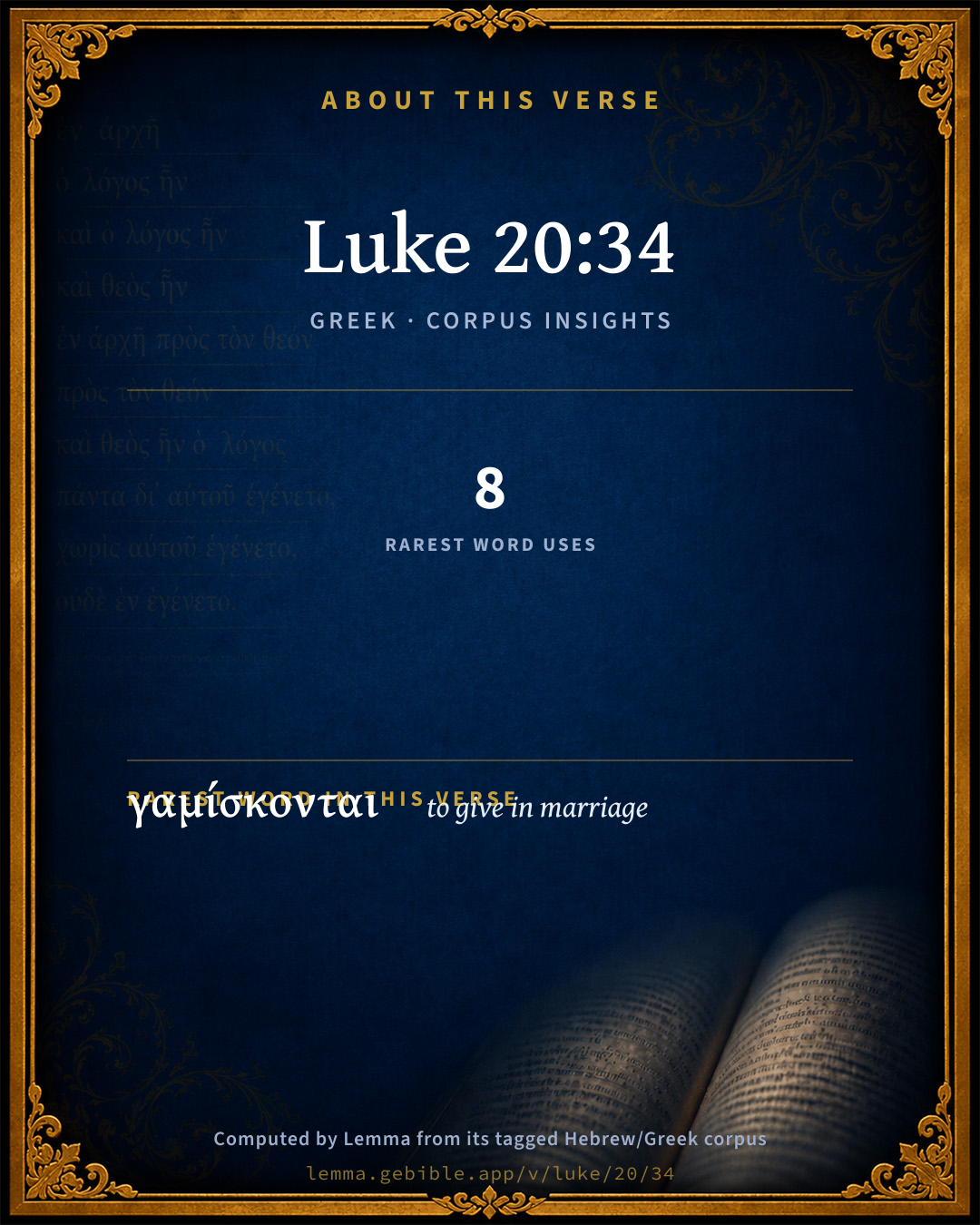
Luke 20:34

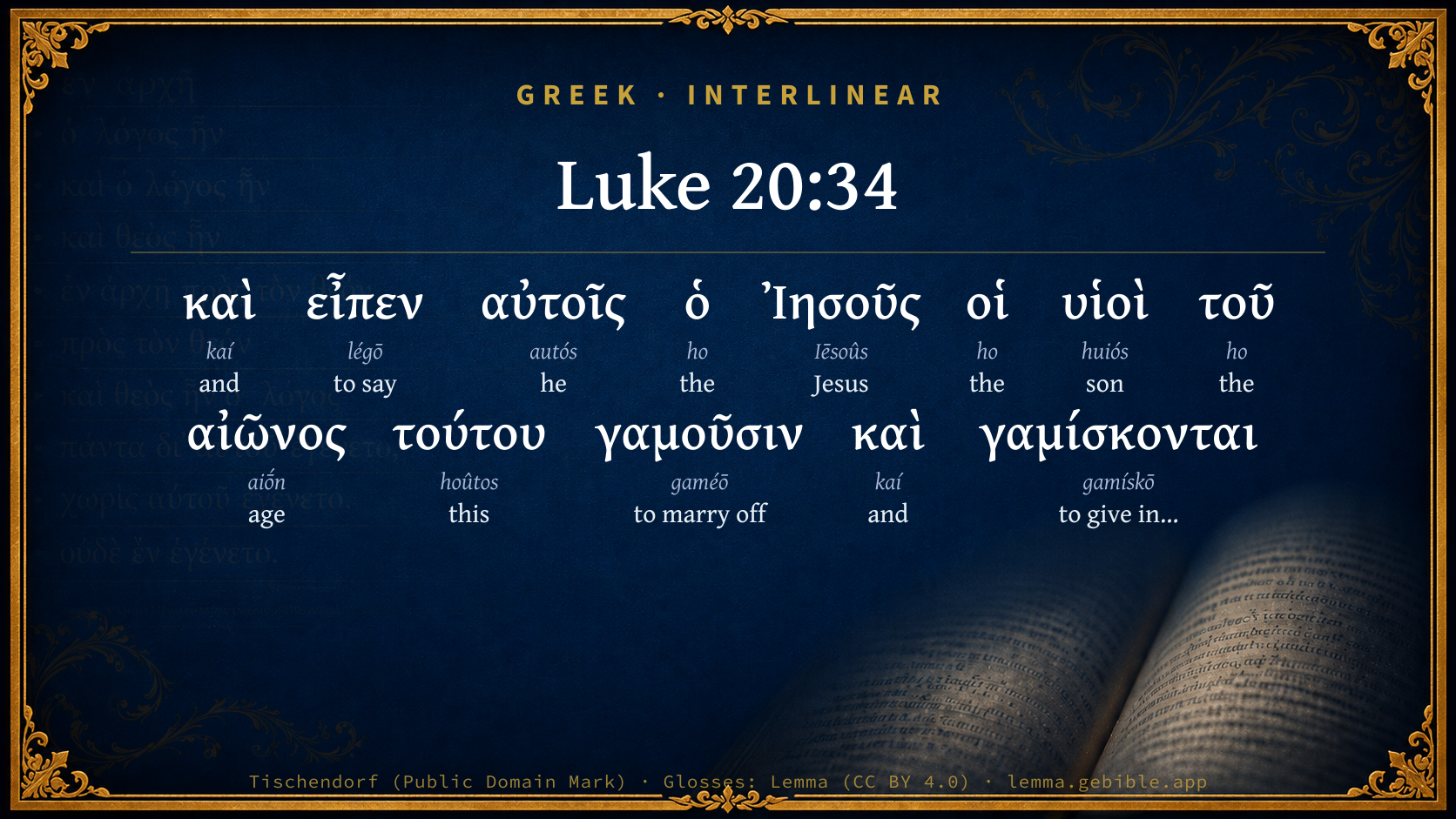
Greek (Tischendorf 8th ed.) Luke 20:34 appears in the Greek New Testament. The text above is from the Tischendorf 8th edition. Each word links to its Strong’s number and a concise gloss. Click any word for its full Thayer’s Greek Lexicon entry.
Download image
Cite this verse

Luke 20:34 (World English Bible). Public Domain. Lemma interlinear Bible study tool, https://lemma.gebible.app/v/luke/20/34.

Show BibTeX & RIS
BibTeX
RIS
English Translation
Jesus said to them, "The children of this age marry, and are given in marriage.
World English Bible · Public Domain
Download a study sheet

One document with this verse’s original text, its word-by-word gloss line, the meaning frame, cross-references with their text, attributed commentary, and full source and license credits — printable, and it pastes into notes with its structure intact.

This verse Autodidact and up

Study sheet (.html) Plain text (.txt)

A passage Seminary Student

Up to 50 verses in one chapter. A passage sheet keeps up to 6 commentary sources and 12 cross-references per verse, in the order this page ranks them, and says so on the sheet whenever that leaves anything out. Ask for a single verse and you get the Autodidact verse sheet above.

Everything on this page stays free to read, with no account — the sheet is a download of what is already on screen, not access to it.

Want to remove ads? Support Godless Engineer
Compare translations 3

The same verse in 3 English versions, stacked beneath the original-language interlinear above. Click any original word for its lexicon entry.

Each is an independent rendering of the whole verse — the interlinear is not word-aligned to these translations.

Highlighted words mark where these versions differ — a whole-verse word diff, not a word-by-word alignment.

  • World English Bible Public Domain
    Jesus said to them, "The children of this age marry, and are given in marriage.
  • King James Version Public Domain
    And Jesus answering said unto them, The children of this world marry, and are given in marriage:
  • unfoldingWord Literal Text CC BY-SA 4.0
    And Jesus said to them, “The sons of this age marry and are given in marriage.

unfoldingWord Literal Text — © unfoldingWord, licensed CC BY-SA 4.0. Word-aligned USFM3 via Door43 (git.door43.org/unfoldingWord/en_ult).

Versions to compare (up to 4)

3 of 4 selected

Show all 19 translations

Every available English version of this verse, each an independent rendering of the whole verse.

  • World English Bible Public Domain
    Jesus said to them, "The children of this age marry, and are given in marriage.
  • Berean Standard Bible Public Domain
    Jesus answered, “The sons of this age marry and are given in marriage.
  • Majority Standard Bible Public Domain
    Jesus answered, “The sons of this age marry and are given in marriage.
  • King James Version Public Domain
    And Jesus answering said unto them, The children of this world marry, and are given in marriage:
  • American Standard Version (1901) Public Domain
    And Jesus said unto them, The sons of this world marry, and are given in marriage:
  • Revised Version (1885) Public Domain
    And Jesus said unto them, The sons of this world marry, and are given in marriage:
  • Geneva Bible (1599) Public Domain
    Then Iesus answered, and sayd vnto them, The children of this world marry wiues, and are married.
  • Douay-Rheims (1899) Public Domain
    And Jesus said to them: The children of this world marry, and are given in marriage:
  • Young's Literal Translation Public Domain
    And Jesus answering said to them, `The sons of this age do marry and are given in marriage,
  • Literal Standard Version CC BY-SA 4.0
    And Jesus answering said to them, “The sons of this age marry and are given in marriage,
  • Unlocked Literal Bible CC BY-SA 4.0
    Jesus said to them, “The sons of this world marry and are given in marriage.
  • unfoldingWord Literal Text CC BY-SA 4.0
    And Jesus said to them, “The sons of this age marry and are given in marriage.
  • Darby Bible Public Domain
    And Jesus said to them, The sons of this world marry and are given in marriage,
  • World Messianic Bible Public Domain
    Yeshua said to them, “The children of this age marry and are given in marriage.
  • Webster's Bible Public Domain
    And Jesus answering, said to them, The children of this world marry, and are given in marriage:
  • Free Bible Version CC BY-SA 4.0
    “Here in this age people marry and are given in marriage,” Jesus explained.
  • Bible in Basic English Public Domain
    And Jesus said to them, The sons of this world are married and have wives;
  • Text-Critical English NT CC BY 4.0
    Jesus answered them, “The people of this age marry and are given in marriage,
  • Tyndale New Testament (1534) Public Domain
    Iesus answered and sayde vnto them. The chyldre of this worlde mary wyves and are maryed

Literal Standard Version (2020), Covenant Press — licensed CC BY-SA 4.0. Text via the HelloAO Bible API (eBible.org). Unlocked Literal Bible (unfoldingWord) — licensed CC BY-SA 4.0. Text via the HelloAO Bible API (eBible.org). unfoldingWord Literal Text — © unfoldingWord, licensed CC BY-SA 4.0. Word-aligned USFM3 via Door43 (git.door43.org/unfoldingWord/en_ult). Free Bible Version, Dr. Jonathan Gallagher — licensed CC BY-SA 4.0. Text via the HelloAO Bible API (eBible.org).

Word by word

More ways to search: Search by grammar → Find every occurrence → Compare this word →

Practice this passage: Drill this verse → Learn its vocabulary →

γαμίσκονται
gamískō
G1061
“to give in marriage”
Verb, Present, Passive, Indicative, 3rd person, Plural
Part of Speech
Verb
Tense
Present
Voice
Passive
Mood
Indicative
Person
3rd person
Number
Plural
Full Thayer's Definition

Origin: from G1062

TDNT: None

1. give in marriage
  1. καὶ kaí G2532 “and” Conjunction
  2. εἶπεν légō G3004 “to say” Verb, Aorist, Active, Indicative, 3rd person, Singular
  3. αὐτοῖς autós G846 “he” Personal pronoun, Dative, Plural, Masculine
  4. ὁ ho G3588 “the” Article, Nominative, Singular, Masculine
  5. Ἰησοῦς Iēsoûs G2424 “Jesus” Noun, Nominative, Singular, Masculine
  6. οἱ ho G3588 “the” Article, Nominative, Plural, Masculine
  7. υἱοὶ huiós G5207 “son” Noun, Nominative, Plural, Masculine
  8. τοῦ ho G3588 “the” Article, Genitive, Singular, Masculine
  9. αἰῶνος aiṓn G165 “age” Noun, Genitive, Singular, Masculine
  10. τούτου hoûtos G3778 “this” Demonstrative pronoun, Genitive, Singular, Masculine
  11. γαμοῦσιν gaméō G1060 “to marry off” Verb, Present, Active, Indicative, 3rd person, Plural
  12. καὶ kaí G2532 “and” Conjunction

About this verse

These counts appear in no published source. They are computed here, from the morphology-tagged text and Lemma’s own curated glosses. What Lemma adds →

13
words
10
distinct lemmas
Gospels
section

Notable vocabulary

The rarest word here is γαμίσκονται to give in marriage G1061 — appearing just 8 times in the whole Greek New Testament.

Shared distinctive vocabulary

γαμίσκονται to give in marriage G1061 occurs in 7 verses of the Greek New Testament. Also found in:

Repetition

Words recur within this verse:

Cross-references

5

Topical passages linked to Luke 20:34 in the Treasury of Scripture Knowledge — connected by theme and wording, ordered by reader-vote popularity; previews shown in the World English Bible.

  • Luke 16:8 "His lord commended the dishonest manager because he had done wisely, for the children of this world are, in their own generation, wiser than the children of the light.
  • Luke 17:27 They ate, they drank, they married, they were given in marriage, until the day that Noah entered into the ark, and the flood came, and destroyed them all.
  • Hebrews 13:4 Let marriage be held in honor among all, and let the bed be undefiled: but God will judge the sexually immoral and adulterers.
  • 1 Corinthians 7:2–16 But, because of sexual immoralities, let each man have his own wife, and let each woman have her own husband.
  • Ephesians 5:31 "For this cause a man will leave his father and mother, and will be joined to his wife. The two will become one flesh."

Cross-references courtesy of OpenBible.info (CC BY 4.0).

Commentary

Notes on Luke 20:34 from classic Christian and Jewish commentators (each source and its license shown beneath its notes). The classic Christian expositions comment on the surrounding passage and are grouped to its opening verse, so a note may address several verses; the Jewish commentaries on the Tanakh (Rashi and others) are per-verse, so they appear only where the commentator wrote on this verse.

Lemma curates 59 commentaries, every one of them public domain or Creative Commons licensed, each selected and text-cleaned for this edition rather than reprinted as found. About our sources →

Bengel's Gnomon

Johann Albrecht Bengel

Luk 20:34. Οἱ υἱοὶ τοῦ αἰῶνος τούτου, the children of this world) who are subject to the law of mortality; not even all the pious being excepted, [who are not now as yet such as they shall be.—V. g.] The antithesis is, the children of God (υἱοὶ—Θεοῦ), in Luk 20:36.

Bengel's Gnomon of the New Testament — English translation (T&T Clark, Edinburgh, 1860) — public domain. Text from a community e-Sword module.

Expositor's Greek Testament

ed. W. Robertson Nicoll

Luk 20:34 . In giving Christ’s answer Lk. omits the charge of ignorance against the questioners found in Mt. and Mk. γαμίσκονται = γαμίζονται in parallels, here only in N.T.

The Expositor's Greek Testament, edited by W. Robertson Nicoll (1897–1910) — public domain. Text from a community e-Sword module.

Geneva Bible (1599)

Geneva Bible translators

They are called here in this place, the children of this world, which live in this world: and not they, that wholly are given to the world, as before Luke 16:8, which are contrary to the children of light.

Geneva Bible (1599) marginal notes — public domain. Text via Bolls.life.

Jamieson, Fausset & Brown

Robert Jamieson, A. R. Fausset & David Brown

said unto them--In Mat 22:29, the reply begins with this important statement:--"Ye do err, not knowing the Scriptures," regarding the future state, "nor the power of God," before which a thousand such difficulties vanish (also Mar 12:24).

Jamieson, Fausset & Brown — Commentary Critical and Explanatory on the Whole Bible (1871) — public domain (CC PDM 1.0). Text via the HelloAO Bible API.

Adam Clarke's Commentary

Verse 34. The children of this world] Men and women in their present state of mortality and probation; procreation being necessary to restore the waste made by death, and to keep up the population of the earth.

Adam Clarke's Commentary on the Bible (1810–1826) — public domain. Text from a community e-Sword/MySword module.

Ellicott's Commentary for English Readers

(34) The children of this world marry.—The three reports of the question are all but absolutely identical. In the form of the answer there are slight variations. The contrast between “the children of this world “or “age,” those, i.e., who belong to it (see Note on Luk_16:8), and those of “that world” or “age,” is peculiar to St. Luke. In both cases the word rests primarily on the idea of time rather than place. It may be noted that no other writer in the New Testament uses the form of words, “that world,” the age or period that is there, not here, for the life of the eternal kingdom. The more common phrase is “the world to come” (Mat_12:32; Mat_19:30).

A Bible Commentary for English Readers, edited by Charles John Ellicott (1878–1897) — public domain. Text from a community e-Sword module.

The Cambridge Bible for Schools and Colleges

gen. ed. J. J. S. Perowne

34. neither can they die any more] Rather, for neither, &c. There is no marriage and no more birth. “There shall be no more death,” Rev_21:4. “The dead shall be raised incorruptible,” 1Co_15:52.

equal unto the angels] Like the angels in being immortal, but superior to them in privileges (Heb_1:4; Heb_2:5-8). “When He shall appear, we shall be like Him; for we shall see Him as He is,” 1Jn_3:2. In this one word our Lord refutes the Sadducean denial of the existence of angels, Act_23:8; and incidentally those material notions of future bliss (Luk_14:15) which all the Jews held.

the children of God, being the children of the resurrection] “I am the resurrection, and the life,” Joh_11:25.

The Cambridge Bible for Schools and Colleges (gen. ed. J. J. S. Perowne; Cambridge University Press, 1878–1918) — public domain. Text from a community e-Sword module.

John Gill's Exposition

For he is not a God of the dead, but of the living,.... See Gill on Mat 22:32.

for all live unto him. The Persic version, reads, "all these live unto him"; namely, Abraham, Isaac, and Jacob; for though they are dead to men, they are not to God; their souls live with him, and their bodies will be raised by him: he reckons of them, as if they were now alive, for he quickens the dead, and calls things that are not, as though they were; and this is the case of all the saints that are dead, as well as of those patriarchs. The Ethiopic reads, "all live with him"; as the souls of all departed saints do; the Arabic version reads, all live in him; so all do now, Act 17:28.

John Gill's Exposition of the Whole Bible (1746–1763) — public domain (CC PDM 1.0). Text via the HelloAO Bible API.

The Pulpit Commentary

Vers. 34-36. And Jesus answering said unto them, The children of this world marry, and are given in marriage: but they which shall be accounted worthy to obtain that world, and the resurrection from the dead, neither marry, nor are given in marriage: neither can they die any more. How different are the few rare pictures which our Master draws of the heaven-life to those painted by the great founders and teachers of other world-wide religions! In his world beyond the grave, while he tells us of a continuing existence, of varied and ever-increasing activity, in contradistinction to the Nirvana of Buddha, in these pictures of Jesus the sensual paradise of Mohammed, for instance, finds no place. Marriage is, according to our Lord"s teaching, but a temporary expedient to preserve the human race, to which death would soon put an end. But in the world to come there will be no death and no marriage. We may assume from his words here that the difference between the sexes will have ceased to exist. They are equal unto the angels. Equal with the angels in being immortal; no death; no marriage. Jesus in this place asserts that angels have a body, but are exempt from any difference of sex. The angels are here introduced because our Lord was speaking with Sadducees, who (Act_23:8) denied the existence of these glorious beings. He wished to set the seal of his teaching on the deeply interesting question of the existence of angels.

The Pulpit Commentary (1880–1919), ed. H.D.M. Spence-Jones & Joseph S. Exell — public domain. Text from a community e-Sword module.

John Wesley's Explanatory Notes

The children of this world - The inhabitants of earth, marry and are given in marriage - As being all subject to the law of mortality; so that the species is in need of being continually repaired.

John Wesley, Explanatory Notes Upon the Whole Bible (1754–1765) — public domain. Text via the GEBible commentary corpus.

Kretzmann's Popular Commentary

Paul E. Kretzmann

The answer of the Lord:

v. 34. And Jesus, answering, said unto them, The children of this world marry and are given in marriage;

v. 35. but they which shall be accounted worthy to obtain that world, and the resurrection from the dead, neither marry, nor are given in marriage;

v. 36. neither can they die any more; for they are equal unto the angels; are the children of God, being the children of the resurrection.

v. 37. Now that the dead are raised, even Moses showed at the bush, when he calleth the Lord the God of Abraham, and the God of Isaac, and the God of Jacob.

v. 38. For He is not a God of the dead, but of the living; for all live unto Him.

First of all, Jesus corrects an entirely false idea which the question of the Sadducees showed them to be holding or to be inferring from the belief of others. So long as people are in this present physical world, they are subject to the laws of the propagation of the human race, they are under the blessing which God gave to our first parents, Gen 1:27-28. And the necessity of marriage is emphasized by the sinfulness of human nature, 1Co 7:2. For that reason they marry and are given in marriage. But those that in the judgment of God will be accounted worthy of the life to come, those that will be taken up into the bliss of heaven, those that will obtain the real resurrection, that unto life, they will no longer be subject to such conditions. For in that life they will be immortal, and will no longer be dependent upon propagation and increase. There will be no marriage in heaven, because all persons will there, like the angels, be sexless. Since they are children of the resurrection, since they have become partakers of the resurrection, they are children of God. All old things that pertained to the life of the flesh will then have passed away, and all things will be new. The believers will indeed have their true bodies, but transfused with the spiritual, heavenly existence. That is one argument. And the second concerns the actual Scriptural proof for the resurrection. Jesus here very wisely refers only to the Pentateuch, to the five books of Moses, choosing His proof-text from one of these books, in order to conform to the idea of the Sadducees. That the dead actually do rise again, Moses indicates very plainly in the story of the burning bush, Exo 3:6. For the text there calls God the Lord of Abraham and of Isaac and of Jacob. In popular belief the patriarchs may have been adjudged dead, but they could not have been, since God is called their Lord. And He is not the God of the dead, but of the living, for all live to Him. Before Him they are living, and so He accounts them. The souls of the righteous men of all times are alive and in the presence of God in eternal happiness. This is true of all believers of all times. And this view and exposition of God is infallible. Therefore we have the confidence that God will raise all those that are His, also according to the body, out of the grave, to a new, blessed, eternal life.

Paul E. Kretzmann, Popular Commentary of the Bible (1921–1924) — public domain. Text from a community e-Sword module.

unfoldingWord translationNotes

Door43 World Missions Community

Connecting Statement:

Jesus begins to answer the Sadducees.

The sons of this world

"The people of this world" or "The people of this time." This is in contrast with those in heaven or the people who live after the resurrection.

marry and are given in marriage

In that culture they spoke of men marrying women and women being given in marriage to their husband. This can also be stated in active form. AT: "get married" (See: Assumed Knowledge and Implicit Information and Active or Passive)

those who are regarded as worthy in that age

This can be stated in active form. AT: "the people in that age whom God will consider to be worthy" (See: Active or Passive)

to receive the resurrection from the dead

"to be raised from the dead" or "to rise from death"

from the dead

From among all those who have died. This expression describes all dead people together in the underworld. To receive resurrection from among them speaks of becoming alive again.

will neither marry nor be given in marriage

In that culture they spoke of men marrying women and women being given in marriage to their husband. This can also be stated in active form. AT: "will not marry" or "will not get married." This is after the resurrection. (See: Assumed Knowledge and Implicit Information and Active or Passive)

Neither can they die anymore

This is after the resurrection. AT: "They will not be able to die anymore" (See: Assumed Knowledge and Implicit Information)

are sons of God, being sons of the resurrection

"are children of God because he has brought them back from the dead"

translationWords

son

world

worthy

resurrection

die

angel

sons of God

unfoldingWord translationNotes — © Distant Shores Media and the Door43 World Missions Community, licensed CC BY-SA 4.0. Source: git.door43.org/Door43/en_tn.

Cambridge Greek Testament for Schools and Colleges

34. οἱ υἱοὶ τοῦ αἰῶνος τούτου, i.e. all who live in the present dispensation. In Luk 16:8 the sense is more special. Here, as often elsewhere, the word rendered ‘world’ is αἰών, which properly means ‘age.’ It is not the κόσμος or material Universe, but the Universe regarded subjectively, i.e. the Time-world.

Cambridge Greek Testament for Schools and Colleges (Cambridge University Press, 1896; 21 vols, various authors incl. Carr, Maclear, Plummer, Farrar, Lumby, Moule, M. R. James, Simcox) — public domain. Text from a community e-Sword module.

International Critical Commentary

34. Jesus begins by removing this erroneous basis and shows that the question is futile. The words of οἱ υἱοὶ τοῦ αἰῶνος … τυχεῖν are peculiar to Lk., who omits “Ye do err, not knowing the Scriptures, nor the power of God.” Comp. Eph 1:21.

International Critical Commentary — older volumes (1896–1929), various authors — public domain. Text from a community e-Sword module.

Godet's Commentaries

Frédéric Louis Godet

Vers. 34-40. The Answer.

This answer is preceded in Matthew and Mark by a severe rebuke, whereby Jesus makes His questioners aware of the gross spiritual ignorance involved in such a question as theirs.

The answer of Jesus has also a sarcastic character. Those accumulated verbs, γαμεῖν, ἐκγαμίζεσθαι, especially with the frequentative γαμίσκεσθαι or ἐκγαμίσκεσθαι, throw a shade of contempt over that whole worldly train, above which the Sadducean mind is incapable of rising. Although from a moral point of view the αἰὼν μέλλων, the world to come, has already begun with the coming of Christ, from a physical point of view, the present world is prolonged till the resurrection of the body, which is to coincide with the restitution of all things. The resurrection from the dead is very evidently, in this place, not the resurrection of the dead in general. What is referred to is a special privilege granted only to the faithful (which shall be accounted worthy; comp. Luk 14:14, the resurrection of the just, and Php 3:11).

The first for, Luk 20:36, indicates a causal relation between the cessation of marriage, Luk 20:35, and that of death, Luk 20:36. The object of marriage is to preserve the human species, to which otherwise death would soon put an end; and this constitution must last till the number of the elect whom God will gather in is completed. While the for makes the cessation of death to be the cause of the cessation of marriage, the particle οὔτε, neither, brings out the analogy which exists between those two facts. The reading οὐδέ is less supported.

Jesus does not say (Luk 20:36) that glorified men are angels,—angels and men are of two different natures, the one cannot be transformed into the other,—but that they are equal with the angels, and that in two respects: no death, and no marriage. Jesus therefore ascribes a body to the angels, exempt from the difference of sex. This positive teaching about the existence and nature of angels is purposely addressed by Jesus to the Sadducees, because, according to Act 23:8, this party denied the existence of those beings.

Jesus calls the raised ones children of God, and explains the title by that of children of the resurrection. Men on the earth are sons of one another; each of the raised ones is directly a child of God, because his body is an immediate work of divine omnipotence. It thus resembles that of the angels, whose body also proceeds directly from the power of the Creator,—a fact which explains the name sons of God, by which they are designated in the O. T. The Mosaic command could not therefore form an objection to the doctrine of the resurrection rightly understood. Jesus now takes the offensive, and proves by that very Moses whom they had been opposing to Him (καί, even, before Moses), the indisputable truth of the doctrine (Luk 20:37-38). The scribes of the pharisaic party had probably often tried to discover such a proof; but it was necessary to dig deeply in the mine to extract from it this diamond.

In the phrase ἐπὶ τῆς βάτου, ἐπί denotes the place where the account of the bush is found. The choice of the word μηνύω, to give to understand, shows that Jesus distinguishes perfectly between an express declaration which does not exist, and an indication such as that which He proceeds to cite. He means simply, that if Moses had not had the idea of immortality, he would not have expressed himself as he does. When Moses put into the mouth of God the designation: God of Abraham, etc., many generations had passed since the three patriarchs lived here below; and yet God still calls Himself their God. God cannot be the God of a being who does not exist. Therefore, in Him they live. Mark the absence of the article before the words νεκρῶν and ζώντων: a God of dead, of living beings. In Plato, it is their participation in the idea which guarantees existence; in the kingdom of God, it is their relation to God Himself. The dative αὐτῷ, to Him, implies a contrast to to us, to whom the dead are as though they were not. Their existence and activity are entirely concentrated in their relation to God. All; not only the three patriarchs. The for bears on the word living. “For they live, really dead though they are to us.”

This prompt and sublime answer filled with admiration the scribes who had so often sought this decisive word in Moses without finding it; they cannot restrain themselves from testifying their joyful surprise. Aware from this time forth that every snare laid for Him will be the occasion for a glorious manifestation of His wisdom, they give up this sort of attack (Luk 20:40).

Frédéric Louis Godet — Commentaries on Luke, John, Romans, and 1 Corinthians — English translation (T&T Clark, Edinburgh, 1870s–1890s) — public domain. Text from a community e-Sword module.

Lesson kit

Teaching starters — assembled from the data on this page, not authored interpretation. Every prompt links to the verse data it draws on. Edit before teaching.

Luke, in the Gospels, opens this verse with 13 words (10 distinct Greek lemmas). Its most distinctive word is gamískō (“to give in marriage”). A historical commentator’s framing appears above. Read the whole chapter for the surrounding context.

Discussion questions

  1. What does “to give in marriage” (gamískō) contribute to the verse as a whole?
  2. Matthew 22:30 shares the word «to give in marriage» with this verse. How do the two illuminate each other?
  3. “the” occurs 3× in this one verse. What is the effect of the repetition?
  4. These translations render this verse differently. What is at stake in choosing one wording over another?
  5. Reading how Bengel's Gnomon and Expositor's Greek Testament read this verse, where do the two commentators agree and where do they part?

Things to notice

Reading settings

Reading text

Shown beneath each verse's original-language words.

Old Testament
Old Testament edition

Read the OT as the Masoretic Hebrew (MT) or the Greek Septuagint (LXX).

English shown for the Greek Septuagint (in the Hebrew ↔ Greek comparison).

Comparing translations? Open the Compare panel on any verse page to stack up to four side by side.