Luke 2:17

Greek (Tischendorf 8th ed.) Luke 2:17 appears in the Greek New Testament. The text above is from the Tischendorf 8th edition. Each word links to its Strong’s number and a concise gloss. Click any word for its full Thayer’s Greek Lexicon entry.
Download image
Cite this verse

Luke 2:17 (World English Bible). Public Domain. Lemma interlinear Bible study tool, https://lemma.gebible.app/v/luke/2/17.

Show BibTeX & RIS
BibTeX
RIS
English Translation
When they saw it, they publicized widely the saying which was spoken to them about this child.
World English Bible · Public Domain
Download a study sheet

One document with this verse’s original text, its word-by-word gloss line, the meaning frame, cross-references with their text, attributed commentary, and full source and license credits — printable, and it pastes into notes with its structure intact.

This verse Autodidact and up

Study sheet (.html) Plain text (.txt)

A passage Seminary Student

Up to 50 verses in one chapter. A passage sheet keeps up to 6 commentary sources and 12 cross-references per verse, in the order this page ranks them, and says so on the sheet whenever that leaves anything out. Ask for a single verse and you get the Autodidact verse sheet above.

Everything on this page stays free to read, with no account — the sheet is a download of what is already on screen, not access to it.

Want to remove ads? Support Godless Engineer
Compare translations 3

The same verse in 3 English versions, stacked beneath the original-language interlinear above. Click any original word for its lexicon entry.

Each is an independent rendering of the whole verse — the interlinear is not word-aligned to these translations.

Highlighted words mark where these versions differ — a whole-verse word diff, not a word-by-word alignment.

  • World English Bible Public Domain
    When they saw it, they publicized widely the saying which was spoken to them about this child.
  • King James Version Public Domain
    And when they had seen it, they made known abroad the saying which was told them concerning this child.
  • unfoldingWord Literal Text CC BY-SA 4.0
    And having seen him, they made known about the message that had been told to them about this child.

unfoldingWord Literal Text — © unfoldingWord, licensed CC BY-SA 4.0. Word-aligned USFM3 via Door43 (git.door43.org/unfoldingWord/en_ult).

Versions to compare (up to 4)

3 of 4 selected

Show all 19 translations

Every available English version of this verse, each an independent rendering of the whole verse.

  • World English Bible Public Domain
    When they saw it, they publicized widely the saying which was spoken to them about this child.
  • Berean Standard Bible Public Domain
    After they had seen the Child, they spread the message they had received about Him.
  • Majority Standard Bible Public Domain
    After they had seen the Child, they spread widely the message they had received about Him.
  • King James Version Public Domain
    And when they had seen it, they made known abroad the saying which was told them concerning this child.
  • American Standard Version (1901) Public Domain
    And when they saw it, they made known concerning the saying which was spoken to them about this child.
  • Revised Version (1885) Public Domain
    And when they saw it, they made known concerning the saying which was spoken to them about this child.
  • Geneva Bible (1599) Public Domain
    And when they had seene it, they published abroade the thing, that was tolde them of that childe.
  • Douay-Rheims (1899) Public Domain
    And seeing, they understood of the word that had been spoken to them concerning this child.
  • Young's Literal Translation Public Domain
    and having seen, they made known abroad concerning the saying spoken to them concerning the child.
  • Literal Standard Version CC BY-SA 4.0
    and having seen, they made known abroad concerning the saying spoken to them concerning the Child.
  • Unlocked Literal Bible CC BY-SA 4.0
    After they had seen him, they made known what had been said to them about this child.
  • unfoldingWord Literal Text CC BY-SA 4.0
    And having seen him, they made known about the message that had been told to them about this child.
  • Darby Bible Public Domain
    and having seen [it] they made known about the country the thing which had been said to them concerning this child.
  • World Messianic Bible Public Domain
    When they saw it, they publicized widely the saying which was spoken to them about this child.
  • Webster's Bible Public Domain
    And when they had seen it, they made known abroad the saying which was told them concerning this child.
  • Free Bible Version CC BY-SA 4.0
    After they'd seen for themselves, they spread the news of what had happened and what they had been told about this baby.
  • Bible in Basic English Public Domain
    And when they saw it, they gave them an account of the things which had been said to them about the child.
  • Text-Critical English NT CC BY 4.0
    After seeing him, they made widely known what they had been told about the child,
  • Tyndale New Testament (1534) Public Domain
    And when they had sene it they publisshed a brode the sayinge which was tolde them of that chylde.

Literal Standard Version (2020), Covenant Press — licensed CC BY-SA 4.0. Text via the HelloAO Bible API (eBible.org). Unlocked Literal Bible (unfoldingWord) — licensed CC BY-SA 4.0. Text via the HelloAO Bible API (eBible.org). unfoldingWord Literal Text — © unfoldingWord, licensed CC BY-SA 4.0. Word-aligned USFM3 via Door43 (git.door43.org/unfoldingWord/en_ult). Free Bible Version, Dr. Jonathan Gallagher — licensed CC BY-SA 4.0. Text via the HelloAO Bible API (eBible.org).

Word by word

More ways to search: Search by grammar → Find every occurrence → Compare this word →

Practice this passage: Drill this verse → Learn its vocabulary →

ἐγνώρισαν
gnōrízō
G1107
“to make known”
Verb, Aorist, Active, Indicative, 3rd person, Plural
Part of Speech
Verb
Tense
Aorist
Voice
Active
Mood
Indicative
Person
3rd person
Number
Plural
Full Thayer's Definition

Origin: from a derivative of G1097

TDNT: 12:58,1

1. to make known a. to become known, be recognised 2. to know, to gain knowledge of, have thorough knowledge of a. in earlier Greek it means "to gain a knowledge of" or "have thorough knowledge of"
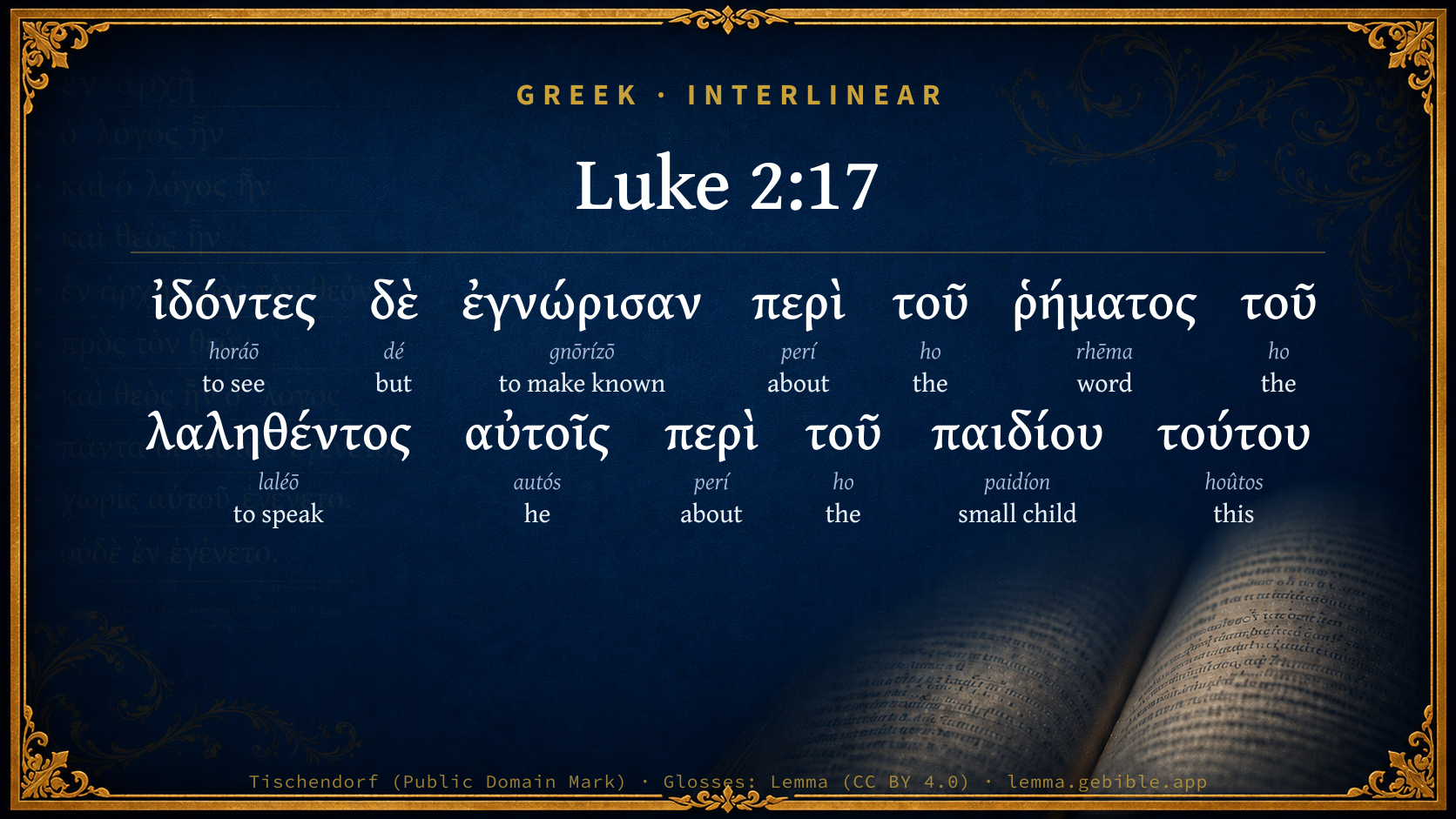
  1. ἰδόντες horáō G3708 “to see” Verb, Aorist, Active, Participle, Nominative, Plural, Masculine
  2. δὲ dé G1161 “but” Conjunction
  3. περὶ perí G4012 “about” Preposition
  4. τοῦ ho G3588 “the” Article, Genitive, Singular, Neuter
  5. ῥήματος rhēma G4487 “word” Noun, Genitive, Singular, Neuter
  6. τοῦ ho G3588 “the” Article, Genitive, Singular, Neuter
  7. λαληθέντος laléō G2980 “to speak” Verb, Aorist, Passive, Participle, Genitive, Singular, Neuter
  8. αὐτοῖς autós G846 “he” Personal pronoun, Dative, Plural, Masculine
  9. περὶ perí G4012 “about” Preposition
  10. τοῦ ho G3588 “the” Article, Genitive, Singular, Neuter
  11. παιδίου paidíon G3813 “small child” Noun, Genitive, Singular, Neuter
  12. τούτου hoûtos G3778 “this” Demonstrative pronoun, Genitive, Singular, Neuter

About this verse

These counts appear in no published source. They are computed here, from the morphology-tagged text and Lemma’s own curated glosses. What Lemma adds →

13
words
10
distinct lemmas
Gospels
section

Notable vocabulary

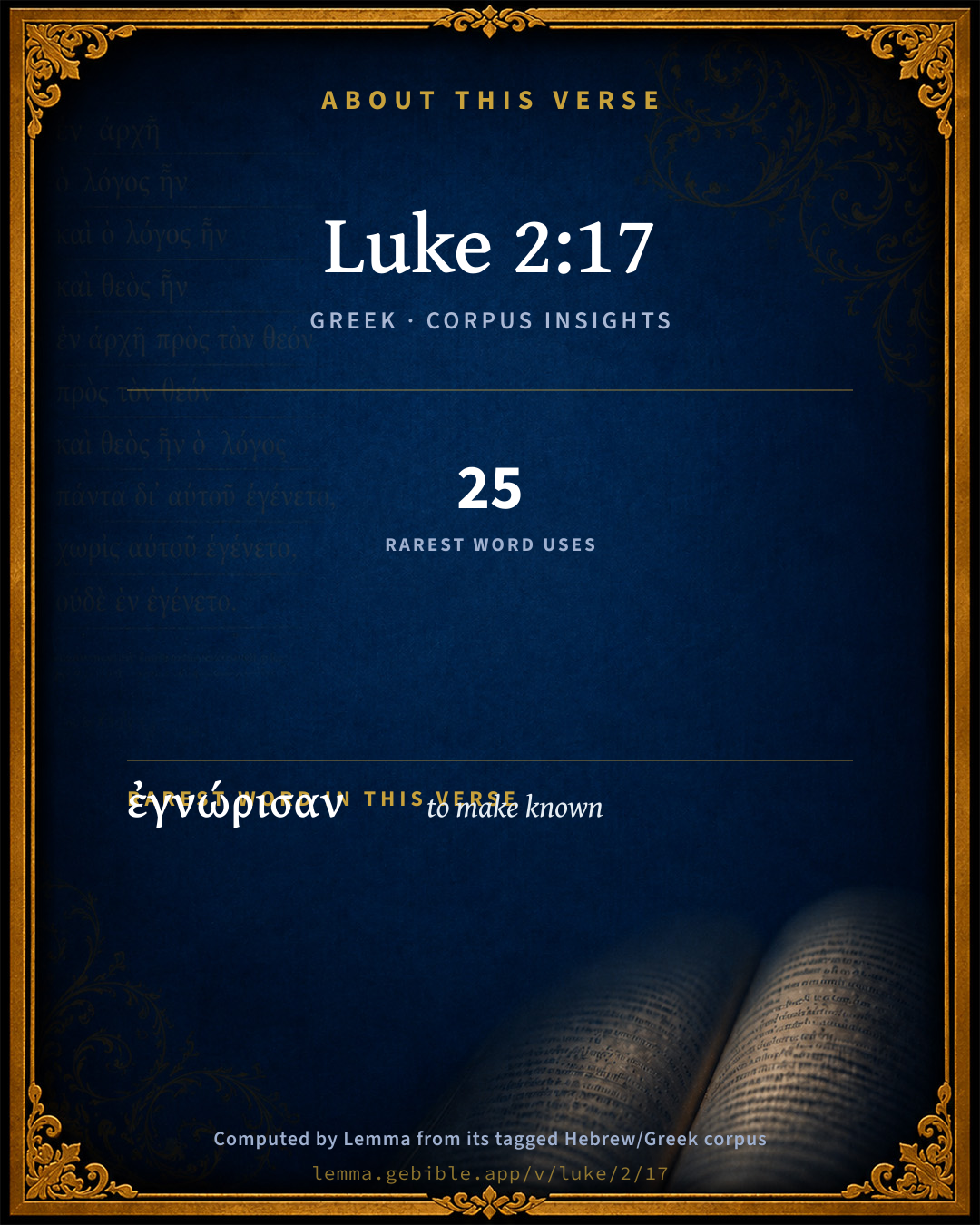
The rarest word here is ἐγνώρισαν to make known G1107 — appearing just 25 times in the whole Greek New Testament.

Shared distinctive vocabulary

ἐγνώρισαν to make known G1107 occurs in 24 verses of the Greek New Testament. Also found in:

Repetition

Words recur within this verse:

Cross-references

7

Topical passages linked to Luke 2:17 in the Treasury of Scripture Knowledge — connected by theme and wording, ordered by reader-vote popularity; previews shown in the World English Bible.

  • Psalms 66:16 Come, and hear, all you who fear God. I will declare what he has done for my soul.
  • Luke 8:39 "Return to your house, and declare what great things God has done for you." He went his way, proclaiming throughout the whole city what great things Jesus had done for him.
  • Psalms 71:17–18 God, you have taught me from my youth. Until now, I have declared your wondrous works.
  • Malachi 3:16 Then those who feared Yahweh spoke one with another; and Yahweh listened, and heard, and a book of memory was written before him, for those who feared Yahweh, and who honored his name.
  • Luke 2:38 Coming up at that very hour, she gave thanks to the Lord, and spoke of him to all those who were looking for redemption in Jerusalem.
  • Psalms 16:9–10 Therefore my heart is glad, and my tongue rejoices. My body shall also dwell in safety.
  • John 1:41–46 He first found his own brother, Simon, and said to him, "We have found the Messiah!" (which is, being interpreted, Christ).

Cross-references courtesy of OpenBible.info (CC BY 4.0).

Commentary

Notes on Luke 2:17 from classic Christian and Jewish commentators (each source and its license shown beneath its notes). The classic Christian expositions comment on the surrounding passage and are grouped to its opening verse, so a note may address several verses; the Jewish commentaries on the Tanakh (Rashi and others) are per-verse, so they appear only where the commentator wrote on this verse.

Lemma curates 59 commentaries, every one of them public domain or Creative Commons licensed, each selected and text-cleaned for this edition rather than reprinted as found. About our sources →

Bengel's Gnomon

Johann Albrecht Bengel

Luk 2:17. Διεγνώρισαν, they made known abroad) even before their departure: see Luk 2:20. [They were the earliest Evangelists.—V. g.]

Bengel's Gnomon of the New Testament — English translation (T&T Clark, Edinburgh, 1860) — public domain. Text from a community e-Sword module.

Meyer's Critical & Exegetical Commentary

Heinrich August Wilhelm Meyer

Luk_2:17 f. Διεγνώρισαν] they gave exact information (διά). The word is only found besides in Schol. in Beck. Anecd. p. 787, 15, but in the sense of accurate distinguishing, which it cannot have in this place (Vulg.: cognoverunt); comp. rather ἐγνώρισεν, Luk_2:15. At the birthplace to the parents and others who were present they made accurate communication of the angelic utterance addressed to them, and all who heard this communication marvelled, but Mary (Luk_2:19), etc.

περὶ τῶν λαληθ.] does not belong to ἀκούσαντες (Gersdorf), but to ἐθαύμ., with which indeed περί is very rarely associated elsewhere; but the thought is: they fell into amazement in consideration of that, which, etc. Comp. Plat. Tim. p. 80 C: τὰ θαυμαζόμενα ἠλέκτρων περὶ τῆς ἕλξεως.

Meyer — Critical and Exegetical Commentary on the New Testament — English translation by Peter Christie, edited by Frederick Crombie (T&T Clark, 1880) — public domain. Text from a community e-Sword module.

Jamieson, Fausset & Brown

Robert Jamieson, A. R. Fausset & David Brown

made known abroad--before their return (Luk 2:20), and thus were the first evangelists [BENGEL].

Jamieson, Fausset & Brown — Commentary Critical and Explanatory on the Whole Bible (1871) — public domain (CC PDM 1.0). Text via the HelloAO Bible API.

Adam Clarke's Commentary

Verse 17. They made known abroad the saying] These shepherds were the first preachers of the Gospel of Christ: and what was their text? Why, Glory to God in the highest heavens, and on earth peace and good will among men. This is the elegant and energetic saying which comprises the sum and substance of the Gospel of God. This, and this only, is the message which all Christ's true pastors or shepherds bring to men. He who, while he professes the religion of Christ, disturbs society by his preachings or writings, who excludes from the salvation of God all who hold not his religious or political creed, never knew the nature of the Gospel, and never felt its power or influence. How can religious contentions, civil broils, or open wars, look that Gospel in the face which publishes nothing but glory to God, and peace and good will among men? Crusades for the recovery of a holy land so called, (by the way, latterly, the most unholy in the map of the world,) and wars for the support of religion, are an insult to the Gospel, and blasphemy against God!

Adam Clarke's Commentary on the Bible (1810–1826) — public domain. Text from a community e-Sword/MySword module.

Ellicott's Commentary for English Readers

(17) They made known abroad . . .—The fact must be borne in mind, as tending to the agitation which reached its height on the arrival of the Magi in Jerusalem. (See Note on Mat_2:3.)

A Bible Commentary for English Readers, edited by Charles John Ellicott (1878–1897) — public domain. Text from a community e-Sword module.

The Cambridge Bible for Schools and Colleges

gen. ed. J. J. S. Perowne

17. made known abroad] Thus they were the first Christian preachers.

The Cambridge Bible for Schools and Colleges (gen. ed. J. J. S. Perowne; Cambridge University Press, 1878–1918) — public domain. Text from a community e-Sword module.

John Gill's Exposition

And when they had seen it,.... Or "him", as the Arabic version reads, the child Jesus, or "them", Joseph, Mary, and the child; or this whole affair, as had been related to them:

they made known abroad; not only in the inn, and among all the people there but throughout the city of Bethlehem,

the saying which was told them concerning this child: both what the angel had told them concerning his birth, and what he was, and where he lay; and what Mary had told them concerning the notice she had from an angel of the conception of him, and the manner of it, and of what he should be; and likewise what Joseph had told them, how an angel had appeared to him, and had acquainted him, after the conception of him, that it was of the Holy Ghost; and was bid to call his name Jesus: as Mary also was, because he was to be the Saviour of his people from their sins: for, no doubt, but they had a conversation with Joseph and Mary about him; and as they could not fail of relating to them, what they had seen and heard that night in the fields, it is reasonable to suppose, that Joseph and Mary would give them some account of the above things; which all make up the saying, or report, they spread abroad: the Persic version reads, "what they had heard of the angel"; but there is no reason to confine it to that.

John Gill's Exposition of the Whole Bible (1746–1763) — public domain (CC PDM 1.0). Text via the HelloAO Bible API.

Trapp's Complete Commentary

John Trapp

17 And when they had seen it, they made known abroad the saying which was told them concerning this child.

Ver. 17. They made known abroad] True goodness is communicative; there is no envy in spiritual things; because they may be divided in solidum: one may have as much as another, and all alike. These shepherds, as those lepers, 2Ki 7:7; 2Ki 7:9, said one to another, "We do not well; this day is a day of good tidings, and we hold our peace," &c.

John Trapp, A Commentary or Exposition upon All the Books of the Old and New Testament (1647–1656) — public domain. Text from a community e-Sword module.

Albert Barnes' Notes on the Bible

When they had see it - When they had satisfied themselves of the truth of the coming of the Messiah, and had ascertained that they could not have been mistaken in the appearance of the angels. There was evidence enough to satisfy “them” that what the angels said was true, or they would not have gone to Bethlehem. Having seen the child themselves, they had now evidence that would satisfy others; and accordingly they became the first preachers of the “gospel,” and went and proclaimed to others that the Messiah had come. One of the first duties of those who are newly converted to God, and a duty in which they delight, is to proclaim to others what they have seen and felt. It should be done in a proper way and at the proper time; but nothing can or should prevent a Christian recently converted from telling his feelings and views to others - to his friends, to his parents, to his brothers, and to his old companions. And it may be remarked that often more good may be done then than during any other period of their life. Entreaties then make an impression; nor can a sinner well resist the appeals made to him by one who was just now with him in the way to ruin, but who now treads the way to heaven.

Albert Barnes' Notes on the Bible (1834–1885) — public domain. Text from a community e-Sword/MySword module.

Haydock's Catholic Bible Commentary

They saw this with the eyes of their body, but with their internal eyes they discovered other wonders, viz. that he, who lay there in such great poverty, was their Messias, their great King, and the Son of God. (Barradius)

George Leo Haydock (1774–1849), Haydock's Catholic Family Bible and Commentary, 1859 edition — public domain. Excludes Psalms (Douay-Rheims chapter numbering differs from Protestant) and Deuterocanonical books (Catholic canon only).

Whedon's Commentary on the Bible

Daniel D. Whedon

17. Made known abroad—That is, they related at Bethlehem the appearance of the angels and the prediction by which they had been induced to visit the place where the infant Jesus was.

Abroad—There is hardly any thing in the Greek equivalent to this word abroad. It does not appear that the shepherds narrated the facts out of the circle surrounding the child. Herod and his court at any rate seem not to have so far been informed of it as to be aroused to any alarm at the birth of a king of the Jews. It was not until the arrival of the Magi explicitly inquiring for the new born king that the palace at Jerusalem was disturbed.

Daniel D. Whedon (gen. ed.), Commentary on the Old and New Testaments (1874–1909) — public domain. Text from a community e-Sword module.

The Pulpit Commentary

And when they had seen it, they made known abroad the saying which was told them concerning this Child. Thus these men, at the bottom of the social scale in Israel, were chosen as the first preachers of the new-born King. Gradually the strange story got noised abroad in the city. The vision of Zacharias, the story of Mary, the two strange births, the marvellous experience of the shepherds. Following upon all this was the arrival of the Magi, and their inquiries after a new-born Messiah, whom they had been directed by no earthly voices to seek after in the neighborhood of Jerusalem. It was then that the jealous fears of Herod were in good earnest aroused, and the result was that he gave immediate directions for the massacre of the innocents in Bethlehem, of which St. Matthew writes.

The Pulpit Commentary (1880–1919), ed. H.D.M. Spence-Jones & Joseph S. Exell — public domain. Text from a community e-Sword module.

MacLaren's Expositions of Holy Scripture

Alexander MacLaren

Luke

SHEPHERDS AND ANGELS

Luk 2:8 - Luk 2:20.

The central portion of this passage is, of course, the angels’ message and song, the former of which proclaims the transcendent fact of the Incarnation, and the latter hymns its blessed results. But, subsidiary to these, the silent vision which preceded them and the visit to Bethlehem which followed are to be noted. Taken together, they cast varying gleams on the great fact of the birth of Jesus Christ.

Why should there be a miraculous announcement at all, and why should it be to these shepherds? It seems to have had no effect beyond a narrow circle and for a time. It was apparently utterly forgotten when, thirty years after, the carpenter’s Son began His ministry. Could such an event have passed from memory, and left no ripple on the surface? Does not the resultlessness cast suspicion on the truthfulness of the narrative? Not if we duly give weight to the few who knew of the wonder; to the length of time that elapsed, during which the shepherds and their auditors probably died; to their humble position, and to the short remembrance of extraordinary events which have no immediate consequences. Joseph and Mary were strangers in Bethlehem. Christ never visited it, so far as we know. The fading of the impression cannot be called strange, for it accords with natural tendencies; but the record of so great an event, which was entirely ineffectual as regards future acceptance of Christ’s claims, is so unlike legend that it vouches for the truth of the narrative. An apparent stumbling-block is left, because the story is true.

Why then, the announcement at all, since it was of so little use? Because it was of some; but still more, because it was fitting that such angel voices should attend such an event, whether men gave heed to them or not; and because, recorded, their song has helped a world to understand the nature and meaning of that birth. The glory died off the hillside quickly, and the music of the song scarcely lingered longer in the ears of its first hearers; but its notes echo still in all lands, and every generation turns to them with wonder and hope.

The selection of two or three peasants as receivers of the message, the time at which it was given, and the place, are all significant. It was no unmeaning fact that the ‘glory of the Lord’ shone lambent round the shepherds, and held them and the angel standing beside them in its circle of light. No longer within the secret shrine, but out in the open field, the symbol of the Divine Presence glowed through the darkness; for that birth hallowed common life, and brought the glory of God into familiar intercourse with its secularities and smallnesses. The appearance to these humble men as they ‘sat simply chatting in a rustic row ‘symbolised the destination of the Gospel for all ranks and classes.

The angel speaks by the side of the shepherds, not from above. His gentle encouragement ‘Fear not!’ not only soothes their present terror, but has a wider meaning. The dread of the Unseen, which lies coiled like a sleeping snake in all hearts, is utterly taken away by the Incarnation. All messages from that realm are thenceforward ‘tidings of great joy,’ and love and desire may pass into it, as all men shall one day pass, and both enterings may be peaceful and confident. Nothing harmful can come out of the darkness, from which Jesus has come, into which He has passed, and which He fills.

The great announcement, the mightiest, most wonderful word that had ever passed angels’ immortal lips, is characterised as ‘great joy’ to ‘all the people,’ in which designation two things are to be noted-the nature and the limitation of the message. In how many ways the Incarnation was to be the fountain of purest gladness was but little discerned, either by the heavenly messenger or the shepherds. The ages since have been partially learning it, but not till the ‘glorified joy’ of heaven swells redeemed hearts will all its sorrow-dispelling power be experimentally known. Base joys may be basely sought, but His creatures’ gladness is dear to God, and if sought in God’s way, is a worthy object of their efforts.

The world-wide sweep of the Incarnation does not appear here, but only its first destination for Israel. This is manifest in the phrase ‘all the people,’ in the mention of ‘the city of David’ and in the emphatic ‘you,’ in contradistinction both from the messenger, who announced what he did not share, and Gentiles, to whom the blessing was not to pass till Israel had determined its attitude to it.

The titles of the Infant tell something of the wonder of the birth, but do not unfold its overwhelming mystery. Magnificent as they are, they fall far short of ‘The Word was made flesh.’ They keep within the circle of Jewish expectation, and announce that the hopes of centuries are fulfilled. There is something very grand in the accumulation of titles, each greater than the preceding, and all culminating in that final ‘Lord.’ Handel has gloriously given the spirit of it in the crash of triumph with which that last word is pealed out in his oratorio. ‘Saviour’ means far more than the shepherds knew; for it declares the Child to be the deliverer from all evil, both of sin and sorrow, and the endower with all good, both of righteousness and blessedness. The ‘Christ’ claims that He is the fulfiller of prophecy, perfectly endowed by divine anointing for His office of prophet, priest, and king-the consummate flower of ancient revelation, greater than Moses the law-giver, than Solomon the king, than Jonah the prophet. ‘The Lord’ is scarcely to be taken as the ascription of divinity, but rather as a prophecy of authority and dominion, implying reverence, but not unveiling the deepest secret of the entrance of the divine Son into humanity. That remained unrevealed, for the time was not yet ripe.

There would be few children of a day old in a little place like Bethlehem, and none but one lying in a manger. The fact of the birth, which could be verified by sight, would confirm the message in its outward aspect, and thereby lead to belief in the angel’s disclosure of its inward character. The ‘sign’ attested the veracity of the messenger, and therefore the truth of all his word-both of that part of it capable of verification by sight and that part apprehensible by faith.

No wonder that the sudden light and music of the multitude of the heavenly host’ flashed and echoed round the group on the hillside. The true picture is not given when we think of that angel choir as floating in heaven. They stood in their serried ranks round the shepherds and their fellows on the solid earth, and ‘the night was filled with music,’ not from overhead, but from every side. Crowding forms became all at once visible within the encircling ‘glory,’ on every face wondering gladness and eager sympathy with men, from every lip praise. Angels can speak with the tongues of men when their theme is their Lord become man, and their auditors are men. They hymn the blessed results of that birth, the mystery of which they knew more completely than they were yet allowed to tell.

As was natural for them, their praise is first evoked by the result of the Incarnation in the highest heavens. It will bring ‘glory to God’ there; for by it new aspects of His nature are revealed to those clear-eyed and immortal spirits who for unnumbered ages have known His power, His holiness, His benignity to unfallen creatures, but now experience the wonder which more properly belongs to more limited intelligences, when they behold that depth of condescending Love stooping to be born. Even they think more loftily of God, and more of man’s possibilities and worth, when they cluster round the manger, and see who lies there.

‘On earth peace.’ The song drops from the contemplation of the heavenly consequences to celebrate the results on earth, and gathers them all into one pregnant word, ‘Peace.’ What a scene of strife, discord, and unrest earth must seem to those calm spirits! And how vain and petty the struggles must look, like the bustle of an ant-hill! Christ’s work is to bring peace into all human relations, those with God, with men, with circumstances, and to calm the discords of souls at war with themselves. Every one of these relations is marred by sin, and nothing less thorough than a power which removes it can rectify them. That birth was the coming into humanity of Him who brings peace with God, with ourselves, with one another. Shame on Christendom that nineteen centuries have passed, and men yet think the cessation of war is only a ‘pious imagination’! The ringing music of that angel chant has died away, but its promise abides.

The symmetry of the song is best preserved, as I humbly venture to think, by the old reading as in the Authorised Version. The other, represented by the Revised Version, seems to make the second clause drag somewhat, with two designations of the region of peace. The Incarnation brings God’s ‘good will’ to dwell among men. In Christ, God is well pleased; and from Him incarnate, streams of divine complacent love pour out to freshen and fertilise the earth.

The disappearance of the heavenly choristers does not seem to have been so sudden as their appearance. They ‘went away from them into heaven,’ as if leisurely, and so that their ascending brightness was long visible as they rose, and attestation was thereby given to the reality of the vision. The sleeping village was close by, and as soon as the last gleam of the departing light had faded in the depths of heaven, the shepherds went ‘with haste,’ untimely as was the hour. They would not have much difficulty in finding the inn and the manger. Note that they do not tell their story till the sight has confirmed the angel message. Their silence was not from doubt; for they say, before they had seen the child, that ‘this thing’ is ‘come to pass,’ and are quite sure that the Lord has told it them. But they wait for the evidence which shall assure others of their truthfulness.

There are three attitudes of mind towards God’s revelation set forth in living examples in the closing verses of the passage. Note the conduct of the shepherds, as a type of the natural impulse and imperative duty of all possessors of God’s truth. Such a story as they had to tell would burn its way to utterance in the most reticent and shyest. But have Christians a less wonderful message to deliver, or a less needful one? If the spectators of the cradle could not be silent, how impossible it ought to be for the witnesses of the Cross to lock their lips!

The hearers of the story did what, alas! too many of us do with the Gospel. ‘They wondered,’ and stopped there. A feeble ripple of astonishment ruffled the surface of their souls for a moment; but like the streaks on the sea made by a catspaw of wind, it soon died out, and the depths were unaffected by it.

The antithesis to this barren wonder is the beautiful picture of the Virgin’s demeanour. She ‘kept all these sayings, and pondered them in her heart.’ What deep thoughts the mother of the Lord had, were hers alone. But we have the same duty to the truth, and it will never disclose its inmost sweetness to us, nor take so sovereign a grip of our very selves as to mould our lives, unless we too treasure it in our hearts, and by patient brooding on it understand its hidden harmonies, and spread our souls out to receive its transforming power. A non-meditative religion is a shallow religion. But if we hide His word in our hearts, and often in secret draw out our treasure to count and weigh it, we shall be able to speak out of a full heart, and like these shepherds, to rejoice that we have seen even as it was spoken unto us.

Alexander MacLaren, Expositions of Holy Scripture (1904–1910) — public domain. Text from a community e-Sword module.

unfoldingWord translationNotes

Door43 World Missions Community

what had been said to them

This can be stated in active form. AT: "what the angels had told the shepherds" (See: Active or Passive)

this child

"the baby"

what was spoken to them by the shepherds

This can be stated in active form. AT: "what the shepherds told them" (See: Active or Passive)

treasuring them in her heart

A person who thinks is something is very valuable or precious is "treasuring" it. Mary considered the things she was told about her son to be very precious. AT: "carefully remembering them" or "joyfully remembering them" (See: Metaphor)

shepherds returned

"shepherds went back to the sheep"

glorifying and praising God

These are very similar and emphasize how excited they were about what God had done. AT: "talking about and praising God's greatness" (See: Doublet)

translationWords

amazed

shepherd

Mary

heart

glory

praise

God

unfoldingWord translationNotes — © Distant Shores Media and the Door43 World Missions Community, licensed CC BY-SA 4.0. Source: git.door43.org/Door43/en_tn.

Cambridge Greek Testament for Schools and Colleges

17. ἐγνώρισαν. Thus the shepherds were the first Christian preachers. The reading διεγν. may have sprung from the previous δὲ by homoeoteleuton.

Cambridge Greek Testament for Schools and Colleges (Cambridge University Press, 1896; 21 vols, various authors incl. Carr, Maclear, Plummer, Farrar, Lumby, Moule, M. R. James, Simcox) — public domain. Text from a community e-Sword module.

International Critical Commentary

17. ἐγνώρισαν. “They made known,” not merely to Mary and Joseph, but to the inhabitants of Bethlehem generally. Both in N.T. and LXX γνωρίζω is commonly trans.; but in Php 1:22 and Job 34:25, as usually in class. Grk., it is intrans. Vulg. makes it intrans. here: cognoverunt de verbo quod dictum erat illis de puero hoc. But ver. 18 makes this very improbable.

International Critical Commentary — older volumes (1896–1929), various authors — public domain. Text from a community e-Sword module.

Vincent's Word Studies in the New Testament

Marvin R. Vincent

They made known. See on verse 8. These shepherds, having charge of flocks devoted to sacrifice, would presently be in the temple, and would meet those who came to worship and to sacrifice, and so proclaim the Messiah in the temple.

Marvin R. Vincent, Word Studies in the New Testament (1887–1900) — public domain. Text from a community e-Sword/MySword module.

Lesson kit

Teaching starters — assembled from the data on this page, not authored interpretation. Every prompt links to the verse data it draws on. Edit before teaching.

Luke, in the Gospels, opens this verse with 13 words (10 distinct Greek lemmas). Its most distinctive word is gnōrízō (“to make known”). A historical commentator’s framing appears above. Read the whole chapter for the surrounding context.

Discussion questions

  1. How does “to make known” (gnōrízō) shape what this verse is saying?
  2. How does Luke 2:15, which shares the word «to make known», read alongside this verse?
  3. What does the repetition of “about” (2× in this one verse) do in this verse?
  4. These translations render this verse differently; the difference is in the English rendering, not the original. What questions does that raise?
  5. Compare how Bengel's Gnomon and Meyer's Critical & Exegetical Commentary read this verse. Where do they agree or differ?

Things to notice

Reading settings

Reading text

Shown beneath each verse's original-language words.

Old Testament
Old Testament edition

Read the OT as the Masoretic Hebrew (MT) or the Greek Septuagint (LXX).

English shown for the Greek Septuagint (in the Hebrew ↔ Greek comparison).

Comparing translations? Open the Compare panel on any verse page to stack up to four side by side.