
Luke 8:15

Greek (Tischendorf 8th ed.) Luke 8:15 appears in the Greek New Testament. The text above is from the Tischendorf 8th edition. Each word links to its Strong’s number and a concise gloss. Click any word for its full Thayer’s Greek Lexicon entry.
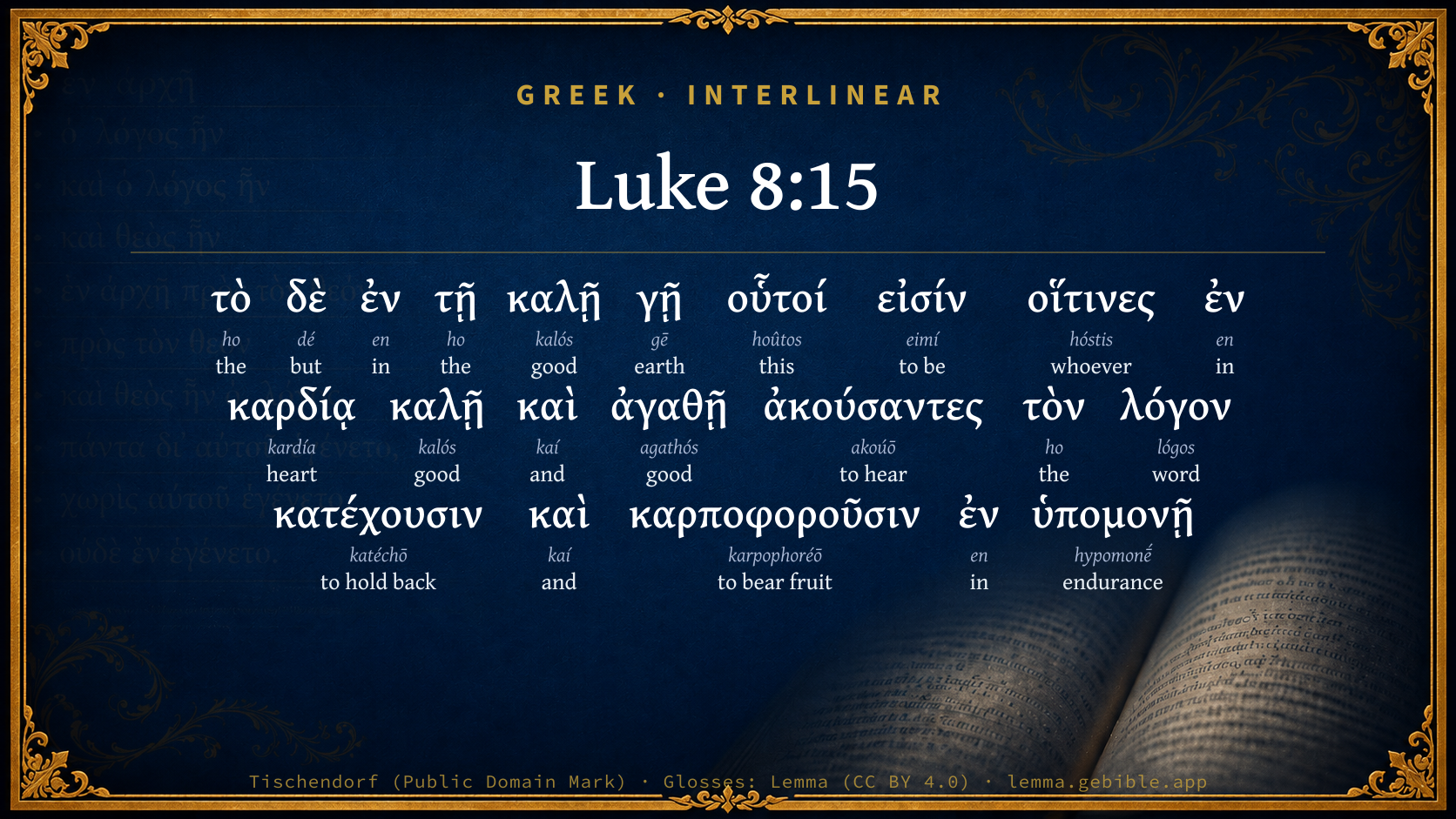
Download image
Cite this verse

Luke 8:15 (World English Bible). Public Domain. Lemma interlinear Bible study tool, https://lemma.gebible.app/v/luke/8/15.

Show BibTeX & RIS
BibTeX
RIS
English Translation
That in the good ground, these are such as in an honest and good heart, having heard the word, hold it tightly, and bring forth fruit with patience.
World English Bible · Public Domain
Highlights
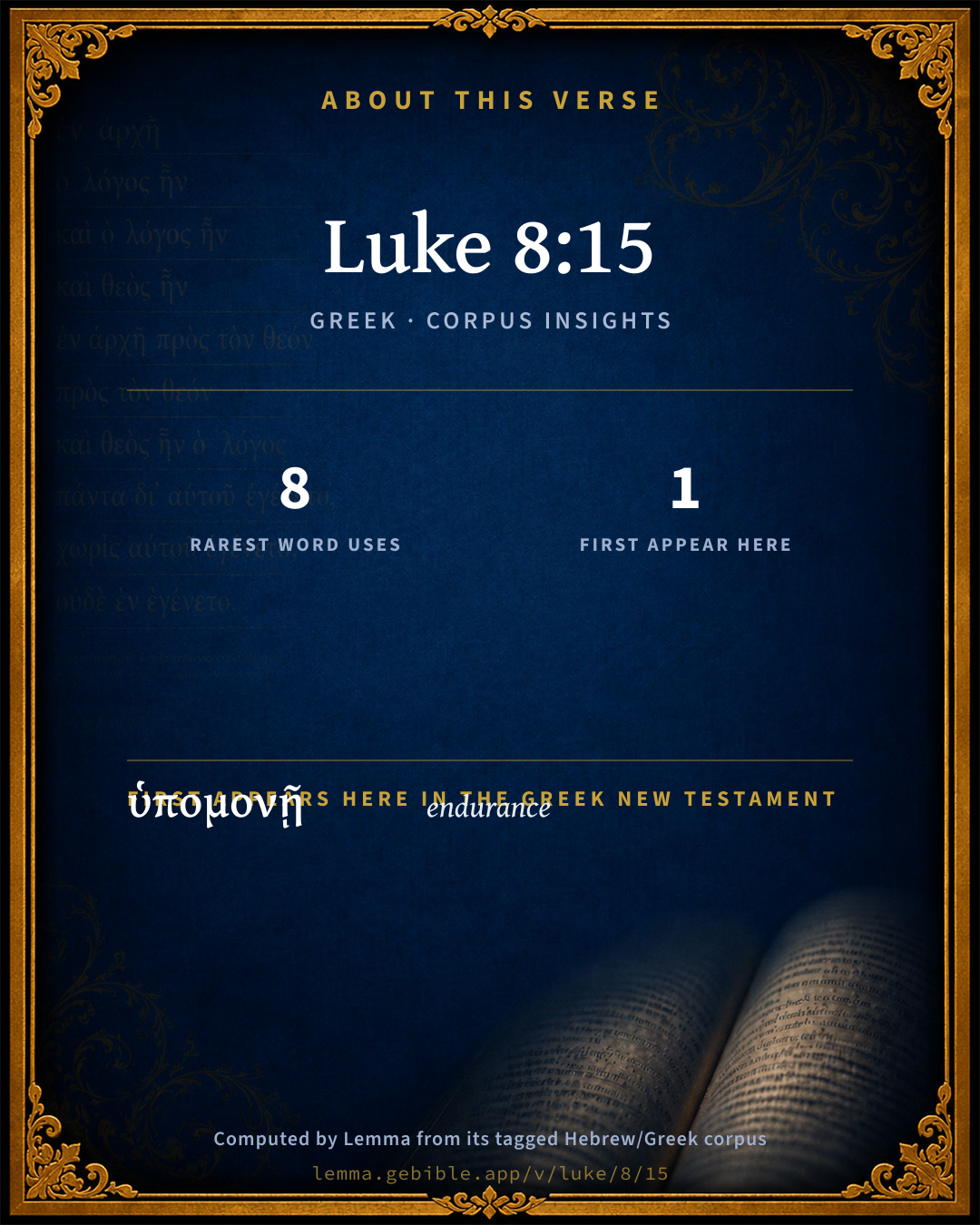
  • 1 first appearance in the Greek New Testament
Full analysis ↓
Download a study sheet

One document with this verse’s original text, its word-by-word gloss line, the meaning frame, cross-references with their text, attributed commentary, and full source and license credits — printable, and it pastes into notes with its structure intact.

This verse Autodidact and up

Study sheet (.html) Plain text (.txt)

A passage Seminary Student

Up to 50 verses in one chapter. A passage sheet keeps up to 6 commentary sources and 12 cross-references per verse, in the order this page ranks them, and says so on the sheet whenever that leaves anything out. Ask for a single verse and you get the Autodidact verse sheet above.

Everything on this page stays free to read, with no account — the sheet is a download of what is already on screen, not access to it.

Want to remove ads? Support Godless Engineer
Compare translations 3

The same verse in 3 English versions, stacked beneath the original-language interlinear above. Click any original word for its lexicon entry.

Each is an independent rendering of the whole verse — the interlinear is not word-aligned to these translations.

Highlighted words mark where these versions differ — a whole-verse word diff, not a word-by-word alignment.

  • World English Bible Public Domain
    That in the good ground, these are such as in an honest and good heart, having heard the word, hold it tightly, and bring forth fruit with patience.
  • King James Version Public Domain
    But that on the good ground are they, which in an honest and good heart, having heard the word, keep it, and bring forth fruit with patience.
  • unfoldingWord Literal Text CC BY-SA 4.0
    But the ones on the good soil, these are the ones who, having heard the word with an honest and good heart, hold it securely and bear fruit with endurance.

unfoldingWord Literal Text — © unfoldingWord, licensed CC BY-SA 4.0. Word-aligned USFM3 via Door43 (git.door43.org/unfoldingWord/en_ult).

Versions to compare (up to 4)

3 of 4 selected

Show all 19 translations

Every available English version of this verse, each an independent rendering of the whole verse.

  • World English Bible Public Domain
    That in the good ground, these are such as in an honest and good heart, having heard the word, hold it tightly, and bring forth fruit with patience.
  • Berean Standard Bible Public Domain
    But the seeds on good soil are those with a noble and good heart, who hear the word, cling to it, and by persevering produce a crop.
  • Majority Standard Bible Public Domain
    But the seeds on good soil are those with a noble and good heart, who hear the word, cling to it, and by persevering produce a crop.
  • King James Version Public Domain
    But that on the good ground are they, which in an honest and good heart, having heard the word, keep it, and bring forth fruit with patience.
  • American Standard Version (1901) Public Domain
    And that in the good ground, these are such as in an honest and good heart, having heard the word, hold it fast, and bring forth fruit with patience.
  • Revised Version (1885) Public Domain
    And that in the good ground, these are such as in an honest and good heart, having heard the word, hold it fast, and bring forth fruit with patience.
  • Geneva Bible (1599) Public Domain
    But that which fell in good ground, are they which with an honest and good heart heare the worde, and keepe it, and bring forth fruite with patience.
  • Douay-Rheims (1899) Public Domain
    But that on the good ground, are they who in a good and perfect heart, hearing the word, keep it, and bring forth fruit in patience.
  • Young's Literal Translation Public Domain
    `And that in the good ground: These are they, who in an upright and good heart, having heard the word, do retain `it', and bear fruit in continuance.
  • Literal Standard Version CC BY-SA 4.0
    And that in the good ground: these are they who in an upright and good heart, having heard the word, retain [it], and bear fruit in continuance.
  • Unlocked Literal Bible CC BY-SA 4.0
    But the seed that fell on the good soil, these are the ones who, hearing the word with an honest and good heart, hold it securely and bear fruit with patient endurance.
  • unfoldingWord Literal Text CC BY-SA 4.0
    But the ones on the good soil, these are the ones who, having heard the word with an honest and good heart, hold it securely and bear fruit with endurance.
  • Darby Bible Public Domain
    But that in the good ground, these are they who in an honest and good heart, having heard the word keep it, and bring forth fruit with patience.
  • World Messianic Bible Public Domain
    Those in the good ground, these are those who with an honest and good heart, having heard the word, hold it tightly, and produce fruit with perseverance.
  • Webster's Bible Public Domain
    But that on the good ground are they, who in an honest and good heart, having heard the word, keep it, and bring forth fruit with patience.
  • Free Bible Version CC BY-SA 4.0
    The seeds sown on good earth are those who are honest and do what is right. They hear the message of truth, hold on to it, and through their perseverance produce a good harvest.
  • Bible in Basic English Public Domain
    And those in the good earth are those who, having given ear to the word, keep it with a good and true heart, and in quiet strength give fruit.
  • Text-Critical English NT CC BY 4.0
    But the seed in the good soil are those who hear the word, hold fast to it with an honest and good heart, and bear fruit with patient endurance.
  • Tyndale New Testament (1534) Public Domain
    That in the good grounde are they which with a good and pure hert heare the worde and kepe it and bringe forth frute with pacience.

Literal Standard Version (2020), Covenant Press — licensed CC BY-SA 4.0. Text via the HelloAO Bible API (eBible.org). Unlocked Literal Bible (unfoldingWord) — licensed CC BY-SA 4.0. Text via the HelloAO Bible API (eBible.org). unfoldingWord Literal Text — © unfoldingWord, licensed CC BY-SA 4.0. Word-aligned USFM3 via Door43 (git.door43.org/unfoldingWord/en_ult). Free Bible Version, Dr. Jonathan Gallagher — licensed CC BY-SA 4.0. Text via the HelloAO Bible API (eBible.org).

Word by word

More ways to search: Search by grammar → Find every occurrence → Compare this word →

Practice this passage: Drill this verse → Learn its vocabulary →

καρποφοροῦσιν
karpophoréō
G2592
“to bear fruit”
Verb, Present, Active, Indicative, 3rd person, Plural
Part of Speech
Verb
Tense
Present
Voice
Active
Mood
Indicative
Person
3rd person
Number
Plural
Full Thayer's Definition

Origin: from G2593

TDNT: 13:16,4

1. to bear fruit 2. to bear, bring forth, deeds 3. to bear fruit of one's self
  1. τὸ ho G3588 “the” Article, Nominative, Singular, Neuter
  2. δὲ dé G1161 “but” Conjunction
  3. ἐν en G1722 “in” Preposition
  4. τῇ ho G3588 “the” Article, Dative, Singular, Feminine
  5. καλῇ kalós G2570 “good” Adjective, Dative, Singular, Feminine
  6. γῇ gē G1093 “earth” Noun, Dative, Singular, Feminine
  7. οὗτοί hoûtos G3778 “this” Demonstrative pronoun, Nominative, Plural, Masculine
  8. εἰσίν eimí G1510 “to be” Verb, Present, Active, Indicative, 3rd person, Plural
  9. οἵτινες hóstis G3748 “whoever” Relative pronoun, Nominative, Plural, Masculine
  10. ἐν en G1722 “in” Preposition
  11. καρδίᾳ kardía G2588 “heart” Noun, Dative, Singular, Feminine
  12. καλῇ kalós G2570 “good” Adjective, Dative, Singular, Feminine
  13. καὶ kaí G2532 “and” Conjunction
  14. ἀγαθῇ agathós G18 “good” Adjective, Dative, Singular, Feminine
  15. ἀκούσαντες akoúō G191 “to hear” Verb, Aorist, Active, Participle, Nominative, Plural, Masculine
  16. τὸν ho G3588 “the” Article, Accusative, Singular, Masculine
  17. λόγον lógos G3056 “word” Noun, Accusative, Singular, Masculine
  18. κατέχουσιν katéchō G2722 “to hold back” Verb, Present, Active, Indicative, 3rd person, Plural
  19. καὶ kaí G2532 “and” Conjunction
  20. ἐν en G1722 “in” Preposition
  21. ὑπομονῇ hypomonḗ G5281 “endurance” Noun, Dative, Singular, Feminine

About this verse

These counts appear in no published source. They are computed here, from the morphology-tagged text and Lemma’s own curated glosses. What Lemma adds →

22
words
16
distinct lemmas
Gospels
section

Notable vocabulary

The rarest word here is καρποφοροῦσιν to bear fruit G2592 — appearing just 8 times in the whole Greek New Testament.

First appearance in Scripture

This word makes its first canonical appearance in the Greek New Testament here:

  • ὑπομονῇ endurance G5281

Shared distinctive vocabulary

καρποφοροῦσιν to bear fruit G2592 occurs in 8 verses of the Greek New Testament. Also found in:
Repetition

Words recur within this verse:

Cross-references

37

Topical passages linked to Luke 8:15 in the Treasury of Scripture Knowledge — connected by theme and wording, ordered by reader-vote popularity; previews shown in the World English Bible.

  • Hebrews 10:36 For you need endurance so that, having done the will of God, you may receive the promise.
  • Galatians 5:22–26 But the fruit of the Spirit is love, joy, peace, patience, kindness, goodness, faithfulness,
  • Colossians 1:10 that you may walk worthily of the Lord, to please him in all respects, bearing fruit in every good work, and increasing in the knowledge of God;
  • Luke 6:45 The good man out of the good treasure of his heart brings out that which is good, and the evil man out of the evil treasure of his heart brings out that which is evil, for out of the abundance of the heart, his mouth speaks.
  • Colossians 1:6 which has come to you; even as it is in all the world and is bearing fruit and growing, as it does in you also, since the day you heard and knew the grace of God in truth;
  • 1 John 2:3 This is how we know that we know him: if we keep his commandments.
  • Matthew 24:13 But he who endures to the end, the same will be saved.
  • Luke 11:28 But he said, "On the contrary, blessed are those who hear the word of God, and keep it."
  • John 14:15 If you love me, keep my commandments.
  • James 1:22–25 But be doers of the word, and not only hearers, deluding your own selves.
  • Deuteronomy 30:6 Yahweh your God will circumcise your heart, and the heart of your seed, to love Yahweh your God with all your heart, and with all your soul, that you may live.
  • John 15:10 If you keep my commandments, you will remain in my love; even as I have kept my Father's commandments, and remain in his love.
  • Romans 6:22 But now, being made free from sin, and having become servants of God, you have your fruit of sanctification, and the result of eternal life.
  • Romans 7:4 Therefore, my brothers, you also were made dead to the law through the body of Christ, that you would be joined to another, to him who was raised from the dead, that we might bring forth fruit to God.
  • Philippians 1:11 being filled with the fruits of righteousness, which are through Jesus Christ, to the glory and praise of God.
  • James 1:16–19 Don't be deceived, my beloved brothers.
  • Ezekiel 36:26–27 A new heart also will I give you, and a new spirit will I put within you; and I will take away the stony heart out of your flesh, and I will give you a heart of flesh.
  • Romans 2:7 to those who by patience in well-doing seek for glory and honor and incorruptibility, eternal life;
  • James 5:7–8 Be patient therefore, brothers, until the coming of the Lord. Behold, the farmer waits for the precious fruit of the earth, being patient over it, until it receives the early and late rain.
  • 1 Peter 2:1–2 Putting away therefore all wickedness, all deceit, hypocrisies, envies, and all evil speaking,
  • Jeremiah 15:16 Your words were found, and I ate them; and your words were to me a joy and the rejoicing of my heart: for I am called by your name, Yahweh, God of hosts.
  • Romans 7:18 For I know that in me, that is, in my flesh, dwells no good thing. For desire is present with me, but I don't find it doing that which is good.
  • 1 Corinthians 7:19 Circumcision is nothing, and uncircumcision is nothing, but the keeping of the commandments of God.
  • Ephesians 2:8 for by grace you have been saved through faith, and that not of yourselves; it is the gift of God,
  • Hebrews 2:1 Therefore we ought to pay greater attention to the things that were heard, lest perhaps we drift away.
  • Hebrews 6:11–12 We desire that each one of you may show the same diligence to the fullness of hope even to the end,
  • James 1:4 Let endurance have its perfect work, that you may be perfect and complete, lacking in nothing.
  • Job 23:11–12 My foot has held fast to his steps. His way have I kept, and not turned aside.
  • Psalms 1:1–3 Blessed is the man who doesn't walk in the counsel of the wicked, Nor stand in the way of sinners, Nor sit in the seat of scoffers;
  • Psalms 51:10 Create in me a clean heart, O God. Renew a right spirit within me.
  • Psalms 119:11 I have hidden your word in my heart, That I might not sin against you.
  • Psalms 119:127–129 Therefore I love your commandments more than gold, Yes, more than pure gold.
  • Proverbs 3:1 My son, don't forget my teaching; But let your heart keep my commandments:
  • Jeremiah 31:33 But this is the covenant that I will make with the house of Israel after those days, says Yahweh: I will put my law in their inward parts, and in their heart will I write it; and I will be their God, and they shall be my people:
  • Jeremiah 32:29 and the Chaldeans, who fight against this city, shall come and set this city on fire, and burn it, with the houses, on whose roofs they have offered incense to Baal, and poured out drink-offerings to other gods, to provoke me to anger.
  • John 14:21–24 One who has my commandments, and keeps them, that person is one who loves me. One who loves me will be loved by my Father, and I will love him, and will reveal myself to him."
  • Philippians 3:13–15 Brothers, I don't regard myself as yet having taken hold, but one thing I do. Forgetting the things which are behind, and stretching forward to the things which are before,

Cross-references courtesy of OpenBible.info (CC BY 4.0).

Commentary

Notes on Luke 8:15 from classic Christian and Jewish commentators (each source and its license shown beneath its notes). The classic Christian expositions comment on the surrounding passage and are grouped to its opening verse, so a note may address several verses; the Jewish commentaries on the Tanakh (Rashi and others) are per-verse, so they appear only where the commentator wrote on this verse.

Lemma curates 59 commentaries, every one of them public domain or Creative Commons licensed, each selected and text-cleaned for this edition rather than reprinted as found. About our sources →

The Biblical Illustrator

Joseph S. Exell

Luk_8:15

But that on the good ground are they, which in an honest and good heart, having heard the Word, keep it

The necessity of patience

The necessity of patience in the Christian course appeareth by these reasons:

1.

The scope of the gospel is to make men fruitful Christians. But this can never be, without the persecution of the world (2Ti_3:12). The shadow doth not more undividedly follow the body, than persecutions and trials follow the profession of the gospel. This necessity of suffering afflictions implies and infers a necessity of patience.

2. It is necessary in respect of the manuring and preparing to fruit. The best ground brings no fruit unless it endure the plough, the harrow, the cold, the frost: even so the Lord prepareth His children to fruits of grace, by patient enduring many trials. The walnut tree is made fruitful by beating, camomile by treading upon, the palm by pressing, and the Christian by suffering.

3. In respect of the producing of fruits, there is great need of patience: seeing there is no fruit of grace which Satan seeks not to kill in the very sprouting and first appearance; as the child in his birth (Rev_12:4). And the wicked world seeks to blast them with the east wind of reproaches, yea to nip and pinch them, out-face and destroy them, with strong and violent persecutions: so as without patience enduring the cross, and despising the shame, this thirtyfold cannot be expected, much less an hundredfold. Thus Christ Himself brings forth to us all His blessed fruits, not without the greatest patience, proportioned to His greatest sufferings: and after the same manner must we also bring forth our fruits to Him.

4. It is necessary, in respect of the growth and ripening of fruits. The seed sown comes not up all at once, but by degrees; first the blade, then the ear, then ripe fruit (Mar_4:28). So all our graces and fruits are small at first, and receive increase by little and little.

5. It is necessary in respect of things that might hinder the growth, if patience prevented not: as first, the smart of present afflictions; for every affliction is grievous for the present (Heb_12:11), the mention thereof oftentimes makes us shrink, and startle, and grow out of heart, because of the roughness of our way. But now by patience we possess our souls, the present remedy of the disciples greatest persecutions (Luk_21:17-19), whereas by impatience we lose ourselves, and lessen our fruits. Secondly, the common crosses which accompany our mortal life will make us weary enough, unless patience supply some strength, and under-shore us. Thirdly, inward temptations, and disquietness of conscience, the wounds of spirit, are so intolerable, that the violence of them often shakes off many fruits, and makes the Christian walk weakly many days. Now patience alone keeps the soul at peace and quietness, waiting for God unto succour or issue. It holds the heart in expectation of the accomplishment of Gods promises, and our happiness in Christ. Fourthly, there are enemies without, which hazard our fruits. Fifthly, infirmities of brethren with whom we converse, were a great means to shake off our fruits (as Barnabas lost his sincerity for a time by Peters dissimulation), if patience did not uphold to discern and bear the infirmities of the weak (Rom_15:1-2).

6. Patience is necessary in respect of the harvest of fruits, the gathering and full reaping of all the seed sown. And thus the good ground brings forth with patience, i.e., with patient expectation of the full fruits; the first-fruits whereof are already attained (Rom_8:25). (Thomas Taylor, D. D)

Effectual hearing

If you would hear the Word aright, be not only attentive, but retentive. Lay the Word up in your memories and hearts. The seed on the good ground are they who, having heard the Word, keep it. The Greek word for keep signifies to hold the Word fast, that it do not run from us. If the seed be not kept in the ground, but is presently washed away, it is sown to little purpose: so, if the Word preached be not kept in your memories and hearts, it is preached in vain. Many people have memories like leaky vessels--the Word goes out as fast as it comes in: how, then, can it profit? If a treasure be put into a chest and the chest not locked, it may easily be taken out: a bad memory is like a chest without a look, the devil can easily take out all the treasure. Labour to keep in memory the truths you hear: the things we esteem we are not so apt to forget. (T Watson.)

Meditation renders good impressions lasting

Gotthold had for some purpose taken from a cupboard a vial of rosewater, and, after using it, inconsiderately left it unstopped. Observing it some time after, he found that all the strength and sweetness of the perfume had evaporated. Here, thought he with himself, is a striking emblem of a heart fond of the world and open to the impression of outward objects. What good does it do to take such a heart to the house of God, and there fill it with the precious essence of the roses of paradise which are the truths of Scripture? What good to kindle in it a glow of devotion, if we afterwards neglect to close the outlet--by which I mean, to keep the Word in an honest and good heart. How vain to hear much, but to retain little, and to practise less. How vain to experience within us sacred and holy emotions, unless we are afterwards careful to close the heart by diligent reflection and prayer, and so keep it unspotted from the world. Neglect this, and the strength and spirit of devotion evaporates, and leaves only a lifeless form behind. (Scriver.)

Remarkable fertility

Paul Joanne ascribes amazing fertility to the soil of Mentone, and backs his assertions by a story which reads like a legend. He says that a stranger coming to pay a visit to his Mentonese friends stuck his walking-stick into the ground and forgot it. Coming back some days afterwards to seek his cane, he was surprised to find it putting forth leaves and young branches. He declares that the little tree has grown vastly, and is still to be seen in the Rue Saint Michel. We have not seen it, and are afraid that to inquire for it in the aforesaid Rue would raise a laugh at our expense. We may believe the story or not as we please; but it may serve as an emblem of the way in which those grow who are by grace planted in Christ. All dry and withered like a rod we are thrust into the sacred soil, and life comes to us at once, with bud and branch and speedy fruit. Aarons rod that budded was not only a fair type of our Lord, but a cheering prophecy of ourselves. Whenever we feel dead and barren let us ask to be buried in Christ afresh, and straightway we shall glorify His name by bearing much fruit. (C. H. Spurgeon.)

The mystery of growth

In the growth of a grain of wheat are three miracles of wonders, viz., the power of absorbing fresh materials, the power of changing them into living vegetable substance, and the power of arranging the new materials according to a fixed pattern. Could we see this process through a powerful magnifying glass, so that the particles which are to be absorbed should seem as large as marbles, we should see millions of such marbles building themselves up into a green tree; some marching to one part, some to another; then changing themselves into tree sub stance, and, finally, all arranged into an exact pattern, so that no one can mistake the nature of the tree. Growth is a mystery. (E. White.)

With patience

Of all the characteristics of the good hearer, this, as it is the most valuable, is also the hardest to attain. To wait is even harder than to labour and to obey. Unless we are to have our harvest very soon, we have hardly the heart to sow. The husbandman has long patience--must have it--till he receives the early and the latter rain. So with us. To become a good hearer, i.e., a good doer of the Word, is a task which requires long patience. We must suffer many a killing frost, many a darkening shower, many a burning sun, before the good seed cast into our hearts by that great Sower, who daily goes forth to sow, will gladden us with its increase. But the longer we wait the more precious will be the harvest--it is only ill weeds that spring up apace--and the sweeter the taste of the bread which has been so hardly earned, and so long in coming. (S. Cox, D. D.)

The Biblical Illustrator, edited by Joseph S. Exell (c. 1880s–1900s) — public domain. Text from a community e-Sword module.

Bengel's Gnomon

Johann Albrecht Bengel

Luk 8:15. [Ἐν τῇ καλῇ γῇ, on the good ground) Lest such a soil should not be sown upon, it is better that some seed should be thrown away on the wayside, etc.—V. g.]—καλῇ καὶ ἀγαθῇ) See Mat 7:17. A frequent compound is καλοκἀγαθός. Καλὸς has somewhat of a relative meaning, ἀγαθός is absolute.—κατέχουσι, retain, keep it fast) not as on the wayside.—καρποφοροῦσι, bear fruit) not as among the thorns.—ἐν ὑπομονῇ, with patience) not as on the rocky ground. Ὑπομονή answers to the one Hebrew word תקוה, waiting, hope. It is strength of mind, sustained by good hope. It precedes the act of bearing fruit in such a way as even to accompany it: on this account it is here put at the end. This constitutes the sum of Christianity.

Bengel's Gnomon of the New Testament — English translation (T&T Clark, Edinburgh, 1860) — public domain. Text from a community e-Sword module.

Expositor's Greek Testament

ed. W. Robertson Nicoll

Luk 8:15 . ἐν καρδίᾳ καλῇ καὶ ἀγαθῇ , in a noble and generous heart, an important contribution by Lk. to the explanation of the conditions of fruitfulness. The former epithet points to a lofty aim or ideal, the latter to enthusiastic whole-hearted devotion to the ideal, the two constituting a heroic character. The phrase was familiar to the Greeks, and Lk. may have been acquainted with their use of it to describe a man comme il faut , but he brings to the conception of the καλὸς κἀγαθὸς new moral elements. ἐν ὑπομονῇ , in patience, as opposed to πρὸς καιρὸν ; and, it might be added, ἐν εἰλικρινείᾳ as opposed to the thorny-ground hearers. ὑπομ ., again in Luk 21:19 , often in Epistles.

The Expositor's Greek Testament, edited by W. Robertson Nicoll (1897–1910) — public domain. Text from a community e-Sword module.

Geneva Bible (1599)

Geneva Bible translators

Which seeketh not only to seem such a one, but is so indeed: so that this word, Honest, respecteth the outward life, and the word, good, is referred to the good gifts of the mind.

With much ado: for the devil and the flesh fight against the spirit of God, which is a new guest.

Geneva Bible (1599) marginal notes — public domain. Text via Bolls.life.

Adam Clarke's Commentary

Verse 15. With patience.] Rather, with perseverance. The Greek word υπομονη, which our translators render patience, properly signifies here, and in Ro 2:7, perseverance. The good ground, because it is good, strong and vigorous, continues to bear: bad or poor ground cannot produce a good crop, and besides it is very soon exhausted. The persons called the good ground in the text are filled with the power and influence of God, and therefore continue to bring forth fruit; i.e. they persevere in righteousness. From this we may learn that the perseverance of the saints, as it is termed, necessarily implies that they continue to bring forth fruit to the glory of God. Those who are not fruitful are not in a state of perseverance.

Adam Clarke's Commentary on the Bible (1810–1826) — public domain. Text from a community e-Sword/MySword module.

Ellicott's Commentary for English Readers

(15) In an honest and good heart.—The Greek for “honest” has a somewhat higher meaning than that which now attaches to the English, and may be better expressed by noble or honourable. The two adjectives were frequently joined together by Greek ethical writers (kalok’agathos), the nobly-good, and so applied to the best forms of an aristocracy, or claimed by those who professed to represent it, to express the highest ideal of moral excellence.

With patience.—Better, with perseverance, or steadfastness. The word implies something more vigorous than the passive submission which we commonly associate with “patience.” The thought is the same as in “he that endureth to the end” (Mat_10:22; Mat_24:13), but the noun does not occur in the other Gospels. It occurs thirteen times in St. Paul’s Epistles.

A Bible Commentary for English Readers, edited by Charles John Ellicott (1878–1897) — public domain. Text from a community e-Sword module.

The Cambridge Bible for Schools and Colleges

gen. ed. J. J. S. Perowne

15. keep it] Comp. Luk_11:28; Joh_14:21. “Thy word have I hid in my heart, that I might not sin against Thee,” Psa_119:11. The opposite of the “forgetful hearers,” Jas_1:25. For them the seed does not fall ‘on the way.’

bring forth fruit with patience] not as in thorns, not as on the rocky ground. The hundredfold harvest does not come at once, but “first the blade, then the ear, then the full corn in the ear.” These words are added by St Luke alone. Patience or persevering consistency is a favourite word with St Paul. It is “strength of mind sustained by good hope...The sum of Christianity.” Bengel.

The Cambridge Bible for Schools and Colleges (gen. ed. J. J. S. Perowne; Cambridge University Press, 1878–1918) — public domain. Text from a community e-Sword module.

John Gill's Exposition

No man, when he hath lighted a candle,.... Christ by this, and some proverbial sentences following, observes to his disciples, that though the mysteries of the kingdom of heaven were delivered in parables for the present, that they might not be seen and understood by some; and though he gave to them the explanation of such parables, as of the above, in a private manner; yet his intention was not, that these things should always remain a secret with them; but as they were the lights of the world, they should communicate them to others; and that that light of the Gospel, and the knowledge of the doctrines of it, which he had imparted to them, were not to be retained and concealed in their bosoms, but to be diffused and spread among others: even as no man, when he lights a candle,

covereth it with a vessel; any sort of vessel, as with a bushel; see Gill on Mat 5:15, or with a bucket, or with a shell, as the Persic version here interprets, rather than translates:

or putteth it under a bed; whether a bed to sleep on, or a couch to sit or lie upon at meals:

but setteth it on a candlestick; a vessel, or instrument made for that use and purpose, to put and hold a candle in:

that they which enter in; to the house, or room, where it is,

may see the light of it, and be enlightened by it: even so it is the will of Christ, that what evangelical light and knowledge he bestows on any persons, they should not hide it, nor their gifts and talents, or keep it back from the view of others, but should hold it forth both in their preaching, and in their practice.

John Gill's Exposition of the Whole Bible (1746–1763) — public domain (CC PDM 1.0). Text via the HelloAO Bible API.

Trapp's Complete Commentary

John Trapp

15 But that on the good ground are they, which in an honest and good heart, having heard the word, keep it, and bring forth fruit with patience.

Ver. 15. In an honest] Referred to the end and intent in the action.

And good heart] In respect of inward renewed qualities.

Having heard the word, keep it] As food or physic, which if not kept, profiteth not. They incorporate it into their souls, so as it becomes an ingrafted word; they are transformed into the same image, conformed to the heavenly pattern.

With patience] Or, with tarriance for the fit season, εν υπομονη. Not as that first ripe fruit, Luk 8:13; Psa 129:6-7

John Trapp, A Commentary or Exposition upon All the Books of the Old and New Testament (1647–1656) — public domain. Text from a community e-Sword module.

The Pulpit Commentary

But that on the good ground are they, which in an honest and good heart, having heard the Word, keep it, and bring forth fruit with patience. In this portraiture of the fourth class of our Lord"s great life-picture of hearers of and inquirers concerning religion, the Greek words rendered in the Authorized Version "honest" and "good" ("in an honest and good heart") were words well known and in familiar use among the widely spread Greek-speaking peoples for whom especially St. Luke"s Gospel was compiled. Professor Bruce ("Parabolic Teaching of Christ," ch. 1.) remarks that "the man who united the two qualities expressed by the term "honest" (better rendered "noble") and "good," represented the beau-ideal of manhood. He was one whose aim was noble, and who was generously devoted to his aim. The expression rendered "honest" (better translated "noble," kalov) has reference to aims or chief ends, and describes one whose mind is raised above moral vulgarity, and is bent, not on money-making and such low pursuits, but on the attainment of wisdom, holiness, and righteousness. The epithet rendered "good" (agayov) denotes generous self-abandonment in the prosecution of lofty ends; large-heartedness, magnanimous, overflowing devotion." Mary of Bethany, with her devoted love and her generous friendship; the centurion Cornelius, with his fervent piety and his noble generosity towards a despised and hated race; Barnabas, with his splendid liberality, his utter absence of care for self, his bright, loving trust in human nature, his true charity, "bearing all things, hoping all things; are good examples, drawn from different sexes and from varied races, and out of diverse paths of life, of these true inquirers, who not only hear the Word, but keep it.

The Pulpit Commentary (1880–1919), ed. H.D.M. Spence-Jones & Joseph S. Exell — public domain. Text from a community e-Sword module.

John Wesley's Explanatory Notes

Who - keep it - Not like the highway side: And bring forth fruit - Not like the thorny ground: With perseverance - Not like the stony.

John Wesley, Explanatory Notes Upon the Whole Bible (1754–1765) — public domain. Text via the GEBible commentary corpus.

MacLaren's Expositions of Holy Scripture

Alexander MacLaren

Luke

ONE SEED AND DIVERSE SOILS

Luk 8:4 - Luk 8:16.

Luke is particular in dating this parable as spoken at a time when crowds resorted to Jesus, and the cities of Galilee seemed emptied out to hear Him. No illusions as to the depth or worth of this excitement beset Him. Sadly He looked on the eager multitudes, because He looked through them, and saw how few of them were bringing ‘an honest and good heart’ for the soil of His word. Just because He saw the shallowness of the momentary enthusiasm, He spoke this pregnant parable from a heavy heart, and as He tells us in His explanation of it to the disciples {ver. 10}, uses the parabolic garb as a means of hiding the truth from the unsusceptible, and of bringing it home to those who were prepared to receive it. Every parable has that double purpose of obscuring and revealing. The obscuring is punitive, but the punishment is meant to be remedial. God never cheats men by a revelation that does not reveal, and the very hiding is meant to stimulate to a search which cannot be vain.

The broad outstanding fact of the parable is tragic. Three failures and one success! It may be somewhat lightened by observing that the proportion which each ‘some’ bears to the whole seed-basketful is not told; but with all alleviation, it is sad enough. What a lesson for all eager reformers and apostles of any truth, who imagine that they have but to open their mouths and the world will listen! What a warning for any who are carried off their feet by their apparent ‘popularity’! What a solemn appeal to all hearers of God’s message!

I. Commentators have pointed out that all four kinds of soil might have been found close together by the lake, and that there may have been a sower at work within sight.

But the occasion of the parable lay deeper than the accident of local surroundings. A path through a cornfield is a prosaic enough thing, but one who habitually holds converse with the unseen, and ever sees it shining through the seen, beholds all things ‘apparelled in celestial light,’ and finds deep truths in commonplace objects. The sower would not intentionally throw seed on the path, but some would find its resting-place there. It would lie bare on the surface of the hard ground, and would not be there long enough to have a chance of germinating, but as soon as the sower’s back was turned to go up the next furrow, down would come the flock of thievish birds that fluttered behind him, and bear away the grains. The soil might be good enough, but it was so hard that the seed did not get in, but only lay on it. The path was of the same soil as the rest of the field, only it had been trodden down by the feet of passengers, perhaps for many years.

A heart across which all manner of other thoughts have right of way will remain unaffected by the voice of Jesus, if He spoke His sweetest, divinest tones, still more when He speaks but through some feeble man. The listener hears the words, but they never get farther than the drum of his ear. They lie on the surface of his soul, which is beaten hard, and is non-receptive. How many there are who have been listening to the preaching of the Gospel, which is in a true sense the sowing of the seed, all their lives, and have never really been in contact with it! Tramp, tramp, go the feet across the path, heavy drays of business, light carriages of pleasure, a never-ending stream of traffic and noise like that which pours day and night through the streets of a great city, and the result is complete insensibility to Christ’s voice.

If one could uncover the hearts of a congregation, how many of them would be seen to be occupied with business or pleasures, or some favourite pursuit, even while they sit decorously in their pews! How many of them hear the preacher’s voice without one answering thought or emotion! How many could not for their lives tell what his last sentence was! No marvel, then, that, as soon as its last sound has ceased, down pounce a whole covey of light-winged fancies and occupations, and carry off the poor fragments of what had been so imperfectly heard. One wonders what percentage of remembrances of a sermon is driven out of the hearers’ heads in the first five minutes of their walk home, by the purely secular conversation into which they plunge so eagerly.

II. The next class of hearers is represented by seed which has had somewhat better fate, inasmuch as it has sunk some way in, and begun to sprout.

The field, like many a one in hilly country, had places where the hard pan of underlying rock had only a thin skin of earth over it. Its very thinness helped quick germination, for the rock was near enough to the surface to get heated by the sun. So, with undesirable rapidity, growth began, and shoots appeared above ground before there was root enough made below to nourish them. There was only one possible end for such premature growth-namely, withering in the heat. No moisture was to be drawn from the shelf of rock, and the sun was beating fiercely down, so the feeble green stem drooped and was wilted.

It is the type of emotional hearers, who are superficially touched by the Gospel, and too easily receive it, without understanding what is involved. They take it for theirs ‘with joy,’ but are strangers to the deep exercises of penitence and sorrow which should precede the joy. ‘Lightly come, lightly go,’ is true in Christian life as elsewhere. Converts swiftly made are quickly lost. True, the most thorough and permanent change may be a matter of a moment; but, if so, into that moment emotions will be compressed like a great river forced through a mountain gorge, which will do the work of years.

Such surface converts fringe all religious revivals. The crowd listening to our Lord was largely made up of them. These were they who, when a ground of offence arose, ‘went back, and walked no more with Him.’ They have had their successors in all subsequent times of religious movement. Light things are caught up by the wind of a passing train, but they soon drop to the ground again. Emotion is good, if there are roots to it. But ‘these have no root.’ The Gospel has not really touched the depths of their natures, their wills, their reason, and so they shrivel up when they have to face the toil and self-sacrifice inherent in a Christian life.

III. The third parcel of seed advanced still farther.

It rooted and grew. But the soil had other occupants. It was full of seeds of weeds and thorns {not thorn bushes}. So the two crops ran a race, and as ill weeds grow apace, the worse beat, and stifled the green blades of the springing corn, which, hemmed in and shut out from light and air, came to nothing.

The man represented has not made clean work of his religion. He has received the good seed, but has forgotten that something has to be grubbed up and cast out, as well as something to be taken in, if he would grow the fair fruits of Christian character. He probably has cut down the thorns, but has left their roots or seeds where they were. He has fruit of a sort, but it is scanty, crude, and green. Why? Because he has not turned the world out of his heart. He is trying to unite incompatibles, one of which is sure to kill the other. His ‘thorns’ are threefold, as Luke carefully distinguishes them into ‘cares and riches and pleasures,’ but they are one in essence, for they are all ‘of this life.’ If he is poor, he is absorbed in cares; if rich, he is yet more absorbed in wealth, and his desires go after worldly pleasures, which he has not been taught, by experience of the supreme pleasure of communion with God, to despise.

Mark that this man does not ‘fall away.’ He keeps up his Christian name to the end. Probably he is a very influential member of the church, universally respected for his wealth and liberality, but his religion has been suffocated by the other growth. He has fruit, but it is not to ‘perfection.’ If Jesus Christ came to Manchester, one wonders how many such Christians He would discover in the chief seats in the synagogues.

IV. The last class avoids the defects of the three preceding.

The soil is soft, deep, and clean. The seed sinks, roots, germinates, has light and air, and brings forth ripened grain. The ‘honest and good heart’ in which it lodges has been well characterised as one ‘whose aim is noble, and who is generously devoted to his aim’ {Bruce, The Parabolic Teaching of Christ, p. 33}. Such a soul Christ recognises as possible, prior to the entrance into it of the word. There are dispositions which prepare for the reception of the truth. But not only the previous disposition, but the subsequent attitude to the word spoken, is emphasised by our Lord. ‘They having heard the word, hold it fast.’ Docilely received, it is steadily retained, or held with a firm grip, whoever and whatever may seek to pluck it from mind or heart.

Further, not only tenacity of grasp, but patient perseverance of effort after the fruit of Christian character, is needed. There must be perseverance in the face of obstacles within and without, if there is to be fruitfulness. The emblem of growth does not suffice to describe the process of Christian progress. The blade becomes the ear, and the ear the full corn, without effort. But the Christian disciple has to fight and resist, and doggedly to keep on in a course from which many things would withdraw him. The nobler the result, the sorer the process. Corn grows; character is built up as the result, first of worthily receiving the good seed, and then of patient labour and much self-suppression.

These different types of character are capable of being changed. The path may be broken up, the rock blasted and removed, the thorns stubbed up. We make ourselves fit or unfit to receive the seed and bear fruit. Christ would not have spoken the parable if He had not hoped thereby to make some of His hearers who belonged to the three defective classes into members of the fourth. No natural, unalterable incapacity bars any from welcoming the word, housing it in his heart, and bringing forth fruit with patience.

Alexander MacLaren, Expositions of Holy Scripture (1904–1910) — public domain. Text from a community e-Sword module.

Cambridge Greek Testament for Schools and Colleges

15. κατέχουσιν, “hold it fast.” Vulg[177] retinent. Comp. Luk 11:28; Joh 14:21; 1Co 11:2. “Thy word have I hid in my heart, that I might not sin against Thee,” Psa 119:11. These are the opposite of the “forgetful hearers,” Jas 1:25. For them the seed does not fall ‘on the way.’

[177] Vulg. Vulgate.

καρποφοροῦσιν ἐν ὑπομονῇ. See Luk 21:19. Not as in thorns, not as on the rocky ground. The hundredfold harvest does not come at once, but “first the blade, then the ear, then the full corn in the ear.” These words are added by St Luke alone. Patience or persevering consistency is a favourite word with St Paul. It is “strength of mind sustained by good hope … The sum of Christianity.” Bengel.

Cambridge Greek Testament for Schools and Colleges (Cambridge University Press, 1896; 21 vols, various authors incl. Carr, Maclear, Plummer, Farrar, Lumby, Moule, M. R. James, Simcox) — public domain. Text from a community e-Sword module.

Alford’s Greek Testament

Henry Alford

15.] It has been said, on Matt. ver. 23, that all receptivity of the seed is from God—and all men have receptivity enough to make it matter of condemnation to them that they receive it not in earnest, and bring not forth fruit:—but there is in this very receptivity a wide difference between men; some being false-hearted, hating the truth, deceiving themselves,—others being earnest and simple-minded, willing to be taught, and humble enough to receive with meekness the engrafted word. It is of these that our Lord here speaks; of this kind was Nathanael, the Israelite indeed in whom was no guile, Joh 1:48: see also Joh 18:37, “Every one that is of the truth, heareth My voice,” and Trench on the Parables, in loc.

καλὸς καὶ ἀγαθός has here nothing to do with its classical sense of εὐγενής, but is purely ethical,—and to be rendered as in E. V., honest and good.

ἐν ὑπομ.] in patience—consistently, through the course of a life spent in duties, and amidst discouragements—ὁ ὑπομείνας εἰς τέλος, οὗτος σωθήσεται, Mat 24:13.

Henry Alford, The Greek Testament (1849–1861) — public domain. Text from a community e-Sword module.

International Critical Commentary

15. τὸ δὲ ἐν τῇ καλῇ γῇ κ.τ.λ. It fell into the good ground (ver. 8), and it is in the right ground. Perhaps οἵτινες has its full meaning: “who are of such a character as to,” etc. The two epithets used of the ground, ἀγαθή in ver. 8 and καλή in ver. 15, are combined for καρδίᾳ: “in a right and good heart.” We must take ἐν καρδίᾳ with κατέχουσι rather than with ἀκούσαντες. Even if ἀκούειν be interpreted to mean “hearing gladly, welcoming,” it is not the same as κατέχειν, which means “hold fast” (1Co 11:2). It is reasonable to suppose that ἀκούειν means the same in all four cases (12, 13, 14, 15). But κατέχουσιν (Lk.), παραδέχονται (Mar 4:20), and συνιών (Mat 13:23) may all be equivalents of the same Aramaic verb, meaning “to take in”: see footnote on 5:21. Comp. 1Co 15:2 ; 1Th 5:21.

ἐν ὑπομονῇ. “With endurance, perseverance,” rather than “patience,” which would be μακροθυμία: in patientia (Vulg.), in tolerantia (c), in sufferentia (d), per patientiam (b f ff2). See Lft. on Col 1:11 ; Trench, Syn. liii. This ὑπομονή is the opposite of ἀφίστανται (ver. 13), and is not in Mt. or Mk. Thus Lk. gives the opposite of all three of the bad classes: κατέχουσιν, non ut in via ;καρποφοροῦσιν, non Ut in spinis; ἐν ὑπομονῇ non in petroso (Beng.). Neither here nor in ver. 8 does Lk. give the degrees of fruitfulness. Mt. and Mk. do so both in the parable and in the interpretation. The suggestion that Lk. has mistaken three numerals for a word which he translates ἐν ὑπομονῇ seems to be a little too ingenious (Expositor, Nov. 1891, p. 381). That Jesus knew that all four of the classes noticed in the parable were to be found in the audience before Him, is probable enough; but we have no means of knowing it. We may safely identify the Eleven and the ministering women with the fourth class. Judas is an instance of the third. But all are warned that the mere receiving of the word is not decisive. Everything depends upon how it is received and how it is retained. Grotius quotes from the Magna Moralia: ᾦ τὰ ἀγαθὰ πάντα ὄντα ἀγαθά ἐστιν, καὶ ὑπὸ τούτων μὴ διαφθείρεται, οἶον ὑπὸ πλούτου καὶ ἀρχῆς, ὁ τοιοῦτος καλὸς καὶἅγαθός.

International Critical Commentary — older volumes (1896–1929), various authors — public domain. Text from a community e-Sword module.

Vincent's Word Studies in the New Testament

Marvin R. Vincent

These are they which [ουτοι εισιν οιτινες] . Which denotes them as belonging to a class. Hence Rev., rightly, such as.

Honest and good heart. Peculiar to Luke. Honest; lit., fair, noble.

Honest, not in the popular sense, but in the sense of the Latin honestus; noble, virtuous, worthy.

Keep (katecousin). Much better Rev., hold it fast, giving the force of the compound verb.

With patience. Or in patience. Peculiar to Luke. In contrast with fall away, ver. 13.

Marvin R. Vincent, Word Studies in the New Testament (1887–1900) — public domain. Text from a community e-Sword/MySword module.

Lesson kit

Teaching starters — assembled from the data on this page, not authored interpretation. Every prompt links to the verse data it draws on. Edit before teaching.

Luke, in the Gospels, opens this verse with 22 words (16 distinct Greek lemmas). Its most distinctive word is karpophoréō (“to bear fruit”). A historical commentator’s framing appears above. Read the whole chapter for the surrounding context.

Discussion questions

  1. The word karpophoréō carries the sense “to bear fruit.” How does it shape the verse?
  2. This is the first place “endurance” appears in Scripture (first appears here). What does its debut here establish?
  3. How does Matthew 13:23, which shares the word «to bear fruit», read alongside this verse?
  4. What does the repetition of “good” (2× in this one verse) do in this verse?
  5. The translations on this page render this verse differently — a whole-verse word diff, not a word-by-word alignment. What might account for the different wordings?
  6. Compare how The Biblical Illustrator and Bengel's Gnomon read this verse. Where do they agree or differ?

Things to notice

  • 1 word makes its first canonical appearance in Scripture here.
  • These translations choose different wording for 15 words in this verse.
  • “good” occurs 2× in this single verse.
  • 16 distinct Greek lemmas span 22 words in this verse.

Reading settings

Reading text

Shown beneath each verse's original-language words.

Old Testament
Old Testament edition

Read the OT as the Masoretic Hebrew (MT) or the Greek Septuagint (LXX).

English shown for the Greek Septuagint (in the Hebrew ↔ Greek comparison).

Comparing translations? Open the Compare panel on any verse page to stack up to four side by side.