Luke 20:17

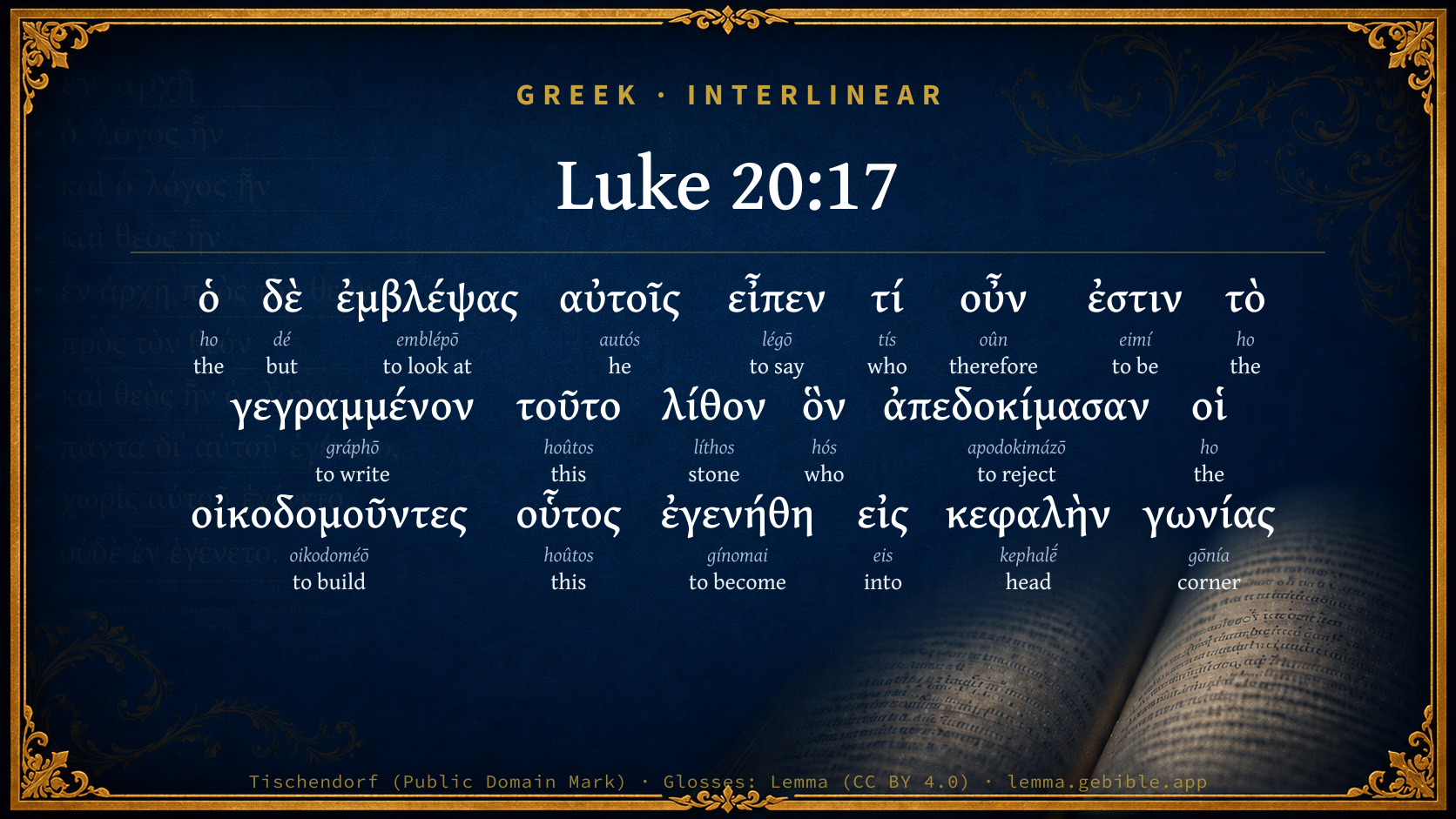
Greek (Tischendorf 8th ed.) Luke 20:17 appears in the Greek New Testament. The text above is from the Tischendorf 8th edition. Each word links to its Strong’s number and a concise gloss. Click any word for its full Thayer’s Greek Lexicon entry.
Download image
Cite this verse

Luke 20:17 (World English Bible). Public Domain. Lemma interlinear Bible study tool, https://lemma.gebible.app/v/luke/20/17.

Show BibTeX & RIS
BibTeX
RIS
English Translation
But he looked at them, and said, "Then what is this that is written, 'The stone which the builders rejected, The same was made the chief cornerstone?'
World English Bible · Public Domain
Download a study sheet

One document with this verse’s original text, its word-by-word gloss line, the meaning frame, cross-references with their text, attributed commentary, and full source and license credits — printable, and it pastes into notes with its structure intact.

This verse Autodidact and up

Study sheet (.html) Plain text (.txt)

A passage Seminary Student

Up to 50 verses in one chapter. A passage sheet keeps up to 6 commentary sources and 12 cross-references per verse, in the order this page ranks them, and says so on the sheet whenever that leaves anything out. Ask for a single verse and you get the Autodidact verse sheet above.

Everything on this page stays free to read, with no account — the sheet is a download of what is already on screen, not access to it.

Want to remove ads? Support Godless Engineer
Compare translations 3

The same verse in 3 English versions, stacked beneath the original-language interlinear above. Click any original word for its lexicon entry.

Each is an independent rendering of the whole verse — the interlinear is not word-aligned to these translations.

Highlighted words mark where these versions differ — a whole-verse word diff, not a word-by-word alignment.

  • World English Bible Public Domain
    But he looked at them, and said, "Then what is this that is written, 'The stone which the builders rejected, The same was made the chief cornerstone?'
  • King James Version Public Domain
    And he beheld them, and said, What is this then that is written, The stone which the builders rejected, the same is become the head of the corner?
  • unfoldingWord Literal Text CC BY-SA 4.0
    But he, having looked at them, said, “What then is this that is written: ‘A stone that the builders rejected, this has become the head of the corner’?

unfoldingWord Literal Text — © unfoldingWord, licensed CC BY-SA 4.0. Word-aligned USFM3 via Door43 (git.door43.org/unfoldingWord/en_ult).

Versions to compare (up to 4)

3 of 4 selected

Show all 19 translations

Every available English version of this verse, each an independent rendering of the whole verse.

  • World English Bible Public Domain
    But he looked at them, and said, "Then what is this that is written, 'The stone which the builders rejected, The same was made the chief cornerstone?'
  • Berean Standard Bible Public Domain
    But Jesus looked directly at them and said, “Then what is the meaning of that which is written: ‘The stone the builders rejected has become the cornerstone’?
  • Majority Standard Bible Public Domain
    But Jesus looked directly at them and said, “Then what is the meaning of that which is written: ‘The stone the builders rejected has become the cornerstone’?
  • King James Version Public Domain
    And he beheld them, and said, What is this then that is written, The stone which the builders rejected, the same is become the head of the corner?
  • American Standard Version (1901) Public Domain
    But he looked upon them, and said, What then is this that is written, The stone which the builders rejected, The same was made the head of the corner?
  • Revised Version (1885) Public Domain
    But he looked upon them, and said, What then is this that is written, The stone which the builders rejected, The same was made the head of the corner?
  • Geneva Bible (1599) Public Domain
    And he beheld them, and said, What meaneth this then that is written, The stone that the builders refused, that is made the head of the corner?
  • Douay-Rheims (1899) Public Domain
    But he looking on them, said: What is this then that is written, The stone, which the builders rejected, the same is become the head of the corner
  • Young's Literal Translation Public Domain
    and he, having looked upon them, said, `What, then, is this that hath been written: A stone that the builders rejected -- this became head of a corner?
  • Literal Standard Version CC BY-SA 4.0
    And He, having looked on them, said, “What, then, is this that has been written: A stone that the builders rejected—this became head of a corner?
  • Unlocked Literal Bible CC BY-SA 4.0
    But Jesus looked at them, and said, “What is the meaning of that which is written: 'The stone that the builders rejected has become the cornerstone'?
  • unfoldingWord Literal Text CC BY-SA 4.0
    But he, having looked at them, said, “What then is this that is written: ‘A stone that the builders rejected, this has become the head of the corner’?
  • Darby Bible Public Domain
    But he looking at them said, What then is this that is written, The stone which they that builded rejected, this has become the corner-stone?
  • World Messianic Bible Public Domain
    But he looked at them and said, “Then what is this that is written, ‘The stone which the builders rejected was made the chief cornerstone’?
  • Webster's Bible Public Domain
    And he beheld them, and said, What is this then that is written, The stone which the builders rejected, the same is become the head of the corner?
  • Free Bible Version CC BY-SA 4.0
    But Jesus looked at them and said, “Then why is it written in the Scriptures, ‘The stone the builders rejected has now become the chief cornerstone’?
  • Bible in Basic English Public Domain
    But he, looking on them, said, Is it not in the Writings, The stone which the builders put on one side, the same has become the chief stone of the building?
  • Text-Critical English NT CC BY 4.0
    But Jesus looked at them and said, “What then is the meaning of this Scripture: ‘The stone the builders rejected has become the cornerstone’?
  • Tyndale New Testament (1534) Public Domain
    And he behelde them and sayde: what meaneth this then that is wrytten: The stone that the bylders refused the same is made the heed corner stone?

Literal Standard Version (2020), Covenant Press — licensed CC BY-SA 4.0. Text via the HelloAO Bible API (eBible.org). Unlocked Literal Bible (unfoldingWord) — licensed CC BY-SA 4.0. Text via the HelloAO Bible API (eBible.org). unfoldingWord Literal Text — © unfoldingWord, licensed CC BY-SA 4.0. Word-aligned USFM3 via Door43 (git.door43.org/unfoldingWord/en_ult). Free Bible Version, Dr. Jonathan Gallagher — licensed CC BY-SA 4.0. Text via the HelloAO Bible API (eBible.org).

Word by word

More ways to search: Search by grammar → Find every occurrence → Compare this word →

Practice this passage: Drill this verse → Learn its vocabulary →

ἀπεδοκίμασαν
apodokimázō
G593
“to reject”
Verb, Aorist, Active, Indicative, 3rd person, Plural
Part of Speech
Verb
Tense
Aorist
Voice
Active
Mood
Indicative
Person
3rd person
Number
Plural
Full Thayer's Definition

Origin: from G575 and G1381

TDNT: 06:15,2

1. to disapprove, reject, repudiate
  1. ὁ ho G3588 “the” Article, Nominative, Singular, Masculine
  2. δὲ dé G1161 “but” Conjunction
  3. ἐμβλέψας emblépō G1689 “to look at” Verb, Aorist, Active, Participle, Nominative, Singular, Masculine
  4. αὐτοῖς autós G846 “he” Personal pronoun, Dative, Plural, Masculine
  5. εἶπεν légō G3004 “to say” Verb, Aorist, Active, Indicative, 3rd person, Singular
  6. τί tís G5101 “who” Interrogative pronoun, Nominative, Singular, Neuter
  7. οὖν oûn G3767 “therefore” Conjunction
  8. ἐστιν eimí G1510 “to be” Verb, Present, Active, Indicative, 3rd person, Singular
  9. τὸ ho G3588 “the” Article, Nominative, Singular, Neuter
  10. γεγραμμένον gráphō G1125 “to write” Verb, Perfect, Passive, Participle, Nominative, Singular, Neuter
  11. τοῦτο hoûtos G3778 “this” Demonstrative pronoun, Nominative, Singular, Neuter
  12. λίθον líthos G3037 “stone” Noun, Accusative, Singular, Masculine
  13. ὃν hós G3739 “who” Relative pronoun, Accusative, Singular, Masculine
  14. οἱ ho G3588 “the” Article, Nominative, Plural, Masculine
  15. οἰκοδομοῦντες oikodoméō G3618 “to build” Verb, Present, Active, Participle, Nominative, Plural, Masculine
  16. οὗτος hoûtos G3778 “this” Demonstrative pronoun, Nominative, Singular, Masculine
  17. ἐγενήθη gínomai G1096 “to become” Verb, Aorist, Passive deponent, Indicative, 3rd person, Singular
  18. εἰς eis G1519 “into” Preposition
  19. κεφαλὴν kephalḗ G2776 “head” Noun, Accusative, Singular, Feminine
  20. γωνίας gōnía G1137 “corner” Noun, Genitive, Singular, Feminine

About this verse

These counts appear in no published source. They are computed here, from the morphology-tagged text and Lemma’s own curated glosses. What Lemma adds →

21
words
18
distinct lemmas
Gospels
section

Notable vocabulary

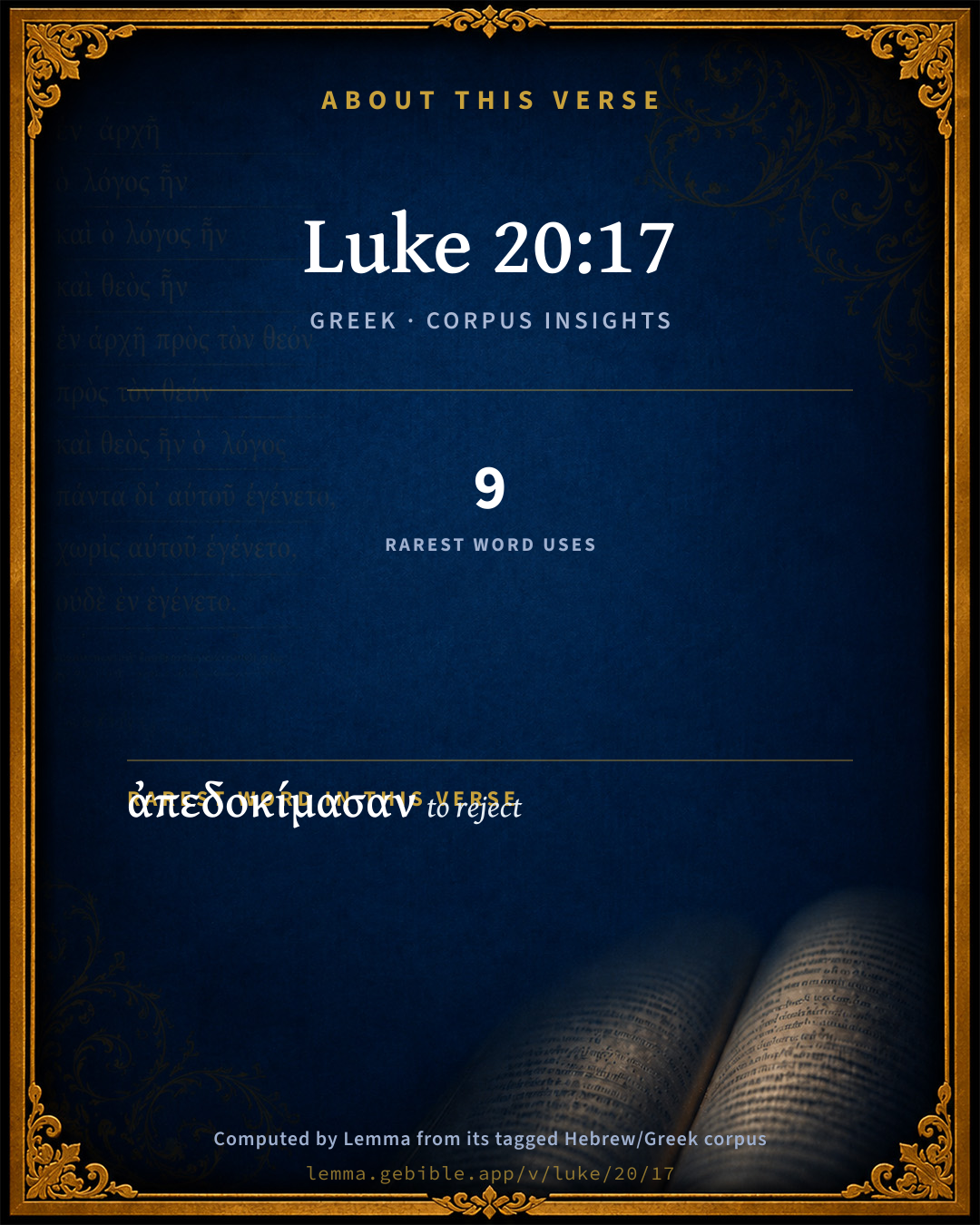
The rarest word here is ἀπεδοκίμασαν to reject G593 — appearing just 9 times in the whole Greek New Testament.

Shared distinctive vocabulary

ἀπεδοκίμασαν to reject G593 occurs in 9 verses of the Greek New Testament. Also found in:

Repetition

Words recur within this verse:

Cross-references

13

Topical passages linked to Luke 20:17 in the Treasury of Scripture Knowledge — connected by theme and wording, ordered by reader-vote popularity; previews shown in the World English Bible.

  • Psalms 118:22 The stone which the builders rejected has become the head of the corner.
  • Isaiah 28:16 therefore thus says the Lord Yahweh, Behold, I lay in Zion for a foundation a stone, a tried stone, a precious corner -[stone] of sure foundation: he who believes shall not be in haste.
  • Acts 4:11 He is 'the stone which was regarded as worthless by you, the builders, which has become the head of the corner.'
  • Matthew 21:42 Jesus said to them, "Did you never read in the Scriptures, 'The stone which the builders rejected, The same was made the head of the corner. This was from the Lord. It is marvelous in our eyes?'
  • Mark 12:10 Haven't you even read this Scripture: 'The stone which the builders rejected, The same was made the head of the corner.
  • 1 Peter 2:7–8 For you therefore who believe is the honor, but for such as are disobedient, "The stone which the builders rejected, Has become the chief cornerstone,"
  • Zechariah 3:9 For, behold, the stone that I have set before Joshua; on one stone are seven eyes: behold, I will engrave the engraving of it,' says Yahweh of Hosts, 'and I will remove the iniquity of that land in one day.
  • Mark 3:5 When he had looked around at them with anger, being grieved at the hardening of their hearts, he said to the man, "Stretch out your hand." He stretched it out, and his hand was restored as healthy as the other.
  • Mark 10:23 Jesus looked around, and said to his disciples, "How difficult it is for those who have riches to enter into the Kingdom of God!"
  • Luke 22:37 For I tell you that this which is written must still be fulfilled in me: 'He was counted with the lawless.' For that which concerns me has an end."
  • Luke 22:61 The Lord turned, and looked at Peter. Then Peter remembered the Lord's word, how he said to him, "Before the rooster crows you will deny me three times."
  • Luke 24:44 He said to them, "This is what I told you, while I was still with you, that all things which are written in the law of Moses, the prophets, and the psalms, concerning me must be fulfilled."
  • John 15:25 But this happened so that the word may be fulfilled which was written in their law, 'They hated me without a cause.'

Cross-references courtesy of OpenBible.info (CC BY 4.0).

Commentary

Notes on Luke 20:17 from classic Christian and Jewish commentators (each source and its license shown beneath its notes). The classic Christian expositions comment on the surrounding passage and are grouped to its opening verse, so a note may address several verses; the Jewish commentaries on the Tanakh (Rashi and others) are per-verse, so they appear only where the commentator wrote on this verse.

Lemma curates 59 commentaries, every one of them public domain or Creative Commons licensed, each selected and text-cleaned for this edition rather than reprinted as found. About our sources →

Tyndale Open Study Notes

Tyndale Open Resources

20:17 The stone . . . cornerstone: Jesus cited Ps 118:22 to predict his rejection and restoration. The cornerstone was the key part of a building, used to support and align adjoining walls. Jesus was rejected by the builders (the religious leaders), but he would become the foundation of a new building (the church).

Tyndale Open Study Notes — © Tyndale Open Resources, licensed CC BY-SA 4.0. Text via the HelloAO Bible API.

Bengel's Gnomon

Johann Albrecht Bengel

Luk 20:17. Ἐμβλέψας, having looked stedfastly upon them) in order to whet (stimulate) the attention of their minds respecting their own selves. The accent or tone, the gesture, and the expression of countenance, often render the force of the words more expressive.—γεγραμμένον, which is written) See Mat 21:42, note.

Bengel's Gnomon of the New Testament — English translation (T&T Clark, Edinburgh, 1860) — public domain. Text from a community e-Sword module.

Expositor's Greek Testament

ed. W. Robertson Nicoll

Luk 20:17-19 . ἐμβλέψας , looking intently, to give impressiveness to what He is going to say in reply. τί οὖν , etc., what then is (means) this Scripture? the οὖν implying that the words point to the very doom they deprecate. Yet the oracle does not directly indicate the fate of the builders, but rather the unexpected turn in the fortunes of the rejected and despised Stone. In Mt. and Mk. the citation is introduced, without any binding connection with what immediately goes before, to state a fact concerning the future of the “Son” lying outside the parable. They give the citation in full. Lk. omits the last clause: παρὰ κυρίου , etc.

The Expositor's Greek Testament, edited by W. Robertson Nicoll (1897–1910) — public domain. Text from a community e-Sword module.

Jamieson, Fausset & Brown

Robert Jamieson, A. R. Fausset & David Brown

written--(in Psa 118:22-23. See on Luk 19:38). The Kingdom of God is here a Temple, in the erection of which a certain stone, rejected as unsuitable by the spiritual builders, is, by the great Lord of the House, made the keystone of the whole. On that Stone the builders were now "falling" and being "broken" (Isa 8:15), "sustaining great spiritual hurt; but soon that Stone should fall upon them and grind them to powder" (Dan 2:34-35; Zac 12:3) --in their corporate capacity in the tremendous destruction of Jerusalem, but personally, as unbelievers, in a more awful sense still.

Jamieson, Fausset & Brown — Commentary Critical and Explanatory on the Whole Bible (1871) — public domain (CC PDM 1.0). Text via the HelloAO Bible API.

Ellicott's Commentary for English Readers

(17) And he beheld them.—Better, He looked on them. The Greek verb implies the gaze turned and fixed on its object, in addition to the mere act of beholding.

A Bible Commentary for English Readers, edited by Charles John Ellicott (1878–1897) — public domain. Text from a community e-Sword module.

The Cambridge Bible for Schools and Colleges

gen. ed. J. J. S. Perowne

17. he beheld them] Rather, looking fixedly on them, to add solemnity to His reference to their own Scriptures.

that is written] He here refers them to the very Psalm from which the Hosanna of the multitude had been taken.

The stone which the builders rejected] This is a quotation from Psa_118:22, comp. Isa_28:16. The stone is regarded both as a foundation-stone, and a stone at the angle of the building, binding the two walls together. These words made a deep impression on St Peter (1Pe_2:7-8).

The Cambridge Bible for Schools and Colleges (gen. ed. J. J. S. Perowne; Cambridge University Press, 1878–1918) — public domain. Text from a community e-Sword module.

John Gill's Exposition

And the chief priests, and the Scribes, that same hour,.... As soon as he had delivered the above parable, together with that of the two sons:

sought to lay hands on him; they had a good will to it, being exceedingly gravelled with the question he put to them concerning John's baptism, which confounded them, and put them to silence; and with the parables he delivered, in which they were so manifestly pointed at:

and they feared the people; lest they should rise and stone them, as in Luk 20:6 or rescue him out of their hands;

for they perceived that he had spoken this parable against them: and that they were the husbandmen that had used the servants of God so ill, and would put to death the son of God, the Messiah; and who would at length be destroyed themselves, and the kingdom of God be taken from them, though they seem to detest and deprecate it, saying in Luk 20:16 God forbid; that we should kill the heir, or that we should be destroyed, and the vineyard given to others: these things grievously nettled them, and exasperated them against him; but they knew not how to help themselves at present.

John Gill's Exposition of the Whole Bible (1746–1763) — public domain (CC PDM 1.0). Text via the HelloAO Bible API.

Trapp's Complete Commentary

John Trapp

17 And he beheld them, and said, What is this then that is written, The stone which the builders rejected, the same is become the head of the corner?

Ver. 17. What is this then that is written, &c.] q.d. If it be not so as I say, that you shall kill the Messiah, how is it that the Scripture saith as much? Press men with Scripture testimonies; that is the readiest way of sound conviction. It was a good speech of Augustine to Manichaeus, contesting with him for audience: Hear me, hear me, said the heretic. Nay, saith Augustine, Nec ego te, nec tu me, sed ambo audiamus apostolum dicentem, peccatum non cognovi, &c. It is not what I say, or what thou sayest, but what the Scripture saith, that we must stand to.

John Trapp, A Commentary or Exposition upon All the Books of the Old and New Testament (1647–1656) — public domain. Text from a community e-Sword module.

The Pulpit Commentary

Vers. 17, 18. And he beheld them, and said, What is this then thai; is written, The stone which the builders rejected, the same is become the head of the corner? Whosoever shall fall upon that stone shall be broken; but on whomsoever it shall fall, it will grind him to powder. In spite of the deprecating expression, the severity of the tone of Jesus increases in his next words, when, looking at them with grave anger (embleqav), he proceeds to speak of himself under the figure of the rejected stone. Quoting a well-known psalm, (Psa_118:22) and using the imagery of Isa_8:14, 15 and Dan_2:44, he describes his fortunes under the imago of a corner-stone that stone which forms the junction between the two most prominent walls of a building, and which is always laid with peculiar care and attention. In Luk_2:34 of our Gospel Simeon refers to the same well-known prophetic saying. The husbandmen who had just been described as vine-dressers are now described as builders, and the murdered son is reproduced under the image of a corner, stone tossed aside as useless. In the first part of the picture, the earthly humiliation of Messiah is portrayed when the stone is laid in the earth. In the second, the stone falling from the top of the building represents the crushing of all earthly opposition by Messiah in his glory. Woe to the builders, then, who had scornfully rejected him.

The rejection and exaltation of Christ.

We look at

I THE REJECTION OF JESUS CHRIST. Its strangeness.

1. From an evidential point of view. How came the builders to reject that valuable Stone? How was it that all the miracles of Jesus, so wonderful, so beneficent, so simple, and so credible as they were; that the life of Jesus, so holy and so beautiful, so gracious and so winning as it was; that the truth spoken by Jesus, so profound, so original, so lofty, so satisfying to the deepest wants of man as it was; how came it to pass that all this left him the "despised and rejected of men"?

2. From a providential point of view. How do we account for it that there should have been such a long and complicated preparation for the coming of the Messiah of the Jews, and of the Redeemer of mankind, and that he should fail to be recognized when he came? Does not all that Divine arrangement of Law and ritual and prophecy, of privilege and discipline, seem to have been attended with failure? Of what use was all that elaborate preparation, when the people of God rejected the Son of God? when he to whom everything pointed, and of whom everything foretold, was not welcomed and honored, but denounced as a deceiver and slain as a criminal?

II CONSIDERATIONS WHICH ACCOUNT FOR IT; or which, if they do not account for it, lessen our surprise concerning it.

1. As to the evidential difficulty. We need not wonder that the very strongest evidence failed to convince those who were unconvinced. What evidence can prevail against bigotry (or prejudice) and selfishness combined? Our knowledge and experience of mankind must have abundantly proved that either of these can repel the clearest and weightiest proofs; much more can both of them. And surely prejudice and self-interest never found a firmer seat than they found in the minds of the "chief priests and the scribes" who led the opposition to our Lord.

2. As to the providential difficulty. We must take into our consideration

(1) the fact that God"s dealings with our race include such apparent failures as this, and oblige us to wait the issue before we judge;

(2) the fact that the long preparation of Israel was by no means wholly an apparent failure. There is evidence of much fulfillment of prophecy; there is the valuable contribution of all that is contained in Old Testament Scripture, which is a rich and precious heritage to the human race; and there is, above all, the formation of a pure and reverent people, distinguished from and raised above all surrounding nations in the supreme element of moral character, which supplied the human material for the first great missionary epoch. Moreover, the very rejection of Jesus Christ has played to be the beginning and foundation of ultimate success, and of a success far deeper and larger than any contemporary and national triumph would have been. It has led up to

III HIS EXALTATION.

1. Notwithstanding his humiliation. That Stone was rejected indeed; that Teacher was silenced, that Prophet slain, that cause covered with infamy; those hopes, cherished by a few disciples, were laid in the tomb and covered from sight; yet, notwithstanding all that apparent defeat and discomfiture, that "Stone has become the Head of the corner," that Teacher the great Teacher of Divine wisdom, that Prophet the acknowledged Savior of mankind, that cause the kingdom of God upon earth.

2. It is the reward of his humiliation. Wherefore also God hath highly exalted him". (Php_2:6-11 Heb_2:9, Heb_2:10)

3. As the result of his humiliation. "I, if I be lifted up, will draw all men unto me." The cross has been the great loadstone which has been attracting the world. It is to a crucified Savior, once slain for our sins, dying in mercy toward our race, that we are drawn in faith and love. It is he "who loved us, and gave himself for us" unto such shame and sorrow and death it is he whom we rejoice to make the Friend of our heart and the Sovereign of our life.

4. Learn the place of privilege. It is well for us that we stand where we do stand at a point in time where we can recognize the Corner-stone. The mountain is best seen afar off, the city or the sea is best seen from above, the character of the generation is best understood after some interval of time. We know Jesus Christ better than we should have done had we lived when he was the Stone rejected of the builders. We could not be better placed than we are by the providence of God for understanding him and rejoicing in his worth.

5. Know the day of opportunity. Recognizing the true character of that once-slighted "Stone," knowing Jesus Christ as we know him now, it is for us to accept him without delay as our personal Redeemer, and to commend him, with all devotedness, to the estimation and trust of all beholders. C.

The Pulpit Commentary (1880–1919), ed. H.D.M. Spence-Jones & Joseph S. Exell — public domain. Text from a community e-Sword module.

John Wesley's Explanatory Notes

He looked on them - To sharpen their attention. Psalm cxviii, 22.

John Wesley, Explanatory Notes Upon the Whole Bible (1754–1765) — public domain. Text via the GEBible commentary corpus.

Scofield Reference Notes

C. I. Scofield

stone

See Psa 118:22; Psa 118:23. (See Scofield "Mat 21:44").

The Scofield Reference Bible (1917 edition), notes by C. I. Scofield — public domain. Text from a community e-Sword module.

unfoldingWord translationNotes

Door43 World Missions Community

Connecting Statement:

Jesus continues teaching the crowd.

But Jesus looked at them

"But Jesus stared at them" or "But he looked straight at them." He did this to hold them accountable to understand what he was saying.

What is the meaning of that which is written: 'The stone ... cornerstone'?

Jesus uses a question to teach the crowd. AT: "You should be able to understand that which is written: 'The stone ... cornerstone.'" (See: Rhetorical Question)

that which is written

"this scripture"

The stone that the builders rejected has become the cornerstone

This is the first of three metaphors in a prophecy from the book of Psalms. This one refers to the Messiah as if he were a stone that builders chose not to use, but that God made the most important stone. (See: Metaphor)

The stone that the builders rejected

"The stone that the builders said was not good enough to use for building." In those days people used stones to build the walls of houses and other buildings.

the builders

This refers to the religious rulers who are rejecting Jesus as Messiah.

the cornerstone

"the chief stone of the building" or "the most important stone of the building"

Every one who falls ... broken to pieces

This second metaphor speaks of people who reject the Messiah as if they fall over a stone and are injured. (See: Metaphor)

will be broken to pieces

This is a result of falling onto the stone. It can be stated in active form. AT: "will break up into pieces" (See: Active or Passive)

But on whomever it falls

"But whomever that stone falls on." This third metaphor speaks about the Messiah judging those who reject him as if he were a large stone that would crush them. (See: Metaphor)

translationWords

word of God

reject

cornerstone

unfoldingWord translationNotes — © Distant Shores Media and the Door43 World Missions Community, licensed CC BY-SA 4.0. Source: git.door43.org/Door43/en_tn.

Cambridge Greek Testament for Schools and Colleges

17. ἐμβλέψας αὐτοῖς. ‘Looking fixedly on them,’ to add solemnity to His reference to their own Scriptures.

τὸ γεγραμμένον. He here refers them to the very Psalm from which the Hosanna of the multitude had been taken.

λίθον ὃν ἀπεδοκίμασαν οἱ οἰκοδομοῦντες. This is a quotation from Psa 118:22; comp. Isa 28:16. The stone is regarded both as a foundation-stone, and a stone at the angle of the building, binding the two walls together. These words made a deep impression on St Peter (1Pe 2:7-8).

ἐγενήθη. ‘Was made.’ The choice of the corner-stone is past and irrevocable.

Cambridge Greek Testament for Schools and Colleges (Cambridge University Press, 1896; 21 vols, various authors incl. Carr, Maclear, Plummer, Farrar, Lumby, Moule, M. R. James, Simcox) — public domain. Text from a community e-Sword module.

Alford’s Greek Testament

Henry Alford

17.] The οὖν infers the negation of μὴ γένοιτο—‘How then, supposing your wish to be fulfilled, could this which is written come to pass?’

Henry Alford, The Greek Testament (1849–1861) — public domain. Text from a community e-Sword module.

International Critical Commentary

17. ἐμβλψας αὐτοῖς. Lk. alone has this touch. Comp, 22:61 and Elisha’s fixed look on Hazael (2Ki 8:11).

Τί οὖν ἐστίν. “If the destruction which I have just foretold is not to come (μὴ γένοιτο), how then do you explain this text?” The passage is once more (see on ver. 9) from the Hallel Psalms (118:22, 23), where see Perowne. The Rabbis recognized it as Messianic: see Schoettg. 1. p. 173. In all three Gospels the quotation is verbatim as in LXX. For τὸ γεγραμμένον see on 22:37, and for ἀπεδοκίμασαν see on 9:22. Perhaps λίθον is “a stone” rather than “the stone”: the builders may have rejected many stones, one of which became κεφαλὴ γωνίας. But, if the Jews used Λίος as a name for the Messiah, as seems to be probable, “the stone” is better. In Justin Martyr we have Λίθος as a name for Christ (Try. xxiv:xxxvi.): see on Rom 9:33.

For the attraction of λίθον to ὄν see on 3:19, and for ἐγενήθη εἰς see on 13:19.

κεφαλὴ γωνίας . Not the key-stone of the arch, but a cornerstone uniting two walls; but whether a foundation-stone at the base of the corner, or a completing stone at the top of it, is uncertain. Comp. Act 4:11 and 1Pe 2:7; also ἀκρογωνιαῖος in Eph 2:20 and Isa 28:16. Mt. and Mk. quote ver. 23 of Psa 118. as well as ver. 22, and Mt. adds the explanation that the Kingdom shall be transferred to a nation bringing forth the fruits thereof. Would Lk. have omitted this reference to the believing and loyal Gentiles if he had known it? We conclude that he was not familiar with Mt.’s account. See on 19:46.

International Critical Commentary — older volumes (1896–1929), various authors — public domain. Text from a community e-Sword module.

Vincent's Word Studies in the New Testament

Marvin R. Vincent

The stone, etc. See on 1Pe 2:4 - 7.

Marvin R. Vincent, Word Studies in the New Testament (1887–1900) — public domain. Text from a community e-Sword/MySword module.

Lesson kit

Teaching starters — assembled from the data on this page, not authored interpretation. Every prompt links to the verse data it draws on. Edit before teaching.

Luke, in the Gospels, opens this verse with 21 words (18 distinct Greek lemmas). Its most distinctive word is apodokimázō (“to reject”). A historical commentator’s framing appears above. Read the whole chapter for the surrounding context.

Discussion questions

  1. What does “to reject” (apodokimázō) contribute to the verse as a whole?
  2. How does Matthew 21:42, which shares the word «to reject», read alongside this verse?
  3. What does the repetition of “the” (3× in this one verse) do in this verse?
  4. These translations render this verse differently; the difference is in the English rendering, not the original. What questions does that raise?
  5. Compare how Tyndale Open Study Notes and Bengel's Gnomon read this verse. Where do they agree or differ?

Things to notice

Reading settings

Reading text

Shown beneath each verse's original-language words.

Old Testament
Old Testament edition

Read the OT as the Masoretic Hebrew (MT) or the Greek Septuagint (LXX).

English shown for the Greek Septuagint (in the Hebrew ↔ Greek comparison).

Comparing translations? Open the Compare panel on any verse page to stack up to four side by side.