
Luke 17:6

Greek (Tischendorf 8th ed.) Luke 17:6 appears in the Greek New Testament. The text above is from the Tischendorf 8th edition. Each word links to its Strong’s number and a concise gloss. Click any word for its full Thayer’s Greek Lexicon entry.
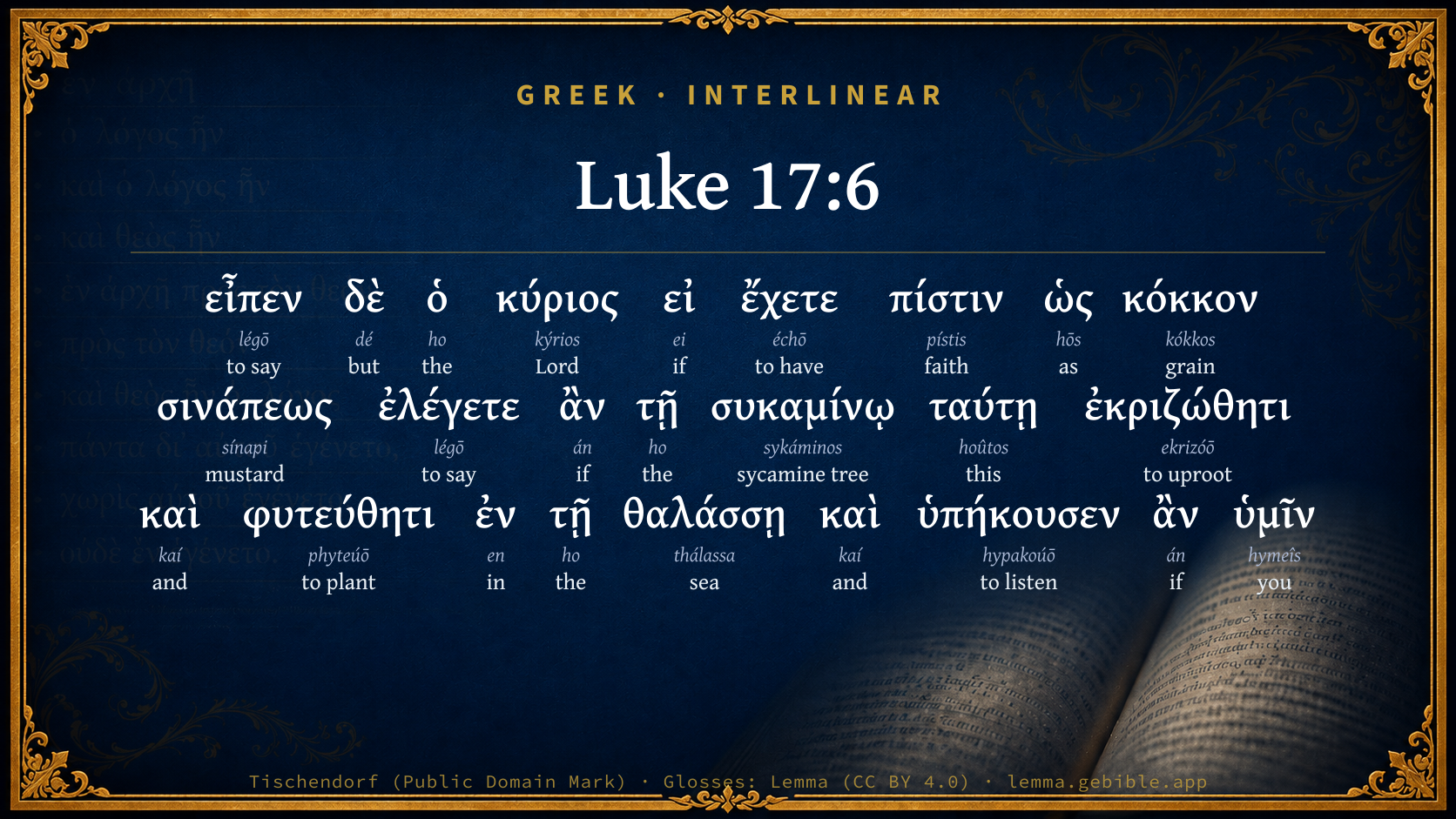
Download image
Cite this verse

Luke 17:6 (World English Bible). Public Domain. Lemma interlinear Bible study tool, https://lemma.gebible.app/v/luke/17/6.

Show BibTeX & RIS
BibTeX
RIS
English Translation
The Lord said, "If you had faith like a grain of mustard seed, you would tell this sycamore tree, 'Be uprooted, and be planted in the sea,' and it would obey you.
World English Bible · Public Domain
Highlights
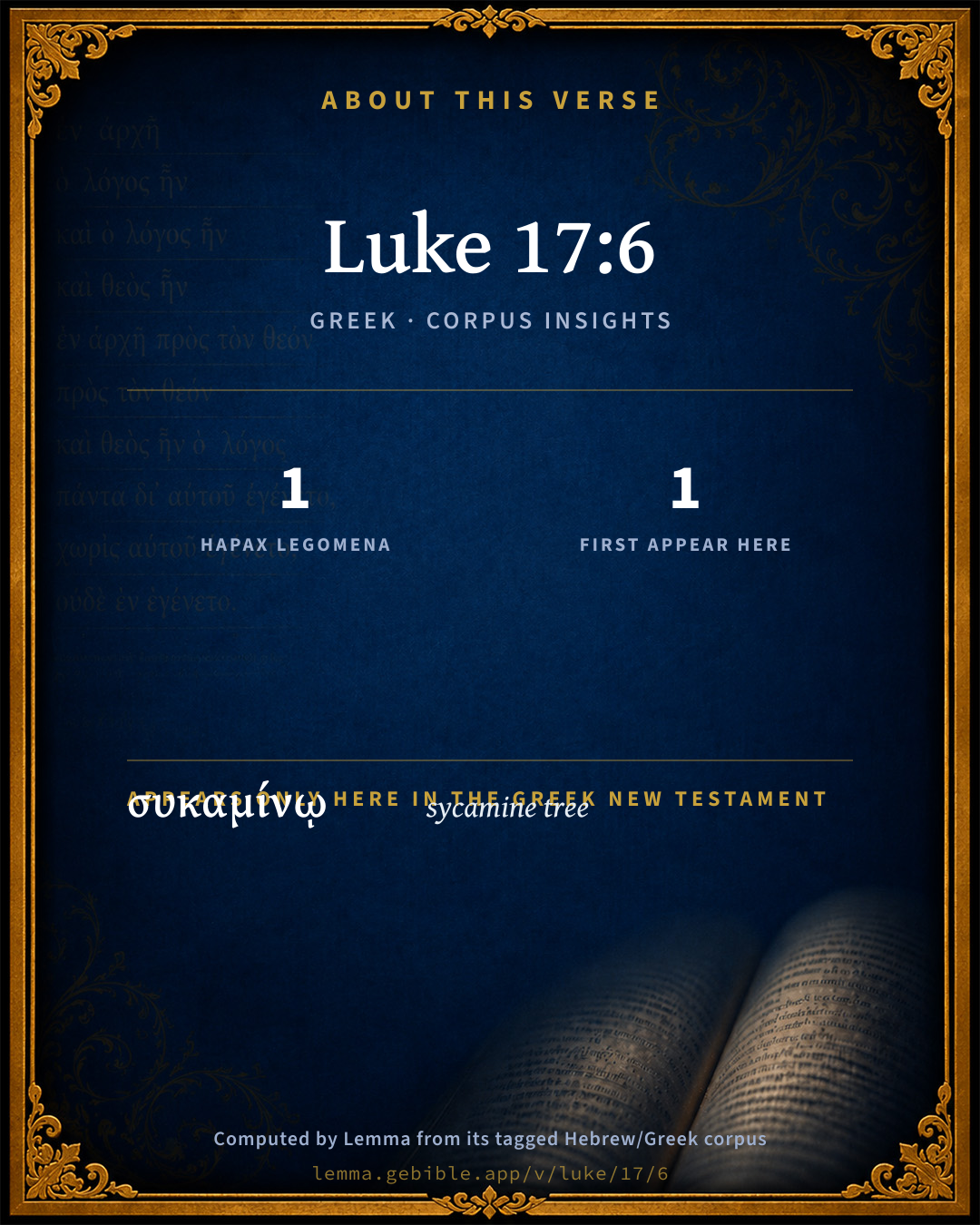
  • 1 hapax legomenon — only here in the Greek New Testament
  • 1 first appearance in the Greek New Testament
Full analysis ↓
Download a study sheet

One document with this verse’s original text, its word-by-word gloss line, the meaning frame, cross-references with their text, attributed commentary, and full source and license credits — printable, and it pastes into notes with its structure intact.

This verse Autodidact and up

Study sheet (.html) Plain text (.txt)

A passage Seminary Student

Up to 50 verses in one chapter. A passage sheet keeps up to 6 commentary sources and 12 cross-references per verse, in the order this page ranks them, and says so on the sheet whenever that leaves anything out. Ask for a single verse and you get the Autodidact verse sheet above.

Everything on this page stays free to read, with no account — the sheet is a download of what is already on screen, not access to it.

Want to remove ads? Support Godless Engineer
Compare translations 3

The same verse in 3 English versions, stacked beneath the original-language interlinear above. Click any original word for its lexicon entry.

Each is an independent rendering of the whole verse — the interlinear is not word-aligned to these translations.

Highlighted words mark where these versions differ — a whole-verse word diff, not a word-by-word alignment.

  • World English Bible Public Domain
    The Lord said, "If you had faith like a grain of mustard seed, you would tell this sycamore tree, 'Be uprooted, and be planted in the sea,' and it would obey you.
  • King James Version Public Domain
    And the Lord said, If ye had faith as a grain of mustard seed, ye might say unto this sycamine tree, Be thou plucked up by the root, and be thou planted in the sea; and it should obey you.
  • unfoldingWord Literal Text CC BY-SA 4.0
    So the Lord said, “If you had faith like a mustard seed, you would say to this mulberry tree, ‘Be uprooted, and be planted in the sea,’ and it would listen to you.

unfoldingWord Literal Text — © unfoldingWord, licensed CC BY-SA 4.0. Word-aligned USFM3 via Door43 (git.door43.org/unfoldingWord/en_ult).

Versions to compare (up to 4)

3 of 4 selected

Show all 19 translations

Every available English version of this verse, each an independent rendering of the whole verse.

  • World English Bible Public Domain
    The Lord said, "If you had faith like a grain of mustard seed, you would tell this sycamore tree, 'Be uprooted, and be planted in the sea,' and it would obey you.
  • Berean Standard Bible Public Domain
    And the Lord answered, “If you have faith the size of a mustard seed, you can say to this mulberry tree, ‘Be uprooted and planted in the sea,’ and it will obey you.
  • Majority Standard Bible Public Domain
    And the Lord answered, “If you have faith the size of a mustard seed, you can say to this mulberry tree, ‘Be uprooted and planted in the sea,’ and it will obey you.
  • King James Version Public Domain
    And the Lord said, If ye had faith as a grain of mustard seed, ye might say unto this sycamine tree, Be thou plucked up by the root, and be thou planted in the sea; and it should obey you.
  • American Standard Version (1901) Public Domain
    And the Lord said, If ye had faith as a grain of mustard seed, ye would say unto this sycamine tree, Be thou rooted up, and be thou planted in the sea; and it would obey you.
  • Revised Version (1885) Public Domain
    And the Lord said, If ye have faith as a grain of mustard seed, ye would say unto this sycamine tree, Be thou rooted up, and be thou planted in the sea; and it would have obeyed you.
  • Geneva Bible (1599) Public Domain
    And the Lord said, If ye had faith, as much as is a graine of mustard seede, and should say vnto this mulberie tree, Plucke thy selfe vp by the rootes, and plant thy selfe in the sea, it should euen obey you.
  • Douay-Rheims (1899) Public Domain
    And the Lord said: If you had faith like to a grain of mustard seed, you might say to this mulberry tree, Be thou rooted up, and be thou transplanted into the sea: and it would obey you.
  • Young's Literal Translation Public Domain
    and the Lord said, `If ye had faith as a grain of mustard, ye would have said to this sycamine, Be uprooted, and be planted in the sea, and it would have obeyed you.
  • Literal Standard Version CC BY-SA 4.0
    and the LORD said, “If you had faith as a grain of mustard, you would have said to this sycamine, Be uprooted, and be planted in the sea, and it would have obeyed you.
  • Unlocked Literal Bible CC BY-SA 4.0
    The Lord said, “If you had faith like a mustard seed, you would say to this mulberry tree, 'Be uprooted, and be planted in the sea,' and it would obey you.
  • unfoldingWord Literal Text CC BY-SA 4.0
    So the Lord said, “If you had faith like a mustard seed, you would say to this mulberry tree, ‘Be uprooted, and be planted in the sea,’ and it would listen to you.
  • Darby Bible Public Domain
    But the Lord said, If ye have faith as a grain of mustard [seed], ye had said to this sycamine tree, Be thou rooted up, and be thou planted in the sea, and it would have obeyed you.
  • World Messianic Bible Public Domain
    The Lord said, “If you had faith like a grain of mustard seed, you would tell this sycamore tree, ‘Be uprooted and be planted in the sea,’ and it would obey you.
  • Webster's Bible Public Domain
    And the Lord said, If ye had faith as a grain of mustard-seed, ye might say to this sycamine-tree, Be thou plucked up by the root, and be thou planted in the sea; and it would obey you.
  • Free Bible Version CC BY-SA 4.0
    The Lord replied, “Even if your trust was as small as a mustard seed, you could say to this mulberry tree, ‘Uproot yourself, and plant yourself in the sea,’ and it would obey you.
  • Bible in Basic English Public Domain
    And the Lord said, If your faith was only as great as a grain of mustard seed, you might say to this tree, Be rooted up and planted in the sea; and it would be done.
  • Text-Critical English NT CC BY 4.0
    The Lord said, “If you had faith like a grain of mustard seed, you could say to this mulberry tree, ‘Be uprooted and planted in the sea,’ and it would obey you.
  • Tyndale New Testament (1534) Public Domain
    And the Lorde sayde: yf ye had faith lyke a grayne of mustard sede and shuld saye vnto this sycamine tree plucke thy selfe vp by the rootes and plant thy selfe in the see: he should obey you.

Literal Standard Version (2020), Covenant Press — licensed CC BY-SA 4.0. Text via the HelloAO Bible API (eBible.org). Unlocked Literal Bible (unfoldingWord) — licensed CC BY-SA 4.0. Text via the HelloAO Bible API (eBible.org). unfoldingWord Literal Text — © unfoldingWord, licensed CC BY-SA 4.0. Word-aligned USFM3 via Door43 (git.door43.org/unfoldingWord/en_ult). Free Bible Version, Dr. Jonathan Gallagher — licensed CC BY-SA 4.0. Text via the HelloAO Bible API (eBible.org).

Word by word

More ways to search: Search by grammar → Find every occurrence → Compare this word →

Practice this passage: Drill this verse → Learn its vocabulary →

συκαμίνῳ
sykáminos
G4807
“sycamine tree”
Adjective, Dative, Singular, Masculine
Part of Speech
Adjective
Case
Dative
Number
Singular
Gender
Masculine
Full Thayer's Definition

Origin: of hebrew origin H8256 in imitation of G4809

TDNT: 19:38,1

1. sycamine tree, having the form and foliage of the mulberry, but fruit resembling the fig
  1. εἶπεν légō G3004 “to say” Verb, Aorist, Active, Indicative, 3rd person, Singular
  2. δὲ dé G1161 “but” Conjunction
  3. ὁ ho G3588 “the” Article, Nominative, Singular, Masculine
  4. κύριος kýrios G2962 “Lord” Noun, Nominative, Singular, Masculine
  5. εἰ ei G1487 “if” Conditional
  6. ἔχετε échō G2192 “to have” Verb, Present, Active, Indicative, 2nd person, Plural
  7. πίστιν pístis G4102 “faith” Noun, Accusative, Singular, Feminine
  8. ὡς hōs G5613 “as” Adverb
  9. κόκκον kókkos G2848 “grain” Noun, Accusative, Singular, Masculine
  10. σινάπεως sínapi G4615 “mustard” Noun, Genitive, Singular, Neuter
  11. ἐλέγετε légō G3004 “to say” Verb, Imperfect, Active, Indicative, 2nd person, Plural
  12. ἂν án G302 “if” Particle
  13. τῇ ho G3588 “the” Article, Dative, Singular, Feminine
  14. ταύτῃ hoûtos G3778 “this” Demonstrative pronoun, Dative, Singular, Feminine
  15. ἐκριζώθητι ekrizóō G1610 “to uproot” Verb, Aorist, Passive, Imperative, 2nd person, Singular
  16. καὶ kaí G2532 “and” Conjunction
  17. φυτεύθητι phyteúō G5452 “to plant” Verb, Aorist, Passive, Imperative, 2nd person, Singular
  18. ἐν en G1722 “in” Preposition
  19. τῇ ho G3588 “the” Article, Dative, Singular, Feminine
  20. θαλάσσῃ thálassa G2281 “sea” Noun, Dative, Singular, Feminine
  21. καὶ kaí G2532 “and” Conjunction
  22. ὑπήκουσεν hypakoúō G5219 “to listen” Verb, Aorist, Active, Indicative, 3rd person, Singular
  23. ἂν án G302 “if” Particle
  24. ὑμῖν hymeîs G5210 “you” Personal pronoun, 2nd person, Dative, Plural

About this verse

These counts appear in no published source. They are computed here, from the morphology-tagged text and Lemma’s own curated glosses. What Lemma adds →

25
words
20
distinct lemmas
Gospels
section

Notable vocabulary

1 hapax legomenon — a word that appears only here in the entire Greek New Testament:

  • συκαμίνῳ sycamine tree G4807

First appearance in Scripture

This word makes its first canonical appearance in the Greek New Testament here:

  • συκαμίνῳ sycamine tree G4807

Shared distinctive vocabulary

ἐκριζώθητι to uproot G1610 occurs in 4 verses of the Greek New Testament. Also found in:
Repetition

Words recur within this verse:

Cross-references

8

Topical passages linked to Luke 17:6 in the Treasury of Scripture Knowledge — connected by theme and wording, ordered by reader-vote popularity; previews shown in the World English Bible.

  • Matthew 17:20 He said to them, "Because of your unbelief. For most assuredly I tell you, if you have faith as a grain of mustard seed, you will tell this mountain, 'Move from here to there,' and it will move; and nothing will be impossible for you.
  • Matthew 21:21 Jesus answered them, "Most assuredly I tell you, if you have faith, and don't doubt, you will not only do what is done to the fig tree, but even if you told this mountain, 'Be taken up and cast into the sea,' it would be done.
  • Mark 9:23 Jesus said to him, "If you can believe, all things are possible to him who believes."
  • Matthew 13:31–32 He set another parable before them, saying, "The Kingdom of Heaven is like a grain of mustard seed, which a man took, and sowed in his field;
  • Mark 11:22–23 Jesus answered them, "Have faith in God.
  • Luke 13:19 It is like a grain of mustard seed, which a man took, and put in his own garden. It grew, and became a large tree, and the birds of the sky lodged in its branches."
  • 1 Corinthians 13:2 If I have the gift of prophecy, and know all mysteries and all knowledge; and if I have all faith, so as to remove mountains, but don't have love, I am nothing.
  • Luke 19:4 He ran on ahead, and climbed up into a sycamore tree to see him, for he was to pass that way.

Cross-references courtesy of OpenBible.info (CC BY 4.0).

Commentary

Notes on Luke 17:6 from classic Christian and Jewish commentators (each source and its license shown beneath its notes). The classic Christian expositions comment on the surrounding passage and are grouped to its opening verse, so a note may address several verses; the Jewish commentaries on the Tanakh (Rashi and others) are per-verse, so they appear only where the commentator wrote on this verse.

Lemma curates 59 commentaries, every one of them public domain or Creative Commons licensed, each selected and text-cleaned for this edition rather than reprinted as found. About our sources →

The Biblical Illustrator

Joseph S. Exell

Luk_17:6

Faith as a grain of mustard seed

The force of faith

We must not imagine that these words give any encouragement to an idle and childish expectation of any startling and ostentatious outcome of a true faith in Jesus Christ; as though Gods grace could ever be used to win for any one the wonder and admiration of His fellow-men, or displayed in any abrupt and fruitless miracle, for our excitement or aggrandizement.

It is a far higher and nobler power which is really promised by our Lord even to the least measure of true faith in Him: a power which is far more fruitful and more mysterious than the mere working of a wonder which would only be like a conjuring trick on a large scale. For what He really here teaches us, as though in a short and vivid parable, is this: that since His coming upon earth, there is a new kind of force astir in the history and in the souls of men--a force which in the speed and certainty of its action can surpass all the ordinary means by which men scheme and work--a force which is effective far beyond all likelihood that we can see in it, so that even its least germ is able to achieve results of inconceivable difficulty and greatness: and for the secret, the character, of this new force He points us to the one spring and motive of the Christian life--to faith. Now, before we leave the outward form in which this truth is taught us, let us notice one point in it: that it is to a seed that our Lord compares the beginning of faith in a mans heart: to a grain of mustard seed: which indeed is the least of all seeds: but when it is grown it is the greatest amongst herbs, and becometh a tree, etc. He seems thus to teach us that all true faith is ever and everywhere growing: not a dead, self-contained thing, but a seed, filled with an almost infinite power of growth in strength and range and beauty. However poor and mean and worthless it may seem, there is that in it which will in due time and with due care force its way into the light and strive towards heaven itself, till the little speck of hope becomes a branching, fruitful wealth of life and beauty, a resting-place and shelter for those who hover round its boughs and find refreshment and protection in its gentle strength. Now I ask you to consider whether we ever meet with any character which does thus seem to escape from the ordinary restrictions of cause and effect: to exert a force far beyond all the likelihood that we can discover: and to achieve results which sober and practical men would never have expected from it? Is there any temper of mind and will which makes a way through insuperable obstacles, and forces mountainous difficulties to yield it service and obedience? Well, in the first place, do we not see a strange foreshadowing of such supernatural effectiveness, and a wonderful contrast between what might reasonably have been looked for and what is actually achieved, in the life and work of men who have a large degree of faith in themselves? Do we not see in what we know of history and politics, and in our own experience too, that the men who do great deeds, who leave a mark behind them, who bend stubborn circumstances to their will, who influence other men (bearing into their hearts the passions or the policy which they have themselves conceived), are always the men who have a firm faith in their own judgment, and a resolute conviction that they will achieve what they have set themselves to do: so that they are not always explaining and apologizing and qualifying and standing on the defensive, but rather going straight forward and fearlessly calling upon others to follow them? But, secondly, there is a nearer reflection of that which the text means, and a higher and more mysterious efficacy, in the power which some can wield by faith in their fellow-men. I trust we all know something of the strange influence by which some men seem able to discover and draw out and strengthen all that is good and hopeful in those with whom they have to do. The change which is wrought by one who meets his fellows with a simple, earnest trust and hope is just the contrary of that miserable atmosphere of dingy mist and cold in which a cynic lives and thinks and acts: distrusting and depreciating others till they cease to show him anything but those meaner, harsher elements in their character which he seems resolute and glad to find. There can hardly be a happier or more fruitful and wonderworking life than his in whose company men are always stirred to brightness and unselfishness just because he always believes that they are purer and better than they are: by whose trustful expectation they are reminded of what they once desired and hoped to be, so that the long-forgotten ideal seems again to come within their reach, and they live, if only for a while, by a light which they never thought to see again. For thus this quickening and enlightening power of faith in our fellow-men changes the whole air and aspect of a life: and he who is thus trustful and hopeful draws out in one man the timid and hidden germ of good, and engenders in another the grace and warmth which his faith presumes; and the dullest heart is startled into sympathy with the charity which believeth all things, and hopeth all things: so that everywhere this faith is greeted by the brightness which itself calls out, as the sun is welcomed by the glad colours which sleep until he comes. (F. Paget, D.D.)

The Biblical Illustrator, edited by Joseph S. Exell (c. 1880s–1900s) — public domain. Text from a community e-Sword module.

Tyndale Open Study Notes

Tyndale Open Resources

17:6 A mustard seed was proverbial for something very small (see 13:19). • you could say to this mulberry tree, ‘May you be uprooted’: Black mulberry trees can live for hundreds of years and have a vast root system, making them very difficult to uproot. • it would obey you: This is not a call to use faith for arbitrary miracles. God has unlimited power, and those who trust in him will see him use it.

Tyndale Open Study Notes — © Tyndale Open Resources, licensed CC BY-SA 4.0. Text via the HelloAO Bible API.

Bengel's Gnomon

Johann Albrecht Bengel

Luk 17:6. Εἰ) if) This IF itself sharpens the energies of minds striving after faith, and enlarges their powers so as to reach it. [By the very fact of setting forth the efficacy of faith, faith itself is increased.—V. g.]—συκαμίνῳ) שקמים, which the LXX. render συκάμινοι. The morus or mulberry tree, a tree often met in Palestine. See 1Ki 10:27. Sometimes the συκομορέα is distinguished from it. See ch. Luk 19:4. See the lexicographers, and Bexa, on this passage. The wild fig-tree is a tree most deeply rooted.[180]—φυτεύθητι, be thou planted) with thy roots, so as to remain in the sea. It is a similar effect to this which is produced on believers themselves.—ἐν τῇ θαλάσσῃ, in the sea) They were at the time near the sea; comp. Mat 17:20; Mat 17:27.—ὑπήκουσεν ἂν, it would obey you) Metaphysicians term it the obediential power. The recognition of the Divine omnipotence, which faith apprehends, increases faith.

[180] The συκάμινος is the mulberry tree, Lat. morus, black and white, Theophr. Caus. Pl. Luk 6:6; Luk 6:4. Συκόμορος or συκομορέα is the fig-mulberry, Th. σῦκον μόρον; an Egyptian kind that bears its fruit on the branches, and has leaves like the white mulberry. Ficus sycomorus, Linnæus.—E. and T.

Bengel's Gnomon of the New Testament — English translation (T&T Clark, Edinburgh, 1860) — public domain. Text from a community e-Sword module.

Expositor's Greek Testament

ed. W. Robertson Nicoll

Luk 17:6 . εἰ ἔχετε . εἰ with pres. in protasis, the imperf. in apodosis with ἄν . Possession of faith already sufficient to work miracles is here admitted. In Mt. the emphasis lies on the want of such faith. Another instance of Lk.’s desire to spare the Twelve. συκαμίνῳ , here only in N.T. = συκομορέα , Luk 19:4 , the fig mulberry tree ( vide there). A tree here, a mountain in Mt.; and the miraculous feat is not rooting it out of the earth but replanting it in the sea a natural impossibility. Pricaeus cites a classic parallel: τὸ πέλαγος πρότερον οἴσει ἄμπελον .

The Expositor's Greek Testament, edited by W. Robertson Nicoll (1897–1910) — public domain. Text from a community e-Sword module.

Geneva Bible (1599)

Geneva Bible translators

If you had no more faith, but the quantity of the grain of mustard seed.

Geneva Bible (1599) marginal notes — public domain. Text via Bolls.life.

Jamieson, Fausset & Brown

Robert Jamieson, A. R. Fausset & David Brown

sycamine--mulberry. (See on Mar 11:22-24.)

Jamieson, Fausset & Brown — Commentary Critical and Explanatory on the Whole Bible (1871) — public domain (CC PDM 1.0). Text via the HelloAO Bible API.

Adam Clarke's Commentary

Verse 6. As a grain of mustard seed] A faith that increases and thrives as that is described to do, Mt 13:32, where see the note. See also Mt 17:20.

This sycamine] The words seem to intimate that they were standing by such a tree. The sycamine is probably the same as the sycamore. Sycamore with us, says Mr. Evelyn, is falsely so called, being our acer majus, greater maple. The true sycamore is the ficus Pharaonis or AEgyptia, Pharaoh's, or Egyptian fig-tree; called also, from its similitude in leaves and fruit, morosyous, or mulberry fig-tree. The Arabians call it guimez: it grows in Cyprus, Caria, Rhodes, and in Judea and Galilee, where our Lord at this time was: see Lu 17:11. St. Jerome, who was well acquainted with these countries, translates the word mulberry-tree.

Be thou plucked up by the root] See Clarke on Mt 21:21, where it is shown that this mode of speech refers to the accomplishment of things very difficult, but not impossible.

Adam Clarke's Commentary on the Bible (1810–1826) — public domain. Text from a community e-Sword/MySword module.

Ellicott's Commentary for English Readers

(6) If ye had faith as a grain of mustard seed.—The words remind us, and must have reminded the disciples, of those of Mat_17:20, which were called forth by the failure of the disciples to heal the demoniac boy after the Transfiguration. The “sycamine tree” (probably not the same as the “sycamore,” but identified by most botanists with the mulberry tree, still cultivated on the slopes of the Lebanon and in the neighbourhood of Jerusalem and Nablous, both for its fruit and as supplying food for silkworms) takes the place of “this mountain,” sc. Hermon, as an illustration of what true faith could do. If we suppose the conversation to have taken place near the Sea of Galilee, both features of the comparison gain a local vividness. It is remarkable that our Lord meets the prayer with what sounds like a reproof; and such a reproof, we must believe, was needed. The most elementary faith would have been enough to teach them (assuming the connection that has been traced above) that God is love, and that He would help them to overcome all hindrances to their love being after the pattern of His own. There was something, it may be, false in the ring of that prayer, an unreal diffidence asking for that as a gift which really comes only through active obedience and the experience which is gained through it.

A Bible Commentary for English Readers, edited by Charles John Ellicott (1878–1897) — public domain. Text from a community e-Sword module.

The Cambridge Bible for Schools and Colleges

gen. ed. J. J. S. Perowne

6. as a grain of mustard seed] “which is the least of all seeds,” Mat_13:32.

unto this sycamine tree] The ‘this: is interesting because it shews that our Lord was teaching in the open air, and pointed to the tree as He spoke. The sycamine (Hebr. shikmah, 1Ch_27:28) seems to be a generic name for various kinds of mulberries (e.g. the Morus alba and nigra), which were freely cultivated in the East. The black mulberry is still called sycamenea in Greece (see Luk_19:4). In Mat_17:20 we have a similar passage with the variation of “this mountain,” which our Lord doubtless spoke pointing to Mount Hermon. The Jews gave to a great Rabbi the title of ‘uprooter of mountains,’ in the sense of 4 remover of difficulties;’ and our Lord here most appropriately expresses the truth that Faith can remove all difficulties and obstacles, Mar_9:23, Luk_11:23. Perhaps the warning never to be spiritually elated springs from the magnificence of this promise.

Be thou plucked up by the root] Literally, “Be instantly uprooted;” and yet it is a tree with very deep roots. See p. 384.

The Cambridge Bible for Schools and Colleges (gen. ed. J. J. S. Perowne; Cambridge University Press, 1878–1918) — public domain. Text from a community e-Sword module.

John Gill's Exposition

But which of you having a servant ploughing,.... In order to keep the disciples humble in the performance of such miraculous works; and that they might not imagine they could have any thing at the hands of God by merit; and to excite them to go on from one duty to another; and never think they have done, or done enough, or more than what is their duty, Christ delivers the following parable.

Which of you having a servant ploughing, or feeding cattle; or "sheep", as the Syriac and Persic versions render it; or a "ploughman", or a "shepherd", as the Ethiopic version; which are both servile works, and done in the field: not that the disciples had any such servants under them, though the words are directed to them, for they had left all, and followed Christ; nor were they brought up to husbandry, but most of them in the fishing trade; Christ only puts this for instance, and supposes such a case:

will say unto him by and by; or straightway, immediately, directly,

when he is come from the field; and has done ploughing, and feeding his cattle, sheep, or cows, or whatever they are; as soon as ever he comes home; or "first", as the Persic version; the first thing he shall say to him, upon his return from thence,

go; to the other side of the room, and to the table there ready spread, and furnished; or "go up", as the Arabic and Ethiopic versions render it; go up to the upper room where they used to dine or sup; see Luk 22:12 or "come in", as the Persic version renders it; and which some learned men observe, is the sense of the Greek word here used; come into the house,

and sit down to meat? or fall, and lie down on the couch, as was the custom in those countries at eating.

John Gill's Exposition of the Whole Bible (1746–1763) — public domain (CC PDM 1.0). Text via the HelloAO Bible API.

Trapp's Complete Commentary

John Trapp

6 And the Lord said, If ye had faith as a grain of mustard seed, ye might say unto this sycamine tree, Be thou plucked up by the root, and be thou planted in the sea; and it should obey you.

Ver. 6. If ye had faith as a grain of mustard seed] Faith as a grain of mustard seed is parva, humilis, sed et acris, fervida, small and low, but also sharp and lively; it must have acrimony and vivacity, and then it may remove mountains.

Ye might say unto this sycamine tree, &c.] That was a senseless slander of the Jews, that Christ stole the true name of God out of the holy of holies, by which means he wrought all his miracles; and that, lest he should lose it, he cut a hole in his thigh, and sewed it therein. Get we but the true faith of God closed up in our hearts (that most holy faith, as St Jude {Jdg 1:20} calleth it), and you may work wonders. {See Trapp on "Mat 17:20"}

John Trapp, A Commentary or Exposition upon All the Books of the Old and New Testament (1647–1656) — public domain. Text from a community e-Sword module.

Albert Barnes' Notes on the Bible

See Mat 17:20. “Sycamine-tree.” This name, as well as sycamore, is given, among us, to the large tree commonly called the buttonwood; but the tree here mentioned is different. The Latin Vulgate and the Syriac versions translate it “mulberry-tree.” It is said to have been a tree that commonly grew in Egypt, of the size and appearance of a mulberry-tree, but bearing a species of figs. This tree was common in Palestine. It is probable that our Lord was standing by one as he addressed these words to his disciples. Dr. Thomson (“The Land and the Book,” vol. i. p. 22-24) says of this tree: “It is generally planted by the wayside, in the open space where several paths meet.” (Compare Luk 19:4.) “This sycamore is a remarkable tree. It not only bears several crops of figs during the year, but these figs grow on short stems along the trunk and large branches, and not at the end of twigs, as in other fruit-bearing trees. The figs are small, and of a greenish-yellow color. At Gaza and Askelon I saw them of a purple tinge, and much larger than they are in this part of the country. They were carried to market in large quantities, and appeared to be more valued there than with us. Still, they are, at best, very insipid, and none but the poorer classes eat them. It is easily propagated, merely by planting a stout branch in the ground, and watering it until it has struck its roots into the soil. This it does with great rapidity and to a vast depth. It was with reference to this latter fact that our Lord selected it to illustrate the power of faith.

Now, look at this tree - its ample girth, its wide-spread arms branching off from the parent trunk only a few feet from the ground; then examine its enormous roots, as thick, as numerous, and as wide-spread into the deep soil below as the branches extend into the air above the very best type of invincible steadfastness. What power on earth can pluck up such a tree? Heaven’s thunderbolt may strike it down, the wild tornado may tear it to fragments, but nothing short of miraculous power can fairly pluck it up by the roots.”

Albert Barnes' Notes on the Bible (1834–1885) — public domain. Text from a community e-Sword/MySword module.

Haydock's Catholic Bible Commentary

To this mulberry-tree. In St. Matthew, (xvii. 19.) we read, to this mountain. Christ might say both at different times. (Witham)

George Leo Haydock (1774–1849), Haydock's Catholic Family Bible and Commentary, 1859 edition — public domain. Excludes Psalms (Douay-Rheims chapter numbering differs from Protestant) and Deuterocanonical books (Catholic canon only).

Matthew Poole's English Annotations

Matthew hath in effect the same, Mat 17:20, though he saith, ye shall say unto this mountain;

See Poole on "Mat 17:20". I cannot be of their mind who think that our Saviour in this, and the parallel place, speaks only of a faith that works miraculous operations; the object of which must be a Divine revelation or promise made to particular persons, that they shall be able to do things (by the power of God) out of and beyond the ordinary course of nature. I do believe that in both texts our Lord designs to show the great honour he will give to the exercise of the grace of faith, so as nothing which shall be for the honour of God, and the good of those that exercise it, and which God hath promised, shall be too hard or great an achievement for it: yet will it not thence follow, that if we had faith, that is, a full persuasion, that God would do such a thing by us, and a rest and confidence in God relating to it, we might remove mountains, or cast sycamine trees into the sea; for no such faith in us now could have a promise for the object, so as such a persuasion would be no faith, but a mere presumption. But there are other things as difficult, for which all believers have promises:

Sin shall have no dominion over you. Resist the devil, and he will flee from you, &c. And there are duties to be performed by us, as hard in the view of our natural eye as removing mountains; amongst which this of forgiving injuries is not the least, especially to some natural tempers. But, saith our Saviour, do not think it impossible to do: you have said well to me, Lord, increase our faith, for if you had faith as a grain of mustard seed, either so small as a grain of mustard seed, (if true), or so lively and working, that had such a principle of life in it as a grain of mustard seed, you might do any duty, resist any temptation, mortify any corruption; and you that have a power given you, and a promise made you, for working miracles, might say to this sycamine tree, Be removed, &c.

Matthew Poole's English Annotations on the Holy Bible (1683–1685) — public domain. Text from a community e-Sword/MySword module.

Whedon's Commentary on the Bible

Daniel D. Whedon

6. If ye had faith—See notes on Mat_21:21-22 and Mat_17:20.

Sycamine tree—Alford makes a distinction between the sycamore and the sycamine; making the former a mulberry, from which the silkworm is fed, and the latter a species of fig. But Dr. Thomson identifies them as one. The sycamore or sycamine is a tree which bears seven times a year an insipid sort of green fig, spreading its branches broadly above, and its roots as broadly and very deeply below, so that transplanting would be indeed miraculous. “The mulberry,” he says, on the contrary, “was more easily plucked up than any tree of its size, and the thing is very often done. Hundreds are plucked and burned for firewood.”

Planted in the sea—Faith is able to pluck from the earth, and plant in the sea; and this last may be pronounced the greater miracle of the two. A sycamore, planted and maintaining its stand in the turbulent waves, is fancifully compared by Bengel to a Christian placed by God in this troublesome scene of sublunary storms.

Daniel D. Whedon (gen. ed.), Commentary on the Old and New Testaments (1874–1909) — public domain. Text from a community e-Sword module.

The Pulpit Commentary

And the Lord said, If ye had faith as a grain of mustard seed, ye might say unto this sycamine tree, Be thou plucked up by the root, and be thou planted in the sea; and it should obey you. The Lord signifies that a very slight real faith, which he compares to the mustard seed, that smallest of grains, would be of power sufficient to accomplish what seemed to them impossible. In other words, he says, "If you have any real faith at all, you will be able to win the victory over yourselves necessary for a perpetual loving judgment of others." The sycamine tree here mentioned in his comparison is not the sycamore; he was probably standing close by the tree in question as he spoke. The sycamine is the black mulberry, Morns nigra, still called sycamenea in Greece.

The Pulpit Commentary (1880–1919), ed. H.D.M. Spence-Jones & Joseph S. Exell — public domain. Text from a community e-Sword module.

John Wesley's Explanatory Notes

And he said, If ye had faith as a grain of mustard seed - If ye had the least measure of true faith, no instance of duty would be too hard for you. Ye would say to this sycamine tree - This seems to have been a kind of proverbial expression.

John Wesley, Explanatory Notes Upon the Whole Bible (1754–1765) — public domain. Text via the GEBible commentary corpus.

Burkitt's Expository Notes on the New Testament

William Burkitt

Here our Saviour tells his disciples, that if they have the smallest degree of true faith, lively, operative faith, it will enable them to perform this difficult duty of forgiving injuries, and all other duties, with as much facility and ease as a miraculous faith would enable them to remove mountains and transplant trees.

Learn, that there is nothing which may tend to the glory of God, or to our own good and comfort, but may be obtained of God by a firm exercise of faith in him: All things are possible to him that believeth.

William Burkitt's Expository Notes on the New Testament (1700–1703) — public domain. Text from a community e-Sword module.

Cambridge Greek Testament for Schools and Colleges

6. ὡς κόκκον σινάπεως, “which is the least of all seeds,” Mat 13:32.

τῇ συκαμίνῳ ταύτῃ. The “this” is interesting because it shews that our Lord was teaching in the open air, and pointed to the tree as He spoke. The sycamine (Hebr. shikmah, 1Ch 27:28) seems to be a generic name for various kinds of mulberries (e.g. the Morus alba and nigra), which were freely cultivated in the East. The black mulberry is still called συκαμινέα in Greece (see Luk 19:4). In Mat 17:20 we have a similar passage with the variation of “this mountain,” which our Lord doubtless spoke pointing to Mount Hermon. The Jews gave to a great Rabbi the title of ‘uprooter of mountains,’ in the sense of ‘remover of difficulties;’ and our Lord here most appropriately expresses the truth that Faith can remove all difficulties and obstacles, Mar 9:23; Mar 11:23. Perhaps the warning against spiritual elation springs from the magnificence of this promise.

ἐκριζώθητι. Literally, ‘Be instantly uprooted’; and yet it is a tree with very deep roots.

Cambridge Greek Testament for Schools and Colleges (Cambridge University Press, 1896; 21 vols, various authors incl. Carr, Maclear, Plummer, Farrar, Lumby, Moule, M. R. James, Simcox) — public domain. Text from a community e-Sword module.

Alford’s Greek Testament

Henry Alford

6.] See on Matt. (17:20) 21:21. On this occasion some particular tree of the sort was close at hand, and furnished the instance, just as the Mount of Transfiguration in the former of those passages, and the Mount of Olives in the latter.

συκάμινος is the mulberry-tree; not very common in Palestine, but still found there. It must not be confounded with συκομορέα, ch. 19:4, which is the Egyptian fig. See note there.

Notice the different tenses with ἄν: ἐλέγετε ἄν, ye would say: ὑπήκουσεν ἄν, it would (even while you were speaking) have obeyed.

ἐκριζώθ.] ‘Cum ipsis radicibus, in mari mansura. Tale quiddam fit ipsis fidelibus.’ Bengel.

Henry Alford, The Greek Testament (1849–1861) — public domain. Text from a community e-Sword module.

International Critical Commentary

6. Εἰἔχετε … ἐλέγετε ἄν . Irregular sequence, which has produced the reading εἰ εἴχετε (D E G H) as a correction. In the protasis the supposition is left open: in the apodosis it is implicitly denied. See Moulton’s note 5. Win. p. 383. We have a further change of tense in ὑπήκουσεν ἄν, implying that the obedience would at once have followed the command. Comp. Xen. Anab. v. 8, 13.

ὡς κόκκον σινάπεως It is not a question of additional faith. Is there genuine faith to any extent? See on 13:19.

τῇ συκαμίνῳ. At the present time both the white and the black mulberry are ommon in Palestine; and in Greece the latter is still called συκαμινέα. It is not certain that the συκάμινος here is a different tree from the συκομορέα (19:4).1 But in any case both are different from the English sycomore, which is a maple. The Συκάμινος is mentioned 1Ch 27:28; 2Ch 1:15, 2Ch 1:9:27; Psa 78:47; Isa 9:10. In Mat 17:20 we have τῶς ὄρει τούτῳ for τῇ συκαμίνῳ ταύτῃ, the saying being uttered just after the descent from the Mount of Transfiguration. Comp. Mat 21:21||. Here Christ’s reply seems to indicate that it is faith in His promise that they should work miracles that is desired by the Apostles.

To treat the saying as a parable, and make the tree mean the Kingdom of God and the sea the heathen world, is fanciful.

International Critical Commentary — older volumes (1896–1929), various authors — public domain. Text from a community e-Sword module.

Vincent's Word Studies in the New Testament

Marvin R. Vincent

Sycamine. Or mulberry. Luke distinguishes between this and sukomorea, the fig - mulberry (ch. 19 4). The names were sometimes confused, but a physician would readily make the distinction, as both were used medicinally.

Marvin R. Vincent, Word Studies in the New Testament (1887–1900) — public domain. Text from a community e-Sword/MySword module.

Lesson kit

Teaching starters — assembled from the data on this page, not authored interpretation. Every prompt links to the verse data it draws on. Edit before teaching.

Luke, in the Gospels, opens this verse with 25 words (20 distinct Greek lemmas). Its most distinctive word is sykáminos (“sycamine tree”). A historical commentator’s framing appears above. Read the whole chapter for the surrounding context.

Discussion questions

  1. How does “sycamine tree” (sykáminos) shape what this verse is saying?
  2. 1 word here appears nowhere else in the Greek New Testament. Why might the author reach for such rare wording?
  3. This is the first place “sycamine tree” appears in Scripture (first appears here). What does its debut here establish?
  4. How does Matthew 13:29, which shares the word «to uproot», read alongside this verse?
  5. What does the repetition of “to say” (2× in this one verse) do in this verse?
  6. These translations render this verse differently. What is at stake in choosing one wording over another?
  7. Compare how The Biblical Illustrator and Tyndale Open Study Notes read this verse. Where do they agree or differ?

Things to notice

  • 1 word in this verse appears nowhere else in the Greek New Testament.
  • 1 word makes its first canonical appearance in Scripture here.
  • These translations choose different wording for 16 words in this verse.
  • “to say” occurs 2× in this single verse.
  • 20 distinct Greek lemmas span 25 words in this verse.

Reading settings

Reading text

Shown beneath each verse's original-language words.

Old Testament
Old Testament edition

Read the OT as the Masoretic Hebrew (MT) or the Greek Septuagint (LXX).

English shown for the Greek Septuagint (in the Hebrew ↔ Greek comparison).

Comparing translations? Open the Compare panel on any verse page to stack up to four side by side.