Luke 4:21

Greek (Tischendorf 8th ed.) Luke 4:21 appears in the Greek New Testament. The text above is from the Tischendorf 8th edition. Each word links to its Strong’s number and a concise gloss. Click any word for its full Thayer’s Greek Lexicon entry.
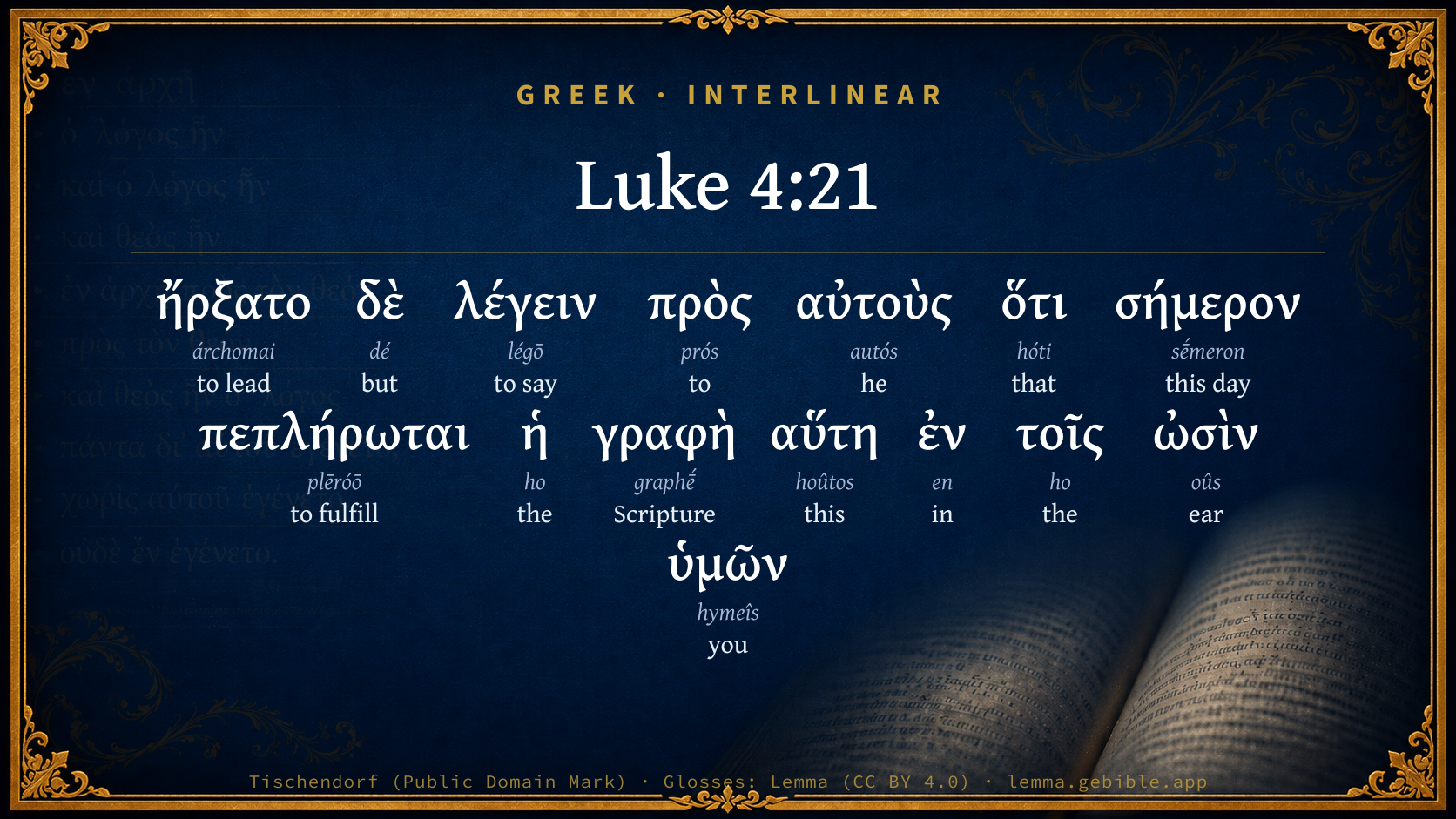
Download image
Cite this verse

Luke 4:21 (World English Bible). Public Domain. Lemma interlinear Bible study tool, https://lemma.gebible.app/v/luke/4/21.

Show BibTeX & RIS
BibTeX
RIS
English Translation
He began to tell them, "Today, this Scripture has been fulfilled in your hearing."
World English Bible · Public Domain
Download a study sheet

One document with this verse’s original text, its word-by-word gloss line, the meaning frame, cross-references with their text, attributed commentary, and full source and license credits — printable, and it pastes into notes with its structure intact.

This verse Autodidact and up

Study sheet (.html) Plain text (.txt)

A passage Seminary Student

Up to 50 verses in one chapter. A passage sheet keeps up to 6 commentary sources and 12 cross-references per verse, in the order this page ranks them, and says so on the sheet whenever that leaves anything out. Ask for a single verse and you get the Autodidact verse sheet above.

Everything on this page stays free to read, with no account — the sheet is a download of what is already on screen, not access to it.

Want to remove ads? Support Godless Engineer
Compare translations 3

The same verse in 3 English versions, stacked beneath the original-language interlinear above. Click any original word for its lexicon entry.

Each is an independent rendering of the whole verse — the interlinear is not word-aligned to these translations.

Highlighted words mark where these versions differ — a whole-verse word diff, not a word-by-word alignment.

  • World English Bible Public Domain
    He began to tell them, "Today, this Scripture has been fulfilled in your hearing."
  • King James Version Public Domain
    And he began to say unto them, This day is this scripture fulfilled in your ears.
  • unfoldingWord Literal Text CC BY-SA 4.0
    Then he began to say to them, “Today this scripture has been fulfilled in your ears.”

unfoldingWord Literal Text — © unfoldingWord, licensed CC BY-SA 4.0. Word-aligned USFM3 via Door43 (git.door43.org/unfoldingWord/en_ult).

Versions to compare (up to 4)

3 of 4 selected

Show all 19 translations

Every available English version of this verse, each an independent rendering of the whole verse.

  • World English Bible Public Domain
    He began to tell them, "Today, this Scripture has been fulfilled in your hearing."
  • Berean Standard Bible Public Domain
    and He began by saying, “Today this Scripture is fulfilled in your hearing.”
  • Majority Standard Bible Public Domain
    and He began by saying, “Today this Scripture is fulfilled in your hearing.”
  • King James Version Public Domain
    And he began to say unto them, This day is this scripture fulfilled in your ears.
  • American Standard Version (1901) Public Domain
    And he began to say unto them, To-day hath this scripture been fulfilled in your ears.
  • Revised Version (1885) Public Domain
    And he began to say unto them, Today hath this scripture been fulfilled in your ears.
  • Geneva Bible (1599) Public Domain
    Then he began to say vnto them, This day is the Scripture fulfilled in your eares.
  • Douay-Rheims (1899) Public Domain
    And he began to say to them: This day is fulfilled this scripture in your ears.
  • Young's Literal Translation Public Domain
    And he began to say unto them -- `To-day hath this writing been fulfilled in your ears;'
  • Literal Standard Version CC BY-SA 4.0
    And He began to say to them, “Today this writing has been fulfilled in your ears”;
  • Unlocked Literal Bible CC BY-SA 4.0
    He began to speak to them, “Today this scripture has been fulfilled in your hearing.”
  • unfoldingWord Literal Text CC BY-SA 4.0
    Then he began to say to them, “Today this scripture has been fulfilled in your ears.”
  • Darby Bible Public Domain
    And he began to say to them, To-day this scripture is fulfilled in your ears.
  • World Messianic Bible Public Domain
    He began to tell them, “Today, this Scripture has been fulfilled in your hearing.”
  • Webster's Bible Public Domain
    And he began to say to them, This day is this scripture fulfilled in your ears.
  • Free Bible Version CC BY-SA 4.0
    “This Scripture you've just heard has been fulfilled today!” he told them.
  • Bible in Basic English Public Domain
    Then he said to them, Today this word has come true in your hearing.
  • Text-Critical English NT CC BY 4.0
    and he began speaking to them, saying, “Today this Scripture has been fulfilled in your hearing.”
  • Tyndale New Testament (1534) Public Domain
    And he began to saye vnto them. This daye is this scripture fulfilled in youre eares.

Literal Standard Version (2020), Covenant Press — licensed CC BY-SA 4.0. Text via the HelloAO Bible API (eBible.org). Unlocked Literal Bible (unfoldingWord) — licensed CC BY-SA 4.0. Text via the HelloAO Bible API (eBible.org). unfoldingWord Literal Text — © unfoldingWord, licensed CC BY-SA 4.0. Word-aligned USFM3 via Door43 (git.door43.org/unfoldingWord/en_ult). Free Bible Version, Dr. Jonathan Gallagher — licensed CC BY-SA 4.0. Text via the HelloAO Bible API (eBible.org).

Word by word

More ways to search: Search by grammar → Find every occurrence → Compare this word →

Practice this passage: Drill this verse → Learn its vocabulary →

ὠσὶν
oûs
G3775
“ear”
Noun, Dative, Plural, Neuter
Part of Speech
Noun
Case
Dative
Number
Plural
Gender
Neuter
Full Thayer's Definition

Origin: apparently a primary word

TDNT: 14:03,7

1. the ear 2. metaph. the faculty of perceiving with the mind, the faculty of understanding and knowing
  1. ἤρξατο árchomai G756 “to lead” Verb, Aorist, Middle deponent, Indicative, 3rd person, Singular
  2. δὲ dé G1161 “but” Conjunction
  3. λέγειν légō G3004 “to say” Verb, Present, Active, Infinitive
  4. πρὸς prós G4314 “to” Preposition
  5. αὐτοὺς autós G846 “he” Personal pronoun, Accusative, Plural, Masculine
  6. ὅτι hóti G3754 “that” Conjunction
  7. σήμερον sḗmeron G4594 “this day” Adverb
  8. πεπλήρωται plēróō G4137 “to fulfill” Verb, Perfect, Passive, Indicative, 3rd person, Singular
  9. ἡ ho G3588 “the” Article, Nominative, Singular, Feminine
  10. γραφὴ graphḗ G1124 “Scripture” Noun, Nominative, Singular, Feminine
  11. αὕτη hoûtos G3778 “this” Demonstrative pronoun, Nominative, Singular, Feminine
  12. ἐν en G1722 “in” Preposition
  13. τοῖς ho G3588 “the” Article, Dative, Plural, Neuter
  14. ὑμῶν hymeîs G5210 “you” Personal pronoun, 2nd person, Genitive, Plural

About this verse

These counts appear in no published source. They are computed here, from the morphology-tagged text and Lemma’s own curated glosses. What Lemma adds →

15
words
14
distinct lemmas
Gospels
section

Shared distinctive vocabulary

ὠσὶν ear G3775 occurs in 34 verses of the Greek New Testament. Also found in:

Repetition

A word recurs within this verse:

Cross-references

7

Topical passages linked to Luke 4:21 in the Treasury of Scripture Knowledge — connected by theme and wording, ordered by reader-vote popularity; previews shown in the World English Bible.

  • John 4:25–26 The woman said to him, "I know that Messiah comes," (he who is called Christ). "When he has come, he will declare to us all things."
  • Matthew 13:14 In them the prophecy of Isaiah is fulfilled, which says, 'By hearing you will hear, And will in no way understand; Seeing you will see, And will in no way perceive:
  • Acts 3:18 But the things which God announced by the mouth of all his prophets, that Christ should suffer, he thus fulfilled.
  • Luke 10:23–24 Turning to the disciples, he said privately, "Blessed are the eyes which see the things that you see,
  • Acts 2:16–18 But this is what has been spoken through the prophet Joel:
  • Acts 2:29–33 "Brothers, I may tell you freely of the patriarch David, that he both died and was buried, and his tomb is with us to this day.
  • John 5:39 "You search the Scriptures, because you think that in them you have eternal life; and these are they which testify about me.

Cross-references courtesy of OpenBible.info (CC BY 4.0).

Commentary

Notes on Luke 4:21 from classic Christian and Jewish commentators (each source and its license shown beneath its notes). The classic Christian expositions comment on the surrounding passage and are grouped to its opening verse, so a note may address several verses; the Jewish commentaries on the Tanakh (Rashi and others) are per-verse, so they appear only where the commentator wrote on this verse.

Lemma curates 59 commentaries, every one of them public domain or Creative Commons licensed, each selected and text-cleaned for this edition rather than reprinted as found. About our sources →

MacLaren's Expositions of Holy Scripture

Alexander MacLaren

Luke

PREACHING AT NAZARETH

Luk 4:21.

This first appearance of our Lord, in His public work at Nazareth, the home of His childhood, was preceded, as we learn from John’s Gospel, by a somewhat extended ministry in Jerusalem. In the course of it, He cast the money-changers out of the Temple, did many miracles, had His conversation with Nicodemus, and on His return towards Galilee met the woman of Samaria at the well. The report of these things, no doubt, had preceded Him, and kindled the Nazarenes’ curiosity to see their old companion who had suddenly shot up into a person of importance, and had even made a sensation in the metropolis. A great man’s neighbours are keen critics of, and slow believers in, his greatness. So it was natural and very prudent that Jesus should not begin His ministry in Nazareth.

We can easily imagine the scene that morning in the little village, nestling among the hills. How many memories would occupy Christ as He entered the synagogue, where He had so often sat a silent worshipper! How Mary’s eyes would fill with tears if she was there, and how the companions of His boyhood, who used to play with Him, would watch Him; all curious, some sympathetic, some jealous, some contemptuous!

The synagogue service began with prayer and praise. Then followed two readings, one from the Law, one from the Prophets. When the latter point was reached, in accordance with usage, Jesus rose, thereby signifying His desire to be reader of the Prophetic portion. We can understand how there would be a movement of quickened attention as the roll was handed to Him and He turned its sheets. He ‘found the place’; that looks as if He sought for it; that is to say, that it was not the appointed lesson for the day-if there was such-but that it was a passage selected by Himself.

I need not enter upon the divergences between Luke’s quotation as given in our English version and the Hebrew. They are partly due to the fact that he is quoting from memory the Greek version of the LXX. He inserts, for instance, one clause which is not found in that place in Isaiah, but in another part of the same prophet. Having read standing, as was the usage, in token of reverence for the Scripture, Jesus resumed His seat, not as having finished, but, as was the usage, taking the attitude of the teacher, which signified authority. And then, His very first sentence was the most unlimited assertion that the great words which He had been reading had reached their full accomplishment in Himself. They are very familiar to our ears. If we would understand their startling audacity we must listen to them with the ears of the Nazarenes, who had known Him ever since He was a child. ‘This day is this Scripture fulfilled in your ears.’ Now, it seems to me that this first sermon of our Lord’s to His old fellow-townsmen brings into striking prominence some characteristics of His whole teaching, to which I desire briefly to direct attention.

I. I note Christ’s self-assertion.

To begin in Nazareth with such words as these in my text was startling enough, but it is in full accord with the whole tone of our Lord’s teaching. If you will carefully search for the most essential characteristics and outstanding differentia of the words of Jesus Christ, even if you make all allowance that some make for the non-historical character of the Gospels, you have this left as the residuum, that the impression which He made upon the men that were nearest to Him, and that caught up most fully the spirit of His teaching, was that the great thing that differentiated it from all other was His unhesitating persistence in pushing into the very forefront, His testimony about Himself. I do not think that there is anything parallel to that anywhere else amongst the men whom the world recognises as being great religious geniuses or great moral teachers. What characterises as perfectly unique our Lord’s teaching is not only the blessed things that He said about God or the deep truths that He said about men and their duty, or the sad things that He said about men and their destiny, or the radiant hopes that He unveiled as to men and their possibility, but what He said about Himself. His message was not so much ‘Believe in God and do right,’ as it was ‘Believe in Me and follow Me.’

I need only point you to the Sermon on the Mount, which is popularly supposed to contain very little of Christ’s reference to Himself, and to remind you how there, in that authoritative proclamation of the laws of the new kingdom, He calmly puts His own utterances as co-ordinate with-nay! as superior to-the utterances of the ancient law, and sweeps aside Moses-though recognising Moses’ divine mission-with an ‘I say unto you.’ I need only remind you, further, how, at the end of that ‘compendium of reasonable morality,’ He lays down this principle-that these sayings of ‘Mine’ are a rock-foundation, on which whoever builds shall never be put to confusion. This is but a specimen of the golden thread, if I may call it so, of self-assertion which runs through the whole of our Lord’s teaching.

Now, I venture to say that this undeniable characteristic is only warranted on the supposition that He is the Son of God, and His work the salvation of the world. If He is so, if ‘He that hath seen Me hath seen the Father,’ if the revelation of Himself which He makes is the Revelation of God, if His death is for the life of the world; and if, when we honour Him, we honour God; when we trust Him, we trust God; when we obey Him we obey God; then I can understand His persistent self-assertion. But otherwise does He not deliberately intercept emotions which are only rightly directed to God? Does He not claim prerogatives, such as forgiveness of sins, bestowal of life, answering of prayer, which are only possessed by the Divine Being?

I know that many who will not go with me in my intellectual formularising of the truth about Christ’s nature do bow to Him with unfeigned reverence. But it seems to me, I humbly confess, that there is no logical basis for such reverence except the full-toned recognition that the mystery of His self-assertion is explained by the mystery of His nature, God manifest in the flesh. I, for my part, do not see how the moral perfectness of Jesus Christ is to be saved, in view of that unmistakable strand in His teaching, unless by such admission. Rather, I feel that the recognition of it brings us face to face with the tremendous alternative, and that the people who were moved to indignation by His self-assertion because they recognised not His divine origin, and said ‘This man blasphemeth’; ‘This deceiver said,’ have more to say in defence of their conclusion than those who bow before Him with reverence, and declare Him to be the pattern of all human perfectness, and yet falter when they are asked to join in the great confession, ‘Thou are the Christ, the Son of the living God.’

II. Secondly, note here our Lord’s sad conception of humanity.

There are, as it were, two strands running through the prophetic passage which He quotes, one in reference to Himself, one in reference to those whom He came to help. To the latter I now turn, to get our Lord’s point of view when He looked upon the facts of human life.

No man will ever do much for the world whose ears have not been opened to hear its sad music. An inadequate conception of its miseries is sure to lead to inadequate prescriptions for their remedy. We must bear upon our own hearts the burdens that we seek to lift off our brothers’ shoulders. There is nothing about the Master’s words concerning mankind more pathetic and more plain than the sad, stern, and yet pitying view which He always took concerning them and their condition.

In the passage on which Jesus based His claims, as given by Luke, one of the clauses is probably not in this place genuine, for ‘the healing of the brokenhearted’ should be struck out of the true text. There are then four symbols employed: the poor, the captives, the blind, the bruised. And these four are representations of the result of one fell cause, and that is-sin.

Sin impoverishes. Our true wealth is God. No man that possesses Him, by love, and trust, and conformity of will and effort to His discerned will, is poor, whatever else he has, whatever else he lacks. And no man who has lost this one durable treasure, the loving communion with, and possession of, God, in mind and heart and will and effort, but is a pauper whatever else he possesses. Wherever a man has sold himself to his own will, and has made himself and his own inclinations and misread good his centre and his aim, which is the definition of sin, there bankruptcy and poverty have come. Thieves sometimes beset travellers from the gold mines, as they are bringing down their dust or their nuggets to market, and empty the pockets of the gold, and fill them up with sand. That is what sin does for us; it takes away our true treasure, and befools us by giving us what seems to be solid till we come to open the bag; and then there is no power in it to buy anything for us. ‘Why will ye spend your labour for that which satisfieth not?’ The one poverty is the impoverishment that lays hold of every soul that wrenches itself, in self-will, apart from God. Sin makes poor.

Sin not only impoverishes, but imprisons ‘the captives.’ Ah! you have only to think of your own experience to find out what that means. Is there nothing in the set of your affections, in the mastery that your passion has over you, in the habits of your lives, which you know as well as God knows it, to be wrong and ruinous, and of which you have tried to get rid? I know the answer, and every one of us, if we will look into our own hearts, knows it: we are ‘tied and bound by the chains of our sin.’ You do not need to go to inebriate homes, where there are people that would cut their right hands off if they could get rid of the craving, and cannot, to find instances of this bondage. We have only to be honest with ourselves, and to try to pull the boat against the stream instead of letting it drift with it, to know the force with which the current runs. A tiny thread like a spider’s draws after it a bit of cotton a little thicker, and knotted to that there is a piece of pack-thread, and after that a two-stranded cord, and then a cable that might hold an ironclad at anchor. That is a parable of how we draw to ourselves, by imperceptible degrees, an ever-thickening set of manacles that bind our wills and make us the servants of sin. ‘His slaves ye are whom ye obey.’ Sin imprisons. That is, your sin-do not let us befool ourselves with abstractions-your sin imprisons you.

Sin blinds. Wherever there comes over a soul the mist of self-will and self-regard, sight fails; and all the greatest things are blurred and blotted. The man that is immersed in his own evil is like one plunged in the ocean. The cold, salt waters are about him, and above him; and to him the glories of the sky, and the brightness of the sun, the tenderness of the colouring, are all blotted out. He who goes through life as some of us do, never seeing God, never seeing the loftiest beauty of goodness, never beholding with any clearness of vision the radiant possibilities of the future and its awful threatenings, may indeed see the things an inch from the point of his nose; but he is blind and cannot see afar off, and can only behold, and that darkly, the insignificances that are around him. Sin blinds.

And sin bruises. It takes all the health out of us, and makes us, from the sole of the foot to the crown of the head, masses of ‘wounds and bruises and putrifying sores.’

The enchantress having worked all this havoc, then gives us a cup of illusion which, when we drink, we know not that there is anything the matter with us. We are like a lunatic in a cell, who thinks himself a prince in a palace, and though living on porridge and milk, fancies that he is partaking of all the dainties of a luxurious table. The deceitfulness of sin is not the least of its tragical consequences.

III. Lastly, we have here our Lord’s conception of Himself and of His own work.

Your time will not allow of my dwelling upon this as I would fain have done, but let me point out one or two of the salient features of this initial programme of His. He claims to be the theme and the fulfilment of prophecy. Now, whatever influences modern notions about the genesis of the Old Testament, and the characteristics of its prophetic utterances may have done, they have not touched, and they never will touch, this one central characteristic of all that old system, that embedded in it there was an onward-looking gaze, anticipatory of a higher fulfilment and a further development of all that it taught. To those of us to whom Christ’s words are the end of all strife I need only point out that, here, He endorses the belief that prophetic utterances, however they may have had, and did have, a lower and immediate meaning, were only realised in the whole sweep and significance in Himself. So He presents Himself before His acquaintances in the little synagogue at Nazareth, and before the whole world to all time, as the centre-point and pivot on which the history of the world, so to speak, revolves; all that was before converging to Him, all that was after flowing down from Him. ‘They that went before, and they that followed after, cried, Hosanna! blessed be He that cometh in the name of the Lord.’

He claims to possess the whole fullness of the divine Spirit: ‘The Spirit of the Lord is upon Me.’ That is a reminiscence, no doubt, of the experience by the fords of the Jordan, at the Baptism. But it also opens up a wondrous consciousness, on His part, of a complete and uninterrupted possession of the divine life in all its fullness, which involves an entire separation from the miseries and needs of men. He claims to be the Messiah of the Old Covenant, with all the fullness of meaning, and loftiness of dignity which clustered round that word and that thought. He claims not only to proclaim, but to bestow, the blessings of which He speaks. For He not only comes to ‘preach good tidings to the poor,’ but ‘to heal the broken-hearted,’ and ‘to set at liberty all them that are bound.’ He is the Gospel which He utters. He not merely proclaims the favour of heaven, but He brings ‘the acceptable year of the Lord.’

This, in barest outline-which is all that your time will admit-is the summary of what Jesus Christ, in that first sermon in the synagogue at Nazareth, asserted Himself to be.

He does not detail the means by which He is about to bring the golden year, the year of Jubilee, ‘the acceptable year of the Lord.’ But I venture to say that it is hard to find, in the life of Jesus Christ, that which fulfils Christ’s own programme, as thus announced, unless you bring in His death on the Cross for the abolition of sin, His Resurrection for the abolition of death; His reign in glory for the bestowment on all sinful and bruised souls of the Spirit of healing and of righteousness.

These Nazarenes listened. Their hearts and consciences attested the magnetic power of His personality, and the truth of His word. So do the hearts and consciences of most of us. They wondered at the ‘words of grace’-whose matter was grace, whose manner was gracious-that proceeded from His mouth. So do most of us. But they let the incipient movement of their hearts be arrested by the cold, carping question, ‘Is not this Joseph’s son?’ and all the enthusiasm chilled into indifference; ‘indignation’ followed, and some of those who had almost been drawn to Him, in an hour’s time had their hands on His robe, to cast Him from the brow of the hill on which their village was built. Every man who comes to the point of feeling some emotions towards Christ as his Redeemer, as his King, is at a fork of the road. He may either take to the right, which will lead him to full communion and acceptance; or he may go to the left, which will carry him away out into the desert. The critical hour in the alchemist’s laboratory was when the lead in his crucible began to melt. If a cold current got at it, it resumed its dead solidity, and no gold could be made.

Brother! do not let the world’s cold currents get at your heart and freeze it again, if you feel that in any measure it is beginning to melt into penitence, and to flow with faith. The same voice that in the synagogue of Nazareth said, ‘He hath anointed Me to preach the Gospel to the poor’ speaks to us to-day from heaven, saying, ‘I counsel thee to buy of Me gold tried in the fire, that thou mayest be rich . . . and anoint thine eyes with eyesalve that thou mayest see.’

Alexander MacLaren, Expositions of Holy Scripture (1904–1910) — public domain. Text from a community e-Sword module.

Tyndale Open Study Notes

Tyndale Open Resources

4:21 has been fulfilled: Jesus announced that because he was present, the new age of salvation had arrived. • this very day! Literally today; cp. 2:11; 5:26; 19:9; 23:43.

Tyndale Open Study Notes — © Tyndale Open Resources, licensed CC BY-SA 4.0. Text via the HelloAO Bible API.

Bengel's Gnomon

Johann Albrecht Bengel

Luk 4:21. Ἤρξατο, He began) A solemn beginning. [Galilee was that region upon which Christ, the Great Light, arose in an extraordinary manner; Isa 9:2-3; Mat 4:15; Luk 4:31. As Isaiah has in an altogether graphic manner described that place, so also the time in which the Light shone on this region with such brightness, has been indicated by the same Isaiah. Jesus sojourned in Galilee throughout the whole year (referring to “the acceptable year of the Lord”) without interruption; and it was during that time that the Jews applied the new name of Galileans to His disciples; Joh 7:52; Mar 14:70. This was a year most full of grace to that most wretched nation: accordingly, Matthew, Mark, and Luke have given a description of this year more at large, whilst John supplies the journey to Jerusalem, which gave a fresh opportunity to the Galileans, who likewise frequented the feasts, of deriving no small profit from the teaching of Jesus. In fine, John by using the formula, “Jesus went up to Jerusalem” (Joh 2:13), takes for granted the more frequent sojourning of the Saviour in Galilee. In this way the Gospel history being in exact accordance both with itself and with the Old Testament, shrinks from no testing that may be applied, however rigorous.—Harm., p. 188.—σήμερον, this day) The Saviour passed a full year in Galilee, reckoning from that day; comp. Luk 4:43 with Luk 4:44.—V. g.]

Bengel's Gnomon of the New Testament — English translation (T&T Clark, Edinburgh, 1860) — public domain. Text from a community e-Sword module.

Expositor's Greek Testament

ed. W. Robertson Nicoll

Luk 4:21 . ἤρξατο : we may take what follows either as the gist of the discourse, the theme (De Wette, Godet, Hahn), or as the very words of the opening sentence (Grotius, Bengel, Meyer, Farrar). Such a direct arresting announcement would be true to the manner of Jesus.

The Expositor's Greek Testament, edited by W. Robertson Nicoll (1897–1910) — public domain. Text from a community e-Sword module.

Jamieson, Fausset & Brown

Robert Jamieson, A. R. Fausset & David Brown

began to say, &c.--His whole address was just a detailed application to Himself of this and perhaps other like prophecies.

Jamieson, Fausset & Brown — Commentary Critical and Explanatory on the Whole Bible (1871) — public domain (CC PDM 1.0). Text via the HelloAO Bible API.

Ellicott's Commentary for English Readers

(21) This day is this scripture fulfilled.—It is obvious that we have here only the opening, words of the sermon preached on the text from Isaiah. There must have been more than this, remembered too vaguely for record, to explain the admiration of which the next clause speaks. But this was what startled them: He had left them as the son of the carpenter—mother, brethren, sisters were still among them—and now He came back claiming to be the Christ, and to make words that had seemed to speak of a far-off glorious dream, as a living and present reality.

A Bible Commentary for English Readers, edited by Charles John Ellicott (1878–1897) — public domain. Text from a community e-Sword module.

The Cambridge Bible for Schools and Colleges

gen. ed. J. J. S. Perowne

21. he began to say unto them] i. e. these were the first words of the discourse. It began with the announcement that He was the Messiah in whom the words of the prophet found their fulfilment.

The Cambridge Bible for Schools and Colleges (gen. ed. J. J. S. Perowne; Cambridge University Press, 1878–1918) — public domain. Text from a community e-Sword module.

John Gill's Exposition

And he began to say unto them,.... To preach from those words; the explanation of which he gave, though not here recorded, and applied them to himself, to whom they belonged, saying:

this day is this Scripture fulfilled in your ears; which is as if he should say, I am the person here spoken of; and at this present time the Spirit of God is upon me; I am anointed with the Holy Ghost, and now preach glad tidings to you, and all the good things here mentioned, and for the several ends proposed; and this Scripture has its full accomplishment which has been read unto you, and you have heard this day. So the Syriac version renders it, "which is in your ears"; that is, which you have now heard. The Jews themselves acknowledge, that these words are spoken of the Messiah. One of their writers (i) says,

"these are the words of the prophet with respect to the Messiah; for the Messiah shall say so, "because the Lord hath anointed me", &c.''

And so said the true Messiah Jesus. Another of them expresses himself thus (k):

"these are the words of the prophet with respect to the Messiah; for the Messiah shall say thus, "because the Lord hath anointed me", &c. or they are the words of the prophet concerning himself.''

And elsewhere it is said by them (l),

"the holy, blessed God, will send his Messiah to us, and he shall be worthy of this, (i.e. the character of a meek person) as it is said, Isa 61:1 "he hath sent me to preach glad tidings to the meek."''

(i) Kimchi in Sepher Shorash. rad. (k) R. Sol. Hamelec in Miclol Yophi in loc. (l) Juchaain, fol. 69. 1.

John Gill's Exposition of the Whole Bible (1746–1763) — public domain (CC PDM 1.0). Text via the HelloAO Bible API.

Trapp's Complete Commentary

John Trapp

21 And he began to say unto them, This day is this scripture fulfilled in your ears.

Ver. 21. This day is this scripture, &c.] This the sum of his sermon, as were also the prophecies we read, the heads only and short notes of the prophets’ larger discourses. Brevity breeds obscurity.

John Trapp, A Commentary or Exposition upon All the Books of the Old and New Testament (1647–1656) — public domain. Text from a community e-Sword module.

Albert Barnes' Notes on the Bible

This scripture - This writing, or this part of the Scriptures.

Fulfilled - It is coming to pass; the thing originally intended by it is about to be accomplished.

In your ears - In your “hearing;” or you hear, in my preaching, the fulfillment of this prophecy. It is probable that he said much “more” than is here recorded, but Luke has preserved only the “substance” of his discourse. This was the “amount” or “sum”” of his sermon, or his explanation of the passage, that it was now receiving its accomplishment.

Albert Barnes' Notes on the Bible (1834–1885) — public domain. Text from a community e-Sword/MySword module.

Haydock's Catholic Bible Commentary

By this Christ wished to shew that he was the Messias foretold by the prophet Isaias, whom they so anxiously expected: he declares himself to be the person pointed out by the prophet. There seems also to be a secret reprehension in these words of Christ; as if he were to say: Why are you so desirous to behold the Messias, whom, when he is before your eyes, you will not receive? Why do you seek him in the prophets, when you neither understand the prophets, nor perceive the truth of their predictions, when they are fulfilled before you eyes? (Maldonatus)

George Leo Haydock (1774–1849), Haydock's Catholic Family Bible and Commentary, 1859 edition — public domain. Excludes Psalms (Douay-Rheims chapter numbering differs from Protestant) and Deuterocanonical books (Catholic canon only).

Whedon's Commentary on the Bible

Daniel D. Whedon

21. This day… fulfilled—The evangelist having given the text, now states in a single sentence the general proposition of the sermon. Our Saviour must now have proceeded to show that HE was this emancipator who would bring deliverance, and this physician who would bind up the broken-hearted. He must have proceeded to show these Nazarenes that they were the poor persons who needed the benefactor, and the bruised who needed the physician. Gracious as were his words, they were humbling to the audience and exalting to himself. Hence arose the rupture that ensued. See note on Luk_4:18.

Daniel D. Whedon (gen. ed.), Commentary on the Old and New Testaments (1874–1909) — public domain. Text from a community e-Sword module.

John Wesley's Explanatory Notes

Today is this scripture fulfilled in your ears - By what you hear me speak.

John Wesley, Explanatory Notes Upon the Whole Bible (1754–1765) — public domain. Text via the GEBible commentary corpus.

The People's New Testament

B. W. Johnson

21. This day is this Scripture fulfilled. By the preaching to which they were now about to listen.

B. W. Johnson's The People's New Testament with Notes (1889–1891) — public domain. Electronic text from the Christian Classics Ethereal Library (CCEL) ThML edition.

Cambridge Greek Testament for Schools and Colleges

21. ἤρξατο δὲ λέγειν πρὸς αὐτούς. i.e. these were the first words of the discourse. It began with the announcement that He was the Messiah in whom the words of the prophet found their fulfilment.

Cambridge Greek Testament for Schools and Colleges (Cambridge University Press, 1896; 21 vols, various authors incl. Carr, Maclear, Plummer, Farrar, Lumby, Moule, M. R. James, Simcox) — public domain. Text from a community e-Sword module.

Alford’s Greek Testament

Henry Alford

21.] ἤρξ. δὲ λέγειν—implying that the following words are merely the substance of a more expanded discourse, which our Lord uttered to that effect: see another occasion in Mat 11:4, Mat 11:5, where the same truth was declared by a series of gracious acts of mercy.

ἡ γρ. κ.τ.λ.] Not ‘this Scripture which is in your ears’—as the Syriac (Etheridge’s translation, p. 407); which would be ἡ γρ. αὕτη ἡ ἐν τ. ὠ., and even then an unusual form of construction: but, is fulfilled in your hearing, by My proclaiming it, and My course of ministry.

Henry Alford, The Greek Testament (1849–1861) — public domain. Text from a community e-Sword module.

International Critical Commentary

21. ἤρξατο δὲ λέγειν. The ἤρξατο is not pleonastic: it points to the solemnity of the moment when His words broke the silence of universal expectation: comp. 7:24, 11:29, 12:1, 14:18. What follows may be regarded as a summary of what was said. It gives us the main subject of His discourse. We are led to suppose that lie said much more; perhaps interpreting to them in detail the things concerning Himself (24:27). The conversation with Nicodemus is similarly condensed by S. John (3:1-21). Even without this narrative we should know from 7:22 and Mat 11:5 that Christ interpreted Isa 61:1 ff. of Himself. The whole of the O.T. was to Him a prophecy respecting His life and work And this applies not only to prophetic utterances, but also to rites and institutions, as well as to historical events, which were so ordered as to be a forecast of the salvation and judgment which He was to bring.1 This verse sums up His sermon.

ἡ γραφὴ αὔτη. “This passage of Scripture” (Mar 12:10; Joh 7:42, etc.) : for Scripture as a whole the plural is used (24:27, 32, 45; Mat 21:42, Mat 21:22:29, Mat 21:26:54, 56; Mar 12:24, etc.). His interpretation of the prophecy was at the same time a fulfilment of it; for the voice of Him of whom the Prophet wrote was sounding in their ears.Hence it is that he affirms πεπλήρωται ἐν τοῖς ὠσὶν ὑμῶν. As Renan says, Il ne prêchait passes opinions, il se prêchait luimême.

International Critical Commentary — older volumes (1896–1929), various authors — public domain. Text from a community e-Sword module.

Vincent's Word Studies in the New Testament

Marvin R. Vincent

He began. Not necessarily denoting his first words, but indicating a solemn and weighty opening.

Marvin R. Vincent, Word Studies in the New Testament (1887–1900) — public domain. Text from a community e-Sword/MySword module.

Lesson kit

Teaching starters — assembled from the data on this page, not authored interpretation. Every prompt links to the verse data it draws on. Edit before teaching.

Luke, in the Gospels, opens this verse with 15 words (14 distinct Greek lemmas). Its most distinctive word is oûs (“ear”). A historical commentator’s framing appears above. Read the whole chapter for the surrounding context.

Discussion questions

  1. The word oûs carries the sense “ear.” How does it shape the verse?
  2. Matthew 10:27 shares the word «ear» with this verse. How do the two illuminate each other?
  3. “the” occurs 2× in this one verse. What is the effect of the repetition?
  4. The translations on this page render this verse differently — a whole-verse word diff, not a word-by-word alignment. What might account for the different wordings?
  5. Reading how MacLaren's Expositions of Holy Scripture and Tyndale Open Study Notes read this verse, where do the two commentators agree and where do they part?

Things to notice

Reading settings

Reading text

Shown beneath each verse's original-language words.

Old Testament
Old Testament edition

Read the OT as the Masoretic Hebrew (MT) or the Greek Septuagint (LXX).

English shown for the Greek Septuagint (in the Hebrew ↔ Greek comparison).

Comparing translations? Open the Compare panel on any verse page to stack up to four side by side.