

Luke 23:2
Greek (Tischendorf 8th ed.) Luke 23:2 appears in the Greek New Testament. The text above is from the Tischendorf 8th edition. Each word links to its Strong’s number and a concise gloss. Click any word for its full Thayer’s Greek Lexicon entry.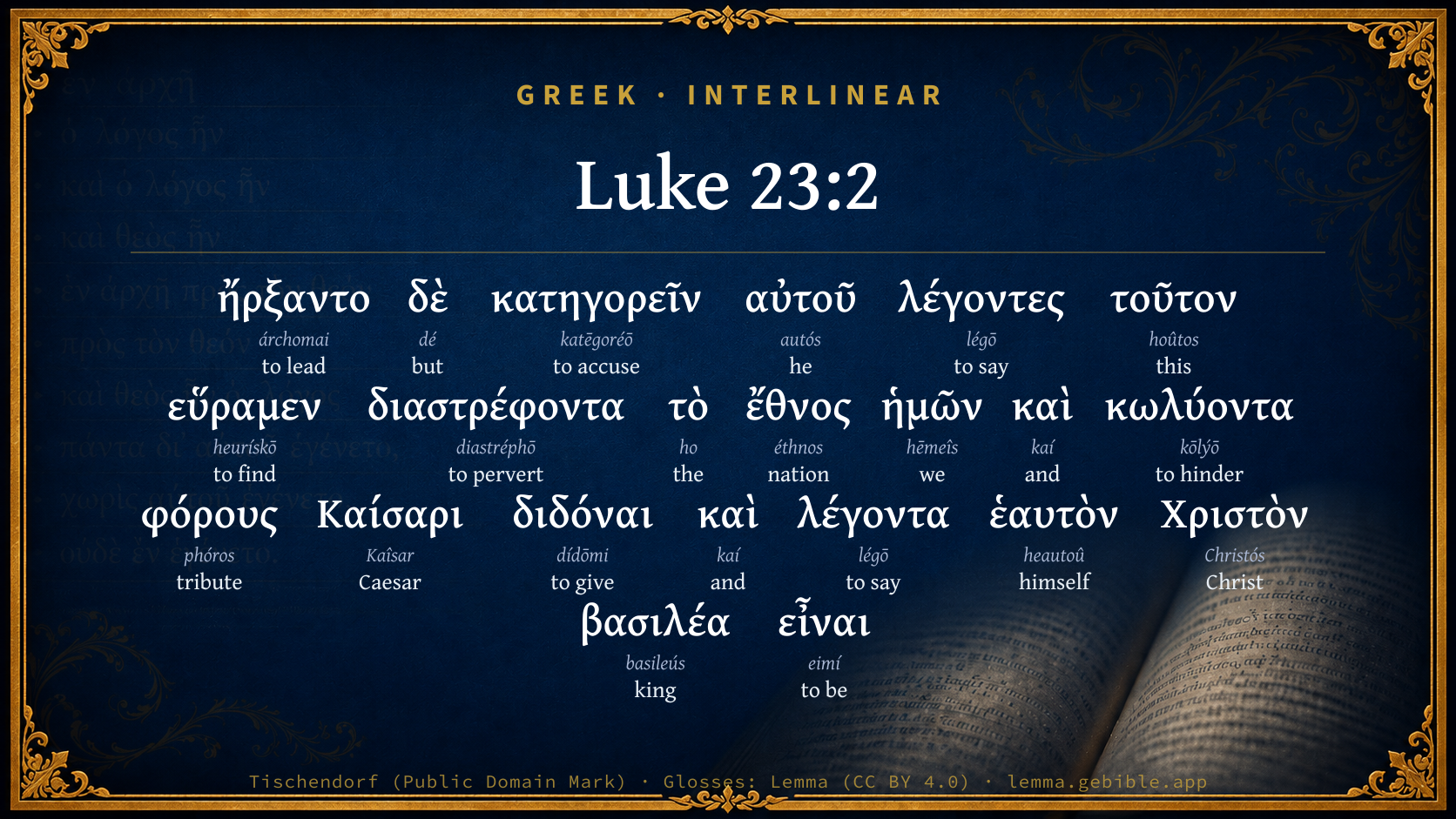
They began to accuse him, saying, "We found this man perverting the nation, forbidding paying taxes to Caesar, and saying that he himself is Christ, a king."
Download a study sheet
One document with this verse’s original text, its word-by-word gloss line, the meaning frame, cross-references with their text, attributed commentary, and full source and license credits — printable, and it pastes into notes with its structure intact.
This verse Autodidact and up
A passage Seminary Student
Up to 50 verses in one chapter. A passage sheet keeps up to 6 commentary sources and 12 cross-references per verse, in the order this page ranks them, and says so on the sheet whenever that leaves anything out. Ask for a single verse and you get the Autodidact verse sheet above.
Everything on this page stays free to read, with no account — the sheet is a download of what is already on screen, not access to it.
Compare translations 3
The same verse in 3 English versions, stacked beneath the original-language interlinear above. Click any original word for its lexicon entry.
Each is an independent rendering of the whole verse — the interlinear is not word-aligned to these translations.
Highlighted words mark where these versions differ — a whole-verse word diff, not a word-by-word alignment.
-
World English Bible Public Domain
They began to accuse him, saying, "We found this man perverting the nation, forbidding paying taxes to Caesar, and saying that he himself is Christ, a king."
-
King James Version Public Domain
And they began to accuse him, saying, We found this fellow perverting the nation, and forbidding to give tribute to Caesar, saying that he himself is Christ a King.
-
unfoldingWord Literal Text CC BY-SA 4.0
And they began to accuse him, saying, “We found this one perverting our nation and forbidding to give tribute to Caesar and saying that he himself is Christ, a king.”
unfoldingWord Literal Text — © unfoldingWord, licensed CC BY-SA 4.0. Word-aligned USFM3 via Door43 (git.door43.org/unfoldingWord/en_ult).
Show all 19 translations
Every available English version of this verse, each an independent rendering of the whole verse.
-
World English Bible Public Domain
They began to accuse him, saying, "We found this man perverting the nation, forbidding paying taxes to Caesar, and saying that he himself is Christ, a king."
-
Berean Standard Bible Public Domain
And they began to accuse Him, saying, “We found this man subverting our nation, forbidding payment of taxes to Caesar, and proclaiming Himself to be Christ, a King.”
-
Majority Standard Bible Public Domain
And they began to accuse Him, saying, “We found this man subverting the nation, forbidding payment of taxes to Caesar, and proclaiming Himself to be Christ, a King.”
-
King James Version Public Domain
And they began to accuse him, saying, We found this fellow perverting the nation, and forbidding to give tribute to Caesar, saying that he himself is Christ a King.
-
American Standard Version (1901) Public Domain
And they began to accuse him, saying, We found this man perverting our nation, and forbidding to give tribute to Caesar, and saying that he himself is Christ a king.
-
Revised Version (1885) Public Domain
And they began to accuse him, saying, We found this man perverting our nation, and forbidding to give tribute to Caesar, and saying that he himself is Christ a king.
-
Geneva Bible (1599) Public Domain
And they began to accuse him, saying, We haue found this man peruerting the nation, and forbidding to pay tribute to Cesar, saying, That he is Christ a King.
-
Douay-Rheims (1899) Public Domain
And they began to accuse him, saying: We have found this man perverting our nation, and forbidding to give tribute to Caesar, and saying that he is Christ the king.
-
Young's Literal Translation Public Domain
and began to accuse him, saying, `This one we found perverting the nation, and forbidding to give tribute to Caesar, saying himself to be Christ a king.'
-
Literal Standard Version CC BY-SA 4.0
and began to accuse Him, saying, “We found this One perverting the nation, and forbidding to give tribute to Caesar, saying Himself to be Christ, a king.”
-
Unlocked Literal Bible CC BY-SA 4.0
They began to accuse him, saying, “We found this man perverting our nation, forbidding to give tribute to Caesar, and saying that he himself is Christ, a king.”
-
unfoldingWord Literal Text CC BY-SA 4.0
And they began to accuse him, saying, “We found this one perverting our nation and forbidding to give tribute to Caesar and saying that he himself is Christ, a king.”
-
Darby Bible Public Domain
And they began to accuse him, saying, We have found this [man] perverting our nation, and forbidding to give tribute to Caesar, saying that he himself is Christ, a king.
-
World Messianic Bible Public Domain
They began to accuse him, saying, “We found this man perverting the nation, forbidding paying taxes to Caesar, and saying that he himself is Messiah, a king.”
-
Webster's Bible Public Domain
And they began to accuse him, saying, We found this man perverting the nation, and forbidding to give tribute to Cesar, saying, that he himself is Christ a king.
-
Free Bible Version CC BY-SA 4.0
There they started to accuse him. “We found this man deceiving our nation, telling people not to pay taxes to Caesar, and claiming he is Messiah, a king,” they said.
-
Bible in Basic English Public Domain
And they made statements against him, saying, This man has to our knowledge been teaching our nation to do wrong, and not to make payment of taxes to Caesar, even saying that he himself is Christ, a king.
-
Text-Critical English NT CC BY 4.0
They began to accuse him, saying, “We found this man perverting the nation and forbidding us to pay taxes to Caesar, declaring himself to be Christ, a king.”
-
Tyndale New Testament (1534) Public Domain
And they beganne to accuse him sayinge: We have founde this felowe pervertynge the people and forbiddynge to paye tribute to Cesar: sayinge that he is Christ a kynge.
Literal Standard Version (2020), Covenant Press — licensed CC BY-SA 4.0. Text via the HelloAO Bible API (eBible.org). Unlocked Literal Bible (unfoldingWord) — licensed CC BY-SA 4.0. Text via the HelloAO Bible API (eBible.org). unfoldingWord Literal Text — © unfoldingWord, licensed CC BY-SA 4.0. Word-aligned USFM3 via Door43 (git.door43.org/unfoldingWord/en_ult). Free Bible Version, Dr. Jonathan Gallagher — licensed CC BY-SA 4.0. Text via the HelloAO Bible API (eBible.org).
Word by word
More ways to search: Search by grammar → Find every occurrence → Compare this word →
Practice this passage: Drill this verse → Learn its vocabulary →
- Appears 5× in the Greek New Testament
- First appears at Luke 20:22
- Part of Speech
- Noun
- Case
- Accusative
- Number
- Plural
- Gender
- Masculine
Full Thayer's Definition
- ἤρξαντο árchomai G756 “to lead” Verb, Aorist, Middle deponent, Indicative, 3rd person, Plural
- δὲ dé G1161 “but” Conjunction
- κατηγορεῖν katēgoréō G2723 “to accuse” Verb, Present, Active, Infinitive
- αὐτοῦ autós G846 “he” Personal pronoun, Genitive, Singular, Masculine
- λέγοντες légō G3004 “to say” Verb, Present, Active, Participle, Nominative, Plural, Masculine
- τοῦτον hoûtos G3778 “this” Demonstrative pronoun, Accusative, Singular, Masculine
- εὕραμεν heurískō G2147 “to find” Verb, Aorist, Active, Indicative, 1st person, Plural
- διαστρέφοντα diastréphō G1294 “to pervert” Verb, Present, Active, Participle, Accusative, Singular, Masculine
- τὸ ho G3588 “the” Article, Accusative, Singular, Neuter
- ἔθνος éthnos G1484 “nation” Noun, Accusative, Singular, Neuter
- ἡμῶν hēmeîs G2249 “we” Personal pronoun, 1st person, Genitive, Plural
- καὶ kaí G2532 “and” Conjunction
- κωλύοντα kōlýō G2967 “to hinder” Verb, Present, Active, Participle, Accusative, Singular, Masculine
- φόρους phóros G5411 “tribute” Noun, Accusative, Plural, Masculine
- Καίσαρι Kaîsar G2541 “Caesar” Noun, Dative, Singular, Masculine
- διδόναι dídōmi G1325 “to give” Verb, Present, Active, Infinitive
- καὶ kaí G2532 “and” Conjunction
- λέγοντα légō G3004 “to say” Verb, Present, Active, Participle, Accusative, Singular, Masculine
- ἑαυτὸν heautoû G1438 “himself” Reflexive pronoun, 3rd person, Accusative, Singular, Masculine
- Χριστὸν Christós G5547 “Christ” Noun, Accusative, Singular, Masculine
- βασιλέα basileús G935 “king” Noun, Accusative, Singular, Masculine
- εἶναι eimí G1510 “to be” Verb, Present, Active, Infinitive
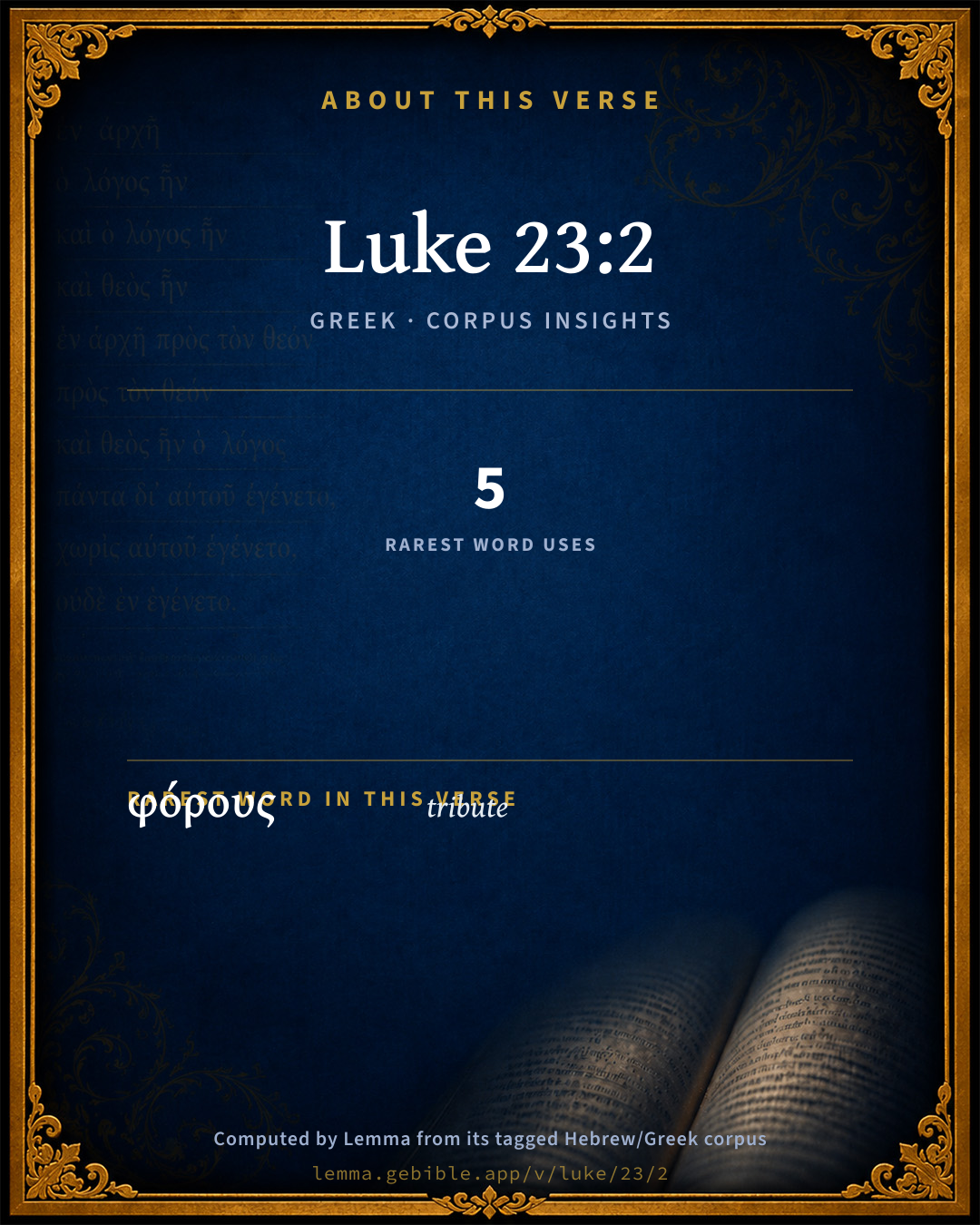
About this verse
These counts appear in no published source. They are computed here, from the morphology-tagged text and Lemma’s own curated glosses. What Lemma adds →
- 22
- words
- 20
- distinct lemmas
- Gospels
- section
Cross-references
29Topical passages linked to Luke 23:2 in the Treasury of Scripture Knowledge — connected by theme and wording, ordered by reader-vote popularity; previews shown in the World English Bible.
- Acts 17:6–7 When they didn't find them, they dragged Jason and certain brothers before the rulers of the city, crying, "These who have turned the world upside down have come here also,
- Luke 23:14 and said to them, "You brought this man to me as one that perverts the people, and see, I have examined him before you, and found no basis for a charge against this man concerning those things of which you accuse him.
- John 19:12 At this, Pilate was seeking to release him, but the Jews cried out, saying, "If you release this man, you aren't Caesar's friend! Everyone who makes himself a king speaks against Caesar!"
- 1 Kings 21:10–13 and set two men, base fellows, before him, and let them testify against him, saying, You did curse God and the king. Then carry him out, and stone him to death.
- Psalms 62:4 They fully intend to throw him down from his lofty place. They delight in lies. They bless with their mouth, but they curse inwardly. Selah.
- Jeremiah 20:10 For I have heard the defaming of many, terror on every side. Denounce, and we will denounce him, [say] all my familiar friends, those who watch for my fall; peradventure he will be persuaded, and we shall prevail against him, and we shall take our revenge on him.
- Jeremiah 38:4 Then the princes said to the king, Let this man, we pray you, be put to death; because he weakens the hands of the men of war who remain in this city, and the hands of all the people, in speaking such words to them: for this man doesn't seek the welfare of this people, but the hurt.
- Zechariah 11:8 I cut off the three shepherds in one month; for my soul was weary of them, and their soul also loathed me.
- Matthew 22:21 They said to him, "Caesar's." Then he said to them, "Give therefore to Caesar the things that are Caesar's, and to God the things that are God's."
- Mark 12:17 Jesus answered them, "Render to Caesar the things that are Caesar's, and to God the things that are God's." They marveled greatly at him.
- Mark 14:61–62 But he stayed quiet, and answered nothing. Again the high priest asked him, "Are you the Christ, the Son of the Blessed?"
- Mark 15:3–5 The chief priests accused him of many things.
- Luke 22:69–70 From now on, the Son of Man will be seated at the right hand of the power of God."
- John 18:30 They answered him, "If this man weren't an evildoer, we wouldn't have delivered him up to you."
- John 18:33–37 Pilate therefore entered again into the Praetorium, called Jesus, and said to him, "Are you the King of the Jews?"
- Acts 16:20–21 When they had brought them to the magistrates, they said, "These men, being Jews, are agitating our city,
- Acts 24:5 For we have found this man to be a plague, an instigator of insurrections among all the Jews throughout the world, and a ringleader of the sect of the Nazarenes.
- 1 Peter 3:16–18 having a good conscience; that, while you are spoken against as evildoers, they may be disappointed who curse your good manner of life in Christ.
- 1 Kings 18:17 It happened, when Ahab saw Elijah, that Ahab said to him, Is it you, you troubler of Israel?
- Psalms 35:11 Unrighteous witnesses rise up. They ask me about things that I don't know about.
- Psalms 64:3–6 Who sharpen their tongue like a sword, And aim their arrows, deadly words,
- Jeremiah 37:13–15 When he was in the gate of Benjamin, a captain of the guard was there, whose name was Irijah, the son of Shelemiah, the son of Hananiah; and he laid hold on Jeremiah the prophet, saying, You are falling away to the Chaldeans.
- Amos 7:10 Then Amaziah the priest of Beth El sent to Jeroboam king of Israel, saying, "Amos has conspired against you in the midst of the house of Israel. The land is not able to bear all his words.
- Matthew 17:27 But, lest we cause them to stumble, go to the sea, and cast a hook, and take up the first fish that comes up. When you have opened its mouth, you will find a stater coin. Take that, and give it to them for me and you."
- Matthew 26:59–60 Now the chief priests, the elders, and the whole council sought false testimony against Jesus, that they might put him to death;
- Mark 14:55–56 Now the chief priests and the whole council sought witnesses against Jesus to put him to death, and found none.
- Luke 20:20–25 They watched him, and sent out spies, who pretended to be righteous, that they might trap him in something he said, so as to deliver him up to the power and authority of the governor.
- Luke 23:5 But they insisted, saying, "He stirs up the people, teaching throughout all Judea, beginning from Galilee even to this place."
- Acts 24:13 Nor can they prove to you the things of which they now accuse me.
Cross-references courtesy of OpenBible.info (CC BY 4.0).
Where the printed editions differ
1 variantPlaces in this verse where the major printed Greek editions disagree on the wording in a way that affects the translation — a comparison of editions, not a manuscript-by-manuscript collation. The editions are the modern critical texts (Nestlé-Aland 28/27, SBL, Westcott-Hort, Tregelles, Tyndale House) and the traditional texts behind the KJV (the Textus Receptus and the Byzantine/Majority text). It is not a claim about which reading is original.
-
Extra text
ἡμῶν
“of us”
In NA28NA27TynSBLWHTreg Not in TRByzἡμῶν (hēmōn) 'of us' is only in older manuscripts (NA28+NA27+Tyn+SBL+WH+Treg)
Textual data: Translators Amalgamated Greek New Testament (STEPBible TAGNT) · CC BY 4.0.
Lesson kit
Teaching starters — assembled from the data on this page, not authored interpretation. Every prompt links to the verse data it draws on. Edit before teaching.
Luke, in the Gospels, opens this verse with 22 words (20 distinct Greek lemmas). Its most distinctive word is phóros (“tribute”). A historical commentator’s framing appears above. Read the whole chapter for the surrounding context.
Discussion questions
- The word phóros carries the sense “tribute.” How does it shape the verse?
- Luke 20:22 shares the word «tribute» with this verse. How do the two illuminate each other?
- “to say” occurs 2× in this one verse. What is the effect of the repetition?
- These translations render this verse differently; the difference is in the English rendering, not the original. What questions does that raise?
- Reading how Tyndale Open Study Notes and Bengel's Gnomon read this verse, where do the two commentators agree and where do they part?
Things to notice
- These translations choose different wording for 7 words in this verse.
- “to say” occurs 2× in this single verse.
- 20 distinct Greek lemmas span 22 words in this verse.
Commentary
Notes on Luke 23:2 from classic Christian and Jewish commentators (each source and its license shown beneath its notes). The classic Christian expositions comment on the surrounding passage and are grouped to its opening verse, so a note may address several verses; the Jewish commentaries on the Tanakh (Rashi and others) are per-verse, so they appear only where the commentator wrote on this verse.
Lemma curates 59 commentaries, every one of them public domain or Creative Commons licensed, each selected and text-cleaned for this edition rather than reprinted as found. About our sources →
Tyndale Open Study Notes
Tyndale Open Resources
Tyndale Open Study Notes — © Tyndale Open Resources, licensed CC BY-SA 4.0. Text via the HelloAO Bible API.
Bengel's Gnomon
Johann Albrecht Bengel
Bengel's Gnomon of the New Testament — English translation (T&T Clark, Edinburgh, 1860) — public domain. Text from a community e-Sword module.
Expositor's Greek Testament
ed. W. Robertson Nicoll
The Expositor's Greek Testament, edited by W. Robertson Nicoll (1897–1910) — public domain. Text from a community e-Sword module.
Geneva Bible (1599)
Geneva Bible translators
Geneva Bible (1599) marginal notes — public domain. Text via Bolls.life.
Adam Clarke's Commentary
Adam Clarke's Commentary on the Bible (1810–1826) — public domain. Text from a community e-Sword/MySword module.
Ellicott's Commentary for English Readers
A Bible Commentary for English Readers, edited by Charles John Ellicott (1878–1897) — public domain. Text from a community e-Sword module.
The Cambridge Bible for Schools and Colleges
gen. ed. J. J. S. Perowne
The Cambridge Bible for Schools and Colleges (gen. ed. J. J. S. Perowne; Cambridge University Press, 1878–1918) — public domain. Text from a community e-Sword module.
John Gill's Exposition
John Gill's Exposition of the Whole Bible (1746–1763) — public domain (CC PDM 1.0). Text via the HelloAO Bible API.
Trapp's Complete Commentary
John Trapp
John Trapp, A Commentary or Exposition upon All the Books of the Old and New Testament (1647–1656) — public domain. Text from a community e-Sword module.
Albert Barnes' Notes on the Bible
Albert Barnes' Notes on the Bible (1834–1885) — public domain. Text from a community e-Sword/MySword module.
Whedon's Commentary on the Bible
Daniel D. Whedon
Daniel D. Whedon (gen. ed.), Commentary on the Old and New Testaments (1874–1909) — public domain. Text from a community e-Sword module.
The Pulpit Commentary
The Pulpit Commentary (1880–1919), ed. H.D.M. Spence-Jones & Joseph S. Exell — public domain. Text from a community e-Sword module.
McGarvey & Pendleton's Commentaries
J. W. McGarvey
J. W. McGarvey (with Philip Y. Pendleton), Commentaries on the New Testament (The Fourfold Gospel, 1914; Acts; and the epistles) — public domain. Text from a community e-Sword/MySword module.
Cambridge Greek Testament for Schools and Colleges
Cambridge Greek Testament for Schools and Colleges (Cambridge University Press, 1896; 21 vols, various authors incl. Carr, Maclear, Plummer, Farrar, Lumby, Moule, M. R. James, Simcox) — public domain. Text from a community e-Sword module.
Alford’s Greek Testament
Henry Alford
Henry Alford, The Greek Testament (1849–1861) — public domain. Text from a community e-Sword module.
International Critical Commentary
International Critical Commentary — older volumes (1896–1929), various authors — public domain. Text from a community e-Sword module.
Vincent's Word Studies in the New Testament
Marvin R. Vincent
Marvin R. Vincent, Word Studies in the New Testament (1887–1900) — public domain. Text from a community e-Sword/MySword module.