Luke 15:32

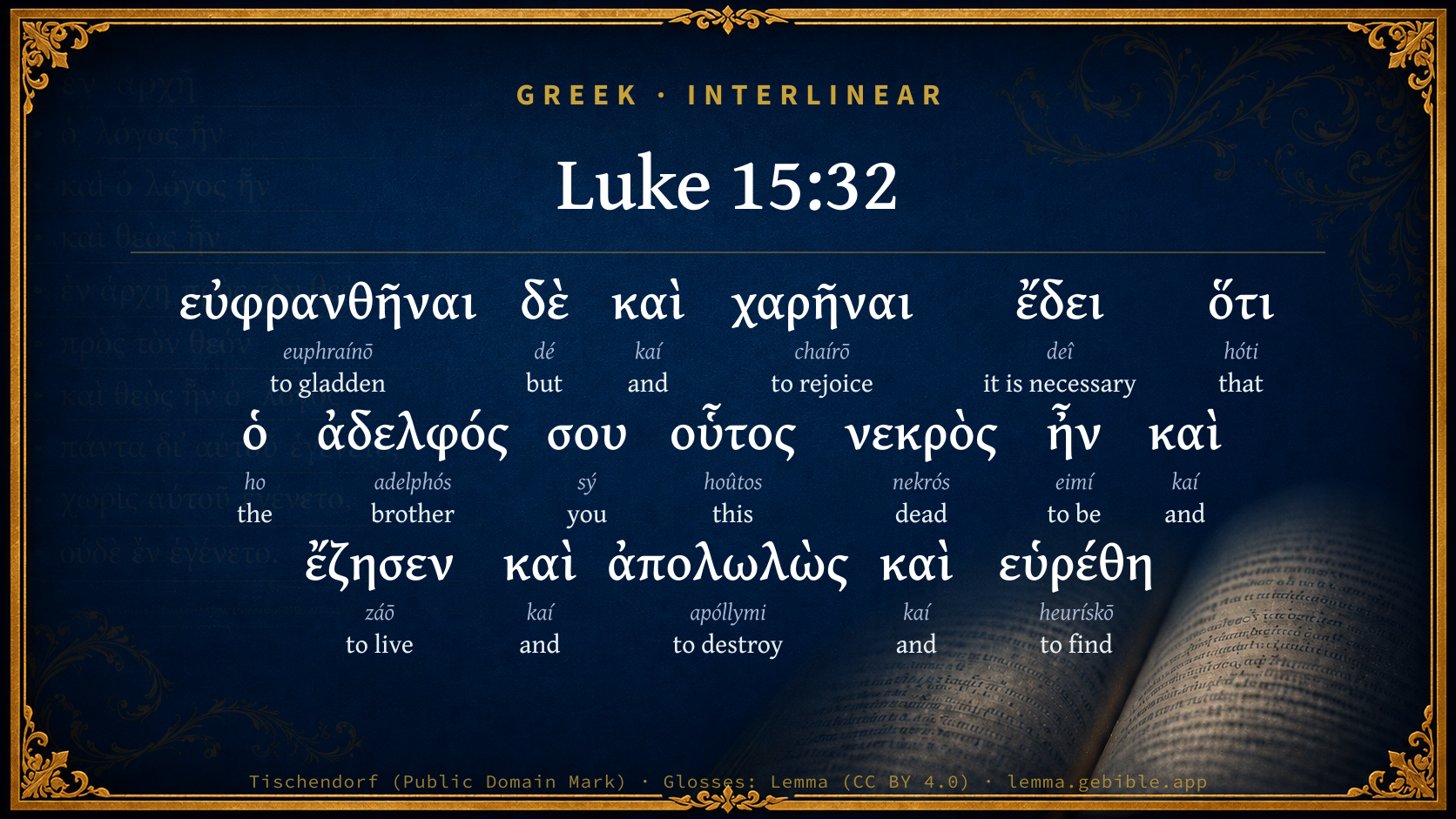
Greek (Tischendorf 8th ed.) Luke 15:32 appears in the Greek New Testament. The text above is from the Tischendorf 8th edition. Each word links to its Strong’s number and a concise gloss. Click any word for its full Thayer’s Greek Lexicon entry.
Download image
Cite this verse

Luke 15:32 (World English Bible). Public Domain. Lemma interlinear Bible study tool, https://lemma.gebible.app/v/luke/15/32.

Show BibTeX & RIS
BibTeX
RIS
English Translation
But it was appropriate to celebrate and be glad, for this, your brother, was dead, and is alive again. He was lost, and is found.'"
World English Bible · Public Domain
Download a study sheet

One document with this verse’s original text, its word-by-word gloss line, the meaning frame, cross-references with their text, attributed commentary, and full source and license credits — printable, and it pastes into notes with its structure intact.

This verse Autodidact and up

Study sheet (.html) Plain text (.txt)

A passage Seminary Student

Up to 50 verses in one chapter. A passage sheet keeps up to 6 commentary sources and 12 cross-references per verse, in the order this page ranks them, and says so on the sheet whenever that leaves anything out. Ask for a single verse and you get the Autodidact verse sheet above.

Everything on this page stays free to read, with no account — the sheet is a download of what is already on screen, not access to it.

Want to remove ads? Support Godless Engineer
Compare translations 3

The same verse in 3 English versions, stacked beneath the original-language interlinear above. Click any original word for its lexicon entry.

Each is an independent rendering of the whole verse — the interlinear is not word-aligned to these translations.

Highlighted words mark where these versions differ — a whole-verse word diff, not a word-by-word alignment.

  • World English Bible Public Domain
    But it was appropriate to celebrate and be glad, for this, your brother, was dead, and is alive again. He was lost, and is found.'"
  • King James Version Public Domain
    It was meet that we should make merry, and be glad: for this thy brother was dead, and is alive again; and was lost, and is found.
  • unfoldingWord Literal Text CC BY-SA 4.0
    But it was proper to celebrate and to rejoice, for this brother of yours was dead, and lived, and he had been lost, and was found.’”

unfoldingWord Literal Text — © unfoldingWord, licensed CC BY-SA 4.0. Word-aligned USFM3 via Door43 (git.door43.org/unfoldingWord/en_ult).

Versions to compare (up to 4)

3 of 4 selected

Show all 18 translations

Every available English version of this verse, each an independent rendering of the whole verse.

  • World English Bible Public Domain
    But it was appropriate to celebrate and be glad, for this, your brother, was dead, and is alive again. He was lost, and is found.'"
  • Berean Standard Bible Public Domain
    But it was fitting to celebrate and be glad, because this brother of yours was dead and is alive again; he was lost and is found.’”
  • Majority Standard Bible Public Domain
    But it was fitting to celebrate and be glad, because this brother of yours was dead and is alive again; he was lost and is found.’”
  • King James Version Public Domain
    It was meet that we should make merry, and be glad: for this thy brother was dead, and is alive again; and was lost, and is found.
  • American Standard Version (1901) Public Domain
    But it was meet to make merry and be glad: for this thy brother was dead, and is alive `again'; and `was' lost, and is found.
  • Revised Version (1885) Public Domain
    But it was meet to make merry and be glad: for this thy brother was dead, and is alive again; and was lost, and is found.
  • Douay-Rheims (1899) Public Domain
    But it was fit that we should make merry and be glad, for this thy brother was dead and is come to life again; he was lost, and is found.
  • Young's Literal Translation Public Domain
    but to be merry, and to be glad, it was needful, because this thy brother was dead, and did live again, he was lost, and was found.'
  • Literal Standard Version CC BY-SA 4.0
    but to be merry, and to be glad, it was necessary, because this your brother was dead, and lived again, he was lost, and was found.”
  • Unlocked Literal Bible CC BY-SA 4.0
    But it was proper for us to feast and be happy, for this brother of yours was dead, and is now alive; he was lost, and has now been found.'”
  • unfoldingWord Literal Text CC BY-SA 4.0
    But it was proper to celebrate and to rejoice, for this brother of yours was dead, and lived, and he had been lost, and was found.’”
  • Darby Bible Public Domain
    But it was right to make merry and rejoice, because this thy brother was dead and has come to life again, and was lost and has been found.
  • World Messianic Bible Public Domain
    But it was appropriate to celebrate and be glad, for this, your brother, was dead, and is alive again. He was lost, and is found.’”
  • Webster's Bible Public Domain
    It was meet that we should make merry, and be glad: for this thy brother was dead, and is alive again; and was lost, and is found.
  • Free Bible Version CC BY-SA 4.0
    But we should be happy and celebrate! This is your brother who was dead, but who has returned alive; he was lost but now he's found!’”
  • Bible in Basic English Public Domain
    But it was right to be glad and to have a feast; for this your brother, who was dead, is living again; he had gone away and has come back.
  • Text-Critical English NT CC BY 4.0
    But it was proper to celebrate and rejoice, for yoʋr brother was dead but is now alive again; he was lost but has now been found.’ ”
  • Tyndale New Testament (1534) Public Domain
    it was mete that we shuld make mery and be glad: for this thy brother was deed and is a lyve agayne: and was loste and is founde.

Literal Standard Version (2020), Covenant Press — licensed CC BY-SA 4.0. Text via the HelloAO Bible API (eBible.org). Unlocked Literal Bible (unfoldingWord) — licensed CC BY-SA 4.0. Text via the HelloAO Bible API (eBible.org). unfoldingWord Literal Text — © unfoldingWord, licensed CC BY-SA 4.0. Word-aligned USFM3 via Door43 (git.door43.org/unfoldingWord/en_ult). Free Bible Version, Dr. Jonathan Gallagher — licensed CC BY-SA 4.0. Text via the HelloAO Bible API (eBible.org).

Word by word

More ways to search: Search by grammar → Find every occurrence → Compare this word →

Practice this passage: Drill this verse → Learn its vocabulary →

εὐφρανθῆναι
euphraínō
G2165
“to gladden”
Verb, Aorist, Passive, Infinitive
Part of Speech
Verb
Tense
Aorist
Voice
Passive
Mood
Infinitive
Full Thayer's Definition

Origin: from G2095 and G5424

TDNT: 14:52,3

1. to gladden, make joyful a. to be glad, to be merry, to rejoice b. to rejoice in, be delighted with a thing
  1. δὲ dé G1161 “but” Conjunction
  2. καὶ kaí G2532 “and” Conjunction
  3. χαρῆναι chaírō G5463 “to rejoice” Verb, Aorist, Passive deponent, Infinitive
  4. ἔδει deî G1163 “it is necessary” Verb, Imperfect, Active, Indicative, 3rd person, Singular
  5. ὅτι hóti G3754 “that” Conjunction
  6. ὁ ho G3588 “the” Article, Nominative, Singular, Masculine
  7. ἀδελφός adelphós G80 “brother” Noun, Nominative, Singular, Masculine
  8. σου sý G4771 “you” Personal pronoun, 2nd person, Genitive, Singular
  9. οὗτος hoûtos G3778 “this” Demonstrative pronoun, Nominative, Singular, Masculine
  10. νεκρὸς nekrós G3498 “dead” Adjective, Nominative, Singular, Masculine
  11. ἦν eimí G1510 “to be” Verb, Imperfect, Active, Indicative, 3rd person, Singular
  12. καὶ kaí G2532 “and” Conjunction
  13. ἔζησεν záō G2198 “to live” Verb, Aorist, Active, Indicative, 3rd person, Singular
  14. καὶ kaí G2532 “and” Conjunction
  15. ἀπολωλὼς apóllymi G622 “to destroy” Verb, Perfect, Active, Participle, Nominative, Singular, Masculine
  16. καὶ kaí G2532 “and” Conjunction
  17. εὑρέθη heurískō G2147 “to find” Verb, Aorist, Passive, Indicative, 3rd person, Singular

About this verse

These counts appear in no published source. They are computed here, from the morphology-tagged text and Lemma’s own curated glosses. What Lemma adds →

18
words
15
distinct lemmas
Gospels
section

Notable vocabulary

The rarest word here is εὐφρανθῆναι to gladden G2165 — appearing just 14 times in the whole Greek New Testament.

Shared distinctive vocabulary

εὐφρανθῆναι to gladden G2165 occurs in 14 verses of the Greek New Testament. Also found in:

Repetition

A word recurs within this verse:

Cross-references

10

Topical passages linked to Luke 15:32 in the Treasury of Scripture Knowledge — connected by theme and wording, ordered by reader-vote popularity; previews shown in the World English Bible.

  • Ephesians 2:1–10 You were made alive when you were dead in transgressions and sins,
  • Luke 15:24 for this, my son, was dead, and is alive again. He was lost, and is found.' They began to celebrate.
  • Isaiah 35:10 and the ransomed of Yahweh shall return, and come with singing to Zion; and everlasting joy shall be on their heads: they shall obtain gladness and joy, and sorrow and sighing shall flee away.
  • Psalms 51:8 Let me hear joy and gladness, That the bones which you have broken may rejoice.
  • Romans 3:4 May it never be! Yes, let God be found true, but every man a liar. As it is written, "That you might be justified in your words, And might prevail when you come into judgment."
  • Jonah 4:10–11 Yahweh said, "You have been concerned for the vine, for which you have not labored, neither made it grow; which came up in a night, and perished in a night.
  • Romans 15:9–13 and that the Gentiles might glorify God for his mercy. As it is written, "Therefore will I give praise to you among the Gentiles, And sing to your name."
  • Hosea 14:9 Who is wise, that he may understand these things? Who is prudent, that he may know them? For the ways of Yahweh are right, And the righteous walk in them; But the rebellious stumble in them.
  • Romans 3:19 Now we know that whatever things the law says, it speaks to those who are under the law, that every mouth may be closed, and all the world may be brought under the judgment of God.
  • Luke 7:34 The Son of Man has come eating and drinking, and you say, 'Behold, a gluttonous man, and a drunkard; a friend of tax collectors and sinners!'

Cross-references courtesy of OpenBible.info (CC BY 4.0).

Where the printed editions differ

1 variant

Places in this verse where the major printed Greek editions disagree on the wording in a way that affects the translation — a comparison of editions, not a manuscript-by-manuscript collation. The editions are the modern critical texts (Nestlé-Aland 28/27, SBL, Westcott-Hort, Tregelles, Tyndale House) and the traditional texts behind the KJV (the Textus Receptus and the Byzantine/Majority text). It is not a claim about which reading is original.

  1. Different wording
    ἔζησεν,

    “is alive ,”

    In NA28NA27TynSBLWHTreg Not in TRByz

    ἀνέζησεν (anezēsen) 'is alive again' occurs in traditional manuscripts (TR+Byz) instead of ἔζησεν, (ezēsen) 'is alive ,' in older manuscripts (NA28+NA27+Tyn+SBL+WH+Treg)

Textual data: Translators Amalgamated Greek New Testament (STEPBible TAGNT) · CC BY 4.0.

Commentary

Notes on Luke 15:32 from classic Christian and Jewish commentators (each source and its license shown beneath its notes). The classic Christian expositions comment on the surrounding passage and are grouped to its opening verse, so a note may address several verses; the Jewish commentaries on the Tanakh (Rashi and others) are per-verse, so they appear only where the commentator wrote on this verse.

Lemma curates 59 commentaries, every one of them public domain or Creative Commons licensed, each selected and text-cleaned for this edition rather than reprinted as found. About our sources →

Adam Clarke's Commentary

Verse 32. This thy brother] Or, THIS brother of THINE. To awaken this ill-natured, angry, inhumane man to a proper sense of his duty, both to his parent and brother, this amiable father returns him his own unkind words, but in a widely different spirit. This son of mine to whom I show mercy is THY brother, to whom thou shouldst show bowels of tenderness and affection; especially as he is no longer the person he was: he was dead in sin - he is quickened by the power of God: he was lost to thee, to me, to himself, and to our God; but now he is found: and he will be a comfort to me, a help to thee, and a standing proof, to the honour of the Most High, that God receiveth sinners. This, as well as the two preceding parables, was designed to vindicate the conduct of our blessed Lord in receiving tax-gatherers and heathens; and as the Jews, to whom it was addressed, could not but approve of the conduct of this benevolent father, and reprobate that of his elder son, so they could not but justify the conduct of Christ towards those outcasts of men, and, at least in the silence of their hearts, pass sentence of condemnation upon themselves. For the sublime, the beautiful, the pathetic, and the instructive, the history of Joseph in the Old Testament, and the parable of the prodigal son in the New, have no parallels either in sacred or profane history.

THE following reflections, taken chiefly from pious Quesnel, cannot fail making this incomparable parable still more instructive.

Three points may be considered here: I. The degrees of his fall. II. The degrees of his restoration; and, III. The consequences of his conversion.

I. The prodigal son is the emblem of a sinner who refuses to depend on and be governed by the Lord. How dangerous is it for us to desire to be at our own disposal, to live in a state of independency, and to be our own governors! God cannot give to wretched man a greater proof of his wrath than to abandon him to the corruption of his own heart.

Not many days, c., Lu 15:13. The misery of a sinner has its degrees and he soon arrives, step by step, at the highest pitch of his wretchedness.

The first degree of his misery is, that he loses sight of God, and removes at a distance from him. There is a boundless distance between the love of God, and impure self-love; and yet, strange to tell, we pass in a moment from the one to the other!

The second degree of a sinner's misery is, that the love of God being no longer retained in the heart, carnal love and impure desires necessarily enter in, reign there, and corrupt all his actions.

The third degree is, that he squanders away all spiritual riches, and wastes the substance of his gracious Father in riot and debauch.

When he had spent all, c., Lu 15:14. The fourth degree of an apostate sinner's misery is, that having forsaken God, and lost his grace and love, he can now find nothing but poverty, misery, and want. How empty is that soul which God does not fill! What a famine is there in that heart which is no longer nourished by the bread of life!

In this state, he joined himself - εκολληθη, he cemented, closely united himself, and fervently cleaved to a citizen of that country, Lu 15:15.

The fifth degree of a sinner's misery is, that he renders himself a slave to the devil, is made partaker of his nature, and incorporated into the infernal family. The farther a sinner goes from God, the nearer he comes to eternal ruin.

The sixth degree of his misery is, that he soon finds by experience the hardship and rigour of his slavery. There is no master so cruel as the devil no yoke so heavy as that of sin; and no slavery so mean and vile as for a man to be the drudge of his own carnal, shameful, and brutish passions.

The seventh degree of a sinner's misery is, that he has an insatiable hunger and thirst after happiness; and as this can be had only in God, and he seeks it in the creature, his misery must be extreme. He desired to fill his belly with the husks, Lu 15:16. The pleasures of sense and appetite are the pleasures of swine, and to such creatures is he resembled who has frequent recourse to them, 2Pe 2:22.

II. Let us observe, in the next place, the several degrees of a sinner's conversion and salvation.

The first is, he begins to know and feel his misery, the guilt of his conscience, and the corruption of his heart. He comes to himself, because the Spirit of God first comes to him, Lu 15:17.

The second is, that he resolves to forsake sin and all the occasions of it; and firmly purposes in his soul to return immediately to his God. I will arise, c., Lu 15:18.

The third is, when, under the influence of the spirit of faith, he is enabled to look towards God as a compassionate and tender-hearted father. I will arise and go to my father.

The fourth is, when he makes confession of his sin, and feels himself utterly unworthy of all God's favours, Lu 15:19.

The fifth is, when he comes in the spirit of obedience, determined through grace to submit to the authority of God and to take his word for the rule of all his actions, and his Spirit for the guide of all his affections and desires.

The sixth is, his putting his holy resolutions into practice without delay; using the light and power already mercifully restored to him, and seeking God in his appointed ways. And he arose and came, c., Lu 15:20.

The seventh is, God tenderly receives him with the kiss of peace and love, blots out all his sins, and restores him to, and reinstates him in, the heavenly family. His father-fell on his neck, and kissed him, Lu 15:20.

The eighth is, his being clothed with holiness, united to God, married as it were to Christ Jesus, 2Co 11:2, and having his feet shod with the shoes of the preparation of the Gospel of peace, Eph 6:15, so that he may run the ways of God's commandments with alacrity and joy. Bring the best robe - put a ring - and shoes, c., Lu 15:22.

III. The consequences of the sinner's restoration to the favour and image of God are, first, the sacrifice of thanksgiving is offered to God in his behalf he enters into a covenant with his Maker, and feasts on the fatness of the house of the Most High.

Secondly, The whole heavenly family are called upon to share in the general joy the Church above and the Church below both triumph; for there is joy (peculiar joy) in the presence of the angels of God over one sinner that repenteth. See Lu 15:10.

Thirdly, God publicly acknowledges him for his son, not only by enabling him to abstain from every appearance of evil, but to walk before him in newness of life, Lu 15:24. The tender-hearted father repeats these words at Lu 15:32, to show more particularly that the soul is dead when separated from God; and that it can only be said to be alive when united to him through the Son of his love. A Christian's sin is a brother's death; and in proportion to our concern for this will our joy be at his restoration to spiritual life. Let us have a brotherly heart towards our brethren, as God has that of a father towards his children, and seems to be afflicted at their loss, and to rejoice at their being found again, as if they were necessary to his happiness.

In this parable, the younger profligate son may represent the Gentile world; and the elder son, who so long served his father, Lu 15:20, the Jewish people. The anger of the elder son explains itself at once - it means the indignation evidenced by the Jews at the Gentiles being received into the favour of God, and made, with them, fellow heirs of the kingdom of heaven.

It may also be remarked, that those who were since called Jews and Gentiles, were at first one family, and children of the same father: that the descendants of Ham and Japhet, from whom the principal part of the Gentile world was formed, were, in their progenitors, of the primitive great family, but had afterwards fallen off from the true religion: and that the parable of the prodigal son may well represent the conversion of the Gentile world, in order that, in the fulness of time, both Jews and Gentiles may become one fold, under one Shepherd and Bishop of all souls.

Adam Clarke's Commentary on the Bible (1810–1826) — public domain. Text from a community e-Sword/MySword module.

Joseph Benson's Commentary

Luk 15:32. It was meet that we should make merry and be glad — Both reason and natural affection justify me in calling the whole family to rejoice on the present occasion. For this thy brother was dead, &c. — As thy brother is returned to us sensible of his folly, and determined to lead a new life in future, his arrival is like his reviving after death, at least, it is his being found after he was really lost. For which reason our joy ought to bear a proportion to the greatness of this occasion. There is a beautiful opposition between the father’s words here, and those of the elder son, Luk 15:30. The latter had there indecently said to his father, This thy son. The father, in his reply, mildly reproves him, and tenderly says, This thy brother — As if he had said, “Though he hath devoured my living with harlots, he is thy brother, as well as my son: wherefore thou shouldest not be angry because he hath repented and is returned, after we thought him irrecoverably lost. Thus the goodness with which the father bore the surly peevishness of his elder son was little inferior to the mercy shown in the pardon that he granted to the younger: and we have herein a moving intimation that the best of men ought to look on the most abandoned sinners as, in some respect, their brethren still, and should especially remember the relation, when there appears any inclination in such sinners to return.” Jesus having thus set before them the affectionate behaviour of an earthly parent toward his undutiful children, left every one to judge whether such weak and wicked creatures can love their offspring with more true tenderness than the great Father Almighty loves his, or can show them more indulgence for their benefit. Indeed, “in this inimitable composition, the amazing mercy of God is painted with captivating beauty; and in all the three parables, the joys occasioned among heavenly beings by the conversion of a single sinner are represented; joys even to God himself, than which a nobler and sweeter thought never entered into the mind of rational creatures. Thus high do men stand in the estimation of God; for which cause they should not cast themselves away in that trifling manner wherein multitudes destroy themselves; neither should any think the salvation of others a small matter, as some who are intrusted with their recovery seem to do. Had the Pharisees understood the parable, how criminal must they have appeared in their own eyes, when they saw themselves truly described in the character of the eldest son, who was angry that his brother had repented! Withal, how bitter must their remorse have been, when they found themselves, not only repining at that which gave joy to God, the conversion of sinners, but excessively displeased with the methods of his procedure in this matter, and maliciously opposing them! If these parables had been omitted by Luke, as they have been by the other three historians, the world would certainly have sustained an unspeakable loss.” — Macknight.

Many have considered this parable in a view of peculiar application to the Jews and Gentiles; and have observed, that the murmurs of the Jews against the apostles for preaching the gospel to the Gentiles, are represented by the conduct of the elder brother. This was certainly a case comprehended in our Lord’s design, but he undoubtedly had something more in his intention: he meant to show, that had the Pharisees been as eminently good as they themselves pretended to be, yet it would have been very unworthy their character to take offence at the kind treatment which any sincere penitent might receive. Thus does he here, and in many parallel texts, condemn their conduct on their own principles, though elsewhere, on proper occasions, he shows the falsehood of those principles, and plainly exposes their hypocrisy and guilt. But our Lord had still a further design in delivering this parable; he intended to give us, as he has done, a lively emblem of the character and condition of sinners in their fallen state. Like this prodigal, they are impatient of the most necessary restraints, fondly conceited of their own wisdom; and when enriched by the bounties of the great common Father, they ungratefully run from him, saying to him, in effect, Depart from us, we desire not the knowledge of thy ways. Sensual pleasures are eagerly sought; and perhaps all their earthly possessions and hopes are quickly paid as the price of them: while the means of obtaining these pleasures continue, not a serious thought of God can find place in their minds. And even when afflictions come upon them, still they make hard shifts, before they will let the grace of God, concurring with his providence, persuade them to think of a return. When they see themselves naked and indigent, enslaved and undone, then they come to themselves, and recover the exercise of their reason. Then they remember the blessings they have thrown away, and attend to the misery they have incurred. And hereupon they resolve to return to their heavenly Father, and put the resolution immediately in practice: they arise and go unto him. Behold with wonder and pleasure the gracious reception they find from divine injured goodness! When such a prodigal comes to his Father, the Father sees him afar off: he pities, meets, embraces him, and interrupts his acknowledgments with the tokens of his returning favour. He arrays him with the robe of the Redeemer’s righteousness, imputed and implanted, with pardon and holiness, adorns him with all his sanctifying graces, and honours him with the tokens of adopting love, and all the glorious privileges and immunities of his children. And all this he does with unutterable delight, in that he who was lost is now found. Let no elder brother murmur at this indulgence, but rather welcome the prodigal back into the family. And let those who have been thus received wander no more, but emulate the strictest piety of those who for many years have served their heavenly Father, and made it their daily care, not to transgress his commandments, but to walk before him in all well-pleasing.

Joseph Benson's Commentary on the Old and New Testaments (1811–1818) — public domain. Text from a community e-Sword module.

Bengel's Gnomon

Johann Albrecht Bengel

Luk 15:32. Ἔδει) Not only is the idea intimated hereby, Thou oughtest to have rejoiced; but this one, Rejoicing ought to have been commenced as it has been at our house. For it is a kind of apologetic defence against the complaint expressed in verse 30 [the killing of the fatted calf for such a profligate], with which comp. Luk 15:2 [in which the corresponding complaint of the Pharisees occurs, “This man receiveth sinners, and eateth with them.”]. [How wonderful is the condescending kindness of the Father (in thus gently expostulating with one who evinced so bad a spirit)!—V. g.] So ἔδει, in the sense it was befitting, not it would be befitting, Act 1:16 [Peter, speaking of the past, ἔδει πληρωθῆναι τὴν γραφὴν—περὶ Ἰούδα, It was befitting, that the Scripture should be fulfilled concerning Judas].—ὁ ἀδελφός σου οὗτος, this thy brother) In antithesis to this thy son, in Luk 15:30 [which the elder brother had said contemptuously].

Bengel's Gnomon of the New Testament — English translation (T&T Clark, Edinburgh, 1860) — public domain. Text from a community e-Sword module.

Jamieson, Fausset & Brown

Robert Jamieson, A. R. Fausset & David Brown

It was meet--Was it possible he should simply take his long vacant place in the family without one special sign of wonder and delight at the change? Would that have been nature? But this being the meaning of the festivity, it would for that very reason be temporary. In time, the dutifulness of even the younger son would become the law and not the exception; he too at length might venture to say, "Lo, these many years do I serve thee"; and of him the father would say, "Son, thou art ever with me." In that case, therefore, it would not be "meet that they should make merry and be glad." The lessons are obvious, but how beautiful! (1) The deeper sunk and the longer estranged any sinner is, the more exuberant is the joy which his recovery occasions. (2) Such joy is not the portion of those whose whole lives have been spent in the service of their Father in heaven. (3) Instead of grudging the want of this, they should deem it the highest testimony to their lifelong fidelity, that something better is reserved for them--the deep, abiding complacency of their Father in heaven.

Next: Luke Chapter 16

Jamieson, Fausset & Brown — Commentary Critical and Explanatory on the Whole Bible (1871) — public domain (CC PDM 1.0). Text via the HelloAO Bible API.

Ellicott's Commentary for English Readers

(32) It was meet that we should make merry.—The Greek expresses moral necessity rather than mere fitness. “We must needs rejoice;” it could not be otherwise. The repetition of the same words that had been used before, “he was dead . . .” is singularly-emphatic. This, and nothing more or less than this was the true account of the change that had passed over the wanderer; and this ought to be a source of joy to all his kindred. There is, perhaps, a touch of tenderness as well as reproof in the way in which the scornful “this thy son” is met by “this thy brother.” The elder son had forgotten that fact, and had almost disclaimed his own sonship in his scorn for the offender.

A Bible Commentary for English Readers, edited by Charles John Ellicott (1878–1897) — public domain. Text from a community e-Sword module.

The Cambridge Bible for Schools and Colleges

gen. ed. J. J. S. Perowne

32. It was meet that we should make merry, and be glad] “They glorified God...saying, Then hath God also to the Gentiles granted repentance unto life,” Act_11:18. It would be impossible to mark more emphatically God’s displeasure at the narrow, exclusive, denunciatory spirit which would claim for ourselves only, or our party, or our Church, a monopoly of heaven. The hard dogmatism and speculative theories of a self-asserting Theology “vanish like oppressive nightmares before this single parable in which Jesus reveals the heavenly secrets of human redemption, not according to a mystical or criminal theory of punishment, but anthropologically,

psychologically, and theologically to every pure eye that looks into the perfect law of liberty.” Von Ammon, Leb. Jesu, iii. 50.

this thy brother] For he is thy brother, and I thy Father, though thou wouldest refuse this name to him, and didst not address that title to me.

The Cambridge Bible for Schools and Colleges (gen. ed. J. J. S. Perowne; Cambridge University Press, 1878–1918) — public domain. Text from a community e-Sword module.

John Gill's Exposition

It was meet that we should make merry,.... Both father, son, and servants; See Gill on Luk 15:23, Luk 15:24 and this elder brother also, because of the relation he stood in to him: and if he had had the same spiritual affection the apostle had for his brethren and kinsmen, according to the flesh, Rom 9:3 and he would have rejoiced at the conversion and return of sinners by repentance:

and be glad; as his father was, and the angels in heaven be; see Luk 15:10

for this thy brother, though he would not own him as such,

was dead, and is alive again, and was lost, and is found:, Luk 15:24 and so the parable is concluded, the elder brother being silenced, and having nothing to say against such strong reasoning.

Next: Luke Chapter 16

John Gill's Exposition of the Whole Bible (1746–1763) — public domain (CC PDM 1.0). Text via the HelloAO Bible API.

Trapp's Complete Commentary

John Trapp

32 It was meet that we should make merry, and be glad: for this thy brother was dead, and is alive again; and was lost, and is found.

Ver. 32. Was lost, and is found] Of himself he left his father; yet is he called the lost son.

John Trapp, A Commentary or Exposition upon All the Books of the Old and New Testament (1647–1656) — public domain. Text from a community e-Sword module.

John Wesley's Explanatory Notes

This thy brother was dead, and is alive - A thousand of these delicate touches in the inspired writings escape an inattentive reader. In ver. 30, the elder son had unkindly and indecently said, This thy son. The father in his reply mildly reproves him, and tenderly says, This thy brother - Amazing intimation, that the best of men ought to account the worst sinners their brethren still; and should especially remember this relation, when they show any inclination to return. Our Lord in this whole parable shows, not only that the Jews had no cause to murmur at the reception of the Gentiles, (a point which did not at that time so directly fall under consideration, ) but that if the Pharisees were indeed as good as they fancied themselves to be, still they had no reason to murmur at the kind treatment of any sincere penitent. Thus does he condemn them, even on their own principles, and so leaves them without excuse. We have in this parable a lively emblem of the condition and behaviour of sinners in their natural state. Thus, when enriched by the bounty of the great common Father, do they ungratefully run from him, ver. 12. Sensual pleasures are eagerly pursued, till they have squandered away all the grace of God, ver. 13. And while these continue, not a serious thought of God can find a place in their minds. And even when afflictions come upon them, ver. 14, still they will make hard shifts before they will let the grace of God, concurring with his providence, persuade them to think of a return, ver. 15, 16. When they see themselves naked, indigent, and undone, then they recover the exercise of their reason, ver. 17. Then they remember the blessings they have thrown away, and attend to the misery they have incurred. And hereupon they resolve to return to their father, and put the resolution immediately in practice, ver. 18, 19. Behold with wonder and pleasure the gracious reception they find from Divine, injured goodness! When such a prodigal comes to his father, he sees him afar off, ver. 20. He pities, meets, embraces him, and interrupts his acknowledgments with the tokens of his returning favour, ver. 21. He arrays him with the robe of a Redeemer's righteousness, with inward and outward holiness; adorns him with all his sanctifying graces, and honours him with the tokens of adopting love, ver. 22. And all this he does with unutterable delight, in that he who was lost is now found, ver. 23, 24. Let no elder brother murmur at this indulgence, but rather welcome the prodigal back into the family. And let those who have been thus received, wander no more, but emulate the strictest piety of those who for many years have served their heavenly Father, and not transgressed his commandments.

John Wesley, Explanatory Notes Upon the Whole Bible (1754–1765) — public domain. Text via the GEBible commentary corpus.

Cambridge Greek Testament for Schools and Colleges

32. εὐφρανθῆναι δὲ καὶ χαρῆναι ἔδει. There was a moral fitness in our mirth. “They glorified God … saying, Then hath God also to the Gentiles granted repentance unto life,” Act 11:18. It would be impossible to mark more emphatically God’s displeasure at the narrow, exclusive, denunciatory spirit which would claim for ourselves only, or our party, or our Church, a monopoly of heaven. The hard dogmatism and speculative theories of a self-asserting Theology “vanish like oppressive nightmares before this single parable in which Jesus reveals the heavenly secrets of human redemption, not according to a mystical or criminal theory of punishment, but anthropologically, psychologically, and theologically to every pure eye that looks into the perfect law of liberty.” Von Ammon, Leb. Jesu, III. 50.

ὁ ἀδελφός σου οὗτος. The οὗτος which the elder son had used is repeated, but in a very different sense. For he is thy brother, and I thy father, though thou wouldest refuse this name to him, and didst not address that title to me.

νεκρὸς ἦν καὶ ἔζησεν. Comp. Rom 11:15.

Cambridge Greek Testament for Schools and Colleges (Cambridge University Press, 1896; 21 vols, various authors incl. Carr, Maclear, Plummer, Farrar, Lumby, Moule, M. R. James, Simcox) — public domain. Text from a community e-Sword module.

Alford’s Greek Testament

Henry Alford

32.] ἔδει—not σε, but generally—it was right. The Father still asserts the restored sonship of his returned prodigal—ὁ ἀδελ. σου οὗτος. We may remark that the difficulties which have been found in the latter part of the parable, from the uncontradicted assertion in ver. 29, if the Pharisees are meant,—and the great pride and uncharitableness shewn, if really righteous persons are meant,—are considerably lightened by the consideration, that the contradiction of that assertion would have been beside the purpose of the parable; that it was the very thing on which the Pharisees prided themselves; that, besides, it is sufficiently contradicted in fact, by the spirit and words of the elder son. He was breaking his Father’s commandment even when he made the assertion,—and the making it is part of his hypocrisy.

The result of the Father’s entreaty is left purposely uncertain (see Trench, Par. in loc.):—is it possible that this should have been the case, had the Jewish nation been meant by the elder brother? But now, as he typifies a set of individuals who might themselves be (and many of them were) won by repentance,—it is thus broken off, to be closed by each individual for himself. For we are all in turn examples of the cases of both these brothers, containing the seeds of both evil courses, in our hearts: but, thanks be to God, under that grace, which is sufficient and willing to seek and save us from both.

Henry Alford, The Greek Testament (1849–1861) — public domain. Text from a community e-Sword module.

International Critical Commentary

32. εὐφρανθῆναι δὲ καὶ χαρῆναι ἔδει. Note the emphatic order. “To be merry and be glad was our bounden duty.” The εὐφρανθῆναι of the external celebration, the χαρῆναι of the inward feeling. The imperf. perhaps contains a gentle reproof: it was a duty which the elder son had failed to recognize.

ὁ ἀδελφόͅ σου οὗτοͅ. The substitution of ὁ ἀδελφόͅ σου for ὁ υἱόͅ μου, and the repetition of οὗτοͅ, clearly involve a rebuke: “this thy brother, of whom thou thinkest so severely. If I have gained a son, thou hast gained a brother.”

Not the least skilful touch in this exquisite parable is that it ends here. We are not told whether the elder brother at last went in and rejoiced with the rest. And we are not told how the younger one behaved afterwards. Both those events were still in the future, and both agents were left free. One purpose of the parable was to induce the Pharisees to come in and claim their share of the Father’s affection and of the heavenly joy. Another was to prove to the outcasts and sinners with what generous love they had been welcomed. Marcion omitted this parable.

Cov. Coverdale.

Tyn. Tyndale.

Gen. Geneva.

AV. Authorized Version.

RV. Revised Version.

Tert. Tertullian.

Win. Winer, Grammar of N.T. Greek (the page refers to Moulton’s edition).

1 In the Midrash there is a story that Moses, while tending Jethro’s flocks, went after a lamb which had gone astray. As he thought that it must be weary, he carried it back on his shoulders, Then God said, that, because he had shown pity to the sheep of a man, He would give him His own sheep, Israel, to feed (Edersh. L. & T. 2. p. 257; Wetst. on Luk 15:5).

§ Found in Luke alone.

1 Nearly all Latin texts have dragmas, dracmas, or drachmas here; but Cod. Palat. and Ad Novatianum xv. (Hartel’s Cypr. App. p. 65) have denarios.

Wic. Wiclif.

Luth. Luther.

1 MSS. of the Vulg. nearly all read evertit, which Wordsworth conjectures to be a slip for everrit. Lat. Vet. has scopis mundavit (b f ff2 l), scopis mundabit (iq), scopis commundat (a) scopis mundat (c r), mundat (d), emundat (e).

Beng. Bengel.

Trench, Trench, Parables.

2 Inter omnes Christi parabolas hæc sane eximia est, plena affectuum of pulcherrimis picta coloribus (Grotius on ver. 20).

Hist. of J. N. History of the Jewish Nation.

אԠא Cod. Sinaiticus, sæc. iv. Brought by Tischendorf from the Convent of St. Catherine on Mt. Sinai; now at St. Petersburg. Contains the whole Gospel complete.

A A. Cod. Alexandrinus, sæc. v. Once in the Patriarchal Library at Alexandria; sent by Cyril Lucar as a present to Charles 1. in 1628, and now in the British Museum. Complete.

Jos. Josephus.

Clem. Alex. Clement of Alexandria.

Trench, Trench, New Testament Synonyms.

Syr Syriac.

Sin. Sinaitic.

B B. Cod. Vaticanus, sæc. 4. In the Vatican Library certainly since 15331 (Batiffol, La Vaticane de Paul 3, etc., p. 86).

D D. Cod. Bezae, sæc. vi. Given by Beza to the University Library at Cambridge 1581. Greek and Latin. Contains the whole Gospel.

L L. Cod. Regius Parisiensis, sæc. viii. National Library at Paris. Contains the whole Gospel.

R R. Cod. Nitriensis Rescriptus, sæc. 8. Brought from a convent in the Nitrian desert about 1847, and now in the British Museum. Contains 1:1-13, 1:69-2:4, 16-27, 4:38-5:5, 5:25-6:8, 18-36, 39, 6:49-7:22, 44, 46, 47, 8:5-15, 8:25-9:1, 12-43, 10:3-16, 11:5-27, 12:4-15, 40-52, 13:26-14:1, 14:12-15:1, 15:13-16:16, 17:21-18:10, 18:22-20:20, 20:33-47, 21:12-22:15, 42-56, 22:71-23:11, 38-51. By a second hand 15:19-21.

X X. Cod. Monacensis, sæc. ix. In the University Library at Munich. Contains 1:1-37, 2:19-3:38, 4:21-10:37, 11:1-18:43, 20:46-24:53.

Δ̠Δ. Cod. Sangallensis, sæc. ix. In the monastery of St. Gall in Switzerland. Greek and Latin. Contains the whole Gospel.

D. Smith’s Dictionary of the Bible, 2nd edition.

1 “These ‘husks’ are to be seen on the stalls in all Oriental towns, where they are sold for food, but are chiefly used for the feeding of cattle and horses, and especially for pigs” (Tristram, Nat. Hist. of B. p. 361).

U U. Cod. Nanianus, sæc. x. In the Library of St. Mark’s, Venice. Contains the whole Gospel.

Vulg. Vulgate.

F F. Cod. Boreeli, sæc. ix. In the Public Library at Utrecht. Contains considerable portions of the Gospel.

Hier. Palestinian (Jerusalem).

Boh. Bohairic.

Aeth. Ethiopic.

Arm. Armenian.

Goth. Gothic.

International Critical Commentary — older volumes (1896–1929), various authors — public domain. Text from a community e-Sword module.

Lesson kit

Teaching starters — assembled from the data on this page, not authored interpretation. Every prompt links to the verse data it draws on. Edit before teaching.

Luke, in the Gospels, opens this verse with 18 words (15 distinct Greek lemmas). Its most distinctive word is euphraínō (“to gladden”). A historical commentator’s framing appears above. Read the whole chapter for the surrounding context.

Discussion questions

  1. The word euphraínō carries the sense “to gladden.” How does it shape the verse?
  2. Luke 12:19 shares the word «to gladden» with this verse. How do the two illuminate each other?
  3. “and” occurs 4× in this one verse. What is the effect of the repetition?
  4. These translations render this verse differently. What is at stake in choosing one wording over another?
  5. Reading how Adam Clarke's Commentary and Joseph Benson's Commentary read this verse, where do the two commentators agree and where do they part?

Things to notice

Reading settings

Reading text

Shown beneath each verse's original-language words.

Old Testament
Old Testament edition

Read the OT as the Masoretic Hebrew (MT) or the Greek Septuagint (LXX).

English shown for the Greek Septuagint (in the Hebrew ↔ Greek comparison).

Comparing translations? Open the Compare panel on any verse page to stack up to four side by side.