
Luke 21:36

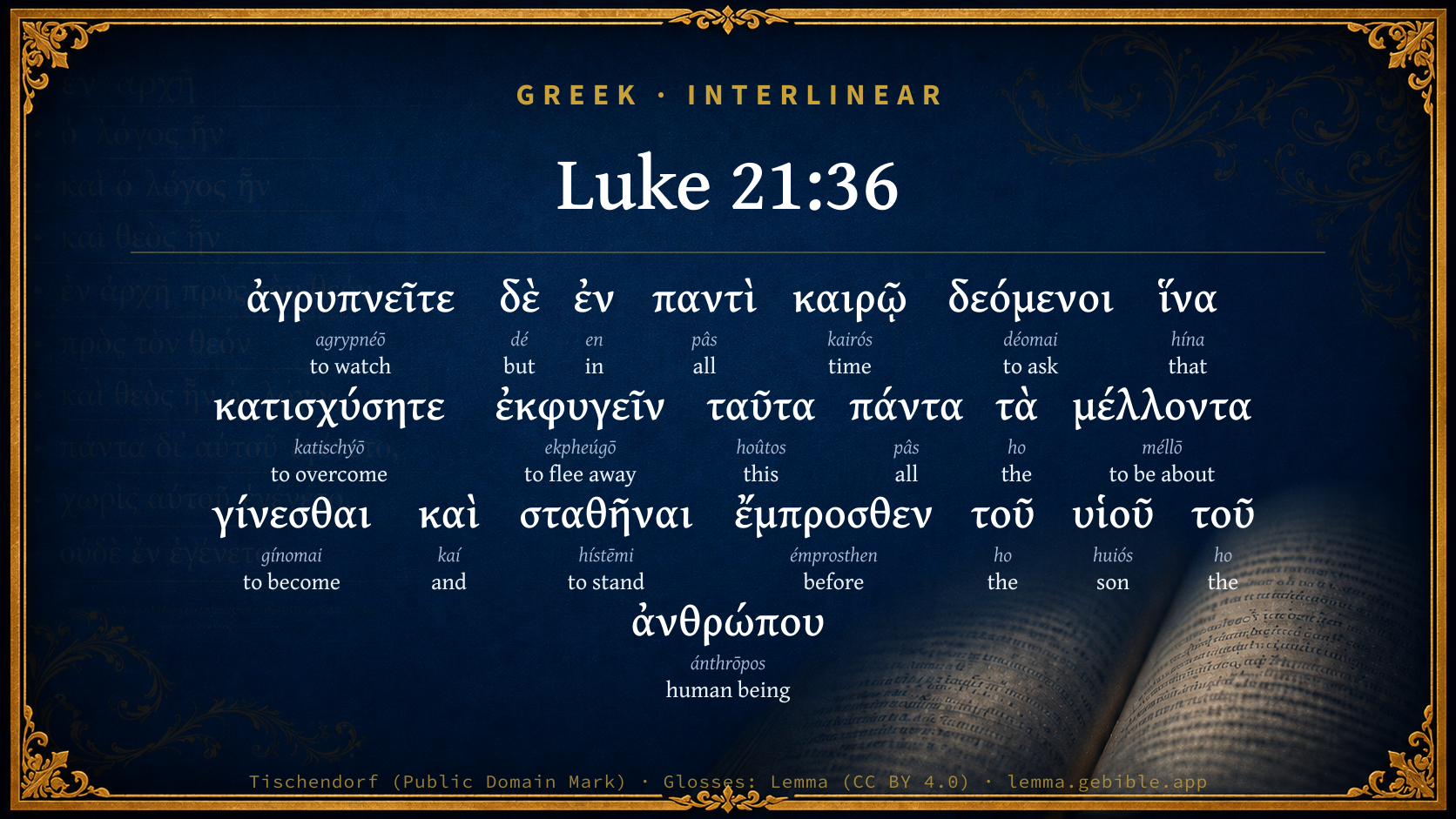
Greek (Tischendorf 8th ed.) Luke 21:36 appears in the Greek New Testament. The text above is from the Tischendorf 8th edition. Each word links to its Strong’s number and a concise gloss. Click any word for its full Thayer’s Greek Lexicon entry.
Download image
Cite this verse

Luke 21:36 (World English Bible). Public Domain. Lemma interlinear Bible study tool, https://lemma.gebible.app/v/luke/21/36.

Show BibTeX & RIS
BibTeX
RIS
English Translation
Therefore be watchful all the time, asking that you may be counted worthy to escape all these things that will happen, and to stand before the Son of Man."
World English Bible · Public Domain
Highlights
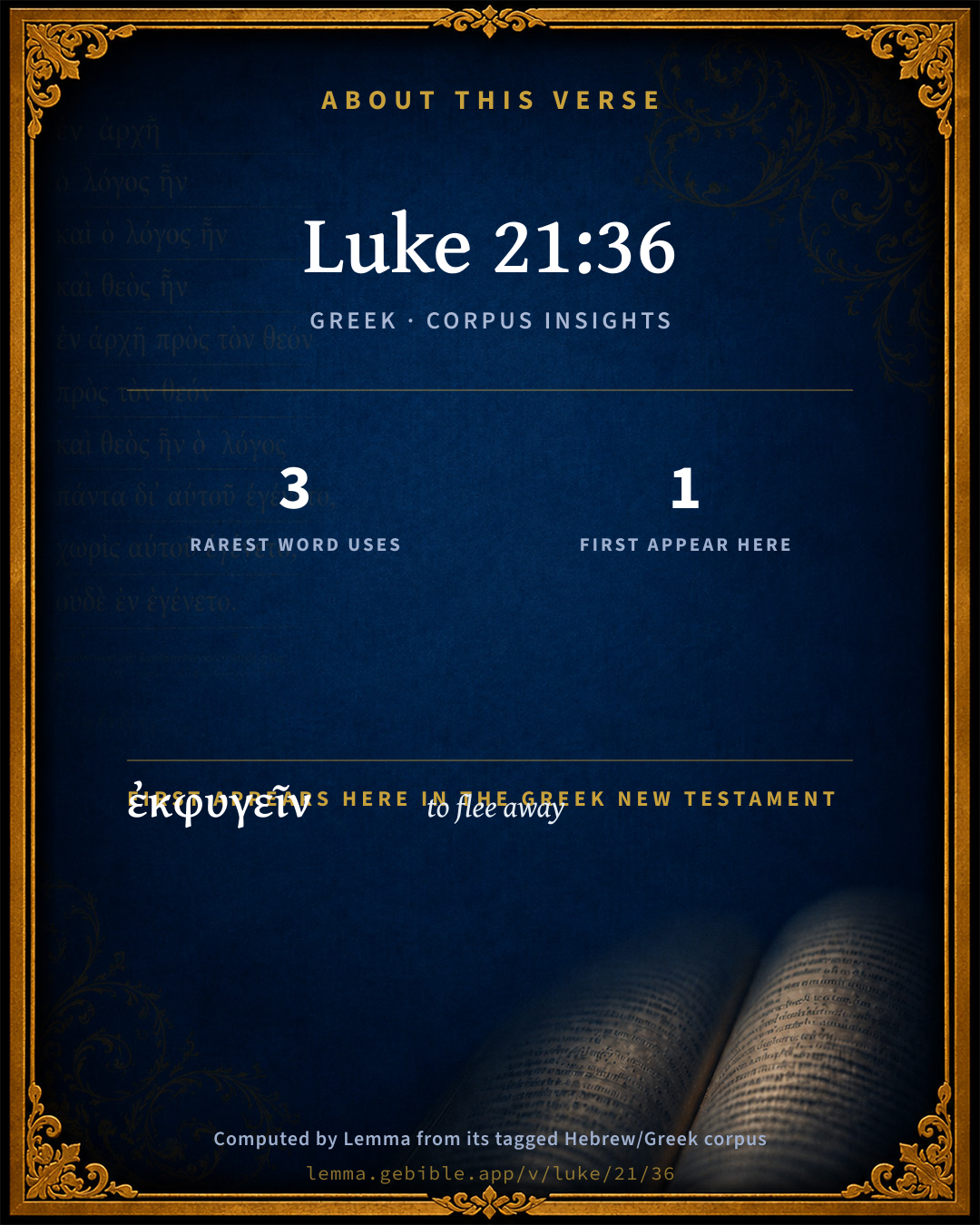
  • 1 first appearance in the Greek New Testament
Full analysis ↓
Download a study sheet

One document with this verse’s original text, its word-by-word gloss line, the meaning frame, cross-references with their text, attributed commentary, and full source and license credits — printable, and it pastes into notes with its structure intact.

This verse Autodidact and up

Study sheet (.html) Plain text (.txt)

A passage Seminary Student

Up to 50 verses in one chapter. A passage sheet keeps up to 6 commentary sources and 12 cross-references per verse, in the order this page ranks them, and says so on the sheet whenever that leaves anything out. Ask for a single verse and you get the Autodidact verse sheet above.

Everything on this page stays free to read, with no account — the sheet is a download of what is already on screen, not access to it.

Want to remove ads? Support Godless Engineer
Compare translations 3

The same verse in 3 English versions, stacked beneath the original-language interlinear above. Click any original word for its lexicon entry.

Each is an independent rendering of the whole verse — the interlinear is not word-aligned to these translations.

Highlighted words mark where these versions differ — a whole-verse word diff, not a word-by-word alignment.

  • World English Bible Public Domain
    Therefore be watchful all the time, asking that you may be counted worthy to escape all these things that will happen, and to stand before the Son of Man."
  • King James Version Public Domain
    Watch ye therefore, and pray always, that ye may be accounted worthy to escape all these things that shall come to pass, and to stand before the Son of man.
  • unfoldingWord Literal Text CC BY-SA 4.0
    But stay awake in every time, praying, so that you may be strong enough to escape all these things that are about to happen, and to stand before the Son of Man.”

unfoldingWord Literal Text — © unfoldingWord, licensed CC BY-SA 4.0. Word-aligned USFM3 via Door43 (git.door43.org/unfoldingWord/en_ult).

Versions to compare (up to 4)

3 of 4 selected

Show all 19 translations

Every available English version of this verse, each an independent rendering of the whole verse.

  • World English Bible Public Domain
    Therefore be watchful all the time, asking that you may be counted worthy to escape all these things that will happen, and to stand before the Son of Man."
  • Berean Standard Bible Public Domain
    So keep watch at all times, and pray that you may have the strength to escape all that is about to happen and to stand before the Son of Man.”
  • Majority Standard Bible Public Domain
    So keep watch at all times, and pray that you may be deemed worthy to escape all that is about to happen and to stand before the Son of Man.”
  • King James Version Public Domain
    Watch ye therefore, and pray always, that ye may be accounted worthy to escape all these things that shall come to pass, and to stand before the Son of man.
  • American Standard Version (1901) Public Domain
    But watch ye at every season, making supplication, that ye may prevail to escape all these things that shall come to pass, and to stand before the Son of man.
  • Revised Version (1885) Public Domain
    But watch ye at every season, making supplication, that ye may prevail to escape all these things that shall come to pass, and to stand before the Son of man.
  • Geneva Bible (1599) Public Domain
    Watche therefore, and pray continually, that ye may be counted worthy to escape all these thinges that shall come to passe, and that ye may stand before the Sonne of man.
  • Douay-Rheims (1899) Public Domain
    Watch ye, therefore, praying at all times, that you may be accounted worthy to escape all these things that are to come, and to stand before the Son of man.
  • Young's Literal Translation Public Domain
    watch ye, then, in every season, praying that ye may be accounted worthy to escape all these things that are about to come to pass, and to stand before the Son of Man.'
  • Literal Standard Version CC BY-SA 4.0
    watch, then, in every season, praying that you may be accounted worthy to escape all these things that are about to come to pass, and to stand before the Son of Man.”
  • Unlocked Literal Bible CC BY-SA 4.0
    But be alert at all times, praying that you may be strong enough to escape all these things that will take place, and to stand before the Son of Man.”
  • unfoldingWord Literal Text CC BY-SA 4.0
    But stay awake in every time, praying, so that you may be strong enough to escape all these things that are about to happen, and to stand before the Son of Man.”
  • Darby Bible Public Domain
    Watch therefore, praying at every season, that ye may be accounted worthy to escape all these things which are about to come to pass, and to stand before the Son of man.
  • World Messianic Bible Public Domain
    Therefore be watchful all the time, praying that you may be counted worthy to escape all these things that will happen, and to stand before the Son of Man.”
  • Webster's Bible Public Domain
    Watch ye therefore, and pray always, that ye may be accounted worthy to escape all these things that shall come to pass, and to stand before the Son of man.
  • Free Bible Version CC BY-SA 4.0
    Always keep watch and pray, so that you may be able to escape all that will happen and stand before the Son of man.”
  • Bible in Basic English Public Domain
    But keep watch at all times with prayer, that you may be strong enough to come through all these things and take your place before the Son of man.
  • Text-Critical English NT CC BY 4.0
    Therefore stay alert at all times, praying that you may be considered worthy to escape everything that will take place, and to stand before the Son of Man.”
  • Tyndale New Testament (1534) Public Domain
    Watche therfore continually and praye that ye maye obtayne grace to flye all this that shall come and that ye maye stonde before the sonne of man.

Literal Standard Version (2020), Covenant Press — licensed CC BY-SA 4.0. Text via the HelloAO Bible API (eBible.org). Unlocked Literal Bible (unfoldingWord) — licensed CC BY-SA 4.0. Text via the HelloAO Bible API (eBible.org). unfoldingWord Literal Text — © unfoldingWord, licensed CC BY-SA 4.0. Word-aligned USFM3 via Door43 (git.door43.org/unfoldingWord/en_ult). Free Bible Version, Dr. Jonathan Gallagher — licensed CC BY-SA 4.0. Text via the HelloAO Bible API (eBible.org).

Word by word

More ways to search: Search by grammar → Find every occurrence → Compare this word →

Practice this passage: Drill this verse → Learn its vocabulary →

κατισχύσητε
katischýō
G2729
“to overcome”
Verb, Present, Active, Subjunctive, 2nd person, Plural
Part of Speech
Verb
Tense
Present
Voice
Active
Mood
Subjunctive
Person
2nd person
Number
Plural
Full Thayer's Definition

Origin: from G2596 and G2480

TDNT: 09:37,4

1. to be strong to another's detriment, to prevail against 2. to be superior in strength 3. to overcome 4. to prevail
  1. ἀγρυπνεῖτε agrypnéō G69 “to watch” Verb, Present, Active, Imperative, 2nd person, Plural
  2. δὲ dé G1161 “but” Conjunction
  3. ἐν en G1722 “in” Preposition
  4. παντὶ pâs G3956 “all” Adjective, Dative, Singular, Masculine
  5. καιρῷ kairós G2540 “time” Noun, Dative, Singular, Masculine
  6. δεόμενοι déomai G1189 “to ask” Verb, Present, Middle or Passive deponent, Participle, Nominative, Plural, Masculine
  7. ἵνα hína G2443 “that” Conjunction
  8. ἐκφυγεῖν ekpheúgō G1628 “to flee away” Verb, Aorist, Active, Infinitive
  9. ταῦτα hoûtos G3778 “this” Demonstrative pronoun, Accusative, Plural, Neuter
  10. πάντα pâs G3956 “all” Adjective, Accusative, Plural, Neuter
  11. τὰ ho G3588 “the” Article, Accusative, Plural, Neuter
  12. μέλλοντα méllō G3195 “to be about” Verb, Present, Active, Participle, Accusative, Plural, Neuter
  13. γίνεσθαι gínomai G1096 “to become” Verb, Present, Middle or Passive deponent, Infinitive
  14. καὶ kaí G2532 “and” Conjunction
  15. σταθῆναι hístēmi G2476 “to stand” Verb, Aorist, Passive, Infinitive
  16. ἔμπροσθεν émprosthen G1715 “before” Preposition
  17. τοῦ ho G3588 “the” Article, Genitive, Singular, Masculine
  18. υἱοῦ huiós G5207 “son” Noun, Genitive, Singular, Masculine
  19. τοῦ ho G3588 “the” Article, Genitive, Singular, Masculine
  20. ἀνθρώπου ánthrōpos G444 “human being” Noun, Genitive, Singular, Masculine

About this verse

These counts appear in no published source. They are computed here, from the morphology-tagged text and Lemma’s own curated glosses. What Lemma adds →

21
words
18
distinct lemmas
Gospels
section

Notable vocabulary

The rarest word here is κατισχύσητε to overcome G2729 — appearing just 3 times in the whole Greek New Testament.

First appearance in Scripture

This word makes its first canonical appearance in the Greek New Testament here:

  • ἐκφυγεῖν to flee away G1628

Shared distinctive vocabulary

κατισχύσητε to overcome G2729 occurs in 3 verses of the Greek New Testament. Also found in:
Repetition

Words recur within this verse:

Cross-references

23

Topical passages linked to Luke 21:36 in the Treasury of Scripture Knowledge — connected by theme and wording, ordered by reader-vote popularity; previews shown in the World English Bible.

  • 1 John 2:28 Now, little children, remain in him, that when he appears, we may have boldness, and not be ashamed before him at his coming.
  • Matthew 25:13 Watch therefore, for you don't know the day nor the hour in which the Son of Man is coming.
  • 1 Peter 5:8 Be sober and self-controlled. Be watchful. Your adversary the devil, walks around like a roaring lion, seeking whom he may devour.
  • Matthew 24:42 Watch therefore, for you don't know in what hour your Lord comes.
  • 1 Peter 4:7 But the end of all things is near. Therefore be of sound mind, self-controlled, and sober in prayer.
  • Mark 13:33 Watch, keep alert, and pray; for you don't know when the time is.
  • 1 Corinthians 16:13 Watch! Stand firm in the faith! Be courageous! Be strong!
  • Luke 18:1 He also spoke a parable to them that they must always pray, and not give up,
  • Malachi 3:2 "But who can endure the day of his coming? And who will stand when he appears? For he is like a refiner's fire, and like launderer's soap;
  • Matthew 26:41 Watch and pray, that you don't enter into temptation. The spirit indeed is willing, but the flesh is weak."
  • Luke 12:37–40 Blessed are those servants, whom the lord will find watching when he comes. Most assuredly I tell you, that he will dress himself, and make them recline, and will come and serve them.
  • Ephesians 6:13–14 Therefore, put on the whole armor of God, that you may be able to withstand in the evil day, and, having done all, to stand.
  • Mark 13:37 What I tell you, I tell all: Watch."
  • Jude 1:24 Now to him who is able to keep them from stumbling, and to present you faultless before the presence of his glory in great joy,
  • 1 Thessalonians 5:17 Pray without ceasing.
  • Colossians 4:2 Continue steadfastly in prayer, watching therein with thanksgiving;
  • 2 Thessalonians 1:5–6 This is an obvious sign of the righteous judgment of God, to the end that you may be counted worthy of the Kingdom of God, for which you also suffer.
  • 2 Timothy 4:5 But you be sober in all things, suffer hardship, do the work of an evangelist, and fulfill your ministry.
  • Psalms 1:5 Therefore the wicked shall not stand in the judgment, Nor sinners in the congregation of the righteous.
  • Acts 10:2 a devout man, and one who feared God with all his house, who gave gifts for the needy generously to the people, and always prayed to God.
  • Ephesians 6:18–19 with all prayer and requests, praying at all times in the Spirit, and being watchful to this end in all perseverance and requests for all the saints:
  • Job 27:10 Will he delight himself in the Almighty, And call on God at all times?
  • Luke 20:35 But those who are considered worthy to attain to that age and the resurrection from the dead, neither marry, nor are given in marriage.

Cross-references courtesy of OpenBible.info (CC BY 4.0).

Where the printed editions differ

2 variants

Places in this verse where the major printed Greek editions disagree on the wording in a way that affects the translation — a comparison of editions, not a manuscript-by-manuscript collation. The editions are the modern critical texts (Nestlé-Aland 28/27, SBL, Westcott-Hort, Tregelles, Tyndale House) and the traditional texts behind the KJV (the Textus Receptus and the Byzantine/Majority text). It is not a claim about which reading is original.

  1. Different wording
    δὲ

    “also”

    In NA28NA27TynSBLWHTreg Not in TRByz

    οὖν (oun) 'therefore' occurs in traditional manuscripts (TR+Byz) instead of δὲ (de) 'also' in older manuscripts (NA28+NA27+Tyn+SBL+WH+Treg)

  2. Different wording
    κατισχύσητε

    “you may have strength”

    In NA28NA27TynSBLWHTreg Not in TRByz

    καταξιωθῆτε (kataxiōthēte) 'you may be considered worthy' occurs in traditional manuscripts (TR+Byz) instead of κατισχύσητε (katischusēte) 'you may have strength' in older manuscripts (NA28+NA27+Tyn+SBL+WH+Treg)

Textual data: Translators Amalgamated Greek New Testament (STEPBible TAGNT) · CC BY 4.0.

Commentary

Notes on Luke 21:36 from classic Christian and Jewish commentators (each source and its license shown beneath its notes). The classic Christian expositions comment on the surrounding passage and are grouped to its opening verse, so a note may address several verses; the Jewish commentaries on the Tanakh (Rashi and others) are per-verse, so they appear only where the commentator wrote on this verse.

Lemma curates 59 commentaries, every one of them public domain or Creative Commons licensed, each selected and text-cleaned for this edition rather than reprinted as found. About our sources →

The Biblical Illustrator

Joseph S. Exell

Luk_21:36

Watch ye, therefore, and pray always

Christian preparation for the coming of the Lord

The subject of our inquiry to-day will be--What practical effect ought the doctrine of the Lords second coming to have on you and me, living when and where and as we do?

On the certainty of that coming, I need, I suppose, say very little. On the manner of that coming, we possibly may not be agreed; the time of it is expressly and purposely concealed from us. Two things, therefore, seem to me to have a right, as elements, to influence our practice in this matter; the absolute certainty that the day will come, and the absolute uncertainty when it will come. In fact, in both these respects we are in much the same situation as we are, when in health and strength and the prime of life, with regard to the day of our death. We know that it must be; but no sign appears of its immediate approach. And from this example, so common and so well understood, we may perhaps be able easily to deduce our duty in the other case. The wise course with regard to the inevitable day of ones death appears to be this: never to lose sight of the certainty of it, but to keep ourselves ever ready, while at the same time we do not morbidly brood over the fact, nor allow it to interrupt our duties in life. And here, as in that other case, we must avoid a diseased and restless state of anticipation, as well as the opposite extreme of entire forgetfulness. But perhaps it may be said, In laying down rules for the one consideration, that of our own deaths, are we not also including the other, the expectation of the coming of the Lord? Certainly, in some particulars the two great events coincide; but by no means in all. And it may be profitable for a few moments to ask ourselves wherein they are identical, and wherein each has its region peculiar to itself. They coincide in that each event, as far as we are concerned, will put a limit to this our present state of existence; but they differ, in that the one will do this for ourselves alone; the other, for all mankind. And this is a strictly practical consideration; for I suppose few of us are so selfish as to confine our anticipations and provisions to ourselves alone, but we all extend them over those who are to come after us. The certainty, then, of the day of the Lord will influence those provisions, if we look on it as bringing the limit of this state of time; we shall be rather anxious to do present good with our substance, making moderate provision for our successors, than to lay the foundations of great possessions, and starve our charities to do so. Again, they differ, in that the one brings to ourselves alone the final state; the other completes the great scheme of redemption. The number of Gods elect will be accomplished, and His glorious kingdom will have come. And such a consideration, while it may not have much distinctive influence upon our individual Christian lives, ought to have much upon our regard of our relative duties, and our efforts for spreading Christs gospel on earth. (Dean Alford.)

On preparing for Christs coming rather than for death

Of all the subjects on which we may speculate as to our own state and destination, perhaps none is so mysterious, none so difficult to form a definite idea of, as the condition of the dead after the act of death; on the other hand nothing is more simple and clear, than their state after the coming of the Lord. There is, then, this consideration, which is worthy at least of our notice; that the looking for and waiting unto the day of the Lord brings us something more definite, something immediately following it of a more tangible kind, more calculated to make a deep impression on us, than the contemplation of the day of our own death. The realities consequent on the one are and must be, even to the strongest faith, shrouded in a mist which is to us impenetrable; the other, with its realities, stands forth boldly before us, marked out in all its features by the hand of Christ Himself. So that the man who waits for the Lords coming is likely to be more definite, more assured, more manly and determined in whatever effects on his character such anticipation may have, than he who merely looks forward to his own death. Moreover, when we compare the two as to the question, which best befits the Christian as an object of thought and expectation--we cannot, I think, hesitate a moment. The New Testament is full of exhortations to watch and prepare for the Lords coming. From His own discourses while on earth in the flesh, through those of the apostles in the Acts, through the Epistles of St. Paul, St. Peter, St. James, St. John, St. Jude, even to the latest written words of the Spirit in the Revelation, no command is more frequent, none more solemnly impressed on us, than that we should keep that great event constantly in view, and be ever ready for it. Whereas we shall hardly find one exhortation, addressed directly to us as Christians, to be ready for the day of our own death. And why so? clearly not because such readiness is not necessary--far from it indeed--but because the greater absorbs the less: because the promise of our ascended Saviour--His return to us--His coming to take account of His servants--includes in it all that the other possibly could do, and very much more; because death is at the best but a gloomy thing, bearing trace of the curse, accompanied with pain and sorrow, whereas the Lords coming is to His people a thought full of joy--the completion of their redemption, the beginning of their reign of glory. (Dean Alford.)

Preparation of heart

We want, in our preparation for the day of the Lord, lightness of heart; hearts which we can lift up to heaven where our treasure is; hearts which are not tied down to this earth--not cleaving to the dust. And how may we lighten our hearts? The first lightening--the first rolling off of the burden which weighed so heavily on them, is the work of Gods Spirit in the day of His power; is that setting free from the load of sin by the blessed effects of justifying faith in Christ, in which the law of the Spirit of life makes us free from the law of sin and death. But how may we best keep them, when thus lightened, from again accumulating a burden, and being weighed down from their proper object of contemplation and desire? Listen to our Lords command. It is the surfeiting of this worlds employments and pleasures which thus clogs the heart. This, then, of all things is to be shunned, if we would be prepared for that day. You cannot, beloved, be casting yourselves fully into the arms of the world, and be prepared for the coming of the Lord. The two things are absolutely incomparable. If you choose the part of eagerness about things present, that day will come upon you unawares--whether it come with the sign in the clouds and the resurrection trumpet, or with the sinking of the flesh and heart, the curtained chamber; the bedside group fading away from the failing vision. (Dean Alford.)

The command to watch

Two facts concerning His advent are plainly stated and they are all that a majority of His Church will perceive, namely: that we are ignorant of the time of the end; that it will be sudden.

I. THE READY SOUL IS THE DILIGENT.

II. THE READY SOUL IS THE VIGILANT.

III. THE READY SOUL IS THE PRAYERFUL. (De Witt S. Clark.)

The safety of prayer

Our Lord did not so much urge the duty of praying as the safety of prayer.

I. To this, then, let us first turn our thoughts. Jesus mentioned as the special aim of prayer: That ye may be accounted worthy to escape all these things, i.e., calamities, that their city, nation, race, and, in fact, the human family were liable to experience, but yet might escape if only they would seek to be accounted worthy to do so. The word worthy as here used calls for examination; for if it be taken in the sense of deserving because faultless, there is no use in saying anything about it: we are not that; and we never can so be accounted worthy, having already committed aggravated offences against God without number, which have brought compromises of guilt and stains upon our souls. The idea of merit, however, which the word worthy usually carries with it, is not at all intended in this verse. The verb used is a military term really, meaning to conquer, to win a victory, to prevail against another, against an enemy, against baffling influences and hindering circumstances. Hence the meaning of the word in the text is: that they might be able to prevail and escape all the calamities Jesus had been speaking of. The Revised Version sustains this interpretation. It gives the text: But watch ye at every season, making supplication that ye may prevail to escape all these things that shall come to pass, and to stand before the Son of Man. It was not that He counselled His disciples to deserve or merit safety through their good conduct, although their good conduct was to be as binding as ever, but to pray that they might be tenacious of purpose, unyielding, and therefore, successful in overcoming temptation, walking so faithfully with their Lord Jesus Christ, as to practise good conduct and persevere in it.

II. Mind, they were to pray that they might be tenacious. On that they ought to resolve; ought to set out to be tenacious in Christian living, in overcoming human oppositions, surmounting temporal obstacles, social hindrances, threats of rulers, frowns of society, oppositions of families, clamours of self-interest, desires for enjoyment, and lusts that ruin the soul--bearing their cross to follow after Jesus; but still, in addition to all this,nay in order to accomplish all this, they were to make continual and systematic applications to the Host High God. Wherever you have failed tell it to God; in perfect frankness confess it to Him, and ask Him to account you worthy to escape all forces of temptation, and all calamities that are, or are to be, consequent on sin; or as the Revised Version has the text: Make supplication that you may prevail to escape, every evil of ungodliness, whether already wrought in the callousness of your heart, or in a weakness of character growing out of self-love, or in the fearful sorrows that are to be experienced on Christs rejection of your undying soul in the judgment day. (Dr. Trumbull.)

Watching

I. WATCH OVER YOUR OUTGOINGS (Mar_7:20).

II. WATCH OVER THE INCOMINGS. See to it that mind and heart are ever filled with such suggestions as can carry the stamp of Christs approval.

III. WATCH OVER YOUR SURROUNDINGS. Your life has to be lived in the midst of hindering difficulties and influences. Then understand your life. Know the power of your circumstances.

IV. WATCH OVER YOUR OPPORTUNITIES. You will have opportunities

(1) of growing in grace;

(2) of showing faithfulness to your Lord;

(3) of serving Him in your daily sphere. (The Weekly Pulpit.)

Watching

I. ITS PECULIAR CHARACTER. The very quintessence of all faith; the very reason why faith is necessary for the true life. The soul in which burns the light of faith looks forward, and by looking forward is helped to step forward, expecting some strange yet true results. The will is strengthened to assert itself, sometimes on ventures which appear without foundation, but which are based upon the reality of what is to come. So the Christian can go forward with confidence and security.

1. From the call of Abraham to the present day, the supreme attitude of Gods children has been that of expectancy.

2. Just as the Israelites looked for the first coming of the Messiah, so Christians look for the second coming in power and great glory.

II. THE ESSENTIAL BENEFITS OF WATCHING.

1. It is a power which, though often latent and unobserved, is still a power of incalculable force. The unknown reserve of spiritual influence which lies at the root of the sincerely Christian character.

2. The watcher is always ready. No haziness about life, or uncertainty about its aims. (Anon.)

Watchfulness

See that sentry at the gate of an encampment or a fortress--mark his measured tread, his martial port, his anxious thoughdetermined countenance--his quiet and searching glance, as he repeats his constant walk--that soldier is awake; but he is more--he is upon his guard--his mind is full of his important trust--he feels the weight of his responsibility. But see--his frame becomes relaxed, his form grows less erect, his movements lose their regular mechanical succession--his look is vacant or abstracted, he no longer looks afar off and at hand in search of approaching danger, he has either forgotten it, or ceased to reckon it so imminent. And yet the man is wide awake; not only are his eyes still open, but they see surrounding objects; all his senses are still active, and his mind, though distracted from his present duty, is as much at work as ever; for no sooner does the slightest sound arouse him, than, as if by magic, he recovers his position and the tension of his muscles, he resumes his measured walk, his mingled air of circumspection and defiance, and his look of bold but anxious scrutiny. Even before, he was awake; but now he is awake and at the same time on his guard. Precisely the same difference exists between a simple wakefulness in spiritual matters--a wakefulness of understanding, conscience, and affection, and the active exercise of spiritual vigilance; this is impossible without the other, but the other does not necessarily involve this. In both cases, that is, in the literal and spiritual case supposed, there is a sensible gradation of remissness or the opposite. We have seen the sentry wholly losing for a moment the recollection of his solemn trust; but this is not the only way in which he may unconsciously betray it. Look at him again. Every look, every motion, now betokens concentration of his thoughts and feelings on the danger which impends, and against which he is set to watch. Perhaps he is now motionless, but it is only that his eye may be more steadfastly fixed upon the point from which the enemys approach is apprehended. In that point his whole being seems to be absorbed. And you can see at a glance that he is ready, even for the first and faintest intimation of a moving object on that dim horizon. But while he stands like a statue, with his face turned towards that dreaded point, look beyond him and behind him, at those forms which are becoming every moment more and more defined against the opposite quarter of the heavens. He hears them not, because their step is noiseless; he sees them not, because his eye and all his faculties are employed in an opposite direction. While he strains every sense to catch the first intimations of approaching danger, it is creeping stealthily behind him, and when at last his ear distinguishes the tramp of armed men, it is too late, for a hostile hand is already on his shoulder, and if his life is spared, it is only to be overpowered and disarmed without resistance. And yet that soldier was not only awake, but on his guard--his whole being was absorbed in contemplation of the danger which impended; but, alas, he viewed it as impending only from one quarter, and lost sight of it as really approaching from another. We may even suppose that he was right in looking where he did, and only wrong in looking there exclusively. There was an enemy to be expected from that quarter, and if this had been the only one, the sentrys duty would have been successfully performed; but he was not aware, or had forgotten, that the danger was a complex one--that while the enemy delayed his coming, another might be just at hand, and thus the very concentration of his watchfulness on one point defeated its own purpose, by withdrawing his attention from all others. By a slight shifting in the scene, I might present to you the same man or another, gazing not at one point only, but at all; sweeping the whole visible horizon with his eye as he maintains his martial vigil. See with what restless activity his looks pass from one distant point to another, as if resolved that nothing shall escape him, that no imaginable source of danger shall remain unwatched. That man might seem to be in every sense awake and on his guard--surprise might seem to be impossible--but hark! what sound is that which suddenly disturbs him in his solitary vigils? he looks hastily around him, but sees nothing, yet the sound is growing every moment louder and more distinct; a voice of noise from the city--the voice of them that shout for mastery--the voice of them that cry for being overcome! Doubt is no longer possible--it is--it is behind him--yes, the enemy for whom he looked so vigilantly, is within the walls, and the banner which he thought to have seen waving at a distance, is floating in triumph just above his head. The cases which I have supposed are not mere appeals to your imagination. They are full of instruction as to practical realities. They vividly present to us in figurative forms the actual condition of the soul in reference to spiritual dangers. (J. A. Alexander, D. D.)

Before the Son of Man

Before the Son of Man

I. RIGID REQUIREMENTS OF HIS STANDARD.

1. Consecration. Implies self-surrender. The doctrine of the Cross lies at the threshold of Christian living.

2. Purity. Involves thought of the heart, speech, actions.

3. Non-resistance. Overcome evil with good. This is the law of the New Testament, though not of nations or of the world.

4. Forgiveness of injury. Goes beyond passive indifference. Exacts positive affection.

II. DUTY OF STANDING BEFORE HIM. Every time we hear the gospel, we stand before the Son of Man. Every time we witness His ordinances, we are brought face to face with Him. How? Either condemned or justified. Christ is the great Refiner of men. It is our duty to stand before Him.

1. Because His is the only perfect standard. He makes no mistakes.

2. Because it is the only way to secure His favour. Once men put Him on trial; now the order is reversed. He demands that every man be put to the test, to show his quality. To refuse to submit to Christs judgment, is to confess cowardice.

3. Because by this we reach our proper place. The scientific principle is here applied. It is a species of natural selection--the survival of the fittest. Conclusion: To stand before the Son of Man implies--

1. Your life in harmony with His.

2. Watching and prayer.

3. His favour and divinest blessing. (H. S. Lobingier.)

The Biblical Illustrator, edited by Joseph S. Exell (c. 1880s–1900s) — public domain. Text from a community e-Sword module.

Tyndale Open Study Notes

Tyndale Open Resources

21:36 To stand before means “to pass the test” and stand approved before Jesus Christ at his second coming.

Tyndale Open Study Notes — © Tyndale Open Resources, licensed CC BY-SA 4.0. Text via the HelloAO Bible API.

Bengel's Gnomon

Johann Albrecht Bengel

Luk 21:36. Ἀγρυπνεῖτε, watch) Mar 13:33.—ἐν παντὶ καιρῷ δεόμενοι [praying always], praying at every season) ch. Luk 18:1. At every season or time, whether these things [Luk 21:28; Luk 21:31], which are about to be immediately, are had regard to [viz. ταῦτα πάντα (Luk 21:31-32), these nearer events, which are about to befall the city.—Not. Crit.], or that (more remote) day, the day of the Son of Man: Luk 21:28; Luk 21:34. This brief sentence comprises the whole discourse concerning the city and the universal world.—ἐκφυγεῖν, to escape) suddenly.—σταθῆναι) As to the force of this word, see on Mat 12:25. [“Σταθῆναι, to be made to stand by another, to stand by the help of another; στῆναι, by one’s own strength.”—Ammonius.]

Bengel's Gnomon of the New Testament — English translation (T&T Clark, Edinburgh, 1860) — public domain. Text from a community e-Sword module.

Expositor's Greek Testament

ed. W. Robertson Nicoll

Luk 21:36 . ἐν παντὶ καιρῷ , in every season. κατισχύσητε , that ye may have power, “prevail” (R.V [180] ). καταξιωθῆτε (T.R.), “may be accounted worthy” (A.V [181] ), also gives a very good meaning, even in some respects preferable. σταθῆναι , to stand in the judgment (so, many), or to be presented to, placed before. So most recent commentators. Either gives a good sense (Bleek).

[180] Revised Version.

[181] Authorised Version.

The Expositor's Greek Testament, edited by W. Robertson Nicoll (1897–1910) — public domain. Text from a community e-Sword module.

Geneva Bible (1599)

Geneva Bible translators

You may so appear that you will abide the countenance and sentence of the Judge without fear.

Geneva Bible (1599) marginal notes — public domain. Text via Bolls.life.

Jamieson, Fausset & Brown

Robert Jamieson, A. R. Fausset & David Brown

Watch . . . pray, &c.--the two great duties which in prospect of trial are constantly enjoined. These warnings, suggested by the need of preparedness for the tremendous calamities approaching, and the total wreck of the existing state of things, are the general improvement of the whole discourse, carrying the mind forward to Judgment and Vengeance of another kind and on a grander and more awful scale--not ecclesiastical or political but personal, not temporal but eternal--when all safety and blessedness will be found to lie in being able to "STAND BEFORE THE SON OF MAN" in the glory of His personal appearing.

Jamieson, Fausset & Brown — Commentary Critical and Explanatory on the Whole Bible (1871) — public domain (CC PDM 1.0). Text via the HelloAO Bible API.

Adam Clarke's Commentary

Verse 36. Watch ye therefore, and pray always] Perhaps we should connect ες παντι καιρω, continually, with αγρυπνειτε, watch, as it appears to be the most natural order. Indeed the word continually belongs equally to both watch and pray; and no man is safe, at any time, who does not attend to this advice as literally as possible.

That shall come to pass] That is, the tribulations which are on their way to overwhelm and destroy the Jewish people. These are sufficiently stated in the preceding verses.

To stand before the Son of man.] To be acquitted, and to be condemned, are expressed, in Ro 14:4, by standing and falling. Those who were faithful to the grace they had received were not only not destroyed in the destruction of Jerusalem, but became heralds of the grace and mercy of God to the nations. Thus they were counted worthy to stand before the Son of man-to minister salvation in his name.

Adam Clarke's Commentary on the Bible (1810–1826) — public domain. Text from a community e-Sword/MySword module.

Ellicott's Commentary for English Readers

(36) Pray always.—The word is not the same commonly used for “pray,” but occurs once only in the other Gospels (Mat_9:38). St. Luke uses it fifteen times in the Gospel and Acts together, and St. Paul six times (2Co_5:20; 2Co_8:4; 2Co_10:2, et seq.). It is not used by any other New Testament writer.

That ye may be accounted worthy . . .—See Note on Luk_20:35. The better MSS., however, give, “that ye may have strength to escape.”

To stand before the Son of man.—The same preposition is used with special reference to the final judgment in 2Co_5:10, 1Th_3:13.

A Bible Commentary for English Readers, edited by Charles John Ellicott (1878–1897) — public domain. Text from a community e-Sword module.

The Cambridge Bible for Schools and Colleges

gen. ed. J. J. S. Perowne

36. pray always] Luk_18:1; Eph_6:18. Render, watch ye at all times, making supplication.

accounted worthy] See on Luk_20:35. Another reading is “ye may prevail” (katischusete).

to stand before the Son of man] “The ungodly shall not stand in the judgment,” Psa_1:5. “Who shall stand when He appeareth,” Mal_3:2.

the Son of man] See on Luk_5:24, Luk_9:58. On this day our Lord also uttered the Parables of the Ten Virgins and of the Talents, and other warnings, Matthew 25. On this occasion too (as Van Oosterzee conjectures) our Lord may have used His agraphon dogma “in that wherein I shall find you, in that will I judge you,” Just. Mart. Dial.

The Cambridge Bible for Schools and Colleges (gen. ed. J. J. S. Perowne; Cambridge University Press, 1878–1918) — public domain. Text from a community e-Sword module.

Trapp's Complete Commentary

John Trapp

36 Watch ye therefore, and pray always, that ye may be accounted worthy to escape all these things that shall come to pass, and to stand before the Son of man.

Ver. 36. That ye may be accounted worthy] Great is the emphasis of this word, καταξιωθητε (saith learned Beza), for it gives us to understand that we owe all to the free election of God, who loved us first, and so accepted us for worthy, Rev 3:4.

John Trapp, A Commentary or Exposition upon All the Books of the Old and New Testament (1647–1656) — public domain. Text from a community e-Sword module.

The Pulpit Commentary

Standing before Christ.

"Watch... and pray that ye may be accounted worthy... to stand before the Son of man." What is involved in this worthiness? It must include our being

I PREPARED TO GIVE ACCOUNT TO HIM. We know that we shall have to do that; (Ro 10 2Co_5:10) and we must expect, when we do stand before the Judge, to account to Jesus Christ for

(1) the relation which we have voluntarily sustained to himself how we have received his invitation, and with what fullness we have accepted him as the Redeemer, the Friend, the Lord of our heart and life;

(2) the way in which we have served him since we called ourselves by his Namei.e. how closely we have followed him, how obedient we have been to his commandments, how earnest and faithful we have Showed ourselves in his cause; in tact, hove true and loyal we have proved to be as his servants here.

II CONFORMED TO HIS LIKENESS, Will not our Lord expect to find those who professed to be his disciples, who had access to so many and such great privileges, stand before him such as he lived and died to make them. We know what that is. "He gave himself for us, to redeem us from all iniquity;" he has "called us to holiness;" he came and wrought his work in order that he might make us to be in our spirit and character the children of God, bearing our heavenly Father"s image. He will therefore look to those who stand before him as his redeemed ones for:

1. Purity of heart; the abhorrence of all that is evil, and love for that which is good and true and pure.

2. A loving spirit; a spirit of unselfishness, of devotedness, of generosity, of tender solicitude for the well-being of others.

3. Reverence and consecration of heart to God.

III READY FOR THE HEAVENLY SPHERE, To "stand before" the king meant to be ready to fulfill his royal behest, prepared to do at once and to do effectively whatever he might require. To stand before our Divine Sovereign means to be ready to do his bidding, to execute his commandments as he shall employ us in his heavenly service. We naturally and rightly hope that he will entrust us with the most honorable errands, will appoint us to elevated posts, will charge us with noble occupations that will demand enlarged ability and that will contribute great things to his cause and kingdom. We may be sure that the devoted and faithful discharge of our duties here will prove the best preparation for celestial activity and usefulness, lie that is faithful in a few things now will be made ruler over many things hereafter. He who puts out his talents here will be found worthy to stand before the King, and to be employed by him in broad and blessed spheres of service there. If we would be "accounted worthy" to do this, we must "watch and pray.

1. We must spend much time with God in the study of his will and in supplication for the quickening influences of his Spirit.

2. We must often examine our own hearts, observing our progress or retrogression, ready for the act of penitence, or of praise, or of reconsecration as we find ourselves declining. We must also observe the forces that are around us, and distinguish carefully between the hostile and the friendly, between those which make for folly and for sin and those which lead up to wisdom and to righteousness. C.

The Pulpit Commentary (1880–1919), ed. H.D.M. Spence-Jones & Joseph S. Exell — public domain. Text from a community e-Sword module.

John Wesley's Explanatory Notes

Watch ye therefore - This is the general conclusion of all that precedes. That ye may be counted worthy - This word sometimes signifies an honour conferred on a person, as when the apostles are said to be counted worthy to suffer shame for Christ, Acts v, 41. Sometimes meet or becoming: as when John the Baptist exhorts, to bring fruits worthy of repentance, chap. iii, 8. And so to be counted worthy to escape, is to have the honour of it, and to be fitted or prepared for it. To stand - With joy and triumph: not to fall before him as his enemies.

John Wesley, Explanatory Notes Upon the Whole Bible (1754–1765) — public domain. Text via the GEBible commentary corpus.

unfoldingWord translationNotes

Door43 World Missions Community

Connecting Statement:

Jesus finishes teaching his disciples.

be alert

"be ready for my coming"

strong enough to escape all these things

Possible meanings are 1) "strong enough to endure these things" or 2) "able to avoid these things."

these things that will take place

"these things that will happen." Jesus has just told them about terrible things that will happen, such as persecution, war, and captivity.

to stand before the Son of Man

"to stand with confidence before the Son of Man." This probably refers to when the Son of Man judges everyone. A person who is not ready will be afraid of the Son of Man and will not stand with confidence.

translationWords

pray

Son of Man

unfoldingWord translationNotes — © Distant Shores Media and the Door43 World Missions Community, licensed CC BY-SA 4.0. Source: git.door43.org/Door43/en_tn.

Cambridge Greek Testament for Schools and Colleges

36. κατισχύσητε. אBLX Copt. Ti[363] W. H[364] &c. καταξιωθῆτε ACD, La[365]; but probably derived from Luk 20:35.

[363] Ti. Tischendorf.

[364] W. H. Westcott and Hort.

[365] La. Lachmann.

Between 38 and 38 four cursive MSS. add the story of the woman taken in adultery, Joh 7:53 to Joh 8:11.

36. ἀγρυπνεῖτε δὲ κ.τ.λ. Luk 18:1; Eph 6:18. Render ‘watch ye at all times, making supplication.’ ἐν παντὶ καιρῷ. At every season.

κατισχύσητε. See critical note, and Luk 20:35.

σταθῆναι. ‘To take your place.’ Comp. Luk 18:11, Luk 19:8. Mal 3:2. Meyer takes it in the passive sense, ‘to be set’ (by the angels, Mat 24:31).

τοῦ υἱοῦ τοῦ ἀνθρώπου. See on Luk 5:24, Luk 9:58. On this day our Lord also uttered the Parables of the Ten Virgins and of the Talents, and other warnings, Matthew 25.

Cambridge Greek Testament for Schools and Colleges (Cambridge University Press, 1896; 21 vols, various authors incl. Carr, Maclear, Plummer, Farrar, Lumby, Moule, M. R. James, Simcox) — public domain. Text from a community e-Sword module.

Alford’s Greek Testament

Henry Alford

36.] σταθ., to be set, i.e. by the angels—see Matt. ver. 31—before the glorified Son of Man.

37,

Henry Alford, The Greek Testament (1849–1861) — public domain. Text from a community e-Sword module.

International Critical Commentary

36. ἀγρυπνεῖτε δέ. Comp. Eph 6:18; Heb 13:17; 2Sa 12:21; Psa 126:1; Pro 8:34.

The οῦν (A C R, b c ff2. Syrr. Aeth. Arm.) for δέ (א B D, a d e) probably comes from Mat 25:13 and Mar 13:35,

ἐν παντὶ καιρῷ 18:1 and 1Th 5:17 are in favour of taking these words with δεόμενοι (Wic. Gen. Rhem. AV.) rather than with ἀγρυπνεῖτε (Tyn. Cov. Cran. RV.). For similar questions comp. 9:17, 18, 57, 10:18, 9:39, etc.

κατισχύσητε. This is the reading of א B L X 33, Aegyptt. Aeth. and is adopted by the best editors. It properly means “prevail against”. (Mat 16:18; Jer 15:18; 2Ch 8:3; comp. Luk 23:23; Isa 22:4; Wisd. 17:5). The καταξιωθῆτε of A C D R, Latt. Syrr. Arm., Tert. perhaps comes from 20:35.

σταθῆναι. “To hold your place.” comp. Τότε στήσεται ἐν παρρησία πολλῇ ὁ δίκαιος (Wisd. 5:1). It is clear from 11:18. 18:11, 40, 19:8; Act 2:14, Act 5:20, Act 11:13, Act 17:22, Act 25:18, Act 27:21, etc., that σταθῆναι is not to be taken passively of being placed by the Angels (Mat 24:31). Comp. τίς δύναται σταθῆναι; (Rev 6:17). For the opposite of σταθῆναι see 23:30; Rev 6:16: comp. 1Jn 2:28.

The Apocalypse of Jesus

Hase (Gesch. Jesu, § 97). Colani (J. C. et les croyances messianiques de son temps). and others think that Jesus had penetration enough to foresee and predict the destruction of Jerusalem, but they cannot believe that He was such a fanatic as to foretell that He would return in glory and judge the world. Hence they, conclude that these predictions about the Parusia were never uttered by Him Keim sees that Mar 13:32 cannot be an invention (Jes. of Naz. 5. p. 241): in some shape or other Jesus must have foretold His glorious Return. therefore this eschatological discourse is based upon some genuine utterances of Jesus; but has been expanded into an apocalyptic poem with the help of other material. Both Keim and some of those who deny the authenticity of any prediction of Christ’s Return assume the existence of an apocalypse by some Jewish Christian; as the source from which large portions of this discourse are taken. Weizsäcker holds that the apocalypse was Jewish, and was taken from a lost section of the Book of Enoch. Weiffenbach. followed by Wendt and Vischer, upholds the theory of a Jewish-Christian original.

But did this spurious apocalypse, the existence of which is pure conjecture. supply Lk. with what he has recorded 11:49-51. 13:23-27, 35, 17:23, 37. 18:8, 19:15, 43, 20:16? Did it supply Mt. with what he has recorded 7:22, 10:23, 19:28, 21:44. 13:7. 25:31, 26:64? Mk. also with the parallels to them passages? That all three derived these utterances from Apostolic tradition is credible. Is it credible that a writing otherwise unknown and by an unknown author should have had such enormous influence? And its influence does not end with the three Evangelists. It has contributed largely to the Epistles of S. Paul. especially to the very earliest of them. Comp. 1Th 2:16, 1Th 2:4:6, 1Th 2:17, 5:1Th 2:1-3;, 2Th 2:1-12. And it would seem to have influenced much of the imagery in Revelation. which foretells wars. famine, pestilence. and persecution (6:4, 5, 8, 9), and the Return of the Saviour accompanied by the armies of heaven (19:11-16). This supposed fictitious apocalypse is assigned to A.D. 68, or thereabouts; and therefore long after the Pauline Epistles were written. Apostolic tradition, which is known to have existed, is a far safer hypothesis. See Godet. ad loc. (2. PP. 430 ff.), whose remarks have been, freely used in this note. See also Briggs, The Messiah of the Gospels, T. & T. Clark. 1894, ch. 4. where this “Apocalypse of Jesus” is critically discussed, with special reference to the theory of Weiffenbach and others that the assumed Jewish-Christian apocalypse consisted of these three portions:—(a) the ἀρχὴ ὠδίνων, Mar 13:7, Mar 13:8=Mat 24:6-8=Luk 21:9-11; (β) the θλίψις, Mar 13:14-20=Mat 24:15-22; (γ) the παρουσία, Mar 13:24-27=Mat 24:29-31=Luk 21:25-27.Luk 21:1 Briggs points out the insignificance of the fact that ideas such as these are found in Jewish pseudepigrapha. These ideas were by them derived from the O.T.. which was the common source of both canonical and uncanonical apocalypses, whether Jewish or Christian. Jesus uses this source on other occasions, and there is nothing unreasonable in the belief that He uses it here. The cosmical disturbances foretold (vv. 25-27) “belong not only to the theophanies and the Christophanies of prophecy, but also to the theophanies and Christophanies of history In both the Old Testament and the New. They represent the response of the creature to the presence of the Creator” (p. 155). Both Briggs and Nösgen (Gesch. J. C. Kap. 9.), give abundant references to the literature of the subject in Beyschlag (L.J.), Hilgenfeld (Einl. 1. N.T.), Holsten (die syn. Ev..), Immer (Ntl. Theol.), Mangold in Bleek (Einl. 1. N.T.), Pfleiderer (Urchristen.), Pressensé (J.C.) Spitta (die Offbg. des Joh.) and Wendt (Lehre Jesu). See also especially D. E. Haupt (Eschatolog Aussagen Jesu in d. syn. Evang., Berlin, 1895).

International Critical Commentary — older volumes (1896–1929), various authors — public domain. Text from a community e-Sword module.

Vincent's Word Studies in the New Testament

Marvin R. Vincent

Watch. See on Mr 13:33.

Marvin R. Vincent, Word Studies in the New Testament (1887–1900) — public domain. Text from a community e-Sword/MySword module.

Lesson kit

Teaching starters — assembled from the data on this page, not authored interpretation. Every prompt links to the verse data it draws on. Edit before teaching.

Luke, in the Gospels, opens this verse with 21 words (18 distinct Greek lemmas). Its most distinctive word is katischýō (“to overcome”). A historical commentator’s framing appears above. Read the whole chapter for the surrounding context.

Discussion questions

  1. How does “to overcome” (katischýō) shape what this verse is saying?
  2. This is the first place “to flee away” appears in Scripture (first appears here). What does its debut here establish?
  3. How does Matthew 16:18, which shares the word «to overcome», read alongside this verse?
  4. What does the repetition of “all” (2× in this one verse) do in this verse?
  5. The translations on this page render this verse differently — a whole-verse word diff, not a word-by-word alignment. What might account for the different wordings?
  6. Compare how The Biblical Illustrator and Tyndale Open Study Notes read this verse. Where do they agree or differ?

Things to notice

  • 1 word makes its first canonical appearance in Scripture here.
  • These translations choose different wording for 23 words in this verse.
  • “all” occurs 2× in this single verse.
  • 18 distinct Greek lemmas span 21 words in this verse.

Reading settings

Reading text

Shown beneath each verse's original-language words.

Old Testament
Old Testament edition

Read the OT as the Masoretic Hebrew (MT) or the Greek Septuagint (LXX).

English shown for the Greek Septuagint (in the Hebrew ↔ Greek comparison).

Comparing translations? Open the Compare panel on any verse page to stack up to four side by side.