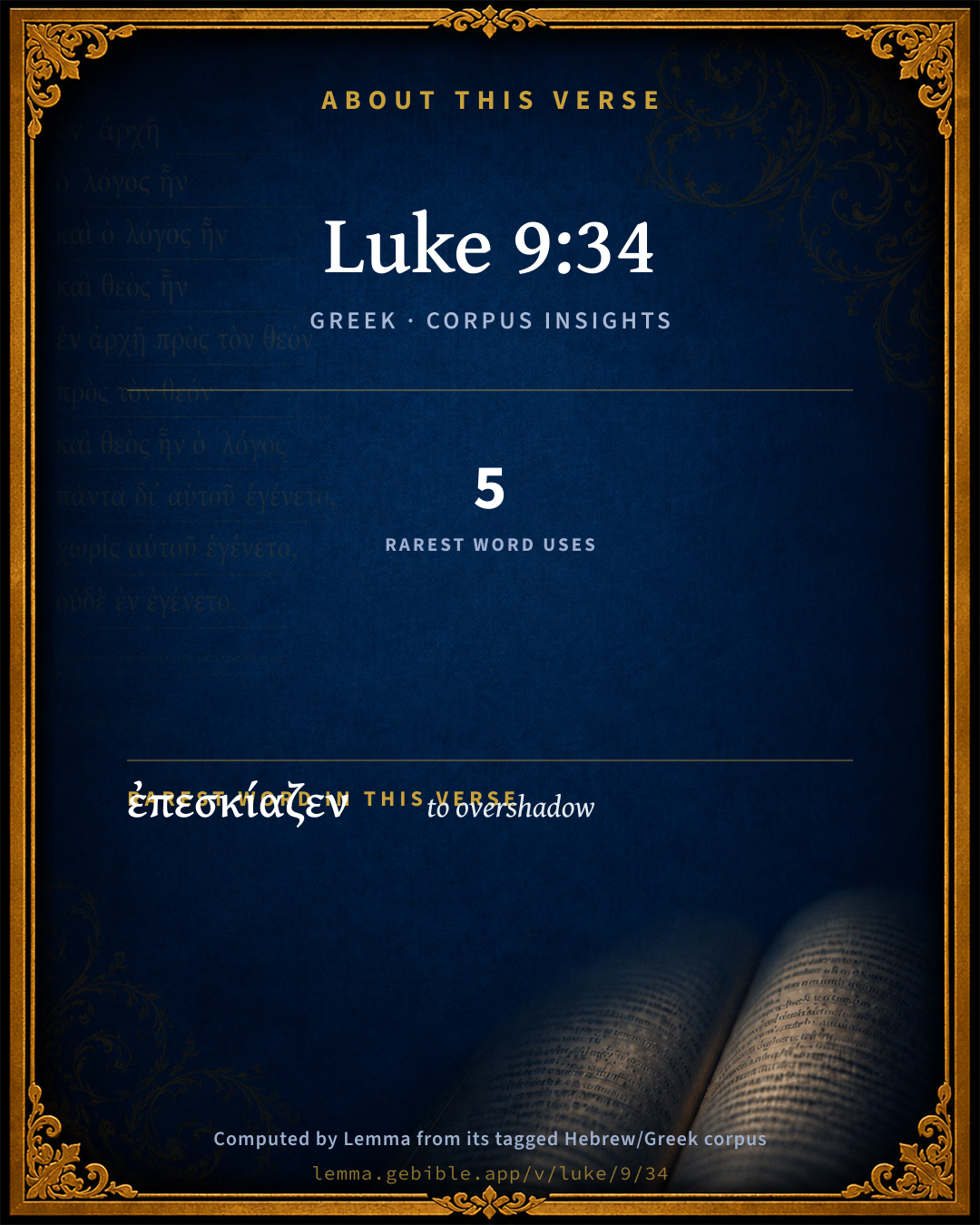
Luke 9:34

Greek (Tischendorf 8th ed.) Luke 9:34 appears in the Greek New Testament. The text above is from the Tischendorf 8th edition. Each word links to its Strong’s number and a concise gloss. Click any word for its full Thayer’s Greek Lexicon entry.
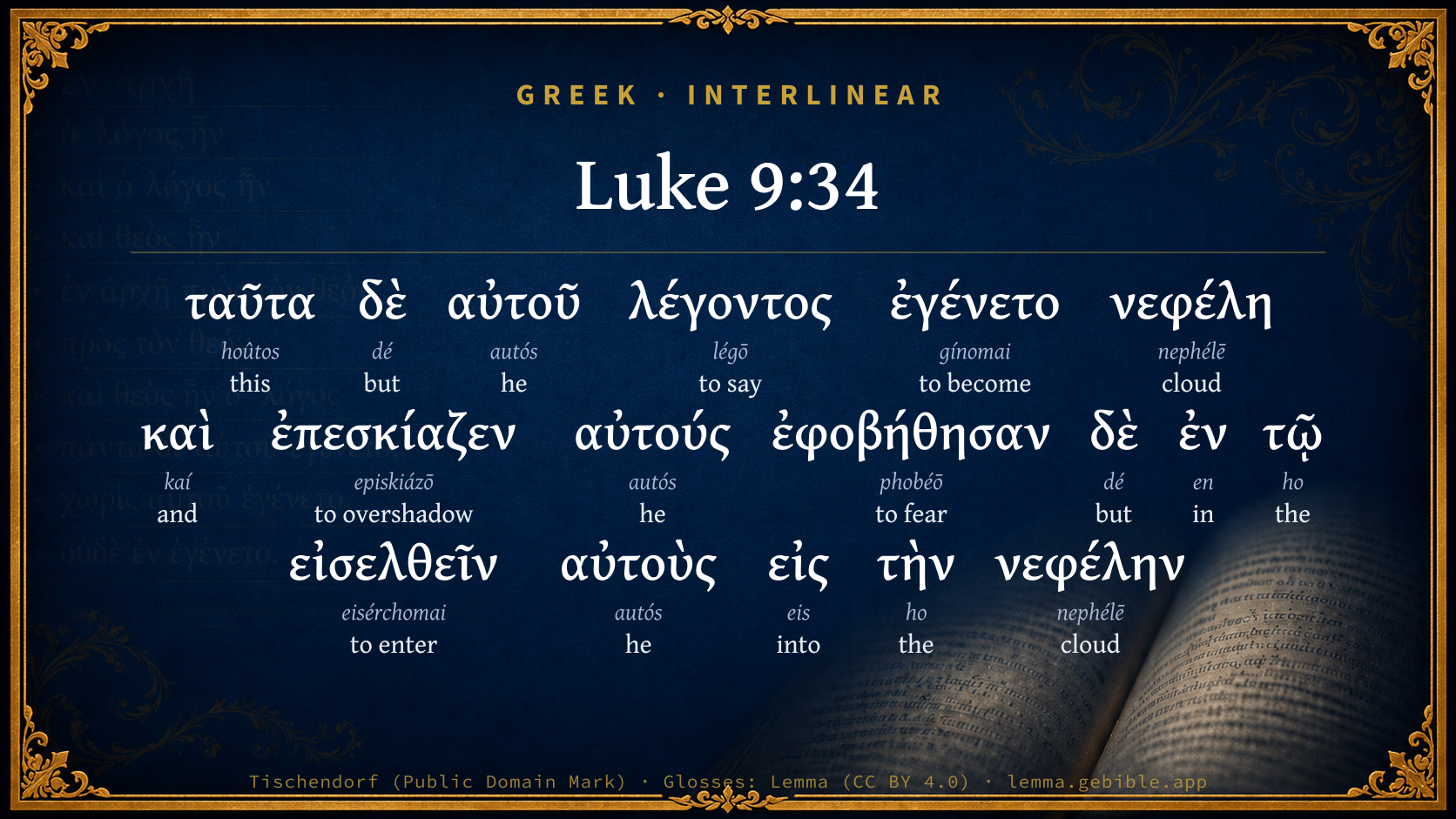
Download image
Cite this verse

Luke 9:34 (World English Bible). Public Domain. Lemma interlinear Bible study tool, https://lemma.gebible.app/v/luke/9/34.

Show BibTeX & RIS
BibTeX
RIS
English Translation
While he said these things, a cloud came and overshadowed them, and they were afraid as they entered into the cloud.
World English Bible · Public Domain
Download a study sheet

One document with this verse’s original text, its word-by-word gloss line, the meaning frame, cross-references with their text, attributed commentary, and full source and license credits — printable, and it pastes into notes with its structure intact.

This verse Autodidact and up

Study sheet (.html) Plain text (.txt)

A passage Seminary Student

Up to 50 verses in one chapter. A passage sheet keeps up to 6 commentary sources and 12 cross-references per verse, in the order this page ranks them, and says so on the sheet whenever that leaves anything out. Ask for a single verse and you get the Autodidact verse sheet above.

Everything on this page stays free to read, with no account — the sheet is a download of what is already on screen, not access to it.

Want to remove ads? Support Godless Engineer
Compare translations 3

The same verse in 3 English versions, stacked beneath the original-language interlinear above. Click any original word for its lexicon entry.

Each is an independent rendering of the whole verse — the interlinear is not word-aligned to these translations.

Highlighted words mark where these versions differ — a whole-verse word diff, not a word-by-word alignment.

  • World English Bible Public Domain
    While he said these things, a cloud came and overshadowed them, and they were afraid as they entered into the cloud.
  • King James Version Public Domain
    While he thus spake, there came a cloud, and overshadowed them: and they feared as they entered into the cloud.
  • unfoldingWord Literal Text CC BY-SA 4.0
    But as he was saying these things, a cloud appeared and overshadowed them, and they were afraid as they entered into the cloud.

unfoldingWord Literal Text — © unfoldingWord, licensed CC BY-SA 4.0. Word-aligned USFM3 via Door43 (git.door43.org/unfoldingWord/en_ult).

Versions to compare (up to 4)

3 of 4 selected

Show all 19 translations

Every available English version of this verse, each an independent rendering of the whole verse.

  • World English Bible Public Domain
    While he said these things, a cloud came and overshadowed them, and they were afraid as they entered into the cloud.
  • Berean Standard Bible Public Domain
    While Peter was speaking, a cloud appeared and enveloped them, and they were afraid as they entered the cloud.
  • Majority Standard Bible Public Domain
    While Peter was speaking, a cloud appeared and enveloped them, and they were afraid as they entered the cloud.
  • King James Version Public Domain
    While he thus spake, there came a cloud, and overshadowed them: and they feared as they entered into the cloud.
  • American Standard Version (1901) Public Domain
    And while he said these things, there came a cloud, and overshadowed them: and they feared as they entered into the cloud.
  • Revised Version (1885) Public Domain
    And while he said these things, there came a cloud, and overshadowed them: and they feared as they entered into the cloud.
  • Geneva Bible (1599) Public Domain
    Whiles he thus spake, there came a cloude and ouershadowed them, and they feared when they were entring into the cloude.
  • Douay-Rheims (1899) Public Domain
    And as he spoke these things, there came a cloud, and overshadowed them; and they were afraid, when they entered into the cloud.
  • Young's Literal Translation Public Domain
    and as he was speaking these things, there came a cloud, and overshadowed them, and they feared in their entering into the cloud,
  • Literal Standard Version CC BY-SA 4.0
    and as he was speaking these things, there came a cloud, and overshadowed them, and they feared in their entering into the cloud,
  • Unlocked Literal Bible CC BY-SA 4.0
    As he was saying this, a cloud came and overshadowed them, and they were afraid as they entered into the cloud.
  • unfoldingWord Literal Text CC BY-SA 4.0
    But as he was saying these things, a cloud appeared and overshadowed them, and they were afraid as they entered into the cloud.
  • Darby Bible Public Domain
    But as he was saying these things, there came a cloud and overshadowed them, and they feared as they entered into the cloud:
  • World Messianic Bible Public Domain
    While he said these things, a cloud came and overshadowed them, and they were afraid as they entered into the cloud.
  • Webster's Bible Public Domain
    While he was thus speaking, there came a cloud and overshadowed them: and they feared as they entered into the cloud.
  • Free Bible Version CC BY-SA 4.0
    While he was speaking a cloud came and spread over them. They were terrified as they entered the cloud.
  • Bible in Basic English Public Domain
    And while he said these things, the shade of a cloud came over them, and they were full of fear when they went into the cloud.
  • Text-Critical English NT CC BY 4.0
    But as he was saying this, a cloud came and overshadowed them, and they were afraid as they entered the cloud.
  • Tyndale New Testament (1534) Public Domain
    Whyll he thus spake ther came a cloude and shadowed them: and they feared when they were come vnder the cloude.

Literal Standard Version (2020), Covenant Press — licensed CC BY-SA 4.0. Text via the HelloAO Bible API (eBible.org). Unlocked Literal Bible (unfoldingWord) — licensed CC BY-SA 4.0. Text via the HelloAO Bible API (eBible.org). unfoldingWord Literal Text — © unfoldingWord, licensed CC BY-SA 4.0. Word-aligned USFM3 via Door43 (git.door43.org/unfoldingWord/en_ult). Free Bible Version, Dr. Jonathan Gallagher — licensed CC BY-SA 4.0. Text via the HelloAO Bible API (eBible.org).

Word by word

More ways to search: Search by grammar → Find every occurrence → Compare this word →

Practice this passage: Drill this verse → Learn its vocabulary →

ἐπεσκίαζεν
episkiázō
G1982
“to overshadow”
Verb, Imperfect, Active, Indicative, 3rd person, Singular
Part of Speech
Verb
Tense
Imperfect
Voice
Active
Mood
Indicative
Person
3rd person
Number
Singular
Full Thayer's Definition

Origin: from G1909 and a derivative of G4639

TDNT: 13:39,1

1. to throw a shadow upon, to envelop in a shadow, to overshadow
  1. ταῦτα hoûtos G3778 “this” Demonstrative pronoun, Accusative, Plural, Neuter
  2. δὲ dé G1161 “but” Conjunction
  3. αὐτοῦ autós G846 “he” Personal pronoun, Genitive, Singular, Masculine
  4. λέγοντος légō G3004 “to say” Verb, Present, Active, Participle, Genitive, Singular, Masculine
  5. ἐγένετο gínomai G1096 “to become” Verb, Aorist, Middle deponent, Indicative, 3rd person, Singular
  6. νεφέλη nephélē G3507 “cloud” Noun, Nominative, Singular, Feminine
  7. καὶ kaí G2532 “and” Conjunction
  8. αὐτούς autós G846 “he” Personal pronoun, Accusative, Plural, Masculine
  9. ἐφοβήθησαν phobéō G5399 “to fear” Verb, Aorist, Passive deponent, Indicative, 3rd person, Plural
  10. δὲ dé G1161 “but” Conjunction
  11. ἐν en G1722 “in” Preposition
  12. τῷ ho G3588 “the” Article, Dative, Singular, Neuter
  13. εἰσελθεῖν eisérchomai G1525 “to enter” Verb, Aorist, Active, Infinitive
  14. αὐτοὺς autós G846 “he” Personal pronoun, Accusative, Plural, Masculine
  15. εἰς eis G1519 “into” Preposition
  16. τὴν ho G3588 “the” Article, Accusative, Singular, Feminine
  17. νεφέλην nephélē G3507 “cloud” Noun, Accusative, Singular, Feminine

About this verse

These counts appear in no published source. They are computed here, from the morphology-tagged text and Lemma’s own curated glosses. What Lemma adds →

18
words
13
distinct lemmas
Gospels
section

Notable vocabulary

The rarest word here is ἐπεσκίαζεν to overshadow G1982 — appearing just 5 times in the whole Greek New Testament.

Shared distinctive vocabulary

ἐπεσκίαζεν to overshadow G1982 occurs in 5 verses of the Greek New Testament. Also found in:

Repetition

Words recur within this verse:

  • νεφέλη cloud G3507 ×2
  • αὐτοῦ he G846 ×3
  • δὲ but G1161 ×2
  • τῷ the G3588 ×2

Cross-references

10

Topical passages linked to Luke 9:34 in the Treasury of Scripture Knowledge — connected by theme and wording, ordered by reader-vote popularity; previews shown in the World English Bible.

  • Exodus 40:34–38 Then the cloud covered the tent of meeting, and the glory of Yahweh filled the tent.
  • Matthew 17:5–7 While he was still speaking, behold, a bright cloud overshadowed them. Behold, a voice came out of the cloud, saying, "This is my beloved Son, in whom I am well pleased. Listen to him."
  • Exodus 14:19–20 The angel of God, who went before the camp of Israel, moved and went behind them; and the pillar of cloud moved from before them, and stood behind them.
  • Judges 6:22 Gideon saw that he was the angel of Yahweh; and Gideon said, Alas, Lord Yahweh! because I have seen the angel of Yahweh face to face.
  • Judges 13:22 Manoah said to his wife, We shall surely die, because we have seen God.
  • Psalms 18:9–11 He bowed the heavens also, and came down. Thick darkness was under his feet.
  • Isaiah 19:1 The burden of Egypt. Behold, Yahweh rides on a swift cloud, and comes to Egypt: and the idols of Egypt shall tremble at his presence; and the heart of Egypt shall melt in the midst of it.
  • Mark 9:7–8 A cloud came, overshadowing them, and a voice came out of the cloud, "This is my beloved Son. Listen to him."
  • Revelation 1:17 When I saw him, I fell at his feet like a dead man. He laid his right hand on me, saying, "Don't be afraid. I am the first and the last,
  • Daniel 10:8 So I was left alone, and saw this great vision, and there remained no strength in me; for my comeliness was turned in me into corruption, and I retained no strength.

Cross-references courtesy of OpenBible.info (CC BY 4.0).

Commentary

Notes on Luke 9:34 from classic Christian and Jewish commentators (each source and its license shown beneath its notes). The classic Christian expositions comment on the surrounding passage and are grouped to its opening verse, so a note may address several verses; the Jewish commentaries on the Tanakh (Rashi and others) are per-verse, so they appear only where the commentator wrote on this verse.

Lemma curates 59 commentaries, every one of them public domain or Creative Commons licensed, each selected and text-cleaned for this edition rather than reprinted as found. About our sources →

The Biblical Illustrator

Joseph S. Exell

Luk_9:34-36

They feared as they entered into the cloud

Entering the cloud

I.

THE GLOOM OF THE CLOUD OFTEN SUCCEEDS THE GLADNESS OF THE LIGHT. Delight even in our divines, experiences is not to be all. These disciples had a hard work to do yet. God has reasons for the darkness as well as for the light.

II. THE ENTERING INTO THE CLOUD WAS A MATTER OF FEAR. Fear on entering! It is often the first experience that we dread. The awful solitude of Glencoe strikes you most on entering; by degrees, you see colour among the rocks, beauty in the vale. Overcome first fear, and then, as you merge into some dread experience, the mind will become accustomed to the change. No sorrow is so great as it seems.

III. THERE IS A VOICE IN THE CLOUD, AND IT IS THE VOICE OF GOD. A cloud and a voice! Yes, the conjunction is beautiful even in a human sense. It is under the cloud of misconception that a friends voice is all-sustaining; it is under the cloud of some dark trial that the tender tones of love make sweetest music. This was the voice of God. That in itself is deepest solace and truest inspiration. Speak, Lord! Enoch heard that voice when he walked with God. It is a Fathers voice. In the cloud, if we are the children of the world, there will be heard only our own voice--the voice of repining--the voice of distrust--the voice of mourning--or, worst of all, the voice of despair!

IV. THERE IS A SOLITARY VISION AFTER THE CLOUD. They saw Jesus only. Beautiful in one sense, though they were disappointed that other visions were gone.

V. THERE IS A TRANSFIGURATION LAND, WHERE THERE ARE NO CLOUDS. Then the voice will come from the throne, not from the cloud. There are no clouds there; faith needs no more trial; character no more test. Christian transfiguration is not completed here; we are renewed, but not glorified yet. But in ourselves we have a prophecy of perfected life, even the earnest of the inheritance. (W. M. Statham, B. A.)

The overshadowing cloud, and the voice that comes from it

The first thing that claims attention is--

I. THE OVERSHADOWING CLOUD. It is not necessary for us to go on far in life before we find clouds coming to cast their shadows over us. We know that the elements are there out of which overshadowing clouds are in constant process of formation. And we know too that there are active agents all the time in operation on those elements. There are the rivers and lakes and seas about us, spreading out their broad water surfaces. And there is the sun with his genial beams, turning that water into vapour, and sending it off on its floating voyage through the air, to form into clouds which shall cast their shadows over our pathway. And just so it is in our experience of life in its moral or spiritual aspect. We carry in us, and find around us, the elements and agents that are occupied continually in forming the clouds that come and overshadow us. In the sickness and death of those we love, or in the visitation of personal sickness, in the loss of property, in the disappointment of our reasonable expectations, what clouds arise continually from all these varied sources! How darkly their shadows fall upon us! The apostles were on the Mount of Transfiguration. Jesus in all the glory of His coming kingdom stood in the midst of them. They stood at the very vestibule of heaven, with all the radiance of its glory beaming around them; and yet, even on that towering summit--a point of elevation in brightness and bliss, such as dwellers on this globe had never reached before--there came a cloud and overshadowed them. And so it must be with us. We must expect the clouds to come and cast their shadows over us. This side of heaven we cannot get beyond their reach. There came a cloud and overshadowed them, has been descriptive of the experience of Gods people from the beginning. If we look at the lives of Abraham, Job, Jacob, David, or any of Gods servants, as written in the Bible, we see how broad and deep these shadows have lain upon their pathway.

II. THE FEELING WITH WHICH THIS EXPERIENCE. IS GENERALLY MET. And they feared as they entered into the cloud. Nothing is more natural to fallen men than fear in reference to God and eternity. And it is not difficult to point out the causes of it.

1. One of these is our consciousness of sin. Fear cannot find room where sin has not gone before it.

2. There may be a failure to understand the views which the Scriptures give us of Gods providence; or an unwillingness to believe those views. Either of these things will give rise to the fear of which we are speaking. This is the Bible view of Gods providences towards His people. Could anything be brighter, or more cheerful? Then why should Christians fear when the cloud comes? There would be no room for fear if we only had simple faith in these Bible views of providence. Fear springs from the want of faith. In the darkest hour of Luthers trying life the Elector of Saxony was the only earthly defender who stood by him. For a time it was doubtful whether the Emperor Charles V. might not send an army against the elector and crush him. Where will you be, said some one to Luther, if the emperor should send his forces against the elector? It was under the sustaining influence of the principle we are now considering that that heroic man sublimely said, I shall be either in heaven or under heaven. He could enter the darkest cloud without fear.

III. THE VOICE FROM THE CLOUD. There came a voice out of the cloud, saying, This is My beloved Son; hear Him. And this is the design of all Gods afflictive dealings with His people. The cloud comes upon us, with its overshadowing gloom, to check us in the too eager pursuit of other things, and to enable us to see Jesus, and understand His character and work. A soldier had lost his right arm from the shoulder during the last war. To an agent of the Christian Commission, who visited him, he said, It seems to me I cannot be grateful enough for losing my arm. It was dreadful to me at first. Thus he feared as he entered into the cloud. But, he continued, it has ended in bringing me to Jesus. And now, I can say with truth, It is better to enter into life halt or maimed, rather than having two hands or two feet to be cast into outer darkness. Thus God lets the clouds of trial come and overshadow us, that we may be prepared to see the light, and glory, and infinite sufficiency, and preciousness, that are to be found in Christ.

Sorrow touchd by love grows bright,

With more than raptures ray;

And darkness shows us worlds of light

We never saw by day.

And then this voice from the cloud quickens to duty, as well as points to Jesus. This is My beloved Son; hear Him. Such was Davids experience when he said, Before I was afflicted I went astray; but now have I kept Thy word. The voice from the overshadowing cloud had quickened him in duty. There are two trees. One is growing on a fertile plain, the other is perched high up on the mountain-side. The lowland tree will lean to this side or that, though it be but a summer breeze that bends it, or a bank of cowslips from which its trunk leans aslope. But let the storm and the avalanche do their worst to the hardy pine-tree of the Alps, it will cling to its little ledge on the side of the precipice and grow straight. Its roots point down to the centre of the earth; and the more the storms rock it, the hardier, and the stronger, and the straighter it will grow. And the same law holds in spiritual growth as in that which is natural. The voice from the overshadowing cloud quickens to duty and strengthens for service. And there is no nobler sight to contemplate than that of a child of God, whose confidence in Him cannot be shaken--not fearing when the clouds gather, nor faltering when the tempests burst. And thus we have attempted to speak of the overshadowing cloud; of the fear with which it is entered; and of the voice that comes from it. The cloud, the fear, the voice. There is just one lesson we may carry away with us from the consideration of this subject. It is this: If we are true Christians we never need fear the developments of Gods providences. However darkly the clouds may gather, or however fiercely the storms may burst, they cannot harm us. We need not fear. (R. Newton.)

The cloud and the voice

With a natural cloud the facts we associate are obscurity, dimness, a degree of mystery, a hiding of the light--sometimes very mercifully softening and tempering what would be more dazzling than the delicate organ of sight could bear--yet a body so attenuated, transparent, and movable, that we feel the darkness is transient. It may pass away from the face of the sun; it may be touched by his beams, transfigured to the eye, and made almost like another sun in splendour. Such, under the laws of light and air and water and attraction, are the properties of the cloud in nature. Now, in that succession of special disclosures of the Divine Presence and care for man, of which the Bible is the completest record and Christ the perfect incarnation, it is striking to see how each principal act of revelation is covered with a cloud--a palpable veil of mystery. From the beginning to the end you see the persistent and remarkable reappearance of this symbol. Considering how these different books of the Bible were produced, and what a variety of authors, periods, countries, stages of literary culture, they proceed from, this is more than a coincidence--it is design. It discloses a general truth. As men are brought near to the very sight and feeling of their Lord, an obscurity overshadows them; there is a shrinking; reverence hides the face; the angels even, admitted to the brightest day, veil their eyes with their wings; no sight is clear enough, no faith is bold enough, not to need the screen. They feared as they entered into the cloud.

1. Most of our deepest acquaintance with religious truth comes by a discipline of some severity. To pass out of a life of indifference and self-indulgence into one of purity and prayer requires a painful effort. If you can look back to any time when your life took a new starting-point, or rose to a higher aim, you will remember there was some hard conflict connected with it. Suffering is not only the consequence of sin, but the instrument of recovery. It is a means of penitence, and so a minister to the only real peace.

2. The second point on this practical side of the doctrine is that it is when we are entering into this cloud--having only the dark side of it before us, and its damp and chilly folds closing around us--that we are afraid. The purpose of the cloud is to shut out all that we are not meant to see. It is also a kind of background for the heavenly vision. This is only one way of expressing the exact and eternal contradiction of right and wrong. The true life is born by a painful travail.

3. For, thirdly, there comes, as the Evangelist writes, a voice out of the cloud, which is sufficient, if we will hearken to it, to guide us through the dark, into the light, where the sun is never dim.

4. Hear Him. Hear Him, and He will scatter the cloud from about you with the breath of His mouth. (Bishop Huntington.)

The cloud

I. The Lord did show that He could frame a better piece of architecture of a sudden than Peter could imagine to build: he spake of three tabernacles, which would be long in piecing together; God in a moment creates one cloud to receive them all better than a hundred tabernacles. Such a one as Moses and the Israelites had in the wilderness to shadow them against all offence. Such things the heathen did drive at in their poetical fictions: but I am sure the Lord is able to pitch a cloud between His chosen and their enemies, that the hand of violence shall not touch them, neither shall any evil come nigh their dwelling.

II. A cloud did interpose itself to qualify the object of the Transfiguration, and to make it fit for the disciples to behold it: the cloud indeed was very bright, yet it was dark and opacous in respect of Christs body, which did exceed the very light of the sun. In this life we must look through a cloud, we must expect to see Him as in a glass darkly, hereafter we shall see Him face to face. Mark the infirmity of mans nature in this sinful corruptible condition, and let us learn humility; it was not enough that Peter, John, and James were not transformed in the Mount, as Christ was--no, nor as Moses and Elias were, our vile flesh is not receptive of such celestial excellency--but to abase them and us further, a shady cloud opposed itself before their eyes, because we are not fit nor worthy to behold such pure happiness in these days of vanity. Such knowledge is too excellent for me, says David, I cannot attain unto it.

III. This cloud was set up for a land-mark to limit curiosity, and to drive men off from approaching too near to pry into the Divine secrets. Where God sets up a cloud it is a manifest sign that those are our bounds, and we must not break them.

IV. And I am sure this reason searcheth the true cause of the cloud as near as any. God the Father in the Old Testament was wont to utter His voice out of the thick clouds of the air, and so He continues His holy will in the gospel, and therefore prepared this cloud to preach from thence the words which follow, This is My beloved Son, &c. (Bishop Hacker.)

A cloud of protection

Where God covers anything with a miraculous shadow, it promiseth that the Divine protection is round about it. Leonidas the Grecian was told that his enemies came marching in such full troops against him, that their darts when they threw them up would cover the light of the sun: Leonidas puts it off with this stout Courage, Turn in umbra pugnabimus; Then we will fight in the shade. A courageous word, and made very fit for a Christians mouth. Believe in the Lord, and we are all under His custody and defence; beseech Him to stretch His wings upon us, and the Holy Ghost will overshadow us, In umbra pugnabimus, to that shadow we betake ourselves to shun the fire of anger, and the heat of con cupiscence; under that shadow will we fight against our ghostly enemies. Why did not the disciples know their own strength and assurance when this cloud did overshadow them? Did not the Lord declare that He took them into His protection? (Bishop Hacker.)

Man and mystery

I. MAN IN CONTACT WITH MYSTERY. The disciples now stood face to face with The Cloud.

1. Every science is an attempt to solve Natures mysteries, to discover Natures secrets.

2. Nor in the realm of Religion does man have less frequently to do with mystery. In the fact that man has thus to do with mystery, we have a sign of the finiteness of our nature.

II. MAN ALARMED AT MYSTERY. There are many mysteries, such for instance as some in the physical world, contact with which does not awaken fear. Some in the natural world. As when stupendous nature seems to be the enemy of man, so that it arrays itself in plague, storm, earthquake, against the feeble, the unoffending, the good. Some in intellectual speculation. Those who climb the mountain of inquiry often fear as they enter the cloud. Some in personal experience. And there will be death. In the fact that man is thus alarmed at mystery, we have one proof of the sinfulness of our nature. To a pure being mystery would have no dread.

III. MAN ENLIGTENED IN MYSTERY. But the cloud became a sanctuary; the mystery a revelation. For out of it there came a voice, saying, This is My beloved Son: hear Him. So hearing the Divine teaching about the ever-living, ever-present Christ, we connect Him and mystery together thus: Christ is the moral of all mysteries. The cloud settled on the mountain, and enwrapped the three disciples, solely to perfect the revelation of Christ to them. Thus every mystery in human life is meant, and adapted, to train us for Christ. Does mystery discover to us our ignorance, so that we feel as those that grope in darkness, and stretch forth imploring hands, and strain eager eyes for light? That yearning, thus intensified under the pressure of mystery, is a yearning for Christ, the Light of the World. Does mystery make us realize our feebleness, so that we feel as a leaf driven before the winds of circumstances, a waif tossed on the waves of the unresting ocean of the material universe, and cry for strength? That cry is for Christ, the arm of the Lord revealed. Christ is the interpreter of mystery. There are mysteries that He solves for us now by the record of His wonderful words. Christ is the controller of all mystery. Not alone hath He the keys of death and hell, though verily these two are among the deepest of all mysteries; but He is the Sovereign of the future, for to Him is subject the world to come. (U. R. Thomas)

The Lord Jesus as Mediator

1. From the occasions upon which this voice came from heaven; at His Baptism, which was Christs dedication of Himself to the work of a Redeemer and Saviour, and now at His Transfiguration, to distinguish Him from Moses and the other prophets, and publicly to instal Him in the mediatory office.

2. The matter of the words show His fitness for this office, for here you have--

(1) His dignity; not a servant, but a Son (Heb_3:5-6).

(2) The dearness between God and Him.

3. His acceptableness to God, who is well-pleased with the design, the terms, the management of it.

II. This work of Mediator Christ executeth by three offices of King, Priest, Prophet.

III. That though all the three offices be employed, yet the prophetical office is more explicitly mentioned, partly as suiting with the present occasion, which is to demonstrate that Christ hath sufficient authority to repeal the Law of Moses which the prophets were to explain, confirm, and maintain till His coming. (T. Manton, D. D.)

Christ, the great Prophet, must be Head

I. That Christ is the great Prophet and Teacher of the Church appeareth

1. By the titles given to Him.

(1) He is compared with Moses, the great Lawgiver among the Jews Deu_18:15).

(2) He is called the Angel or Messenger of the Covenant (Mal_3:1).

2. By the properties of His office. He has three things to qualify Him for this high office.

(1) Absolute supreme authority; and therefore we must hear Him and hearken to Him.

(2) All manner of sufficiency and power of God to execute this office Joh_3:34).

(3) There is in Him a powerful efficacy. As He hath absolute authority to teach in His own name, and fulness of sufficiency to make known the mind of God to us; so He hath power to make His doctrine effectual. And when He dealt with His disciples, after He had opened the Scriptures, He opened their understandings (Luk_24:25). So He opened the heart of Lydia Act_16:14). He can teach so as to draw (Joh_6:44-45). He can excite the drowsy mind, change and turn the rebellious will, cure the distempered affections, make us to be what He persuadeth us to be. There is no such teacher as Christ, who doth not only give us our lesson, but a heart to learn; therefore to Him must we submit, hear nothing against Him, but all from Him.

II. About hearing Him; that must be explained also. First, What it is to hear. It being our great duty, and the respect bespoken for Him. In the hearing of words there are three things considerable; the sound that cometh to the ear, the understanding of the sense and meaning, and the assent or consent of the mind. Of the first, the beasts are capable, for they have ears to hear the sound of words uttered. The second is common to all men, for they can sense such intelligible words as they hear. The third belongeth to disciples, who are swayed by their Masters authority. Secondly, How can we now hear Christ, since He is removed into the heaven of heavens, and doth not speak to us in person. The revelation is settled, and not delivered by parcels, as it was to the ordinary prophets. Now we hear Christ in the Scriptures (Heb_2:3-4). Thirdly, The properties of this hearing or submission to our Great Prophet.

1. There must be a resolute consent or resignation of ourselves to His teaching and instruction. All particular duties are included in the general.

2. This resignation of our souls to Christ as a Teacher, as it must be resolute, so it must be unbounded and without reserves. We must submit absolutely to all that He propoundeth, though some mysteries be above our reason, some precepts against the interest and inclination of the flesh, some promises seem to be against hope, or contrary to natural probabilities.

3. It must be speedy. No delay (Heb_3:7).

4. Your consent to hear Him must be real, practical, obediential, verified in the whole tenor and course of your lives and actions; for Christ will not be flattered with empty titles: Why call ye Me Lord, and Master, and do not the things which I say? (Luk_6:46). Many study Christianity to form their opinions, rather than reform their hearts and practice. The great use of knowledge and faith is to behold the love of God in the face of Jesus Christ, that our own love may be quickened and increased to Him again. If it serve only to regulate opinions, it is but dead speculation, not a living faith.

III. The reasons why this Prophet must be heard.

1. Because He is the only beloved Son of God.

2. Because the doctrine of the gospel which He speaks is the most sweet, excellent, and comfortable doctrine that can be heard or understood by the heart of man. Uses:

I. Of conviction, to the carnal Christian for not submitting to Christs authority.

1. Do you seriously come to Him that you may have pardon and life?

2. Do you respect the word of the gospel, entertain it with reverence and delight, as the voice of the great Prophet? Do you meditate on it, digest it as the seed of the new life, as the rule of your actions, as the charter of your hopes?

3. Do you mingle it with faith in the hearing, that it may profit you?

4. Do you receive it as the Word of God?

5. Doth it come to you as the Mediators word, not in word only, but in power?

6. Do you hear Him universally?

7. Do you hear Him so as to prefer God, and Christ, and the life to come, above all the sensual pleasures and vain delights, and worldly happiness, which you enjoy here?

II. ADVICE TO WEAK CHRISTIANS.

1. TO excite themselves to obedience by this hear Him when dead and lifeless.

2. When you do renounce some beloved lust, or pleasing sin, urge your hearts with Christs authority. Remember who telleth you of cutting off your right hand, and plucking out your right eye. How can I look the Mediator in the face, if I should wilfully break any of His laws, prefer the satisfaction of a base lust, before the mercies and hopes offered me by Jesus Christ.

3. In deep distresses, when you are apt to question the comfort of the promises, it is hard to keep the rejoicing of hope, without regarding whose word and promise is it (Heb_3:6). (T. Manton, D. D. )

The cloud a blessing

Man is harrassed by groundless fears. Who has ever looked for blessings in a cloud? Were we appointed to collect the riches of the universe, how many would pass by the clouds, as though in their dark and troubled breasts no treasure could be found I How often have we trembled as we have entered into the cloud of bereavement, or sorrowful apprehension; and yet in such a cloud have we heard a voice, as did the trembling disciples l In the cloud which they dreaded they heard the Divine voice; henceforward, then, let us gratefully remember that even a cloud can contain a blessing, and that sometimes fear is but the quaking harbinger of joy. (J. Parker, D. D.)

Keeping a secret

It is a privilege to be trusted. Sometimes the trust is a burden. Few can keep secrets. The disciples were able to do so. We are told concerning one thing that they had seen that they kept it close.

I. THE SECRET HELD. A vision of Christs glory among beings of another world. That vision had been--

1. Instructive.

2. Assuring.

3. Elevating.

II. THE REASONS FOR THE MAINTAINED SECRECY.

1. The spiritual attainments of the disciples were not sufficiently advanced for them to speak freely of what they had seen without some damage to themselves. A sneer of some doubter might have weakened their belief at that time.

2. Christ had enjoined silence. He was in no haste to astonish the world.

3. The outside world was not in a fit state to receive the knowledge of that vision. A time was sure to come when the disciples could speak openly and effectively. Peter doubtless made frequent references to it (2Pe_1:16). We may remember that--

(1) We have no need to refrain from speaking of what Christ has done in giving us peace.

(2) Whatever witness we bear should be the outcome of a real experience. Anyhow, we should endeavour to let the praise of Christ be on our lips and reflected in our lives. (Homiletic Magazine.)

The Biblical Illustrator, edited by Joseph S. Exell (c. 1880s–1900s) — public domain. Text from a community e-Sword module.

Tyndale Open Study Notes

Tyndale Open Resources

9:34 a cloud overshadowed them: Clouds often veil the presence of God (Exod 16:10; 19:9; 24:16).

Tyndale Open Study Notes — © Tyndale Open Resources, licensed CC BY-SA 4.0. Text via the HelloAO Bible API.

Bengel's Gnomon

Johann Albrecht Bengel

Luk 9:34. [Νεφέλη, a cloud) This cloud, as is evident from what follows, let itself down low to the earth.—V. g.—εἰς τὴν νεφέλην, into the cloud) out of which the voice of GOD issued forth. To such an exalted audience (presence) are both of these saints admitted. Exo 34:5; 1Ki 19:13.—V. g.]—ἐκείνους, as they entered, etc.) The they refers to Moses and Elias [not to the disciples].

Bengel's Gnomon of the New Testament — English translation (T&T Clark, Edinburgh, 1860) — public domain. Text from a community e-Sword module.

Expositor's Greek Testament

ed. W. Robertson Nicoll

Luk 9:34 . It is not clear who were enveloped by the cloud. If the reading ἐκείνους before εἰσελθεῖν were retained it would imply that the three disciples were outside; αὐτοὺς , the reading of [92] , etc., implies that all were within.

[92] Codex Vaticanus (sæc. iv.), published in photographic facsimile in 1889 under the care of the Abbate Cozza-Luzi.

The Expositor's Greek Testament, edited by W. Robertson Nicoll (1897–1910) — public domain. Text from a community e-Sword module.

Godet's Commentaries

Frédéric Louis Godet

3 d. Luk 9:34-36. The Divine Voice.

Here we have the culminating point of this scene. As the last sigh of the dying Christian is received by the Lord, who comes for him (Joh 14:3; Act 7:55-56), so the presence of God is manifested at the moment of the glorification of Jesus.

The cloud is no ordinary cloud; it is the veil in which God invests Himself when He appears here below. We meet with it in the desert and at the inauguration of the temple; we shall meet with it again at the ascension. Matthew calls it a bright cloud; nevertheless he says, with the two others, that it overshadowed this scene. His meaning is, that the brightness of the central light pierced through the cloudy covering which cast its mysterious shadow on the scene. If with the T. R. we read ἐκείνους, only Jesus, Moses, and Elijah were enveloped in the cloud, and the fear felt by the disciples proceeded from uneasiness at being separated from their Master. But if with the Alex. we read αὐτούς, all six were enveloped in an instant by the cloud, and the fear which seized the apostles was caused by their vivid sense of the divine nearness. The former meaning is more natural; for the voice coming forth out of the cloud could scarcely be addressed to any but persons who were themselves outside the cloud.

The form of the divine declaration is very nearly the same in the three accounts. The Alex. reading in Luke: this is my Elect, is preferable to the received reading: this is my beloved Son, which is taken either from the two other narratives, or from the divine salutation at the baptism. It is a question here of the elect in an absolute sense, in opposition to servants, like Moses and Elijah, chosen for a special work. Comp. Luk 23:35. The exhortation: Hear Him, is the repetition of that by which Moses, Deu 18:15, charged Israel to welcome at some future day the teaching of the Messiah. This last word indicates the design of the whole scene: “Hear Him, whatever He may say to you; follow in His path, wherever He may lead you.” We have only to call to mind the words of Peter: “Be it far from Thee, Lord! this shall not be unto Thee,” in the preceding conversation, to feel the true bearing of this divine admonition.

We find here again the realization of a law which occurs throughout the life of Jesus; it is this, that every act of voluntary humiliation on the part of the Son is met by a corresponding act of glorification, of which He is the object, on the part of the Father. He goes down into the waters of the Jordan, devoting Himself to death; God addresses Him as His well-beloved Son. In John 12, in the midst of the trouble of His soul, He renews His vow to be faithful unto death; a voice from heaven answers Him with the most magnificent promise for His filial heart.

Matthew mentions here the feeling of fear which the other two mention earlier.

The word: Jesus only, Luk 9:36, is common to the three narratives. It is a forcible expression of the feeling of those who witnessed the scene after the disappearing of the celestial visitants; see on Luk 2:15. Does it contain any allusion to the idea which has been made the very soul of the narrative: The law and the prophets pass away; Jesus and His word alone remain? To me it appears doubtful.

The silence kept at first by the apostles is accounted for in Matthew and Mark by a positive command of Jesus. The Lord’s intention, doubtless, was to prevent the carnal excitement which the account of such a scene might produce in the hearts of the other apostles and in the minds of the people. After the resurrection and the ascension, there would no longer be anything dangerous in the account of the transfiguration. The risen One could not be a king of this world. Luke does not mention Jesus’ prohibition; he had no reason for omitting it, had he known of it. The omission of the following conversation respecting the coming of Elijah may be accounted for, on the other hand, as intentional. This idea being current only amongst the Jews, Luke might not think it necessary to record for Gentile readers the conversation to which it had given rise. Besides, Luk 1:17 already contained a summary of what there was to be said on this subject. This entire scene, then, in each of its phases, conduced to the object which Jesus had in view—the strengthening of the faith of His own. In the first, the contemplation of His glory; in the second, the sanction of that way of sorrow into which He was to enter and take them with Him; in the third, the divine approval stamped on all His teaching: these were powerful supports for the faith of the three principal apostles, which, once confirmed, became, apart from words, the support of the faith of their weaker fellow-disciples.

The objections to the reality of the transfiguration are: 1. Its magical character and uselessness: Why, asks Keim, should there be a sign from heaven on this grand scale, when Jesus always refused to grant any such prodigy!

But nowhere, perhaps, does the sound reasonableness of the gospel come out more clearly than in this narrative; glorification is as much the normal termination of a holy life, as death is of corrupt life. The design with which this manifestation, which might have been concealed from the disciples, was displayed to them, appears from its connection with the previous conversation respecting the sufferings of the Messiah.—2. The impossibility of the reappearing of beings who have long been dead (see on Luk 9:30).—3. A real appearing of Elijah would be an actual contradiction to the following conversation (in Matthew and Mark), in which Jesus denies the return of this prophet in person, as expected by the rabbis and the people. These are the arguments of Bleek and Keim.

But what Jesus denies in the following conversation is not a temporary appearance, like that of the transfiguration, but Elijah’s return to life on earth in order to fulfil a new ministry. This is what John the Baptist had accomplished (Luk 1:17).—4. The silence of John, who must have conceived of the glory of Jesus in a more spiritual manner.

Is it to be believed that this objection can be raised by the same critic who blames John for the magical character of the miracles which he relates, and denies their reality for this reason? The transfiguration, along with many other incidents (the choice of the Twelve, the institution of baptism and the Lord’s Supper, etc.), is omitted by John for the simple reason that they were sufficiently known through the Syn., and did not necessarily enter into the plan of his book.—5. “The artificial character of the narrative appears from its resemblance to certain narratives of the O. T.” (Keim). And yet this very Keim disputes the reality of the appearing of Moses and Elijah, on the ground that apparitions of the dead are not warranted by the O. T.! But how is the existence of our three narratives to be explained? Paulus reduces the whole to a natural incident. He supposes an interview of Jesus with two unknown friends with whom He had made an appointment on the mountain. The reflection of the rising or setting sun on the snows of Hermon, followed by a sudden clap of thunder, occasioned all the rest. But who were those secret friends more closely connected with Jesus than His most intimate apostles? This explanation only results in making this scene a got-up affair, and Jesus a charlatan. It is abandoned at the present day. Weisse, Strauss, and Keim regard the transfiguration as nothing but an invention of mythical origin, designed to represent the moral glory of Jesus under images derived from the history of Moses and Elijah. But they can never explain how the Church created a picture so complete as this out of fragments of O. T. narrative. And how could a mythical narrative occur in the midst of such precise historical notes of time as those in which it is contained in the three narrations (six or eight days after the conversation at Caesarea, on the one hand; the eve of the cure of the lunatic child, on the other)? And Jesus’ strict injunction forbidding His apostles to publish an event which never took place! We must pass here, as everywhere else, from the mythical theory to the supposition of imposture. And Peter’s absurd speech—would the Church have been likely to make its founder speak after this fashion? Lastly, others have regarded the transfiguration simply as a dream of Peter’s. But did the two other apostles have the same dream at the same time? And would Jesus have attached such importance to a disciple’s dream as to have strictly prohibited him from relating it until after His resurrection from the dead? All these fruitless attempts prove that the denial of the fact has also its difficulties.

From innocence to holiness, and from holiness to glory; here we have the normal development of human existence, its royal path. The transfiguration, at the culminating point of the life of Jesus, shows that once at least this ideal has been realized in the history of humanity.

This narrative is one of those in which we can most clearly establish the originality and superior character of Luke’s sources of information. Certainly, he has neither derived his matter from the two other evangelists, nor from a document common to all three. This is evident from these two expressions: eight days after, and the elect of God (Luk 9:28 and Luk 9:35). The details by which Luke determines for us the precise object of this scene, and the subject of Jesus’ conversation with Moses and Elijah, as well as the picture he gives of the state of the disciples, are such inimitable touches, and are so suggestive for purposes of interpretation, that criticism must renounce its mission as a search after historic truth, or else decide to accord to Luke the possession of independent sources of information closely connected with the fact.

The transfiguration is the end and seal of the Galilean ministry, and at the same time the opening of the history of the passion in our three Gospels.

Frédéric Louis Godet — Commentaries on Luke, John, Romans, and 1 Corinthians — English translation (T&T Clark, Edinburgh, 1870s–1890s) — public domain. Text from a community e-Sword module.

Jamieson, Fausset & Brown

Robert Jamieson, A. R. Fausset & David Brown

a cloud--not one of our watery clouds, but the Shekinah-cloud (see on Mat 23:39), the pavilion of the manifested presence of God with His people, what Peter calls "the excellent" of "magnificent glory" (Pe2 1:17).

a voice--"such a voice," says Peter emphatically; "and this voice [he adds] we heard, when we were with Him in the holy mount" (Pe2 1:17-18).

Jamieson, Fausset & Brown — Commentary Critical and Explanatory on the Whole Bible (1871) — public domain (CC PDM 1.0). Text via the HelloAO Bible API.

The Cambridge Bible for Schools and Colleges

gen. ed. J. J. S. Perowne

34. there came a cloud, and overshadowed them] “A bright cloud,” Mat_17:5. Possibly the Sheckinah, or cloud of glory (see on Luk_1:35), which was the symbol of the Divine Presence (Exo_33:9; 1Ki_8:10). If a mere mountain cloud had been intended, there would have been no reason for their fear.

The Cambridge Bible for Schools and Colleges (gen. ed. J. J. S. Perowne; Cambridge University Press, 1878–1918) — public domain. Text from a community e-Sword module.

John Gill's Exposition

And it came to pass, that on the next day,.... For Jesus and his disciples staid all night on the mountain:

when they were come down from the hill; to the bottom of it:

much people met him. The Vulgate Latin, Syriac, and Persic versions read, "met them".

John Gill's Exposition of the Whole Bible (1746–1763) — public domain (CC PDM 1.0). Text via the HelloAO Bible API.

Trapp's Complete Commentary

John Trapp

32 But Peter and they that were with him were heavy with sleep: and when they were awake, they saw his glory, and the two men that stood with him.

33 And it came to pass, as they departed from him, Peter said unto Jesus, Master, it is good for us to be here: and let us make three tabernacles; one for thee, and one for Moses, and one for Elias: not knowing what he said.

34 While he thus spake, there came a cloud, and overshadowed them: and they feared as they entered into the cloud.

Ver. 34. There came a cloud] {See Trapp on "Mat 17:5"}

John Trapp, A Commentary or Exposition upon All the Books of the Old and New Testament (1647–1656) — public domain. Text from a community e-Sword module.

The Pulpit Commentary

While he thus spake, there came a cloud, and overshadowed them: and they feared as they entered into the cloud. This luminous cloud, bright though it was, yet veiled the more intolerable brightness within. That such a bright cloud had the power of overshadowing and concealing, is not strange, for light in its utmost intensity hides as effectually as the darkness would do. God dwells in light inaccessible, whom therefore "no man hath seen, nor can see". (1Ti_6:16) Milton writes"Dark with excess of light.

Philo speaks of the highest light as identical with darkness. Anselm thus understands the cloud here, quoting the words of 1Ti_6:16, referred to above, and then the words of Moses, "And Moses drew near unto the thick darkness where God was", (Exo_20:21) and then this passage from the Transfiguration, and comments thus: "Illa caligo et ista nubes, atque ilia lux idem sunt" (see Archbishop Trench on "Transfiguration," in "Studies in the Gospels," 8). The fear which these eye-witnesses remember as one of their experiences that memorable night was a very natural feeling. As the cloud stole over the mountain ridge, and the glory-light gradually paled and waned, the sensation of intense pleasure and satisfaction, which we may assume to be the natural accompaniment of such a blessed scene, would give place to awe and amazement.

The Pulpit Commentary (1880–1919), ed. H.D.M. Spence-Jones & Joseph S. Exell — public domain. Text from a community e-Sword module.

John Wesley's Explanatory Notes

A cloud came and overshadowed them all. And they, the apostles, feared, while they (Moses and Elijah) entered into the cloud, which took them away.

John Wesley, Explanatory Notes Upon the Whole Bible (1754–1765) — public domain. Text via the GEBible commentary corpus.

unfoldingWord translationNotes

Door43 World Missions Community

As he was saying this

"While Peter was saying these things"

they were afraid

These adult disciples were not afraid of clouds. This phrase indicates that some kind of unusual fear came over them with the cloud. AT: "they were terrified" (See: Assumed Knowledge and Implicit Information)

they entered into the cloud

This can be expressed in terms of what the cloud did. AT: "the cloud surrounded them"

A voice came out of the cloud

It is understood that the voice could only have belonged to God. AT: "God spoke to them from the cloud" (See: Assumed Knowledge and Implicit Information)

Son

This is an important title for Jesus, the Son of God. (See: Translating Son and Father)

the one who is chosen

This can be stated with an active form. AT: "the one I have chosen" or "I have chosen him" (See: Active or Passive)

They kept silent ... what they had seen

This is information that tells what happened after the story as a result of the events in the story itself. (See: End of Story)

kept silent ... told no one

The first phrase refers to their immediate response, and the second refers to what they did in the following days.

translationWords

voice

chosen one

Son of God

Jesus

unfoldingWord translationNotes — © Distant Shores Media and the Door43 World Missions Community, licensed CC BY-SA 4.0. Source: git.door43.org/Door43/en_tn.

Cambridge Greek Testament for Schools and Colleges

34. νεφέλη. “A bright cloud,” Mat 17:5. Possibly the Shekinah, or cloud of glory (see on Luk 1:35), which was the symbol of the Divine Presence (Exo 33:9; 1Ki 8:10). If a mere mountain cloud had been intended, there would have been no reason for their fear.

αὐτούς. This reading implies that the Apostles also were overshadowed by the cloud of glory. The less attested ἐκείνους of Rec[203] implies that it only overspread Jesus, and Moses, and Elias.

[203] Rec. The Textus Receptus.

Cambridge Greek Testament for Schools and Colleges (Cambridge University Press, 1896; 21 vols, various authors incl. Carr, Maclear, Plummer, Farrar, Lumby, Moule, M. R. James, Simcox) — public domain. Text from a community e-Sword module.

Alford’s Greek Testament

Henry Alford

34.] There is no difference in the accounts, as Meyer thinks: the ἐν τῷ διαχωρίζ.…, ver. 33, is only an additional particular, and the rest is exactly in accordance. Notice however the remarkable word ἐκλελεγμένος of the correct text: and compare the reff.

Henry Alford, The Greek Testament (1849–1861) — public domain. Text from a community e-Sword module.

International Critical Commentary

34. ἐγένετο νεφέλη καὶ ἐπεσκίαζεν αὐτούς. Mt. calls it φωτεινή, a “luminous cloud.” Here there is perhaps an association of ideas, suggested by similarity of sound, between ἐπεσκίαζεν and the Shechinah or δόξη mentioned in ver. 31. Comp. ἐπεσκίαζεν ἐπὶ τὴν σκηνὴν ἡ νεφέλη (Exo 40:29). Strictly speaking a luminous cloud cannot overshadow; but it may veil. Light may be as blinding as darkness. We cannot be sure whether the αὐτούς includes the three Apostles or not. It does not include them in ver. 33, and probably does not include them here. The reading ἐκείνους εἰσελθεἰν (A D P R) is meant to exclude the Apostles; but εἰσελθεῖν αὐτούς (א B C L) is right. See D. B.2 art. “Cloud.”

International Critical Commentary — older volumes (1896–1929), various authors — public domain. Text from a community e-Sword module.

Vincent's Word Studies in the New Testament

Marvin R. Vincent

A cloud. "A strange peculiarity has been noticed about Hermon, in the extreme rapidity of the formation of cloud on the summit. In a few minutes a thick cap forms over the top of the mountain, and as quickly disperses and entirely disappears" (Edersheim).

Overshadowed them [επεσκιαζεν] . A beautiful imperfect : "began to overshadow them;" thus harmonizing with the words, "as they entered into." Them [αυτους] must, I think, be confined to Moses, Elias, and Jesus. Grammatically, it might include all the six; but the disciples hear the voice out of the cloud, and the cloud, as a symbol of the divine presence, rests on these three as a sign to the disciples. See Exo 14:19; Exo 19:16; 1Ki 8:10; Psa 104:3.

Marvin R. Vincent, Word Studies in the New Testament (1887–1900) — public domain. Text from a community e-Sword/MySword module.

Lesson kit

Teaching starters — assembled from the data on this page, not authored interpretation. Every prompt links to the verse data it draws on. Edit before teaching.

Luke, in the Gospels, opens this verse with 18 words (13 distinct Greek lemmas). Its most distinctive word is episkiázō (“to overshadow”). A historical commentator’s framing appears above. Read the whole chapter for the surrounding context.

Discussion questions

  1. How does “to overshadow” (episkiázō) shape what this verse is saying?
  2. How does Matthew 17:5, which shares the word «to overshadow», read alongside this verse?
  3. What does the repetition of “cloud” (2× in this one verse) do in this verse?
  4. These translations render this verse differently; the difference is in the English rendering, not the original. What questions does that raise?
  5. Compare how The Biblical Illustrator and Tyndale Open Study Notes read this verse. Where do they agree or differ?

Things to notice

Reading settings

Reading text

Shown beneath each verse's original-language words.

Old Testament
Old Testament edition

Read the OT as the Masoretic Hebrew (MT) or the Greek Septuagint (LXX).

English shown for the Greek Septuagint (in the Hebrew ↔ Greek comparison).

Comparing translations? Open the Compare panel on any verse page to stack up to four side by side.