
Luke 15:24

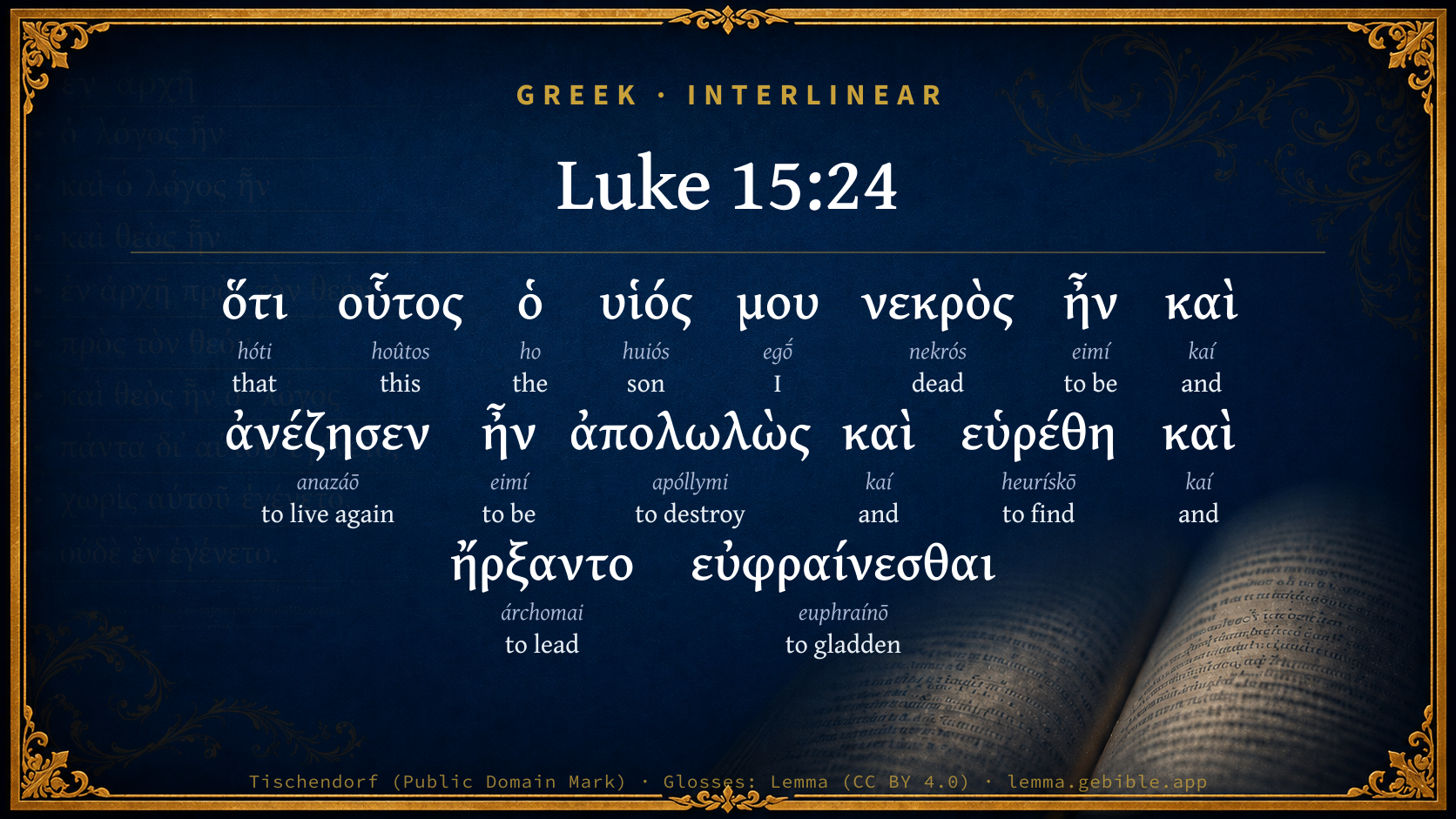
Greek (Tischendorf 8th ed.) Luke 15:24 appears in the Greek New Testament. The text above is from the Tischendorf 8th edition. Each word links to its Strong’s number and a concise gloss. Click any word for its full Thayer’s Greek Lexicon entry.
Download image
Cite this verse

Luke 15:24 (World English Bible). Public Domain. Lemma interlinear Bible study tool, https://lemma.gebible.app/v/luke/15/24.

Show BibTeX & RIS
BibTeX
RIS
English Translation
for this, my son, was dead, and is alive again. He was lost, and is found.' They began to celebrate.
World English Bible · Public Domain
Highlights
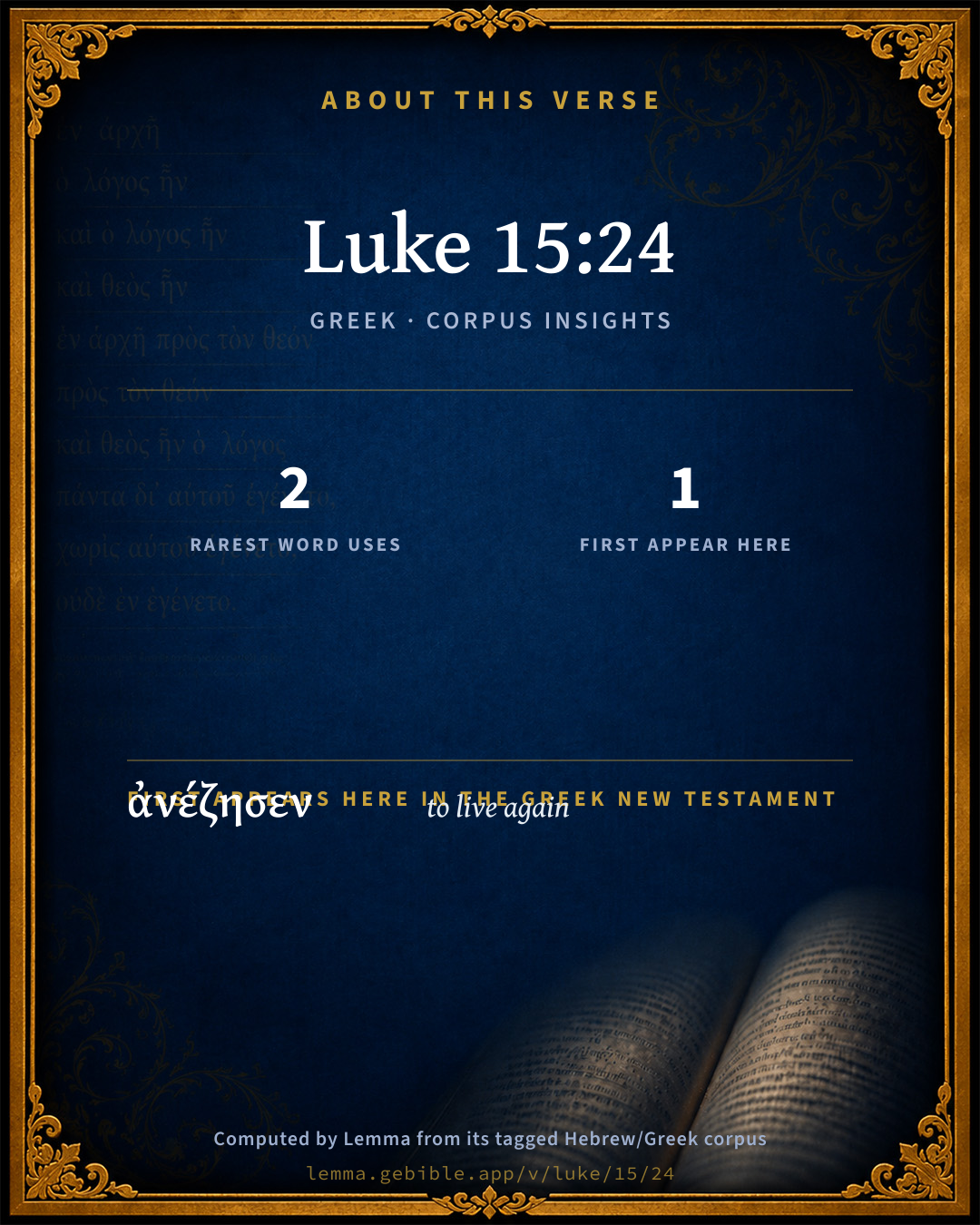
  • 1 first appearance in the Greek New Testament
Full analysis ↓
Download a study sheet

One document with this verse’s original text, its word-by-word gloss line, the meaning frame, cross-references with their text, attributed commentary, and full source and license credits — printable, and it pastes into notes with its structure intact.

This verse Autodidact and up

Study sheet (.html) Plain text (.txt)

A passage Seminary Student

Up to 50 verses in one chapter. A passage sheet keeps up to 6 commentary sources and 12 cross-references per verse, in the order this page ranks them, and says so on the sheet whenever that leaves anything out. Ask for a single verse and you get the Autodidact verse sheet above.

Everything on this page stays free to read, with no account — the sheet is a download of what is already on screen, not access to it.

Want to remove ads? Support Godless Engineer
Compare translations 3

The same verse in 3 English versions, stacked beneath the original-language interlinear above. Click any original word for its lexicon entry.

Each is an independent rendering of the whole verse — the interlinear is not word-aligned to these translations.

Highlighted words mark where these versions differ — a whole-verse word diff, not a word-by-word alignment.

  • World English Bible Public Domain
    for this, my son, was dead, and is alive again. He was lost, and is found.' They began to celebrate.
  • King James Version Public Domain
    For this my son was dead, and is alive again; he was lost, and is found. And they began to be merry.
  • unfoldingWord Literal Text CC BY-SA 4.0
    For this son of mine was dead, and has come back to life; he was lost, and he has been found.’ Then they began to celebrate.

unfoldingWord Literal Text — © unfoldingWord, licensed CC BY-SA 4.0. Word-aligned USFM3 via Door43 (git.door43.org/unfoldingWord/en_ult).

Versions to compare (up to 4)

3 of 4 selected

Show all 19 translations

Every available English version of this verse, each an independent rendering of the whole verse.

  • World English Bible Public Domain
    for this, my son, was dead, and is alive again. He was lost, and is found.' They began to celebrate.
  • Berean Standard Bible Public Domain
    For this son of mine was dead and is alive again! He was lost and is found!’ So they began to celebrate.
  • Majority Standard Bible Public Domain
    For this son of mine was dead and is alive again! He was lost and is found!’ So they began to celebrate.
  • King James Version Public Domain
    For this my son was dead, and is alive again; he was lost, and is found. And they began to be merry.
  • American Standard Version (1901) Public Domain
    for this my son was dead, and is alive again; he was lost, and is found. And they began to be merry.
  • Revised Version (1885) Public Domain
    for this my son was dead, and is alive again; he was lost, and is found. And they began to be merry.
  • Geneva Bible (1599) Public Domain
    For this my sonne was dead, and is aliue againe: and he was lost, but he is found. And they began to be merie.
  • Douay-Rheims (1899) Public Domain
    Because this my son was dead, and is come to life again: was lost, and is found. And they began to be merry.
  • Young's Literal Translation Public Domain
    because this my son was dead, and did live again, and he was lost, and was found; and they began to be merry.
  • Literal Standard Version CC BY-SA 4.0
    because this son of mine was dead, and lived again, and he was lost, and was found; and they began to be merry.
  • Unlocked Literal Bible CC BY-SA 4.0
    For my son was dead, and now he is alive. He was lost, and now he is found.' Then they began to celebrate.
  • unfoldingWord Literal Text CC BY-SA 4.0
    For this son of mine was dead, and has come back to life; he was lost, and he has been found.’ Then they began to celebrate.
  • Darby Bible Public Domain
    for this my son was dead and has come to life, was lost and has been found. And they began to make merry.
  • World Messianic Bible Public Domain
    for this, my son, was dead and is alive again. He was lost and is found.’ Then they began to celebrate.
  • Webster's Bible Public Domain
    For this my son was dead, and is alive again; he was lost, and is found. And they began to be merry.
  • Free Bible Version CC BY-SA 4.0
    because this is my son who was dead, but who has returned alive; he was lost but now he's found.’ So they started celebrating.
  • Bible in Basic English Public Domain
    For this, my son, who was dead, is living again; he had gone away from me, and has come back. And they were full of joy.
  • Text-Critical English NT CC BY 4.0
    For this son of mine was dead but is now alive again; he was lost but has now been found.’ And they began to celebrate.
  • Tyndale New Testament (1534) Public Domain
    for this my sonne was deed and is alyve agayne he was loste and is now founde. And they began to be merye.

Literal Standard Version (2020), Covenant Press — licensed CC BY-SA 4.0. Text via the HelloAO Bible API (eBible.org). Unlocked Literal Bible (unfoldingWord) — licensed CC BY-SA 4.0. Text via the HelloAO Bible API (eBible.org). unfoldingWord Literal Text — © unfoldingWord, licensed CC BY-SA 4.0. Word-aligned USFM3 via Door43 (git.door43.org/unfoldingWord/en_ult). Free Bible Version, Dr. Jonathan Gallagher — licensed CC BY-SA 4.0. Text via the HelloAO Bible API (eBible.org).

Word by word

More ways to search: Search by grammar → Find every occurrence → Compare this word →

Practice this passage: Drill this verse → Learn its vocabulary →

ἀνέζησεν
anazáō
G326
“to live again”
Verb, Aorist, Active, Indicative, 3rd person, Singular
Part of Speech
Verb
Tense
Aorist
Voice
Active
Mood
Indicative
Person
3rd person
Number
Singular
Full Thayer's Definition

Origin: from G303 and G2198

TDNT: 16:32,3

1. live again, recover life a. to be restored to a correct life 1. of one who returns to a better moral state b. to revive, regain strength and vigour
  1. ὅτι hóti G3754 “that” Conjunction
  2. οὗτος hoûtos G3778 “this” Demonstrative pronoun, Nominative, Singular, Masculine
  3. ὁ ho G3588 “the” Article, Nominative, Singular, Masculine
  4. υἱός huiós G5207 “son” Noun, Nominative, Singular, Masculine
  5. μου egṓ G1473 “I” Personal pronoun, 1st person, Genitive, Singular
  6. νεκρὸς nekrós G3498 “dead” Adjective, Nominative, Singular, Masculine
  7. ἦν eimí G1510 “to be” Verb, Imperfect, Active, Indicative, 3rd person, Singular
  8. καὶ kaí G2532 “and” Conjunction
  9. ἦν eimí G1510 “to be” Verb, Imperfect, Active, Indicative, 3rd person, Singular
  10. ἀπολωλὼς apóllymi G622 “to destroy” Verb, Perfect, Active, Participle, Nominative, Singular, Masculine
  11. καὶ kaí G2532 “and” Conjunction
  12. εὑρέθη heurískō G2147 “to find” Verb, Aorist, Passive, Indicative, 3rd person, Singular
  13. καὶ kaí G2532 “and” Conjunction
  14. ἤρξαντο árchomai G756 “to lead” Verb, Aorist, Middle deponent, Indicative, 3rd person, Plural
  15. εὐφραίνεσθαι euphraínō G2165 “to gladden” Verb, Present, Passive, Infinitive

About this verse

These counts appear in no published source. They are computed here, from the morphology-tagged text and Lemma’s own curated glosses. What Lemma adds →

16
words
13
distinct lemmas
Gospels
section

Notable vocabulary

The rarest word here is ἀνέζησεν to live again G326 — appearing just 2 times in the whole Greek New Testament.

First appearance in Scripture

This word makes its first canonical appearance in the Greek New Testament here:

  • ἀνέζησεν to live again G326

Shared distinctive vocabulary

ἀνέζησεν to live again G326 occurs in 2 verses of the Greek New Testament. Also found in:
Repetition

Words recur within this verse:

Cross-references

30

Topical passages linked to Luke 15:24 in the Treasury of Scripture Knowledge — connected by theme and wording, ordered by reader-vote popularity; previews shown in the World English Bible.

  • Ephesians 2:5 even when we were dead through our trespasses, made us alive together with Christ (by grace you have been saved),
  • Ezekiel 34:16 I will seek that which was lost, and will bring back that which was driven away, and will bind up that which was broken, and will strengthen that which was sick: but the fat and the strong I will destroy; I will feed them in justice.
  • Luke 19:10 For the Son of Man came to seek and to save that which was lost."
  • Colossians 2:13 You were dead through your trespasses and the uncircumcision of your flesh. He made you alive together with him, having forgiven us all our trespasses,
  • Luke 15:4 "Which of you men, if you had one hundred sheep, and lost one of them, wouldn't leave the ninety-nine in the wilderness, and go after the one that was lost, until he found it?
  • Ephesians 2:1 You were made alive when you were dead in transgressions and sins,
  • Luke 15:32 But it was appropriate to celebrate and be glad, for this, your brother, was dead, and is alive again. He was lost, and is found.'"
  • Romans 6:11 Thus also consider yourselves also to be dead to sin, but alive to God in Christ Jesus our Lord.
  • Luke 15:7–9 I tell you that even so there will be more joy in heaven over one sinner who repents, than over ninety-nine righteous people who need no repentance.
  • Isaiah 35:10 and the ransomed of Yahweh shall return, and come with singing to Zion; and everlasting joy shall be on their heads: they shall obtain gladness and joy, and sorrow and sighing shall flee away.
  • John 11:25 Jesus said to her, "I am the resurrection and the life. He who believes in me, though he die, yet will he live.
  • 2 Corinthians 5:14–15 For the love of Christ constrains us; because we judge thus, that one died for all, therefore all died.
  • John 5:24–25 "Most assuredly I tell you, he who hears my word, and believes him who sent me, has eternal life, and doesn't come into judgment, but has passed out of death into life.
  • Romans 8:2 For the law of the Spirit of life in Christ Jesus made me free from the law of sin and of death.
  • Romans 12:15 Rejoice with those who rejoice. Weep with those who weep.
  • Matthew 18:10–13 See that you don't despise one of these little ones, for I tell you that in heaven their angels always see the face of my Father who is in heaven.
  • 1 Corinthians 12:26 When one member suffers, all the members suffer with it. Or when one member is honored, all the members rejoice with it.
  • Ephesians 5:14 Therefore he says, "Awake, you who sleep, and arise from the dead, and Christ will shine on you."
  • Jeremiah 31:12–17 They shall come and sing in the height of Zion, and shall flow to the goodness of Yahweh, to the grain, and to the new wine, and to the oil, and to the young of the flock and of the herd: and their soul shall be as a watered garden; and they shall not sorrow any more at all.
  • Ezekiel 34:4 You haven't strengthened the diseased, neither have you healed that which was sick, neither have you bound up that which was broken, neither have you brought back that which was driven away, neither have you sought that which was lost; but with force and with rigor have you ruled over them.
  • Mark 8:22 He came to Bethsaida. They brought a blind man to him, and begged him to touch him.
  • John 5:21 For as the Father raises the dead and gives them life, even so the Son also gives life to whom he desires.
  • Romans 6:13 Neither present your members to sin as instruments of unrighteousness, but present yourselves to God, as alive from the dead, and your members as instruments of righteousness to God.
  • Romans 11:15 For if the rejection of them is the reconciling of the world, what would their acceptance be, but life from the dead?
  • Revelation 3:1 "And to the angel of the assembly in Sardis write: He who has the seven Spirits of God, and the seven stars says these things: "I know your works, that you have a reputation of being alive, but you are dead.
  • 1 Timothy 5:6 But she who gives herself to pleasure is dead while she lives.
  • Genesis 45:28 Israel said, "It is enough. Joseph my son is still alive. I will go and see him before I die."
  • Luke 10:19 Behold, I give you authority to tread on serpents and scorpions, and over all the power of the enemy. Nothing will in any way hurt you.
  • Jude 1:12 These are hidden rocky reefs in your love feasts when they feast with you, shepherds who without fear feed themselves; clouds without water, carried along by winds; autumn leaves without fruit, twice dead, plucked up by the roots;
  • Isaiah 66:11 that you may suck and be satisfied with the breasts of her consolations; that you may milk out, and be delighted with the abundance of her glory.

Cross-references courtesy of OpenBible.info (CC BY 4.0).

Commentary

Notes on Luke 15:24 from classic Christian and Jewish commentators (each source and its license shown beneath its notes). The classic Christian expositions comment on the surrounding passage and are grouped to its opening verse, so a note may address several verses; the Jewish commentaries on the Tanakh (Rashi and others) are per-verse, so they appear only where the commentator wrote on this verse.

Lemma curates 59 commentaries, every one of them public domain or Creative Commons licensed, each selected and text-cleaned for this edition rather than reprinted as found. About our sources →

Joseph Benson's Commentary

Luk 15:24. For this my son was dead — Was considered by me as dead; and is alive again — “It is by a very common and beautiful emblem, that vicious persons are represented as dead, both by sacred and profane authors; and the natural death of their children would be less grievous to pious parents than to see them abandoned to such a course as this young sinner took.” — Doddridge. He was lost and is found — We looked upon him as utterly lost, but lo! he is come back again, beyond all expectation, in safety. Two things here are worthy of observation: 1st, That the conversion of a soul from sin to God is the raising of that soul from death to life, and the finding of that which seemed to be lost. It is a great, wonderful, and happy change: it is like that which passes upon the face of the earth when the spring returns. 2d, The conversion of sinners is very pleasing to the God of heaven, and all that belong to his family ought to rejoice in it. Those in heaven do, and those on earth should, rejoice. And they began to be merry — They sat down to the feast, rejoicing exceedingly at the happy occasion of it.

Joseph Benson's Commentary on the Old and New Testaments (1811–1818) — public domain. Text from a community e-Sword module.

MacLaren's Expositions of Holy Scripture

Alexander MacLaren

Luke

THE PRODIGAL AND HIS FATHER

Luk 15:11 - Luk 15:24.

The purpose of the three parables in this chapter has to be kept in mind. Christ is vindicating His action in receiving sinners, which had evoked the murmurings of the Pharisees. The first two parables, those of the lost sheep and the lost drachma, appeal to the common feeling which attaches more importance to lost property just because it is lost than to that which is possessed safely. This parable rises to a higher level. It appeals to the universal emotion of fatherhood, which yearns over a wandering child just because he has wandered.

We note a further advance, in the proportion of one stray sheep to the ninety-nine, and of one lost coin to the nine, contrasted with the sad equality of obedience and disobedience in the two sons. One per cent., ten per cent., are bearable losses, but fifty per cent. is tragic.

I. The first part {Luk 15:11 - Luk 15:16} tells of the son’s wish to be his own master, and what came of it.

The desire to be independent is good, but when it can only be attained by being dependent on him whose authority is irksome, it takes another colour. This foolish boy wished to be able to use his father’s property as his own, but he had to get the father’s consent first. It is a poor beginning of independence when it has to be set up in business by a gift.

That is the essential absurdity in our attempts to do without God and to shake off His control. We can only get power to seem to do it by misusing His gifts. When we say, ‘Who is Lord over us?’ the tongues which say it were given us by Him. The next step soon followed. ‘Not many days after,’ of course, for the sense of ownership could not be kept up while near the father. A man who wishes to enjoy worldly good without reference to God is obliged, in self-defence, to hustle God out of his thoughts as soon and as completely as possible.

The ‘far country’ is easily reached; and it is far, though a step can land us in it. A narrow bay may compel a long journey round its head before those on its opposite shores can meet. Sin takes us far away from God, and the root of all sin is that desire of living to one’s self which began the prodigal’s evil course.

The third step in his downward career, wasting his substance in riotous living, comes naturally after the two others; for all self-centred life is in deepest truth waste, and the special forms of gross dissipation to which youth is tempted are only too apt to follow the first sense of being their own masters, and removed from the safeguards of their earthly father’s home. Many a lad in our great cities goes through the very stages of the parable, and, when a mother’s eye is no longer on him, plunges into filthy debauchery. But living which does not outrage the proprieties may be riotous all the same; for all conduct which ignores God and asserts self as supreme is flagrantly against the very nature of man, and is reckless waste.

Such a ‘merry’ life is sure to be ‘short.’ There is always famine in the land of forgetfulness of God, and when the first gloss is off its enjoyments, and one’s substance is spent, its pinch is felt. The unsatisfied hunger of heart, which dogs godless living, too often leads but to deeper degradation and closer entanglement with low satisfactions. Men madly plunge deeper into the mud in hope of finding the pearl which has thus far eluded their search.

A miserable thing this young fool had made of his venture, having spent his capital, and now being forced to become a slave, and being set to nothing better than to feed swine. The godless world is a hard master, and has very odious tasks for its bondsmen. The unclean animals are fit companions for one who made himself lower than they, since filth is natural to them and shameful for him. They are better off than he is, for husks do nourish them, and they get their fill, but he who has sunk to longing for swine’s food cannot get even that. The dark picture is only too often verified in the experience of godless men.

II. The wastrel’s returning sanity is described in Luk 15:17 - Luk 15:20.

‘He came to himself.’ Then he had been beside himself before. It is insanity to try to shake off God, to aim at independence, to wander from Him, to fling away our ‘substance,’ that is, our true selves, and to starve among the swine-troughs. He remembers the bountiful housekeeping at home, as starving men dream of feasts, and he thinks of himself with a kind of pity and amazement.

There is no sign that his conscience smote him, or that his heart woke in love to his father. His stomach, and it only, urged him to go home. He did, indeed, feel that he had been wrong, and had forfeited the right to be called a son, but he did not care much for losing that name, or even for losing the love to which it had the right, if only he could get as much to eat as one of the hired servants, whose relation to the master was less close, and, in patriarchal times, less happy, than that of slaves born in the house.

One good thing about the lad was that he did not let the grass grow under his feet, but, as soon as he had made the resolution, began to carry it into effect. The bane of many a resolve to go back to God is that it is ‘sicklied o’er’ by procrastination. The ragged prodigal has not much to leave which need hold him, but many such a one says, ‘I will arise and go to my father to-morrow,’ and lets all the to-morrows become yesterdays, and is sitting among the swine still.

Low as the prodigal’s motive for return was, the fact of his return was enough. So is it in regard to our attitude to the gospel. Men may be drawn to give heed to its invitations from the instinct of self-preservation, or from their sense of hungry need, and the belief that in it they will find the food they crave for, while there may be little consciousness of longing for more from the Father than the satisfaction of felt wants. The longing for a place in the Father’s heart will spring up later, but the beginning of most men’s taking refuge in God as revealed in Christ is the gnawing of a hungry heart. The call to all is, ‘Ho, every one that thirsteth, come ye to the waters, and he that hath no money; come ye, buy, and eat.’

III. The climax of the parable, for which all the rest is but as scaffolding, is the father’s welcome {vs. 20b-24}.

Filial love may die in the son’s heart, but paternal yearning lives in the father’s. The wanderer’s heart would be likely to sink as he came nearer the father’s tent. It had seemed easy to go back when he acted the scene in imagination, but every step homewards made the reality more difficult.

No doubt he hesitated when the old home came in sight, and perhaps his resolution would have oozed out at his finger ends if he had had to march up alone in his rags, and run the gauntlet of servants before he came to speech with his father. So his father’s seeing him far off and running to meet him is exquisitely in keeping, as well as movingly setting forth how God’s love goes out to meet His returning prodigals. That divine insight which discerns the first motions towards return, that divine pity which we dare venture to associate with His infinite love, that eager meeting the shamefaced and slow-stepping boy half-way, and that kiss of welcome before one word of penitence or request had been spoken, are all revelations of the heart of God, and its outgoings to every wanderer who sets his face to return.

Beautifully does the father’s welcome make the son’s completion of his rehearsed speech impossible. It does not prevent his expression of penitence, for the more God’s love is poured over us, the more we feel our sin. But he had already been treated as a son, and could not ask to be taken as a servant. Beautifully, too, the father gives no verbal answer to the lad’s confession, for his kiss had answered it already; but he issues instructions to the servants which show that the pair have now reached the home and entered it together.

The gifts to the prodigal are probably significant. They not only express in general the cordiality of the welcome, but seem to be capable of specific interpretations, as representing various aspects of the blessed results of return to God. The robe is the familiar emblem of character. The prodigal son is treated like the high-priest in Zechariah’s vision; his rags are stripped off, and he is clothed anew in a dress of honour. ‘Them he also justified: and whom he justified, them he also sanctified.’ The ring is a token of wealth, position, and honour. It is also a sign of delegated authority, and is an ornament to the hand. So God gives His prodigals, when they come back, an elevation which unforgiven beings do not reach, and sets them to represent Him, and arrays them in strange beauty. No doubt the lad had come back footsore and bleeding, and the shoes may simply serve to keep up the naturalness of the story. But probably they suggest equipment for the journey of life. That is one of the gifts that accompany forgiveness. Our feet are shod with the preparedness of the gospel of peace.

Last of all comes the feast. Heaven keeps holiday when some poor waif comes shrinking back to the Father. The prodigal had been content to sink his sonship for the sake of a loaf, but he could not get bread on such terms. He had to be forgiven and bathed in the outflow of his father’s love before he could be fed; and, being thus received, he could not but be fed. The feast is for those who come back penitently, and are received forgivingly, and endowed richly by the Father in heaven.

Alexander MacLaren, Expositions of Holy Scripture (1904–1910) — public domain. Text from a community e-Sword module.

Bengel's Gnomon

Johann Albrecht Bengel

Luk 15:24. Οὗτος, this) This is a [triumphal] verse, or formula of words, and hymn, which has in it somewhat of rhythm, and seems to have been often repeated; see Luk 15:32: it was accompanied with symphony (‘music’), Luk 15:25. The ancients used verse when strongly affected. See Gen 37:33; 1 Chronicles 13 (12):18, [which are in the Hebraic form of poetry, parallelism.]

Bengel's Gnomon of the New Testament — English translation (T&T Clark, Edinburgh, 1860) — public domain. Text from a community e-Sword module.

Jamieson, Fausset & Brown

Robert Jamieson, A. R. Fausset & David Brown

my son--now twice his son.

dead . . . lost--to me; to himself--to my service, my satisfaction; to his own dignity, peace, profit.

alive again . . . found--to all these.

merry--(See on Luk 15:10).

Jamieson, Fausset & Brown — Commentary Critical and Explanatory on the Whole Bible (1871) — public domain (CC PDM 1.0). Text via the HelloAO Bible API.

Adam Clarke's Commentary

Verse 24. Was dead] Lost to all good - given up to all evil. In this figurative sense the word is used by the best Greek writers. See many examples in Kypke.

Adam Clarke's Commentary on the Bible (1810–1826) — public domain. Text from a community e-Sword/MySword module.

Ellicott's Commentary for English Readers

(24) This my son was dead.—The words, looked at merely as part of the story, have a wonderful pathos. Absence, alienation, the self-chosen shame, this had made the father think of the son as “dead.” Death would indeed have been far easier to bear. Spiritually, we are taught that repentance is nothing less than the passing from the death of sin to the life of righteousness, from the “graves of lust” (Num_11:34) to the power of the resurrection. The “lost” and “found” appear as furnishing the link that connects this with the preceding parables, and makes the trilogy, as it were, complete.

A Bible Commentary for English Readers, edited by Charles John Ellicott (1878–1897) — public domain. Text from a community e-Sword module.

The Cambridge Bible for Schools and Colleges

gen. ed. J. J. S. Perowne

24. was dead, and is alive again] The metaphor of ‘death’ to express the condition of impenitent sin is universal in the Bible. “Thou hast a name that thou livest and art dead,” Rev_3:1. “Awake thou that sleepest, and arise from the dead,” Eph_5:14. “You hath He quickened who were dead in trespasses and sins,” Eph_2:1. “Yield yourselves unto God as those that are alive from the dead,”Rom_6:13.

was lost] This poor youth had been in the exact Roman sense perditus—a ‘lost,’ an ‘abandoned’ character.

The Cambridge Bible for Schools and Colleges (gen. ed. J. J. S. Perowne; Cambridge University Press, 1878–1918) — public domain. Text from a community e-Sword module.

John Gill's Exposition

For this my son was dead,.... These words contain the reasons of the above entertainment, and of all that spiritual joy and mirth; in which the father acknowledges the returning penitent as his son; though he had behaved so wickedly before, and though he judged himself unworthy of the relation; and this he did, by sending the Spirit of adoption into his heart, to witness his sonship to him; and takes notice of his past state and condition, to show the great reason there was for joy, at his present one: for before be was "dead", dead in Adam, in whom all died; dead in law, being under a sentence of condemnation and death; and dead in trespasses and sins, which is a spiritual or moral death: in which all mankind by nature are: and which lies in a separation from God, Father, Son, and Spirit; in an alienation from the life of God; in a deformation of the image of God; in a loss of original righteousness; in the darkness of the understanding; in the inordinateness of the affections; in the pollution of the mind and conscience; in the stubbornness of the will; and in an impotency to that which is spiritually good; and in a privation of spiritual sense and motion: this had been the case, but now it was otherwise:

and is alive again: the Spirit of life from Christ had entered into him, and Christ was formed in his heart; and a principle of life was infused into him; a divine image was enstamped upon his soul; the understanding was enlightened in divine things; the affections were set upon them; the will was subjected to God, to his will and law, and to Christ and his righteousness, and the way of salvation by him, and to his commands and ordinances; and principles of grace and holiness were wrought in him, to do as well as to will; a spiritual sense of things were given him; a spiritual sight, hearing, tasting, and feeling, and savouring; he lived a life of holiness from Christ, of faith upon him, and of communion with him, and to his glory: and he came to be so, not of himself, nor by any creature; for no man can quicken himself, nor can any creature do it for him; it was entirely owing to the power and grace of God: and great reason here was for joy and mirth, as there is for every one that is quickened by the Spirit of God; for such shall never enter into condemnation, nor die again, but shall live and reign with Christ for ever:

he was lost; lost in Adam, and in himself; so he was when in the far country, and when among the swine and husks; so as that he knew not where he was, nor what a condition he was in; nor did he know how to get out of it, nor could he help himself; nor could any other creature; though not irretrievably and irrecoverably lost; not to the love of God, his knowledge of him, care and provision for him in Christ, in his counsel and covenant: hence the following mercy,

and is found; not only by Christ, in redemption, but by the Spirit of Christ in the effectual calling; when he was brought and came to himself, and saw his lost state and condition by nature; and when he was directed and brought home to his Father's house, and entertained with all the provisions of it; and such have reason to rejoice and be glad, for they shall be found in Christ at death and at judgment, and shall be with him to all eternity:

and they began to be merry: all parties. The Father expressed his joy, and the gladness of his heart, upon the return of his son to him; he exhorted to be merry on this account, Luk 15:23 and enforces it with reasons in this verse, taken from the relation he stood in to him, and the wonderful change that had passed upon him, and the finding of him; and he rejoices himself at his conversion, in the exercise of that grace which he himself implanted, and in the performance of duty by his assistance: not that any new joy arises in God's heart at such a time; for he always rejoiced in the persons of his elect, as they were the objects of his love, as chosen in Christ, and given to him, and as interested in the covenant of grace; and he rejoiced in the accomplishment of their salvation, by his Son: but in conversion, there are new expressions of joy; he rejoices over them to do them good, and rejoices in the good he does them; and this is the open beginning of his joy, and but the beginning of it; for it will continue, it is not all over, not all expressed, but will be in the fullest manner hereafter, to all eternity: the returned son began to be merry, as he had good reason for it; as that he was come back from the far country, where a mighty famine had been: and from the citizen of that country, his fields, and swine; that he was come to his father, and his father's house, where was bread enough and to spare; an house well furnished with all suitable provisions; a family made up of saints, where ministers of the Gospel are stewards, and angels guards, and where Christ is Son, priest, and master; and that he was received here, and owned as a son; not only was one secretly, but was owned as such openly; and was not only called so by the servants, but by the father himself; and that after he had behaved so vilely, and in his own conscience knew he was unworthy of the relation; and that he was received immediately, as soon as ever he came, and that in the most tender manner; and was entertained in the most free, generous, and sumptuous way; though he went away from his father of himself, and had spent his substance in a scandalous manner; and was in a most filthy, ragged, and piteous condition; and that he should be clothed with the best robe, the robe of Christ's righteousness; and so had nothing to fear from law and justice; nor was he in any danger of wrath to come because of his sins; nor had he any reason to doubt of his right and admission to the heavenly glory; and that he had the ring of love on the hand of faith, and could believe his interest in it, which is better than life, and will continue for ever; and that his feet were shod with the preparation of the Gospel of peace; that he understood the Gospel, and was brought to a submission to Gospel ordinances, and had his conversation agreeably to it; and that the fatted calf was killed, and set before him to eat of, and feed upon: and now he began to live and fare sumptuously, and to have spiritual joy and pleasure, which he never knew before; and this was but the beginning of joy to him: spiritual joy is not all over at once, it continues and increases; nor is it full and perfect in this life, but in heaven it will be complete, and without interruption; the servants also, the ministers of the Gospel, began to be merry on this occasion; who express their joy at the conversion of sinners, because of the glory of Father, Son, and Spirit, concerned in it; because of the grace bestowed then on sinners themselves; and because the interest of Christ is strengthened, and his churches increased, and Satan's kingdom weakened; and because their own ministry is blessed; and which strengthens their hands and hearts, and encourages them to go on in their work: and this is but the beginning of their joy; for they continue to rejoice at the growth of grace in believers, and when they are in a thriving and flourishing condition; when they walk becoming the Gospel of Christ, and live in peace among themselves; and persevere in faith and holiness to the end; and these will be their joy and crown of rejoicing, at the coming of Christ Jesus.

John Gill's Exposition of the Whole Bible (1746–1763) — public domain (CC PDM 1.0). Text via the HelloAO Bible API.

Trapp's Complete Commentary

John Trapp

24 For this my son was dead, and is alive again; he was lost, and is found. And they began to be merry.

Ver. 24. For this my son was dead, &c.] So fareth it with every faithful Christian. He was dead, but now lives, and cannot be insensible or ignorant of such a change.

John Trapp, A Commentary or Exposition upon All the Books of the Old and New Testament (1647–1656) — public domain. Text from a community e-Sword module.

Albert Barnes' Notes on the Bible

Was dead - This is capable of two significations:

“I supposed” that he was dead, but I know now that he is alive. He was “dead to virtue” - he was sunk in pleasure and vice.

The word is not unfrequently thus used. See 1Ti 5:6; Mat 8:22; Rom 6:13. Hence, to be restored to “virtue” is said to be restored again to life, Rom 6:13; Rev 3:1; Eph 2:1. It is probable that this latter is the meaning here. See Luk 15:32.

Was lost - Had wandered away from home, and we knew not where he was.

Albert Barnes' Notes on the Bible (1834–1885) — public domain. Text from a community e-Sword/MySword module.

Haydock's Catholic Bible Commentary

Was dead, and is come to life again. A sinner, in mortal sin, is deprived of the divine grace, which is the spiritual life of the soul. At his conversion it is restored to him, and he begins to live again. (Witham)

George Leo Haydock (1774–1849), Haydock's Catholic Family Bible and Commentary, 1859 edition — public domain. Excludes Psalms (Douay-Rheims chapter numbering differs from Protestant) and Deuterocanonical books (Catholic canon only).

Whedon's Commentary on the Bible

Daniel D. Whedon

24. Dead… alive—The metaphors of death and life, to express ruin and recovery, can be found in various languages. Thus Cicero at his return to Rome after banishment says, in a public address to the city, that he is recalled from death to life; from despair to hope; from destruction to safety.

Daniel D. Whedon (gen. ed.), Commentary on the Old and New Testaments (1874–1909) — public domain. Text from a community e-Sword module.

Cambridge Greek Testament for Schools and Colleges

24. νεκρὸς ἦν καὶ ἀνέζησεν. The metaphor of ‘death’ to express the condition of impenitent sin is universal in the Bible. “Thou hast a name that thou livest and art dead,” Rev 3:1. “Awake thou that sleepest, and arise from the dead,” Eph 5:14. “You hath He quickened who were dead in trespasses and sins,” Eph 2:1. “Yield yourselves unto God as those that are alive from the dead,” Rom 6:13.

ἦν ἀπολωλώς. This poor youth had been in the exact Roman sense perditus—a ‘lost,’ an ‘abandoned’ character.

Cambridge Greek Testament for Schools and Colleges (Cambridge University Press, 1896; 21 vols, various authors incl. Carr, Maclear, Plummer, Farrar, Lumby, Moule, M. R. James, Simcox) — public domain. Text from a community e-Sword module.

Alford’s Greek Testament

Henry Alford

24.] νεκ. κ. ἀνέζ.,—the lost money: ἀπολωλ. καὶ εὑρέθη,—the lost sheep: see 1Jn 3:14: Eph 2:5: 1Pe 2:25.

ἤρξαντο, a contrast to the ἤρξατο in ver. 14.

Henry Alford, The Greek Testament (1849–1861) — public domain. Text from a community e-Sword module.

International Critical Commentary

24. Note the rhythmical cadence of this refrain (24, 32), and comp. Exo 15:1, Exo 15:21; Num. 23., Num 23:24.; 2Sa 1:19-27. Carmine usi veteres in magno effectu (Bang.): There is probably no difference in meaning between the two halves of the refrain; but νεκρός means “dead to me,” and ἀπολωλώς “lost to me.” Would the father speak to the servants of his son’s being morally dead? Whereas he might well speak of one who had gone away, apparently for ever, as practically dead. And if we give a moral sense to νεκρός, why not to ἀπολωλώς (19:10; [Mat 18:11])?

Here the first part of the parable ends. The welcome which Jesus gave to outcasts and sinners is justified. The words καὶ ἤρξαντο εὐφρίνεσθαι should be given to ver. 25 rather than to ver. 24. An interval elapses during which the father’s command is executed; and then the banquet, which is the setting of the second part of the parable, begins.

International Critical Commentary — older volumes (1896–1929), various authors — public domain. Text from a community e-Sword module.

Vincent's Word Studies in the New Testament

Marvin R. Vincent

Is alive - is found [ανεζησεν - ευρεθη] . Both aorists, and pointing back to a definite time in the fast; doubtless the moment when he "came to himself." Wyc., hath lived.

The Prodigal Son is a favorite subject in Christian art. The return of the penitent is the point most frequently chose, but the dissipation in the far country and the degradation among the swine are also treated. The dissipation is the subject of an interesting picture by the younger Teniers in the gallery of the Louvre. The prodigal is feasting at a table with two courtesans, in front of an inn, on the open shutter of which a tavern - score is chalked. An old woman leaning on a stick begs alms, possibly foreshadowing the fate of the females at the table. The youth holds out his glass, which a servant fills with wine. In the right - hand corner appears a pigsty where a stable - boy is feeding the swine, but with his face turned toward the table, as if in envy of the gay revellers there. All the costumes and other details of the picture are Dutch. Holbein also represents him feasting with his mistress, and gambling with a sharper who is sweeping the money off the table. The other points of the story are introduced into the background. Jan Steen paints him at table in a garden before an inn. A man plays a guitar, and two children are blowing bubbles - "an allegory of the transient pleasures of the spendthrift." Mrs. Jameson remarks that the riotous living is treated principally by the Dutch painters. The life among the swine is treated by Jordaens in the Dresden Gallery. The youth, with only a cloth about his loins, approaches the trough where the swine are feeding, extends his hand, and seems to ask food of a surly swineherd, who points him to the trough. In the left - hand corner a young boor is playing on a pipe, a sorrowful contrast to the delicious music of the halls of pleasure. Salvator Rosa pictures him in a landscape, kneeling with clasped hands amid a herd of sheep, oxen, goats, and swine. Rubens, in a farm - stable, on his knees near a trough, where a woman is feeding some swine. He looks imploringly at the woman. One of the finest examples of the treatment of the return is by Murillo, in the splendid picture in the gallery of the Duke of Sutherland. It is thus described by Stirling (" Annals of the Artists of Spain ") : "The repentant youth, locked in the embrace of his father, is, of course, the principal figure; his pale, emaciated countenance bespeaks the hardships of his husk - coveting time, and the embroidery on his tattered robe the splendor of his riotous living. A little white dog, leaping up to caress him, aids in telling the story. On one side of this group a man and a boy lead in the fatted calf; on the other appear three servants bearing a light - blue silk dress of Spanish fashion, and the gold ring; and one of them seems to be murmuring at the honors in preparation for the lost one."

Marvin R. Vincent, Word Studies in the New Testament (1887–1900) — public domain. Text from a community e-Sword/MySword module.

Lesson kit

Teaching starters — assembled from the data on this page, not authored interpretation. Every prompt links to the verse data it draws on. Edit before teaching.

Luke, in the Gospels, opens this verse with 16 words (13 distinct Greek lemmas). Its most distinctive word is anazáō (“to live again”). A historical commentator’s framing appears above. Read the whole chapter for the surrounding context.

Discussion questions

  1. What does “to live again” (anazáō) contribute to the verse as a whole?
  2. This is the first place “to live again” appears in Scripture (first appears here). What does its debut here establish?
  3. How does Romans 7:9, which shares the word «to live again», read alongside this verse?
  4. What does the repetition of “to be” (2× in this one verse) do in this verse?
  5. These translations render this verse differently. What is at stake in choosing one wording over another?
  6. Compare how Joseph Benson's Commentary and MacLaren's Expositions of Holy Scripture read this verse. Where do they agree or differ?

Things to notice

  • 1 word makes its first canonical appearance in Scripture here.
  • These translations choose different wording for 10 words in this verse.
  • “to be” occurs 2× in this single verse.
  • 13 distinct Greek lemmas span 16 words in this verse.

Reading settings

Reading text

Shown beneath each verse's original-language words.

Old Testament
Old Testament edition

Read the OT as the Masoretic Hebrew (MT) or the Greek Septuagint (LXX).

English shown for the Greek Septuagint (in the Hebrew ↔ Greek comparison).

Comparing translations? Open the Compare panel on any verse page to stack up to four side by side.