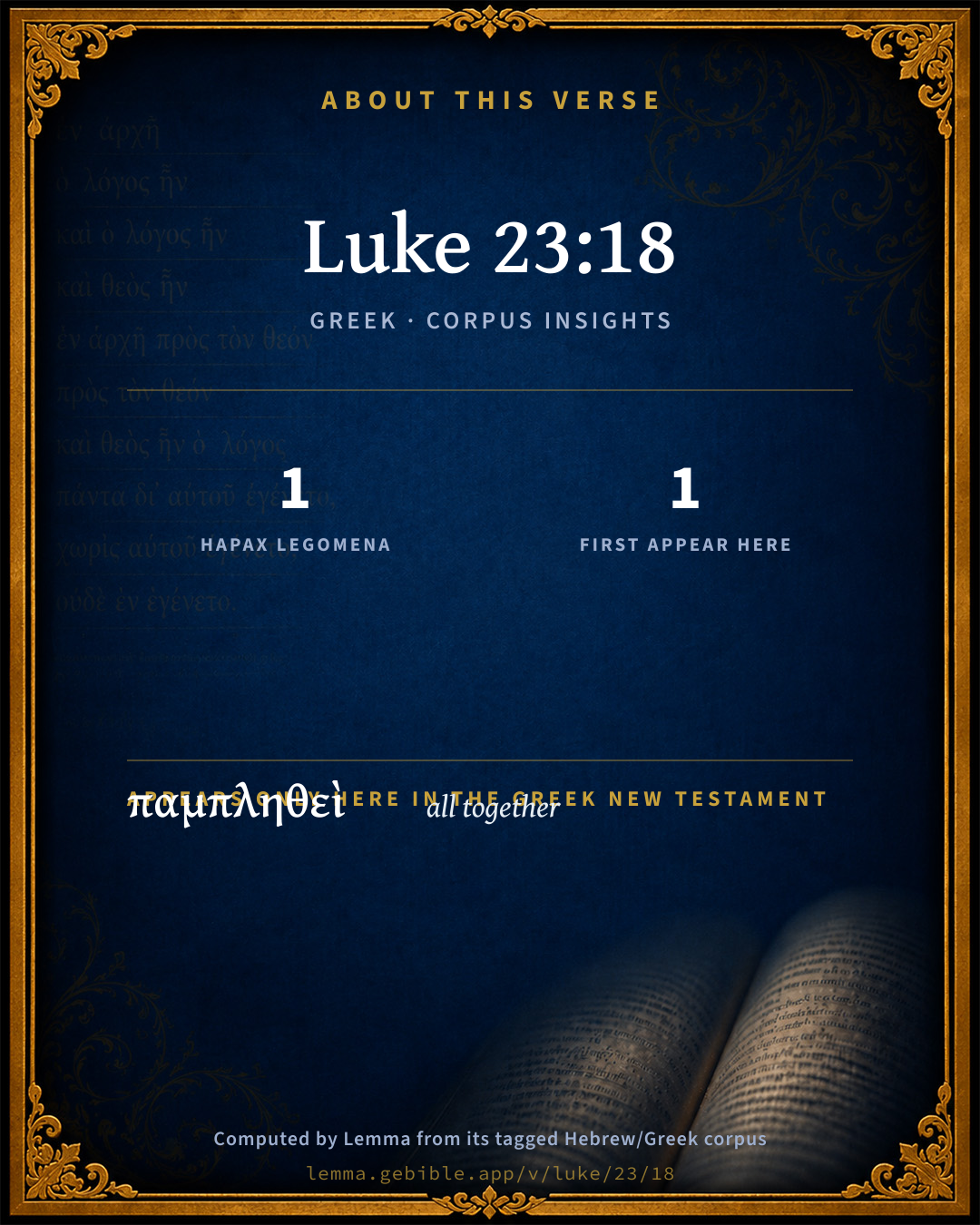
Luke 23:18

Greek (Tischendorf 8th ed.) Luke 23:18 appears in the Greek New Testament. The text above is from the Tischendorf 8th edition. Each word links to its Strong’s number and a concise gloss. Click any word for its full Thayer’s Greek Lexicon entry.
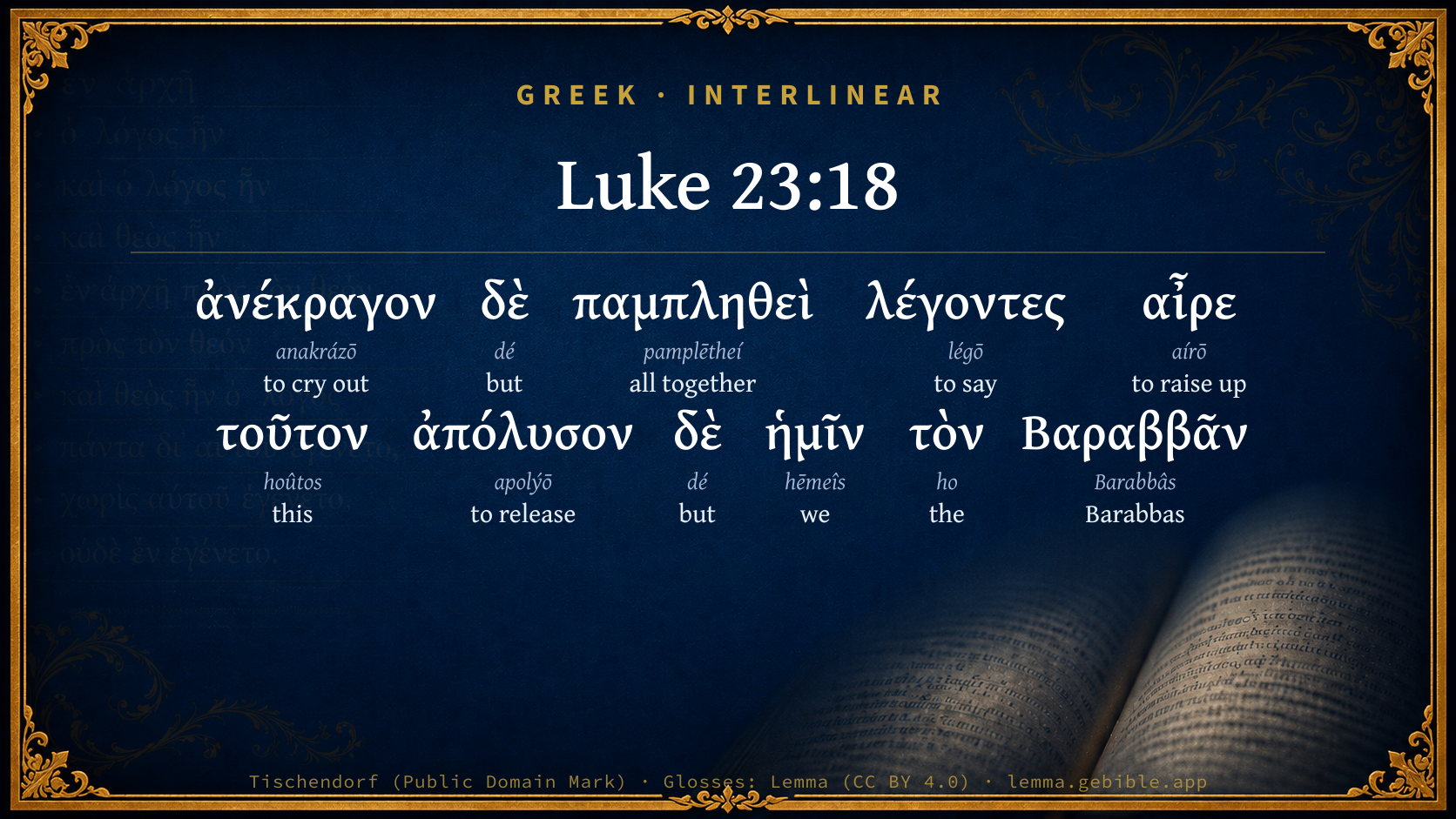
Download image
Cite this verse

Luke 23:18 (World English Bible). Public Domain. Lemma interlinear Bible study tool, https://lemma.gebible.app/v/luke/23/18.

Show BibTeX & RIS
BibTeX
RIS
English Translation
But they all cried out together, saying, "Away with this man! Release to us Barabbas!" --
World English Bible · Public Domain
Highlights
  • 1 hapax legomenon — only here in the Greek New Testament
  • 1 first appearance in the Greek New Testament
Full analysis ↓
Download a study sheet

One document with this verse’s original text, its word-by-word gloss line, the meaning frame, cross-references with their text, attributed commentary, and full source and license credits — printable, and it pastes into notes with its structure intact.

This verse Autodidact and up

Study sheet (.html) Plain text (.txt)

A passage Seminary Student

Up to 50 verses in one chapter. A passage sheet keeps up to 6 commentary sources and 12 cross-references per verse, in the order this page ranks them, and says so on the sheet whenever that leaves anything out. Ask for a single verse and you get the Autodidact verse sheet above.

Everything on this page stays free to read, with no account — the sheet is a download of what is already on screen, not access to it.

Want to remove ads? Support Godless Engineer
Compare translations 3

The same verse in 3 English versions, stacked beneath the original-language interlinear above. Click any original word for its lexicon entry.

Each is an independent rendering of the whole verse — the interlinear is not word-aligned to these translations.

Highlighted words mark where these versions differ — a whole-verse word diff, not a word-by-word alignment.

  • World English Bible Public Domain
    But they all cried out together, saying, "Away with this man! Release to us Barabbas!" --
  • King James Version Public Domain
    And they cried out all at once, saying, Away with this man, and release unto us Barabbas:
  • unfoldingWord Literal Text CC BY-SA 4.0
    But they cried out all together, saying, “Take away this one, but release to us Barabbas!”

unfoldingWord Literal Text — © unfoldingWord, licensed CC BY-SA 4.0. Word-aligned USFM3 via Door43 (git.door43.org/unfoldingWord/en_ult).

Versions to compare (up to 4)

3 of 4 selected

Show all 19 translations

Every available English version of this verse, each an independent rendering of the whole verse.

  • World English Bible Public Domain
    But they all cried out together, saying, "Away with this man! Release to us Barabbas!" --
  • Berean Standard Bible Public Domain
    But they all cried out in unison: “Away with this man! Release Barabbas to us!”
  • Majority Standard Bible Public Domain
    But they all cried out in unison: “Away with this man! Release Barabbas to us!”
  • King James Version Public Domain
    And they cried out all at once, saying, Away with this man, and release unto us Barabbas:
  • American Standard Version (1901) Public Domain
    But they cried out all together, saying, Away with this man, and release unto us Barabbas: --
  • Revised Version (1885) Public Domain
    But they cried out all together, saying, Away with this man, and release unto us Barabbas:
  • Geneva Bible (1599) Public Domain
    Then all ye multitude cried at once, saying, Away with him, and deliuer vnto vs Barabbas:
  • Douay-Rheims (1899) Public Domain
    But the whole multitude together cried out, saying: Away with this man, and release unto us Barabbas:
  • Young's Literal Translation Public Domain
    and they cried out -- the whole multitude -- saying, `Away with this one, and release to us Barabbas,'
  • Literal Standard Version CC BY-SA 4.0
    and they cried out—the whole multitude—saying, “Away with this One, and release Barabbas to us,”
  • Unlocked Literal Bible CC BY-SA 4.0
    But they cried out all together, saying, “Away with this man, and release to us Barabbas!”
  • unfoldingWord Literal Text CC BY-SA 4.0
    But they cried out all together, saying, “Take away this one, but release to us Barabbas!”
  • Darby Bible Public Domain
    But they cried out in a mass saying, Away with this [man] and release Barabbas to us;
  • World Messianic Bible Public Domain
    But they all cried out together, saying, “Away with this man! Release to us Barabbas!”—
  • Webster's Bible Public Domain
    And they cried out all at once, saying, Away with this man, and release to us Barabbas:
  • Free Bible Version CC BY-SA 4.0
    But they all shouted together, “Kill this man, and release Barabbas to us.”
  • Bible in Basic English Public Domain
    But with loud voices they said all together, Put this man to death, and make Barabbas free.
  • Text-Critical English NT CC BY 4.0
    So they all cried out together, “Away with this man, and release for us Barabbas!”
  • Tyndale New Testament (1534) Public Domain
    And all the people cryed at once sayinge: awaye with him and delyvre to vs Barrabas:

Literal Standard Version (2020), Covenant Press — licensed CC BY-SA 4.0. Text via the HelloAO Bible API (eBible.org). Unlocked Literal Bible (unfoldingWord) — licensed CC BY-SA 4.0. Text via the HelloAO Bible API (eBible.org). unfoldingWord Literal Text — © unfoldingWord, licensed CC BY-SA 4.0. Word-aligned USFM3 via Door43 (git.door43.org/unfoldingWord/en_ult). Free Bible Version, Dr. Jonathan Gallagher — licensed CC BY-SA 4.0. Text via the HelloAO Bible API (eBible.org).

Word by word

More ways to search: Search by grammar → Find every occurrence → Compare this word →

Practice this passage: Drill this verse → Learn its vocabulary →

About this verse

These counts appear in no published source. They are computed here, from the morphology-tagged text and Lemma’s own curated glosses. What Lemma adds →

11
words
10
distinct lemmas
Gospels
section

Notable vocabulary

1 hapax legomenon — a word that appears only here in the entire Greek New Testament:

  • παμπληθεὶ all together G3826

First appearance in Scripture

This word makes its first canonical appearance in the Greek New Testament here:

  • παμπληθεὶ all together G3826

Shared distinctive vocabulary

ἀνέκραγον to cry out G349 occurs in 5 verses of the Greek New Testament. Also found in:

Repetition

A word recurs within this verse:

Cross-references

7

Topical passages linked to Luke 23:18 in the Treasury of Scripture Knowledge — connected by theme and wording, ordered by reader-vote popularity; previews shown in the World English Bible.

  • Acts 3:14 But you denied the Holy and Righteous One, and asked for a murderer to be granted to you,
  • Acts 21:36 for the multitude of the people followed after, crying out, "Away with him!"
  • Acts 22:22 They listened to him until he said that; then they lifted up their voice, and said, "Rid the earth of this fellow, for he isn't fit to live!"
  • Mark 15:6–15 Now at the feast he used to release to them one prisoner, whom they asked of him.
  • John 18:39–40 But you have a custom, that I should release someone to you at the Passover. Therefore do you want me to release to you the King of the Jews?"
  • John 19:15–16 They cried out, "Away with him! Away with him! Crucify him!" Pilate said to them, "Shall I crucify your King?" The chief priests answered, "We have no king but Caesar!"
  • Matthew 27:15–26 Now at the feast the governor was accustomed to release to the multitude one prisoner, whom they desired.

Cross-references courtesy of OpenBible.info (CC BY 4.0).

Commentary

Notes on Luke 23:18 from classic Christian and Jewish commentators (each source and its license shown beneath its notes). The classic Christian expositions comment on the surrounding passage and are grouped to its opening verse, so a note may address several verses; the Jewish commentaries on the Tanakh (Rashi and others) are per-verse, so they appear only where the commentator wrote on this verse.

Lemma curates 59 commentaries, every one of them public domain or Creative Commons licensed, each selected and text-cleaned for this edition rather than reprinted as found. About our sources →

The Biblical Illustrator

Joseph S. Exell

Luk_23:18

Release unto us Barabbas

Barabbas or Christ?

We speak of the choice in the Lords passion, which is--

I. A SIGN OF THE LORDS GRACE AND PATIENCE.

II. A SIGN OF THE PEOPLES DEEP SHAME AND GUILT.

1. It was six oclock in the morning. Conscience-smitten, as never before, Pilate perceives the mob--the Lord in their midst, with a white garment, and the crown of thorns on His head--returning from Herod, and approaching his palace. Suffered under Pontius Pilate--thus it runs in our imperishable creed, surely not to erect a monument to a weak man, but to warn us every Sunday. Christ suffered under indecision and doubt, under fear of man and flattery of man. We speak, however, of the peoples choice. It was the custom to release unto them a prisoner at the feast. Pilate tries to avail himself of that custom. They shall decide with perfect clearness and consciousness. The decision shall be made as easy as possible for them. They shall examine and compare. Whether of the twain will ye that I release unto you?--thus asks Pilate. We have to make the same decision. Here, Christ, with the word of truth and life, which answers the deepest cravings of our heart; a light in our path which has never deceived any one. There, the wisdom of the world, with its devious ways and vain speech; with its final bankruptcy of all knowledge, asking, What is truth? Here, a love that seeks our salvation, that remains always true, even when human love is wavering; a love that never suffers the redeemed to be torn from its hand. There, selfishness, falsehood, and cunning; and finally, the comfortless advice, See thou to that! Here, forgiveness and peace; there, in spite of outward prosperity and splendour, a sting in the conscience that cannot be removed. Here, even in times of tribulation, the conviction: The Lord is with me; His rod and His staff, they comfort me. There, in times of want and distress, murmuring obstinacy and despair. Here, hope that lasts beyond death, and that anchors itself in the mercy and promises of God, therefore, even in dying, able to triumph: O death, where is thy sting? O grave, where is thy victory? There, illusion upon illusion, for we never know what may happen, until death at last dispels every illusion I Who could still be doubtful about the choice? It is true many for a time allow others to decide for them. They move along as they are directed; they believe because others have told them so. Many avoid the decision even when commanded by the Word of God. But this is sure: There will come serious hours for each one, according to Gods design and will, when he must decide of his own free will, when the refusal to decide will be practically a decision. There is only the question: Are we capable of choosing? Are we really free? Does the decision lie in our hand? Indeed, there arise unbidden so many voices in the heart against it; so many evil influences act upon us from childhood. The heart is by nature deceitful above all things--now most exultant, now afflicted unto death. Luther, as you know, wrote a little book on the bondage of the will, or that free will is nothing. He compared it to a staff without life, a hard, cold stone. In this Luther is right, and is on the side of Paul, who says, So then it is not of him that willeth, nor of him that runneth, but of God that showeth mercy (Rom_9:16). It is true that deep in our hearts there is a tendency to resist the truth, a proneness to sin and sensuality, a spirit that says No to the word and will of God. But, on the other hand, God embraces us with His unseen arms, and in spirit speaks to us. Conscience can be silenced, but not killed; the hunger for the life and peace of God will be felt again and again. As the flower is attracted toward the sun, the bird of passage to the south, the iron to the magnet, so the human heart is drawn to God and His Word. Both are destined for each other. We can and ought to choose; that is our privilege and responsibility: our salvation is left in our own hands.

II. A SIGN OF THE PEOPLES DEEP SHAME AND GUILT. Israel also had a choice. But in choosing it incurred the deepest shame and guilt. And they cried out all at once, saying, Away with this Man, and release unto us Barabbas! There is no wavering nor delay, no answer to the question, What evil hath He done? There is no inward struggle, and no examination, but the most frivolous levity, which is swift to condemn, even in the holiest and most important cause. Indeed, Pilate warns them several times, and Gods voice warns them through him, to think and to deliberate once more. But their levity turns into stubbornness and hardening of the heart. How many still decide for unbelief without hesitation, without having carefully examined! They merely repeat what others maintain; they merely follow their own natural inclination. They are opponents of faith, not because they reflect too much, but because they reflect too little. It is a simple condition of equity that one should examine before rejecting, and that one should compare what Jesus gives with what the world offers. Levity, however, does not examine, it postpones. It finds pleasure in the moment, and avoids all that is disagreeable. When hours of distress and helplessness again come upon us, our only resources are falsehood and deceit--human help and human counsel, which soon shall be changed into shame. Alas! how many there are whose thoughtlessness turns into stubbornness, and from that into entire surrender to the power of darkness. (W. Hahnelt.)

Barabbas or Jesus

All time is one history of this one manifold choice. Every evil deed since Adams fall has been belief in Satan and disbelief in God, a choice of Satan, his service, his wages, his kingdom, his sins, and his everlasting doom, instead of the glad obedience, the beauty of holiness, the sweet harmony, the everlasting glory of the ever-blessed God. Even heathens, from the relics of paradise, knew of this choice. They pictured to themselves man, at the outset of life, standing where two ways parted, pleasure alluring him to a way full of all ease and sweetness; virtue, with a holy majesty, calling him to present toil, and an inheritance with God. And they unknowing! They knew that they made an evil choice, they owned of themselves sorrowfully, I know and approve what is best, I follow what is worst. I knew what I ought to be; unhappily, I could not do it. They knew what they chose, but not whom they chose, or whom they denied. More fearful is the contest in Israel, because they knew more. They chose, Scripture says, new gods. If it seem evil unto you to serve the Lord, says Joshua, when his own warfare was accomplished, choose you this day whom you will serve; but as for me and my house, we will serve the Lord. How long halt ye between two opinions? says Elijah; if the Lord be God, follow Him; but if Baal, then follow him. Darker still and more evil was the choice, when Holiness Itself, God, was manifest in the flesh. This is the condemnation, that light was come into the world, and men loved darkness rather than light, because their deeds were evil. But His Godhead was still veiled in the flesh. His glory was not yet revealed, the Spirit was not yet given. More deadly the choice became, when the weakness of His human nature was taken up in the glory of His Divine, and He was declared to be the Son of God with power, according to the Spirit of Holiness, by the resurrection from the dead. Hence the evil of some subtle sin, which the soul perhaps knows not to be sin, only it knows that, were its parents by, it would not do it. It has made an evil choice; and that choice cleaves to it, perhaps, through years of helpless strife and misery. The first evil choice is the parent of all which follows. It has chosen Satan instead of God; and now, before it can again choose aright, it must undo that first choice, and will that all had been unchosen which it ever chose out ff God. But there is no safety against making the very worst choice, except in the fixed, conscious purpose in all things to make the best. The last acts are mostly not in a persons own power. They who compass themselves about with sparks cannot themselves quench the burning. They who make the first bad choice are often hurried on, whether they will or no. Each choice, so far, involves the whole character. The one choice is manifoldly repeated. The roads part asunder slightly; yet, unmarked, the distance between them is ever widening, until they end in heaven or in hell. Each act of choice is a step toward either. It is a bitter memory to think that we have so often chosen out of God. But we can never amend our choice, unless, in bitterness of soul, we own that it has been amiss. We can never come to true penitence unless we learn the intense evil of the manifold wrongness of our choice. Hard is it to own this, that all has to be undone and begun anew, that the whole choice is to be reformed; and therefore it is hard truly to turn to God and be saved. (E. B. Pusey, D. D.)

Renouncing Christ

Albert, Bishop of Mayence, had a physician attached to his person, who, being a Protestant, did not enjoy the prelates favour. The man seeing this, and being an avaricious, ambitious world.seeker, denied his God, and turned back to Popery, saying to his associates, Ill put Jesus Christ by for a while till Ive made my fortune, and then bring Him out again. This horrible blasphemy met with its just reward; for next day the miserable hypocrite was found dead in his bed, his tongue hanging from his mouth, his face as black as a coal, and his neck twisted half round. I was myself an ocular witness of this merited chastisement of impiety. (M. Luther.)

The Biblical Illustrator, edited by Joseph S. Exell (c. 1880s–1900s) — public domain. Text from a community e-Sword module.

Joseph Benson's Commentary

Luk 23:18-25. They cried out all at once — Thus, by giving ground a little, and proposing to chastise Jesus, to satisfy these wretches, Pilate only encouraged them to press on the more, and become more violent in their clamours for his crucifixion; saying, Away with this man — Αιρε τουτον, tolle istum in crucem, crucify this fellow; and release unto us Barabbas, who for a certain sedition, and for murder, was cast into prison — Thus the Jewish rulers demanded the release of a notorious villain, who had really been guilty of the crime whereof they had falsely accused Jesus; had made an insurrection with some accomplices; and had also committed murder in the insurrection, a crime which, though their impudence exceeded all bounds, they durst not lay to Christ’s charge. For this infamous creature the people likewise begged life, preferring him to the Son of God, who had always made it his whole study to do them good! Pilate, therefore, willing — Or rather, desirous; to release Jesus, spake again to them — Luke does not tell us what the governor said to the people, but the other evangelists have supplied that defect. See on Mat 27:15-25, and Mar 15:6-15. But they — Without so much as offering any further reason, persisted in their importunity; and cried out as before, Crucify him, crucify him — They not only would have him to die, but to die in the most ignominious and painful manner: nothing less will satisfy them than that he should be crucified. And he — Pilate; said unto them the third time, Why? What evil hath he done — Name his crime. What can you prove against him? I have found no cause of death — No cause why he should be put to death. We may observe here, as Peter, a disciple of Christ, dishonoured him by denying him thrice; so Pilate, a heathen, honoured Christ by thrice owning him to be innocent. I will therefore — As I said, (Luk 23:16,) chastise him — By scourging, and then I hope your rage will be moderated, and you will be prevailed upon to agree that I should let him go, without any further punishment. But popular fury, the more it is complimented, the more furious it grows. Hence they were instant with loud voices — With great noises or outcries; not requesting, but requiring that he might be crucified — As if they had as much right at the feast to demand the crucifying of one that was innocent as the release of one that was guilty! And the voices of them and of the chief priests prevailed — Pilate at length yielded to their importunity, and consented to do what was contrary both to the conviction and inclination of his own mind, not having courage to withstand so strong a stream. He gave sentence that it should be as they required — Here we see judgment turned away backward, and justice standing afar off, for fear of popular fury! truth is fallen in the street, and equity cannot enter. He released unto them him that for sedition and murder was cast into prison, &c. — Who hereby would be hardened in his wickedness, and do the more mischief; whom they desired — Being altogether such a one as themselves; but he delivered Jesus to their will — And he could not have dealt more barbarously with him than to deliver him to the will of them who hated him with a perfect hatred, and whose tender mercies were cruelties.

Joseph Benson's Commentary on the Old and New Testaments (1811–1818) — public domain. Text from a community e-Sword module.

Meyer's Critical & Exegetical Commentary

Heinrich August Wilhelm Meyer

Luk_23:18-23. A condensed account down to the final condemnation, Luk_23:24 f.

Αἶρε] e medio tolle,a demand for His death. Comp. Act_21:36; Act_22:22; Dion. Hal Luk_4:4, and elsewhere.

ὅστις] quippe qui, not equivalent to the simple qui, but: a man of such a kind that he, etc.

ἦν βεβλημ.] not a paraphrase of the pluperfect, but denoting the condition.

Luk_23:20. προσεφώνησε] made an address. Comp. Act_21:40.

Luk_23:21. σταύρου] Imperative active, not middle; paroxytone, not perispomenon.

Luk_23:22. γάρ] as Mat_27:23.

Luk_23:23. ἐπέκειντο] they pressed, they urged, instabant, Vulg. Comp. Luk_5:1; 3Ma_1:22, often thus in the classical writers.

κατίσχυον] they became predominant, they prevailed. Comp. Polyb. vi. 51. 6, xx. 5. 6; Mat_16:18.

Meyer — Critical and Exegetical Commentary on the New Testament — English translation by Peter Christie, edited by Frederick Crombie (T&T Clark, 1880) — public domain. Text from a community e-Sword module.

Expositor's Greek Testament

ed. W. Robertson Nicoll

Luk 23:18 . παμπληθεί : adverb, from παμπληθής (here only in N.T.) = in the whole-mob style, giving a vivid idea of the overpowering shout raised. αἶρε τοῦτον , take away this one, i.e. , to the cross. ἀπόλυσον , release; if ye will release some one (Luk 23:16 , ἀπολύσω ) let it be Barabbas. Lk. makes this demand the voluntary act of the people. In the parallels ( vide there) it is suggested to them by Pilate (Mt.), and urged on them by the priests. In Lk. s narrative the behaviour of the people is set in a dark light, while both Pilate and the priests are treated with comparative mildness. In view of Israel’s awful doom, Lk. says in effect: the people have suffered for their own sin .

The Expositor's Greek Testament, edited by W. Robertson Nicoll (1897–1910) — public domain. Text from a community e-Sword module.

Adam Clarke's Commentary

Verse 18. Away with this man] That is, Put him to death - αιρε τουτον, literally, Take this one away, i.e. to punishment - to death.

Adam Clarke's Commentary on the Bible (1810–1826) — public domain. Text from a community e-Sword/MySword module.

The Cambridge Bible for Schools and Colleges

gen. ed. J. J. S. Perowne

18. all at once] If we read plethei for pamplethei, the meaning will be that ‘they (the priests) called aloud to the multitude,’ as in Mat_27:20. The choice of Barabbas by the mob was not spontaneous; it was instigated by these priestly murderers. The guilt of the Crucifixion rests mainly with the Priests, because it was mainly due to their personal influence (Mar_15:2).

release tinto us Barabbas] This was the last drop in the cup of Jewish iniquity. Rom_11:30-33.

Barabbas] Rather, Bar-Abbas, ‘Son of a (distinguished) father,’ or Bar-Rabbas, ‘Son of a great Rabbi.’ Origen had the reading, ‘Jesus Bar-Abbas,’ in Mat_27:17, and as Jesus was a common name, and Bar-Abbas is only a patronymic, the reading is not impossible. At this stage of the trial, Barabbas may have been led out, and the choice offered them between ‘Jesus Bar-Abbas and Jesus which is called Christ’ as they stood on the pavement side by side.

The Cambridge Bible for Schools and Colleges (gen. ed. J. J. S. Perowne; Cambridge University Press, 1878–1918) — public domain. Text from a community e-Sword module.

John Gill's Exposition

And they cried out all at once,.... The chief priests, rulers, and people, not bearing to hear of a release of him, now they had got him in their hands; and enraged at the proposal, in a most clamorous way, cried out, as one man, immediately:

Saying, away with this man; to the cross; to Calvary, the place of execution; away with him out of the world; he is not fit to live:

and release unto us Barabbas; whose character is given in the next verse; See Gill on Mat 27:16.

John Gill's Exposition of the Whole Bible (1746–1763) — public domain (CC PDM 1.0). Text via the HelloAO Bible API.

Trapp's Complete Commentary

John Trapp

18 And they cried out all at once, saying, Away with this man, and release unto us Barabbas:

Ver. 18. Release unto us] What marvel though murderers desire a murderer? Similis similem sibi quaerit.

John Trapp, A Commentary or Exposition upon All the Books of the Old and New Testament (1647–1656) — public domain. Text from a community e-Sword module.

Albert Barnes' Notes on the Bible

See the notes at Mat 27:20-23.

Albert Barnes' Notes on the Bible (1834–1885) — public domain. Text from a community e-Sword/MySword module.

The Pulpit Commentary

Vers. 18, 19. And they cried out all atones, saying, Away with this Man! and release unto us Barabbas: (who for a certain sedition made in the city, and for murder, was east into prison). Barabbas, whose release the people demanded at the instigation of the influential men of the Sanhedrin, was a notable leader in one of the late insurrectionary movements so common at this time. St. John styles him a robber; this well describes the character of the man; a bandit chief who carried on his lawless career under the veil of patriotism, and was supported and protected in consequence by many of the people. The meaning of his name Bar-Abbas is "Son of a (famous) father," or possibly Bar-Rabbas, "Son of a (famous) rabbi." A curious reading is alluded to by Origen, which inserts before Barabbas the word "Jesus." It does not, however, appear in any of the older or more trustworthy authorities. Jesus was a common name at that period, and it is possible that "when Barabbas was led out, the Roman, with some scorn, asked the populace whom they preferred Jesus Bar-Abbas or Jesus who is called Christ!" (Farrar.). That this reading existed in very early times is indisputable, and Origen, who specially notices it, approves of its omission, not on critical, but on dogmatic grounds.

The Pulpit Commentary (1880–1919), ed. H.D.M. Spence-Jones & Joseph S. Exell — public domain. Text from a community e-Sword module.

unfoldingWord translationNotes

Door43 World Missions Community

General Information:

Verse 19 tells us background information about who Barabbas is. (See: Background Information)

they cried out all together

"All the people in the crowd shouted"

Away with this man, and release

"Take this man away! Release." They are asking him to have his soldiers kill Jesus. AT: "Take this man away and execute him! Release" (See: Assumed Knowledge and Implicit Information)

release to us

"us" refers to the crowd only, and not to Pilate and his soldiers. (See: Exclusive and Inclusive "We")

Barabbas was a man ... for murder

This is background information that Luke gives about who Barabbas was. (See: Background Information)

who had been put into prison

This can be stated in active form. AT: "whom the Romans had put in prison" (See: Active or Passive)

a certain rebellion in the city

"trying to persuade the people of the city to rebel against the Roman government"

translationWords

Barabbas

prison

rebel

unfoldingWord translationNotes — © Distant Shores Media and the Door43 World Missions Community, licensed CC BY-SA 4.0. Source: git.door43.org/Door43/en_tn.

Cambridge Greek Testament for Schools and Colleges

18. πανπληθεί. If we read πλήθει for πανπληθεί, the meaning will be that ‘they (the priests) called aloud to the multitude,’ as in Mat 27:20. The choice of Barabbas by the mob was not spontaneous; it was instigated by these priestly murderers. The guilt of the Crucifixion rests mainly with the Priests, because it was mainly due to their personal influence (Mar 15:11).

ἀπόλυσον … ἡμῖν κ.τ.λ. This was the last drop in the cup of Jewish iniquity. Rom 11:30-33.

τὸν Βαραββᾶν. Bar-Abbas, ‘Son of a (distinguished) father,’ or Bar-Rabbas, ‘Son of a great Rabbi.’ Origen had the reading, ‘Jesus Bar-Abbas,’ in Mat 27:17, and as Jesus was a common name, and Bar-Abbas is only a patronymic, the reading is not impossible. At this stage of the trial, Barabbas may have been led out, and the choice offered them between ‘Jesus Bar-Abbas and Jesus which is called Christ’ as they stood on the pavement side by side.

Cambridge Greek Testament for Schools and Colleges (Cambridge University Press, 1896; 21 vols, various authors incl. Carr, Maclear, Plummer, Farrar, Lumby, Moule, M. R. James, Simcox) — public domain. Text from a community e-Sword module.

International Critical Commentary

18. ἀνέκραγον. We have the 1 aorist 4:33, 8:28; Mar 1:23, Mar 6:49: and in LXX both aorists are common. Here A X Γ have ἀνέκραξαν, א B L T ἀνέκραγον. Here only in bibl. Grk. does πανπληθεί occur.

Αἶρε τοῦτον. E medio tolle istum: Act 21:36, Act 21:22:22; Mat 24:39; Joh 19:15: comp. Act 8:33. They are perhaps recalling such passages as Deu 17:7, Deu 19:19.

ἀπόλυσον δὲ ἡμῖν. Nothing is known of this custom of releasing a prisoner at the Passover apart from the Gospels. Pilate says “Ye have a custom” (Joh 18:39), which is against the hypothesis that he originated it: The Herods may have done so in imitation of Roman customs. At the first recorded lecstisternium prisoners were released (Livy, v. 13, 7).

βαραββᾶν. “Son of Abba” (father). Other instances of the name are given by Lightfoot: Samuel Bar-Abba, Nathan Bar-Abba (Hor. Heb. Mat 27:16). But evidence is wanting that Abba was a proper name. On the remarkable reading “Jesus Barabbas” Mat 27:16, Mat 27:17 see WH. ii. App. 19.

International Critical Commentary — older volumes (1896–1929), various authors — public domain. Text from a community e-Sword module.

Vincent's Word Studies in the New Testament

Marvin R. Vincent

All together [παμπληθει] . The whole multitude [τληθος] of them. Only here in New Testament.

Away [αιρε] . Lit., take away. Compare Act 21:36; Act 22:22.

Marvin R. Vincent, Word Studies in the New Testament (1887–1900) — public domain. Text from a community e-Sword/MySword module.

Lesson kit

Teaching starters — assembled from the data on this page, not authored interpretation. Every prompt links to the verse data it draws on. Edit before teaching.

Luke, in the Gospels, opens this verse with 11 words (10 distinct Greek lemmas). Its most distinctive word is pamplētheí (“all together”). A historical commentator’s framing appears above. Read the whole chapter for the surrounding context.

Discussion questions

  1. How does “all together” (pamplētheí) shape what this verse is saying?
  2. 1 word here appears nowhere else in the Greek New Testament. Why might the author reach for such rare wording?
  3. This is the first place “all together” appears in Scripture (first appears here). What does its debut here establish?
  4. How does Mark 1:23, which shares the word «to cry out», read alongside this verse?
  5. What does the repetition of “but” (2× in this one verse) do in this verse?
  6. The translations on this page render this verse differently — a whole-verse word diff, not a word-by-word alignment. What might account for the different wordings?
  7. Compare how The Biblical Illustrator and Joseph Benson's Commentary read this verse. Where do they agree or differ?

Things to notice

  • 1 word in this verse appears nowhere else in the Greek New Testament.
  • 1 word makes its first canonical appearance in Scripture here.
  • These translations choose different wording for 5 words in this verse.
  • “but” occurs 2× in this single verse.
  • 10 distinct Greek lemmas span 11 words in this verse.

Reading settings

Reading text

Shown beneath each verse's original-language words.

Old Testament
Old Testament edition

Read the OT as the Masoretic Hebrew (MT) or the Greek Septuagint (LXX).

English shown for the Greek Septuagint (in the Hebrew ↔ Greek comparison).

Comparing translations? Open the Compare panel on any verse page to stack up to four side by side.