Luke 1:34

Greek (Tischendorf 8th ed.) Luke 1:34 appears in the Greek New Testament. The text above is from the Tischendorf 8th edition. Each word links to its Strong’s number and a concise gloss. Click any word for its full Thayer’s Greek Lexicon entry.
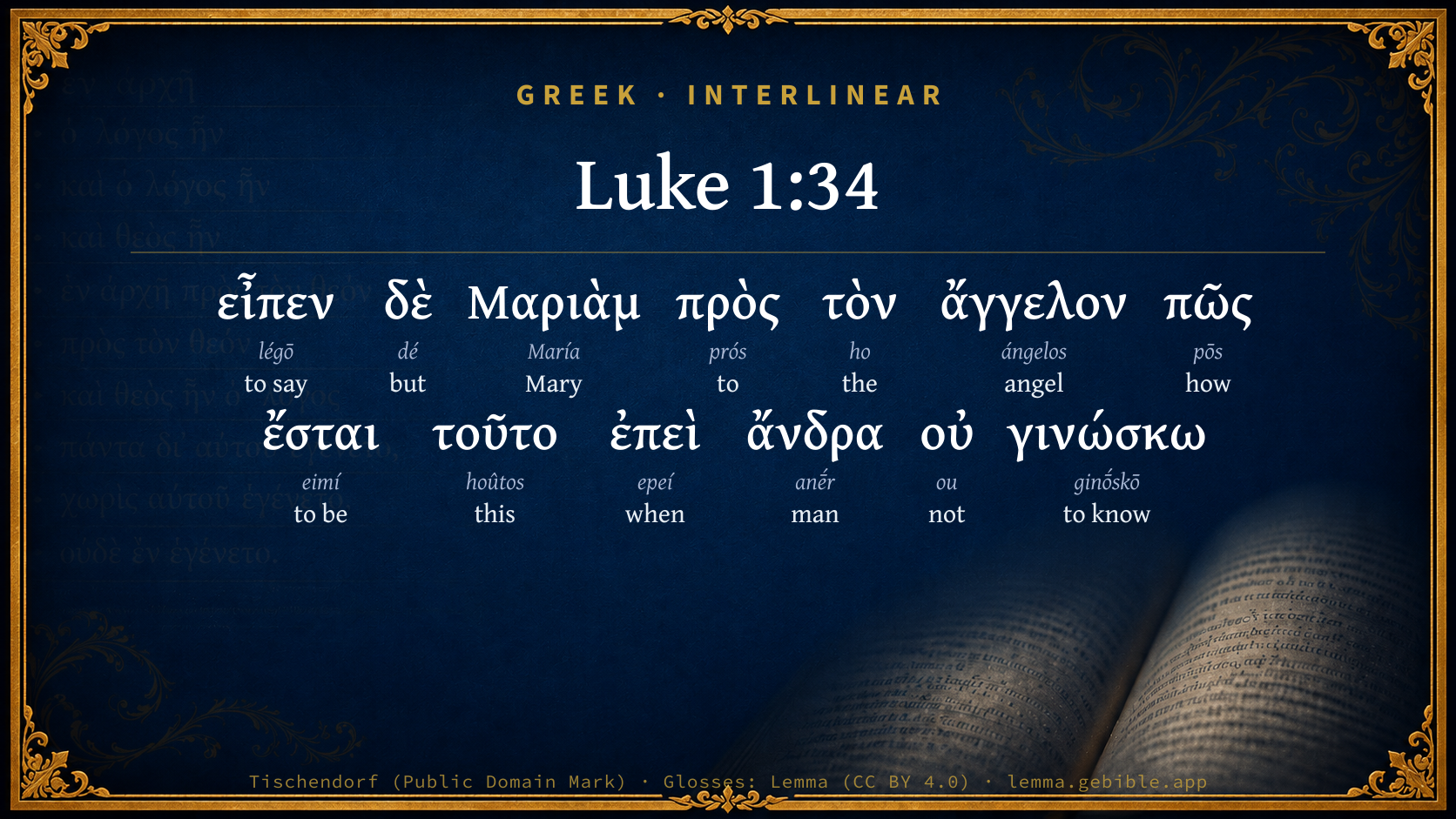
Download image
Cite this verse

Luke 1:34 (World English Bible). Public Domain. Lemma interlinear Bible study tool, https://lemma.gebible.app/v/luke/1/34.

Show BibTeX & RIS
BibTeX
RIS
English Translation
Mary said to the angel, "How can this be, seeing I am a virgin?"
World English Bible · Public Domain
Download a study sheet

One document with this verse’s original text, its word-by-word gloss line, the meaning frame, cross-references with their text, attributed commentary, and full source and license credits — printable, and it pastes into notes with its structure intact.

This verse Autodidact and up

Study sheet (.html) Plain text (.txt)

A passage Seminary Student

Up to 50 verses in one chapter. A passage sheet keeps up to 6 commentary sources and 12 cross-references per verse, in the order this page ranks them, and says so on the sheet whenever that leaves anything out. Ask for a single verse and you get the Autodidact verse sheet above.

Everything on this page stays free to read, with no account — the sheet is a download of what is already on screen, not access to it.

Want to remove ads? Support Godless Engineer
Compare translations 3

The same verse in 3 English versions, stacked beneath the original-language interlinear above. Click any original word for its lexicon entry.

Each is an independent rendering of the whole verse — the interlinear is not word-aligned to these translations.

Highlighted words mark where these versions differ — a whole-verse word diff, not a word-by-word alignment.

  • World English Bible Public Domain
    Mary said to the angel, "How can this be, seeing I am a virgin?"
  • King James Version Public Domain
    Then said Mary unto the angel, How shall this be, seeing I know not a man?
  • unfoldingWord Literal Text CC BY-SA 4.0
    But Mary said to the angel, “How will this be, since I have not known a man?”

unfoldingWord Literal Text — © unfoldingWord, licensed CC BY-SA 4.0. Word-aligned USFM3 via Door43 (git.door43.org/unfoldingWord/en_ult).

Versions to compare (up to 4)

3 of 4 selected

Show all 19 translations

Every available English version of this verse, each an independent rendering of the whole verse.

  • World English Bible Public Domain
    Mary said to the angel, "How can this be, seeing I am a virgin?"
  • Berean Standard Bible Public Domain
    “How can this be,” Mary asked the angel, “since I am a virgin?”
  • Majority Standard Bible Public Domain
    “How can this be,” Mary asked the angel, “since I am a virgin?”
  • King James Version Public Domain
    Then said Mary unto the angel, How shall this be, seeing I know not a man?
  • American Standard Version (1901) Public Domain
    And Mary said unto the angel, How shall this be, seeing I know not a man?
  • Revised Version (1885) Public Domain
    And Mary said unto the angel, How shall this be, seeing I know not a man?
  • Geneva Bible (1599) Public Domain
    Then sayde Marie vnto the Angel, How shall this be, seeing I knowe not man?
  • Douay-Rheims (1899) Public Domain
    And Mary said to the angel: How shall this be done, because I know not man?
  • Young's Literal Translation Public Domain
    And Mary said unto the messenger, `How shall this be, seeing a husband I do not know?'
  • Literal Standard Version CC BY-SA 4.0
    And Mary said to the messenger, “How will this be, seeing I do not know a husband?”
  • Unlocked Literal Bible CC BY-SA 4.0
    Mary said to the angel, “How will this happen, since I have not slept with any man?”
  • unfoldingWord Literal Text CC BY-SA 4.0
    But Mary said to the angel, “How will this be, since I have not known a man?”
  • Darby Bible Public Domain
    But Mary said to the angel, How shall this be, since I know not a man?
  • World Messianic Bible Public Domain
    Miriam said to the angel, “How can this be, seeing I am a virgin?”
  • Webster's Bible Public Domain
    Then said Mary to the angel, How shall this be, seeing I know not a man?
  • Free Bible Version CC BY-SA 4.0
    “How is this possible?” Mary asked. “I'm still a virgin.”
  • Bible in Basic English Public Domain
    And Mary said to the angel, How may this be, because I have had no knowledge of a man?
  • Text-Critical English NT CC BY 4.0
    Mary said to the angel, “How will this be, since I am a virgin?”
  • Tyndale New Testament (1534) Public Domain
    Then sayd Mary vnto the angell: How shall this be seinge I knowe not a man?

Literal Standard Version (2020), Covenant Press — licensed CC BY-SA 4.0. Text via the HelloAO Bible API (eBible.org). Unlocked Literal Bible (unfoldingWord) — licensed CC BY-SA 4.0. Text via the HelloAO Bible API (eBible.org). unfoldingWord Literal Text — © unfoldingWord, licensed CC BY-SA 4.0. Word-aligned USFM3 via Door43 (git.door43.org/unfoldingWord/en_ult). Free Bible Version, Dr. Jonathan Gallagher — licensed CC BY-SA 4.0. Text via the HelloAO Bible API (eBible.org).

Word by word

More ways to search: Search by grammar → Find every occurrence → Compare this word →

Practice this passage: Drill this verse → Learn its vocabulary →

About this verse

These counts appear in no published source. They are computed here, from the morphology-tagged text and Lemma’s own curated glosses. What Lemma adds →

13
words
13
distinct lemmas
Gospels
section

Commentary

Notes on Luke 1:34 from classic Christian and Jewish commentators (each source and its license shown beneath its notes). The classic Christian expositions comment on the surrounding passage and are grouped to its opening verse, so a note may address several verses; the Jewish commentaries on the Tanakh (Rashi and others) are per-verse, so they appear only where the commentator wrote on this verse.

Lemma curates 59 commentaries, every one of them public domain or Creative Commons licensed, each selected and text-cleaned for this edition rather than reprinted as found. About our sources →

The Biblical Illustrator

Joseph S. Exell

Luk_1:34-35

The Holy Ghost shall come upon thee

Of Christs Incarnation

These words are the angels answer to Mary, who, understanding the angel as speaking of a thing presently to be done before Joseph and she should come together, desires to know how she, being a virgin, should conceive.

Here--

1. The angel tells her how she should conceive and bring forth a Son, namely, by the power of the Holy Ghost, which is the power of the Highest, the Spirit of God being the true God, and so the Highest. The way of the Spirits powerful working to this miraculous conception, is denoted by two words. One is, that the Holy Ghost should come upon her, not in an ordinary way, as in the conception of all men (Job_10:8, Thine handshave made me, and fashioned me together round about); but in an extraordinary way, as on the prophets, and those that were raised to some extraordinary work. The other is, that the power of the Highest, which is infinite power, should overshadow her, to wit, make her, though a virgin, to conceive by virtue of the efficacy of infinite power, by which the world was created, when the same Spirit moved on the waters, cherished them, and framed the world.

2. He shows what should follow on this miraculous conception, namely, that the fruit of her womb, the child she should bear, should be called the Son of God. Where the angel teaches two things.

(1) The immaculate, sinless conception of the child Jesus, that holy thing, a holy thing though proceeding from a sinful creature, not tainted with sin, as all other children are. The powerful operation of the Divine Spirit sanctified that part of the virgins body of which the human nature of Christ was formed, so that by that influence it was separated from all impurity and defilement. So that, though it proceeded from a creature infected with original sin, there was no sin or taint of impurity in it. This was a glorious instance of the power of the Highest.

(2) He tells the virgin, that therefore, seeing that child to be thus conceived, he should be called, that is, owned to be, the Son of God. He says not, Therefore that holy thing shall be the Son of God, for he was the Son of God before, by virtue of His eternal generation; but, therefore he shall be called, i.e., owned to be really so, and more than a man.

I. I AM TO SHOW WHO SHE WAS THAT WAS THE MOTHER OF CHRIST AS MAN. Christ as God had no mother, and as man no father. But His mother as man was Mary. She was the seed of Abraham; and so Christ was that seed of Abraham, in whom all nations were to be blessed (Gal_3:16). She was of the tribe of Judah (Luk_3:33), and of that tribe Christ by her did spring (Heb_7:14). She was also of the family of David, as appears by her genealogy (Luk_3:1-38.), and therefore Christ is called the Son of David, as the Messiah behoved to be. She was, however, but a mean woman, the family of David being then reduced to a low outward condition in the world, having long before lost its flourishing state; so that our Lord sprung up as a root out of a dry ground (Isa_11:1; Isa_53:2).

II. I COME TO SHOW WHAT WE ARE TO UNDERSTAND BY CHRISTS BECOMING MAN. It implies--

1. That He had a real being and existence before His incarnation. He truly was before He was conceived in the womb of the virgin, and distinct from that being which was conceived in her. What and if ye shall see the Son of Man ascend up where He was before? (Joh_6:62). Yea, He was with His Father from all eternity, before any of the creatures came out of the womb of nothing.

2. That He actually took upon Him our nature. He assumed the entire nature of man into the unity of His Divine person, with all its integral parts and essential properties; and so was made or became a real and true man by that assumption. Hence it is said (Joh_1:14), The Word was made flesh. But though Jesus Christ had two natures, yet not two persons, which was the error of Nestorius, who lived in the fourth century. Again, though the Word was made flesh, yet it was without any confusion of the natures, or change of the one into the other: which was the heresy of the Eutychians of old, who so confounded the two natures in the person of Christ, that they denied all distinction between them. Eutyches thought that the-union was so made in the natures of Christ, that the humanity was absorbed and wholly turned into the Divine nature; so that, by that transubstantiation, the human nature had no longer being. But by this union the human nature is so united with the Divinity, that each retains its own essential properties distinct. The properties of either nature are preserved entire. It is impossible that the Majesty of the Divinity can receive any alteration; and it is as impossible that the meanness of the humanity can receive the impression of the Deity, so as to be changed into it, and a creature be metamorphosed into the Creator, and temporary flesh become eternal, and finite mount up into infinite. As the soul and the body are united, and make one person, yet the soul is not changed into the perfections of the body, nor the body into the perfections of the soul. There is a change indeed made in the humanity, by its being advanced to a more excellent union, but not in the Deity; as a change is made in the air when it is enlightened by the sun, not in the sun which communicates that brightness to the air. Athanasius makes the burning bush to be a type of Christs incarnation; the fire signifying the Divine nature, and the bush the human. The bush is a branch springing from the earth, and the fire descends from heaven. As the hush was united to the fire, yet was not hurt by the flame, nor converted into the fire, there remained a difference between the bush and the fire, yet the properties of fire shined in the bush, so that the whole bush seemed to be on fire. So in the incarnation of Christ, the human nature is not swallowed up by the Divine, nor changed into it, nor confounded with it: but they are so united, that the properties of both remain firm: two are so become one, that they remain two still; one person in two natures, containing the glorious perfections of the Divinity, and the weakness of the humanity. The fulness of the Godhead dwells bodily in Christ.

3. Christs becoming man implies the voluntariness of this act of His in assuming the human nature.

III. I proceed to show that CHRIST WAS TRUE MAN. Being the eternal Son of God, He became man, by taking to Himself a true body and a reasonable soul. He had the same human nature which is common to all men, sin only excepted. He is called in Scripture man, and the Son of man, the seed of the woman, the seed of Abraham, the Son of David, &c.; which designations could not have been given unto Him, if He had not been true man. The actions and passions of His life show that He had true flesh. He was hungry, thirsty, weary, faint, &c. For certainly if the Son of God would stoop so low as to take upon Him our frail flesh, He would not omit the nobler part, the soul, without which He could not be man. We are told that Jesus increased in wisdom and stature, the one in respect of His body, the other in respect of His soul. The sufferings of His body were indeed very great; it was filled with exquisite torture and pain; but His soul sufferings were much greater, as I observed in a former discourse.

IV. I come now to show WHAT WE ARE TO UNDERSTAND BY CHRISTS BEING CONCEIVED BY THE POWER OF THE HOLY GHOST IN THE WOMB OF THE VIRGIN MARY. To open this a little three things are to be considered here.

I. The framing of Christs human nature in the womb of the Virgin. The matter of His body was of the very flesh and blood of the virgin, otherwise He could not haw been the Son of David, of Abraham, and Adam, according to the flesh. Indeed God might have created His body out of nothing, or have formed it of the dust of the ground, as He did the body of Adam, our original progenitor: but had He been thus extraordinarily formed, and not propagated from Adam, though He had been a man like one of us, yet He would not have ban of kin to us; because it would not have been a nature derived from Adam, the common parent of us all. It was therefore requisite to an affinity with us, not only that He should have the same human nature, but that it should flow from the same principle, and be propagated to Him. And thus He is of the same nature that sinned, and so what He did and suffered may be imputed to us. Whereas, if He had been created as Adam was, it could not have been claimed in a legal and judicial way. The Holy Ghost did not minister any matter unto Christ from His own substance. Hence Basil says, Christ was conceived, not of the substance, but by the power, not by any generation, but by appointment and benediction of the Holy Ghost.

2. Let us consider the sanctifying of Christs human nature. I have already said that that part of the flesh of the Virgin, whereof the human nature of Christ was made, was purified and refined from all corruption by the overshadowing of the Holy Ghost, as a skilful workman separates the dross from the gold. Our Saviour was therefore called that holy thing Luk_1:35). Now this sanctification of the human nature of Christ was necessary.

(1) To fit it for personal union with the Word, who, out of His infinite love, humbled Himself to become flesh, and at the same time out of His infinite purity, could not defile Himself by becoming sinful flesh.

(2) With respect to the end of His incarnation, even the redemption and salvation of lost sinners; that as the first Adam was the fountain of our impurity, so the second Adam should also be the pure fountain of our righteousness. He that needed redemption himself could never have purchased redemption for us.

3. We are to consider the personal union of the manhood with the Godhead. To clear this a little, you would know--

(1) That when Christ assumed our nature, it was not united consubstantially, so as the three persons in the Godhead are united among themselves; they all have but one and the same nature and will: but in Christ there are two distinct natures and wills, though but one person.

(2) They are not united physically, as the soul and body are united in a man: for death actually dissolves that union; but this is indissoluble. So that when His soul was expired, and His body interred, both soul and body were still united to the second person as much as ever.

(3) Nor yet is this such a mystical union as is between Christ and believers. Indeed this is a glorious union. But though believers are said to be in Christ, and Christ in them, yet they arc not one person with Him. But more positively, this assumption of which I speak is that whereby the second

person in the glorious Godhead did take the human nature into a persons! union with Himself, by virtue whereof the manhood subsists in the second person, yet without confusion, as I showed already, both making but one person Immanuel, God with us. So that though there be a twofold nature in Christ, yet not a double person. Again, as it was produced miraculously, so it was assumed integrally; that is to say, Christ took a complete and perfect soul and body, with all and every faculty and member pertaining to it. And this was necessary, that thereby He might heal the whole nature of the disease and leprosy of sin, which had ceased upon and wofully infected every member and faculty of man. Christ assumed all, to sanctify all. Again, He assumed our nature with all its sinless infirmities: therefore it is said of Heb_2:17), In all things it behoved Him to be made like unto His brethren. But here we are to distinguish between personal and natural infirmities. Personal infirmities are such as befall particular persons, from particular causes, as dumbness, deafness, blindness, lameness, leprosies, &c. Now, it was no way necessary that Christ should assume these; but the natural ones, such as hunger, thirst, weariness, sweating, bleeding, mortality, &e. (Rom_8:3). Again, the human nature is so united with the Divine, that each nature still retains its own essential properties distinct. The glory of His Divinity was not extinguished or diminished, though it was eclipsed and obscured under the veil of our humanity; but there was no more change in the hiding of it, than there is in the body of the sun, when he is shadowed by the interposition of a cloud, And this union of the two natures in Christ is an inseparable union; so that from the first moment thereof, there never was, nor to all eternity shall there ever be, any separation of them.

V. I now proceed to show way CHRIST WAS BORN OF A VIRGIN. That Christ was to be born of a virgin, was prophesied and foretold many ages before His incarnation, as Isa_7:14. The Redeemer of the worldbehoved to be so born, as not to derive the stain of mans nature by His generation. It was most conformable to the infinite dignity of His person, that a supernatural and a Divine person be concerned as an active principle in it. By His being born of a virgin the holiness of His nature is effectually secured. Christ was an extraordinary person, and another Adam; and therefore it was necessary He should be produced a new way. Thus we may be thoroughly satisfied--

1. That Christ had a true human body; and that though He was made in the likeness of sinful flesh, He had not merely the likeness of flesh, but true Luk_24:39; Heb_2:14).

2. That He had reasonable soul, which was a created spirit, and that the Divine nature was not instead of a soul to Him.

3. That Christs body was not made of any substance sent down from heaven, but of the substance of the Virgin (Gal_4:4). He was the seed of the woman (Gen_3:15), and the fruit of Marys womb Luk_1:42), otherwise He had not been our brother.

4. That the Holy Ghost cannot be called the Father of Christ, since His human nature was formed, not of His substance, but of that of the Virgin, by His power.

5. That though as to the nativity of Christ there was nothing as to the way of it extraordinary, but He was at the ordinary time brought forth as others Luk_2:22-23), and that as a general truth. A woman, when she is in travail, hath sorrow, because her hour is come (Joh_16:21), yet He was born without sin, being that holy thing. He could not have been our Redeemer, had He not been so (Heb_7:26).

6. That the reason why Christ was born without sin, and the sin of Adam did not reach Him, was because He came not of Adam by ordinary generation, not by the blessing of marriage, but by a special promise after the fall.

I shall conclude all with some INFERENCES.

1. Jesus Christ is the true Messiah promised to Adam as the seed of the woman, to Abraham as his seed, the Shiloh mentioned by Jacob on his deathbed, the Prophet spoken of by Moses to be raised from among the children of Israel, the Son of David, and the Son to be born of a virgin.

2. Behold the wonderful love of God the Father, who was content to degrade and abase His dear Son, in order to bring about the salvation of sinners.

3. See here the wonderful love and astonishing condescendency of the Son, to be born of a woman, in order that He might die in the room of sinners. What great love to sinners, and what unparalleled condescension was here!

4. See here the cure of our being conceived in sin, and brought forth in iniquity.

5. Christ is sensibly touched with all the infirmities that attend our frail nature, and has pity and compassion upon His people under all their pressures and burdens (Heb_2:17-18). (T. Boston.)

The life of separation

The question that is uttered by Mary is not for a moment an utterance of incredulity. It is really the utterance of a believer who accepts the message that God has sent her, but who is conscious of difficulties in the way of its fulfilment. How can I ever be a mother, how can I ever be a mother of the Messiah Christ? The conditions--the fixed, the unalterable conditions--of my life make that to be for me an impossibility. How can this be, seeing I know not man? The words, of course, teach us this truth, that Mary was conscious that there was to the Divine promise and its fulfilment in her what seemed like a mighty barrier. We cannot say for certain whether the old legend is true; but it has always seemed to me that these words of our Lady bear out its truth in a most remarkable way. I refer to the old story that when St. Mary was quite a child she was taken up by her parents to the Temple, and that she there dedicated herself to serve God by a life of separation, and in the state of lifelong virginity, under the direct inspiration of the Holy Spirit of Love. And certainly that there was the existence of some such special barrier as this seems to be recognized and confessed in the question we are now considering. For just consider what her position was. She had been already espoused unto an old man called Joseph; and if their union was to have been the marriage union under its ordinary conditions, the message of Gabriel to Mary would simply have been under, stood by her in this way, that she should be, in the course of nature, the mother of Davids Greater Son. We know quite well that one of the great longings of every Jewish maiden down through the ages had been to become the mother of the Messiah; and it was this longing that made the thought of virginity utterly abhorrent to the whole spirit of Judaism. If, then, Gabriel had come to Mary when she was about to enter the married life under ordinary conditions she would never have been staggered by the Divine promise, and would never have seen any difficulty in the way of its fulfilment. In her humility she might have felt unworthy of it, but she would have bowed her head in pure and simple submission, and would have said--not the first--but her second word: Behold the handmaid of the Lord; be it unto me according to Thy word. But what she says is this: How can this be, seeing I know not man. What does this lead me to recognize? This fact, that already the love of God had done this for Mary--it had led her to a life of separation, it had led her to deliberately turn away from the state of life which was the common longing of the daughters of Israel; that she had already separated herself from man as a necessary preliminary condition of consecrating herself to God; and that the motive of this had been the love of God. Mary is emphatically revealed to us in the Bible not simply as a woman of devotion, but a woman whose devotion takes especially the contemplative form. She kept all His sayings and treasured them in her heart; she was one who was continually looking up at God with the fixed eye of wrapt contemplation; she was the pure in heart, and she saw God. And as she gazed on the vision of Gods beauty and lived in the recognition of Gods love, the love of God took possession of her heart in wondrous fulness and power; and as she gave herself up to be moulded by that love her first response to its working was the response of separation. Now Christian life is always a life of separation. That is its first aspect. We are taught this by the lessons of olden times. If you go back to the history of Israel, the Chosen People could only consecrate themselves to God in the Church in the wilderness and in the land of Canaan when they had come out of Egypt and had been separated from it by the separating waters of the Red Sea. Why, the very term whereby the Christian society is known shows this,--I mean the Greek equivalent to our word Church. Now what is the Ecclesia. The Eccleisa is a people called out. Out from what? Out from the world. As long as the present condition of things continues, the Church and the world can never be coextensive terms. The Church will always be found to be an Ecclesia, an election; in other words a people of separation, separate by privilege of course, but separate by responsibility also. And separation is the first essential feature of every true Christian life. In this separation there are two things to be remembered. In the first place, the separation is the act of God. It is God who separates, as He teaches us, when speaking to His people of old He says to them, Be ye holy, for I am holy, who have separated you to be My people. God separated His people to Himself, first, by the passage of the Red Sea, and then by the sprinkling of the blood when Moses came down from Mount Sinai. And so it is with us. We are separated by Gods act. The great act of separation with us is the act of Holy Baptism. We have been separated by Gods act, and we are to respond to it now by coming out and by being separate. Separate from what? Now here we must be very careful as we work our way, for we have to avoid two distinct difficulties. We have to avoid practically making the Church and the world the same, and saying that the Church has, so to say, to put a gloss over the world; and, on the other hand, we have to avoid an unpractical, uncommon sense trancendentalism, which is contrary to the example of Christ and the spirit of His gospel. That marvellous Eucharistic prayer of our Lord seems to teach the plain truth about this matter: I pray not that Thou shouldest take them out of the world, but that Thou shouldest keep them from the evil. What He prays for is this--not that He may have a people living in absolute isolation from society, but that He may have a people going out into the society of their day, living lives of loyalty to Christ where Christs name is denied, living lives of bold obedience to principle while passion sways the conduct of the many. Well, then, what we understand by the world is society as far as it is swayed by passion and desire, and not by principle and loyalty to Christ. In other words, the world is godless and corrupt society; and from that we must come out and be separate. Woe be to us if we fail in loyalty to Christ here. We shall bear, to our own shame before men, angels, and God, the brand of moral cowardice, and a more degrading brand than that cannot be stamped on any man or womans brow. Again, what are we to understand by separation? Well, we know in the Jewish days there were different degrees of separation. There was, for instance, the separation of the tribe of Levi for the diaconate, the separation of the family of Aaron for the priesthood, the separation of the Nazarites for a life of special strictness. Then, above all, there was the life of separation which marked off every Jew from the Gentiles as he obeyed the requirements of the Jewish law. So, again, in the Church there are different forms of separation.

I. To mention the highest of all, THERE IS THE SEPARATION TO WHAT WE CALL RELIGION. There are those to whom the voice comes which has found its expression in the 45th Psalm, verses 10 and 11. There is a state of life created by Christ in His Church, to which men and women are attracted to follow Him in poverty, in chastity, and in obedience; and of all forms of separation, that of the religious life is the most intense in its expression.

II. Then, again, THERE IS THE SEPARATION OF PROVIDENTIAL CIRCUMSTANCES. I want to mention three especially.

1. First of all, come family ties. Always think highly of the family. There is no sphere in life in which woman can minister better, in which she can do greater work for God, for the Church, and for those for whom Christ lived and died, than within the limits of the home.

2. Then there are those who are called aside by sickness, those whom God in His wonderful way leads by constrainings that must be submitted to, to a separation not only from the world outside, but sometimes even from the family within. As the world would say, they are apparently useless for life. But Do; they are led by God within the veil. Like the priest of Israel who twice daily entered into the Holy Place, and stood by the alter of incense alone and offered its sweet savour to God; so these are led by God by a wonderful separation to do a higher work than that of ministering, and that is the work of intercession.

3. Then, again, I cannot help thinking that there is a third way in which God separates some in His providential leadings, and that is by a retiring disposition. I do not for a moment say that you ought to give way to that self-consciousness which to many makes intercourse with the world one long agony. But there are many of you who go through life sorely weighted by that shyness, that self-consciousness, which makes you always think that nobody cares for you. It may be that even this temperament is a revelation of the will of God for you, and that by it he has separated you from much social joy and from many opportunities of exercising visibly holy influence, in order that you may be numbered with that hidden band whose ministry is the secret ministry of intercession rather than the ministry of open work. And, believe me, all these family ties, all these providential visitations of sickness and of temperament, are separations created by God, to which it is our wisdom, as it is our duty, to be submissive and obedient.

III. Then, again, THERE IS THE SEPARATION OF OBEDIENCE TO THE INNER LEADINGS OF THE SPIRIT, We are not under the law, but under grace. Many, we know, would like to have a definite law telling them what they may do and what they may not. You may go to a concert, but not to a theatre, you may ,go to a dinner party, but not to a ball--everything put down as clear as it can be. And we know that in former days Puritanism did attempt something of the kind; but it ended in failure, as it was bound to do. For we have not simply to deal with abstract laws, but we have to deal with individual characters. Cannot you see how it may be harmful for one to go where to another it would not only be not harmful, but positively helpful. So, outside the great Moral Law, God does not lay down any hard and fast rule, He does not legislate for our amusements. He put us under the guidance of the Spirit. Some people go with a clear conscience where others cannot go but with a guilty conscience. The great law of Christian life here is this--always be true to conscience; never allow yourself to do what you believe to be contrary to Gods Will for you, but do not limit another Christians liberty by your own rule of conduct or your own conviction as to what is lawful or expedient. Ah! be sure of it, separation will always mark off those whose lives are ruled by principle where lives are generally ruled by passion. What is the great principle that rules conduct in the world? Is it not undisciplined desire? That is the one great thing men live for--to gratify desire. But when Christ really comes into the heart the pain of pains is to grieve Him, and the joy of joys is to please Him, because we love Him. In no mere metaphorical language, we really love Him, and to give Him joy is our joy. How can we henceforth go out into the world and deny Him, and not rather there own Him gladly, by proved obedience to His manifested will? Last of all, love separates in yet another way. Love melts. It first renews, and then inspires, and then it melts. It has often happened even in the love of this world, that intercourse has begun with revulsion, but then love came in after a time, and the one who has been misunderstood is seen as she really is; and then comes grief for all the past, and with that grief comes of necessity the desire for reparation, the ready confession of wrong-doling and full purpose of amendment of life. And so it is with us. We loved not God, we knew not what He was; and then came a revelation of Him in Christ, and then the free gift of His Spirit in our hearts brings upon us a deep grief. I grieve that I should have sinned against a love so great, so long enduring--this recognized love of God melts me down into contrition, it makes me hate all my past life, until continuance in it is an impossibility, it brings me to his feet in confession, it raises me to go forth and show my sorrow for a life conformed to the world in the dead past by separation from the world in the living present. Such is the first thought that we have to notice. The life of a Christian is a life of separation because it is a life lived in the power of the love of God. (Canon Body.)

The miraculous conception

I. THE IMPORTANCE OF THE DOCTRINE AS AN ARTICLE OF THE FAITH. It is evidently the foundation of the whole distinction between the character of Christ in the condition of a man and that of any other prophet. Had the conception of Jesus been in the natural way, His intercourse with the Deity could have been of no other kind than the nature of any other man might have equally admitted; than the prophets enjoyed, when their minds were enlightened by the extraordinary influence of the Holy Spirit. The Holy Scriptures speak a very different language: they tell us, that the same God who spake in times past to the fathers by the prophets, hath in these latter days spoken unto us by His Son; evidently establishing a distinction of Christianity from preceding revelations, upon a distinction between the two characters of a prophet of God, and of Gods Son. Moses bore to Jesus, as we are told, the humble relation of a servant to a son. And lest the superiority on the side of the Son should be deemed a mere superiority of the office to which He was appointed, we are told that the Son is higher than the angels; being the effulgence of Gods glory, the express image of His person; the God whose throne is for ever and ever, the sceptre of whose kingdom is a sceptre of righteousness. And this high dignity of the Son is alleged as a motive for religious obedience to His commands, and for reliance on His promises. It is this, indeed, which gives such authority to His precepts, and such certainty to His whole doctrine, as render faith in Him the first duty of religion. But we need not go so high as to the Divine nature of our Lord to evince the necessity of His miraculous conception. It was necessary to the scheme of redemption, by the Redeemers offering of Himself as an expiatory sacrifice, that the manner of His conception should be such that He should in no degree partake of the natural pollution of the fallen race whose guilt He came to atone, nor be included in the general condemnation of Adams progeny. On the other hand, it were not difficult to show that the miraculous conception, once admitted, naturally brings up after it the great doctrines of the atonement and the incarnation. The miraculous conception of our Lord evidently implies some higher purpose of His coming than the mere business of a teacher. The business of a teacher might have been performed by a mere man enlightened by the prophetic spirit.

II. Having seen the importance of the doctrine of the miraculous conception as an article of our faith, let us, in the next place, consider THE SUFFICIENCY OF THE EVIDENCE BY WHICH THE FACT IS SUPPORTED. We have for it the express testimony of two out of the four evangelists,--of St. Matthew, whose Gospel was published in Judea within a few years after our Lords Ascension; and of St. Luke, whose narrative was composed (as may be collected from the authors short preface) to prevent the mischief that was to be apprehended from some pretended histories of our Saviours life, in which the truth was probably blended with many legendary tales. It is very remarkable, that the fact of the miraculous conception should be found in the first of the four Gospels,--written at a time when many of the near relations of the holy family must have been living, by whom the story, had it been false, had been easily confuted; that it should be found again in St. Lukes Gospel, written for the peculiar use of the converted Gentiles, and for the express purpose of furnishing a summary of authentic facts, and of suppressing spurious narrations. Was it not ordered by some peculiar providence of God, that the two great branches of the primitive Church, the Hebrew congregations for which St. Matthew wrote, and the Greek congregations for which St. Luke wrote, should find an express record of the miraculous conception each in its proper Gospel? Or if we consider the testimony of the writers simply as historians of the times in which they lived, without regard to their inspiration, which is not admitted by the adversary,--were not Matthew and Luke--Matthew, one of the twelve apostles of our Lord, and Luke, the companion of St. Paul--competent to examine the evidence of the facts which they have recorded? Is it likely that they have recorded facts upon the credit of a vague report, without examination? (Bishop Horsley.)

The difficulty of Marys situation

It is not, commonly, sufficiently seen what an advance these words are upon the angels previous announcement, and how simply appalling they must have sounded to the trembling listener. There had been nothing as yet which suggested a single step beyond the ordinary course of nature, and mothers are proverbially capable of believing in any the most exalted future for their children; but now words had been spoken which proposed to change the whole tenor of her life and being, and demanded little short of an agony of faith. Nay! may she acquiesce without sin? Her betrothal--what can it mean?--is to be ignored, and her child is to recognize no earthly father. What will the world say, that little world--all the more terrible because it is so little--of society in Nazareth? And how shall she break it to Joseph? And, then, she may remember some dreadful story she has overheard her elders tell in low, stern tones; how some betrothed maiden had been suspected of what she herself was now called upon to brave, and how there had been a trial, and she had been pronounced guilty; and then they had brought her out to the door of her fathers house, and the men of her city had stoned her to death: the only way, they said, of putting away evil from among them. And she was conscious that she must brave all this, practically, alone; there was no prophet, in her case, who would make himself responsible for her integrity, and explain it all to the people, and give them a sign, and convince them that it was all from God. The angel there before her might be very real to her, but when he has disappeared and left her--people do not very readily believe in angels visits to their neighbours; will she ever be quite sure herself? (E. T. Marshall, M. A.)

Rome--her new dogma, and our duties

First, then, WHAT IS THE DOCTRINE? It is, that the Blessed Virgin Mary was herself, by a miraculous interposition of Gods providence, conceived without the stain of original sin. That the nature, therefore, with which she was born into this world was, from the first moment in which she began to exist, not that nature which all inherit who naturally are engendered of the offspring of Adam, but another nature; free from that fault and corruption which, as an hereditary taint, infects every member of the fallen race who is naturally born into this world.

II. And now let us see, secondly, THE PENALTIES UNDER WHICH THIS DOCTRINE IS PROMULGATED. They are those of the Churchs anathema and the condemnation of God. Whosoever henceforth shall deny it is condemned as an heretic. Let no man, says the decree, interfere with this our declaration, pronunciation, and definition, or oppose or contradict it with presumptuous rashness. If any should presume to assail it, let him know that he will incur the indignation of the Omnipotent God, and of His blessed apostles Peter and Paul.

III. Thirdly, let us consider OUR REASONS FOR OBJECTING TO THIS PROMULGATION. First, then, we object to it as the unlawful addition of a new article to the Creed. And here, first, we must establish that it is such an addition. There can be no mistake as to this matter. Before the promulgating of this decree, any one within the Roman communion might, as she teaches, deny, with St. Bernard and St. Augustine, the doctrine of the immaculate conception of the virgin and be saved; since that 8th of December, whosoever denies it must be lost. It is, therefore, on their showing, anew and necessary article of a Christian mans faith. Every lawful addition then to the Creed must be made in accordance with these conditions. And now, if we try this newly-propounded article by these conditions, we shall be able to prove its unlawfulness. For, first, it lacks the condition of the assent of the whole body of the faithful. It is assented to neither by the Eastern, nor by our own branch, of the universal Church. It is true that this argument will not weigh with Rome, because, after the exact pattern of the old Donatist schismatics, she claims to be exclusively THE catholic body, and makes, as they did, communion with herself the one condition of communion with her Lord. But to all beyond these comparatively narrow limits, this argument against her intrusive article is of itself unanswerable. But next it falls under the same condemnation, because it is not the old truth held from the beginning, but a new proposition, which was not received by the primitive Church. To prove this, we need but to compare a few of the plainest facts of history with the very words of the decree by which this dogma has been now promulgated. The Church, it declares, has never ceased to lay down this doctrine, and to cherish and to illustrate it continually by numerous proofs, and more and more daily by splendid facts. For the Church has most clearly pointed out this doctrine, when she did not hesitate to propose the conception of the Virgin for the public devotion and veneration of the faithful. By which illustrious act she pointed out the conception of the Virgin as singular, wonderful, and very far removed from the origins of the rest of mankind, and to be venerated as entirely holy; since the Church celebrates festival-days only of the saints. Here, then, we have

(1) an admission that, for the validity of the decree, it must be possible to assert that it is the ancient truth which it enacts; and next

(2) the rest pretended proof which can be given that the doctrine was thus held of old. From what remote antiquity then is this proof drawn? The answer is well worthy of notice. The earliest date which the Pope can give for any declaration of the dogma, is that of the illustrious act by which the Roman Church proposed the conception of the virgin for the public devotion of the faithful. And when that act was wrought we may learn from a decree of Alexander VIIth, the earliest of his predecessors whom the Pope dares to quote by name, as having protected and defended the conception as the true object of devotion. For this decree informs us, that this pious, devout., add laudable institution emanated from our predecessor Sixtus the IVth. Now Sixtus IVth succeeded to the papacy almost at the close of the fifteenth century; so that this is the earliest act which the Pope can allege to prove his proposition, that the Church has never ceased to lay down this doctrine. But even this is not all; since we cannot fully estimate the falsehood of this reference until we compare it with the decree itself. For this, so far from implying, even at that late period, the implicit holding of the doctrine which is here insinuated, actually provides a special prohibition to guard against any being led by the fact of the festival to condemn those who deny the immaculate conception, because the matter has not been decided by the Apostolic See. Of so late a growth is this doctrine in the Roman communion itself, and so signally does this its novelty condemn its promulgation as an article of faith. We are able to disprove by positive evidence the only other conceivable suggestion by which it could be justified, namely, that though not enunciated sooner, yet that within the bosom of the Church the doctrine was held implicitly from early times. For in answer to this, we assert not only that there is no evidence for it, but that the voice of catholic antiquity distinctly contradicts such a supposition. Of thee, for instance, says one, speaking of our Lords nativity, He took that which even for thee He paid. The mother of the Redeemer herself, otherwise than by redemption, is not loosed from the bond of that ancient sin. He, therefore, says the great Augustine, alone who was at once made Man and remained God, had never any sin, nor took a flesh of sin, although tie came from a maternal flesh of sin. For that of flesh which He took He either purified to take it, or in the taking purified it; and so say all their own greatest authorities. Hear the judgment on this point of one of their bishops, by no means the least learned of their canonists:--That the Blessed Virgin, says Melchior Canus, was entirely free from original sin, is nowhere held in Holy Scripture, taken in its literal sense; but on the other hand, in them is delivered the general law which includes all the sons of Adam without any exception. Nor can it be said that this teaching descended to the Church through the tradition of the apostles, since such traditions have come down to us only through those ancient and holy writers who succeeded the apostles. But it is evident that those ancient writers had not received it from those before them … All the saints who have mentioned this matter have with one mouth asserted that the Virgin Mary was conceived in original sin. This St. Ambrose lays down, this St. Augustine repeatedly; this St. Chrysostom, this Eusebius Emissenus, this Remigius and Maximus, this Beds and Anselm affirm; this St. Bernard and Erhardus, bishop and martyr, with a multitude besides: this doctrine none of the saints have contravened. Neither implicitly, then, nor in open declaration, has this dogma been a doctrine of the Church of old.

IV. But once more, and above all; since the canon of Holy Scripture was complete, No DECLARATION OF DOCTRINE COULD EVER BE INSERTED IN THE CREEDS, WHICH COULD NOT BE SHOWN TO ACCORD WITH THAT WRITTEN WORD OF GOD. And when tested by this rule, the unlawfulness of this attempt will be most clearly proved. For not only is there no passage which can be alleged as even tending to prove it, but against it stand arrayed the clearest sentences of Holy Writ. For, says St. Paul, after examining the case alike of those without the law, as the heathen, or under the law, as the mother of Christ; For there is no difference, for all have sinned--and therefore Mary--and come short of the glory of God; being justified, not by immaculate conception, but freely by His grace through the redemption that is in Christ Jesus. And again, There is none righteous, no, not one. But next

V. we object, not only to any introduction of a new dogma, but we object also in particular to this as, to say the least, HAVING DIRECT TENDENCIES TO HERESY. For it is no mere speculation; it is full of deadly consequences. For, first, if in the course of the Divine process for working out our salvation, our fallen nature was pure from spot of sin in any one before that in the person of Jesus Christ our Lord it was through the operation of the Holy Ghost, sanctified wholly by the union of His Godhead with it, then is that one, and not He, the first fountain of new life to our corrupted race.

This teaching, therefore, points us not to Christ, but to Mary, as the wellhead of our restored humanity; and thus does it directly shake the great doctrine of the incarnation. And then, further, if that nature which He thus took in the womb of His virgin mother was not that which she, like others, inherited from Adam, but one made by Gods creative power to exist under new conditions of original purity, how can we say that He indeed took from her our very nature? Then was that quarry whence was dug that flesh which He united to His Godhead, not of our fallen, but of a new and different, nature; and then is His perfect brotherhood with us destroyed. And yet once more: this last conclusion leads us to another reason why, in Gods name, we protest against this dogma. For it is not merely accidentally that it thus endangers our faith in the true incarnation of our Lord, and points our eyes from Him to His mother as the medium between God and us; but this dangerous delusion is a part, and the crowning part, of a whole system which really places on the Mediators throne the virgin mother instead of the incarnate Son. For this is the grand characteristic of the whole Roman system of Mariolatrous imposture. It does confer upon the Virgin Mary the Mediators office. The whole system of Rome does make the Virgin Mother the special mediator between God and man. It teaches sinners to look to her as more tender, more merciful, more full of pity, more able to sympathize with their infirmities, than is that true High-priest, who is such as became us, because He is fitted by the perfect holiness, and yet true brotherhood with us, of the nature He assumed, to have compassion upon the ignorant, and upon them that are out of the way. Amongst all its defacement of the truth of Christ, this is perhaps the plainest and one of the most hideous features of Roman superstition.

VI. Lastly, brethren, suffer me to lay before you SOME OF THE DUTIES WHICH, AS IT SEEMS TO ME, ARE ENFORCED UPON US BY THIS SAD SPECTACLE OF DEEP CORRUPTION WITHIN THE ROMAN CHURCH.

1. The first is that which, however inadequately, I have felt bound to attempt this day to discharge. It is to protest anew against this monstrous effort to corrupt, by mans additions, the revealed truth of God.

2. Next, surely it is our duty, with all sadness of soul, to make on behalf of those who have so deeply fallen, our humble intercessions with our long-suffering Lord.

3. Again, the sight of this evil surely enforces upon us another duty. For the sake of truth and for the love of souls, we, whose rule of faith is Gods

Word, and whose interpreter of Scripture is true catholic consent, are bound to hold faster than ever to these our real principles.

4. But we have yet another duty, as we contemplate this fearful spectacle; we have to separate ourselves from its evil. (Bishop Samuel Wilberforce.)

The Biblical Illustrator, edited by Joseph S. Exell (c. 1880s–1900s) — public domain. Text from a community e-Sword module.

Joseph Benson's Commentary

Luk 1:34-38. Then said Mary, How shall this be — How can I immediately conceive a child, (for so the angel meant, and so she understood him to mean,) seeing I know not a man? — This was not the language of distrust, or of doubt, respecting what the angel said, but of a desire to be further instructed, for the direction of her conduct. She so inquired concerning the manner, as not to doubt of the fact. Some would render the clause, What? shall this be, if I have no intercourse with a man? as if she desired to be resolved, whether the birth were to be produced in a common, or a miraculous manner. But it is much more natural to suppose, that she understood the former words as an intimation that the effect was immediately to take place, to which her present circumstances seemed, humanly speaking, an invincible objection. She, however, asks no sign for the confirmation of her faith, as Zacharias had done, nor insinuates that she would not believe till a miracle was wrought to convince her; but only that she did not understand how her pregnancy could be effected in her virgin state, and desired him to explain it to her, not doubting but it was possible. Wherefore, the weakness of her apprehension being consistent with faith, and her request being conceived with modesty and humility, the angel told her that the wonderful event should be accomplished by the interposition of the Holy Spirit, and special energy of the power of God, who would preserve her reputation entire, at least in the opinion of impartial judges, and protect her from any injury which this mystery might expose her to; for, by the Jewish law, a severe punishment was inflicted on women betrothed, who proved with child before cohabiting with their husbands. Therefore also — Because thou shalt conceive by the immediate operation of the Holy Ghost; that holy thing which shall be born of thee — That holy offspring of thine; shall — With regard to this miraculous conception, as well as another, and yet greater consideration, be called the Son of God. And behold, thy cousin Elisabeth, &c. — For the confirmation of her faith the angel acquaints her with the pregnancy of her relation Elisabeth, who was then past the age of child-bearing; that being a thing similar, though inferior, to her own pregnancy, which he had been predicting. Mary and Elisabeth might be cousins, as the text affirms, although the former was a descendant of David, and the latter a daughter of Aaron; because the law, Num 36:6, forbidding women to marry out of their own tribes, related only to heiresses, and consequently did not include the tribe of Levi, which had not heritable possessions that could be alienated by such marriages. Accordingly, Lev 22:12, it is supposed a common case, that a priest’s daughter might be married to a stranger. And Mary said, Behold the handmaid of the Lord, &c. — In this answer Mary expressed both great faith and great resignation. She believed what the angel had told her concerning her conception, and wished for it; not regarding the inconveniences she might be exposed to thereby, well knowing that the power of God could easily protect her. Thus Mary, though a young virgin, readily believes an event much more wonderful than that which Zacharias, though an aged priest, had found it so difficult to credit: and thus does God, as it were, out of the mouths of babes and sucklings perfect his praise. It is not improbable, that this time of the virgin’s humble faith, consent, and expectation, might be the very time of her conceiving.

Joseph Benson's Commentary on the Old and New Testaments (1811–1818) — public domain. Text from a community e-Sword module.

Bengel's Gnomon

Johann Albrecht Bengel

Luk 1:34. Πῶς, how) This How is not inconsistent with faith, as Luk 1:45 proves.[8]—οὐ γινώσκω, I know not) The present is here used for [in accordance with and in reference to] the very moment of the conception, which was still future. She gathers from the words of the angel himself, that she is not about to know man. Ἐπεὶ, seeing that, is categorical [absolute]. Mary understood that this promise is being now given to her as one immediately about to be fulfilled, without respect to the consummation of her espousals. A woman is also said to know a man, Num 31:17; Jdg 9:39.

[8] The difference between her and Zacharias, Luk 1:18; lay not in the words but in the spirit.—ED. and TRANSL.

Bengel's Gnomon of the New Testament — English translation (T&T Clark, Edinburgh, 1860) — public domain. Text from a community e-Sword module.

Meyer's Critical & Exegetical Commentary

Heinrich August Wilhelm Meyer

Luk_1:34 f. How is it possible that this shall be the case?[22] namely, τὸ συλλαβεῖν ἐν γαστρὶ καὶ τεκεῖν υἱόν, Euthymius Zigabenus.

Οὐ ΓΙΝΏΣΚΩ] comp. Mat_1:18; Gen_19:8; Jdg_11:39; Num_31:17, since I have sexual intercourse with no man. In this sense the pure maiden knows no man. As, however, she is betrothed, Luk_1:27, her reply shows that she has understood the promise of the angel rightly as soon to be fulfilled, and not to be referred to her impending marriage with Joseph, but as independent of the marriage that was soon to take place. The ἄνδρα οὐ γινώσκω is thus simply the confession of the immaculate virgin conscience, and not (a misunderstanding, which Marys very betrothal ought to have precluded) the vow of perpetual virginity (Augustine, de virgin. 4, Gregory of Nyssa, Grotius, Jansen, Maldonatus, Bisping, and others), or the resolution to that effect (Schegg).

πνεῦμα ἅγιον] In accordance with the nature of a proper name, without the article. Moreover, see on Mat_1:18

ἘΠΕΛΕΎΣΕΤΑΙ ἘΠῚ ΣΈ] will descend upon thee (Act_1:8). This, as well as ἐπισκιάσει σοι, will overshadow thee (Act_5:15), isthe former without figure, the latter figurativelya designation of the connection producing the pregnancy, which, however, is not conceived of in the form of copulation, for which the words are euphemistic expressions (Paulus, von Ammon, and older commentators), or yet under the notion of a bird which covers its eggs (Theophylact, comp. Grotius).[23] Certainly the expressions are correlates of ΓΙΝΏΣΚΩ, but as regards the effect, not as regards the form, since ἐπελεύσ. expresses simply the descent of the Spirit, and ἘΠΙΣΚΙΆΣ. the manifestation of divine power associated therewith in the form of a cloud (after the manner of the Old Testament theophanies, Exo_40:34; Num_9:15; 1Ki_8:10; comp. also Luk_9:34). Augustine and other Fathers have quite mistakenly laid stress in ἐπισκ. on the notion of coolness (in contrast to procreation in lust); comp. ΣΚΙΆΖΕΙΝ ΤῸ ΚΑῦΜΑ in Alciphr. iii. 2.

ΔΎΝΑΜΙς ὙΨΊΣΤΟΥ] without the article: power of the Highest will overshadow thee, will be that, which shall overshadow thee. This will set in in immediate consequence (καί) of the πνεῦμα ἅγιον ἐπελεύσεται ἐπὶ σέ. Strict dogmatic expositors, such as Theophylact, Calovius, have rightly (comp. Luk_24:49) distinguished between the Holy Spirit and the power of the Highest, but in doing so have already imported more precise definitions from the dogmatic system by explaining the power of the Highest of the Son of God, who with His majesty filled the body that had been formed by the Holy Spirit, and thus have, by a more precise description of the formation of the body, broken in upon the delicate veil which the mouth of the angel had breathed over the mystery.[24]

τὸ γεννώμενον ἅγιον] the holy thing that is being begotten shall (after His birth) be called Son of God. Most interpreters take τὸ γεννώμενον as that which is to be born (comp. Luk_1:13), which view, moreover, has drawn after it the old addition ἐκ σοῦ from Mat_1:16. But the context which immediately precedes points only to the begetting (Bengel, Bleek); and to this also points the neuter, which applies to the embryo (comp. on Mat_1:20, and see Fritzsche, ad Aristoph. Thesm. 564), as well as the parallel Mat_1:20. The subject, we may add, is τὸ ἅγιον, not ΤῸ ΓΕΝΝΏΜ. (Kuinoel: proles veneranda = ΤῸ ΓΕΝΝΏΜ. ΤῸ ἍΓΙΟΝ), as also Bornemann assumes, when he (comp. de Wette) takes ἍΓΙΟΝ predicatively: proles tua, cum divina sit. Not as holy, but as begotten by Gods power (διό), is the fruit of Mary called the Son of God. Hofmann, Schriftbew. I. p. 117, explains: it shall be called holy, Son of God, so that those two appellations are to correspond to the two members of the preceding promise. So already Tertullian, as also Bengel and Bleek. But the asyndetic form, in which υἱὸς Θεοῦ would be subjoined, tells against this view all the more, that we should of necessity, in direct accordance with what precedes (ΚΑῚ ΔΎΝΑΜΙς Κ.Τ.Λ.), expect ΚΑῚ ΥἹῸς ΘΕΟῦ, especially after the verb, where no reader could anticipate a second predicate without καί. Comp. Justin, c. Tryph. 100: διὸ καὶ τὸ γεννώμενον ἐξ αὐτῆς ἅγιόν ἐστιν υἱὸς Θεοῦ.

[22] This question is only appropriate to the virgin heart as a question of doubt on the ground of conscious impossibility, and not as an actual wish to learn the how (τὸν τρόπον τοῦ πράγματος, Theophylact); comp. already Augustine: inquirendo dixit, non desperando, whereas the meaning of the question of Zacharias, ver. 18, is the converse.

[23] Approved also by Delitzsch, bibl. Psychol. p. 116 f., and Bleek. But this conception is here very much out of place, and is not implied even in מְרַחֶפֶת, Gen_1:2, which, besides, has nothing to do with the passage before us.

[24] Calovius: Supervenit Spiritus non quidem σπερματικῶς sed δημιουργικῶς, guttulas sanguineas Mariae, e quibus concipienda caro Domini, sanctificando, easdem foecundas reddendo, et ex iisdem corpus humanum efformando. Justin, Apol. I. 33, already rightly gives the simple thought of the chaste and delicate representation: κυοφορῆσαι παρθένον οὖσαν πεποίηκε. Schleiermacher, L. J. p. 62, erroneously affirms that the representation of Luke admits the possibility of Jesus being thought of as conceived with the participation of Joseph. It absolutely excludes any such notion.

Meyer — Critical and Exegetical Commentary on the New Testament — English translation by Peter Christie, edited by Frederick Crombie (T&T Clark, 1880) — public domain. Text from a community e-Sword module.

Godet's Commentaries

Frédéric Louis Godet

3. The manner in which the message was received: Luk 1:34-38.—34. “Then said Mary unto the angel, How shall this be, seeing I know not a man? 35. And the angel answered and said unto her, The Holy Ghost shall come upon thee, and the power of the Highest shall overshadow thee; therefore also that holy thing which shall be born of thee shall be called the Son of God. 36. And, behold, thy cousin Elizabeth, she hath also conceived a son in her old age; and this is the sixth month with her, who was called barren. 37. For with God nothing shall be impossible. 38. And Mary said, Behold the handmaid of the Lord; be it unto me according to thy word. And the angel departed from her.”

Mary’s question does not express doubt: it simply asks for an explanation, and this very request implies faith. Her question is the legitimate expression of the astonishment of a pure conscience.

We observe in the angel’s reply the parallelism which among the Hebrews is always the expression of exalted feeling and the mark of the poetic style. The angel touches upon the most sacred of mysteries, and his speech becomes a song. Are the terms come upon, overshadow, borrowed, as Bleek thinks, from the image of a bird covering her eggs or brooding over her young? Comp. Gen 1:3. It appears to us rather that these expressions allude to the cloud which covered the camp of the Israelites in the desert. In Luk 9:34, as here, the evangelist describes the approach of this mysterious cloud by the term ἐπισκιάζειν.

The Holy Ghost denotes here the divine power, the life-giving breath which calls into developed existence the germ of a human personality slumbering in Mary’s womb. This germ is the link which unites Jesus to human nature, and makes Him a member of the race He comes to save. Thus in this birth the miracle of the first creation is repeated on a scale of greater power. Two elements concurred in the formation of man: a body taken from the ground, and the divine breath. With these two elements correspond here the germ derived from the womb of Mary, and the Holy Ghost who fertilizes it. The absolute purity of this birth results, on the one hand, from the perfect holiness of the divine principle which is its efficient cause; on the other, from the absence of every impure motion in her who becomes a mother under the power of such a principle.

By the word also (“therefore also”) the angel alludes to his preceding words: He shall be called the Son of the Highest. We might paraphrase it: “And it is precisely for this reason that I said to thee, that...” We have then here, from the mouth of the angel himself, an authentic explanation of the term Son of God in the former part of his message. After this explanation, Mary could only understand the title in this sense: a human being of whose existence God Himself is the immediate author. It does not convey the idea of pre-existence, but it implies more than the term Messiah, which only refers to His mission. The word ὑψίστου, of the Highest, also refers to the term υἱὸς ὑψίστου, Son of the Highest, Luk 1:32, and explains it. Bleek, following the Peschito, Tertullian, etc., makes ἅγιον the predicate of κληθήσεται, and υἱὸς Θεοῦ in apposition with ἅγιον: “Wherefore that which shall be born of thee shall be called holy, Son of God.” But with the predicate holy, the verb should have been, not “shall be called,” but shall be. For holy is not a title. Besides, the connection with Luk 1:32 will not allow any other predicate to be given to shall be called than Son of God. The subject of the phrase is therefore the complex term τὸ γεννώμενον ἅγιον, the holy thing conceived in thee, and more especially ἅγιον, the holy; this adjective is taken as a substantive. As the adjective of γεννώμενον, taken substantively, it would of necessity be preceded by the article. The words ἐκ σοῦ are a gloss.

What is the connection between this miraculous birth of Jesus and His perfect holiness? The latter does not necessarily result from the former. For holiness is a fact of volition, not of nature. How could we assign any serious meaning to the moral struggles in the history of Jesus,—the temptation, for example,—if His perfect holiness was the necessary consequence of His miraculous birth? But it is not so. The miraculous birth was only the negative condition of the spotless holiness of Jesus. Entering into human life in this way, He was placed in the normal condition of man before his fall, and put in a position to fulfil the career originally set before man, in which he was to advance from innocence to holiness. He was simply freed from the obstacle which, owing to the way in which we are born, hinders us from accomplishing this task. But in order to change this possibility into a reality, Jesus had to exert every instant His own free will, and to devote Himself continually to the service of good and the fulfilment of the task assigned Him, namely, “the keeping of His Father’s commandment.” His miraculous birth, therefore, in no way prevented this conflict from being real. It gave Him liberty not to sin, but did not take away from Him the liberty of sinning.

Mary did not ask for a sign; the angel gives her one of his own accord. This sign, it is clear, is in close connection with the promise just made to her. When she beholds in Elizabeth the realization of this promised sign, her faith will be thoroughly confirmed. ᾿Ιδὸύ, behold, expresses its unexpectedness.—Καί before αὐτή, she also, brings out the analogy between the two facts thus brought together.

Mary’s being related to Elizabeth in no way proves, as Schleiermacher thought, that Mary did not belong to the tribe of Judah. There was no law to oblige an Israelitish maiden to marry into her own tribe; Mary’s father, even if he was of the tribe of Judah, might therefore have espoused a woman of the tribe of Levi. Could it be from this passage that Keim derives his assertion, that the priestly origin of Mary is indicated in Luke (Luk 1:33)? The dative γήρᾳ in the T. R. is only found in some MSS. All the other documents have γῆρει, from the form γῆρος.

In Luk 1:37 the angel refers the two events thus announced to the common cause which explains them both—the boundless omnipotence of God. That is the rock of faith. ᾿Αδυνατεῖν signifies, properly, to be powerless. And Meyer maintains that this must be its meaning here, and that ῥῆμα is to be taken in its proper sense of word. In that case we should have to give the preference to the Alex. reading τοῦ Θεοῦ: “No word proceeding from God shall remain powerless.” But this meaning is far-fetched. Παρὰ τοῦ Θεοῦ cannot depend naturally either on ῥῆμα or ἀδυνατήσει. Mat 17:20 proves that the verb ἀδυνατεῖν also signifies, in the Hellenistic dialect, to be impossible. The sense therefore is, “Nothing shall be impossible.” Παρὰ τῷ Θεῷ, with God, indicates the sphere in which alone this word is true. As though the angel said, The impossible is not divine. ῾Ρῆμα, as דָּבָר, H1821, a thing, in so far as announced. In reference to this concise vigorous expression of biblical supernaturalism, Oosterzee says: “The laws of nature are not chains which the Divine Legislator has laid upon Himself; they are threads which He holds in His hand, and which He shortens or lengthens at will.”

God’s message by the mouth of the angel was not a command. The part Mary had to fulfil made no demands on her. It only remained, therefore, for Mary to consent to the consequences of the divine offer. She gives this consent in a word at once simple and sublime, which involved the most extraordinary act of faith that a woman ever consented to accomplish. Mary accepts the sacrifice of that which is dearer to a young maiden than her very life, and thereby becomes pre-eminently the heroine of Israel, the ideal daughter of Zion, the perfect type of human receptivity in regard to the divine work. We see here what exquisite fruits the lengthened work of the Holy Spirit under the old covenant had produced in true Israelites. The word ἰδού, behold, does not here express surprise, but rather the offer of her entire being. Just as Abraham, when he answers God with, Behold, here I am (Genesis 22, Behold, I), Mary places herself at God’s disposal. The evangelist shows his tact in the choice of the aorist γένοιτο. The present would have signified, “Let it happen to me this very instant!” The aorist leaves the choice of the time to God.

What exquisite delicacy this scene displays! What simplicity and majesty in the dialogue! Not one word too many, not one too few. A narrative so perfect could only have emanated from the holy sphere within which the mystery was accomplished. A later origin would inevitably have betrayed itself by some foreign element. Hear the Protevangelium of James, which dates from the first part of the second century: “Fear not, said the angel to Mary; for thou hast found grace before the Master of all things, and thou shalt conceive by His word. Having heard that, she doubted and said within herself: Shall I conceive of the Lord, of the living God, and shall I give birth as every woman gives birth? And the angel of the Lord said to her: No, not thus, Mary, for the power of God...,” etc.

Frédéric Louis Godet — Commentaries on Luke, John, Romans, and 1 Corinthians — English translation (T&T Clark, Edinburgh, 1870s–1890s) — public domain. Text from a community e-Sword module.

Geneva Bible (1599)

Geneva Bible translators

The greatness of the matter causeth the Virgin to ask this question, not that she distrusteth any whit at all, for she asketh only of the manner of the conceiving, so that it is plain she believed all the rest.

So speak the Hebrews, signifying by this modest kind of speech the company of man and wife together, and this is the meaning of it: how shall this be, forseeing, I shall be Christ his mother, I am very sure. I shall not know any man: for the godly virgin had learned by the Prophets, that the Messiah should be born of a Virgin.

Geneva Bible (1599) marginal notes — public domain. Text via Bolls.life.

Jamieson, Fausset & Brown

Robert Jamieson, A. R. Fausset & David Brown

How, &c.--not the unbelief of Zacharias, "Whereby shall I know this?" but, taking the fact for granted, "How is it to be, so contrary to the unbroken law of human birth?" Instead of reproof, therefore, her question is answered in mysterious detail.

Jamieson, Fausset & Brown — Commentary Critical and Explanatory on the Whole Bible (1871) — public domain (CC PDM 1.0). Text via the HelloAO Bible API.

Adam Clarke's Commentary

Verse 34. Seeing I know not a man] Or, husband. As she was only contracted to Joseph, and not as yet married, she knew that this conception could not have yet taken place; and she modestly inquires by what means the promise of the angel is to be fulfilled in order to regulate her conduct accordingly.

Adam Clarke's Commentary on the Bible (1810–1826) — public domain. Text from a community e-Sword/MySword module.

Ellicott's Commentary for English Readers

(34) How shall this be?—The question of the Virgin is not altogether of the same nature as that of Zacharias in Luk_1:18. He asks by what sign he shall know that the words were true which told him of a son in his old age. Mary is told of a far greater marvel, for her question shows that she understood the angel to speak of the birth as antecedent to her marriage, and she, accepting the words in faith, does not demand a sign, but reverently seeks to know the manner of their accomplishment.

A Bible Commentary for English Readers, edited by Charles John Ellicott (1878–1897) — public domain. Text from a community e-Sword module.

The Cambridge Bible for Schools and Colleges

gen. ed. J. J. S. Perowne

34. How shall this be?] Mary does not doubt the fact as Zacharias had done; she only enquires as to the mode of accomplishment. The village maiden amid her humble daily duties shews a more ready faith in a far more startling message than the aged priest in the Holy Place amid the Incense.

The Cambridge Bible for Schools and Colleges (gen. ed. J. J. S. Perowne; Cambridge University Press, 1878–1918) — public domain. Text from a community e-Sword module.

John Gill's Exposition

Then said Mary to the angel, how shall this be,.... This she said not as doubting the truth of what was said; for she required no sign, as Zacharias did; nor is she charged with, and blamed for unbelief, as he was; yea, it is expressly said, Luk 1:45 that she believed: nor was this a curious question, as whether she should have this son by a man in a married state, or in her present virgin state; for she clearly understood the angel to mean the latter; and therefore her words express her admiration at it, and also her desire to be informed of the manner how it should be: as to the matter of fact, she did not dispute it, but wanted to be resolved by what means it would be brought about: she knew, by prophecy, that the Messiah was to be born of a virgin, and she perceived, by the angel's declaration, that she was that virgin, but could not imagine in what way this amazing thing should be effected; and therefore proposes this question for the following reason,

seeing I know not a man? "A husband", as the Arabic version renders it; not Joseph, nor any other man; for though she was espoused to Joseph, yet he had not taken her to wife; nor were they, as yet; come together; and before they did, she was found with child of the Holy Ghost, Mat 1:18 she was a pure virgin, untouched by man. The words are an "euphemism", or a modest way of expressing carnal copulation; see Gen 4:1.

John Gill's Exposition of the Whole Bible (1746–1763) — public domain (CC PDM 1.0). Text via the HelloAO Bible API.

Trapp's Complete Commentary

John Trapp

34 Then said Mary unto the angel, How shall this be, seeing I know not a man?

Ver. 34. How shall this be?] This is a speech not of unbelief, but of wonderment, as desiring also to be better informed.

John Trapp, A Commentary or Exposition upon All the Books of the Old and New Testament (1647–1656) — public domain. Text from a community e-Sword module.

Haydock's Catholic Bible Commentary

How shall this be done? She only asks about the manner. --- Because I know not man.[6] This answer, as St. Augustine takes notice, would have been to no purpose, had she not made a vow to God to live always a virgin. (Witham) --- Listen to the words of this pure Virgin. The angel tells her she shall conceive; but she insists upon her virginity, holding her purity in higher estimation than the promised dignity. (St. Gregory of Nyssa.) --- She did not doubt the truth of what the angel said, (as Calvin impiously maintained) but she wished it might not happen to the prejudice of her vowed virginity. (St. Ambrose, St. Augustine, Ven. Bede, Theophylactus, &c. &c.)

===============================

[BIBLIOGRAPHY]

Quia virum non cognosco. St. Augustine, quod profecto non diceret, nisi Deo Virginem se ante vovisset. (De Virginitate, chap. iv, tom. 6, p. 343. Ed. Ben.)

George Leo Haydock (1774–1849), Haydock's Catholic Family Bible and Commentary, 1859 edition — public domain. Excludes Psalms (Douay-Rheims chapter numbering differs from Protestant) and Deuterocanonical books (Catholic canon only).

Matthew Poole's English Annotations

There are some would excuse Mary in this reply, and tell us these words spake in her no doubt that the things spoken by the angel should not come to pass, only admiration, or a desire to be further acquainted which way God would effect such a wonder of providence. Others think her words hardly excusable from all guilt, though the more excusable because there had yet been no such precedent made in the world of the Divine power, as to cause a virgin to conceive, and bring forth a son. The next words,

seeing I know not a man, seem to import that she understood the angel of the present or past time, that she had already conceived, or should immediately conceive, against which she objects her not having any carnal knowledge of any man. For the notion of some papists, that would from hence impose upon us to believe that Mary hath vowed virginity, as if the sense of the words were, I am resolved never to know man, it is so ridiculous, that no man of ordinary sense can allow it; for, besides that there were no such vows that we ever read of amongst the Israelites, nor could any such be made but by the law of God might be rescinded, if made when the virgin was in her father’s house; and besides that it is very improbable that a Jewish woman should make such a vow, in whom barrenness was such a reproach, and who looked upon it as a curse; I say, besides these things, who can have such unworthy thoughts of the blessed virgin, as to think that she should, having made such a vow, admit of an espousal to Joseph to mock him? But she certainly understood the angel as speaking of a thing in being, or which presently should be; and though she believed what the angel said, yet is desirous of further satisfaction how such a thing could be out of the ordinary course of nature.

Matthew Poole's English Annotations on the Holy Bible (1683–1685) — public domain. Text from a community e-Sword/MySword module.

Whedon's Commentary on the Bible

Daniel D. Whedon

34. How shall this be?—Zacharias requires proof of the angel’s statement before he will believe the thing will be done; Mary accepts that the thing will be done, and modestly asks how? One is a case of presumptuous unbelief; the other is a case of faith asking to be further instructed. “I accept in full faith the fact; but by what process (since the natural process is impossible) shall it be accomplished?” The angel now declares the process. Instead of an impure and sexual agency, a holy, unsexual, omnipotent power shall as purely produce the new being as the first germ of plant and tree was originally formed and developed “before it grew.” Gen_2:5.

Daniel D. Whedon (gen. ed.), Commentary on the Old and New Testaments (1874–1909) — public domain. Text from a community e-Sword module.

Kretzmann's Popular Commentary

Paul E. Kretzmann

The explanation of the miracle:

v. 34 Then said Mary unto the angel, How shall this be, seeing I know not a man?

v. 35. And the angel answered and said unto her, The Holy Ghost shall come upon thee, and the power of the Highest shall overshadow thee; therefore also that Holy Thing which shall be born of thee shall be called the Son of God.

v. 36. And, behold, thy cousin Elisabeth, she hath also conceived a son in her old age; and this is the sixth month with her, who was called barren.

v. 37. For with God nothing shall be impossible.

v. 38. And Mary said, Behold the handmaid of the Lord; be it unto me according to thy word. And the angel departed from her.

Mary had received wonderful, overwhelming news, such as she could hardly be expected to grasp and comprehend, that she, the unknown, poor maiden, should be the mother of the Messiah; for the words of the angel permitted no other interpretation. She was ready, in humble trust, to accept the message. But she feels constrained to ask for an explanation, not a sign. She knew only of the ordinary course of nature by which children are born into the world, and which presupposes two parents. She knew herself to be a pure virgin, no man having known her. The angel accepts the question, and, in answering, rises to an exulting chant. God would here make a wonderful exception, He would set aside the usual course of nature. The Holy Spirit, the Power of the Highest, the miraculous life-producing Power, would here exert an influence which would produce a child without fleshly defilement, out of the flesh and blood of the virgin only. No human father would be present, nor would there be any intercourse according to the blessing given to men at the creation. The creative power of God would come upon her, overshadow her, and so the child which would be born would be called holy, the Son of God. The faith of Mary under these trying circumstances is certainly remarkable. "That is a high, excellent faith ’to become a mother and yet remain a simple virgin; this truly transcends sense, thoughts, also all human reason and experience. Mary here has no example in all creatures on earth to which she could hold and thus strengthen herself; yea, they all are against faith; for she is there all alone, who contrary to all reason, sense, and thoughts of men, without the agency of man, should bear and become a mother. Therefore she was obliged to abandon everything, even herself, and cling to the Word alone which the angel proclaimed to her from God. As it happened to Mary with her faith, so it happens to all of us, that we must believe what is opposed to our understanding, thoughts, experience, and example. For that is the property and nature of faith, that it will not permit anything to stand outside of itself, on which a person might rely and rest but only the mere Word of God and the divine promise."

But the angel, as if filled with compassion for Mary’s difficult position, gives her some more information which would tend to set her mind at ease and reassure her. He tells Mary that her kinswoman, Elisabeth, who was of an age in which the normal course of nature no longer permitted the procreation of children, and who for that reason had been commonly considered barren, had been relieved of her reproach by God, this being the sixth month since the Lord had remembered her to give her a son. For—and very impressively the angel brings out the fact—with God there is impossible not one thing; every word of promise which He has made He will carry into execution at His time. Upon this word she might rely without doubt; this would be a powerful support to her faith. And in this way Mary accepted the message in its entirety. There were still doubtless many points concerning which she knew no explanation, which were beyond her power of comprehension. But she simply believed. She put herself entirely into the Lord’s service, as His servant. His work might be carried out in her. Hers was not only obedient submission, but also patient, longing expectation. She was ready to be the mother of the God-man, just as the angel had said. She herself had been conceived and born in sin, after the manner of all ordinary human beings, and the doctrine of Mary’s immaculate conception is a piece of Catholic fiction, but her Son, born of a woman, yet without carnal intercourse, by which He would have been conceived in sin, is the holy Son of God, the Redeemer of the world.

Paul E. Kretzmann, Popular Commentary of the Bible (1921–1924) — public domain. Text from a community e-Sword module.

Burkitt's Expository Notes on the New Testament

William Burkitt

Observe here, 1. The virgin’s question, How shall this be? This question did not import her denial of the possibility of the thing, but her wonder at the strangeness of the thing; it proceeded rather from a desire of information, than from a doubt of infidelity. Therefore she doth not say, This cannot be, nor, How can this be? but, How shall this be? She doth not distrust, but demand, how here virginity shall become fruitful, and how she, being a virgin, could bring forth a son?

Observe, 2. The angel’s reply to the virgin’s question, The Holy Ghost shall come upon thee.

Where note, the angel declares the author who, but not the manner how: the Holy Ghost shall come upon thee, but in what way, and after what manner, is not declared: no mother knows the manner of her natural conception, what presumption had it then been for the mother of the Messiah, to have inquired how the Son of God could take flesh and blood of his creature! It is for none but the Almighty to know those works which do immediately concern himself.

Observe, 3. The holy and immaculate conception of our blessed Redeemer: The Holy Ghost shall come upon thee, and the power of the Most High shall overshadow thee; wherefore that holy thing which shall be born of thee, shall be caled the Son of God; that is, the Holy Ghost shall prepare and sanctify so much of thy flesh blood, or seed, as shall constitute the body of Chirst. For though it was a work of the whole Trinity, yet it is ascribed particularly to the Holy Ghost, sanctification being his peculiar work. And the title and epithet of that holy thing, sheweth the purity and immaculateness of Christ’s human nature, and that none was ever born thus holy and immaculate but Christ only; because none had ever such a way and means of conception, but only he: Therefore that holy thing shall be called the Son of God; not constituted and made, but evidenced and declared. Christ was God before he assumed flesh, even from eternity; but his taking flesh in this manner, evidences him to be the Son of God.

Observe, 4. The argument used by the angel to confirm Mary in the belief of what he had told her, namely, the wonderful conception of her cousin Elizabeth, in her old age, who was now six months gone with child.

Where observe, 1. What an exact knowlege God has, and what a particular notice he takes of all the children of men; he knoweth not only ourselves, but our relations also, Behold thy cousin Elizabeth: the knowledge which God has of every person, and every action, is a clear and distinct knowledge.

Note, 2. How the angel strengthens her faith by a consideration drawn from the almighty power of God; With God nothing shall be impossible, be it ever so strange and difficult. There is no such way to overcome difficulties, as by strengthening our faith in the almighty power of God. Faith will enable us to assent to truths, though seemingly incredible, and to believe the possiblity of things, though appearing impossible.

Observe, lastly, how the virgin expresses her faith and obedience, her submission and entire resignation, to the divine pleasure, to be disposed of by God as he thought fit: Behold the handmaid of the Lord, be it unto me according to thy word. We hear of no more objections or interrogations, but a humble and submissive silence.

Learn hence, that a gracious heart, when once it understands the pleasure of God, argues no farther, but quietly rests in a believing expectation of what God will do. All disputations with God, after his will is made known and understood, arise from infidelity and unbelief. The virgin having thus consented, instantly conceived by the overshadowing power of the Holy Ghost.

William Burkitt's Expository Notes on the New Testament (1700–1703) — public domain. Text from a community e-Sword module.

Godbey's Commentary on the New Testament

William B. Godbey

MARY’S SUBMISSION

34-38. “And Mary said, Behold the handmaiden of the Lord: may it he unto me according to thy word.” Good Lord, give us the faith of Mary, that we may perfectly submit to Thy Word and will, regardless of consequences! Perfect submission is the indefeasible fulcrum on which rests the Archimedean lever by which we tilt the world all out of the heart. In this case, you see, Mary must take the risk of the deepest disgrace in worldly estimation and really the liability of martyrdom as the law specified the penalty of death for prostitution in Israel. Mary’s faith here leaps above every intimidation, and soars to the very pinnacle of victory.

39-45. It is about a hundred miles, through a rough, mountainous country, from Nazareth to Jutta, the home of Elizabeth, in the tribe of Judah. Upon the annunciation of Gabriel, and the information in reference to Elizabeth, her relative, Mary immediately set out on that long journey, walking, riding a donkey, or perhaps a camel, in order to visit her at her home. It here says that she came into the hill-country with haste, into a city of Judah. On arrival at the house of Elizabeth, wonderful manifestations of the Divine presence transpire. Elizabeth is filled with the Holy Ghost — i.e., the spirit of prophecy comes on her, and she speaks fluently with a loud voice: “Blessed art thou among women, and blessed is the fruit of thy womb. And whence is this to me, that the mother of my Lord may come unto me? For, behold, when the voice of thy salutation came into my ears, the infant in my womb leaped with joy. And blessed is she that believeth, because there shall be a perfection unto those things having been spoken unto her by the Lord.” These inspired utterances of Elizabeth, enunciated in the fullness of the Spirit, should raise the faith of every Christian to the acme of full assurance; as we see, positively and unequivocally, that our faith is the measuring line of our experience. There is no reason why the Elizabethan blessing pronounced on Mary may not be appropriated by every disciple of our Lord. O how appropriate the prayer, “Lord, increase our faith!”

46-56. And Mary said: “My soul doth magnify the Lord, and my spirit doth rejoice in God my Savior: because He hath looked upon the humility of His servant; for, behold, from now, all generations shall call me blessed.” While, of course, we are all to diligently steer clear of the Mariolatry so prominent among the Romanists, yet we must admit that the mother of the Lord, in a most extraordinary sense, is blessed among women, honored far above all others. Well did she predict the encomium pronounced upon her by all generations. This had been the grand aspiration, inspiring millions of Jewish maidens; now she very appropriately realizes this pearl of all blessings within the reach of womanhood: “The Mighty One hath wrought great things; His name is holy; His mercy is to generations of generations of them that fear Him. He hath humiliated the mighty from their thrones, and exalted the humble. He hath filled the poor with good things, and sent away the rich empty. He hath looked upon Israel, His son, to remember mercy, as He spoke to our fathers, to Abraham and his seed forever.” This brilliant and beautiful prophetical thanksgiving of Mary, under the inspiration of the Holy Ghost, vividly contrasts the temporal aggrandizement of the worldly with the spiritual blessings and achievements of the saints, its culminating fulfillment realizable at the second coming of our Lord, when all temporal thrones will fall (Dan 7:9); every monarch doff his crown, forfeit his scepter, preparatory to the coronation of Jesus as “King of kings and Lord of lords;” and the promotion of His bridehood to the thrones, dominions, and principalities of all nations.

William B. Godbey, Commentary on the New Testament (1896–1900) — public domain. Text from a community e-Sword module.

unfoldingWord translationNotes

Door43 World Missions Community

How will this happen

Though Mary did not understand how it could happen, she did not doubt that it would happen.

I have not slept with any man

Mary used this polite expression to say that she had not engaged in sexual activity. AT: "I am a virgin" (See: Euphemism)

The Holy Spirit will come upon you

The process of Mary's conception would begin with the Holy Spirit coming to her.

will come upon

"will overtake"

the power of the Most High

It was God's "power" that would supernaturally cause Mary to become pregnant even while she still remained a virgin. Make sure this does not imply any physical or sexual union—this was a miracle.

will come over you

"will cover you like a shadow"

So the holy one to be born will be called the Son of God

This can be stated in active form. AT: "So they will call the holy one who will be born the Son of God" or "So the baby that will be born will be holy, and people will call him the Son of God" (See: Active or Passive)

the holy one

"the holy child" or "the holy baby"

Son of God

This is an important title for Jesus. (See: Translating Son and Father)

translationWords

Holy Spirit

power

Holy One

Son of God

unfoldingWord translationNotes — © Distant Shores Media and the Door43 World Missions Community, licensed CC BY-SA 4.0. Source: git.door43.org/Door43/en_tn.

Cambridge Greek Testament for Schools and Colleges

34. Πῶς ἔσται τοῦτο; Mary does not doubt the fact as Zacharias had done; she only inquires as to the mode of accomplishment. The village maiden amid her humble daily duties shews a more ready faith in a far more startling message than the aged priest in the Holy Place amid the Incense. Inquirendo dixit non desperando. Aug.

Cambridge Greek Testament for Schools and Colleges (Cambridge University Press, 1896; 21 vols, various authors incl. Carr, Maclear, Plummer, Farrar, Lumby, Moule, M. R. James, Simcox) — public domain. Text from a community e-Sword module.

International Critical Commentary

34. Πῶς ἔσται τοῦτο. She does not ask for proof, as Zacharias did (ver. 18); and only in the form of the words does she ask as to the mode of accomplishment. Her utterance is little more than an involuntary expression of amazement: non dubitantis sed admirantis (Grotius). In contrasting her with Zacharias, Ambrose says, Hæc jam de negotio tractat; ille adhuc de nuntio dubitat. It is clear that she does not doubt the fact promised, nor for a moment suppose that her child is to be the child of Joseph.

ἐπεὶ ἄνδρα οὐ γινώσκω Comp. Gen 19:8; Jdg 11:39; Num 31:17. The words are the avowal of a maiden conscious of her own purity; and they are drawn from her by the strange declaration that she is to have a son before she is married. It is very unnatural to understand the words as a vow of perpetual virginity, or as stating that such a vow has already been taken, or is about to be taken. It is difficult to reconcile οὐκ ἐγίνωσκεν (imperf., not aor.) αὐτὴν ἕως (Mat 1:25) with any such vow.1

International Critical Commentary — older volumes (1896–1929), various authors — public domain. Text from a community e-Sword module.

Lesson kit

Teaching starters — assembled from the data on this page, not authored interpretation. Every prompt links to the verse data it draws on. Edit before teaching.

Luke, in the Gospels, opens this verse with 13 words (13 distinct Greek lemmas). Its most distinctive word is epeí (“when”). A historical commentator’s framing appears above. Read the whole chapter for the surrounding context.

Discussion questions

  1. How does “when” (epeí) shape what this verse is saying?
  2. How does Matthew 18:32, which shares the word «when», read alongside this verse?
  3. These translations render this verse differently. What is at stake in choosing one wording over another?
  4. Compare how The Biblical Illustrator and Joseph Benson's Commentary read this verse. Where do they agree or differ?

Things to notice

Reading settings

Reading text

Shown beneath each verse's original-language words.

Old Testament
Old Testament edition

Read the OT as the Masoretic Hebrew (MT) or the Greek Septuagint (LXX).

English shown for the Greek Septuagint (in the Hebrew ↔ Greek comparison).

Comparing translations? Open the Compare panel on any verse page to stack up to four side by side.