
Luke 9:21

Greek (Tischendorf 8th ed.) Luke 9:21 appears in the Greek New Testament. The text above is from the Tischendorf 8th edition. Each word links to its Strong’s number and a concise gloss. Click any word for its full Thayer’s Greek Lexicon entry.
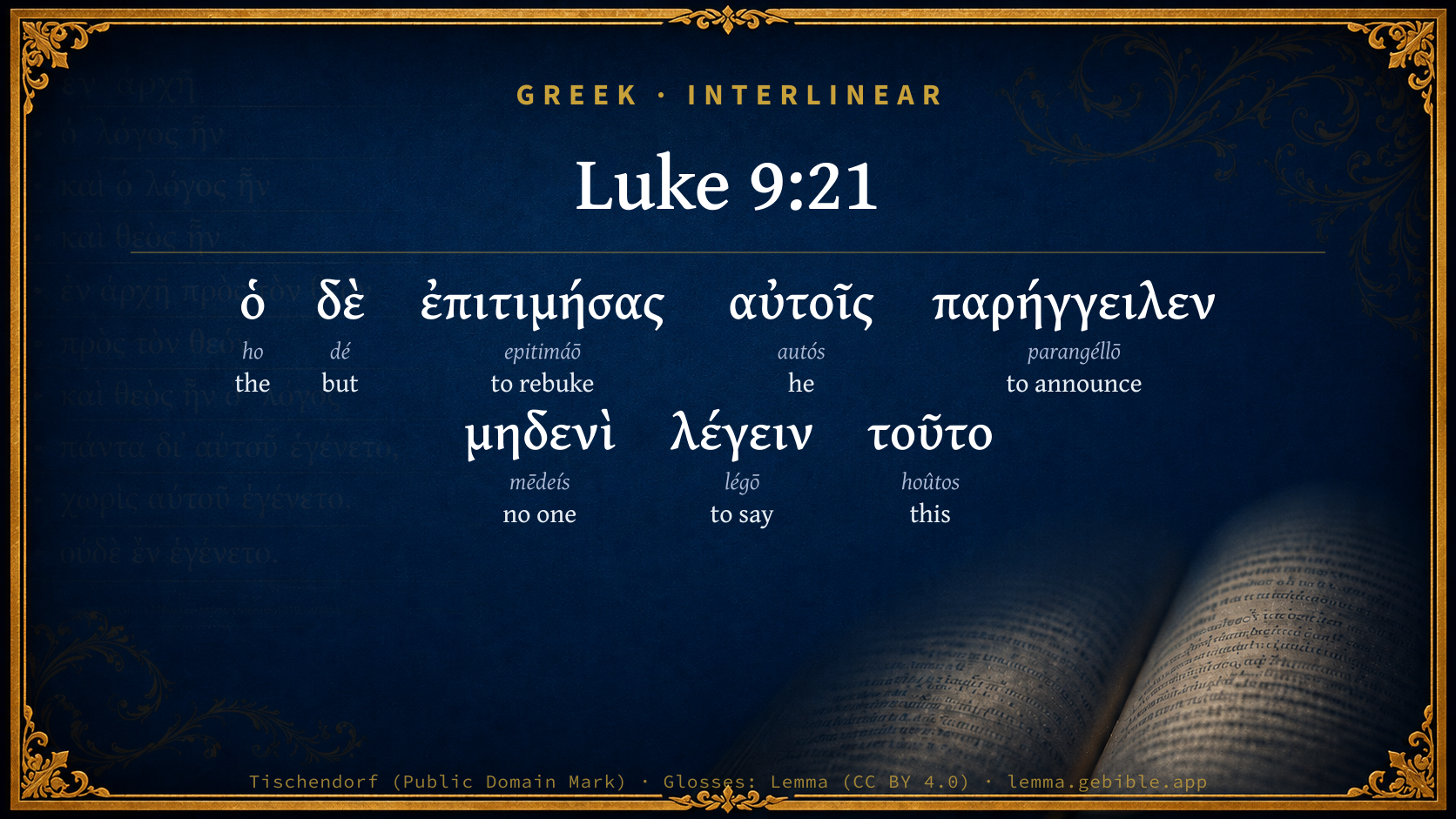
Download image
Cite this verse

Luke 9:21 (World English Bible). Public Domain. Lemma interlinear Bible study tool, https://lemma.gebible.app/v/luke/9/21.

Show BibTeX & RIS
BibTeX
RIS
English Translation
But he warned them, and commanded them to tell this to no one,
World English Bible · Public Domain
Download a study sheet

One document with this verse’s original text, its word-by-word gloss line, the meaning frame, cross-references with their text, attributed commentary, and full source and license credits — printable, and it pastes into notes with its structure intact.

This verse Autodidact and up

Study sheet (.html) Plain text (.txt)

A passage Seminary Student

Up to 50 verses in one chapter. A passage sheet keeps up to 6 commentary sources and 12 cross-references per verse, in the order this page ranks them, and says so on the sheet whenever that leaves anything out. Ask for a single verse and you get the Autodidact verse sheet above.

Everything on this page stays free to read, with no account — the sheet is a download of what is already on screen, not access to it.

Want to remove ads? Support Godless Engineer
Compare translations 3

The same verse in 3 English versions, stacked beneath the original-language interlinear above. Click any original word for its lexicon entry.

Each is an independent rendering of the whole verse — the interlinear is not word-aligned to these translations.

Highlighted words mark where these versions differ — a whole-verse word diff, not a word-by-word alignment.

  • World English Bible Public Domain
    But he warned them, and commanded them to tell this to no one,
  • King James Version Public Domain
    And he straitly charged them, and commanded them to tell no man that thing;
  • unfoldingWord Literal Text CC BY-SA 4.0
    But he, strongly warning them, commanded to tell this to no one,

unfoldingWord Literal Text — © unfoldingWord, licensed CC BY-SA 4.0. Word-aligned USFM3 via Door43 (git.door43.org/unfoldingWord/en_ult).

Versions to compare (up to 4)

3 of 4 selected

Show all 19 translations

Every available English version of this verse, each an independent rendering of the whole verse.

  • World English Bible Public Domain
    But he warned them, and commanded them to tell this to no one,
  • Berean Standard Bible Public Domain
    Jesus strictly warned them not to tell this to anyone.
  • Majority Standard Bible Public Domain
    Jesus strictly warned them not to tell this to anyone.
  • King James Version Public Domain
    And he straitly charged them, and commanded them to tell no man that thing;
  • American Standard Version (1901) Public Domain
    But he charged them, and commanded `them' to tell this to no man;
  • Revised Version (1885) Public Domain
    But he charged them, and commanded them to tell this to no man;
  • Geneva Bible (1599) Public Domain
    And he warned and commanded them, that they should tell that to no man,
  • Douay-Rheims (1899) Public Domain
    But he strictly charging them, commanded they should tell this to no man.
  • Young's Literal Translation Public Domain
    And having charged them, he commanded `them' to say this to no one,
  • Literal Standard Version CC BY-SA 4.0
    And having charged them, He commanded [them] to say this to no one,
  • Unlocked Literal Bible CC BY-SA 4.0
    But he strongly warned them to tell this to no one,
  • unfoldingWord Literal Text CC BY-SA 4.0
    But he, strongly warning them, commanded to tell this to no one,
  • Darby Bible Public Domain
    But, earnestly charging them, he enjoined [them] to say this to no man,
  • World Messianic Bible Public Domain
    But he warned them and commanded them to tell this to no one,
  • Webster's Bible Public Domain
    And he strictly charged them, and commanded them to tell no man that thing,
  • Free Bible Version CC BY-SA 4.0
    Jesus gave them strict orders not to tell anybody about this.
  • Bible in Basic English Public Domain
    But he gave them special orders, not to say this to any man;
  • Text-Critical English NT CC BY 4.0
    Jesus then warned them and instructed them to tell this to no one,
  • Tyndale New Testament (1534) Public Domain
    And he warned and commaunded them that they shuld tell no man that thinge

Literal Standard Version (2020), Covenant Press — licensed CC BY-SA 4.0. Text via the HelloAO Bible API (eBible.org). Unlocked Literal Bible (unfoldingWord) — licensed CC BY-SA 4.0. Text via the HelloAO Bible API (eBible.org). unfoldingWord Literal Text — © unfoldingWord, licensed CC BY-SA 4.0. Word-aligned USFM3 via Door43 (git.door43.org/unfoldingWord/en_ult). Free Bible Version, Dr. Jonathan Gallagher — licensed CC BY-SA 4.0. Text via the HelloAO Bible API (eBible.org).

Word by word

More ways to search: Search by grammar → Find every occurrence → Compare this word →

Practice this passage: Drill this verse → Learn its vocabulary →

About this verse

These counts appear in no published source. They are computed here, from the morphology-tagged text and Lemma’s own curated glosses. What Lemma adds →

8
words
8
distinct lemmas
Gospels
section

Shared distinctive vocabulary

ἐπιτιμήσας to rebuke G2008 occurs in 29 verses of the Greek New Testament. Also found in:
Cross-references

3

Topical passages linked to Luke 9:21 in the Treasury of Scripture Knowledge — connected by theme and wording, ordered by reader-vote popularity; previews shown in the World English Bible.

  • Matthew 16:20 Then he charged the disciples that they should tell no one that he is Jesus the Christ.
  • Matthew 17:9 As they were coming down from the mountain, Jesus commanded them, saying, "Don't tell anyone what you saw, until the Son of Man has risen from the dead."
  • Mark 8:30–31 He charged them that they should tell no one about him.

Cross-references courtesy of OpenBible.info (CC BY 4.0).

Commentary

Notes on Luke 9:21 from classic Christian and Jewish commentators (each source and its license shown beneath its notes). The classic Christian expositions comment on the surrounding passage and are grouped to its opening verse, so a note may address several verses; the Jewish commentaries on the Tanakh (Rashi and others) are per-verse, so they appear only where the commentator wrote on this verse.

Lemma curates 59 commentaries, every one of them public domain or Creative Commons licensed, each selected and text-cleaned for this edition rather than reprinted as found. About our sources →

Godbey's Commentary on the New Testament

William B. Godbey

CHAPTER 36

THE CHURCH

Mat 16:18-19; Mar 8:30; Luk 9:21. Matthew “And I say unto thee, That thou art Peter, and upon this rock I will build My Church, and the gates of hell shall not prevail against it. And I will give unto thee the keys of the kingdom of the heavens; and whatsoever thou mayest bind on earth, shall be bound in the heavens; and whatsoever thou shalt loose on earth, shall be loosed in the heavens. Then He commanded His disciples that they must tell no one that He is the Christ.” It is really indispensable at this date of our Lord’s ministry, that His leading disciples, and especially the apostles, should have clear and positive information as to His Messiahship, only eight months of His earthly ministry still to transpire, with the exception of the forty days intervening between His resurrection and ascension. Now that He is gone away off, out of the circle of His ministry, into this temporary retirement in Sryia, He has an opportune privilege with His disciples alone. As to the multitudes, still let them solve the problem in contemplation of His mighty works, which were certainly calculated to settle the conviction of all the unprejudiced that He was truly the Christ. As He moves on in His ministry, the public proclamation of His Messiahship comes more and more to the front, the matter being in such a shape with the Jews and Romans that such an avowal would cost Him, or any one else, His life. We now reach a grand, salient epoch in our Savior’s ministry, when the gospel Church is conspicuously revealed to the apostles as destined to supersede the politico-ecclesiasticism of the former dispensation. N.B. Peter is a Greek word, and means “rock.” Jesus gave it to Simon, indicative of his firmness. The world, however, never saw the rock in Peter’s character till after the fires of Pentecost had burned out all the trash of depravity, revealing to all the world the solid rock, which caused him to live a hero and die a martyr. When our Savior says to Simon, “Thou art Peter” — i.e., “Thou art rock,” He used the word Petros, which means a broken rock, such as we use in a building — immediately He says, “Upon this rock,” using the word Petra, which means the great unbroken strata, underlying the continents and oceans, and constituting the foundation of the earth. This word He applies to Himself. All Christian character, in this life, is more or less fragmentary, Jesus being the only Integer, whom we all imitate, and to whose perfection and glory we aspire, living in the hope of that coming glorification which shall make us like Him. Now what about the Church? Our Savior’s word is Ekklesia, from Ek, “out,” and kaleo, “to call.” Hence it means the “called out” — no hereditary hierarchy, nor ecclesiasticism, like Judaism; but the individual souls, in every nation, who hear the call of the Holy Ghost (and He calls all), and come out of the world, forsaking all, and identifying themselves with God for time and eternity. These, and only these, constitute the Church of God. Now He said, “On this Rock I will build My Church, and the gates of hell shall not prevail against her.” We must go down through all the sand, mud, soapstone, and slate, till we strike the solid rock, and there build our superstructure, if we want it to stand. The calling out by the Holy Ghost is regeneration; and the building on Christ, sanctification. Hence the instability and vacillation peculiar to unsanctified Christians; while the genuine and thorough sanctification gives you a stability which will not cower in the presence of roaring lions and martyr fires. “Here,” He says, “I will build,” i.e., edify you indefinitely. While the negative side of sanctification, going down to the deep foundation of the earth, and consciously reaching the solid rock, is definite and complete. The erection of the superstructure — i.e., the building of Christian character — will not only continue through this life, beautifully progressive, but through all eternity, towering into loftier heights, and broading into grander dimensions, thus accumulating the Divine similitude and glory, the wonder of redeemed humanity, and the admiration of the unfallen intelligences of the celestial universe through the flight of eternal ages. Comparatively few have any correct conception as to what the Church is. They think the carnal, worldly people, constituting the congregations in the different denominations, are the Church; whereas none but the truly regenerated ever have been or can be members of God’s Church; regeneration bringing you in, and sanctification establishing you, qualifying you for official responsibilities, such as the pastorate, the diaconate, eldership, evangelism, and teaching.

William B. Godbey, Commentary on the New Testament (1896–1900) — public domain. Text from a community e-Sword module.

Tyndale Open Study Notes

Tyndale Open Resources

9:21-22 not to tell anyone who he was: Jesus did not want to encourage a popular uprising; his calling was not to overthrow Rome, but to suffer and die.

Tyndale Open Study Notes — © Tyndale Open Resources, licensed CC BY-SA 4.0. Text via the HelloAO Bible API.

Meyer's Critical & Exegetical Commentary

Heinrich August Wilhelm Meyer

Luk_9:21-22. See on Mat_16:20 f.; Mar_9:30 f. Neither the discourse of Jesus about the rock (Mat_16:17-19), nor His reproof of Peter as Satan (Mat_16:22 f.; Mar_8:32 f.), is found in the Pauline Luke, who did not find the former in Mark (see on Mar_8:29). If he had omitted the saying concerning the rock because of a tendency (Baur and others), he could not in the same interest have passed over the rebuke of Peter as Satan.

Luk_9:22. ὅτι] argumentative. Tell no one, etc., since it is the appointment of God (Luk_24:26) that the Messiah, after many sufferings, etc., should attain to His Messianic attestation by the resurrection (Rom_1:4). Thus, for the present, the Lord quenches the ardour of that confession, that it may not interfere with that onward movement of the divine appointment which is still first of all necessary.

ἀπό] on the part of. See Buttmann, Neut. Gr. p. 280 [E. T. 326].

Meyer — Critical and Exegetical Commentary on the New Testament — English translation by Peter Christie, edited by Frederick Crombie (T&T Clark, 1880) — public domain. Text from a community e-Sword module.

Expositor's Greek Testament

ed. W. Robertson Nicoll

Luk 9:21-27 . The cross and cross-bearing .

The Expositor's Greek Testament, edited by W. Robertson Nicoll (1897–1910) — public domain. Text from a community e-Sword module.

Godet's Commentaries

Frédéric Louis Godet

2 d. Luk 9:21-22. The suffering Christ.

The expression of Luke, He straitly charged and commanded them, is very energetic. The general reason for this prohibition is found in the following announcement of the rejection of the Messiah, as is proved by the participle εἰπών, saying. They were to keep from proclaiming Him openly as the Christ, on account of the contradiction between the hopes which this title had awakened in the minds of the people, and the way in which this office was to be realized in Him. But this threatening prohibition had a more special nature, which appears from John’s narrative. It refers to the recent attempt of the people, after the multiplication of the loaves (Joh 6:14-15), to proclaim Him king, and the efforts which Jesus was then obliged to make to preserve His disciples from this mistaken enthusiasm, which might have seriously compromised His work. It is the recollection of this critical moment which induces Jesus to use this severe language (ἐπιτιμήσας). It was only after the idol of the carnal Christ had been for ever nailed to the cross, that the apostolic preaching could safely connect this title Christ with the name of Jesus. “See how,” as Riggenbach says (Vie de Jésus, p. 318), “Jesus was obliged in the very moment of self-revelation to veil Himself, when He had lighted the fire to cover it again.”—Δέ (Luk 9:21) is adversative: “Thou sayest truly, I am the Christ; but...”

Must, on account of the prophecies and of the divine purpose, of which they are the expression. — The members composing the Sanhedrim consisted of three classes of members: the elders, or presidents of synagogues; the high priests, the heads of twenty-four classes of priests; and scribes, or men learned in the law. All three Syn. give here the enumeration of these official classes. This paraphrase of the technical name invests the announcement of the rejection with all its importance. What a complete reversal of the disciples’ Messianic ideas was this rejection of Jesus by the very authorities from whom they expected the recognition and proclamation of the Messiah! ᾿Αποδοκιμασθῆναι indicates deliberate rejection, after previous calculation.

There was a crushing contradiction between this prospect and the hopes of the disciples; but, as Klostermann truly says, the last words, “And He shall rise again the third day,” furnish the solution of it.

Strauss and Baur contented themselves with denying the details of the prediction in which Jesus foretold His death. Volkmar and Holsten at the present day refuse to allow that He had any knowledge of this event before the last moments. According to Holsten, He went to Jerusalem full of hope, designing to preach there as well as in Galilee, and confident, in case of need, of the interposition of God and of the swords of His adherents....The holy Supper itself was occasioned simply by a passing presentiment....His terrible mistake took Jesus by surprise at the last moment. Keim (ii. p. 556) acknowledges that it is impossible to deny the authenticity of the scene and conversation at Caesarea Philippi. According to him, Jesus could not have failed to have foreseen His violent death long before the catastrophe came. This is proved by the bold opposition of St. Peter, also by such sayings as those referring to the bridegroom who is to be taken away, to death as the way of life (Luk 9:23-24), to Jerusalem which kills the prophets; lastly, by the reply to the two sons of Zebedee. We may add Luk 9:31, Luk 12:50; Joh 2:20; Joh 3:14; Joh 6:53; Joh 12:7; Joh 12:24,—words at once characteristic and inimitable. And as to the details of this prediction, have we not a number of facts which leave no room for doubt as to the supernatural knowledge of Jesus (Luk 22:10-34; Joh 1:49; Joh 4:18; Joh 6:64, etc.)? What the modern critics more generally dispute, is the announcement of the resurrection. But if Jesus foresaw His death, He must have equally foreseen His resurrection, as certainly as a prophet believing in the mission of Israel could not announce the captivity without also predicting the return. And who would ever have dreamed of putting into the mouth of Jesus the expression three days and three nights after the event, when in actual fact the time spent in the tomb did not exceed one day and two nights?

It is asked how it came to pass, if Jesus had so expressly predicted His resurrection, that this event should have been such an extraordinary surprise to his apostles? There we have a psychological problem, which the disciples themselves found it difficult to explain. Comp. the remarks of the evangelists, Luk 9:45, Luk 18:34, and parallels, which can only have come from the apostles. The explanation of this problem is perhaps this: the apostles never thought, before the facts had opened their eyes, that the expressions death and resurrection used by Jesus should be taken literally. Their Master so commonly spoke in figurative language, that up to the last moment they only saw in the first term the expression of a sad separation, a sudden disappearance; and in the second, only a sudden return, a glorious reappearing. And even after the death of Jesus, they in no way thought they should see Him appear again in His old form, and by the restoration to life of the body laid in the tomb. If they expected anything, it was His return as a heavenly King (see on Luk 23:42).

Luke has omitted here the word of approval and the severe reprimand which Jesus, according to Matthew, addressed to Peter on this occasion. If any one is determined to see in this omission of Luke’s a wilful suppression, the result of ill-will towards the Apostle Peter, or at least towards the Jewish Christians (Keim), what will he say of Mark, who, while omitting the words of praise, expressly refers to those of censure?

Frédéric Louis Godet — Commentaries on Luke, John, Romans, and 1 Corinthians — English translation (T&T Clark, Edinburgh, 1870s–1890s) — public domain. Text from a community e-Sword module.

The Cambridge Bible for Schools and Colleges

gen. ed. J. J. S. Perowne

21. commanded them to tell no man] For these perhaps among other reasons:-1. Because His work was not yet finished. 2. Because as yet their faith was very weak and their knowledge very partial. 3. Because they had not yet received the Holy Spirit to give power to their testimony. 4. Because the public proclamation of the truth would have precipitated the workings of God’s foreordained plan (prothesis, Eph_1:9; Eph_3:11).

The Cambridge Bible for Schools and Colleges (gen. ed. J. J. S. Perowne; Cambridge University Press, 1878–1918) — public domain. Text from a community e-Sword module.

John Gill's Exposition

Saying, the son of man must suffer many things,.... In his person and character, in his soul and body, at the hands of God, and of men, and devils:

and be rejected of the elders, and chief priests, and Scribes; who made up the grand sanhedrim of the nation: by these he was to be, and was rejected as the Messiah; and when put up with another which should be released, that other should be preferred, and he rejected; and which was done at the instigation of these men, who were the builders; of whom it was foretold that they should reject the head stone of the corner, Psa 118:22

and be slain; or put to death, with the death of the cross:

and be raised the third day; according to the types and prophecies of the Old Testament. This he added for the comfort of his disciples.

John Gill's Exposition of the Whole Bible (1746–1763) — public domain (CC PDM 1.0). Text via the HelloAO Bible API.

The Pulpit Commentary

And he straitly charged them, and commanded them to tell no man that thing. It would have been no hard task for the disciples to have gone about with an expression of their earnest conviction that the great Prophet was indeed the long looked-for King Messiah, and thus to have raised the excitable crowds to any wild pitch of enthusiasm. It was only a very short time back that, moved by the miracle of the loaves, the multitudes wished to crown him King by force. That was not the kind of homage Jesus sought; besides which, any such enthusiasm thus evoked would quickly have died away, and a hostile reaction would have set in when the high hopes excited by the idea of King Messiah were contradicted by the life of suffering and self-denial which Jesus sternly set himself to live through to its bitter end. This life he sketched out for them in the severe language of the next verse.

The Pulpit Commentary (1880–1919), ed. H.D.M. Spence-Jones & Joseph S. Exell — public domain. Text from a community e-Sword module.

Cambridge Greek Testament for Schools and Colleges

21. μηδενὶ λέγειν. For these perhaps among other reasons:—1. Because His work was not yet finished. 2. Because as yet their faith was very weak and their knowledge very partial. 3. Because they had not yet received the Holy Spirit to give power to their testimony. 4. Because the public proclamation of the truth would have precipitated the workings of God’s foreordained plan (πρόθεσις, Eph 1:9; Eph 3:11). The Messianic errors and confusions of the day were so numerous that, as Riggenbach says, “Jesus was obliged at once to reveal and to veil Himself, to kindle and to cover the flame.”

Cambridge Greek Testament for Schools and Colleges (Cambridge University Press, 1896; 21 vols, various authors incl. Carr, Maclear, Plummer, Farrar, Lumby, Moule, M. R. James, Simcox) — public domain. Text from a community e-Sword module.

International Critical Commentary

21. μηδενὶ λέγειν τοῦτο. Because of the grossly erroneous views about the Messiah which prevailed among the people. Shortly before this they had wished to take Him by force and make Him king (Joh 6:15). Hence Jesus never proclaimed Himself openly to the multitude as the Messiah; and here, when He does to the Twelve, He explains the nature of His Kingdom, and strictly forbids them to make His Messiahship known. The nearest approach to exceptions to this practice are the Samaritan woman (Joh 4:26), and the outcast from the synagogue (Joh 9:37).

Others explain the command to keep silence as prompted by the fear lest the guilt of those who were about to put Jesus to death should be increased by the disciples proclaiming Him as the Messiah. Others again suggest the fear lest the people, if they knew that He was the Messiah, should attempt to rescue Him from the death which it was necessary that He should undergo. Neither of these appears to be satisfactory. In any case the δέ is adversative. What Peter said was quite true: “but He charged them, and commanded.”

International Critical Commentary — older volumes (1896–1929), various authors — public domain. Text from a community e-Sword module.

Vincent's Word Studies in the New Testament

Marvin R. Vincent

He straitly charged [επιτιμησας] . The word implies an emphatic, solemn charge; its meaning being, strictly, to lay a penalty upon one, and thence, to charge under penalty.

No man [μηδενι] . The conditional negative : no man, whoever he might be.

22 - 27. Compare Mt 16:21 - 28; Mr 8:31 - 38; Mr 9:1.

Marvin R. Vincent, Word Studies in the New Testament (1887–1900) — public domain. Text from a community e-Sword/MySword module.

Lesson kit

Teaching starters — assembled from the data on this page, not authored interpretation. Every prompt links to the verse data it draws on. Edit before teaching.

Luke, in the Gospels, opens this verse with 8 words (8 distinct Greek lemmas). Its most distinctive word is epitimáō (“to rebuke”). A historical commentator’s framing appears above. Read the whole chapter for the surrounding context.

Discussion questions

  1. How does “to rebuke” (epitimáō) shape what this verse is saying?
  2. How does Matthew 8:26, which shares the word «to rebuke», read alongside this verse?
  3. These translations render this verse differently. What is at stake in choosing one wording over another?
  4. Compare how Godbey's Commentary on the New Testament and Tyndale Open Study Notes read this verse. Where do they agree or differ?

Things to notice

Reading settings

Reading text

Shown beneath each verse's original-language words.

Old Testament
Old Testament edition

Read the OT as the Masoretic Hebrew (MT) or the Greek Septuagint (LXX).

English shown for the Greek Septuagint (in the Hebrew ↔ Greek comparison).

Comparing translations? Open the Compare panel on any verse page to stack up to four side by side.