

Luke 8:13
Greek (Tischendorf 8th ed.) Luke 8:13 appears in the Greek New Testament. The text above is from the Tischendorf 8th edition. Each word links to its Strong’s number and a concise gloss. Click any word for its full Thayer’s Greek Lexicon entry.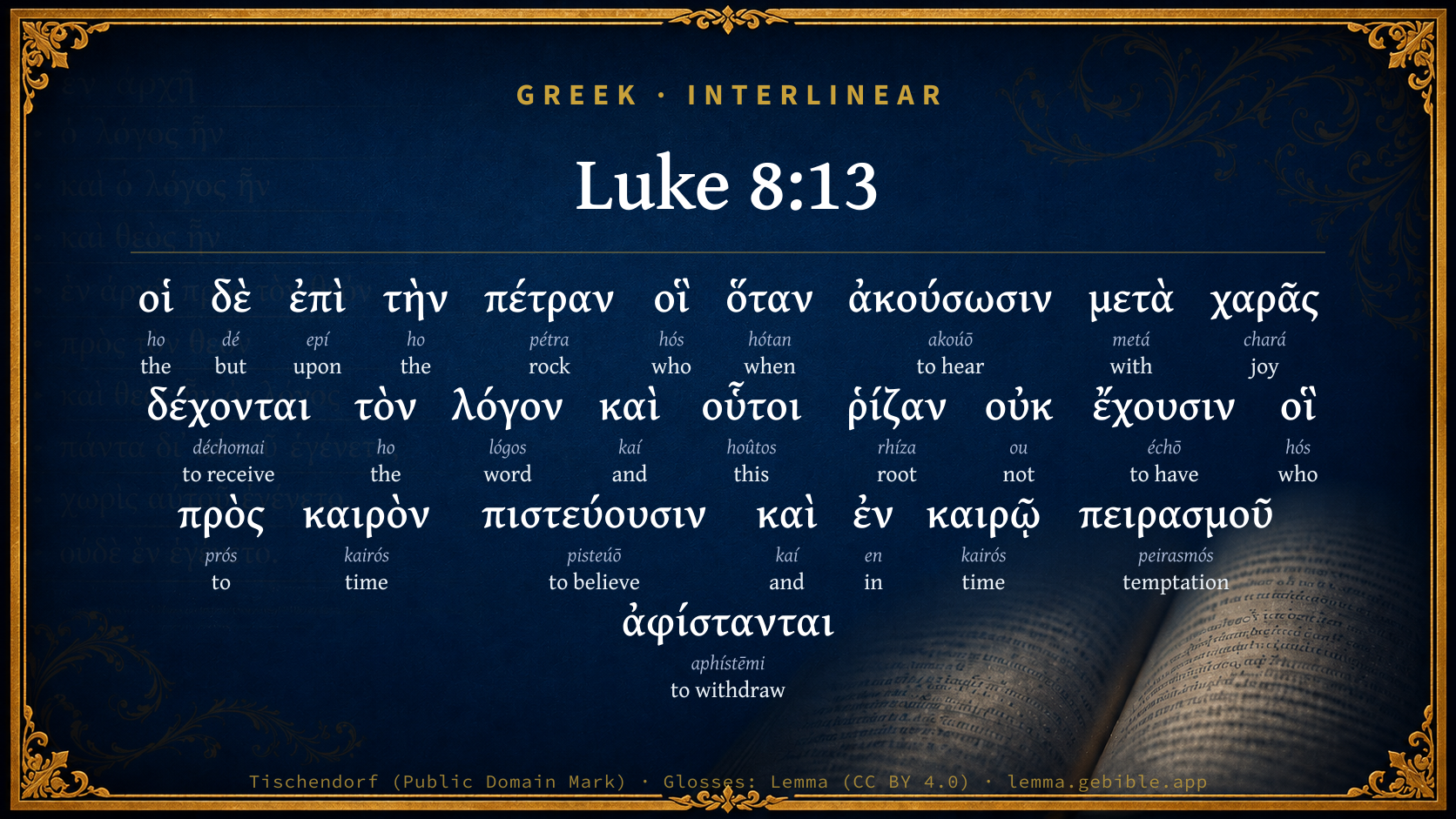
Those on the rock are they who, when they hear, receive the word with joy; but these have no root, who believe for a while, then fall away in time of temptation.
Download a study sheet
One document with this verse’s original text, its word-by-word gloss line, the meaning frame, cross-references with their text, attributed commentary, and full source and license credits — printable, and it pastes into notes with its structure intact.
This verse Autodidact and up
A passage Seminary Student
Up to 50 verses in one chapter. A passage sheet keeps up to 6 commentary sources and 12 cross-references per verse, in the order this page ranks them, and says so on the sheet whenever that leaves anything out. Ask for a single verse and you get the Autodidact verse sheet above.
Everything on this page stays free to read, with no account — the sheet is a download of what is already on screen, not access to it.
Compare translations 3
The same verse in 3 English versions, stacked beneath the original-language interlinear above. Click any original word for its lexicon entry.
Each is an independent rendering of the whole verse — the interlinear is not word-aligned to these translations.
Highlighted words mark where these versions differ — a whole-verse word diff, not a word-by-word alignment.
-
World English Bible Public Domain
Those on the rock are they who, when they hear, receive the word with joy; but these have no root, who believe for a while, then fall away in time of temptation.
-
King James Version Public Domain
They on the rock are they, which, when they hear, receive the word with joy; and these have no root, which for a while believe, and in time of temptation fall away.
-
unfoldingWord Literal Text CC BY-SA 4.0
And the ones on the rock the ones, when they hear, receive the word with joy. But they have no root; they believe for a time, and in a time of testing they go away.
unfoldingWord Literal Text — © unfoldingWord, licensed CC BY-SA 4.0. Word-aligned USFM3 via Door43 (git.door43.org/unfoldingWord/en_ult).
Show all 19 translations
Every available English version of this verse, each an independent rendering of the whole verse.
-
World English Bible Public Domain
Those on the rock are they who, when they hear, receive the word with joy; but these have no root, who believe for a while, then fall away in time of temptation.
-
Berean Standard Bible Public Domain
The seeds on rocky ground are those who hear the word and receive it with joy, but they have no root. They believe for a season, but in the time of testing, they fall away.
-
Majority Standard Bible Public Domain
The seeds on rocky ground are those who hear the word and receive it with joy, but they have no root. They believe for a season, but in the time of testing, they fall away.
-
King James Version Public Domain
They on the rock are they, which, when they hear, receive the word with joy; and these have no root, which for a while believe, and in time of temptation fall away.
-
American Standard Version (1901) Public Domain
And those on the rock `are' they who, when they have heard, receive the word with joy; and these have no root, who for a while believe, and in time of temptation fall away.
-
Revised Version (1885) Public Domain
And those on the rock are they which, when they have heard, receive the word with joy; and these have no root, which for a while believe, and in time of temptation fall away.
-
Geneva Bible (1599) Public Domain
But they that are on the stones, are they which when they haue heard, receiue ye word with ioy: but they haue no rootes: which for a while beleeue, but in the time of tentation goe away.
-
Douay-Rheims (1899) Public Domain
Now they upon the rock, are they who when they hear, receive the word with joy: and these have no roots; for they believe for a while, and in time of temptation, they fall away.
-
Young's Literal Translation Public Domain
`And those upon the rock: They who, when they may hear, with joy do receive the word, and these have no root, who for a time believe, and in time of temptation fall away.
-
Literal Standard Version CC BY-SA 4.0
And those on the rock: they who, when they may hear, receive the word with joy, and these have no root, who for a time believe, and in time of temptation fall away.
-
Unlocked Literal Bible CC BY-SA 4.0
The ones on the rock are those who, when they hear the word, receive it with joy. But they have no root; they believe for a while, and in a time of testing they fall away.
-
unfoldingWord Literal Text CC BY-SA 4.0
And the ones on the rock the ones, when they hear, receive the word with joy. But they have no root; they believe for a time, and in a time of testing they go away.
-
Darby Bible Public Domain
But those upon the rock, those who when they hear receive the word with joy; and these have no root, who believe for a time, and in time of trial fall away.
-
World Messianic Bible Public Domain
Those on the rock are they who, when they hear, receive the word with joy; but these have no root. They believe for a while, then fall away in time of temptation.
-
Webster's Bible Public Domain
They on the rock are they, who, when they hear, receive the word with joy; and these have no root, who for a while believe, and in time of temptation fall away.
-
Free Bible Version CC BY-SA 4.0
The seeds that fall on the stony ground are those who hear and welcome the message with joy but don't have any roots. They trust for a while but when difficult times come they give up.
-
Bible in Basic English Public Domain
And those on the rock are those who with joy give hearing to the word; but having no root, they have faith for a time, and when the test comes they give up.
-
Text-Critical English NT CC BY 4.0
The ones on the rock are those who, when they hear the word, receive it with joy. Yet they have no root; they believe for a while, but in a time of testing they fall away.
-
Tyndale New Testament (1534) Public Domain
They on the stonnes are they which when they heare receave the worde with ioye. But these have noo rootes which for a whyle beleve and in tyme of temptacion goo awaye.
Literal Standard Version (2020), Covenant Press — licensed CC BY-SA 4.0. Text via the HelloAO Bible API (eBible.org). Unlocked Literal Bible (unfoldingWord) — licensed CC BY-SA 4.0. Text via the HelloAO Bible API (eBible.org). unfoldingWord Literal Text — © unfoldingWord, licensed CC BY-SA 4.0. Word-aligned USFM3 via Door43 (git.door43.org/unfoldingWord/en_ult). Free Bible Version, Dr. Jonathan Gallagher — licensed CC BY-SA 4.0. Text via the HelloAO Bible API (eBible.org).
Word by word
More ways to search: Search by grammar → Find every occurrence → Compare this word →
Practice this passage: Drill this verse → Learn its vocabulary →
- Appears 14× in the Greek New Testament
- First appears at Luke 2:37
- Part of Speech
- Verb
- Tense
- Present
- Voice
- Middle or Passive deponent
- Mood
- Indicative
- Person
- 3rd person
- Number
- Plural
Full Thayer's Definition
- οἱ ho G3588 “the” Article, Nominative, Plural, Masculine
- δὲ dé G1161 “but” Conjunction
- ἐπὶ epí G1909 “upon” Preposition
- τὴν ho G3588 “the” Article, Accusative, Singular, Feminine
- πέτραν pétra G4073 “rock” Noun, Accusative, Singular, Feminine
- οἳ hós G3739 “who” Relative pronoun, Nominative, Plural, Masculine
- ὅταν hótan G3752 “when” Conjunction
- ἀκούσωσιν akoúō G191 “to hear” Verb, Aorist, Active, Subjunctive, 3rd person, Plural
- μετὰ metá G3326 “with” Preposition
- χαρᾶς chará G5479 “joy” Noun, Genitive, Singular, Feminine
- δέχονται déchomai G1209 “to receive” Verb, Present, Middle or Passive deponent, Indicative, 3rd person, Plural
- τὸν ho G3588 “the” Article, Accusative, Singular, Masculine
- λόγον lógos G3056 “word” Noun, Accusative, Singular, Masculine
- καὶ kaí G2532 “and” Conjunction
- οὗτοι hoûtos G3778 “this” Demonstrative pronoun, Nominative, Plural, Masculine
- ῥίζαν rhíza G4491 “root” Noun, Accusative, Singular, Feminine
- οὐκ ou G3756 “not” Particle, Negative
- ἔχουσιν échō G2192 “to have” Verb, Present, Active, Indicative, 3rd person, Plural
- οἳ hós G3739 “who” Relative pronoun, Nominative, Plural, Masculine
- πρὸς prós G4314 “to” Preposition
- καιρὸν kairós G2540 “time” Noun, Accusative, Singular, Masculine
- πιστεύουσιν pisteúō G4100 “to believe” Verb, Present, Active, Indicative, 3rd person, Plural
- καὶ kaí G2532 “and” Conjunction
- ἐν en G1722 “in” Preposition
- καιρῷ kairós G2540 “time” Noun, Dative, Singular, Masculine
- πειρασμοῦ peirasmós G3986 “temptation” Noun, Genitive, Singular, Masculine
- ἀφίστανται aphístēmi G868 “to withdraw” Verb, Present, Middle or Passive deponent, Indicative, 3rd person, Plural
About this verse
These counts appear in no published source. They are computed here, from the morphology-tagged text and Lemma’s own curated glosses. What Lemma adds →
- 27
- words
- 22
- distinct lemmas
- Gospels
- section
Cross-references
34Topical passages linked to Luke 8:13 in the Treasury of Scripture Knowledge — connected by theme and wording, ordered by reader-vote popularity; previews shown in the World English Bible.
- Hosea 6:4 "Ephraim, what shall I do to you? Judah, what shall I do to you? For your love is like a morning cloud, And like the dew that disappears early.
- John 5:35 He was the burning and shining lamp, and you were willing to rejoice for a while in his light.
- Proverbs 12:12 The wicked desires the plunder of evil men, But the root of the righteous flourishes.
- Ezekiel 33:32 Behold, you are to them as a very lovely song of one who has a pleasant voice, and can play well on an instrument; for they hear your words, but they don't do them.
- 2 Peter 2:22 But it has happened to them according to the true proverb, "The dog turns to his own vomit again," and "the sow that had washed to wallowing in the mire."
- Jude 1:12 These are hidden rocky reefs in your love feasts when they feast with you, shepherds who without fear feed themselves; clouds without water, carried along by winds; autumn leaves without fruit, twice dead, plucked up by the roots;
- Isaiah 58:2 Yet they seek me daily, and delight to know my ways: as a nation that did righteousness, and didn't forsake the ordinance of their God, they ask of me righteous judgments; they delight to draw near to God.
- John 8:30–32 As he spoke these things, many believed in him.
- 1 Corinthians 15:2 by which also you are saved, if you hold firmly the word which I preached to you--unless you believed in vain.
- Galatians 3:1 Foolish Galatians, who has bewitched you not to obey the truth, before whose eyes Jesus Christ was openly set forth among you as crucified?
- Galatians 3:4 Did you suffer so many things in vain, if it is indeed in vain?
- Ephesians 3:17 that Christ may dwell in your hearts through faith; to the end that you, being rooted and grounded in love,
- James 2:26 For as the body apart from the spirit is dead, even so faith apart from works is dead.
- 2 Peter 2:20 For if, after they have escaped the defilement of the world through the knowledge of the Lord and Savior Jesus Christ, they are again entangled therein and overcome, the last state has become worse with them than the first.
- Job 19:28 If you say, 'How we will persecute him!' Because the root of the matter is found in me,
- Psalms 106:12–14 Then they believed his words. They sang his praise.
- Proverbs 12:3 A man shall not be established by wickedness, But the root of the righteous shall not be moved.
- Matthew 13:20–21 What was sown on the rocky places, this is he who hears the word, and immediately with joy receives it;
- Mark 4:16–17 These in like manner are those who are sown on the rocky places, who, when they have heard the word, immediately receive it with joy.
- Luke 22:31–32 The Lord said, "Simon, Simon, behold, Satan asked to have you, that he might sift you as wheat,
- John 2:23–25 Now when he was in Jerusalem at the Passover, during the feast, many believed in his name, observing his signs which he did.
- John 12:42–43 Nevertheless even of the rulers many believed in him, but because of the Pharisees they didn't confess it, so that they wouldn't be put out of the synagogue,
- John 15:2 Every branch in me that doesn't bear fruit, he takes away. Every branch that bears fruit, he prunes, that it may bear more fruit.
- John 15:6 If a man doesn't remain in me, he is thrown out as a branch, and is withered; and they gather them, throw them into the fire, and they are burned.
- Galatians 4:15–20 What was the blessing you enjoyed? For I testify to you that, if possible, you would have plucked out your eyes and given them to me.
- Colossians 2:7 rooted and built up in him, and established in the faith, even as you were taught, abounding in it in thanksgiving.
- 1 Thessalonians 3:5 For this cause I also, when I couldn't stand it any longer, sent that I might know your faith, for fear that by any means the tempter had tempted you, and our labor would have been in vain.
- 1 Timothy 1:19 holding faith and a good conscience; which some having thrust away made a shipwreck concerning the faith;
- 2 Timothy 2:18–19 men who have erred concerning the truth, saying that the resurrection is already past, and overthrowing the faith of some.
- Hebrews 10:39 But we are not of those who shrink back to destruction, but of those who have faith to the saving of the soul.
- Mark 6:20 for Herod feared John, knowing that he was a righteous and holy man, and kept him safe. When he heard him, he did many things, and he heard him gladly.
- Acts 8:13–23 Simon himself also believed. Being baptized, he continued with Philip. Seeing signs and great miracles occuring, he was amazed.
- 1 Corinthians 13:2 If I have the gift of prophecy, and know all mysteries and all knowledge; and if I have all faith, so as to remove mountains, but don't have love, I am nothing.
- Colossians 1:23 if it is so that you continue in the faith, grounded and steadfast, and not moved away from the hope of the Gospel which you heard, which is being proclaimed in all creation under heaven; of which I, Paul, was made a servant.
Cross-references courtesy of OpenBible.info (CC BY 4.0).
Lesson kit
Teaching starters — assembled from the data on this page, not authored interpretation. Every prompt links to the verse data it draws on. Edit before teaching.
Luke, in the Gospels, opens this verse with 27 words (22 distinct Greek lemmas). Its most distinctive word is aphístēmi (“to withdraw”). A historical commentator’s framing appears above. Read the whole chapter for the surrounding context.
Discussion questions
- The word aphístēmi carries the sense “to withdraw.” How does it shape the verse?
- How does Luke 2:37, which shares the word «to withdraw», read alongside this verse?
- What does the repetition of “time” (2× in this one verse) do in this verse?
- The translations on this page render this verse differently — a whole-verse word diff, not a word-by-word alignment. What might account for the different wordings?
- Compare how Tyndale Open Study Notes and Bengel's Gnomon read this verse. Where do they agree or differ?
Things to notice
- These translations choose different wording for 8 words in this verse.
- “time” occurs 2× in this single verse.
- 22 distinct Greek lemmas span 27 words in this verse.
Commentary
Notes on Luke 8:13 from classic Christian and Jewish commentators (each source and its license shown beneath its notes). The classic Christian expositions comment on the surrounding passage and are grouped to its opening verse, so a note may address several verses; the Jewish commentaries on the Tanakh (Rashi and others) are per-verse, so they appear only where the commentator wrote on this verse.
Lemma curates 59 commentaries, every one of them public domain or Creative Commons licensed, each selected and text-cleaned for this edition rather than reprinted as found. About our sources →
Tyndale Open Study Notes
Tyndale Open Resources
Tyndale Open Study Notes — © Tyndale Open Resources, licensed CC BY-SA 4.0. Text via the HelloAO Bible API.
Bengel's Gnomon
Johann Albrecht Bengel
Bengel's Gnomon of the New Testament — English translation (T&T Clark, Edinburgh, 1860) — public domain. Text from a community e-Sword module.
Expositor's Greek Testament
ed. W. Robertson Nicoll
The Expositor's Greek Testament, edited by W. Robertson Nicoll (1897–1910) — public domain. Text from a community e-Sword module.
Ellicott's Commentary for English Readers
A Bible Commentary for English Readers, edited by Charles John Ellicott (1878–1897) — public domain. Text from a community e-Sword module.
The Cambridge Bible for Schools and Colleges
gen. ed. J. J. S. Perowne
The Cambridge Bible for Schools and Colleges (gen. ed. J. J. S. Perowne; Cambridge University Press, 1878–1918) — public domain. Text from a community e-Sword module.
John Gill's Exposition
John Gill's Exposition of the Whole Bible (1746–1763) — public domain (CC PDM 1.0). Text via the HelloAO Bible API.
Trapp's Complete Commentary
John Trapp
John Trapp, A Commentary or Exposition upon All the Books of the Old and New Testament (1647–1656) — public domain. Text from a community e-Sword module.
The Pulpit Commentary
The Pulpit Commentary (1880–1919), ed. H.D.M. Spence-Jones & Joseph S. Exell — public domain. Text from a community e-Sword module.
Cambridge Greek Testament for Schools and Colleges
Cambridge Greek Testament for Schools and Colleges (Cambridge University Press, 1896; 21 vols, various authors incl. Carr, Maclear, Plummer, Farrar, Lumby, Moule, M. R. James, Simcox) — public domain. Text from a community e-Sword module.
International Critical Commentary
International Critical Commentary — older volumes (1896–1929), various authors — public domain. Text from a community e-Sword module.
Vincent's Word Studies in the New Testament
Marvin R. Vincent
Marvin R. Vincent, Word Studies in the New Testament (1887–1900) — public domain. Text from a community e-Sword/MySword module.