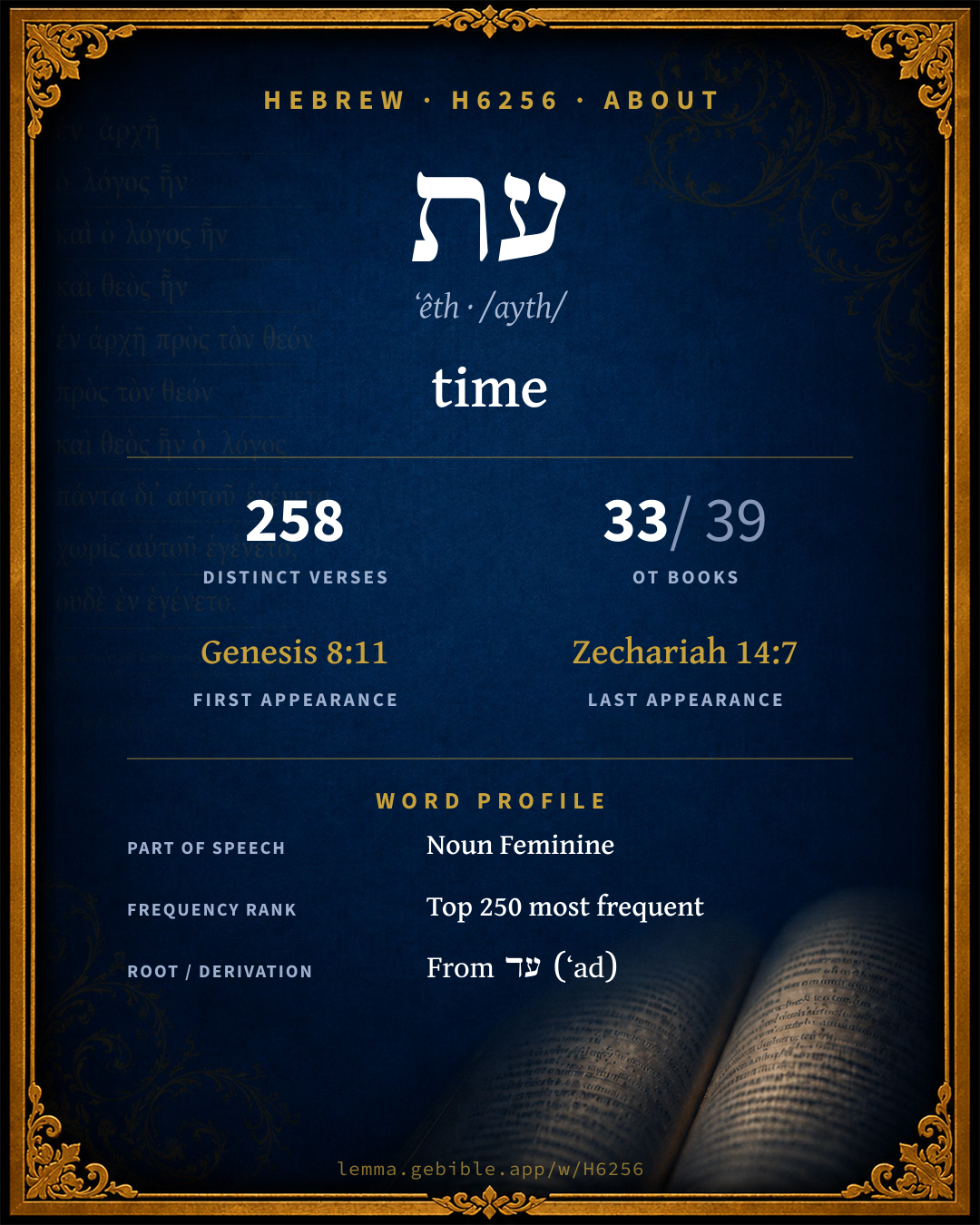
עֵת
time
‘time’ is one of 5 main senses fuller range ↓
Full lexicon entry — Brown-Driver-Briggs (BDB)
From Brown-Driver-Briggs (BDB)
Where this word appears
See every Absolute-state word in the Hebrew Bible →
Grammar key — what these labels mean
Part of speech
- Noun
- A naming word — a person, place, thing, or idea.
- Verb
- An action or state-of-being word.
Noun type
- Common
- A common noun — a general class of person, place, or thing (“king,” “city,” “water”), not a specific name.
Stem
- Qal
- The basic, simple active stem — the plain form of the verb (“he wrote”).
Form
- Infinitive Construct
- A bound verbal noun, frequently with prepositions (“to write / in writing”).
State
- Absolute
- The independent form of a noun, not bound to a following word.
- Construct
- A noun bound to a following noun in a possessive / “of” relationship (the construct chain).
Gender
- Both
- Attested as both masculine and feminine.
Number
- Singular
- One.
- Plural
- More than one (in Hebrew, generally three or more).
Grammatical forms
- Noun, Common, Both, Singular, Absolute 166 times (56%)
- Noun, Common, Both, Singular, Construct 111 times (38%)
- Noun, Common, Both, Plural, Absolute 16 times (5%)
- Noun, Common, Both, Plural, Construct 2 times (1%)
- Verb, Qal, Infinitive Construct 1 time (0%)
Parsed forms decoded from the imported morphology (morphhb / Westminster Leningrad Codex — WLC text public domain, morphhb tagging CC BY 4.0), counted across 296 parsed occurrences — not distinct verses.
Page 1 of 2 — showing verses 1–200 of 258 distinct verses where H6256 appears, across 33 books. Click any verse to open its interlinear word-by-word view. Verse text shown in the World English Bible for context — . Each verse’s Hebrew form is shown with its reference; the English is not keyword-highlighted, since the data carries no word-level English alignment. Use “Compare translations” on any verse to read it across multiple English versions. This concordance covers the Hebrew Bible; Septuagint (Greek Old Testament) occurrences are not indexed here.
Genesis 9 verses
- Genesis 8:11 לְ/עֵ֣ת prep + n c bs cs The dove came back to him at evening, and, behold, in her mouth was an olive leaf plucked off. So Noah knew that the waters were abated from off the earth.
- Genesis 18:10 כָּ/עֵ֣ת prep det + n c bs He said, "I will certainly return to you when the season comes round. Behold, Sarah your wife will have a son." Sarah heard in the tent door, which was behind him.
- Genesis 18:14 כָּ/עֵ֥ת prep det + n c bs Is anything too hard for Yahweh? At the set time I will return to you, when the season comes round, and Sarah will have a son."
- Genesis 21:22 בָּ/עֵ֣ת prep det + n c bs It happened at that time, that Abimelech and Phicol the captain of his host spoke to Abraham, saying, "God is with you in all that you do.
- Genesis 24:11 לְ/עֵ֣ת לְ/עֵ֖ת prep + n c bs cs prep + n c bs cs He made the camels kneel down outside the city by the well of water at the time of evening, the time that women go out to draw water.
- Genesis 29:7 עֵ֖ת n c bs cs He said, "Behold, it is still the middle of the day, not time to gather the cattle together. Water the sheep, and go and feed them."
- Genesis 31:10 בְּ/עֵת֙ prep + n c bs cs It happened at the time that the flock conceive, that I lifted up my eyes, and saw in a dream, and behold, the male goats which leaped on the flock were streaked, speckled, and grizzled.
- Genesis 38:1 בָּ/עֵ֣ת prep det + n c bs It happened at that time, that Judah went down from his brothers, and visited a certain Adullamite, whose name was Hirah.
- Genesis 38:27 בְּ/עֵ֣ת prep + n c bs cs It happened in the time of her travail, that behold, twins were in her womb.
Exodus 3 verses
- Exodus 9:18 כָּ/עֵ֣ת prep det + n c bs Behold, tomorrow about this time I will cause it to rain a very grievous hail, such as has not been in Egypt since the day it was founded even until now.
- Exodus 18:22 עֵת֒ n c bs Let them judge the people at all times. It shall be that every great matter they shall bring to you, but every small matter they shall judge themselves. So shall it be easier for you, and they shall share the load with you.
- Exodus 18:26 עֵ֑ת n c bs They judged the people at all times. They brought the hard causes to Moses, but every small matter they judged themselves.
Leviticus 3 verses
- Leviticus 15:25 עֶת n c bs cs "'If a woman has a discharge of her blood many days not in the time of her period, or if she has a discharge beyond the time of her period; all the days of the discharge of her uncleanness shall be as in the days of her period: she is unclean.
- Leviticus 16:2 עֵת֙ n c bs and Yahweh said to Moses, "Tell Aaron your brother, not to come at all times into the Most Holy Place within the veil, before the mercy seat which is on the ark; lest he die: for I will appear in the cloud on the mercy seat.
- Leviticus 26:4 בְּ/עִתָּ֑/ם prep + n c bs cs + sfx pers 3mp then I will give you your rains in their season, and the land shall yield its increase, and the trees of the field shall yield their fruit.
Numbers 2 verses
- Numbers 22:4 בָּ/עֵ֥ת prep det + n c bs Moab said to the elders of Midian, Now will this multitude lick up all that is round about us, as the ox licks up the grass of the field. Balak the son of Zippor was king of Moab at that time.
- Numbers 23:23 כָּ/עֵ֗ת prep det + n c bs Surely there is no enchantment with Jacob; Neither is there any divination with Israel: Now shall it be said of Jacob and of Israel, What has God done!
Deuteronomy 18 verses
- Deuteronomy 1:9 בָּ/עֵ֥ת prep det + n c bs I spoke to you at that time, saying, I am not able to bear you myself alone:
- Deuteronomy 1:16 בָּ/עֵ֥ת prep det + n c bs I charged your judges at that time, saying, Hear [the causes] between your brothers, and judge righteously between a man and his brother, and the foreigner who is living with him.
- Deuteronomy 1:18 בָּ/עֵ֣ת prep det + n c bs I commanded you at that time all the things which you should do.
- Deuteronomy 2:34 בָּ/עֵ֣ת prep det + n c bs We took all his cities at that time, and utterly destroyed every inhabited city, with the women and the little ones; we left none remaining:
- Deuteronomy 3:4 בָּ/עֵ֣ת prep det + n c bs We took all his cities at that time; there was not a city which we didn't take from them; sixty cities, all the region of Argob, the kingdom of Og in Bashan.
- Deuteronomy 3:8 בָּ/עֵ֤ת prep det + n c bs We took the land at that time out of the hand of the two kings of the Amorites who were beyond the Jordan, from the valley of the Arnon to Mount Hermon;
- Deuteronomy 3:12 בָּ/עֵ֣ת prep det + n c bs This land we took in possession at that time: from Aroer, which is by the valley of the Arnon, and half the hill-country of Gilead, and the cities of it, gave I to the Reubenites and to the Gadites:
- Deuteronomy 3:18 בָּ/עֵ֥ת prep det + n c bs I commanded you at that time, saying, Yahweh your God has given you this land to possess it: you shall pass over armed before your brothers the children of Israel, all the men of valor.
- Deuteronomy 3:21 בָּ/עֵ֥ת prep det + n c bs I commanded Joshua at that time, saying, Your eyes have seen all that Yahweh your God has done to these two kings: so shall Yahweh do to all the kingdoms where you go over.
- Deuteronomy 3:23 בָּ/עֵ֥ת prep det + n c bs I begged Yahweh at that time, saying,
- Deuteronomy 4:14 בָּ/עֵ֣ת prep det + n c bs Yahweh commanded me at that time to teach you statutes and ordinances, that you might do them in the land where you go over to possess it.
- Deuteronomy 5:5 בָּ/עֵ֣ת prep det + n c bs (I stood between Yahweh and you at that time, to show you the word of Yahweh: for you were afraid because of the fire, and didn't go up onto the mountain;) saying,
- Deuteronomy 9:20 בָּ/עֵ֥ת prep det + n c bs Yahweh was very angry with Aaron to destroy him: and I prayed for Aaron also at the same time.
- Deuteronomy 10:1 בָּ/עֵ֨ת prep det + n c bs At that time Yahweh said to me, Hew you two tables of stone like the first, and come up to me onto the mountain, and make an ark of wood.
- Deuteronomy 10:8 בָּ/עֵ֣ת prep det + n c bs At that time Yahweh set apart the tribe of Levi, to bear the ark of the covenant of Yahweh, to stand before Yahweh to minister to him, and to bless in his name, to this day.
- Deuteronomy 11:14 בְּ/עִתּ֖/וֹ prep + n c bs cs + sfx pers 3ms that I will give the rain of your land in its season, the former rain and the latter rain, that you may gather in your grain, and your new wine, and your oil.
- Deuteronomy 28:12 בְּ/עִתּ֔/וֹ prep + n c bs cs + sfx pers 3ms Yahweh will open to you his good treasure in the sky, to give the rain of your land in its season, and to bless all the work of your hand: and you shall lend to many nations, and you shall not borrow.
- Deuteronomy 32:35 לְ/עֵ֖ת prep + n c bs cs Vengeance is mine, and recompense, At the time when their foot shall slide: For the day of their calamity is at hand, The things that are to come on them shall make haste.
Joshua 7 verses
- Joshua 5:2 בָּ/עֵ֣ת prep det + n c bs At that time Yahweh said to Joshua, Make you flint knives, and circumcise again the children of Israel the second time.
- Joshua 6:26 בָּ/עֵ֥ת prep det + n c bs Joshua charged them with an oath at that time, saying, Cursed be the man before Yahweh, that rises up and builds this city Jericho: with the loss of his firstborn shall he lay the foundation of it, and with the loss of his youngest son shall he set up the gates of it.
- Joshua 8:29 עֵ֣ת n c bs cs The king of Ai he hanged on a tree until the evening: and at the going down of the sun Joshua commanded, and they took his body down from the tree, and cast it at the entrance of the gate of the city, and raised thereon a great heap of stones, to this day.
- Joshua 10:27 לְ/עֵ֣ת prep + n c bs cs It happened at the time of the going down of the sun, that Joshua commanded, and they took them down off the trees, and cast them into the cave in which they had hidden themselves, and laid great stones on the mouth of the cave, to this very day.
- Joshua 11:6 כָּ/עֵ֣ת prep det + n c bs Yahweh said to Joshua, Don't be afraid because of them; for tomorrow at this time will I deliver them up all slain before Israel: you shall hamstring their horses, and burn their chariots with fire.
- Joshua 11:10 בָּ/עֵ֤ת prep det + n c bs Joshua turned back at that time, and took Hazor, and struck the king of it with the sword: for Hazor before was the head of all those kingdoms.
- Joshua 11:21 בָּ/עֵ֣ת prep det + n c bs Joshua came at that time, and cut off the Anakim from the hill-country, from Hebron, from Debir, from Anab, and from all the hill-country of Judah, and from all the hill-country of Israel: Joshua utterly destroyed them with their cities.
Judges 10 verses
- Judges 3:29 בָּ/עֵ֣ת prep det + n c bs They struck of Moab at that time about ten thousand men, every lusty man, and every man of valor; and there escaped not a man.
- Judges 4:4 בָּ/עֵ֥ת prep det + n c bs Now Deborah, a prophetess, the wife of Lappidoth, she judged Israel at that time.
- Judges 10:14 בְּ/עֵ֥ת prep + n c bs cs Go and cry to the gods which you have chosen; let them save you in the time of your distress.
- Judges 11:26 בָּ/עֵ֥ת prep det + n c bs While Israel lived in Heshbon and its towns, and in Aroer and its towns, and in all the cities that are along by the side of the Arnon, three hundred years; why didn't you recover them within that time?
- Judges 12:6 בָּ/עֵ֤ת prep det + n c bs then said they to him, Say now Shibboleth; and he said Sibboleth; for he couldn't manage to pronounce it right: then they laid hold on him, and killed him at the fords of the Jordan. There fell at that time of Ephraim forty-two thousand.
- Judges 13:23 וְ/כָ/עֵ֕ת conj + prep det + n c bs But his wife said to him, If Yahweh were pleased to kill us, he wouldn't have received a burnt offering and a meal-offering at our hand, neither would he have shown us all these things, nor would at this time have told such things as these.
- Judges 14:4 וּ/בָ/עֵ֣ת conj + prep det + n c bs But his father and his mother didn't know that it was of Yahweh; for he sought an occasion against the Philistines. Now at that time the Philistines had rule over Israel.
- Judges 21:14 בָּ/עֵ֣ת prep det + n c bs Benjamin returned at that time; and they gave them the women whom they had saved alive of the women of Jabesh Gilead: and yet so they weren't enough for them.
- Judges 21:22 כָּ/עֵ֥ת prep det + n c bs It shall be, when their fathers or their brothers come to complain to us, that we will say to them, Grant them graciously to us, because we didn't take for each man his wife in battle, neither did you give them to them, else would you now be guilty.
- Judges 21:24 בָּ/עֵ֣ת prep det + n c bs The children of Israel departed there at that time, every man to his tribe and to his family, and they went out from there every man to his inheritance.
Ruth 1 verse
1 Samuel 4 verses
- 1 Samuel 4:20 וּ/כְ/עֵ֣ת conj + prep + n c bs cs About the time of her death the women who stood by her said to her, Don't be afraid; for you have brought forth a son. But she didn't answer, neither did she regard it.
- 1 Samuel 9:16 כָּ/עֵ֣ת prep det + n c bs Tomorrow about this time I will send you a man out of the land of Benjamin, and you shall anoint him to be prince over my people Israel; and he shall save my people out of the hand of the Philistines: for I have looked on my people, because their cry is come to me.
- 1 Samuel 18:19 בְּ/עֵ֥ת prep + n c bs cs But it happened at the time when Merab, Saul's daughter, should have been given to David, that she was given to Adriel the Meholathite as wife.
- 1 Samuel 20:12 כָּ/עֵ֤ת prep det + n c bs Jonathan said to David, Yahweh, the God of Israel, [be witness]: when I have sounded my father about this time tomorrow, [or] the third day, behold, if there be good toward David, shall I not then send to you, and disclose it to you?
2 Samuel 3 verses
- 2 Samuel 11:1 לְ/עֵ֣ת prep + n c bs cs It happened, at the return of the year, at the time when kings go out [to battle], that David sent Joab, and his servants with him, and all Israel; and they destroyed the children of Ammon, and besieged Rabbah. But David stayed at Jerusalem.
- 2 Samuel 11:2 לְ/עֵ֣ת prep + n c bs cs It happened at evening, that David arose from off his bed, and walked on the roof of the king's house: and from the roof he saw a woman bathing; and the woman was very beautiful to look on.
- 2 Samuel 24:15 עֵ֣ת n c bs cs So Yahweh sent a pestilence on Israel from the morning even to the time appointed; and there died of the people from Dan even to Beersheba seventy thousand men.
1 Kings 7 verses
- 1 Kings 8:65 בָֽ/עֵת prep det + n c bs So Solomon held the feast at that time, and all Israel with him, a great assembly, from the entrance of Hamath to the brook of Egypt, before Yahweh our God, seven days and seven days, even fourteen days.
- 1 Kings 11:4 לְ/עֵת֙ prep + n c bs cs For it happened, when Solomon was old, that his wives turned away his heart after other gods; and his heart was not perfect with Yahweh his God, as was the heart of David his father.
- 1 Kings 11:29 בָּ/עֵ֣ת prep det + n c bs It happened at that time, when Jeroboam went out of Jerusalem, that the prophet Ahijah the Shilonite found him in the way; now [Ahijah] had clad himself with a new garment; and they two were alone in the field.
- 1 Kings 14:1 בָּ/עֵ֣ת prep det + n c bs At that time Abijah the son of Jeroboam fell sick.
- 1 Kings 15:23 לְ/עֵ֣ת prep + n c bs cs Now the rest of all the acts of Asa, and all his might, and all that he did, and the cities which he built, aren't they written in the book of the chronicles of the kings of Judah? But in the time of his old age he was diseased in his feet.
- 1 Kings 19:2 כָ/עֵ֤ת prep det + n c bs Then Jezebel send a messenger to Elijah, saying, So let the gods do to me, and more also, if I don't make your life as the life of one of them by tomorrow about this time.
- 1 Kings 20:6 כָּ/עֵ֣ת prep det + n c bs but I will send my servants to you tomorrow about this time, and they shall search your house, and the houses of your servants; and it shall be, that whatever is pleasant in your eyes, they shall put it in their hand, and take it away.
2 Kings 11 verses
- 2 Kings 4:16 כָּ/עֵ֣ת prep det + n c bs He said, At this season, when the time comes round, you shall embrace a son. She said, No, my lord, you man of God, do not lie to your handmaid.
- 2 Kings 4:17 כָּ/עֵ֣ת prep det + n c bs The woman conceived, and bore a son at that season, when the time came round, as Elisha had said to her.
- 2 Kings 5:26 הַ/עֵ֞ת ptcl inter + n c bs He said to him, Didn't my heart go with you, when the man turned from his chariot to meet you? Is it a time to receive money, and to receive garments, and olive groves and vineyards, and sheep and oxen, and men-servants and maid-servants?
- 2 Kings 7:1 כָּ/עֵ֤ת prep det + n c bs Elisha said, Hear you the word of Yahweh: thus says Yahweh, Tomorrow about this time shall a measure of fine flour be [sold] for a shekel, and two measures of barley for a shekel, in the gate of Samaria.
- 2 Kings 7:18 כָּ/עֵ֣ת prep det + n c bs It happened, as the man of God had spoken to the king, saying, Two measures of barley for a shekel, and a measure of fine flour for a shekel, shall be tomorrow about this time in the gate of Samaria;
- 2 Kings 8:22 בָּ/עֵ֥ת prep det + n c bs So Edom revolted from under the hand of Judah to this day. Then did Libnah revolt at the same time.
- 2 Kings 10:6 כָּ/עֵ֥ת prep det + n c bs Then he wrote a letter the second time to them, saying, If you be on my side, and if you will listen to my voice, take the heads of the men your master's sons, and come to me to Jezreel by tomorrow this time. Now the king's sons, being seventy persons, were with the great men of the city, who brought them up.
- 2 Kings 16:6 בָּ/עֵ֣ת prep det + n c bs At that time Rezin king of Syria recovered Elath to Syria, and drove the Jews from Elath; and the Syrians came to Elath, and lived there, to this day.
- 2 Kings 18:16 בָּ/עֵ֣ת prep det + n c bs At that time did Hezekiah cut off [the gold from] the doors of the temple of Yahweh, and [from] the pillars which Hezekiah king of Judah had overlaid, and gave it to the king of Assyria.
- 2 Kings 20:12 בָּ/עֵ֣ת prep det + n c bs At that time Berodach-baladan the son of Baladan, king of Babylon, sent letters and a present to Hezekiah; for he had heard that Hezekiah had been sick.
- 2 Kings 24:10 בָּ/עֵ֣ת prep det + n c bs At that time the servants of Nebuchadnezzar king of Babylon came up to Jerusalem, and the city was besieged.
1 Chronicles 7 verses
- 1 Chronicles 9:25 מֵ/עֵ֥ת עֵ֖ת prep + n c bs n c bs Their brothers, in their villages, were to come in every seven days from time to time to be with them:
- 1 Chronicles 12:22 לְ/עֶת prep + n c bs cs For from day to day men came to David to help him, until there was a great host, like the host of God.
- 1 Chronicles 12:32 לַֽ/עִתִּ֔ים prep det + n c bp Of the children of Issachar, men who had understanding of the times, to know what Israel ought to do, the heads of them were two hundred; and all their brothers were at their commandment.
- 1 Chronicles 20:1 לְ/עֵת֩ לְ/עֵ֣ת prep + n c bs cs prep + n c bs cs It happened, at the time of the return of the year, at the time when kings go out [to battle], that Joab led forth the army, and wasted the country of the children of Ammon, and came and besieged Rabbah. But David stayed at Jerusalem. Joab struck Rabbah, and overthrew it.
- 1 Chronicles 21:28 בָּ/עֵ֣ת prep det + n c bs At that time, when David saw that Yahweh had answered him in the threshing floor of Ornan the Jebusite, then he sacrificed there.
- 1 Chronicles 21:29 בָּ/עֵ֣ת prep det + n c bs For the tent of Yahweh, which Moses made in the wilderness, and the altar of burnt offering, were at that time in the high place at Gibeon.
- 1 Chronicles 29:30 וְ/הָ/עִתִּ֗ים conj + ptcl def.art + n c bp with all his reign and his might, and the times that went over him, and over Israel, and over all the kingdoms of the countries.
2 Chronicles 16 verses
- 2 Chronicles 7:8 בָּ/עֵ֨ת prep det + n c bs So Solomon held the feast at that time seven days, and all Israel with him, a very great assembly, from the entrance of Hamath to the brook of Egypt.
- 2 Chronicles 13:18 בָּ/עֵ֣ת prep det + n c bs Thus the children of Israel were brought under at that time, and the children of Judah prevailed, because they relied on Yahweh, the God of their fathers.
- 2 Chronicles 15:5 וּ/בָ/עִתִּ֣ים conj + prep det + n c bp In those times there was no peace to him who went out, nor to him who came in; but great vexations were on all the inhabitants of the lands.
- 2 Chronicles 16:7 וּ/בָ/עֵ֣ת conj + prep det + n c bs At that time Hanani the seer came to Asa king of Judah, and said to him, Because you have relied on the king of Syria, and have not relied on Yahweh your God, therefore is the host of the king of Syria escaped out of your hand.
- 2 Chronicles 16:10 בָּ/עֵ֥ת prep det + n c bs Then Asa was angry with the seer, and put him in the prison-house; for he was in a rage with him because of this thing. Asa oppressed some of the people at the same time.
- 2 Chronicles 18:34 לְ/עֵ֖ת prep + n c bs The battle increased that day: however the king of Israel stayed himself up in his chariot against the Syrians until the even; and about the time of the going down of the sun he died.
- 2 Chronicles 20:22 וּ/בְ/עֵת֩ conj + prep + n c bs When they began to sing and to praise, Yahweh set liers-in-wait against the children of Ammon, Moab, and Mount Seir, who had come against Judah; and they were struck.
- 2 Chronicles 21:10 בָּ/עֵ֥ת prep det + n c bs So Edom revolted from under the hand of Judah to this day: then did Libnah revolt at the same time from under his hand, because he had forsaken Yahweh, the God of his fathers.
- 2 Chronicles 21:19 וּ/כְ/עֵת֩ conj + prep + n c bs cs It happened, in process of time, at the end of two years, that his bowels fell out by reason of his sickness, and he died of sore diseases. His people made no burning for him, like the burning of his fathers.
- 2 Chronicles 24:11 בְּ/עֵת֩ prep + n c bs cs It was so, that whenever the chest was brought to the king's officers by the hand of the Levites, and when they saw that there was much money, the king's scribe and the chief priest's officer came and emptied the chest, and took it, and carried it to its place again. Thus they did day by day, and gathered money in abundance.
- 2 Chronicles 25:27 וּ/מֵ/עֵ֗ת conj + prep + n c bs Now from the time that Amaziah did turn away from following Yahweh they made a conspiracy against him in Jerusalem; and he fled to Lachish: but they sent after him to Lachish, and killed him there.
- 2 Chronicles 28:16 בָּ/עֵ֣ת prep det + n c bs At that time did king Ahaz send to the kings of Assyria to help him.
- 2 Chronicles 28:22 וּ/בְ/עֵת֙ conj + prep + n c bs cs In the time of his distress did he trespass yet more against Yahweh, this same king Ahaz.
- 2 Chronicles 29:27 וּ/בְ/עֵ֞ת conj + prep + n c bs Hezekiah commanded to offer the burnt offering on the altar. When the burnt offering began, the song of Yahweh began also, and the trumpets, together with the instruments of David king of Israel.
- 2 Chronicles 30:3 בָּ/עֵ֣ת prep det + n c bs For they could not keep it at that time, because the priests had not sanctified themselves in sufficient number, neither had the people gathered themselves together to Jerusalem.
- 2 Chronicles 35:17 בָּ/עֵ֣ת prep det + n c bs The children of Israel who were present kept the Passover at that time, and the feast of unleavened bread seven days.
Ezra 3 verses
- Ezra 8:34 בָּ/עֵ֥ת prep det + n c bs the whole by number and by weight: and all the weight was written at that time.
- Ezra 10:13 וְ/הָ/עֵ֣ת conj + ptcl def.art + n c bs But the people are many, and it is a time of much rain, and we are not able to stand outside: neither is this a work of one day or two; for we have greatly transgressed in this matter.
- Ezra 10:14 לְ/עִתִּ֣ים prep + n c bp Let now our princes be appointed for all the assembly, and let all those who are in our cities who have married foreign women come at appointed times, and with them the elders of every city, and the judges of it, until the fierce wrath of our God be turned from us, until this matter be dispatched.
Nehemiah 7 verses
- Nehemiah 4:22 בָּ/עֵ֤ת prep det + n c bs Likewise at the same time said I to the people, Let everyone with his servant lodge within Jerusalem, that in the night they may be a guard to us, and may labor in the day.
- Nehemiah 6:1 הָ/עֵ֣ת ptcl def.art + n c bs Now it happened, when it was reported to Sanballat and Tobiah, and to Geshem the Arabian, and to the rest of our enemies, that I had built the wall, and that there was no breach left therein; (though even to that time I had not set up the doors in the gates;)
- Nehemiah 9:27 וּ/בְ/עֵ֤ת conj + prep + n c bs cs Therefore you delivered them into the hand of their adversaries, who distressed them: and in the time of their trouble, when they cried to you, you heard from heaven; and according to your manifold mercies you gave them saviors who saved them out of the hand of their adversaries.
- Nehemiah 9:28 עִתִּֽים n c bp But after they had rest, they did evil again before you; therefore left you them in the hand of their enemies, so that they had the dominion over them: yet when they returned, and cried to you, you heard from heaven; and many times did you deliver them according to your mercies,
- Nehemiah 10:34 לְ/עִתִּ֥ים prep + n c bp We cast lots, the priests, the Levites, and the people, for the wood-offering, to bring it into the house of our God, according to our fathers' houses, at times appointed, year by year, to burn on the altar of Yahweh our God, as it is written in the law;
- Nehemiah 13:21 הָ/עֵ֣ת ptcl def.art + n c bs Then I testified against them, and said to them, Why lodge you about the wall? if you do so again, I will lay hands on you. From that time forth came they no more on the Sabbath.
- Nehemiah 13:31 בְּ/עִתִּ֥ים prep + n c bp and for the wood-offering, at times appointed, and for the first fruits. Remember me, my God, for good.
Esther 4 verses
- Esther 1:13 הָֽ/עִתִּ֑ים ptcl def.art + n c bp Then the king said to the wise men, who knew the times, (for so was the king's manner toward all who knew law and judgment;
- Esther 4:14 בָּ/עֵ֣ת לְ/עֵ֣ת prep det + n c bs prep + n c bs For if you altogether hold your peace at this time, then will relief and deliverance arise to the Jews from another place, but you and your father's house will perish: and who knows whether you haven't come to the kingdom for such a time as this?
- Esther 5:13 עֵ֗ת n c bs Yet all this avails me nothing, so long as I see Mordecai the Jew sitting at the king's gate.
- Esther 8:9 בָּֽ/עֵת prep det + n c bs Then were the king's scribes called at that time, in the third month Sivan, on the three and twentieth [day] of it; and it was written according to all that Mordecai commanded to the Jews, and to the satraps, and the governors and princes of the provinces which are from India to Ethiopia, one hundred twenty-seven provinces, to every province according to the writing of it, and to every people after their language, and to the Jews according to their writing, and according to their language.
Job 10 verses
- Job 5:26 בְּ/עִתּֽ/וֹ prep + n c bs cs + sfx pers 3ms You shall come to your grave in a full age, Like a shock of grain comes in its season.
- Job 6:17 בְּ֭/עֵת prep + n c bs In the dry season, they vanish. When it is hot, they are consumed out of their place.
- Job 22:16 עֵ֑ת n c bs Who were snatched away before their time, Whose foundation was poured out as a stream,
- Job 24:1 עִתִּ֑ים n c bp "Why aren't times laid up by the Almighty? Why don't those who know him see his days?
- Job 27:10 עֵֽת n c bs Will he delight himself in the Almighty, And call on God at all times?
- Job 38:23 לְ/עֶת prep + n c bs cs Which I have reserved against the time of trouble, Against the day of battle and war?
- Job 38:32 בְּ/עִתּ֑/וֹ prep + n c bs cs + sfx pers 3ms Can you lead forth the constellations in their season? Or can you guide the Bear with her cubs?
- Job 39:1 עֵ֭ת n c bs cs "Do you know the time when the mountain goats give birth? Do you watch when the doe bears fawns?
- Job 39:2 עֵ֣ת n c bs cs Can you number the months that they fulfill? Or do you know the time when they give birth?
- Job 39:18 כָּ֭/עֵת prep det + n c bs When she lifts up herself on high, She scorns the horse and his rider.
Psalms 22 verses
- Psalms 1:3 בְּ/עִתּ֗/וֹ prep + n c bs cs + sfx pers 3ms He will be like a tree planted by the streams of water, That brings forth its fruit in its season, Whose leaf also does not wither. Whatever he does shall prosper.
- Psalms 4:7 מֵ/עֵ֬ת prep + n c bs cs You have put gladness in my heart, More than when their grain and their new wine are increased.
- Psalms 9:9 לְ/עִתּ֥וֹת prep + n c bp Yahweh will also be a high tower for the oppressed; A high tower in times of trouble.
- Psalms 10:1 לְ/עִתּ֥וֹת prep + n c bp Why do you stand far off, Yahweh? Why do you hide yourself in times of trouble?
- Psalms 10:5 עֵ֗ת n c bs His ways are prosperous at all times; He is haughty, and your laws are far from his sight: As for all his adversaries, he sneers at them.
- Psalms 21:9 לְ/עֵ֪ת prep + n c bs cs You will make them as a fiery furnace in the time of your anger. Yahweh will swallow them up in his wrath. The fire shall devour them.
- Psalms 31:15 עִתֹּתָ֑/י n c bp cs + sfx pers 1cs My times are in your hand. Deliver me from the hand of my enemies, and from those who persecute me.
- Psalms 32:6 לְ/עֵ֪ת prep + n c bs cs For this, let everyone who is godly pray to you in a time when you may be found. Surely when the great waters overflow, they shall not reach to him.
- Psalms 34:1 עֵ֑ת n c bs I will bless Yahweh at all times. His praise will always be in my mouth.
- Psalms 37:19 בְּ/עֵ֣ת prep + n c bs cs They shall not be disappointed in the time of evil. In the days of famine they shall be satisfied.
- Psalms 37:39 בְּ/עֵ֣ת prep + n c bs cs But the salvation of the righteous is from Yahweh. He is their stronghold in the time of trouble.
- Psalms 62:8 עֵ֨ת n c bs Trust in him at all times, you people. Pour out your heart before him. God is a refuge for us. Selah.
- Psalms 69:13 עֵ֤ת n c bs cs But as for me, my prayer is to you, Yahweh, in an acceptable time. God, in the abundance of your loving kindness, answer me in the truth of your salvation.
- Psalms 71:9 לְ/עֵ֣ת prep + n c bs cs Don't reject me in my old age. Don't forsake me when my strength fails.
- Psalms 81:15 עִתָּ֣/ם n c bs cs + sfx pers 3mp The haters of Yahweh would cringe before him, And their punishment would last forever.
- Psalms 102:13 עֵ֥ת n c bs You will arise and have mercy on Zion; For it is time to have pity on her. Yes, the set time has come.
- Psalms 104:27 בְּ/עִתּֽ/וֹ prep + n c bs cs + sfx pers 3ms These all wait for you, That you may give them their food in due season.
- Psalms 105:19 עֵ֥ת Qal inf.cs Until the time that his word happened, And Yahweh's word proved him true.
- Psalms 106:3 עֵֽת n c bs Blessed are those who keep justice. Blessed is one who does what is right at all times.
- Psalms 119:20 עֵֽת n c bs My soul is consumed with longing for your ordinances at all times.
- Psalms 119:126 עֵ֭ת n c bs It is time to act, Yahweh, For they break your law.
- Psalms 145:15 בְּ/עִתּֽ/וֹ prep + n c bs cs + sfx pers 3ms The eyes of all wait for you. You give them their food in due season.
Proverbs 5 verses
- Proverbs 5:19 עֵ֑ת n c bs A loving doe and a graceful deer-- Let her breasts satisfy you at all times. Be captivated always with her love.
- Proverbs 6:14 עֵ֑ת n c bs In whose heart is perverseness, Who devises evil continually, Who always sows discord.
- Proverbs 8:30 עֵֽת n c bs Then I was the craftsman by his side. I was a delight day by day, Always rejoicing before him,
- Proverbs 15:23 בְּ/עִתּ֣/וֹ prep + n c bs cs + sfx pers 3ms Joy comes to a man with the reply of his mouth. How good is a word at the right time!
- Proverbs 17:17 עֵ֭ת n c bs A friend loves at all times; And a brother is born for adversity.
Ecclesiastes 18 verses
- Ecclesiastes 3:1 וְ/עֵ֥ת conj + n c bs For everything there is a season, and a time for every purpose under heaven:
- Ecclesiastes 3:2 עֵ֥ת וְ/עֵ֣ת עֵ֣ת וְ/עֵ֖ת n c bs conj + n c bs n c bs conj + n c bs A time to be born, And a time to die; A time to plant, And a time to pluck up that which is planted;
- Ecclesiastes 3:3 עֵ֤ת וְ/עֵ֣ת עֵ֥ת וְ/עֵ֥ת n c bs conj + n c bs n c bs conj + n c bs A time to kill, And a time to heal; A time to break down, And a time to build up;
- Ecclesiastes 3:4 עֵ֤ת וְ/עֵ֣ת עֵ֥ת וְ/עֵ֥ת n c bs conj + n c bs n c bs cs conj + n c bs cs A time to weep, And a time to laugh; A time to mourn, And a time to dance;
- Ecclesiastes 3:5 עֵ֚ת וְ/עֵ֖ת עֵ֣ת וְ/עֵ֖ת n c bs conj + n c bs cs n c bs conj + n c bs A time to cast away stones, And a time to gather stones together; A time to embrace, And a time to refrain from embracing;
- Ecclesiastes 3:6 עֵ֤ת וְ/עֵ֣ת עֵ֥ת וְ/עֵ֥ת n c bs conj + n c bs n c bs conj + n c bs A time to seek, And a time to lose; A time to keep, And a time to cast away;
- Ecclesiastes 3:7 עֵ֤ת וְ/עֵ֣ת עֵ֥ת וְ/עֵ֥ת n c bs conj + n c bs n c bs conj + n c bs A time to tear, And a time to sew; A time to keep silence, And a time to speak;
- Ecclesiastes 3:8 עֵ֤ת וְ/עֵ֣ת עֵ֥ת וְ/עֵ֥ת n c bs conj + n c bs n c bs cs conj + n c bs cs A time to love, And a time to hate; A time for war, And a time for peace.
- Ecclesiastes 3:11 בְ/עִתּ֑/וֹ prep + n c bs cs + sfx pers 3ms He has made everything beautiful in its time. He has also set eternity in their hearts, yet so that man can't find out the work that God has done from the beginning even to the end.
- Ecclesiastes 3:17 עֵ֣ת n c bs I said in my heart, "God will judge the righteous and the wicked; for there is a time there for every purpose and for every work."
- Ecclesiastes 7:17 עִתֶּֽ/ךָ n c bs cs + sfx pers 2ms Don't be too wicked, neither be foolish. Why should you die before your time?
- Ecclesiastes 8:5 וְ/עֵ֣ת conj + n c bs Whoever keeps the commandment shall not come to harm, and his wise heart will know the time and procedure.
- Ecclesiastes 8:6 עֵ֣ת n c bs For there is a time and procedure for every purpose, although the misery of man is heavy on him.
- Ecclesiastes 8:9 עֵ֗ת n c bs All this have I seen, and applied my mind to every work that is done under the sun. There is a time in which one man has power over another to his hurt.
- Ecclesiastes 9:8 עֵ֕ת n c bs Let your garments be always white, and don't let your head lack oil.
- Ecclesiastes 9:11 עֵ֥ת n c bs I returned, and saw under the sun, that the race is not to the swift, nor the battle to the strong, neither yet bread to the wise, nor yet riches to men of understanding, nor yet favor to men of skill; but time and chance happen to them all.
- Ecclesiastes 9:12 עִתּ֗/וֹ לְ/עֵ֣ת n c bs cs + sfx pers 3ms prep + n c bs cs For man also doesn't know his time. As the fish that are taken in an evil net, and as the birds that are caught in the snare, even so are the sons of men snared in an evil time, when it falls suddenly on them.
- Ecclesiastes 10:17 בָּ/עֵ֣ת prep det + n c bs Happy are you, land, when your king is the son of nobles, And your princes eat in due season, For strength, and not for drunkenness!
Song of Solomon 1 verse
Isaiah 11 verses
- Isaiah 9:1 כָּ/עֵ֣ת prep det + n c bs But there shall be no gloom to her who was in anguish. In the former time he brought into contempt the land of Zebulun and the land of Naphtali; but in the latter time has he made it glorious, by the way of the sea, beyond the Jordan, Galilee of the nations.
- Isaiah 13:22 עִתָּ֔/הּ n c bs cs + sfx pers 3fs Wolves shall cry in their castles, and jackals in the pleasant palaces: and her time is near to come, and her days shall not be prolonged.
- Isaiah 17:14 לְ/עֵ֥ת prep + n c bs cs At evening, behold, terror; [and] before the morning they are no more. This is the portion of those who despoil us, and the lot of those who rob us.
- Isaiah 18:7 בָּ/עֵת֩ prep det + n c bs In that time shall a present be brought to Yahweh of Hosts [from] a people tall and smooth, even from a people awesome from their beginning onward, a nation that measures out and treads down, whose land the rivers divide, to the place of the name of Yahweh of Hosts, Mount Zion.
- Isaiah 20:2 בָּ/עֵ֣ת prep det + n c bs at that time Yahweh spoke by Isaiah the son of Amoz, saying, Go, and loose the sackcloth from off your loins, and put your shoe from off your foot. He did so, walking naked and barefoot.
- Isaiah 33:2 בְּ/עֵ֥ת prep + n c bs cs Yahweh, be gracious to us; we have waited for you: be our arm every morning, our salvation also in the time of trouble.
- Isaiah 33:6 עִתֶּ֔י/ךָ n c bp cs + sfx pers 2ms There shall be stability in your times, abundance of salvation, wisdom, and knowledge: the fear of Yahweh is your treasure.
- Isaiah 39:1 בָּ/עֵ֣ת prep det + n c bs At that time Merodach Baladan the son of Baladan, king of Babylon, sent letters and a present to Hezekiah; for he heard that he had been sick, and was recovered.
- Isaiah 48:16 מֵ/עֵ֥ת prep + n c bs cs Come you near to me, hear you this; from the beginning I have not spoken in secret; from the time that it was, there am I: and now the Lord Yahweh has sent me, and his Spirit.
- Isaiah 49:8 בְּ/עֵ֤ת prep + n c bs cs Thus says Yahweh, In an acceptable time have I answered you, and in a day of salvation have I helped you; and I will preserve you, and give you for a covenant of the people, to raise up the land, to make them inherit the desolate heritage:
- Isaiah 60:22 בְּ/עִתָּ֥/הּ prep + n c bs cs + sfx pers 3fs The little one shall become a thousand, and the small one a strong nation; I, Yahweh, will hasten it in its time.
Jeremiah 34 verses
- Jeremiah 2:17 בְּ/עֵ֖ת prep + n c bs cs Haven't you procured this to yourself, in that you have forsaken Yahweh your God, when he led you by the way?
- Jeremiah 2:27 וּ/בְ/עֵ֤ת conj + prep + n c bs cs who tell a stock, You are my father; and to a stone, You have brought me forth: for they have turned their back to me, and not their face; but in the time of their trouble they will say, Arise, and save us.
- Jeremiah 2:28 בְּ/עֵ֣ת prep + n c bs cs But where are your gods that you have made you? let them arise, if they can save you in the time of your trouble: for according to the number of your cities are your gods, Judah.
- Jeremiah 3:17 בָּ/עֵ֣ת prep det + n c bs At that time they shall call Jerusalem the throne of Yahweh; and all the nations shall be gathered to it, to the name of Yahweh, to Jerusalem: neither shall they walk any more after the stubbornness of their evil heart.
- Jeremiah 4:11 בָּ/עֵ֣ת prep det + n c bs At that time shall it be said to this people and to Jerusalem, A hot wind from the bare heights in the wilderness toward the daughter of my people, not to winnow, nor to cleanse;
- Jeremiah 5:24 בְּ/עִתּ֑/וֹ prep + n c bs cs + sfx pers 3ms Neither say they in their heart, Let us now fear Yahweh our God, who gives rain, both the former and the latter, in its season; who preserves to us the appointed weeks of the harvest.
- Jeremiah 6:15 בְּ/עֵת prep + n c bs cs Were they ashamed when they had committed abomination? nay, they were not at all ashamed, neither could they blush: therefore they shall fall among those who fall; at the time that I visit them they shall be cast down, says Yahweh.
- Jeremiah 8:1 בָּ/עֵ֣ת prep det + n c bs At that time, says Yahweh, they shall bring out the bones of the kings of Judah, and the bones of his princes, and the bones of the priests, and the bones of the prophets, and the bones of the inhabitants of Jerusalem, out of their graves;
- Jeremiah 8:7 עֵ֣ת n c bs cs Yes, the stork in the sky knows her appointed times; and the turtle-dove and the swallow and the crane observe the time of their coming; but my people don't know Yahweh's law.
- Jeremiah 8:12 בְּ/עֵ֧ת prep + n c bs cs Were they ashamed when they had committed abomination? nay, they were not at all ashamed, neither could they blush: therefore shall they fall among those who fall; in the time of their visitation they shall be cast down, says Yahweh.
- Jeremiah 8:15 לְ/עֵ֥ת prep + n c bs cs We looked for peace, but no good came; [and] for a time of healing, and, behold, dismay!
- Jeremiah 10:15 בְּ/עֵ֥ת prep + n c bs cs They are vanity, a work of delusion: in the time of their visitation they shall perish.
- Jeremiah 11:12 בְּ/עֵ֥ת prep + n c bs cs Then shall the cities of Judah and the inhabitants of Jerusalem go and cry to the gods to which they offer incense: but they will not save them at all in the time of their trouble.
- Jeremiah 11:14 בְּ/עֵ֛ת prep + n c bs cs Therefore don't you pray for this people, neither lift up cry nor prayer for them; for I will not hear them in the time that they cry to me because of their trouble.
- Jeremiah 14:8 בְּ/עֵ֣ת prep + n c bs cs You hope of Israel, the Savior of it in the time of trouble, why should you be as a foreigner in the land, and as a wayfaring man who turns aside to stay for a night?
- Jeremiah 14:19 וּ/לְ/עֵ֥ת conj + prep + n c bs cs Have you utterly rejected Judah? has your soul loathed Zion? why have you struck us, and there is no healing for us? We looked for peace, but no good came; and for a time of healing, and, behold, dismay!
- Jeremiah 15:11 בְּ/עֵ֥ת וּ/בְ/עֵ֥ת prep + n c bs cs conj + prep + n c bs cs Yahweh said, Most assuredly I will strengthen you for good; most assuredly I will cause the enemy to make supplication to you in the time of evil and in the time of affliction.
- Jeremiah 18:23 בְּ/עֵ֥ת prep + n c bs cs Yet, Yahweh, you know all their counsel against me to kill me; don't forgive their iniquity, neither blot out their sin from your sight; but let them be overthrown before you; deal you with them in the time of your anger.
About this entry
At a glance — auto-summarized from this page’s data, not written by a person. Every figure links to its source below. This summary describes the numbers; it doesn’t interpret them.
עת — transliterated ʻêth — is a Hebrew noun carrying the sense “time.” It is not a single-sense word — see its full sense range. With 258 verses in 33 books, it is a common word in the Hebrew Bible. It first appears in Genesis 8:11. From the same root come עד, עד and עד. Each statement above links to its evidence; the full detail follows below.
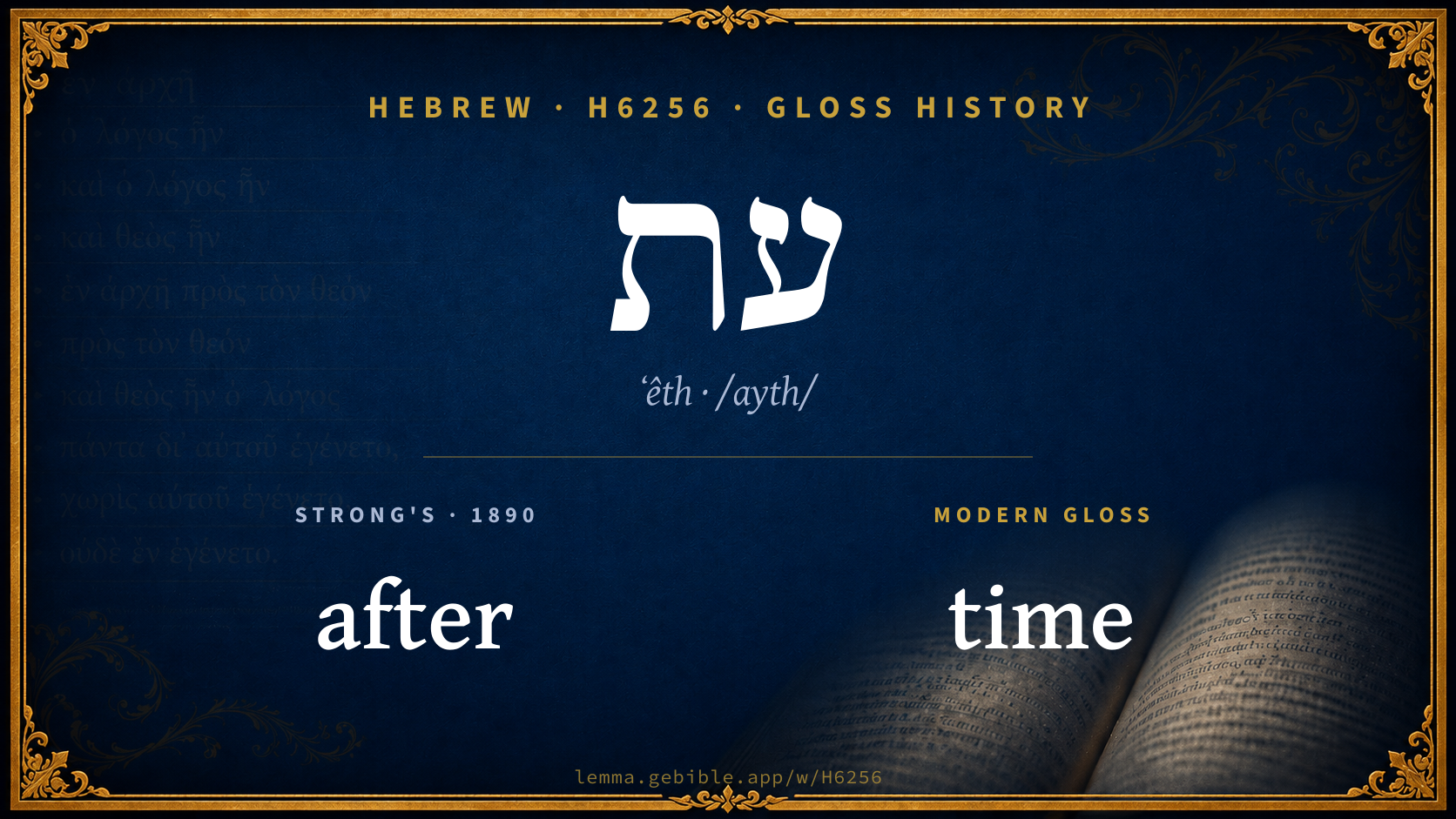
Gloss history
Strong's 1890 vs modern scholarship
About this word
Strong's H6256 catalogs a Hebrew word from the Hebrew Old Testament.
These counts are not copied from any lexicon or concordance. They are computed here, from the morphology-tagged Hebrew Old Testament. What Lemma adds →
- 258
- distinct verses
- The word appears in 258 distinct verses.
- 33 / 39
- OT books
- The word appears in 33 of 39 Old Testament books.
- #167
- by frequency
- Top 250 most frequent Hebrew words (rank 167 of 8,640 Hebrew words by occurrence).
View all 258 occurrences in the concordance →
Most concentrated in
- Jeremiah 34 verses 13%
- Psalms 22 verses 9%
- Deuteronomy 18 verses 7%
By section of the Old Testament
By traditional corpus
Conventional, traditional groupings — biblical authorship is debated, so this is a traditional corpus grouping, not an authorship claim. Each share is this word’s portion of its verses in that division of the Hebrew canon. Each figure is a share of the word’s 258 distinct verses.
- Prophets (Nevi'im) 116 verses · 45%
- Writings (Ketuvim) 107 verses · 41%
- Torah (Pentateuch) 35 verses · 14%
How translations render this word
Counts come from each version’s own published word-to-Strong’s tagging or interlinear alignment — an approximate guide to how each version renders this word, not a word-level alignment the data otherwise carries. Because each total is that version’s own tagged count, the per-version totals vary from one another and need not match the appearance or distinct-verse counts above. These counts may also differ from a printed concordance because Lemma counts each distinctly tagged rendering and does not collapse phrase taggings into a single head-word total. This is a fixed set of word-tagged versions (KJV, ASV, BSB, ULT) and does not change with the reading translation you choose elsewhere. Each version’s license is shown beside its name below (and on Sources).
BDB lists this Strong’s number as 2 distinct words (homographs). Each count above pools all of them and is not split by sense — see the Senses section below. A low-frequency rendering may belong to a different one of those words, not the primary meaning.
- King James Version†: Time 155×, Times 15×, About this time 7×
- American Standard Version†: Time 142×, Times 14×, Season 9×
- Berean Standard Bible†: Time 169×, Times 22×, Season 10×
- unfoldingWord Literal Text†: Time 164×, At 71×, Time of 57×
King James Version Public Domain
Renders H6256 across 294† tagged occurrences — most commonly:
Plus other, less common renderings. Plus 55 renderings that appear only once — usually multi-word phrases or single function words the recovered tagging swept in, not distinct renderings. Not rendered by a distinct English word in 2 further occurrences.
American Standard Version Public Domain
Renders H6256 across 293† tagged occurrences — most commonly:
Plus other, less common renderings. Plus 63 renderings that appear only once — usually multi-word phrases or single function words the recovered tagging swept in, not distinct renderings.
Berean Standard Bible Public Domain
Renders H6256 across 269† tagged occurrences — most commonly:
Plus 44 renderings that appear only once — usually multi-word phrases or single function words the recovered tagging swept in, not distinct renderings. Not rendered by a distinct English word in 26 further occurrences.
unfoldingWord Literal Text CC BY-SA 4.0
Renders H6256 across 371† tagged occurrences — most commonly:
Plus other, less common renderings. Plus 25 renderings that appear only once — usually multi-word phrases or single function words the recovered tagging swept in, not distinct renderings.
11 senses and sub-senses in the full BDB
What do BDB’s symbols mean?
BDB uses these scholarly abbreviations:
| Symbol | Meaning |
|---|---|
| 𝔊 | the Septuagint (the ancient Greek translation, LXX) |
| 𝔙 | the Vulgate (the Latin translation) |
| 𝔖 | the Syriac version (the Peshitta) |
| 𝔗 | the Targum (the Aramaic translation) |
| ψ | the Psalms |
| √ | root (the underlying root or stem) |
| ‖ | parallel passage (a synonymous or contrasted parallel) |
| † | the dagger: every passage where the word occurs is cited |
The 11 senses and sub-senses the full Brown-Driver-Briggs lexicon distinguishes for this word, in lexicon order (not ranked by frequency), with BDB’s own verbatim wording and sub-sense lettering. Shown in Hebrew script with BDB’s own scholarly abbreviations. The condensed entry is in the Lexicon Entry tab. See also the Forms in the corpus table below.
עת I
- 1. time of an event, etc.:
- a. usually (213 times) c. prep.: c. בְּ (142 times), especially בָּע׳ הַהִוא Gn 21:22 (E) in that time, 38:1 (J), Nu 22:4 (E), Dt 1:9 + 14 times Dt; בָּע׳ הַהִיא Jos 5:2; Am 5:13; Dn 12:1(×2) + (69 times, not in P); בָּע׳ הַזֹּאת Est 4:14, בָּעִתִּים הָהֵם 2 Ch 15:5; Dn 11:14; בְּכָל־עֵת at all times Ex 18:22, 26 (E), Lv 16:2 (P) ψ 34:2 +; = continually Pr 8:30, בְּכָל־עֵת אֲשֶׁר Est 5:13 as long as I see Mordecai; c. לְ (31 times; cf. ל 6, p. 516 supr.), 2 S 11:1 + at the time, but Ez 12:27 for distant times, cf. לְעֵת כָּזֹאת Est 4:14, etc.; c. כְּ (21 times; cf. ב 1 a, p. 453 supr.), †מָחָר כָּע׳ הַזֹּאת Jos 11:6 (JE) tomorrow about this time, usually כָּע׳ מָחָר (KöSynt. 401 o) Ex 9:18 (J), 1 S 9:16 (cf. Dr), 20:12; 1 K 19:2; 20:6; 2 K 7:1, 18; 10:6 †; כָּעֵת חַיָּה v. p. 312; †כָּעֵת הָרִאשׁוֹן Is 8:23 at the former time; כָּעֵת alone Nu 23:23 (JE) at this time = now (prob., cf. Di), Ju 13:23; 21:22, etc.; c. מִן (8 times;), מִן הָעֵת הַהִא Ne 13:21, etc.; c. עַד (12 times), עַד־הָע׳ הַהִיא Ne 6:1 up to that time, מֵעֵת עַד־עֵת Ez 4:10, 11, etc. (5 times Dn); c. אֶל־, מֵעֵת אֶל־עֵת 1 Ch 9:25. e.g. Genesis 21:22
- b. often cstr. defined by n.foll.: בְּעֵת צָהֳרָ֑יִם Je 20:16, לְעֵת (הָ)עֶרֶב 2 S 11:12; Gn 8:11; 24:11 (both J), Is 17:14; Zc 14:7, עַד־עֵת הָעָ֑רֶב Jos 8:29 (JE), כְּעֵת מִנְחַת עֶרֶב Dn 9:21, redundantly לְעֶת־יוֹם בְּיוֹם 1 Ch 12:23, ע׳ (ה)קָצִיר Je 50:16; 51:33, ע׳ הַזָּמִיר Ct 2:12, ע׳ זִקְנָה 1 K 11:4; 15:23 ψ 71:9, בְּע׳ אַפְּךָ Je 18:23 = לְע׳ פָּנֶיךָ ψ 21:10 (of anger), לְעִתּוֹת בַּצָּרָה 9:10; 10:1 at times of destitution (v. בַּצָּרָה), etc. e.g. Jeremiah 20:16
- c. sq.inf. לְע׳ בּוֹא הַשֶּׁמֶשׁ Jos 10:27 (JE), 2 Ch 18:34, בְּע׳ קָרְאָם Je 11:14a (read בְּעֵת also v b, Gie), etc. e.g. Joshua 10:27
- d. sq. cl. c. vb. fin. (poet. or late) Dt 32:35; Jb 6:17; 2 Ch 20:22; 24:11; 29:27 + (cf. 2 c). e.g. Deuteronomy 32:35
- 2.
- a. = usual time: לְע׳ צֵאת 2 S 11:1 at the time of kings’ going forth = 1 Ch 20:1; בְּעֵת יַחֵם Gn 31:10; עֵת לֶדֶת Jb 39:1, 2. e.g. 2 Samuel 11:1
- b. proper, suitable time: rain בְּעִתּוֹ Dt 11:14; Je 5:24 +, cf. Lv 26:4 (H), also ψ 1:3; 104:27; 145:15; Pr 15:23; Is 60:22; Ec 3:11; עֵת מִלְחָמָה v 8, ע׳ שָׁלוֹם v 8; sq.inf. Ho 10:12, הַעֵת לָקַחַת 2 K 5:26 is it a time to take money? Hg 1:4, לְהִבָּנוֹת עֶת־בֵּית י׳ v 2 (v a read עַתָּ בָּא Hi We Now al.); עֵת לַעֲשׂוֹת ψ 119:126, cf. Ec 3:2–8 (26 times); abs. כִּי עֵת Ho 13:13 (Hi We al.; GuKau gives עַתָּ; > Now כָּעֵת); abs. c. neg. Jb 22:16; Ec 7:17; hence (late) יוֹדְעֵי בִינָה לָעִתִּים 1 Ch 12:32, יֹדְעֵי הָעִתִּים Est 1:13 i.e. astrologers, etc. e.g. Deuteronomy 11:14
- c. appointed time, בְּעֵת תֵּת וגו׳ 1 S 18:19 at the appointed time of giving, Ez 7:7, 12 Is 13:22, ע׳ פְּקֻדָּתָם Je 8:12; 10:15 = 51:18, 46:21; 50:27 cf. (c.vb. fin.) 6:15; 49:8; 50:31, ע׳ אַרְצוֹ Je 27:7, ע׳ גּוֹיִם Ez 30:3, מְזֻמָּנִים לְעִתִּים Ezr 10:14 Ne 10:35 cf. 13:31; עַד־ע׳ מוֹעֵד 2 S 24:15, ψ 102:14 (‖ מוֹעֵד), etc.; cf. עֵת וּמִשְׁפָּט Ec 8:5, 6 (for time of judgment), עִתּוֹ 9:12; especially לְעֵת קֵץ Dn 8:7 cf. 11:35, 40; 12:4, 9, בְּע׳ עֲוֹן קֵץ Ez 21:30, 34 cf. 35:5; לְקֵץ הָעִתּים Dn 11:13. e.g. 1 Samuel 18:19
- d. as uncertain עֵת וָפֶגַע Ec 9:11. e.g. Ecclesiastes 9:11
- 3. = experiences, fortunes, pl. אֱמוּנַת עִתֶּיךָ Is 33:6, ψ 31:16; הָעִתִּים אֲשֶׁר עָֽבְרוּ עָלָיו 1 Ch 29:30. e.g. Isaiah 33:6
- 4. occurrence, occasion (= פַּעַם), רַבּוֹת עִתִּים Ne 9:28 great numbers of times (= very often). e.g. Nehemiah 9:28
עת II [עֵת] n.pr.loc. on border of Zebulun, only c. ה loc., עִתָּה ק׳ Jos 19
Senses from the full Brown-Driver-Briggs lexicon (Brown, Driver, Briggs; Oxford 1906 — public domain), digitized via Sefaria, supplemented by the OpenScriptures HebrewLexicon (CC BY 4.0). Full attribution on Sources.
Word origin
I. n.f. Am 5:13 and (seldom, mostly late) m. Ezr 10:14 time (NH id.; Ph. עת; Assyrian inu, ittu, time; Talm עַנְתָּא; clearly from a √ ענה, but doubtful whether I. ע׳);—abs. ע׳ Ho 10:12 +, cstr. ע׳ Gn 24:12 +, עֶת־ Lv 15:25 + 5 times; sf. עִתּוֹ Ho 2:11 +, etc.; pl., late, עִתִּים 1 Ch 12:32 +, sf. עִתֶּיךָ Is 33:6; עִתּוֹת ψ 9:10; 10:1, sf. עִתֹּתָ֑י 31:16;—ע׳ only twice P, once H;—
I. [עֵת] n.pr.loc. on border of Zebulun, only c. ה loc., עִתָּה ק׳ Jos 19:13; site unknown.
— Brown-Driver-Briggs (Oxford 1906, public domain), digitized via Sefaria, supplemented by the OpenScriptures HebrewLexicon (CC BY 4.0). See Sources.
Derived from עד (ʻad) (H5703) — perpetuity.
Jastrow Dictionary
A second Hebrew/Aramaic lexicon for comparison, covering Aramaic and post-biblical (Talmudic, Targumic, Midrashic) usage that the biblical-Hebrew BDB does not. Matched by lemma rather than by Strong’s number, so a lemma may carry more than one Jastrow headword (shown separately below), and the entries cover usage well beyond the Bible.
עֵת
- , v. עוּד; or of ענת, v. עוֹנָה I) [duration, turn,]
- 1. ʿEth, the twenty-fourth part of an ʿonah. Tosef. Ber. I, 1; a. e., v. עוֹנָה I.
- 2. time. Pes. 109ᵃ; מימיו לא אמר הגיע עת לעמוד וכ׳ never in his life did he (R. ʿAḳiba) say, it is time to rise from (leave) the house of study, except &c.; Succ. 28ᵃ. Ber. 8ᵃ (ref. to Ps. LXIX, 14) אימתי עת רצון בשעה וכ׳ when is the time of favor? When the congregation is at prayer. Taan. 24ᵇ שמע מינה עת רצון היא I learn from this (dream) that this is an auspicious time for prayer. Yeb. 72ᵃ עת רצון מילתא היא there is something in the idea of a time of favor for prayer; a. fr.—מֵעֵת לָעֵת (abbrev. מעל"ע) the time of twenty-four astronomical hours. Nidd. I, 1 מעל"ע ממעטת עליד מפקידה לפקידה וכ׳ the term of twenty-four hours (of retrospective uncleanness) reduces the term of the interval from one examination to the other &c., i.e. we go by the shorter term whichever it may be. Ḥull. 51ᵇ; Zeb. 74ᵇ צריכה מעל"ע requires the intervening of twenty-four hours (before it may be slaughtered); a. fr.—Pl. עִתִּים, עִתּוֹת, עִי׳. R. Hash. 28ᵃ ע׳ חלים ע׳ שוטה (Tosef. Ter. I, 3 פעמים), v. חָלַם I. Tam. I, 2 לא כל הע׳ שוות the time (for the appearance of the superintendent) was not always the same. Y. Ber. IX, end, 14ᵈ (ref. to Ps. CXIX, 126) העושה תורתו ע׳ … מיפר ברית he who makes the study of the Law a matter of time, destroys the covenant. Sabb. 31ᵃ בשעה … נשאת ונתת באמונה קבעת ע׳ לתורה when man is brought up for judgment, he is asked, hast thou been dealing with integrity? hast thou had regular times for the study of the Law? Snh. 65ᵇ ע׳ ושעות, v. עוּן; a. e.—לְעִיתּוֹתֵי עֶרֶב at the evening appointments (when labor is stopped, the work reviewed, wages paid &c.), in gen. towards evening. Tosef. Ab. Zar. VII (VIII), 10; Bab. Ber. 65ᵃ. Y. Ber. II, 5ᶜ top. Y. Succ. IV, beg. 54ᵇ. Y. Yeb. XVI, 15ᵈ top לציצותי, Var. לציתותי (read: לציתותי ערב); a. e. e.g. Psalms 69:14
A Dictionary of the Targumim, the Talmud Babli and Yerushalmi, and the Midrashic Literature (Marcus Jastrow; London, Luzac, 1903) — Public Domain. Digitized via Sefaria. Digitized via Sefaria. Full attribution on Sources.
Forms in the corpus
The 108 distinct written forms H6256 takes in the Hebrew Bible, most frequent first — each parse links to that state’s occurrences in the concordance. Hebrew forms include their vowel points and cantillation, so a single lemma takes many written forms.
The 60 most common forms are shown; 48 rarer forms follow in the full concordance.
Same root — word family
Other BDB entries built from the same root as H6256, grouped by Strong’s listed origin. These share a root / origin per the lexicon — not necessarily a shared meaning. Each links to that word’s own entry.
Derives from
Shares the same root
Derived from this word
Proper names from this root
People and places named from this root — a name, not an additional meaning of the word.
Compare all same-root words → Showing 4 of 7 — not the complete family. 1 of the same-root words is a proper name (a person or place). They share a root, not necessarily a meaning.
Septuagint verse parallels
This word appears in 237 verses that also exist in the Greek Old Testament (Septuagint), out of the 258 Hebrew verses it occurs in. You can read those verses in Greek by switching the Old Testament edition to the Septuagint.
Read these verses in the Septuagint
- Genesis 8:11
- Exodus 9:18
- Leviticus 15:25
- Numbers 22:4
- Deuteronomy 1:9
- Joshua 5:2
- Judges 3:29
- Ruth 2:14
- 1 Samuel 4:20
- 2 Samuel 11:1
- 1 Kings 8:65
- 2 Kings 4:16
This is a verse-level parallel only — the same verses exist in both the Hebrew and Greek Old Testaments. No word-level Hebrew↔Greek correspondence is claimed: the data carries no such alignment, so no Greek word is shown as this Hebrew word’s translation. Coverage is not total — the Septuagint omits the deuterocanon and renumbers the Psalms, so some Hebrew verses have no direct Greek parallel.