
Jeremiah 5:24

Hebrew (Westminster Leningrad Codex) Jeremiah 5:24 appears in the Hebrew Old Testament. The text above is from the Westminster Leningrad Codex. Each word links to its Strong’s number, a concise gloss, and parsing drawn from the Open Scriptures Hebrew Bible morphology. Click any word for its full Brown-Driver-Briggs (BDB) entry.
Download image
Cite this verse

Jeremiah 5:24 (World English Bible). Public Domain. Lemma interlinear Bible study tool, https://lemma.gebible.app/v/jeremiah/5/24.

Show BibTeX & RIS
BibTeX
RIS
English Translation
Neither say they in their heart, Let us now fear Yahweh our God, who gives rain, both the former and the latter, in its season; who preserves to us the appointed weeks of the harvest.
World English Bible · Public Domain
Download a study sheet

One document with this verse’s original text, its word-by-word gloss line, the meaning frame, cross-references with their text, attributed commentary, and full source and license credits — printable, and it pastes into notes with its structure intact.

This verse Autodidact and up

Study sheet (.html) Plain text (.txt)

A passage Seminary Student

Up to 50 verses in one chapter. A passage sheet keeps up to 6 commentary sources and 12 cross-references per verse, in the order this page ranks them, and says so on the sheet whenever that leaves anything out. Ask for a single verse and you get the Autodidact verse sheet above.

Everything on this page stays free to read, with no account — the sheet is a download of what is already on screen, not access to it.

Want to remove ads? Support Godless Engineer
Compare translations 3

The same verse in 3 English versions, stacked beneath the original-language interlinear above. Click any original word for its lexicon entry.

Each is an independent rendering of the whole verse — the interlinear is not word-aligned to these translations.

Highlighted words mark where these versions differ — a whole-verse word diff, not a word-by-word alignment.

  • World English Bible Public Domain
    Neither say they in their heart, Let us now fear Yahweh our God, who gives rain, both the former and the latter, in its season; who preserves to us the appointed weeks of the harvest.
  • King James Version Public Domain
    Neither say they in their heart, Let us now fear the LORD our God, that giveth rain, both the former and the latter, in his season: he reserveth unto us the appointed weeks of the harvest.
  • unfoldingWord Literal Text CC BY-SA 4.0
    And they do not say in their hearts, “Let us now fear Yahweh our God, the one who gives the rain—both the early rain and the late rain—in its season, he keeps the appointed weeks of the harvest for us.”

unfoldingWord Literal Text — © unfoldingWord, licensed CC BY-SA 4.0. Word-aligned USFM3 via Door43 (git.door43.org/unfoldingWord/en_ult).

Versions to compare (up to 4)

3 of 4 selected

Show all 18 translations

Every available English version of this verse, each an independent rendering of the whole verse.

  • World English Bible Public Domain
    Neither say they in their heart, Let us now fear Yahweh our God, who gives rain, both the former and the latter, in its season; who preserves to us the appointed weeks of the harvest.
  • Berean Standard Bible Public Domain
    They have not said in their hearts, ‘Let us fear the LORD our God, who gives the rains, both autumn and spring, in season, who keeps for us the appointed weeks of harvest.’
  • Majority Standard Bible Public Domain
    They have not said in their hearts, ‘Let us fear the LORD our God, who gives the rains, both autumn and spring, in season, who keeps for us the appointed weeks of harvest.’
  • King James Version Public Domain
    Neither say they in their heart, Let us now fear the LORD our God, that giveth rain, both the former and the latter, in his season: he reserveth unto us the appointed weeks of the harvest.
  • American Standard Version (1901) Public Domain
    Neither say they in their heart, Let us now fear Jehovah our God, that giveth rain, both the former and the latter, in its season; that preserveth unto us the appointed weeks of the harvest.
  • Revised Version (1885) Public Domain
    Neither say they in their heart, Let us now fear the LORD our God, that giveth rain, both the former and the latter, in its season; that reserveth unto us the appointed weeks of the harvest.
  • Geneva Bible (1599) Public Domain
    For they say not in their heart, Let vs nowe feare the Lord our God, that giueth raine both early and late in due season: hee reserueth vnto vs the appointed weekes of the haruest.
  • Douay-Rheims (1899) Public Domain
    And they have not said in their heart: let us fear the Lord our God, who giveth us the early and the latter rain in due season: who preserveth for us the fullness of the yearly harvest.
  • Young's Literal Translation Public Domain
    And they have not said in their heart, `Let us fear, we pray you, Jehovah our God, who is giving rain, The sprinkling and the gathered, in its season, The appointed weeks of harvest He keepeth for us.'
  • Literal Standard Version CC BY-SA 4.0
    And they have not said in their heart, || Now let us fear our God YHWH, who is giving rain, || The autumn rain and the spring rain, in its season, || He keeps the appointed weeks of harvest for us.
  • Unlocked Literal Bible CC BY-SA 4.0
    For they do not say in their hearts, “Let us fear Yahweh our God, the one who brings the rain —the early rain and the late rains—in their right time, keeping the fixed weeks of the harvest for us.”
  • unfoldingWord Literal Text CC BY-SA 4.0
    And they do not say in their hearts, “Let us now fear Yahweh our God, the one who gives the rain—both the early rain and the late rain—in its season, he keeps the appointed weeks of the harvest for us.”
  • Darby Bible Public Domain
    And they say not in their heart, Let us now fear Jehovah our God, that giveth rain, both the early and the latter, in its season; who preserveth unto us the appointed weeks of harvest.
  • World Messianic Bible Public Domain
    They don’t say in their heart, ‘Let’s now fear the LORD our God, who gives rain, both the former and the latter, in its season, who preserves to us the appointed weeks of the harvest.’
  • Webster's Bible Public Domain
    Neither say they in their heart, Let us now fear the LORD our God, that giveth rain, both the former and the latter, in its season: he reserveth to us the appointed weeks of harvest.
  • Free Bible Version CC BY-SA 4.0
    You didn't think to say, “We should appreciate the Lord our God, who sends the autumn and spring rains at the right time, who makes sure we can have a harvest every year.”
  • Bible in Basic English Public Domain
    And they do not say in their hearts, Now let us give worship to our God, who gives the rain, the winter and the spring rain, at the right time; who keeps for us the ordered weeks of the grain-cutting.
  • JPS Tanakh (1917) Public Domain
    Neither say they in their heart: 'Let us now fear the LORD our God, that giveth the former rain, and the latter in due season; that keepeth for us the appointed weeks of the harvest.'

Literal Standard Version (2020), Covenant Press — licensed CC BY-SA 4.0. Text via the HelloAO Bible API (eBible.org). Unlocked Literal Bible (unfoldingWord) — licensed CC BY-SA 4.0. Text via the HelloAO Bible API (eBible.org). unfoldingWord Literal Text — © unfoldingWord, licensed CC BY-SA 4.0. Word-aligned USFM3 via Door43 (git.door43.org/unfoldingWord/en_ult). Free Bible Version, Dr. Jonathan Gallagher — licensed CC BY-SA 4.0. Text via the HelloAO Bible API (eBible.org).

Word by word

More ways to search: Search by grammar → Find every occurrence → Compare this word →

Practice this passage: Drill this verse → Learn its vocabulary →

וירה
yôwreh
H3138
“and · early rain”
Conjunction + Noun, Common, Masculine, Singular, Absolute
Part of Speech
Conjunction + Noun
Type
Common
Gender
Masculine
Number
Singular
State
Absolute
Full BDB Definition

Origin: active participle of H3384

TWOT: 910a

early rain, autumn shower - rain which falls in Palestine from late October until early December
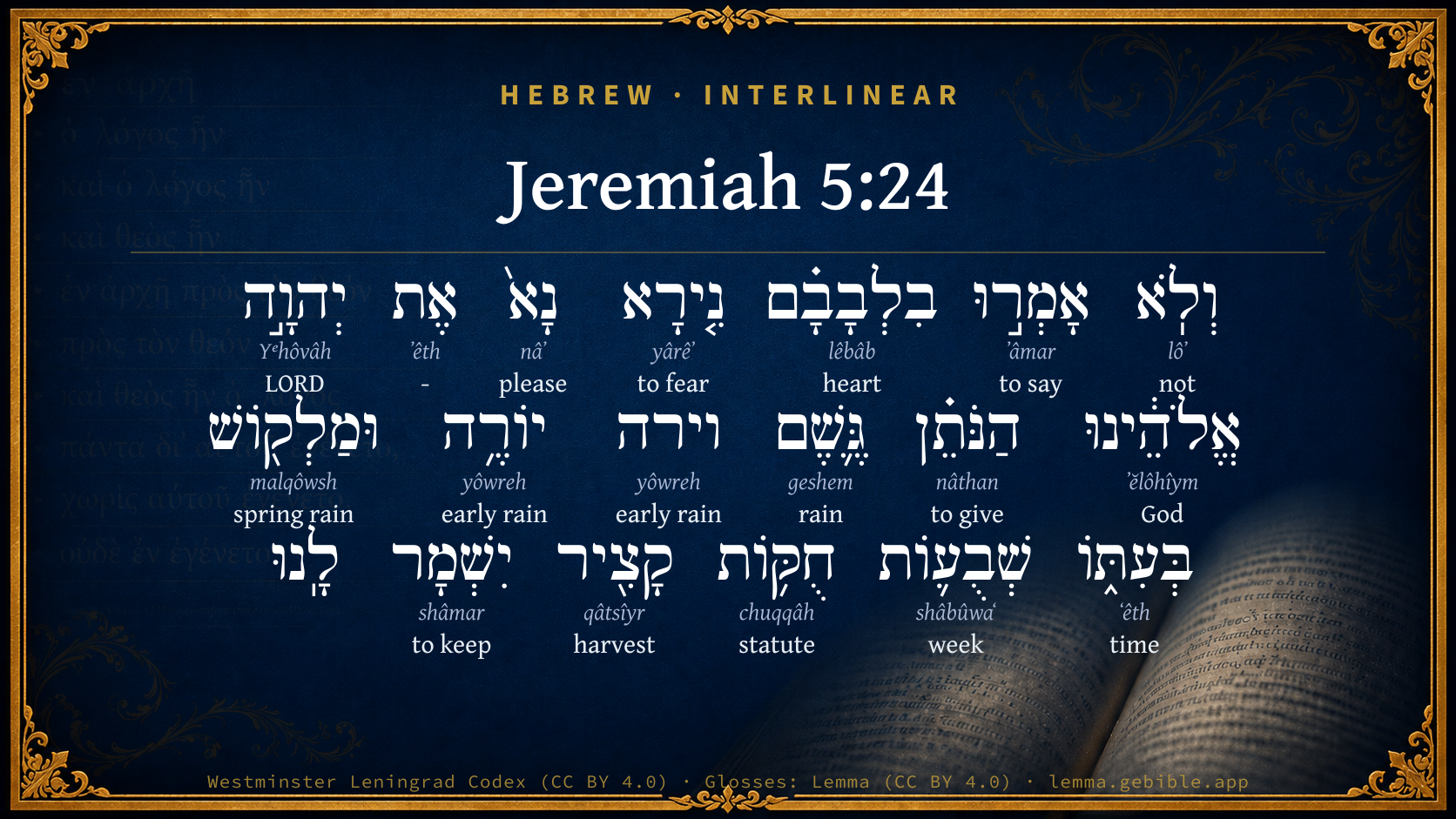
  1. וְלֹֽא lôʼ H3808 “and · not” Conjunction + Particle, Negative
  2. אָמְר֣וּ ʼâmar H559 “to say” Verb, Qal, Perfect, 3rd Person, Common, Plural
  3. בִלְבָבָ֗ם lêbâb H3824 “in/at · heart · their” Preposition + Noun, Common, Masculine, Singular, Construct + Suffix, Personal, 3rd Person, Masculine, Plural
  4. נִ֤ירָא yârêʼ H3372 “to fear” Verb, Qal, Cohortative, 1st Person, Common, Plural
  5. נָא֙ nâʼ H4994 “please” Particle, Exhortation
  6. אֶת ʼêth H853 “-” Particle, Direct Object
  7. יְהוָ֣ה Yᵉhôvâh H3068 “LORD” Noun, Proper
  8. אֱלֹהֵ֔ינוּ ʼĕlôhîym H430 “God(s) · our” Noun, Common, Masculine, Plural, Construct + Suffix, Personal, 1st Person, Common, Plural
  9. הַנֹּתֵ֗ן nâthan H5414 “the · giving” Particle, Definite Article + Verb, Qal, Participle Active, Masculine, Singular, Absolute
  10. גֶּ֛שֶׁם geshem H1653 “rain” Noun, Common, Masculine, Singular, Absolute
  11. יוֹרֶ֥ה yôwreh H3138 “early rain” Noun, Common, Masculine, Singular, Absolute
  12. וּמַלְק֖וֹשׁ malqôwsh H4456 “and · spring rain” Conjunction + Noun, Common, Masculine, Singular, Absolute
  13. בְּעִתּ֑וֹ ʻêth H6256 “in/at · time · his” Preposition + Noun, Common, Both, Singular, Construct + Suffix, Personal, 3rd Person, Masculine, Singular
  14. שְׁבֻע֛וֹת shâbûwaʻ H7620 “weeks of” Noun, Common, Masculine, Plural, Construct
  15. חֻקּ֥וֹת chuqqâh H2708 “statutes of” Noun, Common, Both, Plural, Construct
  16. קָצִ֖יר qâtsîyr H7105 “harvest” Noun, Common, Masculine, Singular, Absolute
  17. יִשְׁמָר shâmar H8104 “to keep” Verb, Qal, Imperfect, 3rd Person, Masculine, Singular

About this verse

These counts appear in no published source. They are computed here, from the morphology-tagged text and Lemma’s own curated glosses. What Lemma adds →

19
words
17
distinct lemmas
Prophets
section

Notable vocabulary

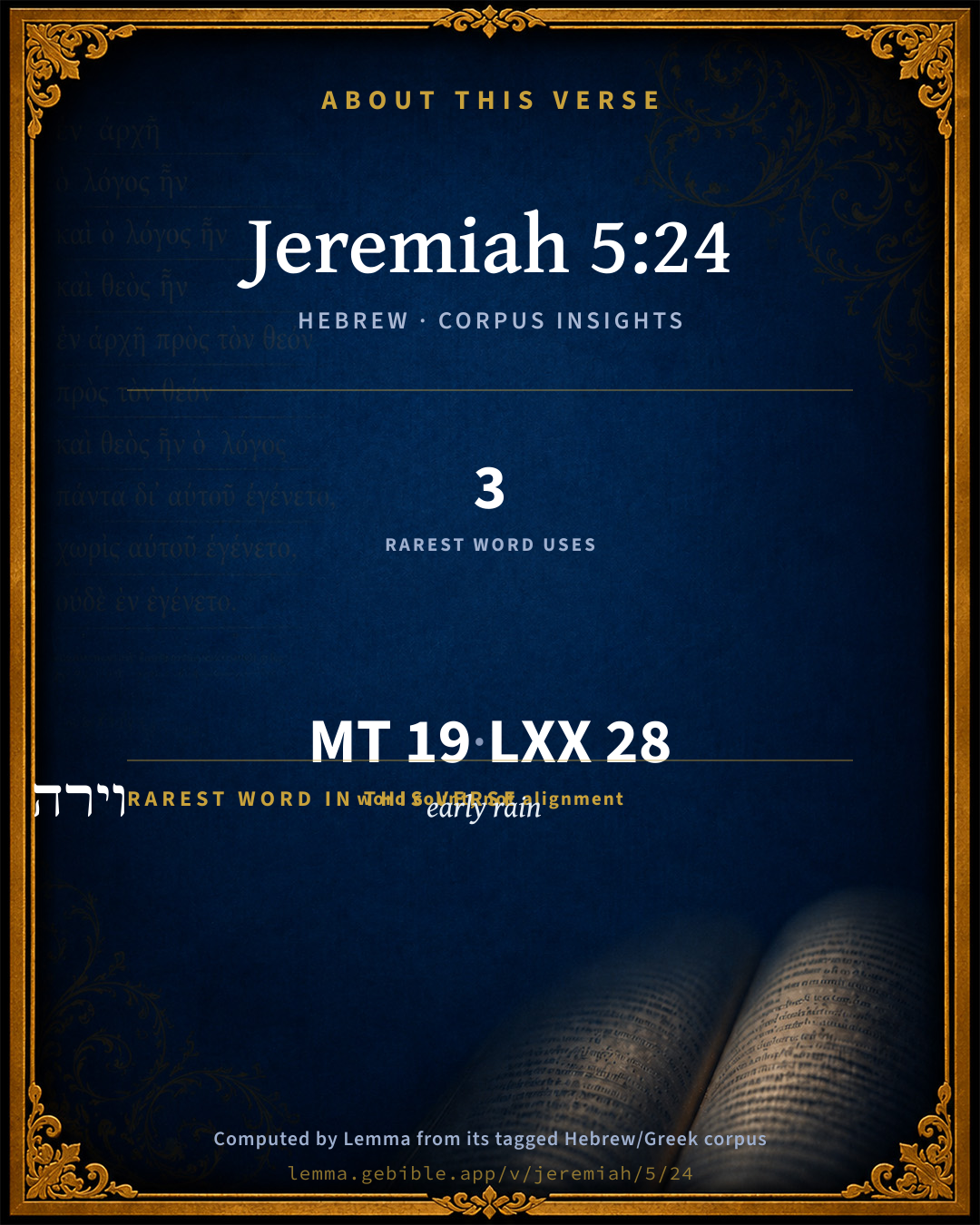
The rarest word here is וירה early rain H3138 — appearing just 3 times in the whole Hebrew Bible.

Shared distinctive vocabulary

וירה early rain H3138 occurs in 2 verses of the Hebrew Bible. Also found in:

Grammatical profile

  • 4 verbs
  • 11 nouns
  • 1 preposition
  • 3 particles

Verb forms

  • אָמְר֣וּ Qal · Perfect
  • נִ֤ירָא Qal · Cohortative
  • הַנֹּתֵ֗ן Qal · Participle Active
  • יִשְׁמָר Qal · Imperfect

Repetition

A word recurs within this verse — often emphatic in Hebrew:

  • וירה early rain H3138 ×2

Hebrew & Septuagint length

In the original languages it is 19 Hebrew tokens and 28 Greek tokens — but the two are counted differently (Hebrew bundles its prefixes and suffixes into one token; the Greek is in lemma form), so that isn’t a like-for-like length.

Cross-references

22

Topical passages linked to Jeremiah 5:24 in the Treasury of Scripture Knowledge — connected by theme and wording, ordered by reader-vote popularity; previews shown in the World English Bible.

  • Psalms 147:8 Who covers the sky with clouds, Who prepares rain for the earth, Who makes grass grow on the mountains.
  • Genesis 8:22 While the earth remains, seed time and harvest, and cold and heat, and summer and winter, and day and night shall not cease."
  • Joel 2:23 "Be glad then, you children of Zion, And rejoice in Yahweh, your God; For he gives you the former rain in just measure, And he causes the rain to come down for you, The former rain and the latter rain, As before.
  • Jeremiah 14:22 Are there any among the vanities of the nations that can cause rain? or can the sky give showers? Aren't you he, Yahweh our God? therefore we will wait for you; for you have made all these things.
  • Matthew 5:45 that you may be children of your Father who is in heaven. For he makes his sun to rise on the evil and the good, and sends rain on the just and the unjust.
  • Acts 14:17 Yet he didn't leave himself without witness, in that he did good and gave you rains from the sky and fruitful seasons, filling our hearts with food and gladness."
  • Deuteronomy 11:13–14 It shall happen, if you shall listen diligently to my commandments which I command you this day, to love Yahweh your God, and to serve him with all your heart and with all your soul,
  • Deuteronomy 28:12 Yahweh will open to you his good treasure in the sky, to give the rain of your land in its season, and to bless all the work of your hand: and you shall lend to many nations, and you shall not borrow.
  • 1 Kings 17:1 Elijah the Tishbite, who was of the foreigners of Gilead, said to Ahab, As Yahweh, the God of Israel, lives, before whom I stand, there shall not be dew nor rain these years, but according to my word.
  • Job 36:27–28 For he draws up the drops of water, Which distill in rain from his vapor,
  • Job 38:37 Who can number the clouds by wisdom? Or who can pour out the bottles of the sky,
  • Isaiah 64:7 There is none who calls on your name, who stirs up himself to take hold of you; for you have hid your face from us, and have consumed us by means of our iniquities.
  • Jeremiah 5:22 Don't you fear me? says Yahweh: won't you tremble at my presence, who have placed the sand for the bound of the sea, by a perpetual decree, that it can't pass it? and though the waves of it toss themselves, yet they can't prevail; though they roar, yet they can't pass over it.
  • Jeremiah 50:5 They shall inquire concerning Zion with their faces turned toward it, [saying], Come you, and join yourselves to Yahweh in an everlasting covenant that shall not be forgotten.
  • Hosea 6:1 "Come, and let us return to Yahweh; For he has torn us to pieces, And he will heal us; He has injured us, And he will bind up our wounds.
  • Amos 4:7 "I also have withheld the rain from you, When there were yet three months to the harvest; And I caused it to rain on one city, And caused it not to rain on another city. One place was rained on, And the piece where it didn't rain withered.
  • Zechariah 10:1 Ask of Yahweh rain in the spring time, Yahweh who makes storm clouds, And he gives rain showers to everyone for the plants in the field.
  • James 5:7 Be patient therefore, brothers, until the coming of the Lord. Behold, the farmer waits for the precious fruit of the earth, being patient over it, until it receives the early and late rain.
  • James 5:17–18 Elijah was a man with a nature like ours, and he prayed earnestly that it might not rain, and it didn't rain on the earth for three years and six months.
  • Revelation 11:6 These have the power to shut up the sky, that it may not rain during the days of their prophecy. They have power over the waters, to turn them into blood, and to strike the earth with every plague, as often as they desire.
  • Job 5:10 Who gives rain on the earth, And sends waters on the fields;
  • Hosea 3:5 Afterward the children of Israel shall return, and seek Yahweh their God, and David their king, and shall come with trembling to Yahweh and to his blessings in the last days.

Cross-references courtesy of OpenBible.info (CC BY 4.0).

Hebrew and Greek witnesses Masoretic Hebrew ↔ Greek Septuagint

The same verse in the two great witnesses to the Old Testament, shown verse-for-verse.

These are two independent witnesses, not word-aligned to each other, and the Septuagint is shown in lemma (dictionary) form.

Hebrew Jeremiah 5:24 Masoretic · Westminster Leningrad Codex

וְלֹֽא אָמְר֣וּ בִלְבָבָ֗ם נִ֤ירָא נָא֙ אֶת יְהוָ֣ה אֱלֹהֵ֔ינוּ הַנֹּתֵ֗ן גֶּ֛שֶׁם וירה יוֹרֶ֥ה וּמַלְק֖וֹשׁ בְּעִתּ֑וֹ שְׁבֻע֛וֹת חֻקּ֥וֹת קָצִ֖יר יִשְׁמָר לָֽנוּ

Neither say they in their heart, Let us now fear Yahweh our God, who gives rain, both the former and the latter, in its season; who preserves to us the appointed weeks of the harvest.

World English Bible · Public Domain

Greek LXX Structure differs

In the Septuagint, Jeremiah is about an eighth shorter than the Hebrew and arranges its material differently — the Oracles Against the Nations (Hebrew chapters 46–51) appear in the middle of the Greek book, after 25:13. Because the chapter and verse boundaries do not line up, a verse-for-verse comparison with the Hebrew is not shown.

A verse-for-verse comparison isn’t shown here because the chapters and verses don’t line up. Switch to the LXX edition with the MT / LXX toggle above to read the Greek directly.

On this verse, Adam Clarke's Commentary discusses the Septuagint’s reading. Read the note in Commentary ↓

Hebrew: Westminster Leningrad Codex (CC BY 4.0). Greek: Septuagint (public domain); English from a public-domain English Septuagint. How the Septuagint differs from the Hebrew →

Targum (Aramaic paraphrase)

1

The Targum is the ancient Jewish Aramaic paraphrase of the Hebrew Scriptures — an interpretive translation, not the Hebrew text itself. Onkelos (literal) and Pseudo-Jonathan (expansive) render the Torah, and Jonathan the Prophets. Coverage is partial: where no permissively-licensed English translation exists for a verse, only the Aramaic is shown. This is verse-level text, not a word-by-word alignment to the Hebrew.

  1. Targum Jonathan Prophets (Joshua–Malachi)
    וְלָא אֲמָרוּ בְלִבְּהוֹן נִדְחַל כְּעַן קֳדָם יְיָ אֱלָהָנָא דְמָחֵית מְטַר בַּכִּיר וְלַקִישׁ בְּעִדָנֵיהּ בִּזְמַן קַיָם שְׁבָעוּיָא דְבִזְמַן חַצְדָא נְטַר לָנָא:

    (no public-domain English translation for this verse)

    Targum Jonathan — Aramaic: “Mikraot Gedolot” (public domain). English: “Sefaria Community Translation” (CC0 1.0 (public-domain dedication)); “London "Chaldee Paraphrase," 1871” (public domain). Text via Sefaria.

Commentary

Notes on Jeremiah 5:24 from classic Christian and Jewish commentators (each source and its license shown beneath its notes). The classic Christian expositions comment on the surrounding passage and are grouped to its opening verse, so a note may address several verses; the Jewish commentaries on the Tanakh (Rashi and others) are per-verse, so they appear only where the commentator wrote on this verse.

Lemma curates 59 commentaries, every one of them public domain or Creative Commons licensed, each selected and text-cleaned for this edition rather than reprinted as found. About our sources →

Trapp's Complete Commentary

John Trapp

Jer 5:24 Neither say they in their heart, Let us now fear the LORD our God, that giveth rain, both the former and the latter, in his season: he reserveth unto us the appointed weeks of the harvest.

Ver. 24. Neither say they in their hearts.] God understands heart language, and expects a tribute there.

Let us now fear the Lord.] Fear him for his goodness, as well as for his greatness. {Jer 5:22} See Hos 3:5. {See Trapp on "Hos 3:5"}

That giveth rain.] Which God decreeth, {Job 28:26} prepareth, {Psa 147:8} withholdeth; {Amo 4:7} bestoweth {Deu 28:12 Mat 5:41} for a witness {Act 14:17} of his general goodness {Mat 5:45} and special providence, as a good householder. {Act 14:17}

He reserveth unto us the appointed weeks of harvest.] Which, if he should deny us but one year only, how easily might he starve us all! See his love, and fear his name.

John Trapp, A Commentary or Exposition upon All the Books of the Old and New Testament (1647–1656) — public domain. Text from a community e-Sword module.

The Biblical Illustrator

Joseph S. Exell

Jer_5:24

Let us now fear the Lord our God, that giveth rain, both the former and the latter, in his season: He reserveth unto us the appointed weeks of the harvest.

The former and the latter rain

Such are the climate and soil of Palestine, that all agricultural operations are most manifestly dependent upon the periodical rainfall. Hence the people speak of the weather and the crops with a more immediate reference to God than is usual with us. It is said that the common expressions of the peasantry are such as quite strike travellers with their apparently devout recognition of the Almighty agency. Certainly we may account for a very large number of what may be called the agricultural promises of the Old Testament, from the fact that little of the food of the people was gained by manufacture or commerce, and the whole population depended upon the field, and the field upon the rain. Although our climate does not so immediately remind us of our dependence upon God, yet it would be well if we remembered whence all our blessings come, and looked up to the hand from which our daily bread is distributed. When He giveth seasons propitious for the harvest, let us thank Him for it; and if at any time He restraineth the blessings of the elements, and leadeth the air with blight and mildew, let us fear and tremble before Him, and humble ourselves before His chastening hand. Gratitude for providential mercies is not, however, the subject of this discourse. I intend to use the text rather in a spiritual sense. As it is in the outward world, so is it in the inward; as it is in the physical, so is it in the spiritual: man is a microcosm, a little world, and all weather and seasons find their image in him. The earth is dependent upon the rain from heaven, so are the souls of men, and so are their holy works, dependent upon the grace shower which cometh from the great Father of Light, the giver of every good and perfect gift.

I. The work of God as it is carried on without. It is needful, whenever any holy enterprise is commenced, that it should be early watered by the helpful Spirit of God. Nothing beginneth well unless it beginneth in God. It cannot take root, it cannot Spring up in hopefulness, except the Holy Spirit shall descend upon it; it will wither like the grass upon the housetops if the celestial dew of the morning fall not early upon it. The like grace is equally needful after years of growth; there is urgent need of the latter rain, the shower of revival, in which the old work shall be freshened, and the first verdure shall be restored; for without this latter rain, the period of harvest, which is the end aimed at, will be disappointing.

II. Apply the text to our spiritual life within us.

1. Here note that usually the spiritual life, as soon as it is commenced, experiences a former rain, or a delightful visitation of grace. So blessed was our first conversion to some of us, that those first days are as green and fragrant in our memories as if they were but yesterday; they are as fresh and fair as if they had but just budded in the garden of time. To hear anyone talk of a precious Christ and of pardon bought with blood, and of full and free salvation, was heaven to us. If, in those days, we had to suffer anything for Jesus, we only regretted we could not suffer more. That was the early rain. The seed had just been sown, and the Master to make it take deeper root and spring up faster into the green blade, gave us the sacred shower of His loving presence. There was much tender wisdom in this gentleness, for the newborn soul is very weak then. Besides, our Master at that time gave us the early rain, as it were, to give our young plant a start in commencing our heavenly growth--a growth to which we might look back in after years. How often have we been refreshed since then in our times of sorrow, by recollecting the months past, when the candle of the Lord shone round about our head! Beloved Christian, if thou art now this day in the dark, pluck a torch from the altars of yesterday, with which to kindle the lights of today. The faithful Promiser was with thee then; thou hadst His love to cheer thee then: go to Him yet once more, and thou shalt receive the latter rain of renewed grace from Him who giveth grace upon grace.

2. It is very usual in the life of grace, for the soul to receive in after years, a second very remarkable visitation of the Holy Spirit, which may be compared to the latter rain. Believe me, the life of grace is no dead level, it is not a fen country, a vast fiat. There are mountains, and there are valleys. There are tribes of Christians who live in the valleys, like the poor Swiss of the Valais, who live in the midst of the miasma, where fever has its lair, and the frame is languid and enfeebled. Such dwellers in the lowlands of unbelief are forever doubting, fearing, troubled about their interest in Christ, and tossed to and fro; but there are other believers, who, by Gods grace, have climbed the mountain of full assurance and near communion. Their place is with the eagle in his eyrie, high aloft. They are like the strong mountaineer, who has trodden the virgin snow, who has breathed the fresh, free air of the Alpine regions, and therefore his sinews are braced, and limbs are vigorous; these are they who do great exploits, being mighty men, men of renown. The saints who dwell on high in the clear atmosphere of faith, are rejoicing Christians, holy and devout men, doing service for the Master all over the world, and everywhere conquerors through Him that loved them. And I desire, oh, how earnestly I desire you to be such men!

3. The text speaks of a third thing. There is the former rain, and the latter rain, and then he says, He has reserved for us the appointed weeks of harvest. Yes, if we shall get this latter rain--and may we have it!--it will then be time to be looking forward to our harvest. Consider well that the harvest begins in the field, though it ends in the garner. Going to heaven begins upon earth; and as the text tells us of weeks, so may I add that going to glory is often a long work. We are like a balloon while it is tied to the earth, it cannot mount; even so our ascent to heaven is delayed by a thousand detaining cords and bands, and the process of setting us free is cutting the ropes one by one. The wheat may well rejoice for the sharp cuts of the sickle, because it is the sign of going home to the garner. After the wheat is cut it stands in shocks, shocks of corn fully ripe, not growing out of the earth, but merely standing on it. The shock is quite disconnected from the soil. How happy is the state of a Christian when he is in the world but is not linked to it! His ripeness drops here and there a grain into the soil, for he is still ready to do good, but he has no longer any vital connection with aught below, he is waiting to be in heaven. Here comes the wain. The corn is put into it, and with shoutings it is carried home. Soon will our Heavenly Father send His chariot, and we who have been ripened by the latter rain, and separated from earth by His Spirits sickle, shall be borne in the chariot of triumph, amidst the shoutings of the angels, and the songs of thrice blessed spirits, up to the eternal garner. (C. H. Spurgeon.)

The God of harvest

I. Some of the aspects of the operations of the God of harvest. The artist will not be called a painting, or the poet an ode, although it is his production; neither will God allow creation to stand for Himself. But the artists painting, and the poets ode, reveal perception, and genius, and feeling, and inspiration, which lead us to the threshold of their personality. So creation is brimful of the power, wisdom, and goodness of its Maker, and providence teems with evidences of care, beneficence, and tenderness on the part of its Author.

1. The God of harvest is the God of life. Take upon the palm of your hand one grain of corn, and examine it. We are told that it is one leaf folded up tightly. Whether it is strictly so or not, there is an outer garment to ward off the severity of the weather, and there is a finer inner garment, with underclothing. But where is life? Is it between the folds, or is there some small particle of matter in the centre which is its secret cell? What is the action which takes place when life springs forth? What are light, and heat, and moisture in relation to life? How does life appropriate to itself substances that have in them no life? And lastly we ask, How does life rise up a hundredfold from the ashes of its own death? These are questions which we cannot answer. To answer them would destroy their very design, for they are there to conduct an inquiry which ends not in themselves but in God.

2. The God of harvest is the God of progress and beauty. There is a process which appears to us to be death, and not any step towards the expansion of life. When the grain has been in the earth some time there is a dissolving of its compactness, as if it could not hold its own against contending forces. It bursts also, as if its girdles were broken. The next step which might be expected to follow is its reduction to the consistency of the clod in which it is lodged. But we are not correct in our estimate of that process. Life has found in the earth what she delights to find at all times--a secret spot to unfold her powers. Silently and unobserved she unfolds the leaf, and sends it forth into the blade and the ear. The process we have alluded to is one of repulsion, without a single comely feature to relieve it. But the fact is, nature is there in her laboratory preparing to send forth life dressed in magnificent beauty. The cornfield, width its golden crop, is one of the loveliest sights in nature. Progressive steps develop the hidden beauties of life. If we further continue our observation, that which we consider to be the termination of all life is its real commencement. The present is the time of ploughing and sowing, the reaping will come by and by.

3. The God of harvest is the God of final and beneficent issues. God works in cycles, but providence is not without intermissions in the turn of the wheel. Periods of action are sharply marked off. Summer and winter may be said to reverse each other, although their revolutions accomplish but one end. These changes prove the existence of a guiding hand, as much as the tacks which the ship makes prove that the man is at the wheel. The thought that all these changes, with a direct and a reversible action, bring about ends transcending in goodness and beauty everything of the kind in the actions themselves, ought to influence us not to seek in labour the joy of harvest. The husbandman does not grind and bake all his corn, but is as careful to keep the best of it for seed, as he is anxious the other part should be wholesome food for his family. So we cannot hope for future joy if no present seed is sown. Good seed cast into good ground--the Word of God sown in the heart--will be watered by His Spirit, Words spoken from the heart, and actions prompted by love, sown in the breasts of others, will grow into a plenteous harvest. The Lord has reserved a period of rejoicing for Christian workers.

II. Reverence and gratitude are due to the God of harvest.

1. A due regard for His honour. Reverence is a state of feeling produced by a sense of the majesty of God, and is the principal element in true worship. This holy passion is better felt than described. It is not a passion wholly created by a sense of sinfulness, which would be simply a dread of His displeasure, but an intense regard for Gods glory. His name is never pronounced except with a feeling of awe, and His works with a sense of reverence. His Word is holy, and His presence sought in the deepest humility. The fear of the Lord is the beginning of wisdom.

2. A deep sense of gratitude. Reverence for God does not crush the love of the soul. It has no frowns, but a smile. We worship and look up. We read the heart of the Giver in the gifts. All His servants are loaded with gifts for us. The earth has He given to the children of men. Its magnificence, its attractions, its beauties, its riches, its harvests, are all ours. More than the earth, yea, and more than the heavens, hath He given unto us, Who gave His only begotten Son.

3. An earnest desire for service. The hurry must be fed, and the naked clothed. The widow needs a friend and the orphan a father. Have we nothing to lend to the Lord by giving to the poor? Is there not a holy ambition in our souls to emulate Him who went about doing good? (T. Davies, M. A.)

Voices of God in the harvest

I. There are voices of God in the yearly harvest. God has mercifully set our lot in an age when the perils of famine and of desolating wars are very seldom known, and in very limited degrees. In past ages the yearly harvest was much more hazardous than it is now that countries are more settled and agricultural science so much farther advanced. Yet in those days God did not withhold His promised harvests from the world, only from parts of it. Not one single year of the worlds history has passed by without a gathered harvest somewhere; only the imperfect communication between distant countries did not then permit the surplus of one land to supply the deficiencies of another. Can any true soul look upon the valleys covered over with corn, and fail to hear them shouting for joy and also singing of the goodness of God? What merciful care of His creatures is thus displayed! How surely a moments failing interest on the part of God would leave our harvest only a heap in a day of sadness and of desperate sorrow! There are many who can discern something of the goodness of the God of providence, who yet try to persuade themselves that it is another kind of God who deals with men as sinners--another God, and this God only a God of stern demands, severities, and vengeance. It is not so. The God of redemption is the very God of bounteous nature. His yearly mercy is designed to carry home to our hearts the very call made by Christ, and by the Word--the call to repentance and trust. In the salvation by Jesus Christ we ought to see in sublime glory that very goodness that spreads our fields with waving corn. In the yearly harvest there is also a voice speaking out Gods faithfulness. Every year He is only doing what He promised our forefather He would do for him and for his descendants; He is only keeping His word. Gods faithfulness to His promise is painted in splendid colours right across the sky in every sun-glinted shower. Gods faithfulness to His promise is sung out by every cloud-flecked, waving cornfield, every gathered sheaf, and every loaded barn.

II. The special voices of God in this years harvest.

III. The voices of God in the scripture use of the harvest.

1. In Scripture, and by the Lord Jesus Christ, the harvest is used as an illustration, and employed to impress Christian duty, especially the duty of working diligently and earnestly in Christs work, the ingathering of sinners to His love, salvation, Church, and heaven.

2. Harvest is also used in Scripture to point a call to us to prepare for the judgment day, and the eternal world. (R. Tuck, B. A.)

Harvest thoughts

The harvest, with its long train of preparatory works--ploughing and seed time, spring and autumn rains, the rest of winter and the heat of summer--is not only the great support of our life in this world--the great business of the year, as far as bodily health and strength are concerned; but it is throughout an instance of our Heavenly Fathers teaching us, without book, many of the truths which it most concerns us to know.

1. He meant us to take notice, first, of His continual presence and power in bringing forward the fruits of the earth. We are not so stupid as to imagine that corn will spring up of itself in our fields, whether it be sown at all or no. When we see a piece of land well stored with it and free from weeds, we do not ascribe it to chance, but we acknowledge that the hand of man has been busy in that place. But consider how much more skilful the work is, to form out of a dry seed, by mixture with a little earth and water, the several parts of an entire plant--the root, the stalk, the blade, the flower, the grain--and be ashamed to recollect how seldom you have thought of that infinite skill and wisdom, in comparison with the notice you have taken of mans part, so very fax inferior, in the work of bringing food out of the earth. Man does his portion of labour and goes away, and sets about something else: but the work of God is forever going on, and therefore we may be sure the workman is forever present.

2. It is the more shameful not to take notice of this; because the growth of corn is, from beginning to end, a work of Gods mercy as well as of His power. It is a sort of token, to our very outward senses, that He has not left us nor forsaken us, for all we have done to provoke Him; and who is there, that has a just sense of his own sin and unworthiness, who will not thankfully receive every thing, both in nature and in Scripture, which encourages him to meditate on so cheering a truth as this?

3. Then, the manner in which the harvest is made available for the supply of our wants may offer abundance of useful instruction although He does so much for us, in forming, watching over, nourishing, and ripening the plant, yet it is not His will we should enjoy the benefit of it without exertion on our own part. In the sweat of our face we must eat bread: we must put it in the ground in the first instance: we must fence, manure, weed, and reap, or all Gods mercy in giving us the fruits of the earth, will at last be thrown away upon us. It is no otherwise in what concerns our spiritual happiness and eternal salvation. We must do our part by faith and prayer and sincere obedience, or we cannot expect God to do His. We must employ so much common sense, as to look forward to another world, and not to mind trifles any more than we can help, while eternal things are open before us. The cultivation of the earth, like the other employments of this life, is not blessed alike to all; and it very often may happen, that God sends prosperity on a bad mans harvest, while the crop of the righteous fails. This, to unbelieving dispositions, is another excuse for irreligious thoughts, and practices; as if God had not warned us beforehand, that He maketh His sun to rise on the evil and on the good, and sendeth rain on the just and on the unjust. God does not think so much of the good things of this world, as to account them a sufficient reward for His faithful servants; by them, or by the want of them, He is trying us in this world, to fit us for our real reward in the next: and to murmur because good harvests, or any other worldly goods, are not bestowed on men according to their behaviour, is as if a man on a journey should be angry and discontented, because he does not find all the comforts of repose and home whilst he is moving along the road. (Plain Sermons by Contributors to Tracts for the Times.)

The God of nature

I. The doctrine asserted. The Lord our God giveth, etc. He is the immediate bestower of what we call natural benefits.

1. The Giver of rain.

(1) He provides it in mercy to mankind.

(2) He withholds it in judgment upon nations.

2. The Appointer of harvest. He reserveth, etc. Important and interesting season. God has appointed it--

(1) As an immutable ordinance (Gen_8:22).

(2) As a time of rejoicing.

(3) As a means of instruction.

II. The duty inferred.

1. Cultivate continual acknowledgment of God.

2. Exercise entire dependence upon God.

3. Render perpetual thanksgiving to God.

4. Devote ourselves to the faithful service of God. (H. Parr.)

Harvest voices

Is there not a modern tendency to exclude God from the harvest field, to put an atheistic trust in secondary causes--subsoil ploughing, artificial manures, the rotation of crops and the like? Nature to the seeing eye and listening ear is sacramental. Earth is crammed with heaven, and the air is redolent with a celestial music.

1. The prophet would have us cherish that filial, reverent and thankful fear towards the great Giver of all which will save us from perverting His gifts. Without a due recognition of God our temporal prosperity becomes a curse. Jeshurun waxed fat and kicked. An engraving by Retseh illustrating a great poem gives us the angels dropping roses from the skies on the heads of denizens in Inferno. Reaching them these fragrant gifts turn to molten lead but to scorch and burn. Is it not thus when the blessings of a kindly providence fall on selfish and ungrateful hearts? The intended boon becomes a bane and the perverted gift a corrosion and a blight. Such is the characteristic sign of worldliness. It is a profanation of lifes gifts to basest uses, and a missing of the higher good. But the bounteousness of each glad harvest time should remind us that we are pensioners on the lavish goodness of our Heavenly Father in order that we may use it as He alone wills, for we are beneficiaries every one, and, as such, trustees of heavens manifold mercies and gifts.

2. The thought of life out of death is conveyed to the spiritual mind. Except a corn of wheat fall into the ground and die, it abideth alone: but if it die, it bringeth forth much fruit.

3. Another suggestion from the harvest is that of cooperation with God. Take a field of corn; it has not come of itself. Geologists never find amid the fossilised remains of primeval vegetation a trace of corn. It is specifically a human product. Wild wheat is unknown. Corn is the product of civilised man. It implies tillage, and this in a sense not true of many other products that minister to mans need. So also is it in the development of Christian character. We are workers together with God. We do not attain to eminence by accident, or, as it were, automatically. It is true that salvation is of God; we are saved by grace through faith; and that not of ourselves: it is the gift of God. But there is sense in which salvation is a process, a diligent culture, a strenuous warfare, a glad but real obedience. We must work out what God works in if we are to come to a real possession of truth and of Christian excellence. The graces of Christian life are not like pictures thrown on a screen by a magic lantern, they are rather like the strands woven in a costly fabric by the weaver at his loom. To change the figure, finished husbandry of soul involves sedulous and patient culture, prayerful self-examination, and a mastery of that inner realm of our being where desire, motive, volition play their determining part in human character. Truth is real, something trowed, when it has become a working and victorious principle in the life. Other than this, it is like so much unused capital locked up in a bank, or so much unworked land on a farm. The Chinese, it is said, discovered the magnetic needle centuries before it was known in the western world. But it was a mere toy. They did not use it for new voyages of discovery or for enterprise in commerce. Its practical utility was nil. May not we commit a similar futility in Christianity?

4. Again, Everything in its season, the harvest seems to say, First the blade, then the ear, then the full corn in the ear. So each period in human life has its appropriate work. We cannot postpone duty and expect the reward of honest diligence. A pious, well-instructed youthhood should go before the active responsibilities and burdens of mid life, as both of these must precede and determine the mellow ripeness of advanced age. No one period in life can do the work of another period. Each has its own function and opportunity. Religion is a sublime forecast to be made use of in lifes early season, and not an afterthought darkened only with unavailing regrets when the summer has ended and the harvest we had wished is forever beyond our reaping. Know thy opportunity was written on the temple of Delphos. It is written deep on the face of time.

5. Let us remember that as the grain of one harvest is the seed of the next, so our life is reproductive, and its influence far-reaching and beyond our power to compute. Moreover, there is a wondrously cumulative power in Christian work and influence; the reaping is larger than the sowing. A self-multiplying process is ever going forward, and the results lie beyond our reckoning. We think of the beginning of things, the initial stages of great reform movements, the so-called forlorn hopes of the past, and with grateful wonder we greet today their fruitful, immeasurable issues. It is difficult for even the most sceptical and slow of belief to resist the lesson of history, that moral and spiritual forces rule and shape the destiny of this world, and that humanity and Christianity are meant the one for the other. (Aldersgate Magazine.)

Lessons from the harvest

I. In reference to God.

1. Admiration.

(1) We may admire the wisdom of God, in all the means that He uses to ripen our corn, and in bringing each field of the same kind to perfection nearly at the same time, so that all, or at least a considerable part of it, may be cut down together, and yet all be fit for use.

(2) The wisdom of God, our preserver, is evident again in bringing the different species of corn to perfection at different times, so that one is not ready till after another is cut down.

(3) The same wisdom is also seen in making the harvest at somewhat different times in different parts of the country, so that those who have reaped it in an early part may procure a few weeks longer work by repairing to a later district,--an arrangement of Divine Providence productive of greater convenience to the farmer, and longer employment to the labourer.

2. Dependence. We can only lay the seed down in the ground and cover it with the soil. God does all the rest.

3. Gratitude. Remember how many difficulties are in the way of every harvest, and how nicely He must adjust the balance of all the influences required to produce it. Too much rain or too little; too powerful and constant sunshine, or too unfrequent; too violent winds, or too dell and general calm, would render our autumn unfruitful. Consider, also, how many arrests there are which we have seen, and of whose fruits we have partaken.

4. Confidence. The sun may fail to ripen the corn, the seed may lose its germinating power, the rain may spoil it, or the wind may shake it; but God has said we shall have harvest, and we always have it. But nothing can by any possibility deprive the blood of Christ of its purifying and saving efficacy: how much more, then, may we expect that promise to be accomplished which says, He that believeth on the Son hath everlasting life?

II. In reference to ourselves.

1. Activity. Although the corn may be ripe in the fields, it will be useless unless gathered into the barn. So is it with Gods blessings through Christ. Our Saviour has died; but what will this avail unless we use the means by which we may obtain the benefits He has purchased?

2. Death.

3. Judgment. (W. Dickson.)

Reflections on harvest

I. The regular return of harvest is an obvious proof of the existence and providence of God. The fruits of the earth, so necessary to the support of animal life, depend on causes beyond the reach of human power. The whole management of the natural world is in hands superior to ours, in the hands of an invisible, almighty Being.

II. The time of harvest naturally calls us to pious meditations and reflections.

1. The seasons are so ordered, as to remind us of the shortness of human foresight. From past experience we expect a harvest in its appointed weeks, and rarely is our expectation frustrated. But the event is not always adjusted to the measure of our hopes. It often falls short, and often exceeds them. The management of the seasons, however, is in unerring hands. Rational beings, in the care of infinite wisdom and goodness are always safe, while they proceed in the line of their duty, and never ought they to indulge anxiety. With Him who governs futurity, they may calmly trust all events.

2. Our dependence is apparent, as in many other things, so especially in the return of harvest. If God sends His blessing, none can revoke it. If He withhold His smiles, our toil is fruitless.

3. Scripture speaks of harvest as a season of gratitude and joy.

4. Harvest teaches diligence and frugality.

(1) God supplies our wants, not by an immediate providence, but by succeeding our prudent labours.

(2) Those precious fruits of the earth which are dealt out only at certain seasons, and which by no art or industry of man can at other seasons be obtained, should be applied to honest and virtuous purposes; not wastefully consumed in criminal indulgences.

5. Harvest inculcates benevolence. Religion consists in an imitation of Gods moral character, especially of His diffusive and disinterested goodness.

6. Harvest reminds us of the shortness of life, and calls us to the diligent improvement of our time. Food and raiment are needful for the body; seek them you may; but rather seek the kingdom of God, and these things will be added.

7. Harvest should be a season of self-examination. We are Gods husbandry. Much has He done for us. What could He have done more? Have we answered His cost? The field, which bringeth forth herbs, meet for Him by whom it is dressed, receiveth blessing from God. But that which beareth thorns and briars, is nigh unto cursing, whose end is to be burned.

8. Harvest reminds us of our obligation to faith and patience. We have a kind of natural faith, which, standing on the ground of past experience, looks forward with expectation of a future harvest. Let Christians, enlightened by revelation, look beyond this world to things unseen; and, relying on the promise, truth, and grace of God, anticipate the blessings of the heavenly state. (J. Lathrop, D. D.)

Lessons from the harvest

I. The blessings. Fruitful showers, and brilliant suns, and azure skies, and earth covered with its bright green clothing, are, indeed, in themselves, blessings; but this character is much more emphatically applied to them when we remember that they are not only beautiful spectacles to delight our eyes and to minister to our senses of enjoyment, but that they yield that sustenance, without which, the globe would soon be thinned of the tribes which inhabit it, and there would be no human eye to rejoice in its beauties. Yes, the great blessing is, that human life is to be sustained by the produce which the fruitful seasons have thus secured to us. What blessings, then, are the former and the latter rain and the appointed weeks of the harvest, which supply this food. But it is chiefly on account of our never-dying souls that the fruitful seasons are a blessing. There is this and that person who now, perhaps, are but cumberers of the ground, bus who are upheld in life one year longer, that the seed of eternal life may be now sown in their hearts--that they may, at length, be made fruitful unto God, and become heirs of a glorious immortality.

II. The source of these blessings.

1. Man, when he would account for any event, in his ungodliness, frequently ascribes is to chance or good luck. But there is no such word in a Christian mans vocabulary. We must carefully distinguish between the agency of the Lord our God and second causes. There is a sad tendency in man to put the instruments which God makes use of to bring to pass all His will in the place of God Himself.

III. The return which God requires.

1. As individuals, let the undeserved goodness of the Lord lead you to fear Him. Ask the gift of the Holy Ghost, to impress your heart with a deep and abiding sense of Gods goodness, at the present time--to humble you under a sense of your own ingratitude; to lead you to Jesus Christ for pardon, peace, and acceptance with God.

2. As heads of families, let us fear the Lord our God. As for me and my house, we will serve the Lord.

3. As subjects of our beloved Sovereign--as members of the commonwealth--let us fear the Lord our God. The national character is made up of the aggregate of individual character. (H. Caddell, M. A.)

The Biblical Illustrator, edited by Joseph S. Exell (c. 1880s–1900s) — public domain. Text from a community e-Sword module.

Jamieson, Fausset & Brown

Robert Jamieson, A. R. Fausset & David Brown

rain . . . former . . . latter--The "former" falls from the middle of October to the beginning of December. The "latter," or spring rain in Palestine, falls before harvest in March and April, and is essential for ripening the crops (Deu 11:14; Joe 2:23).

weeks of . . . harvest--the seven weeks between passover and pentecost, beginning on the sixteenth of Nisan (Deu 16:9). By God's special providence no rain fell in Palestine during the harvest weeks, so that harvest work went on without interruption (see Gen 8:22).

Jamieson, Fausset & Brown — Commentary Critical and Explanatory on the Whole Bible (1871) — public domain (CC PDM 1.0). Text via the HelloAO Bible API.

Adam Clarke's Commentary

Verse 24. Giveth rain, both the former and the latter] See Clarke on Jer 3:3.

The appointed weeks of the harvest.] As the early rains fell in the northern parts of Judea about the end of September, in the civil year of the Hebrews, so the latter rains fell before harvest, in the months of March and April. The appointed weeks of the harvest were those which fell between the passover and pentecost. In the southern parts the harvest was earlier than in the northern. Dr. Blayney translates, "A sufficiency of the appointed things of harvest he secureth to us."

If the word שבעת weeks, be read with a ש sin instead of a ש shin, it will signify fulness or sufficiency; and thus the Septuagint and Vulgate have read it. I think the present reading is much to be preferred. God appoints a harvest time, and in his good providence he generally gives harvest weather.

Adam Clarke's Commentary on the Bible (1810–1826) — public domain. Text from a community e-Sword/MySword module.

John Calvin's Commentaries

The Prophet in other words proves here that the Jews had been justly charged with perverseness: he says, that it did not come to their minds, that they did not think, to fear God. We hence see that all that is said is designed to shew, that the people were no less senseless and stupid, than if they were lifeless elements; nay, that there was more stupidity and more furious madness in their hearts than in any created thing.

To say in the heart means in Hebrew to weigh, to consider. We should say in Latin, “It did not come to their minds,” (non venit illis in mentem;) that is, “Have they not been so void of common sense, that this thought did not come to their minds, or did not occur to them, Let us fear the Lord?” And here he takes away every pretense of ignorance, that they might not object and say, that they did not worship God through error or want of knowledge: “But ye had eyes,” he says, and ye had ears, and all the faculties belonging to men; God gave you rain; there has been no year in which the earth did not bring forth its fruit for you; when ye eat bread, does not the bounty of God occur to your minds? and yet ye consider not that he ought to be worshipped.” We hence see that he takes away every excuse for their ingratitude by saying, that they had been inattentive to those blessings, which were seen by the eyes, and felt by the hands, and touched by every part of the body. But of the rest we must speak to-morrow.

John Calvin's Commentaries (1540-1563) — public domain. Text from the Calvin Translation Society English edition (1840s-50s) via the Christian Classics Ethereal Library (ccel.org). Calvin's coverage is partial (roughly two-thirds of the Bible); uncommented books and verses are honest gaps, never fabricated. The 19th-century editor's footnotes and remarks are omitted so the notes are faithfully Calvin's own voice.

Ellicott's Commentary for English Readers

(24) The Lord our God, that giveth rain . . .—In the climate of Palestine, as it is now, there are not two distinct rainy seasons. The whole period from October to March has that character. The “early” rains are those that come in autumn, the latter those which close the season in spring. The former argument in what we may call the prophet’s natural theology had been drawn from the presence of law in the midst of what seemed the lawless elements of nature. Now he urges that drawn from regularity of succession. Compare Gen_8:22; Psa_148:8; Act_14:17.

Rain, both the former and the latter.—Again a Deuteronomic phrase (Deu_11:14). Compare also Jas_5:7; Pro_16:15.

The appointed weeks of the harvest.—Literally, the weeks, the statutes, or ordinances, of the harvest, the seven weeks included between the beginning of the barley harvest at the Passover and the completion of the wheat harvest at Pentecost.

A Bible Commentary for English Readers, edited by Charles John Ellicott (1878–1897) — public domain. Text from a community e-Sword module.

The Cambridge Bible for Schools and Colleges

gen. ed. J. J. S. Perowne

24. God’s grace as shewn in nature illustrated. As the people refused to fear Him in consideration of His power (Jer_5:22), so neither does His bounty prevail with them.

rain, both the former and the latter] Cp. Jer_3:3. The former (= early) rain was between October and December, the latter fell in March and April.

The Cambridge Bible for Schools and Colleges (gen. ed. J. J. S. Perowne; Cambridge University Press, 1878–1918) — public domain. Text from a community e-Sword module.

John Gill's Exposition

Neither say in their heart,.... It came not into their mind, they never once thought of it, namely, of what follows,

let us now fear the Lord our God; they were not influenced and engaged to the fear of God, neither by his power in the preceding instance, nor by his goodness in the following one:

that giveth rain; in common, all the year round, at proper times, for the use of men and beasts. This is a pure gift of God, and an instance of his goodness, and is peculiar to him, what none of the gods of the Gentiles could give, Jer 14:22,

both the former and the later, in his season; there were two particular seasons in the year in which the land of Israel had rain; the one was in the month Marchesvan, answering to part of October and part of November, and this was the former rain, after the seed was sown in the earth; and the other was in the month of Nisan, answering to part of March and part of April, just before the time of harvest, and this was the latter rain:

he reserveth unto us the appointed weeks of the harvest; which was reckoned by weeks, because of the seven weeks between the passover and pentecost: the barley harvest began at the former, and the wheat harvest at the latter, called the feast of weeks, Exo 34:22 and these were appointed of God, the harvest itself, Gen 8:22 and the weeks in which it was gathered in, Lev 23:15, and these appointments and promises the Lord carefully observed, and faithfully kept.

John Gill's Exposition of the Whole Bible (1746–1763) — public domain (CC PDM 1.0). Text via the HelloAO Bible API.

Haydock's Catholic Bible Commentary

Rain, in autumn and in spring, Deuteronomy xi. 14. (Calmet) --- Fulness. Hebrew, "the weeks for harvest." (Haydock) --- That of barley began at the Passover, and that of wheat ended before the feast of weeks, (Exodus xxxiv. 22., and Leviticus xxiii. 10.; Calmet) or Pentecost. (Haydock)

George Leo Haydock (1774–1849), Haydock's Catholic Family Bible and Commentary, 1859 edition — public domain. Excludes Psalms (Douay-Rheims chapter numbering differs from Protestant) and Deuterocanonical books (Catholic canon only).

Matthew Poole's English Annotations

Neither say they in their heart; they are so careless that they never trouble themselves about it; or so obdurate and stiff that they never lay it to heart, or consider that it is God that disposeth of all fixings according to his own pleasure, both in the earth and in the great deep.

Fear; or, serve and obey; all service to God being both performed in it, and proceeding from it.

That giveth rain, without which nothing could subsist. By this the true God is distinguished from all false idol gods, Jer 14:22; and in this appears not only his power in decreeing, Job 28:26, and preparing it, Psa 147:8 his sovereignty in withholding it, Amo 4:7; but his general goodness in bestowing it, Deu 28:12; Mat 5:45, and his special providence in the seasonable disposal of it, according as there is need, and which he gives as a witness of it, Act 14:17. As in the former instance God sets forth his people’s insensibleness of the works of his greatness and power in so easily taming such an unruly element; so here he doth also further manifest the same by instances of his providence and goodness, implying, that so stupid, resolute, and obstinate they are grown, that they are neither afraid of him for his greatness, which possibly may be understood by the former fear, nor fear him for his goodness, which possibly may be the sense of the word in this latter place.

The former and the latter; he means not the former and latter part of the year, but according to their seasons of sowing and reaping; the former to prepare the ground for sowing, and the latter to prepare the corn for plumping and ripening: see Jer 3:3.

He reserveth unto us the appointed weeks of the harvest; he gives seasonable harvests according to his appointment: the sum is, God would let them know by this what an impudent and foolish, as well as wicked thing it is for them to set themselves against that God that keeps the whole order of nature at his own disposal, which he can govern and order as he sees men behave themselves towards him.

Matthew Poole's English Annotations on the Holy Bible (1683–1685) — public domain. Text from a community e-Sword/MySword module.

Whedon's Commentary on the Bible

Daniel D. Whedon

24. That giveth rain — The former rain falls from the middle of October until the first of December, and is necessary to the germination of the newly sown seed. The latter rain falls just before the reaping, which commences about April 1, and so is necessary to the perfection of the harvest. Upon them the very life of the people depended. And yet only that God against whom they had rebelled could give them. How evidently, then, is the apostasy of the people an insane severing of the tie that bound them to life!

Reserveth… weeks of the harvest — The only hope of the people. God faithfully keeps them for these rebellious ones, thus showing his wonderful patience and tenderness.

Daniel D. Whedon (gen. ed.), Commentary on the Old and New Testaments (1874–1909) — public domain. Text from a community e-Sword module.

The Pulpit Commentary

That giveth rain, etc. The second appeal is to the regularity of the rains. Dr. Robinson remarks that there are not at the present day in Palestine "any particular periods of rain, or succession of showers, which might be regarded as distinct rainy seasons," and that...unless there has been some change m the climate of Palestine, the former and the latter rains seem to correspond to "the first showers of autumn, which revived the parched and thirsty earth and prepared it for the seed, and the later showers of spring, which continued to refresh and forward both the ripening crops and the vernal products of the fields" ("Biblical Researches," 3:98). He reserveth unto us, etc.; literally, he keepeth for us the weeks the statutes of harvest; i.e. the weeks which are the appointed conditions of harvest. The prophet means the seven weeks which elapsed from the second day of the Passover to the "Feast of Harvest," or "Feast of Weeks" (Pentecost). (Exo_23:16 Exo_34:22 Deu_16:9, Deu_16:10)

The silken fetter.

In ver. 22 the prophet has spoken of the soft, unstable sand holding in and beating back the mighty surgings of the sea; but here he tells of what would seem a still more unlikely thing, that the goodness of God should lead men to fear him. He selects that prominent proof of God"s goodness, the giving of the rains and the harvest, as a type of all, and he takes for granted that men ought to have found in this goodness of God an argument for his fear. Now we remark

I THAT THIS IS AN UNUSUAL ARGUMENT. We could understand other attributes of God being appealed to as grounds for fearing him his majesty, his power, his justice, his wrath but his goodness seems to call for almost every other feeling than that of fear. Joy, gratitude, benevolence, praise, but not fear. We delight ourselves in his goodness, we bask in it as in the blessed warmth of the sun, but we never fear it, or see in it a reason for such regard of God. And it is certain that this expectation of the prophet, that God"s goodness should lead us to his fear, was not based on any supposition or belief that there was aught of fearfulness about the goodness of God. Of the devil"s goodness when he turns himself into an angel of light, when he quotes Scripture, as he did at our Lord"s temptation, and when he pours honey into our cup, of his goodness we may be afraid. It is but a mask. And of some men"s goodness we may be afraid men who are "false as the smooth, deceitful sea," "adders" poison under their lips;" they betray with a kiss. And men were wont to fear the goodness of the gods they worshipped. They imagined they would be jealous if they saw a man prospering overmuch. Hence to appease them men would inflict loss and injury on themselves. See the story of Polycrates. Nor either because there is aught of fatality attached to the goodness of God. It is not as the beautiful flush on the countenance, which, lovely as it may appear, is a mark of doom clearly discernible to the experienced eye. For no such reasons as these are we to fear God and his goodness. Nevertheless

II GOD"S GOODNESS IS A PROPER REASON FOR A HOLY FEAR.

1. For it reveals a Being so far removed above all our conceptions of human goodness, One who stands on so infinitely higher a level of moral excellency, that a sacred awe fills our soul as we contemplate what God is and what his love is, especially his love to us in Christ. "There is forgiveness with thee, that thou mayest be feared." Oh, how I fear thee, living God, With deepest, tenderest fears, And worship thee with humble hope And penitential tears!

2. And because God"s goodness reveals the intensity and depth of his love, and therefore reveals a corresponding wrath against all who outrage that love. The gentlest mother yearning with affection for her children, let those little ones be wronged, what a fury will she become towards the wrong-doer, and all because her love is so great! And so, "according to God"s love, so is his wrath." There is no wrath like that "of the Lamb.

3. And because God"s goodness in its temporal manifestations is but granted for a while. He reserves his right to recall it when he will. Hence if riches, or any other form of earthly good and present earthly joy, if these increase, set not your heart upon them. It is terrible to have all our peace of heart and mind, all the joy of our life, identified with and dependent upon what one day God may recall. Every channel of God"s goodness thus becomes a possible channel of deep suffering and distress. If, then, your delight in the gift have not led you to the love and trust of the Giver, what comfort will you have when the gift is withdrawn? What an argument this for the comment of our text!

4. Remember, again, the depraved nature which we carry about with us, which ever seeks to pervert to evil what God gives us for our good. "Jeshurun waxed fat, and kicked." Prosperity is a sore temptation, before which many a man falls. God"s gifts are the material out of which many build a screen, a wall which shuts them off from God. 5. And because God"s goodness heightens our responsibility. How stern the word, "Cut it down; why cumbereth?" etc. Goodness and love and care had been thrown away upon it. If God, then, have pleaded with us by his love, as we know he has, what if our hearts be still estranged from him? "He that from God"s mercy gathers no argument for his fear, may conclude thus much that there is indeed forgiveness with God, but no forgiveness for him" (South). Then let us askLord, let thy fear within us dwell, Thy love our footsteps guide; That love shall all vain love expel, That fear all fear beside. C.

God"s gifts of the rains and the harvest.

"The Lord our God, that giveth rain, both the former and the latter, in his season: he reserveth unto us," etc. To a country so liable to drought as Palestine, the regular, periodic rainfall was of the utmost importance. If they had not the former rain that which came first after seed-time the seed would not germinate in the soil; and if, when near the harvest, the rain did not come again, there would be no full corn in the ear: it would not swell out and mature in any way to the husbandman"s content. "Hence the people of those lands speak of the weather and the crops with a more immediate reference to God than is usual with us. It is said that the common expressions of the peasantry are such as much impress travelers with their apparently devout recognition of the Almighty"s agency." A lady and her party were one day traversing, under the conduct of their Arab guide, the fertile plains west of the Carmel range. "Rain began to fall in torrents. Mohammed, our groom," so the lady tells, "threw a large Arab cloak over me, saying, "May Allah preserve you, O lady, while he is blessing the fields! "Blessing the fields, what a beautiful synonym for the rain! But it indicates the constant dependence of those lands on these rains, and the people"s sense of the high value of this gift of God. The husbandman relies entirely upon the early and the latter rain, and if these do not fall copiously in their season famine will ensue. Therefore, when wishing to point out some signal mark of the Lord"s favor to his people, the prophet selects this, that he "giveth rain, both the former and the latter, in his season," etc. The prophet knew that every heart would assent and own the goodness of the Lord herein. Probably he was more sure of it there and then than he would be here and now. We have got so mystified with the modern doctrines of "the order of nature" and "the uniformity of natural law," that we have come to regard the universe almost as a great machine, the regular working of which excites no surprise, and demands and obtains still less gratitude. But all this is very sad. Happy they who, in the coming round of the seasons, the fall of the rain and the blessed harvest, are both able and glad to confess, "It is the Lord, who giveth food to all flesh: for his mercy endureth forever." But let this verse not so much suggest the literal facts here commemorated by the prophet, as those other and higher spiritual facts which they resemble and suggest. The three blessed gifts of God in the natural world here spoken of, tell of gifts like to them in the spiritual world. And first they remind us of

I THOSE PERSONS WHO ARE SO HAPPY AS TO REALIZE ALL THE THREE: the two rains both the former and the latter and the harvest. Now, there are many such, God be praised for them! In their own religious life they know what God"s blessing of the former rain is. There was such vivid realization of the love of Christ, such hatred of sin, such sweet sensitiveness of conscience, such free intercourse with God in prayer, such bright onlooks into the glory to be revealed, such ready delight in worship and in work, such prompt siding with the will of God in a word, such enjoyment of him, that it is still, and will ever be, a delightful retrospect. What peaceful hours we then enjoyed! How sweet their memory still!

"That was the early rain. The seed had just been sown, and the Master, to make it take deeper root, and to make it spring up faster into the green blade, gave them the sacred shower of his loving presence. And then there came afterwards the fatter rain. For such is needed even in the holiest Christian"s life. The early excitement, the power of novelty, which is a power in the religious life as in all other, wore off, as it is its nature to do. Many weary leagues of life"s pilgrimage had to be traversed, many disappointments to be met with, many trials to be endured, many temptations subtle, strange, strong had to be met and overcome, and they left the soul weary and exhausted. And, but for the blessed latter rain, the strength and vigor of the Divine life in the soul would have died down. But then there came, brought about in one way and another, the second baptism of the Holy Ghost. And, by means of that, separate acts of obedience crystallized into blessed habits, which made their discharge prompt, easy, and effective. The power of prayer became more marked, the knowledge and experience of the truth of God"s Word deepened. The unseen and eternal came out of the mist and vagueness of former years into clear, well-defined reality, so that the seeing him who is invisible came to be a daily vision; and the walk with God grew to be constant, delightful, and more intimate each day. And so the harvest of peace with God, of holy calm, of settled obedience, and of loyal, happy service, was daily reaped. And in the case of those who have passed into the skies, the harvest of glory has been reaped also, or rather is being reaped, the joy of which is ever-during with the eternal life of the soul. So again and again has it been in the experience of the Christian life. And likewise has it been also in the work and service rendered to Christ. That, too, in many an instance, has had its former rain of blessing. It was begun in Christ and for Christ. Tokens of the Lord"s presence were not wanting even at the very outset. Sinners were converted, believers were edified, souls were saved, as the result of the early toil in the Master"s vineyard. The sermons may have been juvenile, unskilled in mere sermonic art, but they had the Divine power with them. The teaching given to the scholars in the class may have been sadly unscientific, and wanting in symmetry and system; but Jesus was commended to the children, and his love so spoken of that they listened, were touched, were persuaded, were saved. And then years after the latter rain came. For a long while the work went on in a quiet, almost monotonous way. There appeared no stir, no great impression made. But he who gave the early rain now sent the latter also. And a new outpouring of the Spirit"s influence was given. And again and increasingly the Word was spoken with power; the influence of Christ"s servant told with all the added strength that life-long consecration to that work gave to it, and many a soul confessed the might of that ministry which Christ enabled him to discharge. And a blessed harvest was reaped, day after day, week by week; the sickle of the Word seemed never so keen, the hand that wielded it never so vigorous, the sheaves never so large, until the reaper was called away to join in the glad festivities of the eternal harvest-home. Yes, so it has been again and again. And, would we have it so with ourselves, and would we not? let it not be forgotten that the realization of these blessings the early and the latter rain, and the harvestin our work depends upon our personal realization of them in our own souls. The soul not alive in and for God can never accomplish much in his work and service. We must "take heed to ourselves" would we successfully take heed to our work, and be the means of salvation to others. Yes, let us remember this. But be encouraged by remembering also that it is Gods way and wont to send this threefold blessing. This verse speaks of his giving these great gifts as his customary habit. It is not an exceptional or strange thing with him, but that which we may, and even should, look for. May he help us so to do, and then give us our heart"s desire! But next consider

II THOSE LESS HAPPY ONES WHO REALIZE ONLY TWO OUT OF THESE THREE GIFTS OF GOD. They have had the early and the latter rains, but the harvest they have not yet rejoiced in. There are such experiences, both in the Christian life and in Christian work. The men were truly converted to God at the first, and they have in after years felt the power of his Spirit again and again; but that harvest of settled peace and joy, that power habitually to walk with God in the comfort of his love, and in prompt, joyful obedience to his will, has not come to them. And they grieve over it much. And yet more is this delay of the harvest often known in the sphere of Christian work. The whole Christian Church mourns today over this delay of harvest. The early rain of the Pentecostal day fell refreshingly upon them; and since then there have been spring-tides of Divine influence, copious outpourings" of the Spirit of God, latter rains in deed and in truth. But the harvest where is that? Where is the world, or even one entire nation, won for God? The boundaries of the kingdom of Satan do not seem much diminished, nor those of the kingdom of God much enlarged. And so, too, individual Churches have, in like manner, been blessed with early and latter rains, but the harvest of their work has not come. They can tell you of times in their history when there seemed a general movement Godwards; when the people met for prayer in unwonted numbers and with unwonted fervor. Their early history may have been one of difficulty and struggle, but these were overborne by a glorious awakening, a girding of them with power, by the Spirit of the Lord manifestly setting up his standard in their midst. "And the Lord added to them daily such as should be saved." And in more recent years they have had like and even larger experiences of his glorious presence. But yet the harvest is not reaped. Not only is the neighborhood around hem still for the most part as it was, untouched, unimpressed by the power of the gospel, but many who gather with them Sunday by Sunday, and in their week-day assemblies, are yet unconverted and unsaved. Where is the harvest? Why does it not come? "How long, O Lord, how long?" these servants of God continually cry to him. And so, too, with the individual worker for Christ. He, too, can look back on a time when he began his holy labor, whether in more prominent or more obscure place it matters not; but there was given to him the early, and since then there has been the latter, rain. But he looks round his class, his family, his school, his congregation, and oh, what a scant portion of the field is as yet even begun to be garnered for Christ! How powerless his words seem to fall on many of them! How unanswered his prayers on their behalf still seem to be! Now, what are we to say to all this? Well, these three things we may surely say: First, that God reserves the weeks of harvest. He has appointed them, but the day of their coming he has reserved in his own power. The husbandman must have long patience; the growth and development of the holy seed is an orderly, and is generally a slow, process. All God"s greatest works are slow. Science is ever teaching us this. What ages upon ages do the geologist and the astronomer demand for the processes of which they tell! How our little chronologies dwindle into insignificance besides those vast periods which they have conclusively shown to have been occupied by the Creator in perfecting those phenomena of which their several sciences take account! And, in the far greater and more difficult work of the moral and spiritual regeneration of human souls, shall we be impatient if God do not begin, continue, and end it all in the short space of our little lives? Surely this is to be unreasonable, is improper, is wrong. But remember, too, that the harvest itself is a long process. They are "weeks of harvest." The ingathering has begun when only one sheaf in a field has been reaped. The Lord Jesus said, "The fields are white already unto harvest," when he held in his hand only one solitary ripe ear of corn, the conversion of the woman of Samaria. Hence we may possibly be mourning that the harvest has not come, when in fact it has actually begun. Why, my brother, it began in you from the first hour that you were converted to God. He was cutting the bonds that bound you to this world when he first called you to himself; and all the varied means by which he is separating you from the world is but the reaping continually going on; and when the sickle of death comes and cuts down this bodily life of yours, it will be but the last stroke of the reaper that tells that the harvest for you is finished at last. And so with your work. The harvest is begun. That child"s heart you won for Christ here, that soul that was brought to Jesus through the Word preached by you there, those others gathered to the Redeemer"s feet elsewhere, what were these blessed facts but the beginning of the harvest, a beginning that is to go on? You are not strong enough to reap all the Lord"s field; be content that he lets you reap a part. Other workmen are to enter in where you may not, and to their arm shall fall the sheaves that you may not gather. So say not any more, "The harvest is delayed." Why, you are actually engaged in it now. You are not a mere sower, but you are a reaper too. And remember the full harvest shall be reaped. He is the Lord of it, and will not let it waste; by one means or another it shall all be gathered in. This is what we have to say to you who mourn at the harvest"s delay.

III But there are others less happy still. THOSE WHO CAN CLAIM TO HAVE REALIZED ONLY ONE OF THESE THREE GIFTS OF GOD. The harvest is not theirs, nor both the former and the latter rains, but only one of them. Now, this one may be only the former rain. In their religious life they were blessed with this; the wonted happy results followed; but since then there has been a standstill, and those observing them are, as St. Paul was in reference to the Galatians," in doubt" about them, and sorrowfully ask the question, "Ye did run well; who did hinder you?" Their goodness has been "like the morning cloud and the early dew it has gone away. And so also in much of religious work. At the beginning there was a zeal and fervor and force which promised great things, but it all soon died down. They had no staying power, and because all was not accomplished in one vigorous rush and charge, and because the difficulties that had to be overcome presented a more stubborn and obstinate front than was anticipated, those who went forth to do battle with them became discouraged and soon turned back. In these cases, both in the life and the work, though there was the former rain, the latter has not as yet fallen. Now where, as is often the case, this has been owing to neglect of those Divine aids which God has placed within our power the blessed aids of prayer, watchfulness, and the diligent Use of grace already given then not pity but censure must be awarded to those of whom we speak. "They have not because they asked not;" or if they asked they "asked amiss." Ah, what a sad amount of such asking amiss there ever is! asking as a substitute for working, instead of as an aid and encouragement thereto; asking, but with motives marred by selfishness, strife, and many forms of that "regarding iniquity in the heart," which ever bars the coming of the needed answer. And so there have been decline and decay, and a fresh fall of the heavenly rain is indeed wanted. Oh, do these words apply to any of us, either in regard to our stunted life or our ineffectual work? It may be so. But, thank God, such sad facts are not always the cause. God may be pleased, notwithstanding that his servants wait upon him for the outpouring of his Spirit they so much desire, to delay his answer. The rains of God have their season, and he best knows what and when that season is. His purpose is to stir you up to yet more earnest prayer, to greater energy of spiritual endeavor. All the night through did Jacob wrestle with the angel, ere he won the glorious name of Israel. Not till after so long and so arduous a struggle that his physical strength gave way, the sinew of his thigh shrank, and he seemed reduced to utter powerlessness; not till then was the victory won. If, therefore, any of us, in cur own religious life or work, are still waiting in prayer and watching thereunto, but yet the desired answer has not come, regard it not as denial, but only as a delay sent to test and try your faith that faith more precious in the sight of God than gold and silver, and which when tested shall come forth triumphant, to the praise and glory of his grace. But there are those who have the latter rain only. Is it not so with all those instances of late repentance, of eleventh-hour turning to God? Such coming to God at the last does now and then occur, and the promise of our Lord, "Whosoever cometh unto me I will," etc., is made good. Such have the latter rain, but they can hardly be said ever to have known the former. And so, too, with those who all their lifetime have been subject to bondage, have walked in darkness and have seen no light, to these tried children of God light often comes at eventide; they have the latter rain, but not the former. And it is so also in many departments of Christian work. Take the long and painful history of many of our missions. For how many years, amid how many discouragements, from deaths, desertions, disease, and the like, have the pioneers of those missions toiled on as the missionaries in Central Africa, so repeatedly deprived by death of one and another of their little band, are yet doing! The early rain has never come, but the latter we are sure they and all such shall have. Oh, how they deserve and demand our sympathy and our earnest prayers! Shame will it be on the Church at home if these be withheld. But we believe they are not and will not be. These are, however, a third class less blessed than those who have both the former and latter rain, and still less than those who have added on the crown and consummation of all their toil the joyous harvest. But far, far more blessed are they than that other and last class of whom also we are reminded.

IV THOSE WHO HAVE NEITHER OF THESE BLESSINGS NEITHER FORMER NOR LATTER RAIN, NOR HARVEST. The profession of the Christian life may be made, and one or other form of Christian work may be undertaken, but all manner of motives, all manner of reasons, save the alone right and true one, may account for such facts. The religion and the work may alike be hollow, formal, insincere; a life and a work on which neither the former nor the latter rains of God"s Spirit will ever come, and the only harvest which shall be reaped will be one of" shame and everlasting contempt." There is no Diane life in the man"s soul, and therefore none in his work either. No more pitiful spectacle can any contemplate than this, and from being examples of it may God in his mercy deliver us all. But there is no need of this. The Lord our God is wont to give "rain, both the former and the latter, in Iris season," and to reserve unto us the appointed weeks of harvest. This is his declared will. Why, then, should we be without his blessing? Oh, let every one resolve that if importunity of prayer can for Christ"s sake win it, we will know the joy of both the former and the latter rain, and will anticipate and look out for the appointed weeks of harvest. You who have had both the former and the latter rain, be ready for the reaper"s work. You who have had but the former rain, plead mightily for the latter too; and you who have had neither, whether in your own life or in your work, remember the fault is your own, but resolve in the strength of God"s grace that it shall be so no more. Turn in him your Lord and Savior, who came that you might have life, and might have it more abundantly, and beseech him to give you what you must have or die. And so for you and for us all we would prayDiffuse, O God, those copious showers, That earth its fruit may yield, And change this barren wilderness To Carmel"s flowery field. C.

The Pulpit Commentary (1880–1919), ed. H.D.M. Spence-Jones & Joseph S. Exell — public domain. Text from a community e-Sword module.

John Wesley's Explanatory Notes

The former rain - The former to prepare the ground for sowing, and the latter to prepare the corn for ripening. Reserveth - He gives seasonable harvests according to his appointment. God would let them know what a foolish, as well as wicked thing it is to set themselves against that God, that keeps the whole order of nature at his own disposal, which he can order as he sees men behave towards him.

John Wesley, Explanatory Notes Upon the Whole Bible (1754–1765) — public domain. Text via the GEBible commentary corpus.

Scofield Reference Notes

C. I. Scofield

fear

(See Scofield "Psa 19:9").

The Scofield Reference Bible (1917 edition), notes by C. I. Scofield — public domain. Text from a community e-Sword module.

Rashi

Rabbi Shlomo Yitzchaki (Rashi)

the early rain and the latter rain Heb. יורה ומלקוש, as the Targum renders: בכיר ולקיש, the early rain and the latter rain.

the weeks of the laws of harvest Seven weeks in which He ordained two ordinances of harvest, the ordinance of the omer, and the ordinance of the two breads.

He keeps for us that the harvest should be in its time.

Rashi on the Tanakh — English translations: “The Judaica Press complete Tanach with Rashi, translated by A. J. Rosenberg” (CC BY 4.0); “Pentateuch with Rashi's commentary by M. Rosenbaum and A.M. Silbermann, 1929-1934” (public domain); “The Metsudah Tanach series, Lakewood, N.J” (CC BY 4.0); and “The Book of Joshua, Metsudah Publications, 1997” (CC BY 4.0). Text via Sefaria.

Lesson kit

Teaching starters — assembled from the data on this page, not authored interpretation. Every prompt links to the verse data it draws on. Edit before teaching.

Jeremiah, in the Prophets, opens this verse with 19 words (17 distinct Hebrew lemmas). Its most distinctive word is yôwreh (“early rain”). A historical commentator’s framing appears above. Read the whole chapter for the surrounding context.

Discussion questions

  1. The word yôwreh carries the sense “early rain.” How does it shape the verse?
  2. Deuteronomy 11:14 shares the word «early rain» with this verse. How do the two illuminate each other?
  3. “early rain” occurs 2× in this one verse. What is the effect of the repetition?
  4. These translations render this verse differently; the difference is in the English rendering, not the original. What questions does that raise?
  5. The verb «אָמְר֣וּ» is Qal Perfect. How does its form color the action?
  6. Reading how Trapp's Complete Commentary and The Biblical Illustrator read this verse, where do the two commentators agree and where do they part?

Things to notice

Reading settings

Reading text

Shown beneath each verse's original-language words.

Old Testament
Old Testament edition

Read the OT as the Masoretic Hebrew (MT) or the Greek Septuagint (LXX).

English shown for the Greek Septuagint (in the Hebrew ↔ Greek comparison).

Comparing translations? Open the Compare panel on any verse page to stack up to four side by side.