
Judges 13:23

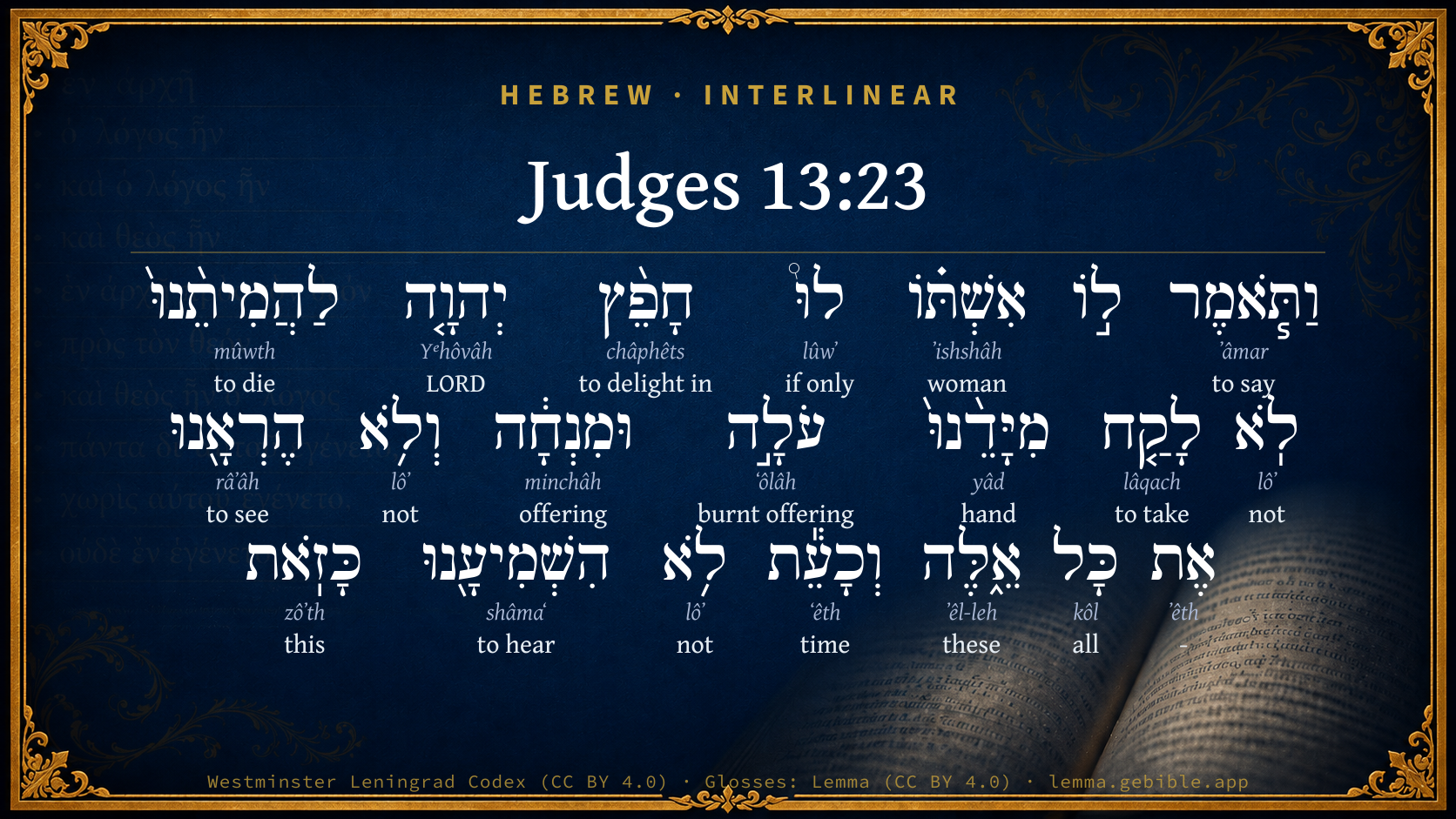
Hebrew (Westminster Leningrad Codex) Judges 13:23 appears in the Hebrew Old Testament. The text above is from the Westminster Leningrad Codex. Each word links to its Strong’s number, a concise gloss, and parsing drawn from the Open Scriptures Hebrew Bible morphology. Click any word for its full Brown-Driver-Briggs (BDB) entry.
Download image
Cite this verse

Judges 13:23 (World English Bible). Public Domain. Lemma interlinear Bible study tool, https://lemma.gebible.app/v/judges/13/23.

Show BibTeX & RIS
BibTeX
RIS
English Translation
But his wife said to him, If Yahweh were pleased to kill us, he wouldn't have received a burnt offering and a meal-offering at our hand, neither would he have shown us all these things, nor would at this time have told such things as these.
World English Bible · Public Domain
Download a study sheet

One document with this verse’s original text, its word-by-word gloss line, the meaning frame, cross-references with their text, attributed commentary, and full source and license credits — printable, and it pastes into notes with its structure intact.

This verse Autodidact and up

Study sheet (.html) Plain text (.txt)

A passage Seminary Student

Up to 50 verses in one chapter. A passage sheet keeps up to 6 commentary sources and 12 cross-references per verse, in the order this page ranks them, and says so on the sheet whenever that leaves anything out. Ask for a single verse and you get the Autodidact verse sheet above.

Everything on this page stays free to read, with no account — the sheet is a download of what is already on screen, not access to it.

Want to remove ads? Support Godless Engineer
Compare translations 3

The same verse in 3 English versions, stacked beneath the original-language interlinear above. Click any original word for its lexicon entry.

Each is an independent rendering of the whole verse — the interlinear is not word-aligned to these translations.

Highlighted words mark where these versions differ — a whole-verse word diff, not a word-by-word alignment.

  • World English Bible Public Domain
    But his wife said to him, If Yahweh were pleased to kill us, he wouldn't have received a burnt offering and a meal-offering at our hand, neither would he have shown us all these things, nor would at this time have told such things as these.
  • King James Version Public Domain
    But his wife said unto him, If the LORD were pleased to kill us, he would not have received a burnt offering and a meat offering at our hands, neither would he have showed us all these things, nor would as at this time have told us such things as these.
  • unfoldingWord Literal Text CC BY-SA 4.0
    But his wife said to him, “If Yahweh desired to kill us, he would not have taken from our hand a burnt offering and a grain offering, and he would not have shown us all these, and at time he would not have made us hear like this.”

unfoldingWord Literal Text — © unfoldingWord, licensed CC BY-SA 4.0. Word-aligned USFM3 via Door43 (git.door43.org/unfoldingWord/en_ult).

Versions to compare (up to 4)

3 of 4 selected

Show all 18 translations

Every available English version of this verse, each an independent rendering of the whole verse.

  • World English Bible Public Domain
    But his wife said to him, If Yahweh were pleased to kill us, he wouldn't have received a burnt offering and a meal-offering at our hand, neither would he have shown us all these things, nor would at this time have told such things as these.
  • Berean Standard Bible Public Domain
    But his wife replied, “If the LORD had intended to kill us, He would not have accepted the burnt offering and the grain offering from our hands, nor would He have shown us all these things or spoken to us this way.”
  • Majority Standard Bible Public Domain
    But his wife replied, “If the LORD had intended to kill us, He would not have accepted the burnt offering and the grain offering from our hands, nor would He have shown us all these things or spoken to us this way.”
  • King James Version Public Domain
    But his wife said unto him, If the LORD were pleased to kill us, he would not have received a burnt offering and a meat offering at our hands, neither would he have showed us all these things, nor would as at this time have told us such things as these.
  • American Standard Version (1901) Public Domain
    But his wife said unto him, If Jehovah were pleased to kill us, he would not have received a burnt-offering and a meal-offering at our hand, neither would he have showed us all these things, nor would at this time have told such things as these.
  • Revised Version (1885) Public Domain
    But his wife said unto him, If the LORD were pleased to kill us, he would not have received a burnt offering and a meal offering at our hand, neither would he have shewed us all these things, nor would at this time have told us such things as these.
  • Geneva Bible (1599) Public Domain
    But his wife saide vnto him, If the Lord woulde kill vs, he woulde not haue receiued a burnt offring, and a meate offring of our hands, neither would he haue shewed vs all these things, nor would now haue tolde vs any such.
  • Douay-Rheims (1899) Public Domain
    And his wife answered him: If the Lord had a mind to kill us, he would not have received a holocaust and libations at our hands, neither would he have shewed us all these things, nor have told us the things that are to come.
  • Young's Literal Translation Public Domain
    And his wife saith to him, `If Jehovah were desirous to put us to death, He had not received from our hands burnt-offering and present, nor shewed us all these things, nor as `at this' time caused us to hear `anything' like this.'
  • Literal Standard Version CC BY-SA 4.0
    And his wife says to him, “If YHWH were desirous to put us to death, He had not received burnt-offering and present from our hands, nor showed us all these things, nor caused us to hear [anything] like this as [at this] time.”
  • Unlocked Literal Bible CC BY-SA 4.0
    But his wife said to him, “If Yahweh wanted to kill us, he would not have received the burnt offering and the grain offering we gave him. He would not have shown us all these things, nor at this time would he have let us hear such things.”
  • unfoldingWord Literal Text CC BY-SA 4.0
    But his wife said to him, “If Yahweh desired to kill us, he would not have taken from our hand a burnt offering and a grain offering, and he would not have shown us all these, and at time he would not have made us hear like this.”
  • Darby Bible Public Domain
    But his wife said to him, "If the LORD had meant to kill us, he would not have accepted a burnt offering and a cereal offering at our hands, or shown us all these things, or now announced to us such things as these."
  • World Messianic Bible Public Domain
    But his wife said to him, “If the LORD were pleased to kill us, he wouldn’t have received a burnt offering and a meal offering at our hand, and he wouldn’t have shown us all these things, nor would he have told us such things as these at this time.”
  • Webster's Bible Public Domain
    But his wife said to him, If the LORD were pleased to kill us, he would not have received a burnt-offering and a meat-offering at our hands, neither would he have showed us all these things, nor would, as at this time, have told us such things as these.
  • Free Bible Version CC BY-SA 4.0
    But his wife replied, “If the Lord had wanted to kill us he wouldn't have accepted our burnt offering and grain offering. He wouldn't have shown us all these things, and he wouldn't have come now and announced this to us.”
  • Bible in Basic English Public Domain
    But his wife said to him, If the Lord was purposing our death, he would not have taken our burned offering and our meal offering, or have given us such orders about the child.
  • JPS Tanakh (1917) Public Domain
    But his wife said unto him: 'If the LORD were pleased to kill us, He would not have received a burnt-offering and a meal-offering at our hand, neither would He have shown us all these things, nor would at this time have told such things as these.'

Literal Standard Version (2020), Covenant Press — licensed CC BY-SA 4.0. Text via the HelloAO Bible API (eBible.org). Unlocked Literal Bible (unfoldingWord) — licensed CC BY-SA 4.0. Text via the HelloAO Bible API (eBible.org). unfoldingWord Literal Text — © unfoldingWord, licensed CC BY-SA 4.0. Word-aligned USFM3 via Door43 (git.door43.org/unfoldingWord/en_ult). Free Bible Version, Dr. Jonathan Gallagher — licensed CC BY-SA 4.0. Text via the HelloAO Bible API (eBible.org).

Word by word

More ways to search: Search by grammar → Find every occurrence → Compare this word →

Practice this passage: Drill this verse → Learn its vocabulary →

לוּ֩
lûwʼ
H3863
“if only”
Conjunction
Part of Speech
Conjunction
Full BDB Definition

Origin: a conditional particle

TWOT: 1085

if, oh that!, if only! - if (unlikely condition) - if only!, oh that!, would that!
  1. וַתֹּ֧אמֶר ʼâmar H559 “and · to say” Conjunction + Verb, Qal, Sequential Imperfect, 3rd Person, Feminine, Singular
  2. אִשְׁתּ֗וֹ ʼishshâh H802 “woman · his” Noun, Common, Feminine, Singular, Construct + Suffix, Personal, 3rd Person, Masculine, Singular
  3. חָפֵ֨ץ châphêts H2654 “to delight in” Verb, Qal, Perfect, 3rd Person, Masculine, Singular
  4. יְהוָ֤ה Yᵉhôvâh H3068 “LORD” Noun, Proper
  5. לַהֲמִיתֵ֨נוּ֙ mûwth H4191 “to die · us” Preposition + Verb, Hiphil, Infinitive Construct + Suffix, Personal, 1st Person, Common, Plural
  6. לֹֽא lôʼ H3808 “not” Particle, Negative
  7. לָקַ֤ח lâqach H3947 “to take” Verb, Qal, Perfect, 3rd Person, Masculine, Singular
  8. מִיָּדֵ֨נוּ֙ yâd H3027 “from · hand · our” Preposition + Noun, Common, Both, Singular, Construct + Suffix, Personal, 1st Person, Common, Plural
  9. עֹלָ֣ה ʻôlâh H5930 “burnt offering” Noun, Common, Feminine, Singular, Absolute
  10. וּמִנְחָ֔ה minchâh H4503 “and · offering” Conjunction + Noun, Common, Feminine, Singular, Absolute
  11. וְלֹ֥א lôʼ H3808 “and · not” Conjunction + Particle, Negative
  12. הֶרְאָ֖נוּ râʼâh H7200 “to see” Verb, Hiphil, Perfect, 3rd Person, Masculine, Singular + Pronoun, Personal, 1st Person, Common, Plural
  13. אֶת ʼêth H853 “-” Particle, Direct Object
  14. כָּל kôl H3605 “all of” Noun, Common, Masculine, Singular, Construct
  15. אֵ֑לֶּה ʼêl-leh H428 “these” Pronoun, Demonstrative, Common, Plural
  16. וְכָעֵ֕ת ʻêth H6256 “and · like/as the · time” Conjunction + Preposition, Determined + Noun, Common, Both, Singular, Absolute
  17. לֹ֥א lôʼ H3808 “not” Particle, Negative
  18. הִשְׁמִיעָ֖נוּ shâmaʻ H8085 “to hear · us” Verb, Hiphil, Perfect, 3rd Person, Masculine, Singular + Suffix, Personal, 1st Person, Common, Plural
  19. כָּזֹֽאת zôʼth H2063 “like/as · this” Preposition + Pronoun, Demonstrative, Feminine, Singular

About this verse

These counts appear in no published source. They are computed here, from the morphology-tagged text and Lemma’s own curated glosses. What Lemma adds →

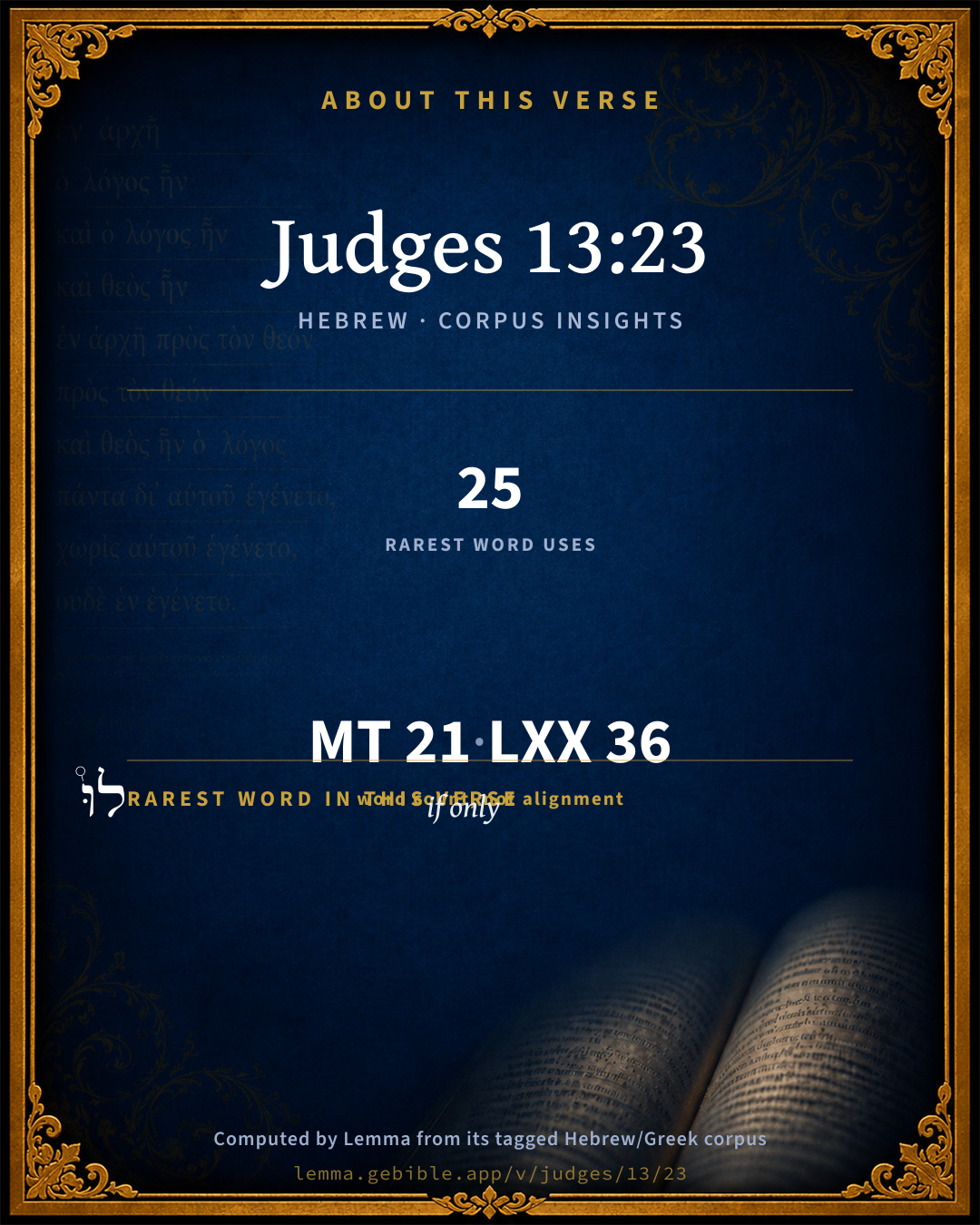
21
words
18
distinct lemmas
Historical
section

Notable vocabulary

The rarest word here is לוּ֩ if only H3863 — appearing just 25 times in the whole Hebrew Bible.

Shared distinctive vocabulary

לוּ֩ if only H3863 occurs in 22 verses of the Hebrew Bible. Also found in:

Grammatical profile

  • 5 verbs
  • 7 nouns
  • 3 pronouns
  • 1 preposition
  • 1 conjunction
  • 4 particles

Verb forms

  • וַתֹּ֧אמֶר Qal · Sequential Imperfect
  • חָפֵ֨ץ Qal · Perfect
  • לַהֲמִיתֵ֨נוּ֙ Hiphil · Infinitive Construct
  • לָקַ֤ח Qal · Perfect
  • הֶרְאָ֖נוּ Hiphil · Perfect
  • הִשְׁמִיעָ֖נוּ Hiphil · Perfect

Repetition

A word recurs within this verse — often emphatic in Hebrew:

Hebrew & Septuagint length

In English translation the verse runs 46 words from the Hebrew and 50 from the Septuagint (LXX English) — closely comparable.

A rough comparison of the two English renderings, which tokenize alike — not a word-level alignment.

Word counts can differ between the Hebrew and the Greek without any difference in meaning — e.g. the Hebrew direct-object marker אֵת has no separate Greek word, and Greek often adds the article ὁ.

In the original languages it is 21 Hebrew tokens and 36 Greek tokens — but the two are counted differently (Hebrew bundles its prefixes and suffixes into one token; the Greek is in lemma form), so that isn’t a like-for-like length.

Cross-references

10

Topical passages linked to Judges 13:23 in the Treasury of Scripture Knowledge — connected by theme and wording, ordered by reader-vote popularity; previews shown in the World English Bible.

  • Psalms 25:14 The friendship of Yahweh is with those who fear him. He will show them his covenant.
  • 1 Corinthians 12:21 The eye can't tell the hand, "I have no need for you," or again the head to the feet, "I have no need for you."
  • Psalms 86:17 Show me a sign of your goodness, That those who hate me may see it, and be shamed, Because you, Yahweh, have helped me, and comforted me.
  • John 14:20 In that day you will know that I am in my Father, and you in me, and I in you.
  • John 15:15 No longer do I call you servants, for the servant doesn't know what his lord does. But I have called you friends, for everything that I heard from my Father, I have made known to you.
  • Proverbs 3:32 For the perverse is an abomination to Yahweh, But his friendship is with the upright.
  • Ecclesiastes 4:9–10 Two are better than one, because they have a good reward for their labor.
  • Genesis 4:4–5 Abel also brought some of the firstborn of his flock and of the fat of it. Yahweh respected Abel and his offering,
  • Psalms 27:13 I am still confident of this: I will see the goodness of Yahweh in the land of the living.
  • John 14:23 Jesus answered him, "If a man loves me, he will keep my word. My Father will love him, and we will come to him, and make our home with him.

Cross-references courtesy of OpenBible.info (CC BY 4.0).

Hebrew and Greek witnesses Masoretic Hebrew ↔ Greek Septuagint

The same verse in the two great witnesses to the Old Testament, shown verse-for-verse.

These are two independent witnesses, not word-aligned to each other, and the Septuagint is shown in lemma (dictionary) form.

Hebrew Judges 13:23 Masoretic · Westminster Leningrad Codex

וַתֹּ֧אמֶר ל֣וֹ אִשְׁתּ֗וֹ לוּ֩ חָפֵ֨ץ יְהוָ֤ה לַהֲמִיתֵ֨נוּ֙ לֹֽא לָקַ֤ח מִיָּדֵ֨נוּ֙ עֹלָ֣ה וּמִנְחָ֔ה וְלֹ֥א הֶרְאָ֖נוּ אֶת כָּל אֵ֑לֶּה וְכָעֵ֕ת לֹ֥א הִשְׁמִיעָ֖נוּ כָּזֹֽאת

But his wife said to him, If Yahweh were pleased to kill us, he wouldn't have received a burnt offering and a meal-offering at our hand, neither would he have shown us all these things, nor would at this time have told such things as these.

World English Bible · Public Domain

Greek LXX Judges 13:23 Septuagint · lemma form

καί εἶπον αὐτός ὁ γυνή αὐτός εἰ θέλω ὁ κύριος θανατόω ἐγώ οὐ ἄν λαμβάνω ἐκ χείρ ἐγώ ὁλοκαύτωμα καί θυσία καί οὐ ἄν δεικνύω ἐγώ οὗτος πᾶς καί καθώς καιρός οὐ ἄν ἀκουτίζω ἐγώ οὗτος

But his wife said to him, If the Lord were pleased to kill us, he would not have received of our hand a whole burnt offering and a meat-offering; and he would not have shown us all these things, neither would he have caused us to hear all these things

LXX2012 (modern English Septuagint) · Public Domain

Hebrew: Westminster Leningrad Codex (CC BY 4.0). Greek: Septuagint (public domain); English from LXX2012 (modern English Septuagint) (Public Domain). How the Septuagint differs from the Hebrew →

Targum (Aramaic paraphrase)

1

The Targum is the ancient Jewish Aramaic paraphrase of the Hebrew Scriptures — an interpretive translation, not the Hebrew text itself. Onkelos (literal) and Pseudo-Jonathan (expansive) render the Torah, and Jonathan the Prophets. Coverage is partial: where no permissively-licensed English translation exists for a verse, only the Aramaic is shown. This is verse-level text, not a word-by-word alignment to the Hebrew.

  1. Targum Jonathan Prophets (Joshua–Malachi)
    וַאֲמַרַת לֵיהּ אִתְּתֵיהּ אִלוּ רַעֲוָא קֳדָם יְיָ דִנְמוּת לָא קַבֵּיל מִנָנָא עֲלָתָא וּמִנְחָתָא וְלָא אַחֲזִינָנָא יַת כָּל אִלֵין וּכְעִידַן פּוֹן לָא אַשְׁמְעִינָנָא כַּהֲדָא:

    (no public-domain English translation for this verse)

    Targum Jonathan — Aramaic: “Mikraot Gedolot” (public domain). English: “Sefaria Community Translation” (CC0 1.0 (public-domain dedication)); “London "Chaldee Paraphrase," 1871” (public domain). Text via Sefaria.

Commentary

Notes on Judges 13:23 from classic Christian and Jewish commentators (each source and its license shown beneath its notes). The classic Christian expositions comment on the surrounding passage and are grouped to its opening verse, so a note may address several verses; the Jewish commentaries on the Tanakh (Rashi and others) are per-verse, so they appear only where the commentator wrote on this verse.

Lemma curates 59 commentaries, every one of them public domain or Creative Commons licensed, each selected and text-cleaned for this edition rather than reprinted as found. About our sources →

Trapp's Complete Commentary

John Trapp

Jdg 13:23 But his wife said unto him, If the LORD were pleased to kill us, he would not have received a burnt offering and a meat offering at our hands, neither would he have shewed us all these [things], nor would as at this time have told us [such things] as these.

Ver. 23. But his wife said unto him.] She, it seemeth, had the stronger faith; and her arguments were in readiness to cheer up her fainting husband. The like, in likelihood, did Priscilla for her Aquila, when for St Paul’s life they laid down their own necks: wherefore also she hath the first salutation. {Rom 16:3-4} Sure it is that Helen Stirk, a Scotch martyr, suffering together with her husband for the cause of Christ, thus bespake him at the place of execution: Husband, rejoice; for we have lived together many joyful days; but this day, wherein we must die together, ought to be most joyful to us both, because we must have joy for ever: therefore I will not bid you good night, for we shall suddenly meet within the kingdom of heaven. {a}

{a} Act. and Mon., 1154.

John Trapp, A Commentary or Exposition upon All the Books of the Old and New Testament (1647–1656) — public domain. Text from a community e-Sword module.

Joseph Benson's Commentary

Jdg 13:23. If the Lord were pleased to kill us — The reasoning of Manoah’s wife here is very just, and shows her to have been a woman of good understanding. Indeed, both of them seem to have been persons of eminent piety, who, amidst the prevailing corruption and idolatry of their people, retained their integrity, and adhered to the worship and service of the true God. And of such God is always mindful, both bestowing peculiar favours upon them, and communicating blessings to his church, and to the world, through their means. Nor would, as at this time, have told us such things — This expression seems to have some emphasis in it, to enhance God’s mercy to them, as being afforded them in a time of such grievous calamity; and in a time when the word of the Lord was precious, and there was no open vision.

Joseph Benson's Commentary on the Old and New Testaments (1811–1818) — public domain. Text from a community e-Sword module.

Geneva Bible (1599)

Geneva Bible translators

These graces that we have received of God, and his accepting of our obedience, are sure tokens of his love toward us, so that nothing can hurt us.

Geneva Bible (1599) marginal notes — public domain. Text via Bolls.life.

Adam Clarke's Commentary

Verse 23. If the Lord were pleased to kill us, c.] This is excellent reasoning, and may be of great use to every truly religious mind, in cloudy and dark dispensations of Divine Providence. It is not likely that God, who has preserved thee so long, borne with thee so long, and fed and supported thee all thy life long, girding thee when thou knewest him not, is less willing to save and provide for thee and thine now than he was when, probably, thou trustedst less in him. He who freely gave his Son to redeem thee, can never be indifferent to thy welfare and if he give thee power to pray to and trust in him, is it at all likely that he is now seeking an occasion against thee, in order to destroy thee? Add to this the very light that shows thee thy wretchedness, ingratitude, and disobedience, is in itself a proof that he is waiting to be gracious to thee; and the penitential pangs thou feelest, and thy bitter regret for thy unfaithfulness, argue that the light and fire are of God's own kindling, and are sent to direct and refine, not to drive thee out of the way and destroy thee. Nor would he have told thee such things of his love, mercy, and kindness, and unwillingness to destroy sinners, as he has told thee in his sacred word, if he had been determined not to extend his mercy to thee.

Adam Clarke's Commentary on the Bible (1810–1826) — public domain. Text from a community e-Sword/MySword module.

The Cambridge Bible for Schools and Colleges

gen. ed. J. J. S. Perowne

23. at this time] lit. at (about) the time, an unusual expression, rendered now in Jdg_21:22, Num_23:23; cf. at (about) the day = now 1Sa_9:27, 1Ki_22:5.

The Cambridge Bible for Schools and Colleges (gen. ed. J. J. S. Perowne; Cambridge University Press, 1878–1918) — public domain. Text from a community e-Sword module.

John Gill's Exposition

But his wife said unto him,.... Who was less fearful, and the strongest believer of the two, seeing her husband so very much intimidated, endeavoured to comfort and strengthen him by the three following arguments:

if the Lord was pleased to kill us, he would not have received a burnt offering and a meat offering at our hands; for it was at the direction of this illustrious Person that they offered these offerings, and who testified the divine acceptance of them, by causing fire in an extraordinary manner to consume them, which was always reckoned a token of God's acceptance of them; and besides, the angel went up in the flame, as being well pleased with them, and, as it were, carrying up the sacrifice to heaven with him, as a sweetsmelling savour to God. Here the angel is called Jehovah by the woman, and shows this was the uncreated angel:

neither would he have showed us all these things; which they saw as the appearance of a divine Person to them in an human form, the consuming of the sacrifice by fire in so strange a manner, and the ascent of the angel heavenwards in the flame of it:

nor would, as at this time, have told us such things as these; as that they should have a son; how the woman was to manage herself, while with child of him; and how when born he was to be brought up, and what things God would do by him, and begin to deliver Israel out of the hand of the Philistines. Now all this would not have been told at such a time of distress, as the nation was now in, but to comfort them, or he would never have told them of a son to be born of them, if they were to be destroyed immediately. So an enlightened soul may reason from the sight and sense he has had of his sinful, lost, and undone state by nature; from the revelation of Christ to him as the only way of salvation; from the views he has had of the glories of his person, and the riches of his grace; and from that communion with God he has sometimes enjoyed; from all this he may reason, that if God had a design to damn him for his sins, he would never have made such discoveries of love, grace, and mercy to him; as well as from the sacrifice of Christ, God has provided and accepted of, on the foot of which justice is engaged to save; and besides, grace and glory are inseparable.

John Gill's Exposition of the Whole Bible (1746–1763) — public domain (CC PDM 1.0). Text via the HelloAO Bible API.

Haydock's Catholic Bible Commentary

Come. The wife of Manue allays his fears with great prudence, as she observes that God had just promised them a son. (Haydock)

George Leo Haydock (1774–1849), Haydock's Catholic Family Bible and Commentary, 1859 edition — public domain. Excludes Psalms (Douay-Rheims chapter numbering differs from Protestant) and Deuterocanonical books (Catholic canon only).

Matthew Poole's English Annotations

Or,

at this time; the particle as noting here, not likeness, but the truth and reality of the thing, as it doth Num 11:1; Deu 9:10, and elsewhere. This expression seems to have some emphasis in it, to enhance God’s mercy to them, as being afforded them in a time of such public and grievous calamity; and in a time when the word of the Lord was precious, and there was no open vision, as it was afterwards, 1Sa 3:1.

Matthew Poole's English Annotations on the Holy Bible (1683–1685) — public domain. Text from a community e-Sword/MySword module.

Whedon's Commentary on the Bible

Daniel D. Whedon

23. If the Lord were pleased to kill us — Reason and faith united, in the heart of the wife develop into a noble and devout trust, and triumph over the fears and trembling of the husband. The essential element of her faith and reason was identical with that which led the apostle to write: “He that spared not his own Son, but delivered him up for us all, how shall he not with him also freely give us all things?” Rom_8:32.

Daniel D. Whedon (gen. ed.), Commentary on the Old and New Testaments (1874–1909) — public domain. Text from a community e-Sword module.

The Pulpit Commentary

But his wife said, etc. The woman"s faith saw more clearly than the man"s fear. With the acceptance of the sacrifice the conscience was cleared from guilt. The ascent of the angel in the flame of the altar was to her the same evidence of an accepted sacrifice as the resurrection and ascension of the Lord Jesus are to us.

The Pulpit Commentary (1880–1919), ed. H.D.M. Spence-Jones & Joseph S. Exell — public domain. Text from a community e-Sword module.

John Wesley's Explanatory Notes

Nor would, &c. - This expression seems to have some emphasis in it, to enhance God's mercy to them, as being afforded them in a time of such grievous calamity; and in a time when the word of the Lord was precious; and there was no open vision.

John Wesley, Explanatory Notes Upon the Whole Bible (1754–1765) — public domain. Text via the GEBible commentary corpus.

unfoldingWord translationNotes

Door43 World Missions Community

He would not have shown us all these things, nor at this time would he have let us hear such things

Manoah's wife said basically the same thing twice for emphasis. These two statements can be combined. AT: "He would not have told us what he wanted us to do" (See: Parallelism)

translationWords

Yahweh

receive

burnt offering

grain offering

unfoldingWord translationNotes — © Distant Shores Media and the Door43 World Missions Community, licensed CC BY-SA 4.0. Source: git.door43.org/Door43/en_tn.

Rashi

Rabbi Shlomo Yitzchaki (Rashi)

At this time [lit. at the time]. At this time.

He would not have apprised us in this way. He would not have apprised us of these tidings if we deserved to die.

Rashi on the Tanakh — English translations: “The Judaica Press complete Tanach with Rashi, translated by A. J. Rosenberg” (CC BY 4.0); “Pentateuch with Rashi's commentary by M. Rosenbaum and A.M. Silbermann, 1929-1934” (public domain); “The Metsudah Tanach series, Lakewood, N.J” (CC BY 4.0); and “The Book of Joshua, Metsudah Publications, 1997” (CC BY 4.0). Text via Sefaria.

Lesson kit

Teaching starters — assembled from the data on this page, not authored interpretation. Every prompt links to the verse data it draws on. Edit before teaching.

Judges, in the Historical, opens this verse with 21 words (18 distinct Hebrew lemmas). Its most distinctive word is lûwʼ (“if only”). A historical commentator’s framing appears above. Read the whole chapter for the surrounding context.

Discussion questions

  1. The word lûwʼ carries the sense “if only.” How does it shape the verse?
  2. How does Genesis 17:18, which shares the word «if only», read alongside this verse?
  3. What does the repetition of “not” (3× in this one verse) do in this verse?
  4. The translations on this page render this verse differently — a whole-verse word diff, not a word-by-word alignment. What might account for the different wordings?
  5. «וַתֹּ֧אמֶר» is a Qal Sequential Imperfect verb. How does that grammatical form shape the action described?
  6. Compare how Trapp's Complete Commentary and Joseph Benson's Commentary read this verse. Where do they agree or differ?

Things to notice

Reading settings

Reading text

Shown beneath each verse's original-language words.

Old Testament
Old Testament edition

Read the OT as the Masoretic Hebrew (MT) or the Greek Septuagint (LXX).

English shown for the Greek Septuagint (in the Hebrew ↔ Greek comparison).

Comparing translations? Open the Compare panel on any verse page to stack up to four side by side.