
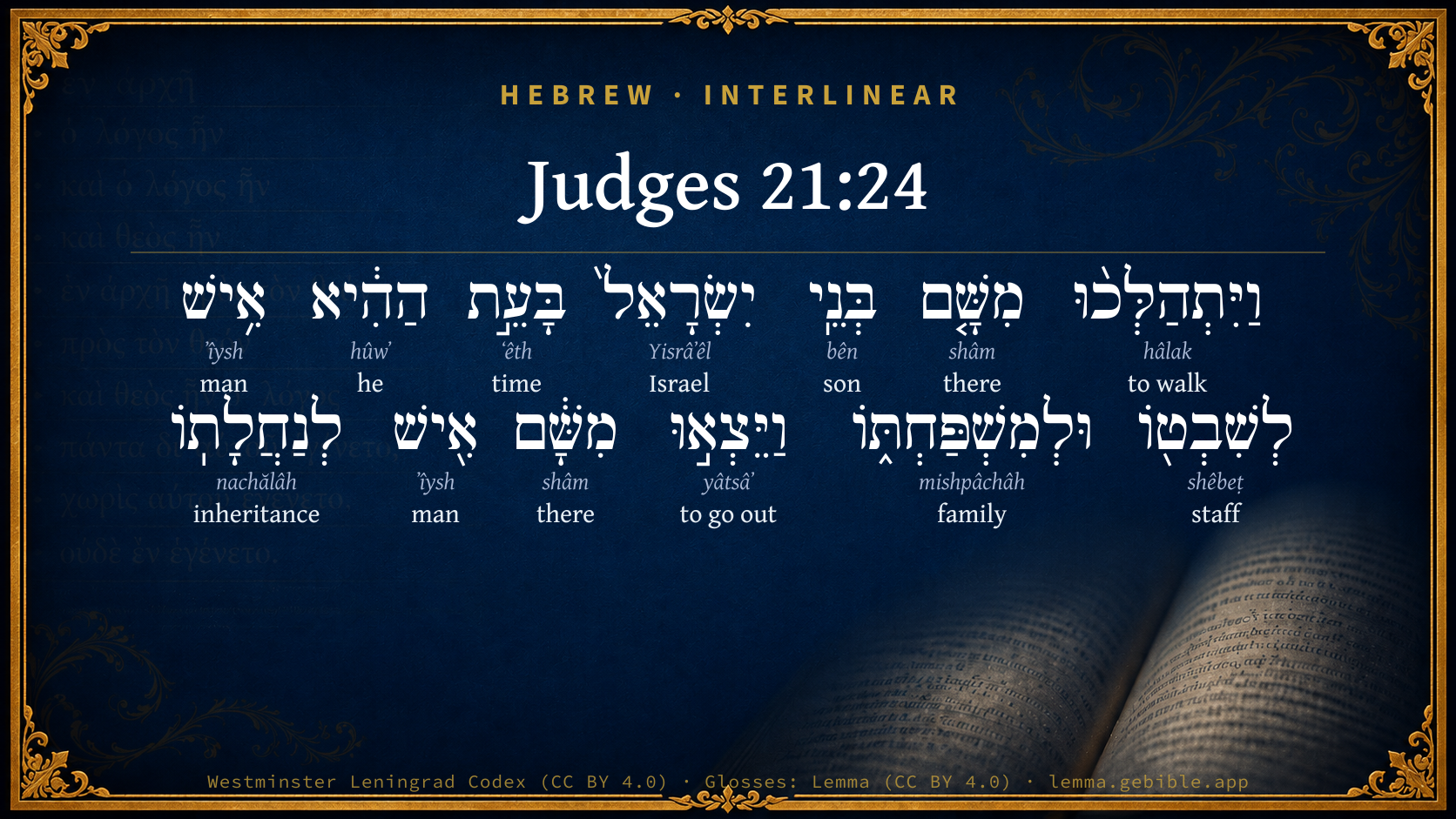
Judges 21:24

Hebrew (Westminster Leningrad Codex) Judges 21:24 appears in the Hebrew Old Testament. The text above is from the Westminster Leningrad Codex. Each word links to its Strong’s number, a concise gloss, and parsing drawn from the Open Scriptures Hebrew Bible morphology. Click any word for its full Brown-Driver-Briggs (BDB) entry.
Download image
Cite this verse

Judges 21:24 (World English Bible). Public Domain. Lemma interlinear Bible study tool, https://lemma.gebible.app/v/judges/21/24.

Show BibTeX & RIS
BibTeX
RIS
English Translation
The children of Israel departed there at that time, every man to his tribe and to his family, and they went out from there every man to his inheritance.
World English Bible · Public Domain
Download a study sheet

One document with this verse’s original text, its word-by-word gloss line, the meaning frame, cross-references with their text, attributed commentary, and full source and license credits — printable, and it pastes into notes with its structure intact.

This verse Autodidact and up

Study sheet (.html) Plain text (.txt)

A passage Seminary Student

Up to 50 verses in one chapter. A passage sheet keeps up to 6 commentary sources and 12 cross-references per verse, in the order this page ranks them, and says so on the sheet whenever that leaves anything out. Ask for a single verse and you get the Autodidact verse sheet above.

Everything on this page stays free to read, with no account — the sheet is a download of what is already on screen, not access to it.

Want to remove ads? Support Godless Engineer
Compare translations 3

The same verse in 3 English versions, stacked beneath the original-language interlinear above. Click any original word for its lexicon entry.

Each is an independent rendering of the whole verse — the interlinear is not word-aligned to these translations.

Highlighted words mark where these versions differ — a whole-verse word diff, not a word-by-word alignment.

  • World English Bible Public Domain
    The children of Israel departed there at that time, every man to his tribe and to his family, and they went out from there every man to his inheritance.
  • King James Version Public Domain
    And the children of Israel departed thence at that time, every man to his tribe and to his family, and they went out from thence every man to his inheritance.
  • unfoldingWord Literal Text CC BY-SA 4.0
    Then the sons of Israel disbursed themselves from there at that time, a man to his tribe and to his clan, and they went away from there, a man to his inheritance.

unfoldingWord Literal Text — © unfoldingWord, licensed CC BY-SA 4.0. Word-aligned USFM3 via Door43 (git.door43.org/unfoldingWord/en_ult).

Versions to compare (up to 4)

3 of 4 selected

Show all 18 translations

Every available English version of this verse, each an independent rendering of the whole verse.

  • World English Bible Public Domain
    The children of Israel departed there at that time, every man to his tribe and to his family, and they went out from there every man to his inheritance.
  • Berean Standard Bible Public Domain
    And at that time, each of the Israelites returned from there to his own tribe and clan, each to his own inheritance.
  • Majority Standard Bible Public Domain
    And at that time, each of the Israelites returned from there to his own tribe and clan, each to his own inheritance.
  • King James Version Public Domain
    And the children of Israel departed thence at that time, every man to his tribe and to his family, and they went out from thence every man to his inheritance.
  • American Standard Version (1901) Public Domain
    And the children of Israel departed thence at that time, every man to his tribe and to his family, and they went out from thence every man to his inheritance.
  • Revised Version (1885) Public Domain
    And the children of Israel departed thence at that time, every man to his tribe and to his family, and they went out from thence every man to his inheritance.
  • Geneva Bible (1599) Public Domain
    So the children of Israel departed thence at that time, euery man to his tribe, and to his familie, and went out from thence euery man to his inheritance.
  • Douay-Rheims (1899) Public Domain
    The children of Israel also returned by their tribes, and families, to their dwellings. In those days there was no king in Israel: but every one did that which seemed right to himself.
  • Young's Literal Translation Public Domain
    And the sons of Israel go up and down thence at that time, each to his tribe, and to his family; and they go out thence each to his inheritance.
  • Literal Standard Version CC BY-SA 4.0
    And the sons of Israel go up and down there at that time, each to his tribe, and to his family; and they each go out there to his inheritance.
  • Unlocked Literal Bible CC BY-SA 4.0
    Then the people of Israel left that place and went home, each one to his own tribe and clan, and each one to his own inheritance.
  • unfoldingWord Literal Text CC BY-SA 4.0
    Then the sons of Israel disbursed themselves from there at that time, a man to his tribe and to his clan, and they went away from there, a man to his inheritance.
  • Darby Bible Public Domain
    And the people of Israel departed from there at that time, every man to his tribe and family, and they went out from there every man to his inheritance.
  • World Messianic Bible Public Domain
    The children of Israel departed from there at that time, every man to his tribe and to his family, and they each went out from there to his own inheritance.
  • Webster's Bible Public Domain
    And the children of Israel departed thence at that time, every man to his tribe and to his family, and they went from thence every man to his inheritance.
  • Free Bible Version CC BY-SA 4.0
    Then the Israelites left and went home to their tribes and families, each one going to the land they owned.
  • Bible in Basic English Public Domain
    Then the children of Israel went away from there, every man to his tribe and his family, every man went back to his heritage.
  • JPS Tanakh (1917) Public Domain
    And the children of Israel departed thence at that time, every man to his tribe and to his family, and they went out from thence every man to his inheritance.

Literal Standard Version (2020), Covenant Press — licensed CC BY-SA 4.0. Text via the HelloAO Bible API (eBible.org). Unlocked Literal Bible (unfoldingWord) — licensed CC BY-SA 4.0. Text via the HelloAO Bible API (eBible.org). unfoldingWord Literal Text — © unfoldingWord, licensed CC BY-SA 4.0. Word-aligned USFM3 via Door43 (git.door43.org/unfoldingWord/en_ult). Free Bible Version, Dr. Jonathan Gallagher — licensed CC BY-SA 4.0. Text via the HelloAO Bible API (eBible.org).

Word by word

More ways to search: Search by grammar → Find every occurrence → Compare this word →

Practice this passage: Drill this verse → Learn its vocabulary →

לְשִׁבְט֖וֹ
shêbeṭ
H7626
“to/for · staff · his”
Preposition + Noun, Common, Masculine, Singular, Construct + Suffix, Personal, 3rd Person, Masculine, Singular
Part of Speech
Preposition + Noun
Type
Common
Gender
Masculine
Number
Singular
State
Construct
Full BDB Definition

Origin: from an unused root probably meaning to branch off

TWOT: 2314a

rod, staff, branch, offshoot, club, sceptre, tribe - rod, staff - shaft (of spear, dart) - club (of shepherd's implement) - truncheon, sceptre (mark of authority) - clan, tribe
  1. וַיִּתְהַלְּכ֨וּ hâlak H1980 “and · to walk” Conjunction + Verb, Hithpael, Sequential Imperfect, 3rd Person, Masculine, Plural
  2. מִשָּׁ֤ם shâm H8033 “from · there” Preposition + Adverb
  3. בְּנֵֽי bên H1121 “sons of” Noun, Common, Masculine, Plural, Construct
  4. יִשְׂרָאֵל֙ Yisrâʼêl H3478 “Israel” Noun, Proper
  5. בָּעֵ֣ת ʻêth H6256 “in/at the · time” Preposition, Determined + Noun, Common, Both, Singular, Absolute
  6. הַהִ֔יא hûwʼ H1931 “the · he” Particle, Definite Article + Pronoun, Personal, 3rd Person, Feminine, Singular
  7. אִ֥ישׁ ʼîysh H376 “man” Noun, Common, Masculine, Singular, Absolute
  8. וּלְמִשְׁפַּחְתּ֑וֹ mishpâchâh H4940 “and · to/for · family · his” Conjunction + Preposition + Noun, Common, Feminine, Singular, Construct + Suffix, Personal, 3rd Person, Masculine, Singular
  9. וַיֵּצְא֣וּ yâtsâʼ H3318 “and · to go out” Conjunction + Verb, Qal, Sequential Imperfect, 3rd Person, Masculine, Plural
  10. מִשָּׁ֔ם shâm H8033 “from · there” Preposition + Adverb
  11. אִ֖ישׁ ʼîysh H376 “man” Noun, Common, Masculine, Singular, Absolute
  12. לְנַחֲלָתֽוֹ nachălâh H5159 “to/for · inheritance · his” Preposition + Noun, Common, Feminine, Singular, Construct + Suffix, Personal, 3rd Person, Masculine, Singular

About this verse

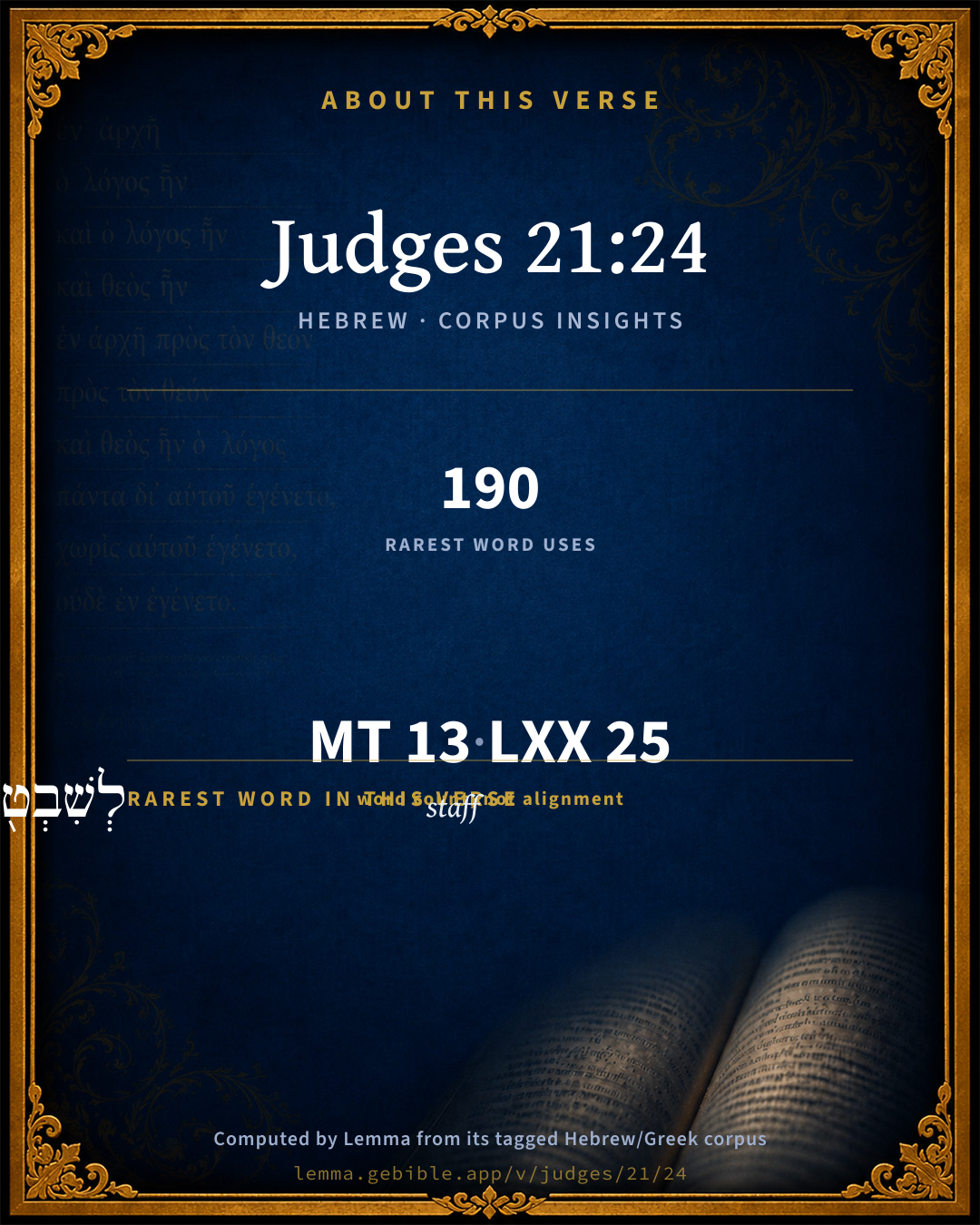
These counts appear in no published source. They are computed here, from the morphology-tagged text and Lemma’s own curated glosses. What Lemma adds →

13
words
11
distinct lemmas
Historical
section

Grammatical profile

  • 2 verbs
  • 8 nouns
  • 1 pronoun
  • 2 adverbs

Verb forms

  • וַיִּתְהַלְּכ֨וּ Hithpael · Sequential Imperfect
  • וַיֵּצְא֣וּ Qal · Sequential Imperfect

Repetition

Words recur within this verse — often emphatic in Hebrew:

  • מִשָּׁ֤ם there H8033 ×2
  • אִ֥ישׁ man H376 ×2

Hebrew & Septuagint length

In English translation the verse runs 29 words from the Hebrew and 27 from the Septuagint (LXX English) — closely comparable.

A rough comparison of the two English renderings, which tokenize alike — not a word-level alignment.

Word counts can differ between the Hebrew and the Greek without any difference in meaning — e.g. the Hebrew direct-object marker אֵת has no separate Greek word, and Greek often adds the article ὁ.

In the original languages it is 13 Hebrew tokens and 25 Greek tokens — but the two are counted differently (Hebrew bundles its prefixes and suffixes into one token; the Greek is in lemma form), so that isn’t a like-for-like length.

Hebrew and Greek witnesses Masoretic Hebrew ↔ Greek Septuagint

The same verse in the two great witnesses to the Old Testament, shown verse-for-verse.

These are two independent witnesses, not word-aligned to each other, and the Septuagint is shown in lemma (dictionary) form.

Hebrew Judges 21:24 Masoretic · Westminster Leningrad Codex

וַיִּתְהַלְּכ֨וּ מִשָּׁ֤ם בְּנֵֽי יִשְׂרָאֵל֙ בָּעֵ֣ת הַהִ֔יא אִ֥ישׁ לְשִׁבְט֖וֹ וּלְמִשְׁפַּחְתּ֑וֹ וַיֵּצְא֣וּ מִשָּׁ֔ם אִ֖ישׁ לְנַחֲלָתֽוֹ

The children of Israel departed there at that time, every man to his tribe and to his family, and they went out from there every man to his inheritance.

World English Bible · Public Domain

Greek LXX Judges 21:24 Septuagint · lemma form

καί περιπατέω ἐκεῖθεν ὁ υἱός ἰσραήλ ἐν ὁ καιρός ἐκεῖνος ἀνήρ εἰς φυλή αὐτός καί εἰς συγγένεια αὐτός καί ἐκἔρχομαι ἐκεῖθεν ἀνήρ εἰς κληρονομία αὐτός

And the children of Israel went thence at that time every man to his tribe and his kindred; and they went thence every man to his inheritance.

LXX2012 (modern English Septuagint) · Public Domain

Hebrew: Westminster Leningrad Codex (CC BY 4.0). Greek: Septuagint (public domain); English from LXX2012 (modern English Septuagint) (Public Domain). How the Septuagint differs from the Hebrew →

Targum (Aramaic paraphrase)

1

The Targum is the ancient Jewish Aramaic paraphrase of the Hebrew Scriptures — an interpretive translation, not the Hebrew text itself. Onkelos (literal) and Pseudo-Jonathan (expansive) render the Torah, and Jonathan the Prophets. Coverage is partial: where no permissively-licensed English translation exists for a verse, only the Aramaic is shown. This is verse-level text, not a word-by-word alignment to the Hebrew.

  1. Targum Jonathan Prophets (Joshua–Malachi)
    וְהַלִיכוּ מִתַּמָן בְּנֵי יִשְׂרָאֵל בְּעִידָנָא הַהִיא גְבַר לְשִׁבְטֵיהּ וּלְזַרְעִיתֵיהּ וּנְפַקוּ מִתַּמָן גְבַר לְאַחְסַנְתֵּיהּ:

    (no public-domain English translation for this verse)

    Targum Jonathan — Aramaic: “Mikraot Gedolot” (public domain). English: “Sefaria Community Translation” (CC0 1.0 (public-domain dedication)); “London "Chaldee Paraphrase," 1871” (public domain). Text via Sefaria.

Commentary

Notes on Judges 21:24 from classic Christian and Jewish commentators (each source and its license shown beneath its notes). The classic Christian expositions comment on the surrounding passage and are grouped to its opening verse, so a note may address several verses; the Jewish commentaries on the Tanakh (Rashi and others) are per-verse, so they appear only where the commentator wrote on this verse.

Lemma curates 59 commentaries, every one of them public domain or Creative Commons licensed, each selected and text-cleaned for this edition rather than reprinted as found. About our sources →

Trapp's Complete Commentary

John Trapp

Jdg 21:24 And the children of Israel departed thence at that time, every man to his tribe and to his family, and they went out from thence every man to his inheritance.

Ver. 24. And the children of Israel departed.] To their tribes by troops, to their families and several possessions man by man; but not without the loss of many a man lost in the war, and much lamented by their relations, who cried out

“ Omega nostrorum Mors est, Mars Alpha malorum. ”

John Trapp, A Commentary or Exposition upon All the Books of the Old and New Testament (1647–1656) — public domain. Text from a community e-Sword module.

Keil & Delitzsch

C. F. Keil & F. Delitzsch

In Jdg 21:24 and Jdg 21:25, the account of this event is brought to a close with a twofold remark: (1) that the children of Israel, i.e., the representatives of the congregation who were assembled at Shiloh, separated and returned every man into his inheritance to his tribe and family; (2) that at that time there was no king in Israel, and every man was accustomed to do what was right in his own eyes. Whether the fathers or brothers of the virgins who had been carried off brought any complaint before the congregation concerning the raid that had been committed, the writer does not state, simply because this was of no moment so far as the history was concerned, inasmuch as, according to Jdg 21:22, the complaint made no difference in the facts themselves.

(Note: "No doubt the fathers and brothers of the virgins demanded them both from the Benjaminites themselves, and also from the elders of Israel, or at any rate petitioned that the Benjaminites might be punished: but the elders replied as they had said that they should; and the persons concerned were satisfied with the answer, and so the affair was brought to a peaceable termination." - Seb. Schmidt.)

With the closing remark in Jdg 21:25, however, with which the account returns to its commencement in Jdg 19:1, the prophetic historian sums up his judgment upon the history in the words, "At that time every man did what was right in his own eyes, because there was no king in Israel," in which the idea is implied, that under the government of a king, who administered right and justice in the kingdom, such things could not possibly have happened. This not only refers to the conduct of the Israelites towards Benjamin in the war, the severity of which was not to be justified, but also to their conduct towards the inhabitants of Jabesh, as described in Jdg 21:5. The congregation had no doubt a perfect right, when all the people were summoned to deliberate upon important matters affecting the welfare of the whole nation, to utter the "great oath" against such as failed to appear, i.e., to threaten them with death and carry out this threat upon such as were obstinate; but such a punishment as this could only be justly inflicted upon persons who were really guilty, and had rebelled against the congregation as the supreme power, and could not be extended to women and children unless they had also committed a crime deserving of death. But even if there were peculiar circumstances in the case before us, which have been passed over by our author, who restricts himself simply to points bearing upon the main purpose of the history, but which rendered it necessary that the ban should be inflicted upon all the inhabitants of Jabesh, it was at any rate an arbitrary exemption to spare all the marriageable virgins, and one which could not be justified by the object contemplated, however laudable that object might be. This also applies to the oath taken by the people, that they would not give any of their daughters as wives to the Benjaminites, as well as to the advice given by the elders to the remaining two hundred, to carry off virgins from the festival at Shiloh. However just and laudable the moral indignation may have been, which was expressed in that oath by the nation generally at the scandalous crime of the Gibeites, a crime unparalleled in Israel, and at the favour shown to the culprits by the tribe of Benjamin, the oath itself was an act of rashness, in which there was not only an utter denial of brotherly love, but the bounds of justice were broken through. When the elders of the nation came to a better state of mind, they ought to have acknowledge their rashness openly, and freed themselves and the nation from an oath that had been taken in such sinful haste. "Wherefore they would have acted far more uprightly, if they had seriously confessed their fault and asked forgiveness of God, and given permission to the Benjaminites to marry freely. In this way there would have been no necessity to cut off the inhabitants of Jabesh from their midst by cruelty of another kind" (Buddeus). But if they felt themselves bound in their consciences to keep the oath inviolably, they ought to have commended the matter to the Lord in prayer, and left it to His decision; whereas, by the advice given to the Benjaminites, they had indeed kept the oath in the letter, but had treated it in deed and truth as having no validity whatever.

Keil & Delitzsch — Biblical Commentary on the Old Testament (1861–1891) — public domain (CC PDM 1.0). Text via the HelloAO Bible API. (Old Testament only.)

Adam Clarke's Commentary

Verse 24. Every man to his tribe] Though this must have been four months after the war with Benjamin, Jdg 20:47; yet it appears the armies did not disband till they had got the remnant of Benjamin settled, as is here related.

Adam Clarke's Commentary on the Bible (1810–1826) — public domain. Text from a community e-Sword/MySword module.

The Cambridge Bible for Schools and Colleges

gen. ed. J. J. S. Perowne

24. departed] went their ways, as the form of the verb implies, going in this direction and that, cf. Gen_13:17, Jos_18:4. The first from thence may mean from Shiloh, the second, from the tribal territory to each man’s private property. Otherwise the two halves of the verse are doublets and come from different sources.

The Cambridge Bible for Schools and Colleges (gen. ed. J. J. S. Perowne; Cambridge University Press, 1878–1918) — public domain. Text from a community e-Sword module.

John Gill's Exposition

And the children of Israel departed thence at that time, every man to his tribe and to his family,.... The war being ended, and things settled as well as circumstances would admit of, for the preservation of the tribe of Benjamin, who were the cause of it, and had suffered so much in it; the Israelites that had met at Mizpeh, and who had not fallen in the war, returned to their respective countries, to their wives and children, and the business of their callings:

and they went out from thence every man to his inheritance; divided by lot to them, to their estates and possessions, which each had a right unto.

John Gill's Exposition of the Whole Bible (1746–1763) — public domain (CC PDM 1.0). Text via the HelloAO Bible API.

Haydock's Catholic Bible Commentary

Himself. This remark has been made twice before, respecting the conduct of Michas and of Dan, both which deserved reprehension. It seems to be added here for the same purpose, that we might not be so much startled at the relation of such strange proceedings. Soon after this event, the angel came to upbraid the Israelites, chap. ii. 1. (Haydock) --- There was not judge perhaps, but anarchy then prevailed. (Du Hamel) --- At least the people were under more restraint when they had kings, (Worthington) or judges divinely appointed at their head. (Haydock)

George Leo Haydock (1774–1849), Haydock's Catholic Family Bible and Commentary, 1859 edition — public domain. Excludes Psalms (Douay-Rheims chapter numbering differs from Protestant) and Deuterocanonical books (Catholic canon only).

Whedon's Commentary on the Bible

Daniel D. Whedon

24. Israel departed thence at that time — As remarked in note on Jdg_21:22, the great body of the army remained encamped with the elders until these affairs of Benjamin were settled. So great a civil war demanded for a time afterwards a standing army.

Daniel D. Whedon (gen. ed.), Commentary on the Old and New Testaments (1874–1909) — public domain. Text from a community e-Sword module.

The Pulpit Commentary

Every man to his inheritance. Compare the breaking up of the national assembly in the days of Joshua. (Jos_24:28 Jud_1:2:6)

The return of peaceful prosperity.

I MEN FIND THEIR MOST HAPPY CONDITION IN THE PURSUIT OF PEACEFUL OCCUPATIONS AND THE ENJOYMENT OF HOME LIFE. It is pleasing to see this concourse of war break up, and the Israelites return home to their farms and their families. War is unnatural, and should be treated as a monstrous evil. The nation which regards military exploits as the chief occupation for its energies is forsaking solid happiness for empty glory.

1. Politically a nation is prosperous when industry flourishes, trade is unchecked, literature finds patrons, science and art are pursued, and general education, morality, and religion are sedulously promoted by the leading men of the age.

2. Religiously a people is prosperous when angry controversy gives place to the peaceful cultivation of holiness, and practical efforts to conquer the sin of the world and spread the blessings of Christianity.

3. Personally men are prosperous when they are at liberty to work in peace and enjoy the fruits of their labours without molestation. In proportion as war, controversy, jealousy, and competition give place to quiet home life and simple endeavours to do our daily duties will happiness be enjoyed as a solid, lasting human treasure.

II IT IS SOMETIMES NOT POSSIBLE TO ENJOY SOLID PEACE TILL AFTER THE FAITHFUL PERFORMANCE OF THE DUTIES OF WARFARE. The peace which the Israelites now enjoyed was the reward which followed the faithful performance of painful acts of justice. The cry of "peace at any price" may be the ignominious utterance of blindness, indolence, cowardice, or selfishness. We can have no worthy peace while the wrongs of any who have claims upon us call for our active interference.

1. National peace must follow the establishment of order and justice. Better all the horrors of civil war than unchecked tyranny, unpunished violence, or outraged innocence.

2. Religious peace must follow the righteous maintenance of truth and right. We must not let false religions go unchallenged, or unholy conduct unrebuked, for the sake of preserving peace. Christ came to send a sword, (Mat_10:34) and his peace comes after the valiant overthrow of the lies and sins which oppose his rule.

3. Personal peace must follow the battle of the soul with its sins and doubts. That is a hollow peace which comes from stifling doubt. We must fight it down. No true peace is possible while sinful habits are unopposed; these must be "resisted unto blood." True peace follows victory over evil.

III A PEACEFUL LIFE IS SECURED AND MAINTAINED THROUGH THE EFFORT OF EACH MAN TO TAKE HIS OWN PLACE AND DO HIS OWN WORK. Trouble too often arises from our forsaking our post and interfering with other people.

1. Industry is favourable to peaceful prosperity. The children of Israel went home immediately after settling affairs in the disturbed district. They went straight from war to work, and wasted no time in idle self-indulgence as a reward for victory.

2. Orderly arrangements promote peace. Every man went to his tribe. Let each of us find his own place in the world, and seek quietly to occupy that, and nothing else.

3. Domestic life inclines to peace. Every man went to his family. The home is the foundation of the most solid blessings of the State. If we desire happiness and peaceful prosperity, let us cherish the sanctities of the hearth.

4. Property favours peace. The men went to their several inheritances. When a man has possessions he is reluctant to create a social disturbance. Therefore lovers of peace should promote thrift and efforts to facilitate the acquisition of property by the people generally of course as the fruits of honest industry.

5. Religous convictions form the most solid foundations for peaceful prosperity. The Israelites accepted their inheritances quietly in obedience to a Divine distribution. We shall enjoy a peaceful life best if we believe that God chooses our inheritance, and accept our lot in contentment and trustfulness from him, endeavouring to use it as his stewards, and hoping for the perfect inheritance of the everlasting home which he will give to his faithful people. A.

The Pulpit Commentary (1880–1919), ed. H.D.M. Spence-Jones & Joseph S. Exell — public domain. Text from a community e-Sword module.

Lesson kit

Teaching starters — assembled from the data on this page, not authored interpretation. Every prompt links to the verse data it draws on. Edit before teaching.

Judges, in the Historical, opens this verse with 13 words (11 distinct Hebrew lemmas). Its most distinctive word is shêbeṭ (“staff”). A historical commentator’s framing appears above. Read the whole chapter for the surrounding context.

Discussion questions

  1. The word shêbeṭ carries the sense “staff.” How does it shape the verse?
  2. What does the repetition of “there” (2× in this one verse) do in this verse?
  3. These translations render this verse differently. What is at stake in choosing one wording over another?
  4. «וַיִּתְהַלְּכ֨וּ» is a Hithpael Sequential Imperfect verb. How does that grammatical form shape the action described?
  5. Compare how Trapp's Complete Commentary and Keil & Delitzsch read this verse. Where do they agree or differ?

Things to notice

Reading settings

Reading text

Shown beneath each verse's original-language words.

Old Testament
Old Testament edition

Read the OT as the Masoretic Hebrew (MT) or the Greek Septuagint (LXX).

English shown for the Greek Septuagint (in the Hebrew ↔ Greek comparison).

Comparing translations? Open the Compare panel on any verse page to stack up to four side by side.