
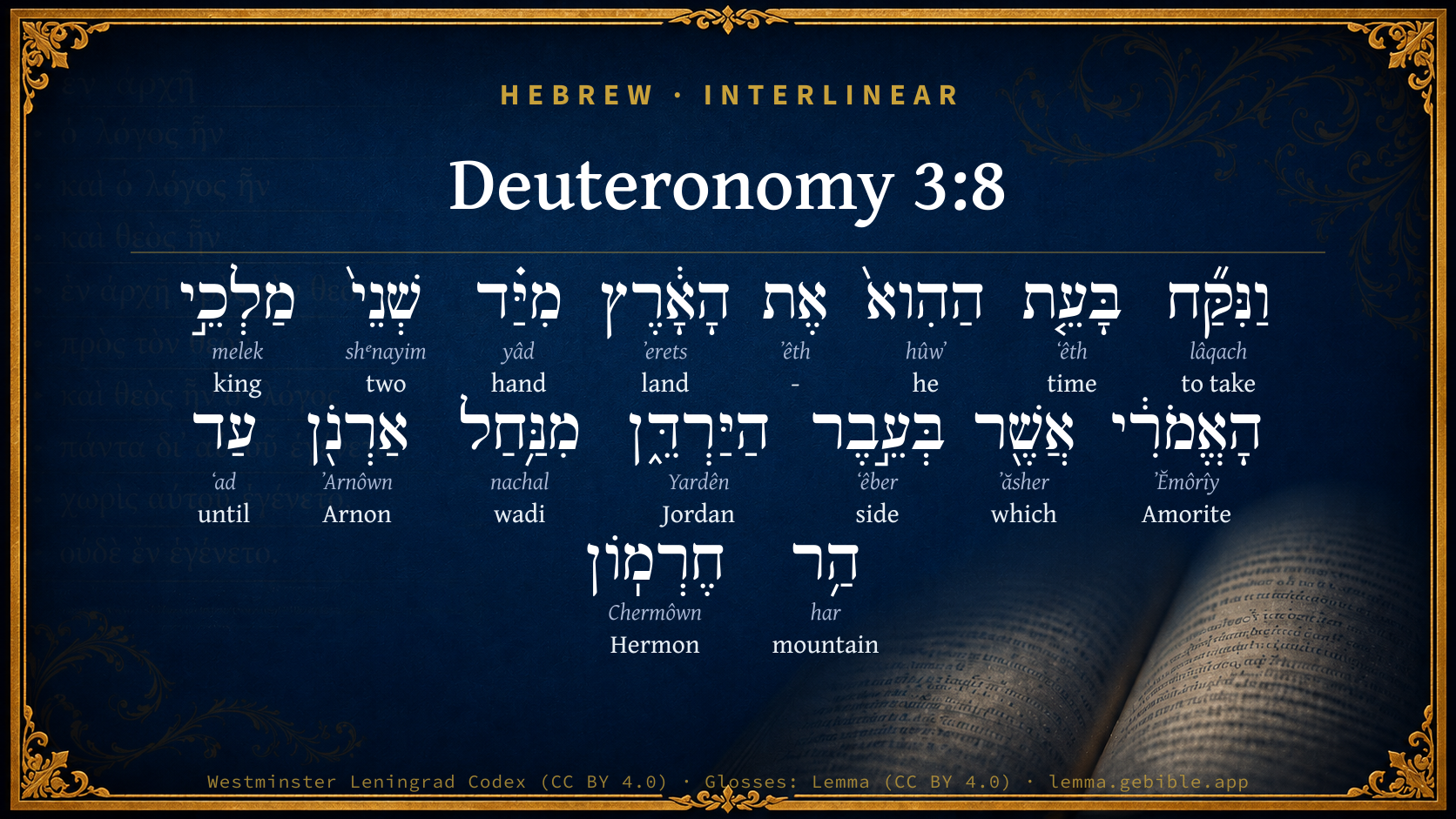
Deuteronomy 3:8

Hebrew (Westminster Leningrad Codex) Deuteronomy 3:8 appears in the Hebrew Old Testament. The text above is from the Westminster Leningrad Codex. Each word links to its Strong’s number, a concise gloss, and parsing drawn from the Open Scriptures Hebrew Bible morphology. Click any word for its full Brown-Driver-Briggs (BDB) entry.
Download image
Cite this verse

Deuteronomy 3:8 (World English Bible). Public Domain. Lemma interlinear Bible study tool, https://lemma.gebible.app/v/deuteronomy/3/8.

Show BibTeX & RIS
BibTeX
RIS
English Translation
We took the land at that time out of the hand of the two kings of the Amorites who were beyond the Jordan, from the valley of the Arnon to Mount Hermon;
World English Bible · Public Domain
Highlights
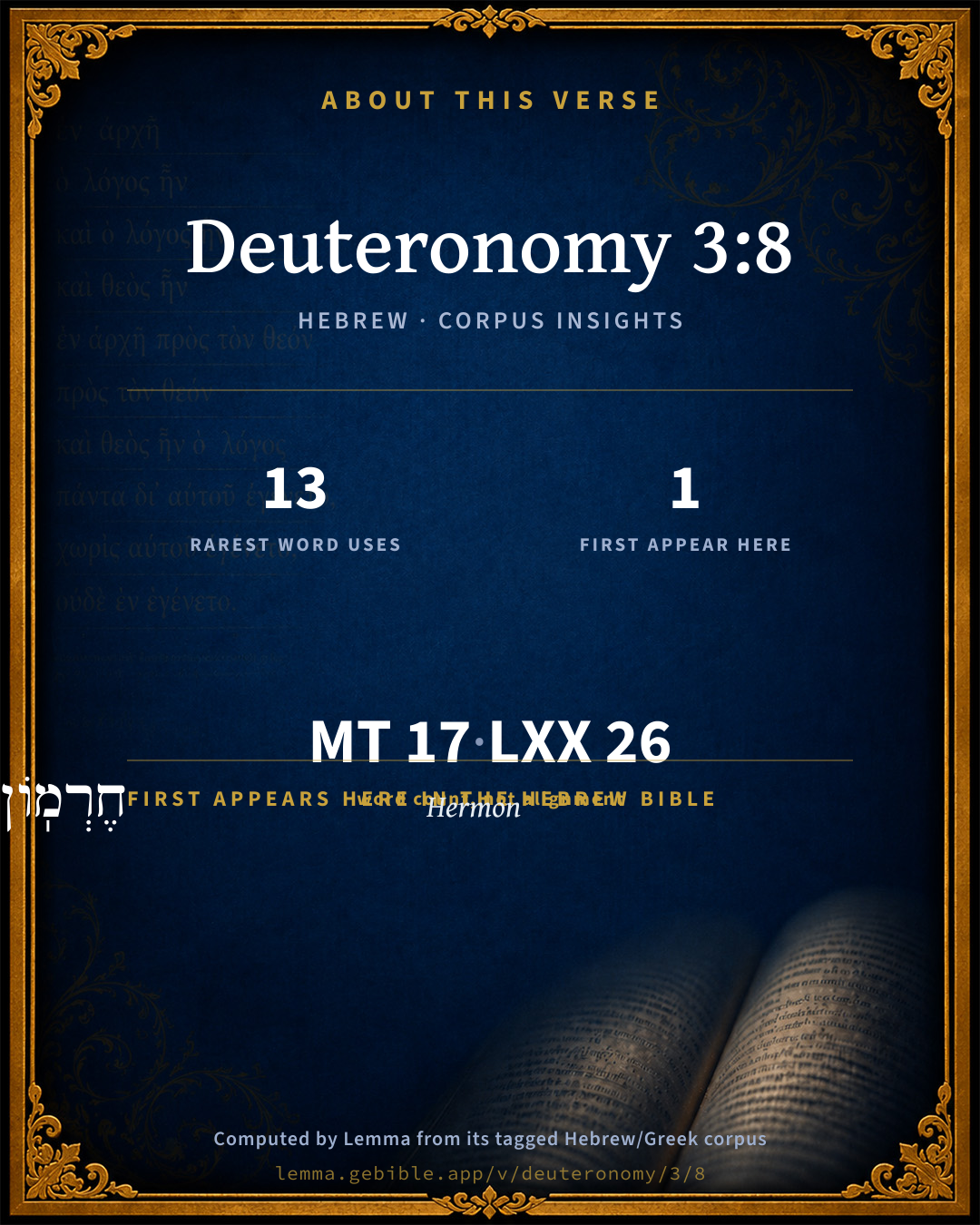
  • 1 first appearance in the Hebrew Bible
Full analysis ↓
Download a study sheet

One document with this verse’s original text, its word-by-word gloss line, the meaning frame, cross-references with their text, attributed commentary, and full source and license credits — printable, and it pastes into notes with its structure intact.

This verse Autodidact and up

Study sheet (.html) Plain text (.txt)

A passage Seminary Student

Up to 50 verses in one chapter. A passage sheet keeps up to 6 commentary sources and 12 cross-references per verse, in the order this page ranks them, and says so on the sheet whenever that leaves anything out. Ask for a single verse and you get the Autodidact verse sheet above.

Everything on this page stays free to read, with no account — the sheet is a download of what is already on screen, not access to it.

Want to remove ads? Support Godless Engineer
Compare translations 3

The same verse in 3 English versions, stacked beneath the original-language interlinear above. Click any original word for its lexicon entry.

Each is an independent rendering of the whole verse — the interlinear is not word-aligned to these translations.

Highlighted words mark where these versions differ — a whole-verse word diff, not a word-by-word alignment.

  • World English Bible Public Domain
    We took the land at that time out of the hand of the two kings of the Amorites who were beyond the Jordan, from the valley of the Arnon to Mount Hermon;
  • King James Version Public Domain
    And we took at that time out of the hand of the two kings of the Amorites the land that was on this side Jordan, from the river of Arnon unto mount Hermon;
  • unfoldingWord Literal Text CC BY-SA 4.0
    And we took at that time the land from the hand of the two kings of the Amorites who across the Jordan, from the wadi of Arnon to Mount Hermon”

unfoldingWord Literal Text — © unfoldingWord, licensed CC BY-SA 4.0. Word-aligned USFM3 via Door43 (git.door43.org/unfoldingWord/en_ult).

Versions to compare (up to 4)

3 of 4 selected

Show all 18 translations

Every available English version of this verse, each an independent rendering of the whole verse.

  • World English Bible Public Domain
    We took the land at that time out of the hand of the two kings of the Amorites who were beyond the Jordan, from the valley of the Arnon to Mount Hermon;
  • Berean Standard Bible Public Domain
    At that time we took from the two kings of the Amorites the land across the Jordan, from the Arnon Valley as far as Mount Hermon—
  • Majority Standard Bible Public Domain
    At that time we took from the two kings of the Amorites the land across the Jordan, from the Arnon Valley as far as Mount Hermon—
  • King James Version Public Domain
    And we took at that time out of the hand of the two kings of the Amorites the land that was on this side Jordan, from the river of Arnon unto mount Hermon;
  • American Standard Version (1901) Public Domain
    And we took the land at that time out of the hand of the two kings of the Amorites that were beyond the Jordan, from the valley of the Arnon unto mount Hermon;
  • Revised Version (1885) Public Domain
    And we took the land at that time out of the hand of the two kings of the Amorites that were beyond Jordan, from the valley of Arnon unto mount Hermon;
  • Geneva Bible (1599) Public Domain
    Thus we tooke at that time out of the hand of two Kings of the Amorites, the land that was on this side Iorden from the riuer of Arnon vnto mount Hermon:
  • Douay-Rheims (1899) Public Domain
    And we took at that time the land out of the hand of the two kings of the Amorrhites, that were beyond the Jordan: from the torrent Amen unto the mount Hermon,
  • Young's Literal Translation Public Domain
    `And we take, at that time, the land out of the hand of the two kings of the Amorite, which is beyond the Jordan, from the brook Arnon unto mount Hermon;
  • Literal Standard Version CC BY-SA 4.0
    And at that time we take the land out of the hand of the two kings of the Amorite, which is beyond the Jordan, from the Brook of Arnon to Mount Hermon
  • Unlocked Literal Bible CC BY-SA 4.0
    At that time we took the land out of the hand of the two kings of the Amorites, who were beyond the Jordan, from the Valley of the Arnon to Mount Hermon
  • unfoldingWord Literal Text CC BY-SA 4.0
    And we took at that time the land from the hand of the two kings of the Amorites who across the Jordan, from the wadi of Arnon to Mount Hermon”
  • Darby Bible Public Domain
    And we took at that time the land out of the hand of the two kings of the Amorites, that were on this side the Jordan, from the river Arnon to mount Hermon
  • World Messianic Bible Public Domain
    We took the land at that time out of the hand of the two kings of the Amorites who were beyond the Jordan, from the valley of the Arnon to Mount Hermon.
  • Webster's Bible Public Domain
    And we took at that time out of the hand of the two kings of the Amorites the land that was on this side of Jordan, from the river of Arnon to mount Hermon;
  • Free Bible Version CC BY-SA 4.0
    So in summary, at that time we took from the two Amorite kings the land east of the Jordan, from the Arnon Valley all the way to Mount Hermon.
  • Bible in Basic English Public Domain
    At that time we took their land from the two kings of the Amorites on the far side of Jordan, from the valley of the Arnon to Mount Hermon;
  • JPS Tanakh (1917) Public Domain
    And we took the land at that time out of the hand of the two kings of the Amorites that were beyond the Jordan, from the valley of Arnon unto mount Hermon —

Literal Standard Version (2020), Covenant Press — licensed CC BY-SA 4.0. Text via the HelloAO Bible API (eBible.org). Unlocked Literal Bible (unfoldingWord) — licensed CC BY-SA 4.0. Text via the HelloAO Bible API (eBible.org). unfoldingWord Literal Text — © unfoldingWord, licensed CC BY-SA 4.0. Word-aligned USFM3 via Door43 (git.door43.org/unfoldingWord/en_ult). Free Bible Version, Dr. Jonathan Gallagher — licensed CC BY-SA 4.0. Text via the HelloAO Bible API (eBible.org).

Word by word

More ways to search: Search by grammar → Find every occurrence → Compare this word →

Practice this passage: Drill this verse → Learn its vocabulary →

חֶרְמֽוֹן
Chermôwn
H2768
“Hermon”
Noun, Proper
Part of Speech
Noun
Type
Proper
Full BDB Definition

Origin: from H2763

TWOT: 744b

Hermon = "a sanctuary" - a mountain on the northeastern border of Palestine and Lebanon and overlooking the border city of Dan
  1. וַנִּקַּ֞ח lâqach H3947 “and · to take” Conjunction + Verb, Qal, Sequential Imperfect, 1st Person, Common, Plural
  2. בָּעֵ֤ת ʻêth H6256 “in/at the · time” Preposition, Determined + Noun, Common, Both, Singular, Absolute
  3. הַהִוא֙ hûwʼ H1931 “the · he” Particle, Definite Article + Pronoun, Personal, 3rd Person, Feminine, Singular
  4. אֶת ʼêth H853 “-” Particle, Direct Object
  5. הָאָ֔רֶץ ʼerets H776 “the · land” Particle, Definite Article + Noun, Common, Both, Singular, Absolute
  6. מִיַּ֗ד yâd H3027 “from · hand of” Preposition + Noun, Common, Both, Singular, Construct
  7. שְׁנֵי֙ shᵉnayim H8147 “two” Adjective, Cardinal number, Masculine, Dual, Construct
  8. מַלְכֵ֣י melek H4428 “kings of” Noun, Common, Masculine, Plural, Construct
  9. הָאֱמֹרִ֔י ʼĔmôrîy H567 “the · Amorite” Particle, Definite Article + Noun, Gentilic, Masculine, Singular, Absolute
  10. אֲשֶׁ֖ר ʼăsher H834 “which” Particle, Relative
  11. בְּעֵ֣בֶר ʻêber H5676 “in/at · side of” Preposition + Noun, Common, Masculine, Singular, Construct
  12. הַיַּרְדֵּ֑ן Yardên H3383 “the · Jordan” Particle, Definite Article + Noun, Proper
  13. מִנַּ֥חַל nachal H5158 “from · wadi of” Preposition + Noun, Common, Masculine, Singular, Construct
  14. אַרְנֹ֖ן ʼArnôwn H769 “Arnon” Noun, Proper
  15. עַד ʻad H5704 “until” Preposition
  16. הַ֥ר har H2022 “mountain of” Noun, Common, Masculine, Singular, Construct

About this verse

These counts appear in no published source. They are computed here, from the morphology-tagged text and Lemma’s own curated glosses. What Lemma adds →

17
words
17
distinct lemmas
Pentateuch
section

Notable vocabulary

The rarest word here is חֶרְמֽוֹן Hermon H2768 — appearing just 13 times in the whole Hebrew Bible.

First appearance in Scripture

This word makes its first canonical appearance in the Hebrew Bible here:

  • חֶרְמֽוֹן Hermon H2768

Shared distinctive vocabulary

חֶרְמֽוֹן Hermon H2768 occurs in 13 verses of the Hebrew Bible. Also found in:

Grammatical profile

  • 1 verb
  • 11 nouns
  • 1 adjective
  • 1 pronoun
  • 1 preposition
  • 2 particles

Verb forms

  • וַנִּקַּ֞ח Qal · Sequential Imperfect

Hebrew & Septuagint length

In English translation the verse runs 32 words from the Hebrew and 32 from the Septuagint (LXX English) — the same length.

A rough comparison of the two English renderings, which tokenize alike — not a word-level alignment.

Word counts can differ between the Hebrew and the Greek without any difference in meaning — e.g. the Hebrew direct-object marker אֵת has no separate Greek word, and Greek often adds the article ὁ.

In the original languages it is 17 Hebrew tokens and 26 Greek tokens — but the two are counted differently (Hebrew bundles its prefixes and suffixes into one token; the Greek is in lemma form), so that isn’t a like-for-like length.

Cross-references

3

Topical passages linked to Deuteronomy 3:8 in the Treasury of Scripture Knowledge — connected by theme and wording, ordered by reader-vote popularity; previews shown in the World English Bible.

  • Joshua 12:2–6 Sihon king of the Amorites, who lived in Heshbon, and ruled from Aroer, which is on the edge of the valley of the Arnon, and [the city that is in] the middle of the valley, and half Gilead, even to the river Jabbok, the border of the children of Ammon;
  • Joshua 13:9–12 from Aroer, that is on the edge of the valley of the Arnon, and the city that is in the middle of the valley, and all the plain of Medeba to Dibon;
  • Numbers 32:33–42 Moses gave to them, even to the children of Gad, and to the children of Reuben, and to the half-tribe of Manasseh the son of Joseph, the kingdom of Sihon king of the Amorites, and the kingdom of Og king of Bashan, the land, according to the cities of it with [their] borders, even the cities of the land round about.

Cross-references courtesy of OpenBible.info (CC BY 4.0).

Hebrew and Greek witnesses Masoretic Hebrew ↔ Greek Septuagint

The same verse in the two great witnesses to the Old Testament, shown verse-for-verse.

These are two independent witnesses, not word-aligned to each other, and the Septuagint is shown in lemma (dictionary) form.

Hebrew Deuteronomy 3:8 Masoretic · Westminster Leningrad Codex

וַנִּקַּ֞ח בָּעֵ֤ת הַהִוא֙ אֶת הָאָ֔רֶץ מִיַּ֗ד שְׁנֵי֙ מַלְכֵ֣י הָאֱמֹרִ֔י אֲשֶׁ֖ר בְּעֵ֣בֶר הַיַּרְדֵּ֑ן מִנַּ֥חַל אַרְנֹ֖ן עַד הַ֥ר חֶרְמֽוֹן

We took the land at that time out of the hand of the two kings of the Amorites who were beyond the Jordan, from the valley of the Arnon to Mount Hermon;

World English Bible · Public Domain

Greek LXX Deuteronomy 3:8 Septuagint · lemma form

καί λαμβάνω ἐν ὁ καιρός ἐκεῖνος ὁ γῆ ἐκ χείρ δύο βασιλεύς ὁ ἀμορραῖος ὅς εἰμί πέραν ὁ ἰορδάνης ἀπό ὁ χειμάρρους αρνων καί ἕως αερμων

And we took at that time the land out of the hands of the two kings of the Amorites, who were beyond Jordan, extending from the brook of Arnon even to Aermon.

LXX2012 (modern English Septuagint) · Public Domain

Hebrew: Westminster Leningrad Codex (CC BY 4.0). Greek: Septuagint (public domain); English from LXX2012 (modern English Septuagint) (Public Domain). How the Septuagint differs from the Hebrew →

Targum (Aramaic paraphrase)

2

The Targum is the ancient Jewish Aramaic paraphrase of the Hebrew Scriptures — an interpretive translation, not the Hebrew text itself. Onkelos (literal) and Pseudo-Jonathan (expansive) render the Torah, and Jonathan the Prophets. Coverage is partial: where no permissively-licensed English translation exists for a verse, only the Aramaic is shown. This is verse-level text, not a word-by-word alignment to the Hebrew.

  1. Targum Onkelos Torah (Genesis–Deuteronomy)
    וּנְסִבְנָא בְּעִדָנָא הַהִיא יָת אַרְעָא מִיַד תְּרֵין מַלְכֵי אֱמֹרָאָה דִי בְּעִבְרָא דְיַרְדְנָא מִנַחֲלָא דְאַרְנֹן עַד טוּרָא דְחֶרְמוֹן

    (no public-domain English translation for this verse)

    Targum Onkelos — Aramaic: “Onkelos Genesis” (public domain); “Onkelos Exodus” (public domain); “Onkelos Leviticus” (public domain); “Onkelos Numbers” (public domain); “Onkelos Deuteronomy” (public domain). English: “Sefaria Community Translation” (CC0 1.0 (public-domain dedication)); “J.W. Etheridge. The Targums of Onkelos and Jonathan Ben Uzziel on the Pentateuch. London: Longmans, Green, 1862” (public domain). Text via Sefaria.

  2. Targum Pseudo-Jonathan Torah (Genesis–Deuteronomy)
    וּנְסֵיבְנָא בְּעִידָנָא הַהִיא יַת אַרְעָא מִן רְשׁוּת תְּרֵין מַלְכֵי אֱמוֹרָאֵי דִבְעִיבְרָא דְיוֹרְדְּנָא מִנַּחֲלֵי אַרְנוֹנָא עַד טַוְורָא דְחֶרְמוֹן

    And at that time we took from the power of the two kings of the Amorites the land beyond the Jordan, from the streams of Arnona unto Mount Hermon.

    Targum Pseudo-Jonathan — Aramaic: “Targum Jonathan on Genesis” (public domain); “Targum Jonathan on Exodus” (public domain); “Targum Jonathan on Leviticus” (public domain); “Targum Jonathan on Numbers” (public domain); “Targum Jonathan on Deuteronomy” (public domain). English: “The Targum of Jonathan ben Uzziel, trans. J. W. Etheridge, London, 1862” (public domain). Text via Sefaria.

Commentary

Notes on Deuteronomy 3:8 from classic Christian and Jewish commentators (each source and its license shown beneath its notes). The classic Christian expositions comment on the surrounding passage and are grouped to its opening verse, so a note may address several verses; the Jewish commentaries on the Tanakh (Rashi and others) are per-verse, so they appear only where the commentator wrote on this verse.

Lemma curates 59 commentaries, every one of them public domain or Creative Commons licensed, each selected and text-cleaned for this edition rather than reprinted as found. About our sources →

The Cambridge Bible for Schools and Colleges

gen. ed. J. J. S. Perowne

8. the two kings of the Amorites] Deu_2:26 to Deu_3:7. ‘Ôg‘s people have not previously been called Amorites: cp. Deu_4:47, Deu_31:4, and the editorial Jos_2:10; Jos_9:10; Jos_24:8; Joshua 12 b. Amorite apparently in the same general sense as in E, e.g. Jos_5:1; Jos_10:5. ‘Ôg himself was of the pre-Amorite Repha‘im, Deu_3:11.

beyond Jordan] As in Deu_1:5 the writer betrays his standpoint in W. Palestine. On the other hand the standpoint of Moses E. of Jordan is properly observed in Deu_3:20; Deu_3:25. Dillm. therefore takes Deu_3:8 as a later insertion. But must we assume a rigorous consistency in the writer of the discourse?

valley of Arnon] Deu_2:24.

unto mount Ḥermon] This carries Israel’s conquest further N. than previously described; another sign of a later hand? Ḥermôn, from the root ḥrm, sacred (see on Deu_2:34); either from a sanctuary on the mount or because the whole mount was held sacred: cp. Jdg_3:3, Mt Ba‘al Ḥermôn. The name covered the long S. end of Anti-Lebanon, above the sources of Jordan, and occurs also in the plur. Ḥermônîm, Psa_42:6, probably because of its triple summit. From its height of 9200 ft H. dominates all Ḥauran or Bashan, is visible as far S. as the heights above Jericho, and forms the natural N. boundary of all E. Palestine. One of its modern names, Jebel esh-Sheikh, means, not ‘old-man mountain,’ from its snowy hoary appearance, but ‘Mount of the Elder’ or ‘Holy Man,’ some famous saint; according to Conder (Hastings’ D. B. ii. 352) the Sheikh ed-Derâzi, the founder of the Druzes. Another name is Jebel, or Towîl, eth-Thalj, ‘Mount,’ or ‘Height of Snow.’

8–17. Allotment of the Conquered Lands

Thus Israel had taken the two Amorite kingdoms, from the ’Arnon to Ḥermon (Deu_3:8)—on which a note is given (Deu_3:9)—that is, from S. to N., the towns of the Mo‘ab Plateau, all Gile‘ad and Bashan (Deu_3:10); then a note on ‘Ôg (Deu_3:11). N. from ‘Arô‘er to half Mt Gile‘ad Moses gave to Re’uben and Gad, the rest of Gile‘ad and Bashan to the half-tribe of Manasseh (Deu_3:12-13 a). Follows a third note Deu_3:13-14 with additions from a later hand Deu_3:15-17 unless Deu_3:16 be regarded as original to the discourse.—The parallels are cited in the notes.

The Cambridge Bible for Schools and Colleges (gen. ed. J. J. S. Perowne; Cambridge University Press, 1878–1918) — public domain. Text from a community e-Sword module.

Joseph Benson's Commentary

Deu 3:8. On this side Jordan — So it was when Moses wrote this book: but afterward, when Israel passed over Jordan, it was called the land beyond Jordan.

Joseph Benson's Commentary on the Old and New Testaments (1811–1818) — public domain. Text from a community e-Sword module.

Tyndale Open Study Notes

Tyndale Open Resources

3:8 Mount Hermon is the southernmost peak in the Anti-Lebanon Mountains northeast of the Sea of Galilee; at 9,300 feet above sea level, it is also the highest. On a clear day, this impressive landmark is visible from many miles away.

Tyndale Open Study Notes — © Tyndale Open Resources, licensed CC BY-SA 4.0. Text via the HelloAO Bible API.

John Gill's Exposition

And we took at that time out of the hands of the two kings of the Amorites,.... Sihon king of Heshbon, and Og king of Bashan:

the land that was on this side Jordan; where Moses then was, being in the plains of Moab, and was the country beyond Jordan, with respect to the land of Canaan, and when in that:

from the river of Arnon unto Mount Hermon; Arnon was a river which divided Moab and the Amorites, Num 22:13 and Hermon was a mountain of Gilead, which ended where Lebanon began, and was the northerly border of this country. It was remarkable for the dew that fell on it; See Gill on Psa 133:3.

John Gill's Exposition of the Whole Bible (1746–1763) — public domain (CC PDM 1.0). Text via the HelloAO Bible API.

Haydock's Catholic Bible Commentary

Beyond. East of the promised land of Chanaan, which the sacred writers have generally in view. (Haydock) --- Hebrew heber, means, "alongside, opposite to, at the passage, at this side," &c. See chap. i. 1., and 3 Kings iv. 24. (Calmet) --- There is no need, therefore, to suppose that this and similar passages have been inserted by a later writer. (Haydock) --- Hermon, which profane authors commonly call Antilibanus, (Calmet) was a part of the range of the mountains of Galaad, by which name it goes frequently, though it be also denominated Seon, or Sion, (chap. iv. 48.; Menochius) and the different nations had other names for it, ver. 9. (Haydock) --- It does not appear that Moses went much beyond the torrent of Jeboc. But he knew that the territory, as far as Hermon and Emath, belonged to the Hebrews, and he probably, sent some troops to take possession of it. They did not, however, entirely banish the Hevites, that dwelt from Baal-Hermon to the entering into Emath. These and some other nations were left by God to instruct Israel, Judges iii. 3.

George Leo Haydock (1774–1849), Haydock's Catholic Family Bible and Commentary, 1859 edition — public domain. Excludes Psalms (Douay-Rheims chapter numbering differs from Protestant) and Deuterocanonical books (Catholic canon only).

Matthew Poole's English Annotations

On this side Jordan; so it was when Moses wrote this book, but afterward, when Israel passed over Jordan, it was called the land beyond Jordan.

Matthew Poole's English Annotations on the Holy Bible (1683–1685) — public domain. Text from a community e-Sword/MySword module.

Whedon's Commentary on the Bible

Daniel D. Whedon

8, 9. From… Arnon unto Mount Hermon — The river Arnon formed the boundary between the Moabites and the Amorites. Hermon is the southern spur of Antilibanus. This mountain was one of the great landmarks of the Israelites, being marked as their northern boundary as the “sea” was with their western. It bore different names, each significant.

Hermon is the lofty peak. Sirion, as the Sidonians called it, and Shenir, its Amorite name, imply a glittering breastplate. It is now called Jebel es-Sheikh, or Jebel et-Tilj. It is also called Sion. See Deu_4:48.

Daniel D. Whedon (gen. ed.), Commentary on the Old and New Testaments (1874–1909) — public domain. Text from a community e-Sword module.

The Pulpit Commentary

Hermon (wOmrj), probably from to be high, "the lofty peak," conspicuous on all sides. By some the name is supposed to be connected with a devoted thing, because this mountain marked the limit of the country devoted or placed under a ban; and it is certainly remarkable that, at the extreme north-east and the extreme southwest of the laud conquered by the Israelites, names derived from Hereto, viz. Hermon and Hormah, (Deu_1:44) should be found; as if to indicate that all between was devoted. Hermon is the southernmost spur of the Autilibanus range. It is "the second mountain in Syria, ranking next to the highest peak of Lebanon behind the cedars. The elevation of Hermon may be estimated at about 10, 000 feet. The whole body of the mountain is limestone, similar to that which composes the main ridge of Lebanon, the central peak rises up an obtuse truncated cone, from 2000 to 3000 feet above the ridges that radiate from it, thus giving it a more commanding aspect than any other mountain in Syria. This cone is entirely naked, destitute alike of trees and vegetation. The snow never disappears from its summit" (Porter, "Handbook, Syria and Palestine," p. 431). At the present day it is known as Jebel esh-Sheikh (The Chief Mountain), also Jebel eth Thel (The Snow Mountain). Anciently also it had various names. By the Hebrews it was known also as Sion (aoyci, the high, Deu_4:48; by the Sidonians it was called Sirion (wOyrci wOyrvi), a cuirass or coat of mail), probably from its shining appearance, especially when covered with snow and by the Amorites it was called Senir, a word probably of the same meaning. These names continued in use to a late period (cf. Psa_99:6; Eze_27:4; Son_4:8; 1Ch_5:23)

The Pulpit Commentary (1880–1919), ed. H.D.M. Spence-Jones & Joseph S. Exell — public domain. Text from a community e-Sword module.

John Wesley's Explanatory Notes

On this side Jordan - So it was when Moses wrote this book; but afterward when Israel passed over Jordan it was called the land beyond Jordan.

John Wesley, Explanatory Notes Upon the Whole Bible (1754–1765) — public domain. Text via the GEBible commentary corpus.

unfoldingWord translationNotes

Door43 World Missions Community

General Information:

Moses continues to speak to the people of Israel.

out of the hand of the two kings

Here the metonym "out of the hand of" means "from the control of." AT: "from the control of the two kings" or "from the two kings" (See: Metonymy)

Amorites ... Bashan ... Edrei ... Og

"Amorite people ... land of Bashan ... town of Edrei ... King Og" See how you translated these in Deuteronomy 1:4.

beyond the Jordan

This refers to the land across the Jordan River, to the east of Israel. Moses was east of the Jordan when he said this. See how you translated this in Deuteronomy 1:1. AT: "east of the Jordan River"

the Valley of the Arnon

See how you translated these words in Deuteronomy 2:24.

Mount Hermon ... Sirion ... Senir

These are all names of the same mountain which is at the northern border of Bashan. (See: How to Translate Names)

of the plain

This is high, flat land between the Arnon River and Mount Gilead.

Salekah

This is the name of a city near Edrei. (See: How to Translate Names)

translationWords

hand

king

Amorite

Jordan River

Sidon

Gilead

kingdom

Bashan

unfoldingWord translationNotes — © Distant Shores Media and the Door43 World Missions Community, licensed CC BY-SA 4.0. Source: git.door43.org/Door43/en_tn.

Rashi

Rabbi Shlomo Yitzchaki (Rashi)

מיד means, FROM THE CONTROL OF.

Rashi on the Tanakh — English translations: “The Judaica Press complete Tanach with Rashi, translated by A. J. Rosenberg” (CC BY 4.0); “Pentateuch with Rashi's commentary by M. Rosenbaum and A.M. Silbermann, 1929-1934” (public domain); “The Metsudah Tanach series, Lakewood, N.J” (CC BY 4.0); and “The Book of Joshua, Metsudah Publications, 1997” (CC BY 4.0). Text via Sefaria.

Lesson kit

Teaching starters — assembled from the data on this page, not authored interpretation. Every prompt links to the verse data it draws on. Edit before teaching.

Deuteronomy, in the Pentateuch, opens this verse with 17 words (17 distinct Hebrew lemmas). Its most distinctive word is Chermôwn (“Hermon”). A historical commentator’s framing appears above. Read the whole chapter for the surrounding context.

Discussion questions

  1. How does “Hermon” (Chermôwn) shape what this verse is saying?
  2. The word “Hermon” first appears here in Scripture. What is being introduced at this debut?
  3. Deuteronomy 3:9 shares the word «Hermon» with this verse. How do the two illuminate each other?
  4. The translations on this page render this verse differently — a whole-verse word diff, not a word-by-word alignment. What might account for the different wordings?
  5. The verb «וַנִּקַּ֞ח» is Qal Sequential Imperfect. How does its form color the action?
  6. Reading how The Cambridge Bible for Schools and Colleges and Joseph Benson's Commentary read this verse, where do the two commentators agree and where do they part?

Things to notice

Reading settings

Reading text

Shown beneath each verse's original-language words.

Old Testament
Old Testament edition

Read the OT as the Masoretic Hebrew (MT) or the Greek Septuagint (LXX).

English shown for the Greek Septuagint (in the Hebrew ↔ Greek comparison).

Comparing translations? Open the Compare panel on any verse page to stack up to four side by side.