
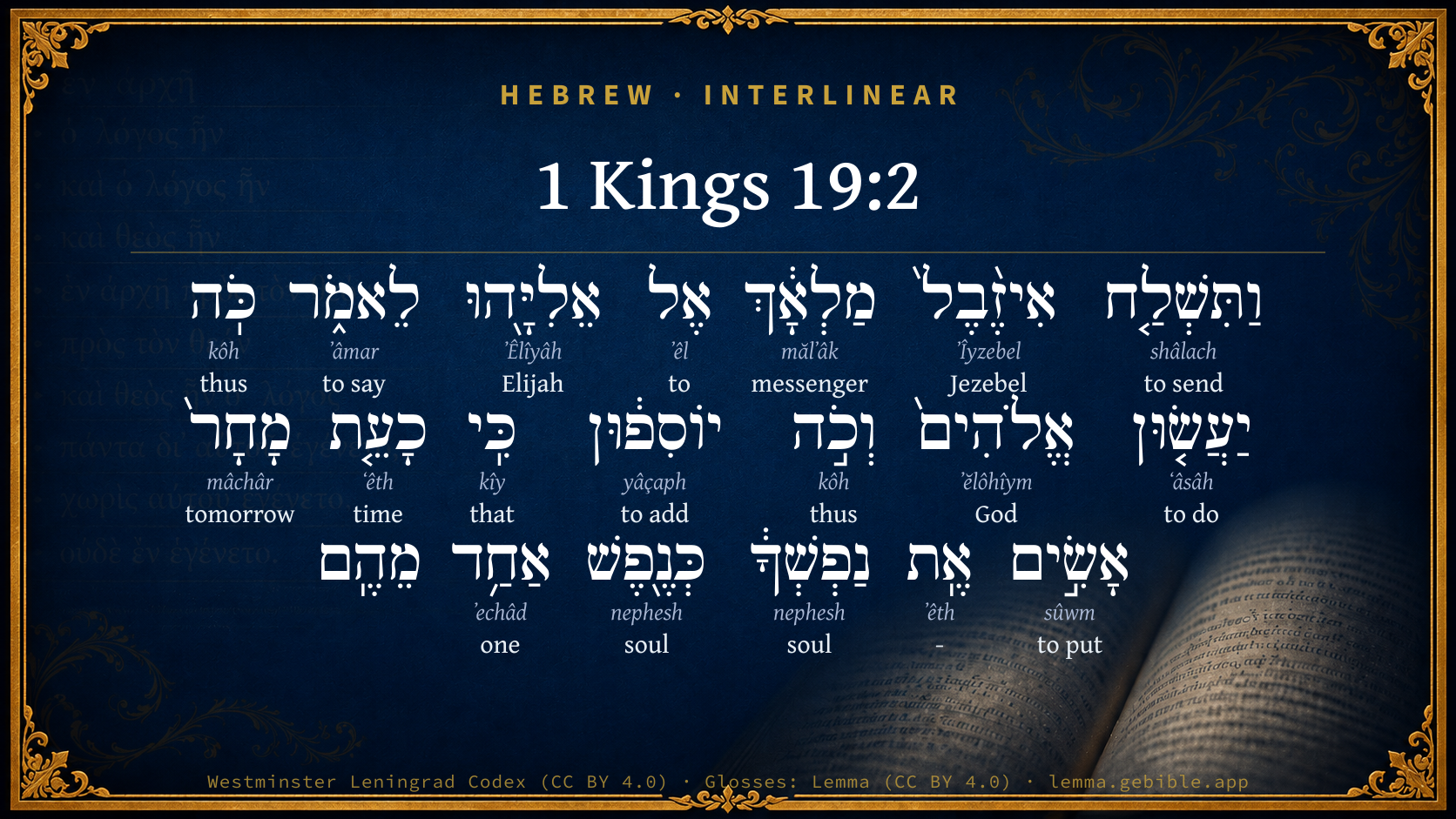
1 Kings 19:2

Hebrew (Westminster Leningrad Codex) 1 Kings 19:2 appears in the Hebrew Old Testament. The text above is from the Westminster Leningrad Codex. Each word links to its Strong’s number, a concise gloss, and parsing drawn from the Open Scriptures Hebrew Bible morphology. Click any word for its full Brown-Driver-Briggs (BDB) entry.
Download image
Cite this verse

1 Kings 19:2 (World English Bible). Public Domain. Lemma interlinear Bible study tool, https://lemma.gebible.app/v/1-kings/19/2.

Show BibTeX & RIS
BibTeX
RIS
English Translation
Then Jezebel send a messenger to Elijah, saying, So let the gods do to me, and more also, if I don't make your life as the life of one of them by tomorrow about this time.
World English Bible · Public Domain
Download a study sheet

One document with this verse’s original text, its word-by-word gloss line, the meaning frame, cross-references with their text, attributed commentary, and full source and license credits — printable, and it pastes into notes with its structure intact.

This verse Autodidact and up

Study sheet (.html) Plain text (.txt)

A passage Seminary Student

Up to 50 verses in one chapter. A passage sheet keeps up to 6 commentary sources and 12 cross-references per verse, in the order this page ranks them, and says so on the sheet whenever that leaves anything out. Ask for a single verse and you get the Autodidact verse sheet above.

Everything on this page stays free to read, with no account — the sheet is a download of what is already on screen, not access to it.

Want to remove ads? Support Godless Engineer
Compare translations 3

The same verse in 3 English versions, stacked beneath the original-language interlinear above. Click any original word for its lexicon entry.

Each is an independent rendering of the whole verse — the interlinear is not word-aligned to these translations.

Highlighted words mark where these versions differ — a whole-verse word diff, not a word-by-word alignment.

  • World English Bible Public Domain
    Then Jezebel send a messenger to Elijah, saying, So let the gods do to me, and more also, if I don't make your life as the life of one of them by tomorrow about this time.
  • King James Version Public Domain
    Then Jezebel sent a messenger unto Elijah, saying, So let the gods do to me, and more also, if I make not thy life as the life of one of them by to morrow about this time.
  • unfoldingWord Literal Text CC BY-SA 4.0
    And Jezebel sent a messenger to Elijah, saying, “Thus may the gods do, and thus may they add, unless about time tomorrow I make your life like the life of one of them.”

unfoldingWord Literal Text — © unfoldingWord, licensed CC BY-SA 4.0. Word-aligned USFM3 via Door43 (git.door43.org/unfoldingWord/en_ult).

Versions to compare (up to 4)

3 of 4 selected

Show all 18 translations

Every available English version of this verse, each an independent rendering of the whole verse.

  • World English Bible Public Domain
    Then Jezebel send a messenger to Elijah, saying, So let the gods do to me, and more also, if I don't make your life as the life of one of them by tomorrow about this time.
  • Berean Standard Bible Public Domain
    So Jezebel sent a messenger to Elijah, saying, “May the gods deal with me, and ever so severely, if by this time tomorrow I do not make your life like the lives of those you killed!”
  • Majority Standard Bible Public Domain
    So Jezebel sent a messenger to Elijah, saying, “May the gods deal with me, and ever so severely, if by this time tomorrow I have not made your life like the lives of those you killed!”
  • King James Version Public Domain
    Then Jezebel sent a messenger unto Elijah, saying, So let the gods do to me, and more also, if I make not thy life as the life of one of them by to morrow about this time.
  • American Standard Version (1901) Public Domain
    Then Jezebel send a messenger unto Elijah, saying, So let the gods do to me, and more also, if I make not thy life as the life of one of them by to-morrow about this time.
  • Revised Version (1885) Public Domain
    Then Jezebel sent a messenger unto Elijah, saying, So let the gods do to me, and more also, if I make not thy life as the life of one of them by tomorrow about this time.
  • Geneva Bible (1599) Public Domain
    Then Iezebel sent a messenger vnto Eliiah, saying, The gods doe so to me and more also, if I make not thy life like one of their liues by to morowe this time.
  • Douay-Rheims (1899) Public Domain
    And Jezabel sent a messenger to Elias, saying: Such and such things may the gods do to me, and add still more, if by this hour to morrow I make not thy life as the life of one of them.
  • Young's Literal Translation Public Domain
    and Jezebel sendeth a messenger unto Elijah, saying, `Thus doth the gods, and thus do they add, surely about this time to-morrow, I make thy life as the life of one of them.'
  • Literal Standard Version CC BY-SA 4.0
    and Jezebel sends a messenger to Elijah, saying, “Thus the gods do, and thus do they add—surely about this time tomorrow, I make your life as the life of one of them.”
  • Unlocked Literal Bible CC BY-SA 4.0
    Then Jezebel sent a messenger to Elijah, saying, “So may the gods do to me, and more also, if I do not make your life like the life of one of those dead prophets by tomorrow about this time.”
  • unfoldingWord Literal Text CC BY-SA 4.0
    And Jezebel sent a messenger to Elijah, saying, “Thus may the gods do, and thus may they add, unless about time tomorrow I make your life like the life of one of them.”
  • Darby Bible Public Domain
    And Jezebel sent a messenger to Elijah saying, So do the gods [to me], and more also, if I make not thy life as the life of one of them by to-morrow about this time!
  • World Messianic Bible Public Domain
    Then Jezebel sent a messenger to Elijah, saying, “So let the gods do to me, and more also, if I don’t make your life as the life of one of them by tomorrow about this time!”
  • Webster's Bible Public Domain
    Then Jezebel sent a messenger to Elijah, saying, So let the gods do to me, and more also, if I make not thy life as the life of one of them by to-morrow about this time.
  • Free Bible Version CC BY-SA 4.0
    Jezebel sent a messenger to Elijah to say, “May the gods do as much to me and more if by tomorrow I haven't made your life like the lives of those you killed!”
  • Bible in Basic English Public Domain
    Then Jezebel sent a servant to Elijah, saying, May the gods' punishment be on me if I do not make your life like the life of one of them by tomorrow about this time.
  • JPS Tanakh (1917) Public Domain
    Then Jezebel sent a messenger unto Elijah, saying: 'So let the gods do to me, and more also, if I make not thy life as the life of one of them by to-morrow about this time.'

Literal Standard Version (2020), Covenant Press — licensed CC BY-SA 4.0. Text via the HelloAO Bible API (eBible.org). Unlocked Literal Bible (unfoldingWord) — licensed CC BY-SA 4.0. Text via the HelloAO Bible API (eBible.org). unfoldingWord Literal Text — © unfoldingWord, licensed CC BY-SA 4.0. Word-aligned USFM3 via Door43 (git.door43.org/unfoldingWord/en_ult). Free Bible Version, Dr. Jonathan Gallagher — licensed CC BY-SA 4.0. Text via the HelloAO Bible API (eBible.org).

Word by word

More ways to search: Search by grammar → Find every occurrence → Compare this word →

Practice this passage: Drill this verse → Learn its vocabulary →

אִיזֶ֨בֶל֙
ʼÎyzebel
H348
“Jezebel”
Noun, Proper
Part of Speech
Noun
Type
Proper
Full BDB Definition

Origin: from H336 and H2083

TWOT: None

Jezebel = "Baal exalts" or " Baal is husband to" or " unchaste" - queen of Israel, wife of Ahab, daughter of Ethbaal
  1. וַתִּשְׁלַ֤ח shâlach H7971 “and · to send” Conjunction + Verb, Qal, Sequential Imperfect, 3rd Person, Feminine, Singular
  2. מַלְאָ֔ךְ mălʼâk H4397 “messenger” Noun, Common, Masculine, Singular, Absolute
  3. אֶל ʼêl H413 “to” Preposition
  4. אֵלִיָּ֖הוּ ʼÊlîyâh H452 “Elijah” Noun, Proper
  5. לֵאמֹ֑ר ʼâmar H559 “to say” Preposition + Verb, Qal, Infinitive Construct
  6. כֹּֽה kôh H3541 “thus” Adverb
  7. יַעֲשׂ֤וּן ʻâsâh H6213 “to do” Verb, Qal, Jussive, 3rd Person, Masculine, Plural + Suffix, n
  8. אֱלֹהִים֙ ʼĕlôhîym H430 “God(s)” Noun, Common, Masculine, Plural, Absolute
  9. וְכֹ֣ה kôh H3541 “and · thus” Conjunction + Adverb
  10. יוֹסִפ֔וּן yâçaph H3254 “to add” Verb, Hiphil, Jussive, 3rd Person, Masculine, Plural + Suffix, n
  11. כִּֽי kîy H3588 “that” Conjunction
  12. כָעֵ֤ת ʻêth H6256 “like/as the · time” Preposition, Determined + Noun, Common, Both, Singular, Absolute
  13. מָחָר֙ mâchâr H4279 “tomorrow” Noun, Common, Masculine, Singular, Absolute
  14. אָשִׂ֣ים sûwm H7760 “to put” Verb, Qal, Imperfect, 1st Person, Common, Singular
  15. אֶֽת ʼêth H853 “-” Particle, Direct Object
  16. נַפְשְׁךָ֔ nephesh H5315 “soul · your” Noun, Common, Both, Singular, Construct + Suffix, Personal, 2nd Person, Masculine, Singular
  17. כְּנֶ֖פֶשׁ nephesh H5315 “like/as · soul” Preposition + Noun, Common, Both, Singular, Absolute
  18. אַחַ֥ד ʼechâd H259 “one” Adjective, Cardinal number, Masculine, Singular, Absolute

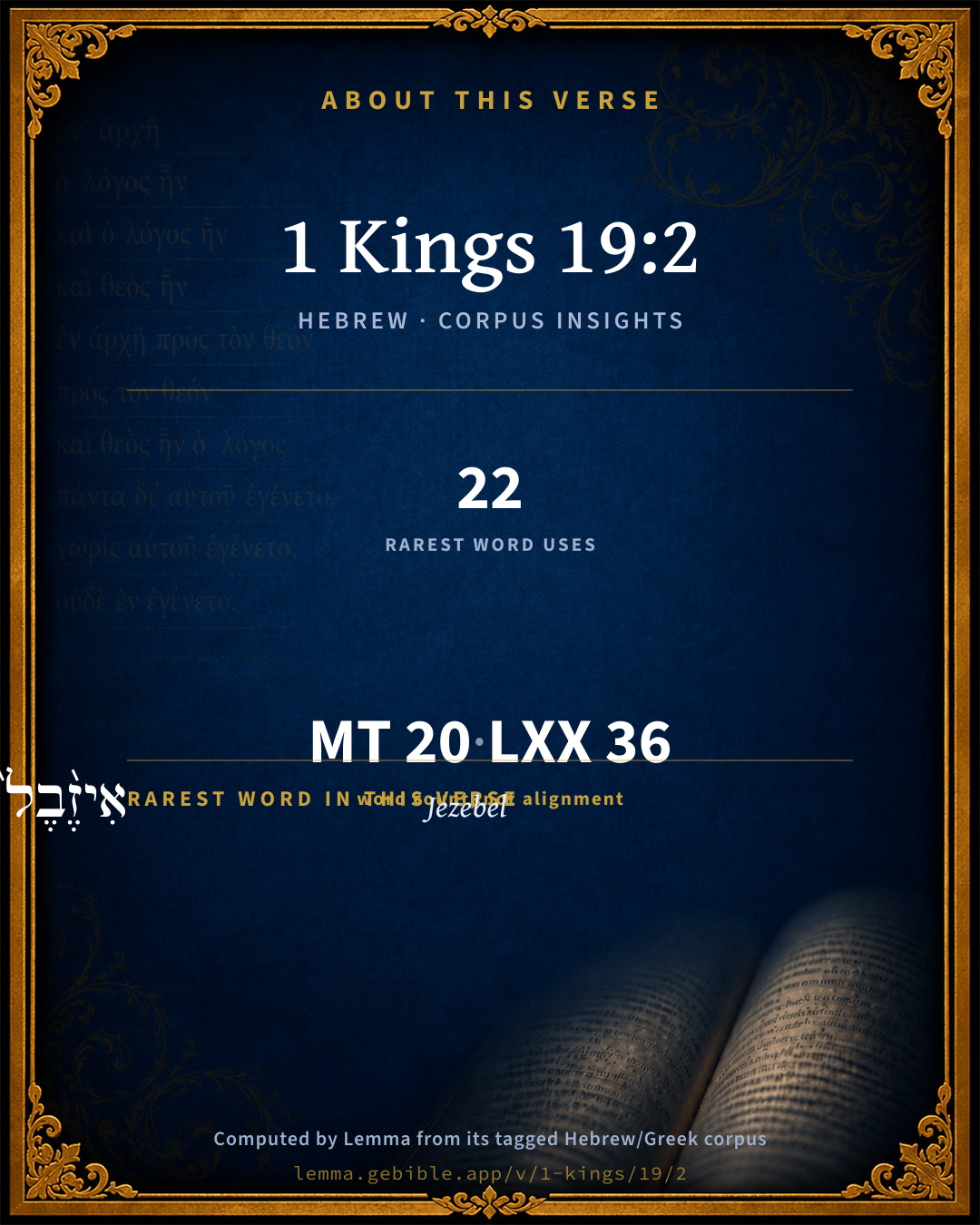
About this verse

These counts appear in no published source. They are computed here, from the morphology-tagged text and Lemma’s own curated glosses. What Lemma adds →

20
words
17
distinct lemmas
Historical
section

Notable vocabulary

The rarest word here is אִיזֶ֨בֶל֙ Jezebel H348 — appearing just 22 times in the whole Hebrew Bible.

Shared distinctive vocabulary

אִיזֶ֨בֶל֙ Jezebel H348 occurs in 19 verses of the Hebrew Bible. Also found in:

Grammatical profile

  • 5 verbs
  • 8 nouns
  • 1 adjective
  • 2 prepositions
  • 1 conjunction
  • 2 adverbs
  • 1 particle

Verb forms

  • וַתִּשְׁלַ֤ח Qal · Sequential Imperfect
  • לֵאמֹ֑ר Qal · Infinitive Construct
  • יַעֲשׂ֤וּן Qal · Jussive
  • יוֹסִפ֔וּן Hiphil · Jussive
  • אָשִׂ֣ים Qal · Imperfect

Repetition

Words recur within this verse — often emphatic in Hebrew:

  • כֹּֽה thus H3541 ×2
  • נַפְשְׁךָ֔ soul H5315 ×2

Hebrew & Septuagint length

In English translation the verse runs 36 words from the Hebrew and 41 from the Septuagint (LXX English) — closely comparable.

A rough comparison of the two English renderings, which tokenize alike — not a word-level alignment.

Word counts can differ between the Hebrew and the Greek without any difference in meaning — e.g. the Hebrew direct-object marker אֵת has no separate Greek word, and Greek often adds the article ὁ.

In the original languages it is 20 Hebrew tokens and 36 Greek tokens — but the two are counted differently (Hebrew bundles its prefixes and suffixes into one token; the Greek is in lemma form), so that isn’t a like-for-like length.

Cross-references

13

Topical passages linked to 1 Kings 19:2 in the Treasury of Scripture Knowledge — connected by theme and wording, ordered by reader-vote popularity; previews shown in the World English Bible.

  • 1 Kings 20:10 Ben Hadad sent to him, and said, The gods do so to me, and more also, if the dust of Samaria shall suffice for handfuls for all the people who follow me.
  • 2 Kings 6:31 Then he said, God do so to me, and more also, if the head of Elisha the son of Shaphat shall stand on him this day.
  • Ruth 1:17 where you die, will I die, and there will I be buried: Yahweh do so to me, and more also, if anything but death part you and me."
  • Exodus 10:28 Pharaoh said to him, "Get away from me! Be careful to see my face no more; for in the day you see my face you shall die!"
  • Daniel 3:15 Now if you are ready whenever you hear the sound of the horn, flute, zither, lyre, harp, pipe, and all kinds of music to you fall down and worship the image which I have made, [well]: but if you don't worship, you shall be cast the same hour into the midst of a burning fiery furnace; and who is that god that shall deliver you out of my hands?
  • 1 Kings 2:28 The news came to Joab; for Joab had turned after Adonijah, though he didn't turn after Absalom. Joab fled to the Tent of Yahweh, and caught hold on the horns of the altar.
  • 2 Kings 19:10–12 Thus shall you speak to Hezekiah king of Judah, saying, Don't let your God in whom you trust deceive you, saying, Jerusalem shall not be given into the hand of the king of Assyria.
  • 2 Kings 19:27–28 But I know your sitting down, and your going out, and your coming in, and your raging against me.
  • Proverbs 27:1 Don't boast about tomorrow; For you don't know what a day may bring forth.
  • Exodus 15:9 The enemy said, 'I will pursue, I will overtake, I will divide the spoil. My desire shall be satisfied on them. I will draw my sword, my hand shall destroy them.'
  • Acts 12:4–6 When he had arrested him, he put him in prison, and delivered him to four squads of four soldiers each to guard him, intending to bring him out to the people after the Passover.
  • James 4:13–14 Come now, you who say, "Today or tomorrow let's go into this city, and spend a year there, trade, and make a profit."
  • 2 Kings 19:22 Whom have you defied and blasphemed? and against whom have you exalted your voice and lifted up your eyes on high? [even] against the Holy One of Israel.

Cross-references courtesy of OpenBible.info (CC BY 4.0).

Hebrew and Greek witnesses Masoretic Hebrew ↔ Greek Septuagint

The same verse in the two great witnesses to the Old Testament, shown verse-for-verse.

These are two independent witnesses, not word-aligned to each other, and the Septuagint is shown in lemma (dictionary) form.

Hebrew 1 Kings 19:2 Masoretic · Westminster Leningrad Codex

וַתִּשְׁלַ֤ח אִיזֶ֨בֶל֙ מַלְאָ֔ךְ אֶל אֵלִיָּ֖הוּ לֵאמֹ֑ר כֹּֽה יַעֲשׂ֤וּן אֱלֹהִים֙ וְכֹ֣ה יוֹסִפ֔וּן כִּֽי כָעֵ֤ת מָחָר֙ אָשִׂ֣ים אֶֽת נַפְשְׁךָ֔ כְּנֶ֖פֶשׁ אַחַ֥ד מֵהֶֽם

Then Jezebel send a messenger to Elijah, saying, So let the gods do to me, and more also, if I don't make your life as the life of one of them by tomorrow about this time.

World English Bible · Public Domain

Greek LXX 1 Kings 19:2 Septuagint · lemma form

καί ἀποστέλλω ιεζαβελ πρός ηλιου καί εἶπον εἰ σύ εἰμί ηλιου καί ἐγώ ιεζαβελ ὅδε ποιέω ἐγώ ὁ θεός καί ὅδε προςτίθημι ὅτι οὗτος ὁ ὥρα αὔριον τίθημι ὁ ψυχή σύ καθώς ψυχή εἷς ἐκ αὐτός

And Jezabel sent to Eliu, and said, If you are Eliu and I am Jezabel, God do so to me, and more also, if I do not make your life by this time to-morrow as the life of one of them.

LXX2012 (modern English Septuagint) · Public Domain

On this verse, The Cambridge Bible for Schools and Colleges discusses the Septuagint’s reading. Read the note in Commentary ↓

Hebrew: Westminster Leningrad Codex (CC BY 4.0). Greek: Septuagint (public domain); English from LXX2012 (modern English Septuagint) (Public Domain). How the Septuagint differs from the Hebrew →

Targum (Aramaic paraphrase)

1

The Targum is the ancient Jewish Aramaic paraphrase of the Hebrew Scriptures — an interpretive translation, not the Hebrew text itself. Onkelos (literal) and Pseudo-Jonathan (expansive) render the Torah, and Jonathan the Prophets. Coverage is partial: where no permissively-licensed English translation exists for a verse, only the Aramaic is shown. This is verse-level text, not a word-by-word alignment to the Hebrew.

  1. Targum Jonathan Prophets (Joshua–Malachi)
    וּשְׁלַחַת אִיזֶבֶל אִזְגָדָא לְוַת אֵלִיָהוּ לְמֵימָר כְּדֵין יַעְבְּדוּן דַחֲלָתָאִי וּכְדֵין יוֹסְפוּן אֱלָהֵין כְּעִדָנָא הָדֵין מְחַר אַשַׁוֵי יַת נַפְשָׁךְ כְּנַפְשָׁא דְחַד מִנְהוֹן:

    (no public-domain English translation for this verse)

    Targum Jonathan — Aramaic: “Mikraot Gedolot” (public domain). English: “Sefaria Community Translation” (CC0 1.0 (public-domain dedication)); “London "Chaldee Paraphrase," 1871” (public domain). Text via Sefaria.

Commentary

Notes on 1 Kings 19:2 from classic Christian and Jewish commentators (each source and its license shown beneath its notes). The classic Christian expositions comment on the surrounding passage and are grouped to its opening verse, so a note may address several verses; the Jewish commentaries on the Tanakh (Rashi and others) are per-verse, so they appear only where the commentator wrote on this verse.

Lemma curates 59 commentaries, every one of them public domain or Creative Commons licensed, each selected and text-cleaned for this edition rather than reprinted as found. About our sources →

Trapp's Complete Commentary

John Trapp

1Ki 19:2 Then Jezebel sent a messenger unto Elijah, saying, So let the gods do [to me], and more also, if I make not thy life as the life of one of them by to morrow about this time.

Ver. 2. So let the gods do to me, &c.] Detexit facinus fatua et non implevit, as Tacitus saith of another. There was a providence in it, that she should threaten; for praemonitus praemunitus, forewarned and half-armed; but still revenges are most dangerous.

John Trapp, A Commentary or Exposition upon All the Books of the Old and New Testament (1647–1656) — public domain. Text from a community e-Sword module.

Joseph Benson's Commentary

1Ki 19:2. Then Jezebel sent a messenger unto Elijah — She gives him notice of her designs beforehand; partly from her high and haughty spirit, as scorning to kill him secretly; partly out of impatience till she had given vent to her rage; and partly from God’s gracious and overruling providence, that hereby Elijah might have an opportunity of escaping. This shows the great folly of outrageous anger; which transported her unthinkingly, but effectually, to counteract and obstruct her own designs. So let the gods do to me, and more also, &c. — This imperious and haughty woman, it appears, managed the king and kingdom according to her own will, and did whatever she pleased; and so far was she from being changed by the evident miracle which had been wrought, that she persists in her former idolatry, and adds to it a monstrous confidence, that in spite of God she would destroy his prophet.

Joseph Benson's Commentary on the Old and New Testaments (1811–1818) — public domain. Text from a community e-Sword module.

Tyndale Open Study Notes

Tyndale Open Resources

19:2 Speaking a curse, Jezebel reinforced her threat to kill Elijah within a day. Solomon had made a similar declaration regarding his half-brother Adonijah (2:23), and the king of Aram later issued an edict against Elisha with the same formula (2 Kgs 6:31). Jezebel acted with cold-blooded resolve to accomplish her purposes (1 Kgs 21:5-15).

Tyndale Open Study Notes — © Tyndale Open Resources, licensed CC BY-SA 4.0. Text via the HelloAO Bible API.

Geneva Bible (1599)

Geneva Bible translators

Though the wicked rage against God’s children, yet he holdeth them back that they cannot execute their malice.

Geneva Bible (1599) marginal notes — public domain. Text via Bolls.life.

Adam Clarke's Commentary

Verse 2. So let the gods do] If I do not slay thee, let the gods slay me with the most ignominious death.

Adam Clarke's Commentary on the Bible (1810–1826) — public domain. Text from a community e-Sword/MySword module.

The Cambridge Bible for Schools and Colleges

gen. ed. J. J. S. Perowne

2. Jezebel sent a messenger] The queen could not restrain herself in her rage. She cannot make arrangements for seizing Elijah at once, but lets him know that she is resolved to do so. The LXX. has no word for ‘a messenger,’ but enlarges the sentence by the words ‘If thou art Elijah, and I Jezebel, so let God &c.’ The message intimates that if he can be found he will be put to death on the morrow.

The Cambridge Bible for Schools and Colleges (gen. ed. J. J. S. Perowne; Cambridge University Press, 1878–1918) — public domain. Text from a community e-Sword module.

John Gill's Exposition

Then Jezebel sent a messenger unto Elijah,.... In Jezreel, or near it, to frighten him away; not caring to seize him, and dispatch him, for fear of the people, in whom he had now a great interest; or otherwise it is not easy to account for it that she should give him notice of it; unless she scorned to do it privately, as some think, and was determined to make a public example of him; but being not as yet prepared for it, sends him word what he must expect, imagining that as he had the courage to appear, he would not flee; no doubt there was an hand of Providence in it, be it which it will, that he might have time to make his escape:

saying, so let the gods do to me, and more also; the gods she served, Baal and Ashtaroth, and by whom she swore:

if I make not thy life as the life of one of them by tomorrow about this time; as one of the prophets Elijah had slain; she swore by her gods, and wished the greatest evils might befall her, if she did not lodge him in the state of the dead where they were in the space of twenty four hours; though Abarbinel thinks it is not an oath, but that the words and meaning of them are, so the gods do; it is their usual way, and they will go on to do so for the future, because of the holiness of their name; and therefore do not boast of slaying the prophets, or make use of that as an argument of their falsehood, for they will do the same by thee by tomorrow this time.

John Gill's Exposition of the Whole Bible (1746–1763) — public domain (CC PDM 1.0). Text via the HelloAO Bible API.

Albert Barnes' Notes on the Bible

The prophet had not long to wait before learning the intentions of the queen. A priest’s daughter herself, she would avenge the slaughtered priests; a king’s wife and a king’s child, she would not quail before a subject. That very night a messenger declared her determination to compass the prophet’s death within the space of a day.

So let the gods ... - A common oath about this time (marginal references). The Greek Version prefixes to this another clause, which makes the oath even more forcible, “As surely as thou art Elijah and I am Jezebel, so let the gods,” etc.

Albert Barnes' Notes on the Bible (1834–1885) — public domain. Text from a community e-Sword/MySword module.

Matthew Poole's English Annotations

Jezebel sent a messenger unto Elijah; she gives him notice of it beforehand; partly, out of the height of her spirit, as scorning to kill him secretly and surreptitiously, and resolving to make him a public sacrifice; partly, out of her impatience, till she had breathed out her rage, which she could do speedily, when it required some time and preparation to seize him, who was now so much esteemed and favoured by all the people; partly, because she supposed that he who had the confidence to come thither, (where, it seems, she was at this time,) would still have the same confidence to stay there, and be obliged in honour to maintain his ground; and principally, from God’s all-disposing providence, that so he might have an opportunity of escaping.

So let the gods do to me, and more also: so far was she from being changed by that most evident miracle, that she persists in her former idolatry, and adds to it a mad and monstrous confidence, that in spite of God she would destroy his prophet.

Matthew Poole's English Annotations on the Holy Bible (1683–1685) — public domain. Text from a community e-Sword/MySword module.

Whedon's Commentary on the Bible

Daniel D. Whedon

2. Jezebel sent a messenger — Here was lack of shrewdness and forethought, if she really wished and designed to carry out her threat, for such announcement of her purpose gave Elijah full opportunity to escape her, or prepare to meet her opposition. But it is possible that her object was to terrify him and drive him away from her city, and that she feared to cope with him otherwise, lest her own fate should be like that of the false prophets.

So let the gods do — “One of those tremendous vows which mark the history of the Semitic race, both within and without the Jewish pale — the vow of Jephthah, the vow of Saul, the vow of Hannibal.” — Stanley.

Daniel D. Whedon (gen. ed.), Commentary on the Old and New Testaments (1874–1909) — public domain. Text from a community e-Sword module.

The Pulpit Commentary

Then Jezebel sent a messenger unto Elijah The prophet, wrapped in his abba, was seemingly about to spend the night in the open air, possibly at the gate, or in the plain. There, in the darkness, the messenger found him, Bahr assumes that this message had Ahab"s sanction; i.e., that he must have known of it and was too weak to prevent it. But it is just as likely that it was sent without his privity. On the evening of that day he would be afraid to threaten one vested with such tremendous powers as Elijah had just proved himself to possess, saying Here the LXX inserts "If thou art Eliou and I Jezebel", So let gods As is here found with a the plural verb, it is rightly assumed that the reference is to the divinities of Phoenicia or of paganism generally. Besides, Jezebel would hardly swear by the one God of Elijah and of Israel. The LXX, however, has oJ qeov, do to me, and more also Heb. and so let them add. See on 1Ki_2:23. Stanley appositely recalls to our minds "the tremendous vows which mark the history of the Semitic race, both within and without the Jewish pale, the vow of Jephthah, the vow of Saul, the vow of Hannibal." Rawlinson remarks that this oath was "familiar in the mouths of kings about this time" (1Ki_20:10; 2Ki_6:31) But it was a standing formula in Israel at all times. (See Rth_1:17; 1Sa_3:17; etc.) if I make not thy life as the life of one of them by tomorrow about this time. "That queen consort, it seems, was, in effect, queen regent" (Henry). What induced the queen to send this message? For it is obvious that if she really meant to slay Elijah, she took the very means to defeat her purpose by thus forewarning him of her intentions. Some of the older expositors (see, e.g., Hall, vol. 2. p. 396) have seen in the act a proof of her blind infatuation, of that infatuation which God often employs to defeat the machinations of wicked men, and this view is not to be lightly rejected. That she fully meant what she said is hardly to be doubted. But later writers, including Keil, Bahr, and Wordsworth, see in the threat nothing more than a scheme for ridding herself of the presence of Elijah. They argue that, finding herself unable to put him to death, partly because of the impression he had made upon the people, and partly, too, because of the ascendancy he had just gained over the king, she resolved, by threatening him with instant death, to give him an opportunity for flight. But this view hardly takes sufficiently into account the exasperation, the blind unreasoning hate, or the reckless and desperate character of the queen. It must be remembered that this message was despatched, not after she had had time for thought and calculation, but on the spur of the moment, as soon as she had heard of the massacre of the priests of Baal. That night she could do nothing, nor perhaps could she see her way clearly to compass his death on the morrow. But she will have him know that he is not going to escape her, and that, whatever the effect on her husband, she is unconquered and unrelenting. She does not stop to argue that he may take the alarm and flee. But she must gratify her impotent rage forthwith by threatening him with death the next day.

Then Jezebel sent a messenger." Not, as we might have expected, to sue for forgiveness, but to threaten reprisals. "She swears and stamps at that whereat she should have trembled" (Hall). There is no hate like"s woman"s, no wickedness like hers. They never do things by halves.

Men differ at most as heaven and earth, But women, best and worst, as heaven and hell.

This woman will not be persuaded though one rose from the dead. (Luk_16:1) The fiery sign was lost upon her ("Faith cometh by hearing, not by apparitions"). Ahab witnessed the execution of the priests and was too much awed to prevent it. Jezebel only hears of it, and straightway vows vengeance against its author. "Adam was not deceived, but the woman being deceived was in the transgression". (1Ti_2:14)

gods do so," etc. This is like much of the profane swearing that we hear, "full of sound and fury, signifying nothing." It costs very little to invoke factitious deities. "The gods she sware by could do her no harm." They had not been able to save their own prophets. Cf. Jud_1:6:31.

If I make not thy life," etc. The enemies of God"s Church and prophets are always chained, and sometimes are infatuate too. They cannot "go beyond the word of the Lord to do less or more". (Num_22:18) "The king"s heart is in the hand of the Lord he turneth it whithersoever he. (Pro_21:1) "He taketh the wise in their own craftiness", (1Co_3:19) and turns the counsel of an Ahithophel into foolishness. (2Sa_15:31) The wrath of man is made to praise Him. (Psa_76:10) "Her threat preserved him whom she meant to kill." "It were no living for godly men if the hands of tyrants were allowed to be as bloody as their hearts" (Hall).

The Pulpit Commentary (1880–1919), ed. H.D.M. Spence-Jones & Joseph S. Exell — public domain. Text from a community e-Sword module.

John Wesley's Explanatory Notes

Jezebel sent - She gives him notice of it before hand: partly, out of the height of her spirit, as scorning to kill him secretly: partly, out of her impatience, till she had breathed out her rage: and principally, from God's all-disposing providence, that so he might have an opportunity of escaping. Do to me, &c. - So far was she from being changed by that evident miracle, that she persists in her former idolatry, and adds to it a monstrous confidence, that in spight of God she would destroy his prophet.

John Wesley, Explanatory Notes Upon the Whole Bible (1754–1765) — public domain. Text via the GEBible commentary corpus.

Rashi

Rabbi Shlomo Yitzchaki (Rashi)

So may the gods do. As you have done to the prophets of the Baal.

Rashi on the Tanakh — English translations: “The Judaica Press complete Tanach with Rashi, translated by A. J. Rosenberg” (CC BY 4.0); “Pentateuch with Rashi's commentary by M. Rosenbaum and A.M. Silbermann, 1929-1934” (public domain); “The Metsudah Tanach series, Lakewood, N.J” (CC BY 4.0); and “The Book of Joshua, Metsudah Publications, 1997” (CC BY 4.0). Text via Sefaria.

Lesson kit

Teaching starters — assembled from the data on this page, not authored interpretation. Every prompt links to the verse data it draws on. Edit before teaching.

1 Kings, in the Historical, opens this verse with 20 words (17 distinct Hebrew lemmas). Its most distinctive word is ʼÎyzebel (“Jezebel”). A historical commentator’s framing appears above. Read the whole chapter for the surrounding context.

Discussion questions

  1. The word ʼÎyzebel carries the sense “Jezebel.” How does it shape the verse?
  2. How does 1 Kings 16:31, which shares the word «Jezebel», read alongside this verse?
  3. What does the repetition of “thus” (2× in this one verse) do in this verse?
  4. These translations render this verse differently; the difference is in the English rendering, not the original. What questions does that raise?
  5. «וַתִּשְׁלַ֤ח» is a Qal Sequential Imperfect verb. How does that grammatical form shape the action described?
  6. Compare how Trapp's Complete Commentary and Joseph Benson's Commentary read this verse. Where do they agree or differ?

Things to notice

Reading settings

Reading text

Shown beneath each verse's original-language words.

Old Testament
Old Testament edition

Read the OT as the Masoretic Hebrew (MT) or the Greek Septuagint (LXX).

English shown for the Greek Septuagint (in the Hebrew ↔ Greek comparison).

Comparing translations? Open the Compare panel on any verse page to stack up to four side by side.