
1 Samuel 9:16

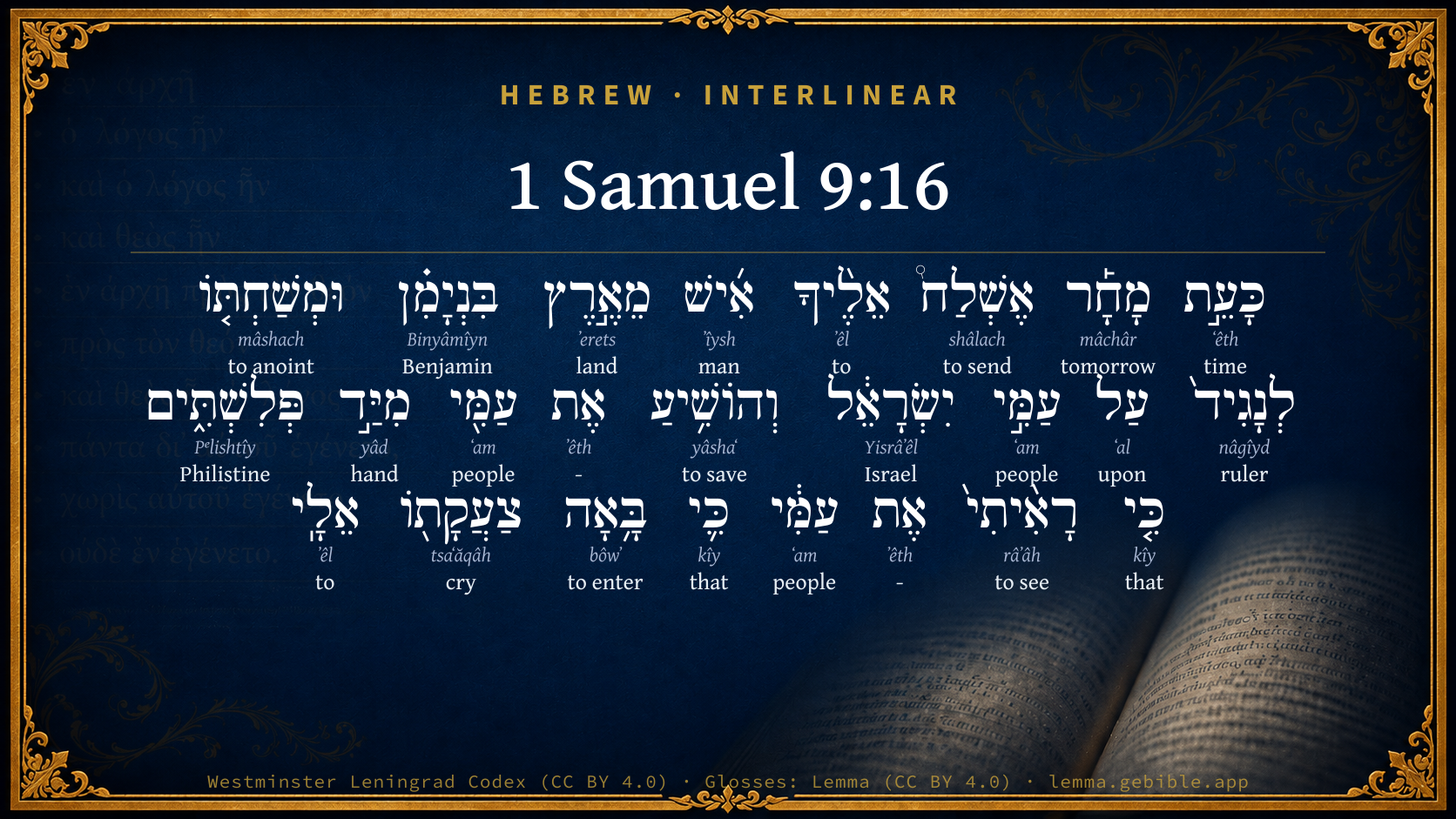
Hebrew (Westminster Leningrad Codex) 1 Samuel 9:16 appears in the Hebrew Old Testament. The text above is from the Westminster Leningrad Codex. Each word links to its Strong’s number, a concise gloss, and parsing drawn from the Open Scriptures Hebrew Bible morphology. Click any word for its full Brown-Driver-Briggs (BDB) entry.
Download image
Cite this verse

1 Samuel 9:16 (World English Bible). Public Domain. Lemma interlinear Bible study tool, https://lemma.gebible.app/v/1-samuel/9/16.

Show BibTeX & RIS
BibTeX
RIS
English Translation
Tomorrow about this time I will send you a man out of the land of Benjamin, and you shall anoint him to be prince over my people Israel; and he shall save my people out of the hand of the Philistines: for I have looked on my people, because their cry is come to me.
World English Bible · Public Domain
Highlights
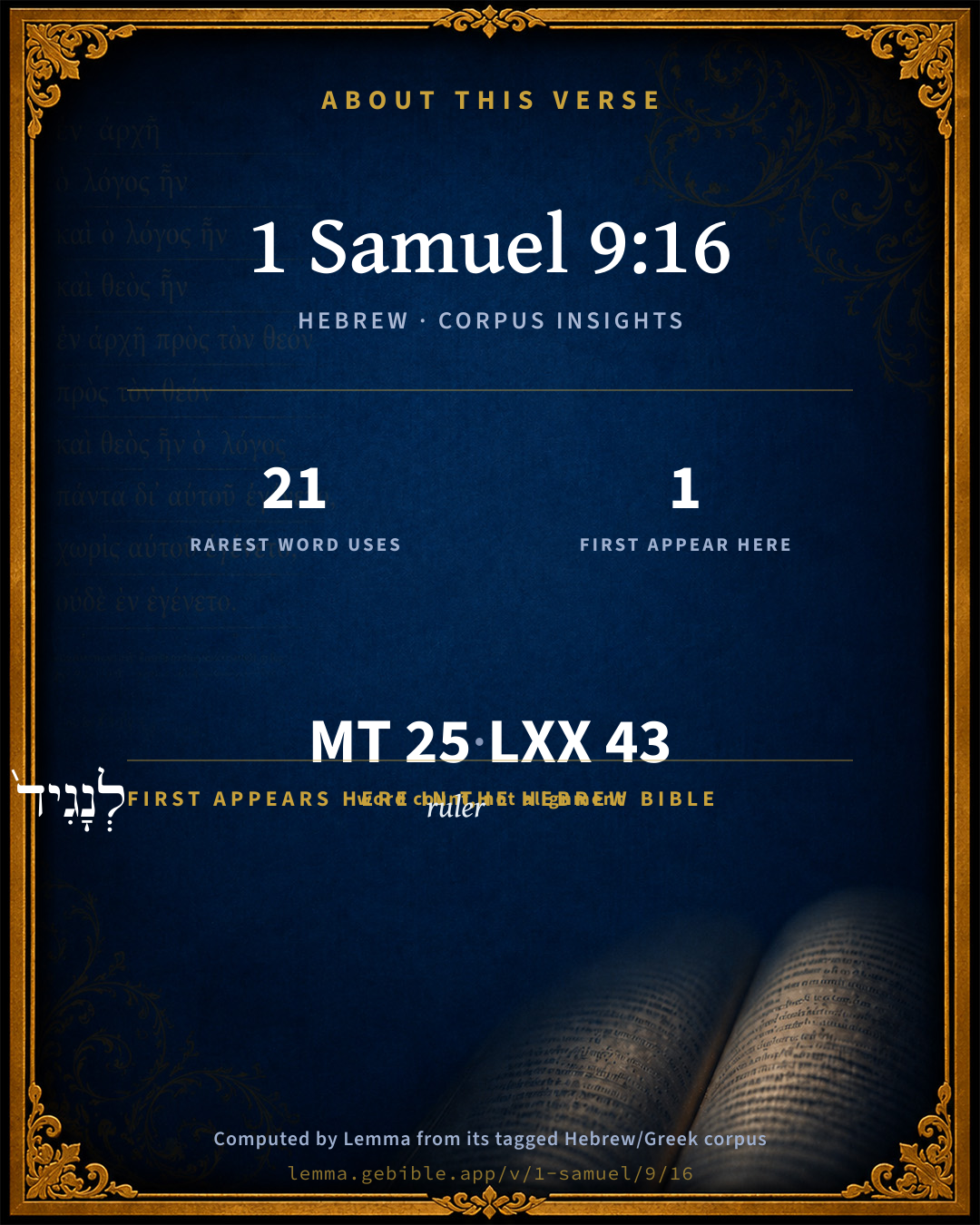
  • 1 first appearance in the Hebrew Bible
Full analysis ↓
Download a study sheet

One document with this verse’s original text, its word-by-word gloss line, the meaning frame, cross-references with their text, attributed commentary, and full source and license credits — printable, and it pastes into notes with its structure intact.

This verse Autodidact and up

Study sheet (.html) Plain text (.txt)

A passage Seminary Student

Up to 50 verses in one chapter. A passage sheet keeps up to 6 commentary sources and 12 cross-references per verse, in the order this page ranks them, and says so on the sheet whenever that leaves anything out. Ask for a single verse and you get the Autodidact verse sheet above.

Everything on this page stays free to read, with no account — the sheet is a download of what is already on screen, not access to it.

Want to remove ads? Support Godless Engineer
Compare translations 3

The same verse in 3 English versions, stacked beneath the original-language interlinear above. Click any original word for its lexicon entry.

Each is an independent rendering of the whole verse — the interlinear is not word-aligned to these translations.

Highlighted words mark where these versions differ — a whole-verse word diff, not a word-by-word alignment.

  • World English Bible Public Domain
    Tomorrow about this time I will send you a man out of the land of Benjamin, and you shall anoint him to be prince over my people Israel; and he shall save my people out of the hand of the Philistines: for I have looked on my people, because their cry is come to me.
  • King James Version Public Domain
    To morrow about this time I will send thee a man out of the land of Benjamin, and thou shalt anoint him to be captain over my people Israel, that he may save my people out of the hand of the Philistines: for I have looked upon my people, because their cry is come unto me.
  • unfoldingWord Literal Text CC BY-SA 4.0
    “About time tomorrow I will send to you a man from the land of Benjamin, and you shall anoint him as ruler over my people Israel. And he will save my people from the hand of the Philistines. For I have seen my people, for its cry has come to me.”

unfoldingWord Literal Text — © unfoldingWord, licensed CC BY-SA 4.0. Word-aligned USFM3 via Door43 (git.door43.org/unfoldingWord/en_ult).

Versions to compare (up to 4)

3 of 4 selected

Show all 18 translations

Every available English version of this verse, each an independent rendering of the whole verse.

  • World English Bible Public Domain
    Tomorrow about this time I will send you a man out of the land of Benjamin, and you shall anoint him to be prince over my people Israel; and he shall save my people out of the hand of the Philistines: for I have looked on my people, because their cry is come to me.
  • Berean Standard Bible Public Domain
    “At this time tomorrow I will send you a man from the land of Benjamin, and you are to anoint him leader over My people Israel; he will save them from the hand of the Philistines. For I have looked upon My people, because their cry has come to Me.”
  • Majority Standard Bible Public Domain
    “At this time tomorrow I will send you a man from the land of Benjamin, and you are to anoint him ruler over My people Israel; he will save them from the hand of the Philistines. For I have looked upon My people, because their cry has come to Me.”
  • King James Version Public Domain
    To morrow about this time I will send thee a man out of the land of Benjamin, and thou shalt anoint him to be captain over my people Israel, that he may save my people out of the hand of the Philistines: for I have looked upon my people, because their cry is come unto me.
  • American Standard Version (1901) Public Domain
    To-morrow about this time I will send thee a man out of the land of Benjamin, and thou shalt anoint him to be prince over my people Israel; and he shall save my people out of the hand of the Philistines: for I have looked upon my people, because their cry is come unto me.
  • Revised Version (1885) Public Domain
    Tomorrow about this time I will send thee a man out of the land of Benjamin, and thou shalt anoint him to be prince over my people Israel, and he shall save my people out of the hand of the Philistines: for I have looked upon my people, because their cry is come unto me:
  • Geneva Bible (1599) Public Domain
    To morow about this time I will send thee a man out of the land of Beniamin: him shalt thou anoint to be gouernour ouer my people Israel, that he may saue my people out of the hands of the Philistims: for I haue looked vpon my people, and their crie is come vnto me.
  • Douay-Rheims (1899) Public Domain
    To morrow about this same hour I will send thee a man of the land of Benjamin, and thou shalt anoint him to be ruler over my people Israel: and he shall save my people out of the hand of the Philistines: for I have looked down upon my people, because their cry is come to me.
  • Young's Literal Translation Public Domain
    `At this time tomorrow, I send unto thee a man out of the land of Benjamin -- and thou hast anointed him for leader over My people Israel, and he hath saved My people out of the hand of the Philistines; for I have seen My people, for its cry hath come in unto Me.'
  • Literal Standard Version CC BY-SA 4.0
    “At this time tomorrow, I send to you a man out of the land of Benjamin—and you have anointed him for leader over My people Israel, and he has saved My people out of the hand of the Philistines; for I have seen My people, for its cry has come to Me.”
  • Unlocked Literal Bible CC BY-SA 4.0
    “Tomorrow about this time I will send you a man from the land of Benjamin, and you will anoint him to be prince over my people Israel. He will save my people from the hand of the Philistines. For I have looked on my people with pity because their call for help has come to me.”
  • unfoldingWord Literal Text CC BY-SA 4.0
    “About time tomorrow I will send to you a man from the land of Benjamin, and you shall anoint him as ruler over my people Israel. And he will save my people from the hand of the Philistines. For I have seen my people, for its cry has come to me.”
  • Darby Bible Public Domain
    To-morrow about this time I will send thee a man out of the land of Benjamin, and thou shalt anoint him prince over my people Israel; and he will save my people out of the hand of the Philistines; for I have looked upon my people, because their cry is come unto me.
  • World Messianic Bible Public Domain
    “Tomorrow about this time I will send you a man out of the land of Benjamin, and you shall anoint him to be prince over my people Israel. He will save my people out of the hand of the Philistines; for I have looked upon my people, because their cry has come to me.”
  • Webster's Bible Public Domain
    To-morrow about this time I will send thee a man out of the land of Benjamin, and thou shalt anoint him to be captain over my people Israel, that he may save my people from the hand of the Philistines: for I have looked upon my people, because their cry has come to me.
  • Free Bible Version CC BY-SA 4.0
    “Around this time tomorrow I'm going to send you a man from the land of Benjamin. Anoint him as ruler over my people Israel, and he will rescue them from the Philistines. I have seen what's happening to my people and I have heard their cry for help.”
  • Bible in Basic English Public Domain
    Tomorrow about this time I will send you a man from the land of Benjamin, and on him you are to put the holy oil, making him ruler over my people Israel, and he will make my people safe from the hands of the Philistines: for I have seen the sorrow of my people, whose cry has come up to me.
  • JPS Tanakh (1917) Public Domain
    'To-morrow about this time I will send thee a man out of the land of Benjamin, and thou shalt anoint him to be prince over My people Israel, and he shall save My people out of the hand of the Philistines; for I have looked upon My people, because their cry is come unto Me.'

Literal Standard Version (2020), Covenant Press — licensed CC BY-SA 4.0. Text via the HelloAO Bible API (eBible.org). Unlocked Literal Bible (unfoldingWord) — licensed CC BY-SA 4.0. Text via the HelloAO Bible API (eBible.org). unfoldingWord Literal Text — © unfoldingWord, licensed CC BY-SA 4.0. Word-aligned USFM3 via Door43 (git.door43.org/unfoldingWord/en_ult). Free Bible Version, Dr. Jonathan Gallagher — licensed CC BY-SA 4.0. Text via the HelloAO Bible API (eBible.org).

Word by word

More ways to search: Search by grammar → Find every occurrence → Compare this word →

Practice this passage: Drill this verse → Learn its vocabulary →

צַעֲקָת֖וֹ
tsaʻăqâh
H6818
“cry · his”
Noun, Common, Feminine, Singular, Construct + Suffix, Personal, 3rd Person, Masculine, Singular
Part of Speech
Noun
Type
Common
Gender
Feminine
Number
Singular
State
Construct
Full BDB Definition

Origin: from H6817

TWOT: 1947a

cry, outcry - outcry (against) - cry of distress (especially as heard by God)
  1. כָּעֵ֣ת ʻêth H6256 “like/as the · time” Preposition, Determined + Noun, Common, Both, Singular, Absolute
  2. מָחָ֡ר mâchâr H4279 “tomorrow” Noun, Common, Masculine, Singular, Absolute
  3. אֶשְׁלַח֩ shâlach H7971 “to send” Verb, Qal, Imperfect, 1st Person, Common, Singular
  4. אֵלֶ֨יךָ ʼêl H413 “to · you” Preposition + Suffix, Personal, 2nd Person, Masculine, Singular
  5. אִ֜ישׁ ʼîysh H376 “man” Noun, Common, Masculine, Singular, Absolute
  6. מֵאֶ֣רֶץ ʼerets H776 “from · land of” Preposition + Noun, Common, Both, Singular, Construct
  7. בִּנְיָמִ֗ן Binyâmîyn H1144 “Benjamin” Noun, Proper
  8. וּמְשַׁחְתּ֤וֹ mâshach H4886 “and · to anoint · him” Conjunction + Verb, Qal, Sequential Perfect, 2nd Person, Masculine, Singular + Suffix, Personal, 3rd Person, Masculine, Singular
  9. לְנָגִיד֙ nâgîyd H5057 “to/for · ruler” Preposition + Noun, Common, Masculine, Singular, Absolute
  10. עַל ʻal H5921 “upon” Preposition
  11. עַמִּ֣י ʻam H5971 “people · my” Noun, Common, Masculine, Singular, Construct + Suffix, Personal, 1st Person, Common, Singular
  12. יִשְׂרָאֵ֔ל Yisrâʼêl H3478 “Israel” Noun, Proper
  13. וְהוֹשִׁ֥יעַ yâshaʻ H3467 “and · to save” Conjunction + Verb, Hiphil, Perfect, 3rd Person, Masculine, Singular
  14. אֶת ʼêth H853 “-” Particle, Direct Object
  15. עַמִּ֖י ʻam H5971 “people · my” Noun, Common, Masculine, Singular, Construct + Suffix, Personal, 1st Person, Common, Singular
  16. מִיַּ֣ד yâd H3027 “from · hand of” Preposition + Noun, Common, Both, Singular, Construct
  17. פְּלִשְׁתִּ֑ים Pᵉlishtîy H6430 “Philistines” Noun, Gentilic, Masculine, Plural, Absolute
  18. כִּ֤י kîy H3588 “that” Conjunction
  19. רָאִ֨יתִי֙ râʼâh H7200 “to see” Verb, Qal, Perfect, 1st Person, Common, Singular
  20. אֶת ʼêth H853 “-” Particle, Direct Object
  21. עַמִּ֔י ʻam H5971 “people · my” Noun, Common, Masculine, Singular, Construct + Suffix, Personal, 1st Person, Common, Singular
  22. כִּ֛י kîy H3588 “that” Conjunction
  23. בָּ֥אָה bôwʼ H935 “to enter” Verb, Qal, Perfect, 3rd Person, Feminine, Singular
  24. אֵלָֽי ʼêl H413 “to · me” Preposition + Suffix, Personal, 1st Person, Common, Singular

About this verse

These counts appear in no published source. They are computed here, from the morphology-tagged text and Lemma’s own curated glosses. What Lemma adds →

25
words
20
distinct lemmas
Historical
section

Notable vocabulary

The rarest word here is צַעֲקָת֖וֹ cry H6818 — appearing just 21 times in the whole Hebrew Bible.

First appearance in Scripture

This word makes its first canonical appearance in the Hebrew Bible here:

  • לְנָגִיד֙ ruler H5057

Shared distinctive vocabulary

צַעֲקָת֖וֹ cry H6818 occurs in 20 verses of the Hebrew Bible. Also found in:

Grammatical profile

  • 5 verbs
  • 13 nouns
  • 3 prepositions
  • 2 conjunctions
  • 2 particles

Verb forms

  • אֶשְׁלַח֩ Qal · Imperfect
  • וּמְשַׁחְתּ֤וֹ Qal · Sequential Perfect
  • וְהוֹשִׁ֥יעַ Hiphil · Perfect
  • רָאִ֨יתִי֙ Qal · Perfect
  • בָּ֥אָה Qal · Perfect

Repetition

Words recur within this verse — often emphatic in Hebrew:

  • עַמִּ֣י people H5971 ×3
  • אֵלֶ֨יךָ to H413 ×2
  • כִּ֤י that H3588 ×2

Hebrew & Septuagint length

In English translation the verse runs 55 words from the Hebrew and 59 from the Septuagint (LXX English) — closely comparable.

A rough comparison of the two English renderings, which tokenize alike — not a word-level alignment.

Word counts can differ between the Hebrew and the Greek without any difference in meaning — e.g. the Hebrew direct-object marker אֵת has no separate Greek word, and Greek often adds the article ὁ.

In the original languages it is 25 Hebrew tokens and 43 Greek tokens — but the two are counted differently (Hebrew bundles its prefixes and suffixes into one token; the Greek is in lemma form), so that isn’t a like-for-like length.

Cross-references

9

Topical passages linked to 1 Samuel 9:16 in the Treasury of Scripture Knowledge — connected by theme and wording, ordered by reader-vote popularity; previews shown in the World English Bible.

  • 1 Samuel 10:1 Then Samuel took the vial of oil, and poured it on his head, and kissed him, and said, Isn't it that Yahweh has anointed you to be prince over his inheritance?
  • Exodus 3:7–9 Yahweh said, "I have surely seen the affliction of my people who are in Egypt, and have heard their cry because of their taskmasters, for I know their sorrows.
  • Psalms 25:18 Consider my affliction and my travail. Forgive all my sins.
  • Psalms 106:44 Nevertheless he regarded their distress, When he heard their cry.
  • 1 Samuel 15:1 Samuel said to Saul, Yahweh sent me to anoint you to be king over his people, over Israel: now therefore listen you to the voice of the words of Yahweh.
  • Exodus 2:23–25 It happened in the course of those many days, that the king of Egypt died, and the children of Israel sighed because of the bondage, and they cried, and their cry came up to God because of the bondage.
  • 1 Kings 19:15–16 Yahweh said to him, Go, return on your way to the wilderness of Damascus: and when you come, you shall anoint Hazael to be king over Syria;
  • 2 Kings 9:3–6 Then take the vial of oil, and pour it on his head, and say, Thus says Yahweh, I have anointed you king over Israel. Then open the door, and flee, and don't wait.
  • 1 Samuel 16:3 Call Jesse to the sacrifice, and I will show you what you shall do: and you shall anoint to me him whom I name to you.

Cross-references courtesy of OpenBible.info (CC BY 4.0).

Hebrew and Greek witnesses Masoretic Hebrew ↔ Greek Septuagint

The same verse in the two great witnesses to the Old Testament, shown verse-for-verse.

These are two independent witnesses, not word-aligned to each other, and the Septuagint is shown in lemma (dictionary) form.

Hebrew 1 Samuel 9:16 Masoretic · Westminster Leningrad Codex

כָּעֵ֣ת מָחָ֡ר אֶשְׁלַח֩ אֵלֶ֨יךָ אִ֜ישׁ מֵאֶ֣רֶץ בִּנְיָמִ֗ן וּמְשַׁחְתּ֤וֹ לְנָגִיד֙ עַל עַמִּ֣י יִשְׂרָאֵ֔ל וְהוֹשִׁ֥יעַ אֶת עַמִּ֖י מִיַּ֣ד פְּלִשְׁתִּ֑ים כִּ֤י רָאִ֨יתִי֙ אֶת עַמִּ֔י כִּ֛י בָּ֥אָה צַעֲקָת֖וֹ אֵלָֽי

Tomorrow about this time I will send you a man out of the land of Benjamin, and you shall anoint him to be prince over my people Israel; and he shall save my people out of the hand of the Philistines: for I have looked on my people, because their cry is come to me.

World English Bible · Public Domain

Greek LXX 1 Samuel 9:16 Septuagint · lemma form

ὡς ὁ καιρός αὔριον ἀποστέλλω πρός σύ ἀνήρ ἐκ γῆ βενιαμίν καί χρίω αὐτός εἰς ἄρχων ἐπί ὁ λαός ἐγώ ἰσραήλ καί σώζω ὁ λαός ἐγώ ἐκ χείρ ἀλλόφυλος ὅτι ἐπιβλέπω ἐπί ὁ ταπείνωσις ὁ λαός ἐγώ ὅτι ἔρχομαι βοή αὐτός πρός ἐγώ

At this time to-morrow I will send to you a man out of the land of Benjamin, and you shall anoint him to be ruler over my people Israel, and he shall save my people out of the hand of the Philistines; for I have looked upon the humiliation of my people, for their cry is come to me.

LXX2012 (modern English Septuagint) · Public Domain

On this verse, Haydock's Catholic Bible Commentary discusses the Septuagint’s reading. Read the note in Commentary ↓

Hebrew: Westminster Leningrad Codex (CC BY 4.0). Greek: Septuagint (public domain); English from LXX2012 (modern English Septuagint) (Public Domain). How the Septuagint differs from the Hebrew →

Targum (Aramaic paraphrase)

1

The Targum is the ancient Jewish Aramaic paraphrase of the Hebrew Scriptures — an interpretive translation, not the Hebrew text itself. Onkelos (literal) and Pseudo-Jonathan (expansive) render the Torah, and Jonathan the Prophets. Coverage is partial: where no permissively-licensed English translation exists for a verse, only the Aramaic is shown. This is verse-level text, not a word-by-word alignment to the Hebrew.

  1. Targum Jonathan Prophets (Joshua–Malachi)
    כְּעִידַן הָדֵין מְחָר אֶשְׁלַח לְוָתָךְ גַבְרָא מֵאַרְעָא שֵׁבֶט בִּנְיָמִין וְתִמְשְׁחִינֵיהּ לְמֶהֱוֵי מַלְכָּא עַל עַמִי יִשְׂרָאֵל וְיִפְרוֹק יַת עַמִי מִידָא דִפְלִשְׁתָּאֵי אֲרֵי גְלֵי קֳדָמַי דוֹחֲקָא דְעַמִי אֲרֵי עֲלַת קְבֵילְתֵּהוֹן לָקֳדָמָי:

    (no public-domain English translation for this verse)

    Targum Jonathan — Aramaic: “Mikraot Gedolot” (public domain). English: “Sefaria Community Translation” (CC0 1.0 (public-domain dedication)); “London "Chaldee Paraphrase," 1871” (public domain). Text via Sefaria.

Commentary

Notes on 1 Samuel 9:16 from classic Christian and Jewish commentators (each source and its license shown beneath its notes). The classic Christian expositions comment on the surrounding passage and are grouped to its opening verse, so a note may address several verses; the Jewish commentaries on the Tanakh (Rashi and others) are per-verse, so they appear only where the commentator wrote on this verse.

Lemma curates 59 commentaries, every one of them public domain or Creative Commons licensed, each selected and text-cleaned for this edition rather than reprinted as found. About our sources →

Trapp's Complete Commentary

John Trapp

1Sa 9:16 To morrow about this time I will send thee a man out of the land of Benjamin, and thou shalt anoint him [to be] captain over my people Israel, that he may save my people out of the hand of the Philistines: for I have looked upon my people, because their cry is come unto me.

Ver. 16. I will send thee a than out of the land of Benjamin.] Arcana gubernatione mea ipso aliud agente. {a} Little did Saul think of the kingdom when he came to Ramah. And as little do we think of heaven, when God by effectual calling "delivereth us from the power of darkness, and translateth us into the kingdom of his dear Son." {Col 1:13}

And thou shalt anoint him to be captain.] Unges eum Antecessorem. Public persons are leaders to others, being as the he-goats before the flock, and therefore must have double care, since they have many eyes upon them.

Out of the hand of the Philistines.] Who were now, as it may seem, confederate with the Ammonites against Israel. {1Sa 12:12}

For I have looked upon my people.] Notwithstanding their late miscarriage in rejecting mine immediate government. "Is Ephraim my dear son? is he a pleasant child? for since I spoke against him, I do earnestly remember him still: therefore my bowels are troubled for him; I will surely have mercy upon him, saith the Lord." {Jer 31:20}

.Because their cry is come unto me.] As Exo 3:9. And the good people cried, Domine indignus sum, sed indigus; I am unworthy of mercy, but I much need it.

{a} Piscat.

John Trapp, A Commentary or Exposition upon All the Books of the Old and New Testament (1647–1656) — public domain. Text from a community e-Sword module.

Joseph Benson's Commentary

1Sa 9:16. To-morrow I will send thee a man, &c. — This shows still that all was done by God’s direction. Out of the hand of the Philistines — Though driven out of the country by Samuel, they were now ready, as appears by the following history, to invade it again; and being the constant and nearest enemies of the Israelites, they were most dreaded by them. And from these did Saul in some measure save them, and would have saved them much more, if his and the people’s sins had not hindered. For I have looked upon my people, because their cry is come unto me — Though he would not hear their cry to relieve them from the oppressions of their kings, (1Sa 8:18,) yet he was so gracious as to make those kings instruments of their deliverance from the oppression of their cruel neighbours.

Joseph Benson's Commentary on the Old and New Testaments (1811–1818) — public domain. Text from a community e-Sword module.

Tyndale Open Study Notes

Tyndale Open Resources

9:16 God’s directive to anoint him (by pouring olive oil on the head) marked Saul’s elevation in status and consecration for a special purpose (see Exod 30:22-33; Lev 8:12; 1 Kgs 19:16; Isa 45:1). • He will rescue them: As they had requested (1 Sam 8:20; cp. Judg 13:5). David eventually subdued the Philistines (2 Sam 5:17-25; 8:1; 21:15, 18-22). • for I have . . . heard their cry (cp. Exod 3:7-9): The Philistines were again threatening to conquer Israel and demand homage from them as vassals.

Tyndale Open Study Notes — © Tyndale Open Resources, licensed CC BY-SA 4.0. Text via the HelloAO Bible API.

Geneva Bible (1599)

Geneva Bible translators

Notwithstanding their wickedness, yet God was ever mindful of his inheritance.

Geneva Bible (1599) marginal notes — public domain. Text via Bolls.life.

Adam Clarke's Commentary

Verse 16. Thou shalt anoint him to be captain] Not to be king, but to be נגיד nagid or captain of the Lord's host. But in ancient times no king was esteemed who was not an able warrior. Plutarch informs us that Alexander the Great esteemed the following verse the most correct, as to its sentiment, of any in the whole Iliad of Homer: -

Ουτος γ' Ατρειδης ευρυκρειων Αγαμεμνων,

Αμφοτερον βασιλευς τ' αγαθος, κρατερος τ' αιχμητης.

"The king of kings, Atrides, you survey;

Great in the war, and great in acts of sway."

POPE.

Adam Clarke's Commentary on the Bible (1810–1826) — public domain. Text from a community e-Sword/MySword module.

Ellicott's Commentary for English Readers

(16) The Philistines.—This statement evidently points to the fact—of which, a little later, we have such ample evidence—that at this juncture the Philistines were again harassing the Israelite territory with their destructive raids. The power of the Philistines was broken, but by no means destroyed, in the great battle of Mizpeh. We know that all through King Saul’s reign, and in the early days of King David, these invasions were repeated with varying success. The statement of 1Sa_7:13 must be understood not as representing that the victory of Mizpeh once and for all destroyed the Philistine power, but that from that day the power of these determined enemies of Israel began to decline. The words of 1Sa_7:13 must be taken as including the ultimate result of the great Hebrew victory. It is clear that the annoyance of these Philistine raids and incursions were the immediate cause of the prayer for a king. The desire for this form of government, no doubt, for a very long while had existed among the people, but this pressing need for a younger and more warlike leader than their old prophet. judge prompted the request to Samuel.

A Bible Commentary for English Readers, edited by Charles John Ellicott (1878–1897) — public domain. Text from a community e-Sword module.

The Cambridge Bible for Schools and Colleges

gen. ed. J. J. S. Perowne

16. out of the hand of the Philistines] See note on 1Sa_7:13.

I have looked upon my people] Sept. “I have looked upon the affliction, of my people.” The word might easily have fallen out of the Hebrew text. Cp. Exo_3:7; Exo_3:9.

The Cambridge Bible for Schools and Colleges (gen. ed. J. J. S. Perowne; Cambridge University Press, 1878–1918) — public domain. Text from a community e-Sword module.

John Gill's Exposition

Tomorrow about this time I will send thee a man out of the land of Benjamin,.... Who without any thought or design of his own, but merely directed by the providence of God, should come to him, not expecting a kingdom; at most only to hear of his father's asses, and which way he should take to find them; missing the finding of which would and did bring him thither:

and thou shalt anoint him to be captain over my people Israel; the leader, ruler, and governor of them; to which high office he was to be appointed by pouring oil upon him, and was the first king on whom this ceremony was performed, and from whence he was called the Lord's anointed:

that he may save my people out of the hands of the Philistines; who, since Samuel was grown old, made encroachments upon them, built garrisons on their borders, and made, it is very probable, incursions upon them, and ravages and oppressions of them:

for I have looked upon my people; with an eye of pity and compassion:

because their cry is come unto me; by reason of the oppressions of the Philistines, and the war they were threatened with by the Ammonites; though Abarbinel thinks this refers to their importunate cry, supplication, and request to have a king set over them.

John Gill's Exposition of the Whole Bible (1746–1763) — public domain (CC PDM 1.0). Text via the HelloAO Bible API.

Albert Barnes' Notes on the Bible

That he may save my people out of the hand of the Philistines, etc. - These words are not very easily reconcileable with 1Sa 7:13. It is possible that the aggressive movements of the Philistines, after the long cessation indicated by 1Sa 7:13, coupled with Samuel’s old age and consequent inability to lead them to victory as before, were among the chief causes which led to the cry for a king. If this were so the Philistine oppression glanced at in this verse might in a general survey be rather connected with Saul’s times than with Samuel’s.

Albert Barnes' Notes on the Bible (1834–1885) — public domain. Text from a community e-Sword/MySword module.

Haydock's Catholic Bible Commentary

Ruler. Hebrew, Nagid, "Leader." Septuagint, "Archon." Chaldean, "King." The Israelites demanded a king, to lead them, and to fight for them; and Homer (Iliad iii.) gives this idea of the chief magistrate, "a good king and stout warrior," which Alexander so much admired. --- Philistines. They had been repressed by Samuel; but they had begun to gain the ascendancy, so as not to suffer the Israelites to have a blacksmith among them, &c. Saul gained some victories over them, and over the other enemies of his people, towards the beginning of his reign, chap. xiii., and xiv. (Calmet) --- To me. God threatened that he would not hear them, when they should grow weary (Haydock) of their king, chap. viii. 18. But he protects his people against the efforts of their foreign enemies. (Menochius) --- Oppression of the innocent cries to heaven for vengeance. (Worthington)

George Leo Haydock (1774–1849), Haydock's Catholic Family Bible and Commentary, 1859 edition — public domain. Excludes Psalms (Douay-Rheims chapter numbering differs from Protestant) and Deuterocanonical books (Catholic canon only).

Matthew Poole's English Annotations

I will send thee a man; I will by my secret providence so dispose of matters, and of the hearts of Saul and his father, that Saul shall come to thee, though with another design.

That he may save my people out of the hand of the Philistines; for though they were now most pressed with the Ammonites, as we read, 1Sa 12:12, yet they looked upon these as a land-flood, which they hoped would be soon up, and soon down again; but the Philistines, their constant, inveterate, and nearest enemies, they most dreaded. And from these Saul did in some measure save them, and should have saved them much more, if his and the people’s manifold sins had not hindered it.

I have looked on my people, to wit, with compassion and resolution to help them; a usual synecdoche.

Their cry, i.e. their earnest prayers to me for help.

Matthew Poole's English Annotations on the Holy Bible (1683–1685) — public domain. Text from a community e-Sword/MySword module.

Whedon's Commentary on the Bible

Daniel D. Whedon

16. Save my people out of the hand of the Philistines — This does not imply that Israel was now in subjection to the Philistines, for after the triumph of Mizpeh (chap. 7) the Philistines were not successful in their attempts to invade the land of Israel as long as Samuel lived; but this verse, as well as chap. 1Sa_7:13, shows that the Philistines continually harassed Israel by attempts to regain their lost dominion over them.

I have looked upon my people — With an eye of compassion, and with intent to help them.

Daniel D. Whedon (gen. ed.), Commentary on the Old and New Testaments (1874–1909) — public domain. Text from a community e-Sword module.

The Pulpit Commentary

That he may save my people out of the hand of the Philistines. Though Samuel had lightened the yoke of the Philistines by his victory at Mizpah, yet he had by no means altogether broken their power. It is so constantly the habit of the historical books of the Bible to include the distant and ultimate results of an act in their account of it, that we must not conclude that what is said in 1Sa_7:13-15 was the immediate consequence of Samuel"s victory. Especially, when it said that "the hand of Jehovah was against the Philistines all the days of Samuel," it is plain that Soul"s successful wars are included in the writer"s summary of events, inasmuch as Samuel"s life was prolonged until nearly the close of that monarch"s reign. The words further show that Soul"s office was essentially military, though this is too much emphasised in the A.V, which renders by captain a word which really means prince, chief. Saul, as a Benjamite, belonged to the bravest and most warlike tribe of Israel, and one whose country was the seat of perpetual combat with the Philistines. Their cry is come unto me. Plainly, therefore, Israel was again suffering from Philistine domination.

The Pulpit Commentary (1880–1919), ed. H.D.M. Spence-Jones & Joseph S. Exell — public domain. Text from a community e-Sword module.

John Wesley's Explanatory Notes

Philistines - For though they were now most pressed with the Ammonites, yet they looked upon these as a land-flood, soon up, and soon down again: but the Philistines, their constant and nearest enemies, they most dreaded. And from these did Saul in some measure save them, and would have saved them much more, if his and the people's sins had not hindered.

John Wesley, Explanatory Notes Upon the Whole Bible (1754–1765) — public domain. Text via the GEBible commentary corpus.

Lesson kit

Teaching starters — assembled from the data on this page, not authored interpretation. Every prompt links to the verse data it draws on. Edit before teaching.

1 Samuel, in the Historical, opens this verse with 25 words (20 distinct Hebrew lemmas). Its most distinctive word is tsaʻăqâh (“cry”). A historical commentator’s framing appears above. Read the whole chapter for the surrounding context.

Discussion questions

  1. How does “cry” (tsaʻăqâh) shape what this verse is saying?
  2. The word “ruler” first appears here in Scripture. What is being introduced at this debut?
  3. Genesis 18:21 shares the word «cry» with this verse. How do the two illuminate each other?
  4. “people” occurs 3× in this one verse. What is the effect of the repetition?
  5. These translations render this verse differently; the difference is in the English rendering, not the original. What questions does that raise?
  6. The verb «אֶשְׁלַח֩» is Qal Imperfect. How does its form color the action?
  7. Reading how Trapp's Complete Commentary and Joseph Benson's Commentary read this verse, where do the two commentators agree and where do they part?

Things to notice

Reading settings

Reading text

Shown beneath each verse's original-language words.

Old Testament
Old Testament edition

Read the OT as the Masoretic Hebrew (MT) or the Greek Septuagint (LXX).

English shown for the Greek Septuagint (in the Hebrew ↔ Greek comparison).

Comparing translations? Open the Compare panel on any verse page to stack up to four side by side.