

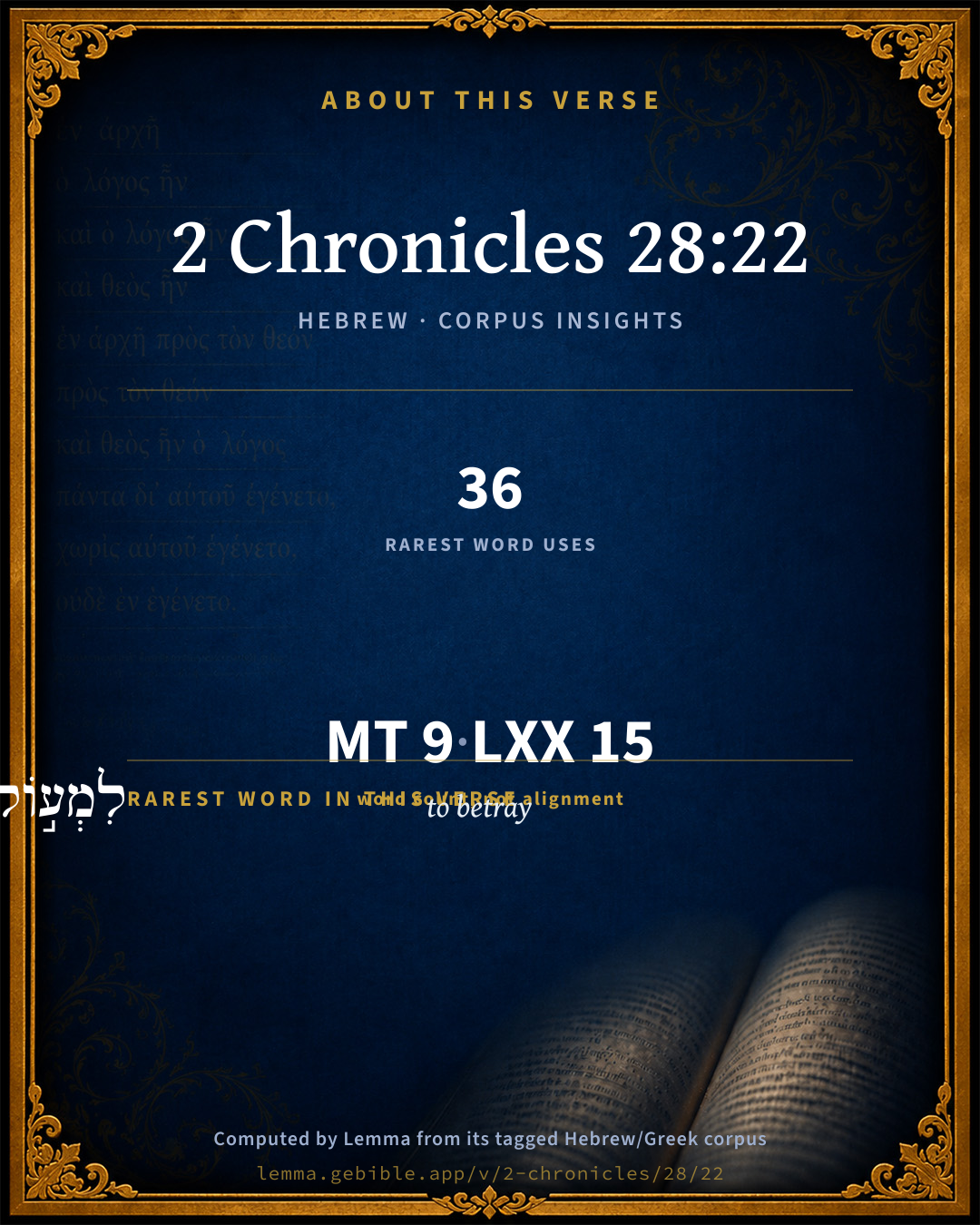
2 Chronicles 28:22

Hebrew (Westminster Leningrad Codex) 2 Chronicles 28:22 appears in the Hebrew Old Testament. The text above is from the Westminster Leningrad Codex. Each word links to its Strong’s number, a concise gloss, and parsing drawn from the Open Scriptures Hebrew Bible morphology. Click any word for its full Brown-Driver-Briggs (BDB) entry.
Download image
Cite this verse

2 Chronicles 28:22 (World English Bible). Public Domain. Lemma interlinear Bible study tool, https://lemma.gebible.app/v/2-chronicles/28/22.

Show BibTeX & RIS
BibTeX
RIS
English Translation
In the time of his distress did he trespass yet more against Yahweh, this same king Ahaz.
World English Bible · Public Domain
Download a study sheet

One document with this verse’s original text, its word-by-word gloss line, the meaning frame, cross-references with their text, attributed commentary, and full source and license credits — printable, and it pastes into notes with its structure intact.

This verse Autodidact and up

Study sheet (.html) Plain text (.txt)

A passage Seminary Student

Up to 50 verses in one chapter. A passage sheet keeps up to 6 commentary sources and 12 cross-references per verse, in the order this page ranks them, and says so on the sheet whenever that leaves anything out. Ask for a single verse and you get the Autodidact verse sheet above.

Everything on this page stays free to read, with no account — the sheet is a download of what is already on screen, not access to it.

Want to remove ads? Support Godless Engineer
Compare translations 3

The same verse in 3 English versions, stacked beneath the original-language interlinear above. Click any original word for its lexicon entry.

Each is an independent rendering of the whole verse — the interlinear is not word-aligned to these translations.

Highlighted words mark where these versions differ — a whole-verse word diff, not a word-by-word alignment.

  • World English Bible Public Domain
    In the time of his distress did he trespass yet more against Yahweh, this same king Ahaz.
  • King James Version Public Domain
    And in the time of his distress did he trespass yet more against the LORD: this is that king Ahaz.
  • unfoldingWord Literal Text CC BY-SA 4.0
    And in the time of his harassment, and he added to act faithlessly against Yahweh, this King Ahaz.

unfoldingWord Literal Text — © unfoldingWord, licensed CC BY-SA 4.0. Word-aligned USFM3 via Door43 (git.door43.org/unfoldingWord/en_ult).

Versions to compare (up to 4)

3 of 4 selected

Show all 18 translations

Every available English version of this verse, each an independent rendering of the whole verse.

  • World English Bible Public Domain
    In the time of his distress did he trespass yet more against Yahweh, this same king Ahaz.
  • Berean Standard Bible Public Domain
    In the time of his distress, King Ahaz became even more unfaithful to the LORD.
  • Majority Standard Bible Public Domain
    In the time of his distress, King Ahaz became even more unfaithful to the LORD.
  • King James Version Public Domain
    And in the time of his distress did he trespass yet more against the LORD: this is that king Ahaz.
  • American Standard Version (1901) Public Domain
    And in the time of his distress did he trespass yet more against Jehovah, this same king Ahaz.
  • Revised Version (1885) Public Domain
    And in the time of his distress did he trespass yet more against the LORD, this same king Ahaz.
  • Geneva Bible (1599) Public Domain
    And in ye time of his tribulation did he yet trespasse more against ye Lord, (this is King Ahaz)
  • Douay-Rheims (1899) Public Domain
    Moreover also in the time of his distress he increased contempt against the Lord: king Achaz himself by himself,
  • Young's Literal Translation Public Domain
    And in the time of his distress -- he addeth to trespass against Jehovah, (this king Ahaz),
  • Literal Standard Version CC BY-SA 4.0
    And in the time of his distress—he adds to trespass against YHWH (this King Ahaz),
  • Unlocked Literal Bible CC BY-SA 4.0
    This same King Ahaz sinned even more against Yahweh in his time of suffering.
  • unfoldingWord Literal Text CC BY-SA 4.0
    And in the time of his harassment, and he added to act faithlessly against Yahweh, this King Ahaz.
  • Darby Bible Public Domain
    And in the time of his trouble he transgressed yet more against Jehovah, this king Ahaz.
  • World Messianic Bible Public Domain
    In the time of his distress, he trespassed yet more against the LORD, this same King Ahaz.
  • Webster's Bible Public Domain
    And in the time of his distress he trespassed yet more against the LORD: this is that king Ahaz.
  • Free Bible Version CC BY-SA 4.0
    Even at this time when he was having so much trouble, King Ahaz sinned more and more against the Lord.
  • Bible in Basic English Public Domain
    And in the time of his trouble, this same King Ahaz did even more evil against the Lord.
  • JPS Tanakh (1917) Public Domain
    And in the time of his distress did he act even more treacherously against the LORD, this same king Ahaz.

Literal Standard Version (2020), Covenant Press — licensed CC BY-SA 4.0. Text via the HelloAO Bible API (eBible.org). Unlocked Literal Bible (unfoldingWord) — licensed CC BY-SA 4.0. Text via the HelloAO Bible API (eBible.org). unfoldingWord Literal Text — © unfoldingWord, licensed CC BY-SA 4.0. Word-aligned USFM3 via Door43 (git.door43.org/unfoldingWord/en_ult). Free Bible Version, Dr. Jonathan Gallagher — licensed CC BY-SA 4.0. Text via the HelloAO Bible API (eBible.org).

Word by word

More ways to search: Search by grammar → Find every occurrence → Compare this word →

Practice this passage: Drill this verse → Learn its vocabulary →

לִמְע֣וֹל
mâʻal
H4603
“to betray”
Preposition + Verb, Qal, Infinitive Construct
Part of Speech
Preposition + Verb
Stem
Qal
Form
Infinitive Construct
Full BDB Definition

Origin: a primitive root

TWOT: 1230

to act unfaithfully, act treacherously, transgress, commit a trespass - (Qal) to act unfaithfully or treacherously - against man - against God - against devoted thing - against husband
  1. וּבְעֵת֙ ʻêth H6256 “and · in/at · time of” Conjunction + Preposition + Noun, Common, Both, Singular, Construct
  2. הָצֵ֣ר tsârar H6887 “to bind” Verb, Hiphil, Infinitive Construct
  3. וַיּ֖וֹסֶף yâçaph H3254 “and · to add” Conjunction + Verb, Hiphil, Sequential Imperfect, 3rd Person, Masculine, Singular
  4. בַּיהוָ֑ה Yᵉhôvâh H3068 “in/at · LORD” Preposition + Noun, Proper
  5. ה֖וּא hûwʼ H1931 “he” Pronoun, Personal, 3rd Person, Masculine, Singular
  6. הַמֶּ֥לֶךְ melek H4428 “the · king” Particle, Definite Article + Noun, Common, Masculine, Singular, Absolute
  7. אָחָֽז ʼÂchâz H271 “Ahaz” Noun, Proper

About this verse

These counts appear in no published source. They are computed here, from the morphology-tagged text and Lemma’s own curated glosses. What Lemma adds →

9
words
8
distinct lemmas
Historical
section

Shared distinctive vocabulary

לִמְע֣וֹל to betray H4603 occurs in 35 verses of the Hebrew Bible. Also found in:

Grammatical profile

  • 3 verbs
  • 4 nouns
  • 1 pronoun
  • 1 preposition

Verb forms

  • הָצֵ֣ר Hiphil · Infinitive Construct
  • וַיּ֖וֹסֶף Hiphil · Sequential Imperfect
  • לִמְע֣וֹל Qal · Infinitive Construct

Hebrew & Septuagint length

In English translation the verse runs 17 words from the Hebrew and 19 from the Septuagint (LXX English) — closely comparable.

A rough comparison of the two English renderings, which tokenize alike — not a word-level alignment.

Word counts can differ between the Hebrew and the Greek without any difference in meaning — e.g. the Hebrew direct-object marker אֵת has no separate Greek word, and Greek often adds the article ὁ.

In the original languages it is 9 Hebrew tokens and 15 Greek tokens — but the two are counted differently (Hebrew bundles its prefixes and suffixes into one token; the Greek is in lemma form), so that isn’t a like-for-like length.

Cross-references

9

Topical passages linked to 2 Chronicles 28:22 in the Treasury of Scripture Knowledge — connected by theme and wording, ordered by reader-vote popularity; previews shown in the World English Bible.

  • Isaiah 1:5 Why should you be beaten more, That you revolt more and more? The whole head is sick, And the whole heart faint.
  • Jeremiah 5:3 O Yahweh, don't your eyes look on truth? you have stricken them, but they were not grieved; you have consumed them, but they have refused to receive correction: they have made their faces harder than a rock; they have refused to return.
  • Ezekiel 21:13 For there is a trial; and what if even the rod that condemns shall be no more? says the Lord Yahweh.
  • 2 Chronicles 33:12 When he was in distress, he begged Yahweh his God, and humbled himself greatly before the God of his fathers.
  • Esther 7:6 Esther said, An adversary and an enemy, even this wicked Haman. Then Haman was afraid before the king and the queen.
  • Psalms 50:15 Call on me in the day of trouble. I will deliver you, and you will honor me."
  • Psalms 52:7 "Behold, this is the man who didn't make God his strength, But trusted in the abundance of his riches, And strengthened himself in his wickedness."
  • Hosea 5:15 I will go and return to my place, until they acknowledge their offense, And seek my face. In their affliction they will seek me earnestly."
  • Revelation 16:9–11 People were scorched with great heat, and people blasphemed the name of God who has the power over these plagues. They didn't repent and give him glory.

Cross-references courtesy of OpenBible.info (CC BY 4.0).

Hebrew and Greek witnesses Masoretic Hebrew ↔ Greek Septuagint

The same verse in the two great witnesses to the Old Testament, shown verse-for-verse.

These are two independent witnesses, not word-aligned to each other, and the Septuagint is shown in lemma (dictionary) form.

Hebrew 2 Chronicles 28:22 Masoretic · Westminster Leningrad Codex

וּבְעֵת֙ הָצֵ֣ר ל֔וֹ וַיּ֖וֹסֶף לִמְע֣וֹל בַּיהוָ֑ה ה֖וּא הַמֶּ֥לֶךְ אָחָֽז

In the time of his distress did he trespass yet more against Yahweh, this same king Ahaz.

World English Bible · Public Domain

Greek LXX 2 Chronicles 28:22 Septuagint · lemma form

ἀλλά ἤ ὁ θλίβω αὐτός καί προςτίθημι ὁ ἀποἵστημι ἀπό κύριος καί εἶπον ὁ βασιλεύς

but only troubled him in his affliction: and he departed yet more from the Lord, and king Achaz said,

LXX2012 (modern English Septuagint) · Public Domain

Hebrew: Westminster Leningrad Codex (CC BY 4.0). Greek: Septuagint (public domain); English from LXX2012 (modern English Septuagint) (Public Domain). How the Septuagint differs from the Hebrew →

Commentary

Notes on 2 Chronicles 28:22 from classic Christian and Jewish commentators (each source and its license shown beneath its notes). The classic Christian expositions comment on the surrounding passage and are grouped to its opening verse, so a note may address several verses; the Jewish commentaries on the Tanakh (Rashi and others) are per-verse, so they appear only where the commentator wrote on this verse.

Lemma curates 59 commentaries, every one of them public domain or Creative Commons licensed, each selected and text-cleaned for this edition rather than reprinted as found. About our sources →

Jamieson, Fausset & Brown

Robert Jamieson, A. R. Fausset & David Brown

HIS IDOLATRY IN HIS DISTRESS. (Ch2 28:22-27)

in the time of his distress did he trespass yet more against the Lord--This infatuated king surrendered himself to the influence of idolatry and exerted his royal authority to extend it, with the intensity of a passion--with the ignorance and servile fear of a heathen (Ch2 28:23) and a ruthless defiance of God (see on Kg2 16:10-20).

Next: 2 Chronicles Chapter 29

Jamieson, Fausset & Brown — Commentary Critical and Explanatory on the Whole Bible (1871) — public domain (CC PDM 1.0). Text via the HelloAO Bible API.

Ellicott's Commentary for English Readers

AHAZ ADOPTS THE SYRIAN IDOLATRY, AND CLOSES THE TEMPLE (2Ch_28:22-25; comp. 2Ki_16:10-18).

(22) In the time of his distress.—At the time when he (Tiglath) oppressed him, i.e., at the time when Ahaz went to Damascus to do homage to the Assyrian monarch (2Ki_16:10), probably in reluctant obedience to a peremptory mandate.

Did he trespass . . . Ahaz.—He dealt yet more unfaithfully towards Jehovah, he, king Ahaz. The subject is emphatically repeated: “he, king Ahaz,” who had already been sorely chastised, sinned yet more. Or “he, king Ahaz,” the notorious apostate.

A Bible Commentary for English Readers, edited by Charles John Ellicott (1878–1897) — public domain. Text from a community e-Sword module.

Trapp's Complete Commentary

John Trapp

2Ch 28:22 And in the time of his distress did he trespass yet more against the LORD: this [is that] king Ahaz.

Ver. 22. And yet in the time of his distress.] So stubborn was he and stiff necked, he would sooner break than bend. Such refractories also were Pharaoh, Saul, the Scribes and Pharisees, the railing thief that suffered with our Saviour: "reprobate silver" the Scripture calleth them; {Jer 6:30} they add rebellion to their sin, {Job 34:37} and to their sinews of iron, brows of brass. {Isa 48:4}

This is that king Ahaz.] That stigmatical Belialist. There are three men in Scripture that have a special brand or mark of ignominy set upon them: Cain, {Gen 4:15} Dathan, {Num 26:9} and Ahaz here; the reason whereof was, chiefly, the sin of stubbornness.

John Trapp, A Commentary or Exposition upon All the Books of the Old and New Testament (1647–1656) — public domain. Text from a community e-Sword module.

The Biblical Illustrator

Joseph S. Exell

2Ch_28:22-23

And in the time of his distress did he trespass yet more against the Lord.

When affliction may be said to have failed of its object

I. I suppose that you have set your heart upon some cherished design--that you have dwelt upon it to such a degree as to neglect for it many social duties and all your thoughts of God. You have missed attaining it, and are deeply disappointed. If you have not learned thenceforward to strive more soberly, to plant and sow, and build and labour, and not look for success without uttering, Father, if it seem good to Thee, nevertheless, not as I will, but as Thou wilt; if you are still engaged in the same projects with the same temper, or one even more infatuated--then distress has been sent to you in vain: you are sacrificing to the gods that smote you; trespassing yet more against the Lord.

II. Suppose that you have been smitten with some disease, mental or bodily--the not unnatural, consequence of dissipation or thoughtlessness, or perverseness, or the like. If you have not learned from Gods displeasure; if you have not resolved that with renewed health you would walk in newness of life; if you have returned to your old sins with new zest from being for a time debarred from them--then the distress which God sent you has hardened and not softened you. You are worshipping the idols of your own hearts with a devotion which it will be more difficult than ever to displace.

III. Or, in conclusion, suppose that you have given way to ill-temper, and that God has punished you by alienation of friends, by retaliation on the part of ill-wishers, by distrust on the part of all. Has this set you upon governing the impetuousness of passion, or checking the reproachful word? Or have you merely turned your spirit into some more unkindly channel--moroseness, peevishness, misanthropy? If so, distress and chastisement have not done their proper work upon you. Like Ahaz you are going on to trespass yet more against the Lord. (D. Hessey.)

Ahazs persistent wickedness

I. A conspicuous example of persistent wickedness. He pushed on in face of many and powerful barriers placed in his way.

1. He had a godly ancestry. Oh, sir, said an aged sinner who came to his minister in great distress, to think of my fathers and mothers prayers, and then of the vile wretch that I have been!

2. It would seem that other like influences continued to surround Ahaz in his own palace. The mother of his son Hezekiah was the daughter of the wise and good Zechariah.

3. God often makes use of goodness to bring men to repentance. He tried this upon Ahaz. In a time of peril and alarm Isaiah was commissioned to say unto him, Take heed and be quiet; fear not, neither be faint-hearted.

4. When goodness fails, it is Gods way to try severity.

II. What came of all this?

1. The kings life was one of ill, not of good.

2. Ahaz brought ill upon others: He made Judah naked. If, says Dr. South, a man could be wicked and a villain to himself alone, the mischief would be so much the more tolerable. But the case is much otherwise. The guilt of the crime lights upon one, but the example of it sways a multitude. Especially is this true if the criminal be one of note or eminence. For the fall of such an one by any temptation is like that of a principal stone or stately pillar tumbling from a lofty eminence into the deep mire of the street. It does not only plunge and sink into the black dirt itself: it also dashes or bespatters all that are about it, or near it, when it falls.

3. In character and influence Ahaz went from bad to worse.

4. He went to an unhonoured and hopeless grave. (Monday Club Sermons.)

Sinning under the rod

I. Ahaz was the son of a pious king of judah.

II. For his wickedness God visited him with a series of sad calamities.

III. We see here the guilt and danger of hardening ourselves under Gods afflicting hand.

IV. Those who receive afflictions may grow more rebellious under them.

V. The guilt of any approach to such a condition may be easily seen.

VI. It becomes us to inquire, what have been the effects of Gods chastenings upon ourselves? (W. H. Lewis, D.D.)

The use and danger of despising afflictions

.

I. The use of afflictions. The end of all the Divine dispensations towards mankind is their eternal salvation, in subserviency to the honour of His great name. This end can only be accomplished in the way of repentance, faith, and holiness. The aim, therefore, of all ordinances, providential dispensations, and means of grace, is to beget or strengthen in us these three branches of Christianity. Among the various means which the Lord makes use of for this end, affliction is one of the chief. The right use of afflictions will lead us--

1. To humble ourselves beneath His mighty hand.

2. To ascribe righteousness to Him by confessing our sins and acknowledging the justice of His dealings with us.

3. To return to Him by Jesus Christ.

4. To cleave to Him with full purpose of heart.

5. To submit to His will.

6. To depend upon His grace and power.

7. To walk in His ways.

II. The dreadful case or those who despise and abuse them (Pro_29:1). Ahaz trespassed more and more. Too many are like him (Rev_16:10-11). (W. Richardson.)

Lessons from the life of Ahaz

I. That a course or sin is continually downward. Sin propagates itself, but is not reformatory.

II. That God is faithful in checking men in this downward course. God ever seeks by His providence and Spirit to turn men from an evil course which will end in ruin.

III. That if men will not be checked in an evil course, they may become notable examples of punishment. (James Wolfendale.)

Evil habits

1. Evil habits strengthen by indulgence.

2. The world increases its power over its votaries as they advance in life.

3. Sinners in mature years lose the perception of religious truth.

4. There is a limit to Divine endurance. (Biblical Museum.)

The Biblical Illustrator, edited by Joseph S. Exell (c. 1880s–1900s) — public domain. Text from a community e-Sword module.

Joseph Benson's Commentary

2Ch 28:22. This is that King Ahaz — That monster and reproach of mankind, that unteachable and incorrigible prince, whom even grievous afflictions made worse, which commonly make men better. This is he whose name deserves to be remembered and detested for ever.

Joseph Benson's Commentary on the Old and New Testaments (1811–1818) — public domain. Text from a community e-Sword module.

Tyndale Open Study Notes

Tyndale Open Resources

28:22-23 King Ahaz spurned the Lord by building an altar modeled after one in Damascus (2 Kgs 16:10-16) and by offering sacrifices to the gods of Damascus.

Tyndale Open Study Notes — © Tyndale Open Resources, licensed CC BY-SA 4.0. Text via the HelloAO Bible API.

The Cambridge Bible for Schools and Colleges

gen. ed. J. J. S. Perowne

22–25 (cp. 2Ki_16:10-18). Apostasy of Ahaz

22. did he trespass … against the LORD: this is that king Ahaz] R.V. did he trespass … against the LORD, this same king Ahaz. For the phrase “this same” cp. 2Ch_32:30; 2Ch_33:23 (R.V.).

The Cambridge Bible for Schools and Colleges (gen. ed. J. J. S. Perowne; Cambridge University Press, 1878–1918) — public domain. Text from a community e-Sword module.

John Gill's Exposition

And gathered together the vessels of the house of God, and cut in pieces the vessels of the house of God,.... And converted them to his own use, sold them, or melted the gold and silver, of which they were, and made money of them, his treasures being exhausted:

and shut up the doors of the house of the Lord: that the people might not come and worship there, but on the high places he made:

and he made him altars in every corner of Jerusalem; that the priests might sacrifice there, and not in the temple.

John Gill's Exposition of the Whole Bible (1746–1763) — public domain (CC PDM 1.0). Text via the HelloAO Bible API.

Haydock's Catholic Bible Commentary

Moreover. Sept. "but to distress him." --- Wicked policy availeth nothing, but entails much evil. W. --- King. Heb. "that king Achaz." The sacred writer thus stigmatizes the impious king, who grew worse the more he was scourged. H. --- This was the monster, which could not be tamed. Amama --- Eva. "ille," is five times used as a reproach, and often to signify applause. Kimchi --- By himself, is an addition. Amama --- It gives us to understand (H.) that Achaz acted thus of his own accord. C. --- Sept. "And king Achaz said, (23) I will studiously seek the gods of Damascus, who have buffetted me," &c. H. --- This resolution he took while the arms of Rasin were formidable to him: but he put it in execution after the king of Assyria had delivered him, when he went to Damascus to return him thanks, 4 K. xvi. 10. This stupid blindness and impiety irritated God so much, that he abandoned Juda to the arms of the king, who had been called in as a protector. How could he expect aid from gods who had suffered their own country and people of Damascus to fall a prey to the invader! C.

George Leo Haydock (1774–1849), Haydock's Catholic Family Bible and Commentary, 1859 edition — public domain. Excludes Psalms (Douay-Rheims chapter numbering differs from Protestant) and Deuterocanonical books (Catholic canon only).

Matthew Poole's English Annotations

That monster and reproach of mankind, that unteachable and incorrigible prince, whom even grievous afflictions made worse, which commonly make men better. This is he whose name deserves to be remembered and detested for ever. Or, king Ahaz was the same, no changeling, not a whit better by all the methods which God used with him.

Matthew Poole's English Annotations on the Holy Bible (1683–1685) — public domain. Text from a community e-Sword/MySword module.

The Pulpit Commentary

This is that King Ahaz. Expunge the words in italic type. Revised Version, this same King Ahaz. But the most literal rendering will be the most forcible: He, the King Ahaz.

The Pulpit Commentary (1880–1919), ed. H.D.M. Spence-Jones & Joseph S. Exell — public domain. Text from a community e-Sword module.

John Wesley's Explanatory Notes

That Ahaz - That monster and reproach of mankind, that unteachable and incorrigible prince, whom even grievous afflictions made worse, which commonly make men better. This is he, whose name deserves to be remembered and detested forever.

John Wesley, Explanatory Notes Upon the Whole Bible (1754–1765) — public domain. Text via the GEBible commentary corpus.

Keil & Delitzsch

C. F. Keil & F. Delitzsch

The liberation of the prisoners. - In Samaria there was a prophet of the Lord (i.e., not of the Jahve there worshipped in the calf images, but of the true God, like Hosea, who also at that time laboured in the kingdom of the ten tribes), Oded by name. He went forth to meet the army returning with the prisoners and the booty, as Azariha-ben-Oded (Ch2 15:2) once went to meet Asa; pointed out to the warriors the cruelty of their treatment of their brethren, and the guilt, calling to Heaven for vengeance, which they thereby incurred; and exhorted them to turn away the anger of God which was upon them, by sending back the prisoners. To soften the hearts of the rude warriors, and to gain them for his purpose, he tells them (Ch2 28:9), "Because the Lord God of your fathers was wroth, He gave them (the men of Judah) into your hand:" your victory over them is consequently not the fruit of your power and valour, but the work of the God of your fathers, whose wrath Judah has drawn upon itself by its defection from Him. This you should have considered, and so have had pity upon those smitten by the wrath of God; "but he have slaughtered among them with a rage which reacheth up to heaven," i.e., not merely with a rage beyond all measure, but a rage which calls to God for vengeance; cf. Ezr 9:6.

Ch2 28:10

"And now the sons of Judah and Jerusalem ye purpose to subject to yourselves for bondmen and bondwomen!" יהוּדה בּני is accus., and precedes as being emphatic; i.e., your brethren, whom the wrath of God has smitten, you purpose to keep in subjection. אתּם also is emphatically placed, and then is again emphasized at the end of the sentence by the suffix in לכם: "Are there not, only concerning you, with you, sins with Jahve your God?" i.e., Have you, to regard only you, not also burdened yourselves with many sins against the Lord? The question הלא, is a lively way of expressing assurance as to a matter which is not at all doubtful.

Ch2 28:11

After thus quickening the conscience, he calls upon them to send back the prisoners which they had carried away from among their brethren, because the anger of Jahve was upon them. Already in their pitiless butchery of their brethren they had committed a sin which cried to heaven, which challenged God's anger and His punishments; but by the carrying away of the women and children from their brethren they had filled up the measure of their sin, so that God's anger and rage must fall upon them.

Ch2 28:12-13

This speech made a deep impression. Four of the heads of the Ephraimites, here mentioned by name, - according to Ch2 28:12, four princes at the head of the assembled people, - came before those coming from the army (על קוּם, to come forward before one, to meet one), and said, Ch2 28:13, "Bring not the captives hither; for in order that a sin of Jahve come upon us, do you purpose (do you intend) to add to our sins and to our guilt?" i.e., to increase our sins and our guilt by making these prisoners slaves; "for great is our guilt, and fierce wrath upon Israel."

Ch2 28:14

Then the armed men (החלוּץ, cf. Ch1 12:23) who had escorted the prisoners to Samaria left the prisoners and the booty before the princes and the whole assembly.

Ch2 28:15

Keil & Delitzsch — Biblical Commentary on the Old Testament (1861–1891) — public domain (CC PDM 1.0). Text via the HelloAO Bible API. (Old Testament only.)

unfoldingWord translationNotes

Door43 World Missions Community

in his time of suffering

"when he was suffering"

the gods of Damascus

The Syrians believed Damascus to be the city where their gods dwelt, much like Yahweh dwelt in Jerusalem. AT: "the gods whom the Syrians worshiped in Damascus" (See: Assumed Knowledge and Implicit Information)

gods that had defeated him

This expresses Ahaz's opinion. Because the Syrians had defeated him and his army, Ahaz attributed his defeat to the gods whom the Syrians worshiped. AT: "gods whom he believed had enabled the Syrian army to defeat him" (See: Assumed Knowledge and Implicit Information)

they were the ruin of him and of all Israel

The word "ruin" can be translated with a verb. AT: "those gods ruined him and all Israel" (See: Abstract Nouns)

all Israel

Here "Israel" represents the southern kingdom of Judah.

translationWords

suffer

sacrifice

false god

Damascus

Aram

unfoldingWord translationNotes — © Distant Shores Media and the Door43 World Missions Community, licensed CC BY-SA 4.0. Source: git.door43.org/Door43/en_tn.

Lesson kit

Teaching starters — assembled from the data on this page, not authored interpretation. Every prompt links to the verse data it draws on. Edit before teaching.

2 Chronicles, in the Historical, opens this verse with 9 words (8 distinct Hebrew lemmas). Its most distinctive word is mâʻal (“to betray”). A historical commentator’s framing appears above. Read the whole chapter for the surrounding context.

Discussion questions

  1. How does “to betray” (mâʻal) shape what this verse is saying?
  2. Leviticus 5:15 shares the word «to betray» with this verse. How do the two illuminate each other?
  3. The translations on this page render this verse differently — a whole-verse word diff, not a word-by-word alignment. What might account for the different wordings?
  4. The verb «הָצֵ֣ר» is Hiphil Infinitive Construct. How does its form color the action?
  5. Reading how Jamieson, Fausset & Brown and Ellicott's Commentary for English Readers read this verse, where do the two commentators agree and where do they part?

Things to notice

Reading settings

Reading text

Shown beneath each verse's original-language words.

Old Testament
Old Testament edition

Read the OT as the Masoretic Hebrew (MT) or the Greek Septuagint (LXX).

English shown for the Greek Septuagint (in the Hebrew ↔ Greek comparison).

Comparing translations? Open the Compare panel on any verse page to stack up to four side by side.