Deuteronomy 9:20

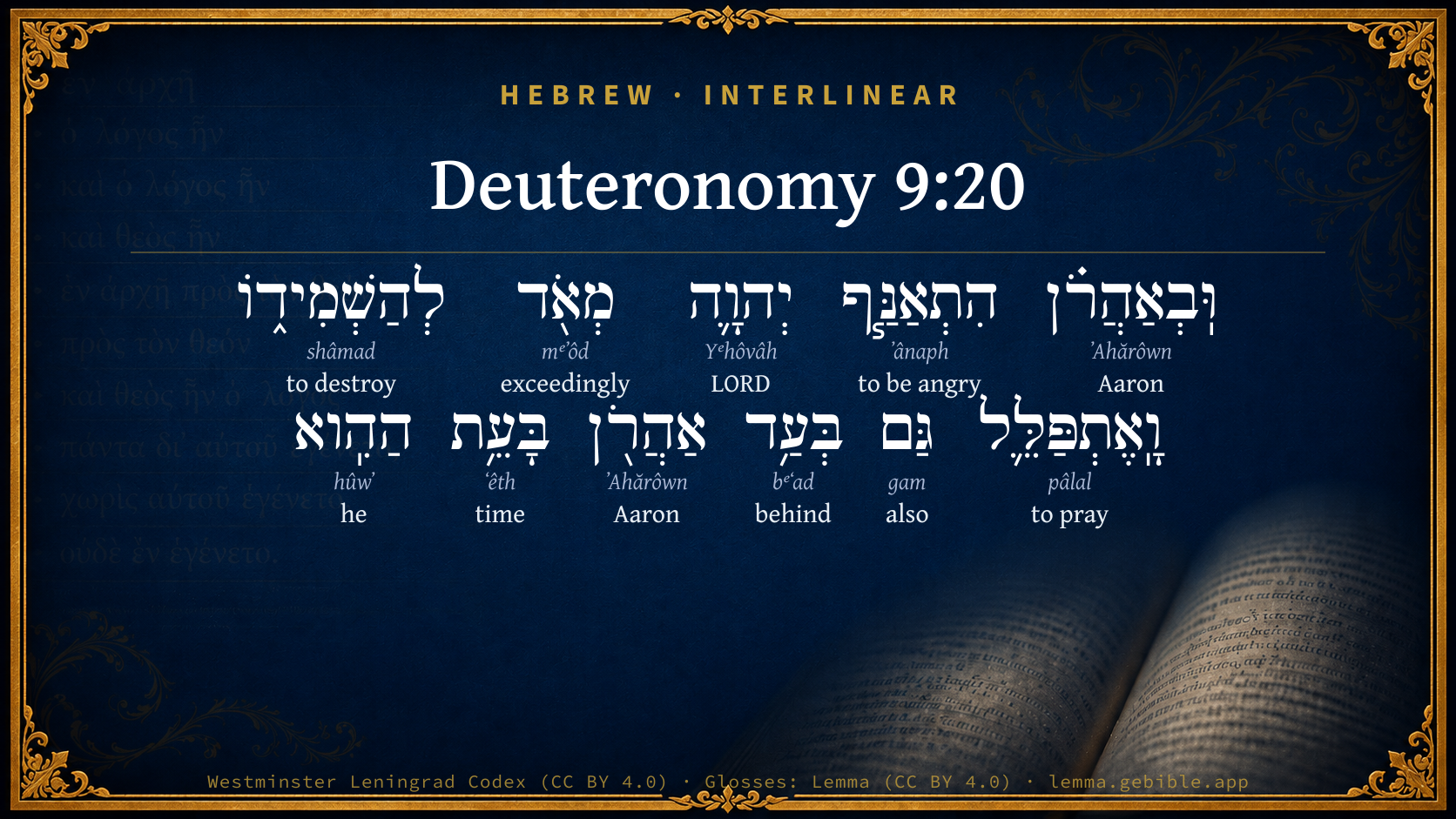
Hebrew (Westminster Leningrad Codex) Deuteronomy 9:20 appears in the Hebrew Old Testament. The text above is from the Westminster Leningrad Codex. Each word links to its Strong’s number, a concise gloss, and parsing drawn from the Open Scriptures Hebrew Bible morphology. Click any word for its full Brown-Driver-Briggs (BDB) entry.
Download image
Cite this verse

Deuteronomy 9:20 (World English Bible). Public Domain. Lemma interlinear Bible study tool, https://lemma.gebible.app/v/deuteronomy/9/20.

Show BibTeX & RIS
BibTeX
RIS
English Translation
Yahweh was very angry with Aaron to destroy him: and I prayed for Aaron also at the same time.
World English Bible · Public Domain
Download a study sheet

One document with this verse’s original text, its word-by-word gloss line, the meaning frame, cross-references with their text, attributed commentary, and full source and license credits — printable, and it pastes into notes with its structure intact.

This verse Autodidact and up

Study sheet (.html) Plain text (.txt)

A passage Seminary Student

Up to 50 verses in one chapter. A passage sheet keeps up to 6 commentary sources and 12 cross-references per verse, in the order this page ranks them, and says so on the sheet whenever that leaves anything out. Ask for a single verse and you get the Autodidact verse sheet above.

Everything on this page stays free to read, with no account — the sheet is a download of what is already on screen, not access to it.

Want to remove ads? Support Godless Engineer
Compare translations 3

The same verse in 3 English versions, stacked beneath the original-language interlinear above. Click any original word for its lexicon entry.

Each is an independent rendering of the whole verse — the interlinear is not word-aligned to these translations.

Highlighted words mark where these versions differ — a whole-verse word diff, not a word-by-word alignment.

  • World English Bible Public Domain
    Yahweh was very angry with Aaron to destroy him: and I prayed for Aaron also at the same time.
  • King James Version Public Domain
    And the LORD was very angry with Aaron to have destroyed him: and I prayed for Aaron also the same time.
  • unfoldingWord Literal Text CC BY-SA 4.0
    And Yahweh was very angry against Aaron, to destroy him. And I interceded also for the sake of Aaron at that time.

unfoldingWord Literal Text — © unfoldingWord, licensed CC BY-SA 4.0. Word-aligned USFM3 via Door43 (git.door43.org/unfoldingWord/en_ult).

Versions to compare (up to 4)

3 of 4 selected

Show all 18 translations

Every available English version of this verse, each an independent rendering of the whole verse.

  • World English Bible Public Domain
    Yahweh was very angry with Aaron to destroy him: and I prayed for Aaron also at the same time.
  • Berean Standard Bible Public Domain
    The LORD was angry enough with Aaron to destroy him, but at that time I also prayed for Aaron.
  • Majority Standard Bible Public Domain
    The LORD was angry enough with Aaron to destroy him, but at that time I also prayed for Aaron.
  • King James Version Public Domain
    And the LORD was very angry with Aaron to have destroyed him: and I prayed for Aaron also the same time.
  • American Standard Version (1901) Public Domain
    And Jehovah was very angry with Aaron to destroy him: and I prayed for Aaron also at the same time.
  • Revised Version (1885) Public Domain
    And the LORD was very angry with Aaron to have destroyed him: and I prayed for Aaron also the same time.
  • Geneva Bible (1599) Public Domain
    Likewise ye Lord was very angrie with Aaron, euen to destroy him: but at that time I prayed also for Aaron.
  • Douay-Rheims (1899) Public Domain
    And he was exceeding angry against Aaron also, and would have destroyed him, and I prayed in like manner for him.
  • Young's Literal Translation Public Domain
    `And with Aaron hath Jehovah shewed himself very angry, to destroy him, and I pray also for Aaron at that time;
  • Literal Standard Version CC BY-SA 4.0
    And YHWH has showed Himself very angry with Aaron, to destroy him, and I also pray for Aaron at that time.
  • Unlocked Literal Bible CC BY-SA 4.0
    Yahweh was very angry with Aaron so as to destroy him; I prayed for Aaron also at the same time.
  • unfoldingWord Literal Text CC BY-SA 4.0
    And Yahweh was very angry against Aaron, to destroy him. And I interceded also for the sake of Aaron at that time.
  • Darby Bible Public Domain
    And with Aaron Jehovah was very angry to destroy him; and I prayed for Aaron also at the same time.
  • World Messianic Bible Public Domain
    The LORD was angry enough with Aaron to destroy him. I prayed for Aaron also at the same time.
  • Webster's Bible Public Domain
    And the LORD was very angry with Aaron to have destroyed him: and I prayed for Aaron also at the same time.
  • Free Bible Version CC BY-SA 4.0
    The Lord was so angry with Aaron he was ready to destroy him, but right then I prayed for Aaron too.
  • Bible in Basic English Public Domain
    And the Lord, in his wrath, would have put Aaron to death: and I made prayer for Aaron at the same time.
  • JPS Tanakh (1917) Public Domain
    Moreover the LORD was very angry with Aaron to have destroyed him; and I prayed for Aaron also the same time.

Literal Standard Version (2020), Covenant Press — licensed CC BY-SA 4.0. Text via the HelloAO Bible API (eBible.org). Unlocked Literal Bible (unfoldingWord) — licensed CC BY-SA 4.0. Text via the HelloAO Bible API (eBible.org). unfoldingWord Literal Text — © unfoldingWord, licensed CC BY-SA 4.0. Word-aligned USFM3 via Door43 (git.door43.org/unfoldingWord/en_ult). Free Bible Version, Dr. Jonathan Gallagher — licensed CC BY-SA 4.0. Text via the HelloAO Bible API (eBible.org).

Word by word

More ways to search: Search by grammar → Find every occurrence → Compare this word →

Practice this passage: Drill this verse → Learn its vocabulary →

הִתְאַנַּ֧ף
ʼânaph
H599
“to be angry”
Verb, Hithpael, Perfect, 3rd Person, Masculine, Singular
Part of Speech
Verb
Stem
Hithpael
Form
Perfect
Person
3rd Person
Gender
Masculine
Number
Singular
Full BDB Definition

Origin: a primitive root

TWOT: 133

to be angry, to be displeased, to breathe hard - (Qal) to be angry (of God) - (Hithpael) to be angry (always of God)
  1. וּֽבְאַהֲרֹ֗ן ʼAhărôwn H175 “and · in/at · Aaron” Conjunction + Preposition + Noun, Proper
  2. יְהוָ֛ה Yᵉhôvâh H3068 “LORD” Noun, Proper
  3. מְאֹ֖ד mᵉʼôd H3966 “exceedingly” Adverb
  4. לְהַשְׁמִיד֑וֹ shâmad H8045 “to destroy · him” Preposition + Verb, Hiphil, Infinitive Construct + Suffix, Personal, 3rd Person, Masculine, Singular
  5. וָֽאֶתְפַּלֵּ֛ל pâlal H6419 “and · to pray” Conjunction + Verb, Hithpael, Sequential Imperfect, 1st Person, Common, Singular
  6. גַּם gam H1571 “also” Particle, Accusative
  7. בְּעַ֥ד bᵉʻad H1157 “behind” Preposition
  8. אַהֲרֹ֖ן ʼAhărôwn H175 “Aaron” Noun, Proper
  9. בָּעֵ֥ת ʻêth H6256 “in/at the · time” Preposition, Determined + Noun, Common, Both, Singular, Absolute
  10. הַהִֽוא hûwʼ H1931 “the · he” Particle, Definite Article + Pronoun, Personal, 3rd Person, Feminine, Singular

About this verse

These counts appear in no published source. They are computed here, from the morphology-tagged text and Lemma’s own curated glosses. What Lemma adds →

11
words
10
distinct lemmas
Pentateuch
section

Notable vocabulary

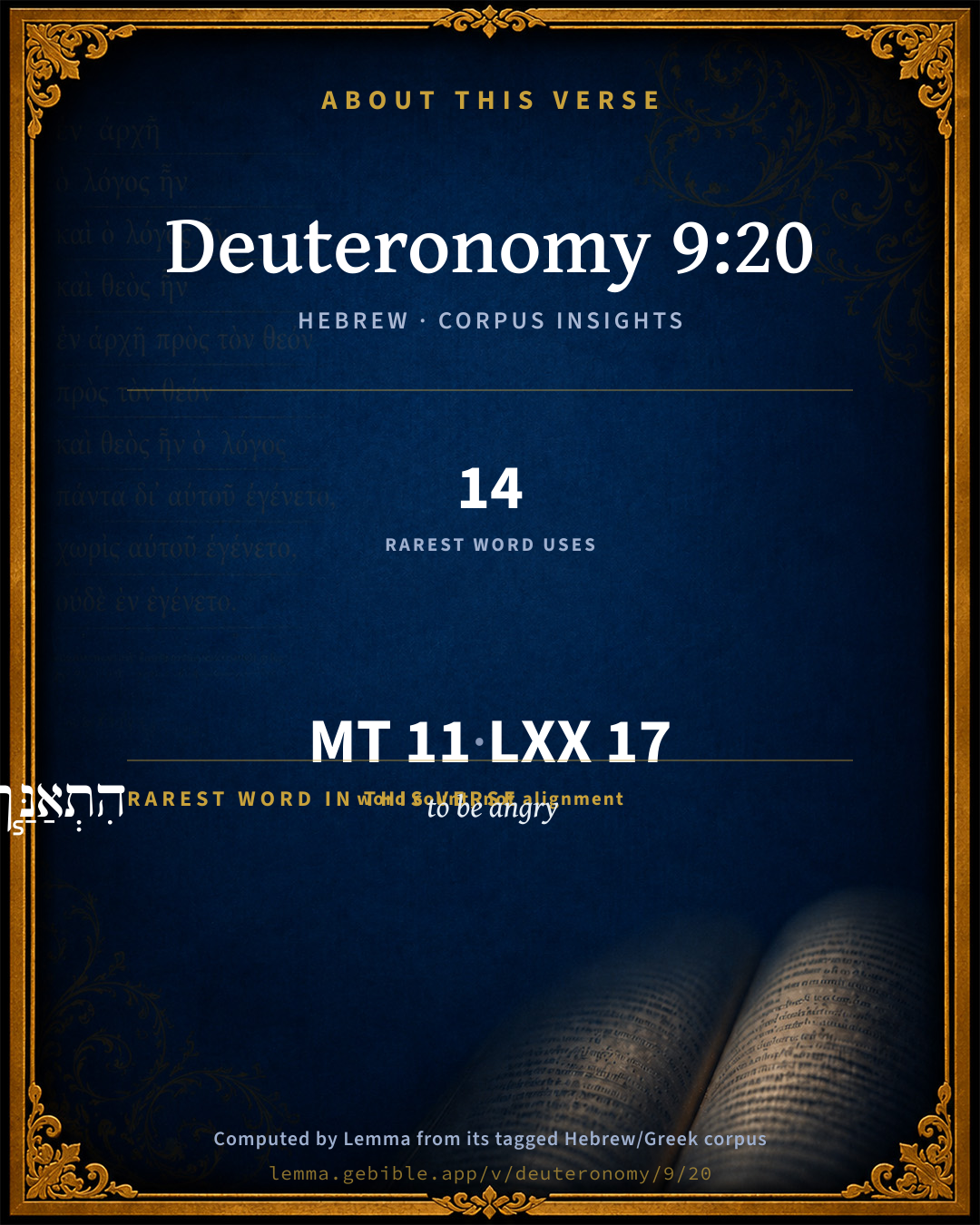
The rarest word here is הִתְאַנַּ֧ף to be angry H599 — appearing just 14 times in the whole Hebrew Bible.

Shared distinctive vocabulary

הִתְאַנַּ֧ף to be angry H599 occurs in 14 verses of the Hebrew Bible. Also found in:

Grammatical profile

  • 3 verbs
  • 4 nouns
  • 1 pronoun
  • 1 preposition
  • 1 adverb
  • 1 particle

Verb forms

  • הִתְאַנַּ֧ף Hithpael · Perfect
  • לְהַשְׁמִיד֑וֹ Hiphil · Infinitive Construct
  • וָֽאֶתְפַּלֵּ֛ל Hithpael · Sequential Imperfect

Repetition

A word recurs within this verse — often emphatic in Hebrew:

  • וּֽבְאַהֲרֹ֗ן Aaron H175 ×2

Hebrew & Septuagint length

In English translation the verse runs 19 words from the Hebrew and 19 from the Septuagint (LXX English) — the same length.

A rough comparison of the two English renderings, which tokenize alike — not a word-level alignment.

Word counts can differ between the Hebrew and the Greek without any difference in meaning — e.g. the Hebrew direct-object marker אֵת has no separate Greek word, and Greek often adds the article ὁ.

In the original languages it is 11 Hebrew tokens and 17 Greek tokens — but the two are counted differently (Hebrew bundles its prefixes and suffixes into one token; the Greek is in lemma form), so that isn’t a like-for-like length.

Cross-references

4

Topical passages linked to Deuteronomy 9:20 in the Treasury of Scripture Knowledge — connected by theme and wording, ordered by reader-vote popularity; previews shown in the World English Bible.

  • Exodus 32:21 Moses said to Aaron, "What did these people do to you, that you have brought a great sin on them?"
  • Exodus 32:35 Yahweh struck the people, because they made the calf, which Aaron made.
  • Hebrews 7:26–28 For such a high priest was fitting for us: holy, guiltless, undefiled, separated from sinners, and made higher than the heavens;
  • Exodus 32:2–5 Aaron said to them, "Take off the golden rings, which are in the ears of your wives, of your sons, and of your daughters, and bring them to me."

Cross-references courtesy of OpenBible.info (CC BY 4.0).

Hebrew and Greek witnesses Masoretic Hebrew ↔ Greek Septuagint

The same verse in the two great witnesses to the Old Testament, shown verse-for-verse.

These are two independent witnesses, not word-aligned to each other, and the Septuagint is shown in lemma (dictionary) form.

Hebrew Deuteronomy 9:20 Masoretic · Westminster Leningrad Codex

וּֽבְאַהֲרֹ֗ן הִתְאַנַּ֧ף יְהוָ֛ה מְאֹ֖ד לְהַשְׁמִיד֑וֹ וָֽאֶתְפַּלֵּ֛ל גַּם בְּעַ֥ד אַהֲרֹ֖ן בָּעֵ֥ת הַהִֽוא

Yahweh was very angry with Aaron to destroy him: and I prayed for Aaron also at the same time.

World English Bible · Public Domain

Greek LXX Deuteronomy 9:20 Septuagint · lemma form

καί ἐπί ἀαρών θυμόω κύριος σφόδρα ἐκὀλεθρεύω αὐτός καί εὔχομαι καί περί ἀαρών ἐν ὁ καιρός ἐκεῖνος

And he was angry with Aaron to destroy him utterly, and I prayed for Aaron also at that time.

LXX2012 (modern English Septuagint) · Public Domain

Hebrew: Westminster Leningrad Codex (CC BY 4.0). Greek: Septuagint (public domain); English from LXX2012 (modern English Septuagint) (Public Domain). How the Septuagint differs from the Hebrew →

Targum (Aramaic paraphrase)

2

The Targum is the ancient Jewish Aramaic paraphrase of the Hebrew Scriptures — an interpretive translation, not the Hebrew text itself. Onkelos (literal) and Pseudo-Jonathan (expansive) render the Torah, and Jonathan the Prophets. Coverage is partial: where no permissively-licensed English translation exists for a verse, only the Aramaic is shown. This is verse-level text, not a word-by-word alignment to the Hebrew.

  1. Targum Onkelos Torah (Genesis–Deuteronomy)
    וְעַל אַהֲרֹן הֲוָה רְגַז מִן קֳדָם יְיָ לַחֲדָא לְשֵׁצָיוּתֵהּ וְצַלֵיתִי אַף עַל אַהֲרֹן בְּעִדָנָא הַהִיא

    (no public-domain English translation for this verse)

    Targum Onkelos — Aramaic: “Onkelos Genesis” (public domain); “Onkelos Exodus” (public domain); “Onkelos Leviticus” (public domain); “Onkelos Numbers” (public domain); “Onkelos Deuteronomy” (public domain). English: “Sefaria Community Translation” (CC0 1.0 (public-domain dedication)); “J.W. Etheridge. The Targums of Onkelos and Jonathan Ben Uzziel on the Pentateuch. London: Longmans, Green, 1862” (public domain). Text via Sefaria.

  2. Targum Pseudo-Jonathan Torah (Genesis–Deuteronomy)
    וְעַל אַהֲרן הֲוָה רְגַז מִן קֳדָם יְיָ לַחֲדָא לְשֵׁיצָיוּתֵיהּ וְצַלֵּיתִי אוּף עַל אַהֲרן בְּעִידָנָא הַהוּא

    But against Aharon was there great displeasure before the Lord, (so that) He would destroy him; but I prayed for Aharon also at that time.

    Targum Pseudo-Jonathan — Aramaic: “Targum Jonathan on Genesis” (public domain); “Targum Jonathan on Exodus” (public domain); “Targum Jonathan on Leviticus” (public domain); “Targum Jonathan on Numbers” (public domain); “Targum Jonathan on Deuteronomy” (public domain). English: “The Targum of Jonathan ben Uzziel, trans. J. W. Etheridge, London, 1862” (public domain). Text via Sefaria.

Commentary

Notes on Deuteronomy 9:20 from classic Christian and Jewish commentators (each source and its license shown beneath its notes). The classic Christian expositions comment on the surrounding passage and are grouped to its opening verse, so a note may address several verses; the Jewish commentaries on the Tanakh (Rashi and others) are per-verse, so they appear only where the commentator wrote on this verse.

Lemma curates 59 commentaries, every one of them public domain or Creative Commons licensed, each selected and text-cleaned for this edition rather than reprinted as found. About our sources →

Geneva Bible (1599)

Geneva Bible translators

Whereby he showeth what danger they are in, that have authority and resist not wickedness.

Geneva Bible (1599) marginal notes — public domain. Text via Bolls.life.

Jamieson, Fausset & Brown

Robert Jamieson, A. R. Fausset & David Brown

The Lord was very angry with Aaron to have destroyed him--By allowing himself to be overborne by the tide of popular clamor, Aaron became a partaker in the guilt of idolatry and would have suffered the penalty of his sinful compliance, had not the earnest intercession of Moses on his behalf prevailed.

Jamieson, Fausset & Brown — Commentary Critical and Explanatory on the Whole Bible (1871) — public domain (CC PDM 1.0). Text via the HelloAO Bible API.

Ellicott's Commentary for English Readers

(20) I prayed for Aaron also.—Jewish commentators ascribe the loss of Aaron’s two sons (Lev_10:1-2) partly to God’s anger at this time.

A Bible Commentary for English Readers, edited by Charles John Ellicott (1878–1897) — public domain. Text from a community e-Sword module.

The Cambridge Bible for Schools and Colleges

gen. ed. J. J. S. Perowne

20. To this there is no reference in Exodus.

The Cambridge Bible for Schools and Colleges (gen. ed. J. J. S. Perowne; Cambridge University Press, 1878–1918) — public domain. Text from a community e-Sword module.

John Gill's Exposition

And the Lord was very angry with Aaron, to have destroyed him,.... For complying with the request of the people in making a calf for them, and for that miserable shift he made to excuse himself; which so provoked the Lord, that he threatened to destroy him, and he was in danger of being cut off, had it not been for the intercession of Moses:

and I prayed for Aaron also the same time: who either was included in the general prayer for the people, Exo 32:31 or a particular prayer was made for him, though not recorded, and which also succeeded.

John Gill's Exposition of the Whole Bible (1746–1763) — public domain (CC PDM 1.0). Text via the HelloAO Bible API.

Albert Barnes' Notes on the Bible

Israel could not even boast that its heads and representatives continued, faithful. Aaron had been already designated for the high priestly functions; but he fell away with the rest of the people. It was due therefore solely to the grace of God and the intercession of Moses that Aaron himself and his promised priesthood with him were not cut off; just as at a later time, when Aaron had actually to die for a new sin Israel owed it still to the same causes that Eleazar was substituted and the High Priesthood perpetuated (compare Deu 10:6; Num 20:24-26).

Albert Barnes' Notes on the Bible (1834–1885) — public domain. Text from a community e-Sword/MySword module.

Haydock's Catholic Bible Commentary

CHAPTER IX.

George Leo Haydock (1774–1849), Haydock's Catholic Family Bible and Commentary, 1859 edition — public domain. Excludes Psalms (Douay-Rheims chapter numbering differs from Protestant) and Deuterocanonical books (Catholic canon only).

Matthew Poole's English Annotations

The Lord was very angry with Aaron, though he was only accessory, as being persuaded, and in a manner compelled, to comply with your desire.

Matthew Poole's English Annotations on the Holy Bible (1683–1685) — public domain. Text from a community e-Sword/MySword module.

Whedon's Commentary on the Bible

Daniel D. Whedon

20. I prayed for Aaron also — Not only upon the people, but also upon Aaron, rested the indignation of Jehovah. Moses acts as a mediator for his brother. In the accounts in Exodus 32 there is no special mention of this intercession. Here Moses makes it prominent, not only that he might make the people thoroughly aware that at that time Israel could not even boast of the righteousness of its eminent men, but also to bring out the fact that Aaron’s investiture with the high priesthood and the maintenance of that institution was purely a work of divine grace. — Keil.

Daniel D. Whedon (gen. ed.), Commentary on the Old and New Testaments (1874–1909) — public domain. Text from a community e-Sword module.

Rashi

Rabbi Shlomo Yitzchaki (Rashi)

ובאהרן התאנף ה׳ AND WITH AARON THE LORD WAS ANGRY, because he listened to you.

להשמידו TO DESTROY HIM — this denotes the extermination of one’s children, and so, too, it states, (Amos 2:9) “And I destroyed (ואשמיד) his fruit (offspring) from above” (Leviticus Rabbah 7:1).

.(אחרי מות AND I PRAYED FOR AARON ALSO, and my prayer availed to atone half, so that only two of his sons died, and two remained alive.

Rashi on the Tanakh — English translations: “The Judaica Press complete Tanach with Rashi, translated by A. J. Rosenberg” (CC BY 4.0); “Pentateuch with Rashi's commentary by M. Rosenbaum and A.M. Silbermann, 1929-1934” (public domain); “The Metsudah Tanach series, Lakewood, N.J” (CC BY 4.0); and “The Book of Joshua, Metsudah Publications, 1997” (CC BY 4.0). Text via Sefaria.

Lesson kit

Teaching starters — assembled from the data on this page, not authored interpretation. Every prompt links to the verse data it draws on. Edit before teaching.

Deuteronomy, in the Pentateuch, opens this verse with 11 words (10 distinct Hebrew lemmas). Its most distinctive word is ʼânaph (“to be angry”). A historical commentator’s framing appears above. Read the whole chapter for the surrounding context.

Discussion questions

  1. How does “to be angry” (ʼânaph) shape what this verse is saying?
  2. Deuteronomy 1:37 shares the word «to be angry» with this verse. How do the two illuminate each other?
  3. “Aaron” occurs 2× in this one verse. What is the effect of the repetition?
  4. These translations render this verse differently; the difference is in the English rendering, not the original. What questions does that raise?
  5. The verb «הִתְאַנַּ֧ף» is Hithpael Perfect. How does its form color the action?
  6. Reading how Geneva Bible (1599) and Jamieson, Fausset & Brown read this verse, where do the two commentators agree and where do they part?

Things to notice

Reading settings

Reading text

Shown beneath each verse's original-language words.

Old Testament
Old Testament edition

Read the OT as the Masoretic Hebrew (MT) or the Greek Septuagint (LXX).

English shown for the Greek Septuagint (in the Hebrew ↔ Greek comparison).

Comparing translations? Open the Compare panel on any verse page to stack up to four side by side.