
Jeremiah 14:19

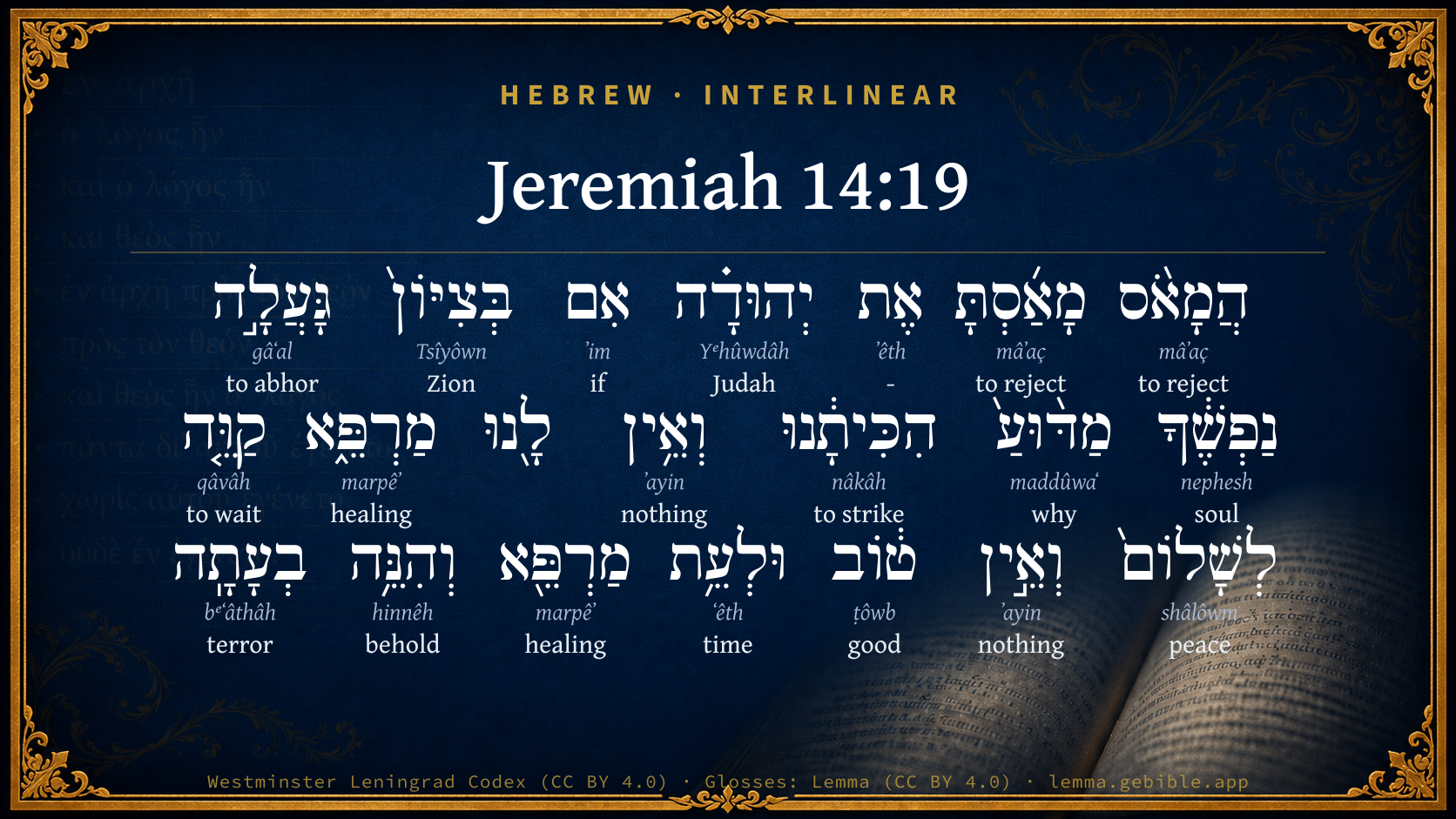
Hebrew (Westminster Leningrad Codex) Jeremiah 14:19 appears in the Hebrew Old Testament. The text above is from the Westminster Leningrad Codex. Each word links to its Strong’s number, a concise gloss, and parsing drawn from the Open Scriptures Hebrew Bible morphology. Click any word for its full Brown-Driver-Briggs (BDB) entry.
Download image
Cite this verse

Jeremiah 14:19 (World English Bible). Public Domain. Lemma interlinear Bible study tool, https://lemma.gebible.app/v/jeremiah/14/19.

Show BibTeX & RIS
BibTeX
RIS
English Translation
Have you utterly rejected Judah? has your soul loathed Zion? why have you struck us, and there is no healing for us? We looked for peace, but no good came; and for a time of healing, and, behold, dismay!
World English Bible · Public Domain
Download a study sheet

One document with this verse’s original text, its word-by-word gloss line, the meaning frame, cross-references with their text, attributed commentary, and full source and license credits — printable, and it pastes into notes with its structure intact.

This verse Autodidact and up

Study sheet (.html) Plain text (.txt)

A passage Seminary Student

Up to 50 verses in one chapter. A passage sheet keeps up to 6 commentary sources and 12 cross-references per verse, in the order this page ranks them, and says so on the sheet whenever that leaves anything out. Ask for a single verse and you get the Autodidact verse sheet above.

Everything on this page stays free to read, with no account — the sheet is a download of what is already on screen, not access to it.

Want to remove ads? Support Godless Engineer
Compare translations 3

The same verse in 3 English versions, stacked beneath the original-language interlinear above. Click any original word for its lexicon entry.

Each is an independent rendering of the whole verse — the interlinear is not word-aligned to these translations.

Highlighted words mark where these versions differ — a whole-verse word diff, not a word-by-word alignment.

  • World English Bible Public Domain
    Have you utterly rejected Judah? has your soul loathed Zion? why have you struck us, and there is no healing for us? We looked for peace, but no good came; and for a time of healing, and, behold, dismay!
  • King James Version Public Domain
    Hast thou utterly rejected Judah? hath thy soul lothed Zion? why hast thou smitten us, and there is no healing for us? we looked for peace, and there is no good; and for the time of healing, and behold trouble!
  • unfoldingWord Literal Text CC BY-SA 4.0
    Have rejecting you rejected Judah? Or has your soul loathed Zion? Why have you stricken us so that there is no healing for us? We hoped for peace, but there was no good, and for a time of healing, but behold, terror!

unfoldingWord Literal Text — © unfoldingWord, licensed CC BY-SA 4.0. Word-aligned USFM3 via Door43 (git.door43.org/unfoldingWord/en_ult).

Versions to compare (up to 4)

3 of 4 selected

Show all 18 translations

Every available English version of this verse, each an independent rendering of the whole verse.

  • World English Bible Public Domain
    Have you utterly rejected Judah? has your soul loathed Zion? why have you struck us, and there is no healing for us? We looked for peace, but no good came; and for a time of healing, and, behold, dismay!
  • Berean Standard Bible Public Domain
    Have You rejected Judah completely? Do You despise Zion? Why have You stricken us so that we are beyond healing? We hoped for peace, but no good has come, and for the time of healing, but there was only terror.
  • Majority Standard Bible Public Domain
    Have You rejected Judah completely? Do You despise Zion? Why have You stricken us so that we are beyond healing? We hoped for peace, but no good has come, and for the time of healing, but there was only terror.
  • King James Version Public Domain
    Hast thou utterly rejected Judah? hath thy soul lothed Zion? why hast thou smitten us, and there is no healing for us? we looked for peace, and there is no good; and for the time of healing, and behold trouble!
  • American Standard Version (1901) Public Domain
    Hast thou utterly rejected Judah? hath thy soul loathed Zion? why hast thou smitten us, and there is no healing for us? We looked for peace, but no good came; and for a time of healing, and, behold, dismay!
  • Revised Version (1885) Public Domain
    Hast thou utterly rejected Judah? hath thy soul loathed Zion? why hast thou smitten us, and there is no healing for us? We looked for peace, but no good came; and for a time of healing, and behold dismay!
  • Geneva Bible (1599) Public Domain
    Hast thou vtterly reiected Iudah, or hath thy soule abhorred Zion? why hast thou smitten vs, that we cannot be healed? Wee looked for peace, and there is no good, and for the time of health, and behold trouble.
  • Douay-Rheims (1899) Public Domain
    Hast thou utterly cast away Juda, or hath thy soul abhorred Sion? why then hast thou struck us, so that there is no healing for us? we have looked for peace, and there is no good: and for the time of healing, and behold trouble.
  • Young's Literal Translation Public Domain
    Hast Thou utterly rejected Judah? Zion hath Thy soul loathed? Wherefore hast Thou smitten us, And there is no healing to us? Looking for peace, and there is no good, And for a time of healing, and lo, terror.
  • Literal Standard Version CC BY-SA 4.0
    Have You utterly rejected Judah? Has Your soul loathed Zion? Why have You struck us, || And there is no healing to us? Looking for peace, and there is no good, || And for a time of healing, and behold, terror.
  • Unlocked Literal Bible CC BY-SA 4.0
    Have you completely rejected Judah? Do you hate Zion? Why will you afflict us when there is no healing for us? We hoped for peace, but there was nothing good— and for a time of healing, but see, there is only terror.
  • unfoldingWord Literal Text CC BY-SA 4.0
    Have rejecting you rejected Judah? Or has your soul loathed Zion? Why have you stricken us so that there is no healing for us? We hoped for peace, but there was no good, and for a time of healing, but behold, terror!
  • Darby Bible Public Domain
    -- Hast thou then utterly rejected Judah? Doth thy soul loathe Zion? Why hast thou smitten us, and there is no healing for us? Peace is looked for, and there is no good, -- and a time of healing, and behold terror!
  • World Messianic Bible Public Domain
    Have you utterly rejected Judah? Has your soul loathed Zion? Why have you struck us, and there is no healing for us? We looked for peace, but no good came; and for a time of healing, and behold, dismay!
  • Webster's Bible Public Domain
    Hast thou utterly rejected Judah? hath thy soul loathed Zion? Why hast thou smitten us, and there is no healing for us? we looked for peace, and there is no good; and for the time of healing, and behold trouble!
  • Free Bible Version CC BY-SA 4.0
    Have you really rejected Judah? Do you hate Zion so much? Why have you wounded us so badly that we can't be healed? We hoped for peace, but instead nothing good has come; we hoped for a time of healing, but instead there was only sudden terror.
  • Bible in Basic English Public Domain
    Have you completely given up Judah? is your soul turned in disgust from Zion? why have you given us blows from which there is no one to make us well? we were looking for peace, but no good came; and for a time of well-being, but there was only a great fear.
  • JPS Tanakh (1917) Public Domain
    Hast Thou utterly rejected Judah? Hath Thy soul loathed Zion? Why hast Thou smitten us, and there is no healing for us? We looked for peace, but no good came; and for a time of healing, and behold terror!

Literal Standard Version (2020), Covenant Press — licensed CC BY-SA 4.0. Text via the HelloAO Bible API (eBible.org). Unlocked Literal Bible (unfoldingWord) — licensed CC BY-SA 4.0. Text via the HelloAO Bible API (eBible.org). unfoldingWord Literal Text — © unfoldingWord, licensed CC BY-SA 4.0. Word-aligned USFM3 via Door43 (git.door43.org/unfoldingWord/en_ult). Free Bible Version, Dr. Jonathan Gallagher — licensed CC BY-SA 4.0. Text via the HelloAO Bible API (eBible.org).

Word by word

More ways to search: Search by grammar → Find every occurrence → Compare this word →

Practice this passage: Drill this verse → Learn its vocabulary →

בְעָתָֽה
bᵉʻâthâh
H1205
“terror”
Noun, Common, Feminine, Singular, Absolute
Part of Speech
Noun
Type
Common
Gender
Feminine
Number
Singular
State
Absolute
Full BDB Definition

Origin: from H1204

TWOT: 265a

terror, dismay
  1. הֲמָאֹ֨ס mâʼaç H3988 “to reject” Particle, Interrogative + Verb, Qal, Infinitive Absolute
  2. מָאַ֜סְתָּ mâʼaç H3988 “to reject” Verb, Qal, Perfect, 2nd Person, Masculine, Singular
  3. אֶת ʼêth H853 “-” Particle, Direct Object
  4. יְהוּדָ֗ה Yᵉhûwdâh H3063 “Judah” Noun, Proper
  5. אִם ʼim H518 “if” Conjunction
  6. בְּצִיּוֹן֙ Tsîyôwn H6726 “in/at · Zion” Preposition + Noun, Proper
  7. גָּעֲלָ֣ה gâʻal H1602 “to abhor” Verb, Qal, Perfect, 3rd Person, Feminine, Singular
  8. נַפְשֶׁ֔ךָ nephesh H5315 “soul · your” Noun, Common, Both, Singular, Construct + Suffix, Personal, 2nd Person, Masculine, Singular
  9. מַדּ֨וּעַ֙ maddûwaʻ H4069 “why” Particle, Interrogative
  10. הִכִּיתָ֔נוּ nâkâh H5221 “to strike · us” Verb, Hiphil, Perfect, 2nd Person, Masculine, Singular + Suffix, Personal, 1st Person, Common, Plural
  11. וְאֵ֥ין ʼayin H369 “and · nothing” Conjunction + Particle, Negative
  12. מַרְפֵּ֑א marpêʼ H4832 “healing” Noun, Common, Masculine, Singular, Absolute
  13. קַוֵּ֤ה qâvâh H6960 “to wait” Verb, Piel, Infinitive Absolute
  14. לְשָׁלוֹם֙ shâlôwm H7965 “to/for · peace” Preposition + Noun, Common, Masculine, Singular, Absolute
  15. וְאֵ֣ין ʼayin H369 “and · nothing” Conjunction + Particle, Negative
  16. ט֔וֹב ṭôwb H2896 “good” Adjective, Adjective, Masculine, Singular, Absolute
  17. וּלְעֵ֥ת ʻêth H6256 “and · to/for · time of” Conjunction + Preposition + Noun, Common, Both, Singular, Construct
  18. מַרְפֵּ֖א marpêʼ H4832 “healing” Noun, Common, Masculine, Singular, Absolute
  19. וְהִנֵּ֥ה hinnêh H2009 “and · behold” Conjunction + Particle, Demonstrative

About this verse

These counts appear in no published source. They are computed here, from the morphology-tagged text and Lemma’s own curated glosses. What Lemma adds →

21
words
17
distinct lemmas
Prophets
section

Notable vocabulary

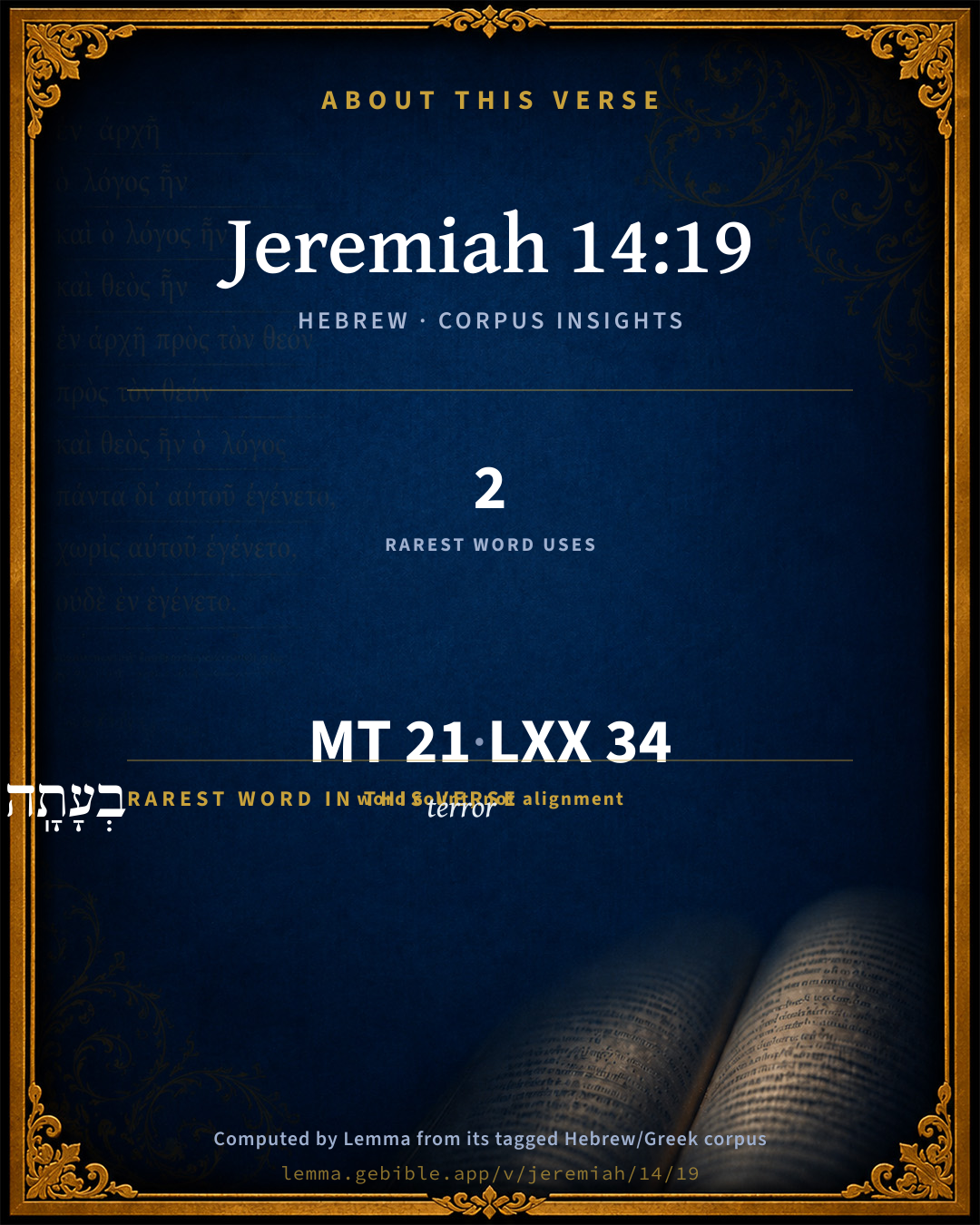
The rarest word here is בְעָתָֽה terror H1205 — appearing just 2 times in the whole Hebrew Bible.

Shared distinctive vocabulary

בְעָתָֽה terror H1205 occurs in 2 verses of the Hebrew Bible. Also found in:

Grammatical profile

  • 5 verbs
  • 8 nouns
  • 1 adjective
  • 1 preposition
  • 1 conjunction
  • 5 particles

Verb forms

  • הֲמָאֹ֨ס Qal · Infinitive Absolute
  • מָאַ֜סְתָּ Qal · Perfect
  • גָּעֲלָ֣ה Qal · Perfect
  • הִכִּיתָ֔נוּ Hiphil · Perfect
  • קַוֵּ֤ה Piel · Infinitive Absolute

Repetition

Words recur within this verse — often emphatic in Hebrew:

  • הֲמָאֹ֨ס to reject H3988 ×2
  • וְאֵ֥ין nothing H369 ×2
  • מַרְפֵּ֑א healing H4832 ×2

Hebrew & Septuagint length

In the original languages it is 21 Hebrew tokens and 34 Greek tokens — but the two are counted differently (Hebrew bundles its prefixes and suffixes into one token; the Greek is in lemma form), so that isn’t a like-for-like length.

Cross-references

20

Topical passages linked to Jeremiah 14:19 in the Treasury of Scripture Knowledge — connected by theme and wording, ordered by reader-vote popularity; previews shown in the World English Bible.

  • Jeremiah 8:15 We looked for peace, but no good came; [and] for a time of healing, and, behold, dismay!
  • Lamentations 5:22 But you have utterly rejected us; You are very angry against us.
  • Jeremiah 6:30 Refuse silver shall men them, because Yahweh has rejected them.
  • 1 Thessalonians 5:3 For when they are saying, "Peace and safety," then sudden destruction will come on them, like birth pains on a pregnant woman; and they will in no way escape.
  • 2 Kings 17:19–20 Also Judah didn't keep the commandments of Yahweh their God, but walked in the statutes of Israel which they made.
  • Job 30:26 When I looked for good, then evil came; When I waited for light, there came darkness.
  • Psalms 78:59 When God heard this, he was angry, And greatly abhorred Israel;
  • Jeremiah 12:8 My heritage is become to me as a lion in the forest: she has uttered her voice against me; therefore I have hated her.
  • Jeremiah 15:18 Why is my pain perpetual, and my wound incurable, which refuses to be healed? will you indeed be to me as a deceitful [brook], as waters that fail?
  • Jeremiah 30:13 There is none to plead your cause, that you may be bound up: you have no healing medicines.
  • 2 Chronicles 36:16 but they mocked the messengers of God, and despised his words, and scoffed at his prophets, until the wrath of Yahweh arose against his people, until there was no remedy.
  • Psalms 80:12–13 Why have you broken down its walls, So that all those who pass by the way pluck it?
  • Psalms 89:38 But you have rejected and spurned. You have been angry with your anointed.
  • Jeremiah 7:29 Cut off your hair, [Jerusalem], and cast it away, and take up a lamentation on the bare heights; for Yahweh has rejected and forsaken the generation of his wrath.
  • Jeremiah 8:22 Is there no balm in Gilead? is there no physician there? why then isn't the health of the daughter of my people recovered?
  • Jeremiah 15:1 Then said Yahweh to me, Though Moses and Samuel stood before me, yet my mind would not be toward this people: cast them out of my sight, and let them go forth.
  • Lamentations 2:13 What shall I testify to you? what shall I liken to you, daughter of Jerusalem? What shall I compare to you, that I may comfort you, virgin daughter of Zion? For your breach is great like the sea: who can heal you?
  • Lamentations 4:17 Our eyes do yet fail [in looking] for our vain help: In our watching we have watched for a nation that could not save.
  • Zechariah 11:8–9 I cut off the three shepherds in one month; for my soul was weary of them, and their soul also loathed me.
  • Romans 11:1–6 I ask then, Did God reject his people? May it never be! For I also am an Israelite, a descendant of Abraham, of the tribe of Benjamin.

Cross-references courtesy of OpenBible.info (CC BY 4.0).

Hebrew and Greek witnesses Masoretic Hebrew ↔ Greek Septuagint

The same verse in the two great witnesses to the Old Testament, shown verse-for-verse.

These are two independent witnesses, not word-aligned to each other, and the Septuagint is shown in lemma (dictionary) form.

Hebrew Jeremiah 14:19 Masoretic · Westminster Leningrad Codex

הֲמָאֹ֨ס מָאַ֜סְתָּ אֶת יְהוּדָ֗ה אִם בְּצִיּוֹן֙ גָּעֲלָ֣ה נַפְשֶׁ֔ךָ מַדּ֨וּעַ֙ הִכִּיתָ֔נוּ וְאֵ֥ין לָ֖נוּ מַרְפֵּ֑א קַוֵּ֤ה לְשָׁלוֹם֙ וְאֵ֣ין ט֔וֹב וּלְעֵ֥ת מַרְפֵּ֖א וְהִנֵּ֥ה בְעָתָֽה

Have you utterly rejected Judah? has your soul loathed Zion? why have you struck us, and there is no healing for us? We looked for peace, but no good came; and for a time of healing, and, behold, dismay!

World English Bible · Public Domain

Greek LXX Structure differs

In the Septuagint, Jeremiah is about an eighth shorter than the Hebrew and arranges its material differently — the Oracles Against the Nations (Hebrew chapters 46–51) appear in the middle of the Greek book, after 25:13. Because the chapter and verse boundaries do not line up, a verse-for-verse comparison with the Hebrew is not shown.

A verse-for-verse comparison isn’t shown here because the chapters and verses don’t line up. Switch to the LXX edition with the MT / LXX toggle above to read the Greek directly.

Hebrew: Westminster Leningrad Codex (CC BY 4.0). Greek: Septuagint (public domain); English from a public-domain English Septuagint. How the Septuagint differs from the Hebrew →

Targum (Aramaic paraphrase)

1

The Targum is the ancient Jewish Aramaic paraphrase of the Hebrew Scriptures — an interpretive translation, not the Hebrew text itself. Onkelos (literal) and Pseudo-Jonathan (expansive) render the Torah, and Jonathan the Prophets. Coverage is partial: where no permissively-licensed English translation exists for a verse, only the Aramaic is shown. This is verse-level text, not a word-by-word alignment to the Hebrew.

  1. Targum Jonathan Prophets (Joshua–Malachi)
    הֲמַרְטַשׁ רְטַשְׁתָּא יַת דְבֵית יְהוּדָה וְאִם יַתְבֵי צִיוֹן רַחֵיק מֵימְרָךְ מָה דֵין אַלְקֵיתָנָא וְלֵית לָנָא אַסָא סַבַּרְנָא לִשְׁלָם וְלֵית טַב וּלְעִדַן סְלִיחַת חוֹבִין וְהָא פּוּרְעֲנוּת חֶטְאִין:

    (no public-domain English translation for this verse)

    Targum Jonathan — Aramaic: “Mikraot Gedolot” (public domain). English: “Sefaria Community Translation” (CC0 1.0 (public-domain dedication)); “London "Chaldee Paraphrase," 1871” (public domain). Text via Sefaria.

Commentary

Notes on Jeremiah 14:19 from classic Christian and Jewish commentators (each source and its license shown beneath its notes). The classic Christian expositions comment on the surrounding passage and are grouped to its opening verse, so a note may address several verses; the Jewish commentaries on the Tanakh (Rashi and others) are per-verse, so they appear only where the commentator wrote on this verse.

Lemma curates 59 commentaries, every one of them public domain or Creative Commons licensed, each selected and text-cleaned for this edition rather than reprinted as found. About our sources →

Trapp's Complete Commentary

John Trapp

Jer 14:19 Hast thou utterly rejected Judah? hath thy soul lothed Zion? why hast thou smitten us, and [there is] no healing for us? we looked for peace, and [there is] no good; and for the time of healing, and behold trouble!

Ver. 19. Hast thou utterly rejected Judah?] So as that I may not put up one prayer more for them. I cannot hold, whatever come of it; let not my Lord be angry if I shoot this arrow also after the former.

John Trapp, A Commentary or Exposition upon All the Books of the Old and New Testament (1647–1656) — public domain. Text from a community e-Sword module.

Joseph Benson's Commentary

Jer 14:19-22. Hast thou utterly rejected Judah? — The prophet again returns to God, and expostulates with him, humbly imploring mercy for his people, which shows that he did not understand God’s words to him,

(Jer 14:11,) as an absolute prohibition to pray for them. Hath thy soul loathed Zion? — Which was formerly thy delight, and the place thou didst choose for thy special residence. Why hast thou smitten, &c. — That is, So smitten that there is no healing — Wounded us past recovery; none else can, and thou wilt not heal us. We looked for peace, &c. — All our hopes and expectations have been frustrated. We acknowledge our wickedness — The accumulated guilt of our land; and the iniquity of our fathers —

Which we have imitated, and therefore are justly punished for it. We do not cover our sin, in which case we know we should not obtain mercy; we confess it, and hope to find thee faithful and just in forgiving it. Do not abhor us — Hebrew, שׁל תנאצ, do not despise, or reject us. What he deprecates is the judgments come already, and further coming on the people, the famine, sword, and pestilence, with the drought, under the sad effects of which they at present laboured; and he prays for their removal or prevention in these words, in which he implies, that the love of God to a people is the source of all the good which they can expect, and his wrath the source of all evil that can befall them. To enforce his petition he pleads, 1st, God’s honour: For thy name’s sake — That name of thine on which we call, and by which we are called; thy nature and attributes; let not these suffer an eclipse; let it not be said or thought by the heathen that thou art either unable or unwilling to protect and save thy people. Do not disgrace the throne of thy glory — The temple, with the ark in it, the especial symbol of thy presence, termed (Jer 17:12,) a glorious high throne from the beginning. Let not the desolations of it give occasion to idolaters to reproach him that used to be worshipped there, as if he wanted power or inclination to protect it; or, as if the gods of Babylon had been too strong for him. 2d, He pleads God’s promise and covenant with Israel: Remember, break not thy covenant with us — “Thou hast promised to be our God, and that we should be thy people, chap. Jer 11:4; that is, That thou wouldst take us under thy protection. We have indeed forfeited all our title to thy promises by our sins, yet we beseech thee still to remember the relation we bear to thee.” Are there any among the vanities of the Gentiles — The vain idols, the imaginary beings, which have no existence save in the fancies of their worshippers, or the gods made by men’s hands; that can give rain? or can the heavens give showers? — Without thy providence. Are showers purely owing to natural causes? Dost thou not direct when and where they shall fall? The giving rain in its season is an argument for God’s providence, often insisted upon in the Scriptures: see note on Jer 5:24. And the prophet, imploring from God a removal of the drought, argues from the impossibility of obtaining relief in any other way, neither the heathen idols, nor the clouds, without God’s will, being able to give rain. Art not thou he, O Lord our God? — Namely, that givest it. Therefore we will wait upon thee — For this blessing, and for the supply of all our other wants.

Joseph Benson's Commentary on the Old and New Testaments (1811–1818) — public domain. Text from a community e-Sword module.

Keil & Delitzsch

C. F. Keil & F. Delitzsch

Renewed supplication and repeated rejection of the same. - Jer 14:19. "Hast thou then really rejected Judah? or doth thy soul loathe Zion? Why hast Thou smitten us, so that there is no healing for us? We look for peace, and there is no good; for the time of healing, and behold terror! Jer 14:20. We know, Jahveh, our wickedness, the iniquity of our fathers, for we have sinned against Thee. Jer 14:21. Abhor not, for Thy name's sake; disgrace not the throne of Thy glory; remember, break not Thy covenant with us! Jer 14:22. Are there among the vain gods of the Gentiles givers of rain, or will the heavens give showers? Art not Thou (He), Jahveh our God? and we hope in Thee, for Thou hast made all these."

Keil & Delitzsch — Biblical Commentary on the Old Testament (1861–1891) — public domain (CC PDM 1.0). Text via the HelloAO Bible API. (Old Testament only.)

Tyndale Open Study Notes

Tyndale Open Resources

14:19-22 Despite the Lord’s command to the contrary (14:11), Jeremiah prayed for God to mitigate the disaster that was occurring and the greater disaster to come.

Tyndale Open Study Notes — © Tyndale Open Resources, licensed CC BY-SA 4.0. Text via the HelloAO Bible API.

Geneva Bible (1599)

Geneva Bible translators

Though the Prophet knew that God had cast off the multitude, which were hypocrites, and bastard children, yet he was assured that for his promise sake he would have still a Church, for the which he prayeth.

Geneva Bible (1599) marginal notes — public domain. Text via Bolls.life.

Jamieson, Fausset & Brown

Robert Jamieson, A. R. Fausset & David Brown

The people plead with God, Jeremiah being forbidden to do so.

no healing-- (Jer 15:18).

peace . . . no good-- (Jer 8:15).

Jamieson, Fausset & Brown — Commentary Critical and Explanatory on the Whole Bible (1871) — public domain (CC PDM 1.0). Text via the HelloAO Bible API.

Adam Clarke's Commentary

Verse 19. We looked for peace] We expected prosperity when Josiah purged the land of idolatry.

And there is no good] For we have relapsed into our former ways.

Adam Clarke's Commentary on the Bible (1810–1826) — public domain. Text from a community e-Sword/MySword module.

John Calvin's Commentaries

The Prophet now turns to prayer and to complaints, that by his example he might at length rouse the people to lamentation, in order that they might humbly implore God’s forgiveness, and sincerely confess their sins and be displeased with themselves. At the same time he indirectly reproves that hardness of which we have before spoken. As then he effected nothing by teaching, he changed his manner of speaking, and leaving the people he addressed God, according to what we have before noticed.

He then asks, Repudiating hast thou repudiated Judah? Has thy soul abominated Sion? Jeremiah seems to reason here from what is inconsistent, as though he had said, “Is it possible that thou hast rejected the tribe of Judah and Mount Sion?” For God had promised that he should ever have a lamp at Jerusalem. The ten tribes had already been overthrown, and their kingdom had not only been distressed, but wholly demolished: still there remained a seed, because the tribe of Judah continued, which was as it were the flower of the whole people; and from him the salvation of the world was to proceed. Hence the Prophet does here, as it were, expostulate with God, as though he had said, “Thou hast chosen the tribe of Judah for this end, that it might be safe perpetually; thou hast also commanded the Temple to be built on Mount Sion for thy name; thou hast said that it would be thy rest for ever: hadst thou then by rejecting rejected the tribe of Judah? does thy soul abominate Mount Sion?

There seems, however, to be a kind of irony implied: for though Jeremiah prayed sincerely, he yet intended to remind the people how foolishly they promised themselves impunity as to their sins, because God had his habitation in the Temple, and because Jerusalem was as it were his royal palace. It is indeed evident that the Prophet recalled to mind the promises of God; but yet he wished briefly to shew, that though God should apparently destroy the remnant, and suffer the Temple to be demolished, he would be still faithful to his promises. In asking therefore these questions, as in astonishment, he had partly a regard to God, and partly also he reminded the people, that though God delivered the body of the people to destruction, he would yet be faithful and constant in what he had promised.

He then says, Why hast thou smitten us, and there is no healing? There is no doubt but that the Prophet in this place also wished to turn God to mercy for this reason, because he had promised to be merciful to the posterity of David, though sometimes he punished them for their sins; for there was this remarkable promise,

“If his children shall offend and violate my covenant, I will smite them with a rod and chastise their iniquities; yet my mercy will I not take from them.” (2 Samuel 7:14; Psalm 89:31-33)

And to the same purpose is what he said in Jeremiah 10:24,

“Chastise me, O Lord, but in judgment,”

that is, moderately, “lest thou bring me to nothing.” There the Prophet, as we have said, reminded God of his covenant; and he does the same here, Why hast thou smitten, so that there is no healing? For the punishment which God inflicts on his Church would be, as he declares, a kind of medicine; but when there is no hope of healing, God seems to render void what he had promised. Hence Jeremiah goes on in drawing his argument from what is inconsistent, as though he had said, that it was not possible that God should so severely smite his people as not to allow a place for forgiveness, but that he would at length be intreated and heal the wound inflicted.

We have expected peace, and there is no good; and the time of healing, and behold trouble, or terror. This latter part of the verse confirms what I just stated, that the Prophet had partly a reference to God in this mode of prayer, and that he partly reproved the Jews, because they thought, being deceived by false confidence, that they were beyond the reach of danger, inasmuch as God had consecrated Jerusalem, that his name might be there called upon, and that the Temple might be his perpetual habitation. As then he saw that his nation were inebriated, as it were, with this foolish notion, he intended briefly to shew to them that God would Ilave an unknown way by which he would retain his faithfulness, and yet punish the ungodly and the transgressors; for by saying, “We expected peace, and there is no good,” he certainly does not commend the fidelity of the people; for relying on God’s promises, they sought comfort in evils, and hoped that God would at length be exorable and propitious. The word expecting is not to be taken in a good sense; but he on the contrary reproves the Jews, because they put too much faith in false prophets. We hence see that he condemns that false expectation by which they had been deceived. Hence also we learn what has been before stated, that the Jews foolishly promised to themselves impunity, because God had chosen his habitation among them; for he shews that God had not in vain threatened their ruin by his servants. This then is also the meaning when he says, We expected the time of healing, and behold terror It now follows —

John Calvin's Commentaries (1540-1563) — public domain. Text from the Calvin Translation Society English edition (1840s-50s) via the Christian Classics Ethereal Library (ccel.org). Calvin's coverage is partial (roughly two-thirds of the Bible); uncommented books and verses are honest gaps, never fabricated. The 19th-century editor's footnotes and remarks are omitted so the notes are faithfully Calvin's own voice.

Ellicott's Commentary for English Readers

(19) Hast thou utterly rejected Judah?—The heart of the patriot overpowers even the conviction of the prophet, and, though bidden not to pray, he bursts forth, in spite of the command, with a prayer of passionate intercession.

Hath thy soul lothed Zion?—The Hebrew implies the act of rejection as well as the feeling which leads to it.

A Bible Commentary for English Readers, edited by Charles John Ellicott (1878–1897) — public domain. Text from a community e-Sword module.

John Gill's Exposition

Hast thou utterly rejected Judah?.... The prophet, though forbid, proceeds to prayers and expostulations on account of this people, the people of the two tribes of Judah and Benjamin: or, "in rejecting hast thou rejected Judah?" (t) from being a nation, from being under thy care and protection? hast thou cast them away, and wilt thou suffer them to go into captivity as the ten tribes? what! Judah, whom the Lord hath chosen, and where was his dwelling place? what! Judah, from whom the chief ruler, the Messiah, was to come? what! Judah, from whom the sceptre was not to depart, nor a lawgiver from between his feet, till Shiloh came? and, what! wilt thou reject, and utterly reject, this tribe, upon which so many favours have been bestowed, and from which so much is expected?

Hath thy soul loathed Zion? whom thou hast formerly so much loved and delighted in, and chosen for thine habitation; Zion, the joy of the whole earth, and a perfection of beauty.

Why hast thou smitten us, and there is no healing for us? brought upon them his judgments; or, however, was about to bring them upon them, famine, sword, and captivity; and there was no deliverance from them, no way to escape them, no relief, no remedy, or no healing, as in Ch2 36:16.

We looked for peace: as the false prophets foretold; or through alliance with neighbouring nations, even all safety and prosperity; and had no notion of desolation and war:

and there is no good; as was promised and expected, but all the reverse:

and for the time of healing; national and civil disorders, from which might have been hoped for a train of blessings:

and behold trouble! fears, frights, perplexities, and distresses; trouble from without, and from within. The Targum is,

"a time of pardon of sins, and behold punishment of sins.''

(t) "reprobando reprobasti", Montanus, Schmidt.

John Gill's Exposition of the Whole Bible (1746–1763) — public domain (CC PDM 1.0). Text via the HelloAO Bible API.

Albert Barnes' Notes on the Bible

A second (compare Jer 14:7-9) earnest intercession, acknowledging the wickedness of the nation, but appealing to the covenant and to God’s Almighty power.

Lothed - More exactly, “hath thrown away as worthless.”

Jer 14:20

Our wickedness, and - Omit and. National sin is the sin of the fathers, perpetuated generation after generation by the children.

Jer 14:21

This verse is in the original very emphatic, and consists of a series of broken ejaculations: “Abhor not for thy name’s sake! Disgrace - lightly esteem” in Deu 32:15 - “not the throne of thy glory! Remember! Break not etc. with us!” The throne of Yahweh’s glory is Jerusalem.

Jer 14:22

None of the idols of the Gentiles can put an end to this present distress.

Art not thou he, O Lord our God! - Rather, “art thou not Yahweh our God?”

Thou hast made all these things - i. e., the heaven with its showers.

Albert Barnes' Notes on the Bible (1834–1885) — public domain. Text from a community e-Sword/MySword module.

Matthew Poole's English Annotations

The prophet again returns to God, expostulating with him, and humbly imploring mercy for his people, which lets us know that he did not understand God’s words to him, Jer 14:11, as an absolute prohibition of him to pray for this people.

Zion was a place whose gates God loved, and Judah was his pleasant portion. Lord, saith the prophet, is it possible thou shouldst loathe a place which thou so much lovedst, or cast off a people which thou hast so much owned?

Why hast thou smitten us, and there is no healing for us? he acknowledgeth God to be he that had smitten them, and their condition without him to be helpless and hopeless; and that all their hopes and expectations were frustrated.

Matthew Poole's English Annotations on the Holy Bible (1683–1685) — public domain. Text from a community e-Sword/MySword module.

Whedon's Commentary on the Bible

Daniel D. Whedon

19-21. Do not abhor us — Again the prophet turns in still more importunate pleading to God. His burdened spirit pours out more impassioned supplications. The nervous sentences, but imperfectly represented in our version, show his deep feeling.

Daniel D. Whedon (gen. ed.), Commentary on the Old and New Testaments (1874–1909) — public domain. Text from a community e-Sword module.

The Pulpit Commentary

We looked for peace, etc.; a repetition of Jer_8:15.

Vers. 19, 22. Prayer a fruit of chastisement.

There is a deeper and more spiritual gone in this utterance. The heart of Israel is conceived of as having been searched and revealed. Repentance is felt, and confession made. The true source of peace and help is sought after; and the false ones which have been tested are rejected.

I IS THE DISCIPLINE AND JUDGMENTS OF LIFE GOD TEACHES MEN HOW TO PRAY. Thereby they learn in a stern school their own sinfulness; the misery and desolation of the soul that is alienated from the life of God and exposed to his wrath and curse; the incapacity of earthly things to deliver or console, and the power of God to forgive and to save. It is in this estimate of themselves and their resources that the foundation is laid for real spiritual desire. When sin has been felt and acknowledged, a relation is established between the soul and God which is immediately recognized in its claims.

II THE SPIRIT WHICH IS THUS PRODUCED IS ALONE ACCEPTABLE TO GOD. There are many prayers which evidently ought not to be, and with due regard to the needs of the sinner and the honor of his heavenly Father could not be, answered. The chief end of prayer is not gained in the obtaining of the objects that are asked for, but in the gradual assumption of a right relation to God and acknowledgment of his character and authority. Thus it is that some prayers sound like wails of despair, whilst others are full of the breathings of resignation, obedience, faith, and love. It is with this filial tone that true prayer begins. And it is only when we have learned that "whom he loveth he chasteneth, and scourgeth every son whom he receiveth," that we are able to adapt it. "Thy will be clone" is the burden of every Christ-taught prayer, as it is the outcome of all true spiritual discipline. M.

The Pulpit Commentary (1880–1919), ed. H.D.M. Spence-Jones & Joseph S. Exell — public domain. Text from a community e-Sword module.

Kretzmann's Popular Commentary

Paul E. Kretzmann

The Prophet again Intercedes

v. 19. Hast Thou utterly rejected Judah? so the prophet sorrowfully asks Jehovah. Hath Thy soul loathed Zion? feeling nothing but disgust for her. Why hast Thou smitten us, and there is no healing for us? We looked for peace, and there is no good, and for the time of healing, and behold trouble! Terror beset them on every hand, and there was no respite in sight.

v. 20. We acknowledge, O Lord, our wickedness, and the iniquity of our fathers, the guilt which was found in the children also, for we have sinned against Thee. It is a confession in the name of those who were still Israelites in truth, since He, in the event of their repenting, had promised them forgiveness.

v. 21. Do not abhor us, in an utter rejection, for Thy name’s sake, which guaranteed to them the true covenant relation with all its benefits, do not disgrace the throne of Thy glory, namely, by repudiating Jerusalem and the Temple of Jehovah. Remember, break not, Thy covenant with us, upholding His promise made to the patriarchs. The prophet finally urges, as a consideration which ought to influence Jehovah, the fact that He alone is able to help in this emergency.

v. 22. Are there any among the vanities of the Gentiles, their empty idols, that can cause rain? Or can the heavens give showers? God, as the only Creator, the one true God, is the only One who can dispense rain and give showers as He sees best. Art not Thou He, O Lord, our God? Since He had sent the dreadful droughts under whose hardships the land was groaning, therefore He alone could provide relief. Therefore we will wait upon Thee, for Thou hast made all these things. It is this understanding which is required of all men who would stand in the proper relation to Jehovah, the one God of mercy.

Paul E. Kretzmann, Popular Commentary of the Bible (1921–1924) — public domain. Text from a community e-Sword module.

unfoldingWord translationNotes

Door43 World Missions Community

for a time of healing

The understood information may be supplied. AT: "we hoped for a time of healing" (See: Ellipsis)

We admit, Yahweh, our offenses, the iniquity of our ancestors

"Yahweh, we admit our wicked offenses and our ancestors' iniquity"

translationWords

reject

Zion

afflicted

cure

peace

terror

iniquity

sin

unfoldingWord translationNotes — © Distant Shores Media and the Door43 World Missions Community, licensed CC BY-SA 4.0. Source: git.door43.org/Door43/en_tn.

Rashi

Rabbi Shlomo Yitzchaki (Rashi)

or has Your soul despised Zion with the intention of never returning, for, if You have in mind to return, why have You smitten us without a cure?

Rashi on the Tanakh — English translations: “The Judaica Press complete Tanach with Rashi, translated by A. J. Rosenberg” (CC BY 4.0); “Pentateuch with Rashi's commentary by M. Rosenbaum and A.M. Silbermann, 1929-1934” (public domain); “The Metsudah Tanach series, Lakewood, N.J” (CC BY 4.0); and “The Book of Joshua, Metsudah Publications, 1997” (CC BY 4.0). Text via Sefaria.

Lesson kit

Teaching starters — assembled from the data on this page, not authored interpretation. Every prompt links to the verse data it draws on. Edit before teaching.

Jeremiah, in the Prophets, opens this verse with 21 words (17 distinct Hebrew lemmas). Its most distinctive word is bᵉʻâthâh (“terror”). A historical commentator’s framing appears above. Read the whole chapter for the surrounding context.

Discussion questions

  1. The word bᵉʻâthâh carries the sense “terror.” How does it shape the verse?
  2. Jeremiah 8:15 shares the word «terror» with this verse. How do the two illuminate each other?
  3. “to reject” occurs 2× in this one verse. What is the effect of the repetition?
  4. These translations render this verse differently; the difference is in the English rendering, not the original. What questions does that raise?
  5. The verb «הֲמָאֹ֨ס» is Qal Infinitive Absolute. How does its form color the action?
  6. Reading how Trapp's Complete Commentary and Joseph Benson's Commentary read this verse, where do the two commentators agree and where do they part?

Things to notice

Reading settings

Reading text

Shown beneath each verse's original-language words.

Old Testament
Old Testament edition

Read the OT as the Masoretic Hebrew (MT) or the Greek Septuagint (LXX).

English shown for the Greek Septuagint (in the Hebrew ↔ Greek comparison).

Comparing translations? Open the Compare panel on any verse page to stack up to four side by side.