
2 Kings 18:16

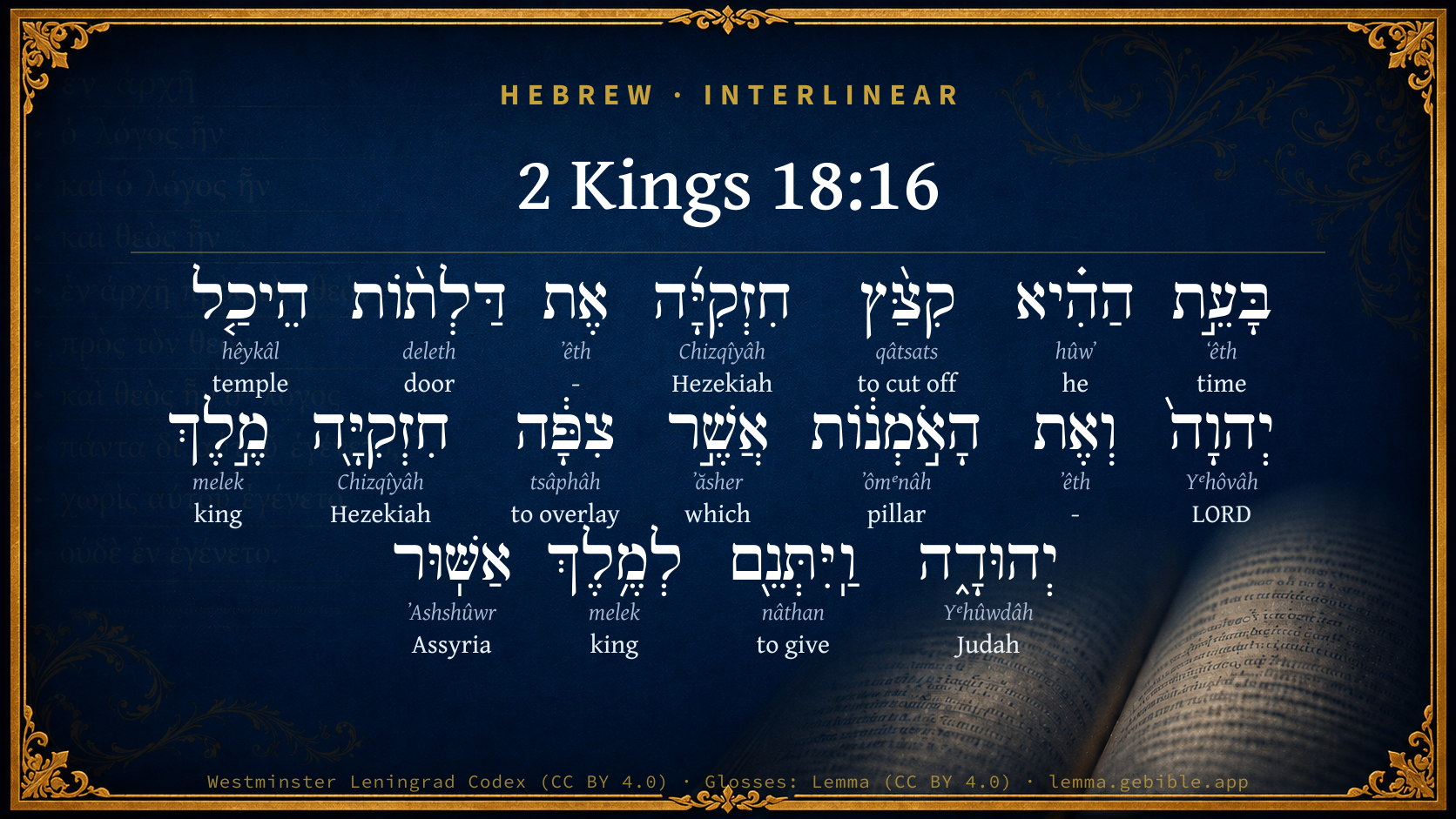
Hebrew (Westminster Leningrad Codex) 2 Kings 18:16 appears in the Hebrew Old Testament. The text above is from the Westminster Leningrad Codex. Each word links to its Strong’s number, a concise gloss, and parsing drawn from the Open Scriptures Hebrew Bible morphology. Click any word for its full Brown-Driver-Briggs (BDB) entry.
Download image
Cite this verse

2 Kings 18:16 (World English Bible). Public Domain. Lemma interlinear Bible study tool, https://lemma.gebible.app/v/2-kings/18/16.

Show BibTeX & RIS
BibTeX
RIS
English Translation
At that time did Hezekiah cut off [the gold from] the doors of the temple of Yahweh, and [from] the pillars which Hezekiah king of Judah had overlaid, and gave it to the king of Assyria.
World English Bible · Public Domain
Highlights
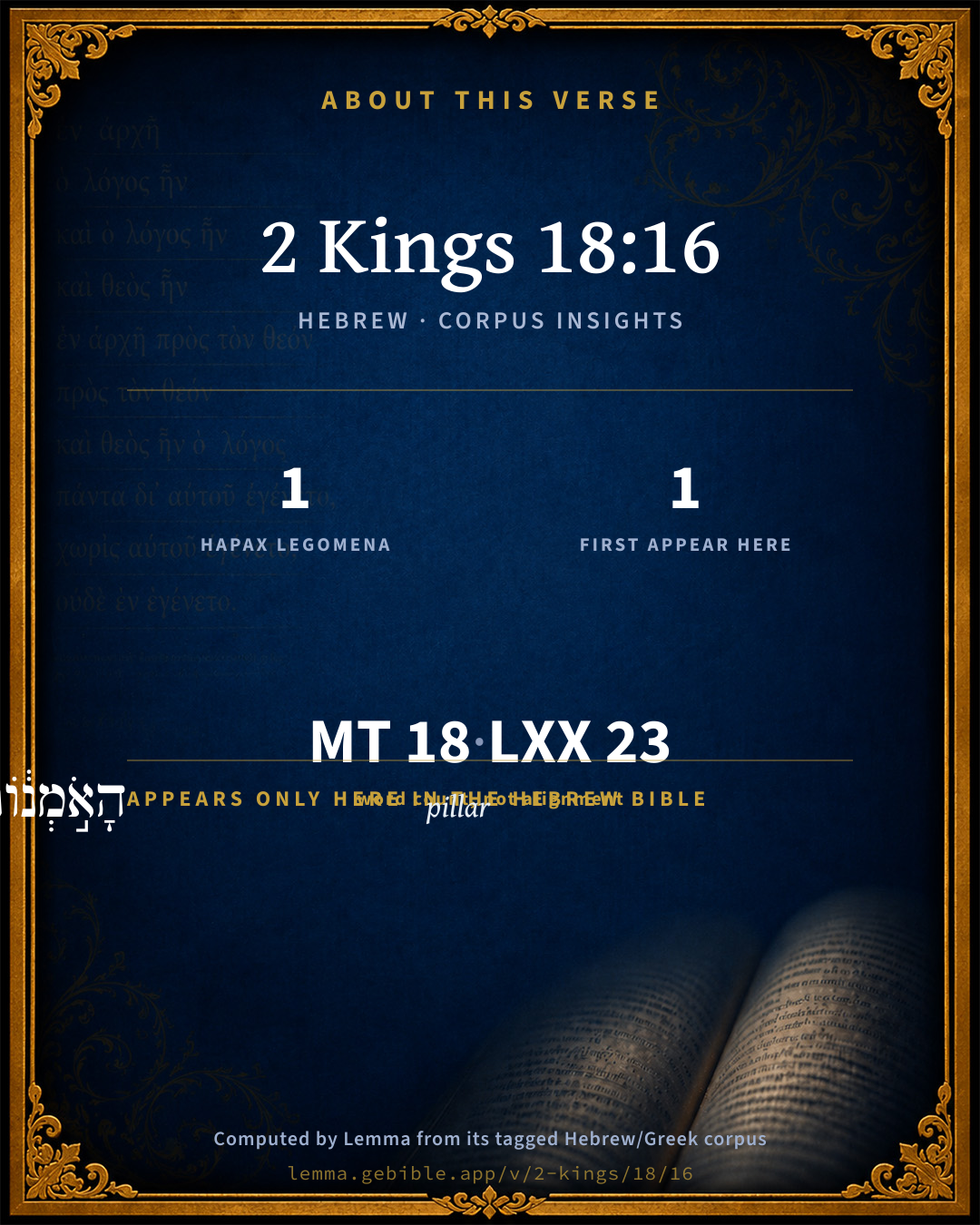
  • 1 hapax legomenon — only here in the Hebrew Bible
  • 1 first appearance in the Hebrew Bible
Full analysis ↓
Download a study sheet

One document with this verse’s original text, its word-by-word gloss line, the meaning frame, cross-references with their text, attributed commentary, and full source and license credits — printable, and it pastes into notes with its structure intact.

This verse Autodidact and up

Study sheet (.html) Plain text (.txt)

A passage Seminary Student

Up to 50 verses in one chapter. A passage sheet keeps up to 6 commentary sources and 12 cross-references per verse, in the order this page ranks them, and says so on the sheet whenever that leaves anything out. Ask for a single verse and you get the Autodidact verse sheet above.

Everything on this page stays free to read, with no account — the sheet is a download of what is already on screen, not access to it.

Want to remove ads? Support Godless Engineer
Compare translations 3

The same verse in 3 English versions, stacked beneath the original-language interlinear above. Click any original word for its lexicon entry.

Each is an independent rendering of the whole verse — the interlinear is not word-aligned to these translations.

Highlighted words mark where these versions differ — a whole-verse word diff, not a word-by-word alignment.

  • World English Bible Public Domain
    At that time did Hezekiah cut off [the gold from] the doors of the temple of Yahweh, and [from] the pillars which Hezekiah king of Judah had overlaid, and gave it to the king of Assyria.
  • King James Version Public Domain
    At that time did Hezekiah cut off the gold from the doors of the temple of the LORD, and from the pillars which Hezekiah king of Judah had overlaid, and gave it to the king of Assyria.
  • unfoldingWord Literal Text CC BY-SA 4.0
    At that time, Hezekiah cut off the doors of the temple of Yahweh and the doorposts that Hezekiah, the king of Judah, had overlaid, and he gave them to the king of Assyria.

unfoldingWord Literal Text — © unfoldingWord, licensed CC BY-SA 4.0. Word-aligned USFM3 via Door43 (git.door43.org/unfoldingWord/en_ult).

Versions to compare (up to 4)

3 of 4 selected

Show all 18 translations

Every available English version of this verse, each an independent rendering of the whole verse.

  • World English Bible Public Domain
    At that time did Hezekiah cut off [the gold from] the doors of the temple of Yahweh, and [from] the pillars which Hezekiah king of Judah had overlaid, and gave it to the king of Assyria.
  • Berean Standard Bible Public Domain
    At that time Hezekiah stripped the gold with which he had plated the doors and doorposts of the temple of the LORD, and he gave it to the king of Assyria.
  • Majority Standard Bible Public Domain
    At that time Hezekiah stripped the gold with which he had plated the doors and doorposts of the temple of the LORD, and he gave it to the king of Assyria.
  • King James Version Public Domain
    At that time did Hezekiah cut off the gold from the doors of the temple of the LORD, and from the pillars which Hezekiah king of Judah had overlaid, and gave it to the king of Assyria.
  • American Standard Version (1901) Public Domain
    At that time did Hezekiah cut off `the gold from' the doors of the temple of Jehovah, and `from' the pillars which Hezekiah king of Judah had overlaid, and gave it to the king of Assyria.
  • Revised Version (1885) Public Domain
    At that time did Hezekiah cut off the gold from the doors of the temple of the LORD, and from the pillars which Hezekiah king of Judah had overlaid, and gave it to the king of Assyria.
  • Geneva Bible (1599) Public Domain
    At the same season did Hezekiah pul off the plates of the doores of the Temple of the Lord, and the pillars (which the sayd Hezekiah King of Iudah had couered ouer) and gaue them to the King of Asshur.
  • Douay-Rheims (1899) Public Domain
    At that time Ezechias broke the doors of the temple of the Lord, and the plates of gold which he had fastened on them, and gave them to the king of the Assyrians.
  • Young's Literal Translation Public Domain
    at that time hath Hezekiah cut off the doors of the temple of Jehovah, and the pillars that Hezekiah king of Judah had overlaid, and giveth them to the king of Asshur.
  • Literal Standard Version CC BY-SA 4.0
    at that time Hezekiah has cut off the doors of the temple of YHWH, and the pillars that Hezekiah king of Judah had overlaid, and gives them to the king of Asshur.
  • Unlocked Literal Bible CC BY-SA 4.0
    Then Hezekiah cut off the gold from the doors of the temple of Yahweh and from the pillars that he had overlaid; he gave the gold to the king of Assyria.
  • unfoldingWord Literal Text CC BY-SA 4.0
    At that time, Hezekiah cut off the doors of the temple of Yahweh and the doorposts that Hezekiah, the king of Judah, had overlaid, and he gave them to the king of Assyria.
  • Darby Bible Public Domain
    At that time Hezekiah stripped the doors of the temple of Jehovah, and the posts that Hezekiah king of Judah had overlaid, and gave them to the king of Assyria.
  • World Messianic Bible Public Domain
    At that time, Hezekiah cut off the gold from the doors of the LORD’s temple, and from the pillars which Hezekiah king of Judah had overlaid, and gave it to the king of Assyria.
  • Webster's Bible Public Domain
    At that time did Hezekiah cut off the gold from the doors of the temple of the LORD, and from the pillars which Hezekiah king of Judah had overlaid, and gave it to the king of Assyria.
  • Free Bible Version CC BY-SA 4.0
    He even stripped the gold he had used to overlay the doors and doorposts of the Lord's Temple and gave everything to the king of Assyria.
  • Bible in Basic English Public Domain
    And at that time Hezekiah had the gold from the doors of the Lord's house, and from the door-pillars plated by him, cut off and gave it to the king of Assyria.
  • JPS Tanakh (1917) Public Domain
    At that time did Hezekiah cut off the gold from the doors of the temple of the LORD, and from the door-posts which Hezekiah king of Judah had overlaid, and gave it to the king of Assyria.

Literal Standard Version (2020), Covenant Press — licensed CC BY-SA 4.0. Text via the HelloAO Bible API (eBible.org). Unlocked Literal Bible (unfoldingWord) — licensed CC BY-SA 4.0. Text via the HelloAO Bible API (eBible.org). unfoldingWord Literal Text — © unfoldingWord, licensed CC BY-SA 4.0. Word-aligned USFM3 via Door43 (git.door43.org/unfoldingWord/en_ult). Free Bible Version, Dr. Jonathan Gallagher — licensed CC BY-SA 4.0. Text via the HelloAO Bible API (eBible.org).

Word by word

More ways to search: Search by grammar → Find every occurrence → Compare this word →

Practice this passage: Drill this verse → Learn its vocabulary →

הָאֹ֣מְנ֔וֹת
ʼômᵉnâh
H547
“the · pillars”
Particle, Definite Article + Noun, Common, Feminine, Plural, Absolute
Part of Speech
Particle + Noun
Type
Common
Gender
Feminine
Number
Plural
State
Absolute
Full BDB Definition

Origin: active participle of H544 (in the original sense of supporting)

TWOT: 116

pillar, supporters of the door - confirm, support, uphold
  1. בָּעֵ֣ת ʻêth H6256 “in/at the · time” Preposition, Determined + Noun, Common, Both, Singular, Absolute
  2. הַהִ֗יא hûwʼ H1931 “the · he” Particle, Definite Article + Pronoun, Personal, 3rd Person, Feminine, Singular
  3. קִצַּ֨ץ qâtsats H7112 “to cut off” Verb, Piel, Perfect, 3rd Person, Masculine, Singular
  4. חִזְקִיָּ֜ה Chizqîyâh H2396 “Hezekiah” Noun, Proper
  5. אֶת ʼêth H853 “-” Particle, Direct Object
  6. דַּלְת֨וֹת deleth H1817 “doors of” Noun, Common, Feminine, Plural, Construct
  7. הֵיכַ֤ל hêykâl H1964 “temple of” Noun, Common, Masculine, Singular, Construct
  8. יְהוָה֙ Yᵉhôvâh H3068 “LORD” Noun, Proper
  9. וְאֶת ʼêth H853 “and · -” Conjunction + Particle, Direct Object
  10. אֲשֶׁ֣ר ʼăsher H834 “which” Particle, Relative
  11. צִפָּ֔ה tsâphâh H6823 “to overlay” Verb, Piel, Perfect, 3rd Person, Masculine, Singular
  12. חִזְקִיָּ֖ה Chizqîyâh H2396 “Hezekiah” Noun, Proper
  13. מֶ֣לֶךְ melek H4428 “king of” Noun, Common, Masculine, Singular, Construct
  14. יְהוּדָ֑ה Yᵉhûwdâh H3063 “Judah” Noun, Proper
  15. וַֽיִּתְּנֵ֖ם nâthan H5414 “and · to give · them” Conjunction + Verb, Qal, Sequential Imperfect, 3rd Person, Masculine, Singular + Suffix, Personal, 3rd Person, Masculine, Plural
  16. לְמֶ֥לֶךְ melek H4428 “to/for · king of” Preposition + Noun, Common, Masculine, Singular, Construct
  17. אַשּֽׁוּר ʼAshshûwr H804 “Assyria” Noun, Proper

About this verse

These counts appear in no published source. They are computed here, from the morphology-tagged text and Lemma’s own curated glosses. What Lemma adds →

18
words
15
distinct lemmas
Historical
section

Notable vocabulary

1 hapax legomenon — a word that appears only here in the entire Hebrew Bible:

  • הָאֹ֣מְנ֔וֹת pillar H547

First appearance in Scripture

This word makes its first canonical appearance in the Hebrew Bible here:

  • הָאֹ֣מְנ֔וֹת pillar H547

Shared distinctive vocabulary

קִצַּ֨ץ to cut off H7112 occurs in 14 verses of the Hebrew Bible. Also found in:

Grammatical profile

  • 3 verbs
  • 11 nouns
  • 1 pronoun
  • 3 particles

Verb forms

  • קִצַּ֨ץ Piel · Perfect
  • צִפָּ֔ה Piel · Perfect
  • וַֽיִּתְּנֵ֖ם Qal · Sequential Imperfect

Repetition

Words recur within this verse — often emphatic in Hebrew:

  • חִזְקִיָּ֜ה Hezekiah H2396 ×2
  • מֶ֣לֶךְ king H4428 ×2

Hebrew & Septuagint length

In English translation the verse runs 36 words from the Hebrew and 36 from the Septuagint (LXX English) — the same length.

A rough comparison of the two English renderings, which tokenize alike — not a word-level alignment.

Word counts can differ between the Hebrew and the Greek without any difference in meaning — e.g. the Hebrew direct-object marker אֵת has no separate Greek word, and Greek often adds the article ὁ.

In the original languages it is 18 Hebrew tokens and 23 Greek tokens — but the two are counted differently (Hebrew bundles its prefixes and suffixes into one token; the Greek is in lemma form), so that isn’t a like-for-like length.

Cross-references

2

Topical passages linked to 2 Kings 18:16 in the Treasury of Scripture Knowledge — connected by theme and wording, ordered by reader-vote popularity; previews shown in the World English Bible.

  • 1 Kings 6:31–35 For the entrance of the oracle he made doors of olive-wood: the lintel [and] door-posts were a fifth part [of the wall].
  • 2 Chronicles 29:3 He in the first year of his reign, in the first month, opened the doors of the house of Yahweh, and repaired them.

Cross-references courtesy of OpenBible.info (CC BY 4.0).

Hebrew and Greek witnesses Masoretic Hebrew ↔ Greek Septuagint

The same verse in the two great witnesses to the Old Testament, shown verse-for-verse.

These are two independent witnesses, not word-aligned to each other, and the Septuagint is shown in lemma (dictionary) form.

Hebrew 2 Kings 18:16 Masoretic · Westminster Leningrad Codex

בָּעֵ֣ת הַהִ֗יא קִצַּ֨ץ חִזְקִיָּ֜ה אֶת דַּלְת֨וֹת הֵיכַ֤ל יְהוָה֙ וְאֶת הָאֹ֣מְנ֔וֹת אֲשֶׁ֣ר צִפָּ֔ה חִזְקִיָּ֖ה מֶ֣לֶךְ יְהוּדָ֑ה וַֽיִּתְּנֵ֖ם לְמֶ֥לֶךְ אַשּֽׁוּר

At that time did Hezekiah cut off [the gold from] the doors of the temple of Yahweh, and [from] the pillars which Hezekiah king of Judah had overlaid, and gave it to the king of Assyria.

World English Bible · Public Domain

Greek LXX 2 Kings 18:16 Septuagint · lemma form

ἐν ὁ καιρός ἐκεῖνος συνκόπτω εζεκιας ὁ θύρα ναός κύριος καί ὁ στηρίζω ὅς χρυσόω εζεκιας βασιλεύς ιουδα καί δίδωμι αὐτός βασιλεύς ἀσσύριος

At that time Ezekias cut off the gold from the doors of the temple, and from the pillars which Ezekias king of Juda had overlaid with gold, and gave it to the king of the Assyrians.

LXX2012 (modern English Septuagint) · Public Domain

Hebrew: Westminster Leningrad Codex (CC BY 4.0). Greek: Septuagint (public domain); English from LXX2012 (modern English Septuagint) (Public Domain). How the Septuagint differs from the Hebrew →

Targum (Aramaic paraphrase)

1

The Targum is the ancient Jewish Aramaic paraphrase of the Hebrew Scriptures — an interpretive translation, not the Hebrew text itself. Onkelos (literal) and Pseudo-Jonathan (expansive) render the Torah, and Jonathan the Prophets. Coverage is partial: where no permissively-licensed English translation exists for a verse, only the Aramaic is shown. This is verse-level text, not a word-by-word alignment to the Hebrew.

  1. Targum Jonathan Prophets (Joshua–Malachi)
    בְּעִדָנָא הַהִיא קַלִיף חִזְקִיָה יַת דָשֵׁי הֵיכָלָא דַייָ וְיַת סְקוֹפַיָא דַחֲפֵי חִזְקִיָה מֶלֶךְ שִׁבְטָא דְבֵית יְהוּדָה וְיַהֲבִינוּן לְמַלְכָּא דְאַתּוּר:

    (no public-domain English translation for this verse)

    Targum Jonathan — Aramaic: “Mikraot Gedolot” (public domain). English: “Sefaria Community Translation” (CC0 1.0 (public-domain dedication)); “London "Chaldee Paraphrase," 1871” (public domain). Text via Sefaria.

Commentary

Notes on 2 Kings 18:16 from classic Christian and Jewish commentators (each source and its license shown beneath its notes). The classic Christian expositions comment on the surrounding passage and are grouped to its opening verse, so a note may address several verses; the Jewish commentaries on the Tanakh (Rashi and others) are per-verse, so they appear only where the commentator wrote on this verse.

Lemma curates 59 commentaries, every one of them public domain or Creative Commons licensed, each selected and text-cleaned for this edition rather than reprinted as found. About our sources →

Trapp's Complete Commentary

John Trapp

2Ki 18:16 At that time did Hezekiah cut off [the gold from] the doors of the temple of the LORD, and [from] the pillars which Hezekiah king of Judah had overlaid, and gave it to the king of Assyria.

Ver. 16. At that time did Hezekiah cut off.] If Ahaz, that church robber, had done this, it would better have become him. Hezekiah for doing it lost his cost. {2Ki 18:16}

John Trapp, A Commentary or Exposition upon All the Books of the Old and New Testament (1647–1656) — public domain. Text from a community e-Sword module.

Ellicott's Commentary for English Readers

(16) Cut off the gold from the doors.—Literally, trimmed, or stripped the doors (the word used in 2Ki_16:17 of the similar proceeding of Ahaz). The leaves of the doors of the sanctuary were overlaid with gold (1Ki_6:18; 1Ki_6:32; 1Ki_6:35). Hard necessity drove Hezekiah to strip off this gold, as well as that with which he had himself plated “the pillars” or rather the framework of the doors (literally, the supporters; others think that the door-posts only are meant by this term).

A Bible Commentary for English Readers, edited by Charles John Ellicott (1878–1897) — public domain. Text from a community e-Sword module.

The Cambridge Bible for Schools and Colleges

gen. ed. J. J. S. Perowne

16. cut off the gold from the doors of the temple] Plainly shewing that there was a great scarcity of gold at this time. Hezekiah was the last man to have stripped the temple doors if there had been any other way of raising what was demanded. He had been rejoiced at the purification and adornment of the temple, and must have been very hard driven ere he consented to undo the work which he had so lately done. Josephus adds to the history (Ant. x. 1. 1) a link which may explain the events which follow in the next section. He says that Sennacherib had promised the ambassadors of Hezekiah to depart on the payment of the impost, but that when he had received the money he paid no regard to what he had promised, but sent his officers to attack Jerusalem. In this way the Biblical record of verse 17 may be joined on to the statements in verse 16. The Chronicler takes no notice of the payment of tribute to Sennacherib, and gives only an account of the siege of Jerusalem and its non-success. And this he does with much more brevity than the compiler of Kings or the parallel record in Isaiah.

The Cambridge Bible for Schools and Colleges (gen. ed. J. J. S. Perowne; Cambridge University Press, 1878–1918) — public domain. Text from a community e-Sword module.

Albert Barnes' Notes on the Bible

Ahaz had already exhausted the treasuries 2Ki 16:8; Hezekiah was therefore compelled to undo his own work.

Albert Barnes' Notes on the Bible (1834–1885) — public domain. Text from a community e-Sword/MySword module.

Haydock's Catholic Bible Commentary

On them. All must go to meet the exigencies of the state. (Grotius, Jur. ii. 5.) --- The doors of temples and palaces were frequently adorned with the most precious metals, as Homer describes the palace of Alcinous; (Odyssey; Haydock) and Tavernier (vii. 12.) speaks of some mosques in Persia, the doors of which are covered with plates of silver. See Josephus, Jewish Wars vi. 6.

George Leo Haydock (1774–1849), Haydock's Catholic Family Bible and Commentary, 1859 edition — public domain. Excludes Psalms (Douay-Rheims chapter numbering differs from Protestant) and Deuterocanonical books (Catholic canon only).

Matthew Poole's English Annotations

Which Hezekiah king of Judah had overlaid; so repairing the injury which his father had done to them, and putting them into the same condition in which Solomon left them, 1Ki 6:32.

Matthew Poole's English Annotations on the Holy Bible (1683–1685) — public domain. Text from a community e-Sword/MySword module.

Whedon's Commentary on the Bible

Daniel D. Whedon

16. Cut off the gold from the doors — In the first year of his reign Hezekiah had repaired the doors of the temple, (2Ch_29:3,) but it is not said that he overlaid them with gold, which word our translators have here supplied without sufficient authority. He doubtless used various kinds of metal, gold among the rest; and this cutting it off again to give to the king of Assyria shows how difficult it was for him to raise the required amount.

It is interesting to find the above confirmed in the Assyrian annals by the following inscription of Sennacherib, discovered among the ruins of Nineveh: “Because Hezekiah, king of Judah, would not submit to my yoke, I came up against him, and by force of arms and by the might of my power, I took forty-six of his strong-fenced cities; and of the smaller towns which were scattered about I took and plundered a countless number. And from these places I captured and carried off as spoil two hundred thousand one hundred and fifty people, old and young, male and female, together with horses and mares, asses and camels, oxen and sheep, a countless multitude. And Hezekiah himself I shut up in Jerusalem, his capital city, like a bird in a cage, building towers round the city to hem him in, and raising banks of earth against the gates so as to prevent escape. Then upon this Hezekiah there fell the fear of the power of my arms, and he sent out to me the chiefs and the elders of Jerusalem with thirty talents of gold and eight hundred talents of silver, and divers treasures, a rich and immense booty. All these things were brought to me at Nineveh, the seat of my government, Hezekiah having sent them by way of tribute, and as a token of his submission to my power.” — RAWLINSON’S Ancient Monarchies, vol. ii, p. 161. The discrepancies, whether apparent or real, between the inscription and the biblical narrative are of little moment compared with the unquestionable confirmation hereby given to the historical veracity of the sacred writers. It will be noticed that the inscription tells with pompous gusto of the Assyrian successes and the spoil that was taken, but makes no record of the disasters which befell the army of Sennacherib. This was in perfect keeping with what we know of the pride and arrogance of all the Assyrian kings.

Daniel D. Whedon (gen. ed.), Commentary on the Old and New Testaments (1874–1909) — public domain. Text from a community e-Sword module.

The Pulpit Commentary

At that time did Hezekiah cut off the gold from the doors of the temple of the Lord, and from the pillars which Hezekiah King of Judah had overlaid, and gave it to the King of Assyria. In the time of his great wealth and prosperity, Hezekiah, while engaged in restoring the temple, (2Ch_29:17-19) had adorned the pillars and doors of the sanctuary with a metal covering, which was probably gold, like Solomon"s. (1Ki_6:20-22, 1Ki_6:28, 1Ki_6:30, 1Ki_6:32) To make up the "thirty talents of gold" he was now obliged to undo his own work, and strip the doors and pillars bare. Sennacherib tells us that, besides the two large sums of gold and silver, Hezekiah sent him at this time "woven cloth, scarlet," embroidered; precious stones of large size; couches of ivory; movable thrones of ivory; skins of buffaloes; horns of buffaloes; and two kinds of woods" ("Records of the Past," vol. 1. p. 39, lines 34-37). It was customary to accompany the fixed tribute with the more precious products of each country.

The Pulpit Commentary (1880–1919), ed. H.D.M. Spence-Jones & Joseph S. Exell — public domain. Text from a community e-Sword module.

unfoldingWord translationNotes

Door43 World Missions Community

the king of Assyria mobilized his great army, sending Tartan and Rabsaris and the chief commander

Sennacherib sent a group of men from his army to Jerusalem to meet with King Hezekiah, including officials named Tartan and Rabsaris.

Tartan ... Rabsaris

Some Bibles translate these as proper names. Other versions of the Bible translate them as titles. AT: "the Tartan ... the Rabsaris" or "the leader of the soldier ... a court official" (See: How to Translate Names)

Lachish

This is the name of a city. (See: How to Translate Names)

the conduit of the upper pool

the channel where the water stored in the "upper pool" flows into the city of Jerusalem

stood by it

"and waited there for King Hezekiah to meet with them"

Eliakim ... Hilkiah ... Shebna ... Joah ... Asaph

These are the names of men. (See: How to Translate Names)

translationWords

temple

Yahweh

column

Assyria

Jerusalem

call

Eliakim

Hilkiah

household

scribe

unfoldingWord translationNotes — © Distant Shores Media and the Door43 World Missions Community, licensed CC BY-SA 4.0. Source: git.door43.org/Door43/en_tn.

Rashi

Rabbi Shlomo Yitzchaki (Rashi)

Removed. The doors, which were gold [plated].

And the thresholds. [Targum] Yonoson rendered the סקופיא, [i.e.,] the thresholds.

Rashi on the Tanakh — English translations: “The Judaica Press complete Tanach with Rashi, translated by A. J. Rosenberg” (CC BY 4.0); “Pentateuch with Rashi's commentary by M. Rosenbaum and A.M. Silbermann, 1929-1934” (public domain); “The Metsudah Tanach series, Lakewood, N.J” (CC BY 4.0); and “The Book of Joshua, Metsudah Publications, 1997” (CC BY 4.0). Text via Sefaria.

Lesson kit

Teaching starters — assembled from the data on this page, not authored interpretation. Every prompt links to the verse data it draws on. Edit before teaching.

2 Kings, in the Historical, opens this verse with 18 words (15 distinct Hebrew lemmas). Its most distinctive word is ʼômᵉnâh (“pillar”). A historical commentator’s framing appears above. Read the whole chapter for the surrounding context.

Discussion questions

  1. How does “pillar” (ʼômᵉnâh) shape what this verse is saying?
  2. This verse holds 1 word here found nowhere else in the Hebrew Bible. What might the rare word draw attention to?
  3. The word “pillar” first appears here in Scripture. What is being introduced at this debut?
  4. Exodus 39:3 shares the word «to cut off» with this verse. How do the two illuminate each other?
  5. “Hezekiah” occurs 2× in this one verse. What is the effect of the repetition?
  6. These translations render this verse differently. What is at stake in choosing one wording over another?
  7. The verb «קִצַּ֨ץ» is Piel Perfect. How does its form color the action?
  8. Reading how Trapp's Complete Commentary and Ellicott's Commentary for English Readers read this verse, where do the two commentators agree and where do they part?

Things to notice

  • 1 word in this verse appears nowhere else in the Hebrew Bible.
  • 1 word makes its first canonical appearance in Scripture here.
  • This verse counts 18 Hebrew ↔ 23 Greek words.
  • These translations choose different wording for 7 words in this verse.
  • “Hezekiah” occurs 2× in this single verse.

Reading settings

Reading text

Shown beneath each verse's original-language words.

Old Testament
Old Testament edition

Read the OT as the Masoretic Hebrew (MT) or the Greek Septuagint (LXX).

English shown for the Greek Septuagint (in the Hebrew ↔ Greek comparison).

Comparing translations? Open the Compare panel on any verse page to stack up to four side by side.