
Jeremiah 6:15

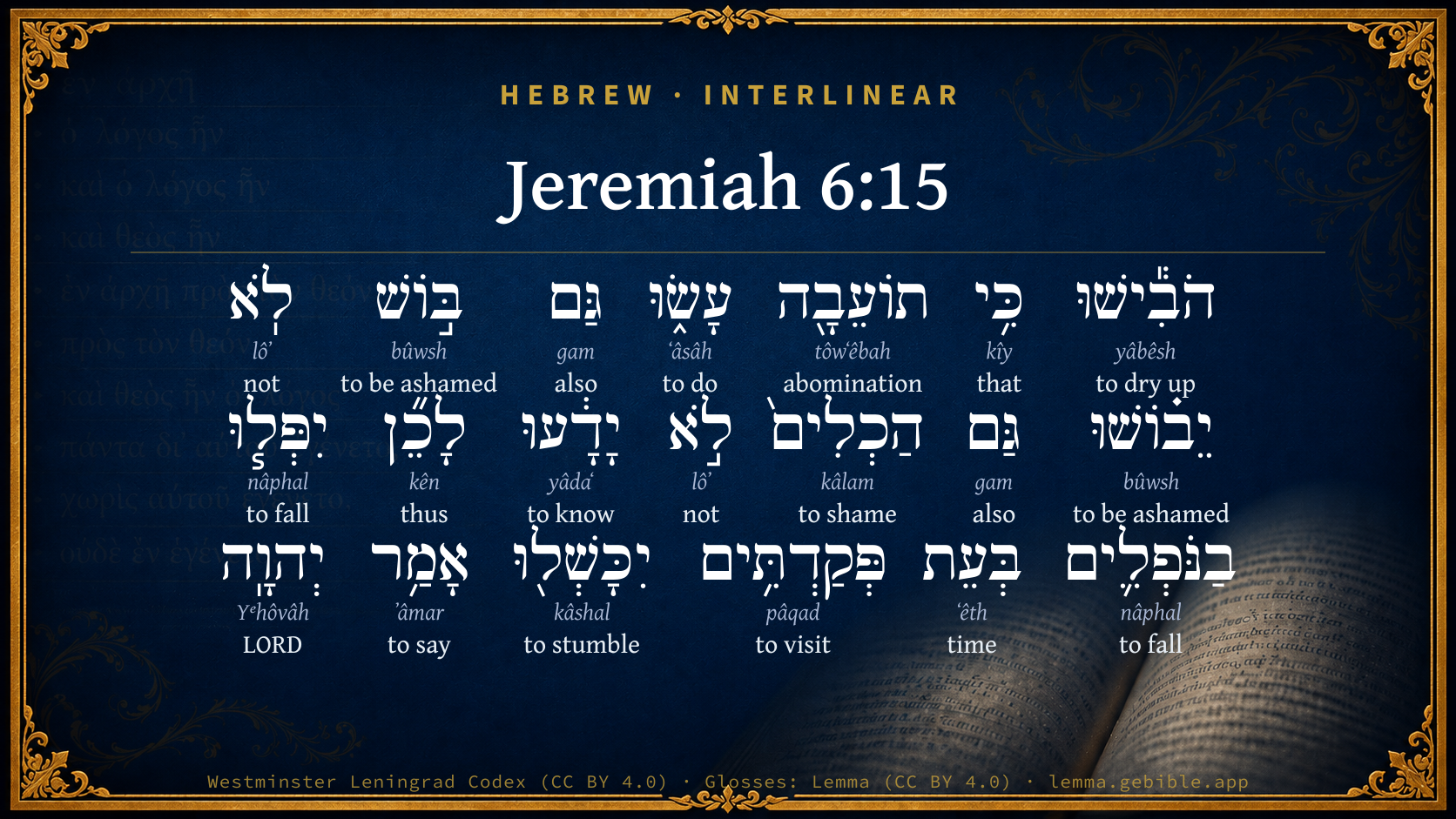
Hebrew (Westminster Leningrad Codex) Jeremiah 6:15 appears in the Hebrew Old Testament. The text above is from the Westminster Leningrad Codex. Each word links to its Strong’s number, a concise gloss, and parsing drawn from the Open Scriptures Hebrew Bible morphology. Click any word for its full Brown-Driver-Briggs (BDB) entry.
Download image
Cite this verse

Jeremiah 6:15 (World English Bible). Public Domain. Lemma interlinear Bible study tool, https://lemma.gebible.app/v/jeremiah/6/15.

Show BibTeX & RIS
BibTeX
RIS
English Translation
Were they ashamed when they had committed abomination? nay, they were not at all ashamed, neither could they blush: therefore they shall fall among those who fall; at the time that I visit them they shall be cast down, says Yahweh.
World English Bible · Public Domain
Download a study sheet

One document with this verse’s original text, its word-by-word gloss line, the meaning frame, cross-references with their text, attributed commentary, and full source and license credits — printable, and it pastes into notes with its structure intact.

This verse Autodidact and up

Study sheet (.html) Plain text (.txt)

A passage Seminary Student

Up to 50 verses in one chapter. A passage sheet keeps up to 6 commentary sources and 12 cross-references per verse, in the order this page ranks them, and says so on the sheet whenever that leaves anything out. Ask for a single verse and you get the Autodidact verse sheet above.

Everything on this page stays free to read, with no account — the sheet is a download of what is already on screen, not access to it.

Want to remove ads? Support Godless Engineer
Compare translations 3

The same verse in 3 English versions, stacked beneath the original-language interlinear above. Click any original word for its lexicon entry.

Each is an independent rendering of the whole verse — the interlinear is not word-aligned to these translations.

Highlighted words mark where these versions differ — a whole-verse word diff, not a word-by-word alignment.

  • World English Bible Public Domain
    Were they ashamed when they had committed abomination? nay, they were not at all ashamed, neither could they blush: therefore they shall fall among those who fall; at the time that I visit them they shall be cast down, says Yahweh.
  • King James Version Public Domain
    Were they ashamed when they had committed abomination? nay, they were not at all ashamed, neither could they blush: therefore they shall fall among them that fall: at the time that I visit them they shall be cast down, saith the LORD.
  • unfoldingWord Literal Text CC BY-SA 4.0
    Were they ashamed when they did an abomination? Indeed to be ashamed, they were not ashamed; they did not even know to blush! Therefore they will fall among the fallen ones; At the time I punish them they will stumble says Yahweh.

unfoldingWord Literal Text — © unfoldingWord, licensed CC BY-SA 4.0. Word-aligned USFM3 via Door43 (git.door43.org/unfoldingWord/en_ult).

Versions to compare (up to 4)

3 of 4 selected

Show all 18 translations

Every available English version of this verse, each an independent rendering of the whole verse.

  • World English Bible Public Domain
    Were they ashamed when they had committed abomination? nay, they were not at all ashamed, neither could they blush: therefore they shall fall among those who fall; at the time that I visit them they shall be cast down, says Yahweh.
  • Berean Standard Bible Public Domain
    Are they ashamed of the abomination they have committed? No, they have no shame at all; they do not even know how to blush. So they will fall among the fallen; when I punish them, they will collapse,” says the LORD.
  • Majority Standard Bible Public Domain
    Are they ashamed of the abomination they have committed? No, they have no shame at all; they do not even know how to blush. So they will fall among the fallen; when I punish them, they will collapse,” says the LORD.
  • King James Version Public Domain
    Were they ashamed when they had committed abomination? nay, they were not at all ashamed, neither could they blush: therefore they shall fall among them that fall: at the time that I visit them they shall be cast down, saith the LORD.
  • American Standard Version (1901) Public Domain
    Were they ashamed when they had committed abomination? nay, they were not at all ashamed, neither could they blush: therefore they shall fall among them that fall; at the time that I visit them they shall be cast down, saith Jehovah.
  • Revised Version (1885) Public Domain
    Were they ashamed when they had committed abomination? nay, they were not at all ashamed, neither could they blush: therefore they shall fall among them that fall: at the time that I visit them they shall be cast down, saith the LORD.
  • Geneva Bible (1599) Public Domain
    Were they ashamed when they had committed abomination? nay, they were not ashamed, no neither coulde they haue any shame: therefore they shall fall among the slaine: when I shall visite them, they shall be cast downe, sayth the Lord.
  • Douay-Rheims (1899) Public Domain
    They were confounded, because they commmitted abomination: yea, rather they were not confounded with confusion, and they knew not how to blush: wherefore they shall fall among them that fall: in the time of their visitation they shall fall down, saith the Lord.
  • Young's Literal Translation Public Domain
    They were ashamed when they did abomination! Yea, they are not at all ashamed, Yea, blushing they have not known, Therefore they do fall among those falling, In the time I have inspected them, They stumble, said Jehovah.
  • Literal Standard Version CC BY-SA 4.0
    They were ashamed when they did abomination! Indeed, they are not at all ashamed, || Indeed, they have not known blushing, || Therefore they fall among those falling, || In the time I have inspected them, || They stumble,” said YHWH.
  • Unlocked Literal Bible CC BY-SA 4.0
    Were they ashamed when they practiced abominations? They were not ashamed; they did not know how to blush! So they will fall among the fallen; they will be brought down when they are punished, says Yahweh.
  • unfoldingWord Literal Text CC BY-SA 4.0
    Were they ashamed when they did an abomination? Indeed to be ashamed, they were not ashamed; they did not even know to blush! Therefore they will fall among the fallen ones; At the time I punish them they will stumble says Yahweh.
  • Darby Bible Public Domain
    Are they ashamed that they have committed abomination? Nay, they are not at all ashamed, neither know they what it is to blush. Therefore they shall fall among them that fall; at the time that I visit them they shall stumble, saith Jehovah.
  • World Messianic Bible Public Domain
    Were they ashamed when they had committed abomination? No, they were not at all ashamed, neither could they blush. Therefore they will fall among those who fall. When I visit them, they will be cast down,” says the LORD.
  • Webster's Bible Public Domain
    Were they ashamed when they had committed abomination? no, they were not at all ashamed, neither could they blush: therefore they shall fall among them that fall: at the time that I visit them they shall be cast down, saith the LORD.
  • Free Bible Version CC BY-SA 4.0
    Were they ashamed of the disgusting things they did? No, they weren't ashamed at all, they couldn't even blush. So they will fall just like the others, when I punish them; they will drop down dead, says the Lord.
  • Bible in Basic English Public Domain
    Let them be put to shame because they have done disgusting things. They had no shame, they were not able to become red with shame: so they will come down with those who are falling: when my punishment comes on them, they will be made low, says the Lord.
  • JPS Tanakh (1917) Public Domain
    They shall be put to shame because they have committed abomination; yea, they are not at all ashamed, neither know they how to blush; therefore they shall fall among them that fall, at the time that I punish them they shall stumble, saith the LORD.

Literal Standard Version (2020), Covenant Press — licensed CC BY-SA 4.0. Text via the HelloAO Bible API (eBible.org). Unlocked Literal Bible (unfoldingWord) — licensed CC BY-SA 4.0. Text via the HelloAO Bible API (eBible.org). unfoldingWord Literal Text — © unfoldingWord, licensed CC BY-SA 4.0. Word-aligned USFM3 via Door43 (git.door43.org/unfoldingWord/en_ult). Free Bible Version, Dr. Jonathan Gallagher — licensed CC BY-SA 4.0. Text via the HelloAO Bible API (eBible.org).

Word by word

More ways to search: Search by grammar → Find every occurrence → Compare this word →

Practice this passage: Drill this verse → Learn its vocabulary →

הַכְלִים֙
kâlam
H3637
“to shame”
Verb, Hiphil, Infinitive Construct
Part of Speech
Verb
Stem
Hiphil
Form
Infinitive Construct
Full BDB Definition

Origin: a primitive root

TWOT: 987

to insult, shame, humiliate, blush, be ashamed, be put to shame, be reproached, be put to confusion, be humiliated - (Niphal) - to be humiliated, be ashamed - to be put to shame, be dishonoured, be confounded - (Hiphil) - to put to shame, insult, humiliate, cause shame to - to exhibit shame - (Hophal) - to be insulted, be humiliated - to be put to shame, be dishonoured, be confounded
  1. הֹבִ֕ישׁוּ yâbêsh H3001 “to dry up” Verb, Hiphil, Perfect, 3rd Person, Common, Plural
  2. כִּ֥י kîy H3588 “that” Conjunction
  3. תוֹעֵבָ֖ה tôwʻêbah H8441 “abomination” Noun, Common, Feminine, Singular, Absolute
  4. עָשׂ֑וּ ʻâsâh H6213 “to do” Verb, Qal, Perfect, 3rd Person, Common, Plural
  5. גַּם gam H1571 “also” Particle, Accusative
  6. בּ֣וֹשׁ bûwsh H954 “to be ashamed” Verb, Qal, Infinitive Absolute
  7. לֹֽא lôʼ H3808 “not” Particle, Negative
  8. יֵב֗וֹשׁוּ bûwsh H954 “to be ashamed” Verb, Qal, Imperfect, 3rd Person, Masculine, Plural
  9. גַּם gam H1571 “also” Particle, Accusative
  10. לֹ֣א lôʼ H3808 “not” Particle, Negative
  11. יָדָ֔עוּ yâdaʻ H3045 “to know” Verb, Qal, Perfect, 3rd Person, Common, Plural
  12. לָכֵ֞ן kên H3651 “to/for · thus” Preposition + Adverb
  13. יִפְּל֧וּ nâphal H5307 “to fall” Verb, Qal, Imperfect, 3rd Person, Masculine, Plural
  14. בַנֹּפְלִ֛ים nâphal H5307 “in/at the · falling” Preposition, Determined + Verb, Qal, Participle Active, Masculine, Plural, Absolute
  15. בְּעֵת ʻêth H6256 “in/at · time of” Preposition + Noun, Common, Both, Singular, Construct
  16. פְּקַדְתִּ֥ים pâqad H6485 “to visit · them” Verb, Qal, Perfect, 1st Person, Common, Singular + Suffix, Personal, 3rd Person, Masculine, Plural
  17. יִכָּשְׁל֖וּ kâshal H3782 “to stumble” Verb, Niphal, Imperfect, 3rd Person, Masculine, Plural
  18. אָמַ֥ר ʼâmar H559 “to say” Verb, Qal, Perfect, 3rd Person, Masculine, Singular
  19. יְהוָֽה Yᵉhôvâh H3068 “LORD” Noun, Proper

About this verse

These counts appear in no published source. They are computed here, from the morphology-tagged text and Lemma’s own curated glosses. What Lemma adds →

20
words
16
distinct lemmas
Prophets
section

Shared distinctive vocabulary

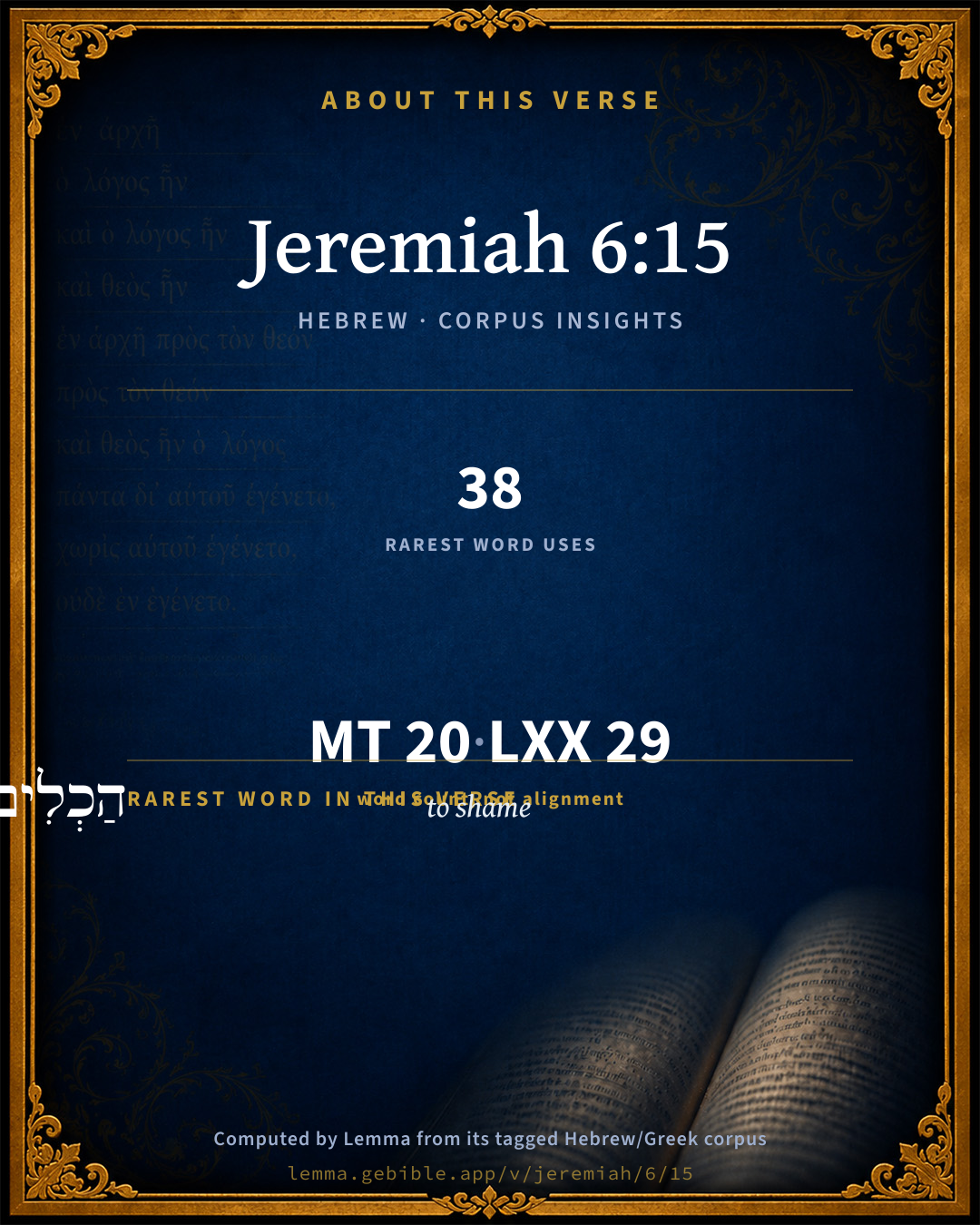
הַכְלִים֙ to shame H3637 occurs in 38 verses of the Hebrew Bible. Also found in:

Grammatical profile

  • 11 verbs
  • 3 nouns
  • 1 conjunction
  • 1 adverb
  • 4 particles

Verb forms

  • הֹבִ֕ישׁוּ Hiphil · Perfect
  • עָשׂ֑וּ Qal · Perfect
  • בּ֣וֹשׁ Qal · Infinitive Absolute
  • יֵב֗וֹשׁוּ Qal · Imperfect
  • הַכְלִים֙ Hiphil · Infinitive Construct
  • יָדָ֔עוּ Qal · Perfect
  • יִפְּל֧וּ Qal · Imperfect
  • בַנֹּפְלִ֛ים Qal · Participle Active
  • פְּקַדְתִּ֥ים Qal · Perfect
  • יִכָּשְׁל֖וּ Niphal · Imperfect
  • אָמַ֥ר Qal · Perfect

Repetition

Words recur within this verse — often emphatic in Hebrew:

  • גַּם also H1571 ×2
  • בּ֣וֹשׁ to be ashamed H954 ×2
  • יִפְּל֧וּ to fall H5307 ×2
  • לֹֽא not H3808 ×2

Hebrew & Septuagint length

In the original languages it is 20 Hebrew tokens and 29 Greek tokens — but the two are counted differently (Hebrew bundles its prefixes and suffixes into one token; the Greek is in lemma form), so that isn’t a like-for-like length.

Cross-references

20

Topical passages linked to Jeremiah 6:15 in the Treasury of Scripture Knowledge — connected by theme and wording, ordered by reader-vote popularity; previews shown in the World English Bible.

  • Jeremiah 8:12 Were they ashamed when they had committed abomination? nay, they were not at all ashamed, neither could they blush: therefore shall they fall among those who fall; in the time of their visitation they shall be cast down, says Yahweh.
  • Jeremiah 3:3 Therefore the showers have been withheld, and there has been no latter rain; yet you have a prostitute's forehead, you refused to be ashamed.
  • Matthew 15:14 Leave them alone. They are blind guides of the blind. If the blind guide the blind, both will fall into a pit."
  • Philippians 3:19 whose end is destruction, whose god is the belly, and whose glory is in their shame, who think about earthly things.
  • Exodus 32:34 Now go, lead the people to the place of which I have spoken to you. Behold, my angel shall go before you. Nevertheless in the day when I punish, I will punish them for their sin."
  • Proverbs 29:1 He who is often rebuked and stiffens his neck Will be destroyed suddenly, with no remedy.
  • Isaiah 3:9 The look of their faces testify against them. They parade their sin like Sodom. They don't hide it. Woe to their soul! For they have brought disaster upon themselves.
  • Isaiah 10:4 They shall only bow down under the prisoners, and shall fall under the slain. For all this his anger is not turned away, but his hand is stretched out still.
  • Jeremiah 5:9 Shall I not visit for these things? says Yahweh; and shall not my soul be avenged on such a nation as this?
  • Jeremiah 5:29 Shall I not visit for these things? says Yahweh; shall not my soul be avenged on such a nation as this?
  • Jeremiah 23:12 Therefore their way shall be to them as slippery places in the darkness: they shall be driven on, and fall therein; for I will bring evil on them, even the year of their visitation, says Yahweh.
  • Ezekiel 2:4 The children are impudent and stiff-hearted: I do sent you to them; and you shall tell them, Thus says the Lord Yahweh.
  • Ezekiel 7:6–9 An end is come, the end is come; it awakes against you; behold, it comes.
  • Ezekiel 14:9–10 If the prophet be deceived and speak a word, I, Yahweh, have deceived that prophet, and I will stretch out my hand on him, and will destroy him from the midst of my people Israel.
  • Ezekiel 16:24–25 that you have built to you a vaulted place, and have made you a lofty place in every street.
  • Ezekiel 24:7 For her blood is in the midst of her; she set it on the bare rock; she didn't pour it on the ground, to cover it with dust.
  • Hosea 9:7 The days of visitation have come. The days of reckoning have come. Israel will consider the prophet to be a fool, And the man who is inspired to be insane, Because of the abundance of your sins, And because your hostility is great.
  • Micah 3:6 "Therefore night is over you, with no vision, And it is dark to you, that you may not divine; And the sun will go down on the prophets, And the day will be black over them.
  • Micah 7:4 The best of them is like a brier. The most upright is worse than a thorn hedge. The day of your watchmen, Even your visitation, has come; Now is the time of their confusion.
  • Zephaniah 3:5 Yahweh, in the midst of her, is righteous. He will do no wrong. Every morning he brings his justice to light. He doesn't fail, but the unjust know no shame.

Cross-references courtesy of OpenBible.info (CC BY 4.0).

Hebrew and Greek witnesses Masoretic Hebrew ↔ Greek Septuagint

The same verse in the two great witnesses to the Old Testament, shown verse-for-verse.

These are two independent witnesses, not word-aligned to each other, and the Septuagint is shown in lemma (dictionary) form.

Hebrew Jeremiah 6:15 Masoretic · Westminster Leningrad Codex

הֹבִ֕ישׁוּ כִּ֥י תוֹעֵבָ֖ה עָשׂ֑וּ גַּם בּ֣וֹשׁ לֹֽא יֵב֗וֹשׁוּ גַּם הַכְלִים֙ לֹ֣א יָדָ֔עוּ לָכֵ֞ן יִפְּל֧וּ בַנֹּפְלִ֛ים בְּעֵת פְּקַדְתִּ֥ים יִכָּשְׁל֖וּ אָמַ֥ר יְהוָֽה

Were they ashamed when they had committed abomination? nay, they were not at all ashamed, neither could they blush: therefore they shall fall among those who fall; at the time that I visit them they shall be cast down, says Yahweh.

World English Bible · Public Domain

Greek LXX Structure differs

In the Septuagint, Jeremiah is about an eighth shorter than the Hebrew and arranges its material differently — the Oracles Against the Nations (Hebrew chapters 46–51) appear in the middle of the Greek book, after 25:13. Because the chapter and verse boundaries do not line up, a verse-for-verse comparison with the Hebrew is not shown.

A verse-for-verse comparison isn’t shown here because the chapters and verses don’t line up. Switch to the LXX edition with the MT / LXX toggle above to read the Greek directly.

Hebrew: Westminster Leningrad Codex (CC BY 4.0). Greek: Septuagint (public domain); English from a public-domain English Septuagint. How the Septuagint differs from the Hebrew →

Targum (Aramaic paraphrase)

1

The Targum is the ancient Jewish Aramaic paraphrase of the Hebrew Scriptures — an interpretive translation, not the Hebrew text itself. Onkelos (literal) and Pseudo-Jonathan (expansive) render the Torah, and Jonathan the Prophets. Coverage is partial: where no permissively-licensed English translation exists for a verse, only the Aramaic is shown. This is verse-level text, not a word-by-word alignment to the Hebrew.

  1. Targum Jonathan Prophets (Joshua–Malachi)
    עֲלֵיהוֹן לְמִבְהַת אֲרֵי תּוֹעֵבְתָּא עֲבָדוּ אַף מִבְהַת לֵית אִינוּן בָהֲתִין אַף אִתְכְּנָעָא לֵית אִינוּן יָדְעִין בְּכֵן יִתְרְמוֹן קָטִילִין בְּעִדַן דְאַסְעַר עֲלֵיהוֹן חוֹבֵיהוֹן יִתְקְלוּן אֲמַר יְיָ:

    (no public-domain English translation for this verse)

    Targum Jonathan — Aramaic: “Mikraot Gedolot” (public domain). English: “Sefaria Community Translation” (CC0 1.0 (public-domain dedication)); “London "Chaldee Paraphrase," 1871” (public domain). Text via Sefaria.

Commentary

Notes on Jeremiah 6:15 from classic Christian and Jewish commentators (each source and its license shown beneath its notes). The classic Christian expositions comment on the surrounding passage and are grouped to its opening verse, so a note may address several verses; the Jewish commentaries on the Tanakh (Rashi and others) are per-verse, so they appear only where the commentator wrote on this verse.

Lemma curates 59 commentaries, every one of them public domain or Creative Commons licensed, each selected and text-cleaned for this edition rather than reprinted as found. About our sources →

Trapp's Complete Commentary

John Trapp

Jer 6:15 Were they ashamed when they had committed abomination? nay, they were not at all ashamed, neither could they blush: therefore they shall fall among them that fall: at the time [that] I visit them they shall be cast down, saith the LORD.

Ver. 15. Were they at all ashamed] Their shamelessness was no small aggravation of their sin. Ita licet multas abominationes commiserunt Papistae sine verecundia, verecundari tamen non possunt, saith Dr John Raynolds. {a} Papists are frontless and shameless. Dr Story, for instance: - I see nothing, said he, before the parliament in the beginning of Queen Elizabeth, to be ashamed of, so less I see to be sorry for; but rather because I have done no more, &c.; wherein he said there was no default in him, but in the higher powers, who much against his mind had laboured only about the young and little sprigs and twigs, whiles they should have struck at the root and rooted it out, meaning thereby the Lady Elizabeth, whom also he afterwards daily cursed in his grace before his meal. And concerning his persecuting and burning the Protestants, he denied not but that he was once at the burning of an earwig (for so he termed it) at Uxbridge (Mr Denley, martyr), where he tossed a faggot at his face as he was singing psalms, and set a spiny evergreen bush of thorns under his feet, a little to prick him, &c. {b}

{a} De Idolat. Rom., p. 85.

{b} Acts and Mon., fol. 1925.

John Trapp, A Commentary or Exposition upon All the Books of the Old and New Testament (1647–1656) — public domain. Text from a community e-Sword module.

The Biblical Illustrator

Joseph S. Exell

Jer_6:15

They were not at all ashamed.

Shamelessness in sin, the certain forerunner of destruction

He who has thus sinned himself past feeling, may be justly supposed to have sinned himself past grace.

1. Extraordinary guilt. Committed abomination.

2. Deportment under guilt. Not at all ashamed, etc.

3. Gods high resentment of their monstrous shamelessness. Were they ashamed?

4. The consequent judgment. Therefore shall they fall, etc.

I. What shame is and what influence it has upon the government of mens manners.

1. Shame is a grief of mind springing from the apprehension of some disgrace brought upon a man. And disgrace consists properly in mens knowledge or opinion of some defect, natural or moral, belonging to them. So that when a man is sensible that anything defective or amiss, either in his person, manners, or the circumstances of his condition, is known, or taken notice of, by others; from this sense or apprehension of his, there naturally results upon his mind a certain grief or displeasure, which grief properly constitutes the passion of shame.

2. From this, that shame is grounded upon the dread man naturally has of the ill opinion of others, and that chiefly with reference to the turpitude or immorality of his actions, it is manifest that it is that great and powerful instrument in the soul of man whereby Providence both preserves society and supports government, forasmuch as it is the most effectual restraint upon him from the doing of such things as more immediately tend to disturb the one and destroy the other.

3. He whom shame has done its work upon, is, ipso facto, stripped of all the common comforts of life. The light is to him the shadow of death; he has no heart nor appetite for business; his very food is nauseous to him. In which wretched condition having passed some years, first the vigour of his intellectuals begins to flag and dwindle away, and then his health follows; the hectic of the soul produces one in the body, the man from an inward falls into an outward consumption, and death at length gives the finishing stroke, and closes all with a sad catastrophe.

II. By what ways men come to cast off shame and grow impudent in sin.

1. By the commission of great sins. For these waste the conscience, and destroy at once. They are, as it were, a course of wickedness abridged into one act, and a custom of sinning by equivalence. They steel the forehead, and harden the heart, and break those bars asunder which modesty had originally fenced and enclosed it with.

2. Custom in sinning never fails in the issue to take away the sense and shame of sin, were a person never so virtuous before. First, he begins to shake off the natural horror and dread which he had of breaking any of Gods commands, and so not to fear sin; next, finding his sinful appetites gratified by such breaches of the Divine law, he comes to like his sin and be pleased with what he has done; and then, from ordinary complacencies, heightened and improved by custom, he comes passionately to delight in such ways. Finally, having resolved to continue and persist in them, he frames himself to a resolute contempt of what is thought or said of him.

3. The examples of great persons take away the shame of anything which they are observed to practise, though never so foul and shameful in itself. Nothing is more contagious than an iii action set off with a great example; for it is natural for men to imitate those above them, and to endeavour to resemble, at least, that which they cannot be.

4. The observation of the general and common practice of anything takes away the shame of that practice. A vice a la mode will look virtue itself out of countenance, and it is well if it does not look it out of heart too. Men love not to be found singular, especially where the singularity lies in the rugged and severe paths of Virtue.

5. To have been once greatly and irrecoverably ashamed renders men shameless. For shame is never of any force but where there is some stock of credit to be preserved. When a man finds that to be lost, he is like an undone gamester, who plays on safety, knowing he can lose no more.

III. The several degrees of shamelessness in sin.

1. A showing of the greatest respect, and making the most obsequious applications and addresses to lewd and infamous persons; and that without any pretence of duty requiring it, which yet alone can justify and excuse men in it.

2. To extenuate or excuse a sin is bad enough, but to defend it is intolerable. Such are properly the devils advocates.

3. Glorying in sin. Higher than this the corruption of mans nature cannot possibly go. This is publicly to set up a standard on behalf of vice, to wear its colours, and avowedly to assert and espouse the cause of it, in defiance of all that is sacred or civil, moral or religious.

IV. Why it brings down judgment and destruction upon the sinner.

1. Because shamelessness in sin always presupposes those actions and courses which God rarely suffers to go unpunished.

2. Because of the destructive influence which it has upon the government of the world. It is manifest that the integrity of mens manners cannot be secured, where there is not preserved upon mens minds a true estimate of vice and virtue, that is, where vice is not looked upon as shameful and opprobrious, and virtue valued as worthy and honourable. But now, where vice walks with a daring front, and no shame attends the practice or the practisers of it, there is an utter confusion of the first dividing and distinguishing properties of mens actions; morality falls to the ground, and government must quickly follow. And whenever it comes to fare thus with any civil State, virtue and common honesty seem to make their appeal to the supreme Governor of all things, to take the matter into His own hands, and to correct those clamorous enormities which are grown too big and strong for law or shame, or any human coercion.

V. What those judgments are.

1. A sudden and disastrous death; and, indeed, suddenness in this can hardly be without disaster.

2. War and desolation.

3. Captivity. (R. South, D. D.)

The shamelessness of sinners

The legend says that, a sinner being at confession, the devil appeared, saying, that he came to make restitution. Being asked what he would restore, he said, Shame; for it is shame that I have stolen from this sinner to make him shameless in sinning; and now I have come to restore it to him, to make him ashamed to confess his sins.

Neither could they blush.

Blushing

(with Ezr_9:6):--Just fancy, said Tom, who had been doing a bit of word study by the aid of his newly-acquired Skeat, to blush is, in its origin, the same word as to blaze, or to blast, and a blush in Danish means a torch. And a very good origin too, said his sister, who got red in the face and hot all over on the slightest provocation. Yes, youth is the blushing time of life. Said Diogenes to a youth whom he saw blushing: Courage, my boy, that is the complexion of virtue.

I. There is the blush of guilt. Who broke the window? All were silent; but one boy looked uneasy. His blush was the blast of his red-hot conscience, condemning the dumb tongue.

II. There is the blush of shame. It was such a mean thing to tell that lie to ones own father. It was a shabby trick I played my chum. And that nasty word I spoke yesterday to a girl, too, it makes me sick-ashamed of myself to think of it. Yes; you ought to think shame. But the man that blushes is not quite a brute.

III. There is the blush of modesty. Tom said nothing about his splendid score at the match, until his sister read aloud at breakfast next morning the flattering report given in the newspaper, at which Tom blushed like a girl. He had his revenge, however, when more than one letter came to Shena from Dr. Barnardo, and Tom protested that he knew now why she had no money to spend on sweets, and poor Shena got very red in the face and went out of the room.

IV. There is the blush of honest indignation at the meanness of the cheat, the cruelty of the bully, the greed of the glutton, and the indifference of selfish souls. This blush of virtuous anger must have come into the meek face of Christ, when He rebuked the disciples for keeping the mothers from bringing their children to Him.

V. Just twice, I think, do we read of blushing in the Bible, and the solemn thing is that the blush in both cases is not before men, but under the eye of God.

1. One of the most remarkable prayers in the Bible is the prayer of Ezra, the scribe--the brave, good, holy man who led a company of his Israelite brethren from Babylon to Jerusalem. It rises hot and passionate out of his very heart; for, like all priestly souls, he makes all the sins of the people his own. O my God, I am ashamed and blush to lift up my face to Thee, my God. He loved his people so dearly that their faults seemed to be his own, and he blushed before the Holy God for shame of them.

2. Quite at the opposite pole of feeling is the other place in the Bible where blushing is spoken of. For Jeremiah, the broken-hearted prophet of the Lord, uses it when he has to describe the utter callousness of the people, in spite of all their sins and sorrows. They were not at all ashamed, neither could they blush. That is surely the most hopeless state of all, when one has lost the very power to feel shame and sorrow before God. The Florentines used to point to Dante in the street, whispering, Theres the man who has been in hell. But hell has come into the heart of the man who cannot blush. Oh, it is better, as Mahomet said in his old age, to blush in this world than in the next. St. John of the eagle eye and loving heart tells us that in the great day of judgment we shall either have the boldness or liberty and confidence of children, or we shall shrink away with shame like a guilty thing surprised. (A. N. Mackray, M. A.)

The Biblical Illustrator, edited by Joseph S. Exell (c. 1880s–1900s) — public domain. Text from a community e-Sword module.

Geneva Bible (1599)

Geneva Bible translators

Hebrew, them that fall.

Geneva Bible (1599) marginal notes — public domain. Text via Bolls.life.

Jamieson, Fausset & Brown

Robert Jamieson, A. R. Fausset & David Brown

ROSENMULLER translates, "They ought to have been ashamed, because . . . but," &c.; the Hebrew verb often expressing, not the action, but the duty to perform it (Gen 20:9; Mal 2:7). MAURER translates, "They shall be put to shame, for they commit abomination; nay (the prophet correcting himself), there is no shame in them" (Jer 3:3; Jer 8:12; Eze 3:7; Zep 3:5).

them that fall--They shall fall with the rest of their people who are doomed to fall, that is, I will now cease from words; I will execute vengeance [CALVIN].

Jamieson, Fausset & Brown — Commentary Critical and Explanatory on the Whole Bible (1871) — public domain (CC PDM 1.0). Text via the HelloAO Bible API.

John Calvin's Commentaries

Jeremiah turns now his discourse to the whole people. In the last verse he reproved only the priests and the prophets; he now speaks more generally, and says, that they had put off all shame. “Behold,” he says, “they are sufficiently proved guilty, their wickedness is manifest, and yet there is no shame. Their disgrace is visible to heaven and earth; angels and all mortals are witnesses of their corruption; but they have such a meretricious front that they are touched by no sense of shame.” He means, in these words, that the wickedness of the people was past all remedy; for they had arrived to that degree of stupor, of which Paul speaks, when he calls those ἀπηλγηκότας, who were obstinate in their vices, who saw no difference between right and wrong, between white and black. (Ephesians 4:19.)

This, then, is what the Prophet means when he says, Have they been ashamed? But a question is much more emphatical, than if it was a simple reprobation or affirmation. They have not been even ashamed, he says. In their very shame, they knew not what it was to be touched by any shamefacedness. This may be classed with those reproofs, by which they had not been subdued; as though he had said, “Efforts having been made to expose their effrontery, in not humbling themselves under the hand of God; they shall therefore fall among the fallen;” that is, “I will dispute no longer with them, nor contend in words, but will execute on them my judgment.” Fall, then, shall they among the fallen; as though he had said, “I have more than sufficiently denounced war on them: had they been healable it would have availed to their conversion, that they had been so often warned; and still more, that I have so sharply stimulated them to come to me: but I will now no more employ words, on the contrary, I will execute my vengeance, so that the calamity which they have derived may devour them.”

They shall wholly fall, he says, in the day of their visitation From this second clause we understand more clearly what it is or what he means when he speaks of falling among the fallen, which is, that they should wholly fall, when God would come as it were with a drawn sword to destroy them, having been wearied with giving them so many warnings.

John Calvin's Commentaries (1540-1563) — public domain. Text from the Calvin Translation Society English edition (1840s-50s) via the Christian Classics Ethereal Library (ccel.org). Calvin's coverage is partial (roughly two-thirds of the Bible); uncommented books and verses are honest gaps, never fabricated. The 19th-century editor's footnotes and remarks are omitted so the notes are faithfully Calvin's own voice.

Ellicott's Commentary for English Readers

(15) Were they ashamed . . .?—The Hebrew gives an assertion, not a question—They are brought to shame (as in Jer_2:26), because they have committed abominations. And yet, the prophet adds, “they were not ashamed” (the verb is in a different voice). There was no inward feeling of shame even when they were covered with ignominy and confusion. They had lost the power to blush, and were callous and insensible. This was then, as always, the most hopeless of all states. To “fall among them that fall” was its inevitable sequel.

A Bible Commentary for English Readers, edited by Charles John Ellicott (1878–1897) — public domain. Text from a community e-Sword module.

The Cambridge Bible for Schools and Colleges

gen. ed. J. J. S. Perowne

15. Were they ashamed when they had committed abomination?] They shall be put to shame, because they have committed abomination (so mg.). This part of the verse is made interrogative in the English in order to avoid the difficulty which the seeming contradiction contained in the following words produces. Co. and Du., however, omit the v., as failing both in metre and in harmony with its context.

nay, they were not at all ashamed] yea, they are not, etc.

among them that fall] They shall not escape, when their countrymen whom they have led astray suffer.

be cast down] better, as mg., stumble.

The Cambridge Bible for Schools and Colleges (gen. ed. J. J. S. Perowne; Cambridge University Press, 1878–1918) — public domain. Text from a community e-Sword module.

John Gill's Exposition

Were they ashamed when they had committed abomination?.... This seems chiefly, and in the first place, to respect the false prophets and wicked priests; who when they committed idolatry, or any other sin, and led the people into the same by their doctrine and example, yet, when reproved for it, were not ashamed, being given up to a judicial hardness of heart:

nay, they were not at all ashamed, neither could they blush; they were men of impudent faces, they had a whore's forehead; there was not the least sign or appearance of shame in them; when charged with the foulest crimes, and threatened with the severest punishment, they were not moved by either; they had neither shame nor fear:

therefore they shall fall among them that fall; meaning that the prophets and priests should perish among the common people, and with them, who should be slain, and fall by the sword of the Chaldeans; the sacredness of their office would not exempt them; they should fare no better than the rest of the people:

at the time that I visit them they shall be cast down, saith the Lord; that is, when the city and temple should be destroyed by the Chaldeans, these would be cast down from their excellency, the high office in which they were, and fall into ruin, and perish with the rest.

John Gill's Exposition of the Whole Bible (1746–1763) — public domain (CC PDM 1.0). Text via the HelloAO Bible API.

Albert Barnes' Notes on the Bible

They are brought to shame because

They have “committed abomination:”

Shame nevertheless they feel not;

To blush nevertheless they know not;

“Therefore they shall fall among” the falling;

“At the time” when “I visit them, they shall” stumble,

“Saith Yahweh.”

The fact is expressed that their conduct was a disgrace to them, though they did not feel it as such. “Abomination” has its usual meaning of idolatry Jer 4:1.

Albert Barnes' Notes on the Bible (1834–1885) — public domain. Text from a community e-Sword/MySword module.

Matthew Poole's English Annotations

Were they, viz. the false prophets, ashamed? Some read it actively, as sometimes it is taken, Did they put the people to shame? but that is not so proper here; it rather notes how bold and confident, or rather impudent, they were in their flatteries, and deceiving the people, a great aggravation of their sin. The form of the interrogation chargeth them home with the guilt, as do also the next words,

neither could they blush; q.d. they had not the least show of shame, usually discovered by blushing.

Committed abomination; or, the thing to be abominated, (a metonymy of the effect,) both by encouraging the people, and joining with them in their idolatries. See Jer 3:3.

Therefore they shall fall among them that fall; therefore they shall perish with those whom they have deceived, as in the following expressions. To fall signifies to be slain, Psa 63:10; Luk 21:24. Visit them, viz. punish them, inflict punishment on them: see Jer 6:6.

Matthew Poole's English Annotations on the Holy Bible (1683–1685) — public domain. Text from a community e-Sword/MySword module.

Whedon's Commentary on the Bible

Daniel D. Whedon

15. The first sentence is not interrogative but declarative: “They are put to shame because they have done abomination, yet they take not shame to themselves,” etc.

Daniel D. Whedon (gen. ed.), Commentary on the Old and New Testaments (1874–1909) — public domain. Text from a community e-Sword module.

The Pulpit Commentary

Were they ashamed? The Authorized Version certainly meets the requirements of the context; there seems to be an implied interrogation. Most, however, render, "They are brought to shame;" in which ease it seems best to take the verb as a perfect of prophetic certitude, equivalent to "they shall surely be brought to shame." When; rather, because. Nay, they were not at all ashamed; rather, nevertheless they feel no shame (i.e. at present). They shall be cast down; rather, they shall stumble.

The sin against the Holy Ghost.

I THIS SIN IS SET FORTH HERE. For the sin is no one definite act, but a condition of mind which renders repentance hopeless and persistence in sin certain. (cf. Revised Version, Mar_3:29, where the true reading is as there given, "is guilty of an eternal sin But is not this the condition described in the text, described vividly, accurately? They had hardened themselves till repentance, yea, even shame, on account of "abomination" was utterly absent from them. were not at all ashamed," no tinge of it, not the least "blush" was visible. Was it not certain that such people who would go on, as they did, in sin, were in danger of eternal sin?" Hence they had never forgiveness, and the prophet was forbidden (see Jer_7:16) even to pray for them. (cf. 1Jn_5:16)

II OTHER INSTANCES OF IT OR APPROXIMATIONS TO IT.

1. Those who with unblushing effrontery ascribed Christ"s holy ministry and his deeds of merciful might to Satanic power. They cried out," Show us a sign from heaven," implying that thus far he had only shown them signs from hell.

2. Those who were responsible for the cry," His blood be on us, and on our children!" And there are instances now. The condition of shamelessness in sin and of helplessness as to repentance may be, and we fear at times is, reached. Therefore note

III THE STEPS BY WHICH MEN REACH THIS CONDITION.

1. By disregard of the rebukes of conscience, stifling them, instead of going, as they would prompt, to the mercy-seat, and there confessing the sin.

2. By persistence in sin.

3. By the commission of great sins.

4. By loss of self-respect.

5. By forfeiture of character and the esteem of men.

IV ITS DOOM. "It hath never forgiveness." "They shall fall among them that fall; they shall be cast down, saith the Lord" Wherefore this?

1. Because sin and sorrow are linked together by a chain that cannot be broken. Therefore where there is eternal sin there must be eternal punishment. The latter keeps pace with the former, and dogs its footsteps forever. It cannot but be so.

2. Because such men are murderers of other men"s souls. They are centers of rebellion against God, of deadly spiritual contagion. Blood-guiltiness is upon them, yea, they are steeped therein.

3. Because God could not be God and not abhor such condition of soul as this sin betrays.

V ITS SOLEMN LESSONS.

1. Cherish a holy hatted of sin, for its tendency is ever to reproduce itself, and so to become eternal.

2. Beware of disregarding the monitor within conscience, God"s voice in our souls. To do so is to drive away the trusty sentinel who guards the approaches of the soul against its deadly foes; to pierce and undermine those blessed walls which keep back the inrush of the ocean upon the whole land. Let us not do aught like this. But prayQuick as the apple of the eye, O God, my conscience make, Swift to discern when sin is nigh, And keep it still awake.

3. Is sin upon your conscience now? At once confess it, and so find from your Lord forgiveness for it, and more deliverance from it and from all possibility of that dread sin which the text describes and which hath never forgiveness. C.

The Pulpit Commentary (1880–1919), ed. H.D.M. Spence-Jones & Joseph S. Exell — public domain. Text from a community e-Sword module.

John Wesley's Explanatory Notes

Committed - Both by encouraging the people, and joining with them in their idolatries.

John Wesley, Explanatory Notes Upon the Whole Bible (1754–1765) — public domain. Text via the GEBible commentary corpus.

Rashi

Rabbi Shlomo Yitzchaki (Rashi)

They should be ashamed Heb. הובישו, they should be ashamed [from Jonathan].

to feel disgrace Heb. הכלים, like להכלים.

Neither are they ashamed They are not ashamed of their evil deeds.

Rashi on the Tanakh — English translations: “The Judaica Press complete Tanach with Rashi, translated by A. J. Rosenberg” (CC BY 4.0); “Pentateuch with Rashi's commentary by M. Rosenbaum and A.M. Silbermann, 1929-1934” (public domain); “The Metsudah Tanach series, Lakewood, N.J” (CC BY 4.0); and “The Book of Joshua, Metsudah Publications, 1997” (CC BY 4.0). Text via Sefaria.

Lesson kit

Teaching starters — assembled from the data on this page, not authored interpretation. Every prompt links to the verse data it draws on. Edit before teaching.

Jeremiah, in the Prophets, opens this verse with 20 words (16 distinct Hebrew lemmas). Its most distinctive word is kâlam (“to shame”). A historical commentator’s framing appears above. Read the whole chapter for the surrounding context.

Discussion questions

  1. What does “to shame” (kâlam) contribute to the verse as a whole?
  2. How does Numbers 12:14, which shares the word «to shame», read alongside this verse?
  3. What does the repetition of “also” (2× in this one verse) do in this verse?
  4. The translations on this page render this verse differently — a whole-verse word diff, not a word-by-word alignment. What might account for the different wordings?
  5. «הֹבִ֕ישׁוּ» is a Hiphil Perfect verb. How does that grammatical form shape the action described?
  6. Compare how Trapp's Complete Commentary and The Biblical Illustrator read this verse. Where do they agree or differ?

Things to notice

Reading settings

Reading text

Shown beneath each verse's original-language words.

Old Testament
Old Testament edition

Read the OT as the Masoretic Hebrew (MT) or the Greek Septuagint (LXX).

English shown for the Greek Septuagint (in the Hebrew ↔ Greek comparison).

Comparing translations? Open the Compare panel on any verse page to stack up to four side by side.